From JPost, 10/10/2010 By YAAKOV LAPPIN AND TOVAH LAZAROFF*:
Five weeks after four Israelis were shot dead in the South Hebron Hills, security forces on Friday killed two Hamas terrorists in Hebron ...
Six suspected terrorist enablers were arrested in the raid, and security officials said every member of the Hamas cell that carried out the driveby attack in August is now either dead or in the custody of Israel or the PA. The cell is suspected of having carried out additional recent shootings in the South Hebron Hills.
The terrorists killed in Friday’s raid have been named as Nashat Karmi, 33, a senior Hamas commander in Hebron, and Mammon Natshe, 24.
They were killed in their Hebron hideout after resisting capture and opening fire on soldiers from the IDF’s Duvdevan undercover unit and officers from the Israel Police’s Counterterrorism Unit (YAMAM).
“There is no comfort for the bereaved parents, orphans or widower, but today we closed a circle in which justice was done,” Judea Brigade commander Col. Guy Hazut told reporters on Friday, after the raid was over.
The four Israelis who were killed on August 31 were Yitzhak and Talya Ames, 47 and 45, respectively, Kochava Even- Haim, 37, and Avishai Shindler, 24. All of them lived in Beit Hagai...
...Both of the gunmen killed on Friday had [previously] been released from Israeli prisons after serving their sentences, and were part of a hardened, experienced generation of terrorists...
...Following the raid ...Palestinians threw rocks and Molotov cocktails during a funeral procession for one of the terrorists; on Route 60, Palestinian threw rocks at Israeli vehicles. No injuries were reported, though four cars were damaged. ...Rocks were also thrown at two Israeli vehicles north of Hebron.
...both Prime Minister Binyamin Netanyahu and Defense Minister Ehud Barak released statements on Friday praising the security forces for their swift action...
*Herb Keinon contributed to this report.

Sunday, October 10, 2010


Arabs: "diplomacy" of threats
From JPost, 10/10/2010 By HERB KEINON*:
...The Palestinian Authority announced over the weekend – following the Arab League meeting in Libya ...that it was considering “alternatives” in case the peace talks collapsed, including seeking US or UN recognition of an independent Palestinian state.
...Erekat said Abbas asked Arab leaders “to press the American administration to recognize an independent Palestinian state within the borders of 1967.” If the Americans reject the request, the Palestinians might take up the issue with the Security Council nonetheless, Erekat said.
...A PA official in Ramallah said the Arab League supported the idea of seeking US or UN recognition of a Palestinian state.
“The Palestinian leadership will give the US administration another chance to solve the crisis,” he said. “If their efforts fail in the next 30 days, we will go to the Americans and the United Nations.”
Israeli officials took the threat in stride. “There is no substitute for direct negotiations and a historic agreement,” one official said. “Everything else is a mirage.”
The official, who said these types of threats were part of the PA’s diplomacy, added that such proposals have not proven serious when raised many times in the past, and that the PA understood that only a negotiated solution could bring peace.
He added that over the past year the Palestinians have alternated threats to go to the UN Security Council searching for recognition of Palestinian statehood, with the threat of abandoning the two-state idea and instead pursuing a “one-state solution.”
...similar proposals in the past have not been embraced by Washington, which consistently has said it wanted to see a negotiated – rather than imposed – settlement...
*Khaled Abu Toameh and AP contributed to this report.
...The Palestinian Authority announced over the weekend – following the Arab League meeting in Libya ...that it was considering “alternatives” in case the peace talks collapsed, including seeking US or UN recognition of an independent Palestinian state.
...Erekat said Abbas asked Arab leaders “to press the American administration to recognize an independent Palestinian state within the borders of 1967.” If the Americans reject the request, the Palestinians might take up the issue with the Security Council nonetheless, Erekat said.
...A PA official in Ramallah said the Arab League supported the idea of seeking US or UN recognition of a Palestinian state.
“The Palestinian leadership will give the US administration another chance to solve the crisis,” he said. “If their efforts fail in the next 30 days, we will go to the Americans and the United Nations.”
Israeli officials took the threat in stride. “There is no substitute for direct negotiations and a historic agreement,” one official said. “Everything else is a mirage.”
The official, who said these types of threats were part of the PA’s diplomacy, added that such proposals have not proven serious when raised many times in the past, and that the PA understood that only a negotiated solution could bring peace.
He added that over the past year the Palestinians have alternated threats to go to the UN Security Council searching for recognition of Palestinian statehood, with the threat of abandoning the two-state idea and instead pursuing a “one-state solution.”
...similar proposals in the past have not been embraced by Washington, which consistently has said it wanted to see a negotiated – rather than imposed – settlement...
*Khaled Abu Toameh and AP contributed to this report.
How much do the Arabs really want peace?
From JPost, 08/10/2010 By HERB KEINON AND KHALED ABU TOAMEH:
Palestinian Authority President Mahmoud Abbas arrived in Libya on Thursday [7th October] to seek Arab League backing for his decision to quit direct talks with Israel until the settlement construction moratorium is renewed, amid no signs that the US and Israel have a formula in hand to break the impasse.
...“We honored the government decision and took upon ourselves a commitment to the international community and the US to start the peace talks,” Netanyahu said of the 10- month moratorium that ended nearly two weeks ago. “The Palestinians waited over nine months and, immediately at the onset of the talks, set a precondition even though they had promised that there would be no preconditions.”
The prime minister said that just as his government honored its commitment regarding the settlement moratorium, “we very much hope that the Palestinians will stay in the peace talks.”
But, said Netanyahu during a visit to Lod, “Today, the questions need to be directed to the Palestinians: Why are you abandoning the talks? Don’t turn your backs on peace; stay in the talks. This is what needs to be asked today, and not of the Israeli government.”
...The US administration, [Ambassador to the US Michael] Oren acknowledged, “came to Israel with a number of suggestions, incentives if you would, that would enable the government to maybe pass a limited extension of two or three months.”
...In Jerusalem, meanwhile, the widespread assessment was that the Arab League would back Abbas’s decision to leave the talks if Israel did not declare another settlement freeze, or did not declare that it would accept the principle of a Palestinian state based on the June 4, 1967, borders.
...in what was perhaps a sign of low expectations in Jerusalem of any dramatic breakthrough, no meeting of the security cabinet or Netanyahu’s senior decision-making forum, the septet, had been scheduled for Friday.
...The Arab foreign ministers will be meeting in the Libyan city of Serte on Friday.
...[a top PA] official said that Abbas did not want to bear sole responsibility for whatever happens with the peace talks. “We want an Arab decision,” he added. “We don’t want the decision to be taken only by the Palestinian leadership.”
Despite the tone of optimism voiced by the official, Yasser Abed Rabbo, a PLO leader and close adviser to Abbas, was quoted by Agence France-Press as saying that there can be no peace as long as Netanyahu is in power...
Palestinian Authority President Mahmoud Abbas arrived in Libya on Thursday [7th October] to seek Arab League backing for his decision to quit direct talks with Israel until the settlement construction moratorium is renewed, amid no signs that the US and Israel have a formula in hand to break the impasse.
...“We honored the government decision and took upon ourselves a commitment to the international community and the US to start the peace talks,” Netanyahu said of the 10- month moratorium that ended nearly two weeks ago. “The Palestinians waited over nine months and, immediately at the onset of the talks, set a precondition even though they had promised that there would be no preconditions.”
The prime minister said that just as his government honored its commitment regarding the settlement moratorium, “we very much hope that the Palestinians will stay in the peace talks.”
But, said Netanyahu during a visit to Lod, “Today, the questions need to be directed to the Palestinians: Why are you abandoning the talks? Don’t turn your backs on peace; stay in the talks. This is what needs to be asked today, and not of the Israeli government.”
...The US administration, [Ambassador to the US Michael] Oren acknowledged, “came to Israel with a number of suggestions, incentives if you would, that would enable the government to maybe pass a limited extension of two or three months.”
...In Jerusalem, meanwhile, the widespread assessment was that the Arab League would back Abbas’s decision to leave the talks if Israel did not declare another settlement freeze, or did not declare that it would accept the principle of a Palestinian state based on the June 4, 1967, borders.
...in what was perhaps a sign of low expectations in Jerusalem of any dramatic breakthrough, no meeting of the security cabinet or Netanyahu’s senior decision-making forum, the septet, had been scheduled for Friday.
...The Arab foreign ministers will be meeting in the Libyan city of Serte on Friday.
...[a top PA] official said that Abbas did not want to bear sole responsibility for whatever happens with the peace talks. “We want an Arab decision,” he added. “We don’t want the decision to be taken only by the Palestinian leadership.”
Despite the tone of optimism voiced by the official, Yasser Abed Rabbo, a PLO leader and close adviser to Abbas, was quoted by Agence France-Press as saying that there can be no peace as long as Netanyahu is in power...
Friday, October 08, 2010
English Judge Bathurst-Norman an antisemite
From the BBC, 07 October 2010:
A judge who compared Israel to the Nazi regime in the Hove Crown Court trial of seven anti-war campaigners has been formally reprimanded.

Judge George Bathurst-Norman made the comparison in a case where seven Smash EDO activists were cleared of plotting to damage a Brighton weapons factory.
... his comments were offensive, one-sided and unbalanced.
The Office for Judicial Complaints said the judge had been reprimanded ...
Judge Bathurst-Norman declined to comment.
The Office for Judicial Complaints issued a statement which said:
...the judge had been presiding over the case of campaigners alleged to have caused criminal damage in 2009, after breaking into the EDO MBM Technology building in Moulsecoomb that manufactured weapons components for Israeli fighter planes.
The defence by campaigners from Smash EDO was that they had been protecting property in Gaza from being damaged by the Israeli airforce and they were entitled to use force to prevent war crimes.
Christopher Osmond, 30, and Simon Levin, 35, both from Brighton, and Elijah Smith, 42, Tom Woodhead, 25, Ornella Saibene, 50, Bob Nicholls, 52, and Harvey Tadman, 44, all from Bristol, were cleared of conspiracy to cause criminal damage.
During the summing up, the judge compared scenes in Israel's December 2008 bombing campaign in Gaza to those of the Nazi regime...
Also see this earlier posting.
A judge who compared Israel to the Nazi regime in the Hove Crown Court trial of seven anti-war campaigners has been formally reprimanded.
Judge George Bathurst-Norman made the comparison in a case where seven Smash EDO activists were cleared of plotting to damage a Brighton weapons factory.
... his comments were offensive, one-sided and unbalanced.
The Office for Judicial Complaints said the judge had been reprimanded ...
Judge Bathurst-Norman declined to comment.
The Office for Judicial Complaints issued a statement which said:
"...A number of complaints were made about some of the observations he made during the trial and summing up...An investigation found that a number of these observations did not arise directly from the evidence at trial and could be seen as an expression of the judge's personal views ..."
...the judge had been presiding over the case of campaigners alleged to have caused criminal damage in 2009, after breaking into the EDO MBM Technology building in Moulsecoomb that manufactured weapons components for Israeli fighter planes.
The defence by campaigners from Smash EDO was that they had been protecting property in Gaza from being damaged by the Israeli airforce and they were entitled to use force to prevent war crimes.
Christopher Osmond, 30, and Simon Levin, 35, both from Brighton, and Elijah Smith, 42, Tom Woodhead, 25, Ornella Saibene, 50, Bob Nicholls, 52, and Harvey Tadman, 44, all from Bristol, were cleared of conspiracy to cause criminal damage.
During the summing up, the judge compared scenes in Israel's December 2008 bombing campaign in Gaza to those of the Nazi regime...
Also see this earlier posting.
Thursday, October 07, 2010
Heaviest rocket attacks from Gaza since Cast Lead
From the IDF Blog, 6 October 2010:

Since Hamas’ takeover in the Gaza Strip rocket fire at Israel had risen exponentially, peaking at the period right before Operation Cast Lead with 3,278 rockets fired at Israel in 2008, and steeply decreasing since the end of the Operation in 2009.

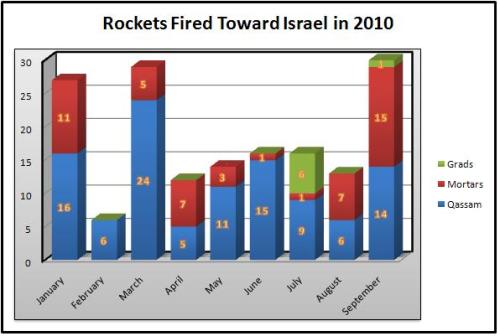
September 2010 saw more missile and mortar attacks against Israel by Gaza terrorists than any other month since the period immediately following IDF Operation Cast Lead in early 2009.
Wednesday, October 06, 2010
Philippe Petain's antisemitism unmasked
From Ynet News, 4 Oct 2010, from AFP:
[The discovery of an original W2 document establishes Vichy leader Philippe Petain's decisive role and reveals his deep antisemitism, French Nazi hunter Serge Klarsfeld told AFP.]
...Petain, a military hero in World War I, became head of the rump state based at Vichy in central France which collaborated with the German Nazi occupiers following defeat in World War II.
The penciled-in changes to the document, from October 1940, are a "profound alteration" of the document's nature, Klarsfeld said.
While the original set out to exclude "descendants of Jews born French or naturalized before 1860", Petain crossed out this reference, thus applying the measures to all Jews in France.
The scope of Jews' exclusion is considerably widened, with the minority being barred from jobs in teaching and the judiciary as well as prevented from standing for elected office.
"The main argument of Petain's defenders was to say that he protected French Jews. This argument has now fallen," he said...
'Desire to turn Jews into scapegoats'
...Now, we have definite proof that the Jews' status was the personal will of marshal Petain," said Klarsfeld.
Petain wanted "to show that France deserved to be at the forefront of the new European order. There was also the desire to turn the Jews into scapegoats for the defeat" of France by the Nazis, said Klarsfeld.
"The status of Jews was a specifically French measure, spontaneous. The Germans didn't ask Vichy France to take this measure...
Nevertheless, of all Nazi-occupied countries, France was the one where "the Jewish community suffered the least tragic harm," said Klarsfeld. Around three-quarters of the Jewish population survived, or around 240,000 out of 320,000. "That's not thanks to France but to the French, thanks to all the courageous people who helped the Jews all over the place," he said.
[The discovery of an original W2 document establishes Vichy leader Philippe Petain's decisive role and reveals his deep antisemitism, French Nazi hunter Serge Klarsfeld told AFP.]
...Petain, a military hero in World War I, became head of the rump state based at Vichy in central France which collaborated with the German Nazi occupiers following defeat in World War II.
The penciled-in changes to the document, from October 1940, are a "profound alteration" of the document's nature, Klarsfeld said.
While the original set out to exclude "descendants of Jews born French or naturalized before 1860", Petain crossed out this reference, thus applying the measures to all Jews in France.
The scope of Jews' exclusion is considerably widened, with the minority being barred from jobs in teaching and the judiciary as well as prevented from standing for elected office.
"The main argument of Petain's defenders was to say that he protected French Jews. This argument has now fallen," he said...
'Desire to turn Jews into scapegoats'
...Now, we have definite proof that the Jews' status was the personal will of marshal Petain," said Klarsfeld.
Petain wanted "to show that France deserved to be at the forefront of the new European order. There was also the desire to turn the Jews into scapegoats for the defeat" of France by the Nazis, said Klarsfeld.
"The status of Jews was a specifically French measure, spontaneous. The Germans didn't ask Vichy France to take this measure...
Nevertheless, of all Nazi-occupied countries, France was the one where "the Jewish community suffered the least tragic harm," said Klarsfeld. Around three-quarters of the Jewish population survived, or around 240,000 out of 320,000. "That's not thanks to France but to the French, thanks to all the courageous people who helped the Jews all over the place," he said.
PA wants what?...tell them they're dreaming....
From International Analyst Network, 30 Sep 2010. by David Singer:
...President Abbas dithered for more than nine months of the initial ten month moratorium period before deigning to enter into direct negotiations with Israel. He demanded then what [PA negotiator Nabil ] Shaath is now recycling - a total building freeze. It proved - and will continue to prove - to be a disastrous error of judgment by the PA. Abbas can only blame himself for the dilemma he currently faces as to whether to resume negotiations or not in view of the expiry of the moratorium period on 26 September.
Assuming however that some compromise is eventually agreed on for a further moratorium - questions must be asked and answers given as to the basis on which such negotiations are to be resumed.
Israel’s position is clear but the PA‘s position is steeped in uncertainty.
The parameters under which Israel has been negotiating are:
1.The Bush Roadmap - subject to Israel‘s 14 expressed written Reservations to it
2.United Nations Security Council Resolutions 242 and 338 and
3.The letter from President George Bush to former Israeli Prime Minister Ariel Sharon dated 14 April 2004
Roadmap references to the Saudi Peace Plan - adopted subsequently as the Arab Initiative - were expressly rejected by Israel as playing any part in the negotiating process - the Reservations stating:
...America did indeed pay serious attention to Israel’s Reservations - as was indicated in the letter President Bush gave to Prime Minister Sharon on 14 April 2004 which stated:
The PA has consistently refused to accept these parameters as defining the goals of the negotiating process.
On 27 November 2007 Israel’s then Prime Minister Ehud Olmert once again clarified these parameters at Annapolis before the leaders of the international community assembled there when he said:
The PA clearly is not negotiating on the same wavelength as Israel as it continues to:.
•Demand the right for millions of Arabs to emigrate to Israel
•Refuses to accept the right of any Jews to live in the West Bank
•Attempts to introduce the Saudi Peace Plan into the negotiations
•Refuses to recognise Israel as the national state of the Jewish people
•Refuses to accept Israel’s Reservations to the Road Map as having any relevance
Israel and the PA have each been playing the negotiating game under different sets of rules. Until they start to play the game under the same rules - any further talks will - like the talks held since 2003 - prove to be a complete waste of time.
...President Abbas dithered for more than nine months of the initial ten month moratorium period before deigning to enter into direct negotiations with Israel. He demanded then what [PA negotiator Nabil ] Shaath is now recycling - a total building freeze. It proved - and will continue to prove - to be a disastrous error of judgment by the PA. Abbas can only blame himself for the dilemma he currently faces as to whether to resume negotiations or not in view of the expiry of the moratorium period on 26 September.
Assuming however that some compromise is eventually agreed on for a further moratorium - questions must be asked and answers given as to the basis on which such negotiations are to be resumed.
Israel’s position is clear but the PA‘s position is steeped in uncertainty.
The parameters under which Israel has been negotiating are:
1.The Bush Roadmap - subject to Israel‘s 14 expressed written Reservations to it
2.United Nations Security Council Resolutions 242 and 338 and
3.The letter from President George Bush to former Israeli Prime Minister Ariel Sharon dated 14 April 2004
Roadmap references to the Saudi Peace Plan - adopted subsequently as the Arab Initiative - were expressly rejected by Israel as playing any part in the negotiating process - the Reservations stating:
"The removal of references other than 242 and 338 (1397, the Saudi Initiative and the Arab Initiative adopted in Beirut). A settlement based upon the road map will be an autonomous settlement that derives its validity therefrom. The only possible reference should be to Resolutions 242 and 338, and then only as an outline for the conduct of future negotiations on a permanent settlement."Israel was also adamant in its Reservations that :
“… declared references must be made to Israel's right to exist as a Jewish state and to the waiver of any right of return for Palestinian refugees to the State of Israel.”
...America did indeed pay serious attention to Israel’s Reservations - as was indicated in the letter President Bush gave to Prime Minister Sharon on 14 April 2004 which stated:
“The United States is strongly committed to Israel's security and well-being as a Jewish state. It seems clear that an agreed, just, fair, and realistic framework for a solution to the Palestinian refugee issue as part of any final status agreement will need to be found through the establishment of a Palestinian state, and the settling of Palestinian refugees there, rather than in Israel.
As part of a final peace settlement, Israel must have secure and recognized borders, which should emerge from negotiations between the parties in accordance with UNSC Resolutions 242 and 338. In light of new realities on the ground, including already existing major Israeli populations centers, it is unrealistic to expect that the outcome of final status negotiations will be a full and complete return to the armistice lines of 1949, and all previous efforts to negotiate a two-state solution have reached the same conclusion.
The PA has consistently refused to accept these parameters as defining the goals of the negotiating process.
On 27 November 2007 Israel’s then Prime Minister Ehud Olmert once again clarified these parameters at Annapolis before the leaders of the international community assembled there when he said:
The PA clearly is not negotiating on the same wavelength as Israel as it continues to:.
•Demand the right for millions of Arabs to emigrate to Israel
•Refuses to accept the right of any Jews to live in the West Bank
•Attempts to introduce the Saudi Peace Plan into the negotiations
•Refuses to recognise Israel as the national state of the Jewish people
•Refuses to accept Israel’s Reservations to the Road Map as having any relevance
Israel and the PA have each been playing the negotiating game under different sets of rules. Until they start to play the game under the same rules - any further talks will - like the talks held since 2003 - prove to be a complete waste of time.
“The negotiations will be based on previous agreements between us, UN Security Council Resolutions 242 and 338, the Roadmap and the April 14th 2004 letter of President Bush to the Prime Minister of Israel.”
It is realistic to expect that any final status agreement will only be achieved on the basis of mutually agreed changes that reflect these realities.”
Tuesday, September 28, 2010
US Senate Backs Netanyahu, Asks Obama to Pressure Abbas
From IsraelNationalNews.com, 27 September 2010, by Tzvi Ben Gedalyahu:
Eighty-seven U.S. senators—almost the entire 100-member Senate—have signed a letter to President Barack Obama that in effect blames the Palestinian Authority for freezing direct talks...
...The senators’ letter praises Prime Minister Netanyahu, who they pointed out "did not abandon the talks” despite “the brutal murder of four innocent Israeli civilians by Hamas militants at the start of the negotiations. We also agree with you [Obama] that it is critical that all sides stay at the table," the letter stated.
..."Neither side should make threats to leave just as the talks are getting started," the letter stated. It was sent several hours before U.S. Middle East envoy George Mitchell announced he will return to the region this week in an effort to prevent the talks from being frozen indefinitely...
Eighty-seven U.S. senators—almost the entire 100-member Senate—have signed a letter to President Barack Obama that in effect blames the Palestinian Authority for freezing direct talks...
...The senators’ letter praises Prime Minister Netanyahu, who they pointed out "did not abandon the talks” despite “the brutal murder of four innocent Israeli civilians by Hamas militants at the start of the negotiations. We also agree with you [Obama] that it is critical that all sides stay at the table," the letter stated.
..."Neither side should make threats to leave just as the talks are getting started," the letter stated. It was sent several hours before U.S. Middle East envoy George Mitchell announced he will return to the region this week in an effort to prevent the talks from being frozen indefinitely...
The Freeze is just an excuse for Abbas
From Israel News, 27 September 2010, by Yitzhak Benhorin:
WASHINGTON – Foreign Minister Avigdor Lieberman met Monday in New York with UN Secretary-General Ban Ki-Moon a short time after the latter expressed his disappointment that the West Bank settlement construction moratorium was not being extended beyond its 10-month period.
... Lieberman contended that the freeze "is just an excuse" for Palestinian President Mahmoud Abbas to quit budding peace talks between the Palestinian Authority and Israel. "For nine months the Palestinians claimed that the freeze is a ploy, and now they have turned it into a lynchpin," said the foreign minister to the UN chief.
After Abbas announced he is awaiting the upcoming meeting of the Arab League at the beginning of October, Lieberman asserted, "If the Arab League is seeking challenges to deal with, there are many in the Arab world. Hundreds of people are killed each week in terrorist attacks, and poverty and despair cry out to the heavens.
"Instead of solving these problems, the leaders of the Arab League prefer to run away from them, and blame Israel for all their internal problems. Instead of dialogue, they prefer to incite the masses against the Jews," added Lieberman.
Lieberman said that Israel is interested in a fair peace agreement. "We are willing to collaborate with the international community and be cooperative, but without compromising on security and Israel's vital interests," he said....
WASHINGTON – Foreign Minister Avigdor Lieberman met Monday in New York with UN Secretary-General Ban Ki-Moon a short time after the latter expressed his disappointment that the West Bank settlement construction moratorium was not being extended beyond its 10-month period.
... Lieberman contended that the freeze "is just an excuse" for Palestinian President Mahmoud Abbas to quit budding peace talks between the Palestinian Authority and Israel. "For nine months the Palestinians claimed that the freeze is a ploy, and now they have turned it into a lynchpin," said the foreign minister to the UN chief.
After Abbas announced he is awaiting the upcoming meeting of the Arab League at the beginning of October, Lieberman asserted, "If the Arab League is seeking challenges to deal with, there are many in the Arab world. Hundreds of people are killed each week in terrorist attacks, and poverty and despair cry out to the heavens.
"Instead of solving these problems, the leaders of the Arab League prefer to run away from them, and blame Israel for all their internal problems. Instead of dialogue, they prefer to incite the masses against the Jews," added Lieberman.
Lieberman said that Israel is interested in a fair peace agreement. "We are willing to collaborate with the international community and be cooperative, but without compromising on security and Israel's vital interests," he said....
Sunday, September 26, 2010
The Nakba Obsession
From City Journal, Summer 2010, Vol. 20, No. 3, by Sol Stern*:
The Palestinian national narrative is the biggest obstacle to peace in the Middle East.

... The Nakba is the heart of the Palestinians’ backward-looking national narrative, which depicts the creation of the State of Israel in 1948 as the original sin that dispossessed the land’s native people. Every year, on the anniversary of Israel’s independence, more and more Palestinians (including Arab citizens of Israel) commemorate the Nakba with pageants that express longing for a lost paradise. Every year, the legend grows of the crimes committed against the Palestinians in 1948, crimes now routinely equated with the Holocaust. Echoing the Nakba narrative is an international coalition of leftists that celebrates the Palestinians as the quintessential Other, the last victims of Western racism and colonialism.
There is only one just compensation for the long history of suffering, say the Palestinians and their allies: turning the clock back to 1948. ...[the "right of return"]... All Palestinian refugees—not just those still alive of the hundreds of thousands who fled in 1948, but their millions of descendants as well—would be allowed to return to Jaffa, Haifa, the Galilee, and all the villages that Palestinian Arabs once occupied.
Such a step would mean suicide for Israel as a Jewish state, which is why Israel would never countenance it. At the very least, then, the Nakba narrative precludes Middle East peace. But it’s also, as it happens, a myth—a radical distortion of history.
...During the 1948 war and for many years afterward, the Western world—including the international Left—expressed hardly any moral outrage about the Palestinian refugees. This had nothing to do with Western racism or colonialism and much to do with recent history. The fighting in Palestine had broken out only two years after the end of the costliest military conflict ever, in which the victors exacted a terrible price on the losers. By that, I don’t mean the Nazi officials and their “willing executioners,” who received less punishment than they deserved, but the 11 million ethnic Germans living in Central and Eastern Europe—civilians all—who were expelled from their homes and force-marched to Germany by the Red Army, with help from the Czech and Polish governments and with the approval of Roosevelt and Churchill. Historians estimate that 2 million died on the way. Around the same time, the Indian subcontinent was divided into two new countries, India and Pakistan; millions of Hindus and Muslims moved from one to the other, and hundreds of thousands died in related violence. Against this background, the West was not likely to be troubled by the exodus of a little more than half a million Palestinians after a war launched by their own leaders.
...The Palestinians were also compromised by the fact that their leader in 1948, Grand Mufti Haj Amin al-Husseini, had been a Nazi collaborator during the war.
In fact, I. F. Stone, the most revered left-wing journalist of the day, was one of the most influential American advocates for the Zionist cause. I have in my possession a book by Stone called This Is Israel, distributed by Boni and Gaer, a major commercial publisher at the time. The book, based on Stone’s reporting during the 1948 Arab-Israeli war, has become a collector’s item by virtue of the fact that Stone’s fans want to forget that it ever existed. Of the four adoring biographies of the great muckraker published in the last decade, only one even mentions that Stone wrote This Is Israel—and then shrugs off its significance in a few paragraphs.
It’s obvious why the book would be embarrassing to today’s leftist critics of Israel and Zionism. It opens with a foreword by Bartley Crum, the prominent American lawyer, businessman, and publisher of PM, the most widely read progressive newspaper of the 1940s. Crum evokes “the miracles [that the Israelis] have performed in peace and war. . . . They have built beautiful modern cities, such as Tel Aviv and Haifa on the edge of the wilderness. . . . They have set up a government which is a model of democracy.” His friend and star correspondent, Izzy Stone, has “set down what he knows and what he has seen, simply, truthfully and eloquently.” We Americans, Crum concludes, “can, through this book, warm ourselves in the glory of a free people who made a two thousand year dream come true in their own free land.”
Accompanied by famed war photographer Robert Capa’s iconic images of male and female Israeli soldiers, Stone’s text reads like a heroic epic. He writes of newborn Israel as a “tiny bridgehead” of 650,000 up against 30 million Arabs and 300 million Muslims and argues that Israel’s “precarious borders,” created by the United Nations’ November 1947 partition resolution, are almost indefensible. “Arab leaders made no secret of their intentions,” Stone writes, and then quotes the head of the Arab League, Abdul Rahman Azzam: “This war will be a war of extermination and a momentous massacre which will be spoken of like the Mongol massacres and the Crusades.”
Palestinian leaders reminded Stone of the fascists he had fought with his pen since the Spanish Civil War. He ticks off the names of several Nazi collaborators prominent among the Arab military units that poured into Palestine after passage of the UN’s resolution. In addition to the grand mufti, they included the head of the Arab Liberation Army, Fawzi el-Kaukji, who took part in the fascist revolt against the British in Iraq in 1940 and then escaped to Berlin, where he recruited Balkan Muslims for the Wehrmacht. Another Palestinian military commander, Sheik Hassan Bey Salameh, was a “former staff officer under Rommel,” Stone writes. “Salameh had last appeared in Palestine in 1944 when he was dropped as a Reichswehr major for sabotage duties.” For good measure, Stone adds, “German Nazis, Polish reactionaries, Yugoslav Chetniks, and Bosnian Moslems flocked [into Palestine] for the war against the Jews.”
And how does Stone explain the war’s surprising outcome and the sudden exodus of the Palestinian Arabs? “Ill-armed, outnumbered, however desperate their circumstances, the Jews stood fast.” The Palestinians, by contrast, began to run away almost as soon as the fighting began. “First the wealthiest families went,” Stone recounts. “While the Arab guerrillas were moving in, the Arab civilian population was moving out.” Stone blames the grand mufti for giving explicit orders to the Palestinians to abandon Haifa, which had the largest Arab community of any city assigned to the Jewish state under the UN’s partition plan.
What is most revealing about the book is the issue that Stone does not write about: the fate of the refugees after their exodus. Stone undoubtedly shared the conventional wisdom at the time: that wars inevitably produced refugees and that the problem was best handled by resettlement in the countries to which those refugees moved. Stone surely expected that the Arab countries to which the Palestinian refugees had moved would eventually absorb them as full citizens. That outcome wouldn’t be perfect justice, but it would limit Palestinian suffering and open the doors to a reasonable and permanent settlement of the conflict. Stone also knew that Israel was in the process of absorbing an almost equal number of impoverished Jewish refugees from the Arab countries, most of whom had been forced out of their homes and lost all their property in places where they had lived for hundreds of years.
Stone could never have foreseen that for the next 62 years, the Palestinians would remain in those terrible refugee camps—not just in the West Bank and the Gaza Strip but in Lebanon, Syria, and present-day Jordan as well. Nor could Stone have imagined that not one Arab country would move to absorb the refugees and offer them citizenship, or that the Palestinians’ leaders would insist on keeping the refugees locked up in the camps for the purpose of dramatizing their Nakba narrative.
...Earlier this year, another pathbreaking work of historical scholarship appeared that, if facts mattered at all in this debate, would put the final nail in the coffin of the Nakba myth. The book is Palestine Betrayed, by Efraim Karsh, head of the Middle East program at King’s College London. Karsh has delved deeper into the British and Israeli archives—and some Arab ones—than any previous historian of the period. He deftly uses this new material to seal the case that the Nakba was, to a large extent, brought on by the Palestinians’ own leaders.
For example, using detailed notes kept by key players in Haifa, Karsh provides a poignant description of an April 1948 meeting attended by Haifa’s Arab officials, officers of the nascent Israeli military, Mayor Shabtai Levy, and Major General Hugh Stockwell, the British military commander of Haifa. Levy, in tears, begged the Arab notables, some of whom were his personal friends, to tell their people to stay in their homes and promised that no harm would befall them. The Zionists desperately wanted the Arabs of Haifa to stay put in order to show that their new state would treat its minorities well. However, exactly as Stone reported in This Is Israel, the Arab leaders told Levy that they had been ordered out and even threatened by the Arab Higher Committee, chaired by the grand mufti from his exile in Cairo...
In describing the battle for Jaffa, the Arab city adjoining Tel Aviv, Karsh uses British military archives to show that the Israelis again promised the Arabs that they could stay if they laid down their arms. But the mufti’s orders again forbade it. In retrospect, it is clear that the mufti wanted the Arabs of Haifa and Jaffa to leave because he feared not that they would be in danger but that their remaining would provide greater legitimacy to the fledgling Jewish state.
Unfortunately, no amount of documentation and evidence about what really happened in 1948 will puncture the Nakba narrative. The tale of dispossession has been institutionalized now, an essential part of the Palestinians’ armament for what they see as the long struggle ahead. It has become the moral basis for their insistence on the refugees’ right to return to Israel, which in turn leads them to reject one reasonable two-state peace plan after another. In the meantime, the more radical Palestinians continue to insist that the only balm for the Nakba is the complete undoing of the historical crime of Zionism—either eliminating Israel or submerging it into a secular democratic state called Palestine. (The proposal is hard to take seriously from adherents of a religion and a culture that abjure secularism and allow little democracy.)
Nor will the facts about 1948 impress the European and American leftists who are part of the international Nakba coalition. The Nakba narrative of Zionism as a movement of white colonial oppressors victimizing innocent Palestinians is strengthened by radical modes of thought now dominant in the Western academy.
Postmodernists and postcolonialists have adapted Henry Ford’s adage that “history is bunk” to their own political purposes. According to the radical professors, there is no factual or empirical history that we can trust—only competing “narratives.” For example, there is the dominant establishment narrative of American history, and then there is the counter-narrative, written by professors like the late Howard Zinn, which speaks for neglected and forgotten Americans.
Just so, the Palestinian counter-narrative of the Nakba can now replace the old, discredited Zionist narrative, regardless of actual historical facts. And thanks to what the French writer Pascal Bruckner has called the Western intelligentsia’s new “tyranny of guilt”—a self-effacement that forbids critical inquiry into the historical narratives of those national movements granted the sanctified status of “oppressed”—the Nakba narrative cannot even be challenged.
This makes for a significant subculture in the West devoted to the delegitimization of Israel and the Zionist idea. To leftists, for whom Israel is now permanently on trial, Stone’s 1948 love song to Zionism has conveniently been disappeared, just as Trotsky was once disappeared by the Soviet Union and its Western supporters (of whom, let us not forget, Stone was one). Thus Tony Judt can write in The New York Review of Books—the same prestigious journal in which Stone began publishing his reconsiderations of Zionism—that Israel is, after all, just an “anachronism” and a historical blunder.
Several years ago, I briefly visited the largest refugee camp in the West Bank: Balata, inside the city of Nablus. Many of the camp’s approximately 20,000 residents are the children, grandchildren, and even great-grandchildren of the Arab citizens of Jaffa who fled their homes in early 1948.
For half a century, the United Nations has administered Balata as a quasi-apartheid welfare ghetto. The Palestinian Authority does not consider the residents of Balata citizens of Palestine; they do not vote on municipal issues, and they receive no PA funding for roads or sanitation. The refugee children—though after 60 years, calling young children “refugees” is absurd—go to separate schools run by UNRWA, the UN’s refugee-relief agency. The “refugees” are crammed into an area of approximately one square kilometer, and municipal officials prohibit them from building outside the camp’s official boundaries, making living conditions ever more cramped as the camp’s population grows. In a building called the Jaffa Cultural Center—financed by the UN, which means our tax dollars—Balata’s young people are undoubtedly nurtured on the myth that someday soon they will return in triumph to their ancestors’ homes by the Mediterranean Sea.
In Balata, history has come full circle. During the 1948 war, Palestinian leaders like Haj Amin al-Husseini insisted that the Arab citizens of Haifa and Jaffa had to leave, lest they help legitimize the Jewish state. Now, the descendants of those citizens are locked up in places like Balata and prohibited from resettling in the Palestinian-administered West Bank—again, lest they help legitimize the Jewish state, this time by removing the Palestinians’ chief complaint. Yet there is a certain perverse logic at work here.
For if Israel and the Palestinians ever managed to hammer out the draft of a peace treaty, Mahmoud Abbas, president of the Palestinian Authority, would have to go to Balata and explain to its residents that their leaders have been lying to them for 60 years and that they are not going back to Jaffa.
Which, to state the obvious again, is one of the main reasons that there has been no peace treaty.
*Sol Stern is a contributing editor of City Journal, a senior fellow at the Manhattan Institute, and the author of Breaking Free: Public School Lessons and the Imperative of School Choice.
The Palestinian national narrative is the biggest obstacle to peace in the Middle East.
Bettmann/Corbis
Palestinian refugees flee the 1948 Arab-Israeli war.
... The Nakba is the heart of the Palestinians’ backward-looking national narrative, which depicts the creation of the State of Israel in 1948 as the original sin that dispossessed the land’s native people. Every year, on the anniversary of Israel’s independence, more and more Palestinians (including Arab citizens of Israel) commemorate the Nakba with pageants that express longing for a lost paradise. Every year, the legend grows of the crimes committed against the Palestinians in 1948, crimes now routinely equated with the Holocaust. Echoing the Nakba narrative is an international coalition of leftists that celebrates the Palestinians as the quintessential Other, the last victims of Western racism and colonialism.
There is only one just compensation for the long history of suffering, say the Palestinians and their allies: turning the clock back to 1948. ...[the "right of return"]... All Palestinian refugees—not just those still alive of the hundreds of thousands who fled in 1948, but their millions of descendants as well—would be allowed to return to Jaffa, Haifa, the Galilee, and all the villages that Palestinian Arabs once occupied.
Such a step would mean suicide for Israel as a Jewish state, which is why Israel would never countenance it. At the very least, then, the Nakba narrative precludes Middle East peace. But it’s also, as it happens, a myth—a radical distortion of history.
...During the 1948 war and for many years afterward, the Western world—including the international Left—expressed hardly any moral outrage about the Palestinian refugees. This had nothing to do with Western racism or colonialism and much to do with recent history. The fighting in Palestine had broken out only two years after the end of the costliest military conflict ever, in which the victors exacted a terrible price on the losers. By that, I don’t mean the Nazi officials and their “willing executioners,” who received less punishment than they deserved, but the 11 million ethnic Germans living in Central and Eastern Europe—civilians all—who were expelled from their homes and force-marched to Germany by the Red Army, with help from the Czech and Polish governments and with the approval of Roosevelt and Churchill. Historians estimate that 2 million died on the way. Around the same time, the Indian subcontinent was divided into two new countries, India and Pakistan; millions of Hindus and Muslims moved from one to the other, and hundreds of thousands died in related violence. Against this background, the West was not likely to be troubled by the exodus of a little more than half a million Palestinians after a war launched by their own leaders.
...The Palestinians were also compromised by the fact that their leader in 1948, Grand Mufti Haj Amin al-Husseini, had been a Nazi collaborator during the war.
In fact, I. F. Stone, the most revered left-wing journalist of the day, was one of the most influential American advocates for the Zionist cause. I have in my possession a book by Stone called This Is Israel, distributed by Boni and Gaer, a major commercial publisher at the time. The book, based on Stone’s reporting during the 1948 Arab-Israeli war, has become a collector’s item by virtue of the fact that Stone’s fans want to forget that it ever existed. Of the four adoring biographies of the great muckraker published in the last decade, only one even mentions that Stone wrote This Is Israel—and then shrugs off its significance in a few paragraphs.
It’s obvious why the book would be embarrassing to today’s leftist critics of Israel and Zionism. It opens with a foreword by Bartley Crum, the prominent American lawyer, businessman, and publisher of PM, the most widely read progressive newspaper of the 1940s. Crum evokes “the miracles [that the Israelis] have performed in peace and war. . . . They have built beautiful modern cities, such as Tel Aviv and Haifa on the edge of the wilderness. . . . They have set up a government which is a model of democracy.” His friend and star correspondent, Izzy Stone, has “set down what he knows and what he has seen, simply, truthfully and eloquently.” We Americans, Crum concludes, “can, through this book, warm ourselves in the glory of a free people who made a two thousand year dream come true in their own free land.”
Accompanied by famed war photographer Robert Capa’s iconic images of male and female Israeli soldiers, Stone’s text reads like a heroic epic. He writes of newborn Israel as a “tiny bridgehead” of 650,000 up against 30 million Arabs and 300 million Muslims and argues that Israel’s “precarious borders,” created by the United Nations’ November 1947 partition resolution, are almost indefensible. “Arab leaders made no secret of their intentions,” Stone writes, and then quotes the head of the Arab League, Abdul Rahman Azzam: “This war will be a war of extermination and a momentous massacre which will be spoken of like the Mongol massacres and the Crusades.”
Palestinian leaders reminded Stone of the fascists he had fought with his pen since the Spanish Civil War. He ticks off the names of several Nazi collaborators prominent among the Arab military units that poured into Palestine after passage of the UN’s resolution. In addition to the grand mufti, they included the head of the Arab Liberation Army, Fawzi el-Kaukji, who took part in the fascist revolt against the British in Iraq in 1940 and then escaped to Berlin, where he recruited Balkan Muslims for the Wehrmacht. Another Palestinian military commander, Sheik Hassan Bey Salameh, was a “former staff officer under Rommel,” Stone writes. “Salameh had last appeared in Palestine in 1944 when he was dropped as a Reichswehr major for sabotage duties.” For good measure, Stone adds, “German Nazis, Polish reactionaries, Yugoslav Chetniks, and Bosnian Moslems flocked [into Palestine] for the war against the Jews.”
And how does Stone explain the war’s surprising outcome and the sudden exodus of the Palestinian Arabs? “Ill-armed, outnumbered, however desperate their circumstances, the Jews stood fast.” The Palestinians, by contrast, began to run away almost as soon as the fighting began. “First the wealthiest families went,” Stone recounts. “While the Arab guerrillas were moving in, the Arab civilian population was moving out.” Stone blames the grand mufti for giving explicit orders to the Palestinians to abandon Haifa, which had the largest Arab community of any city assigned to the Jewish state under the UN’s partition plan.
What is most revealing about the book is the issue that Stone does not write about: the fate of the refugees after their exodus. Stone undoubtedly shared the conventional wisdom at the time: that wars inevitably produced refugees and that the problem was best handled by resettlement in the countries to which those refugees moved. Stone surely expected that the Arab countries to which the Palestinian refugees had moved would eventually absorb them as full citizens. That outcome wouldn’t be perfect justice, but it would limit Palestinian suffering and open the doors to a reasonable and permanent settlement of the conflict. Stone also knew that Israel was in the process of absorbing an almost equal number of impoverished Jewish refugees from the Arab countries, most of whom had been forced out of their homes and lost all their property in places where they had lived for hundreds of years.
Stone could never have foreseen that for the next 62 years, the Palestinians would remain in those terrible refugee camps—not just in the West Bank and the Gaza Strip but in Lebanon, Syria, and present-day Jordan as well. Nor could Stone have imagined that not one Arab country would move to absorb the refugees and offer them citizenship, or that the Palestinians’ leaders would insist on keeping the refugees locked up in the camps for the purpose of dramatizing their Nakba narrative.
...Earlier this year, another pathbreaking work of historical scholarship appeared that, if facts mattered at all in this debate, would put the final nail in the coffin of the Nakba myth. The book is Palestine Betrayed, by Efraim Karsh, head of the Middle East program at King’s College London. Karsh has delved deeper into the British and Israeli archives—and some Arab ones—than any previous historian of the period. He deftly uses this new material to seal the case that the Nakba was, to a large extent, brought on by the Palestinians’ own leaders.
For example, using detailed notes kept by key players in Haifa, Karsh provides a poignant description of an April 1948 meeting attended by Haifa’s Arab officials, officers of the nascent Israeli military, Mayor Shabtai Levy, and Major General Hugh Stockwell, the British military commander of Haifa. Levy, in tears, begged the Arab notables, some of whom were his personal friends, to tell their people to stay in their homes and promised that no harm would befall them. The Zionists desperately wanted the Arabs of Haifa to stay put in order to show that their new state would treat its minorities well. However, exactly as Stone reported in This Is Israel, the Arab leaders told Levy that they had been ordered out and even threatened by the Arab Higher Committee, chaired by the grand mufti from his exile in Cairo...
In describing the battle for Jaffa, the Arab city adjoining Tel Aviv, Karsh uses British military archives to show that the Israelis again promised the Arabs that they could stay if they laid down their arms. But the mufti’s orders again forbade it. In retrospect, it is clear that the mufti wanted the Arabs of Haifa and Jaffa to leave because he feared not that they would be in danger but that their remaining would provide greater legitimacy to the fledgling Jewish state.
Unfortunately, no amount of documentation and evidence about what really happened in 1948 will puncture the Nakba narrative. The tale of dispossession has been institutionalized now, an essential part of the Palestinians’ armament for what they see as the long struggle ahead. It has become the moral basis for their insistence on the refugees’ right to return to Israel, which in turn leads them to reject one reasonable two-state peace plan after another. In the meantime, the more radical Palestinians continue to insist that the only balm for the Nakba is the complete undoing of the historical crime of Zionism—either eliminating Israel or submerging it into a secular democratic state called Palestine. (The proposal is hard to take seriously from adherents of a religion and a culture that abjure secularism and allow little democracy.)
Nor will the facts about 1948 impress the European and American leftists who are part of the international Nakba coalition. The Nakba narrative of Zionism as a movement of white colonial oppressors victimizing innocent Palestinians is strengthened by radical modes of thought now dominant in the Western academy.
Postmodernists and postcolonialists have adapted Henry Ford’s adage that “history is bunk” to their own political purposes. According to the radical professors, there is no factual or empirical history that we can trust—only competing “narratives.” For example, there is the dominant establishment narrative of American history, and then there is the counter-narrative, written by professors like the late Howard Zinn, which speaks for neglected and forgotten Americans.
Just so, the Palestinian counter-narrative of the Nakba can now replace the old, discredited Zionist narrative, regardless of actual historical facts. And thanks to what the French writer Pascal Bruckner has called the Western intelligentsia’s new “tyranny of guilt”—a self-effacement that forbids critical inquiry into the historical narratives of those national movements granted the sanctified status of “oppressed”—the Nakba narrative cannot even be challenged.
This makes for a significant subculture in the West devoted to the delegitimization of Israel and the Zionist idea. To leftists, for whom Israel is now permanently on trial, Stone’s 1948 love song to Zionism has conveniently been disappeared, just as Trotsky was once disappeared by the Soviet Union and its Western supporters (of whom, let us not forget, Stone was one). Thus Tony Judt can write in The New York Review of Books—the same prestigious journal in which Stone began publishing his reconsiderations of Zionism—that Israel is, after all, just an “anachronism” and a historical blunder.
Several years ago, I briefly visited the largest refugee camp in the West Bank: Balata, inside the city of Nablus. Many of the camp’s approximately 20,000 residents are the children, grandchildren, and even great-grandchildren of the Arab citizens of Jaffa who fled their homes in early 1948.
For half a century, the United Nations has administered Balata as a quasi-apartheid welfare ghetto. The Palestinian Authority does not consider the residents of Balata citizens of Palestine; they do not vote on municipal issues, and they receive no PA funding for roads or sanitation. The refugee children—though after 60 years, calling young children “refugees” is absurd—go to separate schools run by UNRWA, the UN’s refugee-relief agency. The “refugees” are crammed into an area of approximately one square kilometer, and municipal officials prohibit them from building outside the camp’s official boundaries, making living conditions ever more cramped as the camp’s population grows. In a building called the Jaffa Cultural Center—financed by the UN, which means our tax dollars—Balata’s young people are undoubtedly nurtured on the myth that someday soon they will return in triumph to their ancestors’ homes by the Mediterranean Sea.
In Balata, history has come full circle. During the 1948 war, Palestinian leaders like Haj Amin al-Husseini insisted that the Arab citizens of Haifa and Jaffa had to leave, lest they help legitimize the Jewish state. Now, the descendants of those citizens are locked up in places like Balata and prohibited from resettling in the Palestinian-administered West Bank—again, lest they help legitimize the Jewish state, this time by removing the Palestinians’ chief complaint. Yet there is a certain perverse logic at work here.
For if Israel and the Palestinians ever managed to hammer out the draft of a peace treaty, Mahmoud Abbas, president of the Palestinian Authority, would have to go to Balata and explain to its residents that their leaders have been lying to them for 60 years and that they are not going back to Jaffa.
Which, to state the obvious again, is one of the main reasons that there has been no peace treaty.
*Sol Stern is a contributing editor of City Journal, a senior fellow at the Manhattan Institute, and the author of Breaking Free: Public School Lessons and the Imperative of School Choice.
Friday, September 24, 2010
Dividing sovereignty of the West Bank between Israel and Jordan
Or International Analyst Network, 22 Sep 2010, David Singer suggests an alternative to the Two-State Solution:
...There is however another far more practical and readily achievable alternative solution....That solution involves the division of sovereignty of the West Bank between Israel and Jordan.
Separation of Arabs and Jews in Palestine - as far as is possible - has been the policy that has guided international diplomacy in the region since 1920. It has been sponsored by the League of Nations, the United Nations and several Commissions of Inquiry. It remains the policy currently favoured and supported by America, Russia, the European Union and the United Nations.
This policy - with one notable exception - has failed for one reason - Arab refusal to accept anything less than sovereignty in 100% of the territory available for allocation between Jews and Arabs.
That one exception was Arab acceptance of the League of Nations decision on 23 September 1922 denying the Jews any entitlement to reconstitute the Jewish National Home in 77% of Palestine - laying the groundwork for the creation of an exclusively Arab State there in 1946 that is today called Jordan.
It was not until 1948 that the Jews were able to create their own State in 17% of Palestine.
Sovereignty in the remaining 6% of Palestine - the West Bank and Gaza - is still up for grabs.
Although Jordan and Israel have fought several wars following the War of Independence in 1948 they have enjoyed a signed and sealed peace treaty between their respective states since 1994 - which has withstood many political and diplomatic pressures that could have heralded its demise.
Jordan indeed fits the Clinton mould of Israel “living peacefully with a neighbor who has the same aspirations for normal life.”
Presently stuck between their two respective States is the West Bank with a population of 2 million Arabs and 500000 Jews - whose territorial sovereignty remains undetermined.
Division of that sovereignty between Israel and Jordan resonates as a just and fair solution for the following reasons:
•It will restore Jordanian governance to the major part of the West Bank as existed from 1950 up to its loss to Israel in the Six Day War in 1967.
•It will bring the overwhelming majority of its 2 million West Bank Arabs under Jordanian protection, free them from Israeli control and restore the freedom of movement and citizenship rights enjoyed by them between 1948 - 1967
•Not one Jew or Arab will have to leave his present home or business in the West Bank
•Issues presently seen as contentious such as water, refugees and Jerusalem have already been identified and proposed solutions flagged in the 1994 Treaty.
•Drawing the new international boundary between Israel and Jordan to end sovereignty claims by Jews and Arabs in the West Bank should be capable of being achieved within three months.
•There will be a dramatic and immediate change in the current status quo which most agree is dangerous and untenable
•Jordan is the only Arab partner that can honour and enforce any agreement on the West Bank that Israel is prepared to sign.
•It will finalize the allocation of sovereignty of former Palestine between the two successor States to the Mandate for Palestine.
Jordan cannot be allowed to simply reject such an alternative out of hand and seek to walk away from the looming conflict that must inevitably fill the void after the collapse of the two-state solution.
Jordan has been part of the problem surrounding the issue of sovereignty in the West Bank since 1920. It now is time for Jordan to step up to the plate and take responsibility for being part of the solution in 2010.
...There is however another far more practical and readily achievable alternative solution....That solution involves the division of sovereignty of the West Bank between Israel and Jordan.
Separation of Arabs and Jews in Palestine - as far as is possible - has been the policy that has guided international diplomacy in the region since 1920. It has been sponsored by the League of Nations, the United Nations and several Commissions of Inquiry. It remains the policy currently favoured and supported by America, Russia, the European Union and the United Nations.
This policy - with one notable exception - has failed for one reason - Arab refusal to accept anything less than sovereignty in 100% of the territory available for allocation between Jews and Arabs.
That one exception was Arab acceptance of the League of Nations decision on 23 September 1922 denying the Jews any entitlement to reconstitute the Jewish National Home in 77% of Palestine - laying the groundwork for the creation of an exclusively Arab State there in 1946 that is today called Jordan.
It was not until 1948 that the Jews were able to create their own State in 17% of Palestine.
Sovereignty in the remaining 6% of Palestine - the West Bank and Gaza - is still up for grabs.
Although Jordan and Israel have fought several wars following the War of Independence in 1948 they have enjoyed a signed and sealed peace treaty between their respective states since 1994 - which has withstood many political and diplomatic pressures that could have heralded its demise.
Jordan indeed fits the Clinton mould of Israel “living peacefully with a neighbor who has the same aspirations for normal life.”
Presently stuck between their two respective States is the West Bank with a population of 2 million Arabs and 500000 Jews - whose territorial sovereignty remains undetermined.
Division of that sovereignty between Israel and Jordan resonates as a just and fair solution for the following reasons:
•It will restore Jordanian governance to the major part of the West Bank as existed from 1950 up to its loss to Israel in the Six Day War in 1967.
•It will bring the overwhelming majority of its 2 million West Bank Arabs under Jordanian protection, free them from Israeli control and restore the freedom of movement and citizenship rights enjoyed by them between 1948 - 1967
•Not one Jew or Arab will have to leave his present home or business in the West Bank
•Issues presently seen as contentious such as water, refugees and Jerusalem have already been identified and proposed solutions flagged in the 1994 Treaty.
•Drawing the new international boundary between Israel and Jordan to end sovereignty claims by Jews and Arabs in the West Bank should be capable of being achieved within three months.
•There will be a dramatic and immediate change in the current status quo which most agree is dangerous and untenable
•Jordan is the only Arab partner that can honour and enforce any agreement on the West Bank that Israel is prepared to sign.
•It will finalize the allocation of sovereignty of former Palestine between the two successor States to the Mandate for Palestine.
Jordan cannot be allowed to simply reject such an alternative out of hand and seek to walk away from the looming conflict that must inevitably fill the void after the collapse of the two-state solution.
Jordan has been part of the problem surrounding the issue of sovereignty in the West Bank since 1920. It now is time for Jordan to step up to the plate and take responsibility for being part of the solution in 2010.
Wednesday, September 22, 2010
Do you want a radical Islamist state between Iraq and suburban Israel?
From Ynet News, 21 Sept 2010, by Martin Sherman:
...why letting Hamas take over Judea and Samaria is extremely unwise
...when [journalist Guy] Bechor claims that if the Hamas took over Judea and Samaria "The international pressure exerted on Israel would be eased and even disappear, as nobody wishes to grant a state to terrorists,” one can only wonder whether he has succumbed to terminal amnesia ...
Indeed, in the case of the Palestinians, the pejorative designation of "terrorist" is alarmingly transitory. After all, the entire Oslo process was launched with "terrorists." The PLO was formally designated as a terror organization until the early ‘90s, and only permitted to open a Mission Office in Washington in 1994 after the signature of Declaration of Principles on the White House Lawn - despite the fact that it had merely outsourced its murderous activities to its violent affiliates.
This clearly indicates that widespread international reticence in dealing with "terrorists" is not something that can be taken for granted - certainly not for any length of time. Indeed, the PLO was "sanitized" largely due to efforts by prominent Israelis. Bechor would do well to keep this in mind, for familiar-sounding voices are being raised today by a growing chorus of influential figures in the US, in the EU…and in Israel, calling for "engagement" with the Hamas.
The trouble with Gaza
Moreover, given the severe worldwide censure that Israel has been subjected to over its policy toward Hamas-governed Gaza, one can only wonder on what Bechor bases his astonishing claim that if Hamas was to govern Judea and Samaria "international pressure exerted on Israel would be eased and even disappear."
No less astounding is Bechor's rhetorical question: "What’s so bad about the new situation created in the Gaza Strip...?"
But even if Israel decided to shrug off international condemnation and risk global censure and sanction, there are huge differences - in terms of geographical extent, topographical structure and strategic significance - between the ramifications of a Hamas takeover of Judea and Samaria, and those of a Hamas-ruled Gaza:
• The length of Israel's frontier with the Gaza Strip is a little over 50 kilometers; that of the "West Bank is about 300 kilometers long (and longer if it is to include the large settlement blocs as Bechor envisages.)
• The Gaza border abuts a relatively remote and sparsely-populated portion of the country. The "West Bank" frontier would run barely a mile from the national parliament, along the very fringes of Israel's most populous areas in the coastal metropolis, adjacent to the perimeter of Ben Gurion Airport and to large sections of the Trans-Israel highway.
• While the Gaza strip is generally low-lying flatlands and contains no water resources that impact on Israeli supply, the "West Bank" is an elevated mountain ridge that commands much of Israel's vital infrastructures (both civilian and military), crucial water resources, major urban population centers and commercial hubs.
Radical Islamic state
Hamas would not have to rain down hundreds of rockets on Israel to paralyze the nation's social and economic routine. A few sporadic firings every now and then would be sufficient for that. In fact, the mere threat of bombardment (even if inaccurate) would bring about a disastrous disruption of air traffic to Israel and catastrophic cessation of tourism.
However, this would hardly constitute an internationally credible "smoking gun" to justify massive Israel retaliation along a front several hundred kilometers long in difficult terrain - especially if the Hamas regime could claim plausible deniability by placing the blame on radical renegades.
This clearly indicates that widespread international reticence in dealing with "terrorists" is not something that can be taken for granted - certainly not for any length of time. Indeed, the PLO was "sanitized" largely due to efforts by prominent Israelis. Bechor would do well to keep this in mind, for familiar-sounding voices are being raised today by a growing chorus of influential figures in the US, in the EU…and in Israel, calling for "engagement" with the Hamas.
The trouble with Gaza
Moreover, given the severe worldwide censure that Israel has been subjected to over its policy toward Hamas-governed Gaza, one can only wonder on what Bechor bases his astonishing claim that if Hamas was to govern Judea and Samaria "international pressure exerted on Israel would be eased and even disappear."
No less astounding is Bechor's rhetorical question: "What’s so bad about the new situation created in the Gaza Strip...?"
- ...lasting damage to the moral fiber of the nation ..
- ...the senseless and futile uprooting any vestige of Jewish presence
- ...Thousands of rockets and mortar shells that have rained down on civilian population centers for years!? Indeed only poor aim on the part of the Palestinians and the sparse target-density in the arid expanses bordering the Gaza Strip have prevented these bombardments from being catastrophic.
But even if Israel decided to shrug off international condemnation and risk global censure and sanction, there are huge differences - in terms of geographical extent, topographical structure and strategic significance - between the ramifications of a Hamas takeover of Judea and Samaria, and those of a Hamas-ruled Gaza:
• The length of Israel's frontier with the Gaza Strip is a little over 50 kilometers; that of the "West Bank is about 300 kilometers long (and longer if it is to include the large settlement blocs as Bechor envisages.)
Hamas would not have to rain down hundreds of rockets on Israel to paralyze the nation's social and economic routine. A few sporadic firings every now and then would be sufficient for that. In fact, the mere threat of bombardment (even if inaccurate) would bring about a disastrous disruption of air traffic to Israel and catastrophic cessation of tourism.
According to Bechor, ensconcing the Hamas in will ensure "there is a master of the house there that can be presented with demands." Well, we saw how splendidly that worked in Gaza - especially with Gilad Shalit.
But perhaps the most worrying aspect of Bechor's analysis is the illusion that his suggested scenario would somehow exempt Israel from the burden of securing the nation. He proposes that "Israel would…allow free passage between the Hamas principality and Jordan. This would provide the Islamic principality with an outlet to the world, via Jordan, which would have to assume the burden just as Egypt did in Gaza."
So Bechor finds the situation in Gaza - which has been flooded by weapons since the disengagement - a model to emulate? It should be remembered that unlike Egypt, Jordan has a Palestinian majority. Thus, being perceived as the "Zionist's warder" of a "Palestinian prison" may destabilize the current regime, either forcing it into far-reaching concessions to the Islamist elements or even surrendering power completely.
So ...what we may get is a radical Islamist state stretching from the Iraqi border in the east to suburban Israel in the west.
So ...what we may get is a radical Islamist state stretching from the Iraqi border in the east to suburban Israel in the west.
Tuesday, September 21, 2010
An Imminent Coup by Hezbollah in Lebanon
From the International Analyst Network, 18 Sep 2010, by Elias Youssef Bejjani:
A Saudi advice has delayed the return of Lebanon's PM, Saad Al Hariri, from Saudi Arabia to Beirut.
Meanwhile, 3500 Hezbollah militiamen are secretly deployed in the Eastern Christian region according to a report that was published yesterday by the "Beirut Observer" web site. Hezbollah has reached its final logistic preparations to execute an armed coup to take over all of Lebanon by force.
The web site attributed its information to well-informed sources in the Saudi media.
Below is a summary of the report with other related information:
Well-informed Saudi sources have confirmed to the "Beirut Observer" that the delay of Lebanon's PM return to Beirut came in response to advice by Saudi officials. The Saudis are extremely concerned in regards to information became available to them indicating that an imminent Hezbollah coup is in on the horizon. The Saudis are fearful that Hezbollah’s threats are not mere political rhetoric this time. The Iranian-armed militia has set all the needed logistic preparations for the coup and is only waiting for the zero hour.
According to the report, Hezbollah's planned coup will take a camouflaged cover of civilian protection this time. But the reality on the ground is that it will not be different from Hezbollah's bloody and cruel invasion of Western Sunni Beirut and Druze Mount Lebanon in May 2008. The coup will be initiated by putting government officials under house arrest. This will include Lebanon's PM, Saad Al Hariri, General prosecutor Said Mirza, Internal Security Forces General Director General Ashraf Rifi as well as many other officials and politicians. Sources said that Information Branch President Colonel Wesam Hassan will be spared from house arrest in the early hours of the coup.
The report went on to conclude that at the present time the centre of attention is a scheduled visit by a Saudi envoy to Damascus today and on the results of his talks with Syrian officials. The Saudi mission to Syria will focus on the current volatile situation in Lebanon, the avoidance of bloodshed, strife and and the repetition of what happened on May 2008. The Saudis fear that the impact of any military coup executed by Hezbollah in Lebanon will spread chaos over the entire region.
Private sources from Beirut unveiled that Hezbollah has deployed 3500 of its armed militia men along the Mediterranean coast in the Christian region from Beirut northwards through the cities of Junieh, Tabarja and Batroun. These bearded Hezbollah men are residing in chalets and apartments located in Christian areas and on standby alert status in case of any political development or security emergency that may require their armed intervention.
According to the report, a decision was taken by Hezbollah's leadership to invade Christian regions loyal to the March 14 Coalition, and subdue them by military force. Hezbollah's Leadership aim from such an invasion is to deliver a bloody intimidation message to all Lebanese who oppose its hegemony over the country. They want to prove on the ground that they have the upper hand, the sole power and the authority all over the country...
Follow this link to the Arabic report published yesterday by the Beirut Observer web site.
A Saudi advice has delayed the return of Lebanon's PM, Saad Al Hariri, from Saudi Arabia to Beirut.
Meanwhile, 3500 Hezbollah militiamen are secretly deployed in the Eastern Christian region according to a report that was published yesterday by the "Beirut Observer" web site. Hezbollah has reached its final logistic preparations to execute an armed coup to take over all of Lebanon by force.
The web site attributed its information to well-informed sources in the Saudi media.
Below is a summary of the report with other related information:
Well-informed Saudi sources have confirmed to the "Beirut Observer" that the delay of Lebanon's PM return to Beirut came in response to advice by Saudi officials. The Saudis are extremely concerned in regards to information became available to them indicating that an imminent Hezbollah coup is in on the horizon. The Saudis are fearful that Hezbollah’s threats are not mere political rhetoric this time. The Iranian-armed militia has set all the needed logistic preparations for the coup and is only waiting for the zero hour.
According to the report, Hezbollah's planned coup will take a camouflaged cover of civilian protection this time. But the reality on the ground is that it will not be different from Hezbollah's bloody and cruel invasion of Western Sunni Beirut and Druze Mount Lebanon in May 2008. The coup will be initiated by putting government officials under house arrest. This will include Lebanon's PM, Saad Al Hariri, General prosecutor Said Mirza, Internal Security Forces General Director General Ashraf Rifi as well as many other officials and politicians. Sources said that Information Branch President Colonel Wesam Hassan will be spared from house arrest in the early hours of the coup.
The report went on to conclude that at the present time the centre of attention is a scheduled visit by a Saudi envoy to Damascus today and on the results of his talks with Syrian officials. The Saudi mission to Syria will focus on the current volatile situation in Lebanon, the avoidance of bloodshed, strife and and the repetition of what happened on May 2008. The Saudis fear that the impact of any military coup executed by Hezbollah in Lebanon will spread chaos over the entire region.
Private sources from Beirut unveiled that Hezbollah has deployed 3500 of its armed militia men along the Mediterranean coast in the Christian region from Beirut northwards through the cities of Junieh, Tabarja and Batroun. These bearded Hezbollah men are residing in chalets and apartments located in Christian areas and on standby alert status in case of any political development or security emergency that may require their armed intervention.
According to the report, a decision was taken by Hezbollah's leadership to invade Christian regions loyal to the March 14 Coalition, and subdue them by military force. Hezbollah's Leadership aim from such an invasion is to deliver a bloody intimidation message to all Lebanese who oppose its hegemony over the country. They want to prove on the ground that they have the upper hand, the sole power and the authority all over the country...
Follow this link to the Arabic report published yesterday by the Beirut Observer web site.
Sunday, September 19, 2010
Russia supplies advance weapons to Syria
From Ynet News, 19 September 2010, by Itamar Eichner:
Jerusalem angered at sale of Russian [cruise] missiles to Syria...
Israeli officials are threatening to sell weapons to "areas of strategic importance" to Russia after Moscow announced over the weekend that it would go through with the sale of P800 [cruise] missiles to Syria...
Russia's announcement came after both Israel and the US implored that it abandon the sale. The cruise missiles discussed, dubbed Yakhont, have a range of 300 km, which puts Israeli ships off of Lebanon's coast at risk of being hit by missiles fired from Syria's southern port.
...last month Prime Minister Benjamin Netanyahu called Russian President Vladimir Putin and requested that he call it off, for fear the missiles will be handed to Hezbollah.
More recently Defense Minister Ehud Barak visited Moscow on a similar mission. Barak spoke with both Putin and Defense Minister Anatoly Serdyukov. ...
Despite the extensive efforts, the deal was announced Friday to be proceeding as planned. "They've gone one step too far," one Jerusalem official said. "This is not in keeping with our cooperation with them."
The official said Israel had so far refrained from selling "strategic, tie-breaking weapons" to third-world countries, and that it expected Russia to do the same.
"The supply of advanced weapons to Syria, one of Hezbollah's two main supporters, especially on the eve of the fateful peace talks with the Palestinians, is not a move encouraging the moderate forces of the Middle East – but rather a prize for extremist states," the source said.
...The P800 is considered one of the world's most advanced cruising missiles due to its speed and low flight. Israel fears it will fall into the hands of Hezbollah in Lebanon, which would put its ships in the Mediterranean at risk, especially in light of terror organizations' desire to derail peace talks with the Palestinians...
Jerusalem angered at sale of Russian [cruise] missiles to Syria...
Israeli officials are threatening to sell weapons to "areas of strategic importance" to Russia after Moscow announced over the weekend that it would go through with the sale of P800 [cruise] missiles to Syria...
Russia's announcement came after both Israel and the US implored that it abandon the sale. The cruise missiles discussed, dubbed Yakhont, have a range of 300 km, which puts Israeli ships off of Lebanon's coast at risk of being hit by missiles fired from Syria's southern port.
...last month Prime Minister Benjamin Netanyahu called Russian President Vladimir Putin and requested that he call it off, for fear the missiles will be handed to Hezbollah.
More recently Defense Minister Ehud Barak visited Moscow on a similar mission. Barak spoke with both Putin and Defense Minister Anatoly Serdyukov. ...
Despite the extensive efforts, the deal was announced Friday to be proceeding as planned. "They've gone one step too far," one Jerusalem official said. "This is not in keeping with our cooperation with them."
The official said Israel had so far refrained from selling "strategic, tie-breaking weapons" to third-world countries, and that it expected Russia to do the same.
"The supply of advanced weapons to Syria, one of Hezbollah's two main supporters, especially on the eve of the fateful peace talks with the Palestinians, is not a move encouraging the moderate forces of the Middle East – but rather a prize for extremist states," the source said.
...The P800 is considered one of the world's most advanced cruising missiles due to its speed and low flight. Israel fears it will fall into the hands of Hezbollah in Lebanon, which would put its ships in the Mediterranean at risk, especially in light of terror organizations' desire to derail peace talks with the Palestinians...
The Next Israel-Hizballah War
In a new Washington Institute Policy Focus #106, published September 2010, Jeffrey White offers an estimation of what renewed hostilities between Israel and Hizballah might look like.
In a meticulously calculated forecast of the future battlefield -- supplemented by original maps and graphics -- White outlines the capabilities and operational objectives of the two sides, the potentially game-changing roles played by Syria and Iran, and the possible impact on the region's postconflict military and political environments.
White concludes that
…If war does in fact come to Israel’s northern border, it would bear little resemblance to the 2006 conflict in Lebanon. Instead, it would in all likelihood be a transformational, even fateful, event for the region...
…In all probability, it would be a major conflict, one fought over extensive areas of Lebanon, Israel, and probably Syria, featuring large military forces executing complex operations and resulting in substantial casualties (military and civilian) as well as major infrastructure damage in all of the countries involved. …the fighting would be intense and would likely escalate and expand. Israel and Hizballah would feel great pressure to win such a war, and that need would drive the hostilities to a new level, likely pulling in Syria and pushing Iran to become involved as well. The conflict would be a severe test for decisionmakers and warfighters on both sides, and a challenge for key external actors, especially the United States.
… Although the challenge of a war with Hizballah and its allies should not be underestimated, the Israel Defense Forces (IDF) are much better prepared today than they were in 2006. …Israel would aim to fundamentally alter the military equation, with great consequences for the political situation.
… it would likely be decisive in the military operational sense. Israeli military strategy would center on the use of large-scale joint air, ground, and naval operations to rapidly eliminate Hizballah’s rocket and missile forces, destroy its ground forces in southern Lebanon, severely damage its command and control systems, and destroy its infrastructure throughout Lebanon.
Israel would probably attempt to prevent the conflict from escalating into general war with Syria …
… Hizballah’s military efforts would center on the following strategies:
■■ Offensively, to launch massive rocket/missile attacks on military and civilian targets with the intention of inflicting significant casualties and damage
■■ Defensively, to oppose Israeli air, ground, and naval operations inside Lebanon with aggressive action, slowing any advances while inflicting as many casualties as possible ...
For their part, Syria and Iran would at minimum provide communications, command, control, intelligence, and resupply assistance in an effort to keep Hizballah in the fight. Syrian air defense elements would oppose “penetrations” of Syrian airspace and perhaps engage Israeli aircraft over Lebanon, given the small operational area involved and the proximity of Damascus to the combat zone. Beyond basic support (e.g., advice, arms, intelligence), Iran’s potential role is unclear. But in a large-scale conflict, Tehran could decide to participate more directly by providing light infantry or special forces in Lebanon, and perhaps missile and air defense forces within Syria. And both Damascus and Tehran would likely feel pressure to increase their roles as the war escalated, due in part to their connections with and commitments to Hizballah.
If Syria became directly involved in a conflict with Israel during a war in Lebanon, its goals would include:
■■ Preserving the regime and its key assets (security, military, economic)
■■ Preserving Hizballah’s position in Lebanon and its ability to threaten Israel
■■ Reestablishing a Syrian military presence in Lebanon
■■Inflicting a defeat on Israel sufficient to create the conditions for regaining the Golan Heights
In Iran, the regime could decide to take one or more of several steps, on an escalating scale of involvement:
■■ Providing more arms to Hizballah and Syria
■■ Providing advisors, technicians, or light combat forces
■■ Carrying out asymmetric attacks on Israeli interests (e.g., terrorist-type actions)
■■ Engaging in regional troublemaking (e.g., raising tensions in the Strait of Hormuz)
■■ Conducting missile strikes on Israel
In the Palestinian arena, Hamas leaders would likely limit the group’s participation to token actions accompanied by supporting rhetoric. At the same time, no one should be surprised if a new war in the north included a “Gaza excursion.” Hamas could decide to enter the conflict in serious fashion, employing heavy rocket fire and long-range weapons. Alternatively, Israel could decide to finish the job begun with Operation Cast Lead in 2008–2009.
Escalation and Uncertainty
The war outlined here would present a dangerous situation— various pressures and dynamics would push it toward escalation. The course of the fighting, the combatants’ offensive strategies and doctrinal approaches, the depth of their preparations for war, their expectation that the other side will use massive force, and the perceived advantages of preemption would all foster a broader and more serious conflict. …
Decisionmakers on all sides would be under great pressure to act quickly in order to achieve their goals and protect their assets and populations…
… it would be a large-scale, intense conflict waged between Israel and some combination of Hizballah and its allies, fought in and over Israel, Lebanon, and Syria, and lasting weeks. In the end …The IDF would be occupying some, perhaps substantial, parts of Lebanon and potentially all of Gaza…
…It would certainly be Israel’s most serious war since 1973, and one that the IDF would have to win. …if Israel acted decisively, were willing to pay the costs in casualties and damage, and enjoyed military success, then a new war could substantially weaken its opponents in the following ways:
■■ Hizballah would be broken as a military factor in Lebanon and weakened politically.
■■ The Syrian regime would be weakened by military defeat and the loss of important military and security assets.
■■ Iran’s activities in the region would be circumscribed by the defeat of its allies; and if Tehran failed to aid them during the conflict, it would lose influence as well.
■■ Hamas (assuming it became involved directly) would lose its military power in Gaza and at least some of its political power.
The U.S. Role
… the United States should not necessarily take immediate steps toward ending it quickly.
Several important objectives would be at stake in such a scenario: breaking Hizballah’s military capabilities and reducing its political power; disabusing Syria of the notion that it can act in Lebanon to further its own interests without significant cost; and removing the potent Hizballah proxy from Iran’s foreign policy arsenal. Only successful IDF operations can achieve those goals.
Accordingly, the United States should consider giving the IDF both the time and the political space it needs to carry out those objectives.
Washington should also be prepared for associated Iranian troublemaking in the Persian Gulf. The United States must demonstrate that it will use force if necessary, thwarting any attempt by Tehran to take advantage of the situation created by a Lebanon war.
Conclusion
Whether hostilities will erupt soon or ever is uncertain; both sides have good reason to avoid it. But if war does come once again to Israel’s northern border, a renewed confrontation between Israel and Hizballah will not resemble their inconclusive 2006 encounter.
The new war will likely be wider in geographic scope and more destructive, with high-intensity operations from the beginning. The dynamics of the fighting will produce rapid escalation, possibly pulling in Syria and even Iran.
Where the war goes badly for either side, significant military and civilian casualties, disruption of economic activity, and damage to infrastructure are probable. Although Israel will most likely prevail in this scenario, victory for either side will carry substantial costs. And for the losing side, the consequences may well be fateful. As the war deterrent appears to weaken, both Israel and Hizballah are preparing for a serious confrontation that neither can afford to lose.
Download the full, 60-page report (a 1.4MB pdf)
Downloadable Maps:
Notional Israeli Air Force Operations against Hizballah
Notional Israeli Offensive Operations in Southern Lebanon
Selected Rocket and Missile Coverage of Israel from Potential Launch Areas in Lebanon
Notional Hizballah Offensive Operations in Northern Israel
Notional Hizballah Defense Concept
*Jeffrey White is a defense fellow at The Washington Institute, specializing in the military and security affairs of the Levant, Iraq, and Iran. A thirty-four-year veteran of the Defense Intelligence Agency (DIA), he participated in DIA operational and policy planning and wrote extensively for senior defense officials, including the secretary of defense and the chairman of the Joint Chiefs of Staff.
In a meticulously calculated forecast of the future battlefield -- supplemented by original maps and graphics -- White outlines the capabilities and operational objectives of the two sides, the potentially game-changing roles played by Syria and Iran, and the possible impact on the region's postconflict military and political environments.
White concludes that
- this is the war the IDF must win -- the consequences may be fateful, and
- Washington should be developing its own concrete plans and preparatory steps now.
…If war does in fact come to Israel’s northern border, it would bear little resemblance to the 2006 conflict in Lebanon. Instead, it would in all likelihood be a transformational, even fateful, event for the region...
…In all probability, it would be a major conflict, one fought over extensive areas of Lebanon, Israel, and probably Syria, featuring large military forces executing complex operations and resulting in substantial casualties (military and civilian) as well as major infrastructure damage in all of the countries involved. …the fighting would be intense and would likely escalate and expand. Israel and Hizballah would feel great pressure to win such a war, and that need would drive the hostilities to a new level, likely pulling in Syria and pushing Iran to become involved as well. The conflict would be a severe test for decisionmakers and warfighters on both sides, and a challenge for key external actors, especially the United States.
… Although the challenge of a war with Hizballah and its allies should not be underestimated, the Israel Defense Forces (IDF) are much better prepared today than they were in 2006. …Israel would aim to fundamentally alter the military equation, with great consequences for the political situation.
… it would likely be decisive in the military operational sense. Israeli military strategy would center on the use of large-scale joint air, ground, and naval operations to rapidly eliminate Hizballah’s rocket and missile forces, destroy its ground forces in southern Lebanon, severely damage its command and control systems, and destroy its infrastructure throughout Lebanon.
Israel would probably attempt to prevent the conflict from escalating into general war with Syria …
… Hizballah’s military efforts would center on the following strategies:
■■ Offensively, to launch massive rocket/missile attacks on military and civilian targets with the intention of inflicting significant casualties and damage
■■ Defensively, to oppose Israeli air, ground, and naval operations inside Lebanon with aggressive action, slowing any advances while inflicting as many casualties as possible ...
For their part, Syria and Iran would at minimum provide communications, command, control, intelligence, and resupply assistance in an effort to keep Hizballah in the fight. Syrian air defense elements would oppose “penetrations” of Syrian airspace and perhaps engage Israeli aircraft over Lebanon, given the small operational area involved and the proximity of Damascus to the combat zone. Beyond basic support (e.g., advice, arms, intelligence), Iran’s potential role is unclear. But in a large-scale conflict, Tehran could decide to participate more directly by providing light infantry or special forces in Lebanon, and perhaps missile and air defense forces within Syria. And both Damascus and Tehran would likely feel pressure to increase their roles as the war escalated, due in part to their connections with and commitments to Hizballah.
If Syria became directly involved in a conflict with Israel during a war in Lebanon, its goals would include:
■■ Preserving the regime and its key assets (security, military, economic)
■■ Preserving Hizballah’s position in Lebanon and its ability to threaten Israel
■■ Reestablishing a Syrian military presence in Lebanon
■■Inflicting a defeat on Israel sufficient to create the conditions for regaining the Golan Heights
In Iran, the regime could decide to take one or more of several steps, on an escalating scale of involvement:
■■ Providing more arms to Hizballah and Syria
■■ Providing advisors, technicians, or light combat forces
■■ Carrying out asymmetric attacks on Israeli interests (e.g., terrorist-type actions)
■■ Engaging in regional troublemaking (e.g., raising tensions in the Strait of Hormuz)
■■ Conducting missile strikes on Israel
In the Palestinian arena, Hamas leaders would likely limit the group’s participation to token actions accompanied by supporting rhetoric. At the same time, no one should be surprised if a new war in the north included a “Gaza excursion.” Hamas could decide to enter the conflict in serious fashion, employing heavy rocket fire and long-range weapons. Alternatively, Israel could decide to finish the job begun with Operation Cast Lead in 2008–2009.
Escalation and Uncertainty
The war outlined here would present a dangerous situation— various pressures and dynamics would push it toward escalation. The course of the fighting, the combatants’ offensive strategies and doctrinal approaches, the depth of their preparations for war, their expectation that the other side will use massive force, and the perceived advantages of preemption would all foster a broader and more serious conflict. …
Decisionmakers on all sides would be under great pressure to act quickly in order to achieve their goals and protect their assets and populations…
… it would be a large-scale, intense conflict waged between Israel and some combination of Hizballah and its allies, fought in and over Israel, Lebanon, and Syria, and lasting weeks. In the end …The IDF would be occupying some, perhaps substantial, parts of Lebanon and potentially all of Gaza…
…It would certainly be Israel’s most serious war since 1973, and one that the IDF would have to win. …if Israel acted decisively, were willing to pay the costs in casualties and damage, and enjoyed military success, then a new war could substantially weaken its opponents in the following ways:
■■ Hizballah would be broken as a military factor in Lebanon and weakened politically.
■■ The Syrian regime would be weakened by military defeat and the loss of important military and security assets.
■■ Iran’s activities in the region would be circumscribed by the defeat of its allies; and if Tehran failed to aid them during the conflict, it would lose influence as well.
■■ Hamas (assuming it became involved directly) would lose its military power in Gaza and at least some of its political power.
The U.S. Role
… the United States should not necessarily take immediate steps toward ending it quickly.
Several important objectives would be at stake in such a scenario: breaking Hizballah’s military capabilities and reducing its political power; disabusing Syria of the notion that it can act in Lebanon to further its own interests without significant cost; and removing the potent Hizballah proxy from Iran’s foreign policy arsenal. Only successful IDF operations can achieve those goals.
Accordingly, the United States should consider giving the IDF both the time and the political space it needs to carry out those objectives.
Washington should also be prepared for associated Iranian troublemaking in the Persian Gulf. The United States must demonstrate that it will use force if necessary, thwarting any attempt by Tehran to take advantage of the situation created by a Lebanon war.
Conclusion
Whether hostilities will erupt soon or ever is uncertain; both sides have good reason to avoid it. But if war does come once again to Israel’s northern border, a renewed confrontation between Israel and Hizballah will not resemble their inconclusive 2006 encounter.
The new war will likely be wider in geographic scope and more destructive, with high-intensity operations from the beginning. The dynamics of the fighting will produce rapid escalation, possibly pulling in Syria and even Iran.
Where the war goes badly for either side, significant military and civilian casualties, disruption of economic activity, and damage to infrastructure are probable. Although Israel will most likely prevail in this scenario, victory for either side will carry substantial costs. And for the losing side, the consequences may well be fateful. As the war deterrent appears to weaken, both Israel and Hizballah are preparing for a serious confrontation that neither can afford to lose.
Download the full, 60-page report (a 1.4MB pdf)
Downloadable Maps:
Notional Israeli Air Force Operations against Hizballah

Notional Israeli Offensive Operations in Southern Lebanon

Selected Rocket and Missile Coverage of Israel from Potential Launch Areas in Lebanon

Notional Hizballah Offensive Operations in Northern Israel

Notional Hizballah Defense Concept

*Jeffrey White is a defense fellow at The Washington Institute, specializing in the military and security affairs of the Levant, Iraq, and Iran. A thirty-four-year veteran of the Defense Intelligence Agency (DIA), he participated in DIA operational and policy planning and wrote extensively for senior defense officials, including the secretary of defense and the chairman of the Joint Chiefs of Staff.
Subscribe to:
Posts (Atom)