From Israel Today magazine, Sunday, January 23, 2011, by Ryan Jones:
Obama Administration officials were quoted by Arabic media on Sunday as saying all US foreign aid to Lebanon will cease if the Hizballah ends up controlling the government in Beirut.
Hizballah brought down the Western-backed government of Prime Minister Saad Hariri last week, and appears poised to either score a major victory in upcoming elections or to use its superior military forces to seize control of the country.
Hizballah had been part of Hariri’s government, and was even granted veto powers as part of a coalition deal signed last year.
Christian leaders in Lebanon are panicked over what will happen to their country in the coming weeks. Samir Geagea, leader of the Christian Lebanese Forces, warned at a Beirut press conference on Saturday that Hizballah will “turn Lebanon in to Gaza,” referring to the current state of the Palestinian-controlled coastal strip after it came under the sway of Hamas.
Walid Jumblatt, whose Druze community is smaller and weaker than the Christians, apparently felt he must side with the stronger of the two opposing forces, and threw his lot in with Hizballah. Jumblatt’s backing may tip the scales in Hizballah’s favor when the Lebanese parliament meets on Monday to pick a new prime minister.
Israeli Vice Prime Minister Silvan Shalom on Saturday said these development had removed all doubt that Lebanon is now a satellite of Iran, which sponsors and even gives orders to Hizballah.
The situation in Lebanon also provides further evidence of why a Palestinian Arab state is a bad idea. Israel can sign nicely-worded agreements with the Palestinian Authority today, but there is no guarantee that Hamas will not tomorrow seize control of the entire Palestinian state and all the money and weapons the Americans have poured into it.
That has already happened once in the Gaza Strip, though the geography of the region has kept the terror group somewhat contained. Were it to happen in a fully sovereign Palestinian state incorporating Judea, Samaria and eastern Jerusalem - and all indications are that it would - then Israel would be facing a new existential threat.

Showing posts with label Hizbullah. Show all posts
Showing posts with label Hizbullah. Show all posts
Tuesday, January 25, 2011


Sunday, September 19, 2010
The Next Israel-Hizballah War
In a new Washington Institute Policy Focus #106, published September 2010, Jeffrey White offers an estimation of what renewed hostilities between Israel and Hizballah might look like.
In a meticulously calculated forecast of the future battlefield -- supplemented by original maps and graphics -- White outlines the capabilities and operational objectives of the two sides, the potentially game-changing roles played by Syria and Iran, and the possible impact on the region's postconflict military and political environments.
White concludes that
…If war does in fact come to Israel’s northern border, it would bear little resemblance to the 2006 conflict in Lebanon. Instead, it would in all likelihood be a transformational, even fateful, event for the region...
…In all probability, it would be a major conflict, one fought over extensive areas of Lebanon, Israel, and probably Syria, featuring large military forces executing complex operations and resulting in substantial casualties (military and civilian) as well as major infrastructure damage in all of the countries involved. …the fighting would be intense and would likely escalate and expand. Israel and Hizballah would feel great pressure to win such a war, and that need would drive the hostilities to a new level, likely pulling in Syria and pushing Iran to become involved as well. The conflict would be a severe test for decisionmakers and warfighters on both sides, and a challenge for key external actors, especially the United States.
… Although the challenge of a war with Hizballah and its allies should not be underestimated, the Israel Defense Forces (IDF) are much better prepared today than they were in 2006. …Israel would aim to fundamentally alter the military equation, with great consequences for the political situation.
… it would likely be decisive in the military operational sense. Israeli military strategy would center on the use of large-scale joint air, ground, and naval operations to rapidly eliminate Hizballah’s rocket and missile forces, destroy its ground forces in southern Lebanon, severely damage its command and control systems, and destroy its infrastructure throughout Lebanon.
Israel would probably attempt to prevent the conflict from escalating into general war with Syria …
… Hizballah’s military efforts would center on the following strategies:
■■ Offensively, to launch massive rocket/missile attacks on military and civilian targets with the intention of inflicting significant casualties and damage
■■ Defensively, to oppose Israeli air, ground, and naval operations inside Lebanon with aggressive action, slowing any advances while inflicting as many casualties as possible ...
For their part, Syria and Iran would at minimum provide communications, command, control, intelligence, and resupply assistance in an effort to keep Hizballah in the fight. Syrian air defense elements would oppose “penetrations” of Syrian airspace and perhaps engage Israeli aircraft over Lebanon, given the small operational area involved and the proximity of Damascus to the combat zone. Beyond basic support (e.g., advice, arms, intelligence), Iran’s potential role is unclear. But in a large-scale conflict, Tehran could decide to participate more directly by providing light infantry or special forces in Lebanon, and perhaps missile and air defense forces within Syria. And both Damascus and Tehran would likely feel pressure to increase their roles as the war escalated, due in part to their connections with and commitments to Hizballah.
If Syria became directly involved in a conflict with Israel during a war in Lebanon, its goals would include:
■■ Preserving the regime and its key assets (security, military, economic)
■■ Preserving Hizballah’s position in Lebanon and its ability to threaten Israel
■■ Reestablishing a Syrian military presence in Lebanon
■■Inflicting a defeat on Israel sufficient to create the conditions for regaining the Golan Heights
In Iran, the regime could decide to take one or more of several steps, on an escalating scale of involvement:
■■ Providing more arms to Hizballah and Syria
■■ Providing advisors, technicians, or light combat forces
■■ Carrying out asymmetric attacks on Israeli interests (e.g., terrorist-type actions)
■■ Engaging in regional troublemaking (e.g., raising tensions in the Strait of Hormuz)
■■ Conducting missile strikes on Israel
In the Palestinian arena, Hamas leaders would likely limit the group’s participation to token actions accompanied by supporting rhetoric. At the same time, no one should be surprised if a new war in the north included a “Gaza excursion.” Hamas could decide to enter the conflict in serious fashion, employing heavy rocket fire and long-range weapons. Alternatively, Israel could decide to finish the job begun with Operation Cast Lead in 2008–2009.
Escalation and Uncertainty
The war outlined here would present a dangerous situation— various pressures and dynamics would push it toward escalation. The course of the fighting, the combatants’ offensive strategies and doctrinal approaches, the depth of their preparations for war, their expectation that the other side will use massive force, and the perceived advantages of preemption would all foster a broader and more serious conflict. …
Decisionmakers on all sides would be under great pressure to act quickly in order to achieve their goals and protect their assets and populations…
… it would be a large-scale, intense conflict waged between Israel and some combination of Hizballah and its allies, fought in and over Israel, Lebanon, and Syria, and lasting weeks. In the end …The IDF would be occupying some, perhaps substantial, parts of Lebanon and potentially all of Gaza…
…It would certainly be Israel’s most serious war since 1973, and one that the IDF would have to win. …if Israel acted decisively, were willing to pay the costs in casualties and damage, and enjoyed military success, then a new war could substantially weaken its opponents in the following ways:
■■ Hizballah would be broken as a military factor in Lebanon and weakened politically.
■■ The Syrian regime would be weakened by military defeat and the loss of important military and security assets.
■■ Iran’s activities in the region would be circumscribed by the defeat of its allies; and if Tehran failed to aid them during the conflict, it would lose influence as well.
■■ Hamas (assuming it became involved directly) would lose its military power in Gaza and at least some of its political power.
The U.S. Role
… the United States should not necessarily take immediate steps toward ending it quickly.
Several important objectives would be at stake in such a scenario: breaking Hizballah’s military capabilities and reducing its political power; disabusing Syria of the notion that it can act in Lebanon to further its own interests without significant cost; and removing the potent Hizballah proxy from Iran’s foreign policy arsenal. Only successful IDF operations can achieve those goals.
Accordingly, the United States should consider giving the IDF both the time and the political space it needs to carry out those objectives.
Washington should also be prepared for associated Iranian troublemaking in the Persian Gulf. The United States must demonstrate that it will use force if necessary, thwarting any attempt by Tehran to take advantage of the situation created by a Lebanon war.
Conclusion
Whether hostilities will erupt soon or ever is uncertain; both sides have good reason to avoid it. But if war does come once again to Israel’s northern border, a renewed confrontation between Israel and Hizballah will not resemble their inconclusive 2006 encounter.
The new war will likely be wider in geographic scope and more destructive, with high-intensity operations from the beginning. The dynamics of the fighting will produce rapid escalation, possibly pulling in Syria and even Iran.
Where the war goes badly for either side, significant military and civilian casualties, disruption of economic activity, and damage to infrastructure are probable. Although Israel will most likely prevail in this scenario, victory for either side will carry substantial costs. And for the losing side, the consequences may well be fateful. As the war deterrent appears to weaken, both Israel and Hizballah are preparing for a serious confrontation that neither can afford to lose.
Download the full, 60-page report (a 1.4MB pdf)
Downloadable Maps:
Notional Israeli Air Force Operations against Hizballah
Notional Israeli Offensive Operations in Southern Lebanon
Selected Rocket and Missile Coverage of Israel from Potential Launch Areas in Lebanon
Notional Hizballah Offensive Operations in Northern Israel
Notional Hizballah Defense Concept
*Jeffrey White is a defense fellow at The Washington Institute, specializing in the military and security affairs of the Levant, Iraq, and Iran. A thirty-four-year veteran of the Defense Intelligence Agency (DIA), he participated in DIA operational and policy planning and wrote extensively for senior defense officials, including the secretary of defense and the chairman of the Joint Chiefs of Staff.
In a meticulously calculated forecast of the future battlefield -- supplemented by original maps and graphics -- White outlines the capabilities and operational objectives of the two sides, the potentially game-changing roles played by Syria and Iran, and the possible impact on the region's postconflict military and political environments.
White concludes that
- this is the war the IDF must win -- the consequences may be fateful, and
- Washington should be developing its own concrete plans and preparatory steps now.
…If war does in fact come to Israel’s northern border, it would bear little resemblance to the 2006 conflict in Lebanon. Instead, it would in all likelihood be a transformational, even fateful, event for the region...
…In all probability, it would be a major conflict, one fought over extensive areas of Lebanon, Israel, and probably Syria, featuring large military forces executing complex operations and resulting in substantial casualties (military and civilian) as well as major infrastructure damage in all of the countries involved. …the fighting would be intense and would likely escalate and expand. Israel and Hizballah would feel great pressure to win such a war, and that need would drive the hostilities to a new level, likely pulling in Syria and pushing Iran to become involved as well. The conflict would be a severe test for decisionmakers and warfighters on both sides, and a challenge for key external actors, especially the United States.
… Although the challenge of a war with Hizballah and its allies should not be underestimated, the Israel Defense Forces (IDF) are much better prepared today than they were in 2006. …Israel would aim to fundamentally alter the military equation, with great consequences for the political situation.
… it would likely be decisive in the military operational sense. Israeli military strategy would center on the use of large-scale joint air, ground, and naval operations to rapidly eliminate Hizballah’s rocket and missile forces, destroy its ground forces in southern Lebanon, severely damage its command and control systems, and destroy its infrastructure throughout Lebanon.
Israel would probably attempt to prevent the conflict from escalating into general war with Syria …
… Hizballah’s military efforts would center on the following strategies:
■■ Offensively, to launch massive rocket/missile attacks on military and civilian targets with the intention of inflicting significant casualties and damage
■■ Defensively, to oppose Israeli air, ground, and naval operations inside Lebanon with aggressive action, slowing any advances while inflicting as many casualties as possible ...
For their part, Syria and Iran would at minimum provide communications, command, control, intelligence, and resupply assistance in an effort to keep Hizballah in the fight. Syrian air defense elements would oppose “penetrations” of Syrian airspace and perhaps engage Israeli aircraft over Lebanon, given the small operational area involved and the proximity of Damascus to the combat zone. Beyond basic support (e.g., advice, arms, intelligence), Iran’s potential role is unclear. But in a large-scale conflict, Tehran could decide to participate more directly by providing light infantry or special forces in Lebanon, and perhaps missile and air defense forces within Syria. And both Damascus and Tehran would likely feel pressure to increase their roles as the war escalated, due in part to their connections with and commitments to Hizballah.
If Syria became directly involved in a conflict with Israel during a war in Lebanon, its goals would include:
■■ Preserving the regime and its key assets (security, military, economic)
■■ Preserving Hizballah’s position in Lebanon and its ability to threaten Israel
■■ Reestablishing a Syrian military presence in Lebanon
■■Inflicting a defeat on Israel sufficient to create the conditions for regaining the Golan Heights
In Iran, the regime could decide to take one or more of several steps, on an escalating scale of involvement:
■■ Providing more arms to Hizballah and Syria
■■ Providing advisors, technicians, or light combat forces
■■ Carrying out asymmetric attacks on Israeli interests (e.g., terrorist-type actions)
■■ Engaging in regional troublemaking (e.g., raising tensions in the Strait of Hormuz)
■■ Conducting missile strikes on Israel
In the Palestinian arena, Hamas leaders would likely limit the group’s participation to token actions accompanied by supporting rhetoric. At the same time, no one should be surprised if a new war in the north included a “Gaza excursion.” Hamas could decide to enter the conflict in serious fashion, employing heavy rocket fire and long-range weapons. Alternatively, Israel could decide to finish the job begun with Operation Cast Lead in 2008–2009.
Escalation and Uncertainty
The war outlined here would present a dangerous situation— various pressures and dynamics would push it toward escalation. The course of the fighting, the combatants’ offensive strategies and doctrinal approaches, the depth of their preparations for war, their expectation that the other side will use massive force, and the perceived advantages of preemption would all foster a broader and more serious conflict. …
Decisionmakers on all sides would be under great pressure to act quickly in order to achieve their goals and protect their assets and populations…
… it would be a large-scale, intense conflict waged between Israel and some combination of Hizballah and its allies, fought in and over Israel, Lebanon, and Syria, and lasting weeks. In the end …The IDF would be occupying some, perhaps substantial, parts of Lebanon and potentially all of Gaza…
…It would certainly be Israel’s most serious war since 1973, and one that the IDF would have to win. …if Israel acted decisively, were willing to pay the costs in casualties and damage, and enjoyed military success, then a new war could substantially weaken its opponents in the following ways:
■■ Hizballah would be broken as a military factor in Lebanon and weakened politically.
■■ The Syrian regime would be weakened by military defeat and the loss of important military and security assets.
■■ Iran’s activities in the region would be circumscribed by the defeat of its allies; and if Tehran failed to aid them during the conflict, it would lose influence as well.
■■ Hamas (assuming it became involved directly) would lose its military power in Gaza and at least some of its political power.
The U.S. Role
… the United States should not necessarily take immediate steps toward ending it quickly.
Several important objectives would be at stake in such a scenario: breaking Hizballah’s military capabilities and reducing its political power; disabusing Syria of the notion that it can act in Lebanon to further its own interests without significant cost; and removing the potent Hizballah proxy from Iran’s foreign policy arsenal. Only successful IDF operations can achieve those goals.
Accordingly, the United States should consider giving the IDF both the time and the political space it needs to carry out those objectives.
Washington should also be prepared for associated Iranian troublemaking in the Persian Gulf. The United States must demonstrate that it will use force if necessary, thwarting any attempt by Tehran to take advantage of the situation created by a Lebanon war.
Conclusion
Whether hostilities will erupt soon or ever is uncertain; both sides have good reason to avoid it. But if war does come once again to Israel’s northern border, a renewed confrontation between Israel and Hizballah will not resemble their inconclusive 2006 encounter.
The new war will likely be wider in geographic scope and more destructive, with high-intensity operations from the beginning. The dynamics of the fighting will produce rapid escalation, possibly pulling in Syria and even Iran.
Where the war goes badly for either side, significant military and civilian casualties, disruption of economic activity, and damage to infrastructure are probable. Although Israel will most likely prevail in this scenario, victory for either side will carry substantial costs. And for the losing side, the consequences may well be fateful. As the war deterrent appears to weaken, both Israel and Hizballah are preparing for a serious confrontation that neither can afford to lose.
Download the full, 60-page report (a 1.4MB pdf)
Downloadable Maps:
Notional Israeli Air Force Operations against Hizballah

Notional Israeli Offensive Operations in Southern Lebanon

Selected Rocket and Missile Coverage of Israel from Potential Launch Areas in Lebanon

Notional Hizballah Offensive Operations in Northern Israel

Notional Hizballah Defense Concept

*Jeffrey White is a defense fellow at The Washington Institute, specializing in the military and security affairs of the Levant, Iraq, and Iran. A thirty-four-year veteran of the Defense Intelligence Agency (DIA), he participated in DIA operational and policy planning and wrote extensively for senior defense officials, including the secretary of defense and the chairman of the Joint Chiefs of Staff.
Sunday, May 16, 2010
Massive wall in eastern Lebanon threatens one of Israel's primary water sources
From a DEBKAfile Exclusive Report May 15, 2010:
Hizballah and Syria are building a massive fortified wall, running from Rashaya Al-Wadi on the western, Lebanese slopes of Mt. Hermon (85 kilometers southeast of Beirut) in the south, to the Lebanese Beqaa Valley town of Aita el-Foukhar, in the north...
The structure, 22 kilometers long in parallel to the Lebanese-Syrian border promises to be one of the biggest fortified structures in the Middle East. It is designed as an obstacle against any Israeli tank forces heading through Lebanon toward the Syrian capital, Damascus. When it is finished, the barrier will isolate a key Lebanese border region - 14 kilometers wide and 22 kilometers long - from the rest of the country and place it under Hizballah-Syrian military control.
This region is inhabited most by Druzes and Christians.
The project became possible in the last year, after Lebanon's Druze leader, Walid Jumblatt, turned away from his pro-Western allegiance and threw in his lot with the pro-Syrian camp, lining up with Syrian president Bashar Assad and Hizballah's secretary Hassan Nasrallah and buying into the military alliance headed by Iran.
Behind the rising wall, Hizballah and Syria can freely smuggle weapons across concealed from outside surveillance, while deepening Syria's footprint in Lebanon. ...Syria intends to keep that region off-limits to Lebanese military access -except for Hizballah. Syrian troops, officers and arms stores are to be based there and maintained in a state of war readiness.
Syria stands to gain another prime strategic asset with its control of Rashaya Al-Wadi, at the southernmost point of the new wall: This scenic village commands the Taim valley, whence flow a number of water courses that feed the River Jordan and the Sea of Galilee; for the first time in many years, Damascus will be placing a hand on one of Israel's primary water sources.
...the project is so immense and the work so intensive, that shops in Damascus have run out of cement, forcing many other construction works in Syria to a standstill.
Hizballah and Syria are building a massive fortified wall, running from Rashaya Al-Wadi on the western, Lebanese slopes of Mt. Hermon (85 kilometers southeast of Beirut) in the south, to the Lebanese Beqaa Valley town of Aita el-Foukhar, in the north...
The structure, 22 kilometers long in parallel to the Lebanese-Syrian border promises to be one of the biggest fortified structures in the Middle East. It is designed as an obstacle against any Israeli tank forces heading through Lebanon toward the Syrian capital, Damascus. When it is finished, the barrier will isolate a key Lebanese border region - 14 kilometers wide and 22 kilometers long - from the rest of the country and place it under Hizballah-Syrian military control.
This region is inhabited most by Druzes and Christians.
The project became possible in the last year, after Lebanon's Druze leader, Walid Jumblatt, turned away from his pro-Western allegiance and threw in his lot with the pro-Syrian camp, lining up with Syrian president Bashar Assad and Hizballah's secretary Hassan Nasrallah and buying into the military alliance headed by Iran.
Behind the rising wall, Hizballah and Syria can freely smuggle weapons across concealed from outside surveillance, while deepening Syria's footprint in Lebanon. ...Syria intends to keep that region off-limits to Lebanese military access -except for Hizballah. Syrian troops, officers and arms stores are to be based there and maintained in a state of war readiness.
Syria stands to gain another prime strategic asset with its control of Rashaya Al-Wadi, at the southernmost point of the new wall: This scenic village commands the Taim valley, whence flow a number of water courses that feed the River Jordan and the Sea of Galilee; for the first time in many years, Damascus will be placing a hand on one of Israel's primary water sources.
...the project is so immense and the work so intensive, that shops in Damascus have run out of cement, forcing many other construction works in Syria to a standstill.
Friday, February 26, 2010
Troika of sabre rattlers meet for secret love-in in Damascus
From JPOST.COM, 26/02/2010:
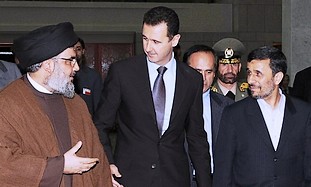
Iranian President Mahmoud Ahmadinejad and Hizbullah leader Sheikh Hassan Nasrallah met Thursday evening in Damascus along with their senior advisors, and discussed regional developments and “the zionist threat,” ...the meeting was not reported upon until after it had taken place for security reasons.
On Thursday Ahmadinejad and Assad together unleashed vicious rhetoric against Israel, with Ahmadinejad declaring that the “criminal” state of Israel is doomed, and Assad charging that Israel “is capable of aggression at any point.” ...Ahmadinejad vowed that Arab nations will usher in a new Middle East “without Zionists and without colonialists.”
In remarks that extended to vicious criticism of the US, and made a mockery of Washington’s efforts to engage his Syrian hosts, Ahmadinejad said the United States should leave the Middle East and stay out of regional affairs. ...Assad took a swipe at Clinton for [suggesting that Syria move away from Iran] ... In a show of unity, the two signed an agreement canceling travel visas between the their countries.
...President Shimon Peres slammed the meeting between Ahmadinejad and Assad, warning that Iran’s true designs were for “hegemony over the Arab world in the Middle East ...The problem in the Middle East is not the Palestinian problem ...[it] is Iran’s attempt to take control of the Arab Middle East, which is why it is building an atomic bomb, and why it is supporting and developing terror organizations like Hizbullah in Lebanon and Hamas in Gaza,” Peres said.
Ahmadinejad, Nasrallah and Assad have dinner together, discuss "threats."
Iranian President Mahmoud Ahmadinejad and Hizbullah leader Sheikh Hassan Nasrallah met Thursday evening in Damascus along with their senior advisors, and discussed regional developments and “the zionist threat,” ...the meeting was not reported upon until after it had taken place for security reasons.
On Thursday Ahmadinejad and Assad together unleashed vicious rhetoric against Israel, with Ahmadinejad declaring that the “criminal” state of Israel is doomed, and Assad charging that Israel “is capable of aggression at any point.” ...Ahmadinejad vowed that Arab nations will usher in a new Middle East “without Zionists and without colonialists.”
In remarks that extended to vicious criticism of the US, and made a mockery of Washington’s efforts to engage his Syrian hosts, Ahmadinejad said the United States should leave the Middle East and stay out of regional affairs. ...Assad took a swipe at Clinton for [suggesting that Syria move away from Iran] ... In a show of unity, the two signed an agreement canceling travel visas between the their countries.
...President Shimon Peres slammed the meeting between Ahmadinejad and Assad, warning that Iran’s true designs were for “hegemony over the Arab world in the Middle East ...The problem in the Middle East is not the Palestinian problem ...[it] is Iran’s attempt to take control of the Arab Middle East, which is why it is building an atomic bomb, and why it is supporting and developing terror organizations like Hizbullah in Lebanon and Hamas in Gaza,” Peres said.
Sunday, January 24, 2010
Conflict with Lebanon looms
From THE JERUSALEM POST,Jan. 23, 2010:
Another military conflict between Israel and Lebanon is "inevitable," Minister-without-Portfolio Yossi Peled (Likud) Saturday at a Beersheba event.
"Without a doubt we are heading for another round (of fighting) in the North. No one knows when, but it's clear that it will happen," the former OC Northern Command said. "We did not know that the Second Lebanon War was going to break out."
...Quoting Middle East analysts, The Washington Post report went on to say Hizbullah launch sites now likely extend past Beirut. The IDF believes that Hizbullah has obtained Iranian-made Fajr missiles...
... "With Iran backing and supplying Hezbollah and the United States backing and supplying Israel, the battlefield is Lebanon," the anti-Hizbullah lawmaker[Lebanese MP Marwan Hamadeh] reportedly said.
"This is where the Iranian missiles sit, and this is where the Israeli air force can reach," he added.
Another military conflict between Israel and Lebanon is "inevitable," Minister-without-Portfolio Yossi Peled (Likud) Saturday at a Beersheba event.
"Without a doubt we are heading for another round (of fighting) in the North. No one knows when, but it's clear that it will happen," the former OC Northern Command said. "We did not know that the Second Lebanon War was going to break out."
...Quoting Middle East analysts, The Washington Post report went on to say Hizbullah launch sites now likely extend past Beirut. The IDF believes that Hizbullah has obtained Iranian-made Fajr missiles...
... "With Iran backing and supplying Hezbollah and the United States backing and supplying Israel, the battlefield is Lebanon," the anti-Hizbullah lawmaker[Lebanese MP Marwan Hamadeh] reportedly said.
"This is where the Iranian missiles sit, and this is where the Israeli air force can reach," he added.
Saturday, December 26, 2009
Israel will apply more force
From a New York Times Memo From Tel Aviv, December 25, 2009, by ISABEL KERSHNER:
TEL AVIV — In the year since Israel launched its devastating military offensive against Hamas in Gaza, the country’s political and military leaders have faced intense international condemnation and accusations of possible war crimes.
But Israel seems to have few qualms. Officials and experts familiar with the country’s military doctrine say that given the growing threats from Iranian-backed militant organizations both in Gaza and in Lebanon, Israel will probably find itself fighting another, similar kind of war.
Only next time, some here suggest, Israel will apply more force.
“The next round will be different, but not in the way people think,” said Giora Eiland, a retired major general and former chief of Israel’s National Security Council. “The only way to be successful is to take much harsher action.”
Such talk has raised alarm among some critics in Israel, but so far it has stirred little public debate.
Both the three-week campaign in Gaza, which ended on Jan. 18, and Israel’s monthlong war in 2006 against the Shiite Hezbollah organization in Lebanon have brought relative quiet to Israel’s borders.
Maj. Gen. Amos Yadlin, the chief of Israel’s military intelligence, said the source of the quiet was “not the adoption of Zionism by our enemies.” The main factor, he recently told an audience at the Institute for National Security Studies at Tel Aviv University, is Israeli deterrence, starting with the war in Lebanon and continuing with the Gaza operation that the Israelis called Cast Lead.
But decisive victory against irregular forces has been elusive. In the military’s assessment, the calm is temporary and fragile; Hamas and Hezbollah are said to be rearming, making another confrontation only a matter of time.
While the Israeli military has a clear advantage in fighting conventional armies, it is still adapting to the new and complicated demands of asymmetric warfare. The military says it is contending with enemies who fight out of uniform and hide behind civilians, intentionally firing rockets out of populated areas into densely populated areas of Israel.
Israel’s objective, according to Gabriel Siboni, a retired colonel who runs the military program at the Institute for National Security Studies, is to shorten and intensify the period of fighting and to lengthen the period between rounds.
...Military officials strenuously deny that Israel plans to hit economic or civilian infrastructure to cause suffering to the local population, in the hope of turning it against the war.
Brig. Gen. Aviv Kochavi, chief of the Israeli military’s Operations Department, told reporters at a recent briefing in Tel Aviv that the army would not shoot at targets that had no proven link “with any form of terror.” But, he added, “we are going to use fire.”
General Kochavi said that Israel would never deliberately fire on civilians but that civilian buildings containing weapons or rocket launchers would be bombed after residents had been warned to evacuate.
With the war in Gaza, however, the distinction between military and civilian infrastructure seemed to become increasingly blurred.
Among the targets destroyed in Gaza were the parliament building and the central prison. ...Israel never claimed that the parliament building was being used to store or fire weapons. But after Hamas took over Gaza in 2007, Israel says, the parliament building became part of the Hamas infrastructure, and therefore a legitimate target to be destroyed.
David Benjamin, a lieutenant colonel in the reserves and a former senior adviser in the Israeli military’s legal department, said that Israel did not need to “buy in” to Hamas’s definitions of what was military and what was political. Israel considers all of Hamas a terrorist organization. The distinction, Mr. Benjamin said, is “artificial in my view.”
...Critics both inside and outside Israel denounce what they — and at least one senior Israeli Army commander — have called the “Dahiya doctrine,” referring to the intention to inflict immense damage and destruction, an approach that would inevitably lead to civilian deaths.
A recent report by the Public Committee Against Torture in Israel, a local advocacy group, pointed to what it called a “significant change” in the Israeli military’s combat doctrine. It said the shift was legally and politically dangerous and cast a “moral stain” on Israeli citizens, and it called for public debate.
But Israeli officials and security experts contend that other Western countries are facing similar challenges in their conflicts abroad. What must change, they say, is not the Israeli military’s conduct but the interpretation and application of the laws of war by the rest of the world....
TEL AVIV — In the year since Israel launched its devastating military offensive against Hamas in Gaza, the country’s political and military leaders have faced intense international condemnation and accusations of possible war crimes.
But Israel seems to have few qualms. Officials and experts familiar with the country’s military doctrine say that given the growing threats from Iranian-backed militant organizations both in Gaza and in Lebanon, Israel will probably find itself fighting another, similar kind of war.
Only next time, some here suggest, Israel will apply more force.
“The next round will be different, but not in the way people think,” said Giora Eiland, a retired major general and former chief of Israel’s National Security Council. “The only way to be successful is to take much harsher action.”
Such talk has raised alarm among some critics in Israel, but so far it has stirred little public debate.
Both the three-week campaign in Gaza, which ended on Jan. 18, and Israel’s monthlong war in 2006 against the Shiite Hezbollah organization in Lebanon have brought relative quiet to Israel’s borders.
Maj. Gen. Amos Yadlin, the chief of Israel’s military intelligence, said the source of the quiet was “not the adoption of Zionism by our enemies.” The main factor, he recently told an audience at the Institute for National Security Studies at Tel Aviv University, is Israeli deterrence, starting with the war in Lebanon and continuing with the Gaza operation that the Israelis called Cast Lead.
But decisive victory against irregular forces has been elusive. In the military’s assessment, the calm is temporary and fragile; Hamas and Hezbollah are said to be rearming, making another confrontation only a matter of time.
While the Israeli military has a clear advantage in fighting conventional armies, it is still adapting to the new and complicated demands of asymmetric warfare. The military says it is contending with enemies who fight out of uniform and hide behind civilians, intentionally firing rockets out of populated areas into densely populated areas of Israel.
Israel’s objective, according to Gabriel Siboni, a retired colonel who runs the military program at the Institute for National Security Studies, is to shorten and intensify the period of fighting and to lengthen the period between rounds.
...Military officials strenuously deny that Israel plans to hit economic or civilian infrastructure to cause suffering to the local population, in the hope of turning it against the war.
Brig. Gen. Aviv Kochavi, chief of the Israeli military’s Operations Department, told reporters at a recent briefing in Tel Aviv that the army would not shoot at targets that had no proven link “with any form of terror.” But, he added, “we are going to use fire.”
General Kochavi said that Israel would never deliberately fire on civilians but that civilian buildings containing weapons or rocket launchers would be bombed after residents had been warned to evacuate.
With the war in Gaza, however, the distinction between military and civilian infrastructure seemed to become increasingly blurred.
Among the targets destroyed in Gaza were the parliament building and the central prison. ...Israel never claimed that the parliament building was being used to store or fire weapons. But after Hamas took over Gaza in 2007, Israel says, the parliament building became part of the Hamas infrastructure, and therefore a legitimate target to be destroyed.
David Benjamin, a lieutenant colonel in the reserves and a former senior adviser in the Israeli military’s legal department, said that Israel did not need to “buy in” to Hamas’s definitions of what was military and what was political. Israel considers all of Hamas a terrorist organization. The distinction, Mr. Benjamin said, is “artificial in my view.”
...Critics both inside and outside Israel denounce what they — and at least one senior Israeli Army commander — have called the “Dahiya doctrine,” referring to the intention to inflict immense damage and destruction, an approach that would inevitably lead to civilian deaths.
A recent report by the Public Committee Against Torture in Israel, a local advocacy group, pointed to what it called a “significant change” in the Israeli military’s combat doctrine. It said the shift was legally and politically dangerous and cast a “moral stain” on Israeli citizens, and it called for public debate.
But Israeli officials and security experts contend that other Western countries are facing similar challenges in their conflicts abroad. What must change, they say, is not the Israeli military’s conduct but the interpretation and application of the laws of war by the rest of the world....
The ascent of the little dictator
From Commentary Magazine, 22/12/09: Assad Returns as the Strong Horse, by Michael J. Totten:
Lebanese Prime Minister Saad Hariri just spent two days with Syrian strongman Bashar Assad in Damascus, and you’d think from reading the wire reports that Lebanon and Syria had re-established normal relations after a rough patch. That’s how it’s being reported, but it’s nonsense.
Hariri went to Damascus with Hizbullah's bayonet in his back.
Assad's regime assassinated Saad Hariri's father, Rafik, in 2005. There is no alternate universe where Saad Hariri is OK with this or where his generically "positive" statements at a press conference were anything other than forced.
I was invited to dinner at Hariri's house earlier this year. Trust me: the man is no friend of the Syrian government or Hizbullah. His political party, the Future Movement, champions liberalism and capitalism, the very antithesis of what is imposed in Syria by Assad's Arab Socialist Baath party regime and the totalitarian Velayat-e Faqih ideology enforced by the Khomeinists in Iran and in the Hizbullah-occupied regions of Lebanon.
Hizbullah and its sponsors in Tehran and Damascus have forced Hariri to surrender to its continuing existence as a warmongering militia that threatens to blow up the country again by picking fights with the Israelis. The national army isn't strong enough to disarm Hizbullah. At the end of the day, Hariri has to do what Hizbullah and its friends say unless someone with a bigger stick covers his back. When Hariri went to Damascus, everyone in the country understood it meant Syria has re-emerged as the strong horse in Lebanon.
The U.S. and France did effectively isolate Assad with Saudi assistance when George W. Bush and Jacques Chirac were in charge, but presidents Barack Obama and Nicolas Sarkozy think they can save the Middle East by “engaging” its most toxic leaders.
Syria, therefore, is no longer isolated. Lebanon’s little anti-Syrian government doesn’t stand a chance under these circumstances, especially not when Hezbollah is the dominant military power in the country.
“It’s a dangerous game these people are playing,” Lebanese activist and political analyst Eli Khoury said last time I spoke with him in Beirut, “but I think it’s only a matter of time until the newcomers burn their fingers with the same realities that we’ve seen over and over again.
... now the U.S., France, and Saudi Arabia are bringing Assad in from the cold and giving him cocoa. His influence, naturally, is rising again, in Lebanon and everywhere else. That's good news for Hizbullah and Iran. It's bad news for the Lebanese, the Americans, the French, the Saudis, and the Israelis. None of this was inevitable, but - in Lebanon, at least - it was predictable.
From Jerusalem Post, 23/12/09: Domino Effect Seen in Lebanon, by Jonathan Spyer*:
Last week's visit by Lebanese Prime Minister Sa'ad Hariri to Damascus is the latest marker in the return of the coercive Syrian presence in Lebanon. It is also an indication of Syria's successful defiance of the west.
The pro-western and pro-Saudi March 14 movement, led by Hariri, achieved a modest victory in elections in June. This victory was effectively nullified in the lengthy coalition "negotiations" that followed. The new government as finally announced in November represented the unusual spectacle of a wholesale capitulation of the electoral victors before the vanquished.
The Hizbullah-led opposition kept their effective veto power in the Cabinet. The government's founding statement included an acknowledgement of the legitimacy of Hizbullah's continued armed presence.
This substantive conceding by Hariri of his election victory has now been accompanied by a symbolic gesture.
The Hizbullah-led opposition conditioned their agreeing to join the coalition on the Hariri visit. But this condition was originally agreed to, according to reports, by Saudi King Abdullah, during his visit to Damascus in October. This visit was a gesture of rapprochement by the Saudis to the Syrians. The main backer of Hariri and March 14 appears at that point to have signaled Saudi willingness to concede its clients to the pro-Syrian interest in Lebanon.
Unlike the Syrian and Iranian clients in Lebanon, Hariri and Co. have no "hard power" or resistance option. The only game they can play is diplomacy. So once their main diplomatic patrons had offered them up, the game was effectively over.
But why did the Saudis choose to make this gesture? On one level, the Saudis hope to pull Syria way from Iran by welcoming Damascus back into the Arab "fold." But Syria has made abundantly clear that it has no intention of ending or even toning down its staunch, 30-year alliance with Teheran.
On another level, the Saudis and Syrians share an additional, common interest in ensuring a weak, vulnerable Iraq between them.
But even this begs another question. Why should the Saudis choose to begin to engage with Iran's main Arab allies - the Syrians - against the US-aligned Iraqis? Riyadh's own patron, after all, is the United States.
Here one arrives at the crux of the matter. Although the Obama administration has hesitated before rushing headlong into renewing relations with Damascus, it has undertaken a series of gestures that have demonstrated that any real policy of isolation is over. This goes hand in hand with the broader regional stance of the administration of attempting "engagement" with the Iranian regime.
Far from signaling to Middle Eastern powers that a new world of cooperation is about to commence, what this U.S. stance conveys to friends and foes in the region is that Washington no longer has the stomach for holding fast against the bid by Iran and its allies for regional hegemony.
The actors, therefore, move to make their accommodation with the changed reality. The small dominoes are falling, like Lebanese Prime Minister Saad Hariri, who visited Damascus last week in a ritual gesture of supplication to Bashar al-Assad.
*The writer is senior researcher at the Global Research in International Affairs Center, IDC, Herzliya.
From the Weekly Standard, 10/12/09: The Murdered Fathers Club: Washington's Allies in Beirut Are Now Bowing to Damascus, by David Schenker**:
Saad Hariri and Walid Jumblatt, the leaders of the Cedar Revolution, whose fathers were all but certainly killed by Syria, are paying homage to Damascus.
Perhaps the leading factor in the March 14 leadership's decision to return to Damascus appears to be Saudi Arabia's equivocating. To mitigate the threat posed by Tehran, Saudi Arabia is attempting to pry Syria away from its 30-year strategic ally, and the first Saudi down-payment in this ill-advised gambit has been its Lebanese allies.
At least in part, this dramatic change in policy is related to the perceived U.S. weakness on Iran. Absent Saudi confidence that Washington will prevent a nuclear Iran, Riyadh is hedging.
For Washington and March 14, of course, the Saudi shift and the imminent expeditions of the coalition's senior leadership to Damascus is not good news. Simply stated, it is indicative of the fact that Syria has a new lease on life in Lebanon.
Sadly, this pro-West coalition, which came to power on the battle-cry of Lebanese "independence," appears to have come full circle. March 14 politicians are already flocking to Damascus to ingratiate themselves with Asad, and the Lebanese president is starting to become a routine fixture in the Syrian capital.
The ongoing tragedy of Lebanon will be played out in the coming days, as the murdered father's club holds its next meeting in Damascus.
**The writer is director of the Program in Arab Politics at the Washington Institute for Near East Policy.
Lebanese Prime Minister Saad Hariri just spent two days with Syrian strongman Bashar Assad in Damascus, and you’d think from reading the wire reports that Lebanon and Syria had re-established normal relations after a rough patch. That’s how it’s being reported, but it’s nonsense.
Hariri went to Damascus with Hizbullah's bayonet in his back.
Assad's regime assassinated Saad Hariri's father, Rafik, in 2005. There is no alternate universe where Saad Hariri is OK with this or where his generically "positive" statements at a press conference were anything other than forced.
I was invited to dinner at Hariri's house earlier this year. Trust me: the man is no friend of the Syrian government or Hizbullah. His political party, the Future Movement, champions liberalism and capitalism, the very antithesis of what is imposed in Syria by Assad's Arab Socialist Baath party regime and the totalitarian Velayat-e Faqih ideology enforced by the Khomeinists in Iran and in the Hizbullah-occupied regions of Lebanon.
Hizbullah and its sponsors in Tehran and Damascus have forced Hariri to surrender to its continuing existence as a warmongering militia that threatens to blow up the country again by picking fights with the Israelis. The national army isn't strong enough to disarm Hizbullah. At the end of the day, Hariri has to do what Hizbullah and its friends say unless someone with a bigger stick covers his back. When Hariri went to Damascus, everyone in the country understood it meant Syria has re-emerged as the strong horse in Lebanon.
The U.S. and France did effectively isolate Assad with Saudi assistance when George W. Bush and Jacques Chirac were in charge, but presidents Barack Obama and Nicolas Sarkozy think they can save the Middle East by “engaging” its most toxic leaders.
Syria, therefore, is no longer isolated. Lebanon’s little anti-Syrian government doesn’t stand a chance under these circumstances, especially not when Hezbollah is the dominant military power in the country.
“It’s a dangerous game these people are playing,” Lebanese activist and political analyst Eli Khoury said last time I spoke with him in Beirut, “but I think it’s only a matter of time until the newcomers burn their fingers with the same realities that we’ve seen over and over again.
... now the U.S., France, and Saudi Arabia are bringing Assad in from the cold and giving him cocoa. His influence, naturally, is rising again, in Lebanon and everywhere else. That's good news for Hizbullah and Iran. It's bad news for the Lebanese, the Americans, the French, the Saudis, and the Israelis. None of this was inevitable, but - in Lebanon, at least - it was predictable.
From Jerusalem Post, 23/12/09: Domino Effect Seen in Lebanon, by Jonathan Spyer*:
Last week's visit by Lebanese Prime Minister Sa'ad Hariri to Damascus is the latest marker in the return of the coercive Syrian presence in Lebanon. It is also an indication of Syria's successful defiance of the west.
The pro-western and pro-Saudi March 14 movement, led by Hariri, achieved a modest victory in elections in June. This victory was effectively nullified in the lengthy coalition "negotiations" that followed. The new government as finally announced in November represented the unusual spectacle of a wholesale capitulation of the electoral victors before the vanquished.
The Hizbullah-led opposition kept their effective veto power in the Cabinet. The government's founding statement included an acknowledgement of the legitimacy of Hizbullah's continued armed presence.
This substantive conceding by Hariri of his election victory has now been accompanied by a symbolic gesture.
The Hizbullah-led opposition conditioned their agreeing to join the coalition on the Hariri visit. But this condition was originally agreed to, according to reports, by Saudi King Abdullah, during his visit to Damascus in October. This visit was a gesture of rapprochement by the Saudis to the Syrians. The main backer of Hariri and March 14 appears at that point to have signaled Saudi willingness to concede its clients to the pro-Syrian interest in Lebanon.
Unlike the Syrian and Iranian clients in Lebanon, Hariri and Co. have no "hard power" or resistance option. The only game they can play is diplomacy. So once their main diplomatic patrons had offered them up, the game was effectively over.
But why did the Saudis choose to make this gesture? On one level, the Saudis hope to pull Syria way from Iran by welcoming Damascus back into the Arab "fold." But Syria has made abundantly clear that it has no intention of ending or even toning down its staunch, 30-year alliance with Teheran.
On another level, the Saudis and Syrians share an additional, common interest in ensuring a weak, vulnerable Iraq between them.
But even this begs another question. Why should the Saudis choose to begin to engage with Iran's main Arab allies - the Syrians - against the US-aligned Iraqis? Riyadh's own patron, after all, is the United States.
Here one arrives at the crux of the matter. Although the Obama administration has hesitated before rushing headlong into renewing relations with Damascus, it has undertaken a series of gestures that have demonstrated that any real policy of isolation is over. This goes hand in hand with the broader regional stance of the administration of attempting "engagement" with the Iranian regime.
Far from signaling to Middle Eastern powers that a new world of cooperation is about to commence, what this U.S. stance conveys to friends and foes in the region is that Washington no longer has the stomach for holding fast against the bid by Iran and its allies for regional hegemony.
The actors, therefore, move to make their accommodation with the changed reality. The small dominoes are falling, like Lebanese Prime Minister Saad Hariri, who visited Damascus last week in a ritual gesture of supplication to Bashar al-Assad.
*The writer is senior researcher at the Global Research in International Affairs Center, IDC, Herzliya.
From the Weekly Standard, 10/12/09: The Murdered Fathers Club: Washington's Allies in Beirut Are Now Bowing to Damascus, by David Schenker**:
Saad Hariri and Walid Jumblatt, the leaders of the Cedar Revolution, whose fathers were all but certainly killed by Syria, are paying homage to Damascus.
Perhaps the leading factor in the March 14 leadership's decision to return to Damascus appears to be Saudi Arabia's equivocating. To mitigate the threat posed by Tehran, Saudi Arabia is attempting to pry Syria away from its 30-year strategic ally, and the first Saudi down-payment in this ill-advised gambit has been its Lebanese allies.
At least in part, this dramatic change in policy is related to the perceived U.S. weakness on Iran. Absent Saudi confidence that Washington will prevent a nuclear Iran, Riyadh is hedging.
For Washington and March 14, of course, the Saudi shift and the imminent expeditions of the coalition's senior leadership to Damascus is not good news. Simply stated, it is indicative of the fact that Syria has a new lease on life in Lebanon.
Sadly, this pro-West coalition, which came to power on the battle-cry of Lebanese "independence," appears to have come full circle. March 14 politicians are already flocking to Damascus to ingratiate themselves with Asad, and the Lebanese president is starting to become a routine fixture in the Syrian capital.
The ongoing tragedy of Lebanon will be played out in the coming days, as the murdered father's club holds its next meeting in Damascus.
**The writer is director of the Program in Arab Politics at the Washington Institute for Near East Policy.
Saturday, August 08, 2009
Why the Iranian alliance will fail
From an article in [a treacherous Israeli newspaper that I don't wish to mention], 7 August 2009, by [the brilliant] Jonathan Spyer, senior research fellow at the Global Research in International Affairs Center at the Interdisciplinary Center, Herzliya:
The key strategic process that has taken place in the Middle East in the last half-decade has been the emergence of an Iranian-led bloc of states and movements, committed to undermining the U.S.-led status quo. ...In the course of 2009, however, this Iranian-led alliance has suffered a series of setbacks....
Central to the outlook of the pro-Iranian alliance is the notion of "muqawama" - resistance... challenging what they portray as the declining power of the United States and its allies. Israel, which this bloc views as an artificial remnant of colonialism in the region, is a central target.
For a while, the muqawama bloc appeared to be racking up achievement after achievement. Iran has sidestepped international attempts to limit or slow its nuclear program. Hezbollah, its creation and client, emerged intact - and claimed to be victorious - in its 2006 fight with an ill-prepared and badly led Israel Defense Forces. The same organization went on to defend its independent military infrastructure in Lebanon, intimidating its pro-Western opponents.
In the Palestinian arena, Hamas has been able to maintain its Gaza enclave thanks to Iranian support. This is important because Iran knows the Palestinian issue remains the great legitimizing element for millions in the region. So a plausible bid for ownership of the Palestinian cause is a strategic goal for the bloc.
In the course of 2009, however, the muqawama alliance's winning streak seems to have ended.
The key strategic process that has taken place in the Middle East in the last half-decade has been the emergence of an Iranian-led bloc of states and movements, committed to undermining the U.S.-led status quo. ...In the course of 2009, however, this Iranian-led alliance has suffered a series of setbacks....
Central to the outlook of the pro-Iranian alliance is the notion of "muqawama" - resistance... challenging what they portray as the declining power of the United States and its allies. Israel, which this bloc views as an artificial remnant of colonialism in the region, is a central target.
For a while, the muqawama bloc appeared to be racking up achievement after achievement. Iran has sidestepped international attempts to limit or slow its nuclear program. Hezbollah, its creation and client, emerged intact - and claimed to be victorious - in its 2006 fight with an ill-prepared and badly led Israel Defense Forces. The same organization went on to defend its independent military infrastructure in Lebanon, intimidating its pro-Western opponents.
In the Palestinian arena, Hamas has been able to maintain its Gaza enclave thanks to Iranian support. This is important because Iran knows the Palestinian issue remains the great legitimizing element for millions in the region. So a plausible bid for ownership of the Palestinian cause is a strategic goal for the bloc.
In the course of 2009, however, the muqawama alliance's winning streak seems to have ended.
- Operation Cast Lead proved that Hamas' belief that it could deter Israel from a major ground operation in Gaza was baseless. The organization's confidence derived from a key item of faith guiding the Iran-led alliance - namely, that Israel is a tired and lost society no longer capable of generating the self-sacrifice necessary for successful national defense.
- In Cast Lead, Israel demonstrated its ability to deliver a telling military blow to Hamas-led Gaza, at minimum cost to itself. In so doing, it also showed that the asymmetric-warfare methods developed by the Iranian Revolutionary Guards and applied by Hamas in Gaza are not foolproof. The silence that has emanated from Gaza since the January operation is a mute testimony to the setback suffered by Hamas and its allies.
- The June 7 elections in Lebanon delivered an additional blow to the Iran-led bloc, with the unexpected defeat of Hezbollah and its allies. The movement's rearming in the country's south continues unabated. But there is no doubt that its inability to attain a parliamentary majority struck at the aura of invincibility and inevitability that this movement has worked to weave around itself.
- Perhaps the most decisive setback to the muqawama bloc, however, has been the ongoing unrest in Iran itself. The demonstrations and protests against the rigged presidential elections there have made a mockery of the claim by Iran and its allies that they represent "popular will" in the region against corrupt pro-Western regimes.
The unrest has laid bare the mechanisms of coercion behind power in Iran. The regime is not in any immediate danger, but it is increasingly being seen, both in Iran and across the region, as just another Middle Eastern government holding power against the will of its own people. The ambition for regional hegemony, an article of faith for the radical group that includes President Mahmoud Ahmadinejad, probably was always beyond the capabilities of the Islamist regime in Tehran.
Ahmadinejad had hoped to turn the rickety, corrupt regime of the mullahs into a model of successful defiance and development for the region. But this aspiration is looking farther off than it did a year ago.
Of course, the impact of these setbacks should not be exaggerated. The game is not yet decided. Iranian nuclear efforts continue apace, Hamas is holding on in Gaza, Hezbollah maintains its independent infrastructure in Lebanon.
The Arab world and the Middle East have a tendency, every few years, to fall under the spell of bright, shining lies that promise to avenge every humiliation, reverse every defeat, reestablish the rightful order. These ringing untruths and their bearers - Pan-Arab nationalism in its rightist and leftist forms, the Palestinian "guerrillas," even the Saddam Hussein regime in the early 1990s - appear on a wave of rhetoric, ride along splendidly for a while, and then crash on the rocks of reality.
The reality, in this case, is the superior social and economic organization of Western states such as Israel, and the inability of any of these forms of politicized anger to adequately address this fact. The muqawama doctrine of Iran is the latest example. Its defeat may still be distant, but the first indications that it is likely to share the eventual fate of its predecessors have become apparent this year.
Sunday, May 03, 2009
Hizbullah's Campaign to take Lebanon for Iran
From The Jerusalem Center for Public Affairs, Jerusalem Viewpoints series*, No. 571, May-June 2009, by Shimon Shapira and Yair Minzili:
- The publication of Hizbullah's subversive plan against Egypt and the exposure of a Shiite group headed by a Hizbullah activist that planned to act against Egyptian targets diverted attention from the challenge that Hizbullah has made against the very foundations of Lebanese authority.
- On April 3, 2009, Hizbullah published its political platform in advance of elections to the Lebanese parliament scheduled for June 7, 2009. The document calls for the abolition of sectarian politics and for the enactment of a new election law that would alter the equation of sectarian forces in Lebanon.
- In this manner, Hizbullah seeks to destroy the foundations of the sectarian regime in Lebanon agreed upon in the National Pact of 1943 that has been preserved by the Lebanese state ever since. The abolition of the existing political system will advance Hizbullah toward its fundamental goal: the establishment of an Islamic state and a complete Iranian takeover of Lebanon.
- The scholarly analyses that define Hizbullah as a Lebanese national movement are baseless. What Lebanese national interests are served by subversive activity in Egypt? What Lebanese interests seek the transfer of Iranian arms from Sudan and Sinai to Gaza? What national Lebanese ideology seeks to subvert the delicate sectarian structure upon which the modern Lebanese state is predicated?
A Pattern of Hizbullah Subversion
The publication of Hizbullah's subversive plan against Egypt and the exposure of a Shiite group headed by a Hizbullah activist, that planned to act against Egyptian targets under the cover of "logistical assistance" to the Palestinians, diverted attention from the challenge that Hizbullah has made against the very foundations of Lebanese authority.
One can safely assume that Hizbullah activity in Egypt was performed with the full knowledge of Iran. The weapons shipment that departed Iran for Gaza was dispatched with Tehran's blessing. Iran was undoubtedly aware that the Egyptian security authorities could uncover Hizbullah's subversive activity, but believed that the Egyptians would prefer to turn a blind eye and allow the passage of the weapons inventory to Gaza. Even if this was not the case, the Iranians posited military assistance to Hamas as a supreme interest of the Islamic Revolution and were prepared to pay the price of a deterioration in relations between the countries. The attacks by Hassan Nasrallah against Egypt, including a summons to the Egyptian army to overthrow the Mubarak regime during Israel's Gaza operation, would not have been made had Nasrallah not understood that in this fashion he was serving the wishes of his masters in Tehran.
Ever since the disclosures, the mass media in the Arab world and in the West has been preoccupied with the dispute that has erupted between Hizbullah and Egypt, and have almost totally ignored the struggle that Hizbullah has initiated to change the face of the Lebanese regime.
While Britain adopted the questionable decision to open a dialogue with the "political wing" of Hizbullah and in practice recognized Hizbullah as a legitimate movement, it would appear that the artificial distinction drawn by the UK between the political and the military wings of Hizbullah has totally collapsed with the discovery of Hizbullah's subversion in Egypt, which merely compounds what was previously discovered in Morocco. In that Sunni Arab kingdom, the king severed ties with Iran in March 2009, accusing it of supporting Shiite Islamic missionary activity.
Hizbullah's Election Platform: Setting the Stage for an Iranian Takeover of Lebanon
On April 3, 2009, Hizbullah published its political platform in advance of elections to the Lebanese parliament scheduled for June 7, 2009. The document calls for the abolition of sectarian politics and for the enactment of a new election law that would alter the equation of sectarian forces in Lebanon.
The 2009 election platform joins a series of basic documents of the Hizbullah movement: These include the Open Letter (Risala Maftuha) from 1985, the first Hizbullah election platform for parliament from 1992, the Hizbullah political document ratified at the movement's Third Congress in 1993, Hizbullah's election platform for the 2000 parliamentary elections, and its platform for the municipal elections of 2004.
These two components - the unequivocal call to abolish sectarian politics and the enactment of a new election law - were placed at the very beginning of the platform in order to emphasize Hizbullah's priorities. In the electoral platform of 2000, Hizbullah had called for establishing a national body for the abolishment of political sectarianism, but only in the fourth section of the platform. It is assumed that in this manner Hizbullah seeks to advance its aspiration to destroy the foundations of the sectarian regime in Lebanon agreed upon in the National Pact of 1943 that has been preserved by the Lebanese state ever since, amidst repeated crises. The abolition of the existing political system will advance Hizbullah toward its fundamental goal: the establishment of an Islamic state that provides political expression to the Shiite majority and a complete Iranian takeover of Lebanon.
What is missing in the new Hizbullah platform? There is no reference to its militia and weapons, as well as to the call from inside Lebanon to dismantle Hizbullah's military capability and to integrate it into the Lebanese Armed Forces. Hizbullah ignores this aspect and insists on keeping its independent military wing as a "resistance" force against Israel.
However, it is clear that the preservation of Hizbullah's military strength is intended primarily to allow the movement to translate its military power and demographic weight into a fundamental change of the Lebanese political system. In addition to this purpose, and no less important, Hizbullah's military power serves as the cutting edge of Iran on Israel's northern border, enabling the Islamic Republic to employ the military power that it erected in Lebanon to serve its strategic interests.
In recent years, and in the course of the severe political crises that have struck Lebanon since the murder of former Prime Minister Rafik al-Hariri in March 2005, Hizbullah has not concealed its intentions to realize the mission entrusted to it by the Iranian Revolutionary regime. The movement is to seize power in Lebanon and thus create another stable and trustworthy link in the Shiite axis of evil under Iranian leadership. In the Lebanese political realm, Hizbullah has labored to reinforce "the (Shiite) Opposition Camp" by aligning with powerful factions beyond the Shiite community against the Sunni-Shiite coalition headed by Saad al-Hariri. In practice, Hizbullah scored a major success by attracting to its side the Christian Free Patriotic Movement headed by Gen. Michel Aoun, and has strengthened its alliance with extremist Salafist Sunni groups. In a show of force, Hizbullah undertook an unprecedented brutal action when it effectively took over Beirut on May 7, 2008, in response to a government attempt to bring about the dismantling of Hizbullah's independent communications infrastructure within Lebanon.
Hizbullah's call for ending political sectarianism, coupled with the enactment of a new election law, came after this demonstration of power and self-confidence, and constitutes the apogee of its indefatigable efforts to attain power in Lebanon. The formulation of an electoral program in a manner that awards Hizbullah the deceptive image of an authentic Lebanese party operating on the basis of Lebanese interests was calculated to attract maximal representation and perhaps even a majority in parliament. However, its political rivals at home will seek to exploit Hizbullah's recent entanglements in subversion against Egypt in order to expose Hizbullah as a disruptive force operating in the service of Iran and Syria.
Once again, it has been demonstrated that all the scholarly analyses that define Hizbullah as a Lebanese national movement are baseless. What Lebanese national interests are served by subversive activity in Egypt? What Lebanese interests seek the transfer of Iranian arms from Sudan and Sinai to Gaza? What national Lebanese ideology seeks to subvert the delicate sectarian structure upon which the modern Lebanese state is predicated?
The responses to these questions may be found in the framework of relations between Revolutionary Iran and its protégé in Lebanon, and between Iranian Supreme Leader Ayatollah Ali Khamenei and his loyal and obedient representative Hassan Nasrallah.
The essence of the tie between them is not simply religious, but has far-reaching political implications influencing the range of Hizbullah behavior in the Lebanese arena and beyond, and symbolizes the growing influence of Iran in the Arab world.
*The Jerusalem Viewpoints series is published by the Institute for Contemporary Affairs, founded jointly with the Wechsler Family Foundation.
Thursday, April 30, 2009
Turkey and Syria hold first joint military exercise ...with US approval
[My emphasis added to these two key excerpts - SL]
From DEBKAfile, April 29, 2009:
Turkey's army chief Gen. Ilker Basburg brushed off the Israeli defense minister Ehud Barak's comment that the [the first] joint Turkish-Syrian military exercise was "disturbing." ...[He] said it was only a border exercise, small-scale and "none of anybody's business."
...the Turkish general made a point of mentioning his "extensive talks with the visiting US Chief of General Staff" and their four-hour long "exchange of views on a range of issues." ...[indicating]that the Turkish-Syrian exercise had received Washington's nod....
Basburg also boasted about his meeting with US President Obama"s national security advisor Jones during President Obama's visit to Turkey early April.
From a DEBKAfile Special Report , April 26, 2009:
[A] joint Turkish-Syrian tank and armored infantry exercise backed by air power [began] across the Turkish-Syrian border Monday, April 27, and lasts three days.
DEBKAfile's military sources stress that it is the first joint military maneuver any NATO member, including Turkey, has ever carried out with Syria. It appears to have received a nod from the Obama administration and another first: Never before has an important NATO power staged a joint exercise with any Arab army.
Ankara's decision to launch the drill on the day Israeli commemorates its war dead - in league with Iran's leading ally - is a measure of how far Turkey's longstanding strategic pact with the Jewish state has fallen by the wayside of recent changes.
...Ankara made its announcement while US secretary of state Hillary Clinton was on a short visit to Beirut.
It comes only four days after another first US step: ...the Obama administration had just approved a large Turkish arms sale to the Lebanese army assigning Turkish military instructors to train Lebanese army units (half of whose personnel are Shiites sympathetic to Hizballah.)
...Neither of the Obama administration's actions took into account Israel's vital security interests; nor was Jerusalem consulted about the strategic changes on its borders - or even informed.
...According to the statement from Ankara, the joint exercise "aims to boost friendship, cooperation and trust between Turkish and Syrian land forces and to increase the capability of border troops to train and work together."...
From DEBKAfile, April 29, 2009:
Turkey's army chief Gen. Ilker Basburg brushed off the Israeli defense minister Ehud Barak's comment that the [the first] joint Turkish-Syrian military exercise was "disturbing." ...[He] said it was only a border exercise, small-scale and "none of anybody's business."
...the Turkish general made a point of mentioning his "extensive talks with the visiting US Chief of General Staff" and their four-hour long "exchange of views on a range of issues." ...[indicating]that the Turkish-Syrian exercise had received Washington's nod....
Basburg also boasted about his meeting with US President Obama"s national security advisor Jones during President Obama's visit to Turkey early April.
From a DEBKAfile Special Report , April 26, 2009:
[A] joint Turkish-Syrian tank and armored infantry exercise backed by air power [began] across the Turkish-Syrian border Monday, April 27, and lasts three days.
DEBKAfile's military sources stress that it is the first joint military maneuver any NATO member, including Turkey, has ever carried out with Syria. It appears to have received a nod from the Obama administration and another first: Never before has an important NATO power staged a joint exercise with any Arab army.
Ankara's decision to launch the drill on the day Israeli commemorates its war dead - in league with Iran's leading ally - is a measure of how far Turkey's longstanding strategic pact with the Jewish state has fallen by the wayside of recent changes.
...Ankara made its announcement while US secretary of state Hillary Clinton was on a short visit to Beirut.
It comes only four days after another first US step: ...the Obama administration had just approved a large Turkish arms sale to the Lebanese army assigning Turkish military instructors to train Lebanese army units (half of whose personnel are Shiites sympathetic to Hizballah.)
...Neither of the Obama administration's actions took into account Israel's vital security interests; nor was Jerusalem consulted about the strategic changes on its borders - or even informed.
...According to the statement from Ankara, the joint exercise "aims to boost friendship, cooperation and trust between Turkish and Syrian land forces and to increase the capability of border troops to train and work together."...
Tuesday, April 28, 2009
The Hamas UK Lobby
From GORIA, April 22, 2009, by Jonathan Spyer* [my emphasis added - SL]:
A meeting was meant to take place on Wednesday, April 22nd, in the Grimond Room at Portcullis House, adjoining the House of Commons in London. The planned meeting was titled "Talk with Hamas" and was meant to feature a video link to Damascus. Khaled Mashaal, leader of Hamas, was supposed to address members of Parliament and journalists via the link, but he failed, due to a technical glitch.
This planned meeting was the latest event in an ongoing and organized campaign to break the Western boycott of Hamas and transform policy toward the organization. Much energy is being expended in the UK. But London is only a way station, with the real prize being the transformation of the US stance.
This campaign is part of a larger effort to change the way that the West sees Islamist movements - and by doing so to bring many of the arguments made by such movements into the mainstream.
Who is behind this effort? The invitation to MPs to the Mashaal meeting came from the office of Independent MP Clare Short.
However, it was issued in the name of John, Lord Alderdice. This name immediately offers a pointer. Alderdice, a veteran Northern Irish politician, is head of the board of advisers of an organization called Conflicts Forum.
Conflicts Forum is jointly led by Alistair Crooke and Mark Perry. Crooke is a former British intelligence officer, while the US-based Perry is described by the organizations website as a 'military, intelligence and foreign affairs analyst'. It describes its aim as opening "a new relationship between the West and the Muslim world."
What this anodyne phrase means in practice is revealed in a remarkably frank document published by this group, in which it explains the means it intends to use to bring about the basic change in perception that will bring Hamas and Hizbullah into the mainstream.
The document notes the need to build a "link-up between activist groups and mobilizers of opinion in order to shift the debate on Islamism from a predominantly defensive posture to a positive assertion of Islamist values and thinking."
It suggests "articulation of Hamas's and Hizbullah's values, philosophy and wider political and social programs... Being more proactive in statements and rephrasing discourse to focus on the positive aspects of Islamist ideology."
The Conflicts Forum publication lays down a precise strategy for the promotion of Hamas and Hizbullah in the West - of which the meeting in the British Parliament forms a part.
The various PR devices suggested include "Use influential individuals - key Muslim personalities... use the Internet, DVD, interviews, podcasts... Link with mass organizations in Western countries - social movements, trade unions - to challenge hegemonic discourse. Approach editors of established journals... with a view to the possibility of them doing a special issue on Islamist thinking or on particular issues."
Undoubtedly, the attempted video link between Hamas HQ in Damascus and the Grimond Room in Portcullis House was meant to be a worthy contribution to this extensive effort to "re-brand" Hamas and Hizbullah.
The UK, and the EU as a whole, remain committed to the Quartet conditions which Hamas must meet to become a partner for dialogue. Hamas (or at least its "military wing") remains on the EU list of proscribed terror organizations.
A cursory observation of the backers of Conflicts Forum, however, reveals a curious paradox. In January 2007, the group proudly announced that it had been awarded a grant of €500,000 by the EU, to develop "more inclusive and legitimate approaches to transforming the Middle East conflict." More specifically, the project entails the "engagement" of "faith-based movements."
So the EU, while currently opposing "engagement" with Hamas, also appears to be offering financial support to a body engaged in lobbying for the organization.
How important are the efforts of Conflicts Forum and its associated groups? Are initiatives such as Wednesday's planned meeting likely to have a tangible effect on policy?
Britain has, of course, already announced that it intends to hold talks with Hizbullah. On Hamas, however, no immediate significant shift in British government policy looks likely.
The Hamas Lobby is busy and active. It encompasses former senior diplomats such as Sir Jeremy Greenstock, as well as the Conflicts Forum nexus.
Foreign Secretary Miliband has praised the Egyptian role in managing dialogue with Hamas in the following terms: "Others speak to Hamas. That's the right thing to do, and I think we should let the Egyptians take this forward."
A knowledgeable source noted that many in the Foreign Office consider that engagement with the group is a "matter of time."
Still, for as long as the US remains firmly committed to insisting that Hamas first abide by the three Quartet conditions (committing to nonviolence, recognizing Israel and accepting previous agreements and obligations), the UK is unlikely to openly break ranks. Differences might well surface if a Palestinian unity government were to be formed. But this too currently looks highly improbable.
Ultimately, the main obstacle to the success of Lord Alderdice, Clare Short and their friends in Conflicts Forum may well be the nature of their client. Hamas leaders have an unfortunate tendency to be candid regarding their movement's goals. This makes presenting the "positive aspects of Islamist ideology" something of a challenge.
Hamas "Foreign Minister" Mahmoud Zahar, for example, speaking last week, stated bluntly that "[Hamas] will never recognize the enemy in any way, shape or form."
A few months ago, the same speaker asserted that "they [Jews] have legitimized the murder of their own children by killing the children of Palestine... They have legitimized the killing of their people all over the world by killing our people."
Spinning statements of that kind into moderation would pose a challenge to the smoothest of PR operators. But as the planned Portcullis House meeting showed, Hamas possesses an experienced, well-oiled, well-funded (largely by the European taxpayer) lobby in the heart of London, in which it may take justifiable pride.
* Jonathan Spyer is a senior research fellow at the Global Research in International Affairs Center at the Interdisciplinary Center, Herzliya
A meeting was meant to take place on Wednesday, April 22nd, in the Grimond Room at Portcullis House, adjoining the House of Commons in London. The planned meeting was titled "Talk with Hamas" and was meant to feature a video link to Damascus. Khaled Mashaal, leader of Hamas, was supposed to address members of Parliament and journalists via the link, but he failed, due to a technical glitch.
This planned meeting was the latest event in an ongoing and organized campaign to break the Western boycott of Hamas and transform policy toward the organization. Much energy is being expended in the UK. But London is only a way station, with the real prize being the transformation of the US stance.
This campaign is part of a larger effort to change the way that the West sees Islamist movements - and by doing so to bring many of the arguments made by such movements into the mainstream.
Who is behind this effort? The invitation to MPs to the Mashaal meeting came from the office of Independent MP Clare Short.
However, it was issued in the name of John, Lord Alderdice. This name immediately offers a pointer. Alderdice, a veteran Northern Irish politician, is head of the board of advisers of an organization called Conflicts Forum.
Conflicts Forum is jointly led by Alistair Crooke and Mark Perry. Crooke is a former British intelligence officer, while the US-based Perry is described by the organizations website as a 'military, intelligence and foreign affairs analyst'. It describes its aim as opening "a new relationship between the West and the Muslim world."
What this anodyne phrase means in practice is revealed in a remarkably frank document published by this group, in which it explains the means it intends to use to bring about the basic change in perception that will bring Hamas and Hizbullah into the mainstream.
The document notes the need to build a "link-up between activist groups and mobilizers of opinion in order to shift the debate on Islamism from a predominantly defensive posture to a positive assertion of Islamist values and thinking."
It suggests "articulation of Hamas's and Hizbullah's values, philosophy and wider political and social programs... Being more proactive in statements and rephrasing discourse to focus on the positive aspects of Islamist ideology."
The Conflicts Forum publication lays down a precise strategy for the promotion of Hamas and Hizbullah in the West - of which the meeting in the British Parliament forms a part.
The various PR devices suggested include "Use influential individuals - key Muslim personalities... use the Internet, DVD, interviews, podcasts... Link with mass organizations in Western countries - social movements, trade unions - to challenge hegemonic discourse. Approach editors of established journals... with a view to the possibility of them doing a special issue on Islamist thinking or on particular issues."
Undoubtedly, the attempted video link between Hamas HQ in Damascus and the Grimond Room in Portcullis House was meant to be a worthy contribution to this extensive effort to "re-brand" Hamas and Hizbullah.
The UK, and the EU as a whole, remain committed to the Quartet conditions which Hamas must meet to become a partner for dialogue. Hamas (or at least its "military wing") remains on the EU list of proscribed terror organizations.
A cursory observation of the backers of Conflicts Forum, however, reveals a curious paradox. In January 2007, the group proudly announced that it had been awarded a grant of €500,000 by the EU, to develop "more inclusive and legitimate approaches to transforming the Middle East conflict." More specifically, the project entails the "engagement" of "faith-based movements."
So the EU, while currently opposing "engagement" with Hamas, also appears to be offering financial support to a body engaged in lobbying for the organization.
How important are the efforts of Conflicts Forum and its associated groups? Are initiatives such as Wednesday's planned meeting likely to have a tangible effect on policy?
Britain has, of course, already announced that it intends to hold talks with Hizbullah. On Hamas, however, no immediate significant shift in British government policy looks likely.
The Hamas Lobby is busy and active. It encompasses former senior diplomats such as Sir Jeremy Greenstock, as well as the Conflicts Forum nexus.
Foreign Secretary Miliband has praised the Egyptian role in managing dialogue with Hamas in the following terms: "Others speak to Hamas. That's the right thing to do, and I think we should let the Egyptians take this forward."
A knowledgeable source noted that many in the Foreign Office consider that engagement with the group is a "matter of time."
Still, for as long as the US remains firmly committed to insisting that Hamas first abide by the three Quartet conditions (committing to nonviolence, recognizing Israel and accepting previous agreements and obligations), the UK is unlikely to openly break ranks. Differences might well surface if a Palestinian unity government were to be formed. But this too currently looks highly improbable.
Ultimately, the main obstacle to the success of Lord Alderdice, Clare Short and their friends in Conflicts Forum may well be the nature of their client. Hamas leaders have an unfortunate tendency to be candid regarding their movement's goals. This makes presenting the "positive aspects of Islamist ideology" something of a challenge.
Hamas "Foreign Minister" Mahmoud Zahar, for example, speaking last week, stated bluntly that "[Hamas] will never recognize the enemy in any way, shape or form."
A few months ago, the same speaker asserted that "they [Jews] have legitimized the murder of their own children by killing the children of Palestine... They have legitimized the killing of their people all over the world by killing our people."
Spinning statements of that kind into moderation would pose a challenge to the smoothest of PR operators. But as the planned Portcullis House meeting showed, Hamas possesses an experienced, well-oiled, well-funded (largely by the European taxpayer) lobby in the heart of London, in which it may take justifiable pride.
* Jonathan Spyer is a senior research fellow at the Global Research in International Affairs Center at the Interdisciplinary Center, Herzliya
Monday, March 23, 2009
Hamas, Hizbullah can't be trusted
From Ynet News 16/3/09, by Roee Nahmias:
...Both Hamas and Hizbullah will continue to seek Israel's destruction and must not be granted any legitimacy, top security official Amos Gilad said Monday.
Speaking at a conference at the Interdisciplinary Center, the head of the Defense Ministry's Diplomatic-Security Bureau said ... both Hamas and Hizbullah are "entities with an incredibly radical worldview, but they're flexible in terms of timetable. For them, there is no such thing as defeat or surrender."
"If they sustain a blow, as happened in Operation Cast Lead for example, they may accept a temporary agreement. However, in terms of their value system, they can always violate such deal the moment they feel strong enough," he said.
..."They are capable of agreeing to a 30-year ceasefire and violating it after 30 days," he said. "Those who think that such agreements can serve as a basis for negotiation are wrong. We should never be tempted into strategic negotiations with Hamas."
'No chance for peace deals'
Turning his attention to the recent British willingness to engage in dialogue with Hizbullah, Gilad said: "I see elements in the Western world that are considering dialogue with these groups in an attempt to convince them, but it won't make a difference. It's possible to reach agreements with them, but we should never think this will lead to peace treaties."
Replying to Ynet's question about whether Hizbullah leader Hassan Nasrallah's latest speech, where he hinted of willingness to engage in talks with the US, constituted a change in policy, Gilad replied: "Hamas and Hizbullah are open to any kind of dialogue. Legitimacy is very important to them. If the Western world is willing to recognize them, they will of course accept that, and this is what Nasrallah meant. However, they will not change their ways, and Israel will always be a target for elimination in their eyes." ...
...Both Hamas and Hizbullah will continue to seek Israel's destruction and must not be granted any legitimacy, top security official Amos Gilad said Monday.
Speaking at a conference at the Interdisciplinary Center, the head of the Defense Ministry's Diplomatic-Security Bureau said ... both Hamas and Hizbullah are "entities with an incredibly radical worldview, but they're flexible in terms of timetable. For them, there is no such thing as defeat or surrender."
"If they sustain a blow, as happened in Operation Cast Lead for example, they may accept a temporary agreement. However, in terms of their value system, they can always violate such deal the moment they feel strong enough," he said.
..."They are capable of agreeing to a 30-year ceasefire and violating it after 30 days," he said. "Those who think that such agreements can serve as a basis for negotiation are wrong. We should never be tempted into strategic negotiations with Hamas."
'No chance for peace deals'
Turning his attention to the recent British willingness to engage in dialogue with Hizbullah, Gilad said: "I see elements in the Western world that are considering dialogue with these groups in an attempt to convince them, but it won't make a difference. It's possible to reach agreements with them, but we should never think this will lead to peace treaties."
Replying to Ynet's question about whether Hizbullah leader Hassan Nasrallah's latest speech, where he hinted of willingness to engage in talks with the US, constituted a change in policy, Gilad replied: "Hamas and Hizbullah are open to any kind of dialogue. Legitimacy is very important to them. If the Western world is willing to recognize them, they will of course accept that, and this is what Nasrallah meant. However, they will not change their ways, and Israel will always be a target for elimination in their eyes." ...
Thursday, January 08, 2009
Israel's reluctant allies
From THE JERUSALEM POST, Jan. 6, 2009, by Douglas Bloomfield:
...Moderate, pro-Western Arab leaders are praying five times a day for Israel to deal Hamas a serious setback, if not a fatal blow, because they see it as a proxy of Iran, which they consider the real threat to their regimes. They haven't the courage to say so publicly, but through the fog of denunciations, the message comes through.
... behind the angry denunciations, these ...Arab leaders - Kings Abdullah of Saudi Arabia and Jordan, President Hosni Mubarak of Egypt and Palestinian Authority President Mahmoud Abbas - are hoping for Israeli success ...Israel is fighting their war for them, sacrificing its lives and expending its treasure to strike a blow at their common enemy, Iran.
HAMAS IN Gaza, like Hizbullah in Lebanon, is the stalking horse for Iran. Egypt had brokered the truce that Hamas ended last month with rockets, reportedly in the hopes of winning a new deal on more favorable terms. Israel's counter-offer was delivered by its air force, armor and infantry.
Egyptian and other moderate Arab leaders blamed Hamas for provoking the response, but being the courageous chaps they aren't, they couched it in bitter denunciations of Israel for having the audacity to defend itself, even if was doing a service for those same Arab autocrats.
Mubarak ... accused Israel of "savage aggression" while noting he had "warned [Hamas] repeatedly that rejecting the truce" would produce these results.
Jordan, which has the most to lose if Hamas succeeds in taking the West Bank as well as Gaza, said if the fighting continues it might "reevaluate" its relations with Israel.
Saudi Arabia, a principle financial backer of Hamas, put the blame on Hamas when it suggested none of this would have happened had the terror group maintained the cease-fire.
The Saudis and Egyptians blocked Syrian-led calls for an immediate Arab League emergency summit to deal with the crisis; it took five days just to convene a ministerial meeting.
The principle beneficiary of any Israeli success - besides those living in the South - would be Abbas, whose life isn't worth a plugged dinar if he dares go to Gaza. Knowing a major goal of the action is to restore his power in Gaza didn't discourage him from denouncing it as "brutal aggression" and "criminal."
From this tendency of Arab leaders to speak out of both sides of their mouths, one might get the impression that they suffer from a collective case of schizophrenia, but it's actually fear mixed with hypocrisy.
NONE OF these dictators is a candidate for the next edition of Profiles in Courage. They are scared of the influence of the militant Islamists and the popularity of the Palestinian cause on the Arab street. Iran and its allies have focused on creating animosity to the entrenched and repressive Sunni regimes which, in the age of satellites and the Internet, can no longer turn public emotions on and off like a water tap.
That's why they are praying so hard for an Israeli victory.
A pro-Hizbullah newspaper said, "Israel would be satisfied with a compromise, but the Arab regimes want to finish Hamas completely." It's probably right. Israeli leaders define victory as a weakened and humbled Hamas that will halt all the attacks, honor a cease-fire and accept international supervision. Hamas, on the other hand, will declare a great victory simply if its leadership is still breathing.
Arab leaders know this is a proxy war with Iran, and Israel is on their side. Some day they may even find the courage to say so publicly....
...Moderate, pro-Western Arab leaders are praying five times a day for Israel to deal Hamas a serious setback, if not a fatal blow, because they see it as a proxy of Iran, which they consider the real threat to their regimes. They haven't the courage to say so publicly, but through the fog of denunciations, the message comes through.
... behind the angry denunciations, these ...Arab leaders - Kings Abdullah of Saudi Arabia and Jordan, President Hosni Mubarak of Egypt and Palestinian Authority President Mahmoud Abbas - are hoping for Israeli success ...Israel is fighting their war for them, sacrificing its lives and expending its treasure to strike a blow at their common enemy, Iran.
HAMAS IN Gaza, like Hizbullah in Lebanon, is the stalking horse for Iran. Egypt had brokered the truce that Hamas ended last month with rockets, reportedly in the hopes of winning a new deal on more favorable terms. Israel's counter-offer was delivered by its air force, armor and infantry.
Egyptian and other moderate Arab leaders blamed Hamas for provoking the response, but being the courageous chaps they aren't, they couched it in bitter denunciations of Israel for having the audacity to defend itself, even if was doing a service for those same Arab autocrats.
Mubarak ... accused Israel of "savage aggression" while noting he had "warned [Hamas] repeatedly that rejecting the truce" would produce these results.
Jordan, which has the most to lose if Hamas succeeds in taking the West Bank as well as Gaza, said if the fighting continues it might "reevaluate" its relations with Israel.
Saudi Arabia, a principle financial backer of Hamas, put the blame on Hamas when it suggested none of this would have happened had the terror group maintained the cease-fire.
The Saudis and Egyptians blocked Syrian-led calls for an immediate Arab League emergency summit to deal with the crisis; it took five days just to convene a ministerial meeting.
The principle beneficiary of any Israeli success - besides those living in the South - would be Abbas, whose life isn't worth a plugged dinar if he dares go to Gaza. Knowing a major goal of the action is to restore his power in Gaza didn't discourage him from denouncing it as "brutal aggression" and "criminal."
From this tendency of Arab leaders to speak out of both sides of their mouths, one might get the impression that they suffer from a collective case of schizophrenia, but it's actually fear mixed with hypocrisy.
NONE OF these dictators is a candidate for the next edition of Profiles in Courage. They are scared of the influence of the militant Islamists and the popularity of the Palestinian cause on the Arab street. Iran and its allies have focused on creating animosity to the entrenched and repressive Sunni regimes which, in the age of satellites and the Internet, can no longer turn public emotions on and off like a water tap.
That's why they are praying so hard for an Israeli victory.
A pro-Hizbullah newspaper said, "Israel would be satisfied with a compromise, but the Arab regimes want to finish Hamas completely." It's probably right. Israeli leaders define victory as a weakened and humbled Hamas that will halt all the attacks, honor a cease-fire and accept international supervision. Hamas, on the other hand, will declare a great victory simply if its leadership is still breathing.
Arab leaders know this is a proxy war with Iran, and Israel is on their side. Some day they may even find the courage to say so publicly....
Tuesday, January 06, 2009
Israel's Tragic Gaza Dilemma
From an OPINION in The Wall Street Journal, JANUARY 4, 2009, by MAX BOOT, senior fellow at the Council on Foreign Relations and author:
A modern democracy can't be as ruthless in counterinsurgency as Russia or Algeria.
There is little doubt that Israel is morally justified in its offensive against Hamas. No nation can sit by and allow its territory to be rocketed with impunity. .... But ...it seems highly unlikely that they will be able to decisively defeat the terrorist organization on their southern border.
Achieving total victory would require waging war in the way that America fought Germany and Japan -- all out and on many fronts until the enemy has no more capacity to resist. Then it would have to occupy the ruined land, imposing a peace at gunpoint to ensure that Gaza could never again be a launching point for attacks on Israel.
None of this is beyond the Israelis' military capacity .... They could also impose a peace at gunpoint. ....
Yet the odds are they won't. .... Israel is not Russia -- or Algeria or Burma or Syria or any other state that has taken a scorched-earth approach to counterinsurgency in recent decades. Israel is a liberal democracy in the modern age whose military operations are conducted under the intense scrutiny of lawyers, judges, opposition politicians, reporters and human-rights activists. And those are just its own internal watchdogs. To these must be added the "international community," which monitors Israeli actions with a degree of interest and antipathy reserved for no other state in the world.
For all the accusations of brutality that are routinely flung at Israel's armed forces, their conduct has been exemplary by historical standards. They have shown far less propensity for indiscriminate killing or torture than did European states in the 1950s when confronting insurgencies in such places as Kenya, Cyprus, Vietnam and Algeria, where the stakes for them were considerably less. The only comparable example of restraint is the conduct of the U.S. armed forces in Iraq and Afghanistan. The United States, too, earns world-wide opprobrium for alleged brutality rather than approbation for its humanity.
...The tragedy for Israel is that a strategy of bolstering indigenous allies is not an option in Gaza. Hamas is, for all of the flaws of the electoral process, the choice of the people. No matter how much of a beating it suffers, there is little reason to think that Fatah could or would come in and effectively administer the territory in a way that would safeguard Israel's security. In the current, feverish atmosphere of Palestinian politics, those who would act with restraint toward the "Zionist entity" are branded as "collaborators" and liable to be killed.
That leaves only one option if Israel wants a friendly, or at least nonhostile, administration in Gaza: It would have to provide that governance itself. Before the first intifada broke out in 1987, Israel was able to administer both the Gaza Strip and West Bank at astonishingly low cost. But the intifada effectively made Israelis feel ashamed of themselves and ended their willingness to bear the costs of "occupation." In 2005, Israel evacuated its settlers from the Gaza Strip in no small part to wipe clean its moral slate.
We now know the settlers' departure did not mollify the extremists. It only emboldened them. So the Israeli armed forces are forced to re-enter the Gaza Strip on a mission without a clear exit strategy or even an obvious definition of victory. That is far from ideal, but it may also be unavoidable.
The essential dilemma Israel faces is this: It can't ignore Hamas's attacks, not only because of the damage they inflict, but also because of the terrible precedent they set. Israel has always been a state that is one battle away from destruction, and it cannot allow its enemies to think that it can be attacked with impunity. But at the same time Israel cannot do what it takes to wipe out the enemy, because of the constraints imposed by its own public, which is far less willing than in the past to suffer or inflict bloodletting.
So the Jewish state is forced to fight an unsatisfying war of attrition with Hamas, Hezbollah and other entities bent on its destruction. The current incursions are only one stage of this lengthy struggle. The odds are that once Israeli troops leave, Hamas will rebuild its infrastructure, forcing the Israelis to go back in the future.
This is the definition of a quagmire, yet Israel has no choice but to keep doing what it's doing. Unlike the French in Algeria or the Americans in Vietnam, it cannot simply pack its bags and go home. If Israel is to continue to exist, it will have to continue to wage low-intensity war for a long time to come -- definitely years, probably decades, possibly centuries.
Israelis have to discard Gen. Douglas MacArthur's famous maxim: "War's objective is victory -- not prolonged indecision. In war there is no substitute for victory." They will have to settle for a substitute because from their standpoint "prolonged indecision" is better than the alternatives -- the annihilation of themselves, which would be unthinkable, or of their enemies, which would be unconscionable.
A modern democracy can't be as ruthless in counterinsurgency as Russia or Algeria.
There is little doubt that Israel is morally justified in its offensive against Hamas. No nation can sit by and allow its territory to be rocketed with impunity. .... But ...it seems highly unlikely that they will be able to decisively defeat the terrorist organization on their southern border.
Achieving total victory would require waging war in the way that America fought Germany and Japan -- all out and on many fronts until the enemy has no more capacity to resist. Then it would have to occupy the ruined land, imposing a peace at gunpoint to ensure that Gaza could never again be a launching point for attacks on Israel.
None of this is beyond the Israelis' military capacity .... They could also impose a peace at gunpoint. ....
Yet the odds are they won't. .... Israel is not Russia -- or Algeria or Burma or Syria or any other state that has taken a scorched-earth approach to counterinsurgency in recent decades. Israel is a liberal democracy in the modern age whose military operations are conducted under the intense scrutiny of lawyers, judges, opposition politicians, reporters and human-rights activists. And those are just its own internal watchdogs. To these must be added the "international community," which monitors Israeli actions with a degree of interest and antipathy reserved for no other state in the world.
For all the accusations of brutality that are routinely flung at Israel's armed forces, their conduct has been exemplary by historical standards. They have shown far less propensity for indiscriminate killing or torture than did European states in the 1950s when confronting insurgencies in such places as Kenya, Cyprus, Vietnam and Algeria, where the stakes for them were considerably less. The only comparable example of restraint is the conduct of the U.S. armed forces in Iraq and Afghanistan. The United States, too, earns world-wide opprobrium for alleged brutality rather than approbation for its humanity.
...The tragedy for Israel is that a strategy of bolstering indigenous allies is not an option in Gaza. Hamas is, for all of the flaws of the electoral process, the choice of the people. No matter how much of a beating it suffers, there is little reason to think that Fatah could or would come in and effectively administer the territory in a way that would safeguard Israel's security. In the current, feverish atmosphere of Palestinian politics, those who would act with restraint toward the "Zionist entity" are branded as "collaborators" and liable to be killed.
That leaves only one option if Israel wants a friendly, or at least nonhostile, administration in Gaza: It would have to provide that governance itself. Before the first intifada broke out in 1987, Israel was able to administer both the Gaza Strip and West Bank at astonishingly low cost. But the intifada effectively made Israelis feel ashamed of themselves and ended their willingness to bear the costs of "occupation." In 2005, Israel evacuated its settlers from the Gaza Strip in no small part to wipe clean its moral slate.
We now know the settlers' departure did not mollify the extremists. It only emboldened them. So the Israeli armed forces are forced to re-enter the Gaza Strip on a mission without a clear exit strategy or even an obvious definition of victory. That is far from ideal, but it may also be unavoidable.
The essential dilemma Israel faces is this: It can't ignore Hamas's attacks, not only because of the damage they inflict, but also because of the terrible precedent they set. Israel has always been a state that is one battle away from destruction, and it cannot allow its enemies to think that it can be attacked with impunity. But at the same time Israel cannot do what it takes to wipe out the enemy, because of the constraints imposed by its own public, which is far less willing than in the past to suffer or inflict bloodletting.
So the Jewish state is forced to fight an unsatisfying war of attrition with Hamas, Hezbollah and other entities bent on its destruction. The current incursions are only one stage of this lengthy struggle. The odds are that once Israeli troops leave, Hamas will rebuild its infrastructure, forcing the Israelis to go back in the future.
This is the definition of a quagmire, yet Israel has no choice but to keep doing what it's doing. Unlike the French in Algeria or the Americans in Vietnam, it cannot simply pack its bags and go home. If Israel is to continue to exist, it will have to continue to wage low-intensity war for a long time to come -- definitely years, probably decades, possibly centuries.
Israelis have to discard Gen. Douglas MacArthur's famous maxim: "War's objective is victory -- not prolonged indecision. In war there is no substitute for victory." They will have to settle for a substitute because from their standpoint "prolonged indecision" is better than the alternatives -- the annihilation of themselves, which would be unthinkable, or of their enemies, which would be unconscionable.
Gaza/Hamastan, Platform for Iranian Destabilization of the Arab World
From IDC Herzliya, 5/1/09, by Dr. Ely Karmon - ICT Senior Researcher [very brief excerpts only, from an important comprehensive analysis - please follow the link to the full article - SL]:
...an extremist state, allied with Iran, Syria and Hizballah, could emerge on Israel's southern border, with a good chance of taking over the West Bank and affecting the stability of Jordan, Egypt and possibly also the Islamic Movement in Israel.
Historical relations
In the late 1980s, Iran-Hamas relations were only marginal, principally because Iran's interests were in mobilizing Shiites in the Gulf.
... The Tehran regime decided to support the "Palestinian resistance" and establish a high-level committee to unite radical organizations hostile to negotiations with Israel in an Islamic front under Iranian leadership. Iran-Hamas relations were put on a formal basis in October 1992, when a Hamas delegation, led by the then Secretary General Mousa Abu-Marzuq and spokesman Ibrahim Ghawshah, visited Tehran for talks. Iran permitted Hamas to open an office in Tehran and pledged $30 million a year to the organization, and they agreed to have the Revolutionary Guards train thousands of Hamas activists in Iran and in Hizballah camps in Lebanon....
Sabotaging the peace process
The signing of the Declaration of Principles (DoP, known as Oslo I) by Israel and the PLO on September 13, 1993, presented the leadership of Hamas with its most difficult strategic challenge: the choice between faithfulness to ideology, and the need to take pragmatic measures aimed at preventing loss of its hold on Palestinian society. The dilemma was further aggravated by the establishment of the autonomous Palestinian National Authority (PA) and the elections for the Autonomy's Legislative Council on January 20, 1996.
...Violent attacks perpetrated by Islamist activists proved crucial in determining the pace and direction of the Israeli-Palestinian political process. The attacks cultivated doubts among Israelis concerning Palestinians' genuine intentions as well as concerning the PA's ability to control elements opposing the implementation of the agreement, and thus the very ability to advance a solution to the historical conflict....
The second Palestinian intifada
... the so-called “al-Aqsa intifada” of September 2000 was a premeditated violent campaign against Israel tainted by strong religious connotations intended to rally around it not only the Palestinians but also the Muslim world at large. ...With the beginning of the violence in October 2000, the PA liberated all the Hamas and PIJ militants arrested during the previous years, but never put on trial for their terrorist activities against Israeli targets, and they began the long run of escalating the intifada with the suicide bombings.
Since the outbreak of the intifada, Iran holds a central position in granting political, propaganda and morale assistance and also material aid to the Hamas.
The Hamas external leadership, which lost its important Jordanian asset, found in Teheran a vital prop. They were received with respect and honor by all the Iranian leaders, from Khomeini to Rafsanjani, by the President and the Foreign Minister, and were allowed to use the Iranian media for their purposes. Iran is also important from the wider Islamic aspect, having tried to advance the Hamas’ aims at the Islamic Conference, as well as every other possible Islamic forum....
The disengagement from Gaza
....Hamas presented the Israeli disengagement as an affirmation that its strategies for resistance had paid off and had led the Palestinian people to victory and that this could be converted into political power through participation in the legislative elections....Hamas’ electoral victory was immediately followed by a Quartet statement conditioning the recognition by the international community of a Hamas government and continued financial support by Hamas’ meeting three requirements: recognition of Israel, acceptance of previous agreements signed by the PA and the PLO, and renunciation of violence. Hamas was quick to reject all three.
Following the growing conflict between the Hamas government and the Fatah controlled PA establishment, Saudi Arabia acted on two levels: to pacify the escalating fighting between them, which threatened to degenerate into a civil war and spill over to Egypt and Jordan. On February 8, 2007, Saudi leaders brought warring Fatah and Hamas leaders together in Mecca to hammer out an agreement on a unity government that would end the internecine violence and the chaos in the Palestinian territories. However, the Mecca Agreement focused only on establishing Palestinian unity and ignored the peace process because, for the Saudis, the most important issue was to prevent the PA from succumbing to Iranian influence.
The Mecca agreement was a victory at points by Hamas leaders, who did not compromise on any of their ideological and strategic goals in exchange for a unity government that gave them the opportunity to obtain international legitimacy and financial support.
The Hamas – Iran strategic partnership
The 18-year struggle by Hizballah in Lebanon provided a model for what Tehran would like to recreate on the West Bank and the Gaza Strip: another Lebanon.
The Hamas victory in the elections was seen as a golden opportunity to enhance Iran’s influence in the region. In mid-April 2006 Iran organized a three-day conference in Tehran which brought together some 600 Palestinian leaders and their supporters from Muslim countries. Hamas’ secretary general Khaled Mashaal declared at the conference that his government would never recognize Israel. On the last day of the conference Iran pledged $50 million in aid to the Hamas government after the US and the EU froze financing.
The price of this support was the escalation campaign against Israel as requested by president Ahmadinejad during his visit to Damascus in late January 2006. He stressed that the jihad of the Hizballah and several Palestinian terrorist organizations, was an important component of a global jihad against the US-led West: "Palestine is the center of the final stages of the battle between Islam and Arrogance."
Palestinian Prime Minister Ismail Haniyeh told Iranians that Palestinians would never bow to pressure to recognize Israel and would keep fighting, thanks in part to support from Iran. “We have a strategic depth here in the Islamic Republic of Iran and throughout the Islamic-Arabic world,” he said.
Iran sent over $120 million in 2006 to the Palestinian Authority to offset the shortfall caused by the Western financial blockade on the Hamas-led government.
... The year 2006 witnessed a significant increase in Israeli-Palestinian violence, despite the agreement in December on a cease-fire in the Gaza Strip. Similarly, intra-Palestinian violence threatened to escalate into civil war in Gaza, despite the continued efforts of Fatah and Hamas to put together a national unity government. Even after the agreement, Hamas forces continued to expand quickly and to get more sophisticated weapons, especially longer range rockets, and training from Iran.
Hamas finally took over Gaza in June 2007 by a military coup. Fatah's armed forces collapsed in the face of a long-planned, well-executed campaign targeting the headquarters and leadership of the PA's security organizations. Fatah’s collapse was largely due to the weakness of their leadership, which failed to mobilize the faction's superior numbers to thwart the assaults. The coup and the horrid violence that accompanied it reveal much about Hamas' politics and long-term objectives.
Hamas began building a military and security force on the example of Hizballah...
Threats of Iranian intervention
Iranian Supreme Leader Ali Khamenei has issued a decree to act against Israel...: "All Palestinian fighters and all believers in the Islamic world .. who dies in this legitimate and sacred defense is a shahid [martyr]." ... over 20,000 Iranian students ...signed up ...to be sent to Gaza if necessary...
...Iran's close cooperation with its Lebanese proxy organization, Hizballah, is the most efficient tool to intervene in the Gaza conflict, if it deems necessary....
Regional implications of Hamas control of Gaza
Egypt’s Foreign Minister Ahmed Aboul Gheit responded to Nasrallah's threats: “They have actually declared war on Egypt….” And when he says “they” he means Iran, Syria, Hizballah, and Hamas.
It should be noted that even before the takeover of Gaza Egyptian President Hosni Mubarak expressed great concern over the increasing strength of Hamas..
...Egypt and Jordan consider that Hamas’ success in gaining control of the PA could not only radicalize the Palestinians and the conflict with Israel but also constitute a dangerous precedent for their own Islamists. At the same time they worry that too much opposition to Hamas could produce instability in the West Bank and Gaza and do not want to be portrayed as adversaries of a democratically elected Palestinian government.
Arab countries appeared deeply divided over how to respond to the latest escalation in fighting between Israel and Hamas, with sharply differing comments from foreign ministers at the opening of an emergency Arab League meeting in Cairo on January 1, 2009. Moderate Arabs blamed Palestinian disunity for the crisis and more radical states, some of whom did not attend, urged collective action to defend the Palestinians against Israel. In the most striking comments, Saudi Arabia’s foreign minister, Prince Saud al-Faisal, criticized the Palestinians for their inability to remain united behind President Mahmoud Abbas of Fatah - an implicit condemnation of Hamas.
Egypt’s president, Hosni Mubarak, has made similar criticisms, and he has essentially told Arab nations - and Iran - that want Egypt to come to the defense of Hamas to mind their own business. The chairman of the Egyptian parliament's foreign affairs committee openly declared that "Egypt won't tolerate the existence of an Islamic state at its border."The state-controlled Egyptian media have blamed Hamas for refusing to renew the six-month cease-fire with Israel and being the main cause of the current violence, for which it also condemns Israel.
...The real conflict is Iran-Syria against Egypt-Saudi Arabia. Islamists are seeking to conquer the region from Arab nationalists....
Conclusion
The present conflict in Gaza must therefore be understood in its broad regional context.
Israel is fighting not only Hamas, a radical Islamist religious/political movement whose ideological and strategic goal is to destroy the Jewish state in order to build on it a Taliban-style one, but is facing a coalition of radical actors – Iran, Syria, Hizballah and Hamas – which is responsible for the destabilization of the entire Middle East for the last two decades.
This is an axis of destabilization led by the radical Khomeinist regime in Tehran, whose president Mahmoud Ahmedinejad threatens to wipe out Israel from the map of the world but in reality is striving to achieve a hegemonic position in the Middle East and the Gulf as a basis to become "an invincible global power... as soon as it achieves advanced technologies," as he proudly declared in October 2006.
Unfortunately, as a result of the inconclusive results of Israel's Second Lebanon War of July-August 2006 and the impotence of the international community to effectively implement the Security Council resolution 1701, Hizballah has rearmed to the teeth with Iranian and Syrian support and has now an evaluated arsenal of 30,000 to 40,000 missiles, twice the number it possessed in 2006, many of which can hit Israel's main population centers.
The campaign against Hamas is raging only months from the spring 2009 elections in Lebanon and the very real possibility that Hizballah would take control of its government, and in the year during which Iran could attain the nuclear capability.
Hamas is a crucial element for Iran because it is the only Sunni member of the coalition, a faction of the broader Muslim Brotherhood movement (the Sunni Syria is actually led by an Alawi/Shia dictatorship), and represents the Palestinian cause, so dear to the Arabs and Muslims worldwide.
Hamas entrenched and victorious in the Gaza Strip represents a deadly threat to the moderate leadership in the West Bank and affects the stability and possibly the survival of the moderate regimes in Jordan and Egypt, thus playing in the hands of the hegemonic aspirations of Tehran.
It is imperative therefore for Israel to win decisively the present war against Hamas, the first step in order to back off the until now successful Iranian coalition.
...an extremist state, allied with Iran, Syria and Hizballah, could emerge on Israel's southern border, with a good chance of taking over the West Bank and affecting the stability of Jordan, Egypt and possibly also the Islamic Movement in Israel.
Historical relations
In the late 1980s, Iran-Hamas relations were only marginal, principally because Iran's interests were in mobilizing Shiites in the Gulf.
... The Tehran regime decided to support the "Palestinian resistance" and establish a high-level committee to unite radical organizations hostile to negotiations with Israel in an Islamic front under Iranian leadership. Iran-Hamas relations were put on a formal basis in October 1992, when a Hamas delegation, led by the then Secretary General Mousa Abu-Marzuq and spokesman Ibrahim Ghawshah, visited Tehran for talks. Iran permitted Hamas to open an office in Tehran and pledged $30 million a year to the organization, and they agreed to have the Revolutionary Guards train thousands of Hamas activists in Iran and in Hizballah camps in Lebanon....
Sabotaging the peace process
The signing of the Declaration of Principles (DoP, known as Oslo I) by Israel and the PLO on September 13, 1993, presented the leadership of Hamas with its most difficult strategic challenge: the choice between faithfulness to ideology, and the need to take pragmatic measures aimed at preventing loss of its hold on Palestinian society. The dilemma was further aggravated by the establishment of the autonomous Palestinian National Authority (PA) and the elections for the Autonomy's Legislative Council on January 20, 1996.
...Violent attacks perpetrated by Islamist activists proved crucial in determining the pace and direction of the Israeli-Palestinian political process. The attacks cultivated doubts among Israelis concerning Palestinians' genuine intentions as well as concerning the PA's ability to control elements opposing the implementation of the agreement, and thus the very ability to advance a solution to the historical conflict....
The second Palestinian intifada
... the so-called “al-Aqsa intifada” of September 2000 was a premeditated violent campaign against Israel tainted by strong religious connotations intended to rally around it not only the Palestinians but also the Muslim world at large. ...With the beginning of the violence in October 2000, the PA liberated all the Hamas and PIJ militants arrested during the previous years, but never put on trial for their terrorist activities against Israeli targets, and they began the long run of escalating the intifada with the suicide bombings.
Since the outbreak of the intifada, Iran holds a central position in granting political, propaganda and morale assistance and also material aid to the Hamas.
The Hamas external leadership, which lost its important Jordanian asset, found in Teheran a vital prop. They were received with respect and honor by all the Iranian leaders, from Khomeini to Rafsanjani, by the President and the Foreign Minister, and were allowed to use the Iranian media for their purposes. Iran is also important from the wider Islamic aspect, having tried to advance the Hamas’ aims at the Islamic Conference, as well as every other possible Islamic forum....
The disengagement from Gaza
....Hamas presented the Israeli disengagement as an affirmation that its strategies for resistance had paid off and had led the Palestinian people to victory and that this could be converted into political power through participation in the legislative elections....Hamas’ electoral victory was immediately followed by a Quartet statement conditioning the recognition by the international community of a Hamas government and continued financial support by Hamas’ meeting three requirements: recognition of Israel, acceptance of previous agreements signed by the PA and the PLO, and renunciation of violence. Hamas was quick to reject all three.
Following the growing conflict between the Hamas government and the Fatah controlled PA establishment, Saudi Arabia acted on two levels: to pacify the escalating fighting between them, which threatened to degenerate into a civil war and spill over to Egypt and Jordan. On February 8, 2007, Saudi leaders brought warring Fatah and Hamas leaders together in Mecca to hammer out an agreement on a unity government that would end the internecine violence and the chaos in the Palestinian territories. However, the Mecca Agreement focused only on establishing Palestinian unity and ignored the peace process because, for the Saudis, the most important issue was to prevent the PA from succumbing to Iranian influence.
The Mecca agreement was a victory at points by Hamas leaders, who did not compromise on any of their ideological and strategic goals in exchange for a unity government that gave them the opportunity to obtain international legitimacy and financial support.
The Hamas – Iran strategic partnership
The 18-year struggle by Hizballah in Lebanon provided a model for what Tehran would like to recreate on the West Bank and the Gaza Strip: another Lebanon.
The Hamas victory in the elections was seen as a golden opportunity to enhance Iran’s influence in the region. In mid-April 2006 Iran organized a three-day conference in Tehran which brought together some 600 Palestinian leaders and their supporters from Muslim countries. Hamas’ secretary general Khaled Mashaal declared at the conference that his government would never recognize Israel. On the last day of the conference Iran pledged $50 million in aid to the Hamas government after the US and the EU froze financing.
The price of this support was the escalation campaign against Israel as requested by president Ahmadinejad during his visit to Damascus in late January 2006. He stressed that the jihad of the Hizballah and several Palestinian terrorist organizations, was an important component of a global jihad against the US-led West: "Palestine is the center of the final stages of the battle between Islam and Arrogance."
Palestinian Prime Minister Ismail Haniyeh told Iranians that Palestinians would never bow to pressure to recognize Israel and would keep fighting, thanks in part to support from Iran. “We have a strategic depth here in the Islamic Republic of Iran and throughout the Islamic-Arabic world,” he said.
Iran sent over $120 million in 2006 to the Palestinian Authority to offset the shortfall caused by the Western financial blockade on the Hamas-led government.
... The year 2006 witnessed a significant increase in Israeli-Palestinian violence, despite the agreement in December on a cease-fire in the Gaza Strip. Similarly, intra-Palestinian violence threatened to escalate into civil war in Gaza, despite the continued efforts of Fatah and Hamas to put together a national unity government. Even after the agreement, Hamas forces continued to expand quickly and to get more sophisticated weapons, especially longer range rockets, and training from Iran.
Hamas finally took over Gaza in June 2007 by a military coup. Fatah's armed forces collapsed in the face of a long-planned, well-executed campaign targeting the headquarters and leadership of the PA's security organizations. Fatah’s collapse was largely due to the weakness of their leadership, which failed to mobilize the faction's superior numbers to thwart the assaults. The coup and the horrid violence that accompanied it reveal much about Hamas' politics and long-term objectives.
Hamas began building a military and security force on the example of Hizballah...
Threats of Iranian intervention
Iranian Supreme Leader Ali Khamenei has issued a decree to act against Israel...: "All Palestinian fighters and all believers in the Islamic world .. who dies in this legitimate and sacred defense is a shahid [martyr]." ... over 20,000 Iranian students ...signed up ...to be sent to Gaza if necessary...
...Iran's close cooperation with its Lebanese proxy organization, Hizballah, is the most efficient tool to intervene in the Gaza conflict, if it deems necessary....
Regional implications of Hamas control of Gaza
Egypt’s Foreign Minister Ahmed Aboul Gheit responded to Nasrallah's threats: “They have actually declared war on Egypt….” And when he says “they” he means Iran, Syria, Hizballah, and Hamas.
It should be noted that even before the takeover of Gaza Egyptian President Hosni Mubarak expressed great concern over the increasing strength of Hamas..
...Egypt and Jordan consider that Hamas’ success in gaining control of the PA could not only radicalize the Palestinians and the conflict with Israel but also constitute a dangerous precedent for their own Islamists. At the same time they worry that too much opposition to Hamas could produce instability in the West Bank and Gaza and do not want to be portrayed as adversaries of a democratically elected Palestinian government.
Arab countries appeared deeply divided over how to respond to the latest escalation in fighting between Israel and Hamas, with sharply differing comments from foreign ministers at the opening of an emergency Arab League meeting in Cairo on January 1, 2009. Moderate Arabs blamed Palestinian disunity for the crisis and more radical states, some of whom did not attend, urged collective action to defend the Palestinians against Israel. In the most striking comments, Saudi Arabia’s foreign minister, Prince Saud al-Faisal, criticized the Palestinians for their inability to remain united behind President Mahmoud Abbas of Fatah - an implicit condemnation of Hamas.
Egypt’s president, Hosni Mubarak, has made similar criticisms, and he has essentially told Arab nations - and Iran - that want Egypt to come to the defense of Hamas to mind their own business. The chairman of the Egyptian parliament's foreign affairs committee openly declared that "Egypt won't tolerate the existence of an Islamic state at its border."The state-controlled Egyptian media have blamed Hamas for refusing to renew the six-month cease-fire with Israel and being the main cause of the current violence, for which it also condemns Israel.
...The real conflict is Iran-Syria against Egypt-Saudi Arabia. Islamists are seeking to conquer the region from Arab nationalists....
Conclusion
The present conflict in Gaza must therefore be understood in its broad regional context.
Israel is fighting not only Hamas, a radical Islamist religious/political movement whose ideological and strategic goal is to destroy the Jewish state in order to build on it a Taliban-style one, but is facing a coalition of radical actors – Iran, Syria, Hizballah and Hamas – which is responsible for the destabilization of the entire Middle East for the last two decades.
This is an axis of destabilization led by the radical Khomeinist regime in Tehran, whose president Mahmoud Ahmedinejad threatens to wipe out Israel from the map of the world but in reality is striving to achieve a hegemonic position in the Middle East and the Gulf as a basis to become "an invincible global power... as soon as it achieves advanced technologies," as he proudly declared in October 2006.
Unfortunately, as a result of the inconclusive results of Israel's Second Lebanon War of July-August 2006 and the impotence of the international community to effectively implement the Security Council resolution 1701, Hizballah has rearmed to the teeth with Iranian and Syrian support and has now an evaluated arsenal of 30,000 to 40,000 missiles, twice the number it possessed in 2006, many of which can hit Israel's main population centers.
The campaign against Hamas is raging only months from the spring 2009 elections in Lebanon and the very real possibility that Hizballah would take control of its government, and in the year during which Iran could attain the nuclear capability.
Hamas is a crucial element for Iran because it is the only Sunni member of the coalition, a faction of the broader Muslim Brotherhood movement (the Sunni Syria is actually led by an Alawi/Shia dictatorship), and represents the Palestinian cause, so dear to the Arabs and Muslims worldwide.
Hamas entrenched and victorious in the Gaza Strip represents a deadly threat to the moderate leadership in the West Bank and affects the stability and possibly the survival of the moderate regimes in Jordan and Egypt, thus playing in the hands of the hegemonic aspirations of Tehran.
It is imperative therefore for Israel to win decisively the present war against Hamas, the first step in order to back off the until now successful Iranian coalition.
Monday, November 24, 2008
Iranian general leads Hizballah war exercise integrated with Tehran, Damascus
From DEBKAfile November 23, 2008:

Hizballah’s military maneuver Saturday, Nov. 22, in an area south of the Litani River barred by the UN gave Iran’s Al Qods chief, Gen. Qassem Suleimani, a chance to personally check on its Lebanese proxy’s ability to draw up battle lines at speed against a potential Israeli tank incursion of the Beqaa Valley.
... the exercise provided Tehran’s first opportunity to test the functioning of the senior staff quarters in Khoramshahr near the Iranian-Iraqi border, which have taken over direct command of the Lebanese terrorist group.
Its maneuver was fully integrated with the military exercises staged across Iran over the week-end and coordinated with Syrian army headquarters in Damascus.
For the first time, all the pro-Iranian military elements on Israel’s borders have now been pulled together for a joint maneuver by a high-ranking Iranian general. As of Nov. 22, therefore, Iran, Syria and Lebanon are tightly meshed into a Tehran-led combined front against any war contingency.
This development seriously upgrades the peril Iran poses to Israel’s security and brings it right up to its back door.
On the ground, Hizballah’s field commanders practiced interchanges - and tested their communications links - with Syria’s 10th and 14th divisions deployed opposite South Lebanon and the Israeli border positions on Mount Hermon, Mount Dov and the Chebaa Farms.
Formally, the al Qods Brigades is a unit of Iran’s Revolutionary Guards Corps, but Gen. Suleimani, whose mandate covers Iran’s extraterritorial surrogates and sponsored terrorist movement, enjoys broad autonomy and answers directly only to supreme ruler Ayatollah Ali Khamenei.
Engrossed in a tough election campaign, Israel’s leaders responded feebly to this development, merely commenting on Hizballah’s “brazen” violation of UN Security Council ceasefire resolution 1701 of 2006, which closed Lebanon south of the Litani to Hizballah gunmen. One defense ministry official affirmed that Hizballah had been armed with “tens of thousands of Iranian rockets,” without indicating what Israel intended to do about this menacing arsenal.
Hizballah manipulated from Tehran and Damascus is going full steam ahead with its war preparations without apparent fear of Israeli interference.

Iran's al Qods chief Qassem Suleimani commands Hizballah war drill in S. Lebanon
Hizballah’s military maneuver Saturday, Nov. 22, in an area south of the Litani River barred by the UN gave Iran’s Al Qods chief, Gen. Qassem Suleimani, a chance to personally check on its Lebanese proxy’s ability to draw up battle lines at speed against a potential Israeli tank incursion of the Beqaa Valley.
... the exercise provided Tehran’s first opportunity to test the functioning of the senior staff quarters in Khoramshahr near the Iranian-Iraqi border, which have taken over direct command of the Lebanese terrorist group.
Its maneuver was fully integrated with the military exercises staged across Iran over the week-end and coordinated with Syrian army headquarters in Damascus.
For the first time, all the pro-Iranian military elements on Israel’s borders have now been pulled together for a joint maneuver by a high-ranking Iranian general. As of Nov. 22, therefore, Iran, Syria and Lebanon are tightly meshed into a Tehran-led combined front against any war contingency.
This development seriously upgrades the peril Iran poses to Israel’s security and brings it right up to its back door.
On the ground, Hizballah’s field commanders practiced interchanges - and tested their communications links - with Syria’s 10th and 14th divisions deployed opposite South Lebanon and the Israeli border positions on Mount Hermon, Mount Dov and the Chebaa Farms.
Formally, the al Qods Brigades is a unit of Iran’s Revolutionary Guards Corps, but Gen. Suleimani, whose mandate covers Iran’s extraterritorial surrogates and sponsored terrorist movement, enjoys broad autonomy and answers directly only to supreme ruler Ayatollah Ali Khamenei.
Engrossed in a tough election campaign, Israel’s leaders responded feebly to this development, merely commenting on Hizballah’s “brazen” violation of UN Security Council ceasefire resolution 1701 of 2006, which closed Lebanon south of the Litani to Hizballah gunmen. One defense ministry official affirmed that Hizballah had been armed with “tens of thousands of Iranian rockets,” without indicating what Israel intended to do about this menacing arsenal.
Hizballah manipulated from Tehran and Damascus is going full steam ahead with its war preparations without apparent fear of Israeli interference.
Wednesday, November 19, 2008
'IAF is ready for Iran's nuclear sites'
From THE JERUSALEM POST, Nov. 18, 2008:

"We are ready to do whatever is demanded of us" in order to stop Iran from getting a nuclear weapon, IAF commander Maj. -Gen. Ido Nehushtan told German magazine Der Spiegel in an interview published Tuesday...[it] is a political question and not an issue of Israel's military capabilities.

IAF commander Maj. -Gen. Ido Nehushtan
[from Der Speigel]
"We are ready to do whatever is demanded of us" in order to stop Iran from getting a nuclear weapon, IAF commander Maj. -Gen. Ido Nehushtan told German magazine Der Spiegel in an interview published Tuesday...[it] is a political question and not an issue of Israel's military capabilities.
[Follow this link to a transcript of the interview on Der Spiegel's Web site]
A strike against Iran's nuclear facilities "is a political decision," the IAF commander said, "but if I understand it correctly, all options are on the table… The Air Force is a very robust and flexible force. We are ready to do whatever is demanded of us."
When asked by the paper whether the Israeli military was able to destroy Iran's nuclear facilities, which are spread around the country and partly located underground, Nehushtan said, "Please understand that I do not want to get into details. I can only say this: It is not a technical or logistical question."
Nehushtan said the cutting edge capabilities of the IDF in the region were not only a derivative of the advanced technologies it uses. "Modern technology is one thing, but the biggest advantage we have is our soldiers and officers. Israel is a small country. We neither have a big population nor natural resources. Our biggest asset is our human resources. And it is the Air Force that makes best use of it," he said.
Nehushtan then addressed the new reality in Lebanon since the integration of Hizbullah into the government in Beirut several months ago. "Hizbullah has been part of the Lebanese government since this spring. It is not a fringe terror organization - it is supported by the state. Militarily, Hizbullah is stronger than the regular Lebanese army. If they attack us, we might react differently [to how we did in the 2006 Second Lebanon War]," he said....
A strike against Iran's nuclear facilities "is a political decision," the IAF commander said, "but if I understand it correctly, all options are on the table… The Air Force is a very robust and flexible force. We are ready to do whatever is demanded of us."
When asked by the paper whether the Israeli military was able to destroy Iran's nuclear facilities, which are spread around the country and partly located underground, Nehushtan said, "Please understand that I do not want to get into details. I can only say this: It is not a technical or logistical question."
Nehushtan said the cutting edge capabilities of the IDF in the region were not only a derivative of the advanced technologies it uses. "Modern technology is one thing, but the biggest advantage we have is our soldiers and officers. Israel is a small country. We neither have a big population nor natural resources. Our biggest asset is our human resources. And it is the Air Force that makes best use of it," he said.
Nehushtan then addressed the new reality in Lebanon since the integration of Hizbullah into the government in Beirut several months ago. "Hizbullah has been part of the Lebanese government since this spring. It is not a fringe terror organization - it is supported by the state. Militarily, Hizbullah is stronger than the regular Lebanese army. If they attack us, we might react differently [to how we did in the 2006 Second Lebanon War]," he said....
Friday, November 07, 2008
Hamas turns Gaza houses into Hizballah-style camouflaged firing positions
From DEBKAfile November 5, 2008:
The 44 Grad rockets, Qassam missiles and mortar rounds which blasted Israel from Gaza Wednesday, Nov. 5, were fired from houses close to the border fence which Hamas had turned into fortified firing positions.
Borrowing Hizballah’s tricks from the 2006 Lebanon war, the Hamas firing squads remove the roofs and cover the top floors with camouflage netting easily removed for attacks.
To spot these heavily-disguised launching pads, round-the-clock aerial observation is necessary.
The 44 Grad rockets, Qassam missiles and mortar rounds which blasted Israel from Gaza Wednesday, Nov. 5, were fired from houses close to the border fence which Hamas had turned into fortified firing positions.
Borrowing Hizballah’s tricks from the 2006 Lebanon war, the Hamas firing squads remove the roofs and cover the top floors with camouflage netting easily removed for attacks.
To spot these heavily-disguised launching pads, round-the-clock aerial observation is necessary.
Tuesday, October 07, 2008
Israeli general warns Hezbollah of harsh response
From Ynet News, 3/10/08:
IDF Northern Command chief says in any future war Israel would use ' disproportionate' force on Lebanese villages from which Hizbullah will fire rockets at its cities. 'From our standpoint, these are not civilian villages, they are military bases,' Maj.-Gen. Eisenkot tells Yedioth Ahronoth ...
... "What happened in the Dahiya quarter of Beirut in 2006 will happen in every village from which Israel is fired on," said Gadi Eisenkot, head of the army's northern division.
Dahiya was a Hizbullah stronghold that Israel flattened in sustained air raids during a 34-day war with the Shiite group two years ago.
"We will apply disproportionate force on it (village) and cause great damage and destruction there. From our standpoint, these are not civilian villages, they are military bases," Eisenkot told the Yedioth Ahronoth newspaper. "This is not a recommendation. This is a plan. And it has been approved," Eisenkot added....
'Hizbullah building capabilities against us'
... Eisenkot said Hizbullah, backed by Iran and Syria, had significantly improved its rocket fire capability since the end of the war two years ago. He rejected accusations that Israel was violating a UN-brokered ceasefire by sending aircraft on reconnaissance flights over Lebanon, saying the aerial missions were necessary given that Iran and Syria continue to arm Hizbullah in breach of the UN truce.
"Hizbullah is building capabilities against us that contravene the agreement signed by the Lebanese government at the end of the war," said Eisenkot. "Therefore there is legitimacy to continue the flights over southern Lebanon and over Lebanon in general."
IDF Northern Command chief says in any future war Israel would use ' disproportionate' force on Lebanese villages from which Hizbullah will fire rockets at its cities. 'From our standpoint, these are not civilian villages, they are military bases,' Maj.-Gen. Eisenkot tells Yedioth Ahronoth ...
... "What happened in the Dahiya quarter of Beirut in 2006 will happen in every village from which Israel is fired on," said Gadi Eisenkot, head of the army's northern division.
Dahiya was a Hizbullah stronghold that Israel flattened in sustained air raids during a 34-day war with the Shiite group two years ago.
"We will apply disproportionate force on it (village) and cause great damage and destruction there. From our standpoint, these are not civilian villages, they are military bases," Eisenkot told the Yedioth Ahronoth newspaper. "This is not a recommendation. This is a plan. And it has been approved," Eisenkot added....
'Hizbullah building capabilities against us'
... Eisenkot said Hizbullah, backed by Iran and Syria, had significantly improved its rocket fire capability since the end of the war two years ago. He rejected accusations that Israel was violating a UN-brokered ceasefire by sending aircraft on reconnaissance flights over Lebanon, saying the aerial missions were necessary given that Iran and Syria continue to arm Hizbullah in breach of the UN truce.
"Hizbullah is building capabilities against us that contravene the agreement signed by the Lebanese government at the end of the war," said Eisenkot. "Therefore there is legitimacy to continue the flights over southern Lebanon and over Lebanon in general."
Sunday, August 17, 2008
Lebanese monitoring group: Hizbullah is violating 1701
From THE JERUSALEM POST , Aug. 17, 2008 by Brenda Gazzar:
An independent monitoring group in Lebanon has disputed a claim made by the commander of the UN Interim Force in Lebanon (UNIFIL) last week that Hizbullah has honored Security Council Resolution 1701, which ended the Second Lebanon War, and called the UN forces "hostages of Hizbullah."
Toni Nissi, the general coordinator of the international-Lebanese Committee for UN Security Council Resolution 1559, told reporters on Saturday that all parties involved - particularly Hizbullah - were violating Resolution 1701.
Resolution "1701 also calls for the implementation of [Security Council Resolution] 1559, especially the disarmament of the militias, and calls for sealing the border between Lebanon and Syria and forbidding the entering of arms and weapons via the border, especially to Hizbullah," Nissi said. "So Hizbullah is violating 1701 big time, and not only by hiding its weapons in warehouses in the south.
Also, we haven't seen any weapons coming out of the south after the War of 2006, so did Hizbullah throw its weapons used in the 2006 war into the sea?"
Nissi's volunteer committee, which has representatives in Lebanon and several other countries, monitors the implementation of several UN resolutions, including Resolution 1701. The committee acts as a consultative body to the UN and has been registered with the office of the UN Secretary General since September 2005, he said.
...On Friday, Dan Carmon, acting head of the Israeli delegation to the United Nations, reprimanded UNIFIL's commander, [Italian Maj.-Gen. Claudio] Graziano during a personal meeting for ignoring Hizbullah violations. Nissi also criticized UNIFIL for "coordinating with Hizbullah and not with the Lebanese government." Resolution "1701 says clearly: No arms south of the Litani [River]. No militias south of the Litani. That is why UNIFIL is here," he said.
...IDF Military Intelligence, various media reports and Nissi's committee say Hizbullah has been rebuilding its forces and acquiring additional weapons south of the Litani....
JTA and Jerusalem Post staff contributed to this report
An independent monitoring group in Lebanon has disputed a claim made by the commander of the UN Interim Force in Lebanon (UNIFIL) last week that Hizbullah has honored Security Council Resolution 1701, which ended the Second Lebanon War, and called the UN forces "hostages of Hizbullah."
Toni Nissi, the general coordinator of the international-Lebanese Committee for UN Security Council Resolution 1559, told reporters on Saturday that all parties involved - particularly Hizbullah - were violating Resolution 1701.
Resolution "1701 also calls for the implementation of [Security Council Resolution] 1559, especially the disarmament of the militias, and calls for sealing the border between Lebanon and Syria and forbidding the entering of arms and weapons via the border, especially to Hizbullah," Nissi said. "So Hizbullah is violating 1701 big time, and not only by hiding its weapons in warehouses in the south.
Also, we haven't seen any weapons coming out of the south after the War of 2006, so did Hizbullah throw its weapons used in the 2006 war into the sea?"
Nissi's volunteer committee, which has representatives in Lebanon and several other countries, monitors the implementation of several UN resolutions, including Resolution 1701. The committee acts as a consultative body to the UN and has been registered with the office of the UN Secretary General since September 2005, he said.
...On Friday, Dan Carmon, acting head of the Israeli delegation to the United Nations, reprimanded UNIFIL's commander, [Italian Maj.-Gen. Claudio] Graziano during a personal meeting for ignoring Hizbullah violations. Nissi also criticized UNIFIL for "coordinating with Hizbullah and not with the Lebanese government." Resolution "1701 says clearly: No arms south of the Litani [River]. No militias south of the Litani. That is why UNIFIL is here," he said.
...IDF Military Intelligence, various media reports and Nissi's committee say Hizbullah has been rebuilding its forces and acquiring additional weapons south of the Litani....
JTA and Jerusalem Post staff contributed to this report
Subscribe to:
Posts (Atom)