Showing posts with label Europe. Show all posts

Sunday, February 27, 2011

Europe's absurd obsession with Israel is laid bare

From The Observer, Sunday 27 February 2011, by Nick Cohen:

The Middle East meant only Israel to many.
Now the lives of millions of Arabs have been brought to Europe's attention.

The Arab revolution is consigning skip-loads of articles, books and speeches about the Middle East to the dustbin of history. In a few months, readers will go through libraries or newspaper archives and wonder how so many who claimed expert knowledge could have turned their eyes from tyranny and its consequences.

To a generation of politically active if not morally consistent campaigners, the Middle East has meant Israel and only Israel. ...the lives of hundreds of millions of Arabs, Berbers and Kurds who were not involved in the conflict could be forgotten.

If you doubt me, consider the stories that the Middle Eastern bureau chiefs missed until revolutions that had nothing to do with Palestine forced them to take notice.

...Far from being a cause of the revolution, antagonism to Israel everywhere served the interests of oppressors.

Europeans have no right to be surprised. Of all people, we ought to know from our experience of Nazism that antisemitism is a conspiracy theory about power...

Fascistic regimes reached for it when they sought to deny their own people liberty. The Protocols of the Elders of Zion, the forgery the far-right wing of the decaying tsarist regime issued in 1903 to convince Russians they should continue to obey the tsar's every command, denounces human rights and democracy as facades behind which the secret Jewish rulers of the world manipulated gullible gentiles.

Syrian Ba'athists, Hamas, the Saudi monarchy and Gaddafi eagerly promoted the Protocols, for why wouldn't vicious elites welcome a fantasy that dismissed democracy as a fraud and justified their domination? Just before the Libyan revolt, Gaddafi tried a desperate move his European predecessors would have understood. He tried to deflect Libyan anger by calling for a popular Palestinian revolution against Israel.

....Europe's amnesia about how tyranny operated in our continent explains why the Libyan revolution is embarrassing a rich collection of dupes and scoundrels who were willing to laugh along with Gaddafi. His contacts in Britain were once confined to the truly lunatic fringe.
  • He supplied arms to the IRA,
  • funded the Workers' Revolutionary Party,
  • Vanessa Redgrave's nasty Trotskyist sect, and
  • entertained Nick Griffin and other neo-Nazis.
We should not forget them when the time comes to settle accounts. But when Tony Blair, who was so eloquent in denouncing the genocides of Saddam, staged a reconciliation with Gaddafi after 9/11, his friendship opened the way for the British establishment to embrace the dictatorship.

It was not only BP and other oil companies, but British academics who were happy to accept his largesse.

The London School of Economics took £1.5m from Saif al-Islam Gaddafi, money which by definition had to have been stolen from the Libyan people, despite being warned to back away by Professor Fred Halliday, the LSE's late and much-missed authority on the Middle East, who never flinched from looking dictators in the eye.

"I've come to know Saif as someone who looks to democracy, civil society and deep liberal values for the core of his inspiration,"


Human Rights Watch, once a reliable opponent of tyranny, went further and described a foundation Saif ran in Libya as a force for freedom, willing to take on the interior ministry in the fight for civil liberties. Meanwhile, and to the surprise of no one, Peter Mandelson, New Labour's butterfly, fluttered round Saif at the country house parties of the plutocracy.

Last week, Saif, the "liberal" promoter of human rights and dining companion of Mandelson, appeared on Libyan television to say that his father's gunmen would fight to the last bullet to keep the Gaddafi crime family in business, a promise he is keeping.

The thinking behind so many who flattered him was that the only issue in the Middle East worth taking a stand on was the Israeli-Palestinian conflict, and that the oppression of Arabs by Arabs was a minor concern.

The longevity of the regimes presided over by the Gaddafi, Assad and Mubarak families and the House of Saud ought to be a reason for denouncing them more vigorously, but their apparent permanence added to the feeling that somehow Libyans, Syrians, Egyptians and Saudis want to live under dictatorships.

The European Union, which did so much to export democracy and the rule of law to former communist dictatorships of eastern Europe, has played a miserable role in the Middle East. It pours in aid but never demands democratisation or restrictions on police powers in return.

That will have to change if the promise of the past month is to be realised.

If it is to help with democracy-building, Europe will need to remind itself as much as the recipients of its money that you can never build free societies on the racist conspiracy theories of the Nazis and the tsars. They are and always have been the tunes that tyrants sing.
purred the [London School of Economics'] David Held as he accepted the cheque.

Sunday, August 15, 2010

Europeans dictate preconditions for Mideast talks

From Reuters Africa, Thu Aug 12, 2010, by Douglas Hamilton*:

JERUSALEM (Reuters) - Major powers are working on a statement to set the basis for direct peace talks between Israel and the Palestinians...[European Union's foreign policy chief ] Catherine Ashton said ...the statement would be issued early next week, if both parties agreed to proceed to direct talks, and negotiations launched in August.

...Palestinian President Mahmoud Abbas indicated Monday he could go to direct talks, provided they were based on a March 19 statement by the Quartet.

Israeli newspapers said Prime Minister Benjamin Netanyahu told U.S. envoy George Mitchell Wednesday he wanted talks to start immediately without any such "precondition." ..."The government of Israel has been calling for the immediate start of direct peace talks between Israelis and Palestinians for more than a year now," [Netanyahu's spokesman Mark] Regev told Reuters.

...Abbas refuses to engage in direct talks...Ashton said the Quartet initiative "should help President Abbas rally enough support, both at home and abroad, to engage in direct talks."

The Quartet says Israel should halt settlement building in the West Bank and reach a full peace agreement with the Palestinians within 24 months, creating a state on the basis of the borders that existed before the 1967 Middle East war.

Ashton's letter made clear that these terms, contained in the Quartet's statement from Moscow on March 19, would form the basis of its statement "to be issued concurrently with the announcement of the launch of direct talks."

...Both sides have discussed a possible land swap to adjust borders under any deal, as Israel has sought to maintain control over several major settlement blocs in the West Bank.

U.S. President Barack Obama wants the peace process to return to the level it broke off at nearly two years ago, when Israel went to war in the winter of 2008-09 to stop rockets being fired from the Gaza Strip by Hamas militants.

The window of opportunity is narrowing. A partial 10-month moratorium on Israeli settlement building in the occupied West Bank, ordered by Netanyahu last November, is due to end on September 26, posing a potentially fatal threat to any dialogue.

(*Additional reporting by Luke Baker in Brussels and Allyn Fisher-Ilan in Jerusalem; editing by Alison Williams)

Friday, July 23, 2010

Will Europe finally tighten its sanctions on Iran?

From The WSJ (subscription needed) JULY 20, 2010, by EMANUELE OTTOLENGHI AND MARK DUBOWITZ*:


Getty Images

In the coming days, the European Union will hopefully adopt tough new measures designed to push Tehran to halt its illegal nuclear activities. "Sanctions have become inevitable," EU leaders said last month in a statement.

For years, Europe has been criticized for its lucrative business deals with a regime that threatens Israel with nuclear annihilation, sponsors terror around the globe, and brutalizes its own population. Now, the rest of the world will be watching how the EU expands on June's new round of U.N. sanctions, in both substance and implementation. The EU is Iran's largest trading partner, so whatever it does will become a "ceiling" particularly for Gulf and Asian countries that are unlikely to do more.

...The problem is that when it comes to Iran, the EU has so far drawn a distinction between ostensibly legitimate Iranian businesses and those involved in procurement and proliferation for the state's nuclear and missile programs.

...By designating specific companies and individuals in Iran's energy industry as well as their overseas procurement branches active in energy-related, nuclear-proliferation and missile activities, the EU could deny vital revenues to companies whose profits and access to foreign technology are critical to Iran's nuclear ambitions. Given that Iran's energy business is wholly owned by state companies; and that many enterprises in its energy-service industry are linked to the Islamic Revolutionary Guard Corps (a key player in the regime's nuclear activities and internal repression efforts), a proper EU blacklist would have to be quite exhaustive.

It would have to include, for example, the hundreds of affiliates operated by Khatam al-Anbiya (Ghorb), the IRGC engineering and construction company, which has won billions of dollars in Iranian energy-related deals. Though Ghorb is already on U.N., U.S., and EU blacklists, its hundreds of affiliates are not. These affiliates intentionally conceal their connection to Ghorb, creating significant business and legal risks for those Western companies transacting with them....

The EU blacklist should also include the 22 Iranian insurance, petroleum and petrochemicals companies recently banned by the U.S. Treasury Department.

The EU ought also to pay particular attention to Kala Naft, the overseas procurement arm of the National Iranian Oil Company, which is on British and Japanese watch lists for its connection to nuclear-proliferation activities.

NaftIran, registered in the Channel Islands and operating in Switzerland (a key player in European energy projects) also shouldn't escape sanctions, nor should Pars Oil & Gas Company, a major Iranian energy company with ties to the IRGC.

...other sectors should also get sharp attention, such as technology, raw materials, and banking. It is in these areas where, through the Iranian-German Trade Bank in Hamburg, Iran has been running operations to evade sanctions for years. ...the prohibition should also cover existing business deals, including the transfer of spare parts, maintenance and repairs to existing projects.

We also know that the EU will likely bar its own companies from entering into joint ventures, investments and other partnerships with Iranian companies in Iran's energy sector. This would effectively amount to a blanket ban on future European involvement in Iran's energy sector, given that no contracts there can be awarded without the participation of an Iranian partner. The EU should further ensure that this ban on investment applies to exploration, production and refining of Iranian oil and natural gas, and to prohibit the transfer of European technology and technical assistance.

So too should the EU extend its ban to overseas Iranian energy projects, where Iranian-government-controlled entities are currently partnering with European companies in Europe. These projects give the Iranian regime access to key technology, technical expertise and influence over European energy sources and their European energy partners.

The mere threat of U.S. energy sanctions, enacted by the Clinton and Obama administrations, has already had a significant impact: Many of Iran's energy partners such as Total, Lukoil, BP, and Eni have already terminated, or have announced their intentions to terminate, their businesses ties with Iran. Massoud Mirkazemi, Iran's oil minister and a former IRGC official, says that without annual oil and gas investments of at least $25 billion, Iran could soon become a net importer of oil. In the first four years of Mahmoud Ahmadinejad's presidency, foreign investment in Iranian energy plummeted 64% to $1.5 billion from $4.2 billion.

Now imagine what tough sanctions from Iran's biggest trading partner could do.

*Mr. Ottolenghi is a senior fellow at the Foundation for Defense of Democracies and author of the forthcoming "Iran: The Looming Crisis" (Profile Books). Mr. Dubowitz is the executive director of the Foundation for Defense of Democracies and leads its Iran Energy Project.

Wednesday, July 21, 2010

Europe considers further sanctions on Iran

From The New York Times, July 19, 2010, by STEPHEN CASTLE:


BRUSSELS — The European Union is considering tough new sanctions against Iran to protest its nuclear program, including banning investment in the oil and gas sector and tightening restrictions on shipping and finance.

...A draft of the proposed new measures names 41 Iranian people, 57 companies or other entities, 15 additional companies thought to be controlled by the Islamic Revolutionary Guards Corps and three deemed to be under the control of the Islamic Republic of Iran Shipping Lines.

Senior European diplomats will discuss the proposed sanctions on Thursday. If approved, they are likely to represent a significant tightening of Europe’s economic pressure on Tehran.

...Last month, European Union leaders agreed in principle to go ahead with tighter measures

...the bloc’s foreign policy chief, Catherine Ashton, has also made it clear she is ready for talks with Iran’s chief negotiator, Saeed Jalili.


...The draft, which bans the supply of items needed for nuclear materials, weapons and ammunition, spells out detailed new restrictions for the energy sector. These would bar the “sale, supply or transfer of key equipment and technology” for refinement, liquefied natural gas, exploration or production. European companies would not be able to provide technical or financial help “to enterprises in Iran that are engaged in the key sectors of Iranian oil and gas industry.”

European Union governments would be forced to monitor Iranian banks in their jurisdiction closely. Financial transfers above 35,000 euros, or about $45,000, would require prior authorization.

Iranian banks would be prohibited from opening new branches or subsidiaries in the 27-nation bloc. There would be a ban on providing insurance and reinsurance “to the government of Iran, or to entities incorporated in Iran or subject to Iran’s jurisdiction.”

Countries in the bloc would stop “all cargo flights operated by Iranian carriers or originating from Iran with the exception of mixed passenger and cargo flights.”

The measures, which would be issued next Monday, include a list of senior officials who would be barred from entering the European Union, including Ali Akbar Ahmadian, chief of the Revolutionary Guards joint staff; Morteza Safari, commander of the navy; and Hosein Salimi, commander of the air force.

Money and economic resources owned or controlled by companies and entities regarded as close to the government or controlled by it would be frozen. These include First East Export Bank, Bank Sepah and Bank Sepah International.

Tuesday, March 16, 2010

European interests in the Middle East shouldn't be held hostage to the Palestinian-Israeli conflict

From The Wall Street Journal, 15 march 2010, by EMANUELE OTTOLENGHI*:

On the eve of her departure for the Middle East, Baroness Catherine Ashton, Europe's new foreign policy czar, reaffirmed the European Union's long-standing refusal to upgrade its relations with Israel unless Israel first makes sweeping concessions. Supposedly, such concessions would help to quickly achieve a negotiated settlement of the Israeli-Palestinian conflict...
...Europe's insistence on linking stronger economic and political ties with Israel to a peace settlement is a direct consequence of a European article of foreign policy faith: That the Palestinian-Israeli conflict is the region's Gordian knot, and that Israel is largely to blame for the failure to reach a comprehensive solution.

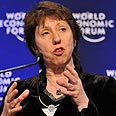
Catherine Ashton, European foreign policy czar, playing nice with her friends in the Arab League
(Associated Press)

Brussels has been too eager to let its friends in the Arab League off the hook.
Predictably, Ms. Ashton's tour of the Middle East is focusing on advancing peace between Israelis and Palestinians—cajoling Israel to indulge the Palestinian Authority, and convincing Arab regimes to do their share. But this attitude reflects a shocking double standard in the way the EU conducts its relations with Israel and the Arab countries. It also fails to serve Europe's interests in the region.

By prioritizing the Palestinian-Israeli dispute over other regional goals, the EU is allowing its interests to be at the mercy of the Palestinians' intramural power contests and Israeli's coalition politics, not to mention Arab tyrants and the greater radical Islam movement.

With tunnel-vision for a Palestinian-Israeli solution, Europe is bowing to supposedly moderate Arab regimes that are recalcitrant about promoting democracy, strengthening civil society, fighting corruption, and improving governance. As they are no doubt telling Ms. Ashton during her first visit to the region, they are prepared to help in the quest for a negotiated Palestinian-Israel solution, but in exchange, Europe must forgo its demands for change inside their own societies. Perhaps that's why, in Ms. Ashton's speech in Cairo on Monday, she contented herself with pressing Hosni Mubarak's repressive autocracy to join efforts to "move from conflict management to conflict resolution" between Israelis and Palestinians. Meanwhile, she made no mention of the woes suffered by more than 80 million Egyptians, not once uttering the words "rights," "governance," or "democracy."

And so it goes: Authoritarian Arab regimes whose policies run contrary to European interests and values get off the hook, while Israel—a democracy and Europe's best economic partner in the area—stays in the doghouse.

Europe can't afford to delay addressing other pressing regional problems because of a stalled Palestinian-Israeli peace agreement. Good governance and respect for human rights in the Maghreb or the Levant are not impeded by the Palestinian-Israeli dispute. Indeed, respectable leadership at home is something the EU should require of its Arab interlocutors in exchange for economic aid, direct investment, and political partnerships. It is risible to use the absence of Palestinian statehood as a pretext to disregard most Arab countries' need for internal reforms, and to ignore their unfulfilled commitments with the EU Association Agreements.

Similarly, denying Israel an upgrade in relations makes little sense. Europe and Israel share values and interests: Israel is a representative democracy, it is an open society, it has a vibrant free press, and it is a robust economy with much to offer Europe thanks to its dynamic, innovative, high-tech-oriented business environment. Israel is an island of stability in a sea of confusion, and an oasis of freedom in the authoritarian desert the Middle East continues to be. Seeking a closer political and economic relationship with Israel thus makes perfect sense and should not be made hostage to a peace process that for almost 10 years now has shown few signs of progress anyway.

Ms. Ashton can rectify the situation by recognizing that regional challenges are quite distinct from the peace process. She could also assert their urgency for many Middle Eastern regimes, and stress that a lack of progress on the Palestinian-Israeli peace process should not become an excuse for dawdling with advancement on other tracks. The EU should rebalance its priorities in the Middle East, and rate developments in other fields at least as high as progress between Israel and Palestine.

Decoupling that conflict from other regional challenges does not mean relegating peacemaking to a secondary role; it means refusing to let vital European interests become hostage to it, and demanding that Arab regimes stop using the Palestinian-Israeli conflict as a pretext for procrastination. It means recognizing that some regional challenges exist quite independently of Israel's existence, and the non-existence of a Palestinian state.

It also means the EU could free itself to upgrade ties with Israel, independent of its troubles with the Palestinians. Clearly, there is much to be gained in an ever-closer relation between Brussels and Jerusalem, and Israel's experience in such disparate fields as homeland security and renewable energy technologies makes closer cooperation particularly desirable from a European standpoint.

Finally, an upgraded political relationship would strengthen, not weaken, Europe's ability to influence Israeli thinking and acting, not least by redressing the current imbalance in Europe's attitude to the region. There is Europe's real chance to help, not hamper, progress for peace.

*Mr. Ottolenghi is a senior fellow with the Foundation for Defense of Democracies, and the author of "Under a Mushroom Cloud: Europe, Iran and the Bomb" (Profile Books, 2009).

The Palestinians' beef with Israel isn't territorial—it's existential.

From The Wall Street Journal, 15 March 2010, by BRET STEPHENS:

The Settlements Aren't the Problem
...as last week's diplomatic eruption over the prospective construction of 1,600 housing units in municipal Jerusalem shows, the settlements are a constant irritant to the United States, one friend Israel can't afford to lose.

The Palestinians' beef with Israel isn't territorial—it's existential.
So it would be a splendid thing for Israel to tear down its settlements, put the settlers behind its pre-1967 borders and finally reach the peace deal with the Palestinians that has been so elusive for so long.

Except for one problem: The Israeli-Palestinian conflict isn't territorial. It's existential.
Israelis are now broadly prepared to live with a Palestinian state along their borders. Palestinians are not yet willing to live with a Jewish state along theirs.

That should help explain why it is that in the past decade, two Israeli prime ministers—Ehud Barak in 2000 and Ehud Olmert in 2008—have put forward comprehensive peace offers to the Palestinians, and have twice been rebuffed. In both cases, the offers included the division of Jerusalem; in the latter case, it also included international jurisdiction over Jerusalem's holy places and concessions on the subject of Palestinian refugees. Current Prime Minister Benjamin Netanyahu has also offered direct peace talks. The Palestinians have countered by withdrawing to "proximity talks" mediated by the U.S.

It also helps explain other aspects of Palestinian behavior. For Hamas, Tel Aviv is no less a "settlement" than the most makeshift Jewish outpost on the West Bank. The supposedly moderate Fatah party has joined that bandwagon, too: Last year, Mohammed Dahlan, one of Fatah's key leaders, said the party was "not bound" by the 1993 Oslo Accords through which the PLO recognized Israel.

Then there is the test case of Gaza. When Israel withdrew all of its settlements from the Strip in 2005, it was supposed to be an opportunity for Palestinians to demonstrate what they would do with a state if they got one. Instead, they quickly turned it into an Iranian-backed Hamas enclave that for nearly three years launched nonstop rocket and mortar barrages against Israeli civilians. Israel was ultimately able to contain that violence, but only at the price of a military campaign that was vehemently denounced by the very people who had urged Israel to withdraw in the first place.

... the sad fact is that the most important thing Israel's withdrawal from Gaza accomplished was to expose the fanatical irredentism that still lies at the heart of the Palestinian movement.

The withdrawal exposed other things too. For years, Israel's soi-disant friends, particularly in Europe, had piously insisted that they supported Israel's right to self-defense against attacks on Israel proper. But none of them lifted a finger to object to the rocket attacks from Gaza, while they were outspoken in denouncing Israel's "disproportionate" use of retaliatory force.

Similarly, Israel withdrew from Gaza with assurances from the Bush administration that the U.S. would not insist on a return to the 1967 borders in brokering any future deal with the Palestinians. But Hillary Clinton reneged on that commitment last year, and now the administration is going out of its way to provoke a diplomatic crisis with Israel over a construction project that...is plainly in keeping with past U.S. undertakings.

In the past decade, Israelis have learned that neither Palestinians nor Europeans can be taken at their word. That's a lesson they may soon begin to draw about the U.S. as well. Which is a pity for many reasons—not least because it gives the settler movement every excuse it needs to keep rolling right along.

Monday, March 15, 2010

EU diplomatic corps a dud under Ashton

From The Telegraph (UK), 15 Mar 2010, by Martin Banks, in Brussels:

[Catherine ] Ashton, ...Europe's foreign minister, was yesterday accused of political "weakness" as she was blamed for an impasse that will significantly delay the creation of a new EU diplomatic corps.

Catherine Ashton blamed for political 'weakness' delay to EU diplomatic corps

The service [called the External Action Service (EEAS)], under her leadership, was supposed to have been established by next month but sources say that infighting between the EU institutions means it will now be summer before it is ready.

...A key obstacle is who will be responsible for the appointment of heads of delegations and staff to the EU's 136 overseas missions ...European Commission... [or] Ashton...

A meeting last Thursday between Lady Ashton and Jose Manuel Barroso, the Commission president, failed to resolve outstanding issues surrounding the corps. The stand-off has triggered further verbal attacks on  ...Ashton, who was plucked from relatively obscurity to lead the EU, and has faced a stream of criticism since taking up her new post on 1 January.

As the High Representative, a job created by the Lisbon Treaty, she had a 20-strong staff, chauffeured car and earns more than Gordon Brown, with an annual salary of £325,000 and generous allowances.

However, with the Commission saying that it should continue to manage the delegations, the tug-of-war over key nominations is set to intensify over coming weeks.

Martin Callanan, a Tory MEP, said, "Barroso recently appointed a former aide to become EU ambassador in Washington without even consulting her. She [has] clearly become something of an easy pushover ...This is down to her weakness and lack of political skills that now threatens to delay the creation of this new service. She doesn't command respect and the penny is starting to drop in Europe that in Baroness Ashton it's gone a dud."

...Ashton has come under fire on several other fronts, including her failure to rush to Haiti after the devastating earthquake on 12 January. She was also slammed for failing to turn up in Mallorca last month for a meeting of EU defence ministers and NATO top brass.

Lady Ashton was last week sent a letter by David Miliband, the Foreign Secretary and one-time favourite to do her job, who voiced concern about infighting between EU institutions ...

Endless Procrastination on Iran

From Commentary Magazine, Sunday, Mar 14, by Emanuele Ottolenghi:

At a weekend retreat in Finland, the foreign ministers of the EU met alongside the Turkish foreign minister, Ahmet Davutoglu.  ...among the conclusions emerging from the gathering, there is the admission by the French foreign minister, Bernard Kouchner, that there is little chance that new sanctions will be passed by the UN Security Council before June. Citing objections from China and Russia, Kouchner said: “We are … talking and talking, trying to get an agreement by negotiation and at the same time working on sanctions. I believe that yes, before June it will be possible, but I’m not so sure.”

Nor is there certainty about the alternative – which, according to the news report, would be unilateral sanctions by the EU and the U.S.

Clearly, there are obstacles on the road to unilateral sanctions – philosophically, many EU countries oppose unilateralism and wish to proceed only after the UN has given the green light. Then, there is the skepticism about sanctions that are not binding on some of Iran’s main trading partners because such measures would fail to bite.

In short, sanctions, even limited ones, are a long way away, and it does not offer any succor to know that EU ministers are “talking about it.”

The fact of the matter is, the last time sanctions were approved was in March 2008, when UN Security Council Resolution 1803 was approved. That was two years ago. Then there was a U.S. presidential election. Then there was a U.S. policy review. Then there were Iranian presidential elections that nobody wished to interfere with. Then there was a summer holiday that nobody wished to spoil. Then there was a U.S. effort to engage the Iranian regime that nobody wished to undermine. Then there was a failed nuclear deal that everyone thought was a win-win situation. Then there was an end-of-the-year deadline that came and went without any Plan B ready to roll out on Jan. 1. Then there was the talking to convince China and Russia (to say nothing of Turkey, which meanwhile became a member of the Security Council), and now there is more talking for Plan C in case Plan B fails. What will the next reason for delay be?

The bottom line is that these are excuses, pretexts, and little else.

There is abundant evidence of Iranian mischief. There is nothing new by now about Iran’s policy of stalling talks. Russian and Chinese interests remain unchanged. The available options for sanctions have been dissected, debated, weighed, assessed, and are known.

It therefore comes down to the following: do the U.S. and the EU wish to stop Iran’s nuclear quest? If so, are they prepared to pay the political price required to make, at least, an honest and worthy effort? Are they willing to face up to the reality that there is simply no international backing for the kind of policies needed to stop Iran now and to avoid conflict in the Persian Gulf later?

If the answer to these questions is yes, there is no need to wait for June. Otherwise, we know what a June deadline means – it means more stalling, more temporizing, more talking, and more procrastinating.

Friday, March 12, 2010

Reluctance in Europe for sanctions on Iran

From the Washington Post, Thursday, March 11, 2010, by Steven Mufson:

Congress and the Obama administration are stepping up pressure on private companies to stop doing business with Iran, but their efforts are running into  ...reluctance in Europe and a host of elusive trading companies eager to sell gasoline and other goods to Iran.

To deter Iran from developing a nuclear weapons program, the House and the Senate have approved separate bills that would impose sanctions on companies that supply gasoline to the Islamic republic and on the insurance, reinsurance and shipping companies that facilitate such trade. And in the past few weeks, a variety of companies -- including Ingersoll Rand, Caterpillar, Siemens and Huntsman -- have indicated they will stop or have stopped doing business with Iran.

But a senior European Union official has written to Secretary of State Hillary Rodham Clinton voicing opposition to congressional efforts to impose U.S. sanctions on European companies.

In a Feb. 26 letter, Catherine Margaret Ashton, the E.U.'s high representative for foreign affairs and security policy, expressed "the EU's deep concern" about the bills because they "envisage the extraterritorial application of U.S. legislation and would therefore be contrary to the EU-U.S. understanding of 1998, under which it was agreed that such sanctions would not be applied to the EU in the light of the EU's commitment to work with the U.S. to counter the threat that Iran poses to international security."

The United States is trying to choke off the 130,000 barrels a day of gasoline that oil-rich Iran imports because it lacks adequate refining capacity.

News reports Wednesday said Royal Dutch Shell Group would no longer sell gasoline to Iran, though industry sources said Shell has not sold gasoline to Iran since last year. Trading giant Vitol also has said it would end gasoline sales to Iran.

But oil industry sources said that Iranian front companies were securing gasoline supplies from Abu Dhabi and Dubai in the United Arab Emirates and from Bahrain, and that some companies in Iraq were making purchases on Iran's behalf. "All you are doing is transferring sales from one company to another," said a trader in Kuwait.

As the United States seeks to rally international pressure, Iran has taken steps to wean itself from imports, which provide 40 percent of its gasoline supplies. Though gasoline there is still heavily subsidized, costing 38 cents a gallon, the government has cut quotas. The U.S. Energy Information Administration said Iran's refinery investments would make it self-sufficient by 2013. Iran also has been stockpiling gasoline; in January, the National Iranian Oil Products Distribution Co. said inventories rose by 3.77 million barrels in nine months, enough to supply all the country's needs for about a month.

"We've discussed ideas for putting additional pressure on Iran," said State Department spokesman P.J. Crowley, referring to talks among the five nations coordinating policy to deter Iran from acquiring nuclear weapons. He said the United States has zeroed in on energy and financial firms, telling them that "if they choose to do business with Iran, it can have commercial implications."

Wednesday, February 24, 2010

European hand-wringing over forged passports, but not over cold-blooded mass terrorism

From WSJ, Tuesday February 23, 2010, by Gerald M. Steinberg, who teaches political science at Bar Ilan University and heads NGO Monitor:

The headlines and video images allegedly showing Israeli spies in Dubai are titillating, but they mask the serious issues involved in the death of Hamas terrorist Mahmoud al-Mabhouh. Along with predictable European hand-wringing over forged passports, this case is the latest example of the failure of the international legal system and the United Nations to provide a remedy to mass terror.

Al-Mabhouh was a cold-blooded murderer—in an interview just last year on Al Jazeera he boasted about kidnapping and then killing two Israeli soldiers. He was also a major figure in arranging arms shipments from Iran to Gaza. Al-Mabhouh shared responsibility for the thousands of rocket attacks fired at civilians in Sderot and other Israeli towns, which resulted in last year's war in Gaza. In his travels, the Hamas terrorist was probably making arrangements for the next round of attacks.

But international law provides no means for stopping terrorists like Al-Mabhouh, or for his Hezbollah counterpart, Imad Moughniyeh, whose life ended with an explosion in Damascus in 2008. (In addition to numerous attacks against Israelis, Moughniyeh has been blamed for the 1983 Beirut bombings that killed hundreds of American and French peacekeepers and the murder of Lebanese President Rafik Hariri.) Cases involving Muslim terrorists, supported by Iran, would never be pursued by the prosecutor of the International Criminal Court, or raised in the framework of the United Nations. Al-Mabhouh violated the human rights of untold Israeli civilians, but the U.N.'s Human Rights Council—which is dominated by such moral stalwarts as Libya, Algeria, and Iran—has no interest in Israeli complaints.

It is equally hard to imagine Interpol issuing arrest warrants in response to Israeli requests. And if warrants were issued, history shows that German, French, Belgian, and other European governments would not risk the consequences of acting on them. Little effort was ever made to apprehend the perpetrators of the Munich Olympic massacre, or of the deadly bombing attacks against synagogues in Istanbul and Athens. It's a widely known secret that European governments had ungentlemanly agreements with the PLO that allowed the Palestinians to operate from their territories, provided the terror attacks occurred elsewhere. Not until 2003 did the EU even put Hamas on its terror list. Hezbollah is currently free to operate in Europe.

The bitter reality is that for Israel, international legal frameworks provide no protection and no hope of justice. Instead, these frameworks are used to exploit the rhetoric of human rights and morality to attack Israel. In European courts, universal jurisdiction statutes, initially created to apprehend and try dictators and genocidal leaders, are now exploited as weapons in the service of the Palestinian cause. In this way, Israeli defense officials are branded as "war criminals."

Similarly, Richard Goldstone's predetermined "fact finding inquiry" into the Gaza war makes no mention of Al-Mabhouh or Iran, which supplied Hamas with over 10,000 rockets for attacks against Israelis. Mr. Goldstone and his team have remained silent about what would be the "legal" way to bring jihadi murderers to justice. In their efforts to demonize Israel, Palestinian terror actually doesn't really exist. The Goldstone team simply refused to accept conclusive Israeli video evidence of Hamas war crimes.

The same legal distortions are found among the organizations that claim to be the world's moral guardians, such as Human Rights Watch. HRW's systematic bias is reflected in a Middle East division that sees no problem in holding fund-raising dinners in Saudi Arabia—one of the world's worst human rights violators and a country officially still at war with Israel—to help finance their campaigns against the Jewish state.

In the absence of any legal remedies or Western solidarity, Israel's only option to protect its citizens from terror has always been to act independently and with force.

When in 1976 a group of Palestinian and German terrorists hijacked an Israel-bound Air France plane to Uganda and separated the Jewish passengers, Israel decided to act. In a daring mission, it rescued all but three passengers while killing all terrorists and several Ugandan soldiers who had been protecting the terrorists. Back then, Israel's detractors also fretted about the "violation of Ugandan sovereignty" even though dictator Idi Amin was in cahoots with the terrorists. Entebbe, though, quickly became the gold standard for successful counter-terror operations. Only a year later, Israeli-trained German special forces freed in Mogadishu, Somalia a Lufthansa plane hijacked by Palestinian terrorists. Similarly, when after years of horrific suicide bombings Israel pioneered the targeted killings of Hamas terrorists—often with the help of unmanned drones—Israel's Western adversaries complained about "extrajudicial assassinations." Today, though, U.S. forces have copied Israel's technique with their own drone killings of jihadi terrorists in the Afghan-Pakistan border region.

Unlike those Predator strikes, though, which hardly raise an eyebrow in the West these days, there was no "collateral damage" in the mysterious Dubai hit. No innocent civilians were hurt, no buildings were damaged. Justice was done, and al-Mabhouh's preparations for the next war ended quietly.

All this is lost on those diplomats, "legal experts," and pundits who blame Israel for Dubai, and angrily denounce the passport infractions. In the absence of viable alternatives, and a refusal to share any of the risks, they are in no position to condemn actions aimed at preventing more terror.

Sunday, February 21, 2010

IAEA report confirms ‘military intentions’ of Iran

From JPost, 21/02/2010, by HAVIV RETTIG GUR AND AP:

... an International Atomic Energy Agency report released on Thursday that says Iran may be developing a nuclear warhead.

...Noting that the report is the first during the term of new IAEA chief Yukiya Amano of Japan, Israel said it “establishes that the agency has a lot of trustworthy information about the past and present activities that testify to the military tendencies of the Iranian program.”

Among these activities were the recently declared decisions to enrich uranium to 20 percent and the continued construction of the Qom nuclear facility, kept secret until it was discovered by Western intelligence agencies and made public in recent months.

The UN nuclear agency report suggested for the first time that Teheran had either resumed such work or had never stopped when US intelligence thought it did.

Thursday’s report appeared to put the UN nuclear monitor on the side of Germany, France, Britain and Israel.

...The confidential IAEA report said Iran’s resistance to agency efforts to probe for signs of a nuclear cover-up “give rise to concerns about possible military dimensions to Iran’s nuclear program.”

...The language of the report appeared to be more directly critical of Iran’s refusal to cooperate with the IAEA than most of those compiled by Amano’s predecessor, Mohamed ElBaradei of Egypt.

It strongly suggested that intelligence supplied by the US, Israel and other IAEA member states on Iran’s attempts to use the cover of a civilian nuclear program to move toward a weapons program was compelling...

...Meanwhile on Friday, Russia’s foreign minister said he was “very alarmed” over Iran’s failure to prove its nuclear program is peaceful, suggesting Moscow may be closer to acceding to Western demands for new UN sanctions against Teheran.

“We are very alarmed, and we cannot accept that Iran is refusing to cooperate” with the IAEA, Lavrov said on Ekho Moskvy radio. He added that he did not understand the need for Iran to conduct its nuclear program in secret, withholding information from the IAEA...

...Susan Rice, the US ambassador to the United Nations, said the IAEA report “underscores that Iran continues to flout its international obligations” and indicates that Teheran is pursuing “a nuclear weapons program with the purpose of evasion.”

The United States has circulated elements for a possible new UN sanctions resolution to other veto-wielding UN Security Council members – Russia, China, Britain and France – and Germany. The six countries have been trying, to no avail, to get Iran to suspend its uranium enrichment program and return to negotiations on its nuclear program.

...“We now have no other choice, given this report, than to seek, together with our partners, the adoption of new measures by the UN Security Council over the next few weeks,” the [French Foreign Ministry] said in a statement.

The United States and its Western allies have been pushing for a fourth round of UN sanctions. But China, which relies on Iran’s energy exports, is skeptical of any new sanctions.

Friday, January 22, 2010

European Commission hides criteria for funding NGOs

From THE JERUSALEM POST Jan. 21, 2010, by Dan Izenberg:

NGO Monitor, a Jerusalem-based watchdog organization, announced on Wednesday it has filed suit against the European Commission of the European Union, demanding that it meet its own transparency requirements and disclose internal documents revealing the decision-making process and criteria for funding Israeli and Palestinian nongovernment organizations.

Gerald Steinberg, the president of NGO Monitor, said at a press conference in Jerusalem that the EU has contributed at least NIS 177 million since June 2005 to about 150 Israeli and Palestinian NGOs, most of which he said demonized and delegitimized Israel.

...On October 23, 2008, Steinberg asked the EC for the transcripts of meetings relating to the funding decisions for grants to Israeli and Palestinian NGOs for the past three years under the PfP (the Partnership for Peace) and EIDHR (European Instrument for Democracy and Human Rights) programs. He also asked for other reports and documents.

It took six months for the EC to respond to the request, but even then it only sent a small number of documents and only after whiting out substantial parts of their contents, charged Steinberg.

The EC told Steinberg it could not provide more information because disclosure would undermine public security and also damage privacy and commercial interests.

Attorney Trevor Asserson said none of these were applicable to Steinberg's request. "The EC is throwing up a cloud of obfuscation," he charged.

Steinberg alleged that of the roughly 70 Israeli NGOs that receive funding from the EC, three-quarters demonize and delegitimize Israel. These, he charged, included B'Tselem, Hamoked Center for the Defense of the Individual, Yesh Din, Ir Amim, Bimkom, The Public Committee against Torture in Israel, Adalah, The Israel Committee against House Demolitions, Gisha, The Association for Civil Rights in Israel, Peace Now, Mossawa, Breaking the Silence, Machsom Watch and The Center for Alternative Information.

Steinberg added that he regarded all organizations calling for a boycott, divestment or sanctions against Israel as being anti-Israeli political organizations....

Friday, January 08, 2010

Israel: more isolated today than at any time since 1948

From The Jerusalem Post, 6/1/10 by Isi Leibler:

Don't be fooled by  ... the appearance of tranquility that seemingly prevails with respect to US-Israel relations......The current hiatus, during which Israel has been placed on the back burner, is due to the fact that President Barack Obama has had his hands full with other crises. Wrangling over health-care reform, dilemmas over how to handle Afghanistan and critiques about his disastrous policy of engaging with tyrants have dramatically eroded his standing even with liberal supporters. This applies especially to the degrading Iranian responses to the administration's groveling efforts to appease them.

INDEED, OBAMA'S recent pronouncements indicate that he may have internalized some of these issues and actually taken a few steps back. His Nobel Prize acceptance speech endorsing the need to combat evil and the obligation to use force, as exemplified in the war against Nazism, was an effort to modify his emerging portrayal in the media as an impotent pacifist.

...Although Congress has affirmed its support for the Jewish state, the administration has in no way signaled any deviation from its initial determination to publicly downgrade the special relationship maintained by former administrations.

In fact, new pressures are looming. European hostility is exemplified by the new EU representative for foreign affairs, Catherine Ashton, who in her maiden speech bitterly criticized the "Israeli occupation," described the temporary freeze as merely "the first step," referred to east Jerusalem as occupied territory, called for a lifting of the blockade of Gaza and expressed renewed opposition to the security fence. Her speech contained no condemnations of Hamas or calls on the Palestinians to cease their incitement. The Europeans are clearly maneuvering to force Israel to return to 1967 borders and negotiate directly with Hamas.

Global pressure is now also mounting to implement the secret and unauthorized offers extended by former prime minister Ehud Olmert to the Palestinians in the dying days of his tenure, when he desperately sought to end his term with a dramatic breakthrough on the peace process. The deal, which PA President Mahmoud Abbas rejected, included ceding all territory gained in the Six Day War, with a few land swaps to retain the major settlement blocs. Olmert even offered to hand over control of the Temple Mount to an international body controlled by Arabs. The lame-duck prime minister initiated this without reference to his cabinet, the Knesset or any other group - and the Netanyahu government has from the outset been adamant that it considers itself in no way obligated to honor these extraordinary unauthorized initiatives.

CURRENTLY, ABBAS appears intent on doing nothing, relying on the international community to continue beating up Israel and extracting unilateral concessions. He even proclaimed that he would not resume negotiations until the international community affirmed that the Palestinian state would adhere to the 1967 borders. However, should he come to his senses and agree to renew discussions, he has repeatedly insisted that the opening benchmark of future negotiations must be based on the offers extended to him by Olmert, despite having previously rejected them. He also seems confident that in order to boost his standing against Hamas, the Americans would press Israel to make further concessions.

There is said to be an internal debate within the US administration whether or not to publicly announce a plan which would probably be similar to the European plan. Secretary of State Hillary Clinton has already referred to an independent Palestinian state "based on 1967 lines and agreed swaps." That would certainly result in a major confrontation with the Israeli government.

These pressures are likely to impact us simultaneously with new initiatives by our enemies, who will undoubtedly exploit the Goldstone report to further demonize and delegitimize us. The UN and other foes of Israel will soon be launching major campaigns calling on the International Criminal Court to charge Israel with crimes against humanity as well as intensifying efforts to indict individual political and military leaders for war crimes.

WE SHOULD have no illusions. The situation is grave. Tough days lie ahead, and we are probably more isolated today than at any time since the birth of the state.

Netanyahu has offered the Palestinians an independent demilitarized state and a settlement freeze - far more than Yitzhak Rabin was willing to concede. Yet he is rebuffed by the Palestinians and accused of being intransigent by the global community, while the Americans, at best, sit on the sidelines. In fact, Obama went so far as to relate to the neighborhood of Gilo in Jewish Jerusalem as an area of contention, complaining that construction in the area "embitters the Palestinians in a way that could end up being very dangerous."

We must prepare ourselves...

Monday, December 21, 2009

The War Over Jerusalem

From History News Network, 21/12/2009, by Dr Daniel Mandel, Fellow in History at Melbourne University and author of H.V. Evatt and the Establishment of Israel: The Undercover Zionist (Routledge, 2004):

Israeli-Palestinian negotiations are foredoomed for now. The party conference of Mahmoud Abbas’s Fatah in August – where the platform, resolutions and speakers from Abbas down rejected Israel’s self-identity as a Jewish state and any attempt to delegitimize terrorism against her – tells us as much. But diplomatic flurry often obscures matters, and one might believe that issues like refugees or borders remain the key – or Jerusalem.

In recent weeks, President Barack Obama returned Jerusalem to the limelight when he described continued Jewish apartment building in eastern parts of the city as being “very dangerous” – a euphemism for the threat of Palestinian violence. Then, this past week, the European Union backed Palestinian demands that eastern Jerusalem become a future Palestinian capital.

Jerusalem has been a diplomatic flashpoint since 1949. That is one of the less fortunate legacies of Dr. H.V. Evatt, Australian external affairs minister at the time.

In 1947, Evatt played a pivotal role in persuading the UN to adopt a partition plan calling for Arab and Jewish states in British-controlled Palestine. However, facing elections at home in December 1949 and with an eye to the large Australian Catholic vote, on which his Labor government depended, he ensured the plan called for internationalizing Jerusalem, which neither side wanted, but which the Vatican did.

It did not work out that way. Arabs rejected partition, with the result that Palestine was partitioned by war, not agreement. Jerusalem ended up divided between Israel and Jordan. Both opposed internationalization when Evatt successfully introduced a U.N. resolution to that effect this month sixty years ago.

International fixation on Jerusalem has been with us since, even if enthusiasm for internationalizing the city quickly receded. U.N. committees and trusteeship proposals devoted to Jerusalem provided a special, exploitable focus for the anti-Israel cause. But this was afforded practical outlet only when Israel came into possession of the city’s eastern half after repelling Jordanian assault in 1967.

Historically and religiously of relatively low importance to Islam – it is never mentioned in the Quran – Jerusalem used to transfix few Muslims, while its Jewish roots had once been freely acknowledged by them.

Under Jordanian control (1948-67) eastern Jerusalem had degenerated into a provincial backwater, of little interest to Arab rulers. Saudi princes never dropped in to Jerusalem to pray at the Dome of the Rock or the Al Aqsa mosque when visiting the fleshpots of nearby Beirut. As late as the 1920s, publications of the Jerusalem waqf, the Muslim religious trust, spoke plainly of the Temple Mount, upon which the mosques are built, as the historical site of Jewry’s Temple.

Today, however, the picture is diametrically opposite.

In Khomeinist Iran, an annual Jerusalem Day parade instituted in 1979 and attended by crowds of up to 300,000 tops all other dates in the regime’s activist calendar. Fatah, which only mentions Jerusalem en passant in its constitutive documents, today boasts a terror group called the Al Aqsa Martyrs Brigades.

A profusion of Palestinian statements and Muslim clerical rulings on Jerusalem speak variously of an historical Jewish presence, if at all, as having been brief; of the non-existence of the biblical temples, or of their location elsewhere; and of the Western Wall, Judaism’s holiest extant site, being actually a Muslim one.

Such sentiments are disseminated widely in the Arab world. A popular piece of Egyptian graffiti declares “It’s our mosque, not their Temple.”

Moreover, Jerusalem has been successfully exploited by violence for diplomatic profit by Palestinian leaders. In 1996, Palestinian riots on the back of Yasser Arafat’s trumped up charge that Israel’s opening of an archeological tunnel endangered the mosques on Temple Mount produced criticism of Israeli provocation.

In 2000, a visit to Temple Mount by Israeli politician Ariel Sharon, pre-arranged with Arafat, was distorted by Palestinian media into a violation of Muslim sanctuaries (which had not in fact been entered), leading to international criticism of Israel and a Palestinian terror wave.

It would therefore appear that President Obama, to put the best construction on his words, did not know what he was doing when he spoke as though there was some correspondence between Israelis building apartments and Palestinians rioting – or worse.

To speak in these terms places a premium on Palestinian violence and increases the probability of its occurrence: the record shows it to be a paying proposition. Noting the European Union’s willingness to publicly side with Palestinian positions rather than support unprejudiced negotiations, Palestinians now have reason to believe that political capital might be exacted by a little violence.

That means that trouble might follow, quite soon.

All of which carries the following implications. For the foreseeable future, peace negotiations will either not resume at all, or lead nowhere, certainly not to a lasting peace. Jerusalem will remain a flashpoint, with violence easily encouraged by public stances taken in favor of Palestinian positions. And Dr. Evatt’s 1949 resolution – conceived in a different world, motivated by domestic political calculations long forgotten – will demonstrate anew the law of unintended consequences.

Ayalon: EU won't cut our ties with Jerusalem

From Ynet News 19 December 2009, by Roni Sofer:


Catherine Ashton, EU's new minister for foreign affairs

Jerusalem continues to be at heart of dispute between Israel, European Union...

Catherine Ashton, the EU's foreign affairs chief, referred to the Israeli capital as "occupied territory" at a speech given earlier this week, prompting Ayalon to state that "just as the Romans failed to severe Israel's ties with Jerusalem, so will the EU's and UN's diplomats."

Saturday's comment by Ayalon also addressed the prospects of the Swedish initiative – declaring east Jerusalem the capital of the future Palestinian state – coming to pass despite the motion's rejection by Israel.

"If any unilateral decisions are made it would be crossing a red line and Israel will no longer be obligated by any post–Oslo deals," he said. Israel will also see such a move "as legitimizing unilateral moves on its part."

As for Israeli-Palestinian peace negotiations, Ayalon said that "... [Abbas is] not really interested in peace.... He is trying to blame Israel for his refusal to progress towards peace...." ...

Friday, December 11, 2009

Europe Seeks to Divide Jerusalem

From the Jerusalem Center for Public Affairs, Jerusalem Briefs Vol. 9, No. 14, 10 December 2009, by Dore Gold* [synopsis only - follow the link to the full article]:
  • According to the 1993 Oslo Agreements, Jerusalem is one of the issues to be discussed in future permanent status negotiations. The Swedish move to have the European foreign ministers back a declaration recognizing eastern Jerusalem as the capital of a future Palestinian state clearly pre-judges the outcome of those talks.
  • When the EU foreign ministers met on December 8, they issued a statement that only partly softened the Swedish draft. It dropped the reference to the Palestinian state being comprised of "the West Bank and Gaza with East Jerusalem as its capital," but still retained a proposal that envisions "Jerusalem as the future capital of two states."
  • The EU statement insisted that the EU "will not recognize any changes in the pre-1967 borders" without the agreement of the parties. Yet by enshrining the 1967 lines as a previous political border, the EU was ignoring that these were only armistice lines and not a recognized international boundary. In fact, it was UN Security Council Resolution 242 which acknowledged that the pre-1967 lines might change.
  • By waving the carrot of a statement of support for eastern Jerusalem to be part of a Palestinian state, the Swedes are causing Mahmoud Abbas' advisors to believe that if they avoid bilateral negotiations with Israel, they can create the political environment for third party intervention to their advantage.
  • What is needed is an ongoing Israeli diplomatic effort for Jerusalem, underlining Israel's legal rights and its role as the protector of the holy sites. Unfortunately, European states, which once sought to protect the holy sites of Christianity in Jerusalem, today appear to be oblivious to what would happen to their churches were the Old City of Jerusalem to be given to a Palestinian regime under the influence of Hamas.

Click here to read the full article.


*Dr. Dore Gold, Israel's ambassador to the UN in 1997-99, is President of the Jerusalem Center for Public Affairs.

Wednesday, August 26, 2009

Developments in Iran's Missile Capabilities Threaten Europe

From JCPA, 25/8/09, by Uzi Rubin*:


Click here to download the

Full Article -- Powerpoint Presentation

  • Iran is vigorously pursuing several missile and space programs at an almost feverish pace with impressive achievements. The Iranians have upgraded their ballistic missiles to become satellite launchers. To orbit a satellite is a very complicated project. There are missile stages, and a careful guidance and control system to insert the satellite into a stable, desired trajectory. They took the Shahab, extended it a bit, added more propellant, and now they have the Safir space launch vehicle. Moreover, the Iranians built a two-stage satellite launcher, instead of the usual three stage rockets for space-lift vehicles. This is incomparable to anything we know - an impressive engineering achievement.

  • In spite of the Missile Technology Control Regime and in the face of sanctions, Iran has succeeded in acquiring the needed infrastructure and to raise a cadre of proficient scientists and engineers backed by academic and research institutes. Iranian missile technology is moving ahead of the level developed by the North Koreans.

  • The solid-propellant Sejil missile signifies a breakthrough. This missile already poses a threat to a number of European Union countries. Based on its demonstrated achievements in solid propulsion and staging, Iran will face no significant hurdle in upscaling the Sejil into a compact, survivable intermediate-range ballistic missile. A range of 3,600 km. will be sufficient to put most of the EU under threat.

  • Contrary to an initial report by U.S. and Russian scientists for the EastWest Institute, with the Sejil, Iran has demonstrated its proficiency in using solid-fuel rockets that have much shorter preparation times than do older liquid-fuel missiles. The West must already prepare for the period in the not-too-distant future when Iran deploys nuclear warheads on its missile forces, which can be dispersed in mountainous regions of Iran and will not be easy to find.

Click here to read the full article.

*Uzi Rubin has been involved in Israeli military research, development, and engineering programs for almost forty years. Between 1991 and 1999 he served as head of Israel's Missile Defense Organization, and in that capacity he oversaw the development of Israel's Arrow anti-missile defense system. He was awarded the Israel Defense Prize in 1996. This Jerusalem Issue Brief is based on his presentation to the Institute for Contemporary Affairs in Jerusalem on August 6, 2009.

Saturday, August 08, 2009

Eureka! Israel to head the world's largest R&D initiative

From THE JERUSALEM POST, Aug. 6, 2009, by Karin Kloosterman:

...As evidence of its leading role in research and development, Israel has been chosen to head the largest R&D network in the world, the "Eureka initiative," a pan-European, inter-governmental initiative that supports European innovation and sees investments of 1.5 billion euros every year.

Since joining the program in 2000, Israel, the only non-European member country, has been among the most active of the 40 members.

...Israel Shamay, Israel's national project coordinator for Eureka, from the Israeli Industry Center for R&D (MATIMOP)... believes that the vote that led to an Israeli representative being chosen to chair the network was an obvious choice, after Israel proved itself among the member countries.

"In the last three years, Israel became one of the five most active members in Eureka and had the same number of projects compared to [EU] countries, which are much bigger. Out of nearly 300 new projects initiated by Eureka, in 2008, we had 40 with Israeli companies participating in them."

Some of the more successful pairings since Israel joined Eureka are between the Israeli agricultural company Veterix, and DeLaval, a Swedish milk industry giant. Veterix developed a capsule that sits in the stomach of a cow to monitor the health of the animal from within, and worked with the Swedish firm to co-develop the idea.

...Elbit Systems, the Israeli Defense Industries high-tech firm, had several projects in Eureka. One was to take cameras intended for military purposes and develop them for the auto industry. If the windshield fogs up or if there is poor visibility, the camera can still see the road. It's good for truckers, says Shamay.

A third success story is the partnership between Starhome, a Comverse subsidiary in Israel, and Nokia and Alcatel-Lucent to develop a smart home system.

Eureka is the largest joint project R&D initiative in the world. Main objectives are to foster R&D joint ventures between corporations, with financial support matched by representative countries.

Germany is now entering the chair position, with Israel to follow. The project maintains a troika system, with three representatives holding chair positions simultaneously - the past, present and future chairs. The name of the Israeli chairperson has not yet been announced.

SHAMAY IS hoping that Israel's upcoming leading role in Eureka will impact positively on the country's industrial development. "Over this period of one year, Israel will determine the agenda of Eureka and can prioritize along with our national interests," he says, pointing out that Israel could initiate new funding schemes for startups and companies, bring more EU investment banks and investors to Israel and expose EU countries to Israel's binational projects like the Red-Dead canal, proposed between Israel and Jordan.

Chief Scientist Dr. Eli Opper said in an interview with Israel's financial newspaper Globes: "During its year as president of Eureka, Israel will be able to set its agenda, which will enable us to promote important initiatives with European support, such as strengthening R&D in low technology industries or in other priority fields, such as the life sciences, water technologies and the environment."

..."In our case [funding comes from] the Chief Scientist's Office. Eureka provides a platform to initiate this cooperation and provides a legal framework," explains Shamay. "It's important to note it's a national task, so we are involving the President of Israel (Shimon Peres), Israel's Ministry of Foreign Affairs, the Ministry of Science and the Israel Venture Association. We invite all of them to take part in this opportunity," he adds.

Israel has other successful partnerships underway in EU R&D programs, in the EU Seventh Framework Programme for R&D, and in Galileo, a global satellite navigation program.

Friday, August 07, 2009

Israel pushing for sanctions on Iran

From Ynet News, 7 Aug 2009, by Roni Sofer:

Jerusalem refuses to wait for Security Council resolution, launches diplomatic campaign aimed at pressuring series of leading countries to act against Islamic republic....

Time is running out, and Israel has decided not to depend on the United Nations in terms of sanctions on Iran . The Foreign Ministry has launched extensive diplomatic activities aimed at pressuring a series of the world's leading countries to impose sanctions on Iran, even if the Security Council fails to make such a decision.

Israel is trying to get the United States, Australia, Canada and some leading European countries to tighten the economic blockade and sanctions imposed on the Islamic republic. The goal is to undermine the stability of the Iranian regime, which is weaker than perceived by the world so far, in order to force it to choose between preserving its regime and halting its nuclear program.

Prime Minister Benjamin Netanyahu, Foreign Minister Avigdor Lieberman and Defense Minister Ehud Barak have been holding discussions recently on "the day after" the talks between the Obama administration and the Ahmadinejad regime fail. This is scheduled to happen next month, according to a timetable set by the Americans.

...the foreign minister said there was a possibility that China – and perhaps Russia as well – would prevent the UN Security Council from imposing severe sanctions on Iran.

...If Obama's dialogue with Iran fails, and China and Russia thwart tough Security Council sanctions, Lieberman believes Israel must aim to have a separate blockade imposed by each Western country, ...[including] the European Union countries and the organization in Brussels, Canada, Australia and of course the US, which would lead the entire move.

..."Only tough sanctions, which will not allow the Iranian regime to continue ignoring the world, will make it possible to stop the nuclear plan," the foreign minister said.

...such effective action is the only way to really threaten Ahmadinejad's regime, which is weak as it is, ahead of the possibility of forceful action.


Israel believes that an effective blockade could lead to one of two outcomes: Causing Ahmadinejad to halt the nuclearization process – in order not to lose power in Tehran, or replacing the Ayatollah regime by the Iranian people, who are aware of the atmosphere in the free world, as seen following the recent presidential elections.

In addition, Israel hopes, such a situation will also harm Iran's satellite organizations – Hamas and Hezbollah.

Monday, July 27, 2009

A Diplomatic Odyssey

From GLORIA, July 20, 2009, by Barry Rubin*:

...And what do [the Sirens: US and Europe] sing to Israel?

More! More! More concessions; take a risk; take a chance; prove you want peace.
  • If you make a deal with Arafat;
  • if you give control over the West Bank and Gaza Strip;
  • if you offer to come down from all the Golan Heights;
  • if you withdraw from south Lebanon, if you withdraw from the Gaza Strip,
  • if you offer a state,

...then we will love you and help you and you will live in peace! We know the future and it will be a future of peace if you only heed us, you silly, stubborn people!

... Blessed are those Israelis who make unilateral concessions for they are called “moderates.” And cursed be those Israelis who don’t make unilateral concessions, for they will be called “hawks” and “hardliners.”

...no sooner is a concession given, a risk taken, that it is forgotten ... And so is the promise of support.

Remember the 1990s’ version of the Sirens’ song? Here’s the plan: Create a Palestinian Authority, give them lots of money and guns. Let them bring in tens of thousands of Palestinians. Turn over more and more of the Gaza Strip and the West Bank. And by governing they will learn responsibility. And Yasir Arafat will become moderate, and a statesman. And there will be no more terrorism or incitement to terrorism. And there will be a two-state solution.

And what about the 2006 song: Stop the war with Hizballah and the UN will establish a strong force to patrol south Lebanon. Hizballah will not be able to return or to build military installations. Arms smuggling will be halted. For we are the entire international community, almost 200 nations strong.

And each time, the chorus goes: if this doesn’t work out, we will support you. We will recognize the risks you have taken, and the concessions you have given, and the losses you have suffered. And the name of Israel will be exalted as a great peacemaker. And the media will say nice things about you.

...If Israel’s leaders and people believed that a freeze in settlement construction would actually bring benefits--either for real peace or for at least real and full Western support based on an understanding that the Palestinian leadership didn’t want peace and that Arab states would do almost nothing to bring it about—it would happen despite all the political obstacles.

But the Israeli public is, for good reasons, doubtful.
...the Israeli public is, for good reasons, doubtful.

If only, we were told Prime Minister Benjamin Netanyahu said that he would accept a two-state solution, how we will appreciate you! And he did. And they didn’t.

How many weeks after the freeze, for example, would the Europeans find some new reason to stop advancing toward Israeli integration with the European Union?

...Repeatedly ...I have raised this issue in private conversations—What about your unfulfilled promises in the past? What about the risks we’ve taken unrewarded? What about all the other concessions that have backfired?--to Western political figures and diplomats. Not a single one responds.

Let me emphasize that: they don’t deny, they don’t apologize, they don’t even make a counter-argument. They simply go on without any reference to what I’ve just said. Not once have I ever heard an effort to address this issue from anyone in an official position. That’s no exaggeration.

... if they refuse even to acknowledge the consequences of their past demands and advice, why should we listen to their latest versions of the same tune?
______________________________________
*Barry Rubin is director of the Global Research in International Affairs (GLORIA) Center and editor of the Middle East Review of International Affairs (MERIA) Journal.