...Glenn Beck, who is holding several rallies in Israel this week, has a better grasp of Middle East politics than most Western experts, not to mention Western leaders.
Certainly, Beck makes silly mistakes on factual matters and details. Yet what’s important is that he comprehends the big picture. ...When people voice absurd and slanderous stereotypes about Beck, it turns out they haven’t actually listened to what he’s been saying.
Why has Beck gotten things right that so many others have missed or distorted? There are five key reasons: Common sense; courage; knowing the difference between right and wrong, willingness to learn, and readiness to admit when one has been wrong. These are virtues often lacking among those with more elegant reputations and impressive diplomas.
What has he gotten right?
1. The main threat in the Middle East is revolutionary Islamism and the United States must combat it.
Revolutionary Islamism includes on its side: Iran, Syria, Hizballah (largely controlling Lebanon), Hamas (governing the Gaza Strip), and the Muslim Brotherhood as well as al-Qaida and, more subtly, the regime governing Turkey. It is an ideology innately hostile to the West, the United States, and Israel. It cannot be bought off or moderated. Revolutionary Islamists will either take over the Middle East or be defeated.
2. The problem is not Islam as a religion but revolutionary Islamism as a political ideology that draws on normative Islam to produce its own plausible interpretation.
While falsely accused of “Islamophobia,” Beck has correctly drawn the distinction between Islam and revolutionary Islamism. Those claiming Islam is “a religion of peace” miss the radicalism easily drawn from its texts as well as the large and growing Islamist forces. Those claiming Islam is inherently extremist miss most of its actual history and the tremendous battle going on among Muslims,
3. The revolutionary Islamist side is winning.
In the last year, revolutionary Islamism has advanced in Egypt, the Gaza Strip, Lebanon, Turkey, and potentially Syria, Libya, and Tunisia.
4. The “Arab Spring” contains many dangers.
The unqualified Western enthusiasm for the “Arab Spring” ignored the threat of growing Islamist power. ...Even now, many are in denial about the Brotherhood becoming Egypt’s strongest single party in parliament and in writing the country’s new constitution. The regime that emerges might not be Islamist but will be radical, anti-American, and dangerously hostile toward Israel.
5. Israel just happens to be largely right and deserves support
Israel has been in a “Twilight Zone” situation. Eighteen years ago, Israel took a tremendous risk for peace by signing an agreement with the PLO, agreeing to establish an armed Palestinian Authority, and negotiating toward the creation of a Palestinian state, Not to mention later offering the Golan Heights to Syria in exchange for peace, withdrawing from south Lebanon, the Gaza Strip, and much of the West Bank.
Yet the more risks for peace Israel took, the more concessions made, the more restraint shown, the more it was slandered and said not to want peace. The more Israel sought a two-state solution, the more people in the West advocated a “no-Israel-state” solution. Beck has cut through this nonsense to point out a simple fact: Israel wants a negotiated compromise and stable peace based on a two-state solution; the Palestinian Authority—not to mention Hamas—doesn’t.
6. One Man’s Terrorist…Is Still a Terrorist
There is no romanticism in the deliberate murder of civilians, systematic incitement of hatred, and goal of establishing a totalitarian society...
7. The Obama Administration has messed up the Middle East to a phenomenal extent...
8. One should be fearless in facing intimidation and politically motivated ridicule...
9. We must reevaluate friends and enemies in this new era of revolutionary Islamism and post-Marxist leftism...
10. Whatever mistakes the United States has made it is a good country and is the hope of the world...
Any criticism one can make of Beck regarding Middle East issues rather pales in comparison to all of the above points on which he is quite correct. But then, as Jews, and Israelis most of all, should know, to be falsely reviled and have one’s image smeared is not proof of being wrong or evil.
... Iran and Hizballah ...planned, orchestrated and funded the coordinated attacks on the Eilat Highway Thursday, Aug. 18 - in which gunmen shot dead eight Israelis and injured 40 - and its sequel: volleys of 90 missiles launched day and night from Gaza against a million Israeli civilians since then.
Yossi Shoshan, 38, from Ofakim, was killed by one of the dozen Grad missiles hitting Beersheba and his home town Saturday night. More than a dozen people were injured, at least one critically.
The prime mover in the missile blitz is Tehran's Palestinian arm, the Jihad Islami, which is responsible for 90 percent of the launches. Hamas is left on the sidelines, cut off for the first time from top levels of authority in Tehran and Damascus.
...Tehran managed to transfer to its Palestinian arm in Gaza, the Jihad Islami, more than 10,000 missiles well in advance of the violence launched three days ago. Most of them are heavy Grads bringing Beersheba, capital of the Negev and Israel's 7th largest town (pop. 200,000), within their 30-kilometer range for a sustained, massive missile offensive.
Tehran has now launched the hardware smuggled into the Gaza Strip ready for a Middle East war offensive for five objectives:
1. To leave Syrian President Bashar Assad free to continue brutalizing his population and ignoring President Barack Obama's demand backed by Europe that he step down.
2. To manufacture a direct military threat on the Jewish state, whose destruction is a fundamental of the Islamic Republic of Iran's ideology.
3. To thwart the Egyptian military junta's operation last week for regaining control of the lawless Sinai Peninsula and destroying the vast weapons smuggling network serving Iran in its capacity as the leading international sponsor of terror.
4. To render the Palestinian Authority Chairman Mahmoud Abbas and his bid for UN recognition of an independent state on Sept. 20 irrelevant. His isolation was brought home to him last Thursday by the coordinated Palestinian terrorist attacks near Eilat last Thursday.
5. To plant ticking bombs around Israel for potential detonation and explosion into a full-blown regional war. debkafile's Washington sources disclose that US Secretary of State Hillary Clinton outlined this peril to Egypt's military ruler, Field Marshall Muhammad Tantawi, Saturday night, Aug. 20, to dissuade him from recalling the Egyptian ambassador to Israel over the deaths of three or five Egyptian police in the melee over the Palestinian terror attack near the Sinai border.
This danger was on the table of Israel's inner cabinet of eight ministers when they met early Sunday to decide on IDF action for terminating the Palestinian missile war.
... three facts stand out from the fog of uncertainty: First, the security crisis besetting Israel has the dangerous potential for dragging the Middle East into a regional war. Second, America and Israel are paying in full the price of their quiescence in the face of Iranian, Hizballah and extremist Palestinian belligerence and active preparations for war, including the stockpiling of thousands of increasingly sophisticated weaponry on Israel's borders. Third, the first step an Israeli soldier or tank takes into the Gaza Strip to silence Jihad Islami's missile fire is more likely than not to precipitate a second Iranian-orchestrated assault on another of Israel's borders.
Sunday morning, no one in any of the capitals concerned was ready to risk guesstimating how far Tehran was ready to go in its current offensive and what orders Hizballah and its Palestinian puppets had received.
For a year, Obama prohibited any new US sanctions to stop Iran developing nuclear weapons – a looming existential threat to both Israel and the US.
Photo by: Reuters
Is President Barack Obama committed to Israel’s security? Reassuring bromides to that effect in his recent speeches are nullified by specific statements that spell out dangerous Israeli concessions and disregard for Israeli vital interests. Worse, the administration’s wider Middle East policies further denude those commitments of meaning.
Thus, when Obama said Israel must have secure, recognized borders “different than the one that existed on June 4, 1967,” many missed the point that this means little, when the new borders are to be “based on the 1967 lines, with mutually agreed swaps” and therefore be virtually indistinguishable from those lines. Indeed, with Palestinians unlikely to agree to any swaps, Obama gave the Palestinians a veto over any continued Israel presence beyond the pre-1967 lines.
Moreover, Obama’s unprecedented call for a Palestinian state to have “permanent Palestinian borders with… Jordan” would require Israel ceding the Jordan Valley, whose retention successive Israeli governments have regarded as vital– another first for a US president.
Obama has also become the first US president to suggest that issues of “territory and security” be agreed upon first, before proceeding to negotiations on all other matters, including Jerusalem and Palestinian refugees and their millions of descendants.
Upholding Israel’s basic security would also mean repudiating the repatriation of the refugees and their descendants. Bush did so in his May 2004 letter; Obama has not. On the contrary, he has supported the so-called Saudi peace plan, which demands not only a return to the 1967 lines, but also the return of all refugees and their descendants.
In May, Obama reiterated that the US “will hold the Palestinians accountable for their actions and their rhetoric.”
But he never has – nor does he now.
When, in August 2009, Fatah held a conference in Bethlehem, reaffirming its refusal to accept Israel’s existence as a Jewish state, glorifying terrorists, insisting on the so-called ‘right of return,’ and rejecting an end of claims in any future peace agreement, Secretary of State Hillary Clinton astonishingly claimed that the conference showed “a broad consensus supporting negotiations with Israel and the two-state solution.”
When in 2010, the PA named a Ramallah square after terrorist Dalal Mughrabi, Clinton falsely claimed that this ceremony was initiated by a “Hamas-run municipality.”
Refusing to identify the PA as responsible, Obama has not penalized it.
INDEED, FAR from holding Palestinians accountable, Obama has consistently rewarded them, increasing aid to almost $1 billion per year. A Palestinian Media Watch report just presented to the US Congress documents that, in May 2011 alone, the PA paid $5,207,000 in salaries to Palestinians in Israeli jails, including blood-soaked terrorists. Last year the US provided $225 million to the general Palestinian budget from which these salaries are paid.
If Obama was genuine about holding the PA accountable, he would be demanding the disbanding of Fatah’s own Al Aqsa Martyrs Brigades – a US- recognized terrorist group. He would demand the abrogation of the PA’s unity agreement with Hamas (which calls for a genocide of Jews) as a precondition of any future talks. He has done neither.
It is also difficult to imagine what conception of American and Israeli security interests led Obama in January to ditch Egyptian president Hosni Mubarak and call for political “transition… now” when protests erupted in Cairo. Still less clear is why his administration spoke immediately of involving “non-secular actors” – a clear allusion to the Muslim Brotherhood – given its virulent hostility to the US and Israel. Now, Obama has legitimized the Brotherhood by initiating contacts with it.
THE NET result is that Egypt is on the road from lukewarm ally and peace-maker to a dependable enemy – one to which Obama has announced the sale of 125 state-of-the-art M1A1 Abrams tanks. It is also disturbing that Obama has not pressured Egypt to close its Gaza border at Rafah, whose recent opening has enabled the flow of weaponry into Hamas-run Gaza.
For a year, Obama prohibited any new US sanctions to stop Iran developing nuclear weapons – a looming existential threat to both Israel and the US. Indeed, further measures which must be taken to stop Iran is precisely what Obama left untouched in his recent speeches.
Thus Obama’s words and deeds not only fail to match his stated commitment to Israel’s security – they negate it.
*Morton A. Klein is National President of the Zionist Organization of America (ZOA). Dr.Daniel Mandel is Director of the ZOA’s Center for Middle East Policy and author of H.V. Evatt & the Establishment of Israel (London: Routledge, 2004).
The White House engaged in two furtive gambits last week that painfully exposed the Obama administration's amateurish, deceitful Middle East-Islamic policies.
The first case concerned the thorny issue of Jerusalem's legal status in American law. In 1947, the United Nations ruled the holy city to be a corpus separatum (Latin for separated body) and not part of any state. All these years later and despite many changes, U.S. policy holds that Jerusalem is an entity unto itself. It ignores that in 1949 the Government of Israel made western Jerusalem its capital and in 1980 it declared the whole of Jerusalem to be the capital. The Executive Branch even ignores U.S. laws from 1995 (requiring a move of the U.S. embassy from Tel Aviv to Jerusalem) and 2002 (requiring that U.S. documents recognize Americans born in Jerusalem as being born in Israel). Instead, it insists that the city's disposition be decided through diplomacy.
Challenging this policy, the American parents of Jerusalem-born Menachem Zivotofsky, demanded on his behalf that his birth certificate and his passport list him as having been born in Israel. When the State Department refused, the parents filed a lawsuit; their case has now reached the U.S. Supreme Court.
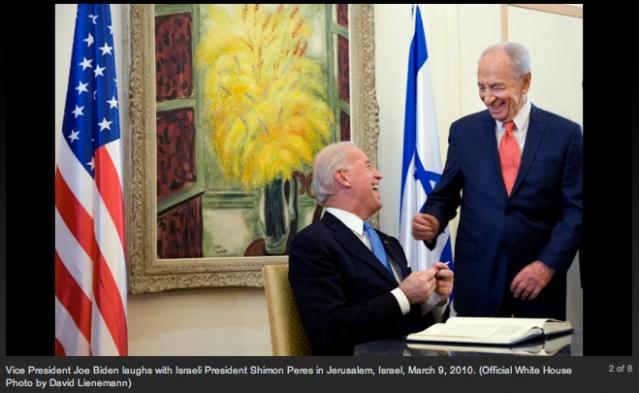
Things started to get interesting on Aug. 4, when Rick Richman of the New York Sun noted that "The White House acknowledges on its own website that Jerusalem is in Israel—as does the State Department and the CIA on theirs," undermining the government's case. Richman pointed to three mentions of "Jerusalem, Israel" in captions to pictures on the White House website in connection with a trip by Joe Biden in March 2010: "Vice President Joe Biden laughs with Israeli President Shimon Peres in Jerusalem, Israel"; "Vice President Joe Biden meets with Israeli Prime Minister Benjamin Netanyahu in Jerusalem, Israel"; and "Vice President Joe Biden has breakfast with Former British Prime Minister Tony Blair . . . in Jerusalem, Israel." Richman deemed this wording to be potentially "pivotal evidence" against the government's case.
One of the pictures on the White House website that mentions "Jerusalem, Israel."
At 3:22 p.m. on Aug. 9, Daniel Halper of the Weekly Standard reiterated Richman's point by posting the first of those pictures. Two hours and four minutes later, at 5:26 p.m., Halper reported that "the White House has apparently gone through its website, cleansing any reference to Jerusalem as being in Israel." The new caption read, "Vice President Joe Biden laughs with Israeli President Shimon Peres in Jerusalem." Someone on the White House staff hoped to pull a fast one. As James Taranto noted in the Wall Street Journal, the Supreme Court does not take kindly to such pranks.
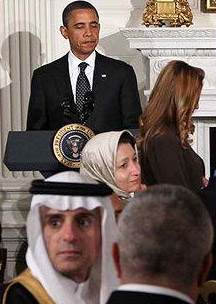
Barack Obama continues George W. Bush's tradition of hosting an iftar at the White House.
The second deceit concerns the guest list for the iftar (breaking-the-Ramadan-fast) dinner at the White House on Aug. 10. The White House published a guest list "of some of the expected attendees" that included 4 members of congress, 36 diplomats, and 11 "community members." To the relief of those who watch such matters, the list mentioned no American Islamists.
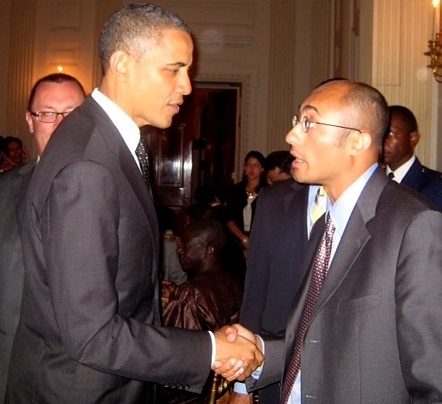
But, it turned out, "some" was a weasel-word. Research by the Investigative Project on Terrorism and others established that the published list did not mention the American Islamists attending that dinner, including Haris Tarin of the Muslim Public Affairs Council, Mohamed Magid of the Islamic Society of North America, and Awais Sufi of Muslim Advocates.
(Also noteworthy: The White House invited not a single representative of the 12-member non-Islamist group, the American Islamic Leadership Coalition, whose mission statement proclaims the goal "to defend the U.S. Constitution, uphold religious pluralism, protect American security and cherish genuine diversity in the practice of our faith of Islam.")
In combination, two deceits in two days makes one wonder about the morality and even sanity of the White House staff under Barack Obama. Do his munchkins really think they can get away with such sleazy sleights of hand?
One of the Islamists, Awais Sufi, at the White House dinner.
Separately, each of these deceptions warrants condemnation; together, they symbolize the tenor of a failed administration in panic over its lowest-ever poll ratings (43.4 percent approval according to RealClearPolitics.com's aggregation of surveys) and trying to revive its fortunes by whatever means necessary, even if its dishonesty might expose it to ridicule.
More specifically, the two incidents point to the bankruptcy of the administration's Middle East and Islamic policies. The arrogance of 2009 remains in place, now tempered by failure and desperation.
...For a listing of U.S. government mentions of "Jerusalem, Israel," see an amicus brief to the Supreme Court compiled by the Zionist Organization of America, dated Aug. 5, 2011.
Republican Newt Gingrich ...Appearing before the Republican Jewish Coalition in Beverly Hills... focused almost the entirety of his speech on Israel and the Middle East. "Both Israel and America are at a dangerous crossroads at which the survival of Israel and the safety of the United States both hang in the balance," Gingrich said. Gingrich told the audience that peace with the Palestinian Islamist movement Hamas is an impossible goal. ... he vowed, if elected, to move the U.S. embassy in Israel from Tel Aviv to Jerusalem. And blasted as "dangerous" recent speeches by President Barack Obama calling for Israel and the Palestinians to restart peace talks with the 1967 borders as a starting point.
"President Obama... wants Israel to accept the indefensible lines of 1967 as the starting point of negotiations. Accepting such a proposal would be a suicidal step for Israel," Gingrich said....
WASHINGTON — US senators proposed a resolution Thursday opposing any Israeli withdrawal to 1967 lines, dealing a symbolic blow to President Barack Obama's efforts to renew peace talks.
"It is contrary to United States policy and national security to have the borders of Israel return to the armistice lines that existed on June 4, 1967," read the text introduced by Senators Orrin Hatch, a Utah Republican, and Joe Lieberman, a Connecticut Independent.
The resolution, which enjoys the support of some 30 other senators, including Democrats, says US policy aims to "support and facilitate Israel in maintaining defensible borders."
Last month, President Barack Obama gave rare public voice to the long-standing US policy of supporting a Palestinian state based on the borders that preceded the Six Day War, with mutually agreed land swaps.
His statement provoked a public scolding from Israeli Prime Minister Benjamin Netanyahu during a subsequent White House visit. The Israeli leader also stressed the "indefensible" nature of the 1967 lines.
"Boundaries that existed on June 4, 1967 placed Israel in a precarious military situation that threatened regional stability," Hatch said in a statement.
"This resolution reaffirms that it is the policy of the United States to support and facilitate Israel in maintaining secure, recognized and defensible borders."...
Congress can take a cue from Jim Baker in 1989 and threaten to cut U.S. money for the U.N.
Now that Israeli Prime Minister Benjamin Netanyahu and his recent sparring partner Barack Obama are back in their corners, the next Arab-Israeli political flash point could be this fall at the U.N. General Assembly. The Palestinian Authority is lobbying Assembly members to legitimize its claim to international status as a "state."
Recognizing "statehood" does not mean U.N. membership, but it would nonetheless be a major Palestinian success. A resolution recognizing a Palestinian "state" could also declare its boundary to be the 1967 borders (in actuality, merely the 1949 armistice lines), with or without President Obama's caveat about "agreed upon swaps" of land.
The obvious Palestinian objective is to remove the issues of statehood and boundaries from the realm of bilateral negotiations with Israel, making them fait accompli. Last fall, the Palestinians focused on obtaining a Security Council resolution for this purpose. They believed, for whatever reason, that Mr. Obama would not order an American veto, as his predecessors would have done without hesitation. Many thought the administration might even vote "yes" rather than abstain.
When it became clear that U.S. opposition in the Security Council was likely, on statehood or on U.N. membership, Palestinian attention shifted to the General Assembly, where there is no veto. General Assembly resolutions are not legally binding, and that body has no authority to recognize states, although its actions can be politically powerful, as the 1975 "Zionism is racism" resolution demonstrated.
This is déjà vu all over again. In late 1988, Palestinians issued a "declaration of statehood," changing their U.N. observer delegation's name from "Palestine Liberation Organization" to "Palestine" to sound more like a state, which scores of countries recognized. The Palestinians then campaigned to join U.N. bodies like the World Health Organization, reasoning that since U.N. agency charters allow only states as members, the admission of "Palestine" would prove that it, too, was a state.
Ridiculous in the real world but not in the U.N., the PLO effort gained overwhelming support there. George H.W. Bush's new administration and Israel protested that "Palestine" manifestly did not meet customary international law definitions of statehood, such as having a clearly defined territory and exercising a government's legitimate domestic and international responsibilities. Third World countries rallied almost unanimously to the PLO, and Europe's response was weak. European diplomats believed Washington's opposition was merely pro forma due to the "Jewish lobby."
Faced with the near certainty of defeat, Secretary of State James Baker warned publicly: "I will recommend to the President that the United States make no further contributions, voluntary or assessed, to any international organization which makes any changes in the PLO's status as an observer organization."
No politician of Mr. Baker's skill would publicize his proposals unless he knew that the president would accept them, and this reality was rapidly understood internationally. Although defeating the PLO campaign required further maneuvering, Mr. Baker's statement was the death knell of the "statehood" push.
The lesson for today is plain. If President Obama wants to block a General Assembly Palestinian statehood resolution, he should act essentially as Messrs. Bush and Baker did. Yet Mr. Obama is highly unlikely to do anything so decisive, which is why many in America and Israel remain gravely concerned about this latest Palestinian diplomatic ploy.
Accordingly, we should turn to Congress, which has a rich history of dealing with U.N. actions it doesn't appreciate. Rather than wait for a Baker-like threat, Congress should legislate broadly that any U.N. action that purports to acknowledge or authorize Palestinian statehood will result in a cutoff of all U.S. contributions to the offending agency.
If the General Assembly ignored this warning, all funds would be cut off to the bloated Secretariat in New York, but not to separate agencies like the World Health Organization, the International Atomic Energy Agency, and others with their own governing bodies and funding mechanisms.
The logic is the same today as it was in 1989. Moreover, our current federal budget deficits provide another attractive reason to reduce U.N. contributions. If political realities make it impossible to cut off funding completely, perhaps a partial reduction, say 50%, might be a suitable compromise.
Although the General Assembly will not convene again until September, there is no time to waste.
Fatah's coalition with Hamas already provides statutory grounds (since the U.S. lists Hamas as a terrorist organization) to eliminate funding for the Palestinian Authority. Reducing U.S. funding to the U.N. is the next available, highly visible, target of opportunity. It presents the U.N. membership with a fascinating question: Would they rather recognize Palestinian statehood, or keep America's money?
*Mr. Bolton, who served as U.S. ambassador to the United Nations from 2005 to 2006, is a senior fellow at the American Enterprise Institute.
Saudi Arabia is rallying Muslim nations across the Middle East and Asia to join an informal Arab alliance against Iran, in a move some U.S. officials worry could draw other troubled nations into the sectarian tensions gripping the Arab world.
Saudi officials have approached Pakistan, Malaysia, Indonesia and Central Asian states to lend diplomatic support—and potentially military assistance in some cases—to help stifle a majority Shiite revolt in Sunni-led Bahrain, a conflict that has become a symbol of Arab defiance against Iran.
Saudi Arabia's efforts, though against a common enemy, signal increasing friction with the Obama administration....
Prince Bandar—who was the Saudi ambassador to Washington for more than two decades—told the Pakistani generals that the U.S. shouldn't be counted on to restore stability across the Middle East ...
...Saudi officials said their campaign was broad. ..."All the major Muslim states are willing to commit to this issue if need be and asked by Saudi leadership."
The official said any potential Pakistani troops could be integrated into the 4,000-man force of mostly Saudi soldiers that deployed to Bahrain in March to defend the ruling Khalifa family against the popular domestic uprising against its rule.
...The military intervention was invited by Bahrain's Sunni monarchy, which accused Iran of driving the protest movement.....
Security forces from other Gulf Cooperation Council members joined Saudi troops in stifling the revolt, in what Saudi Arabia said was a message to Iran not to meddle in other nations' affairs. The GCC includes Kuwait, Bahrain, Oman, Qatar, Saudi Arabia and the UAE. Saudi Arabia has sought to expand the GCC to include Jordan and Morocco.
..Saudi diplomats said that after the GCC force entered Bahrain in March, Riyadh dispatched senior officials to Europe and Asia to explain the operation and try to galvanize support. Foreign Minister Saud al-Faisal traveled to Europe while Prince Bandar traveled to Asia.
Prince Bandar's stops included India, China, Pakistan and Malaysia. Prince Bandar, who has no spokesman, couldn't be reached for comment.
Malaysia, which is also Sunni-dominated, said this month it was willing to send troops to Bahrain, during a visit to Riyadh by Prime Minister Najib Razak. "Malaysia fully backs all sovereign decisions taken by Saudi Arabia and GCC states to safeguard the stability and security of the region in these trying times," Mr. Najib said in a statement.
...Military ties between Pakistan and Saudi Arabia go back decades. Pakistan receives hundreds of millions of dollars a year in Saudi aid, much of it in the form of subsidized oil.
The Saudi overture in Pakistan is a sign of how diplomatic friction in two distinct regions—the Middle East on one hand and Afghanistan and Pakistan on the other—could make it harder for the U.S. to pursue its goals of ending the conflict in Afghanistan, stabilizing nuclear-armed Pakistan, limiting Iran's power and keeping a lid on violent turmoil in the Mideast.
Pakistani and U.S. relations were already souring in March before the U.S. raid in Pakistan that killed Osama bin Laden, which Pakistan viewed as a violation of national sovereignty.
But Pakistan, like Saudi Arabia, relies heavily on the U.S. The U.S. is Saudi Arabia's closest strategic partner. Last year Riyadh and Washington announced a planned $60 billion arms sale, the largest in U.S. history.
The U.S. provides Saudi Arabia and other allies in the region with an air and naval shield against possible attacks by Iran, with military bases in Qatar, Bahrain and the U.A.E.
Still, U.S.-Saudi relations have soured over the past decade. Saudi Arabia was opposed to the toppling of Iraq's Saddam Hussein because of his role as a bulwark against Iranian power. And Riyadh has been skeptical of the Obama administration's efforts to engage Iran diplomatically, among other disagreements.
Riyadh upset officials in Washington in another nominal proxy fight with Iran, in late 2009, when Saudi forces entered Yemen to clear rebels from their shared border. ...
...Saudis blame the U.S. in large part for abetting the push to topple Hosni Mubarak in Egypt. The Saudis saw him as the last strong Sunni hedge against Iranian influence and fear Egypt's new government will be too friendly with Tehran...
...The Arab Spring began to unravel an alliance of so-called moderate Arab states, led by Saudi Arabia and Egypt, which were willing to work closely with the United States and promote peace with Israel.
American support for the Arab uprisings also strained relations, prompting Saudi Arabia to split from Washington on some issues while questioning its longstanding reliance on the United States to protect its interests.
The strained Saudi posture toward Washington was outlined in a recent opinion article by Nawaf Obaid, a Saudi analyst, in The Washington Post that suggested Riyadh was ready to go it alone because the United States had become an “unreliable partner.”...
...Prince Bandar bin Sultan al Saud, who heads the Saudi National Security Council, asked Pakistani generals in March to support the intervention in Bahrain....
The prince told the generals that the U.S. shouldn’t be counted on to restore stability in the Middle East or safeguard Pakistan’s interests in south Asia...
A tectonic shift has occurred in the U.S.-Saudi relationship.
...For more than 60 years, Saudi Arabia has been bound by an unwritten bargain: oil for security. Riyadh has often protested but ultimately acquiesced to what it saw as misguided U.S. policies. But ...the Saudis recalibrate the partnership, Riyadh intends to pursue a much more assertive foreign policy, at times conflicting with American interests.
The backdrop for this change are the rise of Iranian meddling in the region and the counterproductive policies that the United States has pursued here since Sept. 11.
The most significant blunder may have been the invasion of Iraq, which resulted in enormous loss of life and provided Iran an opening to expand its sphere of influence. For years, Iran’s leadership has aimed to foment discord while furthering its geopolitical ambitions. Tehran has long funded Hamas and Hezbollah; recently, its scope of attempted interference has broadened to include the affairs of Arab states from Yemen to Morocco.
This month the chief of staff of Iran’s armed forces, Gen. Hasan Firouzabadi, harshly criticized Riyadh over its intervention in Bahrain, claiming this act would spark massive domestic uprisings. Such remarks are based more on wishful thinking than fact, but Iran’s efforts to destabilize its neighbors are tireless.
As Riyadh fights a cold war with Tehran, Washington has shown itself in recent months to be an unwilling and unreliable partner against this threat.
The emerging political reality is a Saudi-led Arab world facing off against the aggression of Iran and its non-state proxies.
Saudi Arabia will not allow the political unrest in the region to destabilize the Arab monarchies — the Gulf states, Jordan and Morocco.
In Yemen, the Saudis are insisting on an orderly transition of power and a dignified exit for President Ali Abdullah Saleh (a courtesy that was not extended to Hosni Mubarak, despite the former Egyptian president’s many years as a strong U.S. ally).
To facilitate this handover, Riyadh is leading a diplomatic effort under the auspices of the six-country Gulf Cooperation Council. In Iraq, the Saudi government will continue to pursue a hard-line stance against the Maliki government, which it regards as little more than an Iranian puppet.
In Lebanon, Saudi Arabia will act to check the growth of Hezbollah and to ensure that this Iranian proxy does not dominate the country’s political life.
Regarding the widespread upheaval in Syria, the Saudis will work to ensure that any potential transition to a post-Assad era is as peaceful and as free of Iranian meddling as possible.
Transcript &Video From "Ironic Surrealism": Israeli PM Benjamin Netanyahu Speech U.S. Congress May 24, 2011:
Speech by Prime Minister Benjamin Netanyahu to a Joint Meeting of the United States Congress, May 24, 2011
I am deeply honored by your warm welcome. And I am deeply honored that you have given me the opportunity to address Congress a second time.
Mr. Vice President, do you remember the time we were the new kids in town?
And I do see a lot of old friends here. And I do see a lot of new friends of Israel here. Democrats and Republicans alike.
Israel has no better friend than America. And America has no better friend than Israel. We stand together to defend democracy. We stand together to advance peace. We stand together to fight terrorism. Congratulations America, Congratulations, Mr. President. You got bin Laden. Good riddance!
In an unstable Middle East, Israel is the one anchor of stability. In a region of shifting alliances, Israel is America’s unwavering ally. Israel has always been pro-American. Israel will always be pro-American.
My friends, you don’t need to do nation building in Israel. We’re already built. You don’t need to export democracy to Israel. We’ve already got it. You don’t need to send American troops to defend Israel. We defend ourselves. You’ve been very generous in giving us tools to do the job of defending Israel on our own. Thank you all, and thank you President Obama, for your steadfast commitment to Israel’s security. I know economic times are tough. I deeply appreciate this.
Support for Israel’s security is a wise investment in our common future. For an epic battle is now unfolding in the Middle East, between tyranny and freedom. A great convulsion is shaking the earth from the Khyber Pass to the Straits of Gibraltar. The tremors have shattered states and toppled governments. And we can all see that the ground is still shifting. Now this historic moment holds the promise of a new dawn of freedom and opportunity. Millions of young people are determined to change their future. We all look at them. They muster courage. They risk their lives. They demand dignity. They desire liberty.
These extraordinary scenes in Tunis and Cairo, evoke those of Berlin and Prague in 1989. Yet as we share their hopes, but we also must also remember that those hopes could be snuffed out as they were in Tehran in 1979. You remember what happened then. The brief democratic spring in Iran was cut short by a ferocious and unforgiving tyranny. This same tyranny smothered Lebanon’s democratic Cedar Revolution, and inflicted on that long-suffering country, the medieval rule of Hezbollah.
So today, the Middle East stands at a fateful crossroads. Like all of you, I pray that the peoples of the region choose the path less travelled, the path of liberty. No one knows what this path consists of better than you. This path is not paved by elections alone. It is paved when governments permit protests in town squares, when limits are placed on the powers of rulers, when judges are beholden to laws and not men, and when human rights cannot be crushed by tribal loyalties or mob rule.
Israel has always embraced this path, in the Middle East has long rejected it. In a region where women are stoned, gays are hanged, Christians are persecuted, Israel stands out. It is different.
As the great English writer George Eliot predicted over a century ago, that once established, the Jewish state will “shine like a bright star of freedom amid the despotisms of the East.” Well, she was right. We have a free press, independent courts, an open economy, rambunctious parliamentary debates. You think you guys are tough on one another in Congress? Come spend a day in the Knesset. Be my guest.
Courageous Arab protesters, are now struggling to secure these very same rights for their peoples, for their societies. We’re proud that over one million Arab citizens of Israel have been enjoying these rights for decades. Of the 300 million Arabs in the Middle East and North Africa, only Israel’s Arab citizens enjoy real democratic rights. I want you to stop for a second and think about that. Of those 300 million Arabs, less than one-half of one-percent are truly free, and they’re all citizens of Israel! This startling fact reveals a basic truth: Israel is not what is wrong about the Middle East. Israel is what is right about the Middle East.
Israel fully supports the desire of Arab peoples in our region to live freely. We long for the day when Israel will be one of many real democracies in the Middle East.
Fifteen years ago, I stood at this very podium, and said that democracy must start to take root in the Arab World. Well, it’s begun to take root. This beginning holds the promise of a brilliant future of peace and prosperity. For I believe that a Middle East that is genuinely democratic will be a Middle East truly at peace.
But while we hope and work for the best, we must also recognize that powerful forces oppose this future. They oppose modernity. They oppose democracy. They oppose peace.
Foremost among these forces is Iran. The tyranny in Tehran brutalizes its own people. It supports attacks against American troops in Afghanistan and Iraq. It subjugates Lebanon and Gaza. It sponsors terror worldwide.
When I last stood here, I spoke of the dire consequences of Iran developing nuclear weapons. Now time is running out, and the hinge of history may soon turn. For the greatest danger facing humanity could soon be upon us: A militant Islamic regime armed with nuclear weapons.
Militant Islam threatens the world. It threatens Islam. I have no doubt that it will ultimately be defeated. It will eventually succumb to the forces of freedom and progress. But like other fanaticisms that were doomed to fail, militant Islam could exact a horrific price from all of us before its inevitable demise.
A nuclear-armed Iran would ignite a nuclear arms race in the Middle East. It would give terrorists a nuclear umbrella. It would make the nightmare of nuclear terrorism a clear and present danger throughout the world. I want you to understand what this means. They could put the bomb anywhere. They could put it on a missile. It could be on a container ship in a port, or in a suitcase on a subway.
Now the threat to my country cannot be overstated. Those who dismiss it are sticking their heads in the sand. Less than seven decades after six million Jews were murdered, Iran’s leaders deny the Holocaust of the Jewish people, while calling for the annihilation of the Jewish state.
Leaders who spew such venom, should be banned from every respectable forum on the planet. But there is something that makes the outrage even greater: The lack of outrage. In much of the international community, the calls for our destruction are met with utter silence. It is even worse because there are many who rush to condemn Israel for defending itself against Iran’s terror proxies.
But not you. Not America. You have acted differently. You’ve condemned the Iranian regime for its genocidal aims. You’ve passed tough sanctions against Iran. History will salute you America.
President Obama has said that the United States is determined to prevent Iran from developing nuclear weapons. He successfully led the Security Council to adopt sanctions against Iran. You in Congress passed even tougher sanctions. These words and deeds are vitally important.
Yet the Ayatollah regime briefly suspended its nuclear program only once, in 2003, when it feared the possibility of military action. That same year, Muammar Qadaffi gave up his nuclear weapons program, and for the same reason. The more Iran believes that all options are on the table, the less the chance of confrontation. This is why I ask you to continue to send an unequivocal message: That America will never permit Iran to develop nuclear weapons.
As for Israel, if history has taught the Jewish people anything, it is that we must take calls for our destruction seriously. We are a nation that rose from the ashes of the Holocaust. When we say never again, we mean never again. Israel always reserves the right to defend itself.
My friends, while Israel will be ever vigilant in its defense, we will never give up on our quest for peace. I guess we’ll give it up when we achieve it. Israel wants peace. Israel needs peace. We’ve achieved historic peace agreements with Egypt and Jordan that have held up for decades.
I remember what it was like before we had peace. I was nearly killed in a firefight inside the Suez Canal. I mean that literally. I battled terrorists along both banks of the Jordan River. Too many Israelis have lost loved ones. I know their grief. I lost my brother.
So no one in Israel wants a return to those terrible days. The peace with Egypt and Jordan has long served as an anchor of stability and peace in the heart of the Middle East.
This peace should be bolstered by economic and political support to all those who remain committed to peace.
The peace agreements with Egypt and Jordan are vital. But they’re not enough. We must also find a way to forge a lasting peace with the Palestinians. Two years ago, I publicly committed to a solution of two states for two peoples: A Palestinian state alongside the Jewish state.
I am willing to make painful compromises to achieve this historic peace. As the leader of Israel, it is my responsibility to lead my people to peace.
This is not easy for me. I recognize that in a genuine peace, we will be required to give up parts of the Jewish homeland. In Judea and Samaria, the Jewish people are not foreign occupiers. We are not the British in India. We are not the Belgians in the Congo.
This is the land of our forefathers, the Land of Israel, to which Abraham brought the idea of one God, where David set out to confront Goliath, and where Isaiah saw a vision of eternal peace. No distortion of history can deny the four thousand year old bond, between the Jewish people and the Jewish land.
But there is another truth: The Palestinians share this small land with us. We seek a peace in which they will be neither Israel’s subjects nor its citizens. They should enjoy a national life of dignity as a free, viable and independent people in their own state. They should enjoy a prosperous economy, where their creativity and initiative can flourish.
We’ve already seen the beginnings of what is possible. In the last two years,
the Palestinians have begun to build a better life for themselves. Prime Minister Fayad has led this effort. I wish him a speedy recovery from his recent operation.
We’ve helped the Palestinian economy by removing hundreds of barriers and roadblocks to the free flow of goods and people. The results have been nothing short of remarkable. The Palestinian economy is booming. It’s growing by more than 10% a year.
Palestinian cities look very different today than they did just a few years ago. They have shopping malls, movie theaters, restaurants, banks. They even have e-businesses. This is all happening without peace. Imagine what could happen with peace. Peace would herald a new day for both peoples. It would make the dream of a broader Arab-Israeli peace a realistic possibility.
So now here is the question. You have to ask it. If the benefits of peace with the Palestinians are so clear, why has peace eluded us? Because all six Israeli Prime Ministers since the signing of Oslo accords agreed to establish a Palestinian state. Myself included. So why has peace not been achieved? Because so far, the Palestinians have been unwilling to accept a Palestinian state, if it meant accepting a Jewish state alongside it.
You see, our conflict has never been about the establishment of a Palestinian state. It has always been about the existence of the Jewish state. This is what this conflict is about. In 1947, the United Nations voted to partition the land into a Jewish state and an Arab state. The Jews said yes. The Palestinians said no. In recent years, the Palestinians twice refused generous offers by Israeli Prime Ministers, to establish a Palestinian state on virtually all the territory won by Israel in the Six Day War.
They were simply unwilling to end the conflict. And I regret to say this: They continue to educate their children to hate. They continue to name public squares after terrorists. And worst of all, they continue to perpetuate the fantasy that Israel will one day be flooded by the descendants of Palestinian refugees.
My friends, this must come to an end. President Abbas must do what I have done. I stood before my people, and I told you it wasn’t easy for me, and I said… “I will accept a Palestinian state.” It is time for President Abbas to stand before his people and say… “I will accept a Jewish state.”
Those six words will change history. They will make clear to the Palestinians that this conflict must come to an end. That they are not building a state to continue the conflict with Israel, but to end it. They will convince the people of Israel that they have a true partner for peace. With such a partner, the people of Israel will be prepared to make a far reaching compromise. I will be prepared to make a far reaching compromise.
This compromise must reflect the dramatic demographic changes that have occurred since 1967. The vast majority of the 650,000 Israelis who live beyond the 1967 lines, reside in neighborhoods and suburbs of Jerusalem and Greater Tel Aviv.
These areas are densely populated but geographically quite small. Under any realistic peace agreement, these areas, as well as other places of critical strategic and national importance, will be incorporated into the final borders of Israel.
The status of the settlements will be decided only in negotiations. But we must also be honest. So I am saying today something that should be said publicly by anyone serious about peace. In any peace agreement that ends the conflict, some settlements will end up beyond Israel’s borders. The precise delineation of those borders must be negotiated. We will be very generous on the size of a future Palestinian state. But as President Obama said, the border will be different than the one that existed on June 4, 1967. Israel will not return to the indefensible lines of 1967.
We recognize that a Palestinian state must be big enough to be viable, independent and prosperous. President Obama rightly referred to Israel as the homeland of the Jewish people, just as he referred to the future Palestinian state as the homeland of the Palestinian people. Jews from around the world have a right to immigrate to the Jewish state. Palestinians from around the world should have a right to immigrate, if they so choose, to a Palestinian state. This means that the Palestinian refugee problem will be resolved outside the borders of Israel.
As for Jerusalem, only a democratic Israel has protected freedom of worship for all faiths in the city. Jerusalem must never again be divided. Jerusalem must remain the united capital of Israel. I know that this is a difficult issue for Palestinians. But I believe with creativity and goodwill a solution can be found.
This is the peace I plan to forge with a Palestinian partner committed to peace. But you know very well, that in the Middle East, the only peace that will hold is a peace you can defend.
So peace must be anchored in security. In recent years, Israel withdrew from South Lebanon and Gaza. But we didn’t get peace. Instead, we got 12,000 thousand rockets fired from those areas on our cities, on our children, by Hezbollah and Hamas. The UN peacekeepers in Lebanon failed to prevent the smuggling of this weaponry. The European observers in Gaza evaporated overnight. So if Israel simply walked out of the territories, the flow of weapons into a future Palestinian state would be unchecked. Missiles fired from it could reach virtually every home in Israel in less than a minute. I want you to think about that too. Imagine that right now we all had less than 60 seconds to find shelter from an incoming rocket. Would you live that way? Would anyone live that way? Well, we aren’t going to live that way either.
The truth is that Israel needs unique security arrangements because of its unique size. Israel is one of the smallest countries in the world. Mr. Vice President, I’ll grant you this. It’s bigger than Delaware. It’s even bigger than Rhode Island. But that’s about it. Israel on the 1967 lines would be half the width of the Washington Beltway.
Now here’s a bit of nostalgia. I first came to Washington thirty years ago as a young diplomat. It took me a while, but I finally figured it out: There is an America beyond the Beltway. But Israel on the 1967 lines would be only nine miles wide. So much for strategic depth.
So it is therefore absolutely vital for Israel’s security that a Palestinian state be fully demilitarized. And it is vital that Israel maintain a long-term military presence along the Jordan River. Solid security arrangements on the ground are necessary not only to protect the peace, they are necessary to protect Israel in case the peace unravels. For in our unstable region, no one can guarantee that our peace partners today will be there tomorrow.
And when I say tomorrow, I don’t mean some distant time in the future. I mean — tomorrow. Peace can be achieved only around the negotiating table. The Palestinian attempt to impose a settlement through the United Nations will not bring peace. It should be forcefully opposed by all those who want to see this conflict end.
I appreciate the President’s clear position on this issue. Peace cannot be imposed. It must be negotiated. But it can only be negotiated with partners committed to peace.
And Hamas is not a partner for peace. Hamas remains committed to Israel’s destruction and to terrorism. They have a charter. That charter not only calls for the obliteration of Israel, but says ‘kill the Jews wherever you find them’. Hamas’ leader condemned the killing of Osama bin Laden and praised him as a holy warrior. Now again I want to make this clear. Israel is prepared to sit down today and negotiate peace with the Palestinian Authority. I believe we can fashion a brilliant future of peace for our children. But Israel will not negotiate with a Palestinian government backed by the Palestinian version of Al Qaeda.
So I say to President Abbas: Tear up your pact with Hamas! Sit down and negotiate! Make peace with the Jewish state! And if you do, I promise you this. Israel will not be the last country to welcome a Palestinian state as a new member of the United Nations. It will be the first to do so.
My friends, the momentous trials of the last century, and the unfolding events of this century, attest to the decisive role of the United States in advancing peace and defending freedom. Providence entrusted the United States to be the guardian of liberty. All peoples who cherish freedom owe a profound debt of gratitude to your great nation. Among the most grateful nations is my nation, the people of Israel, who have fought for their liberty and survival against impossible odds, in ancient and modern times alike.
I speak on behalf of the Jewish people and the Jewish state when I say to you, representatives of America, Thank you. Thank you for your unwavering support for Israel. Thank you for ensuring that the flame of freedom burns bright throughout the world. May God bless all of you. And may God forever bless the United States of America. End transcript.
Every Arab-Israeli negotiation contains a fundamental asymmetry: Israel gives up land, which is tangible; the Arabs make promises, which are ephemeral. The long-standing American solution has been to nonetheless urge Israel to take risks for peace while America balances things by giving assurances of U.S. support for Israel’s security and diplomatic needs.
It’s on the basis of such solemn assurances that Israel undertook, for example, the Gaza withdrawal. In order to mitigate this risk, President George W. Bush gave a written commitment that America supported Israel absorbing major settlement blocs in any peace agreement, opposed any return to the 1967 lines and stood firm against the so-called Palestinian right of return to Israel.
For 21/2 years, the Obama administration has refused to recognize and reaffirm these assurances. Then last week in his State Department speech, President Obama definitively trashed them. He declared that the Arab-Israeli conflict should indeed be resolved along “the 1967 lines with mutually agreed swaps.”
Nothing new here, said Obama three days later. “By definition, it means that the parties themselves — Israelis and Palestinians — will negotiate a border that is different” from 1967.
It means nothing of the sort. “Mutually” means both parties have to agree. And if one side doesn’t? Then, by definition, you’re back to the 1967 lines.
Nor is this merely a theoretical proposition. Three times the Palestinians have been offered exactly that formula, 1967 plus swaps — at Camp David 2000, Taba 2001, and the 2008 Olmert-Abbas negotiations. Every time, the Palestinians said no and walked away.
And that remains their position today: The 1967 lines. Period. Indeed, in September the Palestinians are going to the United Nations to get the world to ratify precisely that — a Palestinian state on the ’67 lines. No swaps.
Note how Obama has undermined Israel’s negotiating position. He is demanding that Israel go into peace talks having already forfeited its claim to the territory won in the ’67 war — its only bargaining chip. Remember: That ’67 line runs right through Jerusalem. Thus the starting point of negotiations would be that the Western Wall and even Jerusalem’s Jewish Quarter are Palestinian — alien territory for which Israel must now bargain.
The very idea that Judaism’s holiest shrine is alien or that Jerusalem’s Jewish Quarter is rightfully or historically or demographically Arab is an absurdity. And the idea that, in order to retain them, Israel has to give up parts of itself is a travesty.
Obama didn’t just move the goal posts on borders. He also did so on the so-called right of return. Flooding Israel with millions of Arabs would destroy the world’s only Jewish state while creating a 23rd Arab state and a second Palestinian state — not exactly what we mean when we speak of a “two-state solution.” That’s why it has been the policy of the United States to adamantly oppose this “right.”
Yet in his State Department speech, Obama refused to simply restate this position — and refused again in a supposedly corrective speech three days later. Instead, he told Israel it must negotiate the right of return with the Palestinians after having given every inch of territory. Bargaining with what, pray tell?
No matter. “The status quo is unsustainable,” declared Obama, “and Israel too must act boldly to advance a lasting peace.”
Israel too? Exactly what bold steps for peace have the Palestinians taken? Israel made three radically conciliatory offers to establish a Palestinian state, withdrew from Gaza and has been trying to renew negotiations for more than two years. Meanwhile, the Gaza Palestinians have been firing rockets at Israeli towns and villages. And on the West Bank, Palestinian President Mahmoud Abbas turns down then-Israeli Prime Minister Ehud Olmert’s offer, walks out of negotiations with Binyamin Netanyahu and now defies the United States by seeking not peace talks but instant statehood — without peace, without recognizing Israel — at the United Nations. And to make unmistakable this spurning of any peace process, Abbas agrees to join the openly genocidal Hamas in a unity government, which even Obama acknowledges makes negotiations impossible.
Obama’s response to this relentless Palestinian intransigence? To reward it — by abandoning the Bush assurances, legitimizing the ’67 borders and refusing to reaffirm America’s rejection of the right of return.
The only remaining question is whether this perverse and ultimately self-defeating policy is born of genuine antipathy toward Israel or of the arrogance of a blundering amateur who refuses to see that he is undermining not just peace but the very possibility of negotiations.
...Since his policy speech, president has taken a series of steps that only reinforce sense that he is most hostile US leader Jewish state has ever faced.
Photo by: REUTERS
In the aftermath of US President Barack Obama’s May 19 speech on the Middle East, his supporters argued that the policy toward Israel and the Palestinians that Obama outlined in that speech was not anti-Israel. As they presented it, Obama’s assertion that peace negotiations between Israel and the Palestinians must be based on the 1967 lines with agreed swaps does not mark a substantive departure from the positions adopted by his predecessors in the Oval Office.
But this claim is exposed as a lie by previous administration statements. On November 25, 2009, in response to Prime Minister Binyamin Netanyahu’s acceptance of Obama’s demand for a 10-month moratorium on Jewish property rights in Jerusalem, Judea and Samaria, the State Department issued the following statement: “Today’s announcement by the Government of Israel helps move forward toward resolving the Israeli-Palestinian conflict.
We believe that through good-faith negotiations the parties can mutually agree on an outcome which ends the conflict and reconciles the Palestinian goal of an independent and viable state based on the 1967 lines, with agreed swaps, and the Israeli goal of a Jewish state with secure and recognized borders that reflect subsequent developments and meet Israeli security requirements.”
In his speech, Obama stated: “The United States believes... the borders of Israel and Palestine should be based on the 1967 lines with mutually agreed swaps, so that secure and recognized borders are established for both states.”
That is, he took “the Palestinian goal” and made it the US’s goal. It is hard to imagine a more radically anti-Israel policy shift than that.
And that wasn’t Obama’s only radically anti-Israel policy shift. Until his May 19 speech, the US agreed with Israel that the issue of borders is only one of many – including the Palestinians’ rejection of Israel’s right to exist, their demand to inundate Israel with millions of foreign Arab immigrants, their demand for control over Israel’s water supply and Jerusalem – that have to be sorted out in negotiations. The joint US-Israeli position was that until all of these issues were resolved, none of them were resolved.
The Palestinians, on the other hand, claim that before they will discuss any of these other issues, Israel has to first agree to accept the indefensible 1967 boundaries as its permanent borders. This position allows the Palestinians to essentially maintain their policy of demanding that Israel make unreciprocated concessions that then serve as the starting point for further unreciprocated concessions.
It is a position that is antithetical to peace. And on May 19, by stipulating that Israel must accept the Palestinian position on borders as a precondition for negotiations, Obama adopted it as US policy.
SINCE THAT speech, Obama has taken a series of steps that only reinforce the sense that he is the most hostile US president Israel has ever faced. Indeed, when taken together, these steps raise concern that Obama may actually constitute a grave threat to Israel.
Friday’s Yediot Aharonot reported on the dimensions of the threat Obama may pose to the Jewish state. The paper’s account was based on administration and Congressional sources. The story discussed Obama’s plans to contend with the Palestinian plan to pass a resolution at the UN General Assembly in September endorsing Palestinian statehood in Jerusalem, Judea, Samaria and Gaza.
According to Yediot, during his meeting with Obama on May 20, Netanyahu argued that in light of the Palestinians’ automatic majority support at the General Assembly, there was no way to avoid the resolution.
Netanyahu reportedly explained that the move would not be a disaster. The General Assembly overwhelmingly endorsed the PLO’s declaration of independence in 1988.
And the sky still hasn’t fallen.
Obama reportedly was unconvinced. For him, it is unacceptable to be in a position of standing alone with Israel voting against the Palestinian resolution. Obama’s distaste for standing with Israel was demonstrated in February when a visibly frustrated US Ambassador Susan Rice was forced by Congressional pressure to veto the Palestinians’ Security Council draft resolution condemning Israel for refusing to prohibit Jews from building in Jerusalem, Judea and Samaria.
Yediot’s report asserts that Obama refused to brief Netanyahu on the steps his administration is taking to avert such an unpalatable option. What the paper did report was how George Mitchell – Obama’s Middle East envoy until his resignation last week – recommended Obama proceed on this issue.
According to Yediot, Mitchell recommended that Obama work with the Europeans to draft a series of anti-Israel resolutions for the UN Security Council to pass. Among other things, these resolutions, which Mitchell said would be “painful for Israel,” would include an assertion that Jewish building in Jerusalem, Judea and Samaria is illegal.
That is, Mitchell recommended that Obama adopt as US policy at the Security Council past Palestinian demands that Congress forced Obama to reject just months ago at the Security Council. The notion is that by doing so, Obama could convince the Palestinians to water down the even more radically anti-Israel positions they are advancing today at the UN General Assembly that Congressional pressure prevents him from supporting.
Since General Assembly resolutions have no legal weight and Security Council resolutions do carry weight, Mitchell’s policy represents the most anti-Israel policy ever raised by a senior US official. Unfortunately Obama’s actions since last week suggest that he has adopted the gist of Mitchell’s policy recommendations.
First there was his speech before AIPAC. Among other things, Obama used the international campaign to delegitimize Israel’s right to exist as a justification for his policies of demanding that Israel capitulate to the Palestinians’ demands, which he has now officially adopted as US policy.
As he put it, “there is a reason why the Palestinians are pursuing their interests at the United Nations. They recognize that there is an impatience with the peace process – or the absence of one. Not just in the Arab world, but in Latin America, in Europe, and in Asia. That impatience is growing, and is already manifesting itself in capitals around the world.”
From AIPAC, Obama moved on to Europe. There he joined forces with European governments in an attempt to gang up on Israel at the G8 meeting.
Obama sought to turn his embrace of the Palestinian negotiating position into the consensus position of the G8. His move was scuttled by Canadian Prime Minister Stephen Harper, who refused to accept any resolution that made mention of borders without mentioning the Palestinian demand to destroy Israel through Arab immigration, Israel’s right to defensible borders, or the Palestinians’ refusal to accept Israel’s right to exist.
If Harper had not stood by Israel, the G8’s anti-Israel resolution endorsing the Palestinian negotiating position could have formed the basis of a US-sponsored anti-Israel Security Council resolution.
Israelis planning their summer trips should put Canada at the top of their lists.
THE FINAL step Obama has taken to solidify the impression that he does not have Israel’s best interests at heart, is actually something he has not done. Over the past week, Fatah leaders of the US-backed Palestinian Authority have made a series of statements that put paid any thought that they are interested in peace with Israel or differ substantively from their partners in Hamas.
At the Arab League meeting in Qatar on Saturday, PA President Mahmoud Abbas said the Palestinian state “will be free of all Jews.”
Last week the US-supported Abbas denied the Jewish connection to the land of Israel and claimed absurdly that the Palestinians were 9,000 years old.
Equally incriminating, in an interview last week with Aaron Lerner from the IMRA newsgathering website, Palestinian negotiator Nabil Shaath said that now that Hamas was the co-leader of the PA with Fatah, responsibility for continuing to hold IDF St.-Sgt. Gilad Schalit hostage devolved from Hamas to the PA. And the PA would continue to hold him hostage.
Shaath’s statement makes clear that rather than moderating Hamas, the Fatah-Hamas unity deal is transforming Fatah into Hamas.
And yet, Obama has had nothing to say about any of this.
Obama’s now undeniable antipathy for Israel and his apparent willingness to use his power as American president to harm Israel at the UN and elsewhere guarantee that for the duration of his tenure in office, Israel will face unprecedented threats to its security. This disturbing reality ought to focus the attention of all Israelis and of the American Jewish community. With the leader of the free world now openly siding with forces bent on Israel’s destruction, the need for unity has become acute.
MADDENINGLY, HOWEVER, at this time of unprecedented danger we see the Israeli media have joined ranks with Kadima in siding with Obama against Israel in a joint bid to bring down Netanyahu’s government. Yediot Aharonot, Maariv, Haaretz, Channel 2, Channel 10, Army Radio and Israel Radio’s coverage of Netanyahu’s visit and its aftermath was dominated by condemnations of the prime minister, and praise for Obama and opposition leader Tzipi Livni, who called for Netanyahu to resign.
The fact that polling data showed that only 12 percent of Jewish Israelis regard Obama as pro-Israeli and that the overwhelming majority of the public with an opinion believes Netanyahu’s visit was a success made absolutely no impression on the media. The wall-to-wall condemnations of Netanyahu by the Israeli media lend the impression that Israel’s leading reporters and commentators are committed to demoralizing the public into believing that Israel has no option other than surrender.
Then there is the American Jewish leadership. And at this critical time in US-Israel relations, the American Jewish leadership is either silent or siding with Obama. Right after Obama’s shocking speech on May 19, the Anti-Defamation League released a statement endorsing it. Stand With Us congratulated Obama for his AIPAC speech.
With the notable exceptions of the Zionist Organization of America and the Committee for Accuracy in Middle Eastern Reporting in America (CAMERA), leaders of American Jewish organizations have refused to condemn Obama’s anti-Israel positions.
Their silence becomes all the more enraging when placed against the massive support Israel receives from rank-and-file American Jews. In a survey of American Jews taken by CAMERA on May 16-17, between 75% and 95% of American Jews supported Israel’s position on defensible borders, Jerusalem, Palestinian “refugees,” Palestinian recognition of Israel’s right to exist and the right of Jews to live in a Palestinian state.
The refusal of most American Jewish leaders, the Israeli media and Kadima to condemn Obama today makes you wonder if there is anything the US president could do to convince them to break ranks and stand with Israel and with the vast majority of their fellow Jews. But it is more than a source of wonder. It is a reason to be frightened. Because Obama’s actions over the past two weeks make clear to anyone willing to see that in the age of Obama, silence is dangerous.
Prime Minister Binyamin Netanyahu has responded in a masterful manner to Obama’s unanticipated Middle East policy statement - presented without prior consultation on the eve of the Israeli leader’s arrival in Washington - hardly how one would expect the US leader to relate to its “close ally,” an embattled nation.
Sensitive of the imperative to avoid antagonizing the American public by openly humiliating its president, Netanyahu exercised his diplomatic talent and communication skills by providing a restrained response, and outlining why Israel simply could not afford to adopt some of Obama’s recommendations. Our leader’s remarks to the press after meeting with the president, his address to AIPAC, and his brilliant presentation to the joint session of Congress represented a tour de force and made most Israelis feel extremely proud.
What made Obama’s “ambush” especially galling was that only a few days earlier, Netanyahu had delivered a major Knesset policy speech signaling to the US president that beyond the settlement blocs and Jerusalem, Israel was prepared to make further territorial concessions, subject only to the caveat that the Palestinians demonstrate a genuine willingness to negotiate toward a final settlement and disengage from their new genocidal partners.
Obama’s repeated expressions of “unshakable support” for Israel, and his assurance that the US would oppose any Palestinian efforts to breach the Oslo Accords by unilaterally creating a state in September via the United Nations are appreciated, but these failed to detract from the chilling implications of his other policy pronouncements.
In his initial State Department speech, Obama ignored the terms of UN Resolution 242 and the commitment of president George W. Bush to prime minister Ariel Sharon declaring America’s support for Israel’s retention of the major settlement blocs, and the establishment of secure and defensible borders. It was only on the basis of this undertaking that Sharon implemented the disengagement from Gaza that proved so disastrous.
Instead, Obama proclaimed that the pre ‘67 lines (in reality the 1949 armistice lines) - subject to “agreed swaps” (but without reference to settlement blocs or defensible borders) should represent the basis of the new borders. He was surely aware that PA President Mahmoud Abbas had frequently insisted that “swaps” could only be minuscule.
Former prime minister Ehud Olmert, without Knesset endorsement, had unofficially proposed a similar formula to Abbas, but it was conditional on an end-of-conflict settlement in which all issues, including refugees, were resolved. His offers were summarily rejected.
Reacting to Netanyahu’s courageous response, Obama “clarified” his original remarks when he addressed AIPAC, suggesting that the borders would be modified, and even employing Bush’s language regarding demographic changes. But he still adamantly insisted that the pre-1967 armistice lines become the opening benchmark for future negotiations, failed to impose any tangible reciprocal concessions from the Palestinians, including resolving the “wrenching” refugee issue, and refused to reaffirm Bush’s commitment that the refugee problem must be resolved outside the borders of Israel.
If implemented, Obama’s policy as outlined to AIPAC would enable Palestinians to secure a state based on the pre-1967 armistice lines while still demanding the “right of return” - and not conceding anything in return.
This would oblige Israel to lower the benchmark for negotiations to such an extent that it would no longer retain any leverage to facilitate reciprocal concessions from the Palestinians. In short, it would finally demolish the discredited policy of trading land for peace.
Further, it would guarantee the perpetuation of the conflict and enable the Palestinians to escalate their campaign to end Jewish sovereignty by intensifying their demand for the right of return, which is the central component of that campaign.
It is thus inconceivable for Israel to offer further territorial concessions until and unless the Palestinians recognize Israel as the homeland for the Jewish people and accept that their refugee issue will be resolved within the borders of any future Palestinian state. The continuous reference to “occupation” is also misleading, as the PA today effectively controls most of the West Bank, and the Israel military presence there is only to ensure security. Gaza, meanwhile, is completely controlled by the Iran-backed Hamas.
The Obama recommendations represent the culmination of a process initiated with the Oslo Accords, whereby “we give and the Palestinians take.”
If realized, it would represent the Palestinians’ crowning achievement of undermining Israel in stages.
It was also bizarre for Obama to refer constantly to democracy in a region where radical Islamic forces utterly opposed to the US and the West are slaughtering dissidents and religious minorities. Yet Israel, the only genuine democracy in the region, is treated as an obstacle to progress simply because we are not willing to lie down and accept a potentially existential threat.
In the US, aside from the predictable responses from the liberal media, Israel clearly enjoys the support of the majority. Netanyahu, in a forthright manner, pulled no punches, telling Congress that while willing to make sacrifices, Israel would not divide Jerusalem, accept Arab refugees, or forgo the security related to maintaining a military presence in the Jordan Valley. The repeated, unprecedented standing ovations he received from the joint session of Congress demonstrate that despite his differences with the president, he still retains strong bipartisan support crucial for Israel’s long-term relationship with the US.
However, despite an upsurge of support from rank-and-file American Jews, initial responses were muted. Aside from the right-wing ZOA, only World Jewish Congress President Ronald Lauder and Simon Wiesenthal Center head Rabbi Marvin Hier publicly condemned the negative aspects of the Obama address.
We are confronting existential issues that will determine the very future and viability of the Jewish state. It is imperative that we now suspend political differences and unite behind Netanyahu, who speaks on behalf of the vast majority of the nation and whose public support has risen dramatically.
For over a year, many of us have appealed for the formation of a unity government, but the behavior of opposition leader Tzipi Livni over the past week has been so contemptible that this clearly will not happen while she leads Kadima. One has the impression that as Netanyahu adopts increasingly centrist positions, instead of endorsing his initiatives, Livni becomes more hysterical and irrational and intensifies her defamatory outbursts. Even Meretz firebrand Zehava Gal-On called for wall-to-wall support for Netanyahu’s stand against a return of refugees.
At this period of crisis, it is surely time for Kadima to call for Livni’s resignation and elect a leader willing to prioritize the national interest over petty politics. How ironic that members of the US Congress appear to have greater sensitivity and concern for the very real perils confronting Israel than some of our own Knesset members! Domestic unity is crucial to ensure that Obama’s frightening recommendations will not be implemented.
EXECUTIVE SUMMARY: Many in the West have looked upon the “Arab Spring” with hopeful optimism. But for the rulers of Riyadh the Arab Spring’s primary result has been a shaking of the strategic foundation and alignments that have shaped Saudi regional policy since the 1979 Iranian Revolution. The Saudis had previously believed that they were the leaders, with US backing, of a united Sunni coalition against Shiite Iran. Now its partners have fallen by the wayside – Egypt appears to be dropping out, Bahrain is threatened, and the US is wobbly. And, US President Obama’s speech on May 19 did not calm the Saudis down.
...Conclusion
This is certainly a rocky period in Riyadh-Washington relations. As the US struggles to align its interests with its values, it finds it more difficult to support authoritarian monarchies like Bahrain and Saudi Arabia.
But values and interests do not neatly align themselves in international relations. While the US wants to favor democracy and oppose authoritarianism, the authoritarian Islamic regime in Riyadh still plays an integral role in long-term stability and assuring oil supply.
In October 2010, the US announced an arms deal with the kingdom worth over $60 billion. In early April 2011, the US Navy disclosed that Saudi Arabia had asked the US to prepare a proposal for the supply of warships with integrated air and Aegis missile defense systems, as well as helicopters, patrol craft and shore infrastructure. Even if this latter deal does not go through, it demonstrates that the long-term survival of the Saudi regime is still a major US priority in light of the mutual Iranian threat. And, the Saudis knew they could turn to America, indicating business as usual.
There are those who have counseled the administration to reach a new understanding with the Saudis that would lead to the establishment of constitutional monarchies in the region. But it seems the Saudis are in no mood for such talks, nor will they be for many years. The current King, Abdullah, is 87 years old and ailing. The Crown Prince, Sultan, is also over 80 and ailing. The next in line, Prince Nayif, is a known conservative. It is hard to conceive of the Saudi ruling family countenancing any power-sharing arrangement in the near future.
Thus, both countries [USA and Saudi Arabia] will have to continue strategic cooperation, even as their values continue to be at odds. When President Obama said in his speech “there will be times when our short-term interests do not align perfectly with our long-term vision of the region,” he was speaking about Saudi Arabia.
*Dr. Joshua Teitelbaum is a senior research associate at the Begin-Sadat Center for Strategic Studies, principal research associate at the IDC’s GLORIA Center, and a lecturer at Bar-Ilan University. He is also a visiting fellow and contributor to the Task Force on Islamism and the International Order at Stanford’s Hoover Institution. His latest book is Saudi Arabia and the New Strategic Landscape (Stanford: Hoover Press).