From The Winnipeg Jewish Review, August 22, 2011, by Anav Silverman*:
Teachers involved in terror attacks, curriculum that incites hatred...
...Operating under the United Nations High Commissioner for Refugees (UNHCR), UNRWA is the only UN organization responsible for one select group of refugees. While the UNHCR is mandated to “promote durable solutions” for refugees worldwide, which include such alternatives as “resettlement in third countries” UNRWA has followed a fundamentally different policy.
Throughout UNRWA’s 60 years, the agency has done nothing to promote creative resolutions to the Palestinian refugee problem. Instead, it has done everything possible to support the Palestinians’ “right of return” aspirations.
The agency has fermented a policy that seeks to maintain the Palestinians’ refugee status.
UNRWA is the only UN body that assigns the refugee definition not only to refugees but also to their descendants. Thus, from the original [400,000 -750,000; historians differ on the number] Palestinian refugees in 1948, UNRWA has now registered 4.7 million living in Jordan, Syria, Lebanon, the West Bank and Gaza.
... the Palestinian population has been rendered totally dependent both psychologically and socially on a refugee status that was supposed to have been temporary and now defines a way of life.
This way of life is further sustained by the UNRWA education system, one of the largest in the Arab world, which does not used textbooks of its own. Instead, UNRWA schools use Palestinian Authority textbooks, which teach anti-Israel attitudes, and implicitly encourage and praise jihad against Israel while promoting the refugees’ return to 1948 homes. The Institute for Monitoring Peace and Cultural Tolerance in School Education (IMPACTSE), has analyzed these books and found that peace is not mentioned at all. Israel is presented as a usurper, occupier and aggressor, and Jews and Israelis as cunning and deceitful.
EVEN MORE disturbing is that certain members of UNRWA’s teaching staff actually carry out jihadist activities themselves.
Take for example, Awad al-Qiq, a respected science teacher and deputy headmaster at the Rafah Prep Boys School run by UNRWA in Gaza. Al-Qiq, who taught at UNRWA schools for eight years, worked by night as a leader of a rocket engineering squad for Islamic Jihad. In response to al- Qiq’s death in an Israeli airstrike in May 2008, Islamic Jihad praised the science teacher as a martyr who would now find ‘paradise.’ The terrorist organization hung a poster in the entrance to the UNRWA school where he taught, praising al-Qiq’s terrorist activities. His students praised his memory, as a “great educator, who departed as a great warrior.”
Although UNRWA spokesman, Chris Gunness said that there was a “zero-tolerance policy toward politics and militant activities in schools,” one can only wonder how a chief terrorist was able to work in a school system for eight years.
Another noted Hamas extremist, Sayed Seyam, was an UNRWA math and science teacher for 23 years from 1980 until 2003.
Seyam was active in the first Palestinian intifada in 1987, and oversaw rocket and mortar attacks against Israel. Another UNRWA employee, Suheil al-Hindi, an UNRWA teachers’ representative in 2003, applauded suicide bombings in a school in the Jabalya refugee camp in Gaza.
In 2009, UNRWA’s teachers’ union voted to allow Hamas to control the curriculum both in Gaza and the West Bank.
UNRWA schools have also produced some well-known graduates, including Hamas Prime Minister Ismail Haniyeh, who recently condemned the US for killing Osama bin Laden, and Abd al-Aziz Rantisi, another Hamas leader. Rantisi, who attended UNRWA secondary school in Khan Younis, directed countless terrorist attacks against Israelis, and repeatedly called for the murder of American troops in Iraq.
According to Bassem Eid, director of the Palestinian Human Rights Monitoring Group, UNRWA has many Gaza employees who belong to Hamas. Eid explains in a film produced by the Center for Near East Policy Research, Palestinian Refugee Policy: From Despair to Hope, that Hamas made clear to UNRWA that if the agency did not accept its members as employees, UNRWA would be kicked out of Gaza. “In order for UNRWA to survive, they accepted [Hamas’s] conditions because they wanted to continue their activities, to continue corrupting Palestinians...” said Eid.
With UNRWA’s annual budget of one billion dollars per year, the United States, followed by several other western countries, are the leading financial supporters. The US contributed over half a billion dollars ($560 million) from 2009-2010, followed by the European Commission. The UK, Norway, Netherlands and Spain were also among the top 10 donors of 2010.
Much of UNRWA’s budget goes to education.
According to the agency’s website, UNRWA earmarked 52 percent of it regular budget to education in 2009. Only 19 percent was given to health services and 10 percent to relief and social services that year. Arab donors provided only 1.5 percent of UNRWA’s general fund that year ($7 million).
Until UNRWA’s mandate is adjusted to conform to that of UNHCR’s ‘durable solutions,’ Palestinian children under the agency’s care will continue to be educated in a culture that promotes despair and hate in a system that works against their future.
*The writer is an educator at the Hebrew University’s Secondary School of Education in Jerusalem. She writes for a number of news sources, including the Huffington Post, Bangor Daily News, The Near East Policy Center, Sderot Media Center and others. This article first appeared in the Jerusalem Post.

Showing posts with label UN. Show all posts
Showing posts with label UN. Show all posts
Wednesday, August 24, 2011


Thursday, July 07, 2011
UN Human Rights "investigator" posts an antisemitic cartoon but "did not perceive any racist connotations"
From UN Watch, July 6, 2011 in Human Rights Council (UNHRC):
Reaction: UN’s Falk Denies, Then Deletes Anti-Semitic Cartoon
 After UN Watch today exposed his publication of an anti-Semitic cartoon, the UN Human Rights Council’s Richard Falk first denied publishing the cartoon—and then deleted it. See his blog here.
For those wishing to see a screen-capture of the original post prior to its deletion by Falk, please click here.
Go directly to Richard Falk's Blog and read the comments to see what the public think of him...
For those wishing to see a screen-capture of the original post prior to its deletion by Falk, please click here.
Go directly to Richard Falk's Blog and read the comments to see what the public think of him...
Saturday, June 18, 2011
Massacres in Syria, UN Debates Israel
UN Watch Statement to the UN Human Rights Council on Agenda Item 7: “Human rights situation in Palestine and other occupied Arab territories” delivered by Hillel Neuer, June 14 [FOLLOW THE LINKS TO TAKE ACTION BY EMAIL]: Mr. President, History will record that the highest human rights body of the United Nations met today for no objective reason. Nothing in recent events, nothing in logic, nothing in human rights justifies today’s debate. Our meeting is automatic—the consequence of a decision adopted four years ago, shortly after this council was created, to keep a permanent agenda item on one country only: Israel. History will record that at a time when citizens across the Middle East were being attacked by their own government—by rifles, tanks, and helicopters—the UN focused its scarce time and attention on a country in that region where this is not happening; the only country in the region which, despite its flaws, respects the right to peaceful assembly, freedom of speech, freedom of the press, and freedom of religion; the only country in the region with free elections, an independent judiciary, and the equal treatment of women; the only country where gays are not persecuted, arrested or stoned to death, but, on the contrary, march in their own annual parade, as they did in Tel Aviv three days ago. Mr. President, that is why the logic of this agenda item represents the opposite of human rights, and why it embodies the pathologies that so discredited this council’s predecessor. Indeed, this item is so unjust, so biased, so selective, so politicized, and so contradictory to this council’s own principles of equality and universality, that it was condemned by the Secretary-General himself, Mr. Ban Ki-moon, on 20 June 2007, the day after its adoption. And so we ask: In its recent 5-year review, despite everything happening in the Middle East, why did the Council decide to perpetuate this item, an act that will be finalized this week by the General Assembly? Mr. President, History will record that when citizens were being persecuted or massacred by their own governments—in Syria, Iran, Yemen, Libya, Bahrain and elsewhere—the UN chose to turn a blind eye to the victims, and instead endorsed the cynicism, hypocrisy and scapegoating of the perpetrators. Thank you, Mr. President. |
Monday, June 06, 2011
How to Block the Palestine Statehood Ploy
From WSJ, 3 June 2011, by JOHN BOLTON
Congress can take a cue from Jim Baker in 1989 and threaten to cut U.S. money for the U.N.
Congress can take a cue from Jim Baker in 1989 and threaten to cut U.S. money for the U.N.
Now that Israeli Prime Minister Benjamin Netanyahu and his recent sparring partner Barack Obama are back in their corners, the next Arab-Israeli political flash point could be this fall at the U.N. General Assembly. The Palestinian Authority is lobbying Assembly members to legitimize its claim to international status as a "state."
Recognizing "statehood" does not mean U.N. membership, but it would nonetheless be a major Palestinian success. A resolution recognizing a Palestinian "state" could also declare its boundary to be the 1967 borders (in actuality, merely the 1949 armistice lines), with or without President Obama's caveat about "agreed upon swaps" of land.
The obvious Palestinian objective is to remove the issues of statehood and boundaries from the realm of bilateral negotiations with Israel, making them fait accompli. Last fall, the Palestinians focused on obtaining a Security Council resolution for this purpose. They believed, for whatever reason, that Mr. Obama would not order an American veto, as his predecessors would have done without hesitation. Many thought the administration might even vote "yes" rather than abstain.
When it became clear that U.S. opposition in the Security Council was likely, on statehood or on U.N. membership, Palestinian attention shifted to the General Assembly, where there is no veto. General Assembly resolutions are not legally binding, and that body has no authority to recognize states, although its actions can be politically powerful, as the 1975 "Zionism is racism" resolution demonstrated.
This is déjà vu all over again. In late 1988, Palestinians issued a "declaration of statehood," changing their U.N. observer delegation's name from "Palestine Liberation Organization" to "Palestine" to sound more like a state, which scores of countries recognized. The Palestinians then campaigned to join U.N. bodies like the World Health Organization, reasoning that since U.N. agency charters allow only states as members, the admission of "Palestine" would prove that it, too, was a state.
Ridiculous in the real world but not in the U.N., the PLO effort gained overwhelming support there. George H.W. Bush's new administration and Israel protested that "Palestine" manifestly did not meet customary international law definitions of statehood, such as having a clearly defined territory and exercising a government's legitimate domestic and international responsibilities. Third World countries rallied almost unanimously to the PLO, and Europe's response was weak. European diplomats believed Washington's opposition was merely pro forma due to the "Jewish lobby."
Faced with the near certainty of defeat, Secretary of State James Baker warned publicly: "I will recommend to the President that the United States make no further contributions, voluntary or assessed, to any international organization which makes any changes in the PLO's status as an observer organization."
No politician of Mr. Baker's skill would publicize his proposals unless he knew that the president would accept them, and this reality was rapidly understood internationally. Although defeating the PLO campaign required further maneuvering, Mr. Baker's statement was the death knell of the "statehood" push.
The lesson for today is plain. If President Obama wants to block a General Assembly Palestinian statehood resolution, he should act essentially as Messrs. Bush and Baker did. Yet Mr. Obama is highly unlikely to do anything so decisive, which is why many in America and Israel remain gravely concerned about this latest Palestinian diplomatic ploy.
Accordingly, we should turn to Congress, which has a rich history of dealing with U.N. actions it doesn't appreciate. Rather than wait for a Baker-like threat, Congress should legislate broadly that any U.N. action that purports to acknowledge or authorize Palestinian statehood will result in a cutoff of all U.S. contributions to the offending agency.
If the General Assembly ignored this warning, all funds would be cut off to the bloated Secretariat in New York, but not to separate agencies like the World Health Organization, the International Atomic Energy Agency, and others with their own governing bodies and funding mechanisms.
The logic is the same today as it was in 1989. Moreover, our current federal budget deficits provide another attractive reason to reduce U.N. contributions. If political realities make it impossible to cut off funding completely, perhaps a partial reduction, say 50%, might be a suitable compromise.
Fatah's coalition with Hamas already provides statutory grounds (since the U.S. lists Hamas as a terrorist organization) to eliminate funding for the Palestinian Authority. Reducing U.S. funding to the U.N. is the next available, highly visible, target of opportunity. It presents the U.N. membership with a fascinating question: Would they rather recognize Palestinian statehood, or keep America's money?
*Mr. Bolton, who served as U.S. ambassador to the United Nations from 2005 to 2006, is a senior fellow at the American Enterprise Institute.
Thursday, April 21, 2011
US Impotence in the face of Hysterical Hypocrisy at the UN
From Fox News, April 18, 2011, by Anne Bayefsky:
...Democracy-seekers are dying all over [Syria]. Meanwhile, at the United Nations, negotiations over what would be the organization’s first-ever definition of terrorism ended with deadlock on Friday after fifteen years of talking about it.
Leading the naysayers from the Organization of the Islamic Conference (OIC) was Syria, a country that claimed that murdering its preferred antagonists doesn’t count. That might be just a bad joke, except for the fact that the Obama administration has made the U.N. the centerpiece of its national security policy.
Friday marked the last day of a week-long effort by the U.N. ad-hoc Committee on Measures to Eliminate International Terrorism to finalize a comprehensive convention on international terrorism. Negotiations began back in 1996, and courtesy of American taxpayer dollars, they pick up now and again about every six months. Back in 2003, there was a draft put forward by a coordinator charged with bridging gaps, but the OIC objected because a definition of terrorism should “distinguish it from the legitimate struggle of peoples against foreign occupation.” Then again in 2007 a draft compromise failed because the OIC said the proposed definition failed to draw a “distinction between terrorism and peoples’ struggle for self-determination and against foreign occupation.”
On Friday, with four more years of diplomatic lunches under their belt, the OIC and its Syrian spokesperson said no deal because there is a “distinction between terrorism and the struggle for the rights of self-determination by people under foreign occupation and colonial or alien domination.” Representatives from Egypt, Iraq and Saudi Arabia immediately voiced their wholehearted agreement. In plain language, Islamic states including Muslim “allies” of the United States, insist that all Israelis, Americans who get in their way, or anybody else nowadays who objects to President Bashar Assad’s idea of “self-determination,” are fair game.
And Syria’s run at the U.N. on Friday didn’t end there.
Syria is currently running for a seat on the U.N.’s flagship “human rights” body, the Human Rights Council. Seats are allocated to five regional groups, and just to make sure Syria’s ascendancy is unimpeded, the Asian group has only nominated the same number of states as they have seats. So barring any unexpected additions, Syria will join fellow U.N. human rights authorities like Saudi Arabia on the Council in May.
The U.N. does have a “test” for Human Rights Council wannabes. They call it a pledge system – candidates should promise to protect human rights. In the words of the 2006 General Assembly resolution that created the Council (the Bush administration and Israel casting a negative vote), when electing candidates “voluntary pledges and commitments made” “to the promotion and protection of human rights” should be “taken into account.”
Syria has been a quick study. Its pledge, obligingly posted on the U.N. website, says: “Promotion and protection of human rights are of highest importance to Syria…Syria’s candidature to the Human Rights Council signifies its commitment to respect and to support the inalienable and indivisible nature of all human rights.”
That might be another bad joke. Except that the Obama administration announced on March 30 that it was so “pleased to note the landmark achievements of the most recent session of the U.N. Human Rights Council” that it was going to seek a second term. That characterization of the Council’s main March session is somewhat dubious, at least if the administration cared at all about the concept of equality and the welfare of Israel. The last session was the worst on record for the demonization of the Jewish state, the Council adopting more anti-Israel resolutions in one sitting than ever before. The wildly premature announcement – the U.S. term will end in December 31, 2012 according to a new General Assembly deal – erases any possibility of using prospective U.S. membership or associated dollars as clout.
Which brings us back to Syria. Obama diplomats have been making tiny noises about attempting to institute criteria for belonging to the Council that have something to do with a country’s actual human rights record. On Friday, Syrians diplomats treated the toothless Obama speechifying with the ridicule it so richly deserved.
Syrian U.N. Ambassador Bashar Ja’afari warned “those who call for reviewing membership criteria” that the move “would bring unpleasant surprises.” In addition to his country’s penchant for bashing heads, what he meant by this threat was a list of seventeen membership “criteria that have to be met in case this matter is re-visited.”
Syrian thugs think these states should be disqualified from Human Rights Council membership: “colonial states,” states which “…have taken part in the slave trade and not apologized,… propagate Islamophobia…and all forms of cultural discrimination, …ignore international legitimacy,…interfere in the internal affairs of other UN members,…foster state terrorism,…and cause greenhouse effects and global warming.”
However ludicrous, make no mistake about how this classic U.N. debate will turn out. The U.S. idea of caring about human rights as a qualification for membership will be set off against Syria’s list and result in maintaining the status quo – namely, the laughable pledge. There is no possibility whatsoever, that the same countries who comprise the majority of members of the U.N. General Assembly – only 87 of 192 are fully free democracies according to Freedom House – are going to police themselves. Even if the Syrian candidacy is eventually challenged, there is no shortage of like-minded comrades to join Cuba, China, Russian and the Saudis on the U.N.’s idea of a human rights body.
Sadly, none of the above stopped United States Ambassador to the United Nations Susan Rice from telling lawmakers on Capitol Hill a week ago that “the U.N. promotes universal values Americans hold dear” and “the United Nations… make[s] Americans safer.” With the Obama administration looking to the U.N. for guidance on protecting “human rights” and combating “terrorism,” Americans are in serious trouble.
...Democracy-seekers are dying all over [Syria]. Meanwhile, at the United Nations, negotiations over what would be the organization’s first-ever definition of terrorism ended with deadlock on Friday after fifteen years of talking about it.
Leading the naysayers from the Organization of the Islamic Conference (OIC) was Syria, a country that claimed that murdering its preferred antagonists doesn’t count. That might be just a bad joke, except for the fact that the Obama administration has made the U.N. the centerpiece of its national security policy.
Friday marked the last day of a week-long effort by the U.N. ad-hoc Committee on Measures to Eliminate International Terrorism to finalize a comprehensive convention on international terrorism. Negotiations began back in 1996, and courtesy of American taxpayer dollars, they pick up now and again about every six months. Back in 2003, there was a draft put forward by a coordinator charged with bridging gaps, but the OIC objected because a definition of terrorism should “distinguish it from the legitimate struggle of peoples against foreign occupation.” Then again in 2007 a draft compromise failed because the OIC said the proposed definition failed to draw a “distinction between terrorism and peoples’ struggle for self-determination and against foreign occupation.”
On Friday, with four more years of diplomatic lunches under their belt, the OIC and its Syrian spokesperson said no deal because there is a “distinction between terrorism and the struggle for the rights of self-determination by people under foreign occupation and colonial or alien domination.” Representatives from Egypt, Iraq and Saudi Arabia immediately voiced their wholehearted agreement. In plain language, Islamic states including Muslim “allies” of the United States, insist that all Israelis, Americans who get in their way, or anybody else nowadays who objects to President Bashar Assad’s idea of “self-determination,” are fair game.
And Syria’s run at the U.N. on Friday didn’t end there.
Syria is currently running for a seat on the U.N.’s flagship “human rights” body, the Human Rights Council. Seats are allocated to five regional groups, and just to make sure Syria’s ascendancy is unimpeded, the Asian group has only nominated the same number of states as they have seats. So barring any unexpected additions, Syria will join fellow U.N. human rights authorities like Saudi Arabia on the Council in May.
The U.N. does have a “test” for Human Rights Council wannabes. They call it a pledge system – candidates should promise to protect human rights. In the words of the 2006 General Assembly resolution that created the Council (the Bush administration and Israel casting a negative vote), when electing candidates “voluntary pledges and commitments made” “to the promotion and protection of human rights” should be “taken into account.”
Syria has been a quick study. Its pledge, obligingly posted on the U.N. website, says: “Promotion and protection of human rights are of highest importance to Syria…Syria’s candidature to the Human Rights Council signifies its commitment to respect and to support the inalienable and indivisible nature of all human rights.”
That might be another bad joke. Except that the Obama administration announced on March 30 that it was so “pleased to note the landmark achievements of the most recent session of the U.N. Human Rights Council” that it was going to seek a second term. That characterization of the Council’s main March session is somewhat dubious, at least if the administration cared at all about the concept of equality and the welfare of Israel. The last session was the worst on record for the demonization of the Jewish state, the Council adopting more anti-Israel resolutions in one sitting than ever before. The wildly premature announcement – the U.S. term will end in December 31, 2012 according to a new General Assembly deal – erases any possibility of using prospective U.S. membership or associated dollars as clout.
Which brings us back to Syria. Obama diplomats have been making tiny noises about attempting to institute criteria for belonging to the Council that have something to do with a country’s actual human rights record. On Friday, Syrians diplomats treated the toothless Obama speechifying with the ridicule it so richly deserved.
Syrian U.N. Ambassador Bashar Ja’afari warned “those who call for reviewing membership criteria” that the move “would bring unpleasant surprises.” In addition to his country’s penchant for bashing heads, what he meant by this threat was a list of seventeen membership “criteria that have to be met in case this matter is re-visited.”
Syrian thugs think these states should be disqualified from Human Rights Council membership: “colonial states,” states which “…have taken part in the slave trade and not apologized,… propagate Islamophobia…and all forms of cultural discrimination, …ignore international legitimacy,…interfere in the internal affairs of other UN members,…foster state terrorism,…and cause greenhouse effects and global warming.”
However ludicrous, make no mistake about how this classic U.N. debate will turn out. The U.S. idea of caring about human rights as a qualification for membership will be set off against Syria’s list and result in maintaining the status quo – namely, the laughable pledge. There is no possibility whatsoever, that the same countries who comprise the majority of members of the U.N. General Assembly – only 87 of 192 are fully free democracies according to Freedom House – are going to police themselves. Even if the Syrian candidacy is eventually challenged, there is no shortage of like-minded comrades to join Cuba, China, Russian and the Saudis on the U.N.’s idea of a human rights body.
Sadly, none of the above stopped United States Ambassador to the United Nations Susan Rice from telling lawmakers on Capitol Hill a week ago that “the U.N. promotes universal values Americans hold dear” and “the United Nations… make[s] Americans safer.” With the Obama administration looking to the U.N. for guidance on protecting “human rights” and combating “terrorism,” Americans are in serious trouble.
Wednesday, April 13, 2011
Israel must not succumb to false alarms
From an article published 12 April 2011, by Moshe Arens:
The important thing is to stay calm, not press the panic button, and not listen to those familiar faces who reappear every now and then with a new-old initiative suggesting that Israel announce it is prepared to withdraw to the '67 borders.'
...our defense minister...has already sounded the alarm.
According to him, Israel will be hit by a political tsunami in September. His warning bell is being echoed by many who demand the government launch a daring initiative before it is too late, before the tsunami hits us. But they have a pleasant surprise awaiting them: Israel will still be here in September....
States have never been created by UN declarations and never will be. For those who have forgotten, Israel was not created by UN resolution 181 in November 1947, but by David Ben-Gurion's declaration of Israeli independence on May 15, 1948 and by the IDF's ability to take and control the areas of the new state.
A UN declaration, whether at the Security Council or the General Assembly, recognizing a Palestinian state within the borders of the April 1949 armistice lines with Jordan, with Jerusalem as its capital, will be no more effective than Security Council resolution 1701, which prohibited Hezbollah from military operations in southern Lebanon, or General Assembly resolution 3379, which equated Zionism with racism.
If this latest declaration is actually passed, it will merely serve as another reminder of the impotence of the United Nations and its irrelevance when it comes to dealing with international conflicts. The U.S. government must surely be aware of this.
All this brouhaha about the coming tsunami skirts the fundamental issues preventing an agreement between Israel and the Palestinians. Namely, that such an agreement must constitute the end of the conflict, and that the Palestinian signatories to the agreement must be capable of assuring that no acts of terror will be launched from territories that Israel turns over as part of the agreement.
The current Palestinian spokesman, or president if you like, Mahmoud Abbas, is not capable of satisfying either of these conditions. At best, he represents only half of the Palestinians, and regardless of what commitments he undertakes, Hamas and other Islamic jihadists will have plenty of additional claims on Israel even after Abbas signs an agreement. His control over areas in Judea and Samaria is limited at best, and he certainly cannot be relied on to prevent acts of terror against Israel from those areas Israel would withdraw from.
Until the Palestinians get their act together, there seems little chance of reaching an Israeli-Palestinian agreement. That is the sad truth, and no amount of theatrics by Abbas, and maneuvering by the Quartet, the United States and the United Nations, or all of them in concert, will change that. That is what Israeli spokesmen should be explaining to everyone - friends, do-gooders and enemies alike.
And one other point must be made: What they call the 1967 borders are in fact the armistice lines that were agreed on with Jordan in April 1949, an agreement that was violated by Jordan in June 1967. There is nothing sacrosanct about these lines, while many things have changed in the intervening 62 years that cannot be wished away.
The important thing is to stay calm, not press the panic button, and not listen to those familiar faces who reappear every now and then with a new-old initiative suggesting that Israel announce it is prepared to withdraw to the "'67 borders." And to not make any hasty, half-baked statements under the illusion that they will appease those applying pressure on Israel.
At this point, their minds are made up. And such statements will only come to haunt us in the future when the time becomes ripe for proper negotiations with the Palestinians. Only when it is clear that the Israeli government is standing firm on its positions will the pressure on Israel be relaxed.
The important thing is to stay calm, not press the panic button, and not listen to those familiar faces who reappear every now and then with a new-old initiative suggesting that Israel announce it is prepared to withdraw to the '67 borders.'
...our defense minister...has already sounded the alarm.
According to him, Israel will be hit by a political tsunami in September. His warning bell is being echoed by many who demand the government launch a daring initiative before it is too late, before the tsunami hits us. But they have a pleasant surprise awaiting them: Israel will still be here in September....
States have never been created by UN declarations and never will be. For those who have forgotten, Israel was not created by UN resolution 181 in November 1947, but by David Ben-Gurion's declaration of Israeli independence on May 15, 1948 and by the IDF's ability to take and control the areas of the new state.
A UN declaration, whether at the Security Council or the General Assembly, recognizing a Palestinian state within the borders of the April 1949 armistice lines with Jordan, with Jerusalem as its capital, will be no more effective than Security Council resolution 1701, which prohibited Hezbollah from military operations in southern Lebanon, or General Assembly resolution 3379, which equated Zionism with racism.
If this latest declaration is actually passed, it will merely serve as another reminder of the impotence of the United Nations and its irrelevance when it comes to dealing with international conflicts. The U.S. government must surely be aware of this.
All this brouhaha about the coming tsunami skirts the fundamental issues preventing an agreement between Israel and the Palestinians. Namely, that such an agreement must constitute the end of the conflict, and that the Palestinian signatories to the agreement must be capable of assuring that no acts of terror will be launched from territories that Israel turns over as part of the agreement.
The current Palestinian spokesman, or president if you like, Mahmoud Abbas, is not capable of satisfying either of these conditions. At best, he represents only half of the Palestinians, and regardless of what commitments he undertakes, Hamas and other Islamic jihadists will have plenty of additional claims on Israel even after Abbas signs an agreement. His control over areas in Judea and Samaria is limited at best, and he certainly cannot be relied on to prevent acts of terror against Israel from those areas Israel would withdraw from.
Until the Palestinians get their act together, there seems little chance of reaching an Israeli-Palestinian agreement. That is the sad truth, and no amount of theatrics by Abbas, and maneuvering by the Quartet, the United States and the United Nations, or all of them in concert, will change that. That is what Israeli spokesmen should be explaining to everyone - friends, do-gooders and enemies alike.
And one other point must be made: What they call the 1967 borders are in fact the armistice lines that were agreed on with Jordan in April 1949, an agreement that was violated by Jordan in June 1967. There is nothing sacrosanct about these lines, while many things have changed in the intervening 62 years that cannot be wished away.
The important thing is to stay calm, not press the panic button, and not listen to those familiar faces who reappear every now and then with a new-old initiative suggesting that Israel announce it is prepared to withdraw to the "'67 borders." And to not make any hasty, half-baked statements under the illusion that they will appease those applying pressure on Israel.
At this point, their minds are made up. And such statements will only come to haunt us in the future when the time becomes ripe for proper negotiations with the Palestinians. Only when it is clear that the Israeli government is standing firm on its positions will the pressure on Israel be relaxed.
Wednesday, March 09, 2011
The UN honours a suicide bomber
UNRWA youth center names football tournament after first Palestinian female suicide bomber Wafa Idris
The Al-Amari Palestinian youth center has announced a football tournament for youth
to be held later this week, named after the first Palestinian female suicide bomber Wafa Idris.
 The Al-Amari youth center's website displays its logo with UNRWA's name in the center. On the home page, just below the logo and bordered in red, is the announcement of the Wafa Idris tournament.
[http://www.ammariclub.com/mainPage2.aspx ]
The Al-Amari Palestinian youth center has announced a football tournament for youth
to be held later this week, named after the first Palestinian female suicide bomber Wafa Idris.
The Al-Amari youth center's website displays its logo with UNRWA's name in the center. On the home page, just below the logo and bordered in red, is the announcement of the Wafa Idris tournament.[http://www.ammariclub.com/mainPage2.aspx ]
(After publication of this item UNRWA spokesman called PMW and insisted that they are no longer involved in this youth center and not responsible for the naming of the event after the terrorist.)
Wafa Idris was the first Palestinian female suicide bomber. She blew herself up in Jerusalem, killing one and injuring more than 150 on Jan. 27, 2002. As a volunteer for the Palestinian Red Crescent, she was able to bypass Israeli security and enter Jerusalem in a Palestinian ambulance. Since her bombing, Israel has been forced to delay Palestinian ambulances entering Jerusalem at security check points.
The PA has repeatedly presented Wafa Idris as a hero and role model, naming places and events after her, including a summer camp for youth funded by UNICEF, a Fatah women's military unit, a university students group for Fatah members, a Fatah course, and more. There have been public demonstrations and songs on PA TV to honor her. See listing and video below.
The following is the announcement of the Wafa Idris Tournament in the official PA daily:Headline: "Al-Amari plans to launch the 'Shahida (Martyr) of Honor, Wafa Idris' youth tournament."
"The administration of the Al-Amari youth center has announced its plans to launch a youth tournament (for 19-year-olds) to be named 'Shahida (Martyr) of Honor, Wafa Idris [tournament].' The Al-Am'ari administration is maintaining contacts with the Palestinian Football Association for permission. [The tournament] will commence on March 10. Twelve teams will be participating."
[Al-Hayat Al-Jadida, March 6, 2011]
The Palestinian Authority and Fatah have honored Wafa Idris in numerous ways since her bombing:
Summer camp funded by UNICEF named after Wafa Idris:
"Yesterday, activities ended in the camp named after the Shahida [Martyr for Allah] Wafa Idris, for girls in the city of Kalkiliya. The camp was founded by the Scout general administration in the Ministry of Youth and Sports. The camp was under the supervision of the Scouts in the Kalkiliya Administration and about 100 girls from the organizing committee of the city's Scouts participated... [At the closing ceremonies thanks were given including] to UNICEF for its support of the camps."
The Palestinian Authority and Fatah have honored Wafa Idris in numerous ways since her bombing:
Summer camp funded by UNICEF named after Wafa Idris:
"Yesterday, activities ended in the camp named after the Shahida [Martyr for Allah] Wafa Idris, for girls in the city of Kalkiliya. The camp was founded by the Scout general administration in the Ministry of Youth and Sports. The camp was under the supervision of the Scouts in the Kalkiliya Administration and about 100 girls from the organizing committee of the city's Scouts participated... [At the closing ceremonies thanks were given including] to UNICEF for its support of the camps."
[Al-Ayyam, July 18, 2003]
Fatah names women's terror unit for attacking Israeli civilians after Wafa Idris:
"Senior officials in the Fatah Movement have said that the Al Aqsa Martyr's Brigades... has recently created a women's brigade, in order for women to take an active part in the war being fought in the Palestinian areas. The purpose of this brigade is to carry out attacks on the Israeli home front. The unit has been named 'the brigade in honor of the Martyr Wafa Idris.'"
[Al-Quds, March 1, 2002]
Fatah students' group named after Wafa Idris has course in democracy and human rights:
"The students' committee of the Shabiba [Fatah] student movement, the Shahida Wafa Idris cell in the Al-Quds Open University in Tubass, celebrated yesterday the completion of a course in democracy and human rights.
[Al-Hayat Al-Jadida, Aug. 11, 2002]
Fatah named women's course after Wafa Idris:
"... the General Security Forces held a graduation ceremony for the Shahida (Martyr) Wafa Idris course, for training Fatah women cadres, organized by the Commission in cooperation with the General Union of Women and the Public Relations Department in the Jenin District."
[Al-Hayat Al-Jadida (Fatah), July 3, 2005]
PA TV regularly broadcast a video honoring Idris in the years following her terror attack:
"My sister Wafa, my sister Wafa
Oh the heartbeat of pride,
Oh blossom who was on earth and is now in Heaven.
Allahu Akbar! [Allah is greater]
Oh Palestine of the Arabs,
Allahu Akbar, Oh Wafa!
But you chose Shahada [Martyrdom]
In death you have brought life to the aspiration
But you chose Shahada
In death you have brought life to the aspiration."
[PA TV (Fatah), first broadcast May 2002]
Click to view
Oh blossom who was on earth and is now in Heaven.
Allahu Akbar! [Allah is greater]
Oh Palestine of the Arabs,
Allahu Akbar, Oh Wafa!
But you chose Shahada [Martyrdom]
In death you have brought life to the aspiration
But you chose Shahada
In death you have brought life to the aspiration."
[PA TV (Fatah), first broadcast May 2002]
Click to view
 Immediately following the suicide bombing, the Palestinian Authority held a memorial demonstration in her honor. A photograph of this demonstration appeared in a Palestinian daily, featuring posters bearing her picture with the following caption: "The Fatah Movement, Ramallah branch, Al Aqsa Martyr's Brigades, eulogize with great pride the heroic Martyr, of the Al-Amari Refugee Camp, the Martyr Wafa Idris." The demonstrators waving these posters are young girls, perhaps first-graders.
[Al-Ayyam, February 1, 2002]
Fatah video honors Wafa Idris
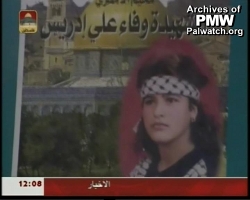 This picture of Wafa Idris with the text "The Shahida (Martyr) Wafa Ali Idris" appeared in a PA TV music video, which blends scenes and pictures paying tribute to the PLO, Fatah, Yasser Arafat and PA and Fatah head Mahmoud Abbas.
[PA TV (Fatah), Dec. 31, 2009]
Among the many articles of praise for Wafa Idris:
"Raviha Diyav, member of the administrative staff of the Palestinian Women Union emphasized that the participation of [Wafa] Idris in the attack shows the determination and the resolve of the Palestinian woman to participate as full partners in the national struggle, alongside her brothers."
[Al-Ayyam, Feb. 1, 2002]
"Recently, the heroine Wafa Idris succeeded in carrying out the bombing in Jerusalem, and subsequently, the Martyr Da'arin Abu Asiyah [carried out a suicide bombing at a roadblock]. These actions... attest to the Palestinian woman's capability to perform successful actions."
[Al-Hayat Al-Jadida, March 11, 2002]
Attaf Yussuf, a columnist in the media supplement The Women's Voice, wrote after Idris's bombing:
"Palestinian women desire to participate alongside the men in all aspects of the struggle."
[Al-Quds, March 1, 2002)]
"She [Idris] represents the major role of the Palestinian woman in the national struggle... Zaad Abu Ayin, a member of the high-ranking Movement Committee of Fatah, delivered a speech in which he praised the heroism of Idris, as a member of the Al Aqsa Martyrs Brigades, which belongs to the Fatah Movement."
[Al-Ayyam, Feb. 1, 2002]
From the internet about the UNRWA youth center:"Al-Amari youth center was established in 1953. Since its creation the center has been a subsidiary to the UNRWA youth club centers system. The center is located at Al-Amari refugee camp within Ramallah & Al-Bireh Municipality area."
[http://www.amari.8m.net/center_in_arabic.htm?%da%d1%c8%ed= ]
Tuesday, March 01, 2011
Why are Obama and Clinton Propping Up Human Rights Demons?
From Eye on the UN, 28 Feb 2011, by Anne Bayefsky:
Secretary of State Hillary Clinton and the Obama administration are on an urgent rescue mission – for the United Nations Human Rights Council. Clinton is not in Geneva today to do something about human rights. She is in Geneva to protect the administration’s investment in the U.N. human rights organization’s top body, which only six months ago welcomed Libya as a full member and only three months ago passed it through its meaningless “universal periodic review” process, touted as its number one monitoring procedure.
Saving the Council’s reputation will be no mean feat. After all, the U.N. has spent years promoting Libya as a human rights authority figure – it was president of its Human Rights Commission in 2003 before being elected to the “reformed” Human Rights Council. Clinton’s trip assumed such urgency because President Obama made the decision to join the Council the flagship of his U.N.-focused foreign policy.
...The Council has two obvious flaws. Number one it has a standing agenda that governs all of its operations, with ten items on it. One is dedicated to condemning the state of Israel and one is for the remaining 191 UN countries that it might be interested in should it ever decide there was another “human rights situations that require[d] the Council’s attention.” The singular effort to use its so-called human rights system to demonize the Jewish state has been a roaring success. Half of its special sessions on specific countries and half of all its resolutions and decisions critical of any state condemn Israel alone.
When the President Obama joined the Council it promised that changing the discriminatory agenda would be their first priority. On Thursday, we discovered, it was a hoax. The review process has been going on in the context of a working group of all interested members of the U.N.
The working group adopted its report on Thursday by consensus – with the U.S. present. And in the usual opaque U.N. language, the consensus report states: “The Council’s agenda and framework for programme of work are as is specified in the annex to Council resolution 5/1.” In plain English, that means business as usual, resolution 5/1 being the discriminatory agenda adopted in June 2007.
The loss can be measured by the administration’s own words. On October 27 of last year the U.S. delegation placed on the table its demands for reform – duly transmitted to an American audience. Agenda reform was top of the list. “The most entrenched and indefensible manifestation of structural bias in this Council comes in the form of…the only agenda item devoted to one country…The United States believes strongly that…as a group charged with examining what must be done to improve the credibility and efficacy of this Council it is incumbent upon us to….to do what is right to help the Council become more evenhanded and depoliticized.”
Secretary Clinton today repeated the mantra. But what she did not say is that when the business-as-usual U.N. “reform” report was approved late Thursday, the only thing the U.S. delegation did was to make a short statement that it “did not support” the permanent Israel-bashing item. In the world of U.N. diplomacy that is backstabbing at its finest.
If the Obama administration had really wanted to stand on principle they could have
Instead, Obama caved. Saving the Council was most important and the U.S. was going down with the ship. The “reform” process will now proceed merrily through the U.N. system without a glitch. The President of the General Assembly said this morning: “I congratulate the Working Group on adopting the Human Rights Council review by consensus.” The U.S. delegation was all present. Nobody peeped.
The second obvious flaw with the Human Rights Council that Hillary is trying her hardest to paper over is its membership. How did Libya get on the Council in the first place?
U.S. Ambassador John Bolton pointed out – when the U.S. voted against the General Assembly resolution that adopted the Council – that it had no membership criteria. The only requirement is this: “when electing members of the Council, Member States [of the U.N. General Assembly] shall take into account the contribution of candidates to the promotion and protection of human rights and their voluntary pledges and commitments made thereto.”
The U.N. set up a lovely website where candidates can deposit their “pledges.” Here is what Libya pledged last May, which was just fine by the vast majority of members of the General Assembly.
But Libya was not alone. Saudi Arabia, China, Cuba and company are all members of this morally bankrupt institution which Secretary Clinton is doing her damnedest to save.
And then there’s this:
On Friday, March 4, Iran – the country that buries women naked to their waist and then stones them to death for “adultery” – is going to take its seat as a full-fledged member of the U.N. Commission on the Status of Women.
If President Obama and his secretary of state really understood the error of using the United Nations to prop up human rights demons, then rather than attempting, even today, to help the Human Rights Council cover its tracks, it should be telling the world and the U.N. to remove Iran from the Commission on the Status of Women.
And it should resign from the Human Rights Council effective immediately now that its “reform” has proved to be impossible – as was obvious to human rights victims from the start.
But don’t hold your breath. The Obama administration would rather promote the institution of the United Nations than save real people from the U.N.’s grotesque neglect.
Secretary of State Hillary Clinton and the Obama administration are on an urgent rescue mission – for the United Nations Human Rights Council. Clinton is not in Geneva today to do something about human rights. She is in Geneva to protect the administration’s investment in the U.N. human rights organization’s top body, which only six months ago welcomed Libya as a full member and only three months ago passed it through its meaningless “universal periodic review” process, touted as its number one monitoring procedure.
Saving the Council’s reputation will be no mean feat. After all, the U.N. has spent years promoting Libya as a human rights authority figure – it was president of its Human Rights Commission in 2003 before being elected to the “reformed” Human Rights Council. Clinton’s trip assumed such urgency because President Obama made the decision to join the Council the flagship of his U.N.-focused foreign policy.
...The Council has two obvious flaws. Number one it has a standing agenda that governs all of its operations, with ten items on it. One is dedicated to condemning the state of Israel and one is for the remaining 191 UN countries that it might be interested in should it ever decide there was another “human rights situations that require[d] the Council’s attention.” The singular effort to use its so-called human rights system to demonize the Jewish state has been a roaring success. Half of its special sessions on specific countries and half of all its resolutions and decisions critical of any state condemn Israel alone.
When the President Obama joined the Council it promised that changing the discriminatory agenda would be their first priority. On Thursday, we discovered, it was a hoax. The review process has been going on in the context of a working group of all interested members of the U.N.
The working group adopted its report on Thursday by consensus – with the U.S. present. And in the usual opaque U.N. language, the consensus report states: “The Council’s agenda and framework for programme of work are as is specified in the annex to Council resolution 5/1.” In plain English, that means business as usual, resolution 5/1 being the discriminatory agenda adopted in June 2007.
The loss can be measured by the administration’s own words. On October 27 of last year the U.S. delegation placed on the table its demands for reform – duly transmitted to an American audience. Agenda reform was top of the list. “The most entrenched and indefensible manifestation of structural bias in this Council comes in the form of…the only agenda item devoted to one country…The United States believes strongly that…as a group charged with examining what must be done to improve the credibility and efficacy of this Council it is incumbent upon us to….to do what is right to help the Council become more evenhanded and depoliticized.”
Secretary Clinton today repeated the mantra. But what she did not say is that when the business-as-usual U.N. “reform” report was approved late Thursday, the only thing the U.S. delegation did was to make a short statement that it “did not support” the permanent Israel-bashing item. In the world of U.N. diplomacy that is backstabbing at its finest.
If the Obama administration had really wanted to stand on principle they could have
- said “we do not join consensus on this document.”
- They could have demanded that there be a vote in the Council on the document before sending it to the General Assembly for formal approval, and then voted against it for the world to see.
- And most importantly, they could have made it very clear that the absence of a change would result in the U.S. departure from the Council.
Instead, Obama caved. Saving the Council was most important and the U.S. was going down with the ship. The “reform” process will now proceed merrily through the U.N. system without a glitch. The President of the General Assembly said this morning: “I congratulate the Working Group on adopting the Human Rights Council review by consensus.” The U.S. delegation was all present. Nobody peeped.
The second obvious flaw with the Human Rights Council that Hillary is trying her hardest to paper over is its membership. How did Libya get on the Council in the first place?
U.S. Ambassador John Bolton pointed out – when the U.S. voted against the General Assembly resolution that adopted the Council – that it had no membership criteria. The only requirement is this: “when electing members of the Council, Member States [of the U.N. General Assembly] shall take into account the contribution of candidates to the promotion and protection of human rights and their voluntary pledges and commitments made thereto.”
The U.N. set up a lovely website where candidates can deposit their “pledges.” Here is what Libya pledged last May, which was just fine by the vast majority of members of the General Assembly.
“The Libyan Arab Jamahiriya is fully committed to the promotion and protection of human rights principles…including the right to direct participation in public life…The Libyan Arab Jamahiriya has paid great attention to human rights over the past 30 years.”That statement was good enough to garner the votes of 155 of 188 UN members and to send Libya to the Council.
But Libya was not alone. Saudi Arabia, China, Cuba and company are all members of this morally bankrupt institution which Secretary Clinton is doing her damnedest to save.
And then there’s this:
On Friday, March 4, Iran – the country that buries women naked to their waist and then stones them to death for “adultery” – is going to take its seat as a full-fledged member of the U.N. Commission on the Status of Women.
If President Obama and his secretary of state really understood the error of using the United Nations to prop up human rights demons, then rather than attempting, even today, to help the Human Rights Council cover its tracks, it should be telling the world and the U.N. to remove Iran from the Commission on the Status of Women.
And it should resign from the Human Rights Council effective immediately now that its “reform” has proved to be impossible – as was obvious to human rights victims from the start.
But don’t hold your breath. The Obama administration would rather promote the institution of the United Nations than save real people from the U.N.’s grotesque neglect.
Hypocrisy Exposed: UN Report Praises Libya's Human Rights Record
From UN Watch, 1 March 2011, by Hillel Neur :
Despite having just voted to suspend Libya from its ranks (expected to be finalized by the UNGA tomorrow), the UN Human Rights Council, according to the agenda of its current session, is planning to "consider and adopt the final outcome of the review of the Libyan Arab Jamahiriya”. According to the council's timetable, the lengthy report hailing Libya's human rights record will be presented on March 18, and then adopted by the council at the end of the month. The report, which the UN has published on the council website, is the outcome of a recent session that was meant to review Libya's human rights record.
Although the Universal Periodic Review (UPR) mechanism is often described by council defenders as its saving grace, the vast majority of council members used it to falsely praise the Gaddafi regime for its alleged promotion of human rights. Only a handful raised genuine issues.
The report also includes praise of Libya's record by the regime's representatives -- click here for quotes. Given that Libya's UN diplomats have defected and admitted that the Gaddafi regime is a gross violator of human rights, it would be nonsensical for the UN to now adopt this false report.
UN Watch called on the council president to acknowledge that the session on Libya was largely a fraud, withdraw the report, and schedule a new session in which council members would tell the truth about the Gaddafi regime's heinous crimes, which were committed over four decades yet ignored by the UN. Libya's long-suffering victims deserve no less.
The UN report's summary notes that delegations "commended" Libya, and that they "noted with appreciation the country’s commitment to upholding human rights on the ground ."
."
Following are quotes from the UNHRC report on Libya's human rights record:
Report hailing Gaddafi's human rights record scheduled for adoption in current session
GENEVA, February 28, 2011 -- UN Watch, which heads the Global NGO Campaign to Remove Libya from the UN Human Rights Council, called on US Secretary of State Hillary Clinton and EU foreign minister Catherine Ashton, who are today addressing the 47-nation body in Geneva, as well as UN rights chief Navi Pillay, to urge the council president to cancel a planned resolution praising Libya's human rights record, scheduled to be adopted in the current session. (See quotes of praise below.)Despite having just voted to suspend Libya from its ranks (expected to be finalized by the UNGA tomorrow), the UN Human Rights Council, according to the agenda of its current session, is planning to "consider and adopt the final outcome of the review of the Libyan Arab Jamahiriya”. According to the council's timetable, the lengthy report hailing Libya's human rights record will be presented on March 18, and then adopted by the council at the end of the month. The report, which the UN has published on the council website, is the outcome of a recent session that was meant to review Libya's human rights record.
Although the Universal Periodic Review (UPR) mechanism is often described by council defenders as its saving grace, the vast majority of council members used it to falsely praise the Gaddafi regime for its alleged promotion of human rights. Only a handful raised genuine issues.
The report also includes praise of Libya's record by the regime's representatives -- click here for quotes. Given that Libya's UN diplomats have defected and admitted that the Gaddafi regime is a gross violator of human rights, it would be nonsensical for the UN to now adopt this false report.
UN Watch called on the council president to acknowledge that the session on Libya was largely a fraud, withdraw the report, and schedule a new session in which council members would tell the truth about the Gaddafi regime's heinous crimes, which were committed over four decades yet ignored by the UN. Libya's long-suffering victims deserve no less.
The UN report's summary notes that delegations "commended" Libya, and that they "noted with appreciation the country’s commitment to upholding human rights on the ground
."Following are quotes from the UNHRC report on Libya's human rights record:
Iran noted that the Libyan Arab Jamahiriya had implemented a number of international human rights instruments and had cooperated with relevant treaty bodies. It noted with appreciation the establishment of the National Human Rights Committee as an independent national human rights institution, and the provision of an enabling environment for non-governmental organizations.
Algeria noted the efforts of the Libyan Arab Jamahiriya to promote human rights, which reflected the country’s commitment to complying with Human Rights Council resolutions and cooperating with the international community. Algeria welcomed the national institutional framework that had been set up, in particular the National Human Rights Committee. It noted that the country had made some progress in the area of education, as well as social and economic progress since the lifting of economic sanctions.
Qatar praised the legal framework for the protection of human rights and freedoms, including, inter alia, its criminal code and criminal procedure law, which provided legal guarantees for the implementation of those rights. Qatar expressed appreciation for the improvements made in the areas of education and health care, the rights of women, children and the elderly, and the situation of people with special needs.
Sudan noted the country’s positive experience in achieving a high school enrolment rate and improvements in the education of women.
The Syrian Arab Republic praised the Libyan Arab Jamahiriya for its serious commitment to and interaction with the Human Rights Council and its mechanisms. It commended the country for its democratic regime based on promoting the people’s authority through the holding of public conferences, which enhanced development and respect for human rights, while respecting cultural and religions traditions.
North Korea praised the Libyan Arab Jamahiriya for its achievements in the protection of human rights, especially in the field of economic and social rights, including income augmentation, social care, a free education system, increased delivery of health-care services, care for people with disabilities, and efforts to empower women. It noted the functioning of the constitutional and legislative framework and national entities.
Bahrain noted that the Libyan Arab Jamahiriya had adopted various policies aimed at improving human rights, in particular the right to education and the rights of persons with disabilities. Bahrain commended the free education system and praised programmes such as electronic examinations and teacher training. It commended the country for its efforts regarding persons with disabilities, particularly all the services and rehabilitation programmes provided.
Palestine commended the Libyan Arab Jamahiriya for the consultations held with civil society in the preparation of the national report, which demonstrated its commitment to the improved enjoyment of human rights. Palestine praised the country for the Great Green Document on Human Rights. It noted the establishment of the national independent institution entrusted with promoting and protecting human rights, which had many of the competencies set out in the Paris Principles. It also noted the interaction of the Libyan Arab Jamahiriya with human rights mechanisms.
Iraq commended the Libyan Arab Jamahiriya for being a party to most international and regional human rights instruments, which took precedence over its national legislation. It welcomed the efforts to present a comprehensive overview of the human rights situation in the country based on the unity among democracy, development and human rights. It also commended the Libyan Arab Jamahiriya for its cooperation with the international community.
Saudi Arabia commended the Libyan Arab Jamahiriya’s achievements in its constitutional, legislative and institutional frameworks, which showed the importance that the country attached to human rights, and for the fact that international treaties took precedence over its national legislation. It noted that the Libyan Arab Jamahiriya had become party to many human rights conventions and had equipped itself with a number of institutions, national, governmental and non-governmental, tasked with promoting and protecting human rights.
Tunisia welcomed [Libya’s] national report, as well as the efforts of the National Committee, such as the website created to gather contributions. Tunisia noted progress made by the Libyan Arab Jamahiriya, such as the adoption of the Great Green Charter, which was very comprehensive and enshrined fundamental freedoms and rights as enshrined in international human rights instruments.
Venezuela acknowledged the efforts of the Libyan Arab Jamahiriya to promote economic, social and cultural rights, especially those of children. It highlighted progress achieved in ensuring free and compulsory education.
Jordan welcomed the Libyan Arab Jamahiriya’s achievements in the promotion and protection of human rights, including the establishment of institutions, particularly in the judiciary system. Jordan praised progress in the fields of health, education and labour, as well as the increased attention to the rights of women. Jordan noted the participation of women in public life, including decision-making, and emphasized the fact that women held one third of all judicial posts.
Cuba commended the Libyan Arab Jamahiriya for the progress made in the achievement of one of the Millennium Development Goals, namely, universal primary education. It noted that the country had also made a firm commitment to providing health care.
Oman commended the Libyan Arab Jamahiriya for its diligent efforts in the field of human rights and for making them its priority. It referred to the legal framework for the protection of human rights, and its clear commitment in that regard, which was reflected in the ratification of most human rights instruments, and its cooperation with United Nations mechanisms. The country’s report focused on both achievements and challenges, which demonstrated its sincerity in addressing human rights issues.
Egypt commended the Libyan Arab Jamahiriya for progress in building a comprehensive national human rights framework of institutions and in drafting legislation and supporting its human resources in that area. It commended the separation of the Ministries of Justice and the Interior and the development of a new criminal code, and it praised the cooperation with international organizations in combating human trafficking and corruption, and the improvement made in the conditions related to illegal migration.
Malta fully recognized the difficulties faced by the Libyan Arab Jamahiriya and welcomed the action taken at the national, bilateral and regional levels to suppress the illegal activities that gave rise to migration. Malta welcomed the cooperation of the Libyan Arab Jamahiriya with the International Organization for Migration.
Bangladesh referred to the progress made in the enjoyment of economic and social rights, including in the areas of education, health care, poverty reduction and social welfare. Bangladesh noted with appreciation the measures taken to promote transparency.
Malaysia commended the Libyan Arab Jamahiriya for being party to a significant number of international and regional human rights instruments.
Morocco welcomed the achievements in promoting social protection, especially for women, children and persons with special needs. It welcomed the efforts to protect the rights of children. It welcomed the establishment of a national committee for the protection of persons with special needs. Morocco also praised the Libyan Arab Jamahiriya for its promotion of human rights education, particularly for security personnel.
Pakistan praised the Libyan Arab Jamahiriya for measures taken both in terms of legislation and in practice, noting with appreciation that it was a party to most of the core human rights treaties. Pakistan praised the Libyan Arab Jamahiriya’s commitment to human rights, in particular the right to health, education and food, even when the country had faced sanctions in the 1990s. Pakistan was encouraged by efforts to address the root causes of illegal migration, and noted the good practice of settling political disputes and developing infrastructure in source countries.
Mexico thanked the delegation for the presentation of the national report and the answers that it had provided. It expressed appreciation for the political will of the Libyan Arab Jamahiriya to address the human rights challenges facing it. Mexico hoped that the universal periodic review of the Libyan Arab Jamahiriya would make a positive contribution to national efforts to overcome challenges to guaranteeing the full enjoyment of human rights.
Myanmar commended the Libyan Arab Jamahiriya for its economic and social progress, and recognized efforts in domestic legislation aimed at guaranteeing equal rights. Myanmar noted that the country had acceded to many international human rights instruments and established a national Human Rights Committee. Myanmar praised efforts to realize basic education for all and a free health-care system.
Viet Nam congratulated the delegation on the quality of the national report. It noted with satisfaction the commitment of the Libyan Arab Jamahiriya to the protection and promotion of the human rights of its people, particularly the country’s accession to the main international human rights conventions. It welcomed achievements made in the exercise of human rights.
Thailand welcomed the national report, which presented both progress and challenges. Thailand highlighted efforts made with regard to education, persons with special needs and vulnerable groups.
Brazil noted the Libyan Arab Jamahiriya’s economic and social progress and acknowledged the promotion of the rights of persons with disabilities, the free health care and the high enrolment in primary education. Brazil noted the successful cooperation with international organizations in areas such as migrant rights, judicial reform and the fight against corruption.
Kuwait expressed appreciation for the Libyan Arab Jamahiriya’s initiative to improve per capita income and to ensure social justice and the fair distribution of wealth. It praised the measures taken with regard to low-income families. Kuwait called upon the Libyan Arab Jamahiriya to continue its efforts to integrate people with disabilities into society while recognizing their positive role.
Wednesday, February 23, 2011
United ...in bashing Israel
From Pajamas Media, February 22, 2011
...Number of UN Security Council presidential statements or resolutions on the current atrocities perpetrated by Arab and Muslim dictators in Iran, Libya, Algeria, Egypt, Tunisia, Saudi Arabia,Yemen, Syria, and Bahrain. ZERO
Number of meetings called by the Security Council to discuss and consider a possible resolution or presidential statement on any of these countries. ZERO
Number of special sessions called by the Human Rights Council to draw attention to, discuss, consider a possible resolution or decision on the current atrocities perpetrated by Arab and Muslim dictators in Iran, Libya, Algeria, Egypt, Tunisia, Saudi Arabia,Yemen, Syria, and Bahrain. ZERO
Number of resolutions or decisions adopted by the Human Rights Council about the lack of democracy and brutality of the governments of Arab and Muslim dictators in Iran, Libya, Algeria, Egypt, Tunisia, Saudi Arabia,Yemen, Syria, and Bahrain. ZERO
Current Members of the UN Human Rights Council: Libya; Saudi Arabia; Bahrain; Egypt just concluded a three-year term in 2010.
Number of Special Sessions on country situations called by the Human Rights Council on Israel: 50% (6 of 12)
Number of Resolutions and Decisions adopted by the Human Rights Council critical of the human rights record of specific states directed at Israel: 50% (41 of 83)...
...Number of UN Security Council presidential statements or resolutions on the current atrocities perpetrated by Arab and Muslim dictators in Iran, Libya, Algeria, Egypt, Tunisia, Saudi Arabia,Yemen, Syria, and Bahrain. ZERO
Number of meetings called by the Security Council to discuss and consider a possible resolution or presidential statement on any of these countries. ZERO
Number of special sessions called by the Human Rights Council to draw attention to, discuss, consider a possible resolution or decision on the current atrocities perpetrated by Arab and Muslim dictators in Iran, Libya, Algeria, Egypt, Tunisia, Saudi Arabia,Yemen, Syria, and Bahrain. ZERO
Number of resolutions or decisions adopted by the Human Rights Council about the lack of democracy and brutality of the governments of Arab and Muslim dictators in Iran, Libya, Algeria, Egypt, Tunisia, Saudi Arabia,Yemen, Syria, and Bahrain. ZERO
Current Members of the UN Human Rights Council: Libya; Saudi Arabia; Bahrain; Egypt just concluded a three-year term in 2010.
Number of Special Sessions on country situations called by the Human Rights Council on Israel: 50% (6 of 12)
Number of Resolutions and Decisions adopted by the Human Rights Council critical of the human rights record of specific states directed at Israel: 50% (41 of 83)...
Thursday, January 20, 2011
UN met only 52% of target for Palestinian aid in 2010
From JPost, 20 January 2011, by TOVAH LAZAROFF:
First time such large gap exists between initial aid request, amount of money donated since UN began humanitarian appeal to member states, international organizations in 2003.
The UN was only able to fund 52 percent of the humanitarian aid it wanted to provide to Palestinians in the West Bank and Gaza in 2010, according to statistics it released on Wednesday at a press conference in Jerusalem.
It’s the first time such a large gap has existed between the initial aid request and the amount of money donated since the UN began a humanitarian appeal for Palestinians to member states and international organizations in 2003.
...The UN raised funds that met 79% of its humanitarian requests for Palestinians in 2009 and 75% in 2008.
...What frustrates him about the Palestinian appeal, [UN humanitarian coordinator for the occupied Palestinian territories, Maxwell] Gaylard said, is that unlike in a natural disaster, the humanitarian problem in the West Bank is man-made and unnecessary.
Humanitarian assistance there is a necessity, but it is not the answer, he said.
The situation can only be resolved through a political solution that would bring peace and prosperity to the region, Gaylord said.
First time such large gap exists between initial aid request, amount of money donated since UN began humanitarian appeal to member states, international organizations in 2003.
The UN was only able to fund 52 percent of the humanitarian aid it wanted to provide to Palestinians in the West Bank and Gaza in 2010, according to statistics it released on Wednesday at a press conference in Jerusalem.
It’s the first time such a large gap has existed between the initial aid request and the amount of money donated since the UN began a humanitarian appeal for Palestinians to member states and international organizations in 2003.
...The UN raised funds that met 79% of its humanitarian requests for Palestinians in 2009 and 75% in 2008.
...What frustrates him about the Palestinian appeal, [UN humanitarian coordinator for the occupied Palestinian territories, Maxwell] Gaylard said, is that unlike in a natural disaster, the humanitarian problem in the West Bank is man-made and unnecessary.
Humanitarian assistance there is a necessity, but it is not the answer, he said.
The situation can only be resolved through a political solution that would bring peace and prosperity to the region, Gaylord said.
Thursday, December 02, 2010
UN Goldstone Committee Head Resigns
From an Eye-on-the-UN Press Release, December 1, 2010 by Anne Bayefsky:
Christian Tomuschat, who headed a UN committee charged with implementing the Goldstone Report, has reportedly resigned.
He had been appointed by UN High Commissioner Navi Pillay.
Tomuschat’s credentials were questioned earlier this year, in a July 14th, 2010 article by Anne Bayefsky.
Tomuschat’s resignation is the second blow to the credibility of the UN’s efforts to implement the Goldstone report. Following Bayefsky’s July article, the UN secretariat official whom Pillay had assigned to coordinate the Tomuschat committee’s activities, Ahmed Motala, was removed from the case.
In July, Bayefsky pointed out that Tomuschat and the other two members of his committee were tainted by their close affiliation with an NGO which had been deeply involved with the Human Rights Council’s campaign to vilify Israel.
Bayefsky’s article also revealed that the UN staffer Motala appointed to work with Tomuschat doubled as an anti-Israel blogger. In the midst of the Gaza war he had written that Israel targeted Palestinian civilians in order to impress voters. The Tomuschat committee staffer wrote “What better way to gain the support of the Israeli electorate than to…kill innocent civilians”
On July 15 Jerusalem Post correspondent, Benjamin Wienthal, revealed prior statements by Tomuschat that indicated deep prejudices on the very issues he had been assigned to tackle. Wienthal reported in the Weekly Standard and the Jerusalem Post that in 2007 Tomuschat told a German newspaper that Israel’s killing of Hamas leader Sheikh Yassin was “as ruthless as the attacks of terrorists.” Later in July, Wienthal reported that Tomuschat had once provided legal advice to Yasser Arafat’s PLO.
Last month, UN Watch reported on further examples of Tomuschat bias.
Tomuschat’s resignation ought to further undermine the credibility of the report he submitted to the Council in September. In his report Tomuschat repeated the odious claim that Israel engaged in “violence against civilians as part of a deliberate policy.” Tomuschat’s report went on to criticize Israel’s legal system for failing to mount a witch hunt for “officials at the highest levels.”
Referring to a Hamas internal “investigation,” in which Hamas exonerated itself from all wrongdoing, Tomuschat’s team could only conclude that it “is not in a position to ascertain the veracity of any of these assertions.”
Following that report, the Human Rights Council reappointed Tomuschat and his other two committee members, Param Cumaraswamy and Mary Davis. They have been charged with producing yet another report by next March.
Unfortunately, many other UN authority figures, selected precisely because of their history of anti-Israel and anti-Western bias, remain.
For further information see EYEontheUN’s list of current UN authorities.
Christian Tomuschat, who headed a UN committee charged with implementing the Goldstone Report, has reportedly resigned.
He had been appointed by UN High Commissioner Navi Pillay.
Tomuschat’s credentials were questioned earlier this year, in a July 14th, 2010 article by Anne Bayefsky.
Tomuschat’s resignation is the second blow to the credibility of the UN’s efforts to implement the Goldstone report. Following Bayefsky’s July article, the UN secretariat official whom Pillay had assigned to coordinate the Tomuschat committee’s activities, Ahmed Motala, was removed from the case.
In July, Bayefsky pointed out that Tomuschat and the other two members of his committee were tainted by their close affiliation with an NGO which had been deeply involved with the Human Rights Council’s campaign to vilify Israel.
Bayefsky’s article also revealed that the UN staffer Motala appointed to work with Tomuschat doubled as an anti-Israel blogger. In the midst of the Gaza war he had written that Israel targeted Palestinian civilians in order to impress voters. The Tomuschat committee staffer wrote “What better way to gain the support of the Israeli electorate than to…kill innocent civilians”
On July 15 Jerusalem Post correspondent, Benjamin Wienthal, revealed prior statements by Tomuschat that indicated deep prejudices on the very issues he had been assigned to tackle. Wienthal reported in the Weekly Standard and the Jerusalem Post that in 2007 Tomuschat told a German newspaper that Israel’s killing of Hamas leader Sheikh Yassin was “as ruthless as the attacks of terrorists.” Later in July, Wienthal reported that Tomuschat had once provided legal advice to Yasser Arafat’s PLO.
Last month, UN Watch reported on further examples of Tomuschat bias.
Tomuschat’s resignation ought to further undermine the credibility of the report he submitted to the Council in September. In his report Tomuschat repeated the odious claim that Israel engaged in “violence against civilians as part of a deliberate policy.” Tomuschat’s report went on to criticize Israel’s legal system for failing to mount a witch hunt for “officials at the highest levels.”
Referring to a Hamas internal “investigation,” in which Hamas exonerated itself from all wrongdoing, Tomuschat’s team could only conclude that it “is not in a position to ascertain the veracity of any of these assertions.”
Following that report, the Human Rights Council reappointed Tomuschat and his other two committee members, Param Cumaraswamy and Mary Davis. They have been charged with producing yet another report by next March.
Unfortunately, many other UN authority figures, selected precisely because of their history of anti-Israel and anti-Western bias, remain.
For further information see EYEontheUN’s list of current UN authorities.
Tuesday, September 28, 2010
The Freeze is just an excuse for Abbas
From Israel News, 27 September 2010, by Yitzhak Benhorin:
WASHINGTON – Foreign Minister Avigdor Lieberman met Monday in New York with UN Secretary-General Ban Ki-Moon a short time after the latter expressed his disappointment that the West Bank settlement construction moratorium was not being extended beyond its 10-month period.
... Lieberman contended that the freeze "is just an excuse" for Palestinian President Mahmoud Abbas to quit budding peace talks between the Palestinian Authority and Israel. "For nine months the Palestinians claimed that the freeze is a ploy, and now they have turned it into a lynchpin," said the foreign minister to the UN chief.
After Abbas announced he is awaiting the upcoming meeting of the Arab League at the beginning of October, Lieberman asserted, "If the Arab League is seeking challenges to deal with, there are many in the Arab world. Hundreds of people are killed each week in terrorist attacks, and poverty and despair cry out to the heavens.
"Instead of solving these problems, the leaders of the Arab League prefer to run away from them, and blame Israel for all their internal problems. Instead of dialogue, they prefer to incite the masses against the Jews," added Lieberman.
Lieberman said that Israel is interested in a fair peace agreement. "We are willing to collaborate with the international community and be cooperative, but without compromising on security and Israel's vital interests," he said....
WASHINGTON – Foreign Minister Avigdor Lieberman met Monday in New York with UN Secretary-General Ban Ki-Moon a short time after the latter expressed his disappointment that the West Bank settlement construction moratorium was not being extended beyond its 10-month period.
... Lieberman contended that the freeze "is just an excuse" for Palestinian President Mahmoud Abbas to quit budding peace talks between the Palestinian Authority and Israel. "For nine months the Palestinians claimed that the freeze is a ploy, and now they have turned it into a lynchpin," said the foreign minister to the UN chief.
After Abbas announced he is awaiting the upcoming meeting of the Arab League at the beginning of October, Lieberman asserted, "If the Arab League is seeking challenges to deal with, there are many in the Arab world. Hundreds of people are killed each week in terrorist attacks, and poverty and despair cry out to the heavens.
"Instead of solving these problems, the leaders of the Arab League prefer to run away from them, and blame Israel for all their internal problems. Instead of dialogue, they prefer to incite the masses against the Jews," added Lieberman.
Lieberman said that Israel is interested in a fair peace agreement. "We are willing to collaborate with the international community and be cooperative, but without compromising on security and Israel's vital interests," he said....
Wednesday, August 11, 2010
Israel threatens boycott of UN investigation
From WJC, 10 August 2010:
Israel has threatened to pull out of a UN inquiry into the IDF raid on the Gaza-bound ‘Freedom Flotilla’ after the UN secretary-general said there was no agreement that the panel would refrain from calling Israeli soldiers to testify. Last week, Jerusalem agreed to participate in the UN probe. Officials said Israel's agreement was conditional on the panel relying on reports from Israel's own military inquiry, not direct testimony from IDF soldiers.
However, at a press conference at UN headquarters on Monday, Secretary-General Ban Ki-moon was asked whether he agreed not to call Israeli soldiers before the panel. "No, there was no such agreement behind the scenes," he replied.
In response, the Netanyahu’s office issued a harsh statement. "Prime Minister Benjamin Netanyahu makes it absolutely clear that Israel will not cooperate with, and will not take part in, any panel that seeks to interrogate Israeli soldiers.”
The government had appointed the retired senior diplomat Joseph Ciechanover to join the UN panel and was preparing for the start of its deliberations on Tuesday when Ban made his remark, throwing plans into turmoil...
Israel has threatened to pull out of a UN inquiry into the IDF raid on the Gaza-bound ‘Freedom Flotilla’ after the UN secretary-general said there was no agreement that the panel would refrain from calling Israeli soldiers to testify. Last week, Jerusalem agreed to participate in the UN probe. Officials said Israel's agreement was conditional on the panel relying on reports from Israel's own military inquiry, not direct testimony from IDF soldiers.
However, at a press conference at UN headquarters on Monday, Secretary-General Ban Ki-moon was asked whether he agreed not to call Israeli soldiers before the panel. "No, there was no such agreement behind the scenes," he replied.
In response, the Netanyahu’s office issued a harsh statement. "Prime Minister Benjamin Netanyahu makes it absolutely clear that Israel will not cooperate with, and will not take part in, any panel that seeks to interrogate Israeli soldiers.”
The government had appointed the retired senior diplomat Joseph Ciechanover to join the UN panel and was preparing for the start of its deliberations on Tuesday when Ban made his remark, throwing plans into turmoil...
Thursday, August 05, 2010
Obama kicks Israel over the Ban Ki-Moon
From FoxNews.com August 02, 2010, by Anne Bayefsky*:
President Obama has now blackmailed the government of Israel into submitting its defense forces to the toxic oversight of the United Nations.
Today U.N. Secretary-General Ban Ki-moon created, with Israel’s approval, a UN investigation of last June’s flotilla incident in which Turkish-backed extremists sought to shatter Israel’s lawful naval blockade of Hamas-run Gaza.
Despite the fact that Israel has already launched an inquiry with international participants, the Obama administration insists that the Israel Defense Forces, and the Israeli legal and political establishment governing their actions, must be subject to UN supervision.
...Even Ban Ki-moon today called the development “unprecedented”. The U.N. team will be second-guessing the actions taken in self-defense by a democratic state, governed by the rule of law and at war with a terrorist entity committed to its destruction -- on account of an undisputed figure of nine deaths.
In the course of war, hundreds of civilians in Afghanistan and Iraq have been killed by American and coalition forces, while undemocratic regimes regularly and deliberately murder thousands, without a peep from the U.N.
If the president tried the same stunt in America, ordering U.S. generals to report to Ban Ki-moon and company and to seek their seal of approval, the uproar would be deafening. But this president has evidently embraced the defining attribute of the U.N. approach to Israel -- double-standards.
Obama’s support for the U.N. investigation is part of a major realignment of U.S. foreign policy to synchronize it with an organization dominated by Islamic interests. Within 24 hours of the flotilla incident, the U.S. agreed to a hasty Security Council presidential statement on May 31 that called for "a prompt, impartial, credible and transparent investigation conforming to international standards." Secretary of State Hillary Clinton and other State Department officials let it be known that “credible” to this administration meant credible in the eyes of the U.N. In the Israeli case, the United States is prepared to make the requisites of self-defense subservient to the U.N. mob.
In today’s U.N. announcement, Ban Ki-moon named former New Zealand Prime Minister Geoffrey Palmer to head his inquiry. Palmer is closely associated with one of the U.N.’s top officials, Helen Clark, ...[who] was Palmer’s deputy during his time in office and, after becoming prime minister herself, named him to a number of important posts. U.N. officials clearly believe that Palmer shares, or will be influenced by, the biases of those who appointed him. In the midst of the Gaza war in January 2009, Clark blamed Israel for the conflict saying the impact of Hamas rocket attacks “has been but a tiny fraction of that of the Israeli strikes on Gaza.” In August 2006 during the Lebanon war, Clark said she found it “hard to believe” that the accidental Israeli bombing of a U.N. observation post in Lebanon was anything but deliberate.
...The details of the Ban investigation, including its mandate, have yet to be ironed out. But Ban’s announcement sets a mid-September deadline for an interim report ...
... Removing the fundamentals of self-defense from Israeli hands is at odds with the very raison d’etre of the Jewish state. This was one demand of a hostile American administration too many.
*Anne Bayefsky is a senior fellow at the Hudson Institute and director of the Touro Institute on Human Rights and the Holocaust.
President Obama has now blackmailed the government of Israel into submitting its defense forces to the toxic oversight of the United Nations.
Today U.N. Secretary-General Ban Ki-moon created, with Israel’s approval, a UN investigation of last June’s flotilla incident in which Turkish-backed extremists sought to shatter Israel’s lawful naval blockade of Hamas-run Gaza.
Despite the fact that Israel has already launched an inquiry with international participants, the Obama administration insists that the Israel Defense Forces, and the Israeli legal and political establishment governing their actions, must be subject to UN supervision.
...Even Ban Ki-moon today called the development “unprecedented”. The U.N. team will be second-guessing the actions taken in self-defense by a democratic state, governed by the rule of law and at war with a terrorist entity committed to its destruction -- on account of an undisputed figure of nine deaths.
In the course of war, hundreds of civilians in Afghanistan and Iraq have been killed by American and coalition forces, while undemocratic regimes regularly and deliberately murder thousands, without a peep from the U.N.
If the president tried the same stunt in America, ordering U.S. generals to report to Ban Ki-moon and company and to seek their seal of approval, the uproar would be deafening. But this president has evidently embraced the defining attribute of the U.N. approach to Israel -- double-standards.
Obama’s support for the U.N. investigation is part of a major realignment of U.S. foreign policy to synchronize it with an organization dominated by Islamic interests. Within 24 hours of the flotilla incident, the U.S. agreed to a hasty Security Council presidential statement on May 31 that called for "a prompt, impartial, credible and transparent investigation conforming to international standards." Secretary of State Hillary Clinton and other State Department officials let it be known that “credible” to this administration meant credible in the eyes of the U.N. In the Israeli case, the United States is prepared to make the requisites of self-defense subservient to the U.N. mob.
In today’s U.N. announcement, Ban Ki-moon named former New Zealand Prime Minister Geoffrey Palmer to head his inquiry. Palmer is closely associated with one of the U.N.’s top officials, Helen Clark, ...[who] was Palmer’s deputy during his time in office and, after becoming prime minister herself, named him to a number of important posts. U.N. officials clearly believe that Palmer shares, or will be influenced by, the biases of those who appointed him. In the midst of the Gaza war in January 2009, Clark blamed Israel for the conflict saying the impact of Hamas rocket attacks “has been but a tiny fraction of that of the Israeli strikes on Gaza.” In August 2006 during the Lebanon war, Clark said she found it “hard to believe” that the accidental Israeli bombing of a U.N. observation post in Lebanon was anything but deliberate.
...The details of the Ban investigation, including its mandate, have yet to be ironed out. But Ban’s announcement sets a mid-September deadline for an interim report ...
... Removing the fundamentals of self-defense from Israeli hands is at odds with the very raison d’etre of the Jewish state. This was one demand of a hostile American administration too many.
*Anne Bayefsky is a senior fellow at the Hudson Institute and director of the Touro Institute on Human Rights and the Holocaust.
Monday, July 26, 2010
Palestinians and Egypt oppose ending "the occupation"
From JPost, 26 July 2010, by JONATHAN D. HALEVI:
The Palestinians want to keep the lava of the refugee problem at full boil.
[A] plan to assist the Gaza Strip in becoming an independent entity has encountered wall-to-wall Palestinian opposition. The dual-headed Palestinian regime in Ramallah (Fatah) and in the Gaza Strip (Hamas) totally rejects [the] proposal to recruit the European Union to build power stations to supply electricity, desalination stations and a sewage treatment plant....
The arguments against exercising Palestinian independence resemble each other. Nabil Abu Rudeineh, spokesman for the Palestinian presidency in Ramallah, views [the] plan as a plot “against the Palestinian people’s aspirations for unity, liberty and independence” ...Ahmed Assaf, spokesman for the Fatah organization that props up the Palestinian Authority, argued that the Gaza Strip is still under “Israeli occupation” and so it will remain, because it constitutes a single geographic unit with the West Bank and east Jerusalem.
Sami Abu Zuheiri, a Hamas spokesman, explained that “although Gaza was liberated in practice from the military and settlement presence, it is still from a legal and practical standpoint under occupation” and the ...initiative is “an attempt to elude the responsibility imposed on the occupation.” Abu Zuheiri argued that Israel, “the occupying country,” must continue to provide for the Gaza Strip’s needs including food, electricity and fuel.
THE HAMAS position exemplifies one of the major absurdities of the Israeli-Palestinian conflict. Hamas, which took pride in liberating the Gaza Strip from the occupation via jihad, is struggling with all its might to preserve the “Israeli occupation” and obligate Israel to continue transferring supplies to an entity that avowedly declares that it will liberate all of Palestine, liquidate the State of Israel and kill and expel its Jewish inhabitants. Hamas receives support for its position from international human rights organizations (Amnesty, Human Rights Watch), Palestinians and Israelis. These, similar to Hamas, vigorously argue that Israel is still “an occupying force” and therefore it must concern itself with “the security and welfare of the Gaza residents.”
Unfortunately, the position of the human rights organizations on which Hamas relies raises substantial questions. If Israel is still an “occupying force” in the Gaza Strip, as they contend, why do these organizations not demand that Israel exercise its obligation to assure the security of the Gaza residents and operate against the Hamas regime that is gradually applying Islamic law while flagrantly trampling human rights, suppressing the opposition with an iron hand and by executions?
Furthermore, not a single one of the human rights organizations suggests the necessary conditions for the conclusion of the “occupation,” but all are demanding that it should be extended by a full opening of the border. This position constitutes a paradox, because if Israel was to lift the siege pursuant to the human rights organizations’ demands (including the naval blockade and control of airspace), then the occupation is presumed to have concluded, and therefore Israel will no longer be under the obligation to concern itself with the Gaza population.
Even currently there is no real effective Israeli “siege” and the Gaza Strip is not a “prison,” as the data of the Hamas government on the transit of goods (imports of $1 billion per year) and people (scores of thousands, including personnel of the Hamas military wing) via the border with Egypt will attest.
Egypt as well is interested in the continuation of the occupation and it once again warns Israel that it should not dare rid itself of it. The official explanation explicitly clarifies its policy: “Concurrence with the argument that posits that the Gaza Strip is considered liberated territory conveys reconciliation with the plan that attempts to impose the burden of managing the Strip on the neighbor who lives in proximity to it, namely Egypt. One must not agree to this, because this will provide Israel with an excellent escape outlet from the strait of the occupation and transfer its repercussions to Egypt, and this could result in the liquidation of the Palestinian problem.”
GIVEN THIS background, the question of why everybody is so enamored with the Israeli “occupation” is accentuated. Why are the Palestinians still adamant in their opposition to receiving total independence, at least at the first stage, on part of Palestinian territory?
... Five years have elapsed since the withdrawal from the Gaza Strip and the Hamas government continues to preserve the refugee camps despite their crowded conditions and immense deprivation, and continues to demand international assistance to help them via UNRWA. ...
...the goal of both the PA and the Hamas government is identical, namely, to keep the lava of the refugee problem at full boil, as this constitutes the key to the ultimate objective of the historic Palestinian odyssey – the liquidation of the State of Israel as a Jewish state. This is the real reason behind the Palestinian love affair with the “Israeli occupation.”
Hamas wants to eat out of Israel’s hand and then proceed to eat the hand itself and the entire body.
Israel’s opposition to placing the noose over its neck with its own hands is depicted by Hamas as a violation of international law.
The Palestinians want to keep the lava of the refugee problem at full boil.
[A] plan to assist the Gaza Strip in becoming an independent entity has encountered wall-to-wall Palestinian opposition. The dual-headed Palestinian regime in Ramallah (Fatah) and in the Gaza Strip (Hamas) totally rejects [the] proposal to recruit the European Union to build power stations to supply electricity, desalination stations and a sewage treatment plant....
The arguments against exercising Palestinian independence resemble each other. Nabil Abu Rudeineh, spokesman for the Palestinian presidency in Ramallah, views [the] plan as a plot “against the Palestinian people’s aspirations for unity, liberty and independence” ...Ahmed Assaf, spokesman for the Fatah organization that props up the Palestinian Authority, argued that the Gaza Strip is still under “Israeli occupation” and so it will remain, because it constitutes a single geographic unit with the West Bank and east Jerusalem.
Sami Abu Zuheiri, a Hamas spokesman, explained that “although Gaza was liberated in practice from the military and settlement presence, it is still from a legal and practical standpoint under occupation” and the ...initiative is “an attempt to elude the responsibility imposed on the occupation.” Abu Zuheiri argued that Israel, “the occupying country,” must continue to provide for the Gaza Strip’s needs including food, electricity and fuel.
THE HAMAS position exemplifies one of the major absurdities of the Israeli-Palestinian conflict. Hamas, which took pride in liberating the Gaza Strip from the occupation via jihad, is struggling with all its might to preserve the “Israeli occupation” and obligate Israel to continue transferring supplies to an entity that avowedly declares that it will liberate all of Palestine, liquidate the State of Israel and kill and expel its Jewish inhabitants. Hamas receives support for its position from international human rights organizations (Amnesty, Human Rights Watch), Palestinians and Israelis. These, similar to Hamas, vigorously argue that Israel is still “an occupying force” and therefore it must concern itself with “the security and welfare of the Gaza residents.”
Unfortunately, the position of the human rights organizations on which Hamas relies raises substantial questions. If Israel is still an “occupying force” in the Gaza Strip, as they contend, why do these organizations not demand that Israel exercise its obligation to assure the security of the Gaza residents and operate against the Hamas regime that is gradually applying Islamic law while flagrantly trampling human rights, suppressing the opposition with an iron hand and by executions?
Furthermore, not a single one of the human rights organizations suggests the necessary conditions for the conclusion of the “occupation,” but all are demanding that it should be extended by a full opening of the border. This position constitutes a paradox, because if Israel was to lift the siege pursuant to the human rights organizations’ demands (including the naval blockade and control of airspace), then the occupation is presumed to have concluded, and therefore Israel will no longer be under the obligation to concern itself with the Gaza population.
Even currently there is no real effective Israeli “siege” and the Gaza Strip is not a “prison,” as the data of the Hamas government on the transit of goods (imports of $1 billion per year) and people (scores of thousands, including personnel of the Hamas military wing) via the border with Egypt will attest.
Egypt as well is interested in the continuation of the occupation and it once again warns Israel that it should not dare rid itself of it. The official explanation explicitly clarifies its policy: “Concurrence with the argument that posits that the Gaza Strip is considered liberated territory conveys reconciliation with the plan that attempts to impose the burden of managing the Strip on the neighbor who lives in proximity to it, namely Egypt. One must not agree to this, because this will provide Israel with an excellent escape outlet from the strait of the occupation and transfer its repercussions to Egypt, and this could result in the liquidation of the Palestinian problem.”
GIVEN THIS background, the question of why everybody is so enamored with the Israeli “occupation” is accentuated. Why are the Palestinians still adamant in their opposition to receiving total independence, at least at the first stage, on part of Palestinian territory?
... Five years have elapsed since the withdrawal from the Gaza Strip and the Hamas government continues to preserve the refugee camps despite their crowded conditions and immense deprivation, and continues to demand international assistance to help them via UNRWA. ...
...the goal of both the PA and the Hamas government is identical, namely, to keep the lava of the refugee problem at full boil, as this constitutes the key to the ultimate objective of the historic Palestinian odyssey – the liquidation of the State of Israel as a Jewish state. This is the real reason behind the Palestinian love affair with the “Israeli occupation.”
Hamas wants to eat out of Israel’s hand and then proceed to eat the hand itself and the entire body.
Israel’s opposition to placing the noose over its neck with its own hands is depicted by Hamas as a violation of international law.
Sunday, July 25, 2010
Another Flotilla of Idiots (even the UN is opposed)
From JPost 23 July 2010:
The Israel Navy went on high alert Thursday amid forecasts that a flotilla of two vessels from Lebanon was preparing to depart for the Gaza Strip in an effort to break the blockade by the end of the week....
...Not only is the navy on heightened alert, the officials said, but diplomatic messages have been passed through third countries with influence on Lebanon not to allow the flotilla to proceed. Israel has also made clear that it will not let the vessels break the blockade.
...and from also JPost, 23 July 2010:
...The UN said Friday that organizations wishing to deliver aid to the Gaza Strip should do so by land and not attempt to break the Israeli blockade of the territory by sea with flotillas, AFP reported.
..."Our stated preference has been and remains that aid should be delivered by established routes, particularly at a sensitive time in indirect proximity (peace) talks between Palestinians and Israelis," said Nesirky.
Defense Minister Ehud Barak said Friday that the planned Lebanese flotilla is an “unnecessary provocation” and Israel holds the Lebanese government responsible to prevent the ships from trying to sail to break the Israel-imposed sea blockade on Gaza.
Barak said that if the cargo the ships were carrying was of a humanitarian nature it would be allowed into Gaza via the Ashdod Port and land crossings Israel controls into Gaza....
The Israel Navy went on high alert Thursday amid forecasts that a flotilla of two vessels from Lebanon was preparing to depart for the Gaza Strip in an effort to break the blockade by the end of the week....
...Not only is the navy on heightened alert, the officials said, but diplomatic messages have been passed through third countries with influence on Lebanon not to allow the flotilla to proceed. Israel has also made clear that it will not let the vessels break the blockade.
...and from also JPost, 23 July 2010:
...The UN said Friday that organizations wishing to deliver aid to the Gaza Strip should do so by land and not attempt to break the Israeli blockade of the territory by sea with flotillas, AFP reported.
..."Our stated preference has been and remains that aid should be delivered by established routes, particularly at a sensitive time in indirect proximity (peace) talks between Palestinians and Israelis," said Nesirky.
Defense Minister Ehud Barak said Friday that the planned Lebanese flotilla is an “unnecessary provocation” and Israel holds the Lebanese government responsible to prevent the ships from trying to sail to break the Israel-imposed sea blockade on Gaza.
Barak said that if the cargo the ships were carrying was of a humanitarian nature it would be allowed into Gaza via the Ashdod Port and land crossings Israel controls into Gaza....
Monday, July 05, 2010
Hezbollah stirs violence against UNFIL in Lebanon
From Reuters Africa, 3 July 2010:
Villagers threw stones at U.N. peacekeepers in southern Lebanon on Saturday, seizing their weapons and wounding their patrol leader...
Tension has increased in recent months between the UNIFIL peacekeepers and residents in Lebanon's south, a stronghold of the militant Hezbollah group.
Some Western diplomats say Hezbollah members have encouraged and taken part in the confrontations...
...U.N. special coordinator for Lebanon Michael Williams told reporters on Thursday there were several incidents in southern Lebanon last week. "Some of these may have been something spontaneous in the street, but some were clearly organised," he said.
[U.N. Secretary-General Ban Ki-moon]'s latest report to the U.N. Security Council on the implementation of Security Council resolution 1701, which halted hostilities in the Israeli-Hezbollah war in 2006, said there was reason for "doubt on the motives of those (civilians) involved" in some of the recent confrontations with UNIFIL.
...Resolution 1701 calls for a stop to arms smuggling and bans all unauthorised weapons between the Litani River and the Blue Line, the U.N.-monitored border between Israel and Lebanon.
Israel has criticised UNIFIL for not stopping weapons it says are flowing to Hezbollah guerrillas. The United Nations says that is the responsibility of the Lebanese authorities.
Villagers threw stones at U.N. peacekeepers in southern Lebanon on Saturday, seizing their weapons and wounding their patrol leader...
Tension has increased in recent months between the UNIFIL peacekeepers and residents in Lebanon's south, a stronghold of the militant Hezbollah group.
Some Western diplomats say Hezbollah members have encouraged and taken part in the confrontations...
...U.N. special coordinator for Lebanon Michael Williams told reporters on Thursday there were several incidents in southern Lebanon last week. "Some of these may have been something spontaneous in the street, but some were clearly organised," he said.
[U.N. Secretary-General Ban Ki-moon]'s latest report to the U.N. Security Council on the implementation of Security Council resolution 1701, which halted hostilities in the Israeli-Hezbollah war in 2006, said there was reason for "doubt on the motives of those (civilians) involved" in some of the recent confrontations with UNIFIL.
...Resolution 1701 calls for a stop to arms smuggling and bans all unauthorised weapons between the Litani River and the Blue Line, the U.N.-monitored border between Israel and Lebanon.
Israel has criticised UNIFIL for not stopping weapons it says are flowing to Hezbollah guerrillas. The United Nations says that is the responsibility of the Lebanese authorities.
Saturday, June 26, 2010
The UN Human Rights Council is a tragic joke
From The Miami Herald, 25 June 2010, BY FRIDA GHITIS:
We should honor BP for protecting the environment. While we're at it, we can name Jack the Ripper to the Commission for the Protection of Women, and make Philip Morris a special advisor on pulmonary health. This would all make perfect sense if we followed the example of United Nations Human Rights Council, one of the most astonishing organizations the world has devised under the UN umbrella.
The Council operates as a parody of itself, as if it had been designed by a team of comedians writing theater of the absurd. The reality, however, is that the UNHRC is a disaster that requires some decisive action by countries that truly value human rights, especially the US.
Today's UNHRC stands as one of the greatest obstacles impeding the protection of human rights by the international community. The organization makes a mockery of the suffering of the victims of human-rights abuses, glorifying their tormentors and depriving victims of a desperately needed protective voice. The obscenely dysfunctional UNHRC has removed from the arsenal of civilization a critically needed tool against regimes that brutalize their people. And now, adding to its dazzling performance in the field of human rights, the Council is working its magic against freedom of the press.
The question now is what does the Obama administration -- and the world's democratic nations -- plan to do about this suppurating sore on the body of the world's foremost international organization?
Where to begin to explain the outrages? Let's look at the Council's Advisory Committee: The group is chaired by Halima Warzazi of Morocco, whose history-making contribution to human rights came when Saddam Hussein used poison gas against Iraq's Kurds in 1988. Warzazi proudly blocked the U.N.'s move to condemn the massacre. The vice-chair of the Committee is the always impressive Swiss diplomat Jean Ziegler, who helped Libya's despot Moammar Qaddafi create the charmingly named ``al-Qaddafi International Prize for Human Rights,'' and became its first winner.
Ziegler who, like the rest of the Council, is obsessed with Israel's sins to the exclusion of any other problem on Earth, has shared the Qaddafi prize honor with Fidel Castro, Louis Farrakhan, Hugo Chávez and other luminaries of freedom. The latest ``expert adviser'' is Nicaragua's Miguel D'Escoto Brockman, admirer of Mahmoud Ahmadinejad and defender of Omar al-Bashir, the Sudanese president indicted by the International Criminal Court for crimes against humanity.
The Council succeeded the disgraceful U.N. Commission on Human Rights in 2006. CHR was such an embarrassment that it had to be disbanded and replaced. But the new effort is even more of a disaster.
The Council, where the 56-member Organization of the Islamic Conference (OIC) effectively dominates the proceedings, now threatens freedom of speech under the guise of protecting religion from defamation. The OIC pushed through a resolution creating a watchdog to prevent perceived slights in the media against religion, such as the cartoons of Mohammed printed in Danish newspapers. U.N. Watch, which keeps an eye on the United Nations to make sure it abides by its own principles, calls this an attempt ``to turn an international shield for religious freedom into a sword for state censorship.''
The Obama administration ended a Bush-era boycott of the UNHRC, promising to use its presence on the Council to pressure the organization to do its job. But that has not happened. According to U.N. Watch's Hillel Neuer, since returning to the Council, the United States has been a disappointment. U.S. participation is not wrong, Neuer argues, ``if it fights vigorously and uses the council to put a spotlight on abusers.'' But it has not done that. Instead, Washington has used the Council as another venue for diplomatic engagement, a policy that has yielded minimal benefits.
Packed with representatives of dictatorships, the UNHRC, says Neuer, is little more than a ``mutual praise society.'' It has stopped monitoring abuses in places like the Congo and Cuba. And, while Iran hangs people in the street, Libya imprisons and tortures dissidents and massacres continue unpunished in other corners of the world, the UNHRC spends almost all of its time condemning Israel.
The U.N. Human Rights Council's behavior is so offensive that it might qualify for that Qaddafi human-rights prize. It's time for the United States to make its presence useful there or else lead democratic countries out of the organization.
We should honor BP for protecting the environment. While we're at it, we can name Jack the Ripper to the Commission for the Protection of Women, and make Philip Morris a special advisor on pulmonary health. This would all make perfect sense if we followed the example of United Nations Human Rights Council, one of the most astonishing organizations the world has devised under the UN umbrella.
The Council operates as a parody of itself, as if it had been designed by a team of comedians writing theater of the absurd. The reality, however, is that the UNHRC is a disaster that requires some decisive action by countries that truly value human rights, especially the US.
Today's UNHRC stands as one of the greatest obstacles impeding the protection of human rights by the international community. The organization makes a mockery of the suffering of the victims of human-rights abuses, glorifying their tormentors and depriving victims of a desperately needed protective voice. The obscenely dysfunctional UNHRC has removed from the arsenal of civilization a critically needed tool against regimes that brutalize their people. And now, adding to its dazzling performance in the field of human rights, the Council is working its magic against freedom of the press.
The question now is what does the Obama administration -- and the world's democratic nations -- plan to do about this suppurating sore on the body of the world's foremost international organization?
Where to begin to explain the outrages? Let's look at the Council's Advisory Committee: The group is chaired by Halima Warzazi of Morocco, whose history-making contribution to human rights came when Saddam Hussein used poison gas against Iraq's Kurds in 1988. Warzazi proudly blocked the U.N.'s move to condemn the massacre. The vice-chair of the Committee is the always impressive Swiss diplomat Jean Ziegler, who helped Libya's despot Moammar Qaddafi create the charmingly named ``al-Qaddafi International Prize for Human Rights,'' and became its first winner.
Ziegler who, like the rest of the Council, is obsessed with Israel's sins to the exclusion of any other problem on Earth, has shared the Qaddafi prize honor with Fidel Castro, Louis Farrakhan, Hugo Chávez and other luminaries of freedom. The latest ``expert adviser'' is Nicaragua's Miguel D'Escoto Brockman, admirer of Mahmoud Ahmadinejad and defender of Omar al-Bashir, the Sudanese president indicted by the International Criminal Court for crimes against humanity.
The Council succeeded the disgraceful U.N. Commission on Human Rights in 2006. CHR was such an embarrassment that it had to be disbanded and replaced. But the new effort is even more of a disaster.
The Council, where the 56-member Organization of the Islamic Conference (OIC) effectively dominates the proceedings, now threatens freedom of speech under the guise of protecting religion from defamation. The OIC pushed through a resolution creating a watchdog to prevent perceived slights in the media against religion, such as the cartoons of Mohammed printed in Danish newspapers. U.N. Watch, which keeps an eye on the United Nations to make sure it abides by its own principles, calls this an attempt ``to turn an international shield for religious freedom into a sword for state censorship.''
The Obama administration ended a Bush-era boycott of the UNHRC, promising to use its presence on the Council to pressure the organization to do its job. But that has not happened. According to U.N. Watch's Hillel Neuer, since returning to the Council, the United States has been a disappointment. U.S. participation is not wrong, Neuer argues, ``if it fights vigorously and uses the council to put a spotlight on abusers.'' But it has not done that. Instead, Washington has used the Council as another venue for diplomatic engagement, a policy that has yielded minimal benefits.
Packed with representatives of dictatorships, the UNHRC, says Neuer, is little more than a ``mutual praise society.'' It has stopped monitoring abuses in places like the Congo and Cuba. And, while Iran hangs people in the street, Libya imprisons and tortures dissidents and massacres continue unpunished in other corners of the world, the UNHRC spends almost all of its time condemning Israel.
The U.N. Human Rights Council's behavior is so offensive that it might qualify for that Qaddafi human-rights prize. It's time for the United States to make its presence useful there or else lead democratic countries out of the organization.
Friday, June 11, 2010
UN "Sanctions" against Iran (again...)
From The New York Times, June 9, 2010, by NEIL MacFARQUHAR*:
UNITED NATIONS — The United Nations Security Council leveled its fourth round of sanctions against Iran’s nuclear program on Wednesday, but the measures did little to overcome widespread doubts that they — or even the additional steps pledged by American and European officials — would accomplish the Council’s longstanding goal: halting Iran’s production of nuclear fuel.
The new resolution, hailed by President Obama as delivering “the toughest sanctions ever faced by the Iranian government,” took months to negotiate and major concessions by American officials, but still failed to carry the symbolic weight of a unanimous decision. Twelve of the 15 nations on the Council voted for the measure, while Turkey and Brazil voted against it and Lebanon abstained.
...But Iran has defied repeated demands from the Security Council to stop enriching nuclear fuel, and immediately vowed to disregard the new sanctions as well. Despite earlier resolutions, Iran has built new, sometimes secret, centrifuge plants needed to enrich uranium — and has enriched it to higher levels of purity.
The main thrust of the sanctions is against military purchases, trade and financial transactions carried out by the Islamic Revolutionary Guards Corps, which controls the nuclear program and has taken a more central role in running the country and the economy. ...
...Diplomats from Brazil and Turkey, which negotiated a deal with Iran last month to send some of its low-enriched uranium abroad in exchange for access to fuel for a medical reactor, criticized the sanctions as derailing a fresh chance for diplomacy.
...Iran’s president, Mahmoud Ahmadinejad, offered few indications of being swayed by the current resolution, saying during a visit to Tajikistan that sanctions are “annoying flies, like a used tissue.”
Iran’s envoy to the United Nations, Mohammad Khazaee, also enumerated a long list of grievances over what he called outside interference in Iranian affairs, vowing before the Security Council that Iran would “never bow.”
...The United States had sought broader measures against Iran’s banks, insurance industry and other trade, but China and Russia were adamant that the sanctions not affect Iran’s day-to-day economy. Washington and Beijing were wrangling down to the last day over which banks to include on the list, diplomats said, and in the end only one appeared on the list of 40 new companies to be blacklisted.
The Chinese ambassador, Li Baodong, said his country’s conditions on the sanctions were that they not harm the world economic recovery and not affect the Iranian people or normal trade.
...On the economic front, studies by the United States government have cast doubt on the efficacy of sanctions, and the World Trade Organization’s Web site indicates that major buyers of Iranian exports include Japan, the European Union, China and India.
“Not too shabby for an alleged pariah state,” said Steven E. Miller, the director of the International Security Program at Harvard University’s Belfer Center for Science and International Affairs. “It does sort of raise the question of who exactly we are persuading with our relentless campaign to isolate Iran.”
Restricting a few dozen additional companies “would seem like a thin reed on which to base a policy,” Mr. Miller added. “I think that by default we end up with sanctions because we don’t know what else to do.”
*Mark Landler contributed reporting from Bogotá, Colombia, and David E. Sanger from Washington.
UNITED NATIONS — The United Nations Security Council leveled its fourth round of sanctions against Iran’s nuclear program on Wednesday, but the measures did little to overcome widespread doubts that they — or even the additional steps pledged by American and European officials — would accomplish the Council’s longstanding goal: halting Iran’s production of nuclear fuel.
The new resolution, hailed by President Obama as delivering “the toughest sanctions ever faced by the Iranian government,” took months to negotiate and major concessions by American officials, but still failed to carry the symbolic weight of a unanimous decision. Twelve of the 15 nations on the Council voted for the measure, while Turkey and Brazil voted against it and Lebanon abstained.
...But Iran has defied repeated demands from the Security Council to stop enriching nuclear fuel, and immediately vowed to disregard the new sanctions as well. Despite earlier resolutions, Iran has built new, sometimes secret, centrifuge plants needed to enrich uranium — and has enriched it to higher levels of purity.
The main thrust of the sanctions is against military purchases, trade and financial transactions carried out by the Islamic Revolutionary Guards Corps, which controls the nuclear program and has taken a more central role in running the country and the economy. ...
...Diplomats from Brazil and Turkey, which negotiated a deal with Iran last month to send some of its low-enriched uranium abroad in exchange for access to fuel for a medical reactor, criticized the sanctions as derailing a fresh chance for diplomacy.
...Iran’s president, Mahmoud Ahmadinejad, offered few indications of being swayed by the current resolution, saying during a visit to Tajikistan that sanctions are “annoying flies, like a used tissue.”
Iran’s envoy to the United Nations, Mohammad Khazaee, also enumerated a long list of grievances over what he called outside interference in Iranian affairs, vowing before the Security Council that Iran would “never bow.”
...The United States had sought broader measures against Iran’s banks, insurance industry and other trade, but China and Russia were adamant that the sanctions not affect Iran’s day-to-day economy. Washington and Beijing were wrangling down to the last day over which banks to include on the list, diplomats said, and in the end only one appeared on the list of 40 new companies to be blacklisted.
The Chinese ambassador, Li Baodong, said his country’s conditions on the sanctions were that they not harm the world economic recovery and not affect the Iranian people or normal trade.
...On the economic front, studies by the United States government have cast doubt on the efficacy of sanctions, and the World Trade Organization’s Web site indicates that major buyers of Iranian exports include Japan, the European Union, China and India.
“Not too shabby for an alleged pariah state,” said Steven E. Miller, the director of the International Security Program at Harvard University’s Belfer Center for Science and International Affairs. “It does sort of raise the question of who exactly we are persuading with our relentless campaign to isolate Iran.”
Restricting a few dozen additional companies “would seem like a thin reed on which to base a policy,” Mr. Miller added. “I think that by default we end up with sanctions because we don’t know what else to do.”
*Mark Landler contributed reporting from Bogotá, Colombia, and David E. Sanger from Washington.
Subscribe to:
Posts (Atom)