Showing posts with label Syria. Show all posts

Wednesday, August 10, 2011

24 NGOs call for UN rights council emergency session on Syria

From a UN Watch PRESS RELEASE,  August 9, 2011:

GENEVA — An international coalition of human rights and church relief organizations are urging the UN’s 47-member Human Rights Council to “end its silence on the atrocities now being committed by the Syrian regime.” The groups are calling for the council to convene an emergency session on the bloody crackdown, hold televised hearings in Geneva for victims to testify, and create a special investigator into rights violations by the regime of President Bashar al-Assad.

Led by UN Watch, a Geneva-based human rights advocacy group, the appeal was submitted in a letter today to council president Laura Dupuy Lasserre, signed by 24 non-governmental, humanitarian and church groups from Australia, Burkina Faso, DR Congo, France, Germany, India, Kenya, Mali, Morocco, Namibia, Nepal, Switzerland, Uganda, the US and Vietnam.

The NGOs criticized the council for holding only one meeting on Syria more than three months ago, saying the UN body had “failed to take prompt or effective action to protect the victims of Syrian mass killings.”
“It’s wrong for the world’s top human rights body to turn a blind eye to Syria’s massacre of its own people, whether in Hama, Deir al-Zour, Idlib, Binnish or elsewhere,” said UN Watch executive director Hillel Neuer.
The majority of the council, including African, Asian and Islamic states, generally oppose “naming and shaming” countries. Influential members China, Russia, and Cuba have defended Syria at the council. Brazil, India and South Africa blocked strong action by the Security Council in New York.

“When the UN allows power politics to trump human rights, the Assad regime gets a free pass to commit mass murder in broad daylight,” said Neuer.

The NGO appeal also called on the council to hold the Syrian military and political leadership personally accountable for alleged “crimes against humanity.”

Click here for text of NGO appeal

Thursday, June 30, 2011

Hezbollah accused of Hariri murder

BEIRUT June 30, 2011 (AP) A U.N.-backed court investigating the 2005 assassination of former Prime Minister Rafik Hariri delivered four arrest warrants Thursday, the latest turn in a case that transformed this Arab nation and brought down the government earlier this year.
...The long-awaited indictment was confirmed by the office of Hariri's son, Saad, six years after the massive truck bombing along Beirut's waterfront on Feb. 14, 2005. Hariri was among 23 people killed.
...Hezbollah, which is also backed by Syria, fiercely denies any role in the killing and says the tribunal is a conspiracy by Israel and the United States.
The dispute over the court encapsulates Lebanon's most explosive conflicts: the role of Hezbollah, the country's most powerful political and military force; the country's dark history of sectarian divisions and violence; and Lebanon's fraught relationship with neighboring Syria.
The indictment raises concerns of a possible resurgence of violence that has bedeviled this tiny Arab country of 4 million people for years, including a devastating 1975-1990 civil war and sectarian battles between Sunnis and Shiites in 2008.
Rafik Hariri was one of Lebanon's most prominent Sunni leaders.
Last year, Hezbollah leader Hassan Nasrallah said the group "will cut off the hand" of anyone who tries to arrest any of its members. It was a potent threat, given that Nasrallah commands an arsenal that far outweighs that of the national army.
Reverberations from the death of Hariri, a billionaire businessman, are still being felt today.
In January, the investigation triggered a political crisis that brought down the Western-backed government of Saad Hariri, who had been prime minister since 2009. Saad Hariri had refused Hezbollah's demands to renounce the court, prompting 11 Hezbollah ministers and their allies to resign from his unity government.
The move further polarized the country's rival factions: Hezbollah with its patrons in Syria and Iran on one side, and Hariri's Western-backed bloc on the other, with support by the U.S. and Saudi Arabia.
The U.S. called Hezbollah's walkout a transparent effort to subvert justice.
After Rafik Hariri was assassinated, suspicion immediately fell on Syria, since Hariri had been seeking to weaken its domination of the country.
Syria has denied having any role in the murder, but the killing galvanized opposition to Damascus and led to huge street demonstrations that helped end Syria's 29-year military presence.

Friday, May 27, 2011

Dispatch Assad to the dustbin of history

From National Review Online, May 24, 2011by Daniel Pipes:
The revolt in Syria offers great opportunities, humanitarian and geo-political. Western states should quickly and robustly seize the moment to dispatch strongman Bashar al-Assad and his accomplice. Many benefits will follow when they reach their appointed dustbin of history.

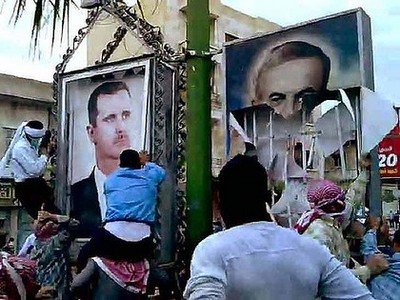
Syrians pulling down pictures of al-Assads, Bashar (left) and his father Hafez.
Foreign: The malign but tactically brilliant Hafez al-Assad blighted the Middle East with disproportionate Syrian influence for decades. His son, the feckless Bashar, has continued this pattern since 2000 by sending terrorists to Iraq, murdering Lebanon's prime minister Rafiq al-Hariri, overthrowing his son Saad, aiding the Hezbollah and Hamas terror groups, and developing chemical and nuclear weapons. His riddance will be a universal boon.

But Bashar's main role internationally is serving as Tehran's premier ally. Despite Westerners usually seeing the Syrian-Iranian alliance as a flimsy marriage of convenience, it has lasted over thirty years, enduring shifts in personnel and circumstances, due to what Jubin Goodarzi in 2006 called the two parties' "broader, long-term strategic concerns derived from their national security priorities."
The Syrian intifada has already weakened the Iranian-led "resistance bloc" by exacerbating political distancing Tehran from Assad and fomenting divisions in the Iranian leadership. Syrian protesters are burning the Iranian flag; were (Sunni) Islamists to take power in Damascus they would terminate the Iranian connection, seriously impairing the mullah's grandiose ambitions.

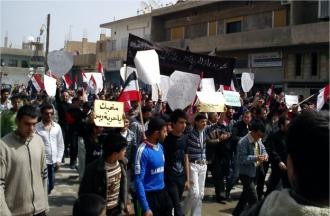
Kurds protesting for citizenship in Qamishli, Syria, in April 2011.
The end of Assad's rule points to other important consequences. Bashar and the ruling Islamist AK party in Turkey have developed such close relations that some analysts see the Assad regime's removal leading to a collapse of Ankara's entire Middle East policy. Also, unrest among the Kurds of Syria could lead to their greater autonomy that would in turn encourage co-ethnics in Anatolia to demand an independent state, a prospect that so worries Ankara, it sent a stream of high level visitors to Damascus and urgently pushed a counter-insurgency accord on it.

Turmoil in Syria offers relief for Lebanon, which has been under the Syrian thumb since 1976. Similarly, a distracted Damascus permits Israeli strategists, at least temporarily, to focus attention on the country's many other foreign problems.

Domestic: In a smug interview discussing developments in Tunisia and Egypt, and just weeks before his own country erupted on March 15, Bashar al-Assad explained the misery also facing his own subjects: "Whenever you have an uprising, it is self-evident that to say that you have anger [which] feeds on desperation."

The word desperation nicely summarizes the Syrian people's lot; since 1970, the Assad dynasty has dominated Syria with a Stalinist fist only slightly less oppressive than that of Saddam Hussein in Iraq. Poverty, expropriation, corruption, stasis, oppression, fear, isolation, Islamism, torture, and massacre are the hallmarks of Assad rule.

Vogue's puff-piece on the wife of Bashar al-Assad in its March 2011 issue.
Thanks to Western greed and gullibility, however, outsiders rarely realize the full extent of this reality. On one hand, the Syrian regime financially supports the Centre for Syrian Studies at the University of St Andrews. On the other, an informal Syria lobby exists. Thus, U.S. Secretary of State Hillary Clinton refers to Bashar al-Assad as a "reformer" and Vogue magazine publishes a puff-piece on the tyrant's wife, "Asma al-Assad: A Rose in the Desert" (calling her "glamorous, young, and very chic—the freshest and most magnetic of first ladies").

One potential danger resulting from regime change must be noted. Expect not a relatively gentle coup d'état as in Tunisia or Egypt but a thorough-going revolution directed not only against the Assad clan but also the Alawi community from which it comes. Alawis, a secretive post-Islamic sect making up about one-eighth of the Syrian population, have dominated the government since 1966, arousing deep hostility among the majority Sunnis. Sunnis carry out the intifada and Alawis do the dirty work of repressing and killing them. This tension could fuel a bloodbath and even civil war, possibilities that outside powers must recognize and prepare for.

As impasse persists in Syria, with protesters filling the streets and the regime killing them, Western policy can make a decisive difference. Steven Coll of the New Yorker is right that "The time for hopeful bargaining with Assad has passed." Time has come to brush aside fears of instability for, as analyst Lee Smith rightly observes, "It can't get any worse than the Assads' regime." Time has come to push Bashar from power, to protect innocent Alawis, and to deal with "the devil we don't know."

Sunday, May 15, 2011

Violence on Israel's borders

From Reuters, 15 May 2011, by Haim Shafir, MAJDAL SHAMS, Golan Heights*:


Violence erupted on Israel's borders with Syria, Lebanon and Gaza on Sunday, leaving at least eight dead and dozens wounded, as Palestinians marked what they term "the catastrophe" of Israel's founding in 1948.


Israeli troops shot at protesters in three separate locations to prevent crowds from crossing Israeli frontier lines in the deadliest such confrontation in years.

Israeli and Syrian media reports said Israeli gunfire killed four people after dozens of Palestinian refugees infiltrated the Israeli-occupied Golan Heights from Syria, along a disputed border that has been quiet for decades.

Witnesses on the nearby Lebanese frontier said four Palestinians were killed after Israeli forces fired at rock-throwing protesters to prevent them from crossing the border.

The Lebanese army had also earlier fired in the air in an attempt to hold back the crowds.

On Israel's tense southern border with the Gaza Strip, Israeli gunfire wounded 60 Palestinians as demonstrators approached Israel's fence with the Hamas Islamist-run enclave, medical workers said.

In Tel Aviv, Israel's commercial hub, a truck driven by an Arab Israeli slammed into vehicles and pedestrians, killing one man and injuring 17 people.

Police were trying to determine whether the incident was an accident or an attack. Witnesses said the driver, who was arrested, ran amok with his truck in downtown traffic.

...In the Druze village of Majdal Shams, on the Golan Heights captured by Israel from Syria in 1967, Mayor Dolan Abu Salah said between 40 and 50 Nakba demonstrators from Syria tore through the frontier fence.

...Israeli troops attempted to mend the breached fence..."We are seeing here an Iranian provocation, on both the Syrian and the Lebanese frontiers, to try to exploit the Nakba day commemorations," said the army's chief spokesman, Lieutenant-Colonel Yoav Mordechai.

Syria is home to 470,000 Palestinian refugees and its leadership, now facing fierce internal unrest, had in previous years prevented protesters from reaching the frontier fence.

"This appears to be a cynical and transparent act by the Syrian leadership to deliberately create a crisis on the border so as to distract attention from the very real problems that regime is facing at home," said a senior Israeli government official who declined to be named.

...in the occupied West Bank, Palestinian youths threw rocks at Israeli soldiers, who fired tear gas and rubber bullets in a clash at the Israeli military checkpoint outside the city of Ramallah ...

(*Additional reporting by Nidal al-Mughrabi in Gaza, Jeffrey Heller, Dan Williams and Ori Lewis in Jerusalem, Ali Sawafta in Ramallah and Yara Bayoumy in Beirut, Writing by Douglas Hamilton; editing by Crispian Balmer)

Saturday, May 07, 2011

Will the "Arab Spring" halt at the Syrian border?

From guardian.co.uk, Sat 30 Apr 2011, by Jonathan Spyer:

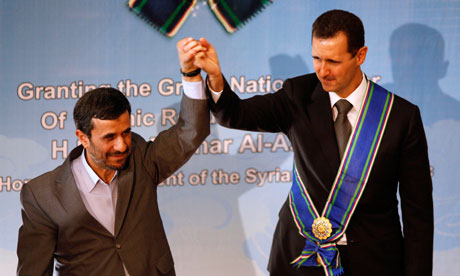
'If you mess around with Assad [right], you are issuing a challenge also to Iran [and Ahmadinejad, left] … the west doesn't want to do that.'
Photograph: Vahid Salemi/AP

...Syria's strategic alliance with Iran was thought of as an uncomfortable fit for the non-Islamist rulers of Syria – so it was assumed that President Assad was looking for a way out if it. Assad's relations with allied Islamist movements such as Hezbollah and Hamas were considered similarly instrumental in nature, and hence similarly susceptible to alteration. ...

These assumptions were noteworthy in that they were not only untrue, but in many ways represented the precise opposite of the truth. Syria's alignment with Iran and its backing of local paramilitary and terrorist clients are not flimsy marriages of convenience. They were and are the core of a successful regional policy. Through it, Damascus has magnified its local and regional influence, and obtained an insurance policy against paying any price for its activities.

This insurance policy is now paying dividends. Syria's alignment with the regional axis led by Iran represents Assad's best hope of survival. Indeed, western fear of Iran is the crucial factor making possible the crackdown in Syria and hence the survival of the regime.

The pro-western Arab authoritarian rulers, Ben Ali of Tunisia and Hosni Mubarak of Egypt, were forced aside by a combination of internal and subsequent western pressure. Non-aligned, isolated Muammar Gaddafi now finds himself fighting in Libya against a coalition of local rebels and western air power.
Assad, by contrast, who is aligned with the coalition of anti-western states and movements led by Iran, is currently facing only nominal and minimal western pressure. This is despite the fact that he appears to be engaged in the energetic slaughter of his own people.

The US administration disapproves of the repression, but the US ambassador to Syria, Robert Ford, remains firmly in place. The British foreign secretary finds the violence unacceptable but the defence secretary makes clear that a Libya-type option is not on the cards.

This is because if you mess around with Assad, you are issuing a challenge also to Iran, Hezbollah, Hamas, and their various regional allies and interests in Iraq and further afield. The leaders of the west don't want to do that.

According to opposition reports, Iranian personnel are on the ground helping to crush the rebellion in Syria. Many Syrians believe that the snipers whose bullets are reaping a terrible toll among the protestors are Iranians. Syrian-Iranian military co-operation is formalised (a co-operation treaty was signed in 1998) and intensive. Syria gives Iran a presence on the Mediterranean, and is the key arms conduit between Tehran and its Hezbollah client in Lebanon. It is also a major recipient of Iranian arms and aid. And Iran, evidently, sticks by its allies.

Since the west's commitment to regional liberty and freedom does not appear to extend to entangling itself in a general confrontation with the Iran-led regional bloc, Assad may feel reasonably confident. Now he just needs to crush the internal challenge.

... The Syrian dictator is currently getting away with slaughtering large numbers of his people because of western fear of Iran and its proxies. The question of whether the Arab spring stops at the borders of the Iran-led regional alliance will thus be decided in Syria.

The Iranians and their allies, who enthusiastically cheered the demonstrations in Egypt and Tunisia, are keen to ensure that it does end there. Western policy, meanwhile, looks likely to be too confused and hesitant to ensure that it does not. This matter will be decided in the weeks and months ahead.

The fall or weakening of the Assad regime in Syria would constitute a serious body blow to Iranian regional ambitions. Its resurgence under the protective tutelage of Tehran, by contrast, would prove that membership of the Iranian alliance provides a handy guarantee for autocratic rulers hoping to avoid the judgment of their peoples. In the ongoing cold war that remains the key strategic process in the Middle East, the west should see preventing this outcome as a key objective.

Thursday, April 28, 2011

USA got Lost on the Road to Damascus

From Yahoo News, Wed Apr 27, by Anthony Ventre:

...It was 2007 when House Speaker Nancy Pelosi hit the road for Damascus, overriding Bush state department criticism of her attempted rogue diplomacy. What wish-fulfillment fantasies compelled Pelosi to visit a country officially listed as a "state sponsor of terror?

"The road to Damascus is the road to peace!" Pelosi enthused.

Pelosi's judgment was that Syria's dictator would succumb to the American left-liberal vision of peace with Israel so long as Israel returned the Golan Heights. It didn't matter to Pelosi that Syria's Bashar Assad was a client state of Iran and a chief sponsor of Hezbollah in Lebanon. Nor did it matter that Syria was funneling fighters into Iraq to oppose U.S. troops. It didn't matter, either, that the Israelis had not consented to any peace process initiated by Pelosi, and were blind-sided by her proclamation.

The Israelis often point out that there could be no peace process without a reliable "peace partner." Terror groups like Hamas could never be peace partners, for example, because they would simply lie to obtain what they wanted. And they did lie. When the Israelis pulled out of Gaza, Hamas amped up its efforts at firing rockets into Israel.

Syria has unmasked itself as an imaginary "peace partner" by murdering an estimated 400 protestors in the current crisis. Assad's regime terrorizes political opponents with tanks and snipers hired from Iran to pick off protest leaders. Such was the fate of Neda Soltan during the 2009 pro-democracy uprising—shot dead by an Iranian police sniper.

Just because Arabs and Persians have been telling us for years that the postage stamp sized state of Israel is the main reason for a Middle Eastern failure doesn't mean it is so. This is particularly obvious now that the Middle Eastern winds have shifted. Clearly, Israel has had nothing to do with the uprisings which have now dwarfed the Palestinian-Israeli conflict in scope and consequences for the U.S.

Putting Israel at the center of Middle Eastern conflicts is a facile copout ....

... The Obama administration has not withdrawn its ambassador, frozen Syrian assets, or threatened war crimes trials as it has with Gadhafi in Libya. Yet, those things can be done now and easily.

It's time for the myth of the "good dictator" in Syria to be put to rest.

Assad under pressure as hundreds of Baathists quit

From AFP, Wed Apr 27:

DAMASCUS (AFP) – Foreign pressure mounted on Syrian President Bashar al-Assad, and hundreds of members resigned from his party, as troops kept their grip on the flashpoint town of Daraa.

...233 members of Syria's ruling Baath party announced their resignation in protest at the deadly crackdown on protesters, according to lists seen by AFP.

...Baath party signatories from the Banias region, which covers Daraa, condemned "the house raids and the indiscriminate use of live fire against people, homes, mosques and churches."

...The Security Council, however, failed to agree on a statement condemning the killing of Syrian protesters  ...talks ended in deadlock ...France called for "strong measures"  ...The United States said Assad must "change course now" ...

Russia and China blocked the statement proposed by Britain, France, Germany and Portugal that would have condemned the violence and backed calls for an independent investigation.

The European Union, meanwhile, is mulling sanctions and the UN human rights body has called for a special session in the wake of the Syrian regime's bloody crackdown ...
...the military assault on Daraa, 100 kilometres (62 miles) south of Damascus, has left more than 30 people dead since Monday, with at least 453 civilians killed across Syria since protests first erupted in mid-March...

Wednesday, April 27, 2011

US: Assad is no peace partner but Gaddafi is worse


Top US State Department official says it's difficult to pursue other diplomatic missions while Syrian regime violently puts down protests.


WASHINGTON – After two years of pushing Israel to reach a peace agreement with Syria, a top US State Department official indicated Tuesday the Obama administration is no longer looking at the current regime as a partner for such a deal.

... Sullivan said the US is also looking at the possibility of imposing sanctions on Syrian leaders and is consulting with international partners on this and other potential steps to halt the bloody crackdown Assad has ordered on opposition protesters.

“President Assad is on the wrong track,” Sullivan said, condemning the civilian deaths. He added, though, that the US is focused on “diplomatic and financial” initiatives aimed at the Syrian regime rather than military intervention as has taken place in Libya.

He also repeatedly declined to label Assad an illegitimate ruler or call for him to go, as the US did in Libya with Muammar Gaddafi once the Libyan leader began to shoot at protesters rather than accede to their demands for reform.

“Ultimately, the future of Syria is up to the people of Syria,” Sullivan said.
“It’s hard for us to stand by and see [President Bashar] Assad and his government engage in the kind of things they’re doing against their own people and to then think easily about how to pursue other diplomatic missions,” Jacob Sullivan, director of policy planning at the State Department, told reporters.

Syria Could Soon Join UN Human Rights Council

From Huffington Post, 24 April 2011, by David Harris:

No, this isn't a bad joke.
The very same Syria that today is mowing down its own people in the streets could well be elected a member of the UN Human Rights Council on May 20th.

Here's how it works:
The Council is comprised of 47 member states. Each is elected for a three-year term, with one-third of the seats becoming vacant each year. According to the UN General Assembly resolution creating the Council in 2006, Asia is assigned 13 of the 47 seats, with the other four regional blocs divvying up the remaining 34. Four of the 13 Asian seats become vacant now.
This year, there's what's called a "clean slate," meaning that four countries were chosen within the Asia group for the four seats. They are India, Indonesia, Philippines, and, yes, Syria. (Syria's candidacy has also been embraced by the Arab League and the Organization of the Islamic Conference.) Unless more Asian countries now opt to vie for the vacant seats, it could soon be a done deal.
Traditionally, when the general vote occurs, the candidate countries selected by their respective regional blocs are automatically endorsed, with perhaps a few dissenting votes, by the larger group.
To indicate its willingness to comply with the Council's mission, Syria has formally pledged "its commitment to respect and to support the inalienable nature of all human rights," adding it "would contribute to accomplish the objectives of the Council, and would support the national and international efforts for promotion and protection of human rights for all, without distinction and selectivity or politicization."
Don't laugh. The Syrian government expressed this with all due solemnity. Given the abysmal record of some others who've been chosen to serve on the Council, it could be enough to get it elected.
Of course, putting Syria on the UN Human Rights Council would make a mockery of the whole exercise.
One hardly knows where to begin in documenting Syria's utter and total disregard for human rights. And, incidentally, this long predates the current bloodshed.
For starters, the regime has no legitimacy. In 2000, Bashar Assad inherited power from his father, Hafez Assad, who himself was no Jeffersonian democrat nor was he, shall we say, the product of the free will of the people. The ruling elite come from the Alawite community, which comprises just 12 percent of the total population.
Open elections in Syria? No. Protection of civil liberties? No. Due process? No. Independent judiciary? No.
Emergency rule? Yes. Torture? Yes. Administrative detention? Yes. Censorship? Yes.
What's more, Syria not only flouts human rights protections at home, but beyond its borders as well.
Damascus houses terrorist groups like Hamas, whose stated aim is the destruction of Israel and the murder of Israelis wherever they may live.
Syria, a bosom buddy of Iran, is involved in the trans-shipment of weaponry to Hezbollah from Iran, in flagrant violation of UN Security Council resolutions and with the aim of strengthening a terrorist entity at the expense of the centralized government in Lebanon.
Until 2007, when Israel took action, Syria pursued a clandestine nuclear-weapons program in collaboration with North Korea. To what end? It's not hard to guess. Whether it has sought to restart that program remains an open question. What's not in question, however, is Syria's failure to cooperate with the International Atomic Energy Agency (IAEA) on inspections.
And it was clear to French President Jacques Chirac that Syria had a central hand in the murder of his friend, Rafik Hariri, the former prime minister of Lebanon, and 21 others in Beirut in 2005.
But despite this deplorable record, Syria has gotten off quite easy.
Bashar Assad was mistakenly seen as a reformer from the get-go by many observers who presumably would rather not have their comments at the time recalled. Because he had spent time in England, was computer savvy, had an attractive wife, and represented a generational shift from his thuggish father, Assad was heralded as ushering in a new era.
Less than one year after he took office, Syria was elected to the UN Security Council as a candidate of the Asian group, with 160 out of 177 votes.
More recently, an unending procession of Western dignitaries have made their way to Damascus in the misplaced, if stubborn, belief they could draw Assad away from the Iranian orbit, laud internal progress, and encourage closer ties. The visitors have included several notable members of the U.S. Congress.
After President Sarkozy took office in 2007, France began to reverse course on the hostile stance towards Syria of President Chirac. Turkish Prime Minister Erdogan embraced the Syrian leader and struck defense and other deals with him. Russia agreed to sell deadly missiles to the Syrian regime. And the U.S. returned its ambassador to Damascus in January, after downgrading bilateral ties in 2005 over the Hariri assassination.
Vogue, the fashion magazine, went so far as to feature the Syrian First Lady in its March issue. The spread could not have been more fawning -- or ill-timed.
And now, lest there have been any doubts all along, Syria has shown its true colors for the world to see.
While uttering empty words about reform, Assad has unleashed the vast power of the state to kill hundreds of his countrymen who dared to peacefully and courageously challenge his rule -- and the end is not in sight.
He's tried to keep the media out, but social media can't be stopped as easily, so we've heard loud and clear from opposition groups. The world knows what's happening there.
What next?
Well, in the case of Libya, after initial hesitation, the international community sprang into action to confront Gaddafi's crimes.
The UN Human Rights Council met in special session. It recommended the suspension of Libya's membership -- which itself had been a travesty when it occurred in 2010. The UN General Assembly endorsed the suspension. And, of course, the UN Security Council took important decisions.
With Syria, it's still unclear. It could go either way.
Within weeks, Syria could be elected a member of the UN Human Rights Council and, despite its own horrendous record, sit imperiously in judgment of others for the next three years.
Or, like Libya, it could instead become the target of a special session of the UN Human Rights Council -- and possibly other UN bodies -- for its systematic violations of human rights and possible crimes against humanity.
The world should be watching closely.
It will reveal a great deal about how the Council works, how regional blocs -- in this case, Asia -- either embrace or reject murderers in their midst, and how individual countries act. Remember that each country has one vote, and those votes will determine the outcome.
We can only hope that a clear majority of the Council will get "Syria-ous."

Thursday, April 21, 2011

US Impotence in the face of Hysterical Hypocrisy at the UN

From Fox News, April 18, 2011, by Anne Bayefsky:

...Democracy-seekers are dying all over [Syria]. Meanwhile, at the United Nations, negotiations over what would be the organization’s first-ever definition of terrorism ended with deadlock on Friday after fifteen years of talking about it.

Leading the naysayers from the Organization of the Islamic Conference (OIC) was Syria, a country that claimed that murdering its preferred antagonists doesn’t count. That might be just a bad joke, except for the fact that the Obama administration has made the U.N. the centerpiece of its national security policy.

Friday marked the last day of a week-long effort by the U.N. ad-hoc Committee on Measures to Eliminate International Terrorism to finalize a comprehensive convention on international terrorism. Negotiations began back in 1996, and courtesy of American taxpayer dollars, they pick up now and again about every six months. Back in 2003, there was a draft put forward by a coordinator charged with bridging gaps, but the OIC objected because a definition of terrorism should “distinguish it from the legitimate struggle of peoples against foreign occupation.” Then again in 2007 a draft compromise failed because the OIC said the proposed definition failed to draw a “distinction between terrorism and peoples’ struggle for self-determination and against foreign occupation.”

On Friday, with four more years of diplomatic lunches under their belt, the OIC and its Syrian spokesperson said no deal because there is a “distinction between terrorism and the struggle for the rights of self-determination by people under foreign occupation and colonial or alien domination.” Representatives from Egypt, Iraq and Saudi Arabia immediately voiced their wholehearted agreement. In plain language, Islamic states including Muslim “allies” of the United States, insist that all Israelis, Americans who get in their way, or anybody else nowadays who objects to President Bashar Assad’s idea of “self-determination,” are fair game.

And Syria’s run at the U.N. on Friday didn’t end there.

Syria is currently running for a seat on the U.N.’s flagship “human rights” body, the Human Rights Council. Seats are allocated to five regional groups, and just to make sure Syria’s ascendancy is unimpeded, the Asian group has only nominated the same number of states as they have seats. So barring any unexpected additions, Syria will join fellow U.N. human rights authorities like Saudi Arabia on the Council in May.

The U.N. does have a “test” for Human Rights Council wannabes. They call it a pledge system – candidates should promise to protect human rights. In the words of the 2006 General Assembly resolution that created the Council (the Bush administration and Israel casting a negative vote), when electing candidates “voluntary pledges and commitments made” “to the promotion and protection of human rights” should be “taken into account.”

Syria has been a quick study. Its pledge, obligingly posted on the U.N. website, says: “Promotion and protection of human rights are of highest importance to Syria…Syria’s candidature to the Human Rights Council signifies its commitment to respect and to support the inalienable and indivisible nature of all human rights.”

That might be another bad joke. Except that the Obama administration announced on March 30 that it was so “pleased to note the landmark achievements of the most recent session of the U.N. Human Rights Council” that it was going to seek a second term. That characterization of the Council’s main March session is somewhat dubious, at least if the administration cared at all about the concept of equality and the welfare of Israel. The last session was the worst on record for the demonization of the Jewish state, the Council adopting more anti-Israel resolutions in one sitting than ever before. The wildly premature announcement – the U.S. term will end in December 31, 2012 according to a new General Assembly deal – erases any possibility of using prospective U.S. membership or associated dollars as clout.

Which brings us back to Syria. Obama diplomats have been making tiny noises about attempting to institute criteria for belonging to the Council that have something to do with a country’s actual human rights record. On Friday, Syrians diplomats treated the toothless Obama speechifying with the ridicule it so richly deserved.

Syrian U.N. Ambassador Bashar Ja’afari warned “those who call for reviewing membership criteria” that the move “would bring unpleasant surprises.” In addition to his country’s penchant for bashing heads, what he meant by this threat was a list of seventeen membership “criteria that have to be met in case this matter is re-visited.”

Syrian thugs think these states should be disqualified from Human Rights Council membership: “colonial states,” states which “…have taken part in the slave trade and not apologized,… propagate Islamophobia…and all forms of cultural discrimination, …ignore international legitimacy,…interfere in the internal affairs of other UN members,…foster state terrorism,…and cause greenhouse effects and global warming.”

However ludicrous, make no mistake about how this classic U.N. debate will turn out. The U.S. idea of caring about human rights as a qualification for membership will be set off against Syria’s list and result in maintaining the status quo – namely, the laughable pledge. There is no possibility whatsoever, that the same countries who comprise the majority of members of the U.N. General Assembly – only 87 of 192 are fully free democracies according to Freedom House – are going to police themselves. Even if the Syrian candidacy is eventually challenged, there is no shortage of like-minded comrades to join Cuba, China, Russian and the Saudis on the U.N.’s idea of a human rights body.

Sadly, none of the above stopped United States Ambassador to the United Nations Susan Rice from telling lawmakers on Capitol Hill a week ago that “the U.N. promotes universal values Americans hold dear” and “the United Nations… make[s] Americans safer.” With the Obama administration looking to the U.N. for guidance on protecting “human rights” and combating “terrorism,” Americans are in serious trouble.

Thursday, March 31, 2011

The baby dictator prepares for a long battle

From JPost, 31 March 2011, by JONATHAN SPYER:

Assad wants to keep his job - his speech indicated he will use all the violence and subterfuge he deems necessary to do.

President Bashar al-Assad’s speech to the Syrian parliament was noteworthy more for what the Syrian dictator did not say than for what he did.

Remarks by Assad aides to the media in the last days had raised expectations that Assad might try to defuse protests by offering a series of concessions. In particular, the possibility of a lifting of emergency laws in place in Syria since 1963 had been hinted at by senior adviser Bouthaina Shaaban.

No such commitments were forthcoming from the Syrian president. The brief address was an announcement by the regime of its determination to stand its ground. It reflected a belief on the part of Assad that to appear to waver at this moment might prove costly. He apparently believes that his regime is sufficiently strong to be able to wear down the protesters without seeking to compromise with their demands.

Instead of wavering, he chose to reiterate the core elements of his regime’s by-now-familiar take on current events in Syria and the wider region.

Since the outbreak of the unrest, the official information channels of the Syrian regime have maintained that an Israeli plot is responsible for the protests. Sana news agency has claimed to have identified mysterious “armed gangs” seeking to commit acts of violence against civilians. The Syrian media has also cited SMS messages coming from Israel that encourage Syrians to take part in the revolt.

Assad’s speech followed and developed this line.

“Plots are being hatched against our country,” he told the assembled parliament members. “Saboteurs are trying to undermine and divide Syria, and to push an Israeli agenda.”

Assad likened the current events to the situation in 2005. In that year, a popular uprising in Beirut and the presence of US forces in Baghdad forced Syria to end its 15-year occupation of Lebanon. The regime faced a Kurdish uprising in the same period.

“Similar to 2005,” the Syrian president told his parliament, “there is chaos in the country under the pretext of reform, especially among sects.”

The reference to sects is perhaps evidence of Assad’s sense of irony, since his own regime rests on the support of the minority Alawi sect, who comprise 12% of the population.

The protesters, meanwhile, hail overwhelmingly from Syria’s 75% Sunni Muslim majority.

But Assad’s irony is no laughing matter. This reference, and the remark about an attempt to “divide” Syria, signal that the regime is accusing the protesters of two of the cardinal sins in the professed Arab nationalist viewpoint of the Baathist regime in Syria.

It matters little whether Assad himself takes seriously his own rhetoric. The point is that this type of terminology has the sound of a regime preparing for a long and ruthless fight against an internal enemy which it is seeking to characterize in the most negative terms at its disposal.

The reference to 2005 is instructive in another way. In that year, the Syrian regime was on the ropes, with some commentators predicting its imminent demise. By citing it, Assad is also reminding his listeners and the world of his staying power. By its favored methods of clandestine violence and intimidation, the Assad family dictatorship bounced back hard from the doldrums in the subsequent years. Bashar believes it can do so again.

Hence the tone of defiance that summed up the speech.

Here the dictator’s feline sense of humor was on display again. “We don’t seek battles,” said Bashar (an assertion which would come as news to the peoples of Israel, Lebanon and Iraq, frequent targets of the myriad proxy military groups maintained by the Syrian regime).

“But if a battle is imposed on us today – ahlan wasahlan – welcome.” Syria would fight the “domino project,” and make it fall.

So there it all was. Israeli plots, domino projects for fragmentation and division.

Armed gangs, chaos, and a welcoming of the battle by the Syrian dictator, casting himself in the nationalist-tragic mode which is the style of stifling rhetoric that he and other regional leaders of his stripe prefer. All by way of a not-soveiled threat.

This time against his own people.

This was the authentic voice of the Arab old order – or at least the military dictatorial part of it. Intoning its old certainties.

No mention of reform or change. “Stability” said Assad, was the number one interest.

The response was swift in coming, and suitably irreverent.

The Facebook page “Syrian Revolution 2011 against Bashar Assad,” a few minutes after the speech, carried a message beginning with the ringing call, “To the public squares, youth of Syria – grab freedom from these clowns, go down now to the streets.”

But if anyone among the Syrian opposition or elsewhere was still under the impression that the Assad family dictatorship would consent quietly to reforming itself out of existence, Wednesday’s speech should be sufficient to put them right.

Bashar Assad wants to keep his job. All the familiar and wearying clichés were on offer, beneath which he will prepare the violence and subterfuge he deems necessary to ensure his survival.

U.S. leaders should not excuse the brutality of Syria’s dictator

From NRO, March 30, 2011, by Claudia Rosett, journalist-in-residence with the Foundation for Defense of Democracies and heads of its Investigative Reporting Project:

If Pres. Barack Obama prefers not to intervene on behalf of the protesters being slaughtered in Syria, the least his administration could do is refrain from endorsing their tyrant.

In Obama’s speech Monday night about America’s interest in defending Libyans and standing alongside other freedom-seekers of the Arab world, Syria didn’t even rate a mention. That discussion was handled Sunday in remarks by Secretary of State Hillary Clinton, speaking on CBS’s Face the Nation. Not only did Clinton nix any thoughts of action on Syria, she ran interference for Syria’s murderous president, Bashar Assad, saying: “Many of the members of Congress of both parties who have gone to Syria in recent months have said they believe he’s a reformer.”

Such deference to U.S. lawmakers was absent from Obama’s decision to go to war in Libya; the president sought a resolution from the United Nations, but not from Congress. But if Congress is now back in the loop, with some members singing the praises of Assad, clearly the State Department needs to do a much better job of briefing them on the realities.

Clinton could start by highlighting the findings of her own department’s annual reports on human rights in Syria. These reports go far to explain why, after 40 years of the Assad family’s totalitarian rule, Syrians are so unhappy with this regime that tens of thousands of them have been risking prison, torture, and death in order to burn offices of the ruling Baath party, topple a statue of the late Hafez Assad, and march through the streets of cities across Syria, demanding freedom from the current Assad. The most recent State Department report, dated 2009, does not include the current season of shooting protesters. But it covers more than enough to convey the general idea.

The report begins with the observation that during 2009, the government and members of its security forces “committed numerous serious human rights abuses, and the human rights situation worsened.” Then come accounts of “arbitrary or unlawful deprivation of life” and “enforced disappearances” that go back to the vanishing of “an estimated 17,000 persons in the late 1970s and early 1980s.” Those numbers, which look like a conservative estimate, presumably include the regime’s 1982 massacre in the city of Hama, which was how the elder Assad dispatched an uprising of the Muslim Brotherhood. Hillary Clinton, in her remarks Sunday, dismissed that mass murder with the comment, “There is a different leader in Syria now.”

Yes, but since the younger Assad took over in 2000, the reign of terror, reinforced by the echoes of Hama, has carried on. The State Department report lists a slew of “suspicious” deaths, disappearances, and arrests in 2009 alone, for offenses such as “degrading speech” or “insulting the president and the judicial system.” The Syrian government, with its long record of allegedly “disappearing” individuals, offered no legal redress and “did not investigate or punish any security force members for their role in disappearances.”

There is a description of the methods of torture and abuse inflicted on the inmates of Syria’s filthy and crowded prisons. Among these are: “electrical shocks; pulling out fingernails; burning genitalia; forcing objects into the rectum; beating, sometimes while the victim was suspended from the ceiling; other times on the soles of the feet.” (I heard a first-person account of this technique some years ago from a survivor of Syria’s prisons, who showed me the horrible scars.) In a 21st-century reprise of the medieval rack and wheel, other methods include “hyperextending the spine; bending the detainees into the frame of a wheel and whipping exposed body parts; . . . [and] using a backward-bending chair to asphyxiate the victim or fracture the victim’s spine.”

This report goes on to enumerate other forms of agony, insult, theft, and repression inflicted by the Assad regime on the 21 million people of Syria. Corruption is rampant. Assad’s Baath Party keeps its monopoly on power by prohibiting criticism of the government and violating its own constitution in order to severely restrict such rights as freedom of assembly. A permit can be required for a gathering of more than three people. There is brutal censorship. Among the cases cited in this report is that of a blogger who was sentenced to three years in prison for “publishing information aimed at weakening national morale.”

For a source other than the State Department, consult the Washington-based Freedom House. The organization puts out a handy report on “The World’s Most Repressive Societies”; in 2010, Syria ranked, as usual, among these “Worst of the Worst.” Freedom House also puts out a country report on Syria. The 2010 version includes an illuminating note about the regime’s practice of rewarding or coercing Syrians into informing on their own relatives, friends, and associates.

This is the regime that Syrians, with incredible courage, are now daring to defy. Assad is shuffling his cabinet and promising concessions he says will “please all the Syrian people.” But it’s a sure bet his security forces will be standing by, just in case the people aren’t pleased enough to stop protesting. One can see what Assad means by “please all the Syrian people” by looking at Syria’s 2007 elections, in which Assad officially produced a voter turnout of 96 percent and won 98 percent of the vote.

Along with all this, Assad’s Syria is a threat to the U.S. and its democratic allies — notably Israel. Its officials welcome terrorists and sanctions-busting weapons traffic, and Syria has amassed its own considerable arsenal of missiles and chemical weapons. It is one of four countries currently on the State Department’s list of terror-sponsoring states, a list it has helped populate since 1979. Under Assad, Syria hosts an array of terrorist groups, including leaders of Hamas, which controls Gaza.

Syria’s regime is a bedfellow of the terror-sponsoring, nuclear-bomb-seeking mullocracy in neighboring Iran. The country supports and abets the flow of weapons to the terrorists of Hezbollah, the Iranian-backed terrorist group that now controls the government of neighboring Lebanon — which Syria occupied from 1976 to 2005. Not only is Syria a longtime missile client of North Korea’s, but under Bashar Assad, Syria became an enterprising nuclear client as well, building a secret reactor with North Korean help (it was destroyed by an Israeli air strike in 2007) and displaying a continuing and alarming interest in nuclear development to this day.

Calling Bashar Assad a “reformer” might satisfy the likes of the United Nations Human Rights Council, where — with Libya only recently suspended — Syria has now brazenly entered the running for a seat. For the U.S. State Department, which, along with those giddy congressional delegations, has been trying to “engage” Assad, it may look like reform when Assad grants them an audience, or Assad’s wife trots out her French designer handbag for an interview with Vogue. Or perhaps Obama and Clinton consider it simplest to try to dismiss Syria’s protests in whatever way might most seem to favor continuing attempts at “engagement” with the Damascus regime.

If it was right for America to intervene in Libya to protect people trying to rid themselves of a bloody tyrant, there can be no excuse for American officials’ doing anything that might help or encourage Assad in his efforts to hold on to power. The long and ugly record of Assad’s regime suggests that he will try to crush this uprising by jailing, torturing, and killing as many protesters as he needs to. Obama may be chiefly concerned with trying to avoid another military intervention in the Middle East. But with his administration praising Assad and signaling that Syria’s regime is exempt from the kind of punishment now descending on Qaddafi, Obama risks ending up with a lot of blood on his hands.

Monday, March 21, 2011

Here's why Gaza is blockaded

From idfnadesk, Mar 17, 2011:


A two-minute ummary of the incident in which the IDF Navy uncovered on-board the cargo ship "Victoria" weaponry intended for the use of terrorist organizations operating in the Gaza Strip. The ship had come from Lattakia, Syria and made a quick stop in Turkey before its final destination to Egypt. According to assessments, the weapons were intended to be smuggled through Egypt into the Gaza Strip. Turkey and Egypt are not believed to be involved with the weapons smuggling.

The weaponry discovered on the vessel included thousands of mortar shells, ammunition, and six anti-ship missiles which may have significantly shifted the regional balance of powers in favor of the terror organizations. These missiles could have been used to threaten Israeli Navy ships, civilian ships, and gas reserves off the coast of Israel.

In addition, Iranian documents found along with the weaponry including a missile identification manual written in Persian containing emblems of the Iranian government, point to the involvement and cooperation between Iran and Syria to further arm terrorist organizations.

Sunday, February 27, 2011

WAKE UP Syrians!!

From The Huffington Post, February 26, 2011, by Saad Khan, Freelance journalist from Islamabad:

Where are the Syrians? There are millions of protesters on the Arab street but Syrians are surprisingly missing from the crowd. This eerie absence is disturbing, to say the least. We are talking about a country with one of the worst human rights records. A dictatorship in the garb of a thin and contorted cover of democracy that essentially calls for a single-party rule. Add to that the repetition of the Bahrain formula: minority ruling the majority. These are the ingredients that could have cooked up a storm but there is not even a feeble thunder.

There have been reports of police beating up activists who were staging a peaceful sit-in outside the Libyan embassy in Damascus. They earlier dispersed a handful of supporters of the Egyptian uprising who were holding a candle-light vigil. The Guardian reports of a crackdown on the internet where people are even afraid to use proxy servers to access social networking sites. Those who dare end up in jail like Tal al-Mallouhi, who was 17 when she was rounded up by Bashar thugs in 2009. Her only crime was to write blogs about democracy and people empowerment. Other bloggers and journalists are facing a similar fate.

There is little attention being paid to Syria in the international press.

United States is following the policy of re-engagement with Syria, almost on the same lines it did with Libya. Although some sanctions are still in place, there is a general feeling of warmth with the inauguration of the Obama administration.

...Bashar has been in power for almost 11 years. It has been a one-party dictatorship since 1970 when his father Hafez staged an intra-party coup. It appears that he will try his best to emulate his father's "success," which would be the most shameful insult to happen to Syrians in modern times.

His support among the minorities is waning; he does not represent the majority in the first place. He is from the Alawite sect that is less than 10% of Syria's population. An overwhelming majority of Ba'ath party members share his faith. This might protect him from inter-cine struggle or a coup. He does not represent the majority. This might work against him.

He surely enjoys an unwavering support from Iran, with which his party shares religious and strategic ties. Perhaps in a bid to support their friend, Iranians have sent warships through the Suez Canal to participate in a war game. They might come to his help if they fear that the Assad empire is about to fall. This will, however, put them on the spot as they are supporting the current uprisings. How will they explain their double standards?

All things considered, it is the right time for Syrians to stand for their rights. It is true that they are afraid. They fear that Bashar might follow in his father's footsteps when he killed thousands of dissenters during the infamous Hama massacre in 1982. There is, however, a remote possibility of him repeating his father's crime against humanity. He can be as tough on protesters as his father's friend Qaddafi is, killing in dozens and hundreds. He cannot, however, afford to start a full-blown massacre sitting right in the heart of Arabia and with the changing dynamics. He is even trying to tame them by distributing aid after a wait of five years in which millions of Syrians living in rural areas lost everything to a severe drought. This, however, is too little and too late. It can't erase the decades of repression, poverty, and injustice.

This is where the Syrians diaspora comes into play. They can throw the first stone. They are free of the state oppression and can openly voice their opinion. They can also pressure the international community to get tough on Bashar. This will provide an impetus to their brethren in Syria to overcome the decades-old fear of brutal state repression. It is party time on the Arab street. Better not miss this opportunity.

Russians arm Hezbollah

From JPost 26 Feb 2011*:

Following Russia's announcement that it will transfer missiles to Syria, Defense Ministry fears weapons could fall into "wrong hands." ...Security officials warned that the Russian cruise missiles "are potentially dangerous weapons and they may come fall into the hands of Hezbollah, just as other weapons systems came from Syria."

The announcement came after Russian Defense Minister Anatoly Serdyukov said that Russia would fulfill its contractual obligation and complete the transfer of cruise missiles to Syria...despite the objections of Israel and the United States...

*Yaakov Katz contributed to this report.

Saturday, February 26, 2011

Israel aware of additional Syrian nuclear facilities

From JPost, 25 Feb 2011, by YAAKOV KATZ:

Israeli intelligence agencies are aware of additional Syrian nuclear facilities, Defense Minister Ehud Barak said on Thursday, amid reports that Syria was harboring a uranium conversion reactor near the town of Marj as-Sultan, about 15 km. east of Damascus.

The German Sueddeutsche Zeitung newspaper on Thursday identified the location of the site, which is suspected of containing a small uranium conversion facility that is functionally related to the covert reactor at al-Kibar that the Israel Air Force destroyed in September 2007.

According to the newspaper and a subsequent analysis of satellite footage by the Washington-based Institute for Science and International Security (ISIS), the facility is reportedly intended for processing uranium yellowcake into uranium tetrafluoride (UF4), and could have been related to making fuel for the reactor destroyed in 2007.

...Strategic Affairs Minister Moshe Ya’alon was quoted as warning Syrian President Bashar Assad “not to challenge us... Assad has already proven that he has negative intentions...We know him as someone who is connected to Iran on one side and Hezbollah on the other.”

Minister-without-Portfolio Yossi Peled told Israel Radio that Israel would not allow hostile countries to obtain nuclear weapons....

Tuesday, September 21, 2010

An Imminent Coup by Hezbollah in Lebanon

From the International Analyst Network, 18 Sep 2010, by Elias Youssef Bejjani:

A Saudi advice has delayed the return of Lebanon's PM, Saad Al Hariri, from Saudi Arabia to Beirut.

Meanwhile, 3500 Hezbollah militiamen are secretly deployed in the Eastern Christian region according to a report that was published yesterday by the "Beirut Observer" web site. Hezbollah has reached its final logistic preparations to execute an armed coup to take over all of Lebanon by force.

The web site attributed its information to well-informed sources in the Saudi media.

Below is a summary of the report with other related information:

Well-informed Saudi sources have confirmed to the "Beirut Observer" that the delay of Lebanon's PM return to Beirut came in response to advice by Saudi officials. The Saudis are extremely concerned in regards to information became available to them indicating that an imminent Hezbollah coup is in on the horizon. The Saudis are fearful that Hezbollah’s threats are not mere political rhetoric this time. The Iranian-armed militia has set all the needed logistic preparations for the coup and is only waiting for the zero hour.

According to the report, Hezbollah's planned coup will take a camouflaged cover of civilian protection this time. But the reality on the ground is that it will not be different from Hezbollah's bloody and cruel invasion of Western Sunni Beirut and Druze Mount Lebanon in May 2008. The coup will be initiated by putting government officials under house arrest. This will include Lebanon's PM, Saad Al Hariri, General prosecutor Said Mirza, Internal Security Forces General Director General Ashraf Rifi as well as many other officials and politicians. Sources said that Information Branch President Colonel Wesam Hassan will be spared from house arrest in the early hours of the coup.

The report went on to conclude that at the present time the centre of attention is a scheduled visit by a Saudi envoy to Damascus today and on the results of his talks with Syrian officials. The Saudi mission to Syria will focus on the current volatile situation in Lebanon, the avoidance of bloodshed, strife and and the repetition of what happened on May 2008. The Saudis fear that the impact of any military coup executed by Hezbollah in Lebanon will spread chaos over the entire region.

Private sources from Beirut unveiled that Hezbollah has deployed 3500 of its armed militia men along the Mediterranean coast in the Christian region from Beirut northwards through the cities of Junieh, Tabarja and Batroun. These bearded Hezbollah men are residing in chalets and apartments located in Christian areas and on standby alert status in case of any political development or security emergency that may require their armed intervention.

According to the report, a decision was taken by Hezbollah's leadership to invade Christian regions loyal to the March 14 Coalition, and subdue them by military force. Hezbollah's Leadership aim from such an invasion is to deliver a bloody intimidation message to all Lebanese who oppose its hegemony over the country. They want to prove on the ground that they have the upper hand, the sole power and the authority all over the country...

Follow this link to the Arabic report published yesterday by the Beirut Observer web site.

Sunday, September 19, 2010

Russia supplies advance weapons to Syria

From Ynet News, 19 September 2010, by Itamar Eichner:

Jerusalem angered at sale of Russian [cruise] missiles to Syria...

Israeli officials are threatening to sell weapons to "areas of strategic importance" to Russia after Moscow announced over the weekend that it would go through with the sale of P800 [cruise] missiles to Syria...

Russia's announcement came after both Israel and the US implored that it abandon the sale. The cruise missiles discussed, dubbed Yakhont, have a range of 300 km, which puts Israeli ships off of Lebanon's coast at risk of being hit by missiles fired from Syria's southern port.

...last month Prime Minister Benjamin Netanyahu called Russian President Vladimir Putin and requested that he call it off, for fear the missiles will be handed to Hezbollah.

More recently Defense Minister Ehud Barak visited Moscow on a similar mission. Barak spoke with both Putin and Defense Minister Anatoly Serdyukov. ...

Despite the extensive efforts, the deal was announced Friday to be proceeding as planned. "They've gone one step too far," one Jerusalem official said. "This is not in keeping with our cooperation with them."

The official said Israel had so far refrained from selling "strategic, tie-breaking weapons" to third-world countries, and that it expected Russia to do the same.

"The supply of advanced weapons to Syria, one of Hezbollah's two main supporters, especially on the eve of the fateful peace talks with the Palestinians, is not a move encouraging the moderate forces of the Middle East – but rather a prize for extremist states," the source said.

...The P800 is considered one of the world's most advanced cruising missiles due to its speed and low flight. Israel fears it will fall into the hands of Hezbollah in Lebanon, which would put its ships in the Mediterranean at risk, especially in light of terror organizations' desire to derail peace talks with the Palestinians...

The Next Israel-Hizballah War

In a new Washington Institute Policy Focus #106, published September 2010, Jeffrey White offers an estimation of what renewed hostilities between Israel and Hizballah might look like.

In a meticulously calculated forecast of the future battlefield -- supplemented by original maps and graphics -- White outlines the capabilities and operational objectives of the two sides, the potentially game-changing roles played by Syria and Iran, and the possible impact on the region's postconflict military and political environments.

White concludes that
  • this is the war the IDF must win -- the consequences may be fateful, and
  • Washington should be developing its own concrete plans and preparatory steps now.
From the Executive Summary:
…If war does in fact come to Israel’s northern border, it would bear little resemblance to the 2006 conflict in Lebanon. Instead, it would in all likelihood be a transformational, even fateful, event for the region...
…In all probability, it would be a major conflict, one fought over extensive areas of Lebanon, Israel, and probably Syria, featuring large military forces executing complex operations and resulting in substantial casualties (military and civilian) as well as major infrastructure damage in all of the countries involved. …the fighting would be intense and would likely escalate and expand. Israel and Hizballah would feel great pressure to win such a war, and that need would drive the hostilities to a new level, likely pulling in Syria and pushing Iran to become involved as well. The conflict would be a severe test for decisionmakers and warfighters on both sides, and a challenge for key external actors, especially the United States.
… Although the challenge of a war with Hizballah and its allies should not be underestimated, the Israel Defense Forces (IDF) are much better prepared today than they were in 2006. …Israel would aim to fundamentally alter the military equation, with great consequences for the political situation.

… it would likely be decisive in the military operational sense. Israeli military strategy would center on the use of large-scale joint air, ground, and naval operations to rapidly eliminate Hizballah’s rocket and missile forces, destroy its ground forces in southern Lebanon, severely damage its command and control systems, and destroy its infrastructure throughout Lebanon.

Israel would probably attempt to prevent the conflict from escalating into general war with Syria …

… Hizballah’s military efforts would center on the following strategies:
■■ Offensively, to launch massive rocket/missile attacks on military and civilian targets with the intention of inflicting significant casualties and damage
■■ Defensively, to oppose Israeli air, ground, and naval operations inside Lebanon with aggressive action, slowing any advances while inflicting as many casualties as possible ...

For their part, Syria and Iran would at minimum provide communications, command, control, intelligence, and resupply assistance in an effort to keep Hizballah in the fight. Syrian air defense elements would oppose “penetrations” of Syrian airspace and perhaps engage Israeli aircraft over Lebanon, given the small operational area involved and the proximity of Damascus to the combat zone. Beyond basic support (e.g., advice, arms, intelligence), Iran’s potential role is unclear. But in a large-scale conflict, Tehran could decide to participate more directly by providing light infantry or special forces in Lebanon, and perhaps missile and air defense forces within Syria. And both Damascus and Tehran would likely feel pressure to increase their roles as the war escalated, due in part to their connections with and commitments to Hizballah.

If Syria became directly involved in a conflict with Israel during a war in Lebanon, its goals would include:
■■ Preserving the regime and its key assets (security, military, economic)
■■ Preserving Hizballah’s position in Lebanon and its ability to threaten Israel
■■ Reestablishing a Syrian military presence in Lebanon
■■Inflicting a defeat on Israel sufficient to create the conditions for regaining the Golan Heights
In Iran, the regime could decide to take one or more of several steps, on an escalating scale of involvement:
■■ Providing more arms to Hizballah and Syria
■■ Providing advisors, technicians, or light combat forces
■■ Carrying out asymmetric attacks on Israeli interests (e.g., terrorist-type actions)
■■ Engaging in regional troublemaking (e.g., raising tensions in the Strait of Hormuz)
■■ Conducting missile strikes on Israel
In the Palestinian arena, Hamas leaders would likely limit the group’s participation to token actions accompanied by supporting rhetoric. At the same time, no one should be surprised if a new war in the north included a “Gaza excursion.” Hamas could decide to enter the conflict in serious fashion, employing heavy rocket fire and long-range weapons. Alternatively, Israel could decide to finish the job begun with Operation Cast Lead in 2008–2009.

Escalation and Uncertainty
The war outlined here would present a dangerous situation— various pressures and dynamics would push it toward escalation. The course of the fighting, the combatants’ offensive strategies and doctrinal approaches, the depth of their preparations for war, their expectation that the other side will use massive force, and the perceived advantages of preemption would all foster a broader and more serious conflict. …
Decisionmakers on all sides would be under great pressure to act quickly in order to achieve their goals and protect their assets and populations…

… it would be a large-scale, intense conflict waged between Israel and some combination of Hizballah and its allies, fought in and over Israel, Lebanon, and Syria, and lasting weeks. In the end …The IDF would be occupying some, perhaps substantial, parts of Lebanon and potentially all of Gaza…

…It would certainly be Israel’s most serious war since 1973, and one that the IDF would have to win. …if Israel acted decisively, were willing to pay the costs in casualties and damage, and enjoyed military success, then a new war could substantially weaken its opponents in the following ways:
■■ Hizballah would be broken as a military factor in Lebanon and weakened politically.
■■ The Syrian regime would be weakened by military defeat and the loss of important military and security assets.
■■ Iran’s activities in the region would be circumscribed by the defeat of its allies; and if Tehran failed to aid them during the conflict, it would lose influence as well.
■■ Hamas (assuming it became involved directly) would lose its military power in Gaza and at least some of its political power.

The U.S. Role
… the United States should not necessarily take immediate steps toward ending it quickly.
Several important objectives would be at stake in such a scenario: breaking Hizballah’s military capabilities and reducing its political power; disabusing Syria of the notion that it can act in Lebanon to further its own interests without significant cost; and removing the potent Hizballah proxy from Iran’s foreign policy arsenal. Only successful IDF operations can achieve those goals.

Accordingly, the United States should consider giving the IDF both the time and the political space it needs to carry out those objectives.

Washington should also be prepared for associated Iranian troublemaking in the Persian Gulf. The United States must demonstrate that it will use force if necessary, thwarting any attempt by Tehran to take advantage of the situation created by a Lebanon war.

Conclusion
Whether hostilities will erupt soon or ever is uncertain; both sides have good reason to avoid it. But if war does come once again to Israel’s northern border, a renewed confrontation between Israel and Hizballah will not resemble their inconclusive 2006 encounter.

The new war will likely be wider in geographic scope and more destructive, with high-intensity operations from the beginning. The dynamics of the fighting will produce rapid escalation, possibly pulling in Syria and even Iran.

Where the war goes badly for either side, significant military and civilian casualties, disruption of economic activity, and damage to infrastructure are probable. Although Israel will most likely prevail in this scenario, victory for either side will carry substantial costs. And for the losing side, the consequences may well be fateful. As the war deterrent appears to weaken, both Israel and Hizballah are preparing for a serious confrontation that neither can afford to lose.


Download the full, 60-page report (a 1.4MB pdf)

Downloadable Maps:
Notional Israeli Air Force Operations against Hizballah
Notional Israeli Offensive Operations in Southern Lebanon
Selected Rocket and Missile Coverage of Israel from Potential Launch Areas in Lebanon
Notional Hizballah Offensive Operations in Northern Israel
Notional Hizballah Defense Concept

*Jeffrey White is a defense fellow at The Washington Institute, specializing in the military and security affairs of the Levant, Iraq, and Iran. A thirty-four-year veteran of the Defense Intelligence Agency (DIA), he participated in DIA operational and policy planning and wrote extensively for senior defense officials, including the secretary of defense and the chairman of the Joint Chiefs of Staff.

Saturday, August 14, 2010

Failure of US policy in Lebanon

From a JERUSALEM POST EDITORIAL, 6 August 2010:

The sniper fire directed at IDF soldiers by the Lebanese Armed Forces on Tuesday, which killed Lt.- Col. Dov Harari and seriously wounded Capt. Ezra Lakia, has spurred a flurry of speculation about the precise causes of the incident.

UNIFIL made it clear that Lebanese forces were to blame for the attack....
...In the four years since the Second Lebanon War, much has happened to undermine the uneasy quiet that prevailed until this week between Israel and Lebanon. But none of it has to do with Israeli actions. Most of the reason for the exacerbated tension lies in the inspiring, funding, training and arming of Hizbullah by Iran and Syria.


And some of it has to do with the US’s and Europe’s ineffective Middle East policy.

Unimpeded by America or Europe and with massive Iranian backing, Hizbullah has consolidated its military and political hegemony in Lebanon. Syria, meanwhile, has fully reinstated its military and political presence after being temporarily expelled from Lebanon by the March 14 Alliance.

Formed by Saad Hariri, Druse leader Walid Jumblatt and others after the February 14, 2005, assassination of Saad Hariri’s father, the Alliance had hoped to transform Lebanon into the Arab world’s first truly free democratic state. But the Second Lebanon War, sparked by Hizbullah aggression, diverted attention and energy from the movement’s push for an independent Lebanon, and in 2008 it effectively capitulated to Hizbullah and Syria.

Ostensibly, it was Saudi Arabia, the patron of present Prime Minister Saad Hariri, that pushed for reconciliation with Syria and Hizbullah. But in reality, this macabrely sycophantic act, in which Hariri the son courted his father’s murderers, is the direct result of the US’s weakening position in the region.

The Saudis, Hariri, and the courageous Jumblatt, whose war-hardened Druse community fought the Party of God to a standstill in May 2008, have come to the realization that with the US and Europe out of the picture in Lebanon, it would be suicidal to stand up to the Iran-Syria-Hizbullah axis, which is increasingly being joined by Turkey. In light of US passivity, meanwhile, the Saudis hope to maintain a semblance of influence in Lebanon by improving relations with Syria. Just this week, Saudi King Abdullah met with President Bashar Assad of Syria in Beirut.

The US refrained from providing the March 14 Alliance with crucial support when it needed it most, missing an historic chance to encourage the creation of new, democratic momentum. The Obama administration’s attempt to “engage” Damascus, instead of sanctioning it for tightening its ties with Teheran and turning Lebanon into a satellite state, has failed miserably. Nor have the US or Europe taken steps against Hizbullah, a key member of the Lebanese government, for bullying the UN peacekeeping forces in Lebanon that are responsible for the implementation of UN Security Council Resolution 1701.

AGAINST THE backdrop of this dismal US track record in Lebanon, it was not surprising that, in response to Tuesday’s deadly incident at the border, Washington declined to take a firm stand against Lebanese forces.

State Department spokesman P.J. Crowley said, “We deeply regret the loss of life; we urge both sides to exercise maximum restraint to avoid an escalation and maintain the cease-fire that is now in place.” Even UNIFIL was more robust than that, conveying the message that if the Lebanese Armed Forces fired into Israel again – the IDF was targeted beyond the border fence but inside Israeli territory – the IDF would blow up its border positions, and flatly rejecting Lebanon’s suggestion that the peacekeepers should be doing the IDF’s gardening work at the border.

The truth is that it is the US, not “both sides,” that can do the most to avoid further escalation in Lebanon.

Washington should take steps to strengthen moderate Lebanese forces while imposing sanctions against the extremists. Otherwise, Israel will be forced, against its will, to fill the vacuum where a robust and savvy American Middle East policy ought to be.