From JPost 26 Feb 2011*:
Following Russia's announcement that it will transfer missiles to Syria, Defense Ministry fears weapons could fall into "wrong hands." ...Security officials warned that the Russian cruise missiles "are potentially dangerous weapons and they may come fall into the hands of Hezbollah, just as other weapons systems came from Syria."
The announcement came after Russian Defense Minister Anatoly Serdyukov said that Russia would fulfill its contractual obligation and complete the transfer of cruise missiles to Syria...despite the objections of Israel and the United States...
*Yaakov Katz contributed to this report.

Showing posts with label Russia. Show all posts
Showing posts with label Russia. Show all posts
Sunday, February 27, 2011


Saturday, November 20, 2010
Remember the 'Refuseniks' rough road to Israel
BOOK REVIEW from The Washington Post, Friday, November 19, 2010, Anne Applebaum:
...In the years that followed, the Soviet Union collapsed; the refuseniks left the U.S.S.R. and were forgotten.
In "When They Come for Us, We'll Be Gone," a fresh, surprising and exceedingly well-researched book, Gal Beckerman has retold their story. Or rather, he has retold two stories: that of the Soviet Jews who made their religion and their desire to emigrate to Israel into a protest movement, and that of the American Jews who championed their cause. Alternating chapters between Russia and the United States, Beckerman shows how the two groups developed in a strange symbiosis, even while knowing very little about each other.
Their relationship changed both groups profoundly. Beckerman believes, in fact, that advocacy for Soviet Jewry "taught American Jews how to lobby." Before the American Jewish community coalesced around the emigration issue, its leaders had been wary of transforming their money and numbers into political clout. The need to save Soviet Jews, he argues - not the need to support Israel - taught American Jews how to use the tools that are so familiar today, from "targeting local congresspeople to asserting influence on the Hill."
It's an unexpected thesis, and completely convincing. Beckerman shows that the movement did not arise out of the blue but was rather the product of the events of the 1960s:
Over time, both groups taught themselves to help each other. Like the rest of the dissident movement, activist Soviet Jews learned how to document the repression used against them and to get their reports out of the country. American Jews learned, in turn, how to beam these facts back into the U.S.S.R. on Radio Liberty, as well as how to present them to Congress, the news media and the White House. For years they pounded away at the advocates of realpolitik - Nixon and Kissinger among them - who wanted U.S.-Soviet relations to focus on arms and trade, not human rights.
In 1974, they won. That was the year that saw the passage of the Jackson-Vanik amendment, legislation that linked Soviet trade deals to Jewish emigration. Sponsored by Sen. Henry "Scoop" Jackson, a non-Jewish politician who had made this issue his own, it forced the White House to establish links between human rights violations and wider diplomatic issues. After the amendment passed, U.S.-Soviet relations were never the same...
After the collapse of the U.S.S.R. in 1991, the movement disappeared, a happy victim of its own success. In the subsequent decade, some 1 million Jews emigrated from the Soviet Union to Israel. Beckerman wants to ensure that the story of this epic struggle isn't forgotten...
WHEN THEY COME FOR US, WE'LL BE GONE...the Soviet Jews ...most of whom had applied to emigrate to Israel and had been turned down: They were "refuseniks..."
The Epic Struggle to Save Soviet Jewry
By Gal Beckerman
Houghton Mifflin Harcourt. 598 pp. $US30
...In the years that followed, the Soviet Union collapsed; the refuseniks left the U.S.S.R. and were forgotten.
In "When They Come for Us, We'll Be Gone," a fresh, surprising and exceedingly well-researched book, Gal Beckerman has retold their story. Or rather, he has retold two stories: that of the Soviet Jews who made their religion and their desire to emigrate to Israel into a protest movement, and that of the American Jews who championed their cause. Alternating chapters between Russia and the United States, Beckerman shows how the two groups developed in a strange symbiosis, even while knowing very little about each other.
Their relationship changed both groups profoundly. Beckerman believes, in fact, that advocacy for Soviet Jewry "taught American Jews how to lobby." Before the American Jewish community coalesced around the emigration issue, its leaders had been wary of transforming their money and numbers into political clout. The need to save Soviet Jews, he argues - not the need to support Israel - taught American Jews how to use the tools that are so familiar today, from "targeting local congresspeople to asserting influence on the Hill."
It's an unexpected thesis, and completely convincing. Beckerman shows that the movement did not arise out of the blue but was rather the product of the events of the 1960s:
- Jewish participation in civil rights marches,
- the Adolf Eichmann war crimes trial,
- the Broadway debut of "Fiddler on the Roof" and
- the Six Day War...
- there was Israeli input, too. A special department of the Mossad offered seed money to the first lobbying groups and even had a couple of paid agents....
- the political thaw that followed Stalin's death,
- the growth of the Soviet human rights movement,
- the institutionalization of Soviet anti-Semitism.
Over time, both groups taught themselves to help each other. Like the rest of the dissident movement, activist Soviet Jews learned how to document the repression used against them and to get their reports out of the country. American Jews learned, in turn, how to beam these facts back into the U.S.S.R. on Radio Liberty, as well as how to present them to Congress, the news media and the White House. For years they pounded away at the advocates of realpolitik - Nixon and Kissinger among them - who wanted U.S.-Soviet relations to focus on arms and trade, not human rights.
In 1974, they won. That was the year that saw the passage of the Jackson-Vanik amendment, legislation that linked Soviet trade deals to Jewish emigration. Sponsored by Sen. Henry "Scoop" Jackson, a non-Jewish politician who had made this issue his own, it forced the White House to establish links between human rights violations and wider diplomatic issues. After the amendment passed, U.S.-Soviet relations were never the same...
After the collapse of the U.S.S.R. in 1991, the movement disappeared, a happy victim of its own success. In the subsequent decade, some 1 million Jews emigrated from the Soviet Union to Israel. Beckerman wants to ensure that the story of this epic struggle isn't forgotten...
Sunday, September 19, 2010
Russia supplies advance weapons to Syria
From Ynet News, 19 September 2010, by Itamar Eichner:
Jerusalem angered at sale of Russian [cruise] missiles to Syria...
Israeli officials are threatening to sell weapons to "areas of strategic importance" to Russia after Moscow announced over the weekend that it would go through with the sale of P800 [cruise] missiles to Syria...
Russia's announcement came after both Israel and the US implored that it abandon the sale. The cruise missiles discussed, dubbed Yakhont, have a range of 300 km, which puts Israeli ships off of Lebanon's coast at risk of being hit by missiles fired from Syria's southern port.
...last month Prime Minister Benjamin Netanyahu called Russian President Vladimir Putin and requested that he call it off, for fear the missiles will be handed to Hezbollah.
More recently Defense Minister Ehud Barak visited Moscow on a similar mission. Barak spoke with both Putin and Defense Minister Anatoly Serdyukov. ...
Despite the extensive efforts, the deal was announced Friday to be proceeding as planned. "They've gone one step too far," one Jerusalem official said. "This is not in keeping with our cooperation with them."
The official said Israel had so far refrained from selling "strategic, tie-breaking weapons" to third-world countries, and that it expected Russia to do the same.
"The supply of advanced weapons to Syria, one of Hezbollah's two main supporters, especially on the eve of the fateful peace talks with the Palestinians, is not a move encouraging the moderate forces of the Middle East – but rather a prize for extremist states," the source said.
...The P800 is considered one of the world's most advanced cruising missiles due to its speed and low flight. Israel fears it will fall into the hands of Hezbollah in Lebanon, which would put its ships in the Mediterranean at risk, especially in light of terror organizations' desire to derail peace talks with the Palestinians...
Jerusalem angered at sale of Russian [cruise] missiles to Syria...
Israeli officials are threatening to sell weapons to "areas of strategic importance" to Russia after Moscow announced over the weekend that it would go through with the sale of P800 [cruise] missiles to Syria...
Russia's announcement came after both Israel and the US implored that it abandon the sale. The cruise missiles discussed, dubbed Yakhont, have a range of 300 km, which puts Israeli ships off of Lebanon's coast at risk of being hit by missiles fired from Syria's southern port.
...last month Prime Minister Benjamin Netanyahu called Russian President Vladimir Putin and requested that he call it off, for fear the missiles will be handed to Hezbollah.
More recently Defense Minister Ehud Barak visited Moscow on a similar mission. Barak spoke with both Putin and Defense Minister Anatoly Serdyukov. ...
Despite the extensive efforts, the deal was announced Friday to be proceeding as planned. "They've gone one step too far," one Jerusalem official said. "This is not in keeping with our cooperation with them."
The official said Israel had so far refrained from selling "strategic, tie-breaking weapons" to third-world countries, and that it expected Russia to do the same.
"The supply of advanced weapons to Syria, one of Hezbollah's two main supporters, especially on the eve of the fateful peace talks with the Palestinians, is not a move encouraging the moderate forces of the Middle East – but rather a prize for extremist states," the source said.
...The P800 is considered one of the world's most advanced cruising missiles due to its speed and low flight. Israel fears it will fall into the hands of Hezbollah in Lebanon, which would put its ships in the Mediterranean at risk, especially in light of terror organizations' desire to derail peace talks with the Palestinians...
Saturday, June 12, 2010
Iran Sanctions ban Russian S-300 missiles
LIFESAVING NEWS!!!...From ASSOCIATED PRESS, 11 June 2010:
Moscow backtracks on intent to seal deal after three-year delay.
MOSCOW — The new UN sanctions prevent Russia from delivering S-300 air-defense missiles to Iran, a Kremlin official said Friday, in a reversal of the position announced by Russia's Foreign Ministry the day before.
The Kremlin statement was sure to please Israel and the United States, which have long urged Russia not to supply the powerful missile system. Russia signed a deal to sell the missiles in 2007, but has delayed their delivery.
The UN Security Council resolution passed Wednesday bans Iran from developing ballistic missiles capable of delivering nuclear weapons, investing in nuclear-related activities and buying certain types of heavy weapons.
The Kremlin official, speaking on condition of anonymity, said the S-300 falls under these sanctions.
Crowley: Resolution calls for states to restrain sales, transfers
The UN resolution does not specifically prohibit Russia from supplying the S-300, the US State Department spokesman said. "However, for the first time, the resolution calls for states to exercise vigilance and restraint in the sale or transfer of all other arms and related materiel," spokesman P.J. Crowley told reporters in Washington. "We appreciate Russia's restraint in the transfer of the S-300 missile system to Iran."
This distinction may help explain the initial confusion.
On Thursday, Foreign Ministry spokesman Andrei Nesterenko said the UN resolution did not apply to air-defense systems, with the exception of shoulder-fired missiles.
The head of the Federal Service for Military-Technical Cooperation, which oversees arms trade, also said Thursday that the sanctions would not affect the S-300 deal. But on Friday the agency said an analysis of the resolution indicated that the missile system was banned under the new sanctions.
Russian President Dmitry Medvedev would issue a decree specifying which types of weapons cannot now be sold to Iran, Foreign Minister Sergey Lavrov said.
Shabbat Shalom....!
Moscow backtracks on intent to seal deal after three-year delay.
MOSCOW — The new UN sanctions prevent Russia from delivering S-300 air-defense missiles to Iran, a Kremlin official said Friday, in a reversal of the position announced by Russia's Foreign Ministry the day before.
The Kremlin statement was sure to please Israel and the United States, which have long urged Russia not to supply the powerful missile system. Russia signed a deal to sell the missiles in 2007, but has delayed their delivery.
The UN Security Council resolution passed Wednesday bans Iran from developing ballistic missiles capable of delivering nuclear weapons, investing in nuclear-related activities and buying certain types of heavy weapons.
The Kremlin official, speaking on condition of anonymity, said the S-300 falls under these sanctions.
Crowley: Resolution calls for states to restrain sales, transfers
The UN resolution does not specifically prohibit Russia from supplying the S-300, the US State Department spokesman said. "However, for the first time, the resolution calls for states to exercise vigilance and restraint in the sale or transfer of all other arms and related materiel," spokesman P.J. Crowley told reporters in Washington. "We appreciate Russia's restraint in the transfer of the S-300 missile system to Iran."
This distinction may help explain the initial confusion.
On Thursday, Foreign Ministry spokesman Andrei Nesterenko said the UN resolution did not apply to air-defense systems, with the exception of shoulder-fired missiles.
The head of the Federal Service for Military-Technical Cooperation, which oversees arms trade, also said Thursday that the sanctions would not affect the S-300 deal. But on Friday the agency said an analysis of the resolution indicated that the missile system was banned under the new sanctions.
Russian President Dmitry Medvedev would issue a decree specifying which types of weapons cannot now be sold to Iran, Foreign Minister Sergey Lavrov said.
Shabbat Shalom....!
Thursday, March 04, 2010
Two-faced Russia on Iran
From Al-Mustaqbal, Lebanon, March 3, 2010:
Russia's Stance: Talking 'Smart Sanctions' On Iran, Giving Smart Arms To Iran

Russia's Stance: Talking 'Smart Sanctions' On Iran, Giving Smart Arms To Iran
Cartoonist: Hassan Bleibel
Sunday, February 21, 2010
IAEA report confirms ‘military intentions’ of Iran
From JPost, 21/02/2010, by HAVIV RETTIG GUR AND AP:
... an International Atomic Energy Agency report released on Thursday that says Iran may be developing a nuclear warhead.
...Noting that the report is the first during the term of new IAEA chief Yukiya Amano of Japan, Israel said it “establishes that the agency has a lot of trustworthy information about the past and present activities that testify to the military tendencies of the Iranian program.”
Among these activities were the recently declared decisions to enrich uranium to 20 percent and the continued construction of the Qom nuclear facility, kept secret until it was discovered by Western intelligence agencies and made public in recent months.
The UN nuclear agency report suggested for the first time that Teheran had either resumed such work or had never stopped when US intelligence thought it did.
Thursday’s report appeared to put the UN nuclear monitor on the side of Germany, France, Britain and Israel.
...The confidential IAEA report said Iran’s resistance to agency efforts to probe for signs of a nuclear cover-up “give rise to concerns about possible military dimensions to Iran’s nuclear program.”
...The language of the report appeared to be more directly critical of Iran’s refusal to cooperate with the IAEA than most of those compiled by Amano’s predecessor, Mohamed ElBaradei of Egypt.
It strongly suggested that intelligence supplied by the US, Israel and other IAEA member states on Iran’s attempts to use the cover of a civilian nuclear program to move toward a weapons program was compelling...
...Meanwhile on Friday, Russia’s foreign minister said he was “very alarmed” over Iran’s failure to prove its nuclear program is peaceful, suggesting Moscow may be closer to acceding to Western demands for new UN sanctions against Teheran.
“We are very alarmed, and we cannot accept that Iran is refusing to cooperate” with the IAEA, Lavrov said on Ekho Moskvy radio. He added that he did not understand the need for Iran to conduct its nuclear program in secret, withholding information from the IAEA...
...Susan Rice, the US ambassador to the United Nations, said the IAEA report “underscores that Iran continues to flout its international obligations” and indicates that Teheran is pursuing “a nuclear weapons program with the purpose of evasion.”
The United States has circulated elements for a possible new UN sanctions resolution to other veto-wielding UN Security Council members – Russia, China, Britain and France – and Germany. The six countries have been trying, to no avail, to get Iran to suspend its uranium enrichment program and return to negotiations on its nuclear program.
...“We now have no other choice, given this report, than to seek, together with our partners, the adoption of new measures by the UN Security Council over the next few weeks,” the [French Foreign Ministry] said in a statement.
The United States and its Western allies have been pushing for a fourth round of UN sanctions. But China, which relies on Iran’s energy exports, is skeptical of any new sanctions.
... an International Atomic Energy Agency report released on Thursday that says Iran may be developing a nuclear warhead.
...Noting that the report is the first during the term of new IAEA chief Yukiya Amano of Japan, Israel said it “establishes that the agency has a lot of trustworthy information about the past and present activities that testify to the military tendencies of the Iranian program.”
Among these activities were the recently declared decisions to enrich uranium to 20 percent and the continued construction of the Qom nuclear facility, kept secret until it was discovered by Western intelligence agencies and made public in recent months.
The UN nuclear agency report suggested for the first time that Teheran had either resumed such work or had never stopped when US intelligence thought it did.
Thursday’s report appeared to put the UN nuclear monitor on the side of Germany, France, Britain and Israel.
...The confidential IAEA report said Iran’s resistance to agency efforts to probe for signs of a nuclear cover-up “give rise to concerns about possible military dimensions to Iran’s nuclear program.”
...The language of the report appeared to be more directly critical of Iran’s refusal to cooperate with the IAEA than most of those compiled by Amano’s predecessor, Mohamed ElBaradei of Egypt.
It strongly suggested that intelligence supplied by the US, Israel and other IAEA member states on Iran’s attempts to use the cover of a civilian nuclear program to move toward a weapons program was compelling...
...Meanwhile on Friday, Russia’s foreign minister said he was “very alarmed” over Iran’s failure to prove its nuclear program is peaceful, suggesting Moscow may be closer to acceding to Western demands for new UN sanctions against Teheran.
“We are very alarmed, and we cannot accept that Iran is refusing to cooperate” with the IAEA, Lavrov said on Ekho Moskvy radio. He added that he did not understand the need for Iran to conduct its nuclear program in secret, withholding information from the IAEA...
...Susan Rice, the US ambassador to the United Nations, said the IAEA report “underscores that Iran continues to flout its international obligations” and indicates that Teheran is pursuing “a nuclear weapons program with the purpose of evasion.”
The United States has circulated elements for a possible new UN sanctions resolution to other veto-wielding UN Security Council members – Russia, China, Britain and France – and Germany. The six countries have been trying, to no avail, to get Iran to suspend its uranium enrichment program and return to negotiations on its nuclear program.
...“We now have no other choice, given this report, than to seek, together with our partners, the adoption of new measures by the UN Security Council over the next few weeks,” the [French Foreign Ministry] said in a statement.
The United States and its Western allies have been pushing for a fourth round of UN sanctions. But China, which relies on Iran’s energy exports, is skeptical of any new sanctions.
Wednesday, February 17, 2010
Netanyahu meets Medvedev in Moscow
From The Israel MFA, 15 Feb 2010:
Advancing our mutual relations and rolling back those who destroy peace and threaten the stability of the Middle East and the world is something I very much look forward to discussing with you.

PRESIDENT OF RUSSIA DMITRY MEDVEDEV: Mr Prime Minister, I am pleased to have this chance to meet with you ...Israel is more than just a partner in the ordinary sense for us, but is a country with whom we are bound by longstanding relations and with whom we share much in common in terms of the nature and makeup of our populations.
Another matter I wanted to bring up during our talks today is that this year is significant in that we will be celebrating the 65th anniversary of victory over Nazism. This is our common victory. I think the celebrations should take place at the highest level. ...
This is important in order to preserve for all time the memory of these events in the chronicles of history and prevent people from taking liberties with and falsifying the account of what actually happened...
ISRAEL PM BENJAMIN NETANYAHU: I am delighted to see you, Mr President...
...You spoke correctly about the need to recognise Russia’s extraordinary contribution in saving mankind against the Nazi tyranny. We know it very well. ...we have over a million Russian speakers many of whom fought in that same Great War, and we know the heroism and sacrifice of the Russian people which is unimaginable. ...
...You correctly say that there are people who wish to distort what happened in the Second World War. ...widespread denial of the Holocaust. And this should be combated as firmly as any distortion of the history of the Second World War. It’s not just an argument of history, it’s an argument about the present and the future.
And I believe that on this we see eye to eye, and on many other things as well. ...I look forward to seeing how we can advance peace, and ...helping roll back the enemies of peace...
Prime Minister Netanyahu's statement to the Israeli press after his meeting with Russian President Medvedev:
"I believe that Russia fully understands the Iranian objective and is well aware of the point the Iranians have reached in their nuclear program. Russia is considering and discussing the issue of sanctions with other members of the Security Council. President Medvedev has listened to my position, which is that the sanctions must have teeth. In order for them to bite, they must have teeth. Diluted sanctions, soft sanctions, will simply not do the job."
Advancing our mutual relations and rolling back those who destroy peace and threaten the stability of the Middle East and the world is something I very much look forward to discussing with you.
Photo: Russian Presidential Press and Information Office
PRESIDENT OF RUSSIA DMITRY MEDVEDEV: Mr Prime Minister, I am pleased to have this chance to meet with you ...Israel is more than just a partner in the ordinary sense for us, but is a country with whom we are bound by longstanding relations and with whom we share much in common in terms of the nature and makeup of our populations.
Another matter I wanted to bring up during our talks today is that this year is significant in that we will be celebrating the 65th anniversary of victory over Nazism. This is our common victory. I think the celebrations should take place at the highest level. ...
This is important in order to preserve for all time the memory of these events in the chronicles of history and prevent people from taking liberties with and falsifying the account of what actually happened...
ISRAEL PM BENJAMIN NETANYAHU: I am delighted to see you, Mr President...
...You spoke correctly about the need to recognise Russia’s extraordinary contribution in saving mankind against the Nazi tyranny. We know it very well. ...we have over a million Russian speakers many of whom fought in that same Great War, and we know the heroism and sacrifice of the Russian people which is unimaginable. ...
...You correctly say that there are people who wish to distort what happened in the Second World War. ...widespread denial of the Holocaust. And this should be combated as firmly as any distortion of the history of the Second World War. It’s not just an argument of history, it’s an argument about the present and the future.
And I believe that on this we see eye to eye, and on many other things as well. ...I look forward to seeing how we can advance peace, and ...helping roll back the enemies of peace...
Prime Minister Netanyahu's statement to the Israeli press after his meeting with Russian President Medvedev:
"I believe that Russia fully understands the Iranian objective and is well aware of the point the Iranians have reached in their nuclear program. Russia is considering and discussing the issue of sanctions with other members of the Security Council. President Medvedev has listened to my position, which is that the sanctions must have teeth. In order for them to bite, they must have teeth. Diluted sanctions, soft sanctions, will simply not do the job."
Sunday, February 14, 2010
Israel and US prepare for Iran battle
From Ynet News, 14 Feb 2010, by Hanan Greenberg:
...Chairman of the [US] Joint Chiefs of Staff Michael Mullen is arriving in Israel for a series of discussions focused on Iran, while Prime Minister Benjamin Netanyahu is heading for talks in Russia for meetings with top Russian officials.
IDF officials say the meetings with Mullen will focus on "the cooperation between the militaries and joint security challenges," with Iran's nuclear race taking center stage. Officials are expected to look into the implications of economic sanctions, while also examining other options.
Admiral Mullen, who in the past has spoken out against the dangerous potential of Iran's nuclear threat, will be holding his ninth meeting with his host, IDF Chief of Staff Major-General Gabi Ashkenazi. Mullen recently said that an Iranian bomb would constitute an existential threat for Israel, stressing that he and Ashkenazi share a similar vision regarding the threat's scope and timetable.
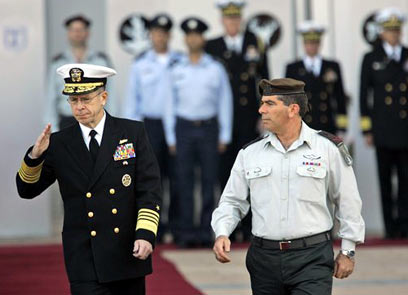
Mullen's visit will be part of a regional tour for America's military chief. He is arriving in Israel from Egypt and will be continuing to Jordan. During his visit in Israel, Mullen will meet with Ashkenazi twice, and is also expected to take part in a meeting with other top Israeli generals.
On Monday, Mullen will be presented with a guard of honor at the IDF headquarters in Tel Aviv. The admiral is also scheduled to visit the Yad Vashem Holocaust Museum in Jerusalem, and meet with dozens of IDF officials involved in the rescue mission to Haiti.
Bibi to meet with Medvedev, Putin
On another front, PM Netanyahu will make an effort to reinforce Russia's contribution to the international campaign against Iran during a series of meetings in Moscow.
During his two-day visit to Moscow, Netanyahu is expected to meet with Russian President Dmitry Medvedev and with Prime Minister Vladimir Putin....
...Chairman of the [US] Joint Chiefs of Staff Michael Mullen is arriving in Israel for a series of discussions focused on Iran, while Prime Minister Benjamin Netanyahu is heading for talks in Russia for meetings with top Russian officials.
IDF officials say the meetings with Mullen will focus on "the cooperation between the militaries and joint security challenges," with Iran's nuclear race taking center stage. Officials are expected to look into the implications of economic sanctions, while also examining other options.
Admiral Mullen, who in the past has spoken out against the dangerous potential of Iran's nuclear threat, will be holding his ninth meeting with his host, IDF Chief of Staff Major-General Gabi Ashkenazi. Mullen recently said that an Iranian bomb would constitute an existential threat for Israel, stressing that he and Ashkenazi share a similar vision regarding the threat's scope and timetable.
Meetings to focus on Iran (Photo: AP)
Mullen's visit will be part of a regional tour for America's military chief. He is arriving in Israel from Egypt and will be continuing to Jordan. During his visit in Israel, Mullen will meet with Ashkenazi twice, and is also expected to take part in a meeting with other top Israeli generals.
On Monday, Mullen will be presented with a guard of honor at the IDF headquarters in Tel Aviv. The admiral is also scheduled to visit the Yad Vashem Holocaust Museum in Jerusalem, and meet with dozens of IDF officials involved in the rescue mission to Haiti.
Bibi to meet with Medvedev, Putin
On another front, PM Netanyahu will make an effort to reinforce Russia's contribution to the international campaign against Iran during a series of meetings in Moscow.
During his two-day visit to Moscow, Netanyahu is expected to meet with Russian President Dmitry Medvedev and with Prime Minister Vladimir Putin....
Wednesday, February 10, 2010
(Finally) Sanctions on Iran Are Coming
From Fox News, February 9, 2010:
President Obama said Tuesday the deadline for sanctions against Iran is fast approaching and that the United States and its allies have extended a hand that has been rejected.
...The issue of sanctions against Iran has been in the works since 2009 with President Obama even laying out an end-of-the-year deadline with his French and British counterparts, but Iran continues to block international observers ....
“Despite their posturing that their nuclear power is only for civilian use, they in fact continue to pursue a course that would lead to weaponization,” Obama said. “And that is not acceptable to the international community, not just to the United States.”
Earlier on Tuesday, Defense Secretary Robert Gates who was in Paris for meetings, said he hopes resolution can be reached with Iran before military action is needed. "Everybody's interest is in seeing this issue resolved without a resort to conflict," Gates said. "...my hope is we will ...be able to keep this in economic and diplomatic channels."
These diplomatic channels also include China, a nation which in the past has cooperated with the United States on the issue of Iran, but has recently disappeared from negotiations. Experts warn the lack of Chinese participation could not only jeopardize talks on Iran, but also have a global effect. “Are we going to have China as a responsible partner or is China going to be cheating and undermining?,” says Jon Alterman of the Center for Strategic and International Studies....
President Obama said he remains optimistic the Chinese will work with the U.S., but seemed more hopeful Russia would also help on the nuclear issue...
....“...what we are going to be working on over the next several weeks is developing a significant regime of sanctions that will indicate to [Iran]how isolated they are from the international community as a whole,” Obama said.
President Obama said Tuesday the deadline for sanctions against Iran is fast approaching and that the United States and its allies have extended a hand that has been rejected.
...The issue of sanctions against Iran has been in the works since 2009 with President Obama even laying out an end-of-the-year deadline with his French and British counterparts, but Iran continues to block international observers ....
“Despite their posturing that their nuclear power is only for civilian use, they in fact continue to pursue a course that would lead to weaponization,” Obama said. “And that is not acceptable to the international community, not just to the United States.”
Earlier on Tuesday, Defense Secretary Robert Gates who was in Paris for meetings, said he hopes resolution can be reached with Iran before military action is needed. "Everybody's interest is in seeing this issue resolved without a resort to conflict," Gates said. "...my hope is we will ...be able to keep this in economic and diplomatic channels."
These diplomatic channels also include China, a nation which in the past has cooperated with the United States on the issue of Iran, but has recently disappeared from negotiations. Experts warn the lack of Chinese participation could not only jeopardize talks on Iran, but also have a global effect. “Are we going to have China as a responsible partner or is China going to be cheating and undermining?,” says Jon Alterman of the Center for Strategic and International Studies....
President Obama said he remains optimistic the Chinese will work with the U.S., but seemed more hopeful Russia would also help on the nuclear issue...
....“...what we are going to be working on over the next several weeks is developing a significant regime of sanctions that will indicate to [Iran]how isolated they are from the international community as a whole,” Obama said.
Wednesday, December 23, 2009
India, Israel step up defence ties
From The Times of India, 23 December 2009:
NEW DELHI: India and Israel have decided to further ramp up their ongoing defence cooperation in areas ranging from military trade and counter-terrorism to intelligence-sharing and joint R&D projects.
This came after a joint working group [JWG] meeting on defence, co-chaired by the director-general of Israeli defence ministry Brigadier-General (retd) Pinchas Buchris and defence secretary Pradeep Kumar, here on Tuesday.
The sheer expanse of the Indo-Israeli defence relationship can be gauged from the fact the JWG meeting came shortly after Israeli Defence Forces chief of general staff Lt-General Gabi Ashkenazi visited India. Army General Deepak Kapoor, too, had visited Israel last month.
...Israel has emerged as the second largest defence supplier to India, notching up military business worth a whopping $9 billion since the 1999 Kargil conflict, next only to Russia.
NEW DELHI: India and Israel have decided to further ramp up their ongoing defence cooperation in areas ranging from military trade and counter-terrorism to intelligence-sharing and joint R&D projects.
This came after a joint working group [JWG] meeting on defence, co-chaired by the director-general of Israeli defence ministry Brigadier-General (retd) Pinchas Buchris and defence secretary Pradeep Kumar, here on Tuesday.
The sheer expanse of the Indo-Israeli defence relationship can be gauged from the fact the JWG meeting came shortly after Israeli Defence Forces chief of general staff Lt-General Gabi Ashkenazi visited India. Army General Deepak Kapoor, too, had visited Israel last month.
...Israel has emerged as the second largest defence supplier to India, notching up military business worth a whopping $9 billion since the 1999 Kargil conflict, next only to Russia.
Sunday, November 29, 2009
Growing international pressure on Iran
From THE JERUSALEM POST, Nov. 28, 2009, by HILARY LEILA KRIEGER and HAVIV RETTIG GUR:
The US and Israel expressed satisfaction over the weekend with what officials from both countries termed "a growing momentum" of international pressure on Iran to halt activities that would enable it to construct nuclear weapons.
The UN's International Atomic Energy Agency on Friday passed a resolution censuring Iran 25-3, demanding that Teheran immediately freeze construction of its newly revealed nuclear facility and heed Security Council resolutions to stop uranium enrichment.
...[Israel's] Foreign Ministry urged world powers to make certain the demands on Iran "did not stop with just rhetoric," according to ministry spokesman Yossi Levy.
"There are two elements that will decide if international pressure is successful," Levy said. "One is an unbending schedule [for diplomatic talks], and two, a price tag for every Iranian violation. When these are in place, the diplomatic process will have a momentum that will ensure the sanctions on the Iranian regime are painful and effective."
....The 25 members of the 35-nation board that backed the resolution included the US, Russia, China, Britain, France and Germany, marking a rare measure of unity from the six world powers on Iran.
...In Teheran, a conservative Iranian legislator warned Saturday that his country may pull out of the Nuclear Nonproliferation Treaty after the UN resolution censure - a move that could seriously undermine world attempts to prevent Iran from developing atomic weapons...
The US and Israel expressed satisfaction over the weekend with what officials from both countries termed "a growing momentum" of international pressure on Iran to halt activities that would enable it to construct nuclear weapons.
The UN's International Atomic Energy Agency on Friday passed a resolution censuring Iran 25-3, demanding that Teheran immediately freeze construction of its newly revealed nuclear facility and heed Security Council resolutions to stop uranium enrichment.
...[Israel's] Foreign Ministry urged world powers to make certain the demands on Iran "did not stop with just rhetoric," according to ministry spokesman Yossi Levy.
"There are two elements that will decide if international pressure is successful," Levy said. "One is an unbending schedule [for diplomatic talks], and two, a price tag for every Iranian violation. When these are in place, the diplomatic process will have a momentum that will ensure the sanctions on the Iranian regime are painful and effective."
....The 25 members of the 35-nation board that backed the resolution included the US, Russia, China, Britain, France and Germany, marking a rare measure of unity from the six world powers on Iran.
...In Teheran, a conservative Iranian legislator warned Saturday that his country may pull out of the Nuclear Nonproliferation Treaty after the UN resolution censure - a move that could seriously undermine world attempts to prevent Iran from developing atomic weapons...
Saturday, September 26, 2009
Stopping Iran is more urgent now
From The Washington Post, Saturday, September 26, 2009:
.... Iran has been illegally hiding another nuclear plant ...hidden in tunnels under a mountain near the city of Qom ...officials say that when it is operational, it could deliver the material for a bomb in a year...
The public announcement, which U.S. officials said they had been planning since July, also offers the Obama administration an opportunity to energize what has looked like a lagging campaign to focus international pressure on Tehran. Gathered for the Group of 20 summit, President Obama, French President Nicolas Sarkozy and British Prime Minister Gordon Brown took turns Friday underlining the seriousness of Iran's latest violation of the Non-Proliferation Treaty and warning of harsh consequences if the Islamic regime did not soon take steps to comply with the Security Council resolutions it has defied for years.
Whether the regime of Ayatollah Ali Khamenei and Mahmoud Ahmadinejad will be moved by the warnings is another matter. The two leaders give every indication of believing their own rhetoric, which declares that the United States and its allies are incapable of stopping the nuclear program or of mounting serious sanctions. Nor does Mr. Ahmadinejad show any intention of negotiating seriously with the group of five permanent Security Council members and Germany at the upcoming talks in Geneva.
The coup that Ayatollah Khamenei and Mr. Ahmadinejad launched against moderates [moderate!? ..compared to what? - SL] within the regime this summer is aimed at perpetuating Iran's belligerent policies toward the West. It follows that outside powers will have little chance of stopping the nuclear program through peaceful means unless the two leaders lose power in the ongoing domestic conflict. Strong sanctions could help the Iranian opposition if average citizens blame the regime for shortages, rising prices or other economic disruptions. But Mr. Ahmadinejad probably reckons that he can use them to rally the country behind him.
That will be harder if the steps have the backing of Russia and China as well as the West -- which is why the Obama administration is focusing diplomacy on those governments. Russian President Dmitry Medvedev hinted at support for sanctions this week, but it's not clear that Moscow's real ruler, Vladimir Putin, agrees. China continues to oppose sanctions in public while quietly striking deals to supply Iran with the gasoline that would be one of the best targets for an embargo.
The United States must make clear to those governments that it will not settle for inaction against a regime that is brazenly defying international treaties and U.N. Security Council resolutions.
.... If it had not been discovered, the Qom plant could have given Iran the means for a bomb by 2011 without the world knowing about it. And if there is one clandestine facility, most likely there are others.
.... Iran has been illegally hiding another nuclear plant ...hidden in tunnels under a mountain near the city of Qom ...officials say that when it is operational, it could deliver the material for a bomb in a year...
The public announcement, which U.S. officials said they had been planning since July, also offers the Obama administration an opportunity to energize what has looked like a lagging campaign to focus international pressure on Tehran. Gathered for the Group of 20 summit, President Obama, French President Nicolas Sarkozy and British Prime Minister Gordon Brown took turns Friday underlining the seriousness of Iran's latest violation of the Non-Proliferation Treaty and warning of harsh consequences if the Islamic regime did not soon take steps to comply with the Security Council resolutions it has defied for years.
Whether the regime of Ayatollah Ali Khamenei and Mahmoud Ahmadinejad will be moved by the warnings is another matter. The two leaders give every indication of believing their own rhetoric, which declares that the United States and its allies are incapable of stopping the nuclear program or of mounting serious sanctions. Nor does Mr. Ahmadinejad show any intention of negotiating seriously with the group of five permanent Security Council members and Germany at the upcoming talks in Geneva.
The coup that Ayatollah Khamenei and Mr. Ahmadinejad launched against moderates [moderate!? ..compared to what? - SL] within the regime this summer is aimed at perpetuating Iran's belligerent policies toward the West. It follows that outside powers will have little chance of stopping the nuclear program through peaceful means unless the two leaders lose power in the ongoing domestic conflict. Strong sanctions could help the Iranian opposition if average citizens blame the regime for shortages, rising prices or other economic disruptions. But Mr. Ahmadinejad probably reckons that he can use them to rally the country behind him.
That will be harder if the steps have the backing of Russia and China as well as the West -- which is why the Obama administration is focusing diplomacy on those governments. Russian President Dmitry Medvedev hinted at support for sanctions this week, but it's not clear that Moscow's real ruler, Vladimir Putin, agrees. China continues to oppose sanctions in public while quietly striking deals to supply Iran with the gasoline that would be one of the best targets for an embargo.
The United States must make clear to those governments that it will not settle for inaction against a regime that is brazenly defying international treaties and U.N. Security Council resolutions.
.... If it had not been discovered, the Qom plant could have given Iran the means for a bomb by 2011 without the world knowing about it. And if there is one clandestine facility, most likely there are others.
Monday, September 21, 2009
Obama sharply alters missile defense plans
From the US Air Force Times, Saturday Sep 19, 2009, by William H. McMichael:
In a major policy reversal, President Barack Obama has scuttled plans to build a massive ground-based missile defense system based in the Czech Republic and Poland that the Bush administration intended to counter the threat posed by Iranian ballistic missiles.
Instead, Obama favors shorter-range ground- and sea-based missiles positioned closer to Iran.
The new system, which Marine Corps Gen. James Cartwright, vice chairman of the Joint Chiefs, said will be “globally deployable, ... globally exportable,” initially will center around ground-based Patriot and Aegis-ship-based SM-3 missiles, networked command-and-control systems and improved sensors. It will mimic the ship-based defense system now used in the joint defense of South Korea and Japan, he said...
...Now off the table are plans to build the politically sensitive system that Defense Secretary Robert Gates proposed to President George W. Bush in 2006 that called for construction of a complex radar station in the Czech Republic and the installation of 10 silo-based Ground-Based Interceptor missiles in Poland...
....Russia had long opposed the 2006 U.S. plan, saying it would undermine its strategic nuclear posture. Asked whether the cooled relations that resulted were a factor in formulating the new policy, Gates said the Russians “are probably not going to be pleased that we are continuing with missile defense efforts in Europe.”
But two elements of the new plan should allay those fears, [Defense Secretary Robert] Gates said. The new sensor plan will not have the capability to look deep into Russia, as the previous omni-directional system could have. ...And the SM-3, with its kinetic warhead, is a weapon that Gates said the Russians “simply cannot, at least rationally, argue bears any kind of a threat to Russia.”
...The overriding U.S. motivation for the change, Gates said, was “almost exclusively” driven by the new intelligence assessments and improvements in technology....
In a major policy reversal, President Barack Obama has scuttled plans to build a massive ground-based missile defense system based in the Czech Republic and Poland that the Bush administration intended to counter the threat posed by Iranian ballistic missiles.
Instead, Obama favors shorter-range ground- and sea-based missiles positioned closer to Iran.
The new system, which Marine Corps Gen. James Cartwright, vice chairman of the Joint Chiefs, said will be “globally deployable, ... globally exportable,” initially will center around ground-based Patriot and Aegis-ship-based SM-3 missiles, networked command-and-control systems and improved sensors. It will mimic the ship-based defense system now used in the joint defense of South Korea and Japan, he said...
...Now off the table are plans to build the politically sensitive system that Defense Secretary Robert Gates proposed to President George W. Bush in 2006 that called for construction of a complex radar station in the Czech Republic and the installation of 10 silo-based Ground-Based Interceptor missiles in Poland...
....Russia had long opposed the 2006 U.S. plan, saying it would undermine its strategic nuclear posture. Asked whether the cooled relations that resulted were a factor in formulating the new policy, Gates said the Russians “are probably not going to be pleased that we are continuing with missile defense efforts in Europe.”
But two elements of the new plan should allay those fears, [Defense Secretary Robert] Gates said. The new sensor plan will not have the capability to look deep into Russia, as the previous omni-directional system could have. ...And the SM-3, with its kinetic warhead, is a weapon that Gates said the Russians “simply cannot, at least rationally, argue bears any kind of a threat to Russia.”
...The overriding U.S. motivation for the change, Gates said, was “almost exclusively” driven by the new intelligence assessments and improvements in technology....
Thursday, September 10, 2009
Netanyahu held secret talks in Russia(?)
From Yedioth Ahronoth, 10/9/09:
...Yedioth Ahronoth newspaper on Wednesday alleged that Prime Minister Benjamin Netanyahu visited Moscow earlier this week, where he is believed to have discussed new weapons deals between Russia and Iran.
...Ynet has learned that the prime minister leased a private jet ...because he feared that any flight on an IAF jet would be too vulnerable to Russian and Israeli media exposure.
... Monday morning Netanyahu left his office without reporting where he was headed, his schedule was mysteriously cleared, and his whereabouts were unknown for a several hours....
...Ties have been warming between Moscow and Jerusalem in recent months, and it is believed the Russians are showing their gratitude to Israel for responding to their request last year and calling off the sale of tanks and unmanned aircraft to Georgia.
Russian President Dmitry Medvedev told Israeli President Shimon Peres during his last visit to Russia that he had ordered a review of all weapons deals with Syria and Iran, this after Peres presented him with information showing that weapons sold to these countries had been obtained by Hezbollah and Hamas.
"Russia objects to Iran holding nuclear weapons," Medvedev stressed to Peres. "This situation is disturbing to all of us, and we have no doubt that if Iran achieves nuclear weapons, this will lead to a nuclear race in the Middle East, which is the worst possible scenario."
Medvedev also promised to do everything possible to ensure Russian weapons sold to Syria do not reach Hezbollah....
Also see the following previous JIW posts on this subject:
...Yedioth Ahronoth newspaper on Wednesday alleged that Prime Minister Benjamin Netanyahu visited Moscow earlier this week, where he is believed to have discussed new weapons deals between Russia and Iran.
...Ynet has learned that the prime minister leased a private jet ...because he feared that any flight on an IAF jet would be too vulnerable to Russian and Israeli media exposure.
... Monday morning Netanyahu left his office without reporting where he was headed, his schedule was mysteriously cleared, and his whereabouts were unknown for a several hours....
...Ties have been warming between Moscow and Jerusalem in recent months, and it is believed the Russians are showing their gratitude to Israel for responding to their request last year and calling off the sale of tanks and unmanned aircraft to Georgia.
Russian President Dmitry Medvedev told Israeli President Shimon Peres during his last visit to Russia that he had ordered a review of all weapons deals with Syria and Iran, this after Peres presented him with information showing that weapons sold to these countries had been obtained by Hezbollah and Hamas.
"Russia objects to Iran holding nuclear weapons," Medvedev stressed to Peres. "This situation is disturbing to all of us, and we have no doubt that if Iran achieves nuclear weapons, this will lead to a nuclear race in the Middle East, which is the worst possible scenario."
Medvedev also promised to do everything possible to ensure Russian weapons sold to Syria do not reach Hezbollah....
Also see the following previous JIW posts on this subject:
Friday, September 04, 2009
Russia's Syria jet deal
From AFP, 3/9/09:
MOSCOW — A top Russian official confirmed the existence of a contract for the supply of MiG-31 fighter jets to Syria but said work on the planes had been frozen, the daily Kommersant reported on Thursday.
"A few years ago, two contracts were signed: one for (the supply to Syria of) MiG-29s and one for MiG-31s," the head of Russia's United Aircraft Corporation, Alexei Fedorov, told the paper. "Consultations on this contract are now ongoing, so its future is unclear."
Kommersant reported in May that Russia had halted work on the modernisation of the fighter jets at the Sokol aviation plant in the Russian city of Nizhny Novgorod. But Russia's state arms exporter has dismissed such reports as rumours.
The 400-500 million-dollar (280-350 million-euro) contract for the delivery of eight MiG-31s fighter jets was inked in early 2007, according to Kommersant. It cited sources close to the arms exporter in May saying the supplies of the planes had been frozen under pressure from Israel over fears the weapon sales could offset the balance of power in the region.
According to a a government official cited by Kommersant, the contract had been suspended after Damascus could no longer afford the planes.
In 2005, Moscow forgave 70 percent of Syria's total debt of 13.4 billion dollars.
United Aircraft chief Federov nevertheless told the paper the Russian planemaker was counting on completing contracts, as production at its factories has slumped amid the global financial crisis.
"Negotiations are ongoing, I hope that in the end the contracts will be realized. We put a lot of hope in it stabilizing the situation in Nizhny Novgorod," he was quoted as saying
MOSCOW — A top Russian official confirmed the existence of a contract for the supply of MiG-31 fighter jets to Syria but said work on the planes had been frozen, the daily Kommersant reported on Thursday.
"A few years ago, two contracts were signed: one for (the supply to Syria of) MiG-29s and one for MiG-31s," the head of Russia's United Aircraft Corporation, Alexei Fedorov, told the paper. "Consultations on this contract are now ongoing, so its future is unclear."
Kommersant reported in May that Russia had halted work on the modernisation of the fighter jets at the Sokol aviation plant in the Russian city of Nizhny Novgorod. But Russia's state arms exporter has dismissed such reports as rumours.
The 400-500 million-dollar (280-350 million-euro) contract for the delivery of eight MiG-31s fighter jets was inked in early 2007, according to Kommersant. It cited sources close to the arms exporter in May saying the supplies of the planes had been frozen under pressure from Israel over fears the weapon sales could offset the balance of power in the region.
According to a a government official cited by Kommersant, the contract had been suspended after Damascus could no longer afford the planes.
In 2005, Moscow forgave 70 percent of Syria's total debt of 13.4 billion dollars.
United Aircraft chief Federov nevertheless told the paper the Russian planemaker was counting on completing contracts, as production at its factories has slumped amid the global financial crisis.
"Negotiations are ongoing, I hope that in the end the contracts will be realized. We put a lot of hope in it stabilizing the situation in Nizhny Novgorod," he was quoted as saying
Iran’s offer of nuclear talks hinders Security Council talks on sanctions
From The Times September 3, 2009, by Roger Boyes in Berlin:
Western diplomats struggled yesterday to secure an agreement on imposing tougher sanctions on Iran in an attempt to end its nuclear programme.
The meeting of the five United Nations permanent Security Council members and Germany was complicated by a last-minute offer of talks from Saeed Jalili, the top nuclear negotiator in Iran.
Because no details of the offer were available, the delegates assumed that Mr Jalili planned to use his proposal to slow the progress of moves to impose sanctions. Russia and China used the prospect of a peace offering from Tehran, however vague, as an argument against punitive measures.
One of the diplomats said: “The point is to duck, dive, tease and confuse until they are more or less resistant to the kind of sanctions that we have been considering.”
One plan, currently before the US Congress, is to ban exports of refined petroleum products and tighten control over Iran’s activities in the financial and insurance markets. A ban on petrol would hit Iran since it imports about 40 per cent of its needs. Petrol shortages have, in the past, led to domestic protests.
But China is already helping Iran to build new oil refineries in the hope of doubling domestic capacity by 2012. By that time Iran will be immune to threats of cutting off petrol imports. It also intends to remove subsidies on domestic petrol, making it more expensive and throttling consumption.
China thus has no commercial interest in sharpening the sanctions weapon. The Russians too are sceptical. Before the permanent members’ session, Moscow talked down the prospect of swift progress.
“I believe nothing new should be expected as the six nations differ over which way they should follow to tackle Iran’s nuclear programme,” said Vladimir Sazhin, of the Russian Institute of Oriental Studies.
Moscow’s view is that Iran is softening its position somewhat and the Security Council five should wait and see how the power structures change in the light of the June 12 presidential election and subsequent unrest.
“Iran has allowed access to the previously classified nuclear facilities in Natanz,” Mr Sazhin said.
France and Germany called this week for harder-edged sanctions. Their concern is that if the West is not seen to be pushing Iran harder, Israel may consider a military strike. Critics of President Obama, such as John Bolton, the former US envoy to the United Nations, argue that sanctions are doomed to fail even if they could be linked directly to stopping Iranian nuclear plans.
“Adopting tougher economic sanctions is simply another detour away from hard decisions on whether to accept a nuclear Iran or support using force to prevent it,” he wrote in The Wall Street Journal this week.
Western diplomats struggled yesterday to secure an agreement on imposing tougher sanctions on Iran in an attempt to end its nuclear programme.
The meeting of the five United Nations permanent Security Council members and Germany was complicated by a last-minute offer of talks from Saeed Jalili, the top nuclear negotiator in Iran.
Because no details of the offer were available, the delegates assumed that Mr Jalili planned to use his proposal to slow the progress of moves to impose sanctions. Russia and China used the prospect of a peace offering from Tehran, however vague, as an argument against punitive measures.
One of the diplomats said: “The point is to duck, dive, tease and confuse until they are more or less resistant to the kind of sanctions that we have been considering.”
One plan, currently before the US Congress, is to ban exports of refined petroleum products and tighten control over Iran’s activities in the financial and insurance markets. A ban on petrol would hit Iran since it imports about 40 per cent of its needs. Petrol shortages have, in the past, led to domestic protests.
But China is already helping Iran to build new oil refineries in the hope of doubling domestic capacity by 2012. By that time Iran will be immune to threats of cutting off petrol imports. It also intends to remove subsidies on domestic petrol, making it more expensive and throttling consumption.
China thus has no commercial interest in sharpening the sanctions weapon. The Russians too are sceptical. Before the permanent members’ session, Moscow talked down the prospect of swift progress.
“I believe nothing new should be expected as the six nations differ over which way they should follow to tackle Iran’s nuclear programme,” said Vladimir Sazhin, of the Russian Institute of Oriental Studies.
Moscow’s view is that Iran is softening its position somewhat and the Security Council five should wait and see how the power structures change in the light of the June 12 presidential election and subsequent unrest.
“Iran has allowed access to the previously classified nuclear facilities in Natanz,” Mr Sazhin said.
France and Germany called this week for harder-edged sanctions. Their concern is that if the West is not seen to be pushing Iran harder, Israel may consider a military strike. Critics of President Obama, such as John Bolton, the former US envoy to the United Nations, argue that sanctions are doomed to fail even if they could be linked directly to stopping Iranian nuclear plans.
“Adopting tougher economic sanctions is simply another detour away from hard decisions on whether to accept a nuclear Iran or support using force to prevent it,” he wrote in The Wall Street Journal this week.
Tuesday, August 25, 2009
Stalin then; Putin now
From The Rubin Report, Tuesday, August 25, 2009, by Barry Rubin:
70 Years Ago: Hitler and Stalin Carve Up Europe; Today Russian Leaders Justify It
Exactly seventy years ago, on August 23, 1939, German Foreign Minister Joachim Von Ribbentrop flew to Moscow to make the deal with the USSR to carve up eastern Europe....
...Nominally, the two countries have signed a non-aggression pact. ...however, it is in fact an alliance. And it certainly isn’t a non-aggression pact against Poland (to be partitioned between the two); Lithuania, Latvia, and Estonia (to be swallowed up by the Soviets; and Finland and Romania (some of whose territory the Soviets seize). Those parts of the agreement are kept secret.
Only one week later, Germany marches into western Poland, thus setting off World War Two, in which an estimated fifty million people die. The Nazis don’t have to worry about a two-front war—until they blunder into creating one for themselves. Soviet raw materials fuel the German war machine, bypassing the British blockade. Would Hitler have gone ahead even without the pact with Stalin? Probably not.
And so the Germans invade Poland on September 1, 1939; on September 17, 1939, the USSR joins in the feast. Its share also brings Stalin control over two million more Jews.
Ten days later, Von Ribbentrop arrives back in Moscow [for a few hours] ...The agreement signed is as brief as the visit. The two countries are “to reestablish peace and order in keeping with their national character” as they divide up Poland. For the Germans, the national character of the Jews is to die; the Slavs to be turned into slaves. For the Soviets, all are to have no more national character at all.
...Today, 70 years later, the Russian government is trying to justify this terrible deed....In effect, the Russian government is asserting its sphere of influence over all these and other independent states. The implications are frightening, most directly for Poles, Latvians, Lithuanians, Estonians, and others in Central Europe but also for Georgia and Azerbaijan, and for anyone who treasures liberty.
Russia has been putting increasing pressure on its neighbors, sometimes using its energy exports for blackmail, sometimes using money or covert operations. One remembers what the American diplomatist George F. Kennan wrote at the onset of the Cold War: To be Russia's neighbor means either to submit or to be considered an enemy.
The basic Russian historical claim about 1939 is that by itself seizing these territories, the USSR prevented Germany from using them as a staging ground for an attack. In addition, efforts to work out a security alliance with Britain and France had failed.
This is profoundly misleading. The Soviets genuinely saw Nazi Germany as an ally. They helped the German army train, they sold it materials to build up its military, and even up to the moment the Germans attacked in 1941, Stalin insisted that Hitler would not betray him....
...Russia’s claim today is, as President Dmitry Medvedev put it during Russia's attack on Georgia, that Moscow had the right to intervene militarily in any country along its borders. Or as military analyst Alexander Golts wrote:
"In his understanding of Realpolitik, [Russia’s strongman] Vladimir Putin does not diverge from the line set by Josef Stalin. Military force decides everything and if there is an opportunity to grab a piece of someone else's territory then it should be taken."
Thus do the apologetics for past dictators past blend in with the aggressive plans of contemporary ones.
Note: Much of this is drawn from Barry Rubin’s forthcoming book, “Children of Dolhinov: A Town and People in the Mists of Time.”
70 Years Ago: Hitler and Stalin Carve Up Europe; Today Russian Leaders Justify It
Exactly seventy years ago, on August 23, 1939, German Foreign Minister Joachim Von Ribbentrop flew to Moscow to make the deal with the USSR to carve up eastern Europe....
...Nominally, the two countries have signed a non-aggression pact. ...however, it is in fact an alliance. And it certainly isn’t a non-aggression pact against Poland (to be partitioned between the two); Lithuania, Latvia, and Estonia (to be swallowed up by the Soviets; and Finland and Romania (some of whose territory the Soviets seize). Those parts of the agreement are kept secret.
Only one week later, Germany marches into western Poland, thus setting off World War Two, in which an estimated fifty million people die. The Nazis don’t have to worry about a two-front war—until they blunder into creating one for themselves. Soviet raw materials fuel the German war machine, bypassing the British blockade. Would Hitler have gone ahead even without the pact with Stalin? Probably not.
And so the Germans invade Poland on September 1, 1939; on September 17, 1939, the USSR joins in the feast. Its share also brings Stalin control over two million more Jews.
Ten days later, Von Ribbentrop arrives back in Moscow [for a few hours] ...The agreement signed is as brief as the visit. The two countries are “to reestablish peace and order in keeping with their national character” as they divide up Poland. For the Germans, the national character of the Jews is to die; the Slavs to be turned into slaves. For the Soviets, all are to have no more national character at all.
...Today, 70 years later, the Russian government is trying to justify this terrible deed....In effect, the Russian government is asserting its sphere of influence over all these and other independent states. The implications are frightening, most directly for Poles, Latvians, Lithuanians, Estonians, and others in Central Europe but also for Georgia and Azerbaijan, and for anyone who treasures liberty.
Russia has been putting increasing pressure on its neighbors, sometimes using its energy exports for blackmail, sometimes using money or covert operations. One remembers what the American diplomatist George F. Kennan wrote at the onset of the Cold War: To be Russia's neighbor means either to submit or to be considered an enemy.
The basic Russian historical claim about 1939 is that by itself seizing these territories, the USSR prevented Germany from using them as a staging ground for an attack. In addition, efforts to work out a security alliance with Britain and France had failed.
This is profoundly misleading. The Soviets genuinely saw Nazi Germany as an ally. They helped the German army train, they sold it materials to build up its military, and even up to the moment the Germans attacked in 1941, Stalin insisted that Hitler would not betray him....
...Russia’s claim today is, as President Dmitry Medvedev put it during Russia's attack on Georgia, that Moscow had the right to intervene militarily in any country along its borders. Or as military analyst Alexander Golts wrote:
"In his understanding of Realpolitik, [Russia’s strongman] Vladimir Putin does not diverge from the line set by Josef Stalin. Military force decides everything and if there is an opportunity to grab a piece of someone else's territory then it should be taken."
Thus do the apologetics for past dictators past blend in with the aggressive plans of contemporary ones.
Note: Much of this is drawn from Barry Rubin’s forthcoming book, “Children of Dolhinov: A Town and People in the Mists of Time.”
Friday, August 07, 2009
Israel pushing for sanctions on Iran
From Ynet News, 7 Aug 2009, by Roni Sofer:
Jerusalem refuses to wait for Security Council resolution, launches diplomatic campaign aimed at pressuring series of leading countries to act against Islamic republic....
Time is running out, and Israel has decided not to depend on the United Nations in terms of sanctions on Iran . The Foreign Ministry has launched extensive diplomatic activities aimed at pressuring a series of the world's leading countries to impose sanctions on Iran, even if the Security Council fails to make such a decision.
Israel is trying to get the United States, Australia, Canada and some leading European countries to tighten the economic blockade and sanctions imposed on the Islamic republic. The goal is to undermine the stability of the Iranian regime, which is weaker than perceived by the world so far, in order to force it to choose between preserving its regime and halting its nuclear program.
Prime Minister Benjamin Netanyahu, Foreign Minister Avigdor Lieberman and Defense Minister Ehud Barak have been holding discussions recently on "the day after" the talks between the Obama administration and the Ahmadinejad regime fail. This is scheduled to happen next month, according to a timetable set by the Americans.
...the foreign minister said there was a possibility that China – and perhaps Russia as well – would prevent the UN Security Council from imposing severe sanctions on Iran.
...If Obama's dialogue with Iran fails, and China and Russia thwart tough Security Council sanctions, Lieberman believes Israel must aim to have a separate blockade imposed by each Western country, ...[including] the European Union countries and the organization in Brussels, Canada, Australia and of course the US, which would lead the entire move.
..."Only tough sanctions, which will not allow the Iranian regime to continue ignoring the world, will make it possible to stop the nuclear plan," the foreign minister said.
...such effective action is the only way to really threaten Ahmadinejad's regime, which is weak as it is, ahead of the possibility of forceful action.
Israel believes that an effective blockade could lead to one of two outcomes: Causing Ahmadinejad to halt the nuclearization process – in order not to lose power in Tehran, or replacing the Ayatollah regime by the Iranian people, who are aware of the atmosphere in the free world, as seen following the recent presidential elections.
In addition, Israel hopes, such a situation will also harm Iran's satellite organizations – Hamas and Hezbollah.
Jerusalem refuses to wait for Security Council resolution, launches diplomatic campaign aimed at pressuring series of leading countries to act against Islamic republic....
Time is running out, and Israel has decided not to depend on the United Nations in terms of sanctions on Iran . The Foreign Ministry has launched extensive diplomatic activities aimed at pressuring a series of the world's leading countries to impose sanctions on Iran, even if the Security Council fails to make such a decision.
Israel is trying to get the United States, Australia, Canada and some leading European countries to tighten the economic blockade and sanctions imposed on the Islamic republic. The goal is to undermine the stability of the Iranian regime, which is weaker than perceived by the world so far, in order to force it to choose between preserving its regime and halting its nuclear program.
Prime Minister Benjamin Netanyahu, Foreign Minister Avigdor Lieberman and Defense Minister Ehud Barak have been holding discussions recently on "the day after" the talks between the Obama administration and the Ahmadinejad regime fail. This is scheduled to happen next month, according to a timetable set by the Americans.
...the foreign minister said there was a possibility that China – and perhaps Russia as well – would prevent the UN Security Council from imposing severe sanctions on Iran.
...If Obama's dialogue with Iran fails, and China and Russia thwart tough Security Council sanctions, Lieberman believes Israel must aim to have a separate blockade imposed by each Western country, ...[including] the European Union countries and the organization in Brussels, Canada, Australia and of course the US, which would lead the entire move.
..."Only tough sanctions, which will not allow the Iranian regime to continue ignoring the world, will make it possible to stop the nuclear plan," the foreign minister said.
...such effective action is the only way to really threaten Ahmadinejad's regime, which is weak as it is, ahead of the possibility of forceful action.
Israel believes that an effective blockade could lead to one of two outcomes: Causing Ahmadinejad to halt the nuclearization process – in order not to lose power in Tehran, or replacing the Ayatollah regime by the Iranian people, who are aware of the atmosphere in the free world, as seen following the recent presidential elections.
In addition, Israel hopes, such a situation will also harm Iran's satellite organizations – Hamas and Hezbollah.
Wednesday, July 22, 2009
Russia, France join US call to halt East Jerusalem construction
From JPost.com » International » Jul 21, 2009:
One day after the United States demanded that Israel stop building projects in east Jerusalem, Russia joined the call, urging the Jewish state to immediately halt construction in the area, and saying that a failure to do so would be a violation of the road map peace agreement.
...France also summoned the Israeli ambassador in Paris to demand a halt to the building in east Jerusalem, French Foreign Minister Bernard Kouchner was quoted by the news agency as saying on Tuesday...
One day after the United States demanded that Israel stop building projects in east Jerusalem, Russia joined the call, urging the Jewish state to immediately halt construction in the area, and saying that a failure to do so would be a violation of the road map peace agreement.
...France also summoned the Israeli ambassador in Paris to demand a halt to the building in east Jerusalem, French Foreign Minister Bernard Kouchner was quoted by the news agency as saying on Tuesday...
Thursday, June 04, 2009
Israeli minister in Russia amid differences
From AFP, 3/6/09:
MOSCOW — Israeli Foreign Minister Avigdor Lieberman met the Russian leadership on a visit marked by differences over Moscow's policy towards Iran and Palestinian militants.
Lieberman, a Russian-speaker born in Soviet-era Moldova, met Foreign Minister Sergei Lavrov in Moscow before going into talks with President Dmitry Medvedev and later meeting Prime Minister Vladimir Putin, officials said.
...Russia is promoting a plan to host a Middle East peace conference, preferably this year, despite Israeli concerns. ...Lieberman had made it clear Israel would not attend if representatives of the Palestinian militant group Hamas were invited.
Lieberman will also try to wean Russia off its relatively close ties to Iran, due to Israeli fears about Iran's nuclear programme and also worries that the Islamic Republic could be emboldened by a recent nuclear test in North Korea, the Russian newspaper said. "The Israelis believe cooperation between the Islamic Republic and several states including Russia is helping speed up Tehran's moves in a dangerous direction. But they haven't yet managed to persuade Russia of this," [Russian daily newspaper] Kommersant said.
However Kommersant noted Lieberman would enjoy the highest-level reception in meeting both Russia's president and prime minister and said both sides would strive for an upbeat tone. "The first Russian-speaking foreign minister of the Jewish state has set developing relations with Russia as one of his priorities. Moscow is treating him in kind," Kommersant said.
MOSCOW — Israeli Foreign Minister Avigdor Lieberman met the Russian leadership on a visit marked by differences over Moscow's policy towards Iran and Palestinian militants.
Lieberman, a Russian-speaker born in Soviet-era Moldova, met Foreign Minister Sergei Lavrov in Moscow before going into talks with President Dmitry Medvedev and later meeting Prime Minister Vladimir Putin, officials said.
...Russia is promoting a plan to host a Middle East peace conference, preferably this year, despite Israeli concerns. ...Lieberman had made it clear Israel would not attend if representatives of the Palestinian militant group Hamas were invited.
Lieberman will also try to wean Russia off its relatively close ties to Iran, due to Israeli fears about Iran's nuclear programme and also worries that the Islamic Republic could be emboldened by a recent nuclear test in North Korea, the Russian newspaper said. "The Israelis believe cooperation between the Islamic Republic and several states including Russia is helping speed up Tehran's moves in a dangerous direction. But they haven't yet managed to persuade Russia of this," [Russian daily newspaper] Kommersant said.
However Kommersant noted Lieberman would enjoy the highest-level reception in meeting both Russia's president and prime minister and said both sides would strive for an upbeat tone. "The first Russian-speaking foreign minister of the Jewish state has set developing relations with Russia as one of his priorities. Moscow is treating him in kind," Kommersant said.
Subscribe to:
Posts (Atom)