From Azure Magazine, Winter 5768 / 2008, No. 31, by AMOTZ ASA-EL (very brief excerpts only - follow the link to the full article):
... the Israeli public’s faith in the integrity of its governmental institutions is declining rapidly..... Moreover, the abundance of excellent leadership elsewhere in Israel--in, for example, the business, technology, and science sectors--forces one to ask why it cannot be found where it is needed the most.
Some place their hopes in a change of leadership. Yet it is hardly that simple: The magnitude of the corruption and ineptitude currently being uncovered, its penetration into all levels of national and local government, and its chronic persistence even in the face of widespread public revulsion force us to look for explanations that transcend momentary circumstances.
...In fact, the root cause of Israel’s current political malaise is not moral or ideological, but structural: Namely, Israel’s unique electoral system.
Israel maintains the world’s most extreme model of the proportional electoral system, and the results are nothing short of disastrous. This system has been depleting Israel’s political energies for decades: It radicalized the territorial debate, debilitated the economy, obstructed long-term planning, derailed government action, distracted cabinets, diverted budgets, weakened prime ministers, destabilized governments, enabled anonymous and often incompetent people to achieve positions of great influence and responsibility, and blurred the distinctions between the executive and legislative branches of government. Perhaps most crucially, it has led talented, accomplished, moral, and charismatic people to abandon the political arena to the mediocre, unimaginative, and uncharismatic people who currently populate it. The electoral system’s contribution to Israel’s current crisis of leadership and governance is grave and possibly decisive. Now is the time, then, to probe its flaws and consider its replacement--before it is too late.
...Proportional representation ...PR....allocates power between political parties according to the percentage of overall votes they receive in a single, nationwide election. By contrast, under the plurality voting system, voters cast ballots for candidates running in district elections. The candidate who receives the most votes is declared the winner. This is known as the “first past the post” or “winner takes all” mechanism. In effect, it means that votes cast for losing candidates are simply discarded. The PR system, therefore, attempts to represent the public’s collective will with maximum accuracy, whereas the plurality system tries to ensure stability through decisive outcomes....
....while it honors the democratic principle of ideological diversity, the PR system’s low threshold percentage for election makes it far too easy for non-mainstream political parties, including radical movements, to enter parliament. The system then sustains their activity--however destabilizing--by paying their officials, giving them a public platform for their inflammatory rhetoric, and shielding them from legal repercussions by granting them parliamentary immunity. ....The result is power without responsibility.
In contrast, voters in a plurality system shun radicalism because they tend to base their political choices on practical considerations and local concerns rather than abstract ideology. Political parties operating under such a system are therefore compelled to field candidates who, despite leaning Right or Left, will tend towards the pragmatic Center. If they do not, they will not be able to command the kind of stable consensus that is a prerequisite for election under a plurality system.
Moreover, because PR relieves politicians of the need to court the majority, it inevitably gives rise to special-interest parties, whose members of parliament are “pledged to the consideration of one interest only.” Consequently, major national issues are neglected so as to make way for the narrow economic concerns of a small constituency. ...Moreover, large parties gradually become subservient to special-interest parties, first by placing special-interest representatives on their candidate lists, then by abandoning themselves to the devices of these parties’ contradictory concerns. Eventually, the large parties lose their unity and, therefore, their ability to lead effectively.....
....Damage to governance is particularly harsh, as PR first shrinks and ultimately destroys parliamentary majorities. Since any given election will produce extremely diverse results, the electorate never emerges with a clear, collective statement on the issues at hand. The morning after an election each party will claim that its programs express the will of the people, while in fact, the will of the people has not been expressed at all. In reality, once they are elected, lawmakers do as they please.
....in Israel....The problems themselves are well known: The Knesset is chronically fragmented; governments change every two years on average and ministerial turnover occurs at a dizzying pace; infighting, corruption, nepotism, and patronage are commonplace; long-term policy schemes, such as the Wisconsin Plan for the labor markets, the Dovrat Reform of the school system, or the Electric Corporation’s de-monopolization are abruptly modified, obstructed, and sometimes derailed by newly arrived ministers. Moreover, Israeli ministers frequently lack managerial experience and are therefore often overbearing. They micromanage, and dole out appointments and pork-barrel allocations at the expense of the long-term planning that both their duty and the national interest demand.
Consequently, Jerusalem’s political corridors are seen as lacking the vision, charisma, responsibility, and accomplishment that have become commonplace in Tel Aviv’s corporate boardrooms. More ominously, voter turnout is steadily declining, reaching an all-time low of 63.2 percent in the last general election. ... Consequently, talented young leaders shun politics, and the ones who do enter politics are seldom leadership material. Witness the critical mass of Israeli politicians who are either former briefcase carriers for other politicians or children of prominent lawmakers--the so-called “princes.”
In a category of their own are Israel’s retired generals, whose unique place in Israeli politics is not only, as most people assume, a byproduct of the country’s ongoing military conflict with its neighbors. It is also a result of the proportional system’s deficiencies. Retired generals have been a permanent fixture in the Knesset for the past four decades because lackluster career politicians--the PR system’s “party men”--need them to create the impression that their lists are offering the charisma that they themselves lack. However, once admitted to the system, the generals, too, are soon conditioned to serve party bosses and forums, often by distributing patronage. Worse still, while the generals are frequently blessed with leadership skills, they are just as frequently politically clueless. Though well-informed on matters of national security, they are glaringly uninformed regarding fundamental domestic issues. In a district system, most of them would fail to be elected, because voters would expect them to discuss local concerns such as teachers’ salaries, health care, and electricity bills before regaling them with insights into the grand questions of war and peace.
Indeed, the basic reality of most Western democracies, in which political careers begin with, and depend on, constant dialogue with local voters, has yet to arrive in Israel. Local politicians--whether they are careerist technocrats or ex-generals--are not accountable to their voters, but to the few thousand members of their party’s central committee, or worse, to a single charismatic leader who handpicks the party list.
Worse still, the PR system has seriously impaired the Israeli government’s ability to tackle controversial but nonetheless vital issues....
....How did we come to this?
The Israeli electoral system was born in a moment of severe crisis. In October 1948, with the War of Independence still raging.... Any other system would demand much more complicated preparations and will be impossible to carry out within a short period of time.
... the foundations of Israel’s political system were improvised under abnormal conditions. With the fledgling Jewish state still fighting for its independence, the need to quickly consolidate its newfound sovereignty by electing its first parliament outweighed any concerns about the mechanics of Israel’s political system, and left no time even to consider the kind of exhaustive constitutional debates that accompanied the establishment of most other modern democracies.
....David Ben-Gurion ... attempted as early as October 1948 to pass a cabinet resolution in favor of plurality elections based on the British model. Ben-Gurion believed that PR created too many political parties, none of which would ever be large enough to constitute a majority of the Knesset, and which would be forced to share power in ways that would paralyze policymakers. Worse still, the system would nurture its own instability, since it allowed--and in fact encouraged--smaller parties to bring down the government in service of their own partisan interests. Though Ben-Gurion’s concerns would later prove to be prophetic, his proposed reform was flatly rejected by the cabinet’s religious members, who were convinced, with good reason, that they would lose political power and influence under a district-based system....
....It may take years for meaningful electoral reform to take shape, but ultimately Israel will have to undergo a thorough political overhaul, one in which at least half, and hopefully many more, of its lawmakers will be elected directly in their districts of residence. Under this system, the Knesset will be governed by a different spirit, one in which a critical mass of lawmakers will be dependent on, and thus loyal to, their local community, and not to a party machine.
....A directly elected Knesset will also raise the quality of leadership and governance in Israel, because a candidate’s election will depend on satisfying his local constituents and not on blind obedience to party superiors. Consequently, people who are more courageous, accomplished, and independent than today’s average Israeli politician will begin to gravitate toward the political arena. At the same time, legislative output itself will improve, as service in the Knesset will be seen as a mission rather than a patronage appointment, and will no longer be considered inferior to an executive position.
Since small parties and single-issue movements will find it much more difficult to win district elections...a reduction in the number of parties will increase government stability. Coalitions will comprise fewer parties and be easier to create, while cabinets will see less turnover and greater collaboration among ministers. So, too, as governments last longer and become less bloated with officials appointed for political reasons, they will become more capable of long-term planning. Finally, as the system gradually attracts better leaders and produces better governance, it will be met with greater voter turnouts and, most important, greater trust and respect from the general public.
These difficult but necessary changes demand a leader who is prepared to confront the powerful anti-reform lobby, much as the 1985 economic recovery plan demanded a confrontation with pro-union forces from the Left and economic populists from the Right. The crisis that the Israeli political system faces today is no less ominous than the catastrophe that faced the Israeli economy in the mid-1980s. It threatens the integrity, the strength, and the future of the state, ...Treating it will therefore take the same vision, resolve, and impartiality that Israel’s leaders displayed back then, and rarely display today. Yet now as then, it is nothing that cannot be done. It just takes leadership.
Amotz Asa-El, the former executive editor of the Jerusalem Post, is an adjunct fellow at the Shalem Center.

Friday, March 21, 2008


Monday, March 17, 2008
IRENA SENDLER - righteous gentile
From Richard's Creations, Portage, Michigan USA (A true story), by Gavriel Horan:
Irena Sendler, turned 97 years old in 2007, a Polish woman who saved 2,500 Jewish children during the Holocaust....

...Mrs. Sendler, code name "Jolanta," smuggled 2,500 children out of the Warsaw Ghetto during the last three months before its liquidation. She found a home for each child. Each was given a new name and a new identity .....
... Mrs. Sendler listed the name and new identity of every rescued child on thin cigarette papers or tissue paper. She hid the list in glass jars and buried them under an apple tree in her friend's backyard. Her hope was to reunite the children with their families after the war. Indeed, though most of their parents perished in the Warsaw Ghetto or in Treblinka, those children who had surviving relatives were returned to them after the war. Yet Irena Sendler sees herself as anything but a heroine. "I only did what was normal. I could have done more," she says. "This regret will follow me to my death."
Breaking the Silence
Though she received the Yad Vashem medal for the Righteous Among the Nations in 1965, Irena Sendler's story was virtually unknown. But in 1999 the silence was broken by some unlikely candidates: four Protestant high-school girls in rural Kansas....looking for a subject for the Kansas State National History Day competition...
... The girls compiled many details of Mrs. Sendler's life, which they eventually made into a short play, "Life in a Jar." The play has since been performed hundreds of times in the United States, Canada, and Poland, and has been broadcast over radio and television, publicizing the silent heroine to the world.
... Mrs. Sendler was a senior administrator in the Warsaw Social Welfare Department, which was in charge of soup kitchens.... From 1939-1942, she was involved in acquiring forged documents, registering many Jews under Christian names so they could receive these services; she listed them all as typhus and tuberculosis victims, to avoid any investigations.
It wasn't enough. Irena joined the Zegota, the Council for Aid to Jews, organized by the Polish underground resistance, operating out of London with the help of many British Jews. Obtaining a pass from the Warsaw Epidemic Control Department to enter the Warsaw Ghetto, she smuggled in food, medicine, and clothing. Over 450,000 Jews had been forced into the small 16-block area that was the Warsaw Ghetto; 5,000 were dying each month. Irena felt that her efforts were helping only to prolong the suffering, but doing nothing to save lives. She decided that the most that could be done was to try to save the children. "When the war started, all of Poland was drowning in a sea of blood. But most of all, it affected the Jewish nation. And within that nation, it was the children who suffered most. That's why we needed to give our hearts to them," Sendler said on ABC News.
In 1942, Mrs. Sendler, "Jolanta," was put in charge of the Children's Division of Zegota. She and her team of twenty-five organized to smuggle out as many children as possible from the Ghetto. .... Irena, herself a young mother, found it almost impossibly painful to have to persuade parents to part with their children, entrusting them to a non-Jewish stranger. The only thing that gave her strength to withstand this pain was the knowledge that there was no other hope for survival....... Fighting against time, "Jolanta," entered the Ghetto several times a day, wearing on her arm a yellow Star of David to show her solidarity, desperately trying to convince parents to let her take their children..... Small children were sedated to keep them from crying, then hidden inside sacks, boxes, body bags, or coffins. Older children who could pretend to be ill were taken out in ambulances. Many were smuggled through sewers or underground tunnels, or taken through an old courthouse or church next to the Ghetto. Outside the Ghetto walls, the children were given false names and documents. ....
....The Church was actively involved in much of Mrs. Sendler's work. However, she stresses that the goal was not to convert people to Catholicism, but rather to save lives. Each family had to promise to return the children to any surviving family members after the war. Unfortunately, this promise was not always kept. Mrs. Sendler spent years after the war, with the help of her lists, trying to track down missing children and reconnect family members.
Of the remaining orphans, some 400 were taken to Israel with Adolph Berman, a leader in Zegota. Many others chose to stay with their adopted parents. Despite Mrs. Sendler's efforts to trace them, some 400 to 500 children are still missing; presumably they either did not survive or they are living somewhere in Poland or elsewhere, perhaps unaware of their Jewish identity.
For two years, Jolanta's covert operations were successful. Then, in October 20, 1943, the Gestapo caught up with her. She was arrested, imprisoned in Warsaw's notorious Pawiak prison, and tortured. Her feet and legs were broken. She still needs crutches and a wheelchair as a result of those injuries, and still carries the scars of those beatings. She refused to betray any of her co-conspirators or to reveal the whereabouts of any of the children.
Jolanta was sentenced to death by firing squad, a sentence that she accepted with pride. But unbeknown to her, Zegota had bribed one of the German guards, who helped her to escape at the last moment....
...Due to the Communist regime's suppression of history and its anti-Semitism, few Poles were aware of Zegota's work, despite the unveiling of a plaque honoring the organization, in 1995, near the former Warsaw Ghetto. Mrs. Sendler continued her life, simply and quietly, continuing to work as a social worker ... until the discovery by the Kansas teenagers catapulted her into the public arena.
Irena Sendler was awarded the Order of White Eagle, Poland's highest distinction, in Warsaw, in 2003. This year, she was nominated to receive the Nobel Peace Prize. At a special session in Poland's upper house of Parliament, President Lech Kaczynski announced the unanimous resolution to honor Mrs. Sendler for rescuing "the most defenseless victims of the Nazi ideology: the Jewish children." He referred to her as a "great heroine who can be justly named for the Nobel Peace Prize. She deserves great respect from our whole nation."
Today's Warsaw still bears testimony to Mrs. Sendler's lifesaving work. The corner store where children were hidden in the basement and the apple tree where the names of the children where buried still stand, all within sight of the German army barracks. Although the children had known her only as Jolanta, as her story became publicized, she began to receive calls from people who recognized her face from the photos: "I remember your face! You took me out of the Ghetto!"
In an interview earlier in 2007 with ABC News, Mrs. Sendler voiced some of her frustrations about how little anything has changed in the world: "After the Second World War it seemed that humanity understood something, and that nothing like that would happen again," Sendler said. "Humanity has understood nothing. Religious, tribal, national wars continue. The world continues to be in a sea of blood." But she added, "The world can be better, if there's love, tolerance, and humility."
Israel to hold largest-ever emergency drill
From THE JERUSALEM POST, Mar. 17, 2008, byYaakov Katz:
In the face of a possible escalation with Syria and Iran's efforts to obtain a nuclear weapon, parts of the country will shut down next month in what security officials say will be the largest emergency exercise in Israel's history.
The drill, which is being organized by the newly-established National Emergency Authority, will take place over five days starting on Sunday, April 6....Preparations for the April exercise are being overseen by Deputy Defense Minister Matan Vilna'i.
On the first day of the drill, Prime Minister Ehud Olmert will convene the cabinet in Jerusalem in response to an "enemy attack" and to decide on an Israeli response.
Based on a lesson learned in the Second Lebanon War and in preparation for Iranian nuclear bombs and enemy use of chemical and biological weapons, the Israel Police, IDF Home Front Command and other military branches, all of the country's hospitals, the Fire and Rescue Service, Magen David Adom and other rescue services will all participate in the drill....
...."This is the biggest exercise in Israel's history," said a high-ranking defense official involved in the planning, while stressing that the exercise was not being conducted due to intelligence that war was imminent but rather as part of the lessons learned from the Second Lebanon War.....
Judy Siegel contributed to this report.
In the face of a possible escalation with Syria and Iran's efforts to obtain a nuclear weapon, parts of the country will shut down next month in what security officials say will be the largest emergency exercise in Israel's history.
The drill, which is being organized by the newly-established National Emergency Authority, will take place over five days starting on Sunday, April 6....Preparations for the April exercise are being overseen by Deputy Defense Minister Matan Vilna'i.
On the first day of the drill, Prime Minister Ehud Olmert will convene the cabinet in Jerusalem in response to an "enemy attack" and to decide on an Israeli response.
Based on a lesson learned in the Second Lebanon War and in preparation for Iranian nuclear bombs and enemy use of chemical and biological weapons, the Israel Police, IDF Home Front Command and other military branches, all of the country's hospitals, the Fire and Rescue Service, Magen David Adom and other rescue services will all participate in the drill....
...."This is the biggest exercise in Israel's history," said a high-ranking defense official involved in the planning, while stressing that the exercise was not being conducted due to intelligence that war was imminent but rather as part of the lessons learned from the Second Lebanon War.....
Judy Siegel contributed to this report.
Sunday, March 16, 2008
Palestinian Forces - Police or Army??
From The Washington Post By Ellen Knickmeyer and Glenn Kessler*, Washington Post Foreign Service Saturday, March 15, 2008:
MUWAQQAR, Jordan -- A U.S.-funded program to train and equip Palestinian security forces is mired in ...differences between Israelis and the Americans over what military capabilities those forces should have once deployed in the territories.
..... Because of Israeli concerns, the group of more than 1,000 Palestinian trainees has not been outfitted with pledged body armor or light-armored personnel carriers. ....
...In unveiling his 2003 blueprint for Middle East peace, President Bush said building an effective Palestinian security force was essential to achieving a Palestinian state alongside a secure Israel.
Touring the region last week, Secretary of State Condoleezza Rice said the goal is to create "a professional and capable Palestinian security force" in part to counter Hamas, the armed Palestinian faction that controls the Gaza Strip and does not recognize Israel.
The forces being trained here in a desert camp one hour from Jordan's capital, Amman, are under the Palestinian Authority, run by...Fatah....
...U.S. contract workers and Jordanian security forces are training about 600 members of the Fatah-dominated National Security Forces, or NSF, in a 16-week course. About 425 members of the elite presidential guard, which answers to Palestinian Authority leader Mahmoud Abbas, are undergoing eight weeks of training....
...But doubts in Israel and in the U.S. Congress about the loyalties of Abbas's forces have slowed the arrival of the program's funding.....
...The Israeli government has insisted that the Palestinian security forces be trained and equipped as a police force rather than an army that could threaten the Jewish state......
...Israeli officials have blocked delivery of body armor to Palestinian forces of a grade capable of stopping rounds from the M-16 assault rifles used by Israeli troops...."You never know when these things are going to be used against you," Shlomo Dror, spokesman for the Israeli Defense Ministry, said of armor and weapons....
*Kessler reported from Washington, the Middle East and Europe. Correspondent Griff Witte in Jerusalem contributed to this report.
MUWAQQAR, Jordan -- A U.S.-funded program to train and equip Palestinian security forces is mired in ...differences between Israelis and the Americans over what military capabilities those forces should have once deployed in the territories.
..... Because of Israeli concerns, the group of more than 1,000 Palestinian trainees has not been outfitted with pledged body armor or light-armored personnel carriers. ....
...In unveiling his 2003 blueprint for Middle East peace, President Bush said building an effective Palestinian security force was essential to achieving a Palestinian state alongside a secure Israel.
Touring the region last week, Secretary of State Condoleezza Rice said the goal is to create "a professional and capable Palestinian security force" in part to counter Hamas, the armed Palestinian faction that controls the Gaza Strip and does not recognize Israel.
The forces being trained here in a desert camp one hour from Jordan's capital, Amman, are under the Palestinian Authority, run by...Fatah....
...U.S. contract workers and Jordanian security forces are training about 600 members of the Fatah-dominated National Security Forces, or NSF, in a 16-week course. About 425 members of the elite presidential guard, which answers to Palestinian Authority leader Mahmoud Abbas, are undergoing eight weeks of training....
...But doubts in Israel and in the U.S. Congress about the loyalties of Abbas's forces have slowed the arrival of the program's funding.....
...The Israeli government has insisted that the Palestinian security forces be trained and equipped as a police force rather than an army that could threaten the Jewish state......
...Israeli officials have blocked delivery of body armor to Palestinian forces of a grade capable of stopping rounds from the M-16 assault rifles used by Israeli troops...."You never know when these things are going to be used against you," Shlomo Dror, spokesman for the Israeli Defense Ministry, said of armor and weapons....
*Kessler reported from Washington, the Middle East and Europe. Correspondent Griff Witte in Jerusalem contributed to this report.
Serious falling-out between Israel’s Barak and Washington
From DEBKAfile, March 15, 2008, 5:01 PM (GMT+02:00):
...Secretary of State Condoleezza Rice and the three US generals, who act as US envoys for the Israel-Palestinian peace track have accused Israel’s defense minister Ehud Barak of sabotaging Rice’s Middle East policy objectives. This accusation was first raised by Palestinian Authority chairman Mahmoud Abbas.
In protest against what he considered these officials’ anti-Israel positions, Barak absented himself from a meeting Friday, March 14, in Jerusalem with US Gen. William Fraser and Palestinian PM Salam Fayyad. Instead, he sent Amos Gilead, senior political adviser at the defense ministry....
...The defense minister complained that Gen. Keith Dayton, one of the three US envoys, leveled harsh criticism against him personally and Israel’s defense community in general at a gathering of US consular staff serving in Israel....
...Barak is reported by DEBKAfile’s military sources to have angrily rejected the US general’s charges ...
...Secretary of State Condoleezza Rice and the three US generals, who act as US envoys for the Israel-Palestinian peace track have accused Israel’s defense minister Ehud Barak of sabotaging Rice’s Middle East policy objectives. This accusation was first raised by Palestinian Authority chairman Mahmoud Abbas.
In protest against what he considered these officials’ anti-Israel positions, Barak absented himself from a meeting Friday, March 14, in Jerusalem with US Gen. William Fraser and Palestinian PM Salam Fayyad. Instead, he sent Amos Gilead, senior political adviser at the defense ministry....
...The defense minister complained that Gen. Keith Dayton, one of the three US envoys, leveled harsh criticism against him personally and Israel’s defense community in general at a gathering of US consular staff serving in Israel....
...Barak is reported by DEBKAfile’s military sources to have angrily rejected the US general’s charges ...
.... Those military sources also noted that Gen. Dayton had still not accomplished his mission to establish an effective Palestinian anti-terror force for the Ramallah government. That appears to be at the bottom of the controversy.
Saturday, March 15, 2008
An island of hope in a sea of darkness
From The Weekend Australian, Editorial, March 15, 2008:
Australia cannot be bullied out of backing Israel
SIXTY years after its creation by a UN resolution, any discussion about the state of Israel continues to stir heated debate. Kevin Rudd's statement to federal parliament this week, commemorating Israel's 60th anniversary and offering Australia's continued support and goodwill, gave another insight into the depth of emotions that have so far defeated all efforts to broker a lasting peace between Israel and its neighbours in the middle east.... a collection of individuals and groups, including the militant Construction Forestry Mining and Energy Union, took an advertisement in this newspaper to dissociate themselves from the bipartisan support given to Israel.
Correspondence to The Weekend Australian has been further proof that deep divisions contine to exist....
...The Jerusalem Post's columnist Amotz Asa-El, who is visiting Australia, is also critical of Western reporting in the Middle East, which is responsible for shaping public opinion on the Israeli-Palestinian issue. Asa-El argues that the Israeli-Palestinian conflict receives too much coverage at the expense of reporting on the broader social and political issues that dominate life from Damascus to Algiers. He says under-reporting gives a skewed impression that the Middle East is confined to a small number of people concentrated in a confined area, rather than the quarter-of-a-billion people spread over a wide region whose political future has big implications for the rest of the world.
Ironically, Israel's success in building a tolerant First World society is the reason that many Western journalists base themselves there and concentrate on the familiar narrative of the Israeli-Palestinian conflict. Israel's success also explains why many academics have chosen to blame Tel Aviv for the continuing conflict rather than the zealots on the other side who have no interest in any settlement that recognises Israel's right to exist. Neither Hamas nor the Iranian leadership in Tehran that sponsors Hezbollah is interested in any settlement that recognises Israel's existence and they are prepared to use the continued suffering of ordinary Palestinians in a propaganda war to win supporters in the West.....
.... Israel was once widely admired in Left circles for its social innovation, such as the Kibbutz movement and its ability to establish vibrant agriculture in what had formerly been barren, arid areas. But many left-wing thinkers have since turned on Israel as a symbol of colonial power. In doing so, they ignore the UN process that established the state of Israel, as outlined by Mr Rudd in his statement to parliament this week. Australia played a key role in the UN debates....
.....One of the most dangerous misconceptions is that Israel is the source of all Arab or al-Qa'ida hostility towards the West. The truth is, if the US withdrew its support for Israel, radical Islam would still find an endless list of reasons to hate the West. Osama bin Laden and al-Qa'ida did not refer to Israel at all until there was a political reason to do so. Such misconceptions about radical Islam support Asa-El's call for a greater sophistication in reporting of Middle East affairs.
The Weekend Australian supports the bipartisan goodwill shown to Israel in parliament this week that acknowledged the unique relationship that exists between the two countries and the shared commitment to democracy, the rule of law and pluralism. ..... As Brendan Nelson told parliament, in a region of the world that is characterised by theocracies and autocracies, the state of Israel is the custodian of the most fragile yet powerful of human emotions, and that is hopeful belief in the freedom of man, freedom of speech, freedom of religion and freedom of assembly.
[Perth-based readers should note that Amotz Asa-el will visit Perth on Tuesday and Wednesday, 18th-19th March]
Australia cannot be bullied out of backing Israel
SIXTY years after its creation by a UN resolution, any discussion about the state of Israel continues to stir heated debate. Kevin Rudd's statement to federal parliament this week, commemorating Israel's 60th anniversary and offering Australia's continued support and goodwill, gave another insight into the depth of emotions that have so far defeated all efforts to broker a lasting peace between Israel and its neighbours in the middle east.... a collection of individuals and groups, including the militant Construction Forestry Mining and Energy Union, took an advertisement in this newspaper to dissociate themselves from the bipartisan support given to Israel.
Correspondence to The Weekend Australian has been further proof that deep divisions contine to exist....
...The Jerusalem Post's columnist Amotz Asa-El, who is visiting Australia, is also critical of Western reporting in the Middle East, which is responsible for shaping public opinion on the Israeli-Palestinian issue. Asa-El argues that the Israeli-Palestinian conflict receives too much coverage at the expense of reporting on the broader social and political issues that dominate life from Damascus to Algiers. He says under-reporting gives a skewed impression that the Middle East is confined to a small number of people concentrated in a confined area, rather than the quarter-of-a-billion people spread over a wide region whose political future has big implications for the rest of the world.
Ironically, Israel's success in building a tolerant First World society is the reason that many Western journalists base themselves there and concentrate on the familiar narrative of the Israeli-Palestinian conflict. Israel's success also explains why many academics have chosen to blame Tel Aviv for the continuing conflict rather than the zealots on the other side who have no interest in any settlement that recognises Israel's right to exist. Neither Hamas nor the Iranian leadership in Tehran that sponsors Hezbollah is interested in any settlement that recognises Israel's existence and they are prepared to use the continued suffering of ordinary Palestinians in a propaganda war to win supporters in the West.....
.... Israel was once widely admired in Left circles for its social innovation, such as the Kibbutz movement and its ability to establish vibrant agriculture in what had formerly been barren, arid areas. But many left-wing thinkers have since turned on Israel as a symbol of colonial power. In doing so, they ignore the UN process that established the state of Israel, as outlined by Mr Rudd in his statement to parliament this week. Australia played a key role in the UN debates....
.....One of the most dangerous misconceptions is that Israel is the source of all Arab or al-Qa'ida hostility towards the West. The truth is, if the US withdrew its support for Israel, radical Islam would still find an endless list of reasons to hate the West. Osama bin Laden and al-Qa'ida did not refer to Israel at all until there was a political reason to do so. Such misconceptions about radical Islam support Asa-El's call for a greater sophistication in reporting of Middle East affairs.
The Weekend Australian supports the bipartisan goodwill shown to Israel in parliament this week that acknowledged the unique relationship that exists between the two countries and the shared commitment to democracy, the rule of law and pluralism. ..... As Brendan Nelson told parliament, in a region of the world that is characterised by theocracies and autocracies, the state of Israel is the custodian of the most fragile yet powerful of human emotions, and that is hopeful belief in the freedom of man, freedom of speech, freedom of religion and freedom of assembly.
[Perth-based readers should note that Amotz Asa-el will visit Perth on Tuesday and Wednesday, 18th-19th March]
Integrating Israel into the Middle East
From The Turkish Daily News, Monday, March 10, 2008, by Masri FEKI :
The Jewish state is not an intruder in the Middle East. It is the extension and the representative of one of the most ancient civilizations of this part of the world.
... Israel is now home to the most numerous Jewish population on earth and, according to all the experts, the majority of the Jewish people will be living on their ancestral land by 2030. That is the most outstanding victory of the Zionist project.
...Zionism today must face a challenge of a completely different nature: the integration of the Jewish state, this time into its regional environment. The peace process alone will not lead to this integration. We have seen that some Arab countries were obliged, at one time in their history, to recognize the Jewish state. They did so, accepting it as an accomplished fact and not as a natural and legitimate regional component. Real global and lasting peace will come the day Israel's neighbors recognize that the Jewish people are on this land de jure, they are not just there de facto. At the same time, we must not lose sight of the fact that the geopolitical stakes of the Jewish state are also those of a region that trying to find its way. The Middle East is seeking its identity.
Pan-Arabism — an ideology that is in ruins since the disappearance of Saddam Hussein's regime and with the weakening of Baathist Syria — did not lead to a project of construction because it did not take into account the diversity of the region, the specificities of its various identities and the communitarian preoccupations of its minorities. The complexity of national construction cannot be limited to the simple use of a single tongue, but also and necessarily reposes on the convergence of a number of political preoccupations and common interests. Its arbitrary conception of the nation —requiring one to be Arab whether one wishes or not, for the simple reason that one uses Arabic — has ignored legitimate national demands in the midst of a Middle East that, in its majority but not exclusively, speaks Arabic.
Like Pan-Arabism, Pan-Islamism is an exclusivist ideology. By rejecting the modern conception of citizenship, it rejects the idea of non-Muslim civilian participation. Its constitution is immutable (divine right), its program cannot be contested since it originates in the Creator of the world. Absolutist by nature, its discourse excludes non-believers and, consequently, non-Muslims, which explains why the flame of Pan-Arabism was often borne by Christian Arabs, uneasy about the hegemonic designs of political Islam. Finally, the transnational and militant nature of its action rapidly made it clandestine, in relation to existing governments. In spite of the diplomatic blackmail that some authoritarian Arab regimes use by brandishing the Islamic threat (“It's me or the deluge”), this ideology has no future because it is devoid of a realistic or coherent project.
A third and final regional framework is progressively taking shape, with the slow decline of the former two. It is “Middle Easternism”. Israel, that represents the region's only non-Arab and non-Muslim minority, must orient its diplomacy in this direction today. Non-Muslim Arabs (Christian Arabs, Druses, etc.) excluded from the pan Islamic club, still have an honorable place within Pan-Arabism. And non-Arab Muslims (Turks, Iranians, Kurds), excluded from the Pan-Arab club can still join pan Islamism. But the Israelis, being neither Arabs nor Muslims, are doubly a minority.
Joining the ‘club':
The Jewish state is not an intruder in the Middle East. It is the extension and the representative of one of the most ancient civilizations of this part of the world. Everything links Israel to this region: geography, history, culture but also religion and language. The Jewish religion is the primary theological reference and the very foundation of Islam and Oriental Christianity. Hebrew and Arabic are as close to each other as two languages of Latin origin. The contribution of Hebrew civilization to the peoples of this region is undeniable.
To claim that this country is Western is synonymous with denying the legitimacy of its existence: Israel's salvation can only come from its uprooting. The Middle East is the only regional “club” the Jewish state can belong to. To support this membership is tantamount to moving closer to the more moderate elements in its Arab neighborhood and, in the first place, the minorities. To reject this option is to accept isolation and disappear. Israel has no choice.
The Jewish state is not an intruder in the Middle East. It is the extension and the representative of one of the most ancient civilizations of this part of the world.
... Israel is now home to the most numerous Jewish population on earth and, according to all the experts, the majority of the Jewish people will be living on their ancestral land by 2030. That is the most outstanding victory of the Zionist project.
...Zionism today must face a challenge of a completely different nature: the integration of the Jewish state, this time into its regional environment. The peace process alone will not lead to this integration. We have seen that some Arab countries were obliged, at one time in their history, to recognize the Jewish state. They did so, accepting it as an accomplished fact and not as a natural and legitimate regional component. Real global and lasting peace will come the day Israel's neighbors recognize that the Jewish people are on this land de jure, they are not just there de facto. At the same time, we must not lose sight of the fact that the geopolitical stakes of the Jewish state are also those of a region that trying to find its way. The Middle East is seeking its identity.
Pan-Arabism — an ideology that is in ruins since the disappearance of Saddam Hussein's regime and with the weakening of Baathist Syria — did not lead to a project of construction because it did not take into account the diversity of the region, the specificities of its various identities and the communitarian preoccupations of its minorities. The complexity of national construction cannot be limited to the simple use of a single tongue, but also and necessarily reposes on the convergence of a number of political preoccupations and common interests. Its arbitrary conception of the nation —requiring one to be Arab whether one wishes or not, for the simple reason that one uses Arabic — has ignored legitimate national demands in the midst of a Middle East that, in its majority but not exclusively, speaks Arabic.
Like Pan-Arabism, Pan-Islamism is an exclusivist ideology. By rejecting the modern conception of citizenship, it rejects the idea of non-Muslim civilian participation. Its constitution is immutable (divine right), its program cannot be contested since it originates in the Creator of the world. Absolutist by nature, its discourse excludes non-believers and, consequently, non-Muslims, which explains why the flame of Pan-Arabism was often borne by Christian Arabs, uneasy about the hegemonic designs of political Islam. Finally, the transnational and militant nature of its action rapidly made it clandestine, in relation to existing governments. In spite of the diplomatic blackmail that some authoritarian Arab regimes use by brandishing the Islamic threat (“It's me or the deluge”), this ideology has no future because it is devoid of a realistic or coherent project.
A third and final regional framework is progressively taking shape, with the slow decline of the former two. It is “Middle Easternism”. Israel, that represents the region's only non-Arab and non-Muslim minority, must orient its diplomacy in this direction today. Non-Muslim Arabs (Christian Arabs, Druses, etc.) excluded from the pan Islamic club, still have an honorable place within Pan-Arabism. And non-Arab Muslims (Turks, Iranians, Kurds), excluded from the Pan-Arab club can still join pan Islamism. But the Israelis, being neither Arabs nor Muslims, are doubly a minority.
Joining the ‘club':
The Jewish state is not an intruder in the Middle East. It is the extension and the representative of one of the most ancient civilizations of this part of the world. Everything links Israel to this region: geography, history, culture but also religion and language. The Jewish religion is the primary theological reference and the very foundation of Islam and Oriental Christianity. Hebrew and Arabic are as close to each other as two languages of Latin origin. The contribution of Hebrew civilization to the peoples of this region is undeniable.
To claim that this country is Western is synonymous with denying the legitimacy of its existence: Israel's salvation can only come from its uprooting. The Middle East is the only regional “club” the Jewish state can belong to. To support this membership is tantamount to moving closer to the more moderate elements in its Arab neighborhood and, in the first place, the minorities. To reject this option is to accept isolation and disappear. Israel has no choice.
New anti-Semitism disguised by hatred of Israel
From Yahoo news, Thu Mar 13, by AFP:
Jews worldwide are facing a new form of anti-Semitism disguised by hatred toward Israel, in addition to more traditional forms of anti-Semitism, a new US report said Thursday.
"This new anti-Semitism is common throughout the Middle East and in Muslim communities in Europe, but it is not confined to these populations," the US State Department said in a report for 2007. It said United Nations bodies, for example, are frequently asked to "commission investigations of what often are sensationalized reports of alleged atrocities and other violations of human rights by Israel," it said.
While the motive may be to defuse a crisis or offer a forum to channel anger, the effect of "unremitting criticism of Israel" bolsters the idea that the Jewish state is a leading source of "abuse of the rights of others," it said.
At the same time UN bodies often fail to "pay attention to regimes that are demonstrably guilty of grave violations," it added.
"Comparing contemporary Israeli policy to that of the Nazis is increasingly commonplace," said the report from the State Department which is required under legislation passed in 2004 to document and combat anti-Semitic acts worldwide. "Anti-Semitism couched as criticism of Zionism or Israel often escapes condemnation since it can be more subtle than traditional forms of anti-Semitism, and promoting anti-Semitic attitudes may not be the conscious intent of the purveyor," it said.
"Israel's policies and practices must be subject to responsible criticism and scrutiny to the same degree as those of any other country," it said. Critics of Israel have a "responsibility to consider the effect their actions may have in prompting hatred of Jews," it said, adding that hostility toward Israel has at times manifested itself in violence toward Jews.
It added that there was a sudden increase in anti-Semitic incidents worldwide during the war between the Lebanese militant group Hezbollah and Israel in 2006.
The report singled out a number of leaders, governments and state-sponsored institutions for fanning the flames of anti-Semitism, with Iran's President Mahmoud Ahmadinejad at the top of the list. It also took to task the Syrian government, Venezuelan President Hugo Chavez, as well as the government-backed Venezuelan, Saudi Arabian and Egyptian media. "Chavez has publicly demonized Israel and utilized stereotypes about Jewish financial influence and control," it said.
More traditional anti-Semitism remains a problem in Russia, it said. "In France, Germany, the United Kingdom, and elsewhere, anti-Semitic violence remains a significant concern," it said. "Recent increases in anti-Semitic incidents have been documented in Argentina, Australia, Canada, South Africa and beyond," it added.
Jews worldwide are facing a new form of anti-Semitism disguised by hatred toward Israel, in addition to more traditional forms of anti-Semitism, a new US report said Thursday.
"This new anti-Semitism is common throughout the Middle East and in Muslim communities in Europe, but it is not confined to these populations," the US State Department said in a report for 2007. It said United Nations bodies, for example, are frequently asked to "commission investigations of what often are sensationalized reports of alleged atrocities and other violations of human rights by Israel," it said.
While the motive may be to defuse a crisis or offer a forum to channel anger, the effect of "unremitting criticism of Israel" bolsters the idea that the Jewish state is a leading source of "abuse of the rights of others," it said.
At the same time UN bodies often fail to "pay attention to regimes that are demonstrably guilty of grave violations," it added.
"Comparing contemporary Israeli policy to that of the Nazis is increasingly commonplace," said the report from the State Department which is required under legislation passed in 2004 to document and combat anti-Semitic acts worldwide. "Anti-Semitism couched as criticism of Zionism or Israel often escapes condemnation since it can be more subtle than traditional forms of anti-Semitism, and promoting anti-Semitic attitudes may not be the conscious intent of the purveyor," it said.
"Israel's policies and practices must be subject to responsible criticism and scrutiny to the same degree as those of any other country," it said. Critics of Israel have a "responsibility to consider the effect their actions may have in prompting hatred of Jews," it said, adding that hostility toward Israel has at times manifested itself in violence toward Jews.
It added that there was a sudden increase in anti-Semitic incidents worldwide during the war between the Lebanese militant group Hezbollah and Israel in 2006.
The report singled out a number of leaders, governments and state-sponsored institutions for fanning the flames of anti-Semitism, with Iran's President Mahmoud Ahmadinejad at the top of the list. It also took to task the Syrian government, Venezuelan President Hugo Chavez, as well as the government-backed Venezuelan, Saudi Arabian and Egyptian media. "Chavez has publicly demonized Israel and utilized stereotypes about Jewish financial influence and control," it said.
More traditional anti-Semitism remains a problem in Russia, it said. "In France, Germany, the United Kingdom, and elsewhere, anti-Semitic violence remains a significant concern," it said. "Recent increases in anti-Semitic incidents have been documented in Argentina, Australia, Canada, South Africa and beyond," it added.
Illegal Construction in Jerusalem
From JCPA, March 2008, by Justus Reid Weiner:

NGOs assert that Arab Jerusalemites have no choice but to build their homes illegally since the municipality systematically rejects their applications for building permits. Then they must contend with municipal inspectors who send bulldozers to demolish their homes.
Human rights lawyer Justus Reid Weiner, a scholar-in-residence at the Jerusalem Center for Public Affairs, has just completed the first systematic study of illegal construction in Jerusalem. Based on scores of interviews from across the political spectrum - from Mayor Olmert to Sari Nusseibeh, original documents, and on-site inspections, Weiner's heavily illustrated new book discredits the conventional wisdom about the causes and effects of illegal building, and documents a pattern of politically-motivated behavior and criminal profiteering that characterizes much of the construction in the Arab sector of the Holy City.

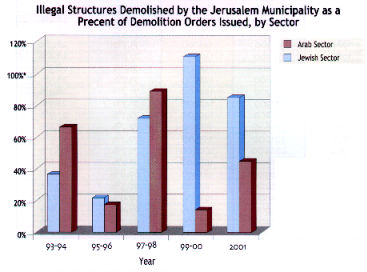
NGOs assert that Arab Jerusalemites have no choice but to build their homes illegally since the municipality systematically rejects their applications for building permits. Then they must contend with municipal inspectors who send bulldozers to demolish their homes.
Human rights lawyer Justus Reid Weiner, a scholar-in-residence at the Jerusalem Center for Public Affairs, has just completed the first systematic study of illegal construction in Jerusalem. Based on scores of interviews from across the political spectrum - from Mayor Olmert to Sari Nusseibeh, original documents, and on-site inspections, Weiner's heavily illustrated new book discredits the conventional wisdom about the causes and effects of illegal building, and documents a pattern of politically-motivated behavior and criminal profiteering that characterizes much of the construction in the Arab sector of the Holy City.
In the Jewish neighborhoods, illegal construction typically takes the form of additions to existing legal structures - such as closing a balcony or hollowing out under a building to create an extra room. In the Arab sector, however, illegal construction often takes the form of entire multi-floor buildings with 4 to 25 living units, built with the financial assistance of the Palestinian Authority on land that is not owned by the builder.
- Illegal construction has reached epidemic proportions. A senior Palestinian official boasted that they have built 6,000 homes without permits during the last 4 years, of which less than 200 were demolished by the city.
- This frantic pace of illegal construction continues despite the fact that the city has authorized more than 36,000 permits for new housing units in the Arab sector, more than enough to meet the needs of Arab residents through legal construction until 2020.
- Arab residents who wish to build legally may consult urban plans translated into Arabic for their convenience and receive individual assistance from Arabic-speaking city employees.
Both Arabs and Jews typically wait 4-6 weeks for permit approval, enjoy a similar rate of application approvals, and pay an identical fee ($3,600) for water and sewage hook-ups on the same size living unit. - The same procedures for administrative demolition orders apply to both Jews and Arabs in all parts of the city, as a final backstop to remove structures built illegally on roadbeds or land designated for schools, clinics, and the like.
- The Palestinian Authority and Arab governments have spent hundreds of millions of dollars in an intentional campaign to subsidize and encourage massive illegal construction in the Arab sector, seeing this as part of their "demographic war" against Israel.
- Many large, multi-story, luxury structures have been built by criminals on land they do not own, frequently land belonging to Palestinian Christians living abroad.
- This epidemic of illegal construction is similar to illegal building that troubles cities in scores of countries worldwide and where the authorities utilize the law to demolish the structures.
- More than any single factor, the 35-year-long boycott of municipal politics by the Palestinian leadership has resulted in the continued imbalance in municipal services in Arab neighborhoods vis-a-vis Jewish neighborhoods.
- Despite frequent accusations that the city's planning policy seeks to "Judaize" Jerusalem, the Arab population of the city has increased since 1967 from 27% to 32%. Moreover, since 1967 new Arab construction has outpaced Jewish construction.

Who will ultimately bear the burden of chaotic development and an eroded quality of life in the Arab neighborhoods? Are their long-term interests served by the Palestinian Authority's "demographic war" or the profiteering of land thieves?
Israel warns Syria
From Ynet news, 14/3/08, byReuters:
...Israel recently conveyed a warning to Syria through a third party that it would hold Damascus accountable if Hizbullah launched attacks on the Jewish state...
...sources, speaking on condition of anonymity, said the warning stemmed largely from Israeli concerns that Hizbullah would launch salvoes of cross-border rockets to coincide with any major Israeli offensive in the Hamas-controlled Gaza Strip.
... the message was conveyed in February through at least one European intermediary following the assassination of a top Hizbullah commander and before this month's five-day Israeli offensive in the Gaza Strip. After the group's senior commander, Imad Mugniyah, was killed in a bombing in Damascus, Hizbullah leader Nasrallah threatened Israel with "open war." ...
...Israel recently conveyed a warning to Syria through a third party that it would hold Damascus accountable if Hizbullah launched attacks on the Jewish state...
...sources, speaking on condition of anonymity, said the warning stemmed largely from Israeli concerns that Hizbullah would launch salvoes of cross-border rockets to coincide with any major Israeli offensive in the Hamas-controlled Gaza Strip.
... the message was conveyed in February through at least one European intermediary following the assassination of a top Hizbullah commander and before this month's five-day Israeli offensive in the Gaza Strip. After the group's senior commander, Imad Mugniyah, was killed in a bombing in Damascus, Hizbullah leader Nasrallah threatened Israel with "open war." ...
Zachor: Remember Forever
From Arutz Sheva, 12/3/08, by Daniel Pinner:
“Remember what Amalek did to you on the way when you were exiting from Egypt: how he chanced upon you on the way, and attacked you by smiting the weak who were straggling behind you, when you were tired and exhausted, and he did not fear God. And it will be, when HaShem your God gives you respite from all your surrounding enemies in the Land which HaShem your God gives you as an inheritance to inherit - eradicate the memory of Amalek from under the heavens. Do not forget.” (Deuteronomy 25:17-19)
Every year, on Shabbat Zachor - the Shabbat of Remembrance, the Shabbat immediately preceding Purim - we read these three verses as the Maftir, the concluding section of the Torah reading....remembering Amalek is appropriate in the run-up to Purim, commemorating the attempt of Amalek’s descendant, Haman, to complete his ancestor’s evil work. ...
...what was important was ...the fact that Amalek wanted to exterminate us all.
...See how they hate us. In every generation - not just the original generation of Amalek, but throughout history. Lest anyone mistakenly believe that Amalek reacted to a chance encounter.... he was willing to travel across a thousand miles of desert in a single night, deliberately to come upon us, just to try to exterminate us....
...Lest anyone think that, given time, Amalek would realise the futility of conflict, half a millennium later he was still trying to exterminate us in Israel in the days of King Saul. And lest we think that Amalek only wants to drive us out of Israel, that he would accept us if only we would be exiled from our land, lest we think that Amalek is only against Zionists, but not against Jews, a millennium after his initial attack his descendants are still trying to exterminate us in exile in Persia.....
...And lest anyone think that Amalek only wants to destroy the religious among us, lest anyone believe that assimilation will bring us respite, know that he attacked not the religious or the Torah scholars, but those of the tribe of Dan who were the furthest from Torah. [Hitler tried to murder anyone with just one Jewish grandparent, regardless of their observance or even awareness of their Jewish connection- SL]
And should you desire to know who has the greatest obligation to fight Amalek, never think that if you are a Torah scholar, a yeshiva student, then you are absolved of this duty. Those who fight must be those “men... who are brave, strong in mitzvot, and victorious in war.” And never believe that it is forbidden to leave the cloistered walls of the yeshiva to defend your fellow-Jews: “Go out from the protection of the Clouds of Glory to wage war against Amalek’s camps.” ...
...And know that whenever and wherever Israel is attacked, whether on the way towards Israel, whether within Israel, or whether in exile, the appropriate Jewish response is not to conciliate the murderous attacker, not to try to make peace with the leaders of the enemy nation, but to chop off the enemy warriors’ heads....
...And know that those who try to exterminate us will themselves be exterminated - utterly, irrevocably, eternally. Irony of ironies: the only way that anyone will even be aware that they existed will be that our history mentions them.
They will be consigned to oblivion, having no remembrance in this world or the next. And irony of ironies: the only way that anyone will even be aware that they existed will be that our history mentions them. Had it not been for the Torah, who would ever have heard of Amalek or of his descendant Haman? They are remembered solely by those whom they wanted to exterminate, and who instead exterminated them, measure for measure.
And just as victory over Amalek is crucial, so too is it crucial to “write this as a remembrance in the Book, and place it in Joshua’s ears” - specifically, to inscribe it in the Book of the Elders. The leaders of Israel must perforce be educated in this war against Amalek, lest they forget its eternal messages, and end up trying to placate evil, to co-exist with murderers, and thereby collaborate in the extermination of Jews.
And just as Amalek attacked us when we were at peace in the desert - after 210 years of exile and slavery we wanted nothing more than to make our way back home - so too, measure for measure, when Amalek will think himself at peace, we are commanded to attack him: “When HaShem your God gives you respite from all your surrounding enemies in the Land which HaShem your God gives you as an inheritance to inherit - eradicate the memory of Amalek from under the heavens.”
Do not wait for him to make war before going out to obliterate him: attack him when you are living in peace in Israel. Amalek, through his murderous attack on us, has forfeited any right to his own peace and security. And, as Yonatan ben Uziel paraphrases this final exhortation: “And it will be, when HaShem your God gives you respite from all those who hate you surrounding the Land which HaShem your God gives you as an inheritance to inherit - eradicate the memory of Amalek from under the heavens.....”
“Remember what Amalek did to you on the way when you were exiting from Egypt: how he chanced upon you on the way, and attacked you by smiting the weak who were straggling behind you, when you were tired and exhausted, and he did not fear God. And it will be, when HaShem your God gives you respite from all your surrounding enemies in the Land which HaShem your God gives you as an inheritance to inherit - eradicate the memory of Amalek from under the heavens. Do not forget.” (Deuteronomy 25:17-19)
Every year, on Shabbat Zachor - the Shabbat of Remembrance, the Shabbat immediately preceding Purim - we read these three verses as the Maftir, the concluding section of the Torah reading....remembering Amalek is appropriate in the run-up to Purim, commemorating the attempt of Amalek’s descendant, Haman, to complete his ancestor’s evil work. ...
...what was important was ...the fact that Amalek wanted to exterminate us all.
...See how they hate us. In every generation - not just the original generation of Amalek, but throughout history. Lest anyone mistakenly believe that Amalek reacted to a chance encounter.... he was willing to travel across a thousand miles of desert in a single night, deliberately to come upon us, just to try to exterminate us....
...Lest anyone think that, given time, Amalek would realise the futility of conflict, half a millennium later he was still trying to exterminate us in Israel in the days of King Saul. And lest we think that Amalek only wants to drive us out of Israel, that he would accept us if only we would be exiled from our land, lest we think that Amalek is only against Zionists, but not against Jews, a millennium after his initial attack his descendants are still trying to exterminate us in exile in Persia.....
...And lest anyone think that Amalek only wants to destroy the religious among us, lest anyone believe that assimilation will bring us respite, know that he attacked not the religious or the Torah scholars, but those of the tribe of Dan who were the furthest from Torah. [Hitler tried to murder anyone with just one Jewish grandparent, regardless of their observance or even awareness of their Jewish connection- SL]
And should you desire to know who has the greatest obligation to fight Amalek, never think that if you are a Torah scholar, a yeshiva student, then you are absolved of this duty. Those who fight must be those “men... who are brave, strong in mitzvot, and victorious in war.” And never believe that it is forbidden to leave the cloistered walls of the yeshiva to defend your fellow-Jews: “Go out from the protection of the Clouds of Glory to wage war against Amalek’s camps.” ...
...And know that whenever and wherever Israel is attacked, whether on the way towards Israel, whether within Israel, or whether in exile, the appropriate Jewish response is not to conciliate the murderous attacker, not to try to make peace with the leaders of the enemy nation, but to chop off the enemy warriors’ heads....
...And know that those who try to exterminate us will themselves be exterminated - utterly, irrevocably, eternally. Irony of ironies: the only way that anyone will even be aware that they existed will be that our history mentions them.
They will be consigned to oblivion, having no remembrance in this world or the next. And irony of ironies: the only way that anyone will even be aware that they existed will be that our history mentions them. Had it not been for the Torah, who would ever have heard of Amalek or of his descendant Haman? They are remembered solely by those whom they wanted to exterminate, and who instead exterminated them, measure for measure.
And just as victory over Amalek is crucial, so too is it crucial to “write this as a remembrance in the Book, and place it in Joshua’s ears” - specifically, to inscribe it in the Book of the Elders. The leaders of Israel must perforce be educated in this war against Amalek, lest they forget its eternal messages, and end up trying to placate evil, to co-exist with murderers, and thereby collaborate in the extermination of Jews.
And just as Amalek attacked us when we were at peace in the desert - after 210 years of exile and slavery we wanted nothing more than to make our way back home - so too, measure for measure, when Amalek will think himself at peace, we are commanded to attack him: “When HaShem your God gives you respite from all your surrounding enemies in the Land which HaShem your God gives you as an inheritance to inherit - eradicate the memory of Amalek from under the heavens.”
Do not wait for him to make war before going out to obliterate him: attack him when you are living in peace in Israel. Amalek, through his murderous attack on us, has forfeited any right to his own peace and security. And, as Yonatan ben Uziel paraphrases this final exhortation: “And it will be, when HaShem your God gives you respite from all those who hate you surrounding the Land which HaShem your God gives you as an inheritance to inherit - eradicate the memory of Amalek from under the heavens.....”
Friday, March 14, 2008
Talks with Hamas?
From Ynet news, 14/3/08, by Roni Sofer:
'Those who call on us to negotiate with Hamas are essentially asking us to discuss the measurements of our coffins,' ambassador to Rome says
Israeli Ambassador to Rome Gideon Meir criticized on Thursday Italian Foreign Minister Massimo D'Alema's call for talks between Hamas and Israel, saying "it is saddening to hear that during the period of mourning for the eight Mercaz Harav yeshiva students there are those who call for negotiations with barbarians and murderers."
Last Monday the D'Alema told foreign reporters "without engaging in dialogue with the Palestinians who govern Gaza, the peace process will have difficulties in moving ahead. Peace in Ramallah will depend on peace in Gaza," he said. "War and peace cannot be separated by just a few kilometers."
According to Meir, whose response made headlines in Italy, "those who call on us to negotiate with Hamas, are essentially asking us to discuss the measurements of our coffins and the roses that will be placed on them.
"Hamas' stance is known and it has not changed – they want to destroy the State of Israel," he said, "such calls for a ceasefire are simply a step on the way to the realization of Hamas' dream to destroy Israel and establish a religious-fundamental state from the Jordan River to the Mediterranean Sea."
Hamas leader Ismail Haniyeh was quick to commend the Italian minister, saying "the European Union's position is improving. They realized that is was a mistake not to negotiate with Hamas. We especially appreciate the statement made by Massimo D'Alema."
Ambassador Meir added that calls for talks with Hamas before the Islamist group complies with the international community's conditions undermine the negotiations between Israel and Palestinian President Mahmoud) Abbas.
"The fact that the head of a terror organization (Haniyeh) praises this (D'Alema's) position, does not add much dignity to those who support it," he said.
'Those who call on us to negotiate with Hamas are essentially asking us to discuss the measurements of our coffins,' ambassador to Rome says
Israeli Ambassador to Rome Gideon Meir criticized on Thursday Italian Foreign Minister Massimo D'Alema's call for talks between Hamas and Israel, saying "it is saddening to hear that during the period of mourning for the eight Mercaz Harav yeshiva students there are those who call for negotiations with barbarians and murderers."
Last Monday the D'Alema told foreign reporters "without engaging in dialogue with the Palestinians who govern Gaza, the peace process will have difficulties in moving ahead. Peace in Ramallah will depend on peace in Gaza," he said. "War and peace cannot be separated by just a few kilometers."
According to Meir, whose response made headlines in Italy, "those who call on us to negotiate with Hamas, are essentially asking us to discuss the measurements of our coffins and the roses that will be placed on them.
"Hamas' stance is known and it has not changed – they want to destroy the State of Israel," he said, "such calls for a ceasefire are simply a step on the way to the realization of Hamas' dream to destroy Israel and establish a religious-fundamental state from the Jordan River to the Mediterranean Sea."
Hamas leader Ismail Haniyeh was quick to commend the Italian minister, saying "the European Union's position is improving. They realized that is was a mistake not to negotiate with Hamas. We especially appreciate the statement made by Massimo D'Alema."
Ambassador Meir added that calls for talks with Hamas before the Islamist group complies with the international community's conditions undermine the negotiations between Israel and Palestinian President Mahmoud) Abbas.
"The fact that the head of a terror organization (Haniyeh) praises this (D'Alema's) position, does not add much dignity to those who support it," he said.
Re-define Laws of War
From THE JERUSALEM POST Mar. 13, 2008, by Haviv Rettig:
The clear distinction between civilian and combatant breaks down in a war against terrorists, and international law must acknowledge and deal with this, according to Harvard law professor Alan Dershowitz.
"The anachronistic theory that you can clearly tell the difference between civilian and combatant must be updated to deal with the new reality in which terrorists use civilian populations for fighting purposes," Dershowitz told The Jerusalem Post ....
...Dershowitz will discuss redefining the concept of civilian to "what I call the 'continuum of civilianality.' You can rank people on a scale of one to 10, one being an infant baby, 10 being a grown man with a shoulder rocket about to fire. In between, there are those people who allow their homes to be used for rocket launches or storage, imams who encourage suicide bombing, people who make the [explosive] belts." ...
...."International law is a barrier to democracies fighting fairly against tyrants," he told the Post. "There are exceptions, but in general, international law is part of the problem and needs revision." ...
.... "You can't deter a person who wants to die or a nation prepared to sacrifice itself, as some in Iran have suggested they're prepared to do."
The issue is not one of preempting an immediate and obvious threat, a situation which international law and the UN Charter already permit. Rather, it is about "prevention."
"An attack on Iran would be a preventive war, not a preemptive one," Dershowitz believes. "If Britain and France had fought a preventive war against Nazi Germany," it could have prevented the Holocaust.
Preventive war is already recognized in a limited way by international law. "The UN is not opposed to this idea. It just argues that preventive wars need the approval of the Security Council," he said....
The clear distinction between civilian and combatant breaks down in a war against terrorists, and international law must acknowledge and deal with this, according to Harvard law professor Alan Dershowitz.
"The anachronistic theory that you can clearly tell the difference between civilian and combatant must be updated to deal with the new reality in which terrorists use civilian populations for fighting purposes," Dershowitz told The Jerusalem Post ....
...Dershowitz will discuss redefining the concept of civilian to "what I call the 'continuum of civilianality.' You can rank people on a scale of one to 10, one being an infant baby, 10 being a grown man with a shoulder rocket about to fire. In between, there are those people who allow their homes to be used for rocket launches or storage, imams who encourage suicide bombing, people who make the [explosive] belts." ...
...."International law is a barrier to democracies fighting fairly against tyrants," he told the Post. "There are exceptions, but in general, international law is part of the problem and needs revision." ...
.... "You can't deter a person who wants to die or a nation prepared to sacrifice itself, as some in Iran have suggested they're prepared to do."
The issue is not one of preempting an immediate and obvious threat, a situation which international law and the UN Charter already permit. Rather, it is about "prevention."
"An attack on Iran would be a preventive war, not a preemptive one," Dershowitz believes. "If Britain and France had fought a preventive war against Nazi Germany," it could have prevented the Holocaust.
Preventive war is already recognized in a limited way by international law. "The UN is not opposed to this idea. It just argues that preventive wars need the approval of the Security Council," he said....
Wednesday, March 12, 2008
Australia marks Israel's 60th year
From JPost.com Mar 12, 2008, by JPOST.COM STAFF :
The Australian parliament commemorated Israel's 60 years of independence Wednesday, and leaders pledged their commitment to the country's security and stated their "respect for the Israeli cause..." ...
The motion was put forward by Prime Minister Kevin Rudd and seconded by Opposition leader Brendan Nelson.
...One Labor MP as well as two powerful unions were opposed...
...and from The Australian, by Paul Maley March 12, 2008:
Labor MP boycotts Israel anniversary
...Labor MP Julia Irwin made good on her threat to boycott the motion commemorating the Israel’s founding and the role Australia played in it, by absenting herself from the chamber.
A spokeswoman for Ms Irwin’s office confirmed her absence was a deliberate act of protest.
Ms Irwin has been a frequent critic of Israel’s conduct in the Israel-Palestine dispute and spoke against the motion at a party room meeting earlier this week. She attempted to table an annual report from human rights group Amnesty International which she said made plain Israel’s human rights abuses....
The Australian parliament commemorated Israel's 60 years of independence Wednesday, and leaders pledged their commitment to the country's security and stated their "respect for the Israeli cause..." ...
The motion was put forward by Prime Minister Kevin Rudd and seconded by Opposition leader Brendan Nelson.
...One Labor MP as well as two powerful unions were opposed...
...and from The Australian, by Paul Maley March 12, 2008:
Labor MP boycotts Israel anniversary
...Labor MP Julia Irwin made good on her threat to boycott the motion commemorating the Israel’s founding and the role Australia played in it, by absenting herself from the chamber.
A spokeswoman for Ms Irwin’s office confirmed her absence was a deliberate act of protest.
Ms Irwin has been a frequent critic of Israel’s conduct in the Israel-Palestine dispute and spoke against the motion at a party room meeting earlier this week. She attempted to table an annual report from human rights group Amnesty International which she said made plain Israel’s human rights abuses....
The time for words and threats has long passed.
From JPost, by Isi Leibler, March 12, 2008:
... we are being coerced, or seduced, into agreeing to a temporary truce arrangement with Hamas, enabling the organization to upgrade its missile infrastructure, smuggle in more advanced weapons, send its members for training abroad, and renew hostilities at a time of its choosing....
... Prime Minister Ehud Olmert ...is already hinting that a truce will come into effect as soon as the missile launches ease, and he obviously welcomes the bizarre American-inspired Egyptian offer to mediate a cease-fire. If that fails, similar offers are already in the pipeline from other dubious intermediaries like former US president Jimmy Carter and former UN secretary-general Kofi Annan.
A hudna would indeed create a temporary period of calm. But in the long term, it is a prescription for catastrophe. Taking advantage of the porous Egyptian border, Hamas and its Iranian and Syrian backers would upgrade and replicate Hizbullah's achievements in Lebanon. That would evolve into a disastrous replay of the Second Lebanon War, with the added handicap this time of the IDF possibly simultaneously being engaged on two fronts....
... the IDF withdrawal from Gaza after two days begs the question of whether, beyond temporarily placating domestic public opinion, the incursion served any purpose at all. The subsequent Hamas victory parades certainly do not suggest that it strengthened our deterrence.....
....We must now gird ourselves to end the terrorist abominations, lest what we have been facing in the south engulfs even more of the country. Israel must reject efforts by the international community to reconcile us to an indefinite war of attrition....
...our public diplomacy must respond more effectively to those who mindlessly denounce us for reacting "disproportionately" in exercising our right to self-defense. Their condemnations are irrational, unprecedented and unquestionably reflect the application of double standards against us....
.....No country under rocket and missile barrages, least of all one which genuinely respects the sanctity of human life, can be expected to sacrifice its citizens in the name of ensuring a spurious proportionality. And if civilian casualties ensue because Palestinian noncombatants are employed as human shields, the blame must be directed toward the Palestinian belligerents, not the Israeli victims.
We must therefore be prepared to defy our critics and swiftly defeat our foes with force. That was the basis on which Israel warded off its enemies in the past, in the days when our leaders still recognized that their prime obligation was to protect their citizens. Nothing has changed since. Preemption was and remains Israel's cardinal strategy of defense.
One need not be a military genius to appreciate what must be done. Launching missiles against our civilians should be declared an act of war. Immediate action should be taken to cut off the head of the snake and methodically target the Hamas military and political leaders who direct the killings.
Should that fail, we must act more drastically. Following ample notice for civilians to evacuate, we should bombard specific areas from where missiles are being launched. When we are condemned for "responding disproportionately," we should remind the United States and its allies that even in the absence of any threat of missile attacks to their civilians, they had no compunctions about carpet-bombing terrorist locations in Afghanistan and Iraq. NATO did likewise in Belgrade, even targeting residential areas during its botched attempt to assassinate Slobodan Milosevic.
If all else fails, recognizing that maintenance of the status quo would genuinely pose an existential threat to us, we would be obliged to launch a full-scale invasion of Gaza. That would be a calculated decision, not a gut reaction, and would be undertaken with the realization that such a conflict will lead to a major toll in lives on all sides.
Clearly, the vast majority of Israelis have no desire to occupy Gaza or rule over Arabs for longer than is absolutely necessary. But suggesting that we take no action at all because the aftermath will be complex is the worst of all options.
The time for words and threats has long passed. We have no reason to harbor any feelings of guilt because we have explored every conceivable venue to attain a peaceful solution. We realize that those confronting us are more obsessed with achieving our demise than improving their own miserable lot and gaining independence. We must act with determination and take whatever measures are deemed necessary to protect our citizens and the future of this nation.
That will only be achieved if we restore our deterrent abilities. It can be done.
... we are being coerced, or seduced, into agreeing to a temporary truce arrangement with Hamas, enabling the organization to upgrade its missile infrastructure, smuggle in more advanced weapons, send its members for training abroad, and renew hostilities at a time of its choosing....
... Prime Minister Ehud Olmert ...is already hinting that a truce will come into effect as soon as the missile launches ease, and he obviously welcomes the bizarre American-inspired Egyptian offer to mediate a cease-fire. If that fails, similar offers are already in the pipeline from other dubious intermediaries like former US president Jimmy Carter and former UN secretary-general Kofi Annan.
A hudna would indeed create a temporary period of calm. But in the long term, it is a prescription for catastrophe. Taking advantage of the porous Egyptian border, Hamas and its Iranian and Syrian backers would upgrade and replicate Hizbullah's achievements in Lebanon. That would evolve into a disastrous replay of the Second Lebanon War, with the added handicap this time of the IDF possibly simultaneously being engaged on two fronts....
... the IDF withdrawal from Gaza after two days begs the question of whether, beyond temporarily placating domestic public opinion, the incursion served any purpose at all. The subsequent Hamas victory parades certainly do not suggest that it strengthened our deterrence.....
....We must now gird ourselves to end the terrorist abominations, lest what we have been facing in the south engulfs even more of the country. Israel must reject efforts by the international community to reconcile us to an indefinite war of attrition....
...our public diplomacy must respond more effectively to those who mindlessly denounce us for reacting "disproportionately" in exercising our right to self-defense. Their condemnations are irrational, unprecedented and unquestionably reflect the application of double standards against us....
.....No country under rocket and missile barrages, least of all one which genuinely respects the sanctity of human life, can be expected to sacrifice its citizens in the name of ensuring a spurious proportionality. And if civilian casualties ensue because Palestinian noncombatants are employed as human shields, the blame must be directed toward the Palestinian belligerents, not the Israeli victims.
We must therefore be prepared to defy our critics and swiftly defeat our foes with force. That was the basis on which Israel warded off its enemies in the past, in the days when our leaders still recognized that their prime obligation was to protect their citizens. Nothing has changed since. Preemption was and remains Israel's cardinal strategy of defense.
One need not be a military genius to appreciate what must be done. Launching missiles against our civilians should be declared an act of war. Immediate action should be taken to cut off the head of the snake and methodically target the Hamas military and political leaders who direct the killings.
Should that fail, we must act more drastically. Following ample notice for civilians to evacuate, we should bombard specific areas from where missiles are being launched. When we are condemned for "responding disproportionately," we should remind the United States and its allies that even in the absence of any threat of missile attacks to their civilians, they had no compunctions about carpet-bombing terrorist locations in Afghanistan and Iraq. NATO did likewise in Belgrade, even targeting residential areas during its botched attempt to assassinate Slobodan Milosevic.
If all else fails, recognizing that maintenance of the status quo would genuinely pose an existential threat to us, we would be obliged to launch a full-scale invasion of Gaza. That would be a calculated decision, not a gut reaction, and would be undertaken with the realization that such a conflict will lead to a major toll in lives on all sides.
Clearly, the vast majority of Israelis have no desire to occupy Gaza or rule over Arabs for longer than is absolutely necessary. But suggesting that we take no action at all because the aftermath will be complex is the worst of all options.
The time for words and threats has long passed. We have no reason to harbor any feelings of guilt because we have explored every conceivable venue to attain a peaceful solution. We realize that those confronting us are more obsessed with achieving our demise than improving their own miserable lot and gaining independence. We must act with determination and take whatever measures are deemed necessary to protect our citizens and the future of this nation.
That will only be achieved if we restore our deterrent abilities. It can be done.
Subscribe to:
Posts (Atom)