Wednesday, July 26, 2017

Blind Europe...

From JPost, 20 July 2017, by Melanie Phillips:


In Budapest this week, Prime Minister Benjamin Netanyahu had an unintentionally revealing moment.

On an open microphone, he was overheard condemning as “crazy” the EU’s insistence on resolving the Israel-Palestinian conflict as a precondition for closer trade ties. European links with Israel, he said, would determine whether the EU would “live and thrive or shrivel and disappear.”

The situation is surely even broader and starker than that.

European leaders don’t realize their fate is wrapped up not only with Israel but with Judaism itself.

They don’t grasp that prejudice against the Jews is a major driver of Islamist attacks not just against Israel but also against the West. And they don’t understand how their own orthodoxies are aiding that malign process.

Last April Sarah Halimi, a 67-year-old French Jewish woman, was murdered by her 27-year-old neighbor, Malian immigrant Kobili Traore, who beat and tortured her before throwing her alive out of the third floor window of her Paris apartment. During the attack he shouted “Allahu akbar” and “you sheitan!” (devil). He had previously taunted her repeatedly with anti-Jewish remarks.

The police, who had failed to respond to the pleas by Halimi’s family to do something about Traore because they feared being accused of anti-Muslim prejudice, have refused to acknowledge this was an anti-Jewish crime.

In recent years, French Jews have been repeatedly attacked by Muslim assailants motivated by religiously based hatred of Jews. France has persistently ignored the significance of this.

When Islamists murdered French Jews in the Hyper Cacher kosher supermarket in Paris in 2015, the Jewish community observed bitterly that this atrocity was only properly acknowledged because it happened two days after the slaughter at Charlie Hebdo.

What the Hyper Cacher atrocity actually showed, along with other attacks on French Jewish targets around the same time, was what Europeans have denied for so long: that Muslims kill Jews because they are Jews.

In 2003 Sébastien Selam was killed in Paris by Adel Amastaïbou who screamed: “I’ll go to heaven, I killed my Jew!” In 2014 in Lyon a man armed with a hammer and an iron stick charged at his neighbor, a woman and her child, yelling “Dirty Jew, go back to your country!” The same month a young man was beaten up in Paris by two men crying: “Dirty Jew, we don’t like Jews here, this is no Israel, this is Palestine!” In Britain, there is an ongoing furor over antisemitism in the Labour Party. This is being blamed on the party’s far-left leader, Jeremy Corbyn. But anti-Jewish attitudes, expressed principally through attacks on Israel, are now the default position throughout the Left.

The usual alibi that such views are anti-Israel but not anti-Jew doesn’t wash. Although those expressing them may have no personal animosity against Jews, their Israel-bashing has precisely the same characteristics as Jew-baiting: singling out Jews or the Jewish state alone for double standards, demonization and systematic lying used against no other people.

During Netanyahu’s visit to Paris last Sunday, the French president Emmanuel Macron helpfully observed that anti-Zionism was a “new type of antisemitism.” He also issued a welcome call for “total clarity” on the Halimi murder and admitted: “We were silent because we did not want to see.”

Alas, Macron himself doesn’t want to see what needs to be seen. He has persistently failed to acknowledge the real cause of Islamist terrorism, blaming it on things like joblessness, grievances or – most fatuously – global warming.

Islamist terrorism is caused by a fanatical interpretation of Islam. Intrinsic to that is hatred and fear of the Jews deriving from Islamic sacred texts. Islamists further believe that modernity has to be stopped, the Jews are behind modernity and all other evil and so the Jews have to be eradicated.

The Islamists’ key insight is that progressive views have hollowed out Western societies, particularly in Europe, so that they no longer know what values they need to defend against the Islamic jihad.

What secularists fail to grasp is that the values they most prize, such as the power of reason or belief in human rights, were created by Judaism and expressed in the West through Christianity.

Human rights rest on the belief that all are created equal in the image of God. The power of reason rests on the revolutionary concept in the book of Genesis that there is an intelligible universe.

Secular ideologies, however, are positively anti-Judaism.

Moral relativism denies the moral codes of Mosaic law. Deep green environmentalism repudiates the belief embodied in the creation that mankind is superior to the natural world. Scientific materialism dethrones God and puts man in his place.

Judaism is an obstacle both to the unconstrained individualism of Western libertines and also to the Islamist attack on reason, equality and freedom. Small wonder Western progressives make common cause with Islamists against the Jewish people.

Macron is a universalist who doesn’t believe in defending Western national identity. Nor does he believe in France. He said last February: “French culture does not exist; there is a culture in France and it is diverse...

French art? I never met it!” Anyone who believes Macron will defend the Jewish people, the free world or France itself is in for a rude awakening. As are the rest of Europe and the West, while they continue to misjudge the central importance of Israel and the Jewish people to their battle to survive.

Unilateral recognition of a Palestinian state undermines the international rule of law

Shortly to be published in the Jerusalem Centre for Public Affairs, by Peter Wertheim, Executive Director of the Executive Council of Australian Jewry:


...another failed state....

The following is the Abstract. Follow the link for a full copy, complete with references.

Among those who advocate immediate recognition of a Palestinian state, other than as an outcome of a peace agreement with Israel, there is a striking irony in the contrast between the legalistic approach they purportedly adopt on one question, namely settlements, and their cavalier disregard for well-established legal principles on another, namely the creation of states and their recognition. One either supports the international rule of law as a general principle, or not at all. One does not get to pick and choose.

The four criteria of statehood set out in Article 1 of the Montevideo Convention the Rights and Duties of States, 1933, are widely accepted as the minimum required by customary international law for the creation of a new State. Two of the criteria – a single, centralized government and the capacity to enter into relations with other states – are manifestly not satisfied by any Palestinian entity.

The internal divide between the secular nationalist movement among Palestinians (represented by the PLO and Palestinian Authority (PA) which controls parts of the West Bank), and the theocratic movement (represented by Hamas, which controls the Gaza Strip) has resulted in internecine violence on many occasions. All attempts at internal reconciliation have failed and appear to be intractable. They are at loggerheads on the most basic questions, not only concerning peace with Israel and other issues of foreign and domestic policy, but also on the essential nature of a future Palestinian state. Thus, for reasons which are entirely internal to Palestinian society, there is no reasonable prospect for the foreseeable future of any government being formed which would exercise effective control over both the West Bank and the Gaza Strip, and would have the capacity to give effect to any agreements purportedly entered into by “Palestine”.

Although recognition is a political act and a matter of discretion, it is “subject to compliance with the imperatives of general international law”. Given that the criteria of government and the capacity to enter into relations with other States are at present not satisfied by any Palestinian entity, recognition of any such entity as a State would be to affirm a fiction, contrary to the imperatives of general international law. Recognition by even a large number of other States cannot overcome clear and compelling objective evidence indicating that the mandatory legal criteria of statehood have not been met. An exception would be admission of the entity as a member State of the UN. If, notwithstanding its admission to the UN as a member State, the entity does not in fact meet the customary law criteria of statehood, at law it is still a State, albeit a failed State.

Applying the additional requirements for recognition contained in the European Community Declaration and Guidelines (1991), the Palestinians have failed, and are likely to continue for the foreseeable future to be unwilling, to make commitments to respect the inviolability of the frontiers with Israel, to repudiate all territorial claims by Palestine against Israel and to settle all disputes with Israel by peaceful means.

Recognition of a Palestinian State at the present time would not only be contrary to the well-established requirements for statehood stipulated by customary international law and the additional requirements mandated by the European Community Declaration and Guidelines in 1991, it would also contravene the internationally recognized and witnessed Oslo Accords between the Palestinians and Israel and lay the foundations for opening a new phase of the Palestinians’ conflict with Israel, rather than for resolving the conflict. Recognition would therefore undermine the primary purposes of the UN Charter and the current international rules-based order, which is to maintain international peace and security.

The above is the Abstract. Follow the link for a full copy, complete with references.

Tuesday, July 25, 2017

Islam's Bogus Claim to Jerusalem

In the light of recent confected indignation over Israeli measures to prevent terrorism on the Temple mount, it is timely to review these brief videos from Mordechai Kedar, and a hsitorical study by Daniel Pipes:


An excellent historical review, published by Daniel Pipes in 2001, has even more relevance today. The following are very brief excerpts only. Follow the link to the full review.

...An historical survey shows that the stature of the city, and the emotions surrounding it, inevitably rises for Muslims when Jerusalem has political significance. Conversely, when the utility of Jerusalem expires, so does its status and the passions about it. This pattern first emerged during the lifetime of the Prophet Muhammad in the early seventh century. Since then, it has been repeated on five occasions: 
  • in the late seventh century, 
  • in the twelfth-century Countercrusade, 
  • in the thirteenth-century Crusades, 
  • during the era of British rule (1917-48), and 
  • since Israel took the city in 1967. 
The consistency that emerges in such a long period provides an important perspective on the current confrontation....

...Conclusion
Politics, not religious sensibility, has fueled the Muslim attachment to Jerusalem for nearly fourteen centuries; what the historian Bernard Wasserstein has written about the growth of Muslim feeling in the course of the Countercrusade applies through the centuries: 
"often in the history of Jerusalem, heightened religious fervour may be explained in large part by political necessity." 
This pattern has three main implications. 

First, Jerusalem will never be more than a secondary city for Muslims; 
"belief in the sanctity of Jerusalem ... cannot be said to have been widely diffused nor deeply rooted in Islam." 
Second, the Muslim interest lies not so much in controlling Jerusalem as it does in denying control over the city to anyone else. 

Third, the Islamic connection to the city is weaker than the Jewish one because it arises as much from transitory and mundane considerations as from the immutable claims of faith.

Friday, July 21, 2017

EU Relations with Israel need to be repaired.

From The Times, 21 July 2017, by David Charter:


Bibi at a Budapest synagogue

Benjamin Netanyahu was recorded attacking the EU’s “crazy” insistenc­e on resolving the conflict with the Palestinians as a condition for closer ties with Israel ...during his meeting with the leaders of Hungary, Poland, the Czech Republic and Slovakia.

“There is no logic here,” he said of EU policy.

“Europe is undermining its secur­ity by undermining Israel.

‘‘Europe is undermining its progress by undermining the connection with Israeli innovation because of a crazy attempt to create­ conditions (for peace with the Palestinians). It’s crazy. I think it’s actually crazy.”

European ties with Israel would determine whether the bloc would “thrive or disappear”, he said.

Hungarian Prime Minister Viktor Orban, who is hosting the meeting, gave assurances on behal­f of the four countries that they would press Brussels to work more closely with Israel.

This was another sign of divergence between western and eastern Europe, which fell out over EU demands for all countries to take in refugees.

Relations between the EU and Israel have been tense for years. Israel feels that Brussels criticises its policies while being too soft on the Palestinians.

The bloc is Israel’s main trading partner but relations have soured since November 2015, when Brussels began to label products made in Jewish settlements in the West Bank.

The EU does not recognise Israe­li sovereignty over territories it captured in the 1967 war.

After the meeting in Budapest, Mr Orban called for Europe to change tack, with better ties and less criticism of Israel. “The EU should value the efforts made by the state of Israel for stability in the region,” he said. “Relations with Israel are not rational enough and need to be repaired.” ...

Saturday, July 15, 2017

The Time has Come to Dismantle UNRWA

From BESA Center Perspectives Paper No. 528, July 14, 2017, by Adi Schwartz:


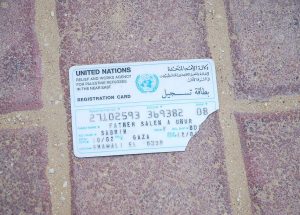
UNRWA registration card recovered during counterterrorism operation in southern Gaza, 26 July 2007, via Wikimedia Commons

In a surprising change of policy, Israeli Prime Minister Netanyahu has called for the dismantling of UNRWA. Such a move could benefit both Israel and the peace process. The new US administration might change its decades-old policy as well.

Last month, Israeli Prime Minister Benjamin Netanyahu stunned many by declaring that the United Nations Relief and Works Agency (UNRWA) should be dismantled.

Speaking at a weekly cabinet meeting, Netanyahu charged that
“in various UNRWA institutions, there is a lot of incitement against Israel, and therefore the existence of UNRWA – and unfortunately its work from time to time – perpetuates the Palestinian refugee problem rather than solves it. … Therefore, the time has come to dismantle UNRWA and merge its components with the United Nations High Commissioner for Refugees [UNHCR].”
This long overdue step was rejected for years by the Israeli establishment. Up to now, Jerusalem has prevented attempts to change UNRWA’s mandate or close it down because it perceived the agency as a stabilizing factor. Israel focused instead on anti-Israeli incitement in UNRWA’s education system and on its collaboration with Hamas. That collaboration implied an international imprimatur on egregious Hamas behavior.

Instead of fighting UNRWA’s very existence, Israel focused on its actions. This time, the prime minister is talking about a bigger shift in policy.

UNRWA’s initial role was to distribute humanitarian assistance to Palestinian Arabs displaced during the 1948 war. However, over the years, instead of being a tool to solve the refugee problem, UNRWA has become a tool for its eternal perpetuation. Without UNRWA, the Palestinian refugees, and certainly their children, grandchildren, and great-grandchildren, would have resettled in their Arab host countries or elsewhere in the world, as many millions of other refugees have done. They would have done so reluctantly, of course, but would have had no other choice, as no organization would have taken care of them for so many years.

Because UNRWA did nothing to reduce the number of Palestinian refugees, their numbers have swollen from 750,000 in 1949 to more than 5 million today. This was a surrender to the Arab wish to perpetuate the problem. From its earliest stages, UNRWA was a politicized agency, more interested in appeasing the Arab world’s wish to destroy Israel than in the humanitarian cause for whose sake it was established.

Without UNRWA, the Arabs could not have come to the negotiations table with international support – as embodied by UNRWA – for their ridiculous demand that 5 million refugees and their descendants be allowed to resettle in Israel, thus subverting its Jewish nature. Without UNRWA, only a small fraction of its “registered refugees” would be considered real refugees in the first place. Many of UNRWA’s refugees should never have been granted that status, and the vast majority of them are descendants who would not be granted automatic refugee status elsewhere in the world. The Arabs would likely have attempted these demands, but would not have had the backing of a special UN agency.

As the years have worn on, UNRWA has maintained a system expressly meant to perpetuate the refugee problem rather than solve it. Unlike the UNHCR, which provides six options for the cessation of the status of refugee, UNRWA offers zero. Whereas the primary concern of UNHCR is to resettle refugees and help them build new lives, UNRWA promotes only one future: repatriation to Israel. That prospect is contrary to worldwide historical practice and anathema to Israel. It is also toxic to both the prospects for a peace agreement and Palestinian national development.

In effect, UNRWA has become a spokesman – and patron – for the call to destroy the Jewish homeland by flooding it with millions of refugees and their descendants. Without UNRWA, it is hard to see how the belligerent Palestinian/Arab call for return could have survived for seven decades. Because Israel is not going to commit national suicide via demographic subversion, this UNRWA-induced intransigence is an assured recipe for the conflict’s prolongation.

Merging UNRWA into UNHCR would mean an immediate drop in the number of Palestinian refugees from more than 5 million today to a few hundred thousand, perhaps even fewer. 

Most of UNRWA’s refugees either never left their country (Mandatory Palestine) or became citizens of another country (Jordan) and would thus simply be omitted from the list. 

Moreover, this merger would mean repatriation is not the sole option for solving the Palestinian refugee problem. Both these outcomes are clearly in the interests of both Israelis and Palestinians.

The Trump administration seems open to fresh ideas. For years, the US – the biggest donor to UNRWA – did not want to deal with the agency because it feared an Arab backlash. This time, it appears Washington and the Sunni world have enough in common – from fighting Iran to signing major arm deals – that Washington should not fear making major changes to UNRWA, or even abolishing it altogether. A push from Jerusalem may well wield results this time around.

Thursday, July 13, 2017

Winds of war in the Persian Gulf?

From BESA Center Perspectives Paper No. 527, July 13, 2017, by Dr. Edy Cohen:

The winds of war blowing between Saudi Arabia and Qatar, as well as Iranian subversion, are destabilizing the Persian Gulf principalities. 

To make matters worse, the economic situation, which has worsened in recent years because of ill-advised decisions, is stoking fears of popular uprisings and widespread disturbances ... in which some of the Gulf monarchies might fall. 

The main winner would be Tehran, for which the current crisis, along with the boycott imposed on Qatar, has opened a path to a takeover of Bahrain – and Iran has already, in effect, taken over Baghdad, Damascus, Beirut, and Sana’a.   

The Saudi economy has seen an unprecedented deterioration in recent years. The continued decline of oil prices in world markets, the massive assistance to Egypt since the July 2013 takeover by Abdel Fattah Sisi, the cost of funding the coalition fighting the Houthis and their Iranian patrons in Yemen, and of course the considerable aid extended to the Syrian rebels have wreaked havoc on Riyadh’s public treasury and the ruling monarchy’s personal wealth.

As a result, Riyadh has had to slash 900 riyals (about $300) from military and civil servant salaries as part of a major cutback in the public sector, including the abolition of salary increments and bonuses. Recently, the authorities have also had to hike taxes on cigarettes and energy drinks to the tune of 100% of the cost of the product, after having imposed new taxes in June. One sign of the crisis reflecting its severity is a new toll that will go into effect in April 2018 on roads in the Riyadh area and on crossings into neighboring Arab states.

Aside from affecting its own residents, Saudi Arabia’s economic situation also stands to affect other Gulf countries and particularly Bahrain, which is suffering its own deep crisis as Tehran arms and funds Shiite organizations aimed at destabilizing it.

The Iranians have been exploiting Riyadh’s and Bahrain’s difficulties to the hilt. Not long ago, the Saudis thwarted an attack near the holy sites of Mecca. The Iranian subversion could escalate to the point of seeking to destabilize the kingdom (as it is doing in Bahrain) by activating armed militias within its territory.

Shiite Iran is also helping Qatar, which, according to the (Saudi) plan, should by now have been begging for the lifting of the boycott. Tehran is thereby driving a wedge between the Arab Gulf principalities and bolstering its own status as the region’s hegemonic power. It has been sending Qatar tons of food and raw materials daily by sea, and these goods have flooded the emirate’s markets and shopping centers.

There is, however, no free lunch. Tehran is now regarded as having rescued Qatar, and the principality will have to reward it for this. Iranian aid has already weakened the Sunni political-military coalition that was supposed to contend with Tehran’s expansionary ambitions. For example, Qatar has pulled out of the anti-Houthi coalition in Yemen.

The state of affairs in the Persian Gulf is extremely delicate. The fall of one principality would probably lead to the fall of others. The Gulf is undergoing one of the most difficult economic crises in its history, one that could destabilize some of the monarchies. Angry demonstrations and riots against rising prices, new taxes, and mounting unemployment, similar to those that occurred in Tunisia, Egypt, Libya, Yemen, and Syria in 2010 and 2011 – the ultimate nightmare of any Arab leader – are entirely plausible.

Moreover, the Qatar crisis is not over. The principality has strongly rebuffed the twelve Saudi conditions for lifting the blockade and normalizing relations with the foursome (Saudi Arabia, Egypt, the United Arab Emirates, and Bahrain). Those conditions include downgrading Qatar’s diplomatic ties with Tehran; ensuring that forces of the Iranian Revolutionary Guard Corps leave the emirate; shutting Turkish military bases in Qatar; severing Doha’s ties with the Muslim Brotherhood, Hezbollah, al-Qaeda, and ISIS while ceasing to fund them; handing over terrorists residing in Qatar to the foursome; closing the Al Jazeera network; and paying compensation.

The failure of the attempt to isolate Qatar and subjugate it to the foursome’s demands has stirred fears of a Saudi military intervention there. Iran, however, has scored many points with the Arabs thanks to its support for the emirate. This is part of a long-term strategic game in which Iran first seeks to win Arab states’ sympathy and then arms and activates subversive groups in the Gulf.

Tehran is striving to curtail American and Saudi influence in the Gulf, take over the Islamic world in general, and seize the Gulf’s natural resources and holy places via its erstwhile proxies, the Yemeni Houthis positioned along the Saudi border.

If Tehran’s plan succeeds, the Persian Gulf will be effectively divided between it and Russia, a highly undesirable development for Israel. The Gulf crisis is wholly unrelated to Israel, but Jerusalem must closely monitor what is happening there.

The current situation is ostensibly good for the US ...exporting weapons and military equipment, as President Trump promised he would do during his Riyadh visit. Yet instead of seeking profits, however substantial, Washington would be better off working to enhance stability in the region...

Wednesday, July 12, 2017

Israel won. Now live with it.

From Melanie Phillips, 10 July 2017:

The Middle East Forum held a meeting in Jerusalem last night to discuss Daniel Pipes’s “Victory Caucus“ ...He urges that the conflict should be reframed as a war which Israel has won and the Arabs have lost rather than a never-ending impasse with demands upon Israel for negotiations, peace processes and compromises...

This is a very much-needed initiative. There is an urgent need to recalibrate the whole issue ... for the benefit of the Palestinians ...for the west and also for Israel.

We have to ask ourselves, surely, why do the Palestinians think the war is still on. Well, I think there are a number of reasons for that. One reason is that, unfortunately, if you are a religious Muslim you believe that any land conquered by Islam is then consecrated to Islam and nobody else can ever have sovereignty over it. So from that point of view there can be no victory over that kind of fanatical religious mindset.

But the main reason why the Palestinians think the war is still on is because they are encouraged to think that by the west. By Britain, by Europe and also by Israel’s great ally and friend, America.

The Palestinian story has been accepted by the west to the extent that the west believes there is a Palestinian people which has a historic, national and legitimate claim to the land. There never was a Palestinian people, there is not, and it does not now have any legitimate claim to the land.

Even if it did have a claim to the land it would be forfeit because of nearly a century of exterminatory aggression. In every other conflict in the world, that sort of exterminatory aggression means that the aggressors are treated as pariahs. Uniquely in this conflict the aggressors have been treated over the best part of a century – because of their aggression – as statesmen-in-waiting.

It’s not rocket science. If you treat aggressors as statesmen-in-waiting, you do not get peace and harmony. You get more aggression.

Now why has the west rewarded aggression in this way – uniquely – in this region? Many reasons. One is ignorance. One is malice. One is realpolitik – the desire to appease the Arabs over the oil weapon. Another is simply that people in the west believe – and I’ve heard this so many times – that there is no alternative.

But I would suggest there’s a deeper problem here. The prevalent view in the west is that it no longer does war and victory. This is seen as uncivilised. War is seen as brutal, uncivilised and must never be undertaken. If the Palestinians or the Arabs or the developing world are waging war, well we “expect that of them”, don’t we, because they are basically “uncivilised” people. We in the west do not apparently expect them to accord with our own values of respect for human life, democracy and all the rest of it. In other words, the west has a deeply racist attitude towards the developing world.

And it believes in itself that it doesn’t do war any more because war is uncivilised. Instead of war it does conflict resolution; it does law, not war.

And so as a result the war that’s been taking place in this region by the Arabs against the Jewish homeland means that the west thinks that a compromise is essential. You have a war of extermination? Put the two sides in the same room, bang their heads together until they reach a compromise. Because both sides, according to this view, have a legitimate claim to the same piece of land.

In other words the west has, for nearly a century, mistaken this whole conflict as a fight over land boundaries whereas in fact it is a war of extermination. And where the west wants to press Israel to make compromise, every compromise Israel has ever made is seen by the Arabs as a sign of weakness and an incentive to further aggression.

In conclusion, I would say that the west’s mistake – its conceptual, its fundamental mistake – perpetuates this conflict; indeed it is a signal reason, possibly the main reason, why this conflict got under way in the first place.

In the 1930s, Britain responded to the pogroms being committed by the Arabs of this land against the returning Jews – and responded to the Arabs’ violence against the then-ruling British under the Palestine Mandate – Britain responded to this aggression by saying to the Arabs: “Have part of the land which we have undertaken by solemn agreement under international treaty obligation to give to the Jews”.

In other words, the original “two-state solution” was proposed in 1936 as a reward for exterminatory aggression and terror; and that continues to be the case today.

My final point is that the west needs to understand this – but, my goodness, Israel needs to understand that this narrative has to change. Israel is most reluctant to say to the free world, to the west, what it should be saying: 
“Are you crazy? Why do you treat this conflict differently from all other conflicts?” 
And until the west and until Israel actually understand that this conflict has to be reframed as one of war and victory, we’re not going to get anywhere

Saturday, July 08, 2017

Carr push a worry

From The Australian, 8 July 2017, by Peter Baldwin:


Federal Labor frontbenchers Anthony Albanese and Tony Burke. 
Picture: Justin Brierty

Bob Carr is at it again, working hard to shift the ALP away from its (and his) previous position of strong support for Israel to one of seriously unbalanced support for Palestinian demands.

Talk about strange bedfellows. Carr has congratulated Greens senator Lee Rhiannon, a person he strongly criticised in the past, for her “very strong and very brave” efforts on this issue. High praise for someone who consistently reduces the Israel-Palestine issue to wooden Marxist cliches about “oppressor and oppressed”.

Later this month, the NSW Labor Party conference will debate a motion, strongly backed by Carr, calling on a future ALP government to “recognise Palestine”. The proposition will then go to the ALP national conference next year, at which it is expected to pass with the support of the national left and the NSW right.

This would represent a significant hardening of the position adopted at the 2015 national conference that called on a Labor government to “discuss” Palestinian recognition with other nations if the peace process stalled and Israeli settlement building continued. The 2015 resolution was itself a major change from the party’s earlier stance, which recognised that a Palestinian state could emerge only from a comprehensive negotiated settlement with Israel.

So, assuming this goes as expected, a Labor federal government would be formally bound to grant immediate and uncondi­tional recognition to a Palestinian state.

But before turning to the merits of this proposition it is worth digressing to reflect on the political dynamics at work here that are symptomatic of some local and global trends that should worry not just Israel’s supporters but anyone concerned with the integrity of policymaking processes in our main political parties.

Last week Carr gave a talk on Palestine to a gathering of ALP members organised by the party organisations in the Watson and Grayndler federal electorates. The MPs for these seats Tony Burke and Anthony Albanese, frontbenchers affiliated with the right and left factions respectively, were present.

Carr’s talk consisted of an unbroken recitation of alleged Israeli villainy, devoid of even the slightest suggestion of fault on the Palestinian side. There was no reference to the repeated two-state offers by Israel and no acknowledgment of the genocidally hostile “negotiating partners” that Israel has had to deal with.

The whole tenor of the speech was grotesquely unbalanced, as must have been obvious to Carr and the senior MPs present. Yet there was not the slightest dissent from anyone at the meeting. Labor members of left and right now are starting to sound like Rhiannon.

So what is going on here? The obvious explanation is to point to electoral demographics, the string of western Sydney electorates with large Arab and Muslim populations, Blaxland topping the list with Muslims comprising about 25 per cent of the electorate.

But more significant than straight electoral demographics, I suspect, is the changing composition of party branches, some of which are drawn overwhelmingly from these communities, so that MPs may have more reason to fear loss of party preselection than defeat in the general election.

I can speak on this as someone who was closely involved in the “branch stacking” wars in the 1970s and 80s that for a time convulsed Labor branches in inner Sydney.

When it comes to branch stacking, there is nothing to match an industrial scale “ethnic stack” in which “community leaders” deliver the votes en masse. Local members are rightly terrified of this phenomenon, and typically fall over themselves trying to appease whichever group, or individual, is responsible.

The risk is that the Labor Party — and not just the Labor Party — becomes a vehicle for sectional interests. For a warning of where this can lead consider Britain, where extremism and anti-Semitism have become rife within the Labour Party, leading to two official inquiries and where party gatherings are starting to be segregated by gender in some areas.

Even the Oxford University Labour Club has been rent by disturbing allegations of anti-Semitism.

I don’t think it is possible to overstate the importance of this sinister development.

But returning to the Palestinian recognition issue, we need to ask what kind of Palestinian state would be being recognised?

Under customary international law, a proper state must meet certain criteria set out in the Montevideo Convention on the Rights and Duties of States (1933).

As well as having a permanent population and a defined territory, it must also have a single centralised administration that can assert its authority over and maintain order among the people in its territory without the assistance of another state.

Furthermore, it must be able to enter into relations with other states and be able to deliver on any international agreements it makes.

To suggest that a Palestinian state based on the West Bank and Gaza Strip could, under anything like present circumstances, go anywhere near meeting these requirements is patently ludicrous. Since the Israeli withdrawal from Gaza in 2005 the territory has been controlled by the terrorist group Hamas, which seized control in an armed coup in 2007 that culminated with Palestinian Authority officials being hurled to their death off tall buildings.

The two factions remain bitterly divided to this day, with the Palestinian Authority controlled by Fatah recently cutting off electricity to Gaza.

Hamas has used its control of Gaza to mount repeated attacks on Israel, most recently in 2014, with appalling consequences for Israel but most especially for the people of Gaza.

The position of Fatah in the West Bank is tenuous, and increasingly devoid of any shred of democratic legitimacy. It is loathed for its corrupt and incompetent administration. The last legislative elections were held 11 years ago and were won decisively by Hamas.

In 2014 the Fatah administration was saved from being overthrown by a Hamas coup only by the intervention of the Israeli domestic security agency, Shin Bet, Israel reasonably taking the view that Fatah was the lesser evil compared to Hamas with its explicitly genocidal ideology.

A lesser evil, perhaps, but Fatah is still pretty bad. Back in 2015 the “moderate” chairman of the Palestinian Authority, Mahmoud Abbas, praised those who participated in a “stab a Jew” campaign that arose from a blatantly confected campaign suggesting the Israelis were about to change the status of the Temple Mount/al-Aqsa Mosque holy sites to allow Jews as well as Muslims to pray there. This was what Abbas posted on his personal website: “Al-Aqsa Mosque is ours … and they have no right to defile it with their filthy feet. We will not allow them to, and we will do everything in our power to protect Jerusalem … We bless every drop of blood that has been spilled for Jerusalem, which is clean and pure blood.”

But back to Hamas.

Just a month ago Hamas leaders emphatically rejected the right of Fatah figures such as Abbas to negotiate on their behalf after the latter gave certain commitments when meeting US President Donald Trump: “No one has authorised Mahmoud Abbas to represent the Palestinian people and no one is obligated to any position he’s issued.” So much for the requirement that a legitimate state be able to enter into and adhere to international agreements.

Just recently Hamas released a new policy statement that some in the West hailed as replacing its genocidal charter that (in article 7) looks forward to the day when the last Jew can be exterminated. This is delusional: Hamas has made clear that the new document does not supersede the charter or alter it in any way.

Importantly, the new document that Hamas’s apologists in the West hail for its “moderation” makes clear that a state based on the West Bank and Gaza would be no more than a transitional step to the ultimate goal of Israel’s complete destruction. As the document spells out: “Hamas rejects any alternative to the full and complete liberation of Palestine, from the river to the sea.”

This chimes with numerous statements by senior Hamas officials through the years, such as this one from Mahmoud al-Zahar, who has served as foreign minister in Hamas’s Gaza regime: “We don’t want to establish an Islamic emirate in Gaza; we want an Islamic state in all Palestine.”

Zahar went on to say that if Hamas could move part of its assets to the West Bank, “we will be able to go for a successful battle that we will win it at the end.”

What does he envisage happening “at the end”? In 2010 he boasted about the anticipated annihilation of the Jewish people in these terms: “We extended our hands to feed these hungry dogs and wild beasts, and they devoured our fingers. We have learned the lesson — there is no place for you among us, and you have no future among the nations of the world. You are headed to annihilation.”

Let us suppose hypothetically that the international efforts to secure a Palestinian state under present circumstances were successful and that Israel was forced to concede a state based on the West Bank, the Gaza Strip and East Jerusalem and withdraw all of its security forces. What might eventuate?

I think we can confidently predict that the results will not be pretty.

Consider the Gaza precedent. In 2005 the government of Ariel Sharon carried out a complete withdrawal of the Israeli civil and military presence in Gaza. The 9000 Jewish settlers were forced to leave, in some cases having to be dragged out.

There was a great deal of optimism at the time, the decision receiving high praise interna­tion­ally. There was even talk of Gaza becoming a “Singapore on the Mediterranean”. A Jewish businessman financed the purchase of a complex of high-technology greenhouses that supported a thriving horticultural industry and donated it to the Palestinians.

We all know what happened. There was a vicious power struggle in which Hamas emerged triumphant over the Palestinian Authority and began the militarisation of the strip, building a huge subterranean infrastructure of tunnels, command posts, weapons and storage dumps below the densely populated areas of the strip.

Key military assets were deliberately placed near hospitals, schools and mosques to maximise the adverse publicity for Israel when the inevitable battles began. Since then, there have been repeated rounds of vicious conflict. Israel has been terrorised with rocket attacks and Gaza civilians suffered even worse as Israel retaliated. Parts of Gaza where the military assets were placed have been repeatedly reduced to smoking ruins, the economy crippled, the civilian population immiserated.

Now consider: who is likely to prevail in a fight for control of a Palestinian state based on the West Bank as well as Gaza between the rancid, corrupt and unpopular Fatah and the jihadist fanatics of Hamas? All recent precedent suggests the latter will be the “strong horse”.

Having thus secured control, Hamas would be in an incomparably stronger position to pursue its ultimate goal of completely destroying Israel.

It would have far more territory, much greater proximity to the main Israeli population centres, and much longer borders that would be impossible to secure to prevent infiltration of arms.

The result would be “Gaza writ large”, an unimaginable catastrophe for both Israelis and Palestinians.

Israel-USA relations: a whole new ballgame

From Israel Hayom, 7 July 2017, by Ruthie Blum:


U.S. Ambassador to Israel, David Friedman ...this week... At the annual Fourth of July ‎celebration... stressed America's ‎‎"unbreakable bond" with the Jewish state.‎

The bond Friedman was referring to had become so fragile during former U.S. President Barack ‎Obama's two terms in office that it became the punchline of a joke ...by comedian ‎Jay Leno. Obama, Leno quipped, knows just how unbreakable the U.S.-Israel bond is, "since ‎he's been trying to break it for years."‎

...And then [Friedman] quoted, in Hebrew, a line from Psalm 118 -- "This is a day that the Lord has made; ‎let us [be glad and] rejoice in it" -- to make a point about Israel's being "the source of many of the ‎Judeo-Christian values that spawned the American enterprise." He invoked the famous Puritan Pilgrim John Winthrop, who in 1630 "implored his followers to be faithful to the teachings of ‎the Jewish prophet, Micah, to 'do justice, love mercy and walk humbly with thy God,'" [This line happens to be the last line of this week's Haphtorah: Balak - SL] and told ‎new immigrants to America that if they did so, they would "find that the God of Israel is among ‎us." ‎

He said that when Winthrop "referred to New England as a 'city upon a hill with the eyes of all ‎people upon us," he was also referring to Jerusalem. Indeed, Friedman added,
"So much of who ‎we are derives from the teachings of ancient Israel. And, perhaps for that reason, it is no surprise ‎that the United States and Israel have the most special of special relationships."‎
Here, again, Friedman purposely spoke of Jerusalem, emphasizing that the success and mutual ‎admiration that America and the Jewish state enjoy emanate from "ancient Israel."‎

‎"We have, of course, common enemies that unite us," he said -- as well as military, trade, culture ‎and cybersecurity cooperation. "But our collective core, what fundamentally unites us, is that we ‎are the two shining cities on a hill, drawn together by a shared history, shared values and ... a ‎shared destiny of continued greatness."‎

This declaration was nothing short of momentous, particularly as it came on the heels of senior ‎Trump adviser and son-in-law Jared Kushner's June 21 meeting in Ramallah with PA President ‎Mahmoud Abbas, whose henchmen described the encounter as "tense." Apparently, being told ‎by a prominent member of the White House staff that the paying of terrorists' salaries has got to ‎stop is not what Abbas had expected to hear -- despite being yelled at by Trump himself in May ‎for having lied about the rampant incitement in the PA against Jews and Israelis.‎

Friedman's next allusion to Jerusalem involved noting that he is the "first [U.S.] ambassador to ‎accompany [Trump] in visiting the kotel hamaaravi, the Western Wall." From here, he segued ‎into his conclusion by talking about how, earlier in the day, he and Israeli Prime Minister ‎Benjamin Netanyahu had toured the aircraft carrier the USS George H.W. Bush off the coast of ‎Haifa. ‎

Peace through strength, he announced (quoting King David's words in Psalm 29, which he said ‎his father used to recite every Shabbat morning) is "a foundational cornerstone of the Trump ‎administration" and a "guiding principle of the State of Israel." ‎

Finally, Friedman said that American men and women in uniform, like their Israeli counterparts ‎in the IDF, "hope never to fire a shot," preferring to keep the world safe through a demonstration ‎of strength and courage. However -- he implied -- they willingly sacrifice their lives in this ‎mission if left no other choice.‎

While the new U.S. ambassador to Israel wound down his remarks by wishing the United State a ‎happy 241st birthday, the audience revved up its cheering for the start of what Americans call "a ‎whole new ballgame."

Monday, June 26, 2017

The inexorable erosion of Jewish identity in USA

From Caroline Glick, 23 June 2017:


Vilifying Israel on campus

Caroline, refers to two studies of the American Jewish community and its future trajectory.

...The first study was published by the Jewish Agency’s Jewish People Policy Institute. [JPPI] It analyzes the data from the 2013 Pew survey of American Jewish attitudes. The Pew survey demonstrated that the Jewish identity of American Jews is growing increasingly attenuated and superficial.

Famously, the study noted that while 19% of American Jews said that they view observance of Jewish law as an essential part of their Jewish identity, 42% said they viewed having a good sense of humor as an essential part of their Jewish identity.

The JPPI study analyzed the Pew data regarding rates of marriage and childbearing among American Jews aged 24-54. The study started with the data on intermarriage. Sixty percent of non-haredi American Jews are married to non-Jews. A mere 32% of married American Jews are raising their children as Jewish to some degree.

From there, the JPPI study considered marriage and childbirth rates in general. It works out that a mere 50% of American Jews between 24 and 54 are married. And a mere 40% of American Jews between those ages have children living with them. In other words, the majority of adult American Jews are childless.

The JPPI study tells us two important things.

First, in the coming years there will be far fewer American Jews. Second, among those who are Jewish, their Jewish identity will continue to weaken.

Clearly, it would be unwise for Israel to believe that it can depend on such a community to secure its interests in the US for the long haul.

The second study shows that not only can Israel not expect the American Jewish community to help it maintain its alliance with the US. The number of American Jews willing to spearhead anti-Israel campaigns is likely to grow in the coming years.

The second study was produced by Brand Israel, a group of public relations experts that for the past decade has been trying to change the way young Americans think about Israel. The idea was to discuss aspects of Israel that have nothing to do with the Palestinians, with an emphasis on Israel as a hi-tech power. The hope was that by branding Israel as the Start-Up Nation, leftists, who support the Palestinians, would still support Israel.

Fern Oppenheim, one of the leaders of Brand Israel, presented the conclusions of an analysis of the group’s work at the Herzliya Conference this week and discussed them with the media. It works out that the PR campaign backfired.

Far from inspiring increased support for Israel, Oppenheim argued that the hi-tech-centric branding campaign made leftist American Jews even more anti-Israel. She related that over the past decade, there has been an 18-point drop in support for Israel among US Jewish students.

To remedy the situation, which she referred to as “devastating,” Oppenheim recommended changing the conversation from hi-tech to “shared values.”

The problem with Oppenheim’s recommendation is that it ignores the problem.

Young American Jews aren’t turning against Israel because their values are different from Israeli values. By and large, they have the same values as Israeli society. And if they know anything about Israel, they know that their values aren’t in conflict with Israeli values.

Young American Jews are turning on Israel for two reasons. 

First, they don’t care that they are Jewish and as a consequence, see no reason to stick their necks out on Israel’s behalf.

And second... supporting Israel requires them to endanger or relinquish their ideological home on the Left. Since their leftist identities are far stronger than their Jewish identities, young American Jews are joining the BDS mob in increasing numbers.

...The only way to diminish the groundswell of American Jews who are becoming hostile toward Israel is to defeat the forces of political BDS on campuses. To do this, Israel should turn not to the Jewish community but to evangelical Christians, the Trump administration and the Republican-controlled Congress.

As for the American Jews, Israel needs to stop viewing the community as a resource and begin to view it as a community in crisis....

Sunday, June 25, 2017

REPORTS THAT TRUMP CONSIDERING PULLING OUT OF PEACE EFFORTS

From JPost, June 25 2017, BY YASSER OKBI:

Image result for Abbas and Kushner. (photo credit:REUTERS)
Abbas and Kushner. (photo credit:REUTERS)

US President Donald Trump is reportedly weighing whether to pull out of Israeli-Palestinian peace negotiations following a "tense" meeting with White House senior staff and officials in Ramallah, according to London-based Arabic daily al-Hayat on Saturday. 

The report claimed that Trump is to determine the future of reigniting Mideast peace efforts in the near future, including  the possibility of withdrawing completely from the process. 

Image result for Hadas Malka, killed by terrorist, remembered as loving, brave warrior
Hadas Malka, killed by terrorist, remembered as loving, brave warrior

Image result for Netanyahu, Kushner meet in Jerusalem
Netanyahu, Kushner meet in Jerusalem

...The al-Hayat report came just days after a meeting between the administration's senior adviser Jared Kushner and Palestinian Authority President Mahmoud Abbas, which was described as "tense" by an Abbas advisor present at the talks.

...Abbas angrily accused Kushner and Trump's lead international negotiator, Jason Greenblatt, of taking Israel's side and refused to commit to the request.

The report claims that the Trump administration was equally upset with Abbas after he failed to denounce the latest stabbing attack in Jerusalem, leaving 23-year-old St.-Sgt. Maj. Hadas Malka brutally stabbed to death in a terror attack last week. Ties were further strained after Abbas reportedly refused to meet  American ambassador to Israel David Friedman.

The Palestinian official also told the paper that the Americans demanded Palestinian officials curb inflammatory statements regarding Israel.

...Abbas claimed that Israel is using the issue of payments to terrorists and their families as a pretext to avoid entering peace-talks, saying that the payments are a part of the Palestinian government's "social responsibility."

Friday, June 23, 2017

The EastMed Pipeline Could Be a Giant Step Towards Enhancing Regional Security

From BESA Center Perspectives Paper No. 505, June 22, 2017, by George N. Tzogopoulos:


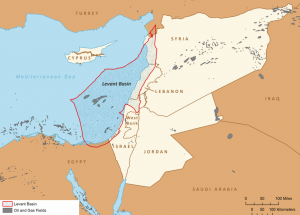
Boundaries of the Levant Basin, US Energy Information Administration

The EastMed pipeline, a proposed means of transporting gas from the eastern Mediterranean to new markets, would be expensive and difficult – but it is feasible. Easier and less expensive solutions are also being considered, but the security element works in EastMed’s favor. EastMed would allow Cyprus, Greece, and Israel to collaborate while developing their roles as hubs of stability in a turbulent neighborhood. The EU and the US would likely see improvement in Western energy dependence. And Israel would have the opportunity to improve its relationship with the EU, not only by participating in a project of European interest but also by finding new clients for its own gas in the European market.

The gas discoveries in the eastern Mediterranean are altering regional dynamics. Transporting that gas to new export destinations, principally in Europe, will be complicated but feasible.

With this challenge in mind, Cyprus, Greece, and Israel have intensified their contacts of late. Trilateral summits are regularly taking place with the participation of Cypriot President Nicos Anastasiades and Greek and Israeli Prime Ministers Alexis Tsipras and Benjamin Netanyahu. (In April 2017, Italy joined the club, signing a declaration in Tel Aviv to that effect.)

The first trilateral summit took place in Nicosia in January 2016 and the second in December 2016 in Jerusalem. A third was held only a few days ago in Thessaloniki. At that most recent summit, the leaders agreed to deepen their energy collaboration by exploring means of constructing an underwater “EastMed” pipeline.

The project envisages a 1,300 km offshore pipeline and a 600 km onshore one from Eastern Mediterranean sources to Cyprus, from Cyprus to Crete, from Crete to mainland Greece (the Peloponnese), and from the Peloponnese to Western Greece. Then, the plan is to connect Western Greece to Italy east of Otranto via a 207 km offshore pipeline across the Ionian Sea, the so-called Poseidon.

At first glance, the biggest obstacle to the construction of the EastMed pipeline – which, if constructed, would be the longest and deepest subsea pipeline on earth – is its technical viability. Practical challenges abound. On the approach to Crete, for example, there is a stretch of about 10 km where the depth is quite high, which could cause construction problems. However, the companies involved are optimistic that technology will advance sufficiently to enable the pipeline to be built.

The Natural Gas Supplier Corporation (DEPA) of Greece describes the project as “technically feasible,” according to studies it has conducted. To bolster its case, DEPA notes the success of the Medgaz pipeline, which runs between Algeria and Spain. Israel energy minister Yuval Steinitz, too, has attempted to ease fears about construction issues and suggests that EastMed can be completed by 2025.

Technical feasibility is not the only matter of concern, however. Another challenge is the cost, which has been projected to range anywhere from $4 billion to $7 billion. Low gas prices are also concern, as they could prevent private companies from supporting the project alongside the EU (which is prepared to offer co-financing).

Alternatives scenarios are on the table to address these concerns. LNG bases in either Cyprus or Israel could work in theory, but the prohibitively high cost of constructing them makes them a nonstarter. On a practical level, there are two real options available.

The first is to construct a 550 km submarine pipeline beginning from the Leviathan reservoir in Israeli waters, passing through Cypriot waters, and reaching southern Turkey. Israeli gas would then be shipped from southern Turkey to Europe via existing, and perhaps some newly constructed, pipeline networks. This project is estimated to cost half or possibly even less than half what EastMed would cost. But in view of the lack of resolution on the Cyprus Question, Israel is hesitant to proceed to an agreement with Turkey on this matter.

The second option is to use already existing LNG facilities in Egypt. Gas from the eastern Mediterranean could theoretically be supplied to the two Egyptian facilities in Damietta and Idku, turning Egypt back into a gas exporter. But the recent discovery of the Zohr field represents an unknown factor. It cannot be anticipated how this field will influence Egypt’s energy priorities and the balance between domestic consumption and exports. Also, neither the construction of new pipelines nor the reversal of the existing one connecting Israel to Egyptian LNG facilities would be an easy process.

If the Cyprus Question is resolved soon, the Turkish option will gain ground. But the restarted talks between Anastasiades and Turkish Cypriot leader Mustafa Akinci are highly unlikely to lead to a breakthrough. In any case, Turkey will not be considered a reliable partner by Israel for as long as President Tayyip Erdoğan dominates the political sphere, despite the rapprochement achieved last summer. Israel also has reservations vis-à-vis Egypt: the growing Russian role in Egypt’s energy sector cannot be ignored.

Israel has always attached great significance to political and security parameters. If the EastMed project develops, it will certainly improve Israel’s relationship with the EU. Commissioner for Climate Action and Energy Miguel Arias Cañete has said construction of this pipeline would contribute to the reduction of Europe’s dependency on Russian energy, a potential result also viewed with favor by the US.

The traditional division among EU member states on their view of Moscow can work in EastMed’s favor. While Germany is looking favorably towards Nord Stream II, which will complement Nord Stream I in the transporting of Russian gas to Europe under the Baltic Sea, the EU might well emphasize energy security and push (with the support of the US) for the realization of EastMed.

Israel is the driving force for energy development in the eastern Mediterranean, and its choices on this matter will have serious implications in terms of both strategic calculations and long-term economic planning. By cooperating with trustworthy democratic countries, Jerusalem will be able to mitigate the risk of instability, secure clients on the Continent, strengthen its relationship with the EU, and improve its image in Europe.