Tuesday, June 06, 2017

Fifty Years After the Six-Day War

From The Washington Times, June 5, 2017, by Daniel Pipes:

Israel's military triumph over three enemy states in June 1967 is the most outstandingly successful war of all recorded history. The Six-Day War was also deeply consequential for the Middle East, establishing the permanence of the Jewish state, dealing a death-blow to pan-Arab nationalism, and (ironically) worsening Israel's place in the world because of its occupation of the West Bank and Jerusalem.

....how did a spectacular battlefield victory translate into problems that still torment Israel today? Because it stuck Israelis in an unwanted role they cannot escape.

First, Israeli leftists and foreign do-gooders wrongly blame Israel's government for not making sufficient efforts to leave the West Bank, as though greater efforts could have found a true peace partner. In this, critics ignore rejectionism, the attitude of refusing to accept anything Zionist that has dominated Palestinian politics for the past century. Its founding figure, Amin al-Husseini, collaborated with Hitler and even had a key role in formulating the Final Solution; recent manifestations include the "anti-normalization" and the boycott, divestment, and sanction (BDS) movements. [Arab] Rejectionism renders Israeli concessions useless, even counterproductive, because Palestinians respond to them with more hostility and violence.


The Israelis vastly increased (the lined area) the size of Jerusalem on unifying it.

Second, Israel faces a conundrum of geography and demography in the West Bank. While its strategists want to control the highlands, its nationalists want to build towns, and its religious want to possess Jewish holy sites, Israel's continued ultimate rule over a West Bank population of 1.7 million mostly hostile Arabic-speaking, Muslim Palestinians takes an immense toll both domestically and internationally.

Various schemes to keep the land and defang an enemy people – by integrating them, buying them off, dividing them, pushing them out, or finding another ruler for them – have all come to naught.

Third, the Israelis in 1967 took three unilateral steps in Jerusalem that created future time bombs: vastly expanding the city's borders, annexing it, and offering Israeli citizenship to the city's new Arab residents.

In combination, these led to a long-term demographic and housing competition that Palestinians are winning, jeopardizing the Jewish nature of the Jews' historic capital. Worse, 300,000 Arabs could at any time choose to take Israeli citizenship.

These problems raise the question: Had Israeli leaders in 1967 foreseen the current problems, what might they have done differently in the West Bank and Jerusalem? They could have:
Made the battle against rejectionism their highest priority through unremitting censorship of every aspect of life in the West Bank and Jerusalem, severe punishments for incitement, and an intense effort to imbue a more positive attitude toward Israel.
Invited back in the Jordanian authorities, rulers of the West Bank since 1949, to run that area's (but not Jerusalem's) internal affairs, leaving the Israel Defense Forces with only the burden to protect borders and Jewish populations.
Extended the borders of Jerusalem only to the Old City and to uninhabited areas.
Thought through the full ramifications of building Jewish towns on the West Bank.

And today, what can Israelis do? The Jerusalem issue is relatively easy, as most Arab residents have not yet taken out Israeli citizenship, so Israel's government can still stop this process by reducing the size of Jerusalem's 1967 borders and terminating the offer of Israeli citizenship to all the city residents. Though it may lead to unrest, cracking down on illegal housing sites is imperative.

The illegal buildings in the "refugee camp" of Shuafat, located within Jerusalem's 1967 borders.

The West Bank is tougher. So long as Palestinian rejectionism prevails, Israel is stuck with overseeing an intensely hostile population that it dare not release ultimate control of. This situation generates a vicious, impassioned debate among Israelis (recall the Rabin assassination) and harms the country's international standing (think of U.N. Security Council Resolution 2334). But returning to 1949's "Auschwitz lines" and abandoning 400,000 Israeli residents of the West Bank to the Palestinians' tender mercies is obviously not a solution.

Instead, Israel needs to confront and undermine Palestinian rejectionism, which means convincing Palestinians that Israel is a permanent state, that the dream to eliminate it is futile, and that they are sacrificing for naught. Israel can achieve these goals by making victory its goal, by showing Palestinians that continued rejectionism brings them only repression and failure. The U.S. government can help by green lighting the path to an Israel victory.

Only through victory can the astonishing triumph of those six days in 1967 be translated into the lasting solution of Palestinians accepting the permanence of the Jewish state.

The Over-Dramatization of Israel’s “Dilemma”

From BESA Center Perspectives Paper No. 479, May 28, 2017, by Dr. Max Singer*:

Israel is not facing a dilemma about how much, if any,  land to give up from the West Bank, because the Palestinians will not agree to take land and cannot be forced to do so. 

The Palestinian community sees peace with Israel as defeat in their 100-year struggle. Continued Israeli occupation is one of the Palestinians’ best weapons against Israel, and they will not give it up while their war to eliminate Israel continues. 

Israelis should recognize that since the Palestinians are forcing Israel to continue the temporary but long-term occupation, Israelis need to 

  1. cooperate in reducing the moral and other costs of that occupation; and
  2. stop telling the world that Israel could choose to end the occupation. 
The occupation, like the need for military strength and to absorb casualties, is part of the price Israel has to pay to live here. Maturity means being able to go forward with no solution in sight.

Ehud Barak recently had a long review in Haaretz of Micah Goodman’s important new book, Catch 67, to which Goodman responded the following week. Goodman argues that Israel’s 1967 victory created a “catch” or trap reflected in Israel’s current dilemma, in which both sides (the Israeli political left and right) are correct. Barak disagrees. In his view, the choice is clear: the left is correct.

Both Barak’s own view and his telling of Goodman’s ignore the reality of Israel’s actual choices today. We are not facing a dilemma about giving up territory. We are facing a distasteful task, and a need for patience over a period of decades.

Israel does not now have a choice about giving the Palestinians land or creating a Palestinian state; Israel is therefore not facing a dilemma.

While there are undoubtedly peace-seeking Palestinians, as a community, the Palestinians have not even begun to discuss the possibility of making a peace that accepts Israel and ends the Palestinian effort to gain all the land “from the river to the sea.” Nor have they begun public discussion of the possibility of most of the “refugees” settling outside Israel. Without debate among Palestinians, there is no way they can give up their determination to destroy Israel and make a genuine peace.

There is zero chance that there could be a real peace agreement now regardless of how much land Israel would be willing to give up.. A true two-state solution would finally defeat Palestinian and Arab efforts of a century, and they are not yet ready to accept defeat. Whatever disagreement there is among Israelis about how much land, if any, Israel should give up to get  peace, that disagreement is not what is standing in the way of peace.

Theoretically, there are two other possibilities that might create a dilemma for Israel about giving up land. The first would be an agreement with the Palestinians to take over some of Judea and Samaria without making a full peace with Israel.  The second would be a unilateral action by Israel to separate the peoples and end the occupation without Palestinian agreement.

For the reasons discussed below, neither of these is a realistic possibility regardless of how much of Judea and Samaria Israel is willing to give up.  Again, no real dilemma.

The Palestinians have a voice in what happens. The choice they have made is to force Israel to “occupy” them, because they want to keep up the struggle to destroy Israel.  Being a victim, an “occupied people,” improves their diplomatic position, causes Israel pain, and provokes internal conflict within Israel. These effects are bad for Israel and good for the Palestinians. Indeed, the more harmful they are for Israel, the more desirable they are for the Palestinians.

There would have to be a lot more disadvantages to the status quo for the Palestinians before they would give up such a weapon against Israel to improve their living conditions. This is especially true for the Palestinian leadership, which suffers less from the status quo than most Palestinians and benefits more from the continuation of the conflict.

But if the Palestinians will not make an agreement that would sacrifice the advantage of forcing Israel to be an “occupier”, is there any way that Israel can force them to do so by taking unilateral action to separate the peoples? This idea appealed to Sharon, and so he organized Israel’s “disengagement” from Gaza. Some Israelis say the withdrawal was a good idea that only worked out badly because it was done unilaterally. But why should we think the Palestinians would have agreed to arrangements that would have been better for Israel? They consider themselves to be at war with us. They want to cause us pain and put us at a disadvantage, and are willing to accept casualties and suffering to do so.

Gaza was simple, but the West Bank is complicated. There is no way Israel can separate itself from the Palestinian population in the West Bank without Palestinian agreement. This is because of Israel’s military need for access to the Jordan Valley, which would be true even if there were no settlement blocs.

Even if all the ideological settlements and hilltop outposts were gone, no unilateral Israeli withdrawal could produce a stable new status quo that we could impose on the Palestinians. Also, Israel is still regarded internationally as occupying Gaza even though it has withdrawn completely. The same would be true for Judea and Samaria after an Israeli unilateral withdrawal. The Palestinians would insist that they are still occupied and would take steps to force Israel to act in the evacuated areas.

So the Palestinians have us trapped. Although we have committed ourselves to the principle that the occupation in Judea and Samaria is temporary, we will be stuck with it for a long time. We also have to continue taking casualties and sending our children to become soldiers and to kill people. We were not given our home on a silver platter.

This reality means that the question of what land we should give up is a question for the fairly distant future. When there is a real possibility for improving things by giving up land, conditions in our region and perhaps the world will be unpredictably different than they are today. Our disagreements over how much land, if any, to give up make no difference right now. We are not facing a practical dilemma.  There is no reason we should continue to beat up each other about what land, if any, we should be willing to give up for what benefits.

A solid majority of Israelis and our government have decided that Israel should be willing to give up most of Judea and Samaria in order to have peace, and perhaps even to separate ourselves from the Palestinians without peace. An even bigger majority is opposed to any withdrawals while the Palestinian community is in its current state. Therefore it is not true that our conflict with the Palestinians is the result of a stubborn or selfish insistence on holding onto all of the land of Israel. But there is nothing we can do at present to implement our willingness to give up most of the West Bank.

What can we do to make things better while we are living with the status quo?  First, if we recognize that the Palestinians will not give us any way of getting out of being “occupiers,” we can work together, left and right, to reduce the moral and other harm of the “occupation.”  And we can stop the internal name-calling and harsh charges against each other for not trying hard enough to end the occupation. We shouldn’t be fighting over something we have no power to change. The energy used for such fights should be directed towards making the occupation less harmful.

Our diplomatic position would also improve if there were fewer Israelis blaming one another for the continued occupation when Israel has no choice in the matter.

For the longer term, we  should do whatever we can to make the Palestinians and the Arab world more willing to give up their determination to destroy us.  Being nicer to them might help, although that is not usually a very effective strategy in the Middle East. It may be more useful to let them see that we are not riven by internal division or unable to bear the moral burden of being occupiers, so we are as willing as they are to continue living with the status quo indefinitely. The US could help by replacing false “even-handedness” with a truth-telling strategy that shows the Arab world that the US will not help them destroy Israel.

Many Israelis argue that we have to find a solution for our conflict with the Palestinians, and some insist that the problem is urgent (“Peace Now.”) But the experience of Israel’s first sixty years should teach us that patience is an advantage and perhaps even a necessity. What entitles us to have a solution available?

This is not to argue that the status quo does not have dangers. Israel is not safe. We are strong but also vulnerable, and quite capable of making decisive mistakes. But eagerness to settle our conflict with the Palestinians will not make us safe. Neither will anything else. Keeping our home here requires that we accept dangers and human costs of all kinds.

Dr. Max Singer
*Dr Singer, a founder and senior fellow of the Hudson Institute, is a senior fellow at the Begin-Sadat Center for Strategic Studies at Bar-Ilan University in Israel.

Monday, June 05, 2017

As an Arab, I am embarrassed by the Six-Day War

From Times of Israel, 4 June 2017, by Fred Maroun*:
Fred Maroun
Fred Maroun

On the fiftieth anniversary of the Six-Day War, I commemorate with my Jewish friends. Before the war, Jews around the world feared what would happen to the Jews of Israel as they were surrounded by Arab armies and as the Arab leaders drummed up anti-Semitic hatred. But Israel stunned the whole world and particularly Arab leaders when it initiated a preventative attack, and when its young army vanquished much bigger and more experienced Arab armies in the short space of six days.

I am happy for my Jewish friends, but at the same time, as an Arab, I am embarrassed. I am not embarrassed that we lost. We deserved to lose, and I cannot even think of the massacres that may have ensued if we won. I am embarrassed that we started the war in the first place. An unnecessary war that followed 19 years after another unnecessary war that we also lost.

I am embarrassed that we let hatred drive our decision to go to war. I am embarrassed that we did not take Israel’s offer right after the war to make peace in exchange for land. I am embarrassed that since then, Egypt’s and Jordan’s realization of the foolishness of war was not matched by the rest of the Arab world, particularly my own country of Lebanon.

I am embarrassed that we never made a single credible comprehensive offer of peace to Israel. I am embarrassed that still today, 69 years after our first war against Israel, we still use the Palestinians as pawns in our war of hatred.

I am embarrassed that instead of denouncing the hatred, much of the world has joined with us in attacking the Jews’ right to self-determination.

I am embarrassed that I, and the few other Arabs who stand up to hatred, cannot do much more than speak up, and that we have not moved to action even our fellow Arabs who live comfortably in the West.

I am embarrassed as a citizen of the West because we pay lip service to Israel but we cannot provide substantial support to Israel, for example against the Arab attempts to rewrite the past and erase the Jewish history of Jerusalem.

I am embarrassed that we in the West are too beholden to Arab dictators to even take the symbolic step of recognizing that Jerusalem is an indivisible part of Israel.

I am embarrassed to ethnically belong to a group that thrives on hatred and to geographically belong to a group that appeases haters.

I am embarrassed to belong to a human race that has learned nothing from the lessons of the past and that continues to let antisemitism fester and grow.

I am embarrassed that I cannot write these words in an Arab publication or even in a mainstream Western publication because hatred and appeasement are too strong.

But there is something that I can do, and it is to fly in the face of every Arab tyrant and every Arab hatemonger, and to write the truth where I can, because unlike the vast majority Arabs who see the truth and yet remain silent, I refuse to be silenced, and that is something that I am proud of.

So, to my Jewish friends, on the fiftieth anniversary of the Six-Day War, I say, you have a lot to be proud of, not only from those six days, but from everything that your people did before and after. All the hatred in the world cannot take that pride away.

*Fred Maroun is a Canadian of Arab origin who lived in Lebanon until 1984, including during 10 years of civil war. Fred supports Israel's right to exist as a Jewish state, and he supports a liberal and democratic Middle East where all religions and nationalities, including Palestinians, can co-exist in peace with each other and with Israel, and where human rights are respected. Fred is an atheist, a social liberal, and an advocate of equal rights for LGBT people everywhere. Fred Maroun writes for Gatestone Institute.

Friday, June 02, 2017

Arab leaders planned for genocide in Six-Day War

From Ynetnews, 29 May 2017, by Ben-Dror Yemini:

During the 1967 war, Israel seized Egyptian and Jordanian operational documents with clear orders to annihilate the civil population. Nevertheless, different academics are distorting the facts in a bid to turn the Arabs into victims and Israel into an aggressor. Here’s the real story.

More than anything else, the Six-Day War has turned into a rewritten war. A sea of publications deal with what happened at the time. Gamal Abdel Nasser’s Egypt, the revisionists assert, had no ability to fight Israel, and anyway, he had no intention to do so.

It’s true that he made threats. 
It’s true that he sent more and more divisions to Sinai. 
It’s true that he expelled the United Nations observers. 
It’s true that he incited the masses in Arab countries. 
It’s true that the Arab regimes rattled their sabers and prepared for war. 
It’s true that he closed the Straits of Tiran. 
It’s true that Israel was besieged from its southern side. It’s true that this was a serious violation of international law. It’s true that it was a “casus belli” (a case of war).

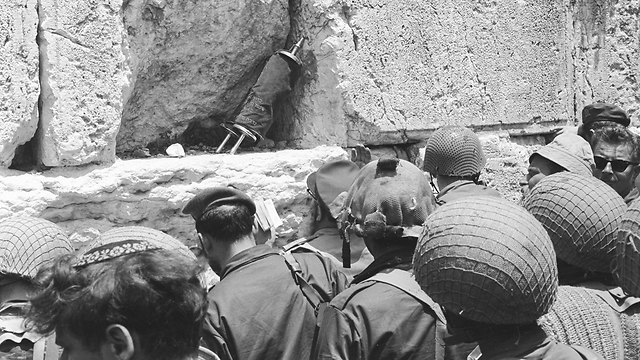
IDF forces at the Western Wall during Six-Day War. When there is a narrative, who needs facts? (Photo: Bamahane)

All that doesn’t matter, however, because there is a mega-narrative that obligates the forces of progress to exempt the Arabs from responsibility and point the accusing finger at Israel. And when there is a narrative, who needs facts? After all, according to the mega-narrative, Israel had expansionist plans, so it seized the opportunity. Different scholars are distorting the facts in a bid to turn the Arabs into victims and Israel into an aggressor.

Excuse us for winning
I was a child, an elementary school student. I remember fear, a lot of fear. There were no shelters in the house I lived in. It was clear that there would be bombings, so we dug pits in the yard.

Occasionally, we are reminded of the sound of thunder from Cairo to remind us of the annihilation threats. But in fact, they were much more serious. Both the Arab League and the leaders of all neighboring states announced in an unequivocal manner that the plan was annihilation. I repeat: Annihilation. Arrogant talk? Considering the fact that the Arab and Muslim world was engaged in endless self and mutual massacres, it was pretty clear that what they were doing to themselves—and it’s still going on—they would also do to Israel.

We must remember one thing, therefore: The alternative to victory was annihilation. So excuse us for winning. Because an occupation without an annihilation is preferable to an annihilation without an occupation.

‘Our goal is clear: To wipe Israel off the map’
The Arab states never accepted the State of Israel’s existence, not for a moment. There was no occupation from 1949 to 1967, but a Palestinian state wasn’t established, because the leaders of the Arab world didn’t want another state. They wanted Israel. They didn’t hide their intentions for a minute.

The new stage began in 1964. On the backdrop of a conflict over the water sources, the Arab League convened in Cairo and announced:
“... collective Arab military preparations, when they are completed, will constitute the ultimate practical means for the final liquidation of Israel.”
Two years went by, and then-defense minister Hafez Assad, who went on to become Syria's president, declared:
"Strike the enemy’s settlements, turn them into dust, pave the Arab roads with the skulls of Jews.” And to erase any doubt, he added: "We are determined to saturate this earth with your (Israeli) blood, to throw you into the sea.”

 Six-Day War. Those who rewrite history are winning
Six-Day War. Those who rewrite history are winning

Nine days before the war broke out, Nasser said:
“The Arab people want to fight. Our basic aim is the destruction of the State of Israel.” Two more days passed before Iraq’s president, Abdul Rahman Arif, joined the threats: “This is our chance…our goal is clear: To wipe Israel off the map.”
Two days before the war broke out, PLO founder and leader Ahmad Shukieri said:
“Whoever survives will stay in Palestine, but in my opinion, no one will remain alive.” 
Yes, that was the atmosphere. Does anyone still seriously think that those were just declarations? Does anyone think that their intention was an enlightened occupation? Does anyone think that there would not have been a mass slaughter like the one Egypt carried out in Yemen and later on in Biafra?

Hussein: No annihilation orders, 'as far as I know'
In order to understand that these were not false statements, it should be noted that in a meeting held after the war between Israel’s Ambassador to London Aharon Remez and British Foreign Secretary George Brown, Remez said that Israel had seized documents of the Jordanian army on operational orders, from May 25 and 26, about two weeks before the war's outbreak, which included orders to exterminate the civil population in the communities that were planned to be occupied as well. They believed at the time that it was indeed going to happen.

It isn’t clear, Remez said at the time, whether Hussein was aware of these orders, but they were very similar to the annihilation orders issued by the Egyptian army. This appears both in Michael Oren’s book about the Six-Day war and in Miriam Joyce’s book about Hussein’s relations with the United States and Britain, as well as in Dr. Moshe Elad’s book (“Core Issues in the Israeli-Palestinian conflict”). At first, Hussein rejected the claims about the annihilation orders out of hand, but later added: “As far as I know.”

Clear and simple facts
The days passed. The threats increased. More and more forces were sent to Sinai. More Arab countries joined the war coalition. It’s unclear whether Nasser really wanted a war, Oren wrote in his book. But he and the Arab countries did everything in their power to deteriorate the situation. Nasser’s appetite kept growing, and immediately after blocking the straits, he declared: “If we managed to restore the conditions that existed before 1956 (the Straits of Tiran are blocked), God will surely help us and urge us to restore the situation that existed in 1948.”

The late Yitzhak Rabin, who served as IDF chief of staff at the time, told the government that “it will be a difficult war… There will be many losses.” He estimated that 50,000 people would be killed. And Oren, who had read almost every document that had been declassified, concluded: “The documentation shows that Israel wanted to prevent a war with all its might, and that up to the eve of the battles it tried to stop the war in every possible way—even at a heavy strategic and economic cost for the state.” These are the facts. But those who rewrite history are winning.

The political debate over the Israeli control of the territories has led to a situation in which political opinions disrupt the factual research. The political debate is important. It’s certainly legitimate. But there is no need to rewrite history to justify a political stance. It should be the other way around: 
Facts should influence political views. And the facts are clear and simple: 
The Arab states’ leaders did not only settle for declarations on an expected annihilation, they even prepared operational orders.

Trump’s Air Strike on al-Tanf: No to the Shiite Crescent... HEAR, HEAR!!

From BESA Center Perspectives Paper No. 483, 1 June 2017, by Prof. Hillel Frisch:


image from US DoD - US Central Command Combined Joint Task Force Operation Inherent Resolve


The two recent US air strikes on a Syrian convoy heading to the al-Tanf military base in the southern Syrian Desert a few miles from the Jordanian-Syrian border have major strategic importance. The attack signaled for the first time since the Syrian civil war broke out in 2011 that the US would not countenance the reemergence of the Iranian-controlled Shiite crescent that Iran had created through Teheran, Baghdad, Damascus, and Beirut after the US exited Iraq in 2010.

The US air strikes on a Syrian convoy heading to al-Tanf military base in the southern Syrian Desert a few miles from the Jordanian-Syrian border scarcely made any front pages in the world media. This was a major oversight. The strikes should have been a major headline, especially as they occurred prior to Trump’s visit to Saudi Arabia.

The attack signaled for the first time since the Syrian civil war broke out in the spring of 2011 that the US, under Trump, will not countenance the reemergence of the Iranian-controlled Shiite crescent that Iran had created to connect Teheran, Baghdad, Damascus, and Beirut. Iran had taken advantage of the US’s exit from Iraq in 2010 and the outbreak of the Syrian civil war a year later to establish that Shiite crescent.

Technically, the two air strikes were a minor affair. Two fighting F-15 jets struck a convoy of Syrian troops and unidentified pro-Syrian militia members, killing five to fifty of them as well as destroying several vehicles. The US justified the strike on military grounds. The convoy was likely to threaten elite US army troops advising Free Syrian Army-linked forces, who, together with YPG Kurdish forces, have pushed ISIS back to Raqqa, its last major stronghold in Syria.

According to the US army spokesperson, the strike hardly came as a surprise. The Syrians had long known of the 35-mile radius “deconfliction” zone around a former Syrian army base that US special troops use to train their local allies. Syrian forces were aware that they were forbidden to enter that zone.

The real goal behind the attack lies in the reason the Syrian convoy risked penetrating the area. The Syrians and their allies were obviously trying to link up with pro-Iranian militias operating against ISIS around Mosul, the last and crumbling stronghold of ISIS in Iraq.  Syria and its Iranian patron reasoned that as ISIS was responsible for rupturing the Iranian-controlled Shiite crescent in 2014 when it captured Raqqa and Mosul and the vast space in between, the defeat of ISIS had to be a prelude to resurrecting the crescent.

President Trump obviously thought otherwise. Unlike his predecessor, who viewed Iran as part of the solution to lowering the flames in the Middle East, Trump sees Iran as very much part of the problem. That position that is in tandem with that of Saudi Arabia, the Gulf States, and Jordan (from where the F-15s might have taken off). All those states view Iran as the major threat by far to their national security.

There could be no better way to express the new American administration’s unity of purpose with its traditional Gulf allies than a military strike to show its commitment to containing the Iranian crescent threat. The timing of the strike was perfect – two days before the president and his entourage landed in Riyadh to sign multibillion-dollar armament deals between the US and Riyadh.

Iran clearly understood the strategic meaning of this otherwise minor military move. Fars, a leading Iranian news agency linked to the Islamic Revolutionary Guard Corps, announced that 3,000 fighters from Hezbollah, the Iran-backed Lebanese Shia militia, were being sent to the area “to prepare the Syrian army and its allies for thwarting the US plots in the region and establish security at the Palmyra-Baghdad road.”

The larger impact of the strike was also clear to Russia, the ally of Iran and Syria. Russia’s deputy foreign minister condemned the strike, calling on the US to stick to the original mandate of the multi-state coalition to defeat Sunni Islamic terrorism.

Above all, the strike and its vast regional implications demonstrate that the containment and, possibly, the ultimate defeat of ISIS are hardly likely to enhance the prospects of achieving peace in the area. To the contrary, the rollback of ISIS is only going to intensify the conflict between the various militias on the ground, as well as their national and international sponsors.

Only the promotion – or thwarting – of an Iran-dominated Shiite and heterodox arc, with all its implications for the regional and international balance of power, can catapult a small patch of desert devoid of any natural resources, known hitherto only to local geographers, into an international flashpoint. Commit to memory the name and location of al-Tanf. It is liable to haunt the wider Middle East for years to come.

CUNY invites the vulgar extremist Linda Sarsour to deliver the keynote address to its graduates

From The New English Review, 1 June 2017, by A.J. Caschetta:


vulgar extremist Linda Sarsour

In an era when saying the wrong thing, deemed offensive by someone, can end a career, social justice warriors always seem to get a pass. Few have received more than Linda Sarsour, a Muslim self-styled “feminist” who supports a political system that systematically represses women, celebrates child warriors on social media, and once tweeted of two ideological foes, “I wish I could take away their vaginas – they don’t deserve to be women.” 

The more Sarsour offends, the more she is celebrated. Barack Obama honored her as a Champion of Change. Today she will give the keynote address at the City University of New York’s (CUNY) School of Public Health graduation ceremony.

Sarsour’s endorsement of sharia law and leadership in the anti-Israel Boycott, Divestment, and Sanctions (BDS) movement should have made her an unfit candidate to address graduates of any educational institution even if she weren’t a social media provocateur. Ayaan Hirsi Ali, one of the women whose vagina Sarsour wants to confiscate, calls her a “fake feminist.” Brigitte Gabriel, the other woman, calls Sarsour a “master manipulator” successfully swaying “the gullible women’s movement.”

Ariel Behar of IPT News wrote that Sarsour specializes in trying “to shut down those who cite her record of celebrating terrorists and advocating radical positions by calling the critics Islamophobes.” Sarsour is also a conspiracy theorist, endorsing, for instance, the bizarre view that failed “underwear bomber” Umar Farouk Abdulmutallab was “a CIA agent.”

Sarsour’s defenders claim that her views stem from anger and “should come as no surprise for a Palestinian-American;” after all what she really opposes is “right-wing Zionism.” Sarsour has said that Zionists – including the vast majority of Jews – can’t be feminists. She didn’t say only “right-wing Zionists” can’t be feminists.

Why would the CUNY want to showcase someone who, as Daniel Pipes documents, has such a “long record of incompetence, extremism, vulgarity, and eccentricity”? 

Dov Hikind, a Brooklyn Democrat in the New York Assembly, says “it’s just nuts. It makes no sense. It’s crazy to have this woman be the person who’s going to speak to the students.”   

In an effort to explain, CUNY Chancellor James B. Millikin released an April 26 statement saying that while the views Sarsour “reportedly” has on Israel are “anathema to the values of higher education,” forgoing a commencement speech by Sarsour “would conflict with the First Amendment and the principles of academic freedom.”

Much the same argument was made by five CUNY professors in a spirited but sophomoric defense of Sarsour’s right to speak at the academic blog InsideHigherEd. Two of the five, Meena Alexander and Rosalind Patchesky, are known for their anti-Israel activism.

But these arguments conflate and grossly misunderstand free speech and academic freedom.Which speakers a university, even a public one, invites to deliver commencement speeches is not a First Amendment issue. This is not a matter of deciding whether to allow this or that student demonstration or campus guest lecture to take place; it’s a formal endorsement, not of what the speaker says, but of the speaker’s qualifications and ability to inspire an audience. Of course Sarsour has a First Amendment right to her anti-Zionism and even to her anti-Semitism. But CUNY does not have a First Amendment obligation to honor her or provide a platform for her.

Academic freedom is another thing entirely. Sarsour is not a CUNY faculty member, or even an academic. Even if she were, her academic freedom would only be violated if Millikin tried to influence the content of her teaching.

Those who cite Columbia University’s hosting of a lecture by Iranian president Mahmoud Ahmadinejad as a precedent are missing the point entirely. Having a morbid intellectual curiosity perform live for the benefit of scientific observation is one thing. Inviting one to give parting words of advice to your student body is another thing altogether.

If Millikin really found Sarsour’s support for BDS (no need for the qualifier “reportedly”) “anathema to the values of higher education,” as Chancellor, he could have easily overridden her selection. This is what likely happens all the time in nearly every academic institution when someone suggests a conservative speaker be invited.

The problem, most likely, is that Sarsour received far more faculty support than any conservative who ever made it past the first round of nominations at CUNY.

If university administrators want to wilt under pressure and allow this kind of spectacle to take place, they should at least find the courage not to cite the First Amendment and academic freedom as the reasons.

Thursday, June 01, 2017

Ehud Barak: Blatantly Ignoring Danger

From BESA Center Perspectives No. 482, May 31, 2017, by Maj. Gen. (res.) Gershon Hacohen:


Ehud Barak, photo by Remy Steinegger, image via World Economic Forum

Former PM Ehud Barak’s arguments in favor of withdrawal from Judea and Samaria undercut Israel’s security and are a departure from the Oslo Accords’ security vision. Israel would be wise to present President Trump with actual facts on this issue [yes to the Rabin outline as based on the principles of his last speech, and no to the Clinton-Barak plan].

US President Donald Trump’s visit to Israel seems to have triggered a new campaign over the future of the Jewish people in the land of its forefathers, and former Prime Minister Ehud Barak has joined the ranks of those whose hopes for Israeli concessions in Judea and Samaria and Jerusalem have been rekindled.

In a piece published in Haaretz last week that sharply criticized author Micah Goodman’s book Catch 67: The Ideologies behind the Disagreements Tearing Israel Apart, Barak sought to weigh in on the question of whether Israel can properly defend itself in the event it withdraws from Judea and Samaria.

Barak’s answer was decisive: Israel’s refusal to separate from the Palestinians and withdraw to the 1967 lines – with certain exceptions for the big settlement blocs – is “a definite threat to the future of the Zionist project,” while the threats that may arise following a withdrawal are “military technical risks.” He was dismissive of the Right’s premise that such territorial concessions are potentially extremely dangerous, arguing that “Israel is the strongest country in the region militarily, strategically and economically and – if we craft our relations with the United States skillfully – also diplomatically.”

According to Barak, if Israel succeeds in navigating the moves it is expected to pursue, it would be able to deal with any military threat that may rear its head.

But history has proven that even superpowers can fail. One needs to look no further than the Russians and the Americans in Afghanistan.

Since the 2005 disengagement from the Gaza Strip, Israel has a clear point of reference as to the nature of the potential threat a Palestinian state may constitute. By similar logic, one can argue that what happened in the Gaza Strip – i.e., the terrorist threat it poses to the border-adjacent communities – could happen in Judea and Samaria, only this time, it would be the majority of the cities in Israel’s center and coastal plain that would be targeted.

Barak and his supporters promise that the future Palestinian state will be demilitarized. It is worth exploring whether this objective is attainable and to what extent, especially in an age when global arms proliferation is available to the highest bidder, as seen by the unabated arms smuggling to Hamas in Gaza and Hezbollah in Lebanon, and given both groups’ increasing domestic weapons production capabilities.

The other approach, which Barak utterly dismisses as an unfounded right-wing view, argues that establishing and maintaining Palestinian demilitarization is essential if Israel is to maintain its ongoing security efforts and a thriving civilian presence throughout Judea and Samaria.

Let’s assume, for the sake of argument, that rightists have a mixed set of ideologies, as Barak claims. That does not change the fact that the need for strategic depth on Israel’s narrow coastline was not the Right’s brainchild.

In his 1978 book And Now Tomorrow, then-Labor party leader Shimon Peres wrote,
“If a separate Palestinian state is established, it will be armed to the teeth. It will also have bases for the most extreme terrorist forces and they will be equipped with anti-aircraft and anti-tank missiles that will endanger not only passersby but every plane and helicopter flying in Israel’s skies and every vehicle traveling on the main highways of the coastal plain. … The main problem is not agreeing on demilitarization, but upholding such an agreement in practice.”
Know thy place
Like many of those supporting the notion of withdrawal, Barak has based his arguments on the fact that many in the defense establishment share his views. While the numbers may be in his favor, what does it really mean? Galileo taught us that progress depends on open and critical scientific thinking. Arguing that one’s view is akin to scientific truth simply because it is the majority opinion belongs in a church or the rabbinical establishment. Neither Albert Einstein nor Nobel laureate Dan Shechtman had the support of the scientific community in the early days of their research.

We now have the opportunity to validate the expertise professed by these defense officials when they address strategic questions. Early in the 1948 War of Independence, during a situation assessment with the IDF’s General Staff, then-Prime Minister David Ben-Gurion stated that “we will adhere to the experts’ advice on the technical issues, but the experts will not have the final say on everything – that is up to the people’s representatives. It is not up to the experts to decide whether to wage war or not, and whether to defend the Negev or not.”

The same is true of the question of Israel’s future in Judea and Samaria. Experts are welcome to express their opinion, but one must remember that when it comes to this issue they are not politically impartial professionals, and unlike on technical matters, the experts are not familiar with the ins and outs of strategic issues.

In his Haaretz piece, Barak defends his support as prime minister in 2000 for a two-state solution as outlined by then-US President Bill Clinton.
But there is a fundamental difference between what Prime Minister Yitzhak Rabin agreed to in the 1993 Oslo Accords and the Clinton plan.

In his last Knesset speech, delivered on Oct. 5, 1995, Rabin underscored four guiding principles: 

  1. “We aspire to establish the State of Israel as a Jewish state with at least 80% of its population Jewish”; 
  2. “first and foremost, a united Jerusalem, including [the suburbs of] Maaleh Adumim and Givat Ze’ev, as the capital of Israel, under Israeli sovereignty”; 
  3. “for Israel’s security, the border will be drawn in the Jordan Valley, in the broadest interpretation of this term”; 
  4. touching on the Palestinian political entity that will be established alongside Israel, west of the Jordan River, “This entity will be less than a state and will independently manage the lives of the Palestinians under its rule.”

In contrast, Clinton’s plan, which both Barak and former Prime Minister Ehud Olmert agreed to, leads to the division of Jerusalem and to Israel’s abandoning its broad hold on the Jordan Valley, which is a true departure from Rabin’s views that demanded the latter be interpreted in the broadest possible way.

In his pattern of binary thinking, Barak described Israel’s decision-making junctures as requiring the leadership to choose one of two paths: withdrawal from Judea and Samaria or deterioration into an apartheid state. But as the main articles of the Oslo Accords have been implemented, how can anyone seriously suggest that our continued control of another people is akin to apartheid? The completion of the Israeli withdrawal from areas A and B in Judea and Samaria in 1996 and the 2005 disengagement from Gaza are proof that our rule over another people has ended.

About 90% of the Palestinian population in Judea and Samaria has been under the Palestinian Authority’s rule since the mid-1990s and Gaza’s population has been under Hamas rule since 2007. Therefore, the Israeli-Palestinian conflict currently focuses on the Jerusalem area and Area C in Judea and Samaria. Rabin argued that Israeli control in these areas – all the settlements, military bases, main highways, and the vital area leading to the Jordan Valley – was the minimum necessary to preserve defensible Israeli borders.

In view of Trump’s aspiration to “reach a deal” between Israel and the Palestinians, Israel would be wise to express a position that enjoys broad national consensus: yes to the Rabin outline as based on the principles of his last speech, and no to the Clinton-Barak plan.

Thursday, May 25, 2017

Hamas - another failed Palestinian-Arab organisation

From BESA Center Perspectives Paper No. 465, May 14, 2017, by Hillel Frisch*:

EXECUTIVE SUMMARY: Mounting evidence suggests that Hamas, viewed as either a terrorist movement or as a government, is one more failed Palestinian organization. It is recognized as such by Gaza’s inhabitants, who no longer show up to their rallies. Its lack of popularity is one reason for the small concessions contained in its recently published document. More concessions will come as popular pressure mounts. Israel should be patient, as time is on its side.


Hamas rally, photo by Soman, via Wikipedia Commons

As dovish Israelis seek signs that Hamas is about to modify its bigoted anti-Semitic covenant, evidence is accumulating that Hamas is yet another failed Palestinian organization on a long list of similar organizations. Their collective failure adds up to the failure of the Palestinian national movement as a whole.

The signposts of failure are easy to spot. The Hamas movement – which, since it took over Gaza in 2007, is now the Hamas government – has failed in both its major objectives. The first of these is muqawama, or “resistance” (in reality, the quest to destroy the State of Israel). The second is the governing of Gaza.

Few terrorist movements in the world were touted as so major and threatening a military force as Hamas, especially by Israeli opinion makers, military analysts, and the official military establishment. Hamas’s strategy of muqawama became a buzzword to denote a long-term threat to Israel’s security. Overlooked was the fact that muqawama was a strategy employed long ago by Fatah, its rival, with motley results.

In retrospect, the Hamas resistance was even less successful. Fatah and the PLO, which the faction once controlled, recognized the weakness of long-term terrorist attrition when Arafat gave the green light to the Oslo process. He signed on to a provisional Palestinian autonomy in Judea and Samaria/the West Bank after having assassinated numerous advocates of that route. His reversion to mass terrorism during the second intifada, while initially successful, proved to be a disaster from which the local population has yet to recover. The Oslo process took place 29 years after its official inception.

Hamas, though presumed to be more radical than Fatah and to have longer staying power because of its religious ardor, has proved less resilient than its competitor. Following the third round of the Israel-Hamas conflict in the summer of 2014, missile launchings and tunnel attacks on Israel have come to an almost complete halt. (In the years preceding the 2014 round, Hamas and the other factions launched on average 1,500 rockets a year. Since the summer of 2014, that number has dwindled to 25 a year, and they are almost always launched by salafi movements that chafe under Hamas rule.) This dramatic slowdown seems to indicate that “resistance”, while remaining a rhetorical device, is no longer Hamas strategy in the field.

Hamas has also failed to provide for the welfare of Gaza inhabitants. In the summer of 2014, Hamas agreed to participate in a unity government headed by President Abbas’s Prime Minister Rami Hamdallah even though Hamas was excluded from the government’s ministerial portfolios. This was the first indication since its takeover of Gaza in 2007 that Hamas recognizes its failure as a government.

The Gaza public, of course, realized Hamas’s failure much sooner. Years earlier, the Hamas government failed to solve Gaza’s pressing electrical blackouts, which created sewage and other ecological problems connected to the need for continuous electrical supply. A movement touted for having provided welfare services in the past is now devoting less than 2% of its expenditures, by its own account, to health and welfare. It has imposed additional taxes on top of the 14% value added tax Israel collects on imports and then transfers, according to an international agreement, to the rival PA. The concrete purchased with this income has gone into building offensive tunnels into Israel rather than solving Gaza’s critical housing problem. On top of all this, Hamas is unable to pay its civil servants their full salaries on a regular basis.

Since 2014, the inhabitants of Gaza have cast their vote against Hamas. They do not do this at the ballot box. (Neither the PA nor Hamas seeks to continue the democratic process that led to the 2007 civil war, which continues to this day.) Instead, they vote with their feet. When Hamas tries to bring them out to rallies, they stay home.

This can be clearly seen in photos of rallies commemorating the creation of Hamas. I found one photo, for example, that had been taken in 2009 in Gaza’s largest square. It is a long shot capturing tens of thousands of demonstrators. A photo taken at the Hamas commemoration ceremony in 2016, however – two years after the punishing bout in the summer of 2014 – looks very different. Hamas had moved the festivities to a narrow street, and the photo was taken close up and at street level. Instead of tens of thousands, one can hardly count one-tenth of that.

This development can be easily corroborated with “Google trends.” A search of the word “Hamas”, written in Arabic, on Palestinian sites shows a decline in the use of the term over the years. The findings are even more dramatic in Arabic searches for “Izz al-Din al-Qassam Brigades”, the fighting arm of the Hamas movement.

Little wonder, then, that Hamas has come up with a document that agrees, at least on tactical grounds, to a Palestinian state in Gaza and Judea and Samaria/the West Bank. The group is attempting to assuage Abbas and the Arab states that back him. Pressure from Gaza’s inhabitants is probably one reason for this move. Given Hamas’s failure as both a government and a terrorist movement, there will likely be more popular pressure to come, with further concessions down the line.

Israel must be patient. Time is on its side.

*Prof. Hillel Frisch is a professor of political studies and Middle East studies at Bar-Ilan University and a senior research associate at the Begin-Sadat Center for Strategic Studies.

The Soviet-Palestinian Lie

From Gatestone, October 16, 2016, by Judith Bergman:

"The PLO was dreamt up by the KGB, which had a penchant for 'liberation' organizations." — Ion Mihai Pacepa, former chief of the Foreign Intelligence Service of Romania.
"First, the KGB destroyed the official records of Arafat's birth in Cairo, and replaced them with fictitious documents saying that he had been born in Jerusalem and was therefore a Palestinian by birth." — Ion Mihai Pacepa.
"[T]he Islamic world was a waiting petri dish in which we could nurture a virulent strain of America-hatred, grown from the bacterium of Marxist-Leninist thought. Islamic anti-Semitism ran deep... We had only to keep repeating our themes -- that the United States and Israel were 'fascist, imperial-Zionist countries' bankrolled by rich Jews." — Yuri Andropov, former KGB chairman.
As early as 1965, the USSR had formally proposed in the UN a resolution that would condemn Zionism as colonialism and racism. Although the Soviets did not succeed in their first attempt, the UN turned out to be an overwhelmingly grateful recipient of Soviet bigotry and propaganda; in November 1975, Resolution 3379 condemning Zionism as "a form of racism and racial discrimination" was finally passed.

The recent discovery that Mahmoud Abbas, president of the Palestinian Authority (PA), was a KGB spy in Damascus in 1983, was discarded by many in the mainstream media as a "historical curiosity" -- except that the news inconveniently came out at the time that President Vladimir Putin was trying to organize new talks between Abbas and Israeli Prime Minister Benjamin Netanyahu. Predictably, the Palestinian Authority immediately dismissed the news. Fatah official Nabil Shaath denied that Abbas was ever a KGB operative, and called the claim a "smear campaign."

The discovery, far from being a "historical curiosity," is an aspect of one of many pieces in the puzzle of the origins of 20th and 21st century Islamic terrorism. Those origins are almost always obfuscated and obscured in ill-concealed attempts at presenting a particular narrative about the causes of contemporary terrorism, while decrying all and any evidence to the contrary as "conspiracy theories."

There is nothing conspiratorial about the latest revelation. It comes from a document in the Mitrokhin archives at the Churchill Archives Center at the University of Cambridge in the United Kingdom. Vasily Mitrokhin was a former senior officer of the Soviet Foreign Intelligence service, who was later demoted to KGB archivist. At immense risk to his own life, he spent 12 years diligently copying secret KGB files that would not otherwise have become available to the public (the KGB foreign intelligence archives remain sealed from the public, despite the demise of the Soviet Union). When Mitrokhin defected from the Russia in 1992, he brought the copied files with him to the UK. The declassified parts of the Mitrokhin archives were brought to the public eye in the writings of Cambridge professor Christopher Andrew, who co-wrote The Mitrokhin Archive (published in two volumes) together with the Soviet defector. Mitrokhin's archives led, among other things, to the discovery of many KGB spies in the West and elsewhere.

Unfortunately, the history of the full extent of the KGB's influence and disinformation operations is not nearly as well-known as it should be, considering the immense influence that the KGB wielded on international affairs. The KGB conducted hostile operations against NATO as a whole, against democratic dissent within the Soviet bloc, and set in motion subversive events in Latin America and the Middle East, which resonate to this day.

The KGB, furthermore, was an extremely active player in the creation of so-called liberation movements in Latin America and in the Middle East, movements that went on to engage in lethal terrorism -- as documented in, among other places, The Mitrokhin Archive, as well as in the books and writings of Ion Mihai Pacepa, the highest-ranking Communist official to defect from the former Soviet bloc.

Pacepa was chief of the Foreign Intelligence Service of Romania and a personal advisor to Romanian Communist leader Nicolae Ceausescu before he defected to the United States in 1978. Pacepa worked with the CIA to bring down communism for more than 10 years; the agency described his cooperation as "an important and unique contribution to the United States."

In a 2004 interview, FrontPage Magazine, Pacepa said:

The PLO was dreamt up by the KGB, which had a penchant for "liberation" organizations. There was the National Liberation Army of Bolivia, created by the KGB in 1964 with help from Ernesto "Che" Guevara ... the KGB also created the Democratic Front for the Liberation of Palestine, which carried out numerous bombing attacks... In 1964 the first PLO Council, consisting of 422 Palestinian representatives handpicked by the KGB, approved the Palestinian National Charter -- a document that had been drafted in Moscow. The Palestinian National Covenant and the Palestinian Constitution were also born in Moscow, with the help of Ahmed Shuqairy, a KGB influence agent who became the first PLO chairman...

In the Wall Street Journal, Pacepa explained how the KGB built up Arafat -- or in current parlance, how they constructed a narrative for him:

He was an Egyptian bourgeois turned into a devoted Marxist by KGB foreign intelligence. The KGB had trained him at its Balashikha special-operations school east of Moscow and in the mid-1960s decided to groom him as the future PLO leader. First, the KGB destroyed the official records of Arafat's birth in Cairo, and replaced them with fictitious documents saying that he had been born in Jerusalem and was therefore a Palestinian by birth.

As the late historian Robert S. Wistrich wrote in A Lethal Obsession, the Six-Day War unleashed a protracted, intensive campaign on the part of the Soviet Union to delegitimize Israel and the movement for Jewish self-determination, known as Zionism. This was done in order to rectify the damage to the Soviet Union's prestige after Israel defeated its Arab allies:

After 1967, the USSR began to flood the world with a constant flow of anti-Zionist propaganda... Only the Nazis in their twelve years of power had ever succeeded in producing such a sustained flow of fabricated libels as an instrument of their domestic and foreign policy.

For this the USSR employed a host of Nazi trigger words to describe the Israeli defeat of the Arab 1967 aggression, several of which are still employed on the Western left today when it comes to Israel, such as "practitioners of genocide", "racists", "concentration camps", and "Herrenvolk."

Furthermore, the USSR engaged in an international smearing campaign in the Arab world. In 1972, the Soviet Union, launched operation "SIG" (Sionistskiye Gosudarstva, or "Zionist Governments"), with the purpose of portraying the United States as an "arrogant and haughty Jewish fiefdom financed by Jewish money and run by Jewish politicians, whose aim was to subordinate the entire Islamic world". Some 4,000 agents were sent from the Soviet Bloc into the Islamic world, armed with thousands of copies of the old czarist Russian forgery, The Protocols of the Elders of Zion. According to KGB chairman Yuri Andropov:

the Islamic world was a waiting petri dish in which we could nurture a virulent strain of America-hatred, grown from the bacterium of Marxist-Leninist thought. Islamic anti-Semitism ran deep... We had only to keep repeating our themes — that the United States and Israel were "fascist, imperial-Zionist countries" bankrolled by rich Jews. Islam was obsessed with preventing the infidels' occupation of its territory, and it would be highly receptive to our characterization of the U.S. Congress as a rapacious Zionist body aiming to turn the world into a Jewish fiefdom.

As early as 1965, the USSR had formally proposed in the UN a resolution that would condemn Zionism as colonialism and racism. Although the Soviets did not succeed in their first attempt, the UN turned out to be an overwhelmingly grateful recipient of Soviet bigotry and propaganda; in November 1975, Resolution 3379 condemning Zionism as "a form of racism and racial discrimination' was finally passed. This followed nearly a decade of diligent Soviet propaganda directed at the Third World, depicting Israel as a Trojan Horse for Western imperialism and racism. This campaign was designed to build support for Soviet foreign policy in Africa and the Middle East. Another tactic was constantly to draw visual and verbal comparisons in the Soviet media between Israel and South Africa (this is the origin of the canard of "Israeli apartheid").

Not only the Third World, but also the Western Left ate all this Soviet propaganda raw. The latter continues to disseminate large parts of it to this day. In fact, slandering someone, whoever they are, as racist, became one of the Left's primary weapons against those with whom it disagrees.

Part of the Soviet tactics in isolating Israel was making the PLO look "respectable." According to Pacepa, this task was left to Romanian leader Nicolae Ceausescu, who had achieved the unlikely propaganda feat of portraying the ruthless Romanian police state to the West as a "moderate" Communist country. Nothing could have been farther from the truth, as was ultimately revealed in the 1989 trial against Nicolae Ceausescu and his wife Elena, which ended with their executions.
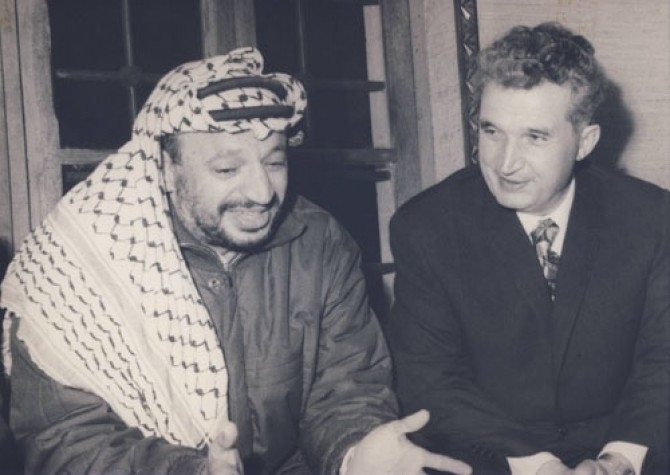

Yasser Arafat (left) with Romanian leader Nicolae Ceausescu during a visit in Bucharest in 1974. (Image source: Romanian National History Museum)

Pacepa wrote in the Wall Street Journal:
In March 1978, I secretly brought Arafat to Bucharest for final instructions on how to behave in Washington. "You simply have to keep on pretending that you'll break with terrorism and that you'll recognize Israel -- over, and over, and over," Ceausescu told him [Arafat]... Ceausescu was euphoric over the prospect that both Arafat and he might be able to snag a Nobel Peace Prize with their fake displays of the olive branch.
... Ceausescu failed to get his Nobel Peace Prize. But in 1994 Arafat got his -- all because he continued to play the role we had given him to perfection. He had transformed his terrorist PLO into a government-in-exile (the Palestinian Authority), always pretending to call a halt to Palestinian terrorism while letting it continue unabated. Two years after signing the Oslo Accords, the number of Israelis killed by Palestinian terrorists had risen by 73%.

In his book, Red Horizons, Pacepa related what Arafat said at a meeting he had with him at PLO headquarters in Beirut around the time that Ceausescu was trying to make the PLO "respectable":
I am a revolutionary. I have dedicated my whole life to the Palestinian cause and the destruction of Israel. I will not change or compromise. I will not agree with anything that recognizes Israel as a state. Never... But I am always willing to make the West think that I want what Brother Ceausescu wants me to do.
The propaganda neatly paved the way for terrorism, Pacepa explained in National Review.

General Aleksandr Sakharovsky, who created Communist Romania's intelligence structure and then rose to head up all of Soviet Russia's foreign intelligence, often lectured me:
"In today's world, when nuclear arms have made military force obsolete, terrorism should become our main weapon."
The Soviet general was not joking. In 1969 alone, there were 82 hijackings of planes worldwide. According to Pacepa, most of those hijackings were committed by the PLO or affiliated groups, all supported by the KGB. In 1971, when Pacepa visited Sakharovsky at his Lubyanka (KGB headquarters) office, the general boasted: "Airplane hijacking is my own invention". Al Qaeda used airplane hijackings on September 11, when they used planes to blow up buildings.


So where does Mahmoud Abbas fit into all this? In 1982, Mahmoud Abbas studied in Moscow at the Institute of Oriental Studies of the Academy of Sciences of the USSR. (In 1983 he went on to become a KGB spy). There he wrote his thesis, published in Arabic as The Other Side: The Secret Relations between Nazism and the Leadership of the Zionist Movement. In it, he denied the existence of gas chambers in the concentration camps, and questioned the number of Holocaust victims by calling the six million Jews who had been killed "a fantastic lie," while simultaneously blaming the Holocaust on the Jews themselves. His thesis supervisor was Yevgeny Primakov, who later went on to become foreign minister of Russia. Even after he had finished his thesis, Abbas maintained close ties with the Soviet leadership, the military and members of security services. In January 1989, he was appointed co-chairman of the Palestinian-Soviet (and then Russian-Palestinian) Working Committee on the Middle East.

When the current leader of the Palestinian Arabs used to be an acolyte of the KGB -- whose machinations have claimed the lives of thousands of people in the Middle East alone -- this cannot be discarded as a "historical curiosity," even if contemporary opinion-makers would prefer to ignore it by viewing it as such.

Although Pacepa and Mitrokhin sounded their warnings many years ago, few people bothered to listen to them. They should.

Saudi Journalist To Palestinian Leaders: You Have Missed Too Many Opportunities To Resolve The Conflict With Israel; It Is Time For Palestinian Unity, Peace With Israel

From MEMRI Special Dispatch No.6941, May 23, 2017:


Mash'al Al-Sudairi 
(Source: Al-Sharq Al-Awsat, London, May 21, 2017)

In his May 21, 2017 column in the London-based Al-Sharq Al-Awsat daily, Saudi journalist Mash'al Al-Sudairi criticized the Palestinian leaders and stated that for many years they had missed numerous diplomatic opportunities to resolve the conflict with Israel, and that they had at the same time lost Palestinian lands on the West Bank and wreaked destruction on Gaza.

Appealing to newly appointed Hamas political bureau head Isma'il Haniya, Al-Sudairi wrote that Hamas's agreement to a Palestinian state in the June 4, 1967 boundaries implied recognition of Israel. Therefore, he said, Hamas should cease its violence against Israel, drop the slogan "Palestine from the [Jordan] River to the [Mediterranean] Sea," and launch an initiative for achieving Palestinian unity. He added that a country's size was not necessarily an indication of its capacity for economic prosperity and success, and that it was high time for young Palestinians to live normal lives like other young people worldwide. The entire Palestinian people, he added, deserved to "enjoy life under peaceful conditions."

Wednesday, May 24, 2017

PA Deception

From PMW Bulletin, May 23, 2017, by Itamar Marcus and Nan Jacques Zilberdik:

Who should the world believe?

What Abbas told Trump today,
or what Palestinian leaders tell their people regularly?

Abbas to Trump in Bethlehem: 
"... two-state solution along the borders of 1967, the state of Palestine with its capital as East Jerusalem living alongside Israel in peace and security."


PLO leader: 
"Everyone knows our goal is to liberate all of the land of Palestine"
PA Chairman Abbas and other PA leaders often reiterate to foreign audiences that they desire peace with Israel and that they support and want to implement the two-state solution. Today Mahmoud Abbas told US President Donald Trump:
"Once again, we reassert to you our positions of accepting the two-state solution along the borders of 1967, the state of Palestine with its capital as East Jerusalem living alongside Israel in peace and security."
[The New York Times, May 23, 2017]
However this is contradicted by numerous statements by PA leaders to their own people and even to Palestinian children. PA religious leaders have even taught recognizing Israel is prohibited by Islam.

Most recently Khaled Mismar, member of the
Palestinian National Council, the legislative body of the PLO, stated that "everyone knows" that despite agreeing to less, the real Palestinian goal is to eventually take all of Israel:

Palestinian National Council member Khaled Mismar: "The revolution broke out in 1965 (i.e., first Fatah terror attack) in order to liberate all of the land of Palestine (i.e., all of Israel), but circumstances didn't permit it... We have fought, and we have withstood everything, all the plots, but we will realize our goal. True, we agreed to receive only 20 or 22 percent of Palestine (i.e., West Bank and Gaza Strip), but a right is never lost as long as someone demands it. Every one of us knows what our goal is (i.e., to 'liberate all of Palestine')."  [Official PA TV, Topic of the Day, May 15, 2017]
 Another Palestinian leader also recently stressed that Palestinians do not intend to change their ideology. All of Israel belongs to Palestinians and is part of "Palestine."

The general coordinator of the PLO's National Committee for Commemorating Nakba Day stated in a speech that: "We will not relinquish one grain of sand from Jaffa, Haifa, Lod or Ramle" - all of which are Israeli cities.
General Coordinator of PLO's National Committee for Commemorating Nakba Day, Muhammad Alyan: "We want to say regarding what happened in 1948: No matter how great the losses and sacrifices may be, we will not relinquish one grain of sand from Jaffa, Haifa, Lod, or Ramle (i.e., all Israeli cities). Let this occupation do what it wants., We are staying here, rooted like the olive tree, fighting, and defending [the homeland]."
[Official PA TV, broadcast for Nakba Day, May 15, 2017]
Palestinian Media Watch has exposed similar statements by other Palestinian leaders, such as Fatah Central Committee member Azzam Al-Ahmad who said that he is "certain" that a Palestinian state in the West Bank will lead to "Palestine" erasing Israel - just like North Vietnam took South Vietnam.

The PA continuously shows its definition of "Palestine" through its use of maps that include all of the State of Israel in "Palestine," for example on plaques of honor or logos , in posts on Facebook describing locations in Israel as situated in "Palestine," or in statements describing "Palestine" as stretching "from the Jordan River to the Mediterranean Sea."

PA religious leaders teach Palestinians that Islamic law forbids them to "relinquish even one grain of sand of Palestine," and PA TV's children's program The Best Home reiterates the message that "all of Palestine will return to us"  and that its size equals the PA areas and Israel combined.

Wednesday, May 17, 2017

How news outlets spread misinformation, lies and propaganda

Don't Ignore the Cultural Boycott of Israel
by Lana Melman*, May 2017

Nearly 50 artists, including Roger Waters, Thurston Moore, Julie Christie and Mike Leigh, recently signed an open letter to the English rock band Radiohead, urging them to cancel their upcoming concert in Israel in support of the cultural boycott against the Jewish state.

In addition to the anti-Israel "regulars," some new artists joined the signatories this time, including the hip-hop group Young Fathers.

The open letter was widely reported on in both music and mainstream publications, including Pitchfork, the Washington Times, Vulture and Yahoo News.

These reports, with rare exception, quote heavily from the letter’s false accusations about Israeli apartheid and human rights violations, without any semblance of a counter-argument to these charges.

In reality, Israel is an open, liberal democracy that guarantees equal rights to all its citizens. Hundreds of artists who visit or perform there every year speak glowingly about the Jewish state, despite the harassment they receive by the likes of Roger Waters and mostly ill-intended grassroots groups.
In its article, Pitchfork, a popular music magazine that bills itself “as the most trusted name in music,” created the illusion of a wave of support for a cultural boycott of Israel by musicians and artists.

But the story conveniently neglected to mention even a handful of the high-profile artists who have rejected the call to boycott Israel -- including Madonna, Justin Bieber, Justin Timberlake, Bon Jovi, Claire Danes, Helen Mirren, Rihanna, Alicia Keys, Pitbull, Lady Gaga, Paul McCartney, Neil Young, Ricky Martin, Joss Stone, Carlos Santana, the Red Hot Chili Peppers, Quentin Tarantino, Paul McCartney, the Rolling Stones, Seal, Kevin Costner, Cyndi Lauper, Yanni, DJ Tiesto, Moby, Elton John and Bob Dylan -- to name but a few.

The Pitchfork article also failed to balance the negative comments by the letter's signatories with even a smattering of positive descriptions, such as one by Madonna, calling Israel “the spiritual center of the world,” or by Jay Leno, who describes Israel as “this one little paradise in the Middle East where freedom reigns.” They also failed to mention Paul McCartney, who kept his concert date in Israel despite threats against him.

Just two days after the circulation of the most recent open letter against Israel, the chief pop–music critic at the New York Times interviewed Roger Waters, as part of its TimesTalks series of conversations with 21st-century “talents and thinkers.”

In the question and answer session, Waters admitted that the open letter fell on deaf ears, and that Radiohead remained committed to performing in Israel in July.

Those same publications that breathlessly reported about the boycott letter were inexcusably quiet about that announcement. 

When news outlets publicize calls for the cultural boycott of Israel and fail to provide balance, they are not sharing a news story; instead, they are helping to spread misinformation, lies and propaganda.


*Lana Melman is the CEO of Liberate Art Inc., a leading expert and commentator on the cultural boycott effort against Israel, a Hollywood liaison, and a professional speaker and writer.

Saturday, May 13, 2017

The progressive right to self invention

This is apparently a universal, not particularly Jewish, topic. Except that the Jewish tradition is a leading example of those mentioned in the conclusion, that have survived for millennia and have every hope of enduring for millennia still.

I’ve extracted the following from two essays* by David P. Goldman (also known as “Spengler”). The excerpts distil, for me, the essence of Goldman’s thesis, which, as usual, I find most illuminating and thought provoking. 

In these essays, he conflates the concept of a search for meaning with that of inventing one’s own identity, which could be a distraction from my primary focus: on the notion on self-invention. When Austrian neurologist and psychiatrist Viktor Frankl, refers to the notion of "man's search for meaning", I believe that he meant for us to search for, and discover, the bedrock meaning inherent to our individual being, as a result of our heritage or circumstance.  I don’t think, as Goldman apparently does, that Frankl was referring to a search for a meaning that is ultimately invented by the individual, in isolation. 

So here goes, in Goldman’s words, with the focus on the notion of self-invention…

...One big idea unifies all of Nietzsche's [intellectual] offspring -- the Marxists, the Freudians, the French Existentialists, the critical theorists, the Deconstructionists, the queer theorists -- and that is the right to self-invention. That is the cruellest hoax ever perpetrated on human beings, for we are not clever or strong enough to reinvent ourselves. To the extent we succeed, we become monsters.

In the Judeo-Christian past, human beings had a destiny… People knew that their impulses must be subordinated to the requirements of God and nature. 

Since the French Revolution, progressives have sought to overthrow the regime of obligation in favour of the right to self-definition...

If you choose your identity at whim, your life has no meaning. That is true in the most parsimonious sense of the word: if you can arbitrarily decide to be a gender-fluid bestialist as well as a F to M to F trans-entity, then your life can "mean" any number of different things, all of them equally arbitrary.

…In the brave new progressive world, life means whatever you want it to mean. It is up to you to invent a meaning that suits you, which you may change whenever it occurs to you to do so.

… If you need to invent [meaning] for yourself, you must first reject what previous generations handed down to you…

There is something perverse in [inventing] the meaning of life. It implies that we don't like our lives and want to [invent] something different. If we don't like living to begin with, we are in deep trouble.

…People have a good reason to look at life cross-eyed, because it contains a glaring flaw - that we are going to die, and we probably will become old and sick and frail before we do so. All the bric-a-brac we accumulate during our lifetimes will accrue to other people, if it doesn't go right into the trash, and all the little touches of self-improvement we added to our personality will disappear - the golf stance, the macrame skills, the ability to play the ukulele and the familiarity with the filmography of Sam Pekinpah.

…[to invent our own identity] is the great pastime of the past century's intellectuals. Jean-Paul Sartre, the sage and eventual self-caricature of Existentialism, instructed us that man's existence precedes his essence, and therefore can invent his own essence more or less as he pleases. That was a silly argument, but enormously influential.

Sartre reacted to the advice of Martin Heidegger (the German existentialist from whom Jean-Paul Sartre cribbed most of his metaphysics). Heidegger told us that our "being" really was being-unto-death, for our life would end, and therefore is shaped by how we deal with the certainty of death. (Franz Kafka put the same thing better: "The meaning of life is that it ends.") Heidegger (1889-1976) thought that to be "authentic" mean to submerge ourselves into the specific conditions of our time, which for him meant joining the Nazi party. That didn't work out too well, and after the war it became every existentialist for himself. Everyone had the chance to invent his own identity according to taste.

Few of us actually read Sartre (and most of us who do regret it), and even fewer read the impenetrable Heidegger… But most of us remain the intellectual slaves of 20th century existentialism notwithstanding.

We want to invent our own identities, which implies doing something unique.

…Most people who make heroic efforts at originality learn eventually that they are destined for no such thing. If they are lucky, they content themselves with … small joys, for example tenure at a university.

But no destiny is more depressing than that of the artist who truly manages to invent a new style and achieve recognition for it. ...The inventor of a truly new style has cut himself off from the past, and will in turn be cut off from the future by the next entrant who invents a unique and individual style. …That is why our image of the artist is a young rebel rather than an elderly sage. If our rebel artists cannot manage to die young, they do the next best thing, namely disappear from public view…

If we set out to invent our own identities, then by definition we must abominate the identities of our parents and our teachers. Our children, should we trouble to bring any into the world, also will abominate ours. 

If self-invention is the path to the meaning of life, it makes the messy job of bearing and raising children a superfluous burden, for we can raise our children by no other means than to teach them contempt for us, both by instruction, and by the example of set in showing contempt to our own parents. 

That is why humanity has found no other way to perpetuate itself than by the continuity of tradition. A life that is worthwhile is one that is worthwhile in all its phases, from youth to old age. 

Of what use are the elderly? In a viable culture they are the transmitters of the accumulated wisdom of the generations. We will take the trouble to have children of our own only when we anticipate that they will respect us in our declining years, not merely because they tolerate us, but because we will have something yet to offer to the young. 

In that case, we do not [invent] the meaning of life. We accept it, rather, as it is handed down to us. 

Tradition by itself is no guarantee of cultural viability. Half of the world's 6,700 languages today are spoken by small tribes in New Guinea, whose rate of extinction is frightful. Traditions perfected over centuries of isolated existence in Neolithic society can disappear in a few years in the clash with modernity. But there are some traditions ...that have survived for millennia and have every hope of enduring for millennia still... 

*To read the original essays in full, see:
The Existential Roots of Trump Derangement Syndrome” in PJ Media, 12 May 2017; and
Why you won't find the meaning of life” in the Asia Times, 11 August 2011.

Monday, May 08, 2017

Entire platoon calls commander who claims he beat Palestinians a 'liar'

From Israel Hayom, 7 May 2017, by Yair Altman:

Spokesman for NGO Breaking the Silence Dean Issacharoff alleges that when ordered to arrest a Palestinian suspect, he beat him while comrades watched

Issacharoff's former commander, comrades and subordinates: We were there, it never happened.

Former members of a platoon in the IDF's Nahal Brigade who served with Dean Issacharoff, spokesman for the nongovernmental organization Breaking the Silence, which publicly and often anonymously criticizes IDF conduct in Judea and Samaria, are furious with their former comrade over public claims that while serving in the army, he beat a Palestinian he had been sent to arrest while his fellow platoon members watched.

Issacharoff made the allegation on camera at an event hosted by Breaking the Silence, a group whose aim is to collect recorded testimonies of IDF misconduct in Judea and Samaria.


Issacharoff 's former platoon comrades went on record calling his "testimony" an outright lie, and are even threatening to sue him for slander.


On Thursday, the Reservists at the Front organization, which is devoted to countering false or distorted narratives about IDF conduct, posted a video on its Facebook page in which 11 former members of Issacharoff 's platoon, as well as company commander Omri Synar, face the camera -- their full names appearing on screen -- and deny his claims. The video went viral, racking up about 270,000 views and thousands of likes and shares. The post was also translated into English.

"When I saw his testimony, I was just astonished," Synar told Israel Hayom.

"I talked to the war room, the command center, and all the soldiers. Maybe there had been something I hadn't seen. No one understood what he was talking about. I'm willing to take any lie detector test. It never happened. It's a completely made-up story," the company commander said.

Issacharoff 's former platoon mates and his former company commander are threatening to sue him for slander and want the Military Advocate General to launch an investigation into his testimony.

"These are serious allegations. He is attacking my good name, and the [good] name of the soldiers," Synar said. "So we'll go on to take legal action against him. Either he's a liar or we're criminals. Either he apologizes and says, 'I lied for one reason or another,' or we'll see him in court."

Chairman of Reservists at the Front, Maj. (ret.) Amit Deri, highlighted the harm caused by Breaking the Silence. "When we visit campuses in the U.S., we hear Breaking the Silence's lies quoted over and over by the biggest anti-Semites and anti-Israel groups. Reservists at the Front will keep on exposing the lies of Breaking the Silence."

Breaking the Silence said sarcastically in response: "These events didn't take place, just like the occupation doesn't exist."

Iran gives $600 million to Hezbollah

From Arutz Sheva, 6/5/17, by Danit Halevy:

Hezbollah has created an independent economy within Lebanon, which includes institutions, education, and businesses - from $600 million worth of Iranian aid, Saudi Arabian newspaper Al-Youm reported on April 25.


The Obama Iran deal provided over $1 billion in cash to Iran, of which $600 million has found its way to Hezbollah

Hezbollah terrorists
Hezbollah terrorists (Reuters)

...the aid was transferred almost completely in hard cash, and is being used for the terror group's institutions and salaries paid to its terrorists and their families...