From: The Australian October 16, 2010, by Rupert Murdoch, chairman and chief executive of News Corporation, publisher of The Australian. This is an edited extract of his speech to the Anti-Defamation League in New York on Wednesday:
THE threats facing Jews today are real.
THE Anti-Defamation League was founded in 1913 in response to something we cannot imagine in America today: the lynching of an innocent Jew.
In the century since then, the league has fought anti-Semitism wherever you have found it. You have championed equal treatment for all races and creeds. And you have held America to her founding promise.
So successful have you been, a few years ago some people were beginning to say, "Maybe we don't need an ADL any more".
That is a much harder argument to make these days.
My own perspective is simple: we live in a world where there is an ongoing war against the Jews.
For the first decades after Israel's founding, this war was conventional in nature. The goal was straightforward: to use military force to overrun Israel. Well before the Berlin Wall came down, that approach had clearly failed.
Then came phase two: terrorism. Terrorists targeted Israelis both home and abroad from the massacre of Israeli athletes at Munich to the second intifada. Terrorists continue to target Jews across the world. But they have not succeeded in bringing down the Israeli government nor weakened Israeli resolve.
Now the war has entered a new phase. This is the soft war that seeks to isolate Israel by delegitimising it. The battleground is everywhere: the media, multinational organisations, non-government organisations. The aim is to make Israel a pariah.
The result is the curious situation we have today: Israel becomes increasingly ostracised, while Iran - a nation that has made no secret of wishing Israel's destruction - pursues nuclear weapons loudly, proudly and without apparent fear of rebuke.
For me, this ongoing war is a fairly obvious fact of life.
Every day, the citizens of the Jewish homeland defend themselves against armies of terrorists whose maps spell out the goal they have in mind: a Middle East without Israel.
In Europe, Jewish populations find themselves targeted by people who share that goal.
And in the US, I fear that our foreign policy only emboldens these extremists.
There are two things that worry me. The first is the disturbing new home that anti-Semitism has found in polite society, especially in Europe. The second is how violence and extremism are encouraged when the world sees Israel's greatest ally distancing herself from the Jewish state.
When Americans think of anti-Semitism, we tend to think of the vulgar caricatures and attacks of the first part of the 20th century. Now it seems that the most virulent strains come from the Left. Often this new anti-Semitism dresses itself up as legitimate disagreement with Israel.
In 2002, Harvard president Lawrence Summers put it this way: "Where anti-Semitism and views that are profoundly anti-Israeli have traditionally been the primary preserve of poorly educated right-wing populists, profoundly anti-Israel views are increasingly finding support in progressive intellectual communities. Serious and thoughtful people are advocating and taking actions that are anti-Semitic in their effect if not their intent."
Far from being dismissed out of hand, anti-Semitism today enjoys support at both the highest and lowest reaches of European society from its most elite politicians to its largely Muslim ghettos. European Jews find themselves caught in this pincer.
We saw a recent outbreak when the European Trade Commissioner declared that peace in the Middle East is impossible because of the Jewish lobby in America. Here's how he put it:
"There is indeed a belief - it's difficult to describe it otherwise - among most Jews that they are right. And it's not so much whether these are religious Jews or not. Lay Jews also share the same belief that they are right. So it is not easy to have, even with moderate Jews, a rational discussion about what is actually happening in the Middle East."
He did not suggest the problem was any specific Israeli policy. The problem, as he defined it, is the nature of the Jews.
Adding to the absurdity, this man then responded to his critics this way: anti-Semitism, he asserted, "has no place in today's world and is fundamentally against our European values".
Of course, he has kept his job.
Unfortunately, we see examples like this all across Europe.
Sweden, for example, has long been a synonym for liberal tolerance. Yet in one of Sweden's largest cities, Jews report increasing examples of harassment. When an Israeli tennis team visited for a competition, it was greeted with riots. So how did the mayor respond? By equating Zionism with anti-Semitism and suggesting that Swedish Jews would be safer in his town if they distanced themselves from Israeli actions in Gaza.
You don't have to look far for other danger signs: the Norwegian government forbids a Norwegian-based, German shipbuilder from using its waters to test a submarine being built for the Israeli navy; Britain and Spain are boycotting an OECD tourism meeting in Jerusalem; in The Netherlands, police report a 50 per cent increase in the number of anti-Semitic incidents.
In Europe today, many of the most egregious attacks on Jewish people, Jewish symbols and Jewish houses of worship have come from the Muslim population.
Unfortunately, far from making clear that such behaviour will not be tolerated, too often the official response is what we've seen from the Swedish mayor, who suggested Jews and Israel were partly to blame themselves.
When Europe's political leaders do not stand up to the thugs, they lend credence to the idea that Israel is the source of all the world's problems and they guarantee more ugliness.
If that is not anti-Semitism, I don't know what is.
That brings me to my second point: the importance of good relations between Israel and the US.
Some believe that if America wants to gain credibility in the Muslim world and advance the cause of peace, Washington needs to put some distance between itself and Israel.
My view is the opposite.
Far from making peace more possible, we are making hostilities more certain.
Far from making things better for the Palestinian people, sour relations between the US and Israel guarantees that ordinary Palestinians will continue to suffer.
The peace we all want will come when Israel feels secure, not when Washington feels distant.
Right now we have war.
There are many people waging this war. Some blow up cafes. Some fire rockets into civilian areas. Some are pursuing nuclear arms. Some are fighting the soft war, through international boycotts and resolutions condemning Israel. All these people are watching the US-Israeli relationship closely.
In this regard, I was pleased to hear the State Department's spokesman clarify America's position this week. He said the US recognises "the special nature of the Israeli state. It is a state for the Jewish people."
This is an important message to send to the Middle East. When people see, for example, a Jewish prime minister treated badly by an American president, they see a more isolated Jewish state. That only encourages those who favour the gun over those who favour negotiation.
Ladies and gentlemen, back in 1937, a man named Vladimir Jabotinsky urged Britain to open up an escape route for Jews fleeing Europe.
Only a Jewish homeland, he said, could protect European Jews from the coming calamity.
In prophetic words, he described the problem this way. "It is not the anti-Semitism of men," he said. "It is, above all, the anti-Semitism of things, the inherent xenophobia of the body social or the body economic under which we suffer."
The world of 2010 is not the world of the 1930s. The threats Jews face today are different.
But these threats are real. They are soaked in an ugly language familiar to anyone old enough to remember World War II.
And these threats cannot be addressed until we see them for what they are: part of an ongoing war against the Jews.

Saturday, October 16, 2010


Tuesday, October 12, 2010
Obama Should Withdraw from Afghanistan, not Iraq
From BESA Center Perspectives Paper No. 115, October 7, 2010, by Prof. Hillel Frisch, senior research associate at the Begin-Sadat Center for Strategic Studies at Bar-Ilan University:
EXECUTIVE SUMMARY: The US can and should withdraw its forces from Afghanistan because there are other states capable of shouldering the burden of stabilizing the country, and the threat from Afghanistan to US security is no longer acute. Iraq, however, can be stabilized only by the US, and its long-term stability is a vital US interest with lasting and broad implications. Consequently, Obama should not be withdrawing troops from Iraq now.
President Barack Obama is making a serious mistake of potentially historical proportions in withdrawing from Iraq. He should reverse direction and withdraw from Afghanistan while staying put in Iraq. Failure to do so might spell the end of America’s preeminence on the world stage, a presence that is critical to global security.
The White House errs in focusing on the war against terror instead of focusing on more traditional concerns, like relations with and between states and mechanisms of maintaining regional balances of power. A reconsideration of the situation in Afghanistan with a balance of power prism leads to the conclusion that at least two emerging world powers, China and India, can be encouraged to become more involved in containing the Afghani situation. Rather than piggybacking on American taxpayers’ money – as Europe did in the Cold War under a US umbrella – these countries should be cajoled in assuming greater responsibility for the situation in Afghanistan.
Indeed, for the first time since the Cold War, other states could play the role of policeman in a battle in Afghanistan and could contain the risk of nuclear fallout in Pakistan. China and India have more to lose than the US in not coping with these problems.
Furthermore, Afghanistan is less important to America today for the following additional reason: Despite the formidable comeback of the Taliban and al-Qaida in Afghanistan and Pakistan since 2005, and the expansion of the terrorist sanctuary there, terrorism against the West has actually declined. This draws into question the link between available sanctuaries and the protection of the US from terrorism.
Though it is true that a Pakistani-Chinese alliance supportive of the Taliban might emerge against the present Karzai regime, which would be supported by India and perhaps Iran, the costs of such instability would be borne by these states. They are sufficiently mature states to resolve the conflict without needing the US to shoulder the burden and drain its resources. A preeminent power should know where to get involved and where, at maximum, to use its good offices, in order to foster stability. America should take advantage of what the British Empire lacked during its very problematic involvement in the region in the 19th century – a regional array of strong states to cope with the fallout and tensions emanating from the Afghani crisis.
By contrast, no one in the Middle East can fill the place of the US if America withdraws from Iraq. Egypt, a state in relative decline, will be lucky if it can cope in the near future with its domestic problems. Saudi Arabia projects no effective power beyond its borders no matter how large the arms deal it signs with the US. The Gulf States are vulnerable to aggressive states, as the Iraq takeover of Kuwait proved a generation ago. All they can and should do is foot more of the bill for US protection.
Another regional power, Turkey, is a problematic player. Its relationship with the US since 2003, and increasingly since Prime Minister Erdogan’s reelection to office in 2007 during which he showed his Islamist colors, suggests that Turkey might become more of a problem for America than a solution to the fallout. Only Israel, a strategic ally of consequence, could conceivably play a role in aiding moderate Arab states in times of crisis.
The future of Iraq, by contrast, is a critical component in maintaining key US interests, if not its continued preeminence. The fall of Iraq could have a domino effect, threatening stability in Jordan and inducing the emergence of a Shiite corridor. Turkey could conceivably join the ranks of Islamic radicalism, alongside Iran, as it carves up the state of Iraq. An expanded Iranian presence in Iraq might embolden Syria to become an even more destabilizing force than at present.
Above all, a stable, pro-Western Iraq is necessary in containing Iran and preventing Saudi Arabia and the weak Gulf States from "bandwagoning" with Iran, just as Jordan was induced to join forces with Egypt’s Nasser in 1967. There is a palpable danger that the world’s major oil resources could then come under control of a nascent, undemocratic counter-alliance that could include China as well.
The facile idea that it does not matter who controls the oil because it would have to be sold in the international market place ignores the reality of a rising Chinese demand for energy sources. Such a control of oil would enable Iran to cut the supply of this crucial resource to democratic states like India. Politically motivated small cuts in oil supply to specific states could raise prices and damage relations between Western allies, making it more difficult for them to meet shared international challenges.
The implications of such empowerment, including the creation of a terrorist groundswell – with obvious ramifications for American allies in the region, from Saudi Arabia to Ethiopia, Egypt, Jordan and Israel - should not be underestimated. A failed Iraq would only increase the danger that Somalia and the potential state failures of Yemen and Lebanon pose to regional and world stability. In short, the state-directed terrorist fallout from Iraq is potentially far greater than from Pakistan/Afghanistan.
State-building in Iraq is doable, but problematic. The party that secured the most votes in the last election is led by Iyad Allawi, a secular Shiite, while most of its voters were Sunnis. The Shiites and Kurds, two groups who have oil, know that they must come to terms with the Sunni minority in order to ensure that the oil reaches international markets, for the benefit of all Iraqis. In Afghanistan, the sharp societal disparities, the lack of a strong modern state tradition, and the mountainous terrain, render a solution to the state-building problem virtually impossible.
Does Obama have the political courage to re-assess his current direction and reevaluate America's troop deployments in line with true, long-term US national interests? As outlined above, these interests clearly require a long-term American presence in Iraq, while Afghanistan is the front from which he could relatively safely order a withdrawal.
EXECUTIVE SUMMARY: The US can and should withdraw its forces from Afghanistan because there are other states capable of shouldering the burden of stabilizing the country, and the threat from Afghanistan to US security is no longer acute. Iraq, however, can be stabilized only by the US, and its long-term stability is a vital US interest with lasting and broad implications. Consequently, Obama should not be withdrawing troops from Iraq now.
President Barack Obama is making a serious mistake of potentially historical proportions in withdrawing from Iraq. He should reverse direction and withdraw from Afghanistan while staying put in Iraq. Failure to do so might spell the end of America’s preeminence on the world stage, a presence that is critical to global security.
The White House errs in focusing on the war against terror instead of focusing on more traditional concerns, like relations with and between states and mechanisms of maintaining regional balances of power. A reconsideration of the situation in Afghanistan with a balance of power prism leads to the conclusion that at least two emerging world powers, China and India, can be encouraged to become more involved in containing the Afghani situation. Rather than piggybacking on American taxpayers’ money – as Europe did in the Cold War under a US umbrella – these countries should be cajoled in assuming greater responsibility for the situation in Afghanistan.
Indeed, for the first time since the Cold War, other states could play the role of policeman in a battle in Afghanistan and could contain the risk of nuclear fallout in Pakistan. China and India have more to lose than the US in not coping with these problems.
Furthermore, Afghanistan is less important to America today for the following additional reason: Despite the formidable comeback of the Taliban and al-Qaida in Afghanistan and Pakistan since 2005, and the expansion of the terrorist sanctuary there, terrorism against the West has actually declined. This draws into question the link between available sanctuaries and the protection of the US from terrorism.
Though it is true that a Pakistani-Chinese alliance supportive of the Taliban might emerge against the present Karzai regime, which would be supported by India and perhaps Iran, the costs of such instability would be borne by these states. They are sufficiently mature states to resolve the conflict without needing the US to shoulder the burden and drain its resources. A preeminent power should know where to get involved and where, at maximum, to use its good offices, in order to foster stability. America should take advantage of what the British Empire lacked during its very problematic involvement in the region in the 19th century – a regional array of strong states to cope with the fallout and tensions emanating from the Afghani crisis.
By contrast, no one in the Middle East can fill the place of the US if America withdraws from Iraq. Egypt, a state in relative decline, will be lucky if it can cope in the near future with its domestic problems. Saudi Arabia projects no effective power beyond its borders no matter how large the arms deal it signs with the US. The Gulf States are vulnerable to aggressive states, as the Iraq takeover of Kuwait proved a generation ago. All they can and should do is foot more of the bill for US protection.
Another regional power, Turkey, is a problematic player. Its relationship with the US since 2003, and increasingly since Prime Minister Erdogan’s reelection to office in 2007 during which he showed his Islamist colors, suggests that Turkey might become more of a problem for America than a solution to the fallout. Only Israel, a strategic ally of consequence, could conceivably play a role in aiding moderate Arab states in times of crisis.
The future of Iraq, by contrast, is a critical component in maintaining key US interests, if not its continued preeminence. The fall of Iraq could have a domino effect, threatening stability in Jordan and inducing the emergence of a Shiite corridor. Turkey could conceivably join the ranks of Islamic radicalism, alongside Iran, as it carves up the state of Iraq. An expanded Iranian presence in Iraq might embolden Syria to become an even more destabilizing force than at present.
Above all, a stable, pro-Western Iraq is necessary in containing Iran and preventing Saudi Arabia and the weak Gulf States from "bandwagoning" with Iran, just as Jordan was induced to join forces with Egypt’s Nasser in 1967. There is a palpable danger that the world’s major oil resources could then come under control of a nascent, undemocratic counter-alliance that could include China as well.
The facile idea that it does not matter who controls the oil because it would have to be sold in the international market place ignores the reality of a rising Chinese demand for energy sources. Such a control of oil would enable Iran to cut the supply of this crucial resource to democratic states like India. Politically motivated small cuts in oil supply to specific states could raise prices and damage relations between Western allies, making it more difficult for them to meet shared international challenges.
The implications of such empowerment, including the creation of a terrorist groundswell – with obvious ramifications for American allies in the region, from Saudi Arabia to Ethiopia, Egypt, Jordan and Israel - should not be underestimated. A failed Iraq would only increase the danger that Somalia and the potential state failures of Yemen and Lebanon pose to regional and world stability. In short, the state-directed terrorist fallout from Iraq is potentially far greater than from Pakistan/Afghanistan.
State-building in Iraq is doable, but problematic. The party that secured the most votes in the last election is led by Iyad Allawi, a secular Shiite, while most of its voters were Sunnis. The Shiites and Kurds, two groups who have oil, know that they must come to terms with the Sunni minority in order to ensure that the oil reaches international markets, for the benefit of all Iraqis. In Afghanistan, the sharp societal disparities, the lack of a strong modern state tradition, and the mountainous terrain, render a solution to the state-building problem virtually impossible.
Does Obama have the political courage to re-assess his current direction and reevaluate America's troop deployments in line with true, long-term US national interests? As outlined above, these interests clearly require a long-term American presence in Iraq, while Afghanistan is the front from which he could relatively safely order a withdrawal.
How the Tide Could Turn Against Radical Islam
From BESA Center Perspectives Paper No. 116, October 10, 2010, by Dr. Max Singer:
EXECUTIVE SUMMARY: The driving forces behind the growth of Islamic radicalism –
US action is not required for the Iranian regime to fall – although it could be a big help.
On the other hand it is probably only the US that could convince the Saudis to hold onto their money rather than using so much to sell Wahhabism throughout the world.
It is important to understand that two quite possible developments could bring about a sea change in the worldwide confrontation with radical Islam....
...Since coming to power [in 1979] Iran’s Islamic revolutionary regime has been ...spreading Islamism throughout the Muslim world through religious/political leadership, inspiration and advocacy, terror and political violence, and national political measures.
...This possibility frightened the Saudi leadership, for whom Shiites were historic enemies. The Saudis felt compelled to compete with the Iranian revolutionary regime for leadership of radical Islam.
The result of this political pressure on the Saudi leadership, plus the great increase in their wealth following the oil price increases of 1979-1980, led to a multiplication of Saudi efforts to spread Wahhabism – the backward-looking Saudi version of Islam – throughout the world. Since 1980, Saudi royal family members and their beneficiaries have been exporting some $4 billion or more dollars a year to spread Wahhabi doctrines and influence throughout the world, from the US through Indonesia, from Chechnya and Bosnia through central Africa. One-hundred-and-twenty billion dollars for ...propaganda is a lot of money.
The result of this immense flow of resources from Saudi Arabia has been a complete transformation of religious and political life in the Muslim world. Wahhabism was a relatively small and somewhat despised element of Islam around the world in 1979. Today Wahhabi-controlled mosques, schools, preachers, and NGOs are a main if not dominant feature in both Muslim majority and Muslim minority communities in almost every country. Wahhabis control, for example, the great majority of Muslim institutions in the US – although certainly most Muslims in the US are not Wahhabis.
...The internal legitimacy of the Iranian revolutionary regime has in the last year become fatally undermined. There is a massive rejection of the regime by the general public because of its destruction of the Iranian economy, because of the forceful imposition of fundamentalist Muslim behavior on the general public, because of the corruption of the regime, and because of its use of violence against public protest of the stolen election last year. And the religious leadership of the revolution has become bitterly divided. Many of the highest religious authorities, and the original leaders of the revolution, have formally proclaimed that the current regime is no longer legitimate. The result has been thousands of defections, and purges, from the leadership of the regime, including the Revolutionary Guards.
It is quite possible that this fatally undermined regime could continue in power – on the bayonets of the Revolutionary Guard – for many years, especially if the outside world continues not to provide moral, political, or financial support for the internal opposition. But it is also possible that the regime will collapse or be overthrown this year or next, or the year after. While no one can predict when this will happen, it is certainly possible that the original engine of the expansion of radical Islam will disappear in the not too distant future.
...it is hard to understand why no democratic government has done anything at all to provide some moral and political support to the opposition or to provide small-scale, non-military assistance, such as communication equipment and Radio Free Europe-style broadcasts. The US in particular could improve the opposition’s position by speaking positively about Iranians imprisoned for political protest and treating the regime with mere diplomatic correctness and by ceasing its policy of going out of its way to demonstrate great respect for the regime. One cannot be sure, but it is entirely plausible that those Iranians trying to replace the regime would have an easier time if Iranians could see that a new regime would be welcomed by the democratic great powers. Iranians may have more respect for these powers, and especially the US, than we realize.
...The main requirement to end the flow of Wahhabi funds from the Saudis is for the US to recognize the harm being produced by these funds and appreciate its power to influence – even to compel – the Saudis into halting this activity. ...The basic US message would be, “Stop giving away so much of your money; keep it at home and use it for yourselves.”
...Despite all their oil money, and oil power, the Saudi leadership understands very deeply that they and their regime are weak and vulnerable, and that the US is infinitely more powerful. If the US comes to understand this half as well as the Saudis, it is not beyond the realm of possibility that the US could lead the Saudis to understand that they could expect America to continue to be their protector if they keep their money at home, but that the US would come to see them as an enemy if they continue to export their funds to promote Wahhabism in the world. Such a change would not have to take many years.
EXECUTIVE SUMMARY: The driving forces behind the growth of Islamic radicalism –
- the Islamic revolution in Iran and
- the immense Saudi funding for spreading Wahhabism
US action is not required for the Iranian regime to fall – although it could be a big help.
On the other hand it is probably only the US that could convince the Saudis to hold onto their money rather than using so much to sell Wahhabism throughout the world.
It is important to understand that two quite possible developments could bring about a sea change in the worldwide confrontation with radical Islam....
...Since coming to power [in 1979] Iran’s Islamic revolutionary regime has been ...spreading Islamism throughout the Muslim world through religious/political leadership, inspiration and advocacy, terror and political violence, and national political measures.
...This possibility frightened the Saudi leadership, for whom Shiites were historic enemies. The Saudis felt compelled to compete with the Iranian revolutionary regime for leadership of radical Islam.
The result of this political pressure on the Saudi leadership, plus the great increase in their wealth following the oil price increases of 1979-1980, led to a multiplication of Saudi efforts to spread Wahhabism – the backward-looking Saudi version of Islam – throughout the world. Since 1980, Saudi royal family members and their beneficiaries have been exporting some $4 billion or more dollars a year to spread Wahhabi doctrines and influence throughout the world, from the US through Indonesia, from Chechnya and Bosnia through central Africa. One-hundred-and-twenty billion dollars for ...propaganda is a lot of money.
The result of this immense flow of resources from Saudi Arabia has been a complete transformation of religious and political life in the Muslim world. Wahhabism was a relatively small and somewhat despised element of Islam around the world in 1979. Today Wahhabi-controlled mosques, schools, preachers, and NGOs are a main if not dominant feature in both Muslim majority and Muslim minority communities in almost every country. Wahhabis control, for example, the great majority of Muslim institutions in the US – although certainly most Muslims in the US are not Wahhabis.
...The internal legitimacy of the Iranian revolutionary regime has in the last year become fatally undermined. There is a massive rejection of the regime by the general public because of its destruction of the Iranian economy, because of the forceful imposition of fundamentalist Muslim behavior on the general public, because of the corruption of the regime, and because of its use of violence against public protest of the stolen election last year. And the religious leadership of the revolution has become bitterly divided. Many of the highest religious authorities, and the original leaders of the revolution, have formally proclaimed that the current regime is no longer legitimate. The result has been thousands of defections, and purges, from the leadership of the regime, including the Revolutionary Guards.
It is quite possible that this fatally undermined regime could continue in power – on the bayonets of the Revolutionary Guard – for many years, especially if the outside world continues not to provide moral, political, or financial support for the internal opposition. But it is also possible that the regime will collapse or be overthrown this year or next, or the year after. While no one can predict when this will happen, it is certainly possible that the original engine of the expansion of radical Islam will disappear in the not too distant future.
...it is hard to understand why no democratic government has done anything at all to provide some moral and political support to the opposition or to provide small-scale, non-military assistance, such as communication equipment and Radio Free Europe-style broadcasts. The US in particular could improve the opposition’s position by speaking positively about Iranians imprisoned for political protest and treating the regime with mere diplomatic correctness and by ceasing its policy of going out of its way to demonstrate great respect for the regime. One cannot be sure, but it is entirely plausible that those Iranians trying to replace the regime would have an easier time if Iranians could see that a new regime would be welcomed by the democratic great powers. Iranians may have more respect for these powers, and especially the US, than we realize.
...The main requirement to end the flow of Wahhabi funds from the Saudis is for the US to recognize the harm being produced by these funds and appreciate its power to influence – even to compel – the Saudis into halting this activity. ...The basic US message would be, “Stop giving away so much of your money; keep it at home and use it for yourselves.”
...Despite all their oil money, and oil power, the Saudi leadership understands very deeply that they and their regime are weak and vulnerable, and that the US is infinitely more powerful. If the US comes to understand this half as well as the Saudis, it is not beyond the realm of possibility that the US could lead the Saudis to understand that they could expect America to continue to be their protector if they keep their money at home, but that the US would come to see them as an enemy if they continue to export their funds to promote Wahhabism in the world. Such a change would not have to take many years.
PA refusal is "the root of the conflict"
From JPost, 12 Oct 2010, by HERB KEINON*:
The Palestinian Authority has [again] rejected Israel’s suggestion that it recognize Israel as a Jewish state in exchange for a renewal of the settlement construction moratorium, officials in the Prime Minister’s Office said on Monday.
“The idea was simple,” one official said. “If they could move on an issue important to us, then the prime minister would feel confident and ask the cabinet for a moratorium extension.”
... Prime Minister Binyamin Netanyahu announced at the opening of the Knesset’s winter session on Monday that he would ask for a settlement moratorium extension if the PA would unequivocally recognize Israel as the nation-state of the Jewish people.
The Palestinians quickly rebuffed the idea, with chief negotiator Saeb Erekat saying the PA “forcefully rejects all these Israeli ...demands ...”
...During his Knesset speech, Netanyahu [said] ...“During the past several weeks, I have explored every path to ensuring the continuation of the talks,” Netanyahu declared, saying he was looking for something to convince the government and the country that the Palestinians “are truly ready to live with us in peace.”
...Because the Palestinians expect us to recognize the Palestinian state as their nationstate, we can expect them to recognize the Jewish state as our nation-state.”
...The prime minister said he hoped that the Palestinian decision not to renew the talks without a renewal of the moratorium was not taken to “avoid making the real decisions necessary for a peace agreement.”
Netanyahu...said that not only Israel, but also the Palestinians, will “have to make difficult decisions.” He said that for compromise to lead to peace, and not more war, it must be accompanied by two fundamental components: recognition and security arrangements.
The demand for Palestinian recognition of Israel as a Jewish state, he said, was ...the “root of the conflict and therefore a central foundation for resolving it. For 100 years, the Palestinians have taught entire generations to believe that there is no Jewish people, that this land is their homeland alone.”...
*Khaled Abu Toameh contributed to this report.
The Palestinian Authority has [again] rejected Israel’s suggestion that it recognize Israel as a Jewish state in exchange for a renewal of the settlement construction moratorium, officials in the Prime Minister’s Office said on Monday.
“The idea was simple,” one official said. “If they could move on an issue important to us, then the prime minister would feel confident and ask the cabinet for a moratorium extension.”
... Prime Minister Binyamin Netanyahu announced at the opening of the Knesset’s winter session on Monday that he would ask for a settlement moratorium extension if the PA would unequivocally recognize Israel as the nation-state of the Jewish people.
The Palestinians quickly rebuffed the idea, with chief negotiator Saeb Erekat saying the PA “forcefully rejects all these Israeli ...demands ...”
...During his Knesset speech, Netanyahu [said] ...“During the past several weeks, I have explored every path to ensuring the continuation of the talks,” Netanyahu declared, saying he was looking for something to convince the government and the country that the Palestinians “are truly ready to live with us in peace.”
...Because the Palestinians expect us to recognize the Palestinian state as their nationstate, we can expect them to recognize the Jewish state as our nation-state.”
...The prime minister said he hoped that the Palestinian decision not to renew the talks without a renewal of the moratorium was not taken to “avoid making the real decisions necessary for a peace agreement.”
Netanyahu...said that not only Israel, but also the Palestinians, will “have to make difficult decisions.” He said that for compromise to lead to peace, and not more war, it must be accompanied by two fundamental components: recognition and security arrangements.
The demand for Palestinian recognition of Israel as a Jewish state, he said, was ...the “root of the conflict and therefore a central foundation for resolving it. For 100 years, the Palestinians have taught entire generations to believe that there is no Jewish people, that this land is their homeland alone.”...
*Khaled Abu Toameh contributed to this report.
Signs of co-existence and reconciliation in PA daily newspaper
From a PMW Bulletin, 11 Oct 2010, by Itamar Marcus and Nan Jacques Zilberdik:
Last week a fire was set to carpets and copies of the Quran inside a mosque near Bethlehem. In a positive move, the PA official daily Al-Hayat Al-Jadida gave prominent first page coverage to the solidarity visit of Israeli "settler rabbis" and "dozens of settler-supporters of peace" who came to the mosque to express condemnation of the arson. The PA daily published a picture of the visit and reported that the rabbis brought new copies of the Quran to replace the burned copies.


Last week a fire was set to carpets and copies of the Quran inside a mosque near Bethlehem. In a positive move, the PA official daily Al-Hayat Al-Jadida gave prominent first page coverage to the solidarity visit of Israeli "settler rabbis" and "dozens of settler-supporters of peace" who came to the mosque to express condemnation of the arson. The PA daily published a picture of the visit and reported that the rabbis brought new copies of the Quran to replace the burned copies.

Rabbi Fruman of Israeli town of Tekoa hands copy of Quran to Palestinian in mosque.
In another positive note, two days later the same PA daily showed a picture of Israeli - Palestinian coexistence by publishing a picture of a Palestinian harvesting his olives to the accompaniment of an Israeli sitting right next to him under the tree playing his guitar.

Settler from Kiryat Arba plays his guitar while a [Palestinian] resident gathers the olive harvest.
The following are texts from two articles in the official PA daily giving prominence to the rabbis' visit:
"Yesterday, a delegation of Jewish religious leaders visited the town of Beit Fajar and examined the destruction caused by the fire two days ago. They emphasized that the Jewish religion is innocent of the perpetrators.... Bethlehem District Governor, Abd Al-Fatah Hamail, received the delegation inside the mosque, and said that the Palestinian side appreciates the visit... The delegation of rabbis emphasized that the aim of their visit to the town of Beit Fajar was to express solidarity with the residents and with the Muslims of Palestine.... They emphasized that they seek peace and justice..."[Al-Hayat Al-Jadida, Oct. 6, 2010]
"Six settler rabbis conducted a solidarity visit to the village of Beit Fajar, near Bethlehem, bringing with them copies of the Quran. Dozens of settler-supporters of peace and hundreds of Palestinians, expressing solidarity, gathered to receive them at the entrance of the village. ...Rabbi Menahem Fruman said: 'This land is the land of peace...'" [Al-Hayat Al-Jadida, Oct. 6, 2010]
Sunday, October 10, 2010
Terrorists who murdered 4 Israelis in August: all killed or in custody
From JPost, 10/10/2010 By YAAKOV LAPPIN AND TOVAH LAZAROFF*:
Five weeks after four Israelis were shot dead in the South Hebron Hills, security forces on Friday killed two Hamas terrorists in Hebron ...
Six suspected terrorist enablers were arrested in the raid, and security officials said every member of the Hamas cell that carried out the driveby attack in August is now either dead or in the custody of Israel or the PA. The cell is suspected of having carried out additional recent shootings in the South Hebron Hills.
The terrorists killed in Friday’s raid have been named as Nashat Karmi, 33, a senior Hamas commander in Hebron, and Mammon Natshe, 24.
They were killed in their Hebron hideout after resisting capture and opening fire on soldiers from the IDF’s Duvdevan undercover unit and officers from the Israel Police’s Counterterrorism Unit (YAMAM).
“There is no comfort for the bereaved parents, orphans or widower, but today we closed a circle in which justice was done,” Judea Brigade commander Col. Guy Hazut told reporters on Friday, after the raid was over.
The four Israelis who were killed on August 31 were Yitzhak and Talya Ames, 47 and 45, respectively, Kochava Even- Haim, 37, and Avishai Shindler, 24. All of them lived in Beit Hagai...
...Both of the gunmen killed on Friday had [previously] been released from Israeli prisons after serving their sentences, and were part of a hardened, experienced generation of terrorists...
...Following the raid ...Palestinians threw rocks and Molotov cocktails during a funeral procession for one of the terrorists; on Route 60, Palestinian threw rocks at Israeli vehicles. No injuries were reported, though four cars were damaged. ...Rocks were also thrown at two Israeli vehicles north of Hebron.
...both Prime Minister Binyamin Netanyahu and Defense Minister Ehud Barak released statements on Friday praising the security forces for their swift action...
*Herb Keinon contributed to this report.
Five weeks after four Israelis were shot dead in the South Hebron Hills, security forces on Friday killed two Hamas terrorists in Hebron ...
Six suspected terrorist enablers were arrested in the raid, and security officials said every member of the Hamas cell that carried out the driveby attack in August is now either dead or in the custody of Israel or the PA. The cell is suspected of having carried out additional recent shootings in the South Hebron Hills.
The terrorists killed in Friday’s raid have been named as Nashat Karmi, 33, a senior Hamas commander in Hebron, and Mammon Natshe, 24.
They were killed in their Hebron hideout after resisting capture and opening fire on soldiers from the IDF’s Duvdevan undercover unit and officers from the Israel Police’s Counterterrorism Unit (YAMAM).
“There is no comfort for the bereaved parents, orphans or widower, but today we closed a circle in which justice was done,” Judea Brigade commander Col. Guy Hazut told reporters on Friday, after the raid was over.
The four Israelis who were killed on August 31 were Yitzhak and Talya Ames, 47 and 45, respectively, Kochava Even- Haim, 37, and Avishai Shindler, 24. All of them lived in Beit Hagai...
...Both of the gunmen killed on Friday had [previously] been released from Israeli prisons after serving their sentences, and were part of a hardened, experienced generation of terrorists...
...Following the raid ...Palestinians threw rocks and Molotov cocktails during a funeral procession for one of the terrorists; on Route 60, Palestinian threw rocks at Israeli vehicles. No injuries were reported, though four cars were damaged. ...Rocks were also thrown at two Israeli vehicles north of Hebron.
...both Prime Minister Binyamin Netanyahu and Defense Minister Ehud Barak released statements on Friday praising the security forces for their swift action...
*Herb Keinon contributed to this report.
Arabs: "diplomacy" of threats
From JPost, 10/10/2010 By HERB KEINON*:
...The Palestinian Authority announced over the weekend – following the Arab League meeting in Libya ...that it was considering “alternatives” in case the peace talks collapsed, including seeking US or UN recognition of an independent Palestinian state.
...Erekat said Abbas asked Arab leaders “to press the American administration to recognize an independent Palestinian state within the borders of 1967.” If the Americans reject the request, the Palestinians might take up the issue with the Security Council nonetheless, Erekat said.
...A PA official in Ramallah said the Arab League supported the idea of seeking US or UN recognition of a Palestinian state.
“The Palestinian leadership will give the US administration another chance to solve the crisis,” he said. “If their efforts fail in the next 30 days, we will go to the Americans and the United Nations.”
Israeli officials took the threat in stride. “There is no substitute for direct negotiations and a historic agreement,” one official said. “Everything else is a mirage.”
The official, who said these types of threats were part of the PA’s diplomacy, added that such proposals have not proven serious when raised many times in the past, and that the PA understood that only a negotiated solution could bring peace.
He added that over the past year the Palestinians have alternated threats to go to the UN Security Council searching for recognition of Palestinian statehood, with the threat of abandoning the two-state idea and instead pursuing a “one-state solution.”
...similar proposals in the past have not been embraced by Washington, which consistently has said it wanted to see a negotiated – rather than imposed – settlement...
*Khaled Abu Toameh and AP contributed to this report.
...The Palestinian Authority announced over the weekend – following the Arab League meeting in Libya ...that it was considering “alternatives” in case the peace talks collapsed, including seeking US or UN recognition of an independent Palestinian state.
...Erekat said Abbas asked Arab leaders “to press the American administration to recognize an independent Palestinian state within the borders of 1967.” If the Americans reject the request, the Palestinians might take up the issue with the Security Council nonetheless, Erekat said.
...A PA official in Ramallah said the Arab League supported the idea of seeking US or UN recognition of a Palestinian state.
“The Palestinian leadership will give the US administration another chance to solve the crisis,” he said. “If their efforts fail in the next 30 days, we will go to the Americans and the United Nations.”
Israeli officials took the threat in stride. “There is no substitute for direct negotiations and a historic agreement,” one official said. “Everything else is a mirage.”
The official, who said these types of threats were part of the PA’s diplomacy, added that such proposals have not proven serious when raised many times in the past, and that the PA understood that only a negotiated solution could bring peace.
He added that over the past year the Palestinians have alternated threats to go to the UN Security Council searching for recognition of Palestinian statehood, with the threat of abandoning the two-state idea and instead pursuing a “one-state solution.”
...similar proposals in the past have not been embraced by Washington, which consistently has said it wanted to see a negotiated – rather than imposed – settlement...
*Khaled Abu Toameh and AP contributed to this report.
How much do the Arabs really want peace?
From JPost, 08/10/2010 By HERB KEINON AND KHALED ABU TOAMEH:
Palestinian Authority President Mahmoud Abbas arrived in Libya on Thursday [7th October] to seek Arab League backing for his decision to quit direct talks with Israel until the settlement construction moratorium is renewed, amid no signs that the US and Israel have a formula in hand to break the impasse.
...“We honored the government decision and took upon ourselves a commitment to the international community and the US to start the peace talks,” Netanyahu said of the 10- month moratorium that ended nearly two weeks ago. “The Palestinians waited over nine months and, immediately at the onset of the talks, set a precondition even though they had promised that there would be no preconditions.”
The prime minister said that just as his government honored its commitment regarding the settlement moratorium, “we very much hope that the Palestinians will stay in the peace talks.”
But, said Netanyahu during a visit to Lod, “Today, the questions need to be directed to the Palestinians: Why are you abandoning the talks? Don’t turn your backs on peace; stay in the talks. This is what needs to be asked today, and not of the Israeli government.”
...The US administration, [Ambassador to the US Michael] Oren acknowledged, “came to Israel with a number of suggestions, incentives if you would, that would enable the government to maybe pass a limited extension of two or three months.”
...In Jerusalem, meanwhile, the widespread assessment was that the Arab League would back Abbas’s decision to leave the talks if Israel did not declare another settlement freeze, or did not declare that it would accept the principle of a Palestinian state based on the June 4, 1967, borders.
...in what was perhaps a sign of low expectations in Jerusalem of any dramatic breakthrough, no meeting of the security cabinet or Netanyahu’s senior decision-making forum, the septet, had been scheduled for Friday.
...The Arab foreign ministers will be meeting in the Libyan city of Serte on Friday.
...[a top PA] official said that Abbas did not want to bear sole responsibility for whatever happens with the peace talks. “We want an Arab decision,” he added. “We don’t want the decision to be taken only by the Palestinian leadership.”
Despite the tone of optimism voiced by the official, Yasser Abed Rabbo, a PLO leader and close adviser to Abbas, was quoted by Agence France-Press as saying that there can be no peace as long as Netanyahu is in power...
Palestinian Authority President Mahmoud Abbas arrived in Libya on Thursday [7th October] to seek Arab League backing for his decision to quit direct talks with Israel until the settlement construction moratorium is renewed, amid no signs that the US and Israel have a formula in hand to break the impasse.
...“We honored the government decision and took upon ourselves a commitment to the international community and the US to start the peace talks,” Netanyahu said of the 10- month moratorium that ended nearly two weeks ago. “The Palestinians waited over nine months and, immediately at the onset of the talks, set a precondition even though they had promised that there would be no preconditions.”
The prime minister said that just as his government honored its commitment regarding the settlement moratorium, “we very much hope that the Palestinians will stay in the peace talks.”
But, said Netanyahu during a visit to Lod, “Today, the questions need to be directed to the Palestinians: Why are you abandoning the talks? Don’t turn your backs on peace; stay in the talks. This is what needs to be asked today, and not of the Israeli government.”
...The US administration, [Ambassador to the US Michael] Oren acknowledged, “came to Israel with a number of suggestions, incentives if you would, that would enable the government to maybe pass a limited extension of two or three months.”
...In Jerusalem, meanwhile, the widespread assessment was that the Arab League would back Abbas’s decision to leave the talks if Israel did not declare another settlement freeze, or did not declare that it would accept the principle of a Palestinian state based on the June 4, 1967, borders.
...in what was perhaps a sign of low expectations in Jerusalem of any dramatic breakthrough, no meeting of the security cabinet or Netanyahu’s senior decision-making forum, the septet, had been scheduled for Friday.
...The Arab foreign ministers will be meeting in the Libyan city of Serte on Friday.
...[a top PA] official said that Abbas did not want to bear sole responsibility for whatever happens with the peace talks. “We want an Arab decision,” he added. “We don’t want the decision to be taken only by the Palestinian leadership.”
Despite the tone of optimism voiced by the official, Yasser Abed Rabbo, a PLO leader and close adviser to Abbas, was quoted by Agence France-Press as saying that there can be no peace as long as Netanyahu is in power...
Friday, October 08, 2010
English Judge Bathurst-Norman an antisemite
From the BBC, 07 October 2010:
A judge who compared Israel to the Nazi regime in the Hove Crown Court trial of seven anti-war campaigners has been formally reprimanded.

Judge George Bathurst-Norman made the comparison in a case where seven Smash EDO activists were cleared of plotting to damage a Brighton weapons factory.
... his comments were offensive, one-sided and unbalanced.
The Office for Judicial Complaints said the judge had been reprimanded ...
Judge Bathurst-Norman declined to comment.
The Office for Judicial Complaints issued a statement which said:
...the judge had been presiding over the case of campaigners alleged to have caused criminal damage in 2009, after breaking into the EDO MBM Technology building in Moulsecoomb that manufactured weapons components for Israeli fighter planes.
The defence by campaigners from Smash EDO was that they had been protecting property in Gaza from being damaged by the Israeli airforce and they were entitled to use force to prevent war crimes.
Christopher Osmond, 30, and Simon Levin, 35, both from Brighton, and Elijah Smith, 42, Tom Woodhead, 25, Ornella Saibene, 50, Bob Nicholls, 52, and Harvey Tadman, 44, all from Bristol, were cleared of conspiracy to cause criminal damage.
During the summing up, the judge compared scenes in Israel's December 2008 bombing campaign in Gaza to those of the Nazi regime...
Also see this earlier posting.
A judge who compared Israel to the Nazi regime in the Hove Crown Court trial of seven anti-war campaigners has been formally reprimanded.
Judge George Bathurst-Norman made the comparison in a case where seven Smash EDO activists were cleared of plotting to damage a Brighton weapons factory.
... his comments were offensive, one-sided and unbalanced.
The Office for Judicial Complaints said the judge had been reprimanded ...
Judge Bathurst-Norman declined to comment.
The Office for Judicial Complaints issued a statement which said:
"...A number of complaints were made about some of the observations he made during the trial and summing up...An investigation found that a number of these observations did not arise directly from the evidence at trial and could be seen as an expression of the judge's personal views ..."
...the judge had been presiding over the case of campaigners alleged to have caused criminal damage in 2009, after breaking into the EDO MBM Technology building in Moulsecoomb that manufactured weapons components for Israeli fighter planes.
The defence by campaigners from Smash EDO was that they had been protecting property in Gaza from being damaged by the Israeli airforce and they were entitled to use force to prevent war crimes.
Christopher Osmond, 30, and Simon Levin, 35, both from Brighton, and Elijah Smith, 42, Tom Woodhead, 25, Ornella Saibene, 50, Bob Nicholls, 52, and Harvey Tadman, 44, all from Bristol, were cleared of conspiracy to cause criminal damage.
During the summing up, the judge compared scenes in Israel's December 2008 bombing campaign in Gaza to those of the Nazi regime...
Also see this earlier posting.
Thursday, October 07, 2010
Heaviest rocket attacks from Gaza since Cast Lead
From the IDF Blog, 6 October 2010:

Since Hamas’ takeover in the Gaza Strip rocket fire at Israel had risen exponentially, peaking at the period right before Operation Cast Lead with 3,278 rockets fired at Israel in 2008, and steeply decreasing since the end of the Operation in 2009.

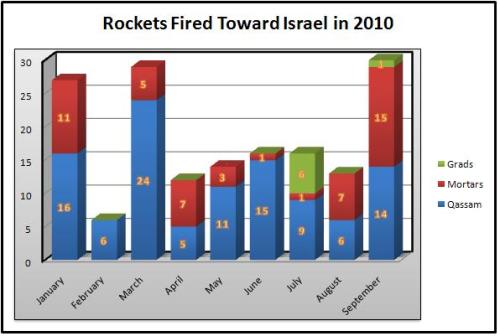
September 2010 saw more missile and mortar attacks against Israel by Gaza terrorists than any other month since the period immediately following IDF Operation Cast Lead in early 2009.
Wednesday, October 06, 2010
Philippe Petain's antisemitism unmasked
From Ynet News, 4 Oct 2010, from AFP:
[The discovery of an original W2 document establishes Vichy leader Philippe Petain's decisive role and reveals his deep antisemitism, French Nazi hunter Serge Klarsfeld told AFP.]
...Petain, a military hero in World War I, became head of the rump state based at Vichy in central France which collaborated with the German Nazi occupiers following defeat in World War II.
The penciled-in changes to the document, from October 1940, are a "profound alteration" of the document's nature, Klarsfeld said.
While the original set out to exclude "descendants of Jews born French or naturalized before 1860", Petain crossed out this reference, thus applying the measures to all Jews in France.
The scope of Jews' exclusion is considerably widened, with the minority being barred from jobs in teaching and the judiciary as well as prevented from standing for elected office.
"The main argument of Petain's defenders was to say that he protected French Jews. This argument has now fallen," he said...
'Desire to turn Jews into scapegoats'
...Now, we have definite proof that the Jews' status was the personal will of marshal Petain," said Klarsfeld.
Petain wanted "to show that France deserved to be at the forefront of the new European order. There was also the desire to turn the Jews into scapegoats for the defeat" of France by the Nazis, said Klarsfeld.
"The status of Jews was a specifically French measure, spontaneous. The Germans didn't ask Vichy France to take this measure...
Nevertheless, of all Nazi-occupied countries, France was the one where "the Jewish community suffered the least tragic harm," said Klarsfeld. Around three-quarters of the Jewish population survived, or around 240,000 out of 320,000. "That's not thanks to France but to the French, thanks to all the courageous people who helped the Jews all over the place," he said.
[The discovery of an original W2 document establishes Vichy leader Philippe Petain's decisive role and reveals his deep antisemitism, French Nazi hunter Serge Klarsfeld told AFP.]
...Petain, a military hero in World War I, became head of the rump state based at Vichy in central France which collaborated with the German Nazi occupiers following defeat in World War II.
The penciled-in changes to the document, from October 1940, are a "profound alteration" of the document's nature, Klarsfeld said.
While the original set out to exclude "descendants of Jews born French or naturalized before 1860", Petain crossed out this reference, thus applying the measures to all Jews in France.
The scope of Jews' exclusion is considerably widened, with the minority being barred from jobs in teaching and the judiciary as well as prevented from standing for elected office.
"The main argument of Petain's defenders was to say that he protected French Jews. This argument has now fallen," he said...
'Desire to turn Jews into scapegoats'
...Now, we have definite proof that the Jews' status was the personal will of marshal Petain," said Klarsfeld.
Petain wanted "to show that France deserved to be at the forefront of the new European order. There was also the desire to turn the Jews into scapegoats for the defeat" of France by the Nazis, said Klarsfeld.
"The status of Jews was a specifically French measure, spontaneous. The Germans didn't ask Vichy France to take this measure...
Nevertheless, of all Nazi-occupied countries, France was the one where "the Jewish community suffered the least tragic harm," said Klarsfeld. Around three-quarters of the Jewish population survived, or around 240,000 out of 320,000. "That's not thanks to France but to the French, thanks to all the courageous people who helped the Jews all over the place," he said.
PA wants what?...tell them they're dreaming....
From International Analyst Network, 30 Sep 2010. by David Singer:
...President Abbas dithered for more than nine months of the initial ten month moratorium period before deigning to enter into direct negotiations with Israel. He demanded then what [PA negotiator Nabil ] Shaath is now recycling - a total building freeze. It proved - and will continue to prove - to be a disastrous error of judgment by the PA. Abbas can only blame himself for the dilemma he currently faces as to whether to resume negotiations or not in view of the expiry of the moratorium period on 26 September.
Assuming however that some compromise is eventually agreed on for a further moratorium - questions must be asked and answers given as to the basis on which such negotiations are to be resumed.
Israel’s position is clear but the PA‘s position is steeped in uncertainty.
The parameters under which Israel has been negotiating are:
1.The Bush Roadmap - subject to Israel‘s 14 expressed written Reservations to it
2.United Nations Security Council Resolutions 242 and 338 and
3.The letter from President George Bush to former Israeli Prime Minister Ariel Sharon dated 14 April 2004
Roadmap references to the Saudi Peace Plan - adopted subsequently as the Arab Initiative - were expressly rejected by Israel as playing any part in the negotiating process - the Reservations stating:
...America did indeed pay serious attention to Israel’s Reservations - as was indicated in the letter President Bush gave to Prime Minister Sharon on 14 April 2004 which stated:
The PA has consistently refused to accept these parameters as defining the goals of the negotiating process.
On 27 November 2007 Israel’s then Prime Minister Ehud Olmert once again clarified these parameters at Annapolis before the leaders of the international community assembled there when he said:
The PA clearly is not negotiating on the same wavelength as Israel as it continues to:.
•Demand the right for millions of Arabs to emigrate to Israel
•Refuses to accept the right of any Jews to live in the West Bank
•Attempts to introduce the Saudi Peace Plan into the negotiations
•Refuses to recognise Israel as the national state of the Jewish people
•Refuses to accept Israel’s Reservations to the Road Map as having any relevance
Israel and the PA have each been playing the negotiating game under different sets of rules. Until they start to play the game under the same rules - any further talks will - like the talks held since 2003 - prove to be a complete waste of time.
...President Abbas dithered for more than nine months of the initial ten month moratorium period before deigning to enter into direct negotiations with Israel. He demanded then what [PA negotiator Nabil ] Shaath is now recycling - a total building freeze. It proved - and will continue to prove - to be a disastrous error of judgment by the PA. Abbas can only blame himself for the dilemma he currently faces as to whether to resume negotiations or not in view of the expiry of the moratorium period on 26 September.
Assuming however that some compromise is eventually agreed on for a further moratorium - questions must be asked and answers given as to the basis on which such negotiations are to be resumed.
Israel’s position is clear but the PA‘s position is steeped in uncertainty.
The parameters under which Israel has been negotiating are:
1.The Bush Roadmap - subject to Israel‘s 14 expressed written Reservations to it
2.United Nations Security Council Resolutions 242 and 338 and
3.The letter from President George Bush to former Israeli Prime Minister Ariel Sharon dated 14 April 2004
Roadmap references to the Saudi Peace Plan - adopted subsequently as the Arab Initiative - were expressly rejected by Israel as playing any part in the negotiating process - the Reservations stating:
"The removal of references other than 242 and 338 (1397, the Saudi Initiative and the Arab Initiative adopted in Beirut). A settlement based upon the road map will be an autonomous settlement that derives its validity therefrom. The only possible reference should be to Resolutions 242 and 338, and then only as an outline for the conduct of future negotiations on a permanent settlement."Israel was also adamant in its Reservations that :
“… declared references must be made to Israel's right to exist as a Jewish state and to the waiver of any right of return for Palestinian refugees to the State of Israel.”
...America did indeed pay serious attention to Israel’s Reservations - as was indicated in the letter President Bush gave to Prime Minister Sharon on 14 April 2004 which stated:
“The United States is strongly committed to Israel's security and well-being as a Jewish state. It seems clear that an agreed, just, fair, and realistic framework for a solution to the Palestinian refugee issue as part of any final status agreement will need to be found through the establishment of a Palestinian state, and the settling of Palestinian refugees there, rather than in Israel.
As part of a final peace settlement, Israel must have secure and recognized borders, which should emerge from negotiations between the parties in accordance with UNSC Resolutions 242 and 338. In light of new realities on the ground, including already existing major Israeli populations centers, it is unrealistic to expect that the outcome of final status negotiations will be a full and complete return to the armistice lines of 1949, and all previous efforts to negotiate a two-state solution have reached the same conclusion.
The PA has consistently refused to accept these parameters as defining the goals of the negotiating process.
On 27 November 2007 Israel’s then Prime Minister Ehud Olmert once again clarified these parameters at Annapolis before the leaders of the international community assembled there when he said:
The PA clearly is not negotiating on the same wavelength as Israel as it continues to:.
•Demand the right for millions of Arabs to emigrate to Israel
•Refuses to accept the right of any Jews to live in the West Bank
•Attempts to introduce the Saudi Peace Plan into the negotiations
•Refuses to recognise Israel as the national state of the Jewish people
•Refuses to accept Israel’s Reservations to the Road Map as having any relevance
Israel and the PA have each been playing the negotiating game under different sets of rules. Until they start to play the game under the same rules - any further talks will - like the talks held since 2003 - prove to be a complete waste of time.
“The negotiations will be based on previous agreements between us, UN Security Council Resolutions 242 and 338, the Roadmap and the April 14th 2004 letter of President Bush to the Prime Minister of Israel.”
It is realistic to expect that any final status agreement will only be achieved on the basis of mutually agreed changes that reflect these realities.”
Tuesday, September 28, 2010
US Senate Backs Netanyahu, Asks Obama to Pressure Abbas
From IsraelNationalNews.com, 27 September 2010, by Tzvi Ben Gedalyahu:
Eighty-seven U.S. senators—almost the entire 100-member Senate—have signed a letter to President Barack Obama that in effect blames the Palestinian Authority for freezing direct talks...
...The senators’ letter praises Prime Minister Netanyahu, who they pointed out "did not abandon the talks” despite “the brutal murder of four innocent Israeli civilians by Hamas militants at the start of the negotiations. We also agree with you [Obama] that it is critical that all sides stay at the table," the letter stated.
..."Neither side should make threats to leave just as the talks are getting started," the letter stated. It was sent several hours before U.S. Middle East envoy George Mitchell announced he will return to the region this week in an effort to prevent the talks from being frozen indefinitely...
Eighty-seven U.S. senators—almost the entire 100-member Senate—have signed a letter to President Barack Obama that in effect blames the Palestinian Authority for freezing direct talks...
...The senators’ letter praises Prime Minister Netanyahu, who they pointed out "did not abandon the talks” despite “the brutal murder of four innocent Israeli civilians by Hamas militants at the start of the negotiations. We also agree with you [Obama] that it is critical that all sides stay at the table," the letter stated.
..."Neither side should make threats to leave just as the talks are getting started," the letter stated. It was sent several hours before U.S. Middle East envoy George Mitchell announced he will return to the region this week in an effort to prevent the talks from being frozen indefinitely...
The Freeze is just an excuse for Abbas
From Israel News, 27 September 2010, by Yitzhak Benhorin:
WASHINGTON – Foreign Minister Avigdor Lieberman met Monday in New York with UN Secretary-General Ban Ki-Moon a short time after the latter expressed his disappointment that the West Bank settlement construction moratorium was not being extended beyond its 10-month period.
... Lieberman contended that the freeze "is just an excuse" for Palestinian President Mahmoud Abbas to quit budding peace talks between the Palestinian Authority and Israel. "For nine months the Palestinians claimed that the freeze is a ploy, and now they have turned it into a lynchpin," said the foreign minister to the UN chief.
After Abbas announced he is awaiting the upcoming meeting of the Arab League at the beginning of October, Lieberman asserted, "If the Arab League is seeking challenges to deal with, there are many in the Arab world. Hundreds of people are killed each week in terrorist attacks, and poverty and despair cry out to the heavens.
"Instead of solving these problems, the leaders of the Arab League prefer to run away from them, and blame Israel for all their internal problems. Instead of dialogue, they prefer to incite the masses against the Jews," added Lieberman.
Lieberman said that Israel is interested in a fair peace agreement. "We are willing to collaborate with the international community and be cooperative, but without compromising on security and Israel's vital interests," he said....
WASHINGTON – Foreign Minister Avigdor Lieberman met Monday in New York with UN Secretary-General Ban Ki-Moon a short time after the latter expressed his disappointment that the West Bank settlement construction moratorium was not being extended beyond its 10-month period.
... Lieberman contended that the freeze "is just an excuse" for Palestinian President Mahmoud Abbas to quit budding peace talks between the Palestinian Authority and Israel. "For nine months the Palestinians claimed that the freeze is a ploy, and now they have turned it into a lynchpin," said the foreign minister to the UN chief.
After Abbas announced he is awaiting the upcoming meeting of the Arab League at the beginning of October, Lieberman asserted, "If the Arab League is seeking challenges to deal with, there are many in the Arab world. Hundreds of people are killed each week in terrorist attacks, and poverty and despair cry out to the heavens.
"Instead of solving these problems, the leaders of the Arab League prefer to run away from them, and blame Israel for all their internal problems. Instead of dialogue, they prefer to incite the masses against the Jews," added Lieberman.
Lieberman said that Israel is interested in a fair peace agreement. "We are willing to collaborate with the international community and be cooperative, but without compromising on security and Israel's vital interests," he said....
Sunday, September 26, 2010
The Nakba Obsession
From City Journal, Summer 2010, Vol. 20, No. 3, by Sol Stern*:
The Palestinian national narrative is the biggest obstacle to peace in the Middle East.

... The Nakba is the heart of the Palestinians’ backward-looking national narrative, which depicts the creation of the State of Israel in 1948 as the original sin that dispossessed the land’s native people. Every year, on the anniversary of Israel’s independence, more and more Palestinians (including Arab citizens of Israel) commemorate the Nakba with pageants that express longing for a lost paradise. Every year, the legend grows of the crimes committed against the Palestinians in 1948, crimes now routinely equated with the Holocaust. Echoing the Nakba narrative is an international coalition of leftists that celebrates the Palestinians as the quintessential Other, the last victims of Western racism and colonialism.
There is only one just compensation for the long history of suffering, say the Palestinians and their allies: turning the clock back to 1948. ...[the "right of return"]... All Palestinian refugees—not just those still alive of the hundreds of thousands who fled in 1948, but their millions of descendants as well—would be allowed to return to Jaffa, Haifa, the Galilee, and all the villages that Palestinian Arabs once occupied.
Such a step would mean suicide for Israel as a Jewish state, which is why Israel would never countenance it. At the very least, then, the Nakba narrative precludes Middle East peace. But it’s also, as it happens, a myth—a radical distortion of history.
...During the 1948 war and for many years afterward, the Western world—including the international Left—expressed hardly any moral outrage about the Palestinian refugees. This had nothing to do with Western racism or colonialism and much to do with recent history. The fighting in Palestine had broken out only two years after the end of the costliest military conflict ever, in which the victors exacted a terrible price on the losers. By that, I don’t mean the Nazi officials and their “willing executioners,” who received less punishment than they deserved, but the 11 million ethnic Germans living in Central and Eastern Europe—civilians all—who were expelled from their homes and force-marched to Germany by the Red Army, with help from the Czech and Polish governments and with the approval of Roosevelt and Churchill. Historians estimate that 2 million died on the way. Around the same time, the Indian subcontinent was divided into two new countries, India and Pakistan; millions of Hindus and Muslims moved from one to the other, and hundreds of thousands died in related violence. Against this background, the West was not likely to be troubled by the exodus of a little more than half a million Palestinians after a war launched by their own leaders.
...The Palestinians were also compromised by the fact that their leader in 1948, Grand Mufti Haj Amin al-Husseini, had been a Nazi collaborator during the war.
In fact, I. F. Stone, the most revered left-wing journalist of the day, was one of the most influential American advocates for the Zionist cause. I have in my possession a book by Stone called This Is Israel, distributed by Boni and Gaer, a major commercial publisher at the time. The book, based on Stone’s reporting during the 1948 Arab-Israeli war, has become a collector’s item by virtue of the fact that Stone’s fans want to forget that it ever existed. Of the four adoring biographies of the great muckraker published in the last decade, only one even mentions that Stone wrote This Is Israel—and then shrugs off its significance in a few paragraphs.
It’s obvious why the book would be embarrassing to today’s leftist critics of Israel and Zionism. It opens with a foreword by Bartley Crum, the prominent American lawyer, businessman, and publisher of PM, the most widely read progressive newspaper of the 1940s. Crum evokes “the miracles [that the Israelis] have performed in peace and war. . . . They have built beautiful modern cities, such as Tel Aviv and Haifa on the edge of the wilderness. . . . They have set up a government which is a model of democracy.” His friend and star correspondent, Izzy Stone, has “set down what he knows and what he has seen, simply, truthfully and eloquently.” We Americans, Crum concludes, “can, through this book, warm ourselves in the glory of a free people who made a two thousand year dream come true in their own free land.”
Accompanied by famed war photographer Robert Capa’s iconic images of male and female Israeli soldiers, Stone’s text reads like a heroic epic. He writes of newborn Israel as a “tiny bridgehead” of 650,000 up against 30 million Arabs and 300 million Muslims and argues that Israel’s “precarious borders,” created by the United Nations’ November 1947 partition resolution, are almost indefensible. “Arab leaders made no secret of their intentions,” Stone writes, and then quotes the head of the Arab League, Abdul Rahman Azzam: “This war will be a war of extermination and a momentous massacre which will be spoken of like the Mongol massacres and the Crusades.”
Palestinian leaders reminded Stone of the fascists he had fought with his pen since the Spanish Civil War. He ticks off the names of several Nazi collaborators prominent among the Arab military units that poured into Palestine after passage of the UN’s resolution. In addition to the grand mufti, they included the head of the Arab Liberation Army, Fawzi el-Kaukji, who took part in the fascist revolt against the British in Iraq in 1940 and then escaped to Berlin, where he recruited Balkan Muslims for the Wehrmacht. Another Palestinian military commander, Sheik Hassan Bey Salameh, was a “former staff officer under Rommel,” Stone writes. “Salameh had last appeared in Palestine in 1944 when he was dropped as a Reichswehr major for sabotage duties.” For good measure, Stone adds, “German Nazis, Polish reactionaries, Yugoslav Chetniks, and Bosnian Moslems flocked [into Palestine] for the war against the Jews.”
And how does Stone explain the war’s surprising outcome and the sudden exodus of the Palestinian Arabs? “Ill-armed, outnumbered, however desperate their circumstances, the Jews stood fast.” The Palestinians, by contrast, began to run away almost as soon as the fighting began. “First the wealthiest families went,” Stone recounts. “While the Arab guerrillas were moving in, the Arab civilian population was moving out.” Stone blames the grand mufti for giving explicit orders to the Palestinians to abandon Haifa, which had the largest Arab community of any city assigned to the Jewish state under the UN’s partition plan.
What is most revealing about the book is the issue that Stone does not write about: the fate of the refugees after their exodus. Stone undoubtedly shared the conventional wisdom at the time: that wars inevitably produced refugees and that the problem was best handled by resettlement in the countries to which those refugees moved. Stone surely expected that the Arab countries to which the Palestinian refugees had moved would eventually absorb them as full citizens. That outcome wouldn’t be perfect justice, but it would limit Palestinian suffering and open the doors to a reasonable and permanent settlement of the conflict. Stone also knew that Israel was in the process of absorbing an almost equal number of impoverished Jewish refugees from the Arab countries, most of whom had been forced out of their homes and lost all their property in places where they had lived for hundreds of years.
Stone could never have foreseen that for the next 62 years, the Palestinians would remain in those terrible refugee camps—not just in the West Bank and the Gaza Strip but in Lebanon, Syria, and present-day Jordan as well. Nor could Stone have imagined that not one Arab country would move to absorb the refugees and offer them citizenship, or that the Palestinians’ leaders would insist on keeping the refugees locked up in the camps for the purpose of dramatizing their Nakba narrative.
...Earlier this year, another pathbreaking work of historical scholarship appeared that, if facts mattered at all in this debate, would put the final nail in the coffin of the Nakba myth. The book is Palestine Betrayed, by Efraim Karsh, head of the Middle East program at King’s College London. Karsh has delved deeper into the British and Israeli archives—and some Arab ones—than any previous historian of the period. He deftly uses this new material to seal the case that the Nakba was, to a large extent, brought on by the Palestinians’ own leaders.
For example, using detailed notes kept by key players in Haifa, Karsh provides a poignant description of an April 1948 meeting attended by Haifa’s Arab officials, officers of the nascent Israeli military, Mayor Shabtai Levy, and Major General Hugh Stockwell, the British military commander of Haifa. Levy, in tears, begged the Arab notables, some of whom were his personal friends, to tell their people to stay in their homes and promised that no harm would befall them. The Zionists desperately wanted the Arabs of Haifa to stay put in order to show that their new state would treat its minorities well. However, exactly as Stone reported in This Is Israel, the Arab leaders told Levy that they had been ordered out and even threatened by the Arab Higher Committee, chaired by the grand mufti from his exile in Cairo...
In describing the battle for Jaffa, the Arab city adjoining Tel Aviv, Karsh uses British military archives to show that the Israelis again promised the Arabs that they could stay if they laid down their arms. But the mufti’s orders again forbade it. In retrospect, it is clear that the mufti wanted the Arabs of Haifa and Jaffa to leave because he feared not that they would be in danger but that their remaining would provide greater legitimacy to the fledgling Jewish state.
Unfortunately, no amount of documentation and evidence about what really happened in 1948 will puncture the Nakba narrative. The tale of dispossession has been institutionalized now, an essential part of the Palestinians’ armament for what they see as the long struggle ahead. It has become the moral basis for their insistence on the refugees’ right to return to Israel, which in turn leads them to reject one reasonable two-state peace plan after another. In the meantime, the more radical Palestinians continue to insist that the only balm for the Nakba is the complete undoing of the historical crime of Zionism—either eliminating Israel or submerging it into a secular democratic state called Palestine. (The proposal is hard to take seriously from adherents of a religion and a culture that abjure secularism and allow little democracy.)
Nor will the facts about 1948 impress the European and American leftists who are part of the international Nakba coalition. The Nakba narrative of Zionism as a movement of white colonial oppressors victimizing innocent Palestinians is strengthened by radical modes of thought now dominant in the Western academy.
Postmodernists and postcolonialists have adapted Henry Ford’s adage that “history is bunk” to their own political purposes. According to the radical professors, there is no factual or empirical history that we can trust—only competing “narratives.” For example, there is the dominant establishment narrative of American history, and then there is the counter-narrative, written by professors like the late Howard Zinn, which speaks for neglected and forgotten Americans.
Just so, the Palestinian counter-narrative of the Nakba can now replace the old, discredited Zionist narrative, regardless of actual historical facts. And thanks to what the French writer Pascal Bruckner has called the Western intelligentsia’s new “tyranny of guilt”—a self-effacement that forbids critical inquiry into the historical narratives of those national movements granted the sanctified status of “oppressed”—the Nakba narrative cannot even be challenged.
This makes for a significant subculture in the West devoted to the delegitimization of Israel and the Zionist idea. To leftists, for whom Israel is now permanently on trial, Stone’s 1948 love song to Zionism has conveniently been disappeared, just as Trotsky was once disappeared by the Soviet Union and its Western supporters (of whom, let us not forget, Stone was one). Thus Tony Judt can write in The New York Review of Books—the same prestigious journal in which Stone began publishing his reconsiderations of Zionism—that Israel is, after all, just an “anachronism” and a historical blunder.
Several years ago, I briefly visited the largest refugee camp in the West Bank: Balata, inside the city of Nablus. Many of the camp’s approximately 20,000 residents are the children, grandchildren, and even great-grandchildren of the Arab citizens of Jaffa who fled their homes in early 1948.
For half a century, the United Nations has administered Balata as a quasi-apartheid welfare ghetto. The Palestinian Authority does not consider the residents of Balata citizens of Palestine; they do not vote on municipal issues, and they receive no PA funding for roads or sanitation. The refugee children—though after 60 years, calling young children “refugees” is absurd—go to separate schools run by UNRWA, the UN’s refugee-relief agency. The “refugees” are crammed into an area of approximately one square kilometer, and municipal officials prohibit them from building outside the camp’s official boundaries, making living conditions ever more cramped as the camp’s population grows. In a building called the Jaffa Cultural Center—financed by the UN, which means our tax dollars—Balata’s young people are undoubtedly nurtured on the myth that someday soon they will return in triumph to their ancestors’ homes by the Mediterranean Sea.
In Balata, history has come full circle. During the 1948 war, Palestinian leaders like Haj Amin al-Husseini insisted that the Arab citizens of Haifa and Jaffa had to leave, lest they help legitimize the Jewish state. Now, the descendants of those citizens are locked up in places like Balata and prohibited from resettling in the Palestinian-administered West Bank—again, lest they help legitimize the Jewish state, this time by removing the Palestinians’ chief complaint. Yet there is a certain perverse logic at work here.
For if Israel and the Palestinians ever managed to hammer out the draft of a peace treaty, Mahmoud Abbas, president of the Palestinian Authority, would have to go to Balata and explain to its residents that their leaders have been lying to them for 60 years and that they are not going back to Jaffa.
Which, to state the obvious again, is one of the main reasons that there has been no peace treaty.
*Sol Stern is a contributing editor of City Journal, a senior fellow at the Manhattan Institute, and the author of Breaking Free: Public School Lessons and the Imperative of School Choice.
The Palestinian national narrative is the biggest obstacle to peace in the Middle East.

Bettmann/Corbis
Palestinian refugees flee the 1948 Arab-Israeli war.
... The Nakba is the heart of the Palestinians’ backward-looking national narrative, which depicts the creation of the State of Israel in 1948 as the original sin that dispossessed the land’s native people. Every year, on the anniversary of Israel’s independence, more and more Palestinians (including Arab citizens of Israel) commemorate the Nakba with pageants that express longing for a lost paradise. Every year, the legend grows of the crimes committed against the Palestinians in 1948, crimes now routinely equated with the Holocaust. Echoing the Nakba narrative is an international coalition of leftists that celebrates the Palestinians as the quintessential Other, the last victims of Western racism and colonialism.
There is only one just compensation for the long history of suffering, say the Palestinians and their allies: turning the clock back to 1948. ...[the "right of return"]... All Palestinian refugees—not just those still alive of the hundreds of thousands who fled in 1948, but their millions of descendants as well—would be allowed to return to Jaffa, Haifa, the Galilee, and all the villages that Palestinian Arabs once occupied.
Such a step would mean suicide for Israel as a Jewish state, which is why Israel would never countenance it. At the very least, then, the Nakba narrative precludes Middle East peace. But it’s also, as it happens, a myth—a radical distortion of history.
...During the 1948 war and for many years afterward, the Western world—including the international Left—expressed hardly any moral outrage about the Palestinian refugees. This had nothing to do with Western racism or colonialism and much to do with recent history. The fighting in Palestine had broken out only two years after the end of the costliest military conflict ever, in which the victors exacted a terrible price on the losers. By that, I don’t mean the Nazi officials and their “willing executioners,” who received less punishment than they deserved, but the 11 million ethnic Germans living in Central and Eastern Europe—civilians all—who were expelled from their homes and force-marched to Germany by the Red Army, with help from the Czech and Polish governments and with the approval of Roosevelt and Churchill. Historians estimate that 2 million died on the way. Around the same time, the Indian subcontinent was divided into two new countries, India and Pakistan; millions of Hindus and Muslims moved from one to the other, and hundreds of thousands died in related violence. Against this background, the West was not likely to be troubled by the exodus of a little more than half a million Palestinians after a war launched by their own leaders.
...The Palestinians were also compromised by the fact that their leader in 1948, Grand Mufti Haj Amin al-Husseini, had been a Nazi collaborator during the war.
In fact, I. F. Stone, the most revered left-wing journalist of the day, was one of the most influential American advocates for the Zionist cause. I have in my possession a book by Stone called This Is Israel, distributed by Boni and Gaer, a major commercial publisher at the time. The book, based on Stone’s reporting during the 1948 Arab-Israeli war, has become a collector’s item by virtue of the fact that Stone’s fans want to forget that it ever existed. Of the four adoring biographies of the great muckraker published in the last decade, only one even mentions that Stone wrote This Is Israel—and then shrugs off its significance in a few paragraphs.
It’s obvious why the book would be embarrassing to today’s leftist critics of Israel and Zionism. It opens with a foreword by Bartley Crum, the prominent American lawyer, businessman, and publisher of PM, the most widely read progressive newspaper of the 1940s. Crum evokes “the miracles [that the Israelis] have performed in peace and war. . . . They have built beautiful modern cities, such as Tel Aviv and Haifa on the edge of the wilderness. . . . They have set up a government which is a model of democracy.” His friend and star correspondent, Izzy Stone, has “set down what he knows and what he has seen, simply, truthfully and eloquently.” We Americans, Crum concludes, “can, through this book, warm ourselves in the glory of a free people who made a two thousand year dream come true in their own free land.”
Accompanied by famed war photographer Robert Capa’s iconic images of male and female Israeli soldiers, Stone’s text reads like a heroic epic. He writes of newborn Israel as a “tiny bridgehead” of 650,000 up against 30 million Arabs and 300 million Muslims and argues that Israel’s “precarious borders,” created by the United Nations’ November 1947 partition resolution, are almost indefensible. “Arab leaders made no secret of their intentions,” Stone writes, and then quotes the head of the Arab League, Abdul Rahman Azzam: “This war will be a war of extermination and a momentous massacre which will be spoken of like the Mongol massacres and the Crusades.”
Palestinian leaders reminded Stone of the fascists he had fought with his pen since the Spanish Civil War. He ticks off the names of several Nazi collaborators prominent among the Arab military units that poured into Palestine after passage of the UN’s resolution. In addition to the grand mufti, they included the head of the Arab Liberation Army, Fawzi el-Kaukji, who took part in the fascist revolt against the British in Iraq in 1940 and then escaped to Berlin, where he recruited Balkan Muslims for the Wehrmacht. Another Palestinian military commander, Sheik Hassan Bey Salameh, was a “former staff officer under Rommel,” Stone writes. “Salameh had last appeared in Palestine in 1944 when he was dropped as a Reichswehr major for sabotage duties.” For good measure, Stone adds, “German Nazis, Polish reactionaries, Yugoslav Chetniks, and Bosnian Moslems flocked [into Palestine] for the war against the Jews.”
And how does Stone explain the war’s surprising outcome and the sudden exodus of the Palestinian Arabs? “Ill-armed, outnumbered, however desperate their circumstances, the Jews stood fast.” The Palestinians, by contrast, began to run away almost as soon as the fighting began. “First the wealthiest families went,” Stone recounts. “While the Arab guerrillas were moving in, the Arab civilian population was moving out.” Stone blames the grand mufti for giving explicit orders to the Palestinians to abandon Haifa, which had the largest Arab community of any city assigned to the Jewish state under the UN’s partition plan.
What is most revealing about the book is the issue that Stone does not write about: the fate of the refugees after their exodus. Stone undoubtedly shared the conventional wisdom at the time: that wars inevitably produced refugees and that the problem was best handled by resettlement in the countries to which those refugees moved. Stone surely expected that the Arab countries to which the Palestinian refugees had moved would eventually absorb them as full citizens. That outcome wouldn’t be perfect justice, but it would limit Palestinian suffering and open the doors to a reasonable and permanent settlement of the conflict. Stone also knew that Israel was in the process of absorbing an almost equal number of impoverished Jewish refugees from the Arab countries, most of whom had been forced out of their homes and lost all their property in places where they had lived for hundreds of years.
Stone could never have foreseen that for the next 62 years, the Palestinians would remain in those terrible refugee camps—not just in the West Bank and the Gaza Strip but in Lebanon, Syria, and present-day Jordan as well. Nor could Stone have imagined that not one Arab country would move to absorb the refugees and offer them citizenship, or that the Palestinians’ leaders would insist on keeping the refugees locked up in the camps for the purpose of dramatizing their Nakba narrative.
...Earlier this year, another pathbreaking work of historical scholarship appeared that, if facts mattered at all in this debate, would put the final nail in the coffin of the Nakba myth. The book is Palestine Betrayed, by Efraim Karsh, head of the Middle East program at King’s College London. Karsh has delved deeper into the British and Israeli archives—and some Arab ones—than any previous historian of the period. He deftly uses this new material to seal the case that the Nakba was, to a large extent, brought on by the Palestinians’ own leaders.
For example, using detailed notes kept by key players in Haifa, Karsh provides a poignant description of an April 1948 meeting attended by Haifa’s Arab officials, officers of the nascent Israeli military, Mayor Shabtai Levy, and Major General Hugh Stockwell, the British military commander of Haifa. Levy, in tears, begged the Arab notables, some of whom were his personal friends, to tell their people to stay in their homes and promised that no harm would befall them. The Zionists desperately wanted the Arabs of Haifa to stay put in order to show that their new state would treat its minorities well. However, exactly as Stone reported in This Is Israel, the Arab leaders told Levy that they had been ordered out and even threatened by the Arab Higher Committee, chaired by the grand mufti from his exile in Cairo...
In describing the battle for Jaffa, the Arab city adjoining Tel Aviv, Karsh uses British military archives to show that the Israelis again promised the Arabs that they could stay if they laid down their arms. But the mufti’s orders again forbade it. In retrospect, it is clear that the mufti wanted the Arabs of Haifa and Jaffa to leave because he feared not that they would be in danger but that their remaining would provide greater legitimacy to the fledgling Jewish state.
Unfortunately, no amount of documentation and evidence about what really happened in 1948 will puncture the Nakba narrative. The tale of dispossession has been institutionalized now, an essential part of the Palestinians’ armament for what they see as the long struggle ahead. It has become the moral basis for their insistence on the refugees’ right to return to Israel, which in turn leads them to reject one reasonable two-state peace plan after another. In the meantime, the more radical Palestinians continue to insist that the only balm for the Nakba is the complete undoing of the historical crime of Zionism—either eliminating Israel or submerging it into a secular democratic state called Palestine. (The proposal is hard to take seriously from adherents of a religion and a culture that abjure secularism and allow little democracy.)
Nor will the facts about 1948 impress the European and American leftists who are part of the international Nakba coalition. The Nakba narrative of Zionism as a movement of white colonial oppressors victimizing innocent Palestinians is strengthened by radical modes of thought now dominant in the Western academy.
Postmodernists and postcolonialists have adapted Henry Ford’s adage that “history is bunk” to their own political purposes. According to the radical professors, there is no factual or empirical history that we can trust—only competing “narratives.” For example, there is the dominant establishment narrative of American history, and then there is the counter-narrative, written by professors like the late Howard Zinn, which speaks for neglected and forgotten Americans.
Just so, the Palestinian counter-narrative of the Nakba can now replace the old, discredited Zionist narrative, regardless of actual historical facts. And thanks to what the French writer Pascal Bruckner has called the Western intelligentsia’s new “tyranny of guilt”—a self-effacement that forbids critical inquiry into the historical narratives of those national movements granted the sanctified status of “oppressed”—the Nakba narrative cannot even be challenged.
This makes for a significant subculture in the West devoted to the delegitimization of Israel and the Zionist idea. To leftists, for whom Israel is now permanently on trial, Stone’s 1948 love song to Zionism has conveniently been disappeared, just as Trotsky was once disappeared by the Soviet Union and its Western supporters (of whom, let us not forget, Stone was one). Thus Tony Judt can write in The New York Review of Books—the same prestigious journal in which Stone began publishing his reconsiderations of Zionism—that Israel is, after all, just an “anachronism” and a historical blunder.
Several years ago, I briefly visited the largest refugee camp in the West Bank: Balata, inside the city of Nablus. Many of the camp’s approximately 20,000 residents are the children, grandchildren, and even great-grandchildren of the Arab citizens of Jaffa who fled their homes in early 1948.
For half a century, the United Nations has administered Balata as a quasi-apartheid welfare ghetto. The Palestinian Authority does not consider the residents of Balata citizens of Palestine; they do not vote on municipal issues, and they receive no PA funding for roads or sanitation. The refugee children—though after 60 years, calling young children “refugees” is absurd—go to separate schools run by UNRWA, the UN’s refugee-relief agency. The “refugees” are crammed into an area of approximately one square kilometer, and municipal officials prohibit them from building outside the camp’s official boundaries, making living conditions ever more cramped as the camp’s population grows. In a building called the Jaffa Cultural Center—financed by the UN, which means our tax dollars—Balata’s young people are undoubtedly nurtured on the myth that someday soon they will return in triumph to their ancestors’ homes by the Mediterranean Sea.
In Balata, history has come full circle. During the 1948 war, Palestinian leaders like Haj Amin al-Husseini insisted that the Arab citizens of Haifa and Jaffa had to leave, lest they help legitimize the Jewish state. Now, the descendants of those citizens are locked up in places like Balata and prohibited from resettling in the Palestinian-administered West Bank—again, lest they help legitimize the Jewish state, this time by removing the Palestinians’ chief complaint. Yet there is a certain perverse logic at work here.
For if Israel and the Palestinians ever managed to hammer out the draft of a peace treaty, Mahmoud Abbas, president of the Palestinian Authority, would have to go to Balata and explain to its residents that their leaders have been lying to them for 60 years and that they are not going back to Jaffa.
Which, to state the obvious again, is one of the main reasons that there has been no peace treaty.
*Sol Stern is a contributing editor of City Journal, a senior fellow at the Manhattan Institute, and the author of Breaking Free: Public School Lessons and the Imperative of School Choice.
Subscribe to:
Posts (Atom)