Showing posts with label Islamism. Show all posts

Wednesday, August 24, 2011

Who kills Arabs and Muslims?

From Hurriyet (Turkey), Tuesday, August 23, 2011, by Burak Bekdil:

It has been more than two and a half years since Prime Minister Recep Tayyip Erdoğan told to Israeli President Shimon Peres’s face, “You (Jews) know well how to kill.” Prime Minister Erdoğan has also declared more than a few times that the main obstacle to peace in this part of the world is Israel, once calling the Jewish state “a festering boil in the Middle East that spreads hate and enmity.”

In this holy month of Ramadan full of blood on Muslim territories, let’s try to identify who are the ones who know well how to kill.

As the Syrian death count clicks every day to come close to 2,000, the Turkish-Kurdish death count does not stop, already over 40,000 since 1984, both adding to the big pool of blood called the Middle East. Only during this Ramadan, the Kurdistan Workers’ Party, or PKK’s, death toll has reached 50 in this Muslim Kurds vs. Muslim Turks war. This excludes the PKK casualties in Turkey and in northern Iraq due to Turkish military retaliation since they are seldom accurately reported.

Let’s speak of facts.

Sudan is not in the conventional Middle East, so let’s ignore the genocide there. Let’s ignore, also, the West Pakistani massacres in East Pakistan (Bangladesh) totaling 1.25 million in 1971. Or 200,000 deaths in Algeria in war between Islamists and the government in 1991-2006.

But a simple, strictly Middle East research will give you
  • one million deaths in the all-Muslim Iran-Iraq war; 
  • 300,000 Muslim minorities killed by Saddam Hussein; 
  • 80,000 Iranians killed during the Islamic revolution; 
  • 25,000 deaths in 1970-71, the days of Black September, by the Jordanian government in its fight against the Palestinians; and 
  • 20,000 Islamists killed in 1982 by the elder al-Assad in Hama. 
  • The World Health Organization’s estimate of Osama bin Laden’s carnage in Iraq was already 150,000 a few years earlier.
In a 2007 research, Gunnar Heinsohn from the University of Bremen and Daniel Pipes, director of the Middle East Forum, found out that
  • some 11 million Muslims have been violently killed since 1948, 
  • of which 35,000, (0.3 percent) died during the six years of Arab war against Israel, or one out of every 315 fatalities. 
  • In contrast, over 90 percent who perished were killed by fellow Muslims.
According to Mssrs. Heinsohn and Pipes, the grisly inventory finds 
  • the total number of deaths in conflicts all over the world since 1950 numbering around 85 million. 
  • Of that, the Muslim Arab deaths in the Arab-Israeli conflict were at 46,000 including 11,000 during Israel’s war of independence. That makes 0.05 percent of all deaths in all conflicts, or 0.4 percent of all Arab deaths in the Arab-Israeli conflict...

Monday, July 04, 2011

Tarek Fatah: “The Jew is Not My Enemy”

In this special edition of The Agenda on TVO, Tuesday, April 5, 2011, host Steve Paikin talks to author Tarek Fatah about his new book, “The Jew is Not My Enemy.”

"Stand Up to Islamism!!"

Speech by Tarek Fatah* to Ideacity (Canada), 28 June 20011:


Excerpts:

"...there's a difference between Islam as a faith ...and Islamism, which is ...a political ideology that says that Western civilisation has to be destroyed..."

"...I've never seen one Canadian stand up to the goon who distributes [literature that promotes] that..."

"...we make noise after noise at games, but we don't make noise [about] what is happening to Western civilisation..."

*Tarek Fatah is the author of "The Jew is Not My Enemy", a widely acclaimed book that investigates the roots of Muslim anti-Semitism.

Monday, June 13, 2011

What Islamists plan for our wives and daughters

From Translating Jihad, 31 May 2011:

...Egyptian Salafi Shaykh Abi-Ishaq al-Huwayni:

We are in the era of jihad.

The era of jihad has come over us, and jihad in the path of Allah is a pleasure. It is a real pleasure.

... The poverty that we’re in—is it not due to our abandonment of jihad? But if we could conduct one, two, or three jihadist operations every year, many people throughout the earth would become Muslims. And whoever rejected this da’wa, or stood in our way, we would fight against him and take him prisoner, and confiscate his wealth, his children, and his women—all of this means money.

Every mujahid who returned from jihad, his pockets would be full. He would return with 3 or 4 slaves, 3 or 4 women, and 3 or 4 children. Multiply each head by 300 dirhams, or 300 dinar, and you have a good amount of profit. If he were to go to the West and work on a commercial deal, he would not make that much money.

Whenever things became difficult (financially), he could take the head (i.e. the prisoner) and sell it, and ease his (financial) crisis. He would sell it like groceries....

From Jihad Watch, 12 June 2011:

Egyptian imam: "When I want a sex slave, I just go to the market and choose the woman I like and purchase her"

This is the second Islamic spokesman to speak out in favor of sex slavery in recent days [see above, from Translating Jihad].

...After Egyptian Shaykh Abu-Ishaq al-Huwayni's controversial comments about jihad and slavery (see here) were published on YouTube, Facebook, and also in Egyptian press, he was given the opportunity to respond in a telephone interview aired on the Islamic satellite television station al-Hikma on 22 May 2011. In his approximately 20-minute response, he contended that ...he was talking ...of offensive jihad.

... he explained the meaning of offensive jihad, and established through sources in the Qur'an and sayings of Muhammad that both offensive jihad and the taking of spoils of war, namely slaves and "sex-slaves," are legitimate under Islam.

Jihad Watch condensed the 20-minute interview down to about 8 and a half minutes. Follow this link to their site to see the subtitled video and the transcript.

Thursday, April 21, 2011

What is the point of dragging Israel, victim of Hamas terrorism into the question of Arrigoni’s death?

From Il Giornale, April 16, 2011, by Fiamma Nirenstein:

The cruelty of the public execution of a young man who had family and friends, as it was the case with Vittorio Arrigoni's killing, is always awful. And this is clear.

What isn’t clear to the European public is that it is patently evident that the killers are his old Islamic Jihadists friends from Gaza. But they could have been Afghanis, or Iraqis.

In 2002, Daniel Pearl was killed in Karachi with similar methods because he was a Jew; in 2004 the decapitation of the American Nick Berg in Iraq was filmed, the Jihadists said, «to give a clear message to the West»; the Italian Fabrizio Quattrocchi was executed because he was «an enemy of God, an enemy of Allah» and Vittorio Arrigoni, as his butchers say it in the video, in the words that scroll across the screen, because «he was spreading western immorality in Gaza» and because «Italy fights against Islamic countries».

It has been repeated again and again that Hamas, with whom Arrigoni was on friendly terms, has condemned the crime. But in actual fact it doesn’t matter if the assassins are members of Hamas or not. They have been, they will be, they are all controlled by Hamas. Even Al Qaida, which has a presence in Gaza, is seen by Hamas in a better or worse light, depending on the moment. But Hamas is always top dog in Gaza.

Hamas is responsible for the captivity of Gilad Shalit; it was responsible for the armed destruction of the UN recreational camp for children, which did not abide by Islamic dictates; it was responsible for arresting 150 women under the accusation of witchcraft and the execution of several of them; it is Hamas that has introduced by law death penalty, whipping, cutting off hands and crucifixion, according to Sharia. Hamas killed the 32-year old Christian book salesman Rami Khader Ayyad, guilty of selling Bibles.

Not all those who carry out these operations, or which Hamas gives orders to fire Qassam missiles against Israel, are members of the terrorist organization that rules Gaza; indeed at times it pretend to fight them.

Hamas is a movement, a party, a fundamentalist State. Its statute stipulates that it wants to destroy the Jewish State, to exterminate Jews and impose an Islamic caliphate on the entire world. Salafite fringes and those linked more to the Muslim Brotherhood in Egypt, those influenced to a greater or lesser extent by Iran or Al Qaeda and based in the Gaza Strip, join up and leave Hamas by turns. The fact that Hamas has now disowned the killers of Arrigoni is not of the slightest importance. In any case, they were still employed by Hamas as members of the Al Qassam Brigades.

To understand the death of this Italian activist, one important fact must be grasped: his death was triggered by the spurious way he mixed his humanitarian ideals with the cause of fundamentalist Gaza, by the fact that he mixed his life with that of his potential enemies, that he thought about as his best friends.

But fundamentalists do not have stable affinities. Only their interpretation of Quran counts. Hamas Gaza, where Arrigoni has been killed, is for us a land ruled by awful and distant laws. Arrigoni loved the Palestinians, but he remained a total foreigner for them. It is for us unconcivable, even if you are a militant like Arrigoni, to live alongside those who fire missiles on civilians, wear belts packed with explosives and hand out sweets when an Israeli family is killed in Itamar, including a three months baby, a four years old child and another of nine.

This is a crucial issue: when you go to Gaza, or Afghanistan, you have to realise that our conception of life, is complitely different from any Islamic political conception of life. You can die because you are Jewish, because you are Italian, or Christian, because you are an apostate, or a corrupt Westerner... the extremist mentality, make no bones about it, cancels out friends and allies.

No matter how much you have worked against the «Zionist power» or that you have called Zionists «rats» (and Arrigoni did this), nothing is of any worth if you break their rule, a rule which will remain unclear until the knife blade comes. Arrigoni was fan of political Islamism because he was an enemy of the Jews, but this did not save him from a cruel execution in front of the camera, just as the one of many others friends or enemies of Hamas or the Islamic Jihad, never mind.

So it is intellectually sad and even dangerous that a demonstration in front of the Italian Parliament blamed Israel and Italy for Arrigoni’s death; or that the ISM, the pro-Palestinian NGO Arrigoni belonged to, attributed «moral responsibility to the State of Israel». These reactions seem to be triggered only by ideological hatred.

But what is more striking still, with sincerest respect for the figure of the President of Republic, was the statement of condolences which Giorgio Napolitano rightly delivered; instead of laying the blame on Islamic fundamentalism, he asked that «a negotiated solution be found to the conflict which sees bloodshed in the region». With the same coherence, he could have invoked any good cause: the fight against world hunger, or child prostitution.

Yet instead, Israel is being summoned to face some mysterious responsibility.

But the fault is only of Islamic fundamentalism; what is the point of dragging the pained witness and victim of Hamas terrorism into the question?

Saturday, March 26, 2011

Disintegrating Arab World may enable Islamism to Flourish

From Reuters, Fri Mar 25, 2011, by Cynthia Johnston and Mohamed Sudam:

SANAA (Reuters) - Yemeni President Ali Abdullah said on Friday he was ready to cede power, the third Arab ruler who may be forced out by popular protests which began in North Africa and have now spread into the Gulf, Syria and Jordan.

...in Syria, protests challenging the rule of President Bashar al-Assad spread across the country after security forces killed dozens of demonstrators in the southern city of Deraa. "The barrier of fear is broken. This is a first step on the road to toppling the regime," said Ibrahim, a middle-aged lawyer in Deraa. "We have reached the point of no return."

Saleh's departure would present a new challenge to Western countries already embroiled in a week-old military intervention in Libya, amid fears that instability in Saudi Arabian neighbor Yemen could open the way for al Qaeda to expand its power there.

...Saleh ...had come under intense pressure to quit since snipers fired on anti-government protesters a week ago, killing 52 people. That bloodshed prompted a string of defections that severely weakened Saleh's position, including by military figures such as top general Ali Mohsen, as well as diplomats and tribal leaders.

...In Syria, Assad's government promised on Thursday to look at giving greater freedom to Syrians. But there was more bloodshed after Friday prayers, with witnesses reporting at least 23 dead, including three in the capital Damascus. Information on casualties was limited and authorities restricted journalists' movements.

HAULING DOWN ASSAD'S STATUE
In Deraa, tens of thousands marched in funerals for some of the dead, chanting "Freedom." In a central square, a Reuters correspondent saw protesters haul down a statue of Assad's father, late president Hafez al-Assad, before security men in plain clothes opened fire with automatic rifles from buildings.

The crowd of some 3,000 scattered under volleys of bullets and tear gas. The reporter saw some wounded helped into cars and ambulances. It was unclear how many, if any, were killed. By evening, however, security forces appeared to have melted away, a crowd of protesters gathered again in the main square and set a government building on fire, witnesses said.

Demonstrations have also flared up in Jordan, and one person was killed on Friday during clashes between protesters calling for political reform and supporters of the pro-Western monarchy. Jordanian Prime Minister Marouf al-Bakhit warned of unspecified consequences if similar clashes occurred.

...The protests were the latest to erupt since the January 4 death of Tunisian street vendor Mohamed Bouazizi, who set himself on fire in protest at his treatment by authorities.

Anger triggered by his death forced out Tunisia's ruler and swept into Egypt -- a country which has wielded huge influence on the political and religious currents of the Muslim world -- bringing down Egyptian strongman Hosni Mubarak on February 11.


"The whole system is changing," said Beirut-based commentator Rami Khoury. "Every single country without exception has to make changes."


"I think we have reached a point of no return. I don't think the Middle East will be the same. It is a new order in the making," said Fawaz Gerges from the London School of Economics.

TANKS BOMBED IN EASTERN LIBYA
A revolt against Libyan leader Muammar Gaddafi has already prompted the third Western military intervention in a Muslim country this century, after Afghanistan and Iraq.

Western warplanes bombed Gaddafi's tanks and artillery in eastern Libya on Friday to try to break a battlefield stalemate and help rebels take the town of Ajdabiyah, which commands the coastal highway linking the east and west of the country. Western countries including the United States, Britain and France began bombing targets in Libya a week ago as part of a U.N.-mandated intervention to protect civilians.

...The Arab revolts are not only unseating rulers, but also threatening to reshape alliances often dominated by rivalry between Shi'ite Iran and Sunni Saudi Arabia.

In Syria, where the minority Alawite elite rule over a Sunni-majority country, protesters have chanted slogans against its alliance with Iran and the Shi'ite armed Hizbollah group in neighboring Lebanon.

But Saudi Arabia saw its grip challenged in Bahrain and sent troops earlier this month to help crack down on protesters -- many of them from the majority Shi'ite population -- demonstrating against the ruling Sunni al Khalifa family. Small protests broke out in Bahrain's capital Manama for a planned "Day of Rage" on Friday despite a ban under martial law imposed last week, but were quickly crushed by security forces.

The challenge to authoritarian rulers by popular protests has so far somewhat marginalized al Qaeda, which had presented its own hardline Islamist ideology as the only alternative to what it called corrupt dictatorships. But instability in Yemen and war in Libya could provide fresh opportunities for the group. It already has a strong presence in Yemen through Al Qaeda in the Arabian Peninsula and in North Africa through Al Qaeda in the Islamic Maghreb.
"The chaos of a post-Saleh Yemen in which there is no managed transition may lead to conditions that could allow [Al Qaeda in the Arabian Peninsula] and other extremist elements to flourish," analyst Christopher Boucek wrote in the militant affairs periodical CTC Sentinel.
Yemen lies on key shipping routes and borders Saudi Arabia, the world's leading oil exporter. It has often seemed to be on the brink of disintegration: northern Shi'ites often taken up arms against Saleh and southerners dream of a separate state

Thursday, March 24, 2011

The Arab Democracy Anthem: Love, Freedom and Khaibar Yahoud [subjugation of the Jews]!


From Quadrant, Nov 2003, by Mark Durie:

When Amrozi bin Nurhasin, the smiling Bali bomber, entered a Bali courtroom on the day of his sentencing, he was shouting

"Jews, remember Khaibar. The army of Muhammad is coming back to defeat you."
What was this Khaibar, and why should it be remembered?
In the time of Muhammad, Khaibar was a fertile oasis in the Arabian desert. It was populated by Jews, who maintained its irrigation systems and lived off its produce. When Muhammad conquered the oasis in 628, the Jews who lived there managed to negotiate a surrender. The conditions of their surrender were that some of them could remain to tend the date palms and gardens, but in return they had to pay 50% of their harvest to the Muslims. The land itself would henceforth belong to the Muslim community. The Jews of Khaibar were also granted permission to keep practising their faith. Soon after, the Arab Christians of Najran were forced to accept the same conditions.

The right of the Jews of Khaibar to stay on their former lands was a temporary concession, withdrawn in 640 by Umar, in obedience to Muhammad’s dying wish: ‘Two religions shall not remain together in the peninsula of the Arabs’. In this same year the whole of Arabia was cleansed of non-Muslims.

Khaibar is a name all Muslims jurists will recognize, since it was the conquest of Khaibar which set the precedent in Islamic case law for the subsequent treatment of non-Muslims who surrendered to Islamic conquest and rule. (Khaibar also provided Muhammad with one of his wives, Safiya, a leading Jewish woman of Khaibar whom he selected for himself from among the enslaved captives.)

The discriminatory shari’a regulations applying to non-Muslims, who are referred to in Islamic law as dhimmis, are based upon the precedent of Khaibar. Through a twist of history the defeat of the Jews of this little-known Arabian oasis helped determine the treatment of many millions of non-Muslims after Islamic conquest, including the once-vast Christian populations of the Middle East.

For this reason, the name of Khaibar has great significance for us all. For extremist Muslims like Amrozi, it stands for the defeat of infidel enemies, and their humiliation and subjugation under shari’a conditions, an enduring signpost to the hope of an Islamist victory. For non-Muslims this name stands for centuries of obliterated history and oppressive discrimination, referred to by Bat Ye’or, historian of the dhimmis, as dhimmitude.

Amrozi the smiling terrorist was right — we should all remember Khaibar, as a turning point in world history. Today the precedent of Khaibar continues to shape the lives of the Jews of Iran, the Copts in Egypt, Africans in the Sudan, Pakistani Christians, Hindus and Zoroastrians, and many more. Widespread discrimination against non-Muslims is endemic in Islamic nations, to a significant degree, and there are signs that the problem is getting worse in the twenty first century, not better.

Amrozi’s laughing face has been constantly on the front page of Australian newspapers in recent months. The grief felt over the casualties in the Bali attacks is profound. So it was a irony that, when the Australian newspaper reported Amrozi’s words on the day after his sentencing, the editors did not recognize the name of Khaibar and misspelled it as Hibah. Despite its landmark significance for interfaith relations, the name of Khaibar now seems to be forgotten, its significance obscured. The fate of the Jews of Khaibar had momentous consequences for world history, yet this page of history has been torn out of the non-Muslim world’s collective consciousness. It is time for it to be returned to its rightful place.

Monday, March 21, 2011

The Arab Revolutions: An Israeli Perspective

From The Washington Institute for Near East Policy: Policy Watch #1778, March 15, 2011, by Ehud Yaari:

Israel has been watching the ongoing upheaval in the Arab world with steadily growing concern. While they hope to see a happy, democratic end to the popular eruptions of protest and discontent against dictatorial regimes, Israelis are bracing themselves for a series of less optimistic outcomes.

A different Middle East is emerging ...An extended period of uncertainty and instability may lie ahead, forcing Israel to cope with a highly volatile environment and reassess some of its longstanding assumptions about the nature of its relationships with some neighboring states.

... anti-Israeli slogans began creeping into the protest movement's inventory. For example
  • tens of thousands cheered in Cairo's Tahrir Square when previously exiled Islamist leader Sheikh Yusuf al-Qaradawi urged them to march on Jerusalem.
  • Mubarak was portrayed as a Zionist agent with a Star of David smeared over his face.
  • Calls for suspension of the bilateral peace treaty and expulsion of Israeli embassy staff were often heard during demonstrations in Amman.
  • In Yemen, demonstrators shouted accusations that President Ali Abdullah Saleh was collaborating with Israel.
  • In Libya, insurgents have often described Muammar Qadhafi as a Jew.
In short, a degree of anti-Israeli sentiment has slowly been mixed into the overwhelmingly domestic agendas of Arab protesters....Below is a short list of Israel's most pressing concerns about the ongoing unrest.

Egyptian Gas Sales and Treaty Review
The Supreme Military Council under Field Marshal Muhammad Hussein Tantawi is making a quiet effort to reassure Israel that Cairo's policy toward it has not changed, and that Egypt still regards bilateral peace as a major strategic asset. At the same time, however, the army's high command seems reluctant to resume gas exports to Israel for fear of public reaction. At this point, the hesitancy is political in nature, not a function of technical difficulties. The council is particularly concerned about the current investigation into charges of corruption involved in the most recent contract governing Egyptian gas sales to Israel, which was orchestrated by Mubarak's close friend Hussein Salem, one of the first Egyptians to flee the country when the revolution gained momentum. The longer this suspension continues, the more difficulty Cairo will have announcing a resumption in sales. The latest word from the new government is that the gas supply will resume soon but prices will be renegotiated.

Whatever the results of the eventual presidential and parliamentary elections, the next government will likely seek a "review" of several elements in the 1979 peace treaty with Israel. For example, some Egyptian politicians have indicated a desire to link progress toward Palestinian statehood with continued implementation of the treaty. The Muslim Brotherhood has already called for resubmitting the treaty to a national referendum.

Indeed, with the official dissolution of the Mabahith, or State Security Investigations -- the Egyptian agency traditionally tasked with curtailing Ikhwan activities -- the Brotherhood is becoming bolder by the day. It will certainly use its clout to contest about a quarter of the seats in the parliament, as well as to influence the outcome of the presidential race. The organization's growing power, combined with policy statements by potential presidential candidates, seems to indicate that Egypt's next leaders will adopt a new policy toward Hamas in the Gaza Strip. In short, a less friendly and cooperative government in Cairo is almost a certainty.

Instability in the Sinai
The next Egyptian government will also likely focus on removing the peace treaty's "limitations over sovereignty," meaning the provisions requiring demilitarization of eastern Sinai. Israel has already permitted Egypt to deploy three battalions in the demilitarized areas, to protect Sharm al-Sheikh and the al-Arish-Rafah region bordering the Gaza Strip. Israel could also conceivably accept a limited revision of the Military Protocol to allow an Egyptian military presence close to the border in the hope of improving Cairo's hold over the Sinai.

Since the revolution, Egyptian authorities have effectively lost control over most of the peninsula and some of its Bedouin tribes. The army has vacated the positions it previously maintained in Central Sinai, instead concentrating on securing the northern coastal road and the road along the Gulf of Aqaba. As a result, the Sinai is fast turning into a wild frontier, a safe haven for local arms smugglers and migrating jihadist groups. Hamas is taking advantage of this situation by developing its network of allies among the armed tribes with the intention of mounting terrorist attacks against Israel via the peninsula. Iran and Hizballah are also redoubling their efforts to gain a solid foothold there.

These activities would only accelerate if Cairo changed its official policy toward the Hamas regime in Gaza. In early contacts between the Egyptian military and Hamas officials, a permanent reopening of the Rafah terminal was discussed not only for individual travel, but also as a trade corridor. This portfolio is now with Gen. Murad Muwafi, who replaced Omar Suleiman as head of General Intelligence. In his previous role as governor of North Sinai, Muwafi dealt with Hamas issues on a daily basis.

In light of these factors, Israel may soon face a major dilemma: how to foil terrorist attacks emanating from the Sinai (e.g., new attempts to lob missiles at Eilat) if Egypt proves unwilling or unable to do so. Preemptive Israeli operations across the border would certainly trigger a major crisis between the two countries.

The Palestinian Authority
According to various indicators, some Palestinian groups may view the storm of successful demonstrations throughout the Arab world as a model for unrest against Israel. Discussions are already quietly under way among different Palestinian groups concerning the structure and potential format of nonviolent marches by thousands of people toward Israel Defense Forces positions, West Bank settlements, Israeli security barriers, and, most important, Jerusalem. The Israeli army is already taking measures to prepare for these possibilities.

For its part, the Palestinian Authority has obtained information about plans to call for mass demonstrations in the West Bank urging an end to the Fatah-Hamas split. Hamas has already allowed a similar demonstration in Gaza. It is difficult to predict at this stage whether West Bank Palestinians would respond to such calls in large numbers. From Israel's point of view, other dangers may emerge in addition to the challenge of dealing with the demonstrations themselves. For example, pressure from the streets could spur Mahmoud Abbas to accept a "unity before reconciliation" deal that gives Hamas complete security control over Gaza, allows it to take part in a "national unity government," and enables it confront Fatah in West Bank elections. Such a deal would legitimize Hamas without securing any substantial concessions from the movement.

Jordan
Under constant pressure from petitions and potential demonstrations, King Abdullah has been promising to speed up reforms in the Hashemite Kingdom. Various opposition groups -- including the Muslim Brotherhood, Palestinian nationalists, and East Jordanian critics of the king's conduct -- are all voicing reservations regarding peace with Israel. Attentive to this mood, Abdullah has appointed some well-known anti-Israeli politicians to the new cabinet, formed by Prime Minister Marouf Bakhit. He also nominated a harsh critic of Israel, Khaled al-Karaki, to the all-important job of chief of the Royal Cabinet.

Clearly, then, Amman is heading toward a policy of cooling relations with Israel, though coordination on security and water issues continues. In fact, this may be the worst period in the short history of peace between the two states. Israeli officials are now worried that the king will accept Iranian overtures to improve relations and visit Tehran.

Conclusion
Severe tests lie ahead for Israel's relationships with its Arab peace partners. Much effort will be needed to protect the peace treaties from the growing assertiveness of the Muslim Brotherhood and other hostile factions...

Tuesday, March 08, 2011

Obama prepares to live with Islamism

From The Washington Post, Friday, March 4, 2011, by Scott Wilson:

The Obama administration is preparing for the prospect that Islamist governments will take hold in North Africa and the Middle East, acknowledging that the popular revolutions there will bring a more religious cast to the region's politics.


...None of the revolutions over the past several weeks has been overtly Islamist, but there are signs that the uprisings could give way to more religious forces. An influential Yemeni cleric called this week for the U.S.-backed administration of President Ali Abdullah Saleh to be replaced with Islamist rule, and in Egypt, an Islamist theoretician has a leading role in drafting constitutional changes after President Hosni Mubarak's fall from power last month.

A number of other Islamist parties are deciding now how big a role to play in protests or post-revolution reforms.

Since taking office, President Obama has argued for a "new beginning" with Islam, suggesting that Islamic belief and democratic politics are not incompatible. But in doing so, he has alarmed some foreign-policy pragmatists and allies such as Israel, who fear that governments based on religious law will inevitably undercut democratic reforms and other Western values.

Some within the U.S. intelligence community, foreign diplomatic circles and the Republican Party say Obama's readiness to accept Islamist movements, even ones that meet certain conditions, fails to take into consideration the methodical approach many such parties adopt toward gradually transforming secular nations into Islamic states at odds with U.S. policy goals.

Hezbollah in Lebanon and Hamas in the Palestinian territories have prospered in democratic elections and exert huge influence. Neither party, each with an armed wing, supports Israel's right to exist, nor have they renounced violence as a political tool.

...[Jonathan Peled, the spokesman for the Israeli Embassy in Washington] said Israel fears that "anti-democratic extremist forces could take advantage of a democratic system," as, he said, Hamas did with its 2006 victory in Palestinian parliamentary elections. Israel allowed Hamas to participate only under pressure from the George W. Bush administration as part of its stated commitment to promote Arab democracy.

...The goal of Islamist movements after taking power is at the root of concern expressed by Republican lawmakers and others in Washington.

...After Hamas won the Palestinian parliamentary elections in 2006, the United States and Israel led an international boycott of the government. But Obama administration officials, reviewing that history with an eye toward the current revolutions, say the reason for the U.S. boycott was not Hamas's Islamic character but its refusal to agree to conditions such as recognizing Israel.

In a speech Monday in Geneva, Secretary of State Hillary Rodham Clinton appeared to draw on that lesson, implicitly inviting Islamist parties to participate in the region's future elections with conditions. "Political participation," Clinton said, "must be open to all people across the spectrum who reject violence, uphold equality and agree to play by the rules of democracy."

Monday, February 21, 2011

WAKE UP! Islamism is bringing the frog to the boil.

From Pajamas Media, 19 Feb 2011, by Rachel Lipsky:
One positive outcome to draw from Egypt’s crisis is the public’s elevated awareness about the Muslim Brotherhood. It is now clearer to many that the Brotherhood’s members are exploiting our open societies and political system right here in our own communities.
The media’s role in deflating the Brotherhood’s dangerous agenda is profound. But other segments of our society are equally guilty. And so, to learn how steadily and consistently the West is losing to a totalitarian political doctrine, read this account. On the surface it may seem an insignificant episode, but assuming it is the model for interfaith or “twinning” devotees, it should be illuminating.
On Dec 4th I attended an interfaith event about which I wrote an article on Pajamas Media, “Where Islamism starts, Interfaith Dialogue Stops.”
At the event, I wanted to share a quote from a document stating the mission of the Muslim Brotherhood in the U.S: “a kind of grand Jihad in eliminating and destroying the Western civilization from within [...].”
To my dismay, as I was about to read the quote, the host, Rev. Yorty, wouldn’t allow me to do so, stating that he did not want to discuss politics. However, he and his cosponsor guest, Reform Rabbi Harry Rosenfeld, allowed other participants to defame Israel with impunity. For them, criticizing Israel did not seem to fall under the rubric of “discussing politics.”
I left the room, not imagining that within weeks I would face these individuals with such low moral standing yet again.
But on January 29th, two Muslim Brotherhood affiliate organizations — the Muslim Public Affairs Council (MPAC) and the Muslim Students Association (MSA) — invited and sponsored Imam Rauf as a keynote speaker at the University of Buffalo. And who do you think participated in the interfaith panel session along with Imam Rauf? You guessed correctly. The same Presbyterian Pastor Thomas Yorty and his cosponsor Rabbi Harry Rosenfeld, who joined Imam Rauf to discuss “how Americans of all faiths can work together for lasting peace.” They both spoke favorably of Imam Rauf and supported the work of MPAC. Overall, the interfaith session was devoid of any theological substance. Instead, the same superficial clichés often repeated during these events were offered yet again with petty statements like “We need to improve our knowledge of other people’s religions.” Of course, during the first event I tried to “improve our knowledge” of the political tenet of Islam, but to no avail. They sabotaged critical thinking and rejected any dissent from their rigid narrow-minded creed.

In the Q&A last session with Imam Rauf, a question was asked about persecution of Christians in the Middle East. Pastor Yorty responded: “Christian persecution is not a topic I know much about.” If the pastor knows nothing about his fellow Christians (hundreds of thousands of murdered Christians in the past three decades), how can he be trusted on interfaith dialogue between Muslims and Christians?
The rabbi’s response to the same question was that Christian persecution in the Middle East is NOT religiously oriented; rather, it’s all political. For example, he stated that Christians who left Beit Lechem did it because of “political fear.” Unfortunately, this stunning response was not followed with any evidence.
Next, a question was asked about the rise of the new anti-Semitism. Rabbi Rosenfeld responded that “lousy economics” has been the reason for the hatred, assuring the mostly Muslim audience of some 150 individuals that anti-Semitism is currently “much less than ever before.” The rabbi also blamed the media for exaggerating anti-Semitism. Surely, the “rabbi” is unaware that his statement is strongly contradicted by the FBI, the CIA, and the U.S. State Department.
The same Rabbi Rosenfeld showed no inhibition in mocking his political opponents. He referred to those who raise the alarm on the supremacist doctrine of Islam as “wacko” and “extremists” and even asked his embracing audience: “don’t you have to laugh at some of these people?” The rabbi’s partner, Pastor Yorty, used the word “haters” to describe opponents of his views.
I primarily attended this event to hear what the controversial Imam Rauf had to say. Yet I found the comments of the pastor and the rabbi more distressing. This is not because Imam Rauf has gone through an epiphany and now displays a drastic change of heart. After all, I have heard the imam a few times throughout the years, at the Chautauqua Institution, and I am used to his polished tone and deceptive language.
What I did not anticipate was the eagerness of Jewish and Christian clergy leaders to capitulate to a mostly Muslim audience [some of whom] believe in a doctrine of Islamic world conquest supported with a dogma which aspires to destroy our way of life, a real threat to our liberties in our Western civilization.
These two clergymen ignored and belittled the horrific suffering of their own people. The persecution of Christians by Muslims was not an issue the pastor “knew much about,” and new anti-Semitism, instigated mostly by Muslims, was “much less than ever before,” merely exaggerated by the media. Of course, anyone who follows world affairs, even occasionally, knows how ludicrous their claims are. These two individuals preferred ingratiating themselves in front of their Muslim counterparts rather than challenging this particular audience to defend the rights of religious freedom and stand up against persecuting people with differing religious views. These clergymen and those who support them betray their communities by ignoring the looming issues and declaring platitudes, all under the name of progressiveness and multicultural understanding.
The organizer of this program is the president of MPAC Western New York chapter and on their national board. In Feb. 2008, Dr. Khalid J. Qazi ran a similar program titled “Understanding Islam,” together with the aforementioned Rev. Yorty. There, Mr. Qazi falsely asserted that Israeli laws institute hate, that Jews rejoice when Palestinians are murdered, and that Jews “got all the goodies after World War II.” While he persistently attacked Israel and Jews, he barely addressed the topic of “Understanding Islam.” Additionally, in the MPAC newsletter of April 2009, Qazi asks “how and why the world could stand by while the state of Israel is subjecting Palestinians to a Holocaust in their own homeland.”
In spite of these outrageous and offensive statements by Dr. Qazi, he still has been accepted by his Jewish and Christian counterparts — while, at the same time, they demonstrate contempt toward their opponents, who are genuinely concerned about what Dr. Qazi and his like really are all about.
Lt. Col. Allen West, newly elected Republican congressman from the state of Florida, shared his concise assessment of political Islam during a panel discussion on the topic. “This is not a religion,” he said, that “you are fighting against. You are fighting against a theo-political belief system [... and] until you get principled leadership in the United States of America that is willing to say that, we will continue to chase our tail, because we’ll never clearly define who this enemy is.”
The question for Rabbi Rosenfeld, Rev. Yorty, and their supporters is: how can they label people with differing viewpoints, or anyone challenging their views, as “extremists” and “wackos”? Is this an honest dialogue? Where is the “principled leadership” among Jewish and Christian clergy who would take the politically incorrect stand and clearly spell out what we are up against? We need ordained religious leaders with intellectual honesty to come forward and let their voices be heard.
If individuals like these clergymen, who are enamored with their alleged “partners for peace,” genuinely want to know “how Americans of all faiths can work together for lasting peace,” for a start, why not discard the politically correct drivel and deal with the vital issues no matter how unpleasant and disturbing they are? I question whether there would be interfaith sessions and “twinning” projects if educated people of courage seriously challenged many of the thorny issues related to the political doctrine of Islam[ism].
For now, interfaith dialogues provide quenching Kool-Aid for spineless leaders as the innocent masses remain oblivious and in danger — while the Islamists laugh all the way to Mecca.

Sunday, February 20, 2011

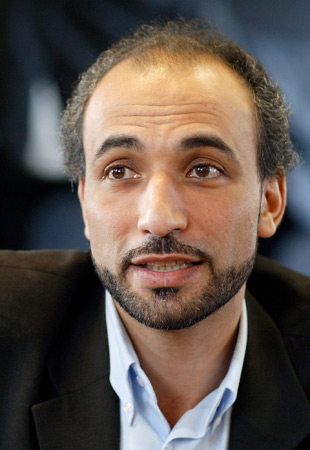
Tariq Ramadan: Western Apologist for Islamist Totalitarianism

Now that the pot is boiling throughout the Middle East, the stirrers in the West are out in their suave suits, trying to hoodwink us into being relaxed about the threat of totalitarian Islamism.

Tariq Ramadan: apologist for his grandfather, Hassan al-Banna, founder of Islamist totalitarianism and terrorist "martyrdom"

In an op-ed in the New York Times, 8 February 2011, Tariq Ramadan writes of his grandfather, founder of the Muslim Brotherhood:

"...The writings from between 1930 and 1945 of Hassan al-Banna, founder of the Brotherhood, show that he opposed colonialism and strongly criticized the fascist governments in Germany and Italy..." [It's in the New York Times, so it must be true...ha-ha-ha!!]

However, the Muslim Brotherhood, which was the brainchild of al-Banna, was totalitarian, extreme, violent and racist from its beginnings in 1928. It's slogan was and is:

 "God is our purpose, the Prophet our leader, the Qur'an our constitution, Jihad our way and dying for God's cause our supreme objective."
Hassan al-Banna: facsist lover of death

Al-Banna's goal was not restricted to Egyptian politics nor Islamic scholarship. He wanted no less than global dominance, and preached a love of death to achieve it. Does this sound like "anti-colonialism"?...

"...we will not stop at this point [freeing Egypt from secularism and modernity], but will pursue this evil force to its own lands, invade its Western heartland, and struggle to overcome it until all the world shouts by the name of the Prophet and the teachings of Islam spread throughout the world. Only then will Muslims achieve their fundamental goal… and all religion will be exclusively for Allah."

My brothers! The ummah that knows how to die a noble and honourable death is granted an exalted life in this world and eternal felicity in the next. Degradation and dishonour are the results of the love of this world and the fear of death. Therefore prepare for jihad and be the lovers of death. Life itself shall come searching after you. ...You should yearn for an honourable death and you will gain perfect happiness. May Allah grant myself and yours the honour of martyrdom in His way!

...so much for "anti-colonialism"...

As for al-Banna's so-called criticism of Fascism, see the Encyclopedia of the Middle East background to the man:

The growth of the Muslim Brotherhood was accompanied or caused in part by the fact that Al-Banna associated it with the German Nazi party and the Third Reich. From the ideological point of view, the Jew hatred, authoritarianism, addiction to violence and desire to defeat the British of both the Muslim Brothers and the Nazis were quite enough to make the two movements find common cause.

The Brotherhood’s political and military alliance with Nazi Germany blossomed into formal state visits, de facto ambassadors, and overt and covert joint ventures. The Muslim Brotherhood transformed Nazi anti-Semitism into a Muslim version, providing Arab translations of Mein Kampf (translated into Arabic as “My Jihad”) and other Nazi anti-Semitic works, including Der Sturmer hate-cartoons, adapted to portray the Jew as the demonic enemy of Allah rather than the German Volk.

When World War II broke out, al-Banna worked to firm up his alliances with Hitler and Mussolini. He sent them letters and emissaries, and urged them to assist him in his struggle against the British and the westernized regime of Egypt's King Farouk. The Intelligence Service of the Muslim Brotherhood vigorously collected information on the heads of the regime in Cairo and on the movements of the British army, offering this and more to the Germans in return for closer relations.

Friday, October 29, 2010

France caves in to terrorist threats

From a DEBKAfile Special Report October 28, 2010:

Just a day after Osama bin Laden warned France to remove its troops from Afghanistan, French Defense Minister Herve Morin announced Thursday, Oct. 28 that the withdrawal of French troops would begin in early 2011. Paris then raised its terror alert level to "red" after confirming the authenticity of the Bin Laden audiotape aired Wednesday.

...Morin tried hard to explain that the decision to pull the 3,750 French troops out of Afghanistan was not connected to the Bin Laden warning - but he was not convincing.

...never since the September 11, 2001 attacks on America, has any Western country caved in so quickly and precisely to an Al Qaeda ultimatum.

Friday, October 22, 2010

The Travails of Modern Islam

From a transcript of an invitation-only seminar at Future Directions International, Perth, Western Australia, August 20, 2010, by Daniel Pipes [brief excerpt only - follow this link to the full transcript, including the Q&A, and to download the audio]:

...the Islamic religion prevails in majority-Muslim countries stretching from Senegal to Indonesia, and is not simply a Middle Eastern phenomenon. Muslim people can now be found in substantial numbers in Europe, North America, Latin America, and indeed, Oceania.

...In the broad sweep of history, the Islamic religion got off to a very fast and successful start. Muhammad himself fled Mecca in 622 A.D. By the time of his death, however, he was ruler of Arabia and within 100 years his followers had gone from Spain to India. This was more than just a military conquest. The Muslim faith was successful in culture, the arts, and the economy and created the great empires of its age. Had you looked around the world say precisely a millennium ago, August 20th, 1010, you would've concluded that Islam was the most successful civilisation, more so than those of China, Europe or India.

Starting from about 1200, especially after the Mogul invasions, the civilisation of Islam declined and stagnated for a long time. The striking fact was that Muslims long were generally unaware of this downturn although it finally became vividly obvious around 1800, especially when Napoleon landed in Egypt and wiped out the Ottoman and Mamluk armies. Napoleon brought with him a cadre of scientists who started studying the flora, fauna, and archaeology, savants who would eventually crack the code of Egyptian hieroglyphics. His was not only a military expedition but a scientific one as well. The contrast between the Egyptians and the French was stark and shocked Muslims into realising that, during their long period of stagnation, Europe had surged ahead.

Trauma followed. Muslims had assumed that they were blessed by God in both spiritual and mundane ways. Now they worried that God had forsaken them, which led to a profound reassessment of what it means to be a Muslim. Muslims saw themselves challenged by Europe and more broadly by the West, and this is a challenge that Muslims still face today.

How is it that the people who should be on top – militarily, economically, politically, culturally, scientifically, technologically – how is it that they now sit at the bottom in terms of literacy, longevity, Nobel Prizes per capita, Olympic medals per capita? Indeed, whatever index you choose, Muslim states are at the bottom. Muslim people are not doing well; some of the worst countries in the world include Somalia, Afghanistan, Lebanon and Iraq, all of which are majority Muslim. This is a great strain, a great challenge: What went wrong and how do they fix it?

...Over the course of the past 200 years, there have been three major explanations. The first one was what one might call the liberal Western explanation, namely emulating the French and the British. These nationalities descended upon Muslim lands in particular; they built empires; they offered themselves as models. They were extremely successful and Muslims tended to emulate them. The symbolic figure of this trend was Kemal Atatürk, the ruler of Turkey between 1923 and 1938, who removed Islam from public life, replaced Arabic words with French words, brought in Belgian and Swiss legal codes, and in all made Turkey look increasingly Western.

But this didn't work. By the 1920s and 30s, despite Atatürk, there was a sense that this liberal effort had failed. So Muslim adopted another approach. The approach that appeared at that time to be most impressive was the illiberal Western approach. The 1920s were the hey-day of totalitarian societies, with Mussolini and Lenin in particular showing the way. These offered models that proved very influential; Gamal Abdel Nasser of Egypt symbolizes this approach to politics. For the next 50 to 60 years, the Fascist and Communist models prevailed in large swaths of intellectual and political life. They didn't do too well either, they didn't solve the problems of weakness and poverty.

So, with the disappointment in these two movements came a third solution, namely the Islamist one. The goal of this movement was not to emulate one form or another of Western ideology or power; it was to return to Islamic experience and to draw on the wisdom and achievements of Muslims in the past and to rehabilitate the Muslim world by learning from Islamic experience. The goal is to do something that is old, that draws on Islamic successes of past centuries. Ayatollah Khomeini symbolizes this approach.

Of course, you can't go back. You can emulate 7th-century Islam but you can't repeat it. Islamist movements of recent decades have created a new ideology, not revived something old. I am convinced this will be a failure too. The so far number-one experiment, the Islamic Republic of Iran, has failed by any standard, if only because a great majority of its subjects are rejecting it.

Bin Laden and Wahhabi-style Islamism clearly have no future. How can they run countries? Just imagine Bin Laden as ruler; it would be like the Taliban and it wouldn't work. Even a less extreme version, such as that in Iran, is not workable in the long term.

Instead, what we're seeing is that the Islamists are evolving into something that is more sustainable. Turkey offers the outstanding model here. The Turkish Islamists run and win elections; they don't depend on violence. They exercise good economic stewardship and good governance more broadly. While Turkey has many problems, its Islamists have shown that an alternative exists. An era has begun in which Islamists in part use violence on the Bin Laden and in part they work the political system.

Many Islamist groups are making a name for themselves by engaging in social services. One of the tensions now in Pakistan is that the Islamists, as happened with the earthquakes some months ago, are coming in first with the most aid for the victims of flooding. They win good will and respect for their work.

Getting back to the central issue, how Muslims answer the question "What went wrong?" Are they approaching a functional answer? I think not but that we are in a very dark period of little creativity, much instability, and much violence. I don't see any improvements soon but I do anticipate the potential for improvement. Anything that can get worse can, logically, also get better, and I expect a working out of the Islamist impulse, to be followed by something more constructive. At some point, Muslims will begin to discard it and to look elsewhere. I don't know what they're going to look for. Will it be return to the 19th century and Western liberalism? Will it be following the Chinese model?

In the meantime, things could get worse. Chemical, biological and nuclear weapons are within grasp and could be used. This threat could lead to far greater instability. There is also considerable anger within the Muslim world as the great majority of Islamist victims have been Muslim, for example in Algeria and Darfur....

Read more: follow this link to the full transcript, including the Q&A, and to download the audio.

Tuesday, October 12, 2010

How the Tide Could Turn Against Radical Islam

From BESA Center Perspectives Paper No. 116, October 10, 2010, by Dr. Max Singer:

EXECUTIVE SUMMARY: The driving forces behind the growth of Islamic radicalism –
  • the Islamic revolution in Iran and
  • the immense Saudi funding for spreading Wahhabism
– may not endure. By the end of this decade, the current strength of Islamism could be shattered.

US action is not required for the Iranian regime to fall – although it could be a big help.

On the other hand it is probably only the US that could convince the Saudis to hold onto their money rather than using so much to sell Wahhabism throughout the world.

It is important to understand that two quite possible developments could bring about a sea change in the worldwide confrontation with radical Islam....

...Since coming to power [in 1979] Iran’s Islamic revolutionary regime has been ...spreading Islamism throughout the Muslim world through religious/political leadership, inspiration and advocacy, terror and political violence, and national political measures.

...This possibility frightened the Saudi leadership, for whom Shiites were historic enemies. The Saudis felt compelled to compete with the Iranian revolutionary regime for leadership of radical Islam.

The result of this political pressure on the Saudi leadership, plus the great increase in their wealth following the oil price increases of 1979-1980, led to a multiplication of Saudi efforts to spread Wahhabism – the backward-looking Saudi version of Islam – throughout the world. Since 1980, Saudi royal family members and their beneficiaries have been exporting some $4 billion or more dollars a year to spread Wahhabi doctrines and influence throughout the world, from the US through Indonesia, from Chechnya and Bosnia through central Africa. One-hundred-and-twenty billion dollars for ...propaganda is a lot of money.

The result of this immense flow of resources from Saudi Arabia has been a complete transformation of religious and political life in the Muslim world. Wahhabism was a relatively small and somewhat despised element of Islam around the world in 1979. Today Wahhabi-controlled mosques, schools, preachers, and NGOs are a main if not dominant feature in both Muslim majority and Muslim minority communities in almost every country. Wahhabis control, for example, the great majority of Muslim institutions in the US – although certainly most Muslims in the US are not Wahhabis.

...The internal legitimacy of the Iranian revolutionary regime has in the last year become fatally undermined. There is a massive rejection of the regime by the general public because of its destruction of the Iranian economy, because of the forceful imposition of fundamentalist Muslim behavior on the general public, because of the corruption of the regime, and because of its use of violence against public protest of the stolen election last year. And the religious leadership of the revolution has become bitterly divided. Many of the highest religious authorities, and the original leaders of the revolution, have formally proclaimed that the current regime is no longer legitimate. The result has been thousands of defections, and purges, from the leadership of the regime, including the Revolutionary Guards.

It is quite possible that this fatally undermined regime could continue in power – on the bayonets of the Revolutionary Guard – for many years, especially if the outside world continues not to provide moral, political, or financial support for the internal opposition. But it is also possible that the regime will collapse or be overthrown this year or next, or the year after. While no one can predict when this will happen, it is certainly possible that the original engine of the expansion of radical Islam will disappear in the not too distant future.

...it is hard to understand why no democratic government has done anything at all to provide some moral and political support to the opposition or to provide small-scale, non-military assistance, such as communication equipment and Radio Free Europe-style broadcasts. The US in particular could improve the opposition’s position by speaking positively about Iranians imprisoned for political protest and treating the regime with mere diplomatic correctness and by ceasing its policy of going out of its way to demonstrate great respect for the regime. One cannot be sure, but it is entirely plausible that those Iranians trying to replace the regime would have an easier time if Iranians could see that a new regime would be welcomed by the democratic great powers. Iranians may have more respect for these powers, and especially the US, than we realize.

...The main requirement to end the flow of Wahhabi funds from the Saudis is for the US to recognize the harm being produced by these funds and appreciate its power to influence – even to compel – the Saudis into halting this activity. ...The basic US message would be, “Stop giving away so much of your money; keep it at home and use it for yourselves.”

...Despite all their oil money, and oil power, the Saudi leadership understands very deeply that they and their regime are weak and vulnerable, and that the US is infinitely more powerful. If the US comes to understand this half as well as the Saudis, it is not beyond the realm of possibility that the US could lead the Saudis to understand that they could expect America to continue to be their protector if they keep their money at home, but that the US would come to see them as an enemy if they continue to export their funds to promote Wahhabism in the world. Such a change would not have to take many years.

Thursday, October 07, 2010

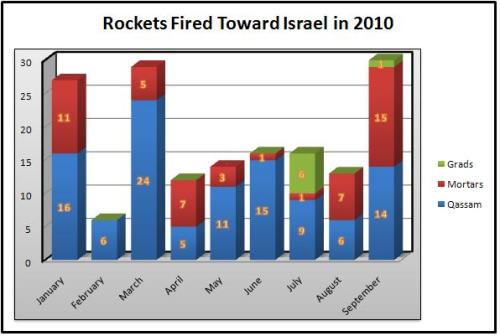
Heaviest rocket attacks from Gaza since Cast Lead

From the IDF Blog, 6 October 2010:

All in all, terrorists have fired 11,293 rockets at Israel in almost nine years.

Since Hamas’ takeover in the Gaza Strip rocket fire at Israel had risen exponentially, peaking at the period right before Operation Cast Lead with 3,278 rockets fired at Israel in 2008, and steeply decreasing since the end of the Operation in 2009.


September 2010 saw more missile and mortar attacks against Israel by Gaza terrorists than any other month since the period immediately following IDF Operation Cast Lead in early 2009.


Monday, September 13, 2010

Islamists Tighten Their Grip on Turkey as Erdogan Extends Powers Over Courts and Army

From Bloomberg, September 12, 2010, by Benjamin Harvey and Steve Bryant*:

Sept. 13 (Bloomberg) -- Turkish Prime Minister Recep Tayyip Erdogan won a referendum on constitutional changes that will strengthen his government’s powers over the courts and army, boosting his prospects of re-election next year.

The package was supported by 58 percent of voters to 42 percent against, with a 78 percent turnout in yesterday’s vote, state broadcaster TRT said citing official figures from the country’s election board. ...
The referendum was widely viewed as a preview of Erdogan’s chances of winning a third term in office at general elections to be held by July. The “yes” vote will bolster a government that has presided over record economic growth even as critics accuse it of seeking to undermine Turkey’s secular system.

Generals and judges who see themselves as the last line of defense against encroaching Islamism, and have frequently clashed with the prime minister since his party came to power in 2002, will have their powers curtailed under the amendments.

The strong win “indicates the prospects of a third term look solid,” and shows that Erdogan’s “political machine” is “far superior to any of its competitors,” said Wolfango Piccoli, an analyst of political risk at the Eurasia Group in London.

Speaking to supporters in Istanbul, Erdogan welcomed the “yes” vote and said he will work on a complete overhaul of Turkey’s constitution, drafted in 1982 when the country was under military rule, after next year’s elections.

...Opposition politicians campaigned against the measures, saying they undermine the separation of powers and would hand Erdogan too much power....
...The amendments ...[will allow] members of the armed forces to be tried in civilian rather than military courts for crimes against the state...

The amendments also restructure the judiciary, giving the government more control over appointments to the Supreme Board of Prosecutors and Judges and the Constitutional Court. The Constitutional Court, which has frequently clashed with Erdogan and struck down measures passed by his lawmakers, will be expanded to 17 members from 11, with 14 appointed by the president and the other three by parliament.

Critics including the opposition Republic People’s Party and Nationalist Action Party say the amendments allow Erdogan to enact what they say is his hidden Islamist agenda...

*With assistance from Seda Sezer in Istanbul. Editors: Ben Holland, Louis Meixler.


From Aljazeera, 12 Sep 2010: Turkish analysts discuss their views on the referendum:

...Al Jazeera spoke to several analysts to get their thoughts on the vote.

Cengiz Aktar, Turkish columnist and journalist
..."There is no unity among the 26 articles unfortunately, and the referendum has turned into a referendum on the AKP [Erdogan's party]. But this is how things happen in this country.

"Now we are heading towards an election next year and if the vote is a 'yes' vote, the hand of the government will be strengthened for a brand new constitution in Turkey."

Semih Idiz, columnist at Turkey's Milliyet newspaper
"There are really only two articles that are controversial. Even the opposition in the past has said it will endorse the remaining articles.

"These two articles are to do with the composition of the high judiciary. The government is basically trying to introduce a system where there can be more parliamentary and effectively government control over the judiciary.

"The hardcore secular camp in Turkey are objecting to this very severely because it believes that this will open a back door to an Islamic agenda for the government in the future.

"So, the lines are pretty well drawn here and they are not really discussing the merits of the article in questions. In fact, they are discussing ideological things.

"The stakes are high for both sides. In fact, we can say for three sides - the Kurdish side as well.

"...there is, what I call, the post-modern civil war between the secularists and the 'Islamists' in this country....

Cuneyt Ulsever, columnist at Turkey's Hurriyet newspaper
"There are two amendments that directly talk about judiciary, with an accusation that the judiciary had been too independent and made another coalition in the country and done many injuries to the political system. This is the allegation of the government.

"The problem is, if the amendments are accepted as proposed by the government, 10 out of 17 members of the constitutional court will be decided directly by the government people."


"The minister of justice and his aides will be the chief of [the] council that will decide about the judges."

"I would say that, yes, the judiciary has done many wrongs in the past, but with this new amendment it is quite possible that the government will directly be the leader and the owner of the judiciary."

"The root of democracy, the separation of powers, will be completely voided."

"As is it today, we will see a more authoritarian prime minister than ever. Our prime minister is already a very authoritarian personality and now he will have all powers in his hands."

Sunday, August 29, 2010

Iran backing Shi'ite rebels in northern Yemen

From a World Tribune INTELLIGENCE BRIEFING, Friday, August 27, 2010:

JERUSALEM — Israel has determined that Iran is acting to destabilize Yemen.

The Israeli intelligence community was said to have confirmed reports that Iran's Islamic Revolutionary Guard Corps was helping Shi'ite rebels in their war against the regime of Yemeni President Ali Abdullah Saleh. Officials said IRGC was relaying weapons and training to the Believing Youth, which operates in northern Yemen near the border with Saudi Arabia.

"Even now it [Iran] controls bodies that function as a state within a state, in Lebanon, Yemen, the Palestinian Authority, and other places," Israeli Deputy Foreign Minister Ayalon said.

..."The Iranian regime spreads instability, supports terror, and oppresses its own people," Ayalon said. "It is impossible to accept atomic weapons in the hands of such a regime."

Officials said Ayalon was reflecting the assessment of the Israeli intelligence community that IRGC has established a presence in Yemen as well as in neighboring Eritrea. They said IRGC was using the Believing Youth to infiltrate neighboring Saudi Arabia, 10 percent of whose population is Shi'ite.

"There's also a possibility that Iran will make a military move against the Arab Gulf states and harm the flow of oil to the world, in which case the entire situation will degrade into widespread confrontations," Ayalon said.

Officials said Ayalon's address was meant to assure Iranians that Israel was a friend and that the Teheran regime marked a regional threat. They said Ayalon's broadcast was widely heard in Iran and the rest of the Gulf region.

"Israel bears no animosity towards the Iranian people," Ayalon said. "We have deep respect and aspire to cooperate with them to bring about a better reality in the region. The problem is intrinsic to the Iranian regime and its conduct, particularly regarding the nuclear issue."

Friday, August 27, 2010

Moderate Islam is the answer

Daniel Pipes, director of the Middle East Forum, former teacher of History at many eminent Universities, with a doctorate from Harvard University, and author of 12 books that have been translated into 33 languages, has been recognized as one of Harvard’s 100 most influential living graduates. He visited Perth, Western Australia last week, and I attended all 5 of his speaking engagements here.

Pipes’ opposition to “Islamism” (radical Islam) is sometimes misunderstood. He doesn’t oppose Islam or Muslims. He says:

"It's a mistake to blame Islam, a religion 14 centuries old, for the evil that should be ascribed to militant Islam, a totalitarian ideology less than a century old. Militant Islam is the problem, but moderate Islam is the solution."

He points out that Islamic society was a global leader for centuries since Mohammed, but has waned in the last two centuries. It is now least successful on virtually every index (freedom, longevity, innovation, economy etc).

Islamism developed as a response to this failure, at first taking its example from fascism (Mussolini) and communism (Lenin) in the 1920s, but overlaying “Islamic” content. It seeks to return to the heyday of Islamic societies and eventually to global Islamic hegemony by imposing and enforcing an extreme, violent, totalitarian interpretation of Islam.

In 1979 it graduated from a phenomenon of merely academic curiosity to become a serious strategic challenge to the free world, when the Islamic Revolution in Iran gave it control of a major Islamic state actor. Although Iran is not a powerful state like the Soviet Union or Germany was, its aspirations to add the nuclear threat to its arsenal of state-sponsored terrorism around the world, pose a grave danger to the free world.

However in addition to terrorism, violence and the nuclear threat, Pipes is even more concerned about Islamist infiltration of the free world using democratic freedoms and lawful means to acquire power. The "war's center of gravity has shifted from force of arms to the hearts and minds of citizens" he says.

Examples of this infiltration include Turkey, Pakistan and Hezbollah in Lebanon. Even the terrorist group Hamas (like Hitler) gained power in elections before it seized total power from its opponents by force. Moreover, Islamism is a utopian movement that has an attractive appeal to some. Proof of this can be found in the increasing number of Western converts to radical Islam. Pipes estimates that there are probably over 150 million Islamists today - more than all the communists and fascists who ever lived. Thus, it is dangerous to ignore the threat of Islamist infiltration of our free nations.

The Western response to this strategic challenge should be in alliance with moderate Muslims. What is needed, Pipes suggests, is a modern, more liberal re-interpretation of Islamic scriptures which would integrate women, gays and other minorities as full members of society, and would co-exist harmoniously with other religions, not seek to convert or subjugate them by force.

In summary: “Militant Islam is the problem, but moderate Islam is the solution."