From NewsWithViews.com, December 14 2007, by Patrick Wood* [Emphasis added]:
...Islamic/Shari’a banking is coming to the United States and other western nations, thanks to global banks such as Citigroup, HSBC, Deutsche Bank, Morgan Stanley and Goldman Sachs. With Great Britain now pledging to become the Islamic banking center of the world, the stampede by all global banks to enter the world of Islamic banking is well underway.
...The implications for the west, and especially for the United States, are staggering. Because all Islamic banking products must be created and offered according to strict Shari’a law, global banks are doing for Islam what it could never do on its own: give legitimacy to Shari’a and infiltrate it into the fabric of western society.
...To insure Shari’a compliance, banks must hire Shari’a scholars to review and approve each product and practice as “halal....
It should be noted that most of these scholars are from the school of radical Wahhabi/Salafi Shari’a in Saudi Arabia and elsewhere, holding views diametrically opposed to the basic values of Western civilization.
....There were very few Islamic banks prior to 1980. However, with the Khomeini revolution in Iran in 1979, Shari’a was summarily imposed throughout Iran and Shari’a finance took off.
Shari’a is the legal and judicial system of Islam that is brutally imposed on many Islamic countries in the middle east. It is the specific embodiment of the totalitarian ideology practiced by the Taliban, Iranian Mullahs and Saudi Wahhabis.
Shari’a is perpetuated by claiming to have its roots in the Koran, but in fact it is mostly the product of rulings and dictates made by Islamic scholars and caliphs over several centuries.
For non-Muslims, Shari’a is best known for its medieval, harsh brutality. Many rulings handed down by Shari’a courts have shocked the western world....
...To the average western mind, Shari’a is no more than a medieval, barbaric code that somehow survived to the 21st century. It flies in the face of western law, philosophy, liberty and freedom. Furthermore, it is the vehicle used to call for the complete destruction of the west and in particular the United States of America, which then will be replaced by Shari’a dictatorships.
How the banking rocket took off
At the behest of global trade moguls, numerous Free Trade Zones (FTZ’s) were created throughout the Islamic world that were full of windfall conditions.
For instance, the Dubai International Financial Centre (DIFC), is a 110 acre free trade zone that was founded in 2004 in Dubai, UAE. According to the DIFC website, participants will enjoy "zero tax rate on income and profits, 100 per cent foreign ownership, no restrictions on foreign exchange or capital/profit repatriation, operational support and business continuity facilities.”
Not surprisingly, Morgan Stanley’s application was one of the first approved by the Dubai Financial Services Authority to operate within the DIFC...
...DIFC and similar Free Trade Zones are a banker’s nirvana into which global bankers have rushed headlong to establish regional financial centers. And the payoff? A chance to enter and then dominate the Islamic banking industry. Such banking has over $1.5 trillion on the table today, and is growing at a steady and explosive rate of over 15% per year.
Understanding that Islamic banking is a very recent phenomenon is underscored by the fact that its largest and most prestigious international conference, World Islamic Banking Conference (WIBC) has met for a mere 14 years. The most recent meeting just concluded in Bahrain and attracted over 1,000 banking delegates from 35 countries.....McKinsey & Company was listed as a “Strategic Partner” of the WIBC, alongside of global accounting firm Ernst & Young and the consummate global investment banker, Goldman Sachs.....
...Britain’s PM Gordon Brown has pointedly stated that he intends to make London the Islamic finance capital of the world. Further, he pledged that in 2008 the British government will issue its own “sukuk”, or Shari’a compliant bonds. Yes, government debt issued as Shari’a compliant.
At the June 13, 2006 Islamic Finance Trade Conference in London, Brown revealed,
"Today British banks are pioneering Islamic banking - London now has more banks supplying services under Islamic principles than any other Western financial centre."
Brown’s statements can only be taken as a challenge by the New York banking establishment to beat him to the finish line. It doesn’t matter who wins this race because the result will be the same: Shari’a banking is quickly encircling the globe and forcing a de facto acceptance of Shari’a law.
Conclusion
International bankers have long ago proven themselves to be completely amoral when it comes to money. They bankrolled the Bolshevik Revolution in 1918 just as blithely as they bankrolled Hitler in the 1930’s. Fortunately for us, neither succeeded in conquering the world.
With Islam, odds of its succeeding are radically different. To start with, there are already 1.6 billion Muslims in the world, and it is the fastest growing religion in history. Secondly, the spread of Islam is richly financed by the oil that is extracted from mid-eastern countries. Thirdly, Islam has already infiltrated most of the west, especially in Europe.
And now, Islam has behind it the combined support and encouragement of the entire global banking community.
The unholy alliance between Islam and global banking may be the final leg on the age-old quest for global domination. Don’t be surprised at the silence of the global elite the next time you hear Islamist mobs chant “Death to America” – their goals are now intertwined.
Bibliography:
1, Sharia’s Trojan Horse 2, Islamic Finance or Financing Islamism? 3, Islamic Economics: What Does it Mean? 4, Federal Reserve speech to Islamic Financial Services Industry Seminar 5, Fed speech on Regulation and Supervision of Islamic Banking 6, Islamic banking rises on oil wealth, drawing non-Muslims 7, How the West Came to Run Islamic Banks8, 12th Annual World Islamic Banking Conference 9, University Islamic Financial
© 2007 Patrick Wood - All Rights Reserved
*Patrick M. Wood is editor of The August Review, which builds on his original research with the late Dr. Antony C. Sutton, who was formerly a Senior Fellow at the Hoover Institution for War, Peace and Revolution at Stanford University. Their 1977-1982 newsletter, Trilateral Observer, was the original authoritative critique on the New International Economic Order spearheaded by members of the Trilateral Commission.

Monday, January 07, 2008


Friday, January 04, 2008
"Moderate" West Bank manufactures Qassams
From DEBKAfile, January 4, 2008:
Two Qassam missiles in construction and launchers uncovered in West Bank town of Nablus...
...A large Israeli force of several battalions uncovered the first West Bank Qassam workshop in Nablus ... Its presence brings central Israel within range of Palestinian missile fire for the first time.
In the south, the first Katyusha rocket with an extended range of up to 18 km reached northern Ashkelon – another first.....Until now, the shorter-range Qassam missiles reached Ashkelon’s southern outskirts....
Thursday, January 03, 2008
Katyusha Hits Askelon, Kassams Continue to Rain
From THE JERUSALEM POST Jan. 3, 2008, by jpost.com staff, Gil Hoffman and AP:
... IAF warplanes bombarded targets across the Gaza Strip, stepping up pressure on Palestinian terrorists after a Katyusha rocket was fired into Israel.
....The 122mm Grad Katyusha rocket fired from the northern Gaza Strip landed in northern Ashkelon. The rocket was launched from a distance of 16.5 kilometers and was the first projectile fired from the Strip to land so far north. It landed in an open area and did not cause any casualties or damage.
Meanwhile...three Kassam rockets fired from Gaza landed in [Sderot]. One of the rockets landed near a residential building, smashing its windows.
Five more Kassam rockets landed in open areas in the western Negev and 14 mortar shells fired from southern Gaza landed in fields near the Israeli border...
Islamic Jihad and the Popular Resistance Committees claimed responsibility for the Katyusha attack. "We are going to launch more strikes in the depth of the entity," they said in a joint statement. The Popular Front for the Liberation of Palestine-General Command, a tiny group backed by Hamas, also claimed responsibility.
Israeli officials said the attack signaled an improved capability by Gaza terrorists.
"The Palestinians have attacked a major Israeli city ... and thus have upped the ante," said government spokesman David Baker...
...In published comments Thursday, Bush said he would not let a future Palestinian state become a base for attacks on Israel. "I won't lend a hand to the establishment of a terror state on the borders of Israel," Bush told Yediot Ahronot.
Opposition leader Binyamin Netanyahu responded to the day's events by saying that the policies of Prime Minister Ehud Olmert and Defense Minister Ehud Barak were "amateurish, blind and dangerous" and had already brought the residents of the Galilee and Haifa under Katyusha fire. He warned that the same would happen soon to Ashdod and eventually, Tel Aviv, if the government was not replaced by one led by him.
"They believe Israel needs to withdraw to the 1967 borders, but it is clear to you that if we leave Judea and Samaria, Hamas will take control there," Netanyahu told a meeting of the Likud secretariat at the party's Tel Aviv headquarters. The opposition leader added that pulling back to the 1967 lines "will mean that if terrorists fire a missile with a 20-kilometer range at the center of the country, it will hit Dizengoff Center."
Meanwhile, during his farewell speech, outgoing OC Home Front Command Maj.-Gen. Yitzhak Gershon said that the IDF was making "exceptional and ongoing efforts" to battle Kassam attacks, but has not been able to provide an effective response to the threat. "Israeli communities in the Gaza belt have been under non-stop Kassam attacks" which "prevent an entire strip of land from conducting normal lives," he said.
Thursday's fighting in Gaza was some of the heaviest in months. The IDF said the target of the air strikes were buildings used by Palestinian terrorists, including one weapons storehouse.The attacks were in response to the Katyusha attack on Ashkelon, the army confirmed...
Hudna is no solution
From an Op-Ed in Haaretz, 02/01/2008, by Ely Karmon:
In light of the success of the pinpoint military operations against Islamic Jihad in the Gaza Strip, and signs of weakening in the Hamas leadership, many are calling for accepting Ismail Haniyeh's purported offer of a hudna (a cease-fire), or alternately a tahadiyeh (a lull in the fighting), in exchange for an end to IDF operations in Gaza and a lifting of the siege.
It appears that the decision makers in Israel have learned nothing....
...Israel's acceptance of the hudna proposal would constitute a strategic victory for Hamas and its allies: The organization would be regarded by the Palestinian population as the leading element in the national struggle. It would quickly receive international legitimacy, establish its economic and political control through the generous assistance of the international community, and be able to develop a deterrent military capability vis-a-vis Israel through massive arms smuggling across the Egyptian border.
In a year or two, an extremist state, allied with Iran, Syria and Hezbollah, will emerge on our southern border, with a good chance of taking over the West Bank and affecting the stability of Jordan, Egypt and possibly also the Islamic Movement in Israel. Even if Hamas meets its promise not to violate the cease-fire for several months, Iran and its ally, Islamic Jihad, will do everything in their power to sabotage the negotiations with the Palestinians.
Is the temporary, tactical and relative calm of a few months, maybe even a year or two, sufficient justification for Israel's next strategic failure? Will we not then face a situation similar to what emerged in southern Lebanon following Israel's unilateral withdrawal of May 2000, which led to the forlorn results of July-August 2006?
[Will] those who are now threatening that we will respond in force if Hamas or any other Palestinian group violates the hudna, not find more excuses to avoid taking action against them?
In light of the continued targeting of Israeli communities with rocket fire, and the ongoing smuggling, Israel must employ a tough policy and keep up its effort against a strengthening of Hamas in the Gaza Strip. This should include targeting the organization's leadership, and if necessary, carrying out a ground offensive to take control of the Philadelphi route and segments of the northern Gaza Strip before weapons of strategic significance find their way there.
...Only by bolstering the moderates in the Palestinian leadership and population in the West Bank, while politically and socially weakening Hamas in Gaza, will it be possible, perhaps, for fissures to occur in the Islamic movement and for a joint struggle with the Fatah moderates and the pragmatic leaders among Hamas against the radicals in control in Gaza and elsewhere.
Dr. Ely Karmon is a senior researcher at the International Institute for Counter-Terrorism at the Inter-Disciplinary Center, Herzliya.
Wednesday, January 02, 2008
Egypt, Iran moving towards normalization
From JPost.com Jan 1, by ASSOCIATED PRESS CAIRO:
At the end of a rare visit to Egypt, a senior Iranian envoy said Tuesday the two regional Muslim heavyweights are making progress in normalizing diplomatic relations, cut nearly three decades ago over regional policy disagreements.
"There is no major problem and everything is moving forward," Ali Larijani, from Iran's powerful National Security Council, said after talks here with Egyptian Foreign Minister Ahmed Aboul Gheit.
Larijani, who is also a close aide to Iran's supreme leader Ayatollah Ali Khamanei, described the talks as "positive and constructive."
Teheran cut diplomatic ties after Cairo signed a peace agreement with Israel in 1979 and provided asylum for the deposed Iranian Shah Mohammad Reza Pahlavi.
Iran's support for Iraqi Shi'ites, Lebanon's Hizbullah and the Palestinian terror organization Hamas has further deteriorated relations, resulting in very limited diplomatic contacts between the two countries.
Egypt has always maintained that normal ties with Iran would come only after Iran stopped meddling in internal affairs of Arab countries....
Killers of off-duty soldiers near Hebron were PA security officers
From Ynet News, 1/1/08, by Efrat Weiss:
Israeli security officials say two of the terrorists who killed Cpl. Ahikam Amihai and Sgt. David Ruben at Telem Creek area last Friday are members of Fatah's security forces. 'PA trying to evade responsibility for attack,' they say
Two of the terrorists who shot dead off-duty IDF soldiers Cpl. Ahikam Amihai (20) and Sgt. David Ruben (21) as they were hiking near Hebron last Friday were members of Fatah's security forces and are on the Palestinian Authority's payroll, Israeli sources said.
One of the terrorists was identified as 26-year-old Hebron resident Amar Taha, a Fatah member and a member of the Palestinian national security forces. The other terrorists was named as 24-year-old Hebron resident Ali Dandanes, a court clerk and Fatah member with links to the Palestinian general intelligence.
The two turned themselves in to the Palestinian Authority's general intelligence custody immediately following the attack, fearing being captured by Israeli security forces.
The PA did not immediately inform Israel that the terrorists were in its custody, but did so only after Shin Bet officials approached Palestinian officials on the matter....
...."Hamas claimed responsibility for the attack only at the request of the family of one of the terrorists, whose father is imprisoned in Israel, but we carried out the attack...." ....
...An Israeli security official said Palestinian statements claiming that the attack was criminally-motivated contradict the evidence the shin Bet has gathered and the admission of the terrorists themselves during their interrogation by PA security forces.
"These statements were issued in an apparent attempt by the PA to evade responsibility in light of the fact that the attack was carried out by members of Fatah and the Authority's security services," the official said.
Ali Waked contributed to the report
Also see Fatah Terrorism is Alive and Well
Israel suffers 8.2 projectiles per day
From DEBKAfile, January 2, 2008:
Hamas averages 8.2 missiles a day in 2007, steps up Iran-Syrian-backed preparations for full-scale war. Israel improves terror-preventive performance
The annual report of Israel’s domestic intelligence service, Shin Bet, paints a troubling picture of a Hamas-ruled government in Gaza expanding its efforts to build a war machine capable of taking on Israel in full-scale military combat, with active input from Iran and Syria.
In the outgoing year, Hamas and its allies fired more than 1.300 Qassam missiles and 1,700 mortar shells from Gaza, subjecting Israeli communities in an expanding radius to a daily average of 8.2 projectiles.
At the same time, the Shin Bet and IDF were strikingly successful in their preventive campaign. They thwarted 29 major attacks inside Israel originating in Gaza, and the number of Israelis killed by terrorists declined from 50 in 2005 and 24 in 2006 to 13 in 2007.
Nonetheless, the Palestinians mounted a total of 2,946 Palestinian terrorist attacks, 9 less than 2006, including a single suicide bombing in Eilat and another three that were intercepted in time.
No let-up is expected next year. In 2007, Hamas smuggled into Gaza more than 80 tons of explosives for use in the fabrication of missiles and bombs, including roadside devices laid down against an Israeli military incursion....
...The Shin Bet reports that hundreds of Hamas operatives were smuggled through the Sinai tunnels out to Iran and Syria and back for special 2-6 month courses at facilities near Tehran and Damascus in commando combat and the manufacture and launching of missiles.
The Shin Bet report notes that Hamas’ smuggling projects spread out from Gaza to the West Bank, where a new terror machine is taking shape....Hizballah, funded the West Bank project at the rate of the equivalent of $10 million per month. The transfers slowed in recent months.
The Shin Bet reports that Hizballah is diverting more funds to building its own substantial new infrastructures in South Lebanon and north of the Litani River.
On dialogue between Jews and Muslims
From JPost, Dec 31, 2007, by ISI LEIBLER:
Dialogue with Muslims .... [is] helpful and certainly preferable to exchanging diatribes, [but] if the objective is primarily to ingratiate ourselves with Muslims and gain publicity, the exercise becomes counterproductive.
The Jewish track record of dialogue with the Church illustrates that until Pope John XXIII's dramatic condemnation of anti-Semitism at the Second Vatican Council, our efforts had little impact beyond reinforcing relationships with marginal Christian philo-Semites.
Meaningful dialogue requires that both parties agree in advance to accord mutual respect and genuinely commit to exploring means of forging deeper understandings. It also presupposes a willingness to indulge in honest and open discussion rather than mouthing platitudes or employing glib rhetoric to cover up differences. Above all, it demands the involvement of responsible and sensitive Jewish representatives, knowledgeable about Judaism and its place in the world at large.
There are circumstances in which dialogue must be avoided. For example, if the Muslim group concerned refuses to condemn the anti-Semitic tirades emanating from Islamic quarters, or even indirectly condones global terrorism and suicide bombings, or promotes conspiracies such as implying that 9/11 was an Israeli plot. To share stages or collaborate with groups holding such views merely provides a platform for radicals to exploit dialogue as a vehicle to obtain respectability and cover up their extremism.
The problem we face with Islamic religious leaders is that while a number of their spokesmen, under pressure, do ritualistically condemn Islamic extremism, many continue to express sympathy with the radicals, or at best remain silent. The dominant Islamic voices being heard are apologists for violence, terrorism and intolerance. If there are moderate Muslims, they remain mainly in the closet or are sufficiently intimidated to avoid condemning the excesses of their jihadist kinsmen.
In this environment, it is contrary to our interests to continuously repeat the politically correct but utterly false mantra that Islam is a religion of peace. Whereas all three major monotheistic religions incorporate elements of militant piety and violence, Islam, with its unique jihadism, today represents the most violent doctrine.
This is not to deny that given more enlightened religious leaders it could become moderate. But the export of Wahhabism from Saudi Arabia has led to the creation of new Islamic schools and the domination of existing institutions by a religious ideology which sanctifies violence. It is in these sources that martyrs (shahids) and suicide bombers were incubated and became such a dominant element in contemporary Islam....
....Some Jewish representatives also display an unfortunate penchant for demonstrating their liberal credentials by endorsing Muslim demands to outlaw security profiling. ....It is simply a denial of reality to dismiss the ethnic profiles of Arab Muslims when 95% of acts of global terrorism emanate from this group....
..... If we bask in expressions of mutual love but fail to proclaim to our partners in dialogue that Israel is central to our Jewish identity, we make a mockery of dialogue and effectively capitulate to the extremists.
Of course, Muslims are entitled to criticize Israeli policies. But there must be understandings in advance that, as distinct from genuine criticism, efforts to delegitimize or demonize Israel make it impossible for us to share platforms with them. We must also insist that the condemnation of Muslim anti-Semitism be an agenda item in all such encounters.
None of this detracts from our obligation to raise our voices against those who would condemn an entire religion because of the criminal behavior of its individuals. Alas, it is galling that in the Muslim arena there are virtually no such condemnations when it comes to incitement against Israel, the Jews, or even America.
There are nevertheless genuine opportunities to conduct constructive dialogue with judiciously selected Muslim groups. For example, the recent visits of Indian Muslims and Indonesian imams to Israel under the auspices of the American Jewish Committee represent the kind of positive dialogue that should be commended and encouraged.
Bottom line: Dialogue with Muslims becomes counterproductive when we grovel and demean ourselves in order to curry favor. All that is achieved is a façade of goodwill which ultimately only strengthens extremists at the expense of the few genuine moderates within the Islamic community whom we are obliged to continue to seek out, for their sake and ours.
The writer is a former chairman of the Governing Board of the World Jewish Congress and a veteran international Jewish leader. ileibler@netvision.net.il
Explosive chemicals smuggled in EU aid bags
From Reuters, Sat Dec 29, 2007:
JERUSALEM (Reuters) - Israel said on Saturday it had recently seized a truck carrying chemicals used to make explosives hidden in bags marked as European Union aid for the Hamas-controlled Gaza Strip.
The army said 6.5 tonnes of potassium nitrate were in bags marked as sugar from the European Union for Palestinians in the coastal enclave....
...The European Union is the largest provider of humanitarian assistance to Gaza....
...Potassium nitrate can be used to make explosives ....
(Writing by Avida Landau; Editing by Matthew Tostevin)
Tuesday, January 01, 2008
Fatah terrorism is alive and well...
From a JPost Analysis, by KHALED ABU TOAMEH, Dec 30, 2007:
Some of the gunmen who participated in Friday's shooting attack near Hebron belong to Palestinian Authority President Mahmoud Abbas's Fatah faction, Fatah activists in the West Bank confirmed over the weekend.
....The involvement of Fatah members in the attack is seen as a serious embarrassment for Abbas and the PA, whose representatives were quick to denounce the perpetrators, pledging to crack down on all armed groups in the West Bank.
The attack shows that several armed Fatah groups continue to operate in the West Bank despite statements by top PA officials to the effect that most of these groups had been dismantled.....
....while such attacks help Fatah score points on the Palestinian street, they also embarrass the PA leadership in Ramallah, especially in front of the international community, which has just pledged to channel to more than $9 billion to the Palestinians over the next three years.
That's why PA officials were quick to condemn the attack...PA Prime Minister Salaam Fayad said ... that his government would fulfill its security commitments toward Israel by pursuing those responsible. ....PA Information Minister Riad al-Malki strongly condemned the attack as an attempt to disrupt peace talks between the Palestinians and Israel.
However, both Fayad and Malki are well aware of the fact that the PA's plan to dismantle all the Fatah-affiliated militias in the West Bank is still far from achieving its goal.
Shortly after PA Interior Minister Abdel Razzak al-Yahya announced Saturday that the Aksa Martyrs Brigades had ceased to exist, the group responded by distributing thousands of leaflets throughout the West Bank scoffing at the claim and vowing to continue the armed struggle against Israel.
Friday, December 28, 2007
What to watch in 2008
From GLORIA, by Barry Rubin*, December 23, 2007:
...2007 ...here are some of its significant trends which will continue to dominate the year to come.
Hamas takeover of the Gaza Strip.
This is the most important single Middle East event of 2007 because it is a clear, probably irreversible, shift in the balance of power. ...it is conceivable that Hamas will take over the West Bank within a few years and marginalize its rival. To Islamists, this is a great victory.
In fact, it is a disaster for Palestinians and Arabs.... A negotiated resolution of the Arab-Israeli or Israeli-Palestinian conflict, and with it prospects for a Palestinian state, has been set back for decades.
...In years to come, struggles between Arab nationalists and Islamists, as well as between Sunnis and Shias, will dwarf the Arab-Israeli conflict. During 2008 we will have to assess whether the Palestinian Authority still ruling the West Bank can meet the Hamas challenge. (We already know it won't meet the diplomatic challenge but it will take all year for most Western politicians and much of the media to discover that.)
The military success of the U.S. surge in Iraq.
U.S. forces showed that pessimistic assessments were wrong and they were able to reduce the power of anti-government insurgents and lower the death toll in Iraq. However, this is a long way from winning the war.
During 2008 the two key questions will be whether U.S. troop withdrawals start in earnest and whether there is any political progress in bringing together Sunni and Shia communities in that country....
The Western failure to tighten sanctions substantially against Iran.
It was clear in 2007 that negotiations with Tehran would fail to deter Iran from its campaign to obtain nuclear weapons. Certainly, France, Britain and Germany were more willing to take--or at least to talk about taking--action but due to their own hesitations, plus resistance from Russia and China, very little happened.
The reaction to these events in Iran was mixed. On one hand, there was more worry about the pressures facing that country plus its own economic woes. On the other hand, the regime expressed more confidence that the West was chicken and that time and tide was on Iran's side.
In 2008 we will be able to see if Tehran's drive for nuclear weapons continues without serious hindrance. Equally, it will be possible to assess whether President Mahmud Ahmadinejad is being weakened by his factional opponents--especially in the March parliamentary elections--or tightening his hold on power and holding to his reckless course....
...Israel prospers.
Despite outdated talk of Prime Minister Ehud Olmert's weakness, he used 2007 to rebuild his authority. Especially interesting, Israel's economic growth has been impressive; unemployment fallen to all-time lows. Revolutionary enthusiasm and paper victories still thrill the Arab world and Iran but material gains continue to be what is important.
The demoralization of Lebanon.
Worried that it is being abandoned by the West, forces supporting the moderate Lebanese government began to wonder if in fact Iran, Syria, and Hizballah would be able to reestablish their control over the country. A key element is the identity of the country's next president. In 2008, it will be important to watch how power shifts in Beirut and whether the investigation of Syrian involvement in terrorism against Lebanese opposition figures leads to an international tribunal.
France changes course.
President Francois Sarkozy has moved France away from the nationalistic effort to undercut the United States and appease radical regimes. Sarkozy, however, has played footsie with Syria and Libya. The question for 2008: Will he implement pledges to get tougher and will French institutions follow him in changing course?
*Barry Rubin is director of the Global Research in International Affairs (GLORIA) Center and editor of the Middle East Review of International Affairs (MERIA) Journal.
Show Syria the Stick
From BESA Perspectives Paper No. 36, December 26, 2007, by Ely Karmon:
....The Iran-Syria-Hizballah-Hamas alliance has acted during the last 15 years as an “axis of destabilization” in the Middle East, achieving major strategic victories at the expense of moderate Arab states, and US, European, and Israeli interests.
The Damascus regime, weakened by the withdrawal of its army from Lebanon and international pressure after the assassination of Rafik Hariri, still maintains a firm grip on the Sunni majority population at home, plays a strong hand in Lebanon, and supports radical Palestinian groups.
With Syrian support, Hizballah (Tehran’s closest ally) has become a state-within-a-state potentially able to become Lebanon’s arbiter if not actual ruler.
Syria is actively involved in the destabilization of the Palestinian arena and has a growing role in supporting the Shi’a anti-American forces in Iraq....
...The "Axis" significantly influences Israel's relations with its neighbors. The inconclusive results of the Second Lebanon War of July-August 2006 and the continuous bombing of Israeli cities and villages from Gaza have diminished Israel’s deterrence versus Hizballah, Hamas, Iran and Syria.
Similarly, the peace process between Israel and the Palestinians, despite the Annapolis gathering, is essentially paralyzed. Hamas is in control of the Gaza Strip, threatens the Fatah-controlled West Bank, and is able to derail any negotiation in the peace process by terrorist attacks.
....This alliance works because of the strong religious ideologies that shape the strategy of three of the actors: Iran, Hizballah and Hamas.
The Tehran regime, based on the revolutionary doctrine of Ayatollah Khomeini, has implemented its creed through an aggressive strategy after silencing all internal dissent. The apocalyptical overtone of Mahdism in its leadership circles makes this ideology even more dangerous.
Hizballah, as proven by its covenant and the open declarations and deeds of its leaders, closely follows the religious ideology and the strategy of export of the Khomeini revolution.
Hamas, as a branch of the Muslim Brotherhood, the oldest Sunni Islamist movement, sees jihad as a general duty of all Muslims and is the only MB group involved in systematic warfare against Israel and “world Zionism.”
Different from the other three, Syria is still driven by Pan-Arabism and the concept of Greater Syria....
The US, Europe and Israel Didn’t Challenge the Alliance
However, the victories of this alliance are not only the result of the robust and durable cooperation between its four members, but also in great measure the consequence of the US, European and Israeli leaderships’ lack of strategic vision and political courage.
The United States and France (the major European country challenged by the axis) did not inflict any serious damage on Iran and its operational arm Hizballah, for the long series of terrorist attacks against their citizens, soldiers and interests. Nor has Syria paid a real price for the direct and indirect support to Iranian and Hizballah anti-Western terrorism. Not only has Iran not suffered any consequences for 20 years of lying about its nuclear program, but the West is still willing to offer ever-greater incentives, strengthening Iran's leaders' sense of self-confidence that they can achieve nuclear military capability.
The West has forced Bashar al-Asad to withdraw the Syrian army from Lebanon, but it has stopped short of endangering his regime at home or curtailing his influence in Lebanon. The continuous political killings there are designed to intimidate those working courageously to end Syria's interference in Lebanon's internal affairs.
Since 1982, Israel has permitted Syria to support Hizballah attacks and Palestinian proxy against its territory. Israeli leaders did not have the courage to challenge Damascus. Even during the July-August 2006 War, when Hamas leader Khaled Mashal was running the kidnapping of the Israeli soldier from Damascus and Syria continued to provide heavy military hardware and ammunition to Hizballah, the Israeli government sent the message that it had no intention to bother Syria.
By giving Hizballah the credit for the Israeli disgraceful withdrawal from southern Lebanon in 2000, by permitting its consolidation as a state-within-a-state and the building of a small modern guerrilla-army, the various Israeli governments have preferred tactical political gains at home to real strategic long-term interests. In the 2006 war in Lebanon, Israel paid a high price not only in human lives and material damage, but also in its regional standing and its deterrent power versus its enemies....
The Threat of a Nuclear Iran
The dangerous destabilizing effect of the Iran-Syria-Hizballah-Hamas alliance on the Middle East and beyond and the leadership role of the Tehran regime in this coalition place the prevention of the Iranian nuclear military program as first priority for the international community.
The US, the international community and Israel face a daunting challenge: how to prevent a nuclear Iran. After 20 years of futile diplomatic dialogue and a year of mild international sanctions, three options remain:
As a global power, the Bush Administration needs to find a grand strategic compromise with Russia to display a common front against Iran and thus considerably enhance the success of the sanctions. Russia could have a crucial role in convincing the ayatollahs of the seriousness of their situation. Russia has redefined the limits of its nuclear cooperation with Iran: it has halted Russian work on the construction of the Bushehr nuclear reactor and is procrastinating in transferring the nuclear fuel required for its activation.
However, in light of the growing tension between the US and Russia on important strategic issues, such as the building of the missile defense system in Poland and the radar station in the Czech Republic or the expansion of NATO into the old Eastern Bloc on Russia’s western border, President Putin is less willing to cooperate on the Iranian file.
There is the possibility to isolate Tehran by breaking the alliance with Syria, which is key in isolating and disarming Hizballah and reducing the influence of radical Palestinians on the peace process with Israel.
Israel cannot defeat Hizballah if it does not occupy most of Lebanon, which it is reluctant to do. Therefore, the best way to change the equation in Lebanon is to challenge Syria. The carrots the European leaders proposed President Bashar al-Asad have not convinced him to join the moderate Arab camp. These incentives should perhaps be improved, but the stick should be waved higher.
....Israel’s air raid on Syria on September 6, 2007 has broken the immunity of the Damascus regime without provoking a European or Arab outcry. Israel should decide on a more forceful Syrian strategy, based on the Turkish example of 1998 (and 2007), and seek US and European support for it. Israel’s air raid also proved that if a country does act against a clear and present danger, the Muslim world will not erupt. Moreover, Iranian aspirations should be viewed in proper proportion. Iran is not an international superpower and it has its own domestic, economic and military vulnerabilities.
If the military option is the last resort, it is imperative to dissuade the Tehran regime from retaliation. ....The US, the European Union and Israel ...must stand firm against the “axis of destabilization” and the apocalyptic plans of the radicals in Tehran.
Dr. Ely Karmon is a Senior Research Scholar at the International Institute for Counter-Terrorism at the Interdisciplinary Center (IDC) in Herzliya, Israel, and a Senior Research Fellow at the Institute for Policy and Strategy at IDC.
....The Iran-Syria-Hizballah-Hamas alliance has acted during the last 15 years as an “axis of destabilization” in the Middle East, achieving major strategic victories at the expense of moderate Arab states, and US, European, and Israeli interests.
The Damascus regime, weakened by the withdrawal of its army from Lebanon and international pressure after the assassination of Rafik Hariri, still maintains a firm grip on the Sunni majority population at home, plays a strong hand in Lebanon, and supports radical Palestinian groups.
With Syrian support, Hizballah (Tehran’s closest ally) has become a state-within-a-state potentially able to become Lebanon’s arbiter if not actual ruler.
Syria is actively involved in the destabilization of the Palestinian arena and has a growing role in supporting the Shi’a anti-American forces in Iraq....
...The "Axis" significantly influences Israel's relations with its neighbors. The inconclusive results of the Second Lebanon War of July-August 2006 and the continuous bombing of Israeli cities and villages from Gaza have diminished Israel’s deterrence versus Hizballah, Hamas, Iran and Syria.
Similarly, the peace process between Israel and the Palestinians, despite the Annapolis gathering, is essentially paralyzed. Hamas is in control of the Gaza Strip, threatens the Fatah-controlled West Bank, and is able to derail any negotiation in the peace process by terrorist attacks.
....This alliance works because of the strong religious ideologies that shape the strategy of three of the actors: Iran, Hizballah and Hamas.
The Tehran regime, based on the revolutionary doctrine of Ayatollah Khomeini, has implemented its creed through an aggressive strategy after silencing all internal dissent. The apocalyptical overtone of Mahdism in its leadership circles makes this ideology even more dangerous.
Hizballah, as proven by its covenant and the open declarations and deeds of its leaders, closely follows the religious ideology and the strategy of export of the Khomeini revolution.
Hamas, as a branch of the Muslim Brotherhood, the oldest Sunni Islamist movement, sees jihad as a general duty of all Muslims and is the only MB group involved in systematic warfare against Israel and “world Zionism.”
Different from the other three, Syria is still driven by Pan-Arabism and the concept of Greater Syria....
The US, Europe and Israel Didn’t Challenge the Alliance
However, the victories of this alliance are not only the result of the robust and durable cooperation between its four members, but also in great measure the consequence of the US, European and Israeli leaderships’ lack of strategic vision and political courage.
The United States and France (the major European country challenged by the axis) did not inflict any serious damage on Iran and its operational arm Hizballah, for the long series of terrorist attacks against their citizens, soldiers and interests. Nor has Syria paid a real price for the direct and indirect support to Iranian and Hizballah anti-Western terrorism. Not only has Iran not suffered any consequences for 20 years of lying about its nuclear program, but the West is still willing to offer ever-greater incentives, strengthening Iran's leaders' sense of self-confidence that they can achieve nuclear military capability.
The West has forced Bashar al-Asad to withdraw the Syrian army from Lebanon, but it has stopped short of endangering his regime at home or curtailing his influence in Lebanon. The continuous political killings there are designed to intimidate those working courageously to end Syria's interference in Lebanon's internal affairs.
Since 1982, Israel has permitted Syria to support Hizballah attacks and Palestinian proxy against its territory. Israeli leaders did not have the courage to challenge Damascus. Even during the July-August 2006 War, when Hamas leader Khaled Mashal was running the kidnapping of the Israeli soldier from Damascus and Syria continued to provide heavy military hardware and ammunition to Hizballah, the Israeli government sent the message that it had no intention to bother Syria.
By giving Hizballah the credit for the Israeli disgraceful withdrawal from southern Lebanon in 2000, by permitting its consolidation as a state-within-a-state and the building of a small modern guerrilla-army, the various Israeli governments have preferred tactical political gains at home to real strategic long-term interests. In the 2006 war in Lebanon, Israel paid a high price not only in human lives and material damage, but also in its regional standing and its deterrent power versus its enemies....
The Threat of a Nuclear Iran
The dangerous destabilizing effect of the Iran-Syria-Hizballah-Hamas alliance on the Middle East and beyond and the leadership role of the Tehran regime in this coalition place the prevention of the Iranian nuclear military program as first priority for the international community.
The US, the international community and Israel face a daunting challenge: how to prevent a nuclear Iran. After 20 years of futile diplomatic dialogue and a year of mild international sanctions, three options remain:
- severe economic sanctions,
- military operation against the Iranian nuclear facilities, or
- laissez faire tactics that allow the Iranians to achieve their goal and devise a deterrent strategy for the future.
As a global power, the Bush Administration needs to find a grand strategic compromise with Russia to display a common front against Iran and thus considerably enhance the success of the sanctions. Russia could have a crucial role in convincing the ayatollahs of the seriousness of their situation. Russia has redefined the limits of its nuclear cooperation with Iran: it has halted Russian work on the construction of the Bushehr nuclear reactor and is procrastinating in transferring the nuclear fuel required for its activation.
However, in light of the growing tension between the US and Russia on important strategic issues, such as the building of the missile defense system in Poland and the radar station in the Czech Republic or the expansion of NATO into the old Eastern Bloc on Russia’s western border, President Putin is less willing to cooperate on the Iranian file.
There is the possibility to isolate Tehran by breaking the alliance with Syria, which is key in isolating and disarming Hizballah and reducing the influence of radical Palestinians on the peace process with Israel.
Israel cannot defeat Hizballah if it does not occupy most of Lebanon, which it is reluctant to do. Therefore, the best way to change the equation in Lebanon is to challenge Syria. The carrots the European leaders proposed President Bashar al-Asad have not convinced him to join the moderate Arab camp. These incentives should perhaps be improved, but the stick should be waved higher.
....Israel’s air raid on Syria on September 6, 2007 has broken the immunity of the Damascus regime without provoking a European or Arab outcry. Israel should decide on a more forceful Syrian strategy, based on the Turkish example of 1998 (and 2007), and seek US and European support for it. Israel’s air raid also proved that if a country does act against a clear and present danger, the Muslim world will not erupt. Moreover, Iranian aspirations should be viewed in proper proportion. Iran is not an international superpower and it has its own domestic, economic and military vulnerabilities.
If the military option is the last resort, it is imperative to dissuade the Tehran regime from retaliation. ....The US, the European Union and Israel ...must stand firm against the “axis of destabilization” and the apocalyptic plans of the radicals in Tehran.
Dr. Ely Karmon is a Senior Research Scholar at the International Institute for Counter-Terrorism at the Interdisciplinary Center (IDC) in Herzliya, Israel, and a Senior Research Fellow at the Institute for Policy and Strategy at IDC.
Haaretz disgraces itself
From an article by Isi Leibler, December 27, 2007 [my emphasis added - SL]:
In the course of a visit to Israel by US Secretary of State Condoleezza Rice, approximately 20 heads of the most senior Israeli think tanks and media leaders were invited by the American Ambassador to Israel, Richard Jones, to a dinner at his private residence to receive a confidential briefing from the Secretary of State....on September 10.
A bizarre exchange took place at this gathering between ... [Haaretz editor David] Landau, who was seated adjacent to the Secretary of State....
Landau opened his remarks by referring to Israel as a "failed state" politically. He said that the only way Israel could be saved would be if the United States were to impose a settlement. Landau told Rice "I implore you" to intervene and added that the Government of Israel wanted "to be raped".
Condoleezza Rice responded that whilst she appreciated the dilemmas facing Israel, the United States would never impose its views on the Jewish state in such a manner.....
..... Whilst Ms. Rice rejected Landau's entreaties for the United States to force Israel to act in what he perceived to be Israel's best interest, there is little doubt that his remarks would have subsequently been widely aired in US State Department circles.
Anyone familiar with Israel's diplomatic history will be aware that the worst fear of government after government was the prospect of the United States alone or in conjunction with another power, seeking to impose a settlement which would be to Israel's political detriment or compromise its vital security interests.
By any benchmark, Landau's behavior as an Israeli citizen would be deemed unacceptable. But it is surely unconscionable that the editor of one of Israel's most influential newspapers, which also appears in an English and global internet version, could urge an American Secretary of State to "rape" his own government. If ever there was a crossing of every red line in terms of propriety, national integrity, and civic responsibility, this extraordinary intervention tops the bill....
What is even more outrageous is that far from displaying remorse at his behaviour, Landau told the Jewish Week that "he had no regrets and that, on the contrary he was pleased, adding that he was later congratulated by several professors in the room who felt 'I articulated what many Israelis feel'."...
...Of course, Landau is entitled to his personal opinions. But it is surely a staggering act of reckless arrogance and a reflection of utter contempt for the democratic process when the editor of Haaretz newspaper at such a venue to have passionately conveyed such views to the American Secretary of State at this most sensitive diplomatic juncture. I have no doubt that the vast majority of Israelis across the entire political spectrum would condemn his action as irresponsible and immoral.
Mr. Landau should apologize or resign.
[Also see Shame on 'Haaretz', posted 6 November 2007]
Friday, December 21, 2007
Fund the Palestinians? Bad Idea
From Jerusalem Post by Daniel Pipes, December 19, 2007:
Lavishing funds on Mahmoud Abbas and the Palestinian Authority to achieve peace has been a mainstay of Western, including Israeli, policy since Hamas seized Gaza in June. But this open spigot has counterproductive results and urgently must be stopped.
Some background: Paul Morro of the Congressional Research Service reports that, in 2006, the European Union and its member states gave US$815 million to the Palestinian Authority, while the United States sent it $468 million. When other donors are included, the total receipts come to about $1.5 billion....
....One report suggests the European Union has funneled nearly $2.5 billion to the Palestinians this year.
Looking ahead, Abbas ...won pledges for an astonishing $7.4 billion (or over $1,800 per capita per year) at the donors' conference. [$1,400 per year is about what an Egyptian earns annually.]
Well, it's a bargain if it works, right? A few billion to end a dangerous, century-old conflict – it's actually a steal.
But innovative research by Steven Stotsky, a research analyst for the Committee for Accuracy in Middle East Reporting in America (CAMERA) finds that an influx of money to the Palestinians has had the opposite effect historically. Relying on World Bank, International Monetary Fund, and other official statistics, Stotsky compares two figures since 1999: budgetary support aid provided annually to the Palestinian Authority and the number of Palestinian homicides annually (including both criminal and terrorist activities, and both Israeli and Palestinian victims). ....In brief, each $1.25 million or so of budgetary support aid translates into a death within the year. ....
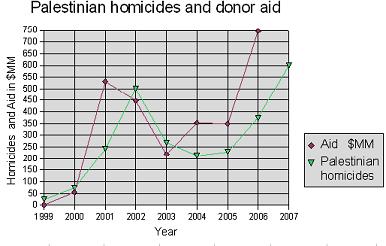
....The Palestinian record fits a broader pattern, as noted by Jean-Paul Azam and Alexandra Delacroix in a 2005 article, "Aid and the Delegated Fight Against Terrorism." They found.... the more foreign aid, the more terrorism.
If these studies run exactly counter to the conventional supposition that poverty, unemployment, repression, "occupation," and malaise drive Palestinians to lethal violence, they do confirm my long-standing argument about Palestinian exhilaration being the problem. The better funded Palestinians are, the stronger they become, and the more inspired to take up arms.
....Rather than further funding Palestinian bellicosity, Western states, starting with Israel, should cut off all funds to the Palestinian Authority.
--------------------------------------------------------------------------------
Dec. 20, 2007 update: Using the Stotsky materials and extrapolating to include the $7.4 billion committed earlier this week, Hal M. Switkay comes up with an estimate of 4,600 Palestinian-caused deaths .... in the three years ahead:
Extrapolation of Stotsky's analysis for $7.4 billion over three years.
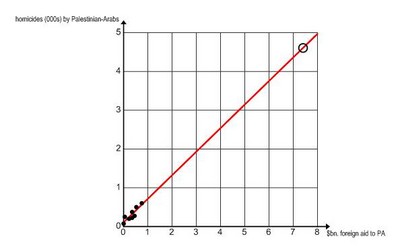
[Homicides by Palestinian Terrorists (1,000s) vs Foreign Aid (US$b)]
....One must be cautious, as the authors are, and explain that correlation – even perfect correlation – does not imply causation. One must present a plausible explanation that could justify the claim of causation, and I have one.
Most of the ignoramuses who opine or make policy regarding the Middle East and jihadists worldwide, believe that poverty causes war, just as poverty causes crime at home, and that terrorists must be given hope to stop their deadly rampage.
However, we know that quite the opposite is true: poor people can choose to study hard, work hard, and lift themselves and their communities gradually out of poverty; crime causes poverty; terrorism causes poverty; and terrorists are given hope by the craven appeasement of the empty-headed Western intellectuals and politicians who come to bargain for their lives – at others' expense, of course. My theory is justified, I believe, by the strong relationship between foreign aid and homicides that occur one year later.
Based on the strong linear correlation between foreign aid to the Palestinian Authority and the number of homicides committed by Palestinian Arabs one year later, I have used extrapolation to predict the consequences of a promised $7.4 billion in aid to the Palestinian Arabs. Please understand that extrapolation is far less reliable than interpolation. Nevertheless, my model predicts approximately 4600 homicides can be expected within a year after the infusion of the pledged foreign aid. This is equivalent to the murder of some 215,000 Americans.
Lavishing funds on Mahmoud Abbas and the Palestinian Authority to achieve peace has been a mainstay of Western, including Israeli, policy since Hamas seized Gaza in June. But this open spigot has counterproductive results and urgently must be stopped.
Some background: Paul Morro of the Congressional Research Service reports that, in 2006, the European Union and its member states gave US$815 million to the Palestinian Authority, while the United States sent it $468 million. When other donors are included, the total receipts come to about $1.5 billion....
....One report suggests the European Union has funneled nearly $2.5 billion to the Palestinians this year.
Looking ahead, Abbas ...won pledges for an astonishing $7.4 billion (or over $1,800 per capita per year) at the donors' conference. [$1,400 per year is about what an Egyptian earns annually.]
Well, it's a bargain if it works, right? A few billion to end a dangerous, century-old conflict – it's actually a steal.
But innovative research by Steven Stotsky, a research analyst for the Committee for Accuracy in Middle East Reporting in America (CAMERA) finds that an influx of money to the Palestinians has had the opposite effect historically. Relying on World Bank, International Monetary Fund, and other official statistics, Stotsky compares two figures since 1999: budgetary support aid provided annually to the Palestinian Authority and the number of Palestinian homicides annually (including both criminal and terrorist activities, and both Israeli and Palestinian victims). ....In brief, each $1.25 million or so of budgetary support aid translates into a death within the year. ....
....The Palestinian record fits a broader pattern, as noted by Jean-Paul Azam and Alexandra Delacroix in a 2005 article, "Aid and the Delegated Fight Against Terrorism." They found.... the more foreign aid, the more terrorism.
If these studies run exactly counter to the conventional supposition that poverty, unemployment, repression, "occupation," and malaise drive Palestinians to lethal violence, they do confirm my long-standing argument about Palestinian exhilaration being the problem. The better funded Palestinians are, the stronger they become, and the more inspired to take up arms.
....Rather than further funding Palestinian bellicosity, Western states, starting with Israel, should cut off all funds to the Palestinian Authority.
--------------------------------------------------------------------------------
Dec. 20, 2007 update: Using the Stotsky materials and extrapolating to include the $7.4 billion committed earlier this week, Hal M. Switkay comes up with an estimate of 4,600 Palestinian-caused deaths .... in the three years ahead:
Extrapolation of Stotsky's analysis for $7.4 billion over three years.
[Homicides by Palestinian Terrorists (1,000s) vs Foreign Aid (US$b)]
....One must be cautious, as the authors are, and explain that correlation – even perfect correlation – does not imply causation. One must present a plausible explanation that could justify the claim of causation, and I have one.
Most of the ignoramuses who opine or make policy regarding the Middle East and jihadists worldwide, believe that poverty causes war, just as poverty causes crime at home, and that terrorists must be given hope to stop their deadly rampage.
However, we know that quite the opposite is true: poor people can choose to study hard, work hard, and lift themselves and their communities gradually out of poverty; crime causes poverty; terrorism causes poverty; and terrorists are given hope by the craven appeasement of the empty-headed Western intellectuals and politicians who come to bargain for their lives – at others' expense, of course. My theory is justified, I believe, by the strong relationship between foreign aid and homicides that occur one year later.
Based on the strong linear correlation between foreign aid to the Palestinian Authority and the number of homicides committed by Palestinian Arabs one year later, I have used extrapolation to predict the consequences of a promised $7.4 billion in aid to the Palestinian Arabs. Please understand that extrapolation is far less reliable than interpolation. Nevertheless, my model predicts approximately 4600 homicides can be expected within a year after the infusion of the pledged foreign aid. This is equivalent to the murder of some 215,000 Americans.
Wednesday, December 19, 2007
Hit ‘em where it hurts
From Ynet News, by Zvi Hauser, 18/12/07:
Forget economic sanctions; Qassams should prompt Palestinian territorial losses
The failure of disengagement, Hamas’ Gaza takeover, and the ongoing Qassam rocket attacks require us to adopt “out-of-the-box” thinking regarding the way to regain Israeli’s deterrence capabilities, which have been lost.
The Israeli obsession with making do with a search for a passive, defensive solution merely encourages the belligerent Palestinian approach and boosts Hamas. Israel must change the rules of the game and actively exact a Hamas territorial price for Palestinian belligerence. Israel’s diplomatic thinking must be brought up to date in the face of the regional interpretation of our compromise policy, which labels any withdrawal as a sign of weakness.
What’s been going on in Gaza in the wake of Israel’s withdrawal proves once again that Palestinian society’s supreme value is not human life or economic welfare, but rather, land. Therefore, we should take the “land for peace” formula and link it to yet another formula, “land for war,” and present this choice to our neighbors.
The ongoing Qassam fire justifies and requires us to take over the Gaza Strip’s “northern edge” where most missiles are fired from. ....
.... The Palestinian exploitation of Israel’s unilateral pullout requires us to reassess the “withdrawal to the last centimeter” approach. The ongoing harm to human rights in Israeli Gaza-region communities justifies a renewed takeover of unpopulated territory, while making it clear to the Palestinians and to the international community that instead of killing civilians, destroying infrastructure, or cutting off the water and electricity supply to a helpless population, Israel chose the most humane move – taking over dominating positions and preventing rocket attacks on civilians.
‘Land is gained through peace, lost in war’ The loss of territory is the most painful stick that can be waived in the face of the Hamas ethos. This is the genuine price tag in Gaza. Not human life, and certainly not economic welfare and all the services that depend on electricity supply, unlike what we would expect in Western civilizations. A future withdrawal from these areas after they are retaken would only be examined as part of a comprehensive peace agreement that would guarantee the security of Israel’s citizens.
... not only those who seek normal life in Sderot must back the shunning of the failed disengagement principles, but also the eternal optimists who believe that somewhere on the horizon there is a formula for making peace with the Palestinians.
The writer is an attorney and former Communication Ministry official
Subscribe to:
Posts (Atom)