Wednesday, September 05, 2018

Israel 25 Years after the Oslo Accords: Why Israelis Shy from Victory


Pipes-Hospital-(1).jpgA cardiologist at Hadassah Hospital cares for a Palestinian baby. Many Israelis wrongly assume that if Palestinians gain sufficiently from the economic, medical, legal, and other benefits that the Jewish national revival brings them, they will relent and accept the Jewish presence.

...Prosperity Doesn’t End Hatred
Many Israelis assume that if Palestinians gain sufficiently from the economic, medical, legal, and other benefits that Zionism brings them, they will relent and accept the Jewish presence. Based on a Marxist assumption that money matters more than ideas, this outlook holds that fine schools, late-model cars, and handsome apartments are the antidote to Palestinian nationalist dreams. Like Atlantans, prosperous Palestinians will be too busy to hate.

Pullquote15.png

This idea began over a century ago, peaked around the time of the Oslo accords in 1993, and is closely associated with then-foreign minister Shimon Peres, author of the book, The New Middle East. Peres aimed to turn Israel, Jordan, and the Palestinians into a Middle East version of Benelux. More grandly, his vision hoped to emulate the French-German accord following World War II when economic ties served to end a historic enmity and form positive political bonds.
In this spirit, Israeli leaders have long worked to build the West Bank and Gazan economies. They lobbied foreign governments to fund the PA. They helped Gaza by subsidizing water and electricity, also facilitating water desalination plants. They proposed international support for an artificial island off the Gaza coast with a port, airport, and resort. They even gave Gaza a gas field.
But this effort failed, spectacularly so. Palestinian fury against Israel remains undiminished. Further, goodwill gestures have been met, not with gratitude, but with rejection. For example, upon the unilateral withdrawal of all Israelis from Gaza in 2005, their greenhouses were turned over to the Palestinians as a goodwill gesture, only to be immediately looted and destroyed.
Perhaps most egregious are the instances of Palestinians treated in Israeli hospitals who show their gratitude by attempting to murder their benefactors. In 2005, a 21-year-old Gaza woman was successfully treated in Beersheba for burns from a gas-tank explosion; she then returned the favor by attempting to attack the hospital as a suicide bomber. In 2011, a Gazan mother whose infant lacked an immune system and who was saved at an Israeli hospital announced on camera that she wanted him to grow up to be a suicide bomber. In 2017, two sisters entering Israel from Gaza, so one of them could receive cancer treatment, attempted to smuggle explosives for Hamas.
Why the failure? The French-German model included a factor absent from the Israeli-Palestinian theater: The defeat of the Nazis. Conciliation occurred not with Hitler still in power but after he and his goals had been pulverized; in contrast, the great majority of Palestinians still believe they can win (i.e., eliminate the Jewish state). They also view efforts at building their economy with suspicion, as Israel sneakily achieving hegemonic control.
As early as 1923, the Zionist leader Vladimir Jabotinsky predicted this failure, calling it infantile “to think that the Arabs will voluntarily consent to the realization of Zionism in return for the cultural and economic benefits we can bestow on them.”
More broadly, increased funding for the Palestinians has not built consumerism and individualism but rage. As one might expect, helping an enemy develop its economy while war is yet underway means supplying it with resources to continue the battle. The money has gone to incitement, “martyr” inculcation, guns, and attack tunnels. Steve Stotsky proved a decade ago the remarkably close correlation between funding for the Palestinian Authority and attacks on Israelis; each additional $1.25 million in aid, he graphed, translated into the killing of an additional Israeli.
Pipes-StotskyTables_Page_3.jpg
Steve Stotsky proved a decade ago the remarkably close correlation between funding for the Palestinian Authority and attacks on Israelis; each additional $1.25 million in aid translated into the killing of an additional Israeli.
Despite perpetual disappointment, Israeli belief in Palestinian prosperity leading to conciliation lives on. Obviously, victory has no appeal to Israelis hoping, however forlornly, for the magic of late-model cars. Wars end, historical experience shows, not by enriching the enemy but by depriving it of resources, reducing its military capabilities, demoralizing its supporters, and spurring popular revolt.[12] Toward this end, armies over the ages cut supply routes, starved cities, established blockades, and applied embargoes. In that spirit, were Israel to engage in economic warfare by withholding tax money, denying entry to laborers, and ending sales of water, food, medicine, and electricity, its actions would lead to victory.
As to the argument that Palestinian economic despair leads to more violence: This is a canard. Only people who still hope to win continue with violence; those who have lost, give up, lick their wounds, and begin to rebuild around their failures. Think of the American South in 1865, Japan in 1945, or the United States in 1975...
Timid Security Services
Two Israeli security establishments exist side-by-side: a fight-to-win one dealing with Iran and other distant enemies; and a defensive, police-style one dealing with Palestinians. The former seeks victory; the latter seeks calm. It is Entebbe vs. Jenin. It is stealing Iran’s nuclear archive vs. letting kite arsonists ply their trade.

Pullquote16.png

The security establishment being defensive matters hugely because often it has the final say on Palestinian policy as shown by the Temple Mount incident in July 2017.[17] After Palestinian jihadists killed two Israeli policemen with weapons hidden in the sacred esplanade, the Israeli government placed metal detectors at the entrance to the Temple Mount, a seemingly uncontroversial step. But Fatah demanded their removal, and despite Israel’s populace and politicians overwhelmingly wanting the metal detectors to stay, the devices quickly disappeared because the security establishment—including the police, the border police, Shabak, Mossad, and the IDF—warned that leaving them in place upset the Palestinians and would prompt violence, chaos, and even a collapse.
Pipes-TempleMount.jpg
After Palestinian jihadists killed two Israeli policemen at the Temple Mount, the Israeli government placed metal detectors at the entrance. When Fatah demanded their removal, the security establishment warned that leaving them in place would prompt violence and chaos.
The security services want to avoid knife stabbings, suicide bombings, a missile barrage from Gaza, and an intifada. Most of all, they fear the collapse of the Palestinian Authority or Hamas, requiring a return to direct Israeli rule over the West Bank and Gaza. As Einat Wilf puts it:
"If the defense establishment thinks that … funds to Gaza are buying it calm, it will do anything possible to ensure that the funds keep flowing, even if that means that the calm is purchased at the cost of a war that will go on for decades."
In prioritizing calm, the security services reject tough measures and see victory as unattainable.
This timidity explains many otherwise surprising facts about the Israeli government, specifically why it:
* Permits illegal buildings
* Turns a blind eye to the theft of water and electricity
* Avoids steps that might provoke the Palestinian leadership’s anger, such as obstructing their off-the-books income, applying the law, reducing their prerogatives, or punishing them
* Opposes the U.S. government slashing aid to the Palestinians 
* Does not stop the destruction of Temple Mount archeological treasures
* Releases convicted murderers and the bodies of dead murderers
* Allows Hezbollah to acquire over100,000 rockets and missiles, then developed plans to evacuate a quarter-million Israelis in the event of war.
* For decades encourages funding for the United Nations Relief and Works Agency for Palestine (UNRWA).
This caution has several causes: First, Israeli governments built on multi-partner coalitions tend, in Jonathan Spyer’s description, “to avoid focus on long term strategic issues, in preference for addressing immediate threats.” Why address a problem when you can kick it down the road?
Second, the Israeli security services take pride in their dealing with the here and now, not abstractions. Leah Rabin, wife of Yitzhak Rabin, once explained his mentality: “He was very pragmatic, hated to deal with something that would happen years down the road. He only thought of what would happen now, in the very near future.” Or, in the immortal command of a lieutenant to his troops, “Secure the area until the end of your shift.”
Third, just as police see criminals as incorrigible troublemakers, so wizened Israeli security chiefs view Palestinians as animal-like adversaries. Unable to imagine the Palestinians doing anything but attacking
Israelis, they reject the goal of victory; can lions attain permanent victory over hyenas? Security types often sound like Leftists, but they are emphatically not. Long and bitter experience, not misty idealism, defines their attitudes. That is why Commanders for Israel’s Security, a group of nearly 300 retired IDF officers who reached the rank of general, representing 80 percent of those in that category, argues for a two-state solution, nearly twice that of the general Israeli Jewish population.
Fourth, Israeli security professionals generally find current circumstances acceptable and do not want change. The PA under Mahmoud Abbas, for all its deficiencies (and contrary to the Arafat era) is a partner. Yes, it incites murder of Israelis and delegitimizes the State of Israel, but better these aggressions than to risk punishing Abbas, reducing his standing, and fomenting an intifada. This attitude leads to caution about change, skepticism toward a more ambitious approach, and reluctance about initiatives that might provoke Palestinian ire.

Pullquote17.png

Fifth, because Palestinians lack military power, they are seen as criminals more than as soldiers; accordingly, the IDF has turned from a military force into a police force, complete with a defensive mentality. Generals seek victory, but police chiefs aim to protect lives. Saving lives translates into seeing stability as a goal in itself. Generals do not enter battle with the goal of saving the lives of their soldiers, but that is how a police chief sees an encounter with criminals. Sixth, the Four Mothers Movement of 1997-2000 traumatized the IDF by managing to spark an emotional backlash against the occupation of southern Lebanon, leading to an ignominious withdrawal.[26] This emphasis on saving soldiers’ lives rather than on achieving strategic goals remains an abiding worry for the IDF leadership.
In all, the main opposition to Israel’s victory comes not from the hapless Left but from the security services. Fortunately, the defense establishment has dissenters who both seek political leadership and Israel’s victory: Gershon Hacohen, who calls for political leaders to exercise independent judgment, is a good example; Yossi Kuperwasser is another.
All who hope for a resolution of the Palestinian problem should urge the Israeli government to squeeze the PA and Hamas. This also suits Palestinian interests, liberating them from their obsession with Israel, so they can build their own polity, economy, society, and culture. Everyone gains from an Israel victory and a Palestinian defeat...
Daniel Pipes (DanielPipes.org, @DanielPipes) is president of the Middle East Forum and publisher of the Middle East Quarterly.

Why Did Rabin Fall for he Oslo Accords?

From Middle East Quarterly Fall 2018 Volume 25: Number 4, SEPTEMBER 01, 2018, by EFRAIM KARSH:

Precisely two decades after the failure by the Golda Meir government to identify a willing Arab peace partner triggered the devastating 1973 Yom Kippur war, another Labor government wrought a far worse catastrophe by substituting an unreconstructed terror organization committed to Israel’s destruction for a willing peace partner. Instead of ending the Palestinian-Israeli conflict, the “Oslo peace process” between Israel and the Palestine Liberation Organization (PLO) created an ineradicable terror entity on Israel’s doorstep that has murdered some 1,600 Israelis, rained thousands of rockets and missiles on the country’s population centers, and toiled tirelessly to delegitimize the right of the Jewish state to exist.

KarshFall2018(1).jpg
(Left to right): PLO chairman Yasser Arafat, Israeli foreign minister Shimon Peres, and prime minister Yitzhak Rabin accept the 1994 Nobel Peace prize in Oslo. Instead of peace, two of Israel’s foremost security and foreign policy veterans created an ineradicable terror entity on Israel’s doorstep.

How did this come to pass? Why did two of Israel’s foremost security and foreign policy veterans—Prime Minister Yitzhak Rabin and Foreign Minister Shimon Peres—lead Israel into what a prominent PLO official candidly described as a Trojan horse designed to promote the organization’s strategic goal: “Palestine from the [Jordan] river to the [Mediterranean] sea”—that is, a Palestine in place of the state of Israel.
Eyes Wide Shut
PLO chairman Yasser Arafat was a diehard man of war who made violence, dislocation, and mayhem the defining characteristics of his career. In 1970, he nearly brought about the destruction of Jordan. Five years later, he helped trigger the horrendous Lebanese civil war, one of the bloodiest conflicts in modern Middle Eastern history, which raged for more than a decade and claimed hundreds of thousands of innocent lives. In 1990-91, he supported the brutalization of Kuwait by Saddam Hussein, at an exorbitant cost to the Palestinians living there, thousands of whom were murdered in revenge attacks while hundreds of thousands more were expelled after Kuwait’s liberation. In between these disasters, Arafat made the Palestinian national movement synonymous with violence and turned the PLO into one of the world’s most murderous terror organizations with the overarching goal of bringing about Israel’s demise.
How, then, did the Rabin government come to believe in the instantaneous transformation of the man and his organization into dedicated agents of peace? ...
In Peres’s view, by joining the Oslo process, Arafat and the PLO had become partners to a momentous historical odyssey; and as long as this partnership remained intact, its success was a foregone conclusion:
"I think what is really important for a peace process is the creation of a partner, more than a plan [b]ecause plans don’t create partners, but if you have a partner, then you negotiate a plan. …When I was thinking about the peace process, I knew in my heart that the greatest problem is how to transform Arafat from the most hated gentleman in this country, and himself with an array of very strange ideas, into a partner that we can sit with, and make him become acceptable to our people— maybe not beloved but at least accepted." 
But what if the would-be partner failed to act out the role ascribed to him? What if his “array of very strange ideas” proved impermeable to change? Peres’ response: “We close our eyes. We don’t criticize because, for peace, we must produce a partner.” 

Pullquote1.png

Peres fully lived up to this principle, going out of his way to deny, dilute, and whitewash the countless Palestinian violations of the accords, or indeed—anything that alluded to the PLO’s continued commitment to Israel’s destruction. “The right of return is in my view an Arab dream that is bound to remain a dream,” he dismissed the Palestinian euphemism for Israel’s destruction through demographic subversion as late as September 2001, after the issue had been instrumental in wrecking both the July 2000 Camp David summit and President Clinton’s proposed peace plan several months later. “I thought then, just as I think today, that one can solve problems without giving up the dreams."
Peres was similarly delusional about the PLO’s failure to abolish the clauses in the Palestinian covenant calling for Israel’s destruction, as required by the Oslo accords. Thus, for example, when the speaker of the Palestinian National Council (PNC), the PLO’s semi-parliament, conditioned the covenant’s amendment on fresh Israeli concessions, Peres dismissed his demands out of hand. “We did not sign an agreement with the PNC speaker. We signed it with the PLO leadership and it is incumbent upon them to ensure its implementation,” he argued, as if it were not the PNC that had adopted the covenant in the first place in 1964, revised it in 1968, and was the only body legally authorized to execute the required amendments. Small wonder that when Arafat informed him on May 4, 1996, that the covenant had been amended, Peres instantaneously lauded the alleged move as “the most important event in the Middle East in a hundred years” though it quickly transpired that no such amendment had actually taken place. Indeed, the covenant, with its plethora of articles calling for Israel’s destruction, stands unrevised to this very day.
When, in May 1994, Arafat told a closed meeting of Muslim leaders in Johannesburg that the Oslo accords were a temporary arrangement designed to bring about Israel’s eventual demise, urging them to help spark a pan-Muslim jihad against Israel, Peres excused the comments as reflecting Arafat’s tortuous adjustment to the new reality while Beilin brushed the remarks off as “silly words.”

Karsh-ArafatV.jpg
In May 1994, Arafat told a closed meeting of Muslim leaders that the Oslo accords were a temporary arrangement designed to bring about Israel’s eventual demise, urging them to spark a pan-Muslim jihad against Israel.

...[Beilin predicted] that “the greatest test of the accord will not be in the intellectual sphere, but will rather be a test of blood.” Should there be no significant drop in the level of violence and terrorism “within a reasonable period of time” after the formation of the Palestinian Authority, he argued, the process would be considered a failure, and Israel would have no choice but to renege on the Oslo accords. “This will only be a means of last resort,” he said. “But if we realize that the level of violence does not subside, we will not be able to proceed, and will most certainly not implement the final-status agreement. And should there be no choice, the IDF will return to those places which it is about to vacate in the coming months." 

Karsh-Sadat.jpg
Egyptian president Anwar Sadat (right) shakes hands with Israeli prime minister Menachem Begin, Jerusalem, November 20, 1977. Following the signing of the Egyptian-Israeli peace treaty in March 1979, Rabin believed that the greatest remaining threat to Israel’s national security was Syria and that a Syrian-Israeli agreement was also likely to pave the road for peace with Lebanon and the Palestinians.
Twenty-five years and thousands of deaths later, with the Gaza Strip transformed into an entrenched terror entity and Israel experiencing horrific waves of terrorism as never before, there is no doubting the abysmal failure of this “test of blood.” Yet rather than reconsider his disastrously flawed premises in the face of their horrendous cost, let alone follow his own pledge to stop the process in such circumstances, Beilin, like other “peace camp” acolytes, continued to willfully ignore the Palestinians’ wanton violation of contractual obligations while blaming Israel for the stalled process. This, despite the public endorsement of the two-state solution by five successive Israeli prime ministers: Shimon Peres, Ehud Barak, Ariel Sharon, Ehud Olmert, and Benjamin Netanyahu.
Rabin’s Reversal
If Peres and Beilin’s self-delusion can be partly explained, if not condoned, on ideological grounds, Rabin’s behavior seems nothing short of the extraordinary. Unlike Beilin, he did not equate peacemaking and reconciliation with appeasement and self-flagellation; unlike Peres, he had no pipe dream of a budding “New Middle East.” Rather he was a quintessential representative of the “activist” approach to the Arab-Israeli conflict dating back to Zeev Jabotinsky and David Ben-Gurion, which upheld that peace would only follow upon Arab realization of the inability to destroy Israel by force of arms. And since the March 1979 Egyptian-Israeli peace treaty had removed the largest and most powerful Arab state from the circle of war, Rabin believed that Israel’s top strategic priority was to neutralize the remaining greatest threat to its national security: Syria. A Syrian-Israeli agreement, he reasoned, was also likely to pave the road for peace with Lebanon, long under Damascus’s tutelage, and with the Palestinians, who would have no choice but to fall in line with their stronger Arab allies.
It was only upon realizing that President Hafez Assad would not take the plunge despite Israel’s readiness to withdraw from virtually the entire Golan Heights that Rabin turned his sights to the Palestinian track. ...

Karsh-Beilin-Abbas.jpg
Yossi Beilin (right) with Mahmoud Abbas, then the PLO signatory for the Oslo accords. Rabin’s lack of faith in Oslo was a corollary of his distrust of Shimon Peres and Beilin, whom he labelled “Peres’s poodle.”

Pullquote3.png

Above all, Rabin’s readiness to embrace Oslo was grounded in his conviction in the reversibility of the process. As he told a high-ranking consultation shortly before departing for the Washington signing ceremony:
"An agreement with the Palestinians is reversible. An agreement with Syria is irreversible. Should the Palestinians cause trouble, we will reenter [their territory]. This is our backyard. But if we give the Golan Heights to Syria, we will have to launch a full-fledged war [should Damascus violate the agreement]." 
...On October 20, 1994, a week after delivering his toughest reprimand of Arafat following the murder of twenty-one people in a suicide bombing on a Tel Aviv bus, Rabin stated that it would be a mistake to blame the PA for the rampaging terrorism. At a press conference with Arafat on January 19, 1995, he went further by claiming that Israel did not expect watertight guarantees on the halt of all attacks from PA-controlled territories. When three days later nineteen Israelis were murdered in a suicide bombing at the Beit Lid junction in central Israel—with Arafat publicly applauding the atrocity—Rabin temporarily banned Palestinian movement from the territories to Israel and threatened that “we will not be able to move forward unless we are confident that the personal security [of Israelis] is assured." 

karsh-Rabin.jpg
At a press conference with Yasser Arafat, January 19, 1995, Rabin claimed that Israel did not expect watertight guarantees on the halt of all attacks from PA-controlled territories

Yet for all his exasperation, he could not bring himself to break with Arafat. When Israeli president Ezer Weizmann, himself a leading proponent of Israeli-Palestinian reconciliation, called for a response to the Beit Lid massacre by halting the Oslo process, Rabin was reportedly “livid,” though some of his ministers backed the suggestion and even Uri Savir, Oslo’s chief negotiator, warned, “We need a profound change of direction to make the next stage a success."
This was not the first time that Rabin rejected the idea of constraining Arafat’s power. In 1994, he had declined a request by the two most prominent “inside” politicians, Faisal Husseini and Hanan Ashrawi, to assist with the creation of a democratic regime in the territories that would replace the corrupt and oppressive rule established by Arafat and his Tunis cronies. The idea was to hold proportional elections for a legislative council, after which the winning party or parties would form a government. This was naturally anathema to Arafat, who insisted on presidential elections where his victory was a foregone conclusion. Rabin dutifully complied, turning down the proposal.
Having ruled out the possibility of a more democratic and less militant Palestinian regime likely headed by the local leadership he had preferred in the first place, Rabin stuck with Arafat, whom he considered, in a curious twist of logic, both a tacit supporter of terrorism and a peacemaker. Acknowledging that Arafat had made no serious effort to fight terrorism or to enforce law and order in Gaza, he nevertheless insisted that “there is no other partner ready to make peace … [or] negotiating with a partner who is ready to make peace … We must abide by our commitments provided Arafat will contain the terrorism emanating from the territories under his control." 

Pullquote4.png

The problem with this assertion was, of course, that Arafat was not trying to make peace or curb terrorism. In April 1995, Maj. Gen. Shaul Mofaz, commanding officer of Southern Command, described Gaza as a hotbed of terrorism and questioned the PA’s ability to fight terrorism in the West Bank once it took control of the area at the end of the year. In the same vein, the head of the military intelligence research department estimated that once the IDF withdrew from the West Bank’s populated areas, the PA would lose all remaining incentives to fight terrorism. This stark prognosis was corroborated by a senior Gaza police officer who revealed that mass arrests carried out by the PA after major terror attacks were “a big show” for Israeli and American consumption, with most detainees released shortly after their arrest having promised not to engage in future acts of terrorism.
Even Lt. Gen. Amnon Shahak, the IDF’s chief-of-staff and Rabin’s protégé, who had carried out delicate political and diplomatic missions on the prime minister’s behalf, warned the Knesset’s foreign affairs and defense committee on August 23, 1995: “If the PA will not act decisively against Palestinian terrorism, everything we are doing now will fail.” Two weeks later, as the Interim Agreement was about to be signed in Washington, the head of the military intelligence research department argued that the PA intensified its anti-terrorist measures only when it feared Israeli retribution. “For Arafat,” he added undiplomatically, “peace is shit.”
Ignoring the considered opinions of his most senior military advisers, Rabin signed the Interim Agreement on September 28, 1995. When questioned about the prudence of this move by American Jewish leaders, he exploded and told the Israeli press, “One should not waste any time on them. They are pariah Jews. They will be judged by Jewish history.” This outburst, however, seemed to reflect Rabin’s inner doubts about his latest move rather than an unwavering conviction in it. Shortly afterwards he confided to Nobel Peace Prize laureate Elie Weisel, “Initially, I thought that Arafat was the solution. Now I am convinced that he is the problem.” 
Rabin’s Real “Peace Legacy”
In the decades attending Rabin’s assassination on November 4, 1995, an extensive “peace legacy” associated with his name has been created, transforming him from “Mr. Security,” as he had been widely known prior to Oslo, into an indefatigable “peacenik,” who would leave no stone unturned in the tireless quest for reconciliation. Had it not been for his assassination, ran a common argument, the peace process would have made substantial progress if not been brought to fruition.

Karsh-RabinFuneral.jpg
Shimon Peres (standing) shakes hands with Jordan’s King Hussein during Yitzhak Rabin’s funeral, November 6, 1995. Rabin did not embrace Oslo out of a burning desire for peace but was maneuvered into it by Peres, hoping that it would help consolidate Israel’s security.
Reality, of course, was quite different. Rabin had never been a member of the “flower generation,” to use Henry Kissinger’s handy quip, but a hardened security man who viewed peace through this prism rather than the other way around. He did not embrace Oslo out of a burning desire for peace but was maneuvered into it by his lifetime nemesis, hoping that it would help consolidate Israel’s security yet lacking a clear idea where the process was headed or, indeed, should be headed. As his widow put it shortly after his assassination, “He was very pragmatic, hated to deal with something that would happen years down the road. He only thought of what would happen now, in the very near future. As far as I know, he did not have a very clear picture of what the final-status agreement would look like.”
Had it been up to Rabin, he would have avoided Oslo altogether in favor of an Israeli-Syrian agreement, and in its absence, a deal with the West Bank and Gaza leadership. As it were, not only did he not view the process in anything remotely reminiscent of the posthumous idealism misattributed to him, but the farther he walked down that path, the greater his disdain for his “peace” partner became—and the lesser his inclination for concessions. He repeatedly lamented that had he known in advance Arafat’s real intentions, he would have never signed the Oslo accords, telling confidents and subordinates (including Henry Kissinger, Tel Aviv mayor and former comrade in arms, Shlomo Lahat, and head of military intelligence Moshe Yaalon) of his intention to revisit, if not abandon, the process after the 1996 elections.
It is doubtful whether Rabin would have indeed disengaged from Oslo in the rather unlikely event of his reelection (at the time of his assassination, he was trailing Netanyahu in most polls, in some by as many as thirteen points) —something that even Netanyahu found impossible to do. It is clear, however, that his perception of the broad contours of the final-status arrangement, as presented in his October 5, 1995 Knesset defense of the Interim Agreement he had signed the previous week, was far more restrictive than that of any of his successors, Netanyahu included.
Rejecting the two-state solution altogether, Rabin foresaw “an entity short of a state that will independently run the lives of the Palestinians under its control” within narrower boundaries than the pre-June 1967 lines. The Jordan Valley area, “in the broadest sense of the word,” was to constitute Israel’s security border, and a united Jerusalem “comprising Maale Adumim and Givat Zeev” was to remain under Israel’s sovereignty. 
Conclusion
It is a historical irony that it was Benjamin Netanyahu, who had vehemently opposed the Oslo process from the outset, who publicly announced Israel’s support for the creation of a Palestinian state, both in his June 2009 Bar-Ilan speech and May 2011 address to a joint meeting of the U.S. Congress. In doing so, he went further not only from Rabin’s “Palestinian entity short of a state” but also from Peres’s preferred vision of peace. For, contrary to the conventional wisdom, Peres did not consider the creation of a Palestinian state an automatic, or even desirable, consequence of the Oslo process. Rather he subscribed to Labor’s old formula of a Jordanian-Palestinian confederation, which he sought to sell to Rabin, Arafat, King Hussein, presidents Bill Clinton and Egypt’s Husni Mubarak, and Morocco’s King Hassan II, among others.
It was thus Beilin who shrewdly steered his two superiors towards a path they had not planned to take despite his keen awareness of the untrustworthiness of the “peace” partner. As he put it on one occasion:
"I never had any illusions regarding Arafat. I never considered him an important world leader. I think he has committed numerous follies. He could have achieved a lot for his people many years ago, and his personal record includes almost every possible mistake … But since I have only Arafat, despite all the stupidities he utters, I must negotiate with him." 
This approach probably makes the Oslo process the only case in diplomatic history where a party to a peace accord was a priori amenable to its wholesale violation by its cosignatory. There have, of course, been numerous agreements where one or both parties acted in bad faith. The September 1938 Munich agreement, to give a prime example, was conceived by Hitler as a “Trojan Horse” for the destruction of Czechoslovakia, a strategy emulated by Arafat fifty-five years later with the Oslo process. But while there was little Czechoslovakia could do given its marked military inferiority and betrayal by the international community, in Oslo, it was the stronger party that allowed its far weaker counterpart to flaunt the agreement with impunity—with devastating consequences that would haunt both sides for decades to come.
Efraim Karsh, editor of the Middle East Quarterly, is director of the Begin-Sadat Center for Strategic Studies at Bar-Ilan University and emeritus professor of Middle East and Mediterranean studies at King's College London

Wednesday, August 29, 2018

The Liberty of Nations

From the WSJ Saturday Essay, 29 Aug 2018, by Yoram Hazony (brief excerpts only - follow the link for the full essay): 

Nationalism is widely denounced today, but its critics overlook its long history as the foundation of limited government and individual liberty and its role in allowing human diversity to flourish

Nationalism is on the rise across the globe. It is key to Donald Trump’s appeal in the U.S. It is the driving force behind resistance to the European Union and its policies in Britain, Italy, Austria, Poland and Hungary. And it is reflected in the success of Narendra Modi in India, Shinzo Abe in Japan and Benjamin Netanyahu in Israel. Even before considering more complicated examples such as Russia, Turkey and China—whose politics have arguably taken a nationalist turn as well—this constitutes a broad revival of nationalist ideals and aspirations.

Many critics see this revival as the greatest political danger of our time. But it is a mistake to think of nationalism as an inherently regressive or destructive political force. In fact, nationalism was the engine that established modern political liberty, and it has been a spur to diversity among nations. It has been embraced by both liberals and conservatives, including revered figures such as Woodrow Wilson and Teddy Roosevelt, David Ben-Gurion and Mahatma Gandhi, Charles de Gaulle and Margaret Thatcher....

...National cohesion is the secret ingredient that allows free institutions to exist, the bedrock on which a functioning democracy is built. No wonder, then, that no multinational empire has ever been ruled as a democracy. Lacking mutual loyalty, its respective nationalities see one another only as a threat. That was the case in multinational states such as the Soviet Union, Yugoslavia, Syria and Iraq. In the long run, nothing holds such states together but coercion. In such cases, lifting the oppression of the state doesn’t bring freedom, only dissolution and civil war.

Of course, this doesn’t mean that every national state will have free institutions and protect individual liberties. But even national states far removed from the West—such as India, Israel, Japan, South Korea and Taiwan—have succeeded in imitating the English and American precedents. We are still waiting to see a multinational regime that is able to maintain genuine democracy over time....

...Nationalism has its vices and its extreme expressions. Every nationalist movement contains haters and bigots (though not necessarily more of them than are found in universalist political and religious movements). But nationalism’s vices are outweighed by its considerable virtues. A world in which independent nations are permitted to compete freely with one another is a world in which diverse ways of life can flourish, each an experiment in how human beings should live. We have good reason to believe that such a world holds out the best prospects for freedom, for innovation and advancement, and for tolerance.

(brief excerpts only - follow the link for the full essay)

US rejects the "Palestinian Right of Return”

From World Israel News, 25 August 2018:

Report: Trump to oppose Palestinian ‘Right of Return’
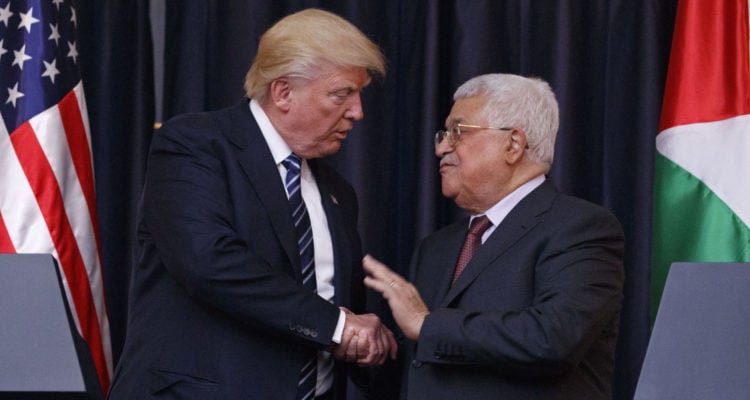
US President Donald Trump and PA leader Mahmoud Abbas. 
(AP/Evan Vucci, File)

President Donald Trump will announce the US rejection of the Palestinian “Right of Return” in the next several days, Israel’s Hadashot TV reported Saturday.

The Palestinians claim refugee status for five million people, which includes millions of descendants of the approximately 700,000 original refugees who were living in British Mandatory Palestine, or what is now the State of Israel, and were displaced during the 1948 War of Independence.

These descendants of refugees, supported by the United Nations Relief and Works Agency for Palestine (UNRWA), live in Judea and Samaria, the Gaza Strip, Jordan, Syria and Lebanon.

The majority of the original refugees are no longer alive.
“UNRWA is unique in terms of its long-standing commitment to one group of refugees. It has contributed to the welfare and human development of four generations of Palestine refugees, defined as ‘persons whose normal place of residence was Palestine during the period 1 June 1946 to 15 May 1948, and who lost both home and means of livelihood as a result of the 1948 conflict.’ The descendants of Palestine refugee males, including legally adopted children, are also eligible for registration,” the Agency states on its website.
The Trump administration has challenged UNRWA’s mandate, suggesting that UN funding instead go to the UN body responsible for all other refugees.
 
In a recent statement to the Israeli cabinet, echoing the US administration, Prime Minister Benjamin Netanyahu called it an “absurdity” that “there are already great-grandchildren of non-refugees” supported by UNRWA.

The Right of Return has been one of the sticking points in the Israeli-Palestinian negotiations. Israel has a population of close to nine million and sees the influx of five million “refugees” as a threat to its existence.

Trump’s announcement on the Right of Return will be made ahead of the next session of the UN General Assembly in September, the report said.

Monday, August 13, 2018

Declarations of 'fervent support' for nation-state law

From Israel Hayom, 9 Aug 2018, by Mati Tuchfeld and Israel Hayom Staff:

A group of former Prisoners of Zion and the group Professors for a Strong Israel each voiced their support for the nation-state law in letters to government ministers and Knesset lawmakers on Wednesday.

"We, the aliyah activists and Prisoners of Zion, who paid for our aspirations to be in the Land of Israel, the State of Israel, the land of the Jewish people with lengthy prison sentences declare our fervent support for the nation-state law passed by Israel's Knesset. This Basic Law strengthens the connection of Jews from all over the world to the State of Israel and proclaims that the State of Israel is the state of the Jewish people," the Prisoners of Zion wrote.
"It seems that the need to enact a national law has been on the agenda since the establishment of the independent state of Israel. In our view, it is rather strange that this was only now passed.
"We hope the legislation will block the incessant attempts to empty Israel of its Jewish national character and turn it into a state of all its citizens.
"There is no contradiction between democracy and nationalism. Both these premises complete and strengthen one another. Moreover, the Jewish national character of the state serves to guarantee the existence and development of democracy."
The letter also condemned opponents of the law.

"It is peculiar that there are certain groups and people who on the one hand call themselves Zionists but on the other hand reject the nation-state law. It is inconceivable that one can be a Zionist and oppose the nation-state law. Furthermore, the attacks on the nation-state law are continuing and even growing, even after the legislation was lawfully passed by the Knesset. This clearly contradicts the democratic process.
"The nation-state law does not violate the rights of non-Jewish citizens and every law-abiding citizen who fulfills their civic duties will be afforded respect and equality. The nation-state law established the Jewish national character of the state and lays a solid foundation for the existence of a democratic, healthy and prosperous society in which there is room for diversity of opinion and belief."

The group Professors for a Strong Israel also voiced support for the legislation on Wednesday. Members criticized opponents of the law, saying that 
"a large group has formed whose goal is to transform the State of Israel from the Jewish nation-state to a state of all its citizens, through the negation of the idea of a Jewish state."Supporters of this approach, and they are many, act in various ways to promote their goal, including through the judicial system, the activities of the branches of the New Israel Fund and now through the employment of non-Jewish minorities."
Meanwhile, the Kohelet Policy Forum convened on Wednesday to toast the enactment of the nation-state law. Among those in attendance were the founders of the Institute for Zionist Strategies and other activists involved in the various stages of formulating and preparing the legislation.

Also in attendance were Likud MKs Avi Dichter and Amir Ohana, Jerusalem Affairs Minister and mayoral candidate Zeev Elkin, Aramean Christianity representative Shadi Halul and Israel Hayom Editor-in-Chief Boaz Bismuth.

Dichter told the conference that those who claim the law contradicts the Declaration of Independence and harming minorities had obviously not read it or were trying to pull the wool over others' eyes.

Kohelet Policy Forum head Moshe Koppel said that in another 20 years, the current uproar over the law would be long forgotten. He said all that would be remembered would be that in 2018 the Knesset legislated one of the most important laws in the state's history.

Thursday, August 09, 2018

Ending Fake Refugee Status for Millions of Palestinian Arabs

From Foreign Policy, AUGUST 3, 2018, BY COLUM LYNCH, ROBBIE GRAMER:

White House Senior Advisor Jared Kushner stands with U.S. Ambassador to the United Nations Nikki Haley at a U.N. Security Council meeting on Middle East issues on Feb. 20. (Drew Angerer/Getty Images)
White House Senior Advisor Jared Kushner stands with U.S. Ambassador to the United Nations Nikki Haley at a U.N. Security Council meeting on Middle East issues on Feb. 20. 
(Drew Angerer/Getty Images) 

Jared Kushner, U.S. President Donald Trump’s son-in-law and senior advisor, has quietly been trying to do away with [UNRWA], according to internal emails obtained by Foreign Policy.

His initiative is part of a broader push by the Trump administration and its allies in Congress to strip these Palestinians of their refugee status in the region and take their issue off the table in negotiations between Israel and the Palestinians, according to both American and Palestinian officials. At least two bills now making their way through Congress address the issue....

“It is important to have an honest and sincere effort to disrupt UNRWA,” Kushner wrote ...“This [agency] perpetuates a status quo, is corrupt, inefficient and doesn’t help peace...” ...
The United States has helped fund UNRWA since it was formed in 1949 ...

...many... today see UNRWA as part of an international infrastructure that has artificially kept the refugee issue alive and kindled hopes among the exiled Palestinians that they might someday return home...

Critics of the agency point in particular to its policy of granting refugee status not just to those who fled Mandatory Palestine 70 years ago but to their descendants as well—accounting that puts the refugee population at around 5 million, nearly one-third of whom live in camps across Jordan, Lebanon, Syria, the West Bank, and Gaza.

...Kushner raised the refugee issue with officials in Jordan during a visit to the region in June, along with Special Representative for International Negotiations Jason Greenblatt. According to Palestinian officials, he pressed the Jordan to strip its more than 2 million registered Palestinians of their refugee status so that UNRWA would no longer need to operate there.

“[Kushner said] the resettlement has to take place in the host countries and these governments can do the job that UNRWA was doing,” said Hanan Ashrawi, a member of Executive Committee of the Palestine Liberation Organization.

...Saeb Erekat, the Palestinians’ chief negotiator, told reporters in June that Kushner’s delegation had said it was ready to stop funding UNRWA altogether and instead direct the money—$300 million annually—to Jordan and other countries that host Palestinian refugees.

“All this is actually aimed at liquidating the issue of the Palestinian refugees,” he said.

The White House declined to comment on the record for this story. A senior executive branch official, speaking on condition of anonymity, said U.S. policy regarding the U.N.’s Palestinian refugee program “has been under frequent evaluation and internal discussion. The administration will announce its policy in due course.”

Jordanian officials in New York and Washington did not respond to queries about the initiative.

Kushner and Nikki Haley, the U.S. ambassador to the United Nations, both proposed ending funding for UNRWA back in January. ...

The following week, the State Department announced that that United States would cut the first $125 million installment of its annual payment to UNRWA by more than half, to $60 million.

...Victoria Coates, a senior advisor to Greenblatt, sent an email to the White House’s national security staff indicating that the White House was mulling a way to eliminate the U.N.’s agency for Palestinian refugees.
“UNRWA should come up with a plan to unwind itself and become part of the UNHCR [U.N. High Commissioner for Refugees] by the time its charter comes up again in 2019,” Coates wrote.
...Of the roughly 700,000 original Palestinian refugees, only a few tens of thousands are still alive, according to estimates.

The push to deny the status to most Palestinians refugees is also gaining traction in Congress.

Last week, Rep. Doug Lamborn, a Republican from Colorado, introduced a bill that would limit the United States to assisting only the original refugees. Most savings in U.N. contributions would be directed to the U.S. Agency for International Development, the United States’ principal international development agency. But USAID is currently constrained by the Taylor Force Act, which restricts the provision of humanitarian assistance to the Palestinian Authority until it ends a policy of providing aid to families of fallen terrorists.

“Instead of resettling Palestinian refugees displaced as a result of the Arab-Israeli Conflict of 1948, UNRWA provides aid to those they define as Palestinian refugees until there is a solution they deem acceptable to the Israeli-Palestinian conflict,” Lamborn’s bill states.
“This policy does not help resettle the refugees from 1948 but instead maintains a refugee population in perpetuity.”
A congressional aide familiar with the legislation said its intent isn’t to gut UNRWA funding, but redirect assistance to descendants through USAID...

Similarly, Sen. James Lankford, (R-Okla.), has drafted legislation that would redirect U.S. funding away from UNRWA and to other local and international agencies.

The bill, which has not yet officially been introduced, would require the U.S. secretary of state certify by 2020 that the United Nations has ended its recognition of Palestinian descendants as refugees.
“The United Nations should provide assistance to the Palestinians in a way that makes clear that the United Nations does not recognize the vast majority of Palestinians currently registered by UNRWA as refugees deserving refugee status,” reads a draft obtained by Foreign Policy.
...previous U.S. administrations have maintained that the vast majority of Palestinian refugees will ultimately have to be absorbed in a new Palestinian state or naturalized in the countries that have hosted them for generations...

Iranian Proxies

From MEMRI Special Dispatch No.7612, August 7, 2018:

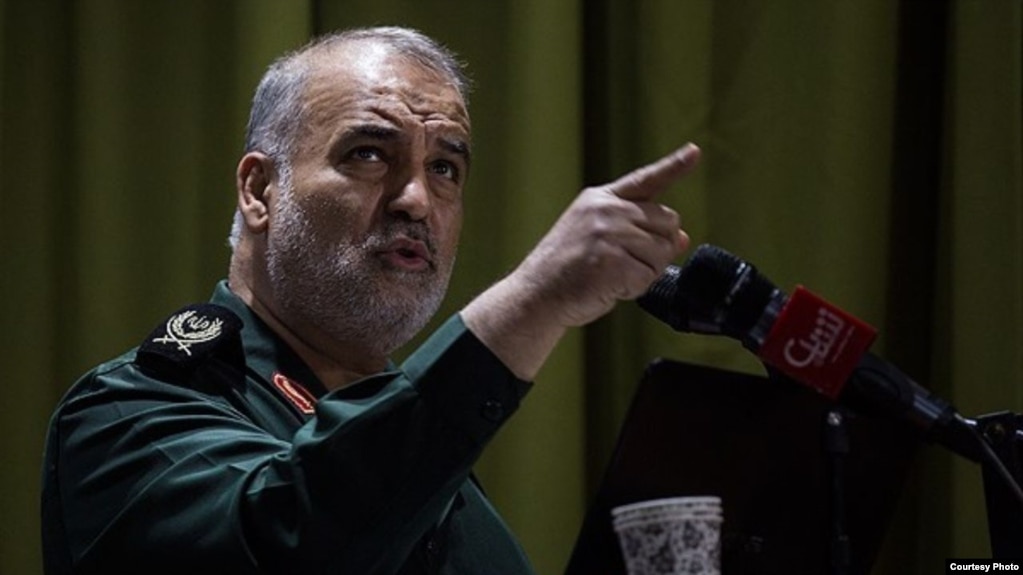
A commander of Iranian Revolutionary Guards, Nasser Sha'bani

On August 6, 2018, the Iranian news agency Fars published statements by Gen. Naser Sha'bani, a top official of Iran's Islamic Revolutionary Guards Corps (IRGC), in which he noted that the regime of the Islamic Revolution had ordered the pro-Iran Ansar Allah (Houthi) militia in Yemen to attack two Saudi tankers, and that it had carried out those orders.

Also in his statements, Gen. Sha'bani clarified that both the Shi'ite Hizbullah in Lebanon and Ansar Allah in Yemen ... would continue to be used for Iran's purposes against its rivals in the region, particularly Saudi Arabia.

It should be emphasized that the quote about the order to attack the tankers was deleted from the Fars website after the statements were published. MEMRI has in its possession a copy of the original prior to the deletion...

Friday, August 03, 2018

OMG! Now the Jews want Israel to be Jewish!

From The Spectator, 4 August 2018, by James Kennard:

The Information for prospective Australians that I had to master before I became a citizen declared 
‘Australia is a secular country’. 
Except it’s a little more complicated than that. The very next line in the document observed that 
‘Christmas and Easter are public holidays’. 
Add in that 

  • the parliament opens each day with a Christian prayer; 
  • the Head of State is also the Head of the Anglican Church; 
  • the flag is embellished with three (arguably four) Christian crosses, 
and it turns out that ‘secular’ Australia shows a lot more respect to one religion than to any other.

And, as a non-Christian, I’m fine with that. I am a proud Australian, and respect its religious character even while I do not share it. In fact, in this age of militant and intolerant secularism, I would wish for Australia’s Christian ethos to be more impactful than it currently is.

There are many other developed nations that make their religious or national identity clear, without being accused of disadvantaging or discriminating against adherents of other religions or bearers of other national identities.

In the UK, the national anthem is a religious hymn; senior bishops are automatically members of parliament and each school must hold a daily act of worship ‘of a Christian character’.

The opening of Ireland’s constitution leaves little doubt as to its religious leanings – ‘We, the people of Éire, Humbly acknowledging all our obligations to our Divine Lord, Jesus Christ.’ Norway’s constitution not only mandates that ‘The Evangelical-Lutheran religion shall remain the official religion of the State’ and that ‘The King shall at all times profess the Evangelical-Lutheran religion’ but even requires that ‘the inhabitants professing it are bound to bring up their children in the same’. Greece declares that ‘The prevailing religion in Greece is that of the Eastern Orthodox Church of Christ’.

Yet none of these countries is condemned for treating adherents of other religions or none as ‘second class’ or introducing an apartheid hierarchy. Latvia is not accused of racism because its constitution proclaims ‘the unwavering will of the Latvian nation to have its own State and its inalienable right of self-determination in order to guarantee the existence and development of the Latvian nation, its language and culture’.

For each of these countries, and dozens more, being the nation-state of a particular group whilst fully welcoming as citizens members of other groups is unremarkable. And let’s not overlook the numerous states that call themselves Islamic, apply Islamic law and do indeed deny rights to non-Muslims, whilst managing to escape any opprobrium.

But as usual, one particular country is treated differently. Listening to the cacophony of criticism accompanying Israel’s recently passed Basic Law (the nearest thing that Israel has to a constitution) entitled ‘Israel as the Nation State of the Jewish People’, one would have thought that the new law bars non-Jews from living in Israel, or at least consigns them to some inferior status with diminished civil rights.

It does nothing of the sort.

Image result for jews in israel
Israelis wave national flags outside the Old City's Damascus Gate in Jerusalem on May 13. 
(Ariel Schalit / Associated Press)

The law declares that ‘The State of Israel is the national home of the Jewish people, in which it fulfills its natural, cultural, religious and historical right to self-determination’. It goes further and states that ‘The right to exercise national self-determination in the State of Israel is unique to the Jewish people’. So there is the one single right that non-Jews are denied – the right to end the existence of the world’s sole Jewish state by making it into something else.

In fact the new law protects the status of minorities far more than the constitutions of other ‘liberal’ countries do. ‘Non-Jews have a right to maintain days of rest on their Sabbaths and festivals’ (unlike the situation in, say, Australia, whereby Jews and Muslims have to use annual leave in order to observe their holy days). ‘The Arabic language has a special status in the state’, which compares most favourably to the status of Russian in Latvia, or Basque in Spain, or Indigenous languages in Australia.

Another clause observes that ‘The state views the development of Jewish settlement as a national value and will act to encourage and promote its establishment and consolidation’. Naturally, the BBC news reported this as support for ‘settlements’, given that viewers need no reminding that these are evil manifestations of Israel’s expansionism, yet ‘settlement’, in the singular, means something quite different.

Those familiar with the history of Zionism, the Jews’ national liberation movement, will recognise support for settlement of the land as one of its key values. Before it even dreamed of statehood, the Zionist movement sought to bring Jews back to the land itself, to get dirt under their fingernails, to drain the swamps and to make the desert bloom. And in this endeavour, as can be seen today, it has been miraculously successful.

Thus the law does no more than state the obvious, that Israel has taken over the role of the Zionist movement, and it is now the state itself that values and encourages Jewish settlement. As with each of the remaining clauses, this does not denigrate or degrade non-Jewish neighbourhoods or suggest that they are less deserving of state support.

So why the anger directed at Israel? Why the accusations? We are left with two explanations. 

The first is that the reporters and critics have not bothered to read the law that they castigate and have instinctively jumped on the ‘apartheid Israel’ bandwagon.

But the alternative is that the detractors know what the law says and yet do indeed believe that to insist that Israel remains the nation-state of the Jewish people is intrinsically racist. Because while countless countries can be officially Christian or Muslim; while all other ethnic groups are entitled to self-determination (and the Palestinians’ right to their own state is unquestionable), deep down, those criticising this law think that one nation on earth does not deserve the same. After seventy years, too many remain uncomfortable with the Jews returning to their land, taking control of their own destiny, and rejoining the family of nations. Too many still believe that Jews are not the same as others. And there’s a word for those who insist that Jews are different.

Sunday, July 22, 2018

Jewish Labour Movement to sue Labour Party over anti-semitism code

From The Sunday Times (UK), 22 July 2018, by Tim Shipman, Political Editor:

As campaigners challenge the party’s new anti-semitism test, the MP Margaret Hodge has confronted the ‘racist’ Jeremy Corbyn

Campaigners put together a dossier of abuse against Margaret Hodge in Corbyn-supporting Facebook groups
VICKIE FLORES

Jewish campaigners are preparing to sue the Labour Party using human rights laws after Jeremy Corbyn’s party ditched key elements of the internationally accepted definition of anti-semitism from Labour’s code of conduct.

The Labour leader’s team is facing two legal challenges amid mutiny in the party after bosses forced through the new code last week in the face of bitter opposition from Jewish leaders — prompting the veteran Labour MP Margaret Hodge to confront Corbyn and tell him he was a “f****** anti-semite and a racist”.

The Sunday Times can reveal that the Jewish Labour Movement (JLM) has submitted a complaint to Labour in the form of a dossier of abuse levelled against Hodge in Corbyn-supporting Facebook groups, which they claim would be permitted under Labour’s definition of anti-semitism.

Separately JLM’s executive will meet tomorrow to discuss mounting a legal case against the party under the European Convention on Human Rights. They will also consider whether to take Labour to court using the Equality Act, arguing that by ignoring the wishes of Jewish groups Labour is violating the “Macpherson principle” that racist acts are those perceived to be racist by the victims.

The Sunday Times has been passed a dossier of abusive tweets made by members of three Facebook groups: We Support Jeremy Corbyn; Supporting Jeremy Corbyn & John McDonnell; and Jeremy Corbyn — True Socialism. Between them the groups have 115,000 members.

Israel Is the Jewish State: Get Over It

From WSJ, 19 July 2018, by Eugene Kontorovich:

Jerusalem comes under fire for its new Basic Law, which is similar to many European constitutions.

Demonstrators attend a rally to protest against the “Jewish Nation-State Bill” in Tel Aviv, July 14.
Demonstrators attend a rally to protest against the “Jewish Nation-State Bill” in Tel Aviv, July 14. PHOTO: JACK GUEZ/AFP/GETTY IMAGES

Let the hand-wringing and denunciations begin. On Thursday Israel finally expressed in constitutional law the basic achievement of Zionism: Israel is the nation-state of the Jewish people. In the seven years since the new provision was first proposed, it has attracted a barrage of criticism from the U.S. and Europe. Foreign politicians have demanded Israel not pass the law, and they have not been mollified by the removal of most of its disputed provisions. A Monday headline at Foreign Policy warned that Israel was “debating democracy itself.” Arab Knesset members ripped up copies of the bill after its passage. One called it “the official beginning of fascism and apartheid.”

In reality, Israel’s Basic Law would not be out of place among the liberal democratic constitutions of Europe—which include similar provisions that have not aroused controversy. The law does not infringe on the individual rights of any Israeli citizen, including Arabs; nor does it create individual privileges. The illiberalism here lies with the law’s critics, who would deny the Jewish state the freedom to legislate like a normal country.

The nation-state law declares that Israel is a country established to instantiate the Jewish people’s “right to national self-determination.” It constitutionalizes symbols of that objective—the national anthem, holidays and so forth. There is nothing undemocratic or even unusual about this. Among European states, seven have similar “nationhood” constitutional provisions.

Consider the Slovak Constitution, which opens with the words, “We the Slovak nation,” and lays claim to “the natural right of nations to self-determination.” Some provisions are found in places like the Baltics, which have large, alienated minority populations. The Latvian Constitution opens by invoking the “unwavering will of the Latvian nation to have its own State and its inalienable right of self-determination in order to guarantee the existence and development of the Latvian nation, its language and culture throughout the centuries.” Latvia’s population is about 25% Russian.

The new Basic Law also establishes Hebrew, the primary language of 80% of Israel’s population, as the official language. Previously, Israel relied on a holdover British Mandate provision that gave official status to Hebrew, Arabic and English.

Far from undermining democracy, the Basic Law puts Israel in line with other Western nations. Most multiethnic, multilingual European Union states give official status only to the majority language. Spain’s Constitution, for example, makes Castilian Spanish the official national language, and requires all citizens to know it, even if their mother tongue is Basque or Catalan.

Another controversial provision of the law declares “the development of Jewish settlement” to be a national value that the government should promote. It is understood to refer to encouraging population dispersion into the periphery of the country. This essentially restates policy adopted by the international community in 1922 in the League of Nations Mandate for Palestine, which sought to “encourage . . . close settlement by Jews.” Again, the provision is only declaratory of values, and does not prescribe or authorize any particular policies. By contrast, the state constitution of Hawaii authorizes land policies to promote homesteading by ethnic Hawaiians, and provides preferential land policies for them.

Moreover, the measure comes against a backdrop of land policies that discriminate against Jews. The Israeli Supreme Court has ruled controversially that Arabs have a right to create residential communities in Israel that exclude Jews. A separate case denied the corresponding right to Jews. In Jerusalem, the Palestinian Authority prescribes the death penalty for Arabs who sell land to Jews. The new Basic Law does not even negate either of those injustices; it merely creates a normative counterweight.

Nor does Israel have official religions, and nothing in the new Basic Law changes that. In this respect, Israel is more liberal than the seven European countries with constitutionally enshrined state religions.

Perhaps the best evidence that Israel needs a constitutional affirmation of its status as the sovereign Jewish nation-state is the eagerness of so many to denounce as undemocratic measures that are considered mundane anywhere else.

Friday, July 20, 2018

British Labor Party Redefines Anti-Semitism

From Mosaic Magazine, 19 July 2018:

Leader of UK Labor: Corbyn

The UK Labor party’s national executive recently adopted a code of conduct on anti-Semitism intended to discourage its members from publicly denouncing Jews—or at least to salvage its reputation in light of their tendency to do so. But rather than base its new code on the definition of anti-Semitism set forth by the International Holocaust Remembrance Alliance (IHRA), which is highly respected in Europe—as they were urged to do by the Anglo-Jewish community and many others—the party leaders decided to employ a far narrower definition. 
Dave Rich comments:
The IHRA definition . . . recognizes that nowadays anti-Semitism often appears in discourse relating to Israel, either by targeting Israel itself as a proxy for Jews or by repeating old anti-Semitic slanders with “Israel” or “Zionist” swapped in for the word “Jew.” This is where Labor’s alternative code of conduct on anti-Semitism . . . falls down. . . . For example, in the Labor code it is not [deemed anti-Semitic] “to accuse Jewish citizens of being more loyal to Israel, or to the alleged priorities of Jews worldwide, than to the interests of their own nations.” The code simply says this is “wrong.” . . . Yet this charge, that Jews cannot be trusted or must always be suspected of having a hidden agenda, is central to the old-fashioned, right-wing anti-Semitism that the party claims to oppose.
Similarly, the IHRA definition says it is anti-Semitic to compare Israel to Nazi Germany, but Labor’s code says this is only the case if there is “evidence of anti-Semitic intent,” a caveat it attaches to all “contentious views” relating to Israel. Nor does Labor’s code agree with IHRA that it is anti-Semitic to argue that the very idea of a state for the Jewish people is a “racist endeavor.”
Thus in today’s Labor party, it is possible to argue that Israel is a Nazi-like state that should be wiped from the map, and that any Jews who say otherwise are probably paid by Israel to do so, and should not be hauled up for anti-Semitism. You may be told that your language is insensitive or impolite and asked to go on an education course, but your anti-racist reputation will remain intact.
All along, the Labor leadership has failed to explain why it feels it can’t use the IHRA definition. . . . It is hard to avoid the conclusion that the Labor leadership does not want to use [it] precisely because it addresses anti-Semitic attitudes that, for years, have circulated and become normalized in the parts of the left where Jeremy Corbyn and his allies have spent their political lives.

Tuesday, July 17, 2018

The Eastern Mediterranean Alliance

From BESA Center Perspectives Paper No. 897, July 17, 2018:


EXECUTIVE SUMMARY: The Eastern Mediterranean Alliance (Israel, Greece, and Cyprus) is emerging at a time of increasing global instability. All three states are firm democracies that promote peace, security, and environmental stability in the region. The tripartite alliance is strategically the most significant anchor of Greek security and economic progress.

Concrete steps over the past three years have set the foundations of an Eastern Mediterranean Alliance (EMA) comprising Israel, Greece, and Cyprus. The convergence of the three nations is the natural outcome of close democratic similarities and a joint desire for stability and progress in a region tormented by perennial Middle East strife, radical Islamism, and the morphing of Turkey into a fundamentalist Islamic autocracy.

The EMA is emerging at a time of increasing global instability. American retrenchment from traditional postwar strategic arrangements, the resurgence of Russia, a troubled EU, the illegal migration crisis, China’s rise as a global power, and much else leave little room for complacency.

Israel, Greece, and the Republic of Cyprus are the only Eastern Mediterranean actors that are firm democracies. As such, they do not only see a common interest in promoting peace, security, and environmental stability in the region, but also seek to promote strong economic bonds following the discovery of rich hydrocarbon deposits in their respective Exclusive Economic Zones.

While each of the EMA partners faces individual challenges, all three are united against the regional spoiler and strutting Islamic “superpower” of Recep Tayyip ErdoÄŸan’s Turkey. The Turkish president misses no opportunity to vow that Ankara will “take what is rightfully hers” – and is just a step away from declaring the international treaties that settled Turkey’s fate after WWI null and void.

From the Greek perspective, the EMA initiative is indispensable. Greece’s sovereign debt crisis and its bankruptcy in 2010 put its relationship with the northern EU members under severe strain. At present, Athens faces the unpalatable prospect of long-term foreign fiscal “monitoring” and significant limitations placed upon its economic policies. Because present and future Greek governments must function while in the vise of EU “monitoring,” Athens seeks to promote alternative bilateral and multilateral initiatives outside the narrow Brussels-dominated space – and the EMA fits this bill perfectly.

Greece’s most pressing strategic concern is Ankara’s expressed purpose of “re-Turkifying” space once in Ottoman possession. ErdoÄŸan’s incursion into Syria, his plans for militarily “stabilizing” northern Iraq, his expanding subversive and Islamicizing activities in the Balkans, and the daily violations by Turkey of Greek sovereign air and sea space leave little hope for a peaceful future. Greece also faces an impasse with the philo-Turkism of many of its “allies” despite waning Turkish fortunes in Europe and Ankara’s dead-in-the-water application to join the EU.

Thus, the EMA has emerged as the most strategically significant anchor of Greek security and economic progress. The discovery of hydrocarbons in Israeli and Cypriot waters has literally put the EMA on the map, stimulating strong interest in the politics, economics, and security of the region from the US and Russia as well as from countries that had been neutral towards the Eastern Mediterranean.

Athens needs to tread a delicate path vis-à-vis Jerusalem and Cairo, the latter of which is gravitating towards the tripartite EMA. Both Israel and Egypt are involved in ongoing disputes in the Middle East, a factor that traditionally “pro-Arab” Greece will need to handle with political and diplomatic finesse.

In any case, recent EMA summit meetings have concluded with optimistic declarations of purpose stressing the developing geopolitical cooperation of Jerusalem, Athens, and Nicosia. Central to these positive developments is the planned construction of the EastMed pipeline, which will bypass Turkey, despite increased cost, and thus enhance security in the Eastern Mediterranean by removing Turkey’s control over the EMA centerpiece.

ErdoÄŸan’s electoral victory on June 24, 2018 strengthened his sultanic and Islamist aspirations and gives added urgency to the promotion of the EMA strategic project. A stronger ErdoÄŸan means a faster transition for Turkey to Islamic fundamentalism. This in turn threatens to bring radical Islam to Europe’s doorstep while exponentially increasing the danger posed by Turkey to the EMA partners. With ErdoÄŸan confirming, with every passing day, his rejection and condemnation of Western values, his hatred for the Jewish state, and his elevation of fundamentalist Islamism as the driving force behind the neo-Ottoman Türkiye, there is little room for compromise with Turkey’s emerging Islamic republic.

In the final analysis, it is not the EMA’s purpose to resolve the issue of Turkey, which is the thorniest security problem for the Western alliance in the Eastern Mediterranean and the Middle East. The EMA’s core mission is to promote and secure the collective interests of its partners, to encourage the primacy of international law over irredentist and aggressive policies irrespective of their source, and to create and strengthen a superstructure of economic initiatives of irrefutable strategic value to Europe and the US. In the meantime, as Federiga Bingi of Johns Hopkins put it, “Europe and NATO cannot afford to be checkmated by ErdoÄŸan.” They should act accordingly.