From GLORIA, by Barry Rubin*, December 23, 2007:
...2007 ...here are some of its significant trends which will continue to dominate the year to come.
Hamas takeover of the Gaza Strip.
This is the most important single Middle East event of 2007 because it is a clear, probably irreversible, shift in the balance of power. ...it is conceivable that Hamas will take over the West Bank within a few years and marginalize its rival. To Islamists, this is a great victory.
In fact, it is a disaster for Palestinians and Arabs.... A negotiated resolution of the Arab-Israeli or Israeli-Palestinian conflict, and with it prospects for a Palestinian state, has been set back for decades.
...In years to come, struggles between Arab nationalists and Islamists, as well as between Sunnis and Shias, will dwarf the Arab-Israeli conflict. During 2008 we will have to assess whether the Palestinian Authority still ruling the West Bank can meet the Hamas challenge. (We already know it won't meet the diplomatic challenge but it will take all year for most Western politicians and much of the media to discover that.)
The military success of the U.S. surge in Iraq.
U.S. forces showed that pessimistic assessments were wrong and they were able to reduce the power of anti-government insurgents and lower the death toll in Iraq. However, this is a long way from winning the war.
During 2008 the two key questions will be whether U.S. troop withdrawals start in earnest and whether there is any political progress in bringing together Sunni and Shia communities in that country....
The Western failure to tighten sanctions substantially against Iran.
It was clear in 2007 that negotiations with Tehran would fail to deter Iran from its campaign to obtain nuclear weapons. Certainly, France, Britain and Germany were more willing to take--or at least to talk about taking--action but due to their own hesitations, plus resistance from Russia and China, very little happened.
The reaction to these events in Iran was mixed. On one hand, there was more worry about the pressures facing that country plus its own economic woes. On the other hand, the regime expressed more confidence that the West was chicken and that time and tide was on Iran's side.
In 2008 we will be able to see if Tehran's drive for nuclear weapons continues without serious hindrance. Equally, it will be possible to assess whether President Mahmud Ahmadinejad is being weakened by his factional opponents--especially in the March parliamentary elections--or tightening his hold on power and holding to his reckless course....
...Israel prospers.
Despite outdated talk of Prime Minister Ehud Olmert's weakness, he used 2007 to rebuild his authority. Especially interesting, Israel's economic growth has been impressive; unemployment fallen to all-time lows. Revolutionary enthusiasm and paper victories still thrill the Arab world and Iran but material gains continue to be what is important.
The demoralization of Lebanon.
Worried that it is being abandoned by the West, forces supporting the moderate Lebanese government began to wonder if in fact Iran, Syria, and Hizballah would be able to reestablish their control over the country. A key element is the identity of the country's next president. In 2008, it will be important to watch how power shifts in Beirut and whether the investigation of Syrian involvement in terrorism against Lebanese opposition figures leads to an international tribunal.
France changes course.
President Francois Sarkozy has moved France away from the nationalistic effort to undercut the United States and appease radical regimes. Sarkozy, however, has played footsie with Syria and Libya. The question for 2008: Will he implement pledges to get tougher and will French institutions follow him in changing course?
*Barry Rubin is director of the Global Research in International Affairs (GLORIA) Center and editor of the Middle East Review of International Affairs (MERIA) Journal.

Friday, December 28, 2007


Show Syria the Stick
From BESA Perspectives Paper No. 36, December 26, 2007, by Ely Karmon:
....The Iran-Syria-Hizballah-Hamas alliance has acted during the last 15 years as an “axis of destabilization” in the Middle East, achieving major strategic victories at the expense of moderate Arab states, and US, European, and Israeli interests.
The Damascus regime, weakened by the withdrawal of its army from Lebanon and international pressure after the assassination of Rafik Hariri, still maintains a firm grip on the Sunni majority population at home, plays a strong hand in Lebanon, and supports radical Palestinian groups.
With Syrian support, Hizballah (Tehran’s closest ally) has become a state-within-a-state potentially able to become Lebanon’s arbiter if not actual ruler.
Syria is actively involved in the destabilization of the Palestinian arena and has a growing role in supporting the Shi’a anti-American forces in Iraq....
...The "Axis" significantly influences Israel's relations with its neighbors. The inconclusive results of the Second Lebanon War of July-August 2006 and the continuous bombing of Israeli cities and villages from Gaza have diminished Israel’s deterrence versus Hizballah, Hamas, Iran and Syria.
Similarly, the peace process between Israel and the Palestinians, despite the Annapolis gathering, is essentially paralyzed. Hamas is in control of the Gaza Strip, threatens the Fatah-controlled West Bank, and is able to derail any negotiation in the peace process by terrorist attacks.
....This alliance works because of the strong religious ideologies that shape the strategy of three of the actors: Iran, Hizballah and Hamas.
The Tehran regime, based on the revolutionary doctrine of Ayatollah Khomeini, has implemented its creed through an aggressive strategy after silencing all internal dissent. The apocalyptical overtone of Mahdism in its leadership circles makes this ideology even more dangerous.
Hizballah, as proven by its covenant and the open declarations and deeds of its leaders, closely follows the religious ideology and the strategy of export of the Khomeini revolution.
Hamas, as a branch of the Muslim Brotherhood, the oldest Sunni Islamist movement, sees jihad as a general duty of all Muslims and is the only MB group involved in systematic warfare against Israel and “world Zionism.”
Different from the other three, Syria is still driven by Pan-Arabism and the concept of Greater Syria....
The US, Europe and Israel Didn’t Challenge the Alliance
However, the victories of this alliance are not only the result of the robust and durable cooperation between its four members, but also in great measure the consequence of the US, European and Israeli leaderships’ lack of strategic vision and political courage.
The United States and France (the major European country challenged by the axis) did not inflict any serious damage on Iran and its operational arm Hizballah, for the long series of terrorist attacks against their citizens, soldiers and interests. Nor has Syria paid a real price for the direct and indirect support to Iranian and Hizballah anti-Western terrorism. Not only has Iran not suffered any consequences for 20 years of lying about its nuclear program, but the West is still willing to offer ever-greater incentives, strengthening Iran's leaders' sense of self-confidence that they can achieve nuclear military capability.
The West has forced Bashar al-Asad to withdraw the Syrian army from Lebanon, but it has stopped short of endangering his regime at home or curtailing his influence in Lebanon. The continuous political killings there are designed to intimidate those working courageously to end Syria's interference in Lebanon's internal affairs.
Since 1982, Israel has permitted Syria to support Hizballah attacks and Palestinian proxy against its territory. Israeli leaders did not have the courage to challenge Damascus. Even during the July-August 2006 War, when Hamas leader Khaled Mashal was running the kidnapping of the Israeli soldier from Damascus and Syria continued to provide heavy military hardware and ammunition to Hizballah, the Israeli government sent the message that it had no intention to bother Syria.
By giving Hizballah the credit for the Israeli disgraceful withdrawal from southern Lebanon in 2000, by permitting its consolidation as a state-within-a-state and the building of a small modern guerrilla-army, the various Israeli governments have preferred tactical political gains at home to real strategic long-term interests. In the 2006 war in Lebanon, Israel paid a high price not only in human lives and material damage, but also in its regional standing and its deterrent power versus its enemies....
The Threat of a Nuclear Iran
The dangerous destabilizing effect of the Iran-Syria-Hizballah-Hamas alliance on the Middle East and beyond and the leadership role of the Tehran regime in this coalition place the prevention of the Iranian nuclear military program as first priority for the international community.
The US, the international community and Israel face a daunting challenge: how to prevent a nuclear Iran. After 20 years of futile diplomatic dialogue and a year of mild international sanctions, three options remain:
As a global power, the Bush Administration needs to find a grand strategic compromise with Russia to display a common front against Iran and thus considerably enhance the success of the sanctions. Russia could have a crucial role in convincing the ayatollahs of the seriousness of their situation. Russia has redefined the limits of its nuclear cooperation with Iran: it has halted Russian work on the construction of the Bushehr nuclear reactor and is procrastinating in transferring the nuclear fuel required for its activation.
However, in light of the growing tension between the US and Russia on important strategic issues, such as the building of the missile defense system in Poland and the radar station in the Czech Republic or the expansion of NATO into the old Eastern Bloc on Russia’s western border, President Putin is less willing to cooperate on the Iranian file.
There is the possibility to isolate Tehran by breaking the alliance with Syria, which is key in isolating and disarming Hizballah and reducing the influence of radical Palestinians on the peace process with Israel.
Israel cannot defeat Hizballah if it does not occupy most of Lebanon, which it is reluctant to do. Therefore, the best way to change the equation in Lebanon is to challenge Syria. The carrots the European leaders proposed President Bashar al-Asad have not convinced him to join the moderate Arab camp. These incentives should perhaps be improved, but the stick should be waved higher.
....Israel’s air raid on Syria on September 6, 2007 has broken the immunity of the Damascus regime without provoking a European or Arab outcry. Israel should decide on a more forceful Syrian strategy, based on the Turkish example of 1998 (and 2007), and seek US and European support for it. Israel’s air raid also proved that if a country does act against a clear and present danger, the Muslim world will not erupt. Moreover, Iranian aspirations should be viewed in proper proportion. Iran is not an international superpower and it has its own domestic, economic and military vulnerabilities.
If the military option is the last resort, it is imperative to dissuade the Tehran regime from retaliation. ....The US, the European Union and Israel ...must stand firm against the “axis of destabilization” and the apocalyptic plans of the radicals in Tehran.
Dr. Ely Karmon is a Senior Research Scholar at the International Institute for Counter-Terrorism at the Interdisciplinary Center (IDC) in Herzliya, Israel, and a Senior Research Fellow at the Institute for Policy and Strategy at IDC.
....The Iran-Syria-Hizballah-Hamas alliance has acted during the last 15 years as an “axis of destabilization” in the Middle East, achieving major strategic victories at the expense of moderate Arab states, and US, European, and Israeli interests.
The Damascus regime, weakened by the withdrawal of its army from Lebanon and international pressure after the assassination of Rafik Hariri, still maintains a firm grip on the Sunni majority population at home, plays a strong hand in Lebanon, and supports radical Palestinian groups.
With Syrian support, Hizballah (Tehran’s closest ally) has become a state-within-a-state potentially able to become Lebanon’s arbiter if not actual ruler.
Syria is actively involved in the destabilization of the Palestinian arena and has a growing role in supporting the Shi’a anti-American forces in Iraq....
...The "Axis" significantly influences Israel's relations with its neighbors. The inconclusive results of the Second Lebanon War of July-August 2006 and the continuous bombing of Israeli cities and villages from Gaza have diminished Israel’s deterrence versus Hizballah, Hamas, Iran and Syria.
Similarly, the peace process between Israel and the Palestinians, despite the Annapolis gathering, is essentially paralyzed. Hamas is in control of the Gaza Strip, threatens the Fatah-controlled West Bank, and is able to derail any negotiation in the peace process by terrorist attacks.
....This alliance works because of the strong religious ideologies that shape the strategy of three of the actors: Iran, Hizballah and Hamas.
The Tehran regime, based on the revolutionary doctrine of Ayatollah Khomeini, has implemented its creed through an aggressive strategy after silencing all internal dissent. The apocalyptical overtone of Mahdism in its leadership circles makes this ideology even more dangerous.
Hizballah, as proven by its covenant and the open declarations and deeds of its leaders, closely follows the religious ideology and the strategy of export of the Khomeini revolution.
Hamas, as a branch of the Muslim Brotherhood, the oldest Sunni Islamist movement, sees jihad as a general duty of all Muslims and is the only MB group involved in systematic warfare against Israel and “world Zionism.”
Different from the other three, Syria is still driven by Pan-Arabism and the concept of Greater Syria....
The US, Europe and Israel Didn’t Challenge the Alliance
However, the victories of this alliance are not only the result of the robust and durable cooperation between its four members, but also in great measure the consequence of the US, European and Israeli leaderships’ lack of strategic vision and political courage.
The United States and France (the major European country challenged by the axis) did not inflict any serious damage on Iran and its operational arm Hizballah, for the long series of terrorist attacks against their citizens, soldiers and interests. Nor has Syria paid a real price for the direct and indirect support to Iranian and Hizballah anti-Western terrorism. Not only has Iran not suffered any consequences for 20 years of lying about its nuclear program, but the West is still willing to offer ever-greater incentives, strengthening Iran's leaders' sense of self-confidence that they can achieve nuclear military capability.
The West has forced Bashar al-Asad to withdraw the Syrian army from Lebanon, but it has stopped short of endangering his regime at home or curtailing his influence in Lebanon. The continuous political killings there are designed to intimidate those working courageously to end Syria's interference in Lebanon's internal affairs.
Since 1982, Israel has permitted Syria to support Hizballah attacks and Palestinian proxy against its territory. Israeli leaders did not have the courage to challenge Damascus. Even during the July-August 2006 War, when Hamas leader Khaled Mashal was running the kidnapping of the Israeli soldier from Damascus and Syria continued to provide heavy military hardware and ammunition to Hizballah, the Israeli government sent the message that it had no intention to bother Syria.
By giving Hizballah the credit for the Israeli disgraceful withdrawal from southern Lebanon in 2000, by permitting its consolidation as a state-within-a-state and the building of a small modern guerrilla-army, the various Israeli governments have preferred tactical political gains at home to real strategic long-term interests. In the 2006 war in Lebanon, Israel paid a high price not only in human lives and material damage, but also in its regional standing and its deterrent power versus its enemies....
The Threat of a Nuclear Iran
The dangerous destabilizing effect of the Iran-Syria-Hizballah-Hamas alliance on the Middle East and beyond and the leadership role of the Tehran regime in this coalition place the prevention of the Iranian nuclear military program as first priority for the international community.
The US, the international community and Israel face a daunting challenge: how to prevent a nuclear Iran. After 20 years of futile diplomatic dialogue and a year of mild international sanctions, three options remain:
- severe economic sanctions,
- military operation against the Iranian nuclear facilities, or
- laissez faire tactics that allow the Iranians to achieve their goal and devise a deterrent strategy for the future.
As a global power, the Bush Administration needs to find a grand strategic compromise with Russia to display a common front against Iran and thus considerably enhance the success of the sanctions. Russia could have a crucial role in convincing the ayatollahs of the seriousness of their situation. Russia has redefined the limits of its nuclear cooperation with Iran: it has halted Russian work on the construction of the Bushehr nuclear reactor and is procrastinating in transferring the nuclear fuel required for its activation.
However, in light of the growing tension between the US and Russia on important strategic issues, such as the building of the missile defense system in Poland and the radar station in the Czech Republic or the expansion of NATO into the old Eastern Bloc on Russia’s western border, President Putin is less willing to cooperate on the Iranian file.
There is the possibility to isolate Tehran by breaking the alliance with Syria, which is key in isolating and disarming Hizballah and reducing the influence of radical Palestinians on the peace process with Israel.
Israel cannot defeat Hizballah if it does not occupy most of Lebanon, which it is reluctant to do. Therefore, the best way to change the equation in Lebanon is to challenge Syria. The carrots the European leaders proposed President Bashar al-Asad have not convinced him to join the moderate Arab camp. These incentives should perhaps be improved, but the stick should be waved higher.
....Israel’s air raid on Syria on September 6, 2007 has broken the immunity of the Damascus regime without provoking a European or Arab outcry. Israel should decide on a more forceful Syrian strategy, based on the Turkish example of 1998 (and 2007), and seek US and European support for it. Israel’s air raid also proved that if a country does act against a clear and present danger, the Muslim world will not erupt. Moreover, Iranian aspirations should be viewed in proper proportion. Iran is not an international superpower and it has its own domestic, economic and military vulnerabilities.
If the military option is the last resort, it is imperative to dissuade the Tehran regime from retaliation. ....The US, the European Union and Israel ...must stand firm against the “axis of destabilization” and the apocalyptic plans of the radicals in Tehran.
Dr. Ely Karmon is a Senior Research Scholar at the International Institute for Counter-Terrorism at the Interdisciplinary Center (IDC) in Herzliya, Israel, and a Senior Research Fellow at the Institute for Policy and Strategy at IDC.
Haaretz disgraces itself
From an article by Isi Leibler, December 27, 2007 [my emphasis added - SL]:
In the course of a visit to Israel by US Secretary of State Condoleezza Rice, approximately 20 heads of the most senior Israeli think tanks and media leaders were invited by the American Ambassador to Israel, Richard Jones, to a dinner at his private residence to receive a confidential briefing from the Secretary of State....on September 10.
A bizarre exchange took place at this gathering between ... [Haaretz editor David] Landau, who was seated adjacent to the Secretary of State....
Landau opened his remarks by referring to Israel as a "failed state" politically. He said that the only way Israel could be saved would be if the United States were to impose a settlement. Landau told Rice "I implore you" to intervene and added that the Government of Israel wanted "to be raped".
Condoleezza Rice responded that whilst she appreciated the dilemmas facing Israel, the United States would never impose its views on the Jewish state in such a manner.....
..... Whilst Ms. Rice rejected Landau's entreaties for the United States to force Israel to act in what he perceived to be Israel's best interest, there is little doubt that his remarks would have subsequently been widely aired in US State Department circles.
Anyone familiar with Israel's diplomatic history will be aware that the worst fear of government after government was the prospect of the United States alone or in conjunction with another power, seeking to impose a settlement which would be to Israel's political detriment or compromise its vital security interests.
By any benchmark, Landau's behavior as an Israeli citizen would be deemed unacceptable. But it is surely unconscionable that the editor of one of Israel's most influential newspapers, which also appears in an English and global internet version, could urge an American Secretary of State to "rape" his own government. If ever there was a crossing of every red line in terms of propriety, national integrity, and civic responsibility, this extraordinary intervention tops the bill....
What is even more outrageous is that far from displaying remorse at his behaviour, Landau told the Jewish Week that "he had no regrets and that, on the contrary he was pleased, adding that he was later congratulated by several professors in the room who felt 'I articulated what many Israelis feel'."...
...Of course, Landau is entitled to his personal opinions. But it is surely a staggering act of reckless arrogance and a reflection of utter contempt for the democratic process when the editor of Haaretz newspaper at such a venue to have passionately conveyed such views to the American Secretary of State at this most sensitive diplomatic juncture. I have no doubt that the vast majority of Israelis across the entire political spectrum would condemn his action as irresponsible and immoral.
Mr. Landau should apologize or resign.
[Also see Shame on 'Haaretz', posted 6 November 2007]
In the course of a visit to Israel by US Secretary of State Condoleezza Rice, approximately 20 heads of the most senior Israeli think tanks and media leaders were invited by the American Ambassador to Israel, Richard Jones, to a dinner at his private residence to receive a confidential briefing from the Secretary of State....on September 10.
A bizarre exchange took place at this gathering between ... [Haaretz editor David] Landau, who was seated adjacent to the Secretary of State....
Landau opened his remarks by referring to Israel as a "failed state" politically. He said that the only way Israel could be saved would be if the United States were to impose a settlement. Landau told Rice "I implore you" to intervene and added that the Government of Israel wanted "to be raped".
Condoleezza Rice responded that whilst she appreciated the dilemmas facing Israel, the United States would never impose its views on the Jewish state in such a manner.....
..... Whilst Ms. Rice rejected Landau's entreaties for the United States to force Israel to act in what he perceived to be Israel's best interest, there is little doubt that his remarks would have subsequently been widely aired in US State Department circles.
Anyone familiar with Israel's diplomatic history will be aware that the worst fear of government after government was the prospect of the United States alone or in conjunction with another power, seeking to impose a settlement which would be to Israel's political detriment or compromise its vital security interests.
By any benchmark, Landau's behavior as an Israeli citizen would be deemed unacceptable. But it is surely unconscionable that the editor of one of Israel's most influential newspapers, which also appears in an English and global internet version, could urge an American Secretary of State to "rape" his own government. If ever there was a crossing of every red line in terms of propriety, national integrity, and civic responsibility, this extraordinary intervention tops the bill....
What is even more outrageous is that far from displaying remorse at his behaviour, Landau told the Jewish Week that "he had no regrets and that, on the contrary he was pleased, adding that he was later congratulated by several professors in the room who felt 'I articulated what many Israelis feel'."...
...Of course, Landau is entitled to his personal opinions. But it is surely a staggering act of reckless arrogance and a reflection of utter contempt for the democratic process when the editor of Haaretz newspaper at such a venue to have passionately conveyed such views to the American Secretary of State at this most sensitive diplomatic juncture. I have no doubt that the vast majority of Israelis across the entire political spectrum would condemn his action as irresponsible and immoral.
Mr. Landau should apologize or resign.
[Also see Shame on 'Haaretz', posted 6 November 2007]
Friday, December 21, 2007
Fund the Palestinians? Bad Idea
From Jerusalem Post by Daniel Pipes, December 19, 2007:
Lavishing funds on Mahmoud Abbas and the Palestinian Authority to achieve peace has been a mainstay of Western, including Israeli, policy since Hamas seized Gaza in June. But this open spigot has counterproductive results and urgently must be stopped.
Some background: Paul Morro of the Congressional Research Service reports that, in 2006, the European Union and its member states gave US$815 million to the Palestinian Authority, while the United States sent it $468 million. When other donors are included, the total receipts come to about $1.5 billion....
....One report suggests the European Union has funneled nearly $2.5 billion to the Palestinians this year.
Looking ahead, Abbas ...won pledges for an astonishing $7.4 billion (or over $1,800 per capita per year) at the donors' conference. [$1,400 per year is about what an Egyptian earns annually.]
Well, it's a bargain if it works, right? A few billion to end a dangerous, century-old conflict – it's actually a steal.
But innovative research by Steven Stotsky, a research analyst for the Committee for Accuracy in Middle East Reporting in America (CAMERA) finds that an influx of money to the Palestinians has had the opposite effect historically. Relying on World Bank, International Monetary Fund, and other official statistics, Stotsky compares two figures since 1999: budgetary support aid provided annually to the Palestinian Authority and the number of Palestinian homicides annually (including both criminal and terrorist activities, and both Israeli and Palestinian victims). ....In brief, each $1.25 million or so of budgetary support aid translates into a death within the year. ....

....The Palestinian record fits a broader pattern, as noted by Jean-Paul Azam and Alexandra Delacroix in a 2005 article, "Aid and the Delegated Fight Against Terrorism." They found.... the more foreign aid, the more terrorism.
If these studies run exactly counter to the conventional supposition that poverty, unemployment, repression, "occupation," and malaise drive Palestinians to lethal violence, they do confirm my long-standing argument about Palestinian exhilaration being the problem. The better funded Palestinians are, the stronger they become, and the more inspired to take up arms.
....Rather than further funding Palestinian bellicosity, Western states, starting with Israel, should cut off all funds to the Palestinian Authority.
--------------------------------------------------------------------------------
Dec. 20, 2007 update: Using the Stotsky materials and extrapolating to include the $7.4 billion committed earlier this week, Hal M. Switkay comes up with an estimate of 4,600 Palestinian-caused deaths .... in the three years ahead:
Extrapolation of Stotsky's analysis for $7.4 billion over three years.

[Homicides by Palestinian Terrorists (1,000s) vs Foreign Aid (US$b)]
....One must be cautious, as the authors are, and explain that correlation – even perfect correlation – does not imply causation. One must present a plausible explanation that could justify the claim of causation, and I have one.
Most of the ignoramuses who opine or make policy regarding the Middle East and jihadists worldwide, believe that poverty causes war, just as poverty causes crime at home, and that terrorists must be given hope to stop their deadly rampage.
However, we know that quite the opposite is true: poor people can choose to study hard, work hard, and lift themselves and their communities gradually out of poverty; crime causes poverty; terrorism causes poverty; and terrorists are given hope by the craven appeasement of the empty-headed Western intellectuals and politicians who come to bargain for their lives – at others' expense, of course. My theory is justified, I believe, by the strong relationship between foreign aid and homicides that occur one year later.
Based on the strong linear correlation between foreign aid to the Palestinian Authority and the number of homicides committed by Palestinian Arabs one year later, I have used extrapolation to predict the consequences of a promised $7.4 billion in aid to the Palestinian Arabs. Please understand that extrapolation is far less reliable than interpolation. Nevertheless, my model predicts approximately 4600 homicides can be expected within a year after the infusion of the pledged foreign aid. This is equivalent to the murder of some 215,000 Americans.
Lavishing funds on Mahmoud Abbas and the Palestinian Authority to achieve peace has been a mainstay of Western, including Israeli, policy since Hamas seized Gaza in June. But this open spigot has counterproductive results and urgently must be stopped.
Some background: Paul Morro of the Congressional Research Service reports that, in 2006, the European Union and its member states gave US$815 million to the Palestinian Authority, while the United States sent it $468 million. When other donors are included, the total receipts come to about $1.5 billion....
....One report suggests the European Union has funneled nearly $2.5 billion to the Palestinians this year.
Looking ahead, Abbas ...won pledges for an astonishing $7.4 billion (or over $1,800 per capita per year) at the donors' conference. [$1,400 per year is about what an Egyptian earns annually.]
Well, it's a bargain if it works, right? A few billion to end a dangerous, century-old conflict – it's actually a steal.
But innovative research by Steven Stotsky, a research analyst for the Committee for Accuracy in Middle East Reporting in America (CAMERA) finds that an influx of money to the Palestinians has had the opposite effect historically. Relying on World Bank, International Monetary Fund, and other official statistics, Stotsky compares two figures since 1999: budgetary support aid provided annually to the Palestinian Authority and the number of Palestinian homicides annually (including both criminal and terrorist activities, and both Israeli and Palestinian victims). ....In brief, each $1.25 million or so of budgetary support aid translates into a death within the year. ....
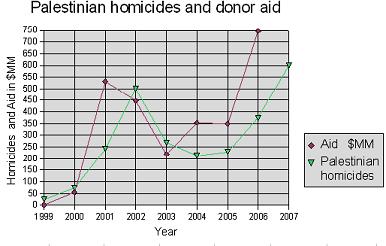
....The Palestinian record fits a broader pattern, as noted by Jean-Paul Azam and Alexandra Delacroix in a 2005 article, "Aid and the Delegated Fight Against Terrorism." They found.... the more foreign aid, the more terrorism.
If these studies run exactly counter to the conventional supposition that poverty, unemployment, repression, "occupation," and malaise drive Palestinians to lethal violence, they do confirm my long-standing argument about Palestinian exhilaration being the problem. The better funded Palestinians are, the stronger they become, and the more inspired to take up arms.
....Rather than further funding Palestinian bellicosity, Western states, starting with Israel, should cut off all funds to the Palestinian Authority.
--------------------------------------------------------------------------------
Dec. 20, 2007 update: Using the Stotsky materials and extrapolating to include the $7.4 billion committed earlier this week, Hal M. Switkay comes up with an estimate of 4,600 Palestinian-caused deaths .... in the three years ahead:
Extrapolation of Stotsky's analysis for $7.4 billion over three years.
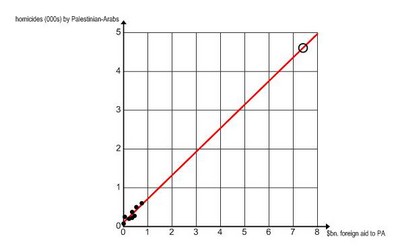
[Homicides by Palestinian Terrorists (1,000s) vs Foreign Aid (US$b)]
....One must be cautious, as the authors are, and explain that correlation – even perfect correlation – does not imply causation. One must present a plausible explanation that could justify the claim of causation, and I have one.
Most of the ignoramuses who opine or make policy regarding the Middle East and jihadists worldwide, believe that poverty causes war, just as poverty causes crime at home, and that terrorists must be given hope to stop their deadly rampage.
However, we know that quite the opposite is true: poor people can choose to study hard, work hard, and lift themselves and their communities gradually out of poverty; crime causes poverty; terrorism causes poverty; and terrorists are given hope by the craven appeasement of the empty-headed Western intellectuals and politicians who come to bargain for their lives – at others' expense, of course. My theory is justified, I believe, by the strong relationship between foreign aid and homicides that occur one year later.
Based on the strong linear correlation between foreign aid to the Palestinian Authority and the number of homicides committed by Palestinian Arabs one year later, I have used extrapolation to predict the consequences of a promised $7.4 billion in aid to the Palestinian Arabs. Please understand that extrapolation is far less reliable than interpolation. Nevertheless, my model predicts approximately 4600 homicides can be expected within a year after the infusion of the pledged foreign aid. This is equivalent to the murder of some 215,000 Americans.
Wednesday, December 19, 2007
Hit ‘em where it hurts
From Ynet News, by Zvi Hauser, 18/12/07:
Forget economic sanctions; Qassams should prompt Palestinian territorial losses
The failure of disengagement, Hamas’ Gaza takeover, and the ongoing Qassam rocket attacks require us to adopt “out-of-the-box” thinking regarding the way to regain Israeli’s deterrence capabilities, which have been lost.
The Israeli obsession with making do with a search for a passive, defensive solution merely encourages the belligerent Palestinian approach and boosts Hamas. Israel must change the rules of the game and actively exact a Hamas territorial price for Palestinian belligerence. Israel’s diplomatic thinking must be brought up to date in the face of the regional interpretation of our compromise policy, which labels any withdrawal as a sign of weakness.
What’s been going on in Gaza in the wake of Israel’s withdrawal proves once again that Palestinian society’s supreme value is not human life or economic welfare, but rather, land. Therefore, we should take the “land for peace” formula and link it to yet another formula, “land for war,” and present this choice to our neighbors.
The ongoing Qassam fire justifies and requires us to take over the Gaza Strip’s “northern edge” where most missiles are fired from. ....
.... The Palestinian exploitation of Israel’s unilateral pullout requires us to reassess the “withdrawal to the last centimeter” approach. The ongoing harm to human rights in Israeli Gaza-region communities justifies a renewed takeover of unpopulated territory, while making it clear to the Palestinians and to the international community that instead of killing civilians, destroying infrastructure, or cutting off the water and electricity supply to a helpless population, Israel chose the most humane move – taking over dominating positions and preventing rocket attacks on civilians.
‘Land is gained through peace, lost in war’ The loss of territory is the most painful stick that can be waived in the face of the Hamas ethos. This is the genuine price tag in Gaza. Not human life, and certainly not economic welfare and all the services that depend on electricity supply, unlike what we would expect in Western civilizations. A future withdrawal from these areas after they are retaken would only be examined as part of a comprehensive peace agreement that would guarantee the security of Israel’s citizens.
... not only those who seek normal life in Sderot must back the shunning of the failed disengagement principles, but also the eternal optimists who believe that somewhere on the horizon there is a formula for making peace with the Palestinians.
The writer is an attorney and former Communication Ministry official
Forget economic sanctions; Qassams should prompt Palestinian territorial losses
The failure of disengagement, Hamas’ Gaza takeover, and the ongoing Qassam rocket attacks require us to adopt “out-of-the-box” thinking regarding the way to regain Israeli’s deterrence capabilities, which have been lost.
The Israeli obsession with making do with a search for a passive, defensive solution merely encourages the belligerent Palestinian approach and boosts Hamas. Israel must change the rules of the game and actively exact a Hamas territorial price for Palestinian belligerence. Israel’s diplomatic thinking must be brought up to date in the face of the regional interpretation of our compromise policy, which labels any withdrawal as a sign of weakness.
What’s been going on in Gaza in the wake of Israel’s withdrawal proves once again that Palestinian society’s supreme value is not human life or economic welfare, but rather, land. Therefore, we should take the “land for peace” formula and link it to yet another formula, “land for war,” and present this choice to our neighbors.
The ongoing Qassam fire justifies and requires us to take over the Gaza Strip’s “northern edge” where most missiles are fired from. ....
.... The Palestinian exploitation of Israel’s unilateral pullout requires us to reassess the “withdrawal to the last centimeter” approach. The ongoing harm to human rights in Israeli Gaza-region communities justifies a renewed takeover of unpopulated territory, while making it clear to the Palestinians and to the international community that instead of killing civilians, destroying infrastructure, or cutting off the water and electricity supply to a helpless population, Israel chose the most humane move – taking over dominating positions and preventing rocket attacks on civilians.
‘Land is gained through peace, lost in war’ The loss of territory is the most painful stick that can be waived in the face of the Hamas ethos. This is the genuine price tag in Gaza. Not human life, and certainly not economic welfare and all the services that depend on electricity supply, unlike what we would expect in Western civilizations. A future withdrawal from these areas after they are retaken would only be examined as part of a comprehensive peace agreement that would guarantee the security of Israel’s citizens.
... not only those who seek normal life in Sderot must back the shunning of the failed disengagement principles, but also the eternal optimists who believe that somewhere on the horizon there is a formula for making peace with the Palestinians.
The writer is an attorney and former Communication Ministry official
There'll be no peace in our time
From News.com, by Greg Sheridan, December 16, 2007 [my emphasis added - SL]:
THIS past week in Israel, where I have been staying for a couple of weeks, there began what should be a historic process: negotiation of a final settlement between Israel and the Palestinians. This is the outcome of the recent Annapolis conference in the US. Three leaders - US President George W. Bush, Israeli Prime Minister Ehud Olmert and Palestinian Authority President Mahmood Abbas - have committed to finding a final settlement within a year. They have not committed to full implementation of this final settlement in that time, merely to the conclusion of an agreement on what the terms of the final settlement will be.
This covers areas such as the amount of territory an independent Palestinian state will get; the so-called right of return of Palestinian refugees and their descendants (which Israel interprets as a right of return to a new Palestinian state and the Palestinians interpret as a right of return to Israel itself), and the arrangements that will cover Jerusalem.
The obstacles to any settlement are enormous. For a start, the Palestinian Authority has no jurisdiction over one-third of its population, which lives in the Gaza Strip under the control of the Islamist terrorist organisation Hamas - an offshoot of the Muslim Brotherhood.
But even in the West Bank, the real power of the Palestinian Authority is very limited. Several West Bank cities are ruled by warlords, not the Authority. Indeed, Palestinian leaders cannot travel safely in all their own cities and are not ready to take over security in most of their cities from Israeli security forces.
In truth, the Palestinian Authority does not have functioning state institutions. Outside donors, including Australia, are set to pump an enormous amount of money into the West Bank to try to improve the quality of life there. This is designed, in part, to strengthen Mahmood Abbas and to show the Palestinians that life on the moderate path, in the West Bank, is much better than life under the extremist path, as in Gaza under Hamas. The Palestinian Authority, however, shows no signs of re-establishing control of the Gaza Strip, and it is inconceivable that Israel would allow the creation of a Palestinian state that did not control both the West Bank and Gaza.
Many people around the world tell Israel to withdraw to its 1967 borders. Two years ago, Israel did pull out of Gaza - and the result was that Hamas took over. Every day now, Hamas terrorists fire rockets - aimed at civilians - from Gaza into Israel. Eventually, one of these rockets will kill a large number of Israeli civilians and there will be a huge Israeli military response inside Gaza. Whatever Mahmood Abbas thinks of this, or Hamas (some of whom have pledged to kill him), he would be forced to make an ultra-nationalist response - and that, in itself, could kill the peace process.
Further, the Annapolis process requires the fulfilment of the conditions of the so-called Road Map, the very first of which is that the Palestinians stamp out terrorism and stop attacks on Israeli civilians. There is no sign the Palestinian Authority can do this, or even that it really wants to do this. Its educational materials are full of hatred against Israel and incitement to terrorism. And that is the fundamental problem.
Neither the Palestinian leadership, nor most of the surrounding Arab states, has really come to grips with Israel's right to exist at peace behind secure borders. Until that happens, no agreement is likely to work on the ground. So, what should have been an epic week may prove only to have been just another footnote of failure in the long saga of failure in the Middle East.
THIS past week in Israel, where I have been staying for a couple of weeks, there began what should be a historic process: negotiation of a final settlement between Israel and the Palestinians. This is the outcome of the recent Annapolis conference in the US. Three leaders - US President George W. Bush, Israeli Prime Minister Ehud Olmert and Palestinian Authority President Mahmood Abbas - have committed to finding a final settlement within a year. They have not committed to full implementation of this final settlement in that time, merely to the conclusion of an agreement on what the terms of the final settlement will be.
This covers areas such as the amount of territory an independent Palestinian state will get; the so-called right of return of Palestinian refugees and their descendants (which Israel interprets as a right of return to a new Palestinian state and the Palestinians interpret as a right of return to Israel itself), and the arrangements that will cover Jerusalem.
The obstacles to any settlement are enormous. For a start, the Palestinian Authority has no jurisdiction over one-third of its population, which lives in the Gaza Strip under the control of the Islamist terrorist organisation Hamas - an offshoot of the Muslim Brotherhood.
But even in the West Bank, the real power of the Palestinian Authority is very limited. Several West Bank cities are ruled by warlords, not the Authority. Indeed, Palestinian leaders cannot travel safely in all their own cities and are not ready to take over security in most of their cities from Israeli security forces.
In truth, the Palestinian Authority does not have functioning state institutions. Outside donors, including Australia, are set to pump an enormous amount of money into the West Bank to try to improve the quality of life there. This is designed, in part, to strengthen Mahmood Abbas and to show the Palestinians that life on the moderate path, in the West Bank, is much better than life under the extremist path, as in Gaza under Hamas. The Palestinian Authority, however, shows no signs of re-establishing control of the Gaza Strip, and it is inconceivable that Israel would allow the creation of a Palestinian state that did not control both the West Bank and Gaza.
Many people around the world tell Israel to withdraw to its 1967 borders. Two years ago, Israel did pull out of Gaza - and the result was that Hamas took over. Every day now, Hamas terrorists fire rockets - aimed at civilians - from Gaza into Israel. Eventually, one of these rockets will kill a large number of Israeli civilians and there will be a huge Israeli military response inside Gaza. Whatever Mahmood Abbas thinks of this, or Hamas (some of whom have pledged to kill him), he would be forced to make an ultra-nationalist response - and that, in itself, could kill the peace process.
Further, the Annapolis process requires the fulfilment of the conditions of the so-called Road Map, the very first of which is that the Palestinians stamp out terrorism and stop attacks on Israeli civilians. There is no sign the Palestinian Authority can do this, or even that it really wants to do this. Its educational materials are full of hatred against Israel and incitement to terrorism. And that is the fundamental problem.
Neither the Palestinian leadership, nor most of the surrounding Arab states, has really come to grips with Israel's right to exist at peace behind secure borders. Until that happens, no agreement is likely to work on the ground. So, what should have been an epic week may prove only to have been just another footnote of failure in the long saga of failure in the Middle East.
Israel could exchange territory to keep settlements
From the International Herald Tribune, by The Associated Press, December 18, 2007:
JERUSALEM: A confidant of Prime Minister Ehud Olmert's said Tuesday that Israel was pushing forward with construction in major West Bank settlements, but proposed compensating the Palestinians with Israeli territory under a final peace deal.
The comments by Vice Premier Haim Ramon were the first time an Israeli official has openly endorsed the idea of a land swap. Palestinian President Mahmoud Abbas also supports the concept, which could solve one of the most contentious issues of the Israeli-Palestinian conflict: Jewish settlements in the West Bank....
...Olmert has signaled he is ready for a large withdrawal from the West Bank, but that he wants to retain the large housing blocs where the vast majority of Jewish settlers live....
..."The Palestinians won't say that this is good, but there is no doubt that the Palestinians understand that in the end of the peace process, the settlement blocs will be under Israeli sovereignty in return for an exchange of territory," Ramon said....
....Abbas said any swap would require Israel to hand over "the same quality and quantity of land" that it keeps, but also said it was "premature" to discuss such a deal.....
....The U.S.-backed "road map" peace plan calls on Israel to freeze all settlement activity, including so-called natural growth in existing communities. However, Israel says the U.S. supports its position on retaining settlement blocs, pointing to a 2004 letter in which President George W. Bush said a final peace deal would have to recognize "new realities on the ground.".....Israel is expected to seek a final border along the lines of its West Bank separation barrier, which is expected to leave roughly 8 percent of the West Bank, along with the settlement blocs, in Israeli hands when it is complete.
...The road map also requires Israel to remove several dozen tiny settlement outposts scattered throughout the West Bank. ...The Palestinians, meanwhile, are required to rein in militant groups. ... Israel also says Abbas must control militants in the Gaza Strip, which was overrun by the Hamas militant group last June. Abbas wields no control in Gaza, raising questions about his ability to carry out any future peace deal....
JERUSALEM: A confidant of Prime Minister Ehud Olmert's said Tuesday that Israel was pushing forward with construction in major West Bank settlements, but proposed compensating the Palestinians with Israeli territory under a final peace deal.
The comments by Vice Premier Haim Ramon were the first time an Israeli official has openly endorsed the idea of a land swap. Palestinian President Mahmoud Abbas also supports the concept, which could solve one of the most contentious issues of the Israeli-Palestinian conflict: Jewish settlements in the West Bank....
...Olmert has signaled he is ready for a large withdrawal from the West Bank, but that he wants to retain the large housing blocs where the vast majority of Jewish settlers live....
..."The Palestinians won't say that this is good, but there is no doubt that the Palestinians understand that in the end of the peace process, the settlement blocs will be under Israeli sovereignty in return for an exchange of territory," Ramon said....
....Abbas said any swap would require Israel to hand over "the same quality and quantity of land" that it keeps, but also said it was "premature" to discuss such a deal.....
....The U.S.-backed "road map" peace plan calls on Israel to freeze all settlement activity, including so-called natural growth in existing communities. However, Israel says the U.S. supports its position on retaining settlement blocs, pointing to a 2004 letter in which President George W. Bush said a final peace deal would have to recognize "new realities on the ground.".....Israel is expected to seek a final border along the lines of its West Bank separation barrier, which is expected to leave roughly 8 percent of the West Bank, along with the settlement blocs, in Israeli hands when it is complete.
...The road map also requires Israel to remove several dozen tiny settlement outposts scattered throughout the West Bank. ...The Palestinians, meanwhile, are required to rein in militant groups. ... Israel also says Abbas must control militants in the Gaza Strip, which was overrun by the Hamas militant group last June. Abbas wields no control in Gaza, raising questions about his ability to carry out any future peace deal....
$7.4 Billion Pledged to PA
From The New York Times, December 18, 2007, by ELAINE SCIOLINO:
PARIS — Eighty-seven countries and international organizations pledged $7.4 billion in aid to the Palestinians on Monday, in the most ambitious fund-raising effort in more than a decade to help Palestinians create a viable, peaceful and secure state of their own.
The total is set to cover the next three years. The Palestinians had hoped to secure $5.6 billion ...but the amount pledged exceeded that figure.
The Palestinian president, Mahmoud Abbas, said at the conference that a “moment of truth” had arrived, urging the world to increase its aid for Palestinians — or risk disaster.
“Without this support, without the payment of aid that will allow the Palestinian treasury to fulfill its role, we will be facing a total catastrophe in the West Bank and Gaza,” Mr. Abbas said.
In appealing for the financing, Prime Minister Salam Fayyad, an economist appointed to lead the Palestinians’ caretaker government, formally presented his new recovery plan for economic, institutional and security reform for a future Palestinian state.
...Many countries do not fulfill pledges that they make at such conferences. Egypt and other Arab countries are known for pledging funds to the Palestinian Authority that they do not deliver...
....The event on Monday was the largest Palestinian donor meeting since 1996, and the latest in a string of aid-raising events for the Palestinians over the years. The Palestinians are one of the highest aid-dependent populations in the world, according to a new World Bank report.
....“Our aim is not to perpetuate assistance to the Palestinians indefinitely,” said Mr. Sarkozy, who calls himself a close friend of Israel. To that end, he called for Israel to allow freedom of movement of people and goods and to immediately freeze all settlement construction on the West Bank. “I must insist on this point: it is in Israel’s best interest, provided its own security is not threatened, to foster a normal existence in the West Bank,” he said. “This alone will enable the Palestinians to work, to stop ruminating on their humiliation, to curb the violence and trafficking and to regain their zest for life.”
As for the Palestinians, Mr. Sarkozy told them to live up to their promises to maintain “law and order over its territory” and to overhaul their security services.
Stephen Castle reported from Brussels and Graham Bowley reported from New York. Isabel Kershner contributed reporting from Jerusalem.
PARIS — Eighty-seven countries and international organizations pledged $7.4 billion in aid to the Palestinians on Monday, in the most ambitious fund-raising effort in more than a decade to help Palestinians create a viable, peaceful and secure state of their own.
The total is set to cover the next three years. The Palestinians had hoped to secure $5.6 billion ...but the amount pledged exceeded that figure.
The Palestinian president, Mahmoud Abbas, said at the conference that a “moment of truth” had arrived, urging the world to increase its aid for Palestinians — or risk disaster.
“Without this support, without the payment of aid that will allow the Palestinian treasury to fulfill its role, we will be facing a total catastrophe in the West Bank and Gaza,” Mr. Abbas said.
In appealing for the financing, Prime Minister Salam Fayyad, an economist appointed to lead the Palestinians’ caretaker government, formally presented his new recovery plan for economic, institutional and security reform for a future Palestinian state.
...Many countries do not fulfill pledges that they make at such conferences. Egypt and other Arab countries are known for pledging funds to the Palestinian Authority that they do not deliver...
....The event on Monday was the largest Palestinian donor meeting since 1996, and the latest in a string of aid-raising events for the Palestinians over the years. The Palestinians are one of the highest aid-dependent populations in the world, according to a new World Bank report.
....“Our aim is not to perpetuate assistance to the Palestinians indefinitely,” said Mr. Sarkozy, who calls himself a close friend of Israel. To that end, he called for Israel to allow freedom of movement of people and goods and to immediately freeze all settlement construction on the West Bank. “I must insist on this point: it is in Israel’s best interest, provided its own security is not threatened, to foster a normal existence in the West Bank,” he said. “This alone will enable the Palestinians to work, to stop ruminating on their humiliation, to curb the violence and trafficking and to regain their zest for life.”
As for the Palestinians, Mr. Sarkozy told them to live up to their promises to maintain “law and order over its territory” and to overhaul their security services.
Stephen Castle reported from Brussels and Graham Bowley reported from New York. Isabel Kershner contributed reporting from Jerusalem.
Monday, December 17, 2007
Syrian Alliance With Iran Unshakable
From AP, by ALBERT AJI, 14/12/07:
DAMASCUS, Syria (AP) — President Bashar Assad rejected claims that Syria's alliance with Iran had been weakened by Damascus' participation in last month's U.S.-sponsored Mideast peace conference, insisting Thursday that ties between the two countries will never be shaken....
....The November conference in Annapolis, Md., which relaunched Israeli-Palestinian peace negotiations, was widely seen as also aimed at isolating Iran by bringing together Arab nations. U.S. officials have expressed hopes that Syria's attendance would mark a start to easing it out of its alliance with Tehran.
Iranian President Mahmoud Ahmadinejad and other top officials denounced the conference, and some officials expressed surprise over Syria's participation — though none directly criticized it....
.....Syria is Iran's closest Arab ally. The two countries have had warm relations since 1980 when Syria sided with Persian Iran against Iraq in the 1980-88 Iran-Iraq war.
DAMASCUS, Syria (AP) — President Bashar Assad rejected claims that Syria's alliance with Iran had been weakened by Damascus' participation in last month's U.S.-sponsored Mideast peace conference, insisting Thursday that ties between the two countries will never be shaken....
....The November conference in Annapolis, Md., which relaunched Israeli-Palestinian peace negotiations, was widely seen as also aimed at isolating Iran by bringing together Arab nations. U.S. officials have expressed hopes that Syria's attendance would mark a start to easing it out of its alliance with Tehran.
Iranian President Mahmoud Ahmadinejad and other top officials denounced the conference, and some officials expressed surprise over Syria's participation — though none directly criticized it....
.....Syria is Iran's closest Arab ally. The two countries have had warm relations since 1980 when Syria sided with Persian Iran against Iraq in the 1980-88 Iran-Iraq war.
Sunday, December 16, 2007
Dichter: NIE proves that Israel failed
From JPost, Dec 15, 2007, by REBECCA ANNA STOIL
Public Security Minister Avi Dichter on Saturday blasted the recent US National Intelligence Estimate that says Teheran has halted its nuclear arms program, warning that a nuclear Iran could lead to a regional war that would threaten Israel.
Dichter also suggested that if American intelligence agencies were wrong about Iran in the NIE, released on December 3, they could also issue false information about whether the Palestinians are fulfilling their security commitments....
...."The softened intelligence report proves that Israel failed to provide the Americans with the whole picture concerning the Iranian nuclear threat," he said. "Something went wrong in the American blueprint for analyzing the severity of the Iranian nuclear threat," said Dichter, in one of the strongest criticisms of the US intelligence analysis offered by a cabinet member.
....He added that it was now the duty of Israel and other concerned countries to provide the US with intelligence information and analyses that would help to change the American assessment.
Regarding the Palestinians, Dichter warned that retired US general James Jones, who heads the mechanism to judge the implementation of road map obligations, could also receive an inaccurate assessment of the situation on the ground and that there were no guarantees he would not make a serious error of judgment regarding the Palestinians' adherence to their commitments.
The "US could make a mistake and decide that the Palestinians have fulfilled their commitments, which could entail very serious consequences from Israel's perspective," Dichter warned.
"Israel cannot allow a situation in which Hamas conducts a war of attrition from Gaza, while Israel is simultaneously holding negotiations with the Palestinians," Dichter said.
He stressed the need for the Palestinians to establish "real and operational" law enforcement, legislative and judicial systems.....
Public Security Minister Avi Dichter on Saturday blasted the recent US National Intelligence Estimate that says Teheran has halted its nuclear arms program, warning that a nuclear Iran could lead to a regional war that would threaten Israel.
Dichter also suggested that if American intelligence agencies were wrong about Iran in the NIE, released on December 3, they could also issue false information about whether the Palestinians are fulfilling their security commitments....
...."The softened intelligence report proves that Israel failed to provide the Americans with the whole picture concerning the Iranian nuclear threat," he said. "Something went wrong in the American blueprint for analyzing the severity of the Iranian nuclear threat," said Dichter, in one of the strongest criticisms of the US intelligence analysis offered by a cabinet member.
....He added that it was now the duty of Israel and other concerned countries to provide the US with intelligence information and analyses that would help to change the American assessment.
Regarding the Palestinians, Dichter warned that retired US general James Jones, who heads the mechanism to judge the implementation of road map obligations, could also receive an inaccurate assessment of the situation on the ground and that there were no guarantees he would not make a serious error of judgment regarding the Palestinians' adherence to their commitments.
The "US could make a mistake and decide that the Palestinians have fulfilled their commitments, which could entail very serious consequences from Israel's perspective," Dichter warned.
"Israel cannot allow a situation in which Hamas conducts a war of attrition from Gaza, while Israel is simultaneously holding negotiations with the Palestinians," Dichter said.
He stressed the need for the Palestinians to establish "real and operational" law enforcement, legislative and judicial systems.....
US intelligence flawed
From DEBKAfile, December 15, 2007:
Israeli minister warns “flawed” US intelligence on Iran nuke will lead to “Yom Kippur”
Internal security minister and former Shin Bet head Avi Dichter was the first government member to publicly and harshly question the US National Intelligence Estimate which says Tehran no longer develops nuclear weapons. He warned that it could spark a “regional Yom Kippur” – a reference to the 1973 Middle East War. The minister said Saturday, Dec. 15: “We know the threat to be ongoing and palpable” for Israel and a whole region within the range of Iran’s ballistic missiles, i.e. Europe and North Africa. Israel and other troubled nations must help the US in every way possible, including by their intelligence, to correct a misconception that could spark a “regional Yom Kippur.”
DEBKAfile reports: Dichter voiced concerns which other Israeli ministers have so far expressed only in private (as reported last week on this site), because they conflict with the views of prime minister Ehud Olmert. The NIE report is deemed negative on three grounds:
1. It means the Bush administration has reconciled itself to a nuclear-armed Iran.
2. While Dichter had the courage to open the eyes of the Israeli public to the danger, he too knows there is no way to correct the “misconception” governing the actions of President Bush and Secretary Rice, because the NIE did not come out of the blue; it was the product of a comprehensive strategic reassessment planned to play out up to the end of the Bush presidency. Both its two underlying objectives are detrimental to Israel:
First: America seeks integration in the unfolding Saudi-Iranian axis. This will entail turning its back on Israel.
Second: It will also entail concessions to Syria, Hizballah and the Palestinians at the expense of Israel and its security.
3. DEBKAfile’s Jerusalem sources reveal that Olmert has confided in his close aides his intention of using the White House’s about-face in the Middle East to advance on simultaneous peace tracks with the Palestinians and Syria. In other words, the Israeli prime minister is willing to make Bush a gift of broad concessions on the West Bank and Golan to aid and abet the president’s pursuit of the budding Riyadh-Tehran partnership.
This was hinted at in Dichter’s added caution Saturday that Washington’s “faulty intelligence” and “erroneous conceptions” could warp its judgment as arbiter of the Middle East roadmap between Israel and the Palestinians, by reporting their nonexistent crackdown on terrorists.
At the same time, as long as ministers like Dichter who are clearly at issue with the prime minister stay in his government, Olmert has no incentive to abandon his plans.
Israeli minister warns “flawed” US intelligence on Iran nuke will lead to “Yom Kippur”
Internal security minister and former Shin Bet head Avi Dichter was the first government member to publicly and harshly question the US National Intelligence Estimate which says Tehran no longer develops nuclear weapons. He warned that it could spark a “regional Yom Kippur” – a reference to the 1973 Middle East War. The minister said Saturday, Dec. 15: “We know the threat to be ongoing and palpable” for Israel and a whole region within the range of Iran’s ballistic missiles, i.e. Europe and North Africa. Israel and other troubled nations must help the US in every way possible, including by their intelligence, to correct a misconception that could spark a “regional Yom Kippur.”
DEBKAfile reports: Dichter voiced concerns which other Israeli ministers have so far expressed only in private (as reported last week on this site), because they conflict with the views of prime minister Ehud Olmert. The NIE report is deemed negative on three grounds:
1. It means the Bush administration has reconciled itself to a nuclear-armed Iran.
2. While Dichter had the courage to open the eyes of the Israeli public to the danger, he too knows there is no way to correct the “misconception” governing the actions of President Bush and Secretary Rice, because the NIE did not come out of the blue; it was the product of a comprehensive strategic reassessment planned to play out up to the end of the Bush presidency. Both its two underlying objectives are detrimental to Israel:
First: America seeks integration in the unfolding Saudi-Iranian axis. This will entail turning its back on Israel.
Second: It will also entail concessions to Syria, Hizballah and the Palestinians at the expense of Israel and its security.
3. DEBKAfile’s Jerusalem sources reveal that Olmert has confided in his close aides his intention of using the White House’s about-face in the Middle East to advance on simultaneous peace tracks with the Palestinians and Syria. In other words, the Israeli prime minister is willing to make Bush a gift of broad concessions on the West Bank and Golan to aid and abet the president’s pursuit of the budding Riyadh-Tehran partnership.
This was hinted at in Dichter’s added caution Saturday that Washington’s “faulty intelligence” and “erroneous conceptions” could warp its judgment as arbiter of the Middle East roadmap between Israel and the Palestinians, by reporting their nonexistent crackdown on terrorists.
At the same time, as long as ministers like Dichter who are clearly at issue with the prime minister stay in his government, Olmert has no incentive to abandon his plans.
Wednesday, December 12, 2007
UN passes resolution proposed by Israel
From JPost, Dec 11, 2007 By MICHAL LANDO, JERUSALEM POST CORRESPONDENT NEW YORK:
The UN passage of an Israeli resolution on agriculture Tuesday is the first time a nonpolitical Israeli resolution has been adopted by the international body, and signifies a breakthrough in Israeli-UN history.
The resolution, which calls on member states to work with relevant UN organizations in promoting the development and transfer of agricultural technologies to developing countries, was passed by the economic and financial committee with a vote of 118 in favor, 29 abstentions and no opposing votes.
"For Israel, this is a very dramatic development, and an historic day at the UN," said Ambassador to the UN Dan Gillerman. "This makes Israel a much more normal and acceptable member of the UN. One of our main aims is to not be a one issue country and to bring awareness of Israel's excellence to the world."
Though Israel has long been known as a source of agricultural innovation, passage of the resolution signified recognition from a body that has been less than welcoming of anything bearing an Israeli stamp.
...."South Africa is a big disappointment," said Gillerman. "They sent out the wrong message.
Presuming to be a leader of the African continent, and as a member of the Security Council, for them to abstain on a resolution which Africa will be a main beneficiary of is shameful."
The resolution stresses ongoing concern that "Africa is the only continent currently not on track to achieve any of the goals of the United Nations Millennium Declaration by 2015," and emphasizes the need for "concerted efforts and continued support" to address Africa's special needs. The Permanent Mission of South Africa did not return calls for comment.
Another impetus for the current resolution is the upcoming meeting of the UN Commission on Sustainable Development, which will meet for the 16th time in May. The agenda for that meeting will include agriculture, water and desertification, and Israel will be one of the vice-chairs of the commission.
"Some people tend to downplay agriculture, but anyone who knows the UN, understands the significance," said Gillerman.
The UN passage of an Israeli resolution on agriculture Tuesday is the first time a nonpolitical Israeli resolution has been adopted by the international body, and signifies a breakthrough in Israeli-UN history.
The resolution, which calls on member states to work with relevant UN organizations in promoting the development and transfer of agricultural technologies to developing countries, was passed by the economic and financial committee with a vote of 118 in favor, 29 abstentions and no opposing votes.
"For Israel, this is a very dramatic development, and an historic day at the UN," said Ambassador to the UN Dan Gillerman. "This makes Israel a much more normal and acceptable member of the UN. One of our main aims is to not be a one issue country and to bring awareness of Israel's excellence to the world."
Though Israel has long been known as a source of agricultural innovation, passage of the resolution signified recognition from a body that has been less than welcoming of anything bearing an Israeli stamp.
...."South Africa is a big disappointment," said Gillerman. "They sent out the wrong message.
Presuming to be a leader of the African continent, and as a member of the Security Council, for them to abstain on a resolution which Africa will be a main beneficiary of is shameful."
The resolution stresses ongoing concern that "Africa is the only continent currently not on track to achieve any of the goals of the United Nations Millennium Declaration by 2015," and emphasizes the need for "concerted efforts and continued support" to address Africa's special needs. The Permanent Mission of South Africa did not return calls for comment.
Another impetus for the current resolution is the upcoming meeting of the UN Commission on Sustainable Development, which will meet for the 16th time in May. The agenda for that meeting will include agriculture, water and desertification, and Israel will be one of the vice-chairs of the commission.
"Some people tend to downplay agriculture, but anyone who knows the UN, understands the significance," said Gillerman.
Olmert vows to remove Qassam rocket threat
From Haaretz, by Barak Ravid, 12/12/07 [this story is particularly relevant to me right now, visiting Sderot, with several members of the Western Australian government]:
The security cabinet was set to meet Wednesday to discuss the situation in the Gaza Strip after Prime Minister Ehud Olmert vowed on Tuesday to remove the threat of Qassam rockets from the southern part of the country.
"The situation in the south of the country, in light of the Qassam rocket fire, has generated a difficult reality," Olmert told an Institute for National Security Studies conference in Tel Aviv Tuesday night.
"We will have to act on this matter in the necessary manner, with the appropriate dose and the right timing, without exaggerating and creating unrealistic expectations. We will not rest until the Qassam rocket threat is completely removed from Sderot and the western Negev." ...
The security cabinet was set to meet Wednesday to discuss the situation in the Gaza Strip after Prime Minister Ehud Olmert vowed on Tuesday to remove the threat of Qassam rockets from the southern part of the country.
"The situation in the south of the country, in light of the Qassam rocket fire, has generated a difficult reality," Olmert told an Institute for National Security Studies conference in Tel Aviv Tuesday night.
"We will have to act on this matter in the necessary manner, with the appropriate dose and the right timing, without exaggerating and creating unrealistic expectations. We will not rest until the Qassam rocket threat is completely removed from Sderot and the western Negev." ...
Friday, November 30, 2007
Gillerman to the UN: 'Stop eternalizing the past'
From JPost, Nov 29, 2007 by MICHAL LANDO:
As Hamas officials called for the United Nations to rescind the partition plan that was adopted in 1947, UN Ambassador Dan Gillerman on Thursday urged it to stop "eternalizing the past" and work toward a better future....
"It is possible to bring the spirit of Annapolis also to the halls of the UN - a coalition of moderates in favor of peace, instead of the spirit that currently blows through the halls that brings hatred and eternalizes the past," he said in an address to the General Assembly.
On November 29, 1947, the UN voted for Resolution 181, which recommended an end to the British Mandate in Palestine and a partition plan that called for the creation of two states - one Jewish and one Arab....
..... Since 1977, this day is earmarked at the UN as an annual day of "Solidarity with the Palestinian People," and is typically commemorated as a day of mourning. Part of the discussion in Thursday's General Assembly meeting was reserved for the "Question of Palestine," an annual ushering-in of several anti-Israel resolutions.
Israel sees it as a happy occasion and streets in several Israeli cities are named after the date.
"The 29th of November is a reason for celebration," said Gillerman.... "On this date, the world got a gift: a state which contributes to humanity more than all the countries in the UN that mourn on this day."
..."Israel recognized two states for two peoples already 60 years ago," Gillerman said. "If the Arabs would have agreed to the historic partition plan, the Palestinians would have had a state for 60 years. What would a 60-year-old Palestinian state look like? Look at what Israel has accomplished in 60 years, where we are and where those who tried to destroy us and who continue to try to destroy us are today." ...
As Hamas officials called for the United Nations to rescind the partition plan that was adopted in 1947, UN Ambassador Dan Gillerman on Thursday urged it to stop "eternalizing the past" and work toward a better future....
"It is possible to bring the spirit of Annapolis also to the halls of the UN - a coalition of moderates in favor of peace, instead of the spirit that currently blows through the halls that brings hatred and eternalizes the past," he said in an address to the General Assembly.
On November 29, 1947, the UN voted for Resolution 181, which recommended an end to the British Mandate in Palestine and a partition plan that called for the creation of two states - one Jewish and one Arab....
..... Since 1977, this day is earmarked at the UN as an annual day of "Solidarity with the Palestinian People," and is typically commemorated as a day of mourning. Part of the discussion in Thursday's General Assembly meeting was reserved for the "Question of Palestine," an annual ushering-in of several anti-Israel resolutions.
Israel sees it as a happy occasion and streets in several Israeli cities are named after the date.
"The 29th of November is a reason for celebration," said Gillerman.... "On this date, the world got a gift: a state which contributes to humanity more than all the countries in the UN that mourn on this day."
..."Israel recognized two states for two peoples already 60 years ago," Gillerman said. "If the Arabs would have agreed to the historic partition plan, the Palestinians would have had a state for 60 years. What would a 60-year-old Palestinian state look like? Look at what Israel has accomplished in 60 years, where we are and where those who tried to destroy us and who continue to try to destroy us are today." ...
Thursday, November 29, 2007
The Bush Letter
From JCPA, Vol. 7, No. 22, 23 November 2007, by Dore Gold [synopsis only - follow the link for the full paper]:
- ... The Bush Letter of April 14, 2004, received by Israel as a quid pro quo for the Gaza Disengagement, introduced new elements into the Israeli-Palestinian peace process that completely superseded the Clinton proposals.
- Prime Minister Sharon explained the significance of the Bush Letter to the Knesset on April 22, 2004: "There is American recognition that in any permanent status arrangement, there will be no return to the ‘67 borders. This recognition is to be expressed in two ways: understanding that the facts that have been established in the large settlement blocs are such that they do not permit a withdrawal to the ‘67 borders and implementation of the term ‘defensible borders.'"
- There is a serious question about the exact standing of the Bush Letter on the eve of Annapolis. Secretary of State Rice stated on November 13, 2007: "I believe that most Israelis are ready to leave most of the - nearly all of the West Bank, just as they were ready to leave Gaza for the sake of peace." Yet all serious public opinion polls actually show strong Israeli support for retaining strategic areas of the West Bank, like the Jordan Valley.
- It has been frequently stated, particularly in Washington, that, "We all know what the final outcome of an Israeli-Palestinian peace settlement will look like," an assertion usually followed by some reference to the Clinton proposals and the talks at Taba. Such statements try to introduce inevitability into the expected parameters of a peace settlement, even though they are based on a whole series of failed negotiating attempts seven years ago that cannot possibly bind the State of Israel, and completely ignore the fact of opposition by the General Staff of the Israel Defense Forces to the Clinton proposals as endangering Israel's security.
- It is critical for Israeli diplomacy to protect the Bush Letter against those who seek to undercut and replace it with a new set of Israeli-Palestinian documents. Israelis have learned from their experience with Gaza what can happen to their most vital security interests if they are not safeguarded at the same time that far-reaching territorial concessions are made....
Subscribe to:
Posts (Atom)