Showing posts sorted by relevance for query UNRWA. Sort by date Show all posts

Saturday, August 02, 2014

UNRWA has become the mask that Hamas wears.

From FrontPage Mag, August 1, 2014 by Daniel Greenfield:

UNRWA bags of building material in Gaza tunnels
Photo-IDF

The UNRWA is on the front lines of the Hamas War in Gaza. In the headlines, its schools are forever being fired on or found to be stockpiling rockets. If individual Gazans are being used as human shields, the UNRWA often seems as if it is one big organizational human shield.

But the UNRWA isn’t Hamas’ human shield. 
The UNRWA is Hamas.

The “UN” part of the UNRWA, the blue logos and symbols, fool us into thinking of it as an international humanitarian organization. But the UNRWA in Gaza functions as a large Palestinian Arab organization with a smattering of foreign supervisory staff.

And those foreign staffers often tend to leave during a conflict.

The UNRWA is not an international organization operating in the Middle East. Effectively it’s a local Arab Muslim organization funded and regulated internationally. Since the UNRWA classifies 80% of Gazans as “refugees”, it administers the biggest welfare state in the world on their behalf.

The UNRWA is the biggest employer in the West Bank and Gaza after the Palestinian Authority and the vast majority of its employees are “locally recruited”. Varying figures place the share of local employees at between 90 and 99 percent.

Even though there are more Arab Muslims living in the West Bank than in Gaza, there are more “official” refugees in Gaza, which means that more UNRWA funding and efforts are directed there. The UNRWA only runs 96 schools in the West Bank, but it runs 245 schools in Gaza. It employs less than 3,000 education staffers in the West Bank, but over 10,000 in Gaza.

Why does Hamas, which is obsessed with brainwashing the next generation into martyrdom, allow a foreign organization to run an educational system for 232,000 pupils?

It’s because in Gaza, Hamas and the UNRWA are the same thing.

The UNRWA’s Gaza staff has its own union. In the 2012 election, a pro-Hamas bloc won the support of most of the union with 25 out of 27 seats on a union board.  

When there was talk of reforming the UNRWA by removing Hamas members from its ranks, the editor of a Hamas paper wrote that, 
“Laying off the agency employees because of their political affiliation means laying off all the employees of the aid agency, because…they are all members of the ‘resistance,’ in its various forms.”
The official word from Hamas was that it and the UNRWA are the same thing. The UNRWA’s vast majority of locally sourced Gazans are part of Hamas.

The UNRWA does not see that as a problem.
“I am sure that there are Hamas members on the UNRWA payroll,” a former UNRWA Commissioner General said, “and I don’t see that as a crime.”
“Hamas as a political organization does not mean that every member is a militant, and we do not do political vetting and exclude people from one persuasion as against another,” he added.
Also if the UNRWA fired Hamas members from its Gaza staff, it would have no one left.

Hamas control over the UNRWA in Gaza is reflected in the schools which promote Islamic terrorism. UNRWA schools have become flashpoints in conflicts between Israel and Hamas because the UNRWA schools are Hamas bases of recruitment and operation.

The current accusations and counter-accusations over attacks on and from UNRWA schools are a reenactment of the same set of events taking place in 2009. Only the locations and the names have changed. The same headlines, “Israeli shelling kills dozens at UN school in Gaza,” and “Massacre of Innocents as UN school is shelled” are repeating all over again.

Then, as now, Hamas launched attacks on Israeli forces from around a UNRWA school. Then it turned out that the attack had happened outside the school and no one had actually died inside the school. Nothing has changed since then. The “massacres” in which Hamas terrorists using UNRWA schools as a base are killed pop up in every paper. The UNRWA repeats the same lies.

Then it “discovers” Hamas rockets in three of its schools. And that’s just the tip of the iceberg because every UNRWA school is a Hamas school.

The UNRWA has admitted that Hamas uses its schools to store rockets. It admits that it has Hamas members in its ranks. It admits that rockets have been fired “into Israel from the vicinity of UN facilities and residential areas.”

What it refuses to admit is that it should in any way be held accountable for functioning as an arm of a terrorist organization.

If an organization consists largely of Hamas members who use it pursue Hamas goals, then the organization is Hamas.

The UNRWA is Hamas.

Hamas use of the UNRWA as its public face is a war crime, but terrorists commit war crimes without a second thought. The UN and the UNRWA however are complicit in the war crime by allowing Hamas to go on exploiting the UN brand.

Hamas is listed as a Foreign Terrorist Organization. It’s against the law for the United States to fund it. By funding the UNRWA, the United States is paying Hamas and participating in its war crimes. Using civilian and humanitarian facilities for military purposes is a war crime. Using them to stage attacks against civilians by attackers out of uniform adds further crimes to the total.

The United States provided $130 million to the UNRWA in 2013. The UNRWA’s operations in Gaza would not be viable without that money.

When Kerry visited Gaza in 2009, the UNRWA’s Gaza chief passed along a letter to him from Hamas. The incident showed that not only was the locally recruited staff working for Hamas, but the UNRWA leadership was clearly cooperating with the terrorist group.

The original “refugees” that the UNRWA was set up to cater to are for the most part dead. The UNRWA has become another UN boondoggle funding a welfare state for “refugee camps” that are older, bigger and more developed than many Middle Eastern cities.

UNRWA staff act as terrorists when they use UNRWA facilities for military purposes, but then switch back to UNRWA when Israel fights back. 
  • Hamas carries out attacks. 
  • The UNRWA demands ceasefires. 
  • Hamas uses UNRWA schools and 
  • the UNRWA denounces Israel when an attack happens.
The UNRWA has become the mask that Hamas wears.

It’s a tactical asset for a terrorist group that empowers its human shield strategy. The UNRWA is not only endangering Israeli civilians, but it is also endangering Gazans who are exploited as human shields by members of a terrorist group masquerading as the staff of an international humanitarian organization.

This issue has come up before and the UNRWA’s long record of evasions and denials, admitting the substance of the claims about the Hamas takeover of the UNRWA, while insisting that its Hamas members are neutral and that all the rocket stores and rocket attacks around UNRWA facilities are unrelated to the Hamas members on its staff, are not good enough anymore.

The United States should not be in the business of funding the corruption of young minds. Money should not be taken from American schools to fund the spread of hatred and terrorism.

It’s time to defund the UNRWA.

Sunday, December 14, 2014

The time has come to examine UNRWA policy

From Israel Resource Review, December 10, 2014, by David Bedein*:

United Nations Relief and Works Agency spokesman Chris Gunness launched personal attacks this week against a Palestinian critic of UNRWA who wrote an op-ed for The Jerusalem Post, followed by a vitriolic attack against the Post itself for publishing the piece. This past Sunday, however, Gunness related to substantive questions about UNRWA policy in a radio interview on the new Voice of Israel Internet radio network. Gunness’s policy statements deserve close attention.

He argues that there are other refugees in the world whose refugee status extends for more than one generation, under the aegis of the other UN agency (the one that handles all other refugees in the world), the United Nations High Commission of Refugees (UNHCR). Yet he neglects to mention that Palestinian refugees are the only refugees in the world who are promised the “right of return” by a UN agency.

Gunness states that UNRWA’s mandate comes from the UN General Assembly, and that that is where the UNRWA definition of “refugee” comes from. Yet UNGA 302, which created UNRWA and from which UNRWA gets its mandate, did not define what a “refugee” is.

UNRWA itself invented a working definition of “refugee” in 1950. Its original refugee definition was: “For working purposes, the Agency has decided that a refugee is a needy person, who, as a result of the war in Palestine, has lost his home and his means of livelihood.” So it is UNRWA that decides who is a refugee – not the UNGA.

Indeed, UNRWA changed the definition [of a UNRWA refugee] over time, including, around 1965, the accommodation of children and grandchildren through the male line, and at a later date extending the definition to all descendants.

Gunness states that the only factor that can change UNRWA policy toward refugees is the UN General Assembly, confusing UNRWA policies with the UNRWA mandate. While the UNRWA mandate to handle Palestinian refugees is etched in stone by the UNGA, donor nations can influence any internal UNRWA policy decision which donor nations may find objectionable or inconsistent with UN policies. 

Gunness claims that UNRWA “must” use the host nation’s textbooks, but does not explain that the choice to do so is an internal UNRWA decision that can be changed if a schoolbook or school teacher violates UN principles.

Gunness holds that Nathan Brown, a Professor of Political Science at George Washington University, is his sole source authority on Palestinian education, and ignores the fact that Brown works for pro-Arab organizations. 

Gunness ignores multiple independent studies of the new PA textbooks that were conducted by The Meir Amit Intelligence and Terrorism Information Center, the Vatican, IMPACT and CFNEPR over the past 14 years, all of which concluded that the new PA textbooks, used in UNRWA schools, encourage jihad, martyrdom and right of return to Palestine, by force of arms.

Gunness categorically states there is no evidence that Hamas terrorists are on the payroll of the UN. Yet successive reports of the US Congressional Research also show that UNRWA, which receives $300 million per year from the US government, reports that UNRWA has never vetted its staff to see if UNRWA employs members of Hamas.

Meanwhile, the European Parliament funded a study that documented Hamas’s takeover of the UNRWA unions in March 2009. The pro-Hamas al-Resala newspaper, right before the September 2012 UNRWA union elections stated that, 
“It is noteworthy that Hamas has controlled the UNRWA staff union in the elections since its inception….”
Al Quds, a Fatah-leaning paper, wrote after the elections:
“According to multiple sources within the Election Commission… the ‘Professional’ slate of Hamas won 25 seats out of 27, divided by 11 seats out of 11 in the teachers’ sector and 6 out of 7 in the labor sector elections, and 8 seats out of 9 in the services sector election.”
Gunness states that whenever there are allegations of UNRWA employees violating UNRWA’s neutrality policy, “They are always investigated and disciplinary action is taken up to and including dismissal.”

Yet in March 2013, in my presence, Gunness told staffers of the US Congress that Hamas leader Suhail Hindi, head of the UNRWA teachers’ union in Gaza, had been dismissed.

However, Hindi was suspended for less than a week. Hindi functions in his capacity to this day.

So much for removing Hamas on staff.

In sum, the concern over UNRWA is that, as a UN agency, it is supposed to maintain absolute neutrality. In an interview with the Post, US State Department spokesman Edgar Vasquez stated unequivocally: 
“It is imperative that all sides respect the humanitarian and development role of UNRWA. And we expect UNRWA personnel to uphold its stated policy of neutrality so that it can carry out its critical mandate.
In light of the UN policy of neutrality, I have repeatedly asked the US embassy and US AID, which administers funds to UNRWA, why the US does not demand an overhaul of the UNRWA curriculum and an end to Hamas presence in UNRWA schools as a condition to render future US funds to UNRWA.

No response has been received – not from the US embassy and not from US AID.

Perhaps the time has come for the US Congress to hold hearings about UNRWA policies, which have now been clearly articulated by UNRWA spokesperson Chris Gunness, to determine if UNRWA is indeed preserving the sacrosanct principle of UN neutrality. After all, if UNRWA is found to be employing thousands of Hamas employees, funding for UNRWA from nations which designate Hamas as a lethal foreign terrorist organization could be suspended.

That includes the US, Canada, the UK, the EU and Australia.

*The writer is author of Roadblock to Peace – How the UN Perpetuates the Arab-Israeli Conflict: UNRWA policies reconsidered.

Friday, January 16, 2009

Gaza Bedfellows UNRWA And Hamas

From Forbes.com Freedom's Edge 8/1/09, by Claudia Rosett:

...In the current violence of Gaza, we are seeing the fruition of one of the most bizarre creations of modern diplomacy: a UN-supported welfare enclave for terrorists.

Behind this lies a straightforward equation. Gaza, with its 1.5 million people, runs almost entirely on international handouts. The UN ranks it among the top per-capita aid recipients on the planet.

And following the Israeli withdrawal in 2005, the Iranian-backed terrorist group Hamas began consolidating power in Gaza--first via elections in 2006, then via a bloody battle in June 2007, in which Hamas drove out the rival Palestinian group Fatah and seized all power in the enclave.
Since then, Hamas has been running Gaza as a territory reduced to basically two industries: aid and terrorism.

Pivotal to this arrangement is one of the UN's oldest and most oddly configured agencies: the UN Relief and Works Agency for Palestine Refugees in the Near East, or UNRWA.

Set up in 1949 with a temporary, three-year mandate to provide aid and jobs for Palestinian refugees, UNRWA has survived for almost 60 years, expanding its scope, budget and influence by extending refugee status to descendants of its beneficiaries.

Normal refugee aid tends to focus on finding ways to resettle displaced people and integrate them back into normal, productive lives. UNRWA, by contrast, provides the main framework for ensuring that the official population of Palestinian refugees remains a swelling source of misery and mayhem--both for their neighbors and for the Palestinians themselves.

From an original refugee population listed by UNRWA as some 900,000 in 1950, UNRWA now provides for a Palestinian "refugee" clientele of more than 4.6 million.

They are spread throughout camps--which physically look more like squalid towns--in Syria, Jordan, Lebanon, the West Bank and Gaza. Into this system flows an annual UNRWA budget now well above $400 million per year, doled out variously in the form of cash, goods, medical care, schooling, job-training programs and so forth.

To handle these operations, UNRWA employs more than 24,000 staffers. That's more than any other UN agency, including the UN High Commissioner for Refugees, or UNHCR, which with some 6,300 staffers--about one-quarter the manpower of UNRWA--is responsible for all other refugees worldwide, totaling more than 11 million.

[Note that 11 million is the CURRENT refugee count. The UNHCR has assisted, and resettled, about 100 million (that's not a misprint, YES 100 million) refugees since World War 2: 25 million in the wake of that war, and over 70 million since then, including over 850,000 Jews expelled from Arab lands since 1950. In the meantime, UNWRA has turned some 600,000 Arab refugees into 5 million - SL]

At UNRWA, more than 99% of the staff are local Palestinians. They sit at the many local levers of the UNRWA distribution machinery, which under UNRWA policy takes on the coloration of and yields to the policies of host governments--as UNRWA officials explained to U.S. lawmakers who some years ago challenged the use of anti-Israeli textbooks in UNRWA schools.

In today's terrorist-run Gaza, such an approach carries exactly the kind of deadly implications now playing out--while UNRWA and other UN officials call for an end to the violence.

Originally headquartered in Beirut, UNRWA moved its main offices to Vienna after the Lebanese Civil War, then moved again in 1996 to its current headquarters in Gaza. There, it serves as a core fundraiser and rallying point for donations from around the globe, many from sovereign states.

While not all charity to Gaza flows through UNRWA, it is UNRWA that enjoys pride of place, with its UN stamp of legitimacy and direct, easy access to the UN's world stage.
Since late December, when Israel began its campaign to end the thousands of rocket and mortar attacks launched by Hamas from Gaza, UNRWA officials have given a parade of briefings via UN headquarters in New York.

Teleconferencing in, they have ignored what UNRWA Commissioner General Karen Koning Abuzayd has described as their "nonpolitical" mandate. With Abuzayd in the lead, they have detailed their outrage on behalf of the Palestinians, excoriated Israel and stepped further into the political arena to demand an immediate ceasefire--something these same UNRWA officials did not do when the attacks were one-way out of Gaza into Israel.

Given the structure and location of UNRWA, such bias comes as no big surprise. Headquartered inside a terrorist enclave, sharing with terrorist authorities such basic interests as keeping the local lights on and the water running, UNRWA officials have plenty of incentives to slam Israel as the culprit--not themselves, or their Hamas cohabiters.

And while blaming Israel, UNRWA officials also have plenty of incentive to present the worst possible picture. The greater the perceived distress, the better the prospects not only for immediate relief, but for future fundraising.

UNRWA's interests in Gaza are by now so entwined and, in many ways, so aligned with Hamas' interests that it is often hard to tell them apart.

And, as UNRWA officials have aired their views and demands from the UN stage, handouts for Gaza have been rolling in from all sides--some via UNRWA, some through other channels.
This goes way beyond Israel allowing hundreds of aid trucks into Gaza, even as the Israeli military is battling to shut down the rocket launchers and destroy the arms-smuggling tunnels and weapons caches of Hamas.

Support in cash and kind, in dollars and tons, has been pledged by donors ranging from Iran to Japan to the European Union to the Arab Gulf States to the U.S. (already the top donor to UNRWA, with $148 million in contributions last year, and now promising an immediate $5 million in response to UNRWA's latest flash appeal for Gaza, plus another $80 million for the agency to spread around in places including Gaza).

Plane-loads of relief, both in goods and services, have been announced by donors ranging from Russia to Libya to Sudan.

When this largesse eventually arrives in Gaza, how exactly will it be spent, distributed and supervised? UNRWA and the surrounding constellations of aid operations in Gaza are by and large areas of deep murk.

In a 2006 U.S. congressional briefing, Abuzayd said it was too difficult for UNRWA to run checks against terrorist watch lists because "Arab last names sound so familiar."

This was a strange comment coming from Abuzayd, a woman who is married to a Sudanese professor, holds a degree in Islamic studies and has worked for UNRWA in Gaza since 2000, first as deputy commissioner of UNRWA and since 2005 as the top boss.

These days, UNRWA officially runs periodic reviews that are supposed to winnow out terror connections. But donors must by and large rely on UNRWA's word that this is a serious process.
The history of terror out of Gaza in recent years suggests that, at best, a lot falls between the cracks. In response to e-mailed queries this week, a UNRWA spokesman said the agency now runs periodic name checks for relief recipients against a UN watch list named for counter-terrorism resolution number 1267 and has found no matches.

That's no big surprise; the 1267 watch list is for major players among al-Qaeda and the Taliban, not Iranian-backed Hamas.

For years, various U.S. lawmakers, including the late Congressman Tom Lantos, have tried introducing bills asking for genuine transparency and accountability from UNRWA--which has never been subject to a genuinely independent external audit.

Such efforts have gained no traction, opposed by a UN that even under the most benign circumstances is hostile to opening its books, plus a U.S. State Department that prefers to close its eyes and shovel millions of U.S. taxpayer dollars into terrorist-controlled infrastructure.
This past September, Democratic Rep. Steve Rothman, with a bipartisan group of five co-sponsors, submitted a concurrent resolution noting that "UNRWA has employed staffers affiliated with terrorism."

The resolution cited specific examples of UNRWA ambulance and schools having been used to abet terrorism and mentioned a number of figures, including Awad al-Qiq, headmaster of an UNRWA school in Gaza, "who also led Islamic Jihad's engineering unit that built bombs and Qassam rockets."

However humane the intent of UNRWA officials, they have become de facto enablers of Hamas' terrorist fiefdom in Gaza.

In pushing for an ever-bigger dole and in using the UN stage as a megaphone to help elicit sympathy, drum up funds, denounce Israel and drape in UN baby blue the interests and demands of the Iranian-backed terrorists of Hamas, they do a terrible disservice not only to the cause of world peace, but to the prospects of the Palestinians themselves for forsaking terror and building better lives.

Also see other JIW postings on this subject.

Saturday, July 15, 2017

The Time has Come to Dismantle UNRWA

From BESA Center Perspectives Paper No. 528, July 14, 2017, by Adi Schwartz:


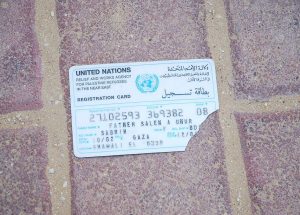
UNRWA registration card recovered during counterterrorism operation in southern Gaza, 26 July 2007, via Wikimedia Commons

In a surprising change of policy, Israeli Prime Minister Netanyahu has called for the dismantling of UNRWA. Such a move could benefit both Israel and the peace process. The new US administration might change its decades-old policy as well.

Last month, Israeli Prime Minister Benjamin Netanyahu stunned many by declaring that the United Nations Relief and Works Agency (UNRWA) should be dismantled.

Speaking at a weekly cabinet meeting, Netanyahu charged that
“in various UNRWA institutions, there is a lot of incitement against Israel, and therefore the existence of UNRWA – and unfortunately its work from time to time – perpetuates the Palestinian refugee problem rather than solves it. … Therefore, the time has come to dismantle UNRWA and merge its components with the United Nations High Commissioner for Refugees [UNHCR].”
This long overdue step was rejected for years by the Israeli establishment. Up to now, Jerusalem has prevented attempts to change UNRWA’s mandate or close it down because it perceived the agency as a stabilizing factor. Israel focused instead on anti-Israeli incitement in UNRWA’s education system and on its collaboration with Hamas. That collaboration implied an international imprimatur on egregious Hamas behavior.

Instead of fighting UNRWA’s very existence, Israel focused on its actions. This time, the prime minister is talking about a bigger shift in policy.

UNRWA’s initial role was to distribute humanitarian assistance to Palestinian Arabs displaced during the 1948 war. However, over the years, instead of being a tool to solve the refugee problem, UNRWA has become a tool for its eternal perpetuation. Without UNRWA, the Palestinian refugees, and certainly their children, grandchildren, and great-grandchildren, would have resettled in their Arab host countries or elsewhere in the world, as many millions of other refugees have done. They would have done so reluctantly, of course, but would have had no other choice, as no organization would have taken care of them for so many years.

Because UNRWA did nothing to reduce the number of Palestinian refugees, their numbers have swollen from 750,000 in 1949 to more than 5 million today. This was a surrender to the Arab wish to perpetuate the problem. From its earliest stages, UNRWA was a politicized agency, more interested in appeasing the Arab world’s wish to destroy Israel than in the humanitarian cause for whose sake it was established.

Without UNRWA, the Arabs could not have come to the negotiations table with international support – as embodied by UNRWA – for their ridiculous demand that 5 million refugees and their descendants be allowed to resettle in Israel, thus subverting its Jewish nature. Without UNRWA, only a small fraction of its “registered refugees” would be considered real refugees in the first place. Many of UNRWA’s refugees should never have been granted that status, and the vast majority of them are descendants who would not be granted automatic refugee status elsewhere in the world. The Arabs would likely have attempted these demands, but would not have had the backing of a special UN agency.

As the years have worn on, UNRWA has maintained a system expressly meant to perpetuate the refugee problem rather than solve it. Unlike the UNHCR, which provides six options for the cessation of the status of refugee, UNRWA offers zero. Whereas the primary concern of UNHCR is to resettle refugees and help them build new lives, UNRWA promotes only one future: repatriation to Israel. That prospect is contrary to worldwide historical practice and anathema to Israel. It is also toxic to both the prospects for a peace agreement and Palestinian national development.

In effect, UNRWA has become a spokesman – and patron – for the call to destroy the Jewish homeland by flooding it with millions of refugees and their descendants. Without UNRWA, it is hard to see how the belligerent Palestinian/Arab call for return could have survived for seven decades. Because Israel is not going to commit national suicide via demographic subversion, this UNRWA-induced intransigence is an assured recipe for the conflict’s prolongation.

Merging UNRWA into UNHCR would mean an immediate drop in the number of Palestinian refugees from more than 5 million today to a few hundred thousand, perhaps even fewer. 

Most of UNRWA’s refugees either never left their country (Mandatory Palestine) or became citizens of another country (Jordan) and would thus simply be omitted from the list. 

Moreover, this merger would mean repatriation is not the sole option for solving the Palestinian refugee problem. Both these outcomes are clearly in the interests of both Israelis and Palestinians.

The Trump administration seems open to fresh ideas. For years, the US – the biggest donor to UNRWA – did not want to deal with the agency because it feared an Arab backlash. This time, it appears Washington and the Sunni world have enough in common – from fighting Iran to signing major arm deals – that Washington should not fear making major changes to UNRWA, or even abolishing it altogether. A push from Jerusalem may well wield results this time around.

Wednesday, August 24, 2011

UNWRA schools foster terrorism

From The Winnipeg Jewish Review, August 22, 2011, by Anav Silverman*:

Teachers involved in terror attacks, curriculum that incites hatred...

...Operating under the United Nations High Commissioner for Refugees (UNHCR), UNRWA is the only UN organization responsible for one select group of refugees. While the UNHCR is mandated to “promote durable solutions” for refugees worldwide, which include such alternatives as “resettlement in third countries” UNRWA has followed a fundamentally different policy.

Throughout UNRWA’s 60 years, the agency has done nothing to promote creative resolutions to the Palestinian refugee problem. Instead, it has done everything possible to support the Palestinians’ “right of return” aspirations.


The agency has fermented a policy that seeks to maintain the Palestinians’ refugee status.


UNRWA is the only UN body that assigns the refugee definition not only to refugees but also to their descendants. Thus, from the original [400,000 -750,000; historians differ on the number] Palestinian refugees in 1948, UNRWA has now registered 4.7 million living in Jordan, Syria, Lebanon, the West Bank and Gaza.

... the Palestinian population has been rendered totally dependent both psychologically and socially on a refugee status that was supposed to have been temporary and now defines a way of life.

This way of life is further sustained by the UNRWA education system, one of the largest in the Arab world, which does not used textbooks of its own. Instead, UNRWA schools use Palestinian Authority textbooks, which teach anti-Israel attitudes, and implicitly encourage and praise jihad against Israel while promoting the refugees’ return to 1948 homes. The Institute for Monitoring Peace and Cultural Tolerance in School Education (IMPACTSE), has analyzed these books and found that peace is not mentioned at all. Israel is presented as a usurper, occupier and aggressor, and Jews and Israelis as cunning and deceitful.

EVEN MORE disturbing is that certain members of UNRWA’s teaching staff actually carry out jihadist activities themselves.
Take for example, 
Awad al-Qiq, a respected science teacher and deputy headmaster at the Rafah Prep Boys School run by UNRWA in Gaza. Al-Qiq, who taught at UNRWA schools for eight years, worked by night as a leader of a rocket engineering squad for Islamic Jihad. In response to al- Qiq’s death in an Israeli airstrike in May 2008, Islamic Jihad praised the science teacher as a martyr who would now find ‘paradise.’ The terrorist organization hung a poster in the entrance to the UNRWA school where he taught, praising al-Qiq’s terrorist activities. His students praised his memory, as a “great educator, who departed as a great warrior.”

Although UNRWA spokesman, Chris Gunness said that there was a “zero-tolerance policy toward politics and militant activities in schools,” one can only wonder how a chief terrorist was able to work in a school system for eight years.

Another noted Hamas extremist, Sayed Seyam, was an UNRWA math and science teacher for 23 years from 1980 until 2003.

Seyam was active in the first Palestinian intifada in 1987, and oversaw rocket and mortar attacks against Israel. Another UNRWA employee, Suheil al-Hindi, an UNRWA teachers’ representative in 2003, applauded suicide bombings in a school in the Jabalya refugee camp in Gaza. 


In 2009, UNRWA’s teachers’ union voted to allow Hamas to control the curriculum both in Gaza and the West Bank.

UNRWA schools have also produced some well-known graduates, including Hamas Prime Minister Ismail Haniyeh, who recently condemned the US for killing Osama bin Laden, and Abd al-Aziz Rantisi, another Hamas leader. Rantisi, who attended UNRWA secondary school in Khan Younis, directed countless terrorist attacks against Israelis, and repeatedly called for the murder of American troops in Iraq.

According to Bassem Eid, director of the Palestinian Human Rights Monitoring Group, UNRWA has many Gaza employees who belong to Hamas. Eid explains in a film produced by the Center for Near East Policy Research, Palestinian Refugee Policy: From Despair to Hope, that Hamas made clear to UNRWA that if the agency did not accept its members as employees, UNRWA would be kicked out of Gaza. “In order for UNRWA to survive, they accepted [Hamas’s] conditions because they wanted to continue their activities, to continue corrupting Palestinians...” said Eid.

With UNRWA’s annual budget of one billion dollars per year, the United States, followed by several other western countries, are the leading financial supporters. The US contributed over half a billion dollars ($560 million) from 2009-2010, followed by the European Commission. The UK, Norway, Netherlands and Spain were also among the top 10 donors of 2010.

Much of UNRWA’s budget goes to education.

According to the agency’s website, UNRWA earmarked 52 percent of it regular budget to education in 2009. Only 19 percent was given to health services and 10 percent to relief and social services that year. Arab donors provided only 1.5 percent of UNRWA’s general fund that year ($7 million).

Until UNRWA’s mandate is adjusted to conform to that of UNHCR’s ‘durable solutions,’ Palestinian children under the agency’s care will continue to be educated in a culture that promotes despair and hate in a system that works against their future.

*The writer is an educator at the Hebrew University’s Secondary School of Education in Jerusalem. She writes for a number of news sources, including the Huffington Post, Bangor Daily News, The Near East Policy Center, Sderot Media Center and others. This article first appeared in the Jerusalem Post
.

Wednesday, August 27, 2014

UNRWA Reform Initiative 2014


From Israel Behind the News, 25 August 2014, by The Center for Near East Policy Research:


The Center for Near East Policy Research (CNEPR) has launched a campaign aimed at reforming the United Nation Refugee Works Agency (UNRWA), to ensure that Western taxpayer money does not aid and abet the growing phenomenon of war education and terror advocacy that we have documented in our research. 

In these most trying times for Israel, during the ‘Protective Edge’ War this summer, we have further witnessed the misuse of UNRWA facilities callously taken over by Hamas’ in its’ campaign against Israel. This crime effects those that need UNRWA the most, as what was once a safe haven for Palestinian refugees has become a hotspot for terrorism, in an immoral and illegal occupation of UN property for dubious purposes.


It is with great urgency that we continue to investigate and document the misuse of UNRWA resources and take our findings to the 38 Western countries that fund UNRWA using your tax money, demanding transparency and serious reforms, so that UNRWA can continue the important services it was established to do. The question must be asked – how is it that after 64 years, Gaza remains unchanged and to this very day, is in a worse humanitarian situation than it has ever been in before?...
In parallel, UNRWA has suffered from three main problems, in which it has been led astray from its own mandate:
  1. The agency will never re-settle any of its’ constituents, as it promotes a ‘right of return’ to villages in Israel, many of which no longer exist. 
  2. The commitment to liberate all of Palestine through Jihad and martyrdom. 
  3. Denial of the legitimacy of the State of Israel and demonization of Jews, with a war-based curriculum in UNRWA schools and youth camps
We believe it is necessary to fix these burgeoning problems for a true and lasting peace that our children and grandchildren will benefit from, for both the Israeli and Palestinian people.
UNRWA:
UNRWA was established in 1950 as a humanitarian agency for those who fit the UNRWA definition of “people whose normal place of residence was Palestine between June 1946 and May 1948, who lost their homes and means of livelihood as a result of the 1948 Arab -Israeli conflict.” 
In 1965, UNRWA did what no other refugee aid agency has ever done, they extended refugee status to the descendants of those refugees from 1948, and today we have an estimated 8.1 million refugees around the world (5.1 millions living under the auspices of UNRWA), who are kept in perpetual limbo, poised and taught that they will return to Israel through force of arms.
Today, there are 29,000 workers staffing UNRWA, with an annual budget that tops $ 1.2 billion. 38 Western, democratic countries are main source of funding for UNRWA and its’ taxpayers bear the burden of this expense. UNRWA has no governing board or oversight whatsoever, never been audited or under any review.
Here is the breakdown of UNRWA’s top donors: 8
- United States (top donor)$294,023,401
- European Commission$216,386,867
- United Kingdom$93,737,454
- Norway$34,595,162

UNRWA GOES TO WAR:
People may ask what UNRWA has to do with the current war with Hamas in Gaza? How many people realize that 75% of the people of Gaza dwell in “temporary” UNRWA refugee camps in Gaza for 66 years, under the specious premise and promise of the “right of return” by force of arms and ‘jihad’ to Arab villages that existed before 1948. How many people realize that UNRWA schools and youth clubs train 492,000 students in Gaza to prepare themselves to kill and die in a war with Israel, under the slogan of “right of return” to Jaffa, Ashkelon, Ashdod, Beer Sheva and Haifa, which replaced Arab villages from before 1948?
The CNEPR has documented the takeover of UNRWA by Hamas and the danger it poses to Israel as the number one obstacle to peace in the region. 9 As long as this refugee agency keeps the people in a life of limbo, with promises of a ‘right’ of return’ and demonization of the Jewish people, we will never see peace in the land.
OUR MISSION:
Our mission under the UNRWA Reform Initiative is to demand a complete overhaul of the educational system, a new peace curriculum to be used in place of the current war curriculum, an official audit of its’ finances and a humane and just solution in resettling the refugees once and for all.
Our research, reports, monographs, articles, books and several documentary films span over 25 years of work in investigating UNRWA policies and practices. We take our findings to the governments of those donor nations that fund UNRWA and demand reform of their dangerous policies. Please review the ‘Scope of our work’ document attached to learn more about the UNRWA Reform Initiative.

Monday, December 12, 2005

The UN’s Palestinian Refugee Problem

This brilliant article from the Shalem Center's Azure magazine, Autumn 5766 / 2005, No. 22, by ARLENE KUSHNER, is a "must read". We're posting exerpts (with our own emphasis added). Follow the link for the full article.

In the aftermath of World War II, when it became apparent that millions of destitute refugees were not going to be attended to by existing organizations, the United Nations saw fit to establish an agency–the United Nations High Commission for Refugees (UNHCR)–to coordinate assistance to them....

.... the UNHCR takes as its ultimate goal the attainment of long-term or “durable” solutions to refugee crises, such as voluntary repatriation or resettlement in countries of asylum or “third” countries. To date, the UNHCR has helped over 25 million people successfully restart their lives.
There is one group of refugees, however, for whom no durable solution has been found in the more than fifty years since their problems began: Palestinian Arabs who fled Israel in the period 1948-1949 as a result of its War of Independence...

...Whereas the rest of the world’s refugees are the concern of the UNHCR, the Palestinians are the sole group of refugees with a UN agency dedicated exclusively to their care: The United Nations Relief and Works Agency (UNRWA), which operates independently of the Convention on refugees. The differences between the two agencies are striking: In addition to classifying Palestinian refugees by a distinct set of criteria...UNRWA has declined to entertain any permanent solution for the Palestinian refugees, insisting instead on a politically unfeasible “return” to pre-1967 Israel.

... UNRWA has succeeded in perpetuating a growing refugee problem. ... UNRWA not only has failed to resolve the Palestinian refugee issue, but has also lost sight of its original humanitarian goals, subordinating them instead to the political aims of the Arab world.

...In the final analysis, UNRWA’s handling of the Palestinian refugee issue is both antagonistic to the achievement of peace in the Middle East and detrimental to the plight of the refugees themselves.

Given these failings, and in light of the existence of an entirely separate and far more successful UN strategy for dealing with refugees under the aegis of UNHCR, a serious reconsideration of the value of UNRWA’s continued existence seems in order.

UNRWA... described “Palestinian refugees” as persons whose normal place of residence was Palestine between June 1946 and May 1948, who lost both their homes and means of livelihood as a result of the 1948 Arab-Israeli conflict.

...Contrast this with the definition provided by the UNHCR.... a refugee is someone who is outside his/her country of nationality or habitual residence; has well-founded fear of persecution because of his/her race, religion, nationality, membership in a particular social group or political opinion; and is unable or unwilling to avail himself/herself of the protection of that country, or to return there, for fear of persecution.

By emphasizing “country of nationality or habitual residence,” the UNHCR clearly intends to exclude the kind of transients– for example, a new arrival to the area in question for the purpose of employment–embraced by UNRWA’s definition.

This is not the only way in which the two definitions differ. The UNRWA definition also encompasses many other persons who would otherwise be excluded by the UNHCR. The latter, for example, outlines in detail the conditions under which the status of “refugee” no longer applies, stating that formal refugee status shall cease to apply to any person who has
voluntarily re-availed himself of the protection of the country of his nationality; or having lost his nationality, he has voluntarily re-acquired it; or, he has acquired a new nationality, and enjoys the protection of the country of his new nationality; or… he can no longer, because the circumstances in connection with which he has been recognized as a refugee have ceased to exist, continue to refuse to avail himself of the protection of the country of his nationality.

By excluding people who have found legal protection from established states, or who have refused to do so when offered, UNHCR has sought to prevent expansion of the definition in ways that would encourage the improper use of UNHCR’s services for political ends.

UNRWA, however, has done just the opposite: Not only has it declined to remove the status of refugee from those persons who no longer fit the original description, such as the hundreds of thousands of Palestinians who have been granted full citizenship by Jordan, but it confers indefinitely the status of refugee upon a Palestinian refugee’s descendants, now entering the fourth generation. ....

..... Without a country to call their own, refugees are denied the basic social, economic, and political rights that most civilians take for granted, and without which a citizen’s ability to lead a productive and fulfilling life is nearly impossible. For this reason, the UN has always sought to end a person’s status as refugee as quickly as possible.

UNRWA’s handling of the Palestinian refugee issue, by contrast, has done just the opposite. For implicit in UNRWA’s decision to expand its already problematic definition of a Palestinian refugee to include a mounting number of descendants is the guarantee that the problem remains an ongoing, ever-growing, and thus ever-worsening one...for Palestinian Arabs who have remained refugees for decades, and for their children, brought into the circle of dependence, the fact of UNRWA’s granting special refugee status has for the most part made their situation only worse.

...the General Assembly resolution establishing UNRWA intend its mandate to be temporary: It sought “the alleviation of the conditions of starvation and distress among the Palestinian refugees” with “a view to the termination of international assistance for relief” at an early date. The provision of direct relief was originally set to end no later than December 1950; yet its mandate has been renewed by the General Assembly every few years, and its current term now runs through June 2008. This begs the question: If UNRWA was set up as a temporary agency, why is it still operating more than half a century later?

One reason, again, lies in its singular definition of a refugee: By conferring the status of refugee on descendants, UNRWA has ensured an ever-growing population in need of its services. Yet a more significant reason has to do with its policy toward the Israeli-Palestinian conflict: UNRWA refuses to consider any resolution to the Palestinian refugee issue other than that demanded by the Arab world–the “right of return” to Israel....

....by encouraging the expectation of and desire for a “return” to Israel that is in all likelihood impossible, UNRWA has done a grave disservice to the refugees themselves–in effect, subordinating the humanitarian aims of refugee assistance to the political aims of Arab leaders. Unlike other refugees, who have been helped to regain some measure of autonomy, the Palestinian refugees remain mired in a sense of helplessness and frustration, condemned to an existence as stateless, displaced persons.

Of all the problems inherent in UNRWA’s policies, however, the practice of hiring from within its own client population is perhaps the thorniest. Of the approximately 24,000 persons in its employ, all but the roughly 100 “internationals” in executive positions are Palestinian Arabs... there is a general rule of thumb that it is not appropriate for an agency to do large-scale hiring of staff from the population it serves. No other UN agency does this; the UNHCR, for example, maintains by design a certain distance from its client base. The reason for this distance is clear: Employers who share the situation of their clients are vulnerable to conflicts of interest. UNRWA staff naturally share the passions and perceptions of their fellow refugees, and can easily be led to act on them inappropriately. In some cases, this means turning a blind eye to beneficiaries of UNRWA services engaged in terrorism; in others, it means outright involvement in terrorist activity itself.

Unfortunately, there is abundant evidence of such involvement. Incidents like the one on July 6, 2001 are not uncommon: The terrorist organization Hamas convened a conference in an UNRWA school in the Jabalya refugee camp in Gaza with the full participation of school administrators and faculty. Students were addressed by Hamas leader Sheikh Ahmed Yassin, who spoke about the “liberation of Jerusalem.” He was then joined by Saheil Alhinadi, UNRWA’s representative from the teachers’ sector, who praised the Hamas students who had carried out suicide attacks against Israelis in recent months. “The road to Palestine,” he orated, “passes through the blood of the fallen.”

....The full extent of the terrorist infiltration in Palestinian refugee camps was revealed during the IDF’s Operation Defensive Shield, mounted in the spring of 2002 in response to an unprecedented wave of terror attacks inside Israel. The evidence gleaned from that operation is both irrefutable and damning: Hardly innocent residential areas, the UNRWA-run camps which the army entered were riddled with small-arms factories, explosives laboratories, Kassam-2 rocket manufacturing plants, and suicide-bombing cells. The camp in Jenin, site of the most intense fighting, provides the most dramatic example of the terrorist takeovers of UNRWA camps. .... The refugee camp is rightly considered to be the center of events and the operational headquarters of all the factions in the Jenin area–it is, as the other side calls it, a hornets’ nest. The Jenin refugee camp is remarkable for the large number of fighting men taking initiatives in the cause of our people. Nothing will defeat them, and nothing fazes them. They are prepared to fight with everything they have. It is little wonder, therefore, that Jenin is known as the capital of the suicide martyrs.

It should come as no surprise, then, that the IDF found a number of wanted terrorists hiding inside UNRWA schools; that a large number of youth clubs operated by UNRWA in the camps were discovered to be meeting places for terrorists; and that an official bureau of the Tanzim, or Fatah-affiliated, militia was established inside a building owned by UNRWA. UNRWA’s donors might be surprised to learn that funds intended for humanitarian relief sometimes end up serving the goals of Palestinian terror....

...UNRWA’s role in the terrorist activity of the Palestinian refugees is not only a passive one. Rather, UNRWA employees themselves sometimes engage in terrorism. According to the 2003 report by the United States General Accounting Office, for example, UNRWA employees were arrested and convicted by Israeli military courts of throwing firebombs at an Israeli public bus; possession of materials that could be used for explosives; and transferring chemicals to assist in bomb-making. Also, the IDF demonstrated that UNRWA ambulances have been used to transport terrorists and firearms in the Zeitoun neighborhood of Gaza City. Dore Gold, former Israeli ambassador to the UN, himself saw shahid (martyr) posters on the walls in the homes of UNRWA workers during a visit to Jenin in April 2002. “It was clear,” he said in a December 2003 interview, “that UNRWA workers were doubling as Hamas operatives.”

Rather than confronting these problems, however, UNRWA has stonewalled. UNRWA’s then-deputy commissioner general Karen AbuZayd (she has since been promoted to commissioner-general), in response to the charge of terrorism in the camps, told The Jerusalem Report in August 2002 that “We just don’t see anything like this. These things are not visible to us.”

And when recently retired commissioner general Peter Hansen submitted to the General Assembly his mandated annual report for the period of July 1, 2001 to June 30, 2002...he failed to mention, even in passing, what had been exposed regarding the terrorist apparatus in the Jenin camp. ....He did, however, admit in an interview with the Canadian Broadcasting Corporation that “I am sure that there are Hamas members on the UNRWA payroll,” but added, “I don’t see that as a crime.”.....

Whether UNRWA is afraid to interfere with terrorist activity in its camps, or has become so entrenched in the terrorist infrastructure as to be effectively indistinguishable from it, the evidence is clear that an agency mandated to serve a humanitarian purpose has been drafted to further a militant political agenda. Yet complicity in terrorist activity is only the worst element of an entire UNRWA regime structurally aimed at advancing the Palestinian cause rather than relieving Palestinian suffering.

As its original, noble objectives have been lost, and its policies are now geared to perpetuating rather than solving the problem, one might rightfully wonder what positive value UNRWA’s continued existence may serve. The present situation, indeed, benefits no one: Not the UN, whose reputation as the guardian of international law and guarantor of international peace and security is tarnished by UNRWA’s links to terror; not Israel, whose hopes for peaceful coexistence with its Palestinian neighbors are thwarted by UNRWA’s unswerving promotion of the “right of return”; and finally, not the Palestinian refugees themselves, who have been denied the opportunity to create new lives, and thus to break the cycle of dependence, frustrated hopes, and perpetual victimhood. In light of these facts, it seems clear that if one is to take seriously the standards of international law set out by the United Nations with respect to refugees, and the aims of its agencies in helping refugees around the world, one must also conclude that UNRWA is not only unhelpful to the Palestinian refugee issue, but in fact detrimental to it.

UNRWA has failed the Palestinian refugees. This failure is the product of half a century of overwhelming politicization of a humanitarian effort. Fortunately, another UN agency exists to deal with the problem of refugees, one with a successful record of resolving their problems around the world. Those nations interested in finding a genuine, viable solution to the Palestinian refugee problem–a sine qua non for peace in the Middle East–should be encouraged to support the end of UNRWA’s regime and the application of the policies of the UNHCR to the Palestinian refugee issue.

Tuesday, May 27, 2008

UNRWA: Barrier to Peace

From BESA Perspectives Papers No. 44, May 27, 2008, by Jonathan Spyer, Senior Research Fellow at the Global Research in International Affairs Center, IDC, Herzliya:

Executive Summary: The United Nations Relief Works Agency (UNRWA) was created under the jurisdiction of the UN High Commissioner for Refugees (UNHCR), with the unique responsibility of solely aiding the Palestinians.

Due to this special status, the UNRWA perpetuates, rather than resolves, the Palestinian refugee issue, and therefore serves as a major obstacle toward resolving the Israeli-Palestinian conflict.

Like no other UN body, UNRWA's definition of refugees includes not only the refugees themselves, but also their descendents. Moreover, refugees keep their status even if they have gained citizenship.

UNRWA employs teachers affiliated with Hamas and allows the dissemination of Hamas messages in its schools. The Hamas coup in Gaza of July 2007 has resulted in a Hamas takeover of UNRWA facilities there.

Therefore, UNRWA's activities require urgent action. The Agency should be dissolved and its services transferred to more appropriate administering organizations.

Background
Millions of refugees worldwide – over 130 million since the end of World War II – have come under the responsibility of the UN High Commissioner for Refugees (UNHCR), which aims to resettle and rehabilitate refugees. On December 8, 1949, the United Nations General Assembly passed Resolution 302, establishing an agency dedicated solely to "direct relief and works programs" for the Palestinian Arab refugees – UNRWA (United Nations Relief Works Agency) – making it a unique body.

UNRWA exists in order to perpetuate, rather than to resolve, the Palestinian refugee issue. No Palestinian has ever lost his or her refugee status. There are hundreds of thousands of Palestinian refugees and their descendants who are citizens of Jordan, for example – yet as far as UNRWA is concerned they are still refugees, eligible for aid. UNRWA, over the past 60 years, has transformed itself into a central vehicle for the perpetuation of the refugee problem, and into a major obstacle for the resolution of the Israeli-Palestinian conflict.

The Problem of Definition
When UNRWA first began counting refugees in 1948, it did so in a way without precedent – seeking to maximize the number of those defined as refugees. UNRWA counts every descendant of the original refugees as a refugee themselves – leading to an increase of 400 percent in the number since 1948.

This was a politically motivated definition to imply that either Palestinians would remain refugees forever or until the day that they returned in a triumph to a Palestinian Arab state that included the territory where Israel existed. If they built lives elsewhere, even after many generations – decades or centuries – they still remained officially refugees. In contrast to other situations around the world, other refugees only retained that status until they found permanent homes elsewhere, presumably as citizens of other countries.

Moreover, refugee status was based solely on the applicant's word. Even UNRWA admitted its figures were inflated in a 1998 Report of the Commissioner General of the United Nations Relief and Works Agency for Palestine Refugees in the Near East (July 1997-30 June 1998): "UNRWA registration figures are based on information voluntarily supplied by refugees primarily for the purpose of obtaining access to Agency services and hence cannot be considered statistically valid demographic data.”

Fostering Conflict
In October 2004, then UNRWA Commissioner General Peter Hansen publicly admitted for the first time that Hamas members were on the UNWRA payroll, adding, “I don’t see that as a crime. Hamas as a political organization does not mean that every member is a militant and we do not do political vetting and exclude people from one persuasion as against another.” Consequently, taxpayers’ money in countries where Hamas was legally defined as a terrorist organization, like the United States and Canada, was being illegally used to fund Hamas-controlled activities.

Hanson’s view that Hamas was a normal political organization whose doctrines did not interfere with the governance and education of Palestinians remains the position of UNRWA. This has been so even when Hamas has committed violence against other Palestinians. After the organization seized Gaza by force in July 2007, UNRWA immediately indicated to Hamas that it was eager to get back to providing its services. Nothing was changed in its procedure or performance after the takeover.

A graphic demonstration of this issue was the death of Awad al-Qiq in May 2008. Qiq had a long career as a science teacher in an UNRWA school and had been promoted to run its Rafah Prep Boys School. He was also the leading bombmaker for Islamic Jihad. He was killed while supervising a factory to make rockets and other weapons for use against Israel, located a short distance from the school. Qiq was thus simultaneously building weapons for attacking Israeli civilians while indoctrinating his students to do the same. Islamic Jihad did not need to pay him a salary for his terrorist activities. The UN and the American taxpayer were already doing so.

The increasing numbers of UNRWA teachers who openly identify with radical groups have created a teachers' bloc that ensures the election of members of Hamas and individuals committed to Islamist ideologies. Using classrooms as a place to spread their radical messages, these teachers have also gravitated to local Palestinian elections. Thus, UNRWA's education system has become a springboard for the political activities of Hamas. For example, Minister of Interior and Civil Affairs Minister Saeed Siyam of Hamas, was a teacher in UNRWA schools in Gaza from 1980 to 2003. He then became a member of UNRWA's Arab Employees Union, and has headed the Teachers Sector Committee. Other notable Hamas graduates of the UNRWA education system include Prime Minister Ismail Haniyeh and Abd al-Aziz Rantisi, the former Hamas chief.

Fostering Dependency
UNRWA’s budget has been supported by many countries of which the United States and Western countries have been the largest contributors. In 1990, UNRWA’s annual budget was over $292 million, and by 2000 it had increased to $365 million. Despite this seemingly significant rise, however, actual allocations among the various refugee camps has decreased – compounded by a very high birth rate and burgeoning camp populations. Refugees were discouraged from moving out and had the incentive of being on welfare if they remained.

Per capita spending among refugees in camps thus declined from $200 in services per year per refugee in the 1970s to about $70 currently. This situation has been most evident in Lebanon, where the government provides little if any additional assistance to the Palestinians.

UNRWA provides jobs to a large number of Palestinians (it has a full time staff of 23,000). While the UN High Commission on Refugees (UNHCR) and the UN Children's Fund (UNICEF) avoid employing locals who are also recipients of agency services, UNRWA does not make this distinction. UNRWA thus keeps a large population of refugees and their descendants in a permanent state of welfare dependency, financed by the western taxpayer. In so doing, it acts as a barrier to attempts to make the refugees into productive citizens. Bureaucracies have a tendency to become self-perpetuating. In the case of UNRWA, this tendency is exacerbated by the fact that the organization’s raison d’etre is the preserving of a refugee problem, rather than finding a solution for it.

Conclusion
The UN erred when it created a UN body devoted exclusively to one refugee population and with a modus operandi contradicting that of all other relief institutions. Four steps are required to bring the international approach to the Palestinian refugee issue in line with standard practice on similar situations.

First, UNRWA itself should be dissolved.

Second, the services UNRWA currently provides should be transferred to other UN agencies, notably the UNHCR, which have a long experience with such programs.

Third, responsibility for normal social services should be turned over to the Palestinian Authority. A large portion of the UNRWA staff should be transferred to that governmental authority.

Fourth, donors should use the maximum amount of oversight to ensure transparency and accountability.

Also see other JIW postings on this subject

Thursday, October 04, 2012

The ever-expanding UNRWA gravy train

From The Middle East Quarterly, FALL 2012 • VOLUME XIX: NUMBER 4, pp. 11-25, by Alexander H. Joffe*:

The Palestinian refugee problem lies at the heart of the Arab-Israeli conflict. But since the 1960s, the international institution charged with aiding the refugees...(UNRWA), has resisted their resettlement in the Arab host countries.
It has done so by shifting to an educational mission, devising expansive redefinitions of who a refugee is, and expanding its legal mandates to "protect" and represent refugees. As a result, a well-intended international relief effort has been progressively undone by the vagueness of its mandate, which allowed UNRWA to bend to the will of the U.N. General Assembly and be taken over by its own charges and by the bureaucratic imperative of institutional survival.

Reintegration: A Short History


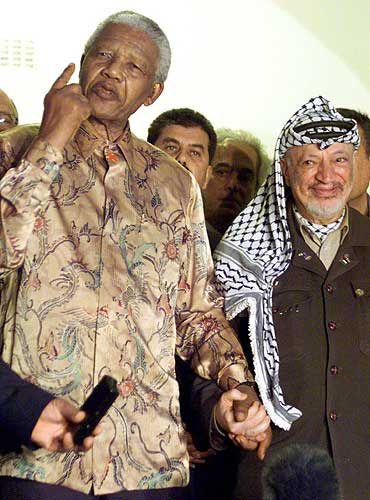
The late Yasser Arafat (right) and South Africa's Nelson Mandela join hands in solidarity. U.N. General Assembly resolution 2649 of November 1970 took "inalienable rights" to another level and specifically named the "peoples of southern Africa and Palestine" as partners in a legitimate struggle for self-determination. UNRWA's activities cannot be viewed in isolation from an institutional environment that has linked the Palestinian issue to decolonization, regardless of its applicability.

The idea of resettlement was implicitly encoded into UNRWA through U.N. General Assembly (UNGA) resolution 194 (III) of December 11, 1948...took care to ensure "the repatriation, resettlement and economic and social rehabilitation of the refugees and the payment of compensation."

...The formal articulation of repatriation and resettlement notwithstanding, as early as 1951, reintegration was understood in diplomatic circles exclusively as resettlement. Refugees shared that assessment, and, along with Arab host countries, resisted it in a variety of ways, so much so that by the late 1950s, reintegration, resettlement, and rehabilitation had reached a dead end. In the words of the 1957 UNRWA director's report:
in spite of the fact that many are establishing themselves in new lives, the refugees collectively remain opposed to certain types of self-support projects which they consider would mean permanent resettlement and the abandonment of hope of repatriation. They are, in general, supported in this stand by the Arab host Governments. ...

Shift to Education

In his report for 1959, incoming UNRWA director John Davis noted that "the execution of the 'long-term task' of assisting refugees to become self-supporting requires certain conditions which so far have not prevailed." He added:
It is no exaggeration to state that every aspect of life and human endeavour in the Near East is conditioned and complicated by the Palestine refugee problem. Its psychological, political, and social repercussions are of no less significance than its economic and humanitarian aspects. Any solution of the Palestine refugee problem must take these aspects into account.
Davis's remarkable statement ... by placing the refugee crisis at the heart of everything in the Middle East, ...implied that until the refugees themselves were satisfied, their plight would remain at the center of regional affairs. As such, his portentous assertion, an essential part of the Palestinian narrative, was perhaps the first high level official indication of UNRWA's intention to keep the refugees, and itself, at the center of Middle Eastern affairs.
Davis argued that UNRWA's mandate should be extended beyond June 30, 1960, when it was due to expire, calling for a reorientation of the agency's mission and an expanded emphasis on "providing general education, both elementary and secondary … teaching vocational skills, and awarding university scholarships; and … offering small loans and grants to individual refugees who have skills and want to become self-employed." This was a shrewd and successful adaptation and a fateful turning point in UNRWA's relationship with the refugees and the idea of resettlement.
Providing primary, secondary, and vocational training vastly expanded the agency's contact with refugees.
  • In 1950, UNRWA operated sixty-four schools with 41,000 elementary pupils, employing approximately 800 teachers.
  • By 1960, this had expanded to 382 schools, almost 124,000 pupils, and 3,500 teachers. By 1980, over 54 percent of UNRWA's resources were dedicated to education.
  • In 2011-12, across its five fields of operation, UNRWA's education program comprised 699 schools, 19,217 educational staff, and 486,754 enrolled pupils.
Increasing access to education and raising educational levels are inherently unobjectionable, a fact that UNRWA has traded on since the 1950s. More controversial has been the content of that education.
Educational materials used in UNRWA schools come from the host countries but are taught by Palestinian teachers, many of whom are graduates of UNRWA schools. During the 1960s and 1970s, teaching Palestinian nationalism was a specific goal of the Palestine Liberation Organization (PLO). Schools, teachers' unions, and youth organizations were targets for the PLO and its competitors such as the Muslim Brotherhood, which completely politicized these spaces. UNRWA and national governments also made funds available for scholarship for higher education, which took place in both Western and Soviet bloc institutions. Indeed, UNRWA's defenders praise the agency's position as a Palestinian national institution and emphasize the role of education.
UNRWA's educational emphasis during the 1970s coincided with the PLO's 1974 adoption of the "phased approach" for Israel's destruction, which included a commitment to the right of return—a euphemism for Israel's demographic subversion—as well as with the creation of the U.N. resolutions and infrastructure to support the "inalienable rights" of the Palestinian people. With the passage of time, textbooks in UNRWA, and later Palestinian Authority (PA) schools, have come under scathing criticism for articulating anti-Israel, anti-Semitic, anti-Western, and anti-peace themes, alongside advocacy of the right of return.
UNRWA's educational turn also had unanticipated and ironic consequences. The Palestinians' educational advantage aided their entry into the professional classes of Arab states, which should have facilitated their reintegration and resettlement. But these educational advantages were mitigated by growing Arab investments in their own educational systems. Rising educational standards in some Arab states, and the PLO's support for Saddam Hussein's 1990 invasion of Kuwait, also resulted in Palestinian marginalization and mass expulsion. Educated Palestinians returning to the West Bank and Gaza relied yet again on UNRWA's relief services. During and after the years following the Oslo accords, UNRWA and UNRWA-educated Palestinians took the lead in opposing the PLO's negotiations with Israel under the aegis of the "rights-based approach" and preserving the right of return.

Who Is a Refugee?

One significant means of UNRWA's permanent institutionalization and resistance to resettlement has been the expansion of its client base through redefinitions of who is a refugee.
The agency's founding resolution 302 (IV) used the term refugee without offering any definition. But the 1951 Convention relating to the Status of Refugees that established the United Nations High Commissioner for Refugees (UNHCR) began to set parameters for the Palestine Arab refugees and for UNRWA: "This Convention shall not apply to persons who are at present receiving from organs or agencies of the United Nations other than the United Nations High Commissioner for Refugees protection and assistance."
The politics behind this decision were a result of pressure from both Western and Arab states. France, for example, had moved to exclude the Palestinian refugees from the UNHCR mandate on the grounds that a number of U.N. organizations were already active in that arena. Arab delegates supported the exclusion, arguing that a universal definition of refugees would "submerge in the general mass of refugees of certain groups which were the particular concern of the General Assembly and the right of which to repatriation had been recognized by General Assembly resolutions."
Without a formal definition set by a supervisory body, UNRWA established its own series of operational definitions for refugees. In 1950, the following definition was offered:
For working purposes, the Agency has decided that a refugee is a needy person, who, as a result of the war in Palestine, has lost his home and his means of livelihood. … In some circumstances, a family may have lost part or all of its land from which its living was secured, but it may still have a house to live in. Others may have lived on one side of the boundary but worked in what is now Israel most of the year. Others, such as Bedouins, normally moved from one area of the country to another, and some escaped with part or all of their goods but cannot return to the area where they formerly resided the greater part of the time.
In 1954 a temporal qualification was introduced:
The definition of a person eligible for relief, as used by the Agency for some years, is one whose normal residence was Palestine for a minimum period of two years preceding the outbreak of the conflict in 1948 and who, as a result of this conflict, has lost both his home and means of livelihood.
The 1955 report of the UNRWA commissioner-general introduced an informal rationale for including other claimants, namely Palestine Arabs who were not displaced in 1948 but who lost some or all of their livelihoods:
There is only a difference of degree between, on the one hand, the situation of the man whose home was on the Jordan side of the demarcation line but whose land is now cut off in Israel, or who worked in what is now Israel[i] Jerusalem, or who sold his produce in the coastal towns or exported it through Palestinian ports, and, on the other hand, the situation of the man who has lost his home as well as his means of livelihood. All of these have lost, in varying degrees, a place in which to work and a way of life. They have that in common. Yet in some cases, the family which continues to reside in its former home, but whose nearby fields are no longer in its possession, may be in a more serious plight. The very proximity of its former possessions—the situation in which the original inhabitants must watch newcomers till their former fields and harvest crops from their former groves—increases the tensions and the psychological strain.
This decision followed up on observations made since 1948 regarding the impoverished state of those claimants. It also acknowledged the difficulty of both distinguishing them from true refugees as well as the moral and practical difficulties in refusing aid. Incorporating border villages into UNRWA's purview expanded its economic role in Gaza and Jordan and articulated a sociopsychological or therapeutic element that would become an important part of UNRWA's mission in the coming decades.
Throughout the 1950s, efforts were made to rectify refugee roles. Fraud, duplicate enrollments, non-counting of deaths, and the holding of ration cards by merchants were all well-known by UNRWA and the Western governments from 1949 onward, but little was or could be done. Riots by refugees, threats by merchants, and lack of cooperation from host countries, who were economically dependent on UNRWA, undermined efforts to reduce refugee rolls. Threats to reduce U.S. contributions to UNRWA amounted to little.
In 1965, the definition was again revised:
Recently a new problem of eligibility has arisen with the appearance of a third generation of refugees (i.e., the children of persons who were themselves born after 14 May 1948). On a literal interpretation of the definition of eligibility as it now stands, there may be some doubt whether these persons are eligible for UNRWA assistance. Under the proposals set out … they would clearly be eligible … subject to their being in need, and this would apply to subsequent generations also.
This new, expansive definition, which extended UNRWA's services to a third generation of refugees, was apparently offered as part of a deal between UNRWA director Laurence Michelmore and the Arab states, in exchange for new refugee surveys that mollified Western pressures.
The 1967 Six-Day War and the influx of more refugees into the UNRWA system from the West Bank offered the opportunity to establish a new baseline, and by 1971, the refugee definition had been expanded again with specifications regarding the inheritability of refugee status:
A Palestine refugee, by UNRWA's working definition, is a person whose normal residence was Palestine for a minimum of two years preceding the conflict in 1948 and who, as a result of this conflict, lost both his home and means of livelihood and took refuge, in 1948, in one of the countries where UNRWA provides relief. Refugees within this definition or the children or grandchildren of such refugees are eligible for agency assistance if they are (a) registered with UNRWA, (b) living in the area of UNRWA's operations, and (c) in need.
By 1994, this operational definition had been further extended:
Under UNRWA's operational definition, Palestine refugees are people whose normal place of residence was Palestine between June 1946 and May 1948, who lost both their homes and means of livelihood as a result of the 1948 Arab-Israeli conflict.
This version is still operative today. There are no qualifications regarding a refugee having been displaced to a country where UNRWA operates or whether they have obtained another nationality. Nor does UNRWA require individual applicants to have either endured all three criteria (residence, loss of homes, and loss of livelihood), or provide documentation of these statuses. UNRWA requires only a self-declaration from applicants. The mandate is effectively global and the agency views itself as the "global advocate for the protection and care of Palestine refugees." This generates a total client base of almost 5 million.

Mandates and the Question of Protections

Concurrent with the expansion of the definition of a Palestine refugee has been the vast expansion of UNRWA's mandate from the original, concise role of "direct relief and works programmes" to the ambitious endeavor
to contribute to the human development of Palestine refugees in the Gaza Strip, the West Bank, Jordan, Lebanon, and the Syrian Arab Republic until a durable and just solution is found to the refugee issue. … The Agency's vision is for every Palestine refugee to enjoy the best possible standards of human development, including attaining his or her full potential individually and as a family and community member; being an active and productive participant in socioeconomic and cultural life; and feeling assured that his or her rights are being defended, protected, and preserved.
The agency's imperative to maintain this standard of living indefinitely for an ever-expanding client base is perhaps the single greatest self-imposed impediment to resettlement.
Another form of mission creep has been the use of international law to expand organizational mandates to such fields as "education, health and relief, and social services, microfinance, infrastructure and camp improvement, and emergency assistance including food aid." Moreover, by the early 1980s, UNRWA's mandate had expanded to include protection of the refugees' legal and human rights. In December 1982, for example, U.N. Secretary-general Javier Pérez de Cuéllar asked UNRWA to consider "measures to guarantee the safety and security and the legal and human rights of the Palestinian refugees in the [Israeli] occupied territories."
Six years later he explicitly articulated these guarantees:
(a) "Protection" can mean physical protection, i.e., the provision of armed forces to deter, and if necessary fight, any threats to the safety of the protected persons;
(b) "Protection" can mean legal protection, i.e., intervention with the security and judicial authorities, as well as the political instances, of the occupying Power, by an outside agency, in order to ensure just treatment of an individual or group of individuals;
(c) "Protection" can also take a less well-defined form, called in this report "general assistance," in which an outside agency intervenes with the authorities of the occupying Power to help individuals or groups of individuals to resist violations of their rights (e.g., land confiscations) and to cope with the day-to-day difficulties of life under occupation, such as security restrictions, curfews, harassment, bureaucratic difficulties and so on;
(d) Finally, there is the somewhat intangible "protection" afforded by outside agencies, including especially the international media, whose mere presence and readiness to publish what they observe may have a beneficial effect for all concerned; in this report this type of protection is called "protection by publicity."
UNRWA's protection mandate was amplified in 2007 by the General Assembly, which stated that it was aware "of the valuable work done by the Agency in providing protection to the Palestinian people, in particular Palestine refugees." This was further extended in 2008 with a General Assembly direction to UNRWA regarding the rights of women and children. Likewise, in 2007, the General Assembly approved the commissioner-general's report that included the assertion that "UNRWA is a global advocate for the protection and care of Palestine refugees," and the organization established a senior protection policy advisor position. The influential 2008 "Morris report," compiled by a retired UNHCR staff member, also recommended that it use the U.N.'s human rights system to expand UNRWA's protection for refugees and that the agency's operations support officers in the West Bank and the Gaza Strip act as "roving international protection officers."
The scope of protections is potentially limitless as illustrated by the demand that the refugees be given a voice in the quest for "a just and durable solution" and be protected from the use of "disproportionate force" during this process. Indeed, the "Morris report" recommended that the commissioner-general "should engage with those drawing up negotiating papers and proposing positions and policies in order to ensure to the extent possible that these take proper account of the rights and interests of the refugees and of UNRWA's experience and knowledge." That is: UNRWA should be directly involved in the political process as representative of the Palestinian refugees, their rights, interests and desires, in direct competition with other Palestinian entities—hardly an inducement to resettlement....

Conclusions

UNRWA's ever-expanding mandates, operations and responsibilities, rhetoric, and institutional culture all work against resettlement. ...This ...represents another impediment to ...peace as a whole.
*Alex Joffe is a Shillman/Ginsburg Writing Fellow at the Middle East Forum and a New York-based writer on history and international affairs. His website is www.alexanderjoffe.net.