From "Straight from the Jerusalem Boardroom" #152, May 06, 2011, by Yoram Ettinger
(here's what's happening in Israel while Hamas and Fatah kiss and make up, to work on the two pillars of their economy: international aid and terrorism):
1. Israel's unemployment has declined to 6% in February, 2011, compared with 6.2% in December 2010 and 7.7% in December 2009 (April 29, 2011). The Houston-based ATP Oil & Gas, which specializes in deep off-shore drilling, received a license to drill in Israel (Globes, April 15).
2. The NY-based OrbiMed, the largest healthcare investment firm, established a $200MN Israel-dedicated fund, in order to leverage cutting-edge Israeli innovations (Globes, April 7). The NY-based Yorkville Capital intends to invest $100MN in Israeli companies during 2011. Last week Yorkville invested $50MN in Israel's Elbit Imaging (Globes, April 5).
3. The Irvine-based Broadcom acquired Israel's Provigent for $340MN, Broadcom's 8th Israeli acquisition since November 2000 – VisionTech for $250MN, Dune Networks - $178MN, Pecello - $86MN, Siliquent - $84MN, Octalica - $31MN, SighticVista - $15MN and MStream - $10MN (Globes March 22). The San Jose-based Align Technology acquired Israel's Cadent for $190MN (Globes, March 31). Santa Clara-based Internet security giant, Mcafee, acquired Israel's Sentrigo for $35MN (Globes March 24). Boston Scientific acquired Israel's S.I. Therapies for $20MN - $5MN in cash and the balance according to milestones (Globes, April 5). The Seattle-based Getty Images acquired Israel's PicScout for $20MN (Globes, April 28). India's Ybrant acquired Israel's PicApp for $10MN, its 2nd Israeli acquisition – Oridian for $15MN in 2007 (Globes, April 8).
4. A 39% increase in high-tech investments during the 1st quarter of 2011 - $479MN invested in 140 companies – the best quarter in two years, compared with $234MN in 91 companies during the 1st quarter of 2010. 28% invested by Israeli investors (Globes, April 14).
5. The London-based Sam Capital and the Minneapolis-based Piper Jaffray participated in a $60MN investment in Israel CleanTech Ventures (Globes, April 13). The Luxembourg-based Mangrove Capital Partners, the Menlo Park-based Benchmark Capital and Bessemer Venture Partners, the Palo Alto-based DAG Ventures and the NY-based Insight Venture Partners participated in a $40MN round by Israel's Weeks (Globes, March 30). The Hong Kong-based Pacific Technology Fund and the Menlo Park-based Bessemer participated in a $26MN 4th round by Israel's Altair (Globes, April 11). The Boston-based Spark Capital and the Menlo Park Bessemer and Redpoint Ventures participated in a $20MN round by Israel's AdaptTV (Globes, March 30). The Menlo Park-based Draper, Fisher, Jurvetson and the Menlo Park-based Kleiner Perkins co-led an $18MN round by Israel's agro-tech Kiima (Globes, April 6). The UK-based Lewis Trust Group participated in an $18MN round of private placement by Israel's OrSense (Globes, May 3). The Boston-based Globespan and the Menlo Park-based Sequoia Capital participated in a $15MN 3rd round by Israel's Kaminario (Globes, May 3). Motorola Ventures, the Needham-based Stata Ventures, the Tulsa-based Argonaut Private Equity, the San Jose-based Stryker Endoscopy and the Japan-based NTT invested $15MN in Israel's Amimon (Globes, March 25). Germany's medical giant, Merck committed 10MN Euro to Israel's biomed incubator in Yavneh (Globes, March 31). The Menlo Park-based Benchmark, the Palo Alto-based DAG Ventures and the Menlo Park-based Opus Ventures participated in a $12MN 4th round by Israel's Clarizen (Globes, May 2). The S.F.-based Saints Capital led a $12MN 5th round by Israel's AngioScore, which is located in California (Globes, April 28). The NY-based OrbiMed invested $10.5MN in Israel's SMT (Globes, April 4). The London, NY and Sidney-based Generation CleanTech Investment Management invested $10MN in a 3rd round by Israel's Tigo Energy, its second Israeli investment - $10MN in GreenRoad in 2010 (Globes, April 14). The Waltham-based Northbridge Venture Partners, the Boston-based Egan Venture Capital and the Deerfield-based Vernon & Park Capital invested $4MN in a 3rd round by Israel's CurrenSee (April 21). The Boston-based Schooner Capital participated in a $4MN 1st round by Israel's Zixi (Globes, April 13). The Menlo-Park Benchmark and the Bellevue-based Trilogy Partners and Ignition Partners invested $4MN in a 4th round by Israel's Xeround (Globes, April 6). Eric Schmidt, Google's outgoing CEO invested $1MN in Israel's EyeView (Globes, May 2).

Sunday, May 08, 2011


Saturday, May 07, 2011
Fatah, Hamas and Co. have Slain 981 Israeli Civilians Since 2000
From IsraelNationalNews.com, 5 May 2011, by Gil Ronen:
Nine hundred and eighty three civilians have been murdered by Muslim Arab terrorists since 2000.
The vast majority of the murders were carried out by the Fatah and Hamas terror groups.
About 17,200 civilians were wounded in these premeditated and intentional attacks upon civilian targets.
The statistics were released by the National Insurance Institute, for the upcoming Memorial Day for Fallen IDF Soldiers and Victims of Terror Attacks.
The total number of civilians killed in Muslim-Arab terror attacks since January 1, 1950 stands at 2,443. This figure includes 119 foreign nationals.
The numbers indicate that 40% of the total number of Israeli civilians murdered by terrorists since 1950 were killed from 2000 onward.
The massive and merciless terror onslaught that Israel suffered in the years 2000-2005 has yet to be officially named, even though the number of casualties surpasses that of some of Israel's wars. It is usually referred to either as "The Oslo War" or "The Second Intifada" (an Arab-language term).
The carnage was inflicted upon Israel after PLO terror chiefs and their militias were allowed into the Land of Israel following secret negotiations between Israeli leftists and PLO representatives in Oslo, Norway. This resulted in the Oslo Accords, which recognized the PLO leaders and terrorists as legitimate, after dozens of years in which Israel saw them as unworthy of any respect.
Seven years after being allowed into the Land of Israel, after they had established themselves on the ground and prepared for mass murder, the Arabs launched an unprecedented wave of horrific killings. Their favored targets were concentrations of citizens, be they on passenger buses, in coffee shops, or on lines to enter discotheques or malls.
Nine hundred and eighty-one civilian deaths, for a population Israel's size, is the equivalent of over 40,000 civilian deaths in the USA.
Nine hundred and eighty three civilians have been murdered by Muslim Arab terrorists since 2000.
The vast majority of the murders were carried out by the Fatah and Hamas terror groups.
About 17,200 civilians were wounded in these premeditated and intentional attacks upon civilian targets.
The statistics were released by the National Insurance Institute, for the upcoming Memorial Day for Fallen IDF Soldiers and Victims of Terror Attacks.
The total number of civilians killed in Muslim-Arab terror attacks since January 1, 1950 stands at 2,443. This figure includes 119 foreign nationals.
The numbers indicate that 40% of the total number of Israeli civilians murdered by terrorists since 1950 were killed from 2000 onward.
The massive and merciless terror onslaught that Israel suffered in the years 2000-2005 has yet to be officially named, even though the number of casualties surpasses that of some of Israel's wars. It is usually referred to either as "The Oslo War" or "The Second Intifada" (an Arab-language term).
The carnage was inflicted upon Israel after PLO terror chiefs and their militias were allowed into the Land of Israel following secret negotiations between Israeli leftists and PLO representatives in Oslo, Norway. This resulted in the Oslo Accords, which recognized the PLO leaders and terrorists as legitimate, after dozens of years in which Israel saw them as unworthy of any respect.
Seven years after being allowed into the Land of Israel, after they had established themselves on the ground and prepared for mass murder, the Arabs launched an unprecedented wave of horrific killings. Their favored targets were concentrations of citizens, be they on passenger buses, in coffee shops, or on lines to enter discotheques or malls.
Nine hundred and eighty-one civilian deaths, for a population Israel's size, is the equivalent of over 40,000 civilian deaths in the USA.
Will the "Arab Spring" halt at the Syrian border?
From guardian.co.uk, Sat 30 Apr 2011, by Jonathan Spyer:
...Syria's strategic alliance with Iran was thought of as an uncomfortable fit for the non-Islamist rulers of Syria – so it was assumed that President Assad was looking for a way out if it. Assad's relations with allied Islamist movements such as Hezbollah and Hamas were considered similarly instrumental in nature, and hence similarly susceptible to alteration. ...
These assumptions were noteworthy in that they were not only untrue, but in many ways represented the precise opposite of the truth. Syria's alignment with Iran and its backing of local paramilitary and terrorist clients are not flimsy marriages of convenience. They were and are the core of a successful regional policy. Through it, Damascus has magnified its local and regional influence, and obtained an insurance policy against paying any price for its activities.
This insurance policy is now paying dividends. Syria's alignment with the regional axis led by Iran represents Assad's best hope of survival. Indeed, western fear of Iran is the crucial factor making possible the crackdown in Syria and hence the survival of the regime.
The pro-western Arab authoritarian rulers, Ben Ali of Tunisia and Hosni Mubarak of Egypt, were forced aside by a combination of internal and subsequent western pressure. Non-aligned, isolated Muammar Gaddafi now finds himself fighting in Libya against a coalition of local rebels and western air power.
Assad, by contrast, who is aligned with the coalition of anti-western states and movements led by Iran, is currently facing only nominal and minimal western pressure. This is despite the fact that he appears to be engaged in the energetic slaughter of his own people.
The US administration disapproves of the repression, but the US ambassador to Syria, Robert Ford, remains firmly in place. The British foreign secretary finds the violence unacceptable but the defence secretary makes clear that a Libya-type option is not on the cards.
This is because if you mess around with Assad, you are issuing a challenge also to Iran, Hezbollah, Hamas, and their various regional allies and interests in Iraq and further afield. The leaders of the west don't want to do that.
According to opposition reports, Iranian personnel are on the ground helping to crush the rebellion in Syria. Many Syrians believe that the snipers whose bullets are reaping a terrible toll among the protestors are Iranians. Syrian-Iranian military co-operation is formalised (a co-operation treaty was signed in 1998) and intensive. Syria gives Iran a presence on the Mediterranean, and is the key arms conduit between Tehran and its Hezbollah client in Lebanon. It is also a major recipient of Iranian arms and aid. And Iran, evidently, sticks by its allies.
Since the west's commitment to regional liberty and freedom does not appear to extend to entangling itself in a general confrontation with the Iran-led regional bloc, Assad may feel reasonably confident. Now he just needs to crush the internal challenge.
... The Syrian dictator is currently getting away with slaughtering large numbers of his people because of western fear of Iran and its proxies. The question of whether the Arab spring stops at the borders of the Iran-led regional alliance will thus be decided in Syria.
The Iranians and their allies, who enthusiastically cheered the demonstrations in Egypt and Tunisia, are keen to ensure that it does end there. Western policy, meanwhile, looks likely to be too confused and hesitant to ensure that it does not. This matter will be decided in the weeks and months ahead.
The fall or weakening of the Assad regime in Syria would constitute a serious body blow to Iranian regional ambitions. Its resurgence under the protective tutelage of Tehran, by contrast, would prove that membership of the Iranian alliance provides a handy guarantee for autocratic rulers hoping to avoid the judgment of their peoples. In the ongoing cold war that remains the key strategic process in the Middle East, the west should see preventing this outcome as a key objective.
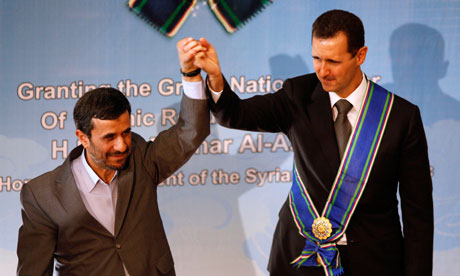
'If you mess around with Assad [right], you are issuing a challenge also to Iran [and Ahmadinejad, left] … the west doesn't want to do that.'
Photograph: Vahid Salemi/AP
...Syria's strategic alliance with Iran was thought of as an uncomfortable fit for the non-Islamist rulers of Syria – so it was assumed that President Assad was looking for a way out if it. Assad's relations with allied Islamist movements such as Hezbollah and Hamas were considered similarly instrumental in nature, and hence similarly susceptible to alteration. ...
These assumptions were noteworthy in that they were not only untrue, but in many ways represented the precise opposite of the truth. Syria's alignment with Iran and its backing of local paramilitary and terrorist clients are not flimsy marriages of convenience. They were and are the core of a successful regional policy. Through it, Damascus has magnified its local and regional influence, and obtained an insurance policy against paying any price for its activities.
This insurance policy is now paying dividends. Syria's alignment with the regional axis led by Iran represents Assad's best hope of survival. Indeed, western fear of Iran is the crucial factor making possible the crackdown in Syria and hence the survival of the regime.
The pro-western Arab authoritarian rulers, Ben Ali of Tunisia and Hosni Mubarak of Egypt, were forced aside by a combination of internal and subsequent western pressure. Non-aligned, isolated Muammar Gaddafi now finds himself fighting in Libya against a coalition of local rebels and western air power.
Assad, by contrast, who is aligned with the coalition of anti-western states and movements led by Iran, is currently facing only nominal and minimal western pressure. This is despite the fact that he appears to be engaged in the energetic slaughter of his own people.
The US administration disapproves of the repression, but the US ambassador to Syria, Robert Ford, remains firmly in place. The British foreign secretary finds the violence unacceptable but the defence secretary makes clear that a Libya-type option is not on the cards.
This is because if you mess around with Assad, you are issuing a challenge also to Iran, Hezbollah, Hamas, and their various regional allies and interests in Iraq and further afield. The leaders of the west don't want to do that.
According to opposition reports, Iranian personnel are on the ground helping to crush the rebellion in Syria. Many Syrians believe that the snipers whose bullets are reaping a terrible toll among the protestors are Iranians. Syrian-Iranian military co-operation is formalised (a co-operation treaty was signed in 1998) and intensive. Syria gives Iran a presence on the Mediterranean, and is the key arms conduit between Tehran and its Hezbollah client in Lebanon. It is also a major recipient of Iranian arms and aid. And Iran, evidently, sticks by its allies.
Since the west's commitment to regional liberty and freedom does not appear to extend to entangling itself in a general confrontation with the Iran-led regional bloc, Assad may feel reasonably confident. Now he just needs to crush the internal challenge.
... The Syrian dictator is currently getting away with slaughtering large numbers of his people because of western fear of Iran and its proxies. The question of whether the Arab spring stops at the borders of the Iran-led regional alliance will thus be decided in Syria.
The Iranians and their allies, who enthusiastically cheered the demonstrations in Egypt and Tunisia, are keen to ensure that it does end there. Western policy, meanwhile, looks likely to be too confused and hesitant to ensure that it does not. This matter will be decided in the weeks and months ahead.
The fall or weakening of the Assad regime in Syria would constitute a serious body blow to Iranian regional ambitions. Its resurgence under the protective tutelage of Tehran, by contrast, would prove that membership of the Iranian alliance provides a handy guarantee for autocratic rulers hoping to avoid the judgment of their peoples. In the ongoing cold war that remains the key strategic process in the Middle East, the west should see preventing this outcome as a key objective.
Wednesday, May 04, 2011
Global double standards: Bin Laden versus Yassin
From Ynet News, 3 May 2011, by Manfred Gerstenfeld:
Double standards applied against Israel: compare the international reactions to the killing of Osama bin Laden by USA, with those to the killing of Hamas terrorist leader Ahmed Yassin by Israel in 2004.
On Monday, UN Secretary General Ban Ki-moon told reporters that "the death of Osama bin Laden, announced by President (Barack) Obama last night, is a watershed moment in our common global fight against terrorism." Yet after the killing of Sheikh Yassin, then-UN Secretary General Kofi Annan said "I do condemn the targeted assassination of Sheikh Yassin and the others who died with him. Such actions are not only contrary to international law, but they do not do anything to help the search for a peaceful solution.”
The now-defunct UN Commission on Human Rights condemned “the tragic death of Sheikh Ahmed Yassin in contravention of the Hague Convention IV of 1907.” At the Security Council, the US had to use its veto power to prevent condemnation of Israel.
After the bin Laden killing, the leaders of the European Council and European Commission stated that his death made the world a safer place and showed that terrorist attacks do not remain unpunished. Following the Yassin killing, then-EU Foreign Policy Chief Javier Solana said, "This type of action does not contribute at all to create the conditions of peace. This is very, very bad news for the peace process. The policy of the European Union has been consistently condemnation of extra-judicial killing."
British Prime Minister David Cameron congratulated President Obama on the success of the bin Laden assassination. Cameron considered it a massive step forward in the fight against extremist terrorism. Former Prime Minister Tony Blair also welcomed bin Laden’s demise. However, the killing of Sheikh Yassin was called by the then-British Foreign Secretary Jack Straw “unacceptable” and “unjustified.” The official spokesman of then-Prime Minister Blair condemned the “unlawful attack“ and observed: "We have repeatedly made clear our opposition to Israel's use of targeted killings and assassinations.”
France's President Nicolas Sarkozy hailed Bin Laden’s killing as a coup in the fight against terrorism. He called President Obama, praised his determination and courage and all others who had pursued the head of al-Qaeda for 10 years. Sarkozy added that the two heads of state had agreed to continue the just and necessary fight against terrorist barbarity and those who support it. Yet after Sheikh Yassin’s death, a French Foreign Ministry spokesman, Herve Ladsous, said, “France condemns the action taken against Sheikh Yassin, just as it has always condemned the principle of any extra-judicial execution as contrary to international law.” Foreign Minister Dominique de Villepin declared that “such acts can only feed the spiral of violence.”
German Chancellor Angel Merkel said at a recent press conference, “I’m glad that killing bin Laden was successful.” She also called it “good news.” Then Foreign Minister Joschka Fischer had stated after the killing of Sheikh Yassin that “the German government is deeply concerned about the development.”
Russia released a statement regarding bin Laden which the Voice of America quoted as saying that retribution inevitably reaches all terrorists and that Russia is ready to “step up” its coordination in the international fight against global terrorism.” After the Yassin assassination, a foreign ministry spokesman said that Moscow was deeply concerned about the situation.
President Abdullah Gul of Turkey declared that the killing of bin Laden was a message for terrorist organizations all around the world. Turkish Prime Minister Recep Tayyip Erdogan had called the killing of Yassin “a terrorist act” and said that “the assassination was not humane.”
A case of anti-Semitism?
This comparison gets even more meaningful when seen in the context of the definition of anti-Semitism as regularly used in the European Union. It was prepared by one of the EU agencies. It gives examples of the ways in which anti-Semitism manifests itself with regard to the State of Israel, including the following: “Applying double standards by requiring of it a behavior not expected or demanded of any other democratic nation.”
Israel could considerably improve its public diplomacy by using the comparison of the two killings and other comparisons of events which occur with great frequency to stress such double standards. This is one of the many ways that Israel can fend off at least part of the unjust criticism against it.
Double standards applied against Israel: compare the international reactions to the killing of Osama bin Laden by USA, with those to the killing of Hamas terrorist leader Ahmed Yassin by Israel in 2004.
On Monday, UN Secretary General Ban Ki-moon told reporters that "the death of Osama bin Laden, announced by President (Barack) Obama last night, is a watershed moment in our common global fight against terrorism." Yet after the killing of Sheikh Yassin, then-UN Secretary General Kofi Annan said "I do condemn the targeted assassination of Sheikh Yassin and the others who died with him. Such actions are not only contrary to international law, but they do not do anything to help the search for a peaceful solution.”
The now-defunct UN Commission on Human Rights condemned “the tragic death of Sheikh Ahmed Yassin in contravention of the Hague Convention IV of 1907.” At the Security Council, the US had to use its veto power to prevent condemnation of Israel.
After the bin Laden killing, the leaders of the European Council and European Commission stated that his death made the world a safer place and showed that terrorist attacks do not remain unpunished. Following the Yassin killing, then-EU Foreign Policy Chief Javier Solana said, "This type of action does not contribute at all to create the conditions of peace. This is very, very bad news for the peace process. The policy of the European Union has been consistently condemnation of extra-judicial killing."
British Prime Minister David Cameron congratulated President Obama on the success of the bin Laden assassination. Cameron considered it a massive step forward in the fight against extremist terrorism. Former Prime Minister Tony Blair also welcomed bin Laden’s demise. However, the killing of Sheikh Yassin was called by the then-British Foreign Secretary Jack Straw “unacceptable” and “unjustified.” The official spokesman of then-Prime Minister Blair condemned the “unlawful attack“ and observed: "We have repeatedly made clear our opposition to Israel's use of targeted killings and assassinations.”
France's President Nicolas Sarkozy hailed Bin Laden’s killing as a coup in the fight against terrorism. He called President Obama, praised his determination and courage and all others who had pursued the head of al-Qaeda for 10 years. Sarkozy added that the two heads of state had agreed to continue the just and necessary fight against terrorist barbarity and those who support it. Yet after Sheikh Yassin’s death, a French Foreign Ministry spokesman, Herve Ladsous, said, “France condemns the action taken against Sheikh Yassin, just as it has always condemned the principle of any extra-judicial execution as contrary to international law.” Foreign Minister Dominique de Villepin declared that “such acts can only feed the spiral of violence.”
German Chancellor Angel Merkel said at a recent press conference, “I’m glad that killing bin Laden was successful.” She also called it “good news.” Then Foreign Minister Joschka Fischer had stated after the killing of Sheikh Yassin that “the German government is deeply concerned about the development.”
Russia released a statement regarding bin Laden which the Voice of America quoted as saying that retribution inevitably reaches all terrorists and that Russia is ready to “step up” its coordination in the international fight against global terrorism.” After the Yassin assassination, a foreign ministry spokesman said that Moscow was deeply concerned about the situation.
President Abdullah Gul of Turkey declared that the killing of bin Laden was a message for terrorist organizations all around the world. Turkish Prime Minister Recep Tayyip Erdogan had called the killing of Yassin “a terrorist act” and said that “the assassination was not humane.”
A case of anti-Semitism?
This comparison gets even more meaningful when seen in the context of the definition of anti-Semitism as regularly used in the European Union. It was prepared by one of the EU agencies. It gives examples of the ways in which anti-Semitism manifests itself with regard to the State of Israel, including the following: “Applying double standards by requiring of it a behavior not expected or demanded of any other democratic nation.”
Israel could considerably improve its public diplomacy by using the comparison of the two killings and other comparisons of events which occur with great frequency to stress such double standards. This is one of the many ways that Israel can fend off at least part of the unjust criticism against it.
Sunday, May 01, 2011
The time has come to call a spade a spade. Their "resistance" is war.
From JPost, 29 April 2011, by CAROLINE B. GLICK:
Prime Minister Binyamin Netanyahu’s response to the Fatah-led Palestinian Authority’s peace deal with Hamas [was]
The PA made the choice in 2005 again when it responded to Israel’s unilateral withdrawal from Gaza with a tenfold increase in the number of rockets and missiles it fired on Israeli civilian targets in the Negev.
The Palestinians made the choice in 2006, when they elected Hamas to rule over them.
They made the choice in March 2007 when Fatah and Hamas signed their first unity deal.
The PA made the choice in 2008 when Abbas rejected then-prime minister Ehud Olmert’s offer of statehood and peace.
The PA made the choice in 2010 when it refused to reinstate peace negotiations with Netanyahu; began peace negotiations with Hamas; and escalated its plan to establish an independent state without peace with Israel.
Now the PA has again made the choice by signing the newest peace deal with Hamas.
...Netanyahu’s call for the PA to choose is the political equivalent of a man telling his wife she must choose between him and her lover, after she has left home, shacked up and had five children with her new man.
...It is a tragedy that after more than a decade of the PA choosing war with Israel ...[we] cannot find the courage to ...[state] the truth and [end] the 18- year policy nightmare in which Israel is an active partner in its own demise.
[This] has been the central pillar of Israel’s foreign policy and domestic politics since Yitzhak Rabin first accepted the PLO as a legitimate actor in 1993 – it doesn’t matter how obvious it is that the Palestinians are uninterested in peaceful coexistence with Israel. It doesn’t matter how openly they wage their war to destroy Israel. Irrespective of the nakedness of Palestinian bad faith, seven successive governments have adopted the view that the only thing that stands between Israel and international pariah status is its leaders’ ability to persuade the so-called international community that Israel is serious about appeasing the Palestinians.
For the past several months, this profoundly neurotic perception of Israel’s options has fed our leaders’ hysterical response to the Palestinians’ plan to unilaterally declare independence.
The Palestinian plan itself discredits the idea that they are interested in anything other than destroying Israel. The plan is to get the UN to recognize a Palestinian state in Jerusalem, Judea, Samaria and Gaza outside the framework of a peace treaty with Israel.
The PA will first attempt to get the Security Council to endorse an independent “Palestine.” If the Obama administration vetoes the move, then the PA will ask the General Assembly to take action. Given the makeup of the General Assembly, it is all but certain that the Palestinians will get their resolution.
THE QUESTION is, does this matter? Everyone from Defense Minister Ehud Barak to hard-left, post-Zionist retreads like Shulamit Aloni and Avrum Burg says it does. They tell us that if this passes, Israel will face international opprobrium if its citizens or military personnel so much as breathe in Judea, Samaria and Jerusalem without Palestinian permission.
These prophets of doom warn that Israel has but one hope for saving itself from diplomatic death: Netanyahu must stand before the world and pledge to give Israel’s heartland and capital to the Palestinians.
And according to helpful Obama administration officials, everything revolves around Netanyahu’s ability to convince the EU-3 – British Prime Minister David Cameron, French President Nicolas Sarkozy and German Chancellor Angela Merkel – that he is serious about appeasing the Palestinians. If he doesn’t offer up Israel’s crown jewels in his speech before the US Congress next month, administration officials warn that the EU powers will go with the Palestinians....
Happily, these warnings are completely ridiculous. UN General Assembly resolutions have no legal weight. Even if every General Assembly member except Israel votes in favor of a resolution recognizing “Palestine,” all the Palestinians will have achieved is another non-binding resolution, with no force of law, asserting the same thing that thousands of UN resolutions already assert. Namely, it will claim falsely that Jerusalem, Judea, Samaria and Gaza are Palestinian territory to which Israel has no right. Israel will be free to ignore this resolution, just as it has been free to ignore its predecessors.
The threat of international isolation is also wildly exaggerated. ...despite its frosty reception from the White House [and] Whitehall, life in Israel has never been better.
According to the latest data released by the Central Bureau of Statistics, Israel’s economy grew 7.8 percent in the last quarter of 2010.
International trade is rising steeply. In the first quarter of 2011, exports rose 27.3%. They grew 19.9% in the final quarter of last year. Imports rose 34.7% between January and March, and 38.9% in the last quarter of 2010.
The Israel-bashing EU remains Israel’s largest trading partner. And even as Turkey embraced Hamas and Iran as allies, its trade with Israel reached an all time high last year.
These trade data expose a truth that the doom and gloomers are unwilling to notice: ... the threat of international isolation is empty.
The same people telling us to commit suicide now lest we face the firing squad in September would also have us believe that the boycott, divestment and sanctions movement is the single greatest threat to the economy. But that lie was put paid this month with the demise of the Australian town of Marrickville’s BDS-inspired boycott.
Last December, the anti-Israel coalition running the town council voted to institute a trade, sports and academic boycott against Israel. Two weeks ago the council was forced to cancel its decision after it learned that it would cost $3.4 million to institute it. Cheaper Israeli products and services would have to be replaced with more expensive non-Israeli ones.
Both Israel’s booming foreign trade and the swift demise of the Marrickville boycott movement demonstrate that the specter of international isolation in the event that Israel extricates itself from the Palestinian peace process charade is nothing more than a bluff. The notion that Israel will be worse off it Netanyahu admits that Abbas has again chosen war against the Jews over peace with us has no credibility.
...Nothing that Israel does will have any impact on [EU] votes [in the UN]. ...Since 1967, the Europeans have consistently been more pro-Palestinian than the US. Now, with the Obama administration demonstrating unprecedented hostility towards Israel, there is no way that the Europeans will suddenly shift to Israel’s side. So when European leaders tell Israelis that we need to convince them we are serious about peace, they aren’t being serious. They are looking for an excuse to be even more hostile. If Israel offers the store to Abbas, then the likes of Cameron, Merkel and Sarkozy will not only recognize “Palestine” at the UN, (because after all, they cannot be expected to be more pro-Israel than the Israeli government that just surrendered), they will recognize Hamas. Because that’s the next step.
It would seem that Israel’s leaders should have gotten wise to this game years ago. And the fact that they haven’t can be blamed [partly] on ...the Israeli Left. ...Its members – from university lecturers to anti-Zionist has-been politicians, artists, actors and hack writers ...have taken it upon themselves to scare the rest of us into taking this ridiculous charade seriously. So it was that last week a group of washed-up radicals gathered in Tel Aviv outside the hall where David Ben-Gurion proclaimed Israeli independence, and declared the independence of “Palestine.” They knew their followers in the media would make a big deal of their agitprop and use it as another means of demoralizing the public into believing we can do nothing but embrace our enemies’ cause against our country.
... The BDS haters have no leverage. ...no matter how much these people hate Israel, they will continue to buy our technologies and contract our researchers, because Cambridge is no longer capable of producing the same quality of scholarship as the Technion.
...it is well past time ...to stop playing this fool’s game. We don’t need anyone’s favors. Abbas has made his choice. Now it is time for [us] to [call a spade a spade].
Prime Minister Binyamin Netanyahu’s response to the Fatah-led Palestinian Authority’s peace deal with Hamas [was]
“The PA must choose either peace with Israel or peace with Hamas. There is no possibility for peace with both.”[But...] The PA made the choice in 2000 when it rejected Israel’s offer of peace and Palestinian statehood and joined forces with Hamas to wage a terror war against Israel.
The PA made the choice in 2005 again when it responded to Israel’s unilateral withdrawal from Gaza with a tenfold increase in the number of rockets and missiles it fired on Israeli civilian targets in the Negev.
The Palestinians made the choice in 2006, when they elected Hamas to rule over them.
They made the choice in March 2007 when Fatah and Hamas signed their first unity deal.
The PA made the choice in 2008 when Abbas rejected then-prime minister Ehud Olmert’s offer of statehood and peace.
The PA made the choice in 2010 when it refused to reinstate peace negotiations with Netanyahu; began peace negotiations with Hamas; and escalated its plan to establish an independent state without peace with Israel.
Now the PA has again made the choice by signing the newest peace deal with Hamas.
...Netanyahu’s call for the PA to choose is the political equivalent of a man telling his wife she must choose between him and her lover, after she has left home, shacked up and had five children with her new man.
...It is a tragedy that after more than a decade of the PA choosing war with Israel ...[we] cannot find the courage to ...[state] the truth and [end] the 18- year policy nightmare in which Israel is an active partner in its own demise.
[This] has been the central pillar of Israel’s foreign policy and domestic politics since Yitzhak Rabin first accepted the PLO as a legitimate actor in 1993 – it doesn’t matter how obvious it is that the Palestinians are uninterested in peaceful coexistence with Israel. It doesn’t matter how openly they wage their war to destroy Israel. Irrespective of the nakedness of Palestinian bad faith, seven successive governments have adopted the view that the only thing that stands between Israel and international pariah status is its leaders’ ability to persuade the so-called international community that Israel is serious about appeasing the Palestinians.
For the past several months, this profoundly neurotic perception of Israel’s options has fed our leaders’ hysterical response to the Palestinians’ plan to unilaterally declare independence.
The Palestinian plan itself discredits the idea that they are interested in anything other than destroying Israel. The plan is to get the UN to recognize a Palestinian state in Jerusalem, Judea, Samaria and Gaza outside the framework of a peace treaty with Israel.
The PA will first attempt to get the Security Council to endorse an independent “Palestine.” If the Obama administration vetoes the move, then the PA will ask the General Assembly to take action. Given the makeup of the General Assembly, it is all but certain that the Palestinians will get their resolution.
THE QUESTION is, does this matter? Everyone from Defense Minister Ehud Barak to hard-left, post-Zionist retreads like Shulamit Aloni and Avrum Burg says it does. They tell us that if this passes, Israel will face international opprobrium if its citizens or military personnel so much as breathe in Judea, Samaria and Jerusalem without Palestinian permission.
These prophets of doom warn that Israel has but one hope for saving itself from diplomatic death: Netanyahu must stand before the world and pledge to give Israel’s heartland and capital to the Palestinians.
And according to helpful Obama administration officials, everything revolves around Netanyahu’s ability to convince the EU-3 – British Prime Minister David Cameron, French President Nicolas Sarkozy and German Chancellor Angela Merkel – that he is serious about appeasing the Palestinians. If he doesn’t offer up Israel’s crown jewels in his speech before the US Congress next month, administration officials warn that the EU powers will go with the Palestinians....
Happily, these warnings are completely ridiculous. UN General Assembly resolutions have no legal weight. Even if every General Assembly member except Israel votes in favor of a resolution recognizing “Palestine,” all the Palestinians will have achieved is another non-binding resolution, with no force of law, asserting the same thing that thousands of UN resolutions already assert. Namely, it will claim falsely that Jerusalem, Judea, Samaria and Gaza are Palestinian territory to which Israel has no right. Israel will be free to ignore this resolution, just as it has been free to ignore its predecessors.
The threat of international isolation is also wildly exaggerated. ...despite its frosty reception from the White House [and] Whitehall, life in Israel has never been better.
According to the latest data released by the Central Bureau of Statistics, Israel’s economy grew 7.8 percent in the last quarter of 2010.
International trade is rising steeply. In the first quarter of 2011, exports rose 27.3%. They grew 19.9% in the final quarter of last year. Imports rose 34.7% between January and March, and 38.9% in the last quarter of 2010.
The Israel-bashing EU remains Israel’s largest trading partner. And even as Turkey embraced Hamas and Iran as allies, its trade with Israel reached an all time high last year.
These trade data expose a truth that the doom and gloomers are unwilling to notice: ... the threat of international isolation is empty.
The same people telling us to commit suicide now lest we face the firing squad in September would also have us believe that the boycott, divestment and sanctions movement is the single greatest threat to the economy. But that lie was put paid this month with the demise of the Australian town of Marrickville’s BDS-inspired boycott.
Last December, the anti-Israel coalition running the town council voted to institute a trade, sports and academic boycott against Israel. Two weeks ago the council was forced to cancel its decision after it learned that it would cost $3.4 million to institute it. Cheaper Israeli products and services would have to be replaced with more expensive non-Israeli ones.
Both Israel’s booming foreign trade and the swift demise of the Marrickville boycott movement demonstrate that the specter of international isolation in the event that Israel extricates itself from the Palestinian peace process charade is nothing more than a bluff. The notion that Israel will be worse off it Netanyahu admits that Abbas has again chosen war against the Jews over peace with us has no credibility.
...Nothing that Israel does will have any impact on [EU] votes [in the UN]. ...Since 1967, the Europeans have consistently been more pro-Palestinian than the US. Now, with the Obama administration demonstrating unprecedented hostility towards Israel, there is no way that the Europeans will suddenly shift to Israel’s side. So when European leaders tell Israelis that we need to convince them we are serious about peace, they aren’t being serious. They are looking for an excuse to be even more hostile. If Israel offers the store to Abbas, then the likes of Cameron, Merkel and Sarkozy will not only recognize “Palestine” at the UN, (because after all, they cannot be expected to be more pro-Israel than the Israeli government that just surrendered), they will recognize Hamas. Because that’s the next step.
It would seem that Israel’s leaders should have gotten wise to this game years ago. And the fact that they haven’t can be blamed [partly] on ...the Israeli Left. ...Its members – from university lecturers to anti-Zionist has-been politicians, artists, actors and hack writers ...have taken it upon themselves to scare the rest of us into taking this ridiculous charade seriously. So it was that last week a group of washed-up radicals gathered in Tel Aviv outside the hall where David Ben-Gurion proclaimed Israeli independence, and declared the independence of “Palestine.” They knew their followers in the media would make a big deal of their agitprop and use it as another means of demoralizing the public into believing we can do nothing but embrace our enemies’ cause against our country.
... The BDS haters have no leverage. ...no matter how much these people hate Israel, they will continue to buy our technologies and contract our researchers, because Cambridge is no longer capable of producing the same quality of scholarship as the Technion.
...it is well past time ...to stop playing this fool’s game. We don’t need anyone’s favors. Abbas has made his choice. Now it is time for [us] to [call a spade a spade].
Not by bread alone
It’s before dawn on Yom Hashoah (27th of Nisan 5771) and the Yahrzeit candles for: my grandmother, Chaya bat Yitzchak; my grandfather, Zvy ben Yosef; and my uncle, Mordechai ben Zvy; are alight nearby. I dedicate this personal note to their memory.


At the seudah shlishit yesterday, Rabbi Freilich asked: what is more important – Yom Hashoah or Yom Ha’atzmaut? I’m certain that they are both absolutely essential, but I feel in my heart that Yom Ha’atzmaut predominates. I wonder why?
Yom Ha’atzmaut follows Yom Hashoah. The latter promises a better future, while the former commemorates a terrible past event. We hope that such a Shoah will never be repeated, however if we don’t remember the past, we are condemned to repeat it.
On the other hand Yom Ha’atzmaut is older than Yom Hashoah. The exodus from Egypt was the birth of Jewish nationhood. We stood as a people and proclaimed that though we are slaves, we are nobler than our wealthy and powerful taskmasters. Our father Abraham loved his fellow man and showed hospitality to desert wayfarers, while our taskmasters worshipped idols and treated their fellow men as cattle. “Love your neighbour as yourself” is greater than wealth and power.
We undertook our first national project: to reject subservience to wealth and power and return to claim the land of Abraham. We sacrificed lambs, which our taskmasters idolised, and the household of Joseph, 70 souls that went to Egypt and had grown to a “mixed multitude” of probably 2-3 million spiritual descendents of Abraham: all ages and from many backgrounds including “converts” (and including 600,000 able-bodied men), stood as one nation.
3,500 years later, this national project to redeem the land of our spiritual forefathers, is still a work in progress. We are still struggling to defend ourselves, our land and our national legitimacy. As we read at our Seder table: “in every generation they rise up against us, to annihilate us…”
Since we left Egypt, we have faced: Amalek; the despots and dictators of the Babylonians, Greeks, and Romans; the Spanish Inquisition; the Crusaders; the Tzars; and the Nazis. Today we face the false “mullahs” of Iran; the baby dictator Assad in his fine suits; the thugs and murderers of Hamas and Hezbollah; the genocidal dreams of the murderous, so-called “Palestinian resistance”; their useful idiots around the world who either deceptively pretend to be pursuing “social justice” or stupidly believe that they are; and the just plain antisemites whose hatred blinds them from seeing that we are one people, one nation, one spirit. We conclude our Seder with Had Gadya to remind ourselves of this on-going parade of enemies.
Yom Hashoah is emblematic of the inhuman tyranny that stands against us. Yom Ha’atzmaut is our antidote.
The Rabbis who proclaimed 27th of Nisan as Yom Hashoah, sandwiched as it is between Pesach and Yom Ha’atzmaut, did so for this reason. We stood as one, first in Egypt. Then despite tribulations like the Shoah, we continue to aspire to higher aims. But just as we took the remains of Joseph with us from Egypt to Israel, we also carry with us the souls of all the loved ones we have lost, on our way to celebrating Yom Ha’atzmaut
We continue our national project: to reclaim the land of our father Abraham as our national homeland. But we do so, not because we aspire to wealth, nor to power. We don’t wish to rule over others, but we will defend ourselves, because only by having our feet rooted firmly in the earth, can we hold our head and hearts above the clouds. Only thus can we ensure that the spirit of Abraham, who loved others as himself, and every soul that is with his, will endure forever and in the world to come, when nation will no longer lift up sword against nation.
Man does not live by bread alone, but he needs bread in order to aspire to higher aims.


Man does not live by bread alone, but he needs bread in order to aspire to higher aims.
At the seudah shlishit yesterday, Rabbi Freilich asked: what is more important – Yom Hashoah or Yom Ha’atzmaut? I’m certain that they are both absolutely essential, but I feel in my heart that Yom Ha’atzmaut predominates. I wonder why?
Yom Ha’atzmaut follows Yom Hashoah. The latter promises a better future, while the former commemorates a terrible past event. We hope that such a Shoah will never be repeated, however if we don’t remember the past, we are condemned to repeat it.
On the other hand Yom Ha’atzmaut is older than Yom Hashoah. The exodus from Egypt was the birth of Jewish nationhood. We stood as a people and proclaimed that though we are slaves, we are nobler than our wealthy and powerful taskmasters. Our father Abraham loved his fellow man and showed hospitality to desert wayfarers, while our taskmasters worshipped idols and treated their fellow men as cattle. “Love your neighbour as yourself” is greater than wealth and power.
We undertook our first national project: to reject subservience to wealth and power and return to claim the land of Abraham. We sacrificed lambs, which our taskmasters idolised, and the household of Joseph, 70 souls that went to Egypt and had grown to a “mixed multitude” of probably 2-3 million spiritual descendents of Abraham: all ages and from many backgrounds including “converts” (and including 600,000 able-bodied men), stood as one nation.
3,500 years later, this national project to redeem the land of our spiritual forefathers, is still a work in progress. We are still struggling to defend ourselves, our land and our national legitimacy. As we read at our Seder table: “in every generation they rise up against us, to annihilate us…”
Since we left Egypt, we have faced: Amalek; the despots and dictators of the Babylonians, Greeks, and Romans; the Spanish Inquisition; the Crusaders; the Tzars; and the Nazis. Today we face the false “mullahs” of Iran; the baby dictator Assad in his fine suits; the thugs and murderers of Hamas and Hezbollah; the genocidal dreams of the murderous, so-called “Palestinian resistance”; their useful idiots around the world who either deceptively pretend to be pursuing “social justice” or stupidly believe that they are; and the just plain antisemites whose hatred blinds them from seeing that we are one people, one nation, one spirit. We conclude our Seder with Had Gadya to remind ourselves of this on-going parade of enemies.
Yom Hashoah is emblematic of the inhuman tyranny that stands against us. Yom Ha’atzmaut is our antidote.
The Rabbis who proclaimed 27th of Nisan as Yom Hashoah, sandwiched as it is between Pesach and Yom Ha’atzmaut, did so for this reason. We stood as one, first in Egypt. Then despite tribulations like the Shoah, we continue to aspire to higher aims. But just as we took the remains of Joseph with us from Egypt to Israel, we also carry with us the souls of all the loved ones we have lost, on our way to celebrating Yom Ha’atzmaut
We continue our national project: to reclaim the land of our father Abraham as our national homeland. But we do so, not because we aspire to wealth, nor to power. We don’t wish to rule over others, but we will defend ourselves, because only by having our feet rooted firmly in the earth, can we hold our head and hearts above the clouds. Only thus can we ensure that the spirit of Abraham, who loved others as himself, and every soul that is with his, will endure forever and in the world to come, when nation will no longer lift up sword against nation.
Man does not live by bread alone, but he needs bread in order to aspire to higher aims.
Friday, April 29, 2011
PA capitulates to Hamas
From JPost, 29 April 2011, by KHALED ABU TOAMEH:
No matter how one looks at it, the Palestinian reconciliation deal is a victory for Hamas.
...Moreover, the timing could not have been better for Hamas.
The Egyptian-sponsored deal came amid signs that Hamas was beginning to lose its grip on the Gaza Strip, as a result of the continued blockade and boycott by the international community.
Last month, thousands of Palestinian demonstrators clashed with Hamas security forces for the first time since the movement seized control over the entire Gaza Strip in the summer of 2007.
Many Palestinians, including Fatah, said that the confrontations reflected increased resentment of Hamas.
But the unity deal with Fatah will now help Hamas reassert its authority over the Gaza Strip. It will also help Hamas emerge from political isolation by turning it into a legitimate and key player in the international arena.
One of the biggest achievements for Hamas is the fact that the unity deal does not require it to relinquish control over the Gaza Strip. In fact, Hamas would be permitted to keep its security forces in the Gaza Strip, further tightening its grip on the area.
Nor does the deal require Hamas to accept the Middle East peace process or accept the two-state solution.
Hamas will be brought into the unity government as an equal partner.
Until a few days ago, Hamas and Fatah were detaining and torturing each other’s supporters.
For the past three-and-a-half years, security forces loyal to Mahmoud Abbas and Salam Fayyad worked round the clock to eliminate Hamas’s presence in the West Bank.
Under the terms of the reconciliation accord, Fatah will have to release all “political detainees” belonging to Hamas. This will only help Hamas regain its strength in the West Bank.
The deal also allows Hamas to run again unconditionally in elections, as was the case in the 2006 parliamentary vote. There’s no guarantee that Hamas would not win again in the next elections, which are expected to take place within a year.
Hamas has been recognized as a legitimate partner and player not only by Fatah, but also by the most populous Arab country, Egypt.
The popular uprising that forced Hosni Mubarak out of office earlier this year has been nothing but a blessing for Hamas. The new Egyptian regime has since been working to improve its ties with Hamas through a series of goodwill gestures that include the reopening of the Rafah border crossing and permitting the movement to have its own “representative office” in Cairo.
Although some Palestinians remained skeptical about the prospects of the unity deal holding for a long period of time, many agreed that Hamas stood to benefit the most from the agreement.
See this TIP Timeline of Terror Attacks by Hamas Since Israel’s 2005 Gaza Withdrawal.
No matter how one looks at it, the Palestinian reconciliation deal is a victory for Hamas.
...Moreover, the timing could not have been better for Hamas.
The Egyptian-sponsored deal came amid signs that Hamas was beginning to lose its grip on the Gaza Strip, as a result of the continued blockade and boycott by the international community.
Last month, thousands of Palestinian demonstrators clashed with Hamas security forces for the first time since the movement seized control over the entire Gaza Strip in the summer of 2007.
Many Palestinians, including Fatah, said that the confrontations reflected increased resentment of Hamas.
But the unity deal with Fatah will now help Hamas reassert its authority over the Gaza Strip. It will also help Hamas emerge from political isolation by turning it into a legitimate and key player in the international arena.
One of the biggest achievements for Hamas is the fact that the unity deal does not require it to relinquish control over the Gaza Strip. In fact, Hamas would be permitted to keep its security forces in the Gaza Strip, further tightening its grip on the area.
Nor does the deal require Hamas to accept the Middle East peace process or accept the two-state solution.
Hamas will be brought into the unity government as an equal partner.
Until a few days ago, Hamas and Fatah were detaining and torturing each other’s supporters.
For the past three-and-a-half years, security forces loyal to Mahmoud Abbas and Salam Fayyad worked round the clock to eliminate Hamas’s presence in the West Bank.
Under the terms of the reconciliation accord, Fatah will have to release all “political detainees” belonging to Hamas. This will only help Hamas regain its strength in the West Bank.
The deal also allows Hamas to run again unconditionally in elections, as was the case in the 2006 parliamentary vote. There’s no guarantee that Hamas would not win again in the next elections, which are expected to take place within a year.
Hamas has been recognized as a legitimate partner and player not only by Fatah, but also by the most populous Arab country, Egypt.
The popular uprising that forced Hosni Mubarak out of office earlier this year has been nothing but a blessing for Hamas. The new Egyptian regime has since been working to improve its ties with Hamas through a series of goodwill gestures that include the reopening of the Rafah border crossing and permitting the movement to have its own “representative office” in Cairo.
Although some Palestinians remained skeptical about the prospects of the unity deal holding for a long period of time, many agreed that Hamas stood to benefit the most from the agreement.
See this TIP Timeline of Terror Attacks by Hamas Since Israel’s 2005 Gaza Withdrawal.
Thursday, April 28, 2011
USA got Lost on the Road to Damascus
From Yahoo News, Wed Apr 27, by Anthony Ventre:
...It was 2007 when House Speaker Nancy Pelosi hit the road for Damascus, overriding Bush state department criticism of her attempted rogue diplomacy. What wish-fulfillment fantasies compelled Pelosi to visit a country officially listed as a "state sponsor of terror?
"The road to Damascus is the road to peace!" Pelosi enthused.
Pelosi's judgment was that Syria's dictator would succumb to the American left-liberal vision of peace with Israel so long as Israel returned the Golan Heights. It didn't matter to Pelosi that Syria's Bashar Assad was a client state of Iran and a chief sponsor of Hezbollah in Lebanon. Nor did it matter that Syria was funneling fighters into Iraq to oppose U.S. troops. It didn't matter, either, that the Israelis had not consented to any peace process initiated by Pelosi, and were blind-sided by her proclamation.
The Israelis often point out that there could be no peace process without a reliable "peace partner." Terror groups like Hamas could never be peace partners, for example, because they would simply lie to obtain what they wanted. And they did lie. When the Israelis pulled out of Gaza, Hamas amped up its efforts at firing rockets into Israel.
Syria has unmasked itself as an imaginary "peace partner" by murdering an estimated 400 protestors in the current crisis. Assad's regime terrorizes political opponents with tanks and snipers hired from Iran to pick off protest leaders. Such was the fate of Neda Soltan during the 2009 pro-democracy uprising—shot dead by an Iranian police sniper.
Just because Arabs and Persians have been telling us for years that the postage stamp sized state of Israel is the main reason for a Middle Eastern failure doesn't mean it is so. This is particularly obvious now that the Middle Eastern winds have shifted. Clearly, Israel has had nothing to do with the uprisings which have now dwarfed the Palestinian-Israeli conflict in scope and consequences for the U.S.
Putting Israel at the center of Middle Eastern conflicts is a facile copout ....
... The Obama administration has not withdrawn its ambassador, frozen Syrian assets, or threatened war crimes trials as it has with Gadhafi in Libya. Yet, those things can be done now and easily.
It's time for the myth of the "good dictator" in Syria to be put to rest.
...It was 2007 when House Speaker Nancy Pelosi hit the road for Damascus, overriding Bush state department criticism of her attempted rogue diplomacy. What wish-fulfillment fantasies compelled Pelosi to visit a country officially listed as a "state sponsor of terror?
"The road to Damascus is the road to peace!" Pelosi enthused.
Pelosi's judgment was that Syria's dictator would succumb to the American left-liberal vision of peace with Israel so long as Israel returned the Golan Heights. It didn't matter to Pelosi that Syria's Bashar Assad was a client state of Iran and a chief sponsor of Hezbollah in Lebanon. Nor did it matter that Syria was funneling fighters into Iraq to oppose U.S. troops. It didn't matter, either, that the Israelis had not consented to any peace process initiated by Pelosi, and were blind-sided by her proclamation.
The Israelis often point out that there could be no peace process without a reliable "peace partner." Terror groups like Hamas could never be peace partners, for example, because they would simply lie to obtain what they wanted. And they did lie. When the Israelis pulled out of Gaza, Hamas amped up its efforts at firing rockets into Israel.
Syria has unmasked itself as an imaginary "peace partner" by murdering an estimated 400 protestors in the current crisis. Assad's regime terrorizes political opponents with tanks and snipers hired from Iran to pick off protest leaders. Such was the fate of Neda Soltan during the 2009 pro-democracy uprising—shot dead by an Iranian police sniper.
Just because Arabs and Persians have been telling us for years that the postage stamp sized state of Israel is the main reason for a Middle Eastern failure doesn't mean it is so. This is particularly obvious now that the Middle Eastern winds have shifted. Clearly, Israel has had nothing to do with the uprisings which have now dwarfed the Palestinian-Israeli conflict in scope and consequences for the U.S.
Putting Israel at the center of Middle Eastern conflicts is a facile copout ....
... The Obama administration has not withdrawn its ambassador, frozen Syrian assets, or threatened war crimes trials as it has with Gadhafi in Libya. Yet, those things can be done now and easily.
It's time for the myth of the "good dictator" in Syria to be put to rest.
Assad under pressure as hundreds of Baathists quit
From AFP, Wed Apr 27:
DAMASCUS (AFP) – Foreign pressure mounted on Syrian President Bashar al-Assad, and hundreds of members resigned from his party, as troops kept their grip on the flashpoint town of Daraa.
...233 members of Syria's ruling Baath party announced their resignation in protest at the deadly crackdown on protesters, according to lists seen by AFP.
...Baath party signatories from the Banias region, which covers Daraa, condemned "the house raids and the indiscriminate use of live fire against people, homes, mosques and churches."
...The Security Council, however, failed to agree on a statement condemning the killing of Syrian protesters ...talks ended in deadlock ...France called for "strong measures" ...The United States said Assad must "change course now" ...
Russia and China blocked the statement proposed by Britain, France, Germany and Portugal that would have condemned the violence and backed calls for an independent investigation.
The European Union, meanwhile, is mulling sanctions and the UN human rights body has called for a special session in the wake of the Syrian regime's bloody crackdown ...
...the military assault on Daraa, 100 kilometres (62 miles) south of Damascus, has left more than 30 people dead since Monday, with at least 453 civilians killed across Syria since protests first erupted in mid-March...
DAMASCUS (AFP) – Foreign pressure mounted on Syrian President Bashar al-Assad, and hundreds of members resigned from his party, as troops kept their grip on the flashpoint town of Daraa.
...233 members of Syria's ruling Baath party announced their resignation in protest at the deadly crackdown on protesters, according to lists seen by AFP.
...Baath party signatories from the Banias region, which covers Daraa, condemned "the house raids and the indiscriminate use of live fire against people, homes, mosques and churches."
...The Security Council, however, failed to agree on a statement condemning the killing of Syrian protesters ...talks ended in deadlock ...France called for "strong measures" ...The United States said Assad must "change course now" ...
Russia and China blocked the statement proposed by Britain, France, Germany and Portugal that would have condemned the violence and backed calls for an independent investigation.
The European Union, meanwhile, is mulling sanctions and the UN human rights body has called for a special session in the wake of the Syrian regime's bloody crackdown ...
...the military assault on Daraa, 100 kilometres (62 miles) south of Damascus, has left more than 30 people dead since Monday, with at least 453 civilians killed across Syria since protests first erupted in mid-March...
The Obama Catastrophy
From "Word from Jerusalem", April 28, 2011, by Isi Leibler:
At every conceivable level, the Obama administration's Middle East policies are spiraling into a disastrous free-fall.
 Even Obama's friend, PA president Mahmoud Abbas, has explicitly accused the US President of having totally misled him. In an interview with Newsweek, he said that
But it is Obama's obtuse and utterly inconsistent approach to the upheavals in the Arab world that have plunged the US into a bottomless pit and possibly irrevocably terminated whatever support for the US remained among some of the more moderate Arab autocracies.
From the outset, Obama surprised the world by his naïve efforts to "engage" with the fervently hostile Iranian extremists seeking to become a nuclear power. When the Iranian people revolted peacefully against the ayatollahs during the "Green Revolution", the American president remained mute even as the regime brutally suppressed the opposition.
Yet when Egyptian president Mubarak, the most loyal US ally in the Arab world, faced a domestic revolt, Obama turned his back on him, demanding his resignation and did not even enable him to retire graciously.
The Saudis and other "moderate" pro-US Arab states were shocked at the manner in which the Americans had responded to their most faithful ally. They undoubtedly now no longer harbor illusions about the reliability of American support under the Obama administration. In fact. the most pessimistic predictions of the outcome of these "democratic" revolts are regrettably now being realized.
The Muslim Brotherhood - which a number of ignorant members of the Obama administration had described as being democratic, more open-minded and even "mostly secular", has emerged as the most powerful force in Egypt. According to a recently released PEW Research Center poll, 75 percent of Egyptians regard the Brotherhood favorably. The US is despised - only 15% favoring a better relationship. More than 50% support the scrapping of the peace treaty with Israel. The Egyptian military council has already initiated moves to renew diplomatic relations with Iran and enabled Iranian ships to traverse the Suez Canal.
The candidate most likely to become president is Amr Moussa, who is favored by 89% of those polled. He is the secretary-general of the Arab League whose hatred for Israel was so intense that Mubarak was obliged to sack him as foreign minister. Only last week he declared that the Camp David accords were no longer relevant.
The other candidate Mohammed ElBaradei declared that if Israel became engaged in a war with Hamas, Egypt would be obliged to respond militarily.
Over 62% support the transformation of Egypt into a sharia state. Obama's betrayal of Mubarak has thus directly led to the installation of a more extremist anti-Western regime.
But the regional situation is even worse. In Libya, Obama's support of the overthrow of the deranged but recently pro-Western Colonel Gaddafi has resulted in a civil war. If Gaddafi wins, he will undoubtedly revert to his former evil terrorist activities which he had voluntarily relinquished. If the rebels are victorious, we are likely to find al-Qaida elements occupying a significant role in the country. The same applies to Yemen, which following the defeat of President Ali Abdullah Saleh, has every likelihood of being transformed into a fully-fledged terrorist state dominated by al-Qaida.
But even more incomprehensible was Obama's extraordinary tepid response to Syria's dictator Bashar Assad, whose brutal crackdown against peaceful demonstrators made Mubarak's repression appear positively mild.
Besides, Assad is an avowed enemy of the US and closely allied with the Iranian regime and enabled al-Qaida forces to traverse Syria in order to fight against American troops in Iraq. He is a major sponsor of Hezbollah and has acted as their conduit for the transfer of arms. He hosts Hamas in Damascus, orchestrated the murder of the Lebanese prime minister, sought to obtain nuclear weapons and bitterly opposed Egypt's peace treaty with Israel.
It is therefore inexplicable that even after hundreds of demonstrators were brutally killed and Assad has made it clear that he will not hesitate killing more citizens to quell any opposition, Obama has still neither called on him to step down nor initiated meaningful sanctions as he did with Libya.
We are left with a feeling of bewilderment. Is the administration so isolated from reality that it truly believes Secretary of State Hillary Clinton when she refers to the tyrannical Assad as a reformer? Or is there a hidden agenda of which we are unaware?
My gut feeling is that there is no conspiracy and it is all a question of absolute and utter incompetence and dysfunctionality. Obama is proving, on a daily basis, to be a complete novice in foreign relations and his liberal ideologue advisers are just as confused.
It is truly mind-boggling. We have a US president who condemns the only genuine democratic partner the US has in the Middle East for building apartments in the suburbs of their capital. He betrays the Egyptian leader Hosni Mubarak, who loyally supported America for four decades and paves the way for a new more hostile Egyptian regime. And yet he hesitates in responding to one of the most committed enemies of the US in the Arab world.
We should therefore be under no illusions that Obama will initiate any meaningful action to curtail Iran's nuclear ambitions.
In summary: The Obama administration has undermined Israel, abandoned its Arab allies and appeased America's worst enemies.
We can only hope and pray that the Republicans will get their act together and designate a credible candidate before the next presidential elections. It is chilling to contemplate the damage Obama could inflict on America's international standing should he be reelected for a second term, free from any electoral constraints. The damage that ongoing American decline and weakness could inflict on Western civilization is positively alarming.In other words, it was Obama's initiative which motivated Abbas to make the unprecedented demand that Israel freeze all construction in settlements, including the Jewish suburbs of east Jerusalem. Abbas now finds it extremely convenient to use Obama's impulsive action as a pretext to refuse to negotiate with Israel and stand by as global pressures are exerted on the Jewish state to make more unilateral concessions.
At every conceivable level, the Obama administration's Middle East policies are spiraling into a disastrous free-fall.
"it was Obama who suggested a full settlement freeze. I said okay, I accept. We both went up the tree. After that, he came down the ladder and he removed the ladder, and said to me jump. Three times he did it."
But it is Obama's obtuse and utterly inconsistent approach to the upheavals in the Arab world that have plunged the US into a bottomless pit and possibly irrevocably terminated whatever support for the US remained among some of the more moderate Arab autocracies.
From the outset, Obama surprised the world by his naïve efforts to "engage" with the fervently hostile Iranian extremists seeking to become a nuclear power. When the Iranian people revolted peacefully against the ayatollahs during the "Green Revolution", the American president remained mute even as the regime brutally suppressed the opposition.
Yet when Egyptian president Mubarak, the most loyal US ally in the Arab world, faced a domestic revolt, Obama turned his back on him, demanding his resignation and did not even enable him to retire graciously.
The Saudis and other "moderate" pro-US Arab states were shocked at the manner in which the Americans had responded to their most faithful ally. They undoubtedly now no longer harbor illusions about the reliability of American support under the Obama administration. In fact. the most pessimistic predictions of the outcome of these "democratic" revolts are regrettably now being realized.
The Muslim Brotherhood - which a number of ignorant members of the Obama administration had described as being democratic, more open-minded and even "mostly secular", has emerged as the most powerful force in Egypt. According to a recently released PEW Research Center poll, 75 percent of Egyptians regard the Brotherhood favorably. The US is despised - only 15% favoring a better relationship. More than 50% support the scrapping of the peace treaty with Israel. The Egyptian military council has already initiated moves to renew diplomatic relations with Iran and enabled Iranian ships to traverse the Suez Canal.
The candidate most likely to become president is Amr Moussa, who is favored by 89% of those polled. He is the secretary-general of the Arab League whose hatred for Israel was so intense that Mubarak was obliged to sack him as foreign minister. Only last week he declared that the Camp David accords were no longer relevant.
The other candidate Mohammed ElBaradei declared that if Israel became engaged in a war with Hamas, Egypt would be obliged to respond militarily.
Over 62% support the transformation of Egypt into a sharia state. Obama's betrayal of Mubarak has thus directly led to the installation of a more extremist anti-Western regime.
But the regional situation is even worse. In Libya, Obama's support of the overthrow of the deranged but recently pro-Western Colonel Gaddafi has resulted in a civil war. If Gaddafi wins, he will undoubtedly revert to his former evil terrorist activities which he had voluntarily relinquished. If the rebels are victorious, we are likely to find al-Qaida elements occupying a significant role in the country. The same applies to Yemen, which following the defeat of President Ali Abdullah Saleh, has every likelihood of being transformed into a fully-fledged terrorist state dominated by al-Qaida.
But even more incomprehensible was Obama's extraordinary tepid response to Syria's dictator Bashar Assad, whose brutal crackdown against peaceful demonstrators made Mubarak's repression appear positively mild.
Besides, Assad is an avowed enemy of the US and closely allied with the Iranian regime and enabled al-Qaida forces to traverse Syria in order to fight against American troops in Iraq. He is a major sponsor of Hezbollah and has acted as their conduit for the transfer of arms. He hosts Hamas in Damascus, orchestrated the murder of the Lebanese prime minister, sought to obtain nuclear weapons and bitterly opposed Egypt's peace treaty with Israel.
It is therefore inexplicable that even after hundreds of demonstrators were brutally killed and Assad has made it clear that he will not hesitate killing more citizens to quell any opposition, Obama has still neither called on him to step down nor initiated meaningful sanctions as he did with Libya.
We are left with a feeling of bewilderment. Is the administration so isolated from reality that it truly believes Secretary of State Hillary Clinton when she refers to the tyrannical Assad as a reformer? Or is there a hidden agenda of which we are unaware?
My gut feeling is that there is no conspiracy and it is all a question of absolute and utter incompetence and dysfunctionality. Obama is proving, on a daily basis, to be a complete novice in foreign relations and his liberal ideologue advisers are just as confused.
It is truly mind-boggling. We have a US president who condemns the only genuine democratic partner the US has in the Middle East for building apartments in the suburbs of their capital. He betrays the Egyptian leader Hosni Mubarak, who loyally supported America for four decades and paves the way for a new more hostile Egyptian regime. And yet he hesitates in responding to one of the most committed enemies of the US in the Arab world.
We should therefore be under no illusions that Obama will initiate any meaningful action to curtail Iran's nuclear ambitions.
In summary: The Obama administration has undermined Israel, abandoned its Arab allies and appeased America's worst enemies.
We can only hope and pray that the Republicans will get their act together and designate a credible candidate before the next presidential elections. It is chilling to contemplate the damage Obama could inflict on America's international standing should he be reelected for a second term, free from any electoral constraints. The damage that ongoing American decline and weakness could inflict on Western civilization is positively alarming.In other words, it was Obama's initiative which motivated Abbas to make the unprecedented demand that Israel freeze all construction in settlements, including the Jewish suburbs of east Jerusalem. Abbas now finds it extremely convenient to use Obama's impulsive action as a pretext to refuse to negotiate with Israel and stand by as global pressures are exerted on the Jewish state to make more unilateral concessions.
Dangerous liaisons (particularly for the West) between Egypt and Iran
From Il Giornale, April 23, 2011, by Fiamma Nirenstein*:
...after thirty hostile years, the Islamic Republic of Iran and Egypt are preparing to exchange ambassadors. The passage of two Iranian ships into the Mediterranean via the Suez Canal some weeks ago foreshadowed this new reality.
(Also see our previous posting on this subject: "Egypt Minister Proposes Opening ‘New Page’ With Iran")
Nabil el Arabi, just appointed Egypt’s Foreign Minister by the new post-revolutionary government, immediately stated he intended to restore relations with Teheran. Then he met with an Iranian official, Mugtabi Amani, in the first institutional visit since Mubarak was deposed. El Arabi then negotiated the opening of the respective embassies in Teheran and Cairo with Iranian Foreign Minister Ali Akhbar Salehi. It seems that Ali Ahbar Sbuyeh, an Iranian career diplomat, will serve as Iranian ambassador to Egypt. Egypt has said that it is too early to announce his Egyptian counterpart. The delay in selecting the new Egyptian ambassador to Iran is probably the result of Egyptian Prime Minister Essam Sharaf’s very recent meeting with the Saudi King, who has made clear his dislike of this new reality.
Discussions are also underway regarding other consequences of the new reality: Egypt’s stance toward Hamas, Iran’s God-child, has changed, and weapons smuggling to Gaza through tunnels from Egyptian territory is no longer stopped by Egyptian security forces. Iran might want more explicit support for Hamas, and might also request protection for Iranian convoys carrying weapons through Sudan.
Egypt and Iran are the two historical pillars, the two great and well-armed forces, of the Sunni and Shiite branches of Islam. They counter-balanced each other.
While the Sunni branch is ambiguous toward the Muslim Brothers and al Qaeda, it has much better relations with the West and has resisted extremism in its territory.
The stronghold of the Shiite branch, on the other hand, is the Islamic Ayatollah regime, which explicitly champions the destruction of Israel and the creation of an Islamic caliphate. It supports terrorist groups whether Sunni or Shiite, including Hamas and Hezbollah. A few days ago, Mahmoud Ahmadinejad, the president of the Islamic Republic of Iran again made unbridled anti-Western threats running along these lines:
The new Egypt, now in search of allies, is under pressure from its population which moves in a much more Islamic direction. If it is true, and it is, that the Muslim Brotherhood accounts for thirty percent, it will therefore dominate the Egyptian parliament. Two days ago, the secretary and deputy supreme guide of the Muslim Brotherhood announced that sharia, with its hand cutting, stoning and terrible abuses of women, will soon be imposed.
Furthermore, after the Tahrir Square revolution, only 35% of the Egyptian population is in favour of keeping the peace treaty with Israel. Demonstrators assaulted the Israeli Embassy in Cairo.
Even Egyptian cabinet ministers can no longer restrain themselves: Samir Radwan, Minister of Finance, referring to new Israeli investments in Egypt, declared:
*Vice-president of the Committee on Foreign Affairs, Chair of the Committee for the Inquiry into Antisemitism, Italian Chamber of Deputies
...after thirty hostile years, the Islamic Republic of Iran and Egypt are preparing to exchange ambassadors. The passage of two Iranian ships into the Mediterranean via the Suez Canal some weeks ago foreshadowed this new reality.
(Also see our previous posting on this subject: "Egypt Minister Proposes Opening ‘New Page’ With Iran")
Nabil el Arabi, just appointed Egypt’s Foreign Minister by the new post-revolutionary government, immediately stated he intended to restore relations with Teheran. Then he met with an Iranian official, Mugtabi Amani, in the first institutional visit since Mubarak was deposed. El Arabi then negotiated the opening of the respective embassies in Teheran and Cairo with Iranian Foreign Minister Ali Akhbar Salehi. It seems that Ali Ahbar Sbuyeh, an Iranian career diplomat, will serve as Iranian ambassador to Egypt. Egypt has said that it is too early to announce his Egyptian counterpart. The delay in selecting the new Egyptian ambassador to Iran is probably the result of Egyptian Prime Minister Essam Sharaf’s very recent meeting with the Saudi King, who has made clear his dislike of this new reality.
Discussions are also underway regarding other consequences of the new reality: Egypt’s stance toward Hamas, Iran’s God-child, has changed, and weapons smuggling to Gaza through tunnels from Egyptian territory is no longer stopped by Egyptian security forces. Iran might want more explicit support for Hamas, and might also request protection for Iranian convoys carrying weapons through Sudan.
Egypt and Iran are the two historical pillars, the two great and well-armed forces, of the Sunni and Shiite branches of Islam. They counter-balanced each other.
While the Sunni branch is ambiguous toward the Muslim Brothers and al Qaeda, it has much better relations with the West and has resisted extremism in its territory.
The stronghold of the Shiite branch, on the other hand, is the Islamic Ayatollah regime, which explicitly champions the destruction of Israel and the creation of an Islamic caliphate. It supports terrorist groups whether Sunni or Shiite, including Hamas and Hezbollah. A few days ago, Mahmoud Ahmadinejad, the president of the Islamic Republic of Iran again made unbridled anti-Western threats running along these lines:
“The United States and other Western nations foment the Middle Eastern revolutions to save the Zionist regime. They want to overturn Syria because it is our friend… the revolt of the Arab world will in any case lead to the collapse of the Zionist regime...the USA is disloyal to the Arabs and will be kicked out of the Middle East ”.The current Egyptian government probably questions the fidelity of the USA and Obama. After all, it was no coincidence that Obama flew to Cairo on his first presidential trip where he gave his first speech to the Arab world. Egypt, which for decades was loyal to its friendship with the USA, is certainly wondering why President Obama abandoned Mubarak without thinking twice. Mubarak was the most pro-American of all the leaders of the Arab world and would have never broken the peace with Israel.
The new Egypt, now in search of allies, is under pressure from its population which moves in a much more Islamic direction. If it is true, and it is, that the Muslim Brotherhood accounts for thirty percent, it will therefore dominate the Egyptian parliament. Two days ago, the secretary and deputy supreme guide of the Muslim Brotherhood announced that sharia, with its hand cutting, stoning and terrible abuses of women, will soon be imposed.
Furthermore, after the Tahrir Square revolution, only 35% of the Egyptian population is in favour of keeping the peace treaty with Israel. Demonstrators assaulted the Israeli Embassy in Cairo.
Even Egyptian cabinet ministers can no longer restrain themselves: Samir Radwan, Minister of Finance, referring to new Israeli investments in Egypt, declared:
“We do not need investments from the enemy”.Relations between Iran and Egypt broke off after Egypt’s President Anwar Sadat’s peace treaty with Israel; it matters that this renewed friendship rests upon anti-Israeli hatred. The Iranian government dedicated a monument to Khaled al Istambuli, who murdered Sadat in the name of the Egyptian Islamic Jihad. Members of the commando, such as Abboud al Zumar, are now released. Al Zumar has said he was disappointed that his revolution resulted in Mubarak. He should wait a moment: he still has to see the results of this one.
*Vice-president of the Committee on Foreign Affairs, Chair of the Committee for the Inquiry into Antisemitism, Italian Chamber of Deputies
PM Netanyahu responds to the Palestinian Authority-Hamas agreement
From the Israel Ministry of Foreign Affairs, 27 April 2011 (Communicated by the Prime Minister's Media Adviser):
Prime Minister Benjamin Netanyahu this evening (Wednesday), 27 April 2011, referred to the anticipated agreement between the Palestinian Authority and Hamas:
Prime Minister Benjamin Netanyahu this evening (Wednesday), 27 April 2011, referred to the anticipated agreement between the Palestinian Authority and Hamas:
"The Palestinian Authority needs to choose between peace with Israel and peace with Hamas. Peace with both is impossible because Hamas aspires to destroy the State of Israel and says so openly. It fires missiles at our cities; it fires anti-tank rockets at our children.
I think that the very idea of this reconciliation shows the weakness of the Palestinian Authority and causes one to wonder if Hamas will seize control of Judea and Samaria like it seized control of the Gaza Strip.
I hope that the Palestinian Authority chooses correctly, i.e. that it chooses peace with Israel. The choice is in its hands."
Hamas and Fatah try reconciliation (again)
From Christian Science Monitor, April 27, 2011, by Kristen Chick, Correspondent:
Rival Palestinian factions Hamas and Fatah say they've agreed to end a four-year rift. If the agreement holds, it could pave the way for the first Palestinian elections since 2006 and end a period of simmering hostilities...
In a deal brokered by Egypt, the two sides agreed in principle to form an interim government made up of “independents” and to hold elections in a year, officials said at a press conference. Officials said they would formally ink the deal within weeks.
... Palestinians in the West Bank and Gaza have watched regional revolutions and held small protests against their own leaders, whom they see as unaccountable and corrupt. They've also urged the factions to put aside their differences for the sake of creating a Palestinian state. That has dragged Fatah's Mahmoud Abbas and Hamas's Khaled Mashaal back to the negotiating table.
Yet many observers are skeptical that the deal will hold, particularly when its comes to implementation.
“Looking at the past four years, at the lack of trust, the lack of confidence, the incitement on both sides, it makes every reasonable person question whether this will be implemented on the ground,” says Mkhaimer Abusada, political science professor at Al Azhar University in Gaza...
Schism developed in 2007
The schism between Hamas and Fatah opened in 2007, when Hamas wrested control of Gaza from Fatah in a bloody conflict. Since then, Fatah has controlled the West Bank and Hamas has ruled Gaza. The divide has complicated efforts to restart Israeli-Palestinian peace negotiations. Egypt, under the rule of former President Hosni Mubarak, tried unsuccessfully for years to bring the two Palestinian factions together. Some Hamas officials were skeptical he was an honest broker however, since Mubarak detested their movement, an offshoot of Egypt's Muslim Brotherhood...
The quick success of the new government in brokering a deal will be a source of pride for Egypt, whose regional influence has declined....
Israel and the US, however...have said in the past they will not recognize a Palestinian government that includes the Islamist organization unless Hamas first renounces violence and recognizes Israel’s right to exist.
Israeli Prime Minister Benjamin Netanyahu rejected the agreement. “The Palestinian Authority must choose either peace with Israel or peace with Hamas. Peace with both is not possible,” he said.
Officials in Cairo tried to head off a confrontation with Israel, implying the interim government would be made up of technocrats and not factional figures. They also said they had agreed on security cooperation, a key area in the ongoing dispute, but did not go into detail. Mr. Abusada said the agreement stipulated that Hamas would remain in control of security in Gaza and Fatah in the West Bank until new elections are held and the government restructures the security apparatus. Hamas’s armed wing, the Al Qassam Brigades, has rejected laying down arms or giving control of security to the very forces they fought fiercely in 2007.
...Hamas ...with a more neutral arbiter in the new Egyptian government, essentially ran out of excuses not to agree, says Emad Gad, an analyst at Al Ahram Center for Political and Strategic Studies in Cairo.
Gad says the upheaval currently under way in Syria, which hosts Hamas’s politburo, was likely a factor pushing the organization to the table. And it also couldn’t ignore the impatience of Gazans, who were tired of living under the blockade Israel imposed after Hamas took control of Gaza. As the wave of protests swept the region, Gazans organized protests of their own against Hamas, which were swiftly put down by Hamas security forces.
But the initial signs on the ground in Gaza were not positive, says Abusada. When Gazans went to a central Gaza City square to celebrate the announcement, they were dispersed by baton-wielding Hamas policemen. “That makes me wonder whether Hamas on the ground and Al Qassam is going to accept this and is ready to implement it,” he says.
Rival Palestinian factions Hamas and Fatah say they've agreed to end a four-year rift. If the agreement holds, it could pave the way for the first Palestinian elections since 2006 and end a period of simmering hostilities...
In a deal brokered by Egypt, the two sides agreed in principle to form an interim government made up of “independents” and to hold elections in a year, officials said at a press conference. Officials said they would formally ink the deal within weeks.
... Palestinians in the West Bank and Gaza have watched regional revolutions and held small protests against their own leaders, whom they see as unaccountable and corrupt. They've also urged the factions to put aside their differences for the sake of creating a Palestinian state. That has dragged Fatah's Mahmoud Abbas and Hamas's Khaled Mashaal back to the negotiating table.
Yet many observers are skeptical that the deal will hold, particularly when its comes to implementation.
“Looking at the past four years, at the lack of trust, the lack of confidence, the incitement on both sides, it makes every reasonable person question whether this will be implemented on the ground,” says Mkhaimer Abusada, political science professor at Al Azhar University in Gaza...
Schism developed in 2007
The schism between Hamas and Fatah opened in 2007, when Hamas wrested control of Gaza from Fatah in a bloody conflict. Since then, Fatah has controlled the West Bank and Hamas has ruled Gaza. The divide has complicated efforts to restart Israeli-Palestinian peace negotiations. Egypt, under the rule of former President Hosni Mubarak, tried unsuccessfully for years to bring the two Palestinian factions together. Some Hamas officials were skeptical he was an honest broker however, since Mubarak detested their movement, an offshoot of Egypt's Muslim Brotherhood...
The quick success of the new government in brokering a deal will be a source of pride for Egypt, whose regional influence has declined....
Israel and the US, however...have said in the past they will not recognize a Palestinian government that includes the Islamist organization unless Hamas first renounces violence and recognizes Israel’s right to exist.
Israeli Prime Minister Benjamin Netanyahu rejected the agreement. “The Palestinian Authority must choose either peace with Israel or peace with Hamas. Peace with both is not possible,” he said.
Officials in Cairo tried to head off a confrontation with Israel, implying the interim government would be made up of technocrats and not factional figures. They also said they had agreed on security cooperation, a key area in the ongoing dispute, but did not go into detail. Mr. Abusada said the agreement stipulated that Hamas would remain in control of security in Gaza and Fatah in the West Bank until new elections are held and the government restructures the security apparatus. Hamas’s armed wing, the Al Qassam Brigades, has rejected laying down arms or giving control of security to the very forces they fought fiercely in 2007.
...Hamas ...with a more neutral arbiter in the new Egyptian government, essentially ran out of excuses not to agree, says Emad Gad, an analyst at Al Ahram Center for Political and Strategic Studies in Cairo.
Gad says the upheaval currently under way in Syria, which hosts Hamas’s politburo, was likely a factor pushing the organization to the table. And it also couldn’t ignore the impatience of Gazans, who were tired of living under the blockade Israel imposed after Hamas took control of Gaza. As the wave of protests swept the region, Gazans organized protests of their own against Hamas, which were swiftly put down by Hamas security forces.
But the initial signs on the ground in Gaza were not positive, says Abusada. When Gazans went to a central Gaza City square to celebrate the announcement, they were dispersed by baton-wielding Hamas policemen. “That makes me wonder whether Hamas on the ground and Al Qassam is going to accept this and is ready to implement it,” he says.
Wednesday, April 27, 2011
US: Assad is no peace partner but Gaddafi is worse
From JPost 27 April 2011, by HILARY LEILA KRIEGER:
Top US State Department official says it's difficult to pursue other diplomatic missions while Syrian regime violently puts down protests.
WASHINGTON – After two years of pushing Israel to reach a peace agreement with Syria, a top US State Department official indicated Tuesday the Obama administration is no longer looking at the current regime as a partner for such a deal.
... Sullivan said the US is also looking at the possibility of imposing sanctions on Syrian leaders and is consulting with international partners on this and other potential steps to halt the bloody crackdown Assad has ordered on opposition protesters.
“President Assad is on the wrong track,” Sullivan said, condemning the civilian deaths. He added, though, that the US is focused on “diplomatic and financial” initiatives aimed at the Syrian regime rather than military intervention as has taken place in Libya.
He also repeatedly declined to label Assad an illegitimate ruler or call for him to go, as the US did in Libya with Muammar Gaddafi once the Libyan leader began to shoot at protesters rather than accede to their demands for reform.
“Ultimately, the future of Syria is up to the people of Syria,” Sullivan said.
Top US State Department official says it's difficult to pursue other diplomatic missions while Syrian regime violently puts down protests.
WASHINGTON – After two years of pushing Israel to reach a peace agreement with Syria, a top US State Department official indicated Tuesday the Obama administration is no longer looking at the current regime as a partner for such a deal.
... Sullivan said the US is also looking at the possibility of imposing sanctions on Syrian leaders and is consulting with international partners on this and other potential steps to halt the bloody crackdown Assad has ordered on opposition protesters.
“President Assad is on the wrong track,” Sullivan said, condemning the civilian deaths. He added, though, that the US is focused on “diplomatic and financial” initiatives aimed at the Syrian regime rather than military intervention as has taken place in Libya.
He also repeatedly declined to label Assad an illegitimate ruler or call for him to go, as the US did in Libya with Muammar Gaddafi once the Libyan leader began to shoot at protesters rather than accede to their demands for reform.
“Ultimately, the future of Syria is up to the people of Syria,” Sullivan said.
“It’s hard for us to stand by and see [President Bashar] Assad and his government engage in the kind of things they’re doing against their own people and to then think easily about how to pursue other diplomatic missions,” Jacob Sullivan, director of policy planning at the State Department, told reporters.
'Annexation for declaration' idea advancing in Knesset
From JPost, 26 Apriil 2011, by GIL HOFFMAN:
MK Danon preparing bills to annex West Bank, repeal Oslo Accords...
Ideas about annexing parts of the West Bank that until recently were considered extreme have been gaining traction in the Knesset in recent weeks as the Palestinian Authority continues threatening to declare a state unilaterally in September.
National Infrastructures Minister Uzi Landau raised the idea at Israel Beiteinu’s convention in Jerusalem two weeks ago and then spoke about it at length in an interview with The Jerusalem Post’s web site last week.
“We’ll have to protect ourselves,” he said. “If [the Palestinians declare a state], I’m going to suggest to my government to extend our sovereignty over the Jordan Valley and over the highly populated blocs we have in Judea and Samaria, just to start with.”
...Landau and Diaspora Affairs Minister Yuli Edelstein will be featured speakers at a rally in favor of annexing Judea and Samaria at the Knesset next month. Top right-wing academics and former foreign minister Moshe Arens are also expected to speak at the event, which is being organized by Likud MK Danny Danon.
Danon favors responding to a Palestinian declaration of statehood by annexing all of Area C, which includes all the West Bank’s Jewish settlements and empty land. He said Prime Minister Binyamin Netanyahu should follow the example of his predecessors Levi Eshkol, who annexed eastern Jerusalem, and Menachem Begin, who annexed the Golan Heights.
A source close to the prime minister said that Netanyahu has kept his cards close to his chest as to how he would respond to Palestinian unilateral action, but that he has said in the past that Israel has its own unilateral options.
Danon said he hoped the threat of annexation could help Netanyahu persuade European leaders to stop the United Nations from voting on Palestinian statehood at the UN General Assembly in September.
Danon is working on two bills: One in favor of annexing the West Bank and another that would repeal the Oslo Accords.
He said he believed that if annexation would be brought to a vote in the Likud it would pass.
Habayit Hayehudi leader Daniel Herschkowitz said he backed the initiative. An Israel Beiteinu spokesman said that beyond Landau, his faction is undecided, but it is possible that it would back the initiative as well.
MK Danon preparing bills to annex West Bank, repeal Oslo Accords...
Ideas about annexing parts of the West Bank that until recently were considered extreme have been gaining traction in the Knesset in recent weeks as the Palestinian Authority continues threatening to declare a state unilaterally in September.
National Infrastructures Minister Uzi Landau raised the idea at Israel Beiteinu’s convention in Jerusalem two weeks ago and then spoke about it at length in an interview with The Jerusalem Post’s web site last week.
“We’ll have to protect ourselves,” he said. “If [the Palestinians declare a state], I’m going to suggest to my government to extend our sovereignty over the Jordan Valley and over the highly populated blocs we have in Judea and Samaria, just to start with.”
...Landau and Diaspora Affairs Minister Yuli Edelstein will be featured speakers at a rally in favor of annexing Judea and Samaria at the Knesset next month. Top right-wing academics and former foreign minister Moshe Arens are also expected to speak at the event, which is being organized by Likud MK Danny Danon.
Danon favors responding to a Palestinian declaration of statehood by annexing all of Area C, which includes all the West Bank’s Jewish settlements and empty land. He said Prime Minister Binyamin Netanyahu should follow the example of his predecessors Levi Eshkol, who annexed eastern Jerusalem, and Menachem Begin, who annexed the Golan Heights.
A source close to the prime minister said that Netanyahu has kept his cards close to his chest as to how he would respond to Palestinian unilateral action, but that he has said in the past that Israel has its own unilateral options.
Danon said he hoped the threat of annexation could help Netanyahu persuade European leaders to stop the United Nations from voting on Palestinian statehood at the UN General Assembly in September.
Danon is working on two bills: One in favor of annexing the West Bank and another that would repeal the Oslo Accords.
He said he believed that if annexation would be brought to a vote in the Likud it would pass.
Habayit Hayehudi leader Daniel Herschkowitz said he backed the initiative. An Israel Beiteinu spokesman said that beyond Landau, his faction is undecided, but it is possible that it would back the initiative as well.
“A Palestinian declaration of statehood would officially bury the Oslo Accords, which state that final borders will be decided via negotiations and that unilateral actions constitute violation of the accords,” Danon said. “The Palestinians declaring a state would free us of all the diplomatic, security, and economic commitments we made in the Oslo Accords.”
Subscribe to:
Posts (Atom)