Saturday, February 10, 2018

If you fly Qatar Airways, you support Hamas

9 February 2018, by Steve Lieblich:

I often see Facebook friends "check in" to Doha airport, often  en route from Australia to Europe and sometimes (indirectly) to Israel. I guess they don't realize that being a customer of Qatar Airways is helping to fund terror attacks on Israeli civilians and the billionaire lifestyles of Hamas leaders.


In May 2014, Qatar Airways’ chief executive officer, Akbar Al Baker said that the airline was now fully owned by the Qatar government. “We became fully government owned in July last year,” he said at a news conference, after the country’s sovereign fund bought a 50-percent stake from Qatar’s former prime minister and other shareholders.

Since Hamas assumed control in Gaza in 2007, Qatar has poured hundreds of millions of dollars into the territory and backed Hamas diplomatically, sheltering its exiled leader Khaled Mashaal.
In 2007, Qatar was one of the only countries to back Hamas after the group booted the more moderate Palestinian Authority out of the Gaza Strip in a bloody coup. In 2012, its then-emir, Sheik Hamad bin Khalifa al-Thani, became the first head of state to visit Gaza under Hamas rule, pledging to raise $400 million toward reconstruction.

In September 2014, Qatar, despite its attempts to improve its image, by welcoming foreign universities, backing al-Jazeera and planning to host the 2022 World Cup, was criticised in the US Congress for its championing of Hamas.

In November 2017, the Qatari Foreign Ministry said the IDF’s destruction of a tunnel leading from the Gaza Strip into Israeli territory was a crime against the Palestinian people that hampered their "legitimate rights" to attack Israeli civilians.
“The State of Qatar expressed its strong condemnation of the Israeli shelling of Gaza Strip in which a number of Palestinians were martyred and others were injured… a continuation of the Israeli crimes against the Palestinian people and a desperate attempt to obstruct their efforts for claiming their legitimate rights.”
Five Palestinian Islamic Jihad terrorists — including two senior commanders — and two terrorists from Hamas’s armed wing were killed as a result of the tunnel’s destruction. Senior Palestinian Islamic Jihad leader Khaled al-Batsh confirmed that the attack tunnel was built by his group for the purpose of kidnapping Israeli soldiers.

Qatar has long been a supporter of Hamas and has paid for much of the reconstruction of the Gaza Strip after the terror group fought a 50-day war with Israel in 2014.

Qatar reiterated its “full support for the Palestinian people’s self-determination and restoration of all legitimate rights, foremost of which is the establishment of an independent and sovereign state on the borders of June 4, 1967 with Jerusalem as its capital.”

In response, in the same month (November 2017), in Washington: A US-Government bipartisan panel singled out Qatar by backing legislation that would slap sanctions on any countries or individuals providing financial and material support to the Islamic militant group Hamas. The proposed bill specifically criticised Qatar for having backed Hamas and hosting senior members of the militant group. The legislation cited a March 2014 Treasury Department report that said Qatar “has for many years openly financed Hamas.”

Saudi Arabia, Egypt, the United Arab Emirates and Bahrain broke ties with Qatar earlier this year over allegations it funds terrorism. The US echoed the accusation.


Ismail Haniyeh (R) and Hamas associates on Haniyeh’s private plane on the way to Qatar at the onset of Operation Protective Edge.
A 27,000 square meter commercial development in Doha, including four towers, office and commercial space and a 10,000 square meter mall, is owned by the wife and children of another Hamas leader, Khaled Mashal. Read more

Last month (January 2018) The United States put Ismail Haniyeh, on its terror blacklist and slapped sanctions on him. The 55-year-old Haniyeh was named head of Hamas in May 2017. 
“Haniyeh has close links with Hamas... and has been a proponent of armed struggle, including against civilians … He has reportedly been involved in terrorist attacks against Israeli citizens. Hamas has been responsible for an estimated 17 American lives killed in terrorist attacks.”
A few days ago (Thursday 9 February 2018) the emir of Qatar, Tamim bin Hamad Al Thani, promised Hamas terror group leader Ismail Hanieyh financial aid. Al Thani affirmed that Qatar would continue to “support the Palestinian people...”

It was the first phone conversation between a world leader and Haniyeh after the US’s decision to add the Hamas leader to its global terror blacklist. Haniyeh thanked the Qatari emir…

Sunday, February 04, 2018

Trump's Potential UNRWA Reforms

From the Middle East Forum, January 31, 2018:


... the Trump administration might "refuse to accept UNRWA's special status for 'Palestine refugees,'" and suspend all U.S. government funding of the group.

... the end of U.S. recognition of fake Palestinian refugees who never lived in what is today Israel, [will remove] a source of irredentism and terrorism.

Middle East Forum director Gregg Roman:
"So long as the United Nations Relief and Works Agency continues to proliferate 'refugees' and breed a victim mentality, it encourages conflict.... Should these reports be true, it would be a major step toward peace."
Forum president Daniel Pipes:
"The American taxpayer is UNRWA's largest donor, paying $370 million in 2016 alone... These funds support violent attacks on Jews, encourage corruption, and delay an end to the Arab-Israeli conflict. The Forum encourages President Trump to take bold leadership and reign in a rogue organization."
These potential moves are consistent with the Forum's Israel Victory Project, which calls for delaying diplomacy until the Palestinians give up their effort to eliminate the Jewish state.

According to The Guardian, Al-Monitor, and NPR, President Trump adopted the Forum's idea when he recognized Jerusalem as Israel's capital and ordered the embassy moved there.

UNRWA: The UN Agency that Creates Palestinian Refugees

From Gatestone Institute, 29 January 2018, by Pierre Rehov:

  •  According to the UN's own definition, the status of "refugee" cannot be passed from generation to generation -- as it conveniently has been for the Palestinians. A Palestinian with a European, American or Jordanian passport has no reason to be considered a refugee. Except by UNRWA.
  • "Since the UN took them over, the Palestinians started burying their dead at night, without declaring them, in order to share their rations. As a result, for nearly 20 years, the official death rate in the camps was close to zero. In addition, there was a lot of movement between the camps. But these displacements were rarely recorded, so that a Palestinian could appear in several camps at the same time..." — Said Aburish, Palestinian Refugee and biographer of the late Palestinian Chairman Yasser Arafat.
  • UNRWA is not just a humanitarian agency. Its political stance is evident at all levels of the organization. A report from the Institute for Monitoring Peace and Cultural Tolerance in School Education, says that the 2016-2017 curriculum for elementary schools in PA, partly funded by UNRWA, "teaches students to be martyrs, to demonize and deny the existence of Israel, and to focus on a 'return' to an exclusively Palestinian country."

In the context of announced budget cuts, the US administration recently announced that it will drastically reduce its financial support of UNRWA (United Nations Relief and Works Agency for Palestine Refugees). US Ambassador to the UN Nikki Haley wanted the outright cancellation of the $364 million allocated each year to the UN agency, as long as it did not implement reforms and transparency, but US Secretary of State Rex Tillerson was for the time being content to halve the first tranche of aid, originally set at $125 million.

At the heart of this case is the desire of US President Donald Trump to stop financing any agency or international organization that does not reflect American interests. There is also, however, a 180-degree turn on the US position in the Arab-Israeli conflict by the new administration. It seems determined not to make the same mistakes -- and fall into the same traps -- as previous administrations.
First, what is UNRWA?

Established in December 1949 with a one-year mandate, UNRWA aimed at its birth to help resettle the 600,000 Palestinian Arabs who had fled the conflict zone during the rebirth of the state of Israel, after five Arab armies had attacked it -- and lost.
The causes of this exile were threefold, according to several polls undertaken in refugee camps and summarized in an article by Tibor Mende, published in French newspaper Le Monde on April 21, 1951:
"Some did not want to live in a Jewish state, others fled the battle and, once that was over, could not return home. Many more left because they were told that it was for a few days, a few weeks at most, and that they would return with the triumphant Arab armies. "
Surprisingly (or not), no parallel office was created to help the 870,000 Jews expelled and despoiled by the majority of Arab-Muslim countries between 1948 and 1974 -- including those militarily forced out of Judea and Samaria by the Hashemite Kingdom of Jordan, which hastened to rename this region the "West Bank" after illegally annexing it in 1948.

It is true that most of the Jews expelled from Arab countries were welcomed by Israel and in the Western world, whereas, with the exception of Jordan, no Arab country bordering the Jewish state made the slightest gesture to help its own victims in a conflict the Arabs had begun. They apparently preferred, instead, to let their co-religionists languish in the worst conditions, presumably in an effort to place the blame for their suffering on Israel.
In 1950, when Canada's General Howard Kennedy and Sir Henry Knight, the first UNRWA leaders, realized that their work was rendered impossible by the politicization of the humanitarian crisis with which they were charged, and that their mandate could not be fulfilled in such a short time, an English Labour MP, Richard Crossrian, was called to explain their failure in the House of Commons. His answer, as reported by Mende in Le Monde, was eloquent:
"As long as we rely on the United Nations to do something serious for the settlement of refugees, we will only deceive ourselves because the United Nations is a political organization. There is the Arab League, and all the politics of the Arab League. The Arab League needs the refugee problem to maintain cohesion against Israel. The refugee settlement would deprive her of her most important complaint ... "
This statement is arguably the best explanation for the fact that UNRWA, created for one year, as noted, is still in operation 70 years later.

In seven decades, the small humanitarian agency has become a monster. UNRWA now has responsibility for more than five million souls, of which only some 20,000 should be considered refugees according to the definition of the UN, which applies to millions of exiles around the world... with the intriguing exception of Palestinians.
"A refugee - within the meaning of the Convention of July 28, 1951 - is someone who has been forced to flee his or her country because of persecution, war, or violence. A refugee has a well-founded fear of persecution for reasons of race, religion, nationality, political opinion or membership in a particular social group. Most likely, they cannot return home or are afraid to do so. War and ethnic, tribal and religious violence are leading causes of refugees fleeing their countries..."
Therefore, according to the UN's own definition, the status of "refugee" cannot be passed from generation to generation -- as it conveniently has been for the Palestinians. A Palestinian with a European, American or Jordanian passport has no reason to be considered a refugee. Except by UNRWA.
Compare some figures:
  • All refugees worldwide (with the exception of Palestinians) are supported by the United Nations High Council for Refugees (UNHCR). A staff of 10,966 executives and employees is trying to help 65.6 million victims, from Congo to Myanmar.
  • UNRWA employs 30,627 executives and 21,571 educators to care for the descendants of Palestinian refugees, whose number, even with the claims of supposedly inherited refugee status, remains ten times lower than all other persons displaced.
In other words, even if one accepts the inapplicable definition of the term "refugee" -- attributed not only to the exiles of 1948 but also to their descendants -- each beneficiary receives assistance in human assistance and money approximately 50 times higher than that of an African or Asian victim of persecution.

UNRWA's annual budget is close to $ 1 billion, of which more than a third, as noted, is funded by the US. Wait, there is more: Unlike other UN humanitarian agencies, the one in charge of the descendants of Palestinian refugees, has a pension fund -- and pensions on the stock market in various countries amount to more than a billion and a half dollars. These figures are astronomical, and only underscore several aberrations of UNRWA.
First, according to UNRWA:
"a refugee from Palestine is a person whose usual place of residence was Palestine between June 1946 and May 1948 and who lost both his home and his means of livelihood because of the 1948 Arab-Israeli conflict. "
Clearly, any immigrant worker or visitor, regardless of his or her origin, could thereby enter the UNRWA statistics, if he could justify having spent just those two years inside what then became Israel.

Yasser Arafat's biographer, Said Aburish, a refugee from the northern region of Israel, and also a former adviser to the late Iraqi President Saddam Hussein, disclosed other aberrations when interviewed by the author:
"Since the UN took them over, the Palestinians started burying their dead at night, without declaring them, in order to share their rations. As a result, for nearly 20 years, the official death rate in the camps was close to zero. In addition, there was a lot of movement between the camps. But these displacements were rarely recorded, so that a Palestinian could appear in several camps at the same time, multiplying the financial support to which he was entitled." (Interview by the author, in 2006, featured in the documentary "From the River to the Sea.")
When it comes to UNRWA, however, the terms used to describe their mission quickly lose their meaning. The suburbs of Jenin and Ramallah, for instance, composed of small plush houses, bordering some overcrowded residences, continue to be called "refugee camps," while tents and stoves have long been replaced by solid constructions, all with sewage and electricity.

To quote a former minister and history professor, Shlomo Ben Ami, in an interview with the author, in May 2006: "Administrations, to survive, tend to perpetuate the problem they are supposed to solve".

UNRWA has mushroomed -- largely on account of at least five generations of "inherited refugee status" -- without apparently having even tried to solve a single refugee problem in seven decades.

In the 1960s, the Israeli government developed a humanitarian project for the self-rehabilitation of Gaza refugees. The idea was simple: it was to build modern residential neighborhoods in the unexploited areas of the formerly-Egyptian Gaza Strip. The 160,000 Palestinians living in camps there would obtain free loans, allowing them quick access to the property, while many would participate in the construction of units, infrastructure, schools and hospitals, in exchange for a salary that would allow them to repay the loan.

The reaction was not long in coming. PLO Chairman Yasser Arafat immediately appealed to the Arab League, which immediately put pressure on the United Nations, causing the organization to immediately to condemn Israel for this initiative, and .and concluded its resolution with the following injunction: "Return the refugees to the camps!" The project was aborted after only 7,500 Palestinians were able to enjoy it.

This "incident" was reported by Tibor Mende in Le Monde. Mende discovered, on the ground, that any initiative aimed at integrating or rehabilitating Palestinian refugees from Lebanon -- where, today, they still have no rights, no access to the labor market, nor to the most basic care -- was prohibited, and concluded:
"These examples support the generally held view that the United Nations would spend large sums of money to create a refugee problem rather than solve it."
Proponents of UNRWA, however, such as UN spokesman Stéphane Dujarric, are right to say that, in a certain way "UNRWA is a stabilizing presence on the ground". If tomorrow the more than 50,000 UNRWA employees, 95% of whom are Palestinians, were left without work; and rations, aids, and access to education for dependents were removed, the already explosive situation in the "camps" could become equally unfortunate.

Another more serious problem remains: UNRWA is not just a humanitarian agency. Its political stance is evident at all levels of the organization. A report from the Institute for Monitoring Peace and Cultural Tolerance in School Education, says that the 2016-2017 curriculum for elementary schools in PA, partly funded by UNRWA, "teaches students to be martyrs, to demonize and deny the existence of Israel, and to focus on a 'return' to an exclusively Palestinian country."

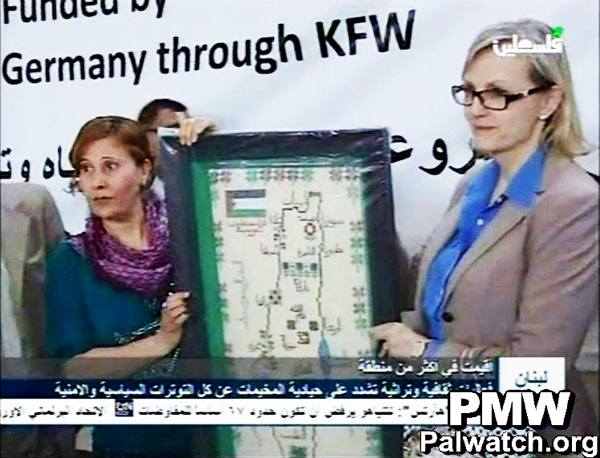
Ann Dismorr (right), the Director of UNRWA in Lebanon, poses with a map that erases the State of Israel and presents all of it as "Palestine." (Image source: Palestinian Authority TV via Palestinian Media Watch)

On February 12, 2017, the non-governmental organization "UN Watch" sent a letter to UN Secretary General Antonio Gutteres, denouncing the actions of about 40 UNRWA officials. The officials' Facebook pages, the report shows, make apologies for Nazism, venerate Hitler, call for the extermination of Jews, celebrate the murder and kidnapping of Israelis, publish Hamas propaganda to the glory of "martyrs" and, more generally, deny the right to Israel's existence, whatever its boundaries. With his back put to the wall by these overwhelming revelations, UNRWA spokesman Chris Gunness hastened to call for an investigation -- against UN Watch!

Even the most moderate among UNRWA loyalists continue to promote the myth of a "right of return" -- a wish that can never be realized because it means flooding the tiny country of Israel (roughly the size of Vancouver Island) with millions of "Palestinian refugees" in order demographically to outnumber the Jews there and thus create the end of Israeli democracy -- and preventing any attempt at "integration".

During the wars between Israel and the terrorist organizations that rule Gaza, rockets were commonly fired from UNRWA schools or from near its hospitals.

Access to several terror tunnels was dug under UNRWA's infrastructure; ammunition was found in its college. Of course, when questioned on these points, UNRWA officials hastened to condemn the intolerable use of their neutrality for the purposes of war! But that did not stop UNRWA from returning the rockets and other mortars found in its infrastructure to Hamas.

Several video reports by the Center for Near East Policy to students at UNRWA schools are even more disturbing. No child, questioned on this point, recognizes the right to the existence of Israel. All girls and boys dream of one day becoming martyrs to the Palestinian cause, and some unashamedly say that their greatest wish is to kill Jews. When asked about the source of their motivation, most said that their teachers taught them that their country was "stolen by the Jews.

So, how to deal with such a situation?

The first logical solution would be to merge UNRWA with the Office of the United Nations High Commissioner for Refugees (UNHCR), thus ending the "Palestinian exception," while distributing UN budgets more equitably among the true refugees suffering extreme misery.

Unfortunately, UNRWA is dependent on the UN General Assembly, where the anti-Israeli automatic majority, led by the Arab League and the Organisation of Islamic Cooperation, has so far been preventing any change in its current status.

The gradual withdrawal of funds allocated by the US seems a positive measure, provided that the resulting shortage leads UNRWA to reform its structure and mode of operation. The danger is that rogue countries will probably try to take over.

The next step would be for the UN to be transparent; to have outside monitors from the US make sure that no member of any terrorist organization is a part of its staff; to trade its highly questionable school curriculum for an education toward peace; to denounce the paramilitary training that sometimes takes place in the courtyards of its schools and, as a token of good faith, to begin by canceling the world tour of its "young ambassador", Muhammad Assaf, who, during his talks, only encourages violence.

It is hard not to include a quote from UNRWA spokesman Chris Gunness: "UNRWA will continue to work tirelessly to ensure the full implementation of our mandate, as defined by the General Assembly. "

In other words, in 30 years, if nothing is done, UNRWA, instead of managing the fate of supposedly between 5 - 6.5 million Palestinians as it does now, will be managing the fate of 40 million.

Censoring talk of Polish complicity in the Holocaust will only make the hatred to simmer and deepen.

From JPost, 29 January 2018, by Lahav Harkov:

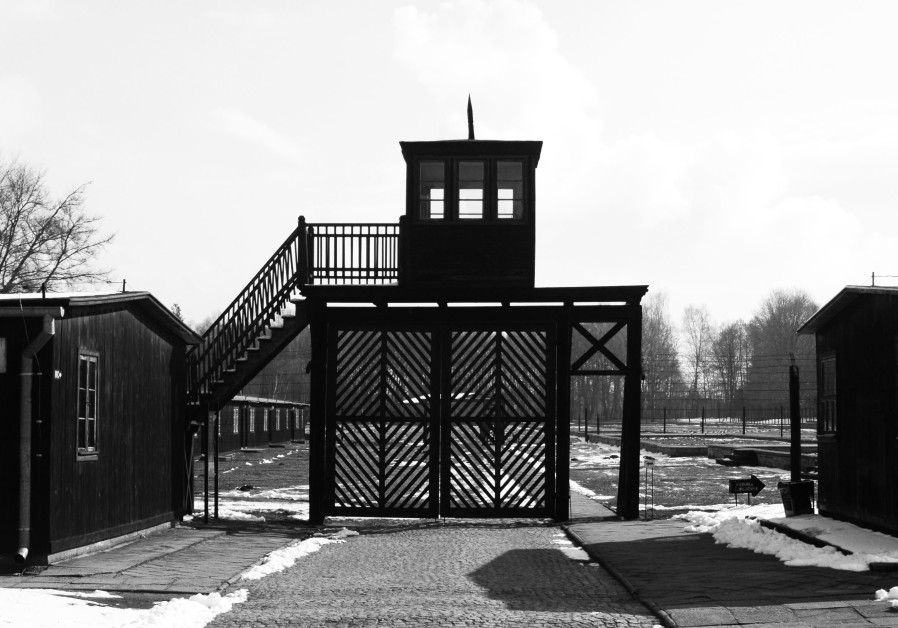
Stutthof concentration camp, Poland
Stutthof concentration camp, Poland. (photo credit: WIKIMEDIA / PHILIPP P EGLI)

...the newly-approved Polish bill  ...didn’t just ban the phrase “Polish death camps” like the headlines say. It outlaws any mention of Polish complicity in the Nazi atrocities, and the offense carries a prison sentence of three years.

Here are some facts about Poland and the Holocaust:

  • Half of the Jews murdered in the Holocaust, about 3 million, were Polish. 
  • Over 90% of Poland’s Jewish population was slaughtered in the Holocaust. You don’t get to numbers like that without cooperation. 
  • In 1941, Poles in the Jedwabne started a pogrom, and locked Jews in a wooden barn that they set on fire. 
  • After the war ended, another pogrom against Jewish refugees took place in Kielce, which is only one of about a dozen cases of postwar violence against Polish Jews sparked by blood libels. 
  • Stories abound about Jews who tried to return to their homes in Poland only to be threatened or murdered by their former neighbors – including some people who I know personally.

At the same time, yes, over 6,000 Poles have been recognized by Yad Vashem as Righteous Among the Nations, and hundreds were killed by the Nazis for helping Jews. Yes, the Polish government in exile helped expose Nazi concentration camps to the world. And yes, 1.9 million non-Jewish Polish civilians were killed by the Nazis and others in combat ...

As a journalist, and as a freedom-loving individual, I abhor censorship. I can just barely stomach it for national security reasons. But this has no security value. This is censoring history to protect Poland’s national ego and avoid confronting the demons of its past. This is borderline Holocaust denial, and it goes along with a trend occurring in neighboring countries, like Hungary and Ukraine.

...Poland needs to face facts. Their country was deeply antisemitic, and it remains so. An Anti-Defamation League poll from 2014 shows 45% of Poles hold antisemitic views.

The way to let go of hate is for Poles who want better for their country to admit it’s there, talk about it, and try to release the demons. Censoring talk of Polish people’s complicity in the Holocaust will only make the hatred that allowed these atrocities to take place simmer and deepen.

Washington reexamining aid to Palestinians

From Times of Israel, 24 January 2018:

... some US officials -- particularly UN envoy Nikki Haley -- are not content with UNRWA cuts, want PA to pay for its boycott of administration

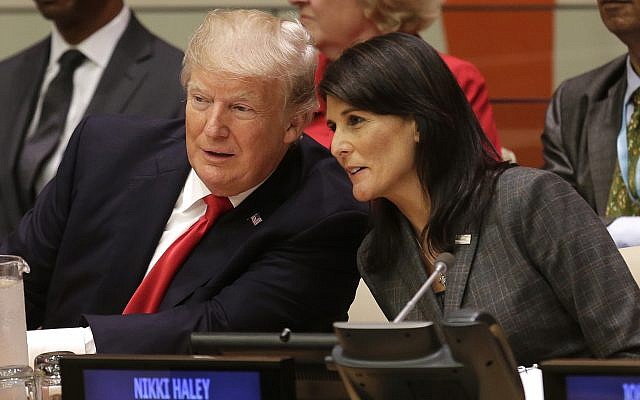
US President Donald Trump speaks with US Ambassador to the UN Nikki Haley, before a meeting at the UN General Assembly at UN headquarters in New York City, on September 18, 2017. (AP Photo/Seth Wenig)


The US leadership is looking beyond its recent cuts to the the UN agency for Palestinian refugees, with the State Department reexamining the entirety of its aid budget to the Palestinian Authority, Hadashot news reported Wednesday.
According to the TV station, which indicated the report was based on US sources, the $100 million cut to the United Nations Relief and Works Agency (UNRWA) earlier this month may well only be the start, as the crisis between Washington and Ramallah deepens. 
A top proponent of further cuts is said to be US Ambassador to the UN Nikki Haley, who reportedly wants the Palestinian leadership to pay for its attitude towards the US government and President Donald Trump. Other officials are said to oppose further cuts.
...Earlier this month, Trump asked why Washington should make “any of these massive future payments,” when the Palestinians were “no longer willing to talk peace.”
In a tweet, the president dismissed Palestinian fury over his recognition of Jerusalem as Israel’s capital, saying he had planned for Israel “to pay” in future negotiations for his declaration. But Palestinian intransigence was now preventing any progress on peace talks, he said
Washington had been paying the Palestinian Authority hundreds of millions of dollars a year “for nothing,” he wrote, complaining that the US received “no appreciation or respect” in return.
“They don’t even want to negotiate a long overdue peace treaty with Israel,” he said. “We have taken Jerusalem, the toughest part of the negotiation, off the table, but Israel, for that, would have had to pay more.”
“But with the Palestinians no longer willing to talk peace,” he went on, “why should we make any of these massive future payments to them?”
Hadashot news said it was told that the consideration of further cuts was not intended as a sanction against the Palestinians. However, it was also told that if the Palestinians end their boycott of the Trump administration, budget cuts would be removed from the agenda.
The TV station noted that Israeli leadership is not keen on deep cuts to Palestinian funding, with officials afraid that backing the Palestinians into a financial corner could lead to escalation in the territories.
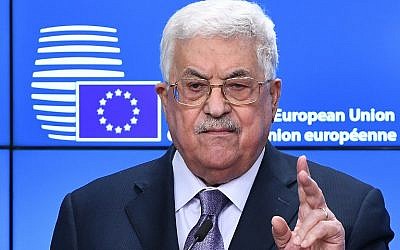
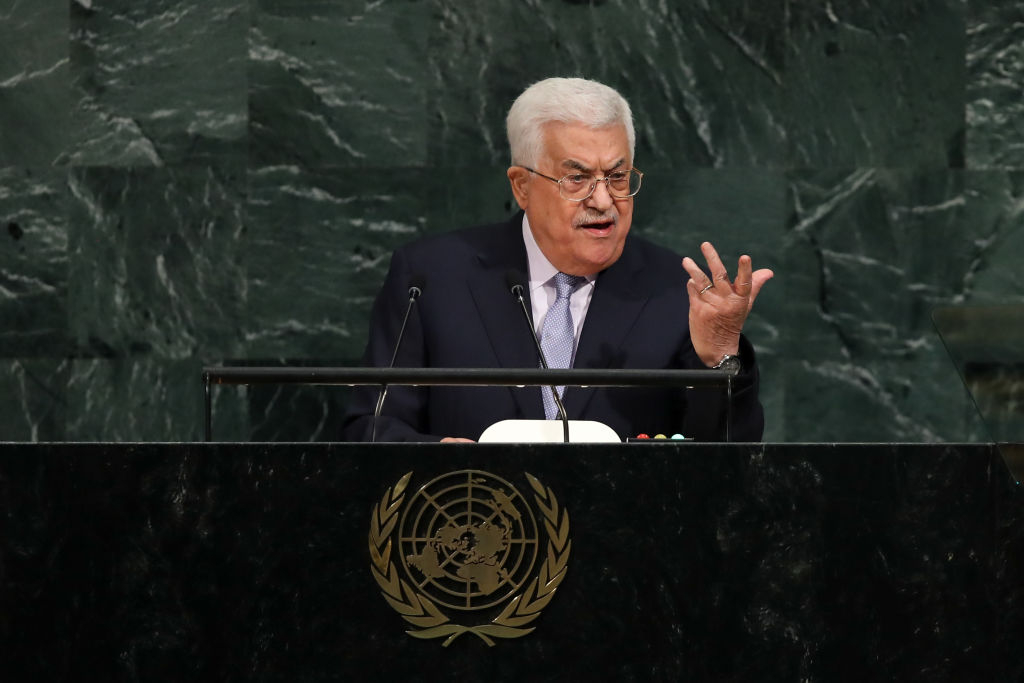
Palestinian Authority President Mahmoud Abbas speaks during a press conference prior to attending a EU foreign affairs council at the European Council in Brussels, January 22, 2018. (EMMANUEL DUNAND / AFP)
The US State Department last week put on hold two planned payments of more than $100 million to UNRWA.
The State Department denied that the freeze was to punish the Palestinian Authority, which has cut ties with Trump’s administration, following his recognition of Jerusalem as Israel’s capital. A spokeswoman said it was linked to necessary “reform” of UNRWA.
Pierre Krahenbuhl, the agency’s commissioner general, said it had not been informed by the United States of any new reform demands, and had been simply “caught up” in a political dispute.
The US gave around $700 million in support to the Palestinians last year, of which about half went to UNRWA, which has a non-political mandate to provide schooling, health care, and other services to more than three million Palestinians across the Middle East.
While welcomed in Israel, Trump’s December 6 recognition of Jerusalem as Israel’s capital angered the Palestinians, who seek East Jerusalem as the capital of their future state.
PA President Mahmoud Abbas has said that the US under Trump can no longer be a mediator in peace talks with Israel, even though Trump stressed the recognition was not a statement of position on the city’s final boundaries.
In late December, the United Nations General Assembly voted to condemn the US decision in a non-binding resolution, after the US vetoed a similar Security Council measure.
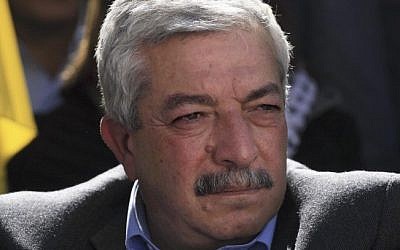
Mahmoud al-Aloul, member of the Central Committee of Fatah. January 6, 2010. (Issam Rimawi/Flash90/File)
Meanwhile, the deputy chief of PA President Mahmoud Abbas’s Fatah party said this week that Palestinian leadership believes the US has never given anything of “substance” to the Palestinians.
“Recently, we were forced to review all of our relations with the American administrations in recent years, and not just the Trump administration,” Mahmoud al-Aloul told the London-based Pan-Arab daily Al Quds Al Arabi. “We assessed that nothing good will come from them for the Palestinian people and the nation, and this is completely clear.
“With all their might, they support [the Palestinians’] enemy that is occupying their lands,” he said.
Dov Lieber and AFP contributed to this report.

Friday, February 02, 2018

A new US approach

From the National Review, 23 January 2018, by Yoram Hazony:


The administration’s foreign policy is a welcome break from the preexisting Washington consensus. 

President Donald Trump has promised that in the Middle East under his presidency, “there are many things that can happen now that would never have happened before.”

Two speeches of the last ten days offer dramatic confirmation of the emerging reconfiguration of America’s relationship with Israel and the Middle East under his leadership.

In a two-hour speech before the Council of the Palestine Liberation Organization (PLO) last week, Mahmoud Abbas, president of the Palestinian Authority, denounced the British, Dutch, French, and Americans for having conspired, ever since the 1650s, to create a Jewish colonial outpost that would “erase the Palestinians from Palestine.”

As Abbas tells it, all this reached a climax on the eve of World War I, when the West realized that it was on the verge of collapse and that the Islamic world was “poised to inherit European civilization.” To put an end to this threat, the Western nations went about carving up the Muslim world so that it would be forever “divided, backward, and engulfed in infighting.” As for the United States, it has been “playing games” of this sort ever since then, importing, for example, the disastrous Arab Spring into Middle East. Abbas summed up by demanding an apology and reparations from Britain for the Balfour Declaration and denying that the United States can serve as a mediator in the Mideast.

Finally, he went to the trouble of cursing both President Trump and the U.S. Congress: Yehrab beitak (“May your house be razed”), he said.

I have been following the speeches of the PLO and its supporters in the Arab world for 30 years. Nothing here is new. These are the same things that Yasser Arafat, Abbas, and the mainline PLO  leadership have always believed. It is a worldview that reflects an abiding hatred for the West, blaming Christians and Jews not only for the founding of Israel but for every calamity that has befallen the Muslim and Arab world for centuries.

What should be one’s policy toward an organization committed to such an ideology? One option is to sympathize with the shame and outrage to which the PLO gives voice, and to try to mitigate it with grants of territory, authority, prestige, and large-scale ongoing funding. American administrations have pursued this option, seeking to make a peace partner out of the PLO, since President Ronald Reagan announced a dialogue with it in December 1988.

Israel, too, has pursued this option, since 1993. x   But in the ensuing 30 years of talk, the only major agreements signed have been those the PLO leadership could find a way to fit into its narrative: Agreements such as the 1993 Oslo Accords, which could be portrayed as inflicting a bitter defeat on Israel and the West — and as a step on the road to ultimate triumph.

President Trump, Vice President Pence, and United Nations Ambassador Nikki Haley are pioneering an alternative policy, which can be summed up in Haley’s words:
“We’re not going to pay to be abused.” 
If players like the PLO, North Korea, Pakistan, and Iran (hopefully, Turkey gets added to this list soon) want to cultivate a civilizational hatred of America, double-talking while they give aid to global terrorism and conjure diplomatic scandals at the U.N. — well, then they don’t get to be allies. They don’t get funded. They don’t get grants of land, authority, and prestige. Those things will be reserved for actual allies. 

In a speech before the PLO last week, Mahmoud Abbas expressed the familiar worldview marked by hatred for the West, blaming Christians and Jews for every calamity that has befallen the Muslim and Arab world for centuries. What this looks like was already on display when Trump became the first serving U.S. president to visit the kotel (the Western Wall) in Jerusalem in May, shredding the longstanding diplomatic taboo against making it look as though the holiest site in Judaism is in fact part of the State of Israel.

Since then, Trump and Haley have taken on UNESCO (United Nations Educational, Scientific and Cultural Organization) and the U.N. Commission on Human Rights, which regularly disseminate the PLO’s view of history and current affairs.

The Trump administration has cut in half America’s massive financial support of UNRWA (the United Nations Relief and Works Agency for Palestine Refugees in the Near East), an organization whose purpose is to maintain generations of unabsorbed descendants of Palestinian Arab refugees, inculcating them in Abbas-style grievances against Israel and the West.

Mike Pence’s address on Monday to Israel’s parliament, the Knesset, continued this trajectory. But he also responded to Abbas’s history lesson with some tasteful but potent narrative-weaving of his own. In addition to the traditional script pointing to the shared interests of the United States and Israel as democracies, Pence emphasized that it was significant to him as an American that “our founders turned to the Hebrew Bible for direction” in establishing their country and that Israel’s story “inspired my forebears to create . . . a new birth of freedom.” He returned repeatedly to the way in which the story of the Jewish people holding fast to God’s promise to return them to their land “shows the power of faith.” Pence even said the traditional Jewish shehehianu blessing (in Hebrew!), thanking God for bringing us to see this day in which the Jewish people have been restored to their land.

On policy, Pence said that Trump “righted a 70-year wrong” in recognizing Jerusalem as Israel’s capital, and that the U.S. embassy would be in the city “by the end of next year.” He promised Israel that “the United states will never allow Iran to acquire a nuclear weapon.”

As for the PLO, Pence gave eloquent and persuasive voice to his country’s desire for peace. But his bottom line also marked a significant shift from previous American administrations: The U.S., Pence said, would support a PLO state “if both sides agree.” In other words,  whether there will be such a state is Israel’s call to make. Which puts American policy light years away from the heyday of George W. Bush’s “road map,” and his breathy “vision of two democratic states, Israel and Palestine, living side by side in peace.”

For a change, there was no daylight between the views Pence outlined in the Knesset and those of his Israeli hosts. Prime Minister Benjamin Netanyahu said that President Trump’s recognition of Jerusalem would go down in Jewish history together with the Balfour Declaration in 1917 and Truman’s recognition of Israel in 1948. Isaac Herzog (Labor), the leader of the opposition,  pointed out that it is “the love of the Bible that connects us to one another.”

Knesset Speaker Yuli Edelstein (Likud) spoke of the Jewish state “fulfilling the words of the prophets” and of “the United States, more than any other country in the world, as Israel’s faithful partner” in this effort.

As for the curses that Abbas called down on President Trump’s house, the Israelis responded by blessing him: Netanyahu told Pence it is “our deepest hope that President Trump and you will succeed in strengthening the United States, . . . so that America will continue to be the greatest power in the world for generations to come.”

And Edelstein said that from Israel he would only hear the blessing Bneh Beitcha (“May your house be built up”). 

There is no shortage of commentators saying that this embrace of Israel is only going to harm the prospects for peace in the Middle East. That view reflects the consensus in Washington before President Trump got there.

For long decades, Washington has crafted policies based on the tacit assumption that America needs the PLO if it is to bring peace to the Middle East. In its effort to “balance” the demands of this extremist organization against Israel’s concerns, American policy inflated the PLO’s importance, and it learned to tolerate and even embrace an organization whose views have always been profoundly anti-Western, not to mention anti-Semitic. 

Meanwhile, the Biblical roots of America’s alliance with Israel have been consistently downplayed for fear that mentioning them would upset Arab sensibilities. Even so elementary a move as recognizing Jerusalem as Israel’s capital, or cutting funding to chronically anti-Western and anti-Semitic organizations, became unthinkable. 

These policies did not bring peace to the Middle East. But they severed the ties between American diplomacy in the region and common sense — to the point that more than a few U.S. officials ended up believing that not only the PLO, but even Iran, whose parliament regularly curses the United States, could be made a peace partner if it were paid handsomely enough. 

The Trump administration, on the other hand, appears to have good grasp of a principle that is under-rated but nonetheless quite useful in making sound policy: In the relations between nations, it matters who blesses you and who curses you.

Friday, January 26, 2018

Note Who Curses America, and Who Blesses It

From the National Review, 23 January 2018, by Yoram Hazony:


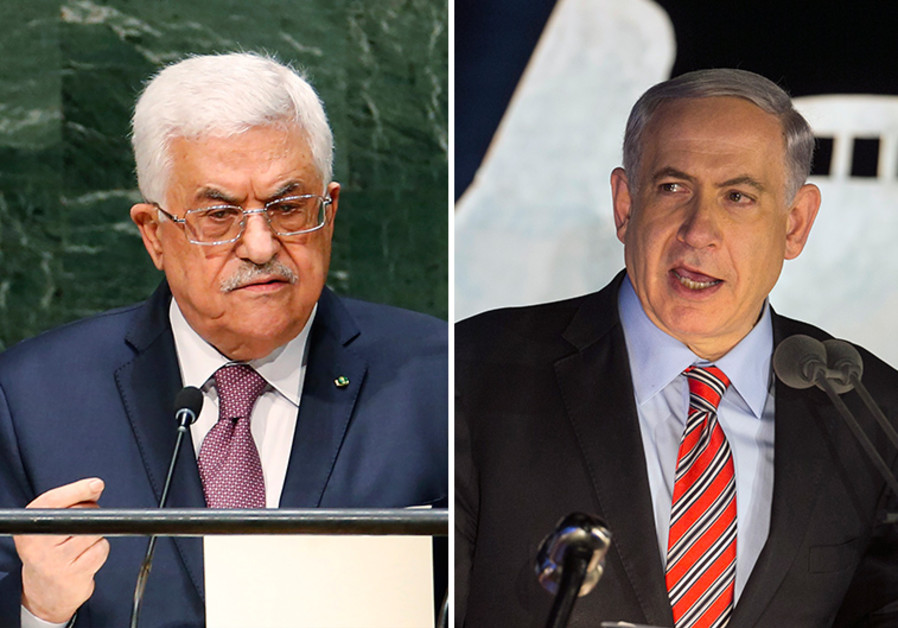
Palestinian Authority President Mahmoud Abbas (left) greets Israeli Prime Minister Benjamin Netanyahu at the White House, September 1, 2010. (Jason Reed /Reuters) 


The administration’s foreign policy is a welcome break from the preexisting Washington consensus. 

President Donald Trump has promised that in the Middle East under his presidency, “there are many things that can happen now that would never have happened before.” Two speeches of the last ten days offer dramatic confirmation of the emerging reconfiguration of America’s relationship with Israel and the Middle East under his leadership.

In a two-hour speech before the Council of the Palestine Liberation Organization (PLO) last week, Mahmoud Abbas, president of the Palestinian Authority, denounced the British, Dutch, French, and Americans for having conspired, ever since the 1650s, to create a Jewish colonial outpost that would “erase the Palestinians from Palestine.”

As Abbas tells it, all this reached a climax on the eve of World War I, when the West realized that it was on the verge of collapse and that the Islamic world was “poised to inherit European civilization.” To put an end to this threat, the Western nations went about carving up the Muslim world so that it would be forever “divided, backward, and engulfed in infighting.”

As for the United States, it has been “playing games” of this sort ever since then, importing, for example, the disastrous Arab Spring into Middle East. Abbas summed up by demanding an apology and reparations from Britain for the Balfour Declaration and denying that the United States can serve as a mediator in the Mideast.

Finally, he went to the trouble of cursing both President Trump and the U.S. Congress: Yehrab beitak (“May your house be razed”), he said.

I have been following the speeches of the PLO and its supporters in the Arab world for 30 years. Nothing here is new. These are the same things that Yasser Arafat, Abbas, and the mainline PLO  leadership have always believed. It is a worldview that reflects an abiding hatred for the West, blaming Christians and Jews not only for the founding of Israel but for every calamity that has befallen the Muslim and Arab world for centuries.

What should be one’s policy toward an organization committed to such an ideology? One option is to sympathize with the shame and outrage to which the PLO gives voice, and to try to mitigate it with grants of territory, authority, prestige, and large-scale ongoing funding. American administrations have pursued this option, seeking to make a peace partner out of the PLO, since President Ronald Reagan announced a dialogue with it in December 1988.

Israel, too, has pursued this option, since 1993. President Trump's 8 Biggest Accomplishments   But in the ensuing 30 years of talk, the only major agreements signed have been those the PLO leadership could find a way to fit into its narrative: Agreements such as the 1993 Oslo Accords, which could be portrayed as inflicting a bitter defeat on Israel and the West — and as a step on the road to ultimate triumph.

President Trump, Vice President Pence, and United Nations Ambassador Nikki Haley are pioneering an alternative policy, which can be summed up in Haley’s words: “We’re not going to pay to be abused.” If players like the PLO, North Korea, Pakistan, and Iran (hopefully, Turkey gets added to this list soon) want to cultivate a civilizational hatred of America, double-talking while they give aid to global terrorism and conjure diplomatic scandals at the U.N. — well, then they don’t get to be allies. They don’t get funded. They don’t get grants of land, authority, and prestige. Those things will be reserved for actual allies.

In a speech before the PLO last week, Mahmoud Abbas expressed the familiar worldview marked by hatred for the West, blaming Christians and Jews for every calamity that has befallen the Muslim and Arab world for centuries. What this looks like was already on display when Trump became the first serving U.S. president to visit the kotel (the Western Wall) in Jerusalem in May, shredding the longstanding diplomatic taboo against making it look as though the holiest site in Judaism is in fact part of the State of Israel.

Since then, Trump and Haley have taken on UNESCO (United Nations Educational, Scientific and Cultural Organization) and the U.N. Commission on Human Rights, which regularly disseminate the PLO’s view of history and current affairs. The Trump administration has cut in half America’s massive financial support of UNRWA (the United Nations Relief and Works Agency for Palestine Refugees in the Near East), an organization whose purpose is to maintain generations of unabsorbed descendants of Palestinian Arab refugees, inculcating them in Abbas-style grievances against Israel and the West.

Mike Pence’s address on Monday to Israel’s parliament, the Knesset, continued this trajectory. But he also responded to Abbas’s history lesson with some tasteful but potent narrative-weaving of his own. In addition to the traditional script pointing to the shared interests of the United States and Israel as democracies, Pence emphasized that it was significant to him as an American that “our founders turned to the Hebrew Bible for direction” in establishing their country and that Israel’s story “inspired my forebears to create . . . a new birth of freedom.”

He returned repeatedly to the way in which the story of the Jewish people holding fast to God’s promise to return them to their land “shows the power of faith.” Pence even said the traditional Jewish shehehianu blessing (in Hebrew!), thanking God for bringing us to see this day in which the Jewish people have been restored to their land.

On policy, Pence said that Trump “righted a 70-year wrong” in recognizing Jerusalem as Israel’s capital, and that the U.S. embassy would be in the city “by the end of next year.” He promised Israel that “the United states will never allow Iran to acquire a nuclear weapon.”

As for the PLO, Pence gave eloquent and persuasive voice to his country’s desire for peace. But his bottom line also marked a significant shift from previous American administrations: The U.S., Pence said, would support a PLO state “if both sides agree.” In other words,  whether there will be such a state is Israel’s call to make. Which puts American policy light years away from the heyday of George W. Bush’s “road map,” and his breathy “vision of two democratic states, Israel and Palestine, living side by side in peace.”

For a change, there was no daylight between the views Pence outlined in the Knesset and those of his Israeli hosts. Prime Minister Benjamin Netanyahu said that President Trump’s recognition of Jerusalem would go down in Jewish history together with the Balfour Declaration in 1917 and Truman’s recognition of Israel in 1948.

Isaac Herzog (Labor), the leader of the opposition,  pointed out that it is “the love of the Bible that connects us to one another.” Knesset Speaker Yuli Edelstein (Likud) spoke of the Jewish state “fulfilling the words of the prophets” and of “the United States, more than any other country in the world, as Israel’s faithful partner” in this effort.

As for the curses that Abbas called down on President Trump’s house, the Israelis responded by blessing him: Netanyahu told Pence it is “our deepest hope that President Trump and you will succeed in strengthening the United States, . . . so that America will continue to be the greatest power in the world for generations to come.” And Edelstein said that from Israel he would only hear the blessing Bneh Beitcha (“May your house be built up”).

There is no shortage of commentators saying that this embrace of Israel is only going to harm the prospects for peace in the Middle East. That view reflects the consensus in Washington before President Trump got there.

For long decades, Washington has crafted policies based on the tacit assumption that America needs the PLO if it is to bring peace to the Middle East. In its effort to “balance” the demands of this extremist organization against Israel’s concerns, American policy inflated the PLO’s importance, and it learned to tolerate and even embrace an organization whose views have always been profoundly anti-Western, not to mention anti-Semitic. 

Meanwhile, the Biblical roots of America’s alliance with Israel have been consistently downplayed for fear that mentioning them would upset Arab sensibilities. Even so elementary a move as recognizing Jerusalem as Israel’s capital, or cutting funding to chronically anti-Western and anti-Semitic organizations, became unthinkable. 

These policies did not bring peace to the Middle East. But they severed the ties between American diplomacy in the region and common sense — to the point that more than a few U.S. officials ended up believing that not only the PLO, but even Iran, whose parliament regularly curses the United States, could be made a peace partner if it were paid handsomely enough. 

The Trump administration, on the other hand, appears to have good grasp of a principle that is under-rated but nonetheless quite useful in making sound policy: In the relations between nations, it matters who blesses you and who curses you.

Tuesday, January 23, 2018

No Difference Between Fatah and Hamas

Abbas's rant must be replied by repudiation of American support for the "Palestinian" cause

From Breitbart, 17 Jan 2018, by Caroline Glick:
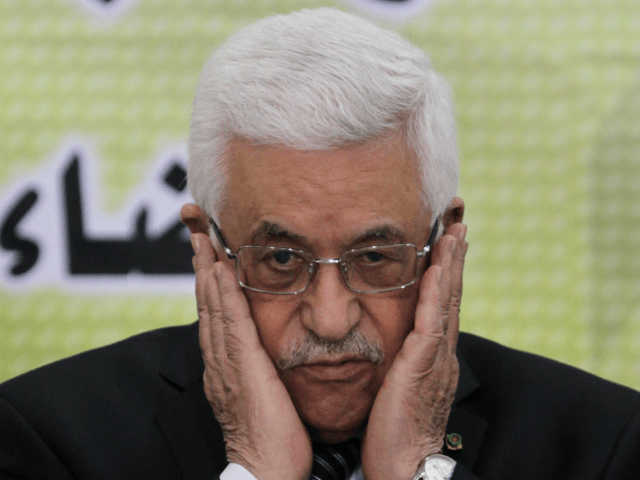
PALESTINIAN-POLITICS Palestinian Authority President and head of the Fatah movement, Mahmud Abbas attends a Fatah 'Revolutionary Council' meeting in the Palestinian West Bank city of Ramallah on September 1, 2013. AFP PHOTO/ABBAS MOMANI (Photo credit should read ABBAS MOMANI/AFP/Getty Images)

For decades, Palestinian Authority leader Mahmoud Abbas has been touted by American leaders as a moderate man of peace.

U.S. leaders from George W. Bush to Barack Obama, and from Condoleezza Rice to John Kerry, all insisted that Abbas is the Palestinian leader who will make an historic deal with Israel.

President Donald Trump has met three times with Abbas since taking office.

On Sunday night, Abbas showed them what he really thinks.

He cursed Trump saying that the U.S. President’s “house should be destroyed.”

He attacked U.S. Ambassador to Israel David Friedman in lurid, antisemitic language:
“U.S. Ambassador to Israel David Friedman is a settler who is opposed to the term ‘occupation.’ He is an offensive human being, and I will not agree to meet him anywhere. They requested that I meet him and I refused, not in Jerusalem, not in Amman, not in Washington.”
Abbas then threatened U.S. Ambassador to the United Nations Nikki Haley.
“She [Haley] threatens to hit people who hurt Israel with the heel of her shoe, and we’ll respond the same way.”
He called Trump’s anticipated Middle East peace plan “a slap in the face,” and said, “we will slap back.”

Abbas declared “dead” the peace agreements he and his colleagues in the Palestine Liberation Organization (PLO) signed with Israel for the Palestinians since 1993. He pledged to block any future U.S. involvement in peace talks between the Palestinians and Israel: “We will not accept American leadership of a political process involving negotiations.”

Abbas then turned his attention to Israel and the Jews.

“Israel,” he said “is a colonial project that has nothing to do with Jews.... Europeans wanted to bring the Jews here to preserve their interests in the region. They asked Holland, which had the world’s largest fleet, to move the Jews...” ...
Israeli President Reuven Rivlin said that Abbas’s remarks harken back to “things that led him to be accused years ago of anti-Semitism and Holocaust denial.”

Abbas’s Ph.D. thesis, which he wrote for a Soviet university controlled by the KGB in the 1960s denied the Holocaust.

Over the past 25 years, the Western and Israeli leaders that have hailed Abbas as a moderate dismissed the significance of his doctorate – which he later published in Jordan as a best-selling book – saying it was a relic of the PLO’s former rejection of Israel’s right to exist.

The problem with Rivlin’s statement is that it ignores Abbas’s record.

Contrary to Rivlin’s view of Abbas’s racist assault on Jews as a throwback to an earlier time, antisemitic diatribes have been a consistent feature of Abbas’s public statements, whether he is speaking to Arab or Western audiences.

In a speech before the European Parliament in 2016, for instance, Abbas recycled the medieval blood libel that Jews poison the wells of Christians. That blood libel incited the death of thousands of Jews through the ages.

Speaking to European lawmakers, Abbas said, “Certain rabbis in Israel have said very clearly to their government that our water should be poisoned in order to have Palestinians killed.”

As for his Holocaust denial being a thing of the past, Abbas posted his doctoral thesis on his official website. His lies are taught as fact in Holocaust education in the Palestinian school system – which he controls.

Then there is his anti-Americanism.

Abbas controls every aspect of the Palestinian Authority (PA), including the rent-a-mobs.

Over the years, protesters have greeted every senior U.S. policymaker who has visited Abbas in Ramallah.

In 2013, 150 protesters demonstrated against then-president Barack Obama when he met with Abbas. In 2007, protesters who worked for Abbas’s government greeted then-Secretary of State Condoleezza Rice with signs calling for Hezbollah to bomb America.

So in stark contrast to Rivlin’s statement, Abbas’s speech was not a throwback to a long ago time. It was a throwback to what he said yesterday, and the day before yesterday and the day before that, and what the Palestinian newspapers and television – which he controls — reported the day and week and month and year before that.

Another explanation of Abbas’s scorched-earth speech Sunday is that he scorched the earth in preparation for his resignation from office. Abbas, Israel’s commentators were quick to note, is 82 years old. So it seems reasonable to conclude that his decision to launch a frontal assault against Jews and Americans was a sort of valedictory address.

But here too, the assessment is contradicted by Abbas’s record.

It is true that Abbas is approaching his 83rd birthday. But he is also approaching the 14th year of his four-year term of office. Abbas has repeatedly refused to stand for reelection since his four-year term ended in 2009.

Not only has Abas rejected repeated calls from his Palestinian colleagues and from successive U.S. administrations to designate a successor, he has sidelined and exiled all of his political rivals in the PLO.

Then there are the steps he has taken to coopt Hamas and so minimize the threat Hamas poses to his maintenance of power.

The Hamas terror group ousted Abbas and his U.S.-trained PLO forces from Gaza in 2007. Rather than launch a U.S.-backed counterstrike against Hamas, Abbas chose to collaborate with Hamas. He has funded Hamas’s government. That funding has enabled the jihadist group to launch a series of missile wars against Israel.

Moreover, Abbas has used the PLO’s position at the UN and in Europe to protect Hamas from criticism and wage a political war against Israel. The goal of this war is to end Western support for Israel’s right to exist by delegitimizing Israel as a colonialist implant of European imperialists.

A man interested in retiring would not have eliminated all of his potential heirs to cling to power, or agreed to a power-sharing deal with Hamas to keep everyone at bay.

So if Abbas isn’t planning to retire, why is he cursing Trump and his senior advisors? Why is he recycling anti-Jewish blood libels from the 12th century and announcing that the deals he signed with Israel and the peace process as a whole are dead?

The simple answer is that Abbas is acting as he is because he is certain that he can. This is how he has always acted. There is nothing new in his speech. And he doesn’t think that he will suffer any consequences for behavior.

Abbas expects President Trump to disregard his statements and continue to bankroll his terror-supporting regime in the name of “the peace process,” or “humanitarian assistance” just as Bush and Obama did.

Abbas gave his speech at start of a two-day conference of the PLO’s Central Committee, which he convened to determine a response to President Trump’s announcement on December 6 that for the first time in nearly seventy years, the U.S. recognizes that Jerusalem is Israel’s capital.

Trump’s Jerusalem declaration placed Abbas and his colleagues in a conundrum. On the one hand, his declaration had no practical implications. Trump signed a waiver delaying the transfer of the U.S. embassy in Israel to Jerusalem. No immediate plans have made to move the embassy.


Moreover, the State Department insists that there is no practical significance to Trump’s statement. Acting Assistant Secretary of State for Near Eastern Affairs David Satterfield told reporters the day after Trump’s announcement that his statement does not change U.S. policy barring American citizens born in Jerusalem from listing Israel as their country of birth on their official documents. Indeed, Satterfield refused to answer a question regarding whether Jerusalem is even in Israel.

On the other hand, simply by recognizing the basic fact that Jerusalem is Israel’s capital and has been Israel’s capital for nearly 70 years, Trump broke with the longstanding U.S. policy of denying observable reality in relation to Israel in order to advance “peace” between Israel and its Arab neighbors.

Only by denying reality can anyone pin hopes on the PLO as a peace partner. Since its inception in 1964, the PLO has rejected Israel’s right to exist. It has rejected that the Jews are a people. It has denied the history of continuous Jewish habitation of the land of Israel for 3,500 years. And it has denied the fact that the Jews built two temples in Jerusalem.

When Abbas said on Sunday that Israel is the creation of European imperialists, he was merely echoing the PLO’s charter.

By recognizing the truth, Trump took a red-hot poker to the PLO’s false, antisemitic founding narrative.

As Prime Minister Binyamin Netanyahu said in response to Abbas’s remarks, “For too long, the Palestinian Authority has been pampered by the international community which didn’t dare tell them the truth – not about Jerusalem and not about recognizing Israel. That has changed. I think Abu Mazen [Abbas] was reacting to that. This is the first time somebody’s told him the truth to his face.”

Trump and his top advisers have made several statements in recent weeks that indicate that his Jerusalem declaration last month was not a one-off.

The President threatened to cut off U.S. aid to Abbas’s regime.

Haley threatened to cut off aid UNRWA, a UN Palestinian refugee agency that works hand and glove with Hamas in Gaza.

Tuesday, the Trump administration informed UNRWA that it is withholding “for further consideration” $65 million of its $370 million annual contribution to UNRWA’s budget.

Statements by Trump’s senior negotiator Jason Greenblatt and Friedman condemning Palestinian Authority finance of terrorism and incitement to murder Israelis have also been groundbreaking.

So far, Tuesday’s hold on a fraction of U.S. funding to UNRWA is the only substantive policy step the Trump administration has taken. Its other moves have been declaratory. They have signaled the beginnings of a new U.S. policy towards Abbas, the PLO and the Palestinian Authority, but the new policy has not yet been articulated, let alone felt on the ground.

By attacking Trump, his advisers, Israel and the Jewish people on Sunday, Abbas was effectively daring Trump to act on his words.

Abbas is betting that Trump is bluffing so the White House’s next moves will be determinative.

The partial funding postponement to UNRWA is notable, but not significant enough to make clear that the U.S. is serious in its policy shift. If no further practical, indisputable steps are taken to translate Trump’s stated positions into a clear move away from the past 25 years of unconditional American support for the Palestinians, Abbas will be empowered to continue to treat him and his administration with the same contempt he exhibited towards Obama and Bush.