Saturday, March 04, 2017

Iran axis in Syria leads Israeli security concerns

From The Times of Israel, March 2, 2017, by RAPHAEL AHREN AND JUDAH ARI GROSS:

Ministry chief praises Trump for tough line on Islamic Republic, says Jerusalem hoping for ongoing US involvement in Syrian crisis

Illustrative: smoke billows following a reported car bomb explosion at a Syrian pro-government position during clashes between rebel fighters and regime forces to take control of an area in the southern city of Daraa on February 20, 2017. (AFP Photo/Mohamad Abazeed)
Smoke billows following a reported car bomb explosion at a Syrian pro-government position during clashes between rebel fighters and regime forces to take control of an area in the southern city of Daraa on February 20, 2017. 
(AFP Photo/Mohamad Abazeed)

Despite ongoing concerns over Iran’s nuclear ambitions, dealing with threats emanating from the Syrian war theater currently tops the agenda of Israel’s security apparatus...

Chagai Tzuriel, director-general of the Intelligence Ministry:
“The most important strategic issue we’re currently facing is the strengthening of the Shiite axis led by Iran in Syria, especially after the fall of Aleppo...Syria is the key arena, because it’s a microcosm of everything: world powers, such as Russia and the US; regional actors such as Iran and Turkey; and rival groups within the country, such the Assad regime, the opposition, the Kurds and the Islamic State...Whatever happens in Syria today will greatly impact the region, and beyond, for years to come.”
The war there shows that the entire world is now made up of “frenemies,” countries with conflicting interests, he said...Israel’s recent rapprochement with Turkey...could be seen as an extension of this “frenemies” concept. The two staunchly disagree on Hamas and the Palestinian issue, but see eye to eye on the threat from Iran.

Syria, Russia, Iran
...In a sense, the six-year-long war in Syria has already had a massive impact on the world, Tzuriel said, citing scores of terrorists and millions of immigrants who exited the country and left their mark across the globe. “In that respect, it is no exaggeration to say that the Syrian civil war has, to some extent, influenced important developments way outside its borders, such as Brexit and even the election in the US,” he said.

Recent developments in Syria have created “a strong imbalance in the region to Iran’s benefit,” said Tzuriel. And yet, since Moscow decided to take a more engaged role in the conflict, actively supporting the Assad regime, Iran’s role as Damascus’s main backer has been diminished, he said.

“Russia has become the dominant power in Syria,” he said, adding that Moscow achieved that feat despite investing remarkably minor resources into the civil war. “The Russians have managed to become the key player with only a few dozen aircraft. That’s proof that political will and the readiness to use military force are key.”

On Tuesday, Russia, along with China and Bolivia, vetoed a United Nations Security Council resolution that would have sanctioned Syrian officials over the regime’s illicit use of chemical weapons. The US and other Western powers on the council voted in favor of the resolution and denounced Moscow for blocking it.

Besides treating wounded civilians on the border and attacking weapons convoys deemed a strategic threat, Israel has so far stayed out of the war. However, Tzuriel said, the US’s continued involvement is crucial to Israel’s interest in seeing Iran kept from extending hegemony to Syria, allowing the Islamic Republic to link Tehran and Beirut.

“For Israel, it is important to see the US remaining active in Syria and the region,” he said.

Criticizing the previous US administration, he said president Barack Obama’s decision, in 2013, to not use military force against Assad’s regime despite its use of chemical weapons “was a pivotal moment for the entire region.”

“This moment changed everything,” said Tzuriel, who served as the Mossad’s representative to the US a few years ago.”It showed [Russian President Vladimir] Putin that the US was not willing to use force. It opened the door for Russia to take center stage.”

For Israel, the most important issue in Syria is making sure Iran and its proxies aren’t able to set up a base to attack Israel from.

Prime Minister Benjamin Netanyahu meets with Russian President Vladimir Putin in Moscow, Russia, on June 7, 2016. (Haim Zach/GPO)
Prime Minister Benjamin Netanyahu meets with Russian President Vladimir Putin in Moscow, Russia, on June 7, 2016. 
(Haim Zach/GPO)

Prime Minister Benjamin Netanyahu is set to travel to Moscow in the coming days to further discuss Israeli-Russian coordination regarding Syria. He has said Israel will oppose any peace agreement that would allow Iran and its Shiite proxies any foothold there.

“If Iran and Hezbollah manage to base themselves in Syria, it would be a permanent source of instability in the entire region,” Tzuriel explained, referring specifically to the threat of an Iranian naval base on the Mediterranean. “It would also bring instability to areas with Sunni minorities outside the Middle East.”

‘Obama didn’t see Iran as part of the problem. Trump does’

Despite the supreme focus on Syria, the Iranian nuclear program remains high on Israel’s agenda, Tzuriel said. Affirming Jerusalem’s general objection to the nuclear pact Iran and six world powers signed in 2015, he confirmed that, so far, Tehran “abides by the terms of the deal.”

But the world may have “bought the present in exchange for the future,” he said.

“The main problem with the deal is that it allows the regime to build advanced centrifuges. These centrifuges will enable Tehran to build several nuclear bombs in much less time than they did before the deal with the old centrifuges,” he said.

Stopping short of calling for the deal to be torn up, he said it would be good “if there was a way to improve the terms of the deal and advance other resolutions that deal with the Iranian missile program and support of terror organizations.”

As opposed to the Obama administration, Trump has indicated a tough policy vis-a-vis Tehran. It is noteworthy that the new president said that he will “never” allow Iran to acquire a nuclear weapon capability, Tzuriel said.

“The feeling in Israel was that Obama didn’t see Iran as part of the problem. Trump, by contrast, appears to view Iran as part of the problem.”

Putting the U.S.-Israel Relationship to Work

From The American Interest, 28 Feb 2017, by STEVEN L. SPIEGEL:


Americans think of Israel in terms of ideology or geopolitics, when they should be thinking about business, technology, and job creation.

With more than six decades of strong ties, the United States and Israel are now reaching a new stage in their relationship: one in which they are bound by common interests in economic and technological innovation. However, the United States has still not developed an effective mechanism for taking advantage of this partnership, which must be nurtured with carefully designed institutional bonds.

There are several ways these bonds might be forged, some more ambitious than others, and some involving other innovative economies in addition to Israel’s. To seize the moment, the Trump Administration needs to act now.

Historically, there have been three dimensions to the U.S.-Israeli relationship. At its inception, Israel was seen as a fulfillment of biblical prophecies, and a haven for Jews escaping from anti-Semitism and persecution in the aftermath of the Holocaust. Many Americans came to view Israel as a paradigm of the Judeo-Christian tradition, as well as the only functioning democracy in the Middle East. Finally, as the Cold War threw the Middle East into turmoil, Israel emerged as a strategic asset for U.S. security and intelligence. As was often said, it was like having a stationary aircraft carrier in the region.

Since 1967, the U.S. government has had no genuine competition from any other country for Israel’s friendship. Today, however, that is no longer true. Many countries, especially in Asia, now compete with the United States to secure the benefits of Israel’s technological prowess. Indeed, China is expected to surpass the United States in the near future as Israel’s most significant collaborator in joint government-backed development projects, according to one Israeli analyst quoted in the Wall Street Journal. China and Israel have officially begun negotiating a free trade agreement, and Israel now joins the United States and Canada in the select group of countries whose citizens receive Chinese visas that are valid for ten years. For now, Israelis—however much they may be flattered by Chinese attention—still feel more comfortable dealing with American interlocutors. But what happens when they get used to China and the United States remains aloof?

There are certainly ample opportunities for the United States to partner with Israel on business and technology. The wide range of fields in which the two countries can cooperate include such areas as water management, medicine, pharmaceuticals, green technology, nanotechnology, cyber security, military instruments, and communications. Israelis were involved in developing the cellphone, Amazon’s Kindle, the navigational app Waze, numerous medical breakthroughs such as devices that help paraplegics walk, advances in stem cell research, and much more. Indeed, a June 2014 Forbes analysis listed five Israeli companies among the top ten that are changing the world of healthcare. In 2016, the Mayo Clinic announced a new collaboration with Israeli start-ups to increase the availability of Israeli medical innovations in the United States.1

It’s no surprise that U.S. companies such as Intel, Facebook, Google, Apple, GM, Lockheed Martin, IBM, and GE have all set up major R&D centers in Israel. Yet most U.S. companies and state and local governments have not yet taken advantage of the enormous potential for U.S.-Israel cooperation.

In particular, the United States and Israel need to boost the development of new security products, just as the U.S. Department of Defense is doing in partnership with Silicon Valley. As outgoing Deputy Secretary of Defense Robert Work put it, “The department is trying to deepen our cooperation with our close allies and partners. We’re collaborating—collaboratively planning now on our roles, missions, and investments in future capabilities.” Due to its record innovation, Israel should be at or near the top of that list of partners.

Such increased cooperation would improve Washington’s ability to manage shifting economic and political forces around the globe. Technology is transforming our world; major powers are scrambling to adjust, and one means of securing an advantage is working with other countries, especially smaller states with particular skills. Partnering with Israel on the development of new technologies would reinforce the U.S. position at the top of the international economic pecking order.

Meanwhile, U.S. companies and governments (Federal, state, and local) should use Israel as an incubator of innovations that could improve U.S. industries and job markets. Of course, there are other countries that hold some advantages for the United States, such as South Korea, Finland, Sweden, and Singapore. But while these and most other countries develop innovation to solve local or regional problems, Israel develops its technology from day one for the global market (since its domestic market is so small). Indeed, Israel was ranked the second-best place in the world to invest after Silicon Valley, according to the 2015 Global Venture Capital Confidence Survey.2

While the numbers are still relatively small, more and more U.S. companies and governments, such as those of New York and Texas, are increasing their ties to Israel’s technology sector. Israeli water experts and companies have become central to California’s efforts to overcome its drought.3 Massachusetts has significantly benefited from projects with Israeli companies, which generated almost 4 percent of the state’s GDP in 2015.4 A possible model for other states can be found in Texas, where minimizing the barriers to entry for Israeli innovators has proven to be financially attractive.5 In addition, cities of all sizes, including Los Angeles, Beverly Hills, San Antonio, and New York City, have begun to discover that their needs can be addressed by Israeli innovation.

The nation’s leading universities, such as MIT and Harvard, have also capitalized on this growing relationship by encouraging the enrollment of more Israeli students, in the hope that these students will create bridges between the Israeli and U.S. technology sectors.6 In February 2017, the President of the ten-campus University of California system signed an MOU with Israel’s National Technological Innovation Authority to develop new technologies.7 Texas A&M and the University of Haifa are establishing an oceanographic observatory, the first of its kind in the eastern Mediterranean Sea.8 Cornell University and Israel’s Technion have partnered to establish an “innovation university”—a project that, in the words of Governor Andrew M. Cuomo, “will help foster technological innovation within New York State, while creating jobs and spurring business investment.”9

The potential for creating U.S. and Israeli jobs, and many beneficial collaborations, is so great that it is unfortunate that U.S. leaders are not making the most of these opportunities. U.S. party politics, ideological divides, and geopolitical concerns have prevented Americans from viewing Israel as a business partner. It seems somehow easier for China to establish such a relationship with Israel, because there is no relevant history of disagreement over issues such as the Palestinian question. Ironically, the Chinese continue to give lip service to the Palestinian cause and, unlike the United States (most of the time), vote at the UN accordingly. To the Chinese, the connection to Israel is strictly business, not an emotional, religious, or even strategic attachment. The first three dimensions of the U.S.-Israel relationship mentioned above do not exist in China’s relationship with Israel.

The United States must develop a realistic and integrated approach to its changing association with Israel in a new era. It is possible that the Trump Administration, with its business orientation, will find it easier to move in a new direction.

Exactly how do we move beyond the current patchwork of partnerships to a broader, more centralized undertaking? There are a variety of alternatives to choose from, each having advantages and deficiencies.

One alternative would be to establish a U.S.-Israel office in the White House. This office would provide a master plan for achieving the kind of cooperation with Israel throughout the United States that we are now beginning to see in California, New York, Texas, and Massachusetts. The U.S. Chamber of Commerce, in collaboration with the Manufacturers’ Association of Israel, recently produced a document that provides a great number of ideas, which the White House office could implement and expand.10

Yet the attraction of locating an office in the White House is undermined by the likelihood that the program would rapidly be politicized or have its personnel decisions used for patronage purposes. The Executive Office of the President is already overcrowded, and inserting a critical U.S.-Israeli program into it might doom that initiative to failure.

A second possibility is the expansion of the U.S.-Israel Science and Technology Commission, created in 1993 by President Bill Clinton and Prime Minister Yitzhak Rabin. Yet while the Commerce Department-based Commission has steadily done “good things,” it has not played a major role in the U.S.-Israeli relationship. There does not seem to be any way of successfully “growing” it, especially in its Commerce Department home.

These alternatives lead us to consider a third, more ambitious option: the creation of an Office for Global Science and Technology Innovation (OGSTI), whose purpose would be to adapt U.S.-based science and technology to partner nations’ needs and non-U.S.-based science and technology to our needs. There is a surplus of national labs, one of which could be used as the site of such an interagency office. This arrangement would be particularly well suited to rectifying the imbalance between brain-power and market size in Israel, by opening many American doors to Israeli innovation at once—an inviting prospect for both countries.

The lead agency in the OGSTI would be the Office of the Science Advisor to the President. This underutilized office would need to be refashioned for the purpose, but its bench of scientific and technological talent is unique within the government. Other participants could include: Department of Defense/Defense Advanced Research Projects Agency (DARPA); the Departments of Commerce, Energy, and Agriculture; the Centers for Disease Control and Prevention; the National Aeronautics and Space Administration; the National Oceanic and Atmospheric Administration; the National Institute of Standards and Technology; and the Environmental Protection Agency, as well as special advisers from the Justice Department to handle patent law and intellectual property rights issues. The State Department might also participate to a certain extent. The office would need to establish close relationships with universities and with private-sector actors who are likely to test and market the outcomes. (Existing or planned units such as the Binational Industrial Research and Development Foundation, and the Binational Agricultural Research and Development Fund, the U.S.-Israel Science and Technology Commission, and the Department of Energy’s potential U.S.-Israel joint energy research center would be incorporated into the Israeli branch of the OGSTI.)

The interagency group would have subcommittees, called “fusion groups,” involving other nations as well as Israel. Other fusion groups should be focused on Japan, Singapore, South Korea, and perhaps Finland or Sweden. The list of fusion groups would have to be open-ended but small, especially at the outset. This approach could also have important implications for the Middle East, as a low-profile group could be established for building discreet relationships between Israel and some Arab countries under U.S. auspices.

As exciting, innovative, and unique as this approach would be, there are caveats here, too. Congress would have to fund the office generously during the initial stages, though some programs are already underway. The coordination required is complex and would demand a degree of cooperation between various agencies that is rarely achieved. As a consequence, there would have to be strong support at the highest levels of the U.S. government, and even that might not be enough.

Perhaps it would be easier and preferable to “go private.” This would involve the establishment of an American-Israeli Commercial Exchange (AICE), a hub in the private sphere that could connect Americans and Israelis with mutual business interests.11 AICE would be a matchmaker organized in three parts: a clearinghouse, a website, and referral groups. The “brick and mortar” office would be a matchmaking service that connected potential partners in specific fields such as cyber security and agriculture. It would thus bring potential investors together with innovators to enable projects that might not have proceeded without this connection. In addition, a website would both provide relevant news updates and advertise opportunities in various areas. “Referral groups” would be networks of entrepreneurs in both countries, which would apprise members of the opportunities offered by new innovations and companies.

This organization would expose many more Americans to the benefits of working with Israeli start-ups and inventions. As with the government office, AICE could be expanded to include a limited number of other fairly small but highly innovative countries as well. Of course, the organization would eventually have to change its name as the number of countries expanded.

But there are problems here, too. AICE would not be in the government and would have to be built from scratch. That would not be easy, and it could be expensive. The possibility of uniting various groups and businesses already involved in Israeli innovations seems slim indeed.

If it would be difficult to create a new operation, then perhaps the answer is to utilize previously existing organizations. The U.S. Chamber of Commerce is already actively participating in U.S.-Israel economic interchange. AIPAC, although not primarily devoted to strengthening U.S. business ties with Israel, might well be interested in expanding its efforts. Some other Jewish organizations might be similarly prepared to generate more activities. The problem here is that each of these enterprises has pre-existing activities, foci, and baggage, and to suggest that one could emerge as the leader of an American effort seems unrealistic indeed.

It might also be possible to create both a governmental and a private mechanism for expanding U.S.-Israeli economic ties. That would be an ideal approach, but given the difficulties in both sectors, it could result in over-reach and failure.

Despite the drawbacks involved in each option, we must give them serious consideration. If one of these approaches is not adopted, other powers will likely step in to reap the economic benefits that the United States will miss. We must do more to develop our common economic, security, and diplomatic interests with Israel, because the stakes are getting higher and the opportunities more lucrative. The United States is the best positioned of all countries to take advantage of the Israeli technological revolution. It’s time to act.

Thursday, March 02, 2017

Facebook sued in mega court case

From A7, 1 March 2017, by Orly Harary:

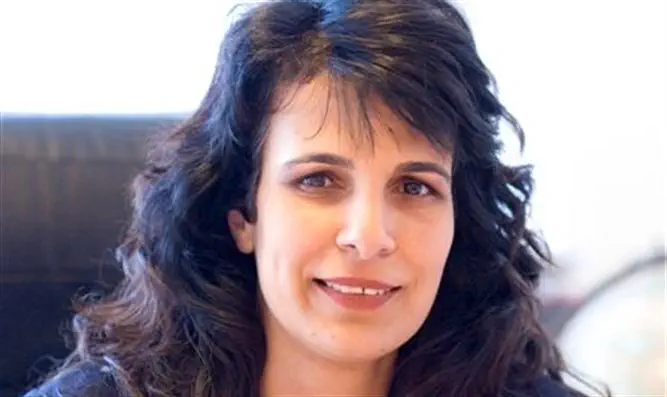
Nitzana Darshan-Leitner
Courtesy Shurat Hadin

NY federal court will hear Shurat Hadin's suits against Facebook for encouraging terrorism

A huge court case will open Wednesday in the Brooklyn District Court in New York.The Shurat Hadin organization, representing families of terror victims, has submitted two federal suits against social media giant Facebook.

The suits were filed in the name of American citizens who fell victim to Hamas terror attacks. The plaintiffs claim that by providing resources, social media services and support for Hamas on Facebook site, the company has violated American anti-terrorism laws.

The two suits, submitted by attorney Robert J. Tolchin and attorney Nitzana Darshan-Leitner who heads the Shurat Hadin organization, deal with the illegal supply of Facebook services to Hamas and the use made by the organization of social media as a means to promote its murderous goals.

The first suit was submitted by the family of US army officer and Vanderbilt graduate student Taylor Force, who was murdered in an attack in Yaffo in March 2016. The second one is a class action suit representing 20,000 Israelis who are demanding that Facebook block users who encourage terror activity.

In Wednesday's hearing the judge will hear the claims of the plaintiffs and the request by Facebook to dismiss both suits and will then decide whether the suits will be adjudicated in a legal procedure.
"The terrorists who stabbed and murdered and attacked innocent Israeli and American citizens all over the state of Israel depended on the wave of incitement which swept the social media sites led by Facebook. Facebook believes that it is allowed to make billions of dollars worth of profits every year without any obligation to demonstrate responsibility, supervise and remove content calling for the murder of Jews worldwide.
 
"The defendants invested huge sums in developing technologies which would enable them to know every detail about their users, yet they refuse to use the very same technologies to stop the incitement to violence against Jews. Facebook has become a weapon of Hamas in its efforts to encourage terror and therefore this must be stopped by using legal means," said Darshan-Leitner.

Wednesday, March 01, 2017

What's the Big Deal?

From The Hill, 24 Feb 2017, by Einat Wilf, former member of the Knesset, and Adi Schwartz is, researcher and writer in Tel Aviv:

President Donald Trump, as expressed in the press conference with Israeli Prime Minister Netanyahu, now aspires in the Middle East to “a much bigger deal”, “a much more important deal”, one that “would take in many, many countries" and "​would cover a very large territory.” This kind of regional deal between the Arab world – and perhaps, the entire Muslim world​​ - and the Jewish State of Israel was always the only deal to be had: a very big deal to solve a very big problem.

True peace requires addressing the deep sources of the conflict. Those lay with the Arab and Muslim reaction to the return of the Jewish people to powerful sovereignty in their ancient homeland. As far as Muslim theology and Arab practice were concerned, the Jews were non-believers, only to be tolerated, never as equals. They should have never been allowed to undermine Muslim rule over the lands, which the Jews claimed as their homeland, but the Arabs viewed as exclusively theirs since conquering them in the seventh century.

The return of the Jewish people to restored sovereignty in their ancient homeland, required Arabs and Muslims to accept that a people, whom they have for centuries treated as inferiors, worthy of contempt, were now claiming equality and exercising power in their midst.

This historical “Chutzpah” is what drove the Arab League to violently reject any kind of plan that would grant the Jewish people equal sovereignty over any part of “Muslim land”​, free from their control. This unnatural historical development, in Arab eyes, led Arab governments to take revenge and forcefully expel hundreds of thousands of Jews, living in their midst, often in communities predating the birth of Islam, just after the establishment of the State of Israel. 

It is also the reason why Arab states kept the Arabs who were displaced during the 1948 Arab-Israeli war and their millions of descendants, ​ as perpetual “refugees” – to deprive the Jewish state of legitimacy and peace.  It is the reason that even after losing repeated military wars against the State of Israel, Arab countries have continued their diplomatic and economic war against it to this day. Even Jordan and Egypt, that have signed nominal peace agreements with Israel, have more of a ‘mutual non-attack’ agreements, rather than genuine peace. 


​The animosity to the concept of the Jewish sovereignty in the Arab Middle East is simply too big. This attitude towards the Jewish state is an Arab – and Muslim – issue, and not only a Palestinian one. The Palestinians have been at the forefront of this Arab and Muslim intolerance, but they are not its creators. They are the thin end of the wedge by which the Arab and Muslim world wages its war against a sovereign Jewish people.

If the word peace is ever to truly describe the situation between Israel and its neighbors, it requires the Arab and Muslim world to address the roots of their intolerance. It requires them to accept the Jews as their equals and as an indigenous people who have come home. This was always too large a task to be undertaken by the Palestinians. Only Arabs and Muslims together can legitimize a different theological interpretation of the Jewish presence in their midst: no longer inferiors and no longer foreigners. In doing so, they can enable and legitimize practical solutions in Jerusalem that accept the centrality of the city to the Jewish people, and to the manufactured problem of the “refugees”, by finally rehabilitating them and absorbing them as fellow Arabs.

This is a tall order, and therefore only a powerful nation, such as the United States, can create the conditions for such an agreement. This means continuing and even enhancing the American multi-layered support for Israel, so as to disavow any people or nation of the possibility of doing away with the State of Israel. But it also means finally addressing the Arab attitudes towards the Jewish state.

The problem is that for decades, the U.S. went along with Arab duplicity, and even enabled it. Washington treated several Arab governments as its allies, while allowing them to foster and spread anti-Israeli hatred. It is time for the new administration to put its money where its mouth is: if the U.S. is serious about achieving a “great deal”, it should start exacting a price on any Arab behavior contrary to that end.

There is a range of actions that the U.S. can take. In any statement regarding the conflict, the new administration must acknowledge that Arab animosity towards the sovereign Jewish state is the root cause of the conflict. 

The U.S. should put an end to its policy of providing Arab countries a carte blanch for not resettling the refugees for nearly seventy years, and cease financially underwriting this behavior through the American decades-long support of a special UN agency (UNRWA). The U.S. should also put a price tag on any Arab anti-Israeli activity in the UN and in international fora. The U.S. could also exact a financial price on the continued Arab and Muslim economic boycott of Israel as well as its boycott in a variety of fields from soccer to culture.

By doing so, the U.S. would send an unequivocal message to the Arab and Muslim world that their future is better served by accepting Israel and the Jewish people as sovereign and equal in their midst, rather than by continuing the useless war they have been waging against Israel, Zionism and the sovereign Jewish people.

Lebanon is responsible for Hezbollah

From YNet, 23 Feb 2017, by Major-General (res.) Giora Eiland, former head of Israel's National Security Council:


Alongside Nasrallah’s harsh words, we should also pay attention to the recent comments made by Lebanese President Michel Aoun, which make it clear that Hezbollah and the government of Lebanon are one and the same.

In recent weeks, Hezbollah Secretary-General Hassan Nasrallah’s threats have become more frequent and more aggressive. Some people say, as implied in IDF Chief of Staff Gadi Eisenkot’s comments Wednesday, that the threats reflect distress rather than self-confidence. I am not so sure about that.

After years of rolling in the Syrian swamp, Hezbollah’s involvement in the war in Syria is expected to increasingly diminish. The fact that the organization is identified with the “winning side” will only give it more confidence in its abilities to shift the fighting towards its main enemy—Israel.

Alongside Nasrallah’s harsh words, we should also pay attention to the recent comments made by Lebanese President Michel Aoun, who reiterated that Hezbollah was part of the power protecting Lebanon from Israel. Although it isn’t new, this statement only strengthens what should have been clear for years—that Hezbollah and the government of Lebanon are one and the same.

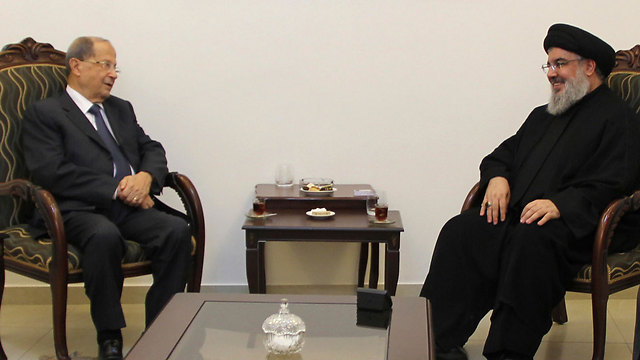
Lebanese President Michel Aoun with Hezbollah Secretary-General Hassan Nasrallah, ‘Lebanon’s defender against Israel’ (Photo: AP)

Both Western countries and Israel have been erring for years in understanding the reality in Lebanon. According to the common view, the political establishment in that country is divided into two camps. On the one side, the “good guys” camp, which includes the majority of Christians, Druze and Sunnis and represents pragmatism, moderation, a Western culture and reliance on Saudi, American and French aid. On the other side, the “bad boys” camp, which is led by Hezbollah with the support of Syria and Iran.

If this current state of affairs is true, the West should try to bolster the “good guys” by providing economic aid, building infrastructures and strengthening the army. The problem is that this description is naïve and very far from the truth and from reality.

The truth is that while there are indeed two camps in Lebanon, there is an unwritten agreement between them that each camp will use its relative advantage for a joint purpose. The “good guys” camp will present the beautiful face of Lebanon—a country with democratic institutions, a Francophile culture and a free economy—thereby obtaining political, economic and military support for the country. In return, the other camp, led by Hezbollah, will serve as the state’s significant military force, will be defined by the government as Lebanon’s defender against the Israeli aggression and will be the only one to decide if it will be quiet or noisy along the border with Israel.

In the Second Lebanon War, Israel fell into the Lebanese trap and played into the hands of the Lebanese government. Israel fought only against Hezbollah, without getting the Lebanese government, the Lebanese army and the country infrastructures involved in the battle. What will happen if we run the third Lebanon war the same way? The outcome will likely be much worse than the results of the previous war. Israel can only defeat Hezbollah at an unbearable cost to the Israeli home front.

The conclusion, therefore, should be clear. If fire is opened at Israel from Lebanese territory, Israel should declare war on the State of Lebanon. There is no one in the world who wants to see Lebanon destroyed—neither the Syrians and the Iranians on the one side, nor the West and Saudi Arabia on the other side. Hezbollah doesn’t want that either. A war against Lebanon, which will inflict heavy damage on all of the country’s infrastructures, will spark an international outcry for a ceasefire after three days, rather than after 33 days like in the Second Lebanon War. It is only from a really short war that Israel will be able to emerge victorious and without serious damage to its home front.

It’s important to remember, therefore, and to remind the world not of Nasrallah’s statements, but rather of the Lebanese president’s statements. Once the fighting breaks out, it will be too late to explain the new strategy. The diplomatic battle should be waged before, not during, a war.

Sunday, February 26, 2017

What Trump should do with the Iran deal

From Fathom, Winter 2016-7, by Emily B. Landau:

1198472149

MAKING THE BEST OF A BAD SITUATION
The debate over the fate of the Iran nuclear deal – or Joint Comprehensive Plan of Action (JCPOA) ...has for the most part been presented in black and white terms. Either the deal is terrible, and should be scrapped altogether, or it is working and should be preserved, even serving as a model for other proliferation challenges. But there is a growing group of experts who are critical of the deal but are nevertheless not advocating that it be renounced by the new administration. ...at the heart of the third option is the need to make the best of a bad situation: to take into account what is feasible and realistic at this point, while working to fix what sorely needs fixing.

... the deal itself would neither be renounced nor renegotiated. Instead, it would be revisited and significantly strengthened – on the nuclear dimension, but perhaps more importantly regarding attitudes of the US administration toward Iran and the deal.

WHY NOT SCRAP THE DEAL?
...First, such a step would cause unnecessary friction with the other P5+1 partners, who have decided to accept the deal, ignore its problematic aspects, and move forward with economic – and for some military – deals with Iran...

Second, a year and a half into the deal – and a year into its implementation – changed realities require new calculations. Iran has already pocketed a significant amount of money – billions of dollars, some in hard cash – and has increased oil exports, so ditching the deal now would mean letting Iran off the hook with its nuclear obligations after Iran has gained much of the sanctions relief it was seeking (despite the complaints of the Supreme Leader). The US would be left with little leverage to improve the situation. In fact, it would have to again try to build up the kind of pressure that Iran faced on the eve of the 2013 negotiation, which took a tremendous amount of time and energy. Moreover, while the US can cause significant pressure with its own financial sanctions, it would no doubt also have to work hard to bring other states on board for additional economic sanctions.

Finally, there is much that can be done to improve the circumstances surrounding the deal, without renouncing or renegotiating it. Indeed, an outright rejection of the JCPOA would only provide a convenient platform for deal supporters to shift blame  for all the ills that will follow, from the Obama administration to the Trump presidency.

CLARIFYING THAT IRAN PURSUED A MILITARY CAPABILITY
An important initial step that the Trump administration should take is to state clearly and publicly that Iran violated the Non-Proliferation Treaty (NPT) for decades, while working on a military nuclear programme. ...the conclusion that Iran advanced a military nuclear programme has already been reached by the IAEA...in December 2015...
But once the report was released, it was immediately and inexplicably shelved; there was no further discussion of the matter, and Iran’s lack of cooperation with the IAEA investigation was ignored. The P5+1 moved on to Implementation Day (mid-January 2016) as if the report had never been issued.

IMPLICATIONS FOR CONFIDENTIALITY, IAEA REPORTS, AND BALLISTIC MISSILES
...Publicly clarifying Iran’s problematic past is critical because Iran denies it ever worked on a military nuclear programme, and has clung to its narrative of nuclear innocence, unchallenged by the P5+1. Declaring that Iran is a violator of the NPT is a necessary precondition for demanding clarifications regarding other issues stemming from the deal – three of which deserve special mention.

The first goes to the confidentiality that Iran seems to have been granted in some of its dealings with the IAEA, that we only learned about over the course of 2015 and 2016. The issue was first exposed regarding the inspection carried out at Parchin (a military site) in September 2015, and in mid-2016 it cropped up again following media reports on Iran’s enrichment plans for year 11 of the deal. These confidentiality privileges were explained by the P5+1 as normal procedure between the IAEA and NPT member states. But Iran is obviously not a normal member of the NPT and should not enjoy such privileges – it is a violator of the treaty, and has not cooperated with the IAEA in its investigations. There is no justification for granting confidentiality, which clearly works in Iran’s favour.

A second problem is that the IAEA reports on Iran’s nuclear programme that have been issued since Implementation Day bear little resemblance to previous reports. The four reports released since January are missing essential technical details and data that had been included in all past reports and that enabled independent assessment of Iran’s compliance. Again, taking into account that Iran has a proven record of NPT violations, there is no justification for omitting this crucial information, and the IAEA should be urged on this basis to return to its previous practice.

Finally, clarifying Iran’s past work on a military nuclear programme feeds into the missile realm as well. This issue is a little trickier than the previous two, because whenever the issue of ballistic missiles is raised, the standard response is that these were not part of the nuclear negotiations. But this response is not satisfactory, because the P5+1 agreed not to include ballistic missiles as a concession to Iran, not because they are not closely tied to a military nuclear programme. In fact, to be a nuclear-capable state in today’s world implies ballistic missile capabilities for delivering nuclear warheads. So the connection is intimate. Moreover, Iran demanded a change in the wording of UN Security Council (UNSC) Resolution 2231 which endorsed the JCPOA and replaced all the previous UNSC resolutions on Iran, including Resolution 1929 from June 2010 that had strong wording regarding ballistic missiles. In the new resolution, Iran was only called upon (not required) to stop work on ballistic missiles; moreover, Resolution 2231 refers to ballistic missiles that were designed to be able to carry a nuclear payload. The added words (‘designed to’) are important, and they go directly to Iran’s insistence on maintaining its narrative of nuclear innocence. Because if Iran never worked on a military capability (as it falsely claims), and has no intention of doing so in the future, then obviously it cannot be accused by the international community of working on a ballistic missile designed to carry a nuclear warhead. For this reason as well, it is important to refute Iran’s nuclear fairy tale, and replace it with the truth. The US should underscore Iran’s culpability in the nuclear realm, and deny it the ability to rely on that excuse.

When one appreciates the benefits that accrue to Iran from

  • its narrative of nuclear innocence – its ability to be treated as a ‘normal’ member of the NPT vis-a-via the IAEA reports that don’t divulge full details of its nuclear programme, 
  • confidentiality privileges on the issue of the inspection of Parchin, and 
  • Iran’s nuclear plans from year 11, as well as on the missile front 
– it is clear why Iran refuses to give it up.

Less comprehensible is the P5+1 acquiescence to this falsehood. The standard explanation provided by the US for not pressing Iran on the PMD was that they preferred to focus on Iran’s future behaviour, which should be monitored regardless of what it did in the past. Moreover, pressing Iran would not serve any purpose because ‘we know what Iran has done’; it would only cause humiliation. But refusing to clarify Iran’s record of violations was a mistake, with negative ramifications. Bringing these violations to the forefront is not about humiliating Iran, but about denying it any benefits from this false narrative. Nor would this step change the terms of the JCPOA. It is a necessary reminder of why there is a need for extra vigilance with regard to Iran – why there are no grounds for confidentiality, secret deals, or exemptions, and why a tough stance needs to be adopted in the missile realm.

CLEARING UP AMBIGUITIES IN THE DEAL: INSPECTION AND ACCESS
Another area that the new Trump administration should focus on is clearing up ambiguities in the JCPOA, especially surrounding the provisions that set the procedures for the IAEA to request access to suspicious military facilities. Originally, the P5+1 appreciated that the major lacuna in the NPT, as far as verification was concerned, was the fact that the IAEA could only inspect declared nuclear sites. Iran’s military work was conducted at a military facility, Parchin, and Iran was not required to grant entry to IAEA inspectors. For this reason, as late as April 2015, the US negotiators spoke of the need for ‘anytime, anywhere’ inspections in Iran. But the provisions of the JCPOA do not grant that. Rather, there is a procedure that the IAEA must go through, and according to one reading this can take up to 24 days, but according to another, Iran would be able to stretch out the timeline further. In the background is the one-time inspection at Parchin in September 2015, when IAEA inspectors did not enter the facility, and the repeated statements by Iran Supreme Leader Ali Khamenei that he will never grant access to Iran’s military facilities.

All of this creates the sense that when a suspicion arises, Iran will probably first reject the request outright, claiming that the suspicions are baseless, and then begin playing for time, as it did quite successfully in the past. The provisions for entering a suspected facility in a timely manner must be clarified among the P5+1.

KEEPING IRAN TO ITS COMMITMENTS AND RESPONDING TO VIOLATIONS
It would seem to be self-evident that Iran must be kept to its JCPOA commitments, but ensuring this is not as simple as it might seem, and many relevant questions have no answer in the text. What constitutes a significant violation? What line does Iran have to cross to elicit a response? If there is a need to respond, who will do so, and by what means? Who must decide, and in what time frame? Formulating clear responses to these questions, and policy on that basis, was something that should have been done in the very first stage – once the JCPOA was announced – but there is no evidence that it was. The Obama administration seems satisfied with the laconic formulation of having ample time to detect a violation and deal with it, if necessary by means of snapback sanctions. But obviously this does not provide clear direction, or the answers to the chain of decisions that will in reality have to be made. While ‘snapback sanctions’ might sound good on paper, it is not likely to work in practice, because sanctions do not simply ‘snap back’ – states need to decide whether to reinstate sanctions, and which sanctions to reinstate. This will no doubt elicit heated discussions, and the process will take time.

Complicating matters over the past year was that the Obama administration actually had no interest in these clarifications; to the contrary, due to its strong commitment to the deal, it was not motivated to seek out violations, to make note of them when revealed, or to think about proper responses. Indeed, violations – such as appear in the fourth IAEA report issued in early November 2016 – have been played down, and other suspected transgressions – specifically regarding lack of Iranian adherence to the JCPOA Procurement Channel – have been brushed aside. With political distance from the deal, and having seen first-hand Obama’s lack of response, the Trump administration will be better positioned to tackle this issue.

CHANGE THE US ATTITUDE TOWARD IRAN
The Obama administration negotiated a very problematic nuclear deal, and then proceeded to weaken the US in its dealings with Iran over the past year and a half. In order to sell the deal, the administration misled the American public by presenting the choice as between this deal or war, and hinted that a deal with Iran could very well engender better US-Iran relations, although there was no sign that this was a realistic expectation. In an effort to continue to maintain the JCPOA over the past year, and despite growing evidence of Iranian misbehaviour and lack of interest in improving relations, the Obama administration played up Iran’s (minimal) cooperation while ignoring or explaining away its regional aggression and deal violations. The administration allowed itself to be deterred by Iranian complaints and accusations of US noncompliance with the JCPOA; indeed, rather than clarifying that the complaints have no leg to stand on, US Secretary of State John Kerry responded by trying to convince companies to go back to business with Iran. The more the administration acquiesced to Iran, the stronger Iran has become; Iran understood that the US would go to great lengths to ensure that it did not walk away from the deal. This translated into significant leverage for Iran and a corresponding loss of leverage for the US.

A major change in the US approach to Iran and the nuclear deal is sorely needed. The US must stop playing the role of Iran’s lawyer and defender, and begin holding it to the terms of the deal, while responding firmly to Iran’s attempts to push the envelope not only with regard to the deal, but in its aggressive regional behaviour as well. The US should state clearly that it will continue to resist what Iran is doing in the missile realm, and its support for terror — and the recent Senate vote (99-0) to renew the Iran Sanctions Act is a step in the right direction. In devising new policies with regard to Iran, cooperation with Israel is important and can be very useful to the Trump administration, especially regarding intelligence gathering.

Turning on Tehran

From Al-Ahram (Egypt), 23 Feb 2017, by Dina Ezzat:

For Trump, as for Arab leaders in the region, confining Iran is top priority.

Ali Khameni
It will not be the settlement of the almost seven decade old Arab-Israeli struggle (now essentially reduced to the Israeli-Palestinian conflict) that will top the agenda for leaders of the Middle East, including Arab leaders, when they start to meet with US President Donald Trump throughout March and April. Rather, it will be containment of Iran and rolling back its expanding regional influence.
“This is the priority for Trump as he announced it during his electoral campaign and of course in statements he made following his inauguration 20 January, especially during the visit of Israeli Prime Minister Binyamin Netanyahu a few days ago,” said a senior and informed Arab diplomat.
This too, he added, is the priority of leading Arab states – certainly Saudi Arabia that is very open in qualifying Iran as the number one threat to stability in the Middle East.

“Saudi Arabia secured the support of Turkey on this matter and that of the Gulf Cooperation Council, and the rest of the Arab countries will join the Saudi call,” the diplomat stated.

During his participation in the annual and high-profile Munich Security Conference this week, Saudi Foreign Minister Adel Al-Jubeir could not have been more direct in associating regional instability and terror, on the one hand, with Iran, on the other.

Only Israeli Minister of Defence Avigdor Lieberman matched the statements of the top Saudi diplomat.

Lieberman called the leader of Al-Quds faction of the Iranian Revolutionary Guard the “number one terrorist” in the world.

While Al-Jubeir, speaking to reporters at the Munich conference, declined to make direct reference to the eye-to-eye on views that he shared with Lieberman, the Israeli minister of defence announced “the good news”:
For the first time since 1948, moderate Sunni Arab leaders agree with Israel on who is the main threat to regional stability.

Lieberman’s statement was much more forthcoming than any previous one made by an Israeli official in the past few years, including the controversial statement that former Israeli foreign minister Tzipi Livni made during a joint press conference in Cairo in 2009 with her then counterpart and now Arab League Secretary-General Ahmed Abul-Gheit that divided the region into “moderates and extremists”.

The Iranian Foreign Ministry criticised the statements of Al-Jubeir and Lieberman. Bahran Qassem, spokesman of the ministry, said that coordination against Iran “is not coincidental”.

The statements of both Al-Jubeir and Lieberman came at a time when US Congress members are promoting tough sanctions against Iran for its recent ballistic missile tests and for destabilising the Middle East.

“I think it is now time for Congress to take Iran on directly in terms of what they’ve done outside the nuclear programme,” Senator Lindsey Graham, a member of the Senate Armed Services Committee, told the Munich Security Conference.

He added that he and other US senators would be pursuing measures to hold Iran accountable for its acts.

On a parallel track, during a visit to the region, new US Secretary of Defense Jim Mattis discussed with the Iraqi prime minister during a visit to Baghdad Monday containing Iranian influence in Iraq, a visit that was also designed to follow up on Iraq’s efforts to combat the Islamic State group (IS) – the second top Middle East priority for the Trump administration – and to reassure Iraqi leaders that the US, contrary to Trump’s rhetoric, is not planning to seize Iraqi oil.

The containment of Iran was also on the agenda of talks that US Vice President Pence held with European Union and NATO leaders.

According to a Washington-based Arab diplomat, who said “I think it is safe to say that the US is acting to make it very hard for Iran to maintain its current regional influence. This is precisely what two leading Middle East countries, Saudi Arabia and Israel, have been working for.”

The good rapport between Moscow and Washington, the same diplomat said, is not diverting the Trump administration from pursuing “putting Iran in a corner.”

In Cairo, informed sources admitted that in talks with Egyptian officials, at all levels, members of the Trump administration have made it very clear that they expect Egypt to be party to what is projected to be a collective effort to limit the regional influence Iran has had, especially in Iraq, Syria and Yemen.

According to one official, any plans that Cairo had to explore further cooperation with Tehran have been suspended. According to another source, Washington is already making it clear that it expects Egypt to have a leading role, “political and otherwise” in “handling Iran.”

“Of course, the Trump administration expects Egypt to have direct involvement in managing the situation in Syria and Libya, but it is also expecting a clear role for Egypt in a plan that it is discussing with the Saudis and the Israelis to ‘limit’ Iran,” he stated.

He explained that this is not just about Egypt, Saudi Arabia and Israel, but about the rest of the GCC, Jordan and also about “Turkey, that the Trump administration is really counting on when it comes to Iran and IS as well, especially in Iraq and Syria”.

None of the officials or diplomats— Egyptian, Arab or Western — who spoke to Al-Ahram Weekly confirmed with certainty the news of a potential joint Arab military force to be designated, essentially, the task of halting Iranian regional hegemony.

One of these sources, based in the Middle East, qualified this plan as “a bit far-fetched in my opinion”. “I don’t think there is a way for Trump to get Egypt to join military efforts with Turkey and Saudi Arabia today to take action against Iran or any other target, including IS, either in Syria or Libya.”

He added that what is likely “and what is already happening is intelligence cooperation and of course political cooperation”.

Another source, based in Washington, said that it would be possible to “envisage something along the line of peacekeeping forces in Syria to which Arab armies could possibly contribute, along with other participations”. He added: “However, it is too early to tell, given that the presidential level talks have not taken place yet. So we will have to wait to see the outcome of the talks that Trump would have with regional leaders.”

According to sources in Washington there is no final timeline for the Trump meetings with Middle East leaders. The likelihood is that the Jordanian monarch might be back to Washington for thorough talks at the Oval Office before his country hosts the regular Arab Summit on 28 and 29 March.

Turkish President Recep Tayyip Erdogan, whose NATO member country is seen in Washington as a key regional power, especially when it comes to curbing Iranian influence in Iraq and Syria, is also expected to meet Trump during the next month.

Meanwhile, Cairo and Washington are still working on a date for a meeting of Trump and President Abdel-Fattah Al-Sisi, with Washington saying to Cairo through different executive and legislative channels that it is expecting Egypt to be “at the forefront of efforts to secure stability in the region”.

The visit of Foreign Minister Sameh Shoukri to the US capital, which starts Saturday, will focus on fixing the time and agenda for the expected Trump-Sisi talks.

Egyptian diplomats say that Shoukri is expected to stress that regional stability cannot be secured without pursuing a settlement for the Palestinian cause.

...Jordan and Egypt are considering the outline of a potential political process they could offer to the US to restart the Israeli-Palestinian settlement process in view of three facts: Netanyahu will not negotiate a two-state solution; Trump will not pressure Netanyahu; and Palestinian Authority leader Mahmoud Abbas has been declining all initiatives proposed by Cairo and Amman to pursue alternate scenarios — either open or secret talks with Netanyahu.

The Jordanian monarch arrived in Cairo Tuesday for talks with Al-Sisi on the matter. The meeting of Al-Sisi and King Abdullah comes less than two days after Israeli daily Haaretz leaked information on a four-way meeting that brought the two Arab leaders together with Netanyahu and former US secretary of state John Kerry in Jordan to consider a potential deal that could be offered to the Palestinian Authority.

An informed senior European diplomat admitted that the deal currently being discussed is less than a “viable Palestinian state with East Jerusalem as its capital”. “I don’t think that this is on anymore. I don’t think even that Arabs are keen to pressure Israel, or the US, to take this path. ...this Palestinian state is not happening,” he said.

What could be happening, he added, is a semi-state essentially in Gaza and a few enclaves of the West Bank that “unfortunately would not have any congruous link with one another”, with both Egypt and Jordan offering “a breathing space” for this Palestinian “entity”.

This, he said, is not about the repatriating Palestinians to Sinai, “from what I know,” but rather making Sinai a potential space for free movement, whereby “Palestinians, Israelis and Jordanians could be coming and going.”

“All of this is of course very tentative and we are not sure that this is something that Abbas would agree to,” the same senior European diplomat said.

He argued that this matter “would take time to settle”. “Of course, Mr Trump would not put his Middle East priorities— Iran and IS — on hold to start first with the Palestinian cause, which is not a priority now, not even to Arab capitals, which are either worried about internal issues or worried about IS or Iran.”

Arab diplomats said that handling the future of the Palestinian cause under Trump would be subject to discussion in Amman during the Arab Summit. One said that it is expected for Abbas to come under considerable pressure to show flexibility.

Abbas missed the last Arab Summit that convened in Mauritania for one day, giving the excuse of grieving the loss of a brother. A Palestinian source at the time asserted that Abbas was simply avoiding coming under Arab pressure...

Saturday, February 18, 2017

Netanyahu vists USA and Australia

From The Australian, 18 Feb 2017, by Greg Sheridan*:

Israeli Prime Minister Benjamin Netanyahu has had the best Washington meeting with US President Donald Trump that he could have hoped for.

Trump was as warm to Netanyahu as Barack Obama had been cold and haughty. Trump was as effusive in his praise not only for his Israeli colleague but for Israel itself, as Obama had been constipated and miserly.

On the most important strategic issue that Israel faces — Iran’s growing nuclear and missile power and its aggressive and destabilising role in the region — the view from Washington is now aligned with Israel’s view.

Above all, Trump gave Netanyahu the maximum diplomatic space to move, especially on policy in relation to the Palestinian issue.

Trump broke protocol by declining to explicitly commit to the traditional formulation of supporting a “two-state solution”, meaning the state of Israel sitting alongside a Palestinian state occupying most of the West Bank and Gaza.

Instead, the President said: “I am looking at two states and one state (solutions). I am very happy with the one that both parties like. I thought for a while the two-state might be easier to do, but honestly, if Bibi (Netanyahu) and the Palestinians are happy, then I am happy with the one they like best.”

Netanyahu himself studiously avoided uttering the phrase “two- state solution”.

In yet another case of Trump derangement syndrome, half the world’s professional bloviators have decided Trump has produced a global revolution, called down the 10 plagues and committed the crime that dare not speak its name.

Yet there was both more and less to what Trump said than the words themselves.

The most important change here was in tone. The US still has its differences with Israel on the Palestinian issue, as Trump also made clear. But the change in tone was everything. Trump is Israel’s ally, and Netanyahu’s ally, standing shoulder to shoulder with ­Israel, jointly working on extremely difficult problems.

But the formal policy differences still remain. Trump, albeit in very gentle language, told Netanyahu that Israel would have to pull back on settlement construction in the West Bank. He said Israel would have to compromise. It wouldn’t get everything it wanted.

About eight years ago, in a ­famous speech at Bar Ilan University, Netanyahu made his own historic, public commitment to the two-state solution. When questioned after his joint appearance with Trump, Netanyahu said his views had not changed. But he is reluctant to go back to intoning the mantra of the “two-state solution”, he says, because its meaning can be too divergent and unclear, and the implications about its timing can also be unclear.

Of course, in saying that he would support a solution the parties agreed to, Trump was in any event giving the Palestinians a veto over anything short of the two-state solution, if that’s what they want.

But there’s no doubt that things are moving. Trump is shaking things up. Netanyahu is facing a miscellany of domestic political problems after an astonishing near decade at the top of one of the most complex and difficult political systems in the democratic world. And the roiling chaos and instability of the Middle East provides its own context of heightened tension.

This week Netanyahu comes to Australia. He will get a warm welcome from Malcolm Turnbull and Bill Shorten too. Australia is not a first division player in the Middle East, but it is the 13th largest economy in the world, the second largest Western allied military contributor in Syria. We are a big player in Asia, where Israel is enjoying unprecedented diplomatic success. And probably, outside Washington, Canberra is the most steadfastly pro-Israel capital in the Western world.

On the day Netanyahu met Trump in Washington, I interviewed Israeli Energy Minister Yuval Steinitz in his Jerusalem ­office. Steinitz is close to Netanyahu and was acting Prime Minister during Netanyahu’s overseas visit. In a long discussion, he offered a critical insight into Israeli government thinking on the two-state ­solution, on Iran, on Syria and on Israel’s booming hi-tech economy.

He rates Iran as the most important challenge facing Israel, but it’s worth quoting him at some length on the Palestinian question.

I asked him if he and the government supported the two-state solution.

“This is very complicated,” he said. “In the longer term, this (the two-state solution) is the view and the hope of the Prime Minister and most Israelis, me included. Unfortunately, at the moment, this is only a theoretical question.

“If someone would come and offer us real peace — the right of Israel to maintain its tiny Jewish state — if someone really offered us genuine peace and real security, most Israelis would be willing to make territorial concessions, including painful territorial concessions, to bring about a demili­tarised Palestinian state.

“Abu Mazen (Palestinian Authority President Mahmoud Abbas) is not a real partner. Look at the main messages in his education system. The main message is that Israel must be destroyed, that Jews are horrible creatures and always corrupt the vicinity around them, so they should be got rid of, like Europe did. Also look what’s happening in Gaza. We withdrew from Gaza, uprooted Jewish settlements, got a mini-Palestinian state with contiguous territory, and we got no security. Instead we’ve had 16,800 rockets and missiles launched on Israel.

“Now, who can guarantee that if we were to make territorial concessions in the West Bank, we won’t see the same thing we saw in Gaza, especially if we see what’s happening all through the Middle East?

“So it (the two-state solution) is unrealistic currently, until we have realistic partners for peace.”

Palestinians would contest many of Steinitz’s points but it seems to be the authentic Israeli government view: the two-state solution is the ideal. It’s not realistic now in a way that is compatible with Israeli security, therefore the status quo, with all its difficulties, must be persisted with.

But Steinitz is much more ­urgently concerned with the danger for Israel, and for many other nations, emerging out of Iran, and it is here that he most urgently wants action from the new Trump administration.

He wants the Trump administration to show resolve, to “stop Iran, to stop Iranian terrorism, Iranian missile programs, Iranian expansion all over the Middle East’’.

“Take Syria. Let’s assume there’s a settlement. Iran’s hope is to make Syria an Iranian stronghold, a Shi’ite extension of Iran, to develop a permanent military presence there. This would mean for Israel an Iranian air force presence, Iranian Republican Guards, tactical missiles, intelligence presence, navy — all on our borders.

“This would also be extremely dangerous for NATO, if Iran has direct control of naval bases. It is very dangerous for American ­allies like Jordan, which could be engulfed by the Iranian presence.

“Iran is also in Lebanon, endangering us and the people of Lebanon. It could lead to another very destructive conflict between Hezbollah and Israel. Like North Korea, Iran is trying to develop long-range missiles including intercontinental ballistic missiles. There is a new determination to constrain both North Korea and Iran. It boils down to the same issue: if North Korea can get thermo­nuclear weapons and long-range missiles, it can reach the middle of America and the middle of Australia. This will have an effect on Iran.”

Steinitz hopes Trump will be more resolute than Obama (he could hardly be less resolute) and Netanyahu is sure to seek Australian support on Iran during his forthcoming visit.

But Israel is concerned not only about missiles and territory and threats. It is a start-up nation and its hi-tech success is the envy of the world. Steinitz believes this is having a direct effect in improving even further Israel-Australia relations, and indeed Israel’s standing around the world.

“Technology is playing a big role here,” Steinitz says.

“Countries are realising that ­although Israel is small, if you want to be on the front line of technology, you need a big Israeli leg. All the hi-tech ­giants have come to Israel. In the last five years we’ve seen a new phenomenon. Other industries, like the car industry or the aeroplane manufacturing industry, see that they too need to have an R&D centre in Israel. Suddenly, all industries are realising that cyber technology and cyber security are crucial.

“Let me give you just a couple of statistics. In little Israel, there are more tech start-ups than in the whole of the EU put together. In complete numbers, Israel is second only to the US. It has more tech start-ups than China or Japan. This year, about 20 per cent of global investment in cyber security (R&D) will be in Israel.”

Israel is a small nation — 8.5 million people — but it is at the centre of giant forces ­shaping the global economy and global security. This week, it wants to focus on Australia.

*Greg Sheridan visited Israel as a guest of the Australia/Israel & Jewish Affairs Council

Tuesday, February 07, 2017

Obama gave Iran the Green Light for Missiles that could hit Israel

From WorldNetDaily.com, 5 Jan 2017:


Just as Iran announced the testing of a ballistic missile and the Trump administration reviewed plans for new sanctions, the rogue Islamic regime claimed that in nuclear negotiations, President Obama allowed Iran to have missiles that could strike Israel, reports Joseph Farah’s G2 Bulletin.

In statements, Iran’s Revolutionary Guard Corps “hinted that restrictions on the range of Iranian missiles so that they reach Israel but not Europe were part of the Iran deal,” reported the Middle East Media Research Institute.

MEMRI said that according to Iranian officials, the Obama administration gave unwritten consent in the nuclear talks and in the Joint Comprehensive Plan of Action negotiations for Iran to develop ballistic missiles with a range of only 2,000 kilometers, or 1,200 miles, which means they could strike Israel but not Europe.

The agreement purports to prevent Iran from obtaining nuclear weapons, restricting its research and development capabilities. However, critics say it gives Iran the capability of building nuclear weapons once the deal expires.

The deal has been controversial because of the secrecy under which Obama took the action, the unknown side deals and the billions of dollars in cash delivered to Iran in the same time frame.

The MEMRI report questioned whether the Obama permission for Iran to develop missiles with a range up to 1,200 miles was a secret part of the overall nuclear deal or “simply unwritten consent.”
Revolutionary Guard commander Mohammad Ali Jafari referred to the IRGC’s Nov. 2, 2015, consent to U.N. Security Council Resolution 2231, saying: “One of the points in this resolution was the matter of restrictions, which some military elements feared. Therefore, we held meetings in [Iran’s] Supreme National Security Council, and also went to the Leader [Khamenei]. The [Iranian] negotiating team told the Westerners that we do not agree to these restrictions. They [the Westerners] said that these issues must be included in the resolution. Even when I met with the Leader, he said that there were no restrictions on developing defensive capabilities. The only restriction relates to nuclear missiles, which, obviously, we never wanted.

The next day, on Nov. 3, 2015, Iranian Army chief of staff Hassan Firouzabadi referred to Jafari’s remarks, saying: “I confirm statements by the IRGC commander that Iran’s missile activity is not restricted. We will follow two restrictions: The first is mentioned in the JCPOA, in the matter of no nuclear planning, and the second is the range of 2,000 km, which has already been noted previously by all elements in Iran.”

The MEMRI report confirmed published accounts that Iranian Maj. Gen. Hassan Firouzabadi claimed his nation is “entitled to produce missiles with a range of 2,000 km.”

“These statements indicate that although the permission given to Iran to develop missiles capable of striking Israel is likely not a secret annex of the JCPOA, it still constitutes unwritten consent that is an integral part of the nuclear deal. It is convenient for both sides not to publish this understanding in written form – for Iran because it rejects any public reference to its missile program, which it defines as defensive but is in fact offensive; and for the Obama administration, because there would be repercussions if it were to be revealed that it had given Iran permission to develop missiles capable of striking Israel,” MEMRI reported.

Trump's Jordanian Option

From BESA Center Perspectives Paper No. 407, February 6, 2017, by Prof. Hillel Frisch and Yitzhak Sokoloff:

King Abdullah of Jordan, WEF, Flickr, Wikimedia Commons

Instead of fixating on an independent Palestinian state, the new US administration should look east to the Hashemite Kingdom as a stabilizing influence on Palestinian politics. President Trump has an opportunity to help Jordan prosper while furthering the interests of the US and its allies.

In his first meeting with President Donald Trump, Prime Minister Benjamin Netanyahu is likely to stake out common ground on the issues that have most troubled American-Israeli relations over the past eight years: the problem of Iran, and Israel’s settlement policy in Judea and Samaria. Particularly in light of recent UN Security Council Resolution 2334, which labeled Israel’s settlement activity illegal, Netanyahu will need to seek American support for renewed Israeli building in Jerusalem and the blocs, and a renewal of the guarantees of the “Bush letter.”

Beyond that, the inauguration of a new American administration presents an opportunity for Israel to take the lead in advocating a far more ambitious initiative: a major investment in the economic prosperity and political stability of the Kingdom of Jordan.

The gravitational force of a prosperous Jordan would expand the functional links that have always existed between the cities of the West Bank and Amman. It would encourage Palestinians in the West Bank to look to a link with Jordan as the best guarantee of their political and economic future.

Because of this, Jordan has the potential (once again) to become a major stabilizing influence on Palestinian politics, which would serve the interests of Israel, Jordan, and the Palestinian people.

The reemergence of a Jordanian role in the disposition of the West Bank is much preferable to the current international fixation on the concept of an independent, contiguous Palestinian state whose border is based on the 1967 lines. Such a state would be no less of a long-term strategic threat today than it was before the advent of Oslo. So too is Palestinian irredentism a threat to Jordan’s security.

A Palestinian state in Judea and Samaria is likely to succumb to a Hamas takeover and Iranian influence, and to become a theocratic and autocratic state along the lines of the Hamas regime in Gaza. Moreover, it is unobtainable.

Despite Israel’s acceptance of the two-state concept and its agreement to unprecedented territorial dispositions, Israeli concessions have not met the minimal Palestinian demands required for a peace agreement. Nor are they ever likely to do so if the Palestinian Authority is seen as the only possible partner in the peace process.

The inauguration of an American administration uncommitted to the principle of an independent Palestinian state provides Israel with the opportunity to advocate a long-term strategic vision of building up a prosperous Jordan. A strong and stable Jordan could provide an alternative to the model of a two-state solution that depends on the Palestinian Authority.

Such a vision will not only attenuate the Israeli-Palestinian conflict. Equally importantly, it will bolster Jordan, whose importance to regional stability has never been so crucial.

Even more critical is Jordan’s role in containing growing Iranian influence. This is particularly vital now that Iran, along with its terrorist arm Hezbollah, has succeeded in placing its candidate in Lebanon’s presidential palace, making Beirut the fourth capital Iran basically controls in the Arab world. The recent rout of the rebels from eastern Aleppo and the complete takeover of the city by Syrian, Hezbollah and other Iranian-backed forces have major implications for the Sunni-Shiite balance of power.

The pivotal roles Jordan is playing in the fights against IS and against the Iranian-Syrian axis are interrelated. The population of Jordan is Sunni, and is extremely fearful of the growing Shiite menace. If the Jordanian state appears unable to stem the tide, the population might turn to IS, as did many of the Sunni tribes in Iraq in the past.

Jordan has traditionally been a pro-Western state ruling through cooption and consensus. Though Jordan is not quite a Jeffersonian democracy, it is far closer to that ideal than any other Arab state in the region.

Critics of a plan to involve Jordan in resolving the Israeli-Palestinian conflict will be quick to point out that it would entail thrusting a role on Jordan that it does not want. This is certainly the case rhetorically.

Jordan has been committed to a two-state solution since the Oslo Accords, but there are two pieces of evidence that the Hashemite Kingdom is flexible and open to political opportunity. The first is that the Kingdom, throughout the twenty-five years since its announcement of the severance of ties with the West Bank, has refrained from amending the 1952 constitution, which enshrines a Kingdom that unites the two banks of the Jordan River – the East and West Banks.

The second are the trial balloons the Kingdom raises from time to time regarding the feasibility of renewing the Jordanian option. The last was in May 2016, when former Jordanian prime minister Abd al Salam Majali met 100 notables in Nablus at a meeting arranged by Ghassan al-Shak’a, a Nablus-based member of the Executive Committee of the PLO. Simultaneously, in the Hebron area, Jordanian MP Muhammad Al-Dawaimeh launched the “One Million Hebronites” initiative to promote a Palestinian-Jordanian confederation. The Hebron delegation was to meet with King Abdullah to discuss this issue, though it should be noted that al-Shak’a stressed that such a confederation could only come into being after a Palestinian state is created.

Several actors can play a critical role in making Jordan prosperous, and they all have a vested interest in making it happen.

The Saudis and the Gulf states should provide the finance. The US should prod them to do so for their own good, but also to reciprocate for the American security umbrella under which they have been living ever since Saddam Hussein occupied Kuwait. Throughout his campaign, President Trump stressed that he wants US allies to pay for the security umbrella the US provides. This is one way the Gulf states and Saudi Arabia can comply.

Regionally, Jordan has never been a more important strategic asset for Saudi Arabia and its Gulf allies or more worthy of investment. It defends what remains of these states’ northern flank against Syrian-Iranian encroachment and helps balance the threat Shiite Iraq poses to Saudi Arabia’s eastern border, critically close to its major oil fields.

Internationally, the current leadership of the EU – the champion of the two-state solution, almost to the point of obsession – has been considerably weakened by events such as the takeover in Crimea and Brexit. With the vast increase in Islamic terrorism on its home ground, the EU might be inclined to join a venture that will be part of the front against terrorism rather than create a state that might well promote it.

Channeling money to the Palestinians through Jordan would also improve transparency and assure that less money is channeled to incitement and terrorism. It will be important to gradually wean international aid away from the PA and towards Jordan to enable the latter to extend its influence in the West Bank. Israeli-Jordanian security cooperation, historically extensive, can also play a vital role in securing the cooperation of the security forces currently operating under the PA.

Recent trends bolster the prospects of such a project. Locally, the possible breakup of the PA into north and south as a result of the struggle over Abbas’s succession could revitalize the links between Nablus and Amman, as well as Hebron and Amman. Should a breakup occur in the PA, its inhabitants will likely pine for the stability Jordanian influence can offer.

Above all, an incoming president who is new to politics, beholden to no political establishment, and a seasoned businessman with a history of making opportunities come true is moving into the White House. The vision of making Jordan prosperous, and the gains of such a venture in the interests of the US and its allies, might well fire his imagination.

The Oslo Disaster

With all that is happening around the world recently, this Mideast Security and Policy Studies No. 123, of September 4, 2016, by BESA's new Director, Prof. Efraim Karsh, may have escaped your attention. Now is a good time to absorb it, carefully...

Prof. Efraim Karsh, the incoming director of the Begin-Sadat Center for Strategic Studies, indicts the Oslo diplomatic process as “the starkest strategic blunder in Israel’s history” and as “one of the worst calamities ever to have afflicted Israelis and Palestinians.”


“Twenty three years after its euphoric launch on the White House lawn,” Karsh writes in this comprehensive study, “the Oslo ‘peace process’ has substantially worsened the position of both parties and made the prospects for peace and reconciliation ever more remote.”
“The process has led to establishment of an ineradicable terror entity on Israel’s doorstep, deepened Israel’s internal cleavages, destabilized its political system, and weakened its international standing.”
“It has been a disaster for West Bank and Gaza Palestinians too. It has brought about subjugation to corrupt and repressive PLO and Hamas regimes. These regimes have reversed the hesitant advent of civil society in these territories, shattered their socioeconomic wellbeing, and made the prospects for peace and reconciliation with Israel ever more remote.”
“This abject failure is a direct result of the Palestinian leadership’s perception of the process as a pathway not to a two-state solution – meaning Israel alongside a Palestinian state in the West Bank and Gaza – but to the subversion of the State of Israel. They view Oslo not as a path to nation-building and state creation, but to the formation of a repressive terror entity that perpetuates conflict with Israel, while keeping its hapless constituents in constant and bewildered awe as Palestinian leaders line their pockets from the proceeds of this misery.”
Karsh details at length how the Oslo process has weakened Israel’s national security in several key respects.

On the strategic and military levels, it allowed the PLO to achieve in one fell swoop its strategic vision of transforming the West Bank and the Gaza Strip into terror hotbeds that would disrupt Israel’s way of life (to use Yasser Arafat’s words).

Politically and diplomatically, he says, Oslo instantaneously transformed the PLO (and, to a lesser extent, Hamas) into an internationally accepted political actor while upholding its commitment to Israel’s destruction, edging toward fully fledged statehood outside the Oslo framework, and steadily undermining Israel’s international standing.

The ending of Israel’s occupation of the Palestinian population of the territories within three-and-a-half years from the onset of the process has gone totally unnoticed (due partly to Palestinian propaganda, partly to Israel’s failure to get this critical point across), with the Jewish state still subject to international opprobrium for the nonexistent “occupation.”

Domestically, Oslo radicalized Israel’s Arab minority, nipping in the bud its decades-long “Israelization” process and putting it on a collision course with Israel’s Jewish community. No less importantly, it made Israeli politics captive to the vicissitudes of Palestinian-Israeli relations, with the PLO and Hamas becoming the effective arbiters of Israel’s political discourse and electoral process.
“On the face of it,” Karsh writes, “Israel’s massive setbacks can be considered Palestinian gains. Yet one’s loss is not necessarily the other’s gain. The Palestinian leadership’s zero-sum approach and predication of Palestinian national identity on hatred of the ‘other,’ rather than on a distinct shared legacy, has resulted in decades of dispersal and statelessness.”
“Even if the PLO were to succeed in gaining international recognition of a fully fledged Palestinian state (with or without a formal peace treaty with Israel) and in preventing Hamas from seizing power, it would still be a failed entity in the worst tradition of Arab dictatorships, in permanent conflict with its Israeli neighbor while brutally repressing its unfortunate subjects.”
Karsh bemoans that fact that “there has been no real reckoning by the Oslo architects and their erstwhile ‘peace camp’ successors, both in Israel and abroad, of the worst blunder in Israel’s history, and no rethinking of its disastrously misconceived assumptions – let alone any public admission of guilt or show of remorse over its horrific costs.”
“Instead, they continue to willfully ignore the Palestinian leadership’s total lack of interest in the two-state solution and serial violation of contractual obligations. They continue to whitewash ongoing Palestinian violence, belittle the extent of Israeli suffering, and blame Jerusalem for the stalled process despite the public endorsement of the two-state solution by five successive Israeli prime ministers: Peres, Barak, Sharon, Olmert, and Netanyahu.”
“Not only has the same terror-tainted Palestinian leadership come to be universally viewed as the prospective government of a future Palestinian state, but its goal of having this state established without negotiating with Israel, or even recognizing its right to exist, seems to be gaining ever wider currency.  This soft racism – asking nothing of the Palestinians as if they are too dim or too primitive to be held accountable for their own words and actions – is an assured recipe for disaster.”
“For so long as not a single Palestinian leader evinces genuine acceptance of the two-state solution or acts in a way signifying an unqualified embrace of the idea, there can be no true or lasting reconciliation with Israel. And so long as the territories continue to be governed by the PLO’s and Hamas’s rule of the jungle, no Palestinian civil society, let alone a viable state, can develop.”
“Just as the creation of free and democratic societies in Germany and Japan after World War II necessitated a comprehensive sociopolitical and educational transformation, so it will only be when Palestinian society undergoes a real ‘spring’ that the century-long conflict between Arabs and Jews can at long last be resolved and a semi-functioning Palestinian state come into being. This requires sweeping the corrupt and oppressive PLO and Hamas rulers from power, eliminating endemic violence from political and social life, and teaching the virtues of coexistence with Israeli neighbors.”
“Sadly, the possibility of a Palestinian spring, which seemed to be in the offing in 1993 when the PLO hovered on the verge of extinction and West Bank and Gaza leadership appeared eager to strike a historic deal within the framework of the Washington peace negotiations, has been destroyed for the foreseeable future by the Oslo ‘peace process’.”