Friday, March 11, 2016

Iran continues to develop offensive nuclear-capable missiles

From Israel Hayom, 10 March 2016:

...Iran test-fired ballistic missiles designed to be able to hit Israel ...a "blatant violation" of the nuclear agreement reached between Iran and Western powers last July.

In a photo provided by Iran's Fars News Agency Wednesday, a Qadr H long-range missile is seen being fired by Iran's Revolutionary Guards
|
Photo credit: AP
In a photo provided by Iran's Fars News Agency Wednesday, a Qadr H long-range missile is seen being fired by Iran's Revolutionary Guards
|
Photo credit: AP
According to Iran's state media, the elite Iranian Revolutionary Guard Corps test-fired several ballistic missiles on Tuesday and Wednesday. Iranian state television showed footage of two Qadr missiles being launched from northern Iran, which the IRGC said hit targets 1,400 kilometers (870 miles) away.

The IRGC maintains dozens of short and medium-range ballistic missiles, the largest stock in the Middle East...

Thursday, March 03, 2016

Open letter to the Navy adviser on Muslim Affairs, Captain Mona Shindy

The following open letter to Captain Mona Shindy, a Muslim lady who has been promoted to the rank of captain in the Royal Australian Navy, and who is apparently adviser to the Chief of the Navy on Muslim affairs, was published in the March 2016 edition of Quadrant magazine.

Dear Captain Shindy,

I would, as a taxpayer and citizen, be much obliged if you would answer the following questions. All except Questions 14a and 15 may be answered by a simple “Yes” or “No”.

1) Do you believe the Koran is the complete and unalterable word of Allah as revealed to his messenger Mohammad?

2) Do you believe in sharia law, including punishments such as amputation for theft?

3) Do you believe women taken prisoners of war by Muslims may be used as sex-slaves, or other slaves?

4) Do you believe a woman’s evidence in court is worth half as much as a man’s?

5) Do you believe apostates from Islam should be put to death?

6) Do you believe homosexuals should be put to death?

7) Do you believe it is permissible for a Muslim to lie to unbelievers?

8) Do you believe a Muslim man can validly divorce his wife by saying “I divorce thee” three times?

9) Do you believe Jews and Christians should pay the dhimmi tax and other disabilities?

10) Do you agree with those Muslim states which make it a capital offence to sell land to a Jew?

11) Do you support Israel’s right to exist behind secure boundaries?

12) Do you believe it should be permissible for Jews and Christians to build places of worship in Muslim countries including Saudi Arabia?

13) Do you believe Jews should be allowed to pray on the Temple Mount in Jerusalem?

14) Do you believe the location of the Australian embassy to Israel should be moved from Tel Aviv to Jerusalem?

14a) If not, why not?

15) In your address to the Royal United Services Institute of New South Wales on March 31, 2015, you stated inter alia: “Another example of double standards is the world’s reluctance or inability to enforce the 1948 United Nations resolution regarding the Israeli-occupied territories of Palestine, but its willingness to take prompt and decisive action against other nations such as Iraq, even in the absence of a United Nations mandate.” What exactly do you mean by this and which 1948 resolution do you refer to?

15a) Is this statement consistent with the rule that serving officers should not comment on political subjects?

16) Do you agree that Israel was the victim of aggressive war by Arab states in 1948, 1967 and 1973?

17) Do you agree that Israel has been the victim of innumerable rocket attacks and other acts of terrorism?

18) Is your paramount loyalty to Her Majesty Queen Elizabeth, the Queen of Australia, and her lawful representatives?

I await your reply with interest.

Hal G.P. Colebatch
Nedlands, WA

Tuesday, March 01, 2016

How about land for a state in Sinai?

Perhaps it's time to revive this plan of Sisi's?? ...from JPost, 8 Sept 2014:

Israeli politicians praise Sisi plan to give Palestinians land for a state in Sinai

Abbas reportedly rejected plan that would expand Gaza to five times its current size and give PA autonomy in West Bank cities; Yesh Atid's Peri, Bayit Yehudi's Shaked say proposal worth exploring.

Sisi and Abu-Mazen                                
Sisi and Abu-Mazen:REUTERS
 
Israeli politicians responded enthusiastically ...to reports that Egyptian President Abdel Fattah al-Sisi was willing to give Palestinians land in Sinai adjacent to Gaza for a state.

Science and Technology Minister Yaakov Peri, a former Shin Bet chief, said he's surprised by Sisi's generosity, calling the proposal "worth discussing seriously."

On Monday, Army Radio reported that Sisi had offered Palestinian Authority President Mahmoud Abbas 1,600 square kilometers in Sinai to expand the Gaza Strip to five times its current size. According to the plan, the territory would serve as a Palestinian state under the complete control of the PA.
x

The new territory, composed of Gaza together with the extra land in Sinai, would be a demilitarized state that would serve as a home to which Palestinian refugees could return.

In addition to the "Greater Gaza State," the cities currently in the Palestinian Authority in the West Bank would be under the autonomous rule of the PA. In exchange, Abbas would give up claims to a state within the pre-1967 lines.

The proposal, which was reported previously in the Arab media last week as having been offered by a senior Egyptian official, but not specifically Sisi, was rejected outright by Abbas.

Peri asked several questions arising from the Egyptian proposal in an interview with Army Radio: "What will happen to Judea and Samaria? What will be with Jerusalem? The idea that major cities in Judea and Samaria will have autonomy is vague; everyone can understand it in a different way."

Still, the Yesh Atid minister said, "there are elements that are worth discussing despite Abbas's refusal."

"This could solve problems that weren't given a response in talks between Israel and the Palestinians so far," he added.

Peri also pointed out that Sisi's initiative suits Egyptian interests, since there are problems with terrorism in the Sinai.

Bayit Yehudi faction chairwoman Ayelet Shaked said the Egyptian president "discerned what the Israeli Left refuses to understand for decades."

"The solution to the Palestinian problem," she added, "must be regional and cannot fall on Israel's shoulders alone."

Shaked called on Prime Minister Binyamin Netanyahu to meet with Sisi and examine whether the initiative is possible.

According to Monday's Army Radio report, Netanyahu has already been updated on the details of the Egyptian proposal, as have US government sources who have expressed support for the idea.

Wednesday, February 24, 2016

Canadian Parliament overwhelmingly passes anti-BDS motion

From JPost, 23 Feb 2016:

The motion calls on the Canadian government to “condemn any and all attempts by Canadian organizations, groups or individuals to promote the BDS movement, both here at home and abroad.”      

Canada’s Parliament passed a motion formally condemning the Boycott, Divestment and Sanctions movement against Israel.

The motion passed Monday in a 229-51 vote, CIJ News reported. Introduced last week by members of the opposition Conservative Party, the motion won support from the ruling Liberal Party as well.

It calls on the Canadian government to “condemn any and all attempts by Canadian organizations, groups or individuals to promote the BDS movement, both here at home and abroad.”

In addition, the motion notes Canada and Israel’s “long history of friendship as well as economic and diplomatic relations.” The motion says the BDS movement “promotes the demonization and delegitimization of the State of Israel.”
Speaking in favor of the motion last week, Foreign Affairs Minister Stephane Dion said
“the world will win nothing for boycotting Israel but depriving itself of the talents of its inventiveness.”
Canadian Jewish groups have praised the motion. In a statement last week, Shimon Fogel, CEO of the Center for Israel and Jewish Affairs, said, according to the European Jewish Press,
“The boycott movement does not contribute to peace and is not pro-Palestinian. It is discrimination based on nationality, and it harms both Israelis and Palestinians alike by driving the two sides further apart. The BDS movement is a fringe movement and is outside genuine peace efforts.”...


"Containing ISIS, keeping Assad weak"


Israel should
  • favor a Kurdish state and Druse autonomy in Syria;
  • must prevent Islamic State from securing a presence on its border;
  • has the tools to deter Hezbollah; and
  • would like to see President Bashar Assad’s regime remain on the ropes,
former national security adviser Maj.-Gen. (res.) Uzi Dayan says ...
As the Syrian civil war enters its sixth year – and the international community continues cease-fire talks that are limping on both legs – the growth of Islamic State could spell the destruction of the Syrian state and solidify jihadi networks on the border, says Dayan, a former commander of the General Staff Reconnaissance Unit, who rose to deputy chief of IDF staff, one level short of his uncle, the legendary chief of staff Moshe Dayan.
“Even if Syria disintegrates – or is undergoing disintegration – we don’t want Syria to be a kingdom of ISIS,” says Dayan, who today is chairman of the Mifal HaPayis national lottery.
What Dayan would like to see emerge from the Syrian chaos is the strengthening of ethnic/religious minorities.
“I am in favor of a Kurdish state and we want the Druse to have autonomy,” he says.
Getting back to Islamic State, Dayan notes that the Syrian-Israeli border was a secure frontier for a long time.
“We don’t want ISIS to be there. We prefer the Syrian army along the border,” he says, although he notes wryly that “a weak Syria is good for Israel.
“My position since the beginning of the civil war is that Israel does not have an interest. Assad is not our friend. We don’t have to help him and we don’t do anything to eliminate him.”
Letting Islamic State deploy along the Israeli border could create a situation where Israel may one day find itself fighting Islamic State, Dayan says.
One security remedy for the Golan border, he suggests, would be “to form a security belt of 8 to 10 kilometers” to keep out rockets and jihadi groups, including the Nusra Front, the Syrian branch of al-Qaida. “It would not be an easy task,” he admits.
Dayan stresses the need to “prevent infiltration of strategic weapons to terrorist organizations.” He cites surface-to-air missiles, chemical weapons and long-range rockets as additions to terrorist arsenals that would ring alarm bells in Jerusalem.
The jihadi terrorist entities could obtain Katyusha rockets at some point and fire the rockets into northern Israel, he says. But, notes Dayan, “Israel is very strong when it comes to military influence about what happens in Syria.”
Dayan sees Islamic State as an idea or a vision that is bigger than the organization itself, and the threat posed to Israel by the group is not just on the Golan border.
“The main mission of the new head of the Shin Bet [Israel Security Agency] will be to prevent the formation of ISIS cells among Israeli Arabs and to prevent the group’s influence [from growing] in Gaza and the West Bank.”
On Israel’s eastern border, Islamic State poses a threat as well – not directly to Israel but to the economically struggling Hashemite kingdom, which, he says, is at real risk of destabilization.
“ISIS is an existential threat to Jordan,” Dayan states bluntly. Israel acts as strategic insurance for Jordan and must stay in control of the Jordan Valley to prevent Islamic State from penetrating the West Bank from the Hashemite Kingdom.
When asked about the possibility that Hezbollah could gain control of the Syrian side of the Golan Heights border, Dayan says: “We can deter Hezbollah.” He also points out that Hezbollah’s resources are stretched across Lebanon and Syria.
In the effort to navigate Israel through the zig-zag complexities of the Syrian civil war – a conflict that has resulted in some 470,000 deaths, according to a report issued earlier this month by the Syrian Center for Policy Research – the key is for Jerusalem to pay close attention to its relations with the US, Turkey and Russia, Dayan says.
“It is quite a pity and a disappointment that Russia has become more reliable than Washington in the region,” says Dayan. He cited the Obama administration’s decision to abandon Egyptian president Hosni Mubarak and support the Muslim Brotherhood-backed Mohamed Morsi as a pivotal point in the waning of American power in the region.
The effects on the region have been significant. “Saudi Arabia looks around and sees Russia delivers more than any power,” he says.
With diplomatic rapprochement between Israel and Turkey on its way, Dayan suggests Jerusalem adopt a pragmatic approach in its relations with Ankara.
“We should try and settle [the problems in] relations, but it is not that we can have an alliance with Turkey,” he says.
Some of the key impediments to rekindling the relationship relations involve President Recep Tayyip Erdogan’s insistence that Israel lift its blockade of the Hamas-run Gaza Strip. Erdogan’s aid to Hamas, a US- and European Union-designated terrorist entity, in Turkey is another stumbling block to an agreement with Israel.
The proposed deal would see Saleh al-Arouri, a senior Hamas member operating in Turkey, leave the country. However, additional Hamas members would continue to operate in Turkey.
Dayan says: “We are not sure if we can arrive at an agreement with the Turks. We should try. We don’t look for new enemies. We have enough.”
Asked to name the three most pressing security threats to Israel, Dayan answers: the Islamic Republic of Iran, delegitimization, and terrorism.
He defines delegitimization as a national security issue because it threatens the “cohesion of Israeli society.”
Dayan says a situation is emerging where Israel is riven by internal conflict over “the relationship between parts of Israeli society, especially when it comes to serving in the military.
“I am not worried about difference of opinion, but we are in one boat; it is difficult navigating where we are sailing to,” he says.
*Benjamin Weinthal is a fellow of the Foundation for Defense of Democracies.

"Rivlin: Support for Israel must not become issue in US presidential election"


Rivlin emphasized to the the Conference of Presidents of Major American Jewish Organizations that US and Israel solidarity are based on the values of democracy, freedom, and liberty.

President Reuven Rivlin speaks with the Conference of Presidents of Major American Jewish Organizati
President Reuven Rivlin speaks with the Conference of Presidents of Major American Jewish Organizations. (photo credit: PRESIDENT'S RESIDENCE)
 
Support for Israel has never been and must not become a political party issue. It is bipartisan, President Reuven Rivlin told the Conference of Presidents of Major American Jewish Organizations on Thursday. The bonds between the two countries are based on values of democracy, freedom, liberty and equality, he said, and emphasized that during the current US presidential election season, when candidates and campaigns try to win points and votes, it was his deep hope that the close relationship between Israel and the US will remain beyond debate.

...Issues touched on by Rivlin in his address and the subsequent question-and-answer session included
  • Iran,
  • the role that the US should play in the Middle East,
  • the fight against anti-Semitism,
  • the need to build bridges of understanding between Jews and Arabs,
  • Jewish unity,
  • the changes in the Middle East which are turning enemies into allies and friends into enemies,
  • Russian involvement in Syria,
  • developments among the Kurds, and
  • the conflict with the Palestinians.
Rivlin said: “We must all stand united in the fight against anti-Semitism. Across the world we are seeing a rise in this old and new disease. Jewish students are threatened on campuses around the world. In Europe, 70 years after the Holocaust, Jews are afraid to wear a kippa in the street; and there is more and more pressure to boycott the world’s only Jewish state. We must stand firm against those threats. Israel is your partner in this fight and you are our partner.”
With regard to Egypt, Rivlin told his guests that “democracy is not always according to Jefferson,” and that President Abdel Fattah al-Sisi is trying to defend Egypt from fundamentalism. Israel understands that and there is strong cooperation between the two countries as they try to keep ISIS out of Sinai, because if ISIS takes over Sinai, this poses an acute danger for both Egypt and Israel.
Taking what happened in Libya as a guideline, Rivlin doubted that Syria will once again become a united nation.
He lamented the fact that so much time has gone by without an understanding being reached between Israel and the Palestinians, a factor which he believes impedes Israel’s ability to live together with the surrounding nations.
...Without actually naming the Oslo Accords, he recalled that “we thought that peace was on the threshold, but in a very short time we were awakened from the dream.”...

Christian priest tells UN: "Israel is the only Mideast country not persecuting Christians"

Father Gabriel Nadaf, an outspoken advocate for IDF service, lambasted the UN Human Rights Council for its anti-Israel bias.

Father Gabriel Nadaf of Nazareth, a Greek Orthodox priest, has been promoting IDF service to Christian Israeli Arabs for many years.

By defending Israel, Nadaf has become the target of brutal attacks by enemies of the Jewish state. He has received countless threats. In 2013, his eldest son was beaten by an Arab from his home town of Nazareth; the following year, he enlisted in the Israeli military.

Don’t miss Father Nadaf telling the world that “those trying to destroy the Jewish state…are hastening the death sentence of Christians in the Middle East…”
 

Israel and Germany Sign Agreement on Nanotechnology and Cybersecurity R&D

Israel has established itself as a world leader in cyber technology innovation and many countries, including Germany, are seeking Israel’s expertise and partnership.
 
 
Netanyahu Merkel
PM Netanyahu meets with German chancellor Angela Merkei. (Amos Ben Gershom/GPO) (Amos Ben Gershom/GPO)
 
Director General of Israeli Ministry of Economy and Industry Amit Lang and Germany’s Parliamentary State Secretary to the Federal Minister of Education and Research Thomas Rachel signed on Wednesday a Joint Declaration of Intent to cooperate on nanotechnology and cyber-security.

In the declaration of intent, the two officials expressed interest in “strengthening bilateral cooperation on research and development and technological innovation,” Israel’s Ministry of Economy and Industry said in a statement.

Such cooperation includes joint programs to support small and medium-sized companies active in the field of nanotechnology, as well as cooperation between research institutes from both countries.
The agencies tasked with implementing the declaration are the Israel Innovation Authority under the Office of the Chief Scientist, and the Federal Ministry of Education and Research in Germany.
The two parties will also issue a joint call for applications in cyber-Security, which is expected to become a platform for relevant industries and entrepreneurs in both countries for cooperation in cyber-security, through funding assistance for joint R&D projects in the field, based on the R&D agreement previously signed by the two ministries.

“The decision to publish a joint call for applications is an expression of the vast economic and research cooperation between Israel and Germany and of Germany’s position as one of Israel’s key trade partners,” the statement said.

The signing of the agreement was part of a visit by Prime Minister Benjamin Netanyahu along with other ministers and directors of government ministries to Berlin this week for the sixth G2G meeting with the German government.
 

A glance at the main political players in Libya

From The Associated Press, Feb. 19, 2016:

As U.S. warplanes strike an Islamic State target in eastern Libya, attention again is focused on the North African country that has endured so much chaos since the 2011 overthrow and death of its leader, Moammar Gadhafi.

Since Gadhafi's fall, two competing governments have emerged in Libya, backed by a loose array of militias, former rebels and tribes. The United Nations has been trying to broker a deal to establish a unity government that could bring peace in the oil-rich country, rein in militants like the Islamic State group, and restore order in what has become a major conduit for migrants heading to Europe.

A look at the major players:
THE GOVERNMENTS:
The capital of Tripoli and most of Libya's western coastal cities answer to the General National Congress, the former parliament whose mandate expired in 2014. Backed by Islamist-affiliated militias known as Libya Dawn, the parliament has expelled the Libyan government outside Tripoli, seized the international airport and fought rival militias in battles that forced foreign embassies to close and displaced thousands. The GNC is headed by Nouri Abu-Sahman, whose Salvation Government runs the western part of Libya. The Tripoli-based prime minister is Khalifa Ghwell.
___
A parliament made up mostly of non-Islamists was elected in 2014 and is based in the eastern city of Tobruk and supported by area tribes. Its internationally recognized government is based in Bayda. The parliament endorsed the U.N. peace deal but rejected a proposed unity government for Libya. Khalifa Hifter, who served in Gadhafi's army before defecting to the opposition in the 1990s, is general commander of the armed forces in eastern Libya that support the parliament. These poorly equipped and organized troops depend on militias mostly made up of civilians who defended their neighborhoods in Benghazi. Hifter considers the Tripoli authorities as terrorists and declared a coup against them in 2014. The leaders in Tripoli consider him a holdover from the Gadhafi era.
___
THE ARMED GROUPS:
Libya Dawn — A coalition of militias from Tripoli and the western city of Misrata, Libya Dawn was until recently Libya's most powerful militia, and it serves as the armed force for the GNC. But the U.N. peace effort and fears of the Islamic State group's power have caused deep rifts. Many of the Tripoli-based militias, which are mainly Islamists, oppose efforts to set up a unity government, fearing a loss of patronage. Except for hard-liners, the Misrata militias, which have long been considered some of the toughest fighters in Libya, back the U.N. peace deal and have focused more on fighting IS since it seized the city of Sirte, a Gadhafi stronghold east of Misrata.
___
Islamic State group — Affiliates to the Islamic State group first arose in the eastern city of Darna in 2014 after many of its extremists pledged allegiance to the militant group. The number of IS fighters in Libya is believed to be about 5,000, mostly made up of jihadis from Tunisia, North Africa and Sub-Saharan Africa. IS now controls only the central city of Sirte and nearby villages, but they have carried out some of worst attacks in the country, including in Tripoli, and have tried to capture or disrupt oil facilities east of Sirte. The group has joined with other militias in Benghazi against Hifter and fought rivals elsewhere in the country. They also are believed to have helped with attacks in neighboring Tunisia. IS was dealt a serious blow after militants believed to be linked to al-Qaida and supported by the local population drove the IS extremists out of Darna last summer. In November, a U.S. airstrike in Darna killed an Islamic State leader, Wissam al-Zubaydi, an Iraqi national who also was known by the pseudonyms Abu Nabil al-Ansbari and Abu Mghira al-Qahtani.
___
Ansar al-Shariah — Believed to be al-Qaida branch in Libya, Ansar al-Shariah has been blamed for the attack on the U.S. mission in Benghazi in 2012 when four Americans were killed, including Ambassador Chris Stevens. The group has weakened since the death of its most prominent leader, Mohammed al-Zahawi, in 2014. Many of its members have joined IS in Sirte; others fought alongside IS against Hifter in Benghazi.

Polish museum exhibits US artist Frank Stella's synagogues

From AP, 18 Feb 2016, by VANESSA GERA,

Frank Stella                        
U.S. artist Frank Stella poses in front of one of his works  
WARSAW, Poland (AP) — An exhibition is opening in Warsaw of abstract works by prominent American painter Frank Stella that were inspired by painted wooden synagogues that once existed across Poland but were destroyed by the Nazis during World War II.
 
"Frank Stella and the Synagogues of Historic Poland" opens Friday at the POLIN Museum of the History of Polish Jews and will run through June 20.

Museum officials say it is the first time that Stella's geometrical and highly abstract works have been shown alongside the sources that inspired him — architectural drawings and documentary photos of synagogues taken before the war — as well as models and drawings of his own that he used to create his large-scale constructions.
The works are from his Polish Village series produced in the 1970s. He embarked on that project after he was inspired by a 1959 book by Polish architects Maria and Kazimierz Piechotka entitled "Wooden Synagogues." The exhibition also features photographs of the synagogues by Szymon Zajczyk, a Jewish photographer and art historian who was killed in the Holocaust.
 
Poland was once home to Europe's largest Jewish community, a vibrant community that numbered nearly 3.5 million people before the war. Most were killed in the Holocaust, with many traces of their culture also destroyed.

Museum director Dariusz Stola said his institution is an appropriate venue for the works because one of its key exhibits is a spectacular, full-scale recreation of a 17th-century painted synagogue — the kind that inspired Stella's creations.

The museum is holding two days of events starting Thursday celebrating the 79-year-old New York-based artist, who traveled to Warsaw for the opening.

Stella has worked as an artist for more than 60 years. His works are on display in museums and galleries across the world, including the Museum of Modern Art in New York.

Monday, February 15, 2016

The IAF’s Achilles’ Heel

            
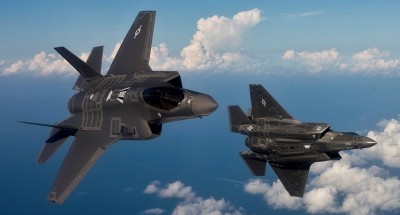
F-35

This week Prime Minister Binyamin Netanyahu told government ministers that he may wait for the next US president before signing a new military assistance deal with America.

Israel’s current military assistance package is set to expire in 2018 and the new package is supposed to include supplemental aid to compensate Israel for President Barack Obama’s nuclear deal with Iran. But to date, the administration has rejected Israel’s requests for additional systems it could use to defend against Iran attacks.

Last October, Defense Minister Moshe Ya’alon asked US Defense Secretary Ashton Carter to provide Israel with a new squadron of F-15s that Israel would outfit with its own electronics systems. Carter reportedly rejected that request as well as one for bunker buster bombs.

Carter instead insisted that Israel use the supplemental aid to purchase more F-35 Joint Strike Fighters, US-made missile defense systems, and the Osprey V-22 helicopter, which Ya’alon didn’t want.

The fact that the administration wants Israel to buy more F-35s instead of F-15s is alarming both for what it tells us about America’s commitment to maintaining Israel’s qualitative edge against Iran and for what it tells us about the F-35, which is set to become the IAF’s next generation combat fighter.

Before considering these issues, it is worth pointing out that the US is not the ally it once was.

This week Britain’s International Institute for Strategic Studies published a report warning that the West’s decades-long military technological superiority over Russia, China and other countries is eroding. The erosion of the West’s military technological advantage over the likes of China and Russia is deeply problematic for Israel. Given the IAF’s complete dependence on US defensive and offensive systems, absent other factors, Israel is imperiled simply by keeping its eggs in America’s basket.

But there are other factors that make continued dependence on the US problematic in the extreme. The erosion of the US’s military technological superiority is matched by its growing weakness internationally. This weakness is most glaring today in Syria.

Last November, Russia deployed an S-400 anti-aircraft system in Latakia. The system is capable of downing jets from a distance of 400 km. Half of Israel, including Ben-Gurion Airport, is within its range. Last December, a member of the IDF General Staff ruminated that never in their worst nightmares did Israeli military planners imagine that the S-400 would be deployed so close to us.

The S-400 ended Israel’s regional air superiority.

It also ended US air superiority.

In late December, Bloomberg reported that right after the Russians deployed the S-400, they began targeting with radar US planes providing air support to rebel forces in Syria.

US officials called Russia’s actions “a direct and dangerous provocation.”

Rather than respond forcefully to Russia’s aggressive move, the US ended all manned flights in the area. It stopped providing air support to rebel forces. There is a direct connection between the US’s docile acceptance of its loss of air superiority in December and the brutal Russian supported assault on Aleppo today.

This week, ambassador Dennis Ross and New York Times military correspondent David Sanger, who are both generally supportive of the Obama administration, published articles excoriating Obama’s policies in Syria.

Ross and Sanger both wrote that Obama was critically mistaken when he said that Russia’s deployment to Syria would not have any significant impact on the region, and that Russia would rue the day it decided to get directly involved.

Sanger noted that the administration’s constant refrain that “there is no military solution” to the war in Syria was wrong.

There is a military solution, it’s “just not our military solution,” a senior US security official admitted to Sanger. It’s Russian President Vladimir Putin’s solution.

Writing in the Los Angeles Times, Ross explained that in deploying his forces to Syria, “Putin aims to demonstrate that Russia, and not America, is the main power broker in the region and increasingly elsewhere.”

In other words, Putin’s involvement in Syria is simply a means to achieve his larger goal of replacing the US as the leading superpower.

This turn of events is dangerous for Israel, not least because the first parties Russia turned to in its anti-American gambit are Israel’s worst enemies – Iran and Hezbollah, along with the Assad regime. By acting in concert, and limiting their operations – as the Iranians have done as well in Iraq – to attacking forces backed by the US, while leaving Islamic State unharmed, the Russians, Iranians, Hezbollah and Bashar Assad make clear that their alliance is first and foremost geared toward reducing US power in the region.

Rather than act on this direct challenge to the US, Obama and Secretary of State John Kerry continue to talk emptily about peace conferences and cease-fires. In so doing their further destroy US credibility as an ally. As America’s primary ally and client in the region, Israel is imperiled by this behavior because it serves to hollow out its capacity to deter its enemies from attacking.

This then brings us to the F-35s and to the IAF’s procurement policies more generally.

Over the past year, the IAF began preparing to take delivery of its first squadron of F-35s. In 2010, Israel placed its first order of 19 planes.

The first two are scheduled to arrive by the end of 2016. The rest are supposed to arrive within two years.

Last year Israel ordered an additional 14 F-35s, and the IAF reportedly wishes to expand that order with an additional 17 aircraft.

By all accounts, the F-35 is an impressive next generation fighter. But at the same time, as Aaron Lerner from IMRA news aggregation service noted this week, the F-35 suffers from one major weakness that arguably cancels out all of its advantages. That weakness is the F-35’s operational dependence on software laboratories and logistics support computers located in the US.

In a manner that recalls Apple’s ability to exert perpetual control over all iPhones by making it impossible for them to long function without periodically updating their operating systems, the US has made it impossible for foreign governments to simply purchase F-35s and use them as they see fit.

As Defense-Aerospace.com reported last November, “All F-35 aircraft operating across the world will have to update their mission data files and their Autonomic Logistic Information System (ALIS) profiles before and after every sortie, to ensure that on-board systems are programmed with the latest available operational data and that ALIS is kept permanently informed of each aircraft’s technical status and maintenance requirements.

“ALIS can, and has, prevented aircraft taking off because of an incomplete data file,” the report revealed.

This technical limitation on the F-35s constitutes a critical weakness from Israel’s perspective for two reasons. First, as the Defense-Aerospace article points out, the need to constantly update the ALIS in the US means that the F-35 must be connected to the Internet in order to work. All Internet connections are maintained via fiber optic underwater cables.

Defense-Aerospace cited an article published last October in Wired.com reporting that those cables are “surprisingly vulnerable” to attack.

According to Nicole Starosielski, a media expert from New York University, all Internet communications go through a mere 200 underwater cables that are “concentrated in very few areas. The cables end up getting funneled through these narrow pressure points all around the globe,” she said.

The Russians are probing this vulnerability.

In October the New York Times reported that “Russian submarines and spy ships are aggressively operating near the vital undersea cables that carry almost all global Internet communications, raising concerns among some American military and intelligence officials that the Russians might be planning to attack those lines in times of tension or conflict.”

According to the report, the fear is that an “ultimate Russian hack on the United States could involve severing the fiber-optic cables at some of their hardest-to-access locations to halt the instant communications on which the West’s governments, economies and citizens have grown dependent.”

Given the F-35’s dependence on the Internet, such an attack, while directed at the US itself, would also ground the IAF’s main combat fighter.

The second reason the F-35’s continuous dependence on a US-based logistics system is a critical weakness is that it would be irresponsible of Israel to trust that the US will not abuse its power to undermine and block IAF operations.

This brings us back to the Pentagon’s insistence that Israel purchase only F-35s and missile defense systems. By giving Israel no option other than purchasing more F-35s, which the Americans control – to the point of being able to ground – even after they are deployed by the IAF, and defensive systems jointly developed with the US and built in the US, the Americans are hollowing out Israel’s ability to operate independently.

Clearly by waiting for the next president to conclude Israel’s military assistance package, Netanyahu is hoping that Obama’s successor will give us a better deal. But the fact is that even if a pro-Israel president is elected, Israel cannot assume that American efforts to erode Israel’s strategic independence will end once Obama leaves office.

George W. Bush, who was more supportive of Israel than Obama, also undermined Israel’s ability to attack Iran’s nuclear installations.

Moreover, given the continuing diminishment of US military power, and America’s expanding strategic vulnerabilities, the possibility that the US will be unwilling or unable to stand by Israel in the future cannot be ruled out.

This week India and Israel were poised to finalize a series of arms deals totalling $3 billion.

The final package is set to be signed during Indian Prime Minister Narendra Modi’s visit to Israel later this year. The deal includes various missile and electronic warfare systems.

In light of the F-35s massive vulnerabilities and the diminishment of US power in the Middle East and beyond, Netanyahu should view India’s enthusiasm for Israeli systems as an opportunity to end the IAF’s utter dependence on increasingly undependable US systems.

Instead of going through with the procurement of the 14 additional F-35s, Netanyahu should offer Modi to jointly develop a next generation fighter based on the Lavi.

Israel’s strategic environment is rapidly changing.

Technological, military and political developments in the region and worldwide must wake our leaders – including IAF commanders – to the fact that Israel cannot afford to maintain, let alone expand, its strategic dependence on the US.

Russia's new Syrian strategy: Ethnic cleansing

From Ynet News, 12 Feb 2016, by Ron Ben-Yishai:

Analysis:Russia's new strategy to prop Assad up is to destroy rebels' power base through ethnic cleansing, forcing supporters to flee as refugees to neighboring countries and eventually Europe.

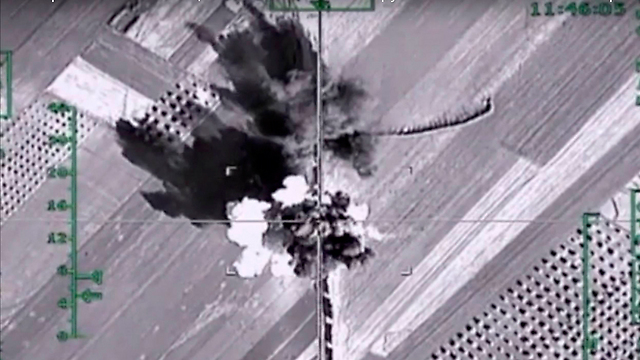
Russian forces, combined with the Iranians and Hezbollah, have changed their tactics in Syria. With a complete disregard to the international community, they are intensively bombing rebel bases, even at the risk of killing thousands of civilians, and starting a new wave of refugees. The two major focus points in the campaign are the cities of Aleppo and Deraa.

It is becoming apparent that a turning point in the favor of the Assad regime, Hezbollah, and the Iranians has occurred in the Syrian Civil War and they have only Vladimir Putin to thank. More specifically – for his vicious yet effective strategy and the generals he has loaned to the regime in order to direct the campaign against the Sunni rebels.

However, what is happening in practice is ethnic cleansing and a new wave of refugees leaving Syria.

Photo: AP
Photo: AP

Until the arrival of the Russians, the Syrian regime, with the assistance of Hezbollah and the Iranians, fought the rebels by attempting to destroy them piecemeal. These sporadic military operations happened here and there and were fought with little to no overarching goal, except to keep rebels away from places of economic or moral importance, and to stop the capture of military bases and government facilities.

There was also a special, almost sacred effort to stop the massacre of Alawites and Shiites, which the Islamists carried out with glee any time the chance arose. Only occasionally was there a clear military objective with a clear strategic purpose.

This lack of strategy very nearly led to the fall of the Assad regime in the spring of 2015. It was then that the Russians entered the fray - not due to any particular love for the Assad regime or the Iranians, but to protect and defend the strategic interests and assets they had in the country.

Yet, the Russians did not have much success at the beginning of their efforts in Syria. This is because the original method employed by the Russians was a copy of the unsuccessful strategy used by the US-led coalition in Libya, Syria, and Iraq, and against ISIS. The American strategy was based on precision airstrikes, while ground forces would be comprised of local forces- such as the Iraqi army and the Kurdish Peshmerga. 

The Russians and the Iranians began their joint operations in Syria in order to eliminate the threat posed by the rebels to the Shiite and the Alawite heartland, specifically the port cities of Latakia and Tartus, cities which also house the principal Russian military installations in Syria.

Photo: AP
Photo: AP

The ground forces operating beneath the Russian air umbrella were members of the Iranian Revolutionary Guards, Basij militias, and additional Shiite militias from Iraq and Afghanistan. However, this combined Russian-Iranian-Syrian-Hezbollah offensive stalled within three months. While the immediate threat to the city of Latakia was pushed back, further gains were not made.

The Russian generals quickly realized after these three months that their strategy was not working. They understood that the secret weapon of the rebel groups they were fighting lay in the fact that the rebels can melt into the civilian population at will, and that the local Sunni community supports and assists them. And it wasn't as if the Russians were avoiding hitting targets in the middle of crowded Sunni cities and towns. They didn't even take civilian casualties into consideration.

But it seems that the Russians indeed understood this secret weapon - the close ties between the rebel fighters and the communities within which they were fighting. The rebels could go on the offensive from hidden areas within the village, then return and blend in with the civilian population when the response came. This was a classic guerrilla war which the rebels were able to fight for an unlimited amount of time.

To top it all off, these fighters are people who were born and raised in these villages, and the civilian population provided them with everything they needed - moral support, food from UN aid convoys, medical attention, hiding places, and firing positions from within private houses and schools. 

On top of this, the assimilation of the rebels into the population of non-combatants triggered international condemnation of airstrikes on these rebel positions. The Russians had to start planning their strikes with additional auction. In short, all the tactics that the IDF has dealt with in its wars against Hezbollah in Lebanon and Hamas in Gaza were working marvelously for the rebels in Syria. Therefore, the Russian generals, who had learned from the Russian experiences in Chechnya, Afghanistan, and now Syria, decided to take off their gloves and brush off all criticism coming from the international community. 

They understood that to bring about a turning point, they would have to denigrate the fighting capabilities of the Syrian guerillas, and that they would have to separate the rebels from their two principal power bases: support by the civilian population and outside military assistance received via Turkey, Jordan, and Lebanon. 

The new strategy the Russians formulated was to destroy these power bases through ethnic cleansing, and force them to flee as refugees to Turkey, Jordan, and Lebanon, and from there on to Europe. As a complementary measure, they would subject those who stayed to blockades and sieges, starving those who refused to leave. 

And therefore, according to credible western sources, the "Russian System" has been activated in Syria. First; they determine senior commanders in the Russian-Iranian-Hezbollah coalition who are from communities which are under rebel occupation, and base them and consolidate these forces who are loyal and essential to the Assad regime. The Russians will then start an intensive bombing campaign of these cities, day and night, with no effort to differentiate between combatant and civilian. 

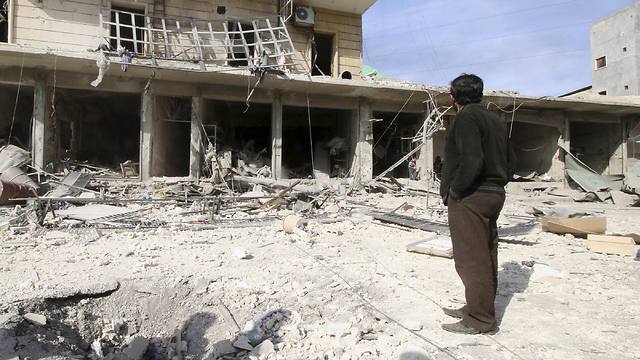
At the same time, the Syrian military, alongside Hezbollah and the Iranians, concentrate their forces on the ground. Infantry units then perform a survey of the area next to the bombed out town. Most of the civilians and rebels who had survived the bombings will have already run for their lives, or will have taken cover in the basements and cellars of the houses throughout the village. And even then, the Syrian military and its allies are in no rush to go into the town to capture it. They simply situate themselves at the entrances to the town, and set up a siege.

The rebels and civilians who survived the bombing can't escape or start over. They don't get any food, water, or anything else which would permit them to live. Between this, and the Russian bombs which continue to fall on them, they are faced with two equally bad options: to either die of hunger or the bombs, or surrender and be killed on the spot.

By contrast, the tactics during the beginning of the civil war were much different: the Syrian forces would enter the towns from which the rebels fled, imbued with a sense of victory, while the civilians (who were also supporters of the rebels) continued to live in the towns. The area would then stay under the control of Hezbollah or the regime until the rebels were able to regroup and be re-armed by the Americans or the Saudis, and then, with the help of the civilians, would come in and retake the city. And the cycle would continue.

Photo: Reuters
Photo: Reuters

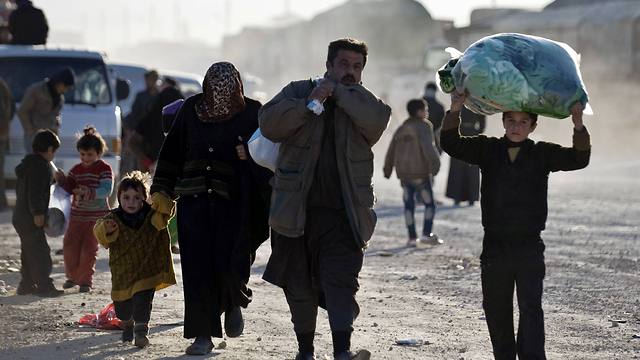
Just the knowledge of the brutal Russian and Iranian strategy - the indiscriminate carpet bombings, the merciless sieges, and the cutting off of supply routes - has sent a tsunami of people, rushing towards the border. Non-combatants and rebels both are fleeing for their lives to the border in their thousands before it is too late. They are worried that the Iranian, Syrian, and Hezbollah ground forces will cut off the escape routes to Turkish and Jordanian borders, and that they will find themselves hungry and under siege, dependent on the grace of a Syrian government which knows no mercy. 

A sensitive situation on the Golan Heights  

The Russian-Iranian-Hezbollah coalition is currently using this new strategy on two fronts: Aleppo and Deraa.

Deraa, the less important of the two fronts, is situated in southern Syria, close to the border with Jordan. The revolution was started here five years ago by Sunni tribesmen angry at the regime. This city is of moral and symbolic importance, and its capture would deal a harsh blow to the rebels' morale. It will also make it more difficult for the rebels to receive assistance from Jordan, as that border would be cut off. Finally, the fall of Deraa would deal a harsh blow to the Nusra Front, as it main headquarters are located there.

In addition, Deraa is only 25 miles from the border fence on the Golan Heights. Therefore, whatever happens in Deraa will have an indirect effect on Israel. If the Assad regime is able to capture the city, the next step may be to open up an offensive to recapture the Syrian Golan, with the help of Hezbollah and the Iranians, and plenty of Russian air support. This is not an ideal situation for Israel. It will require Russian jets to operate dangerously close to the Israeli border, and will test the coordination between the IDF and the Russian air force.

If the Russian-Syrian collation is able to conquer the Syrian Golan heights, it will be easier for the Iranians and Hezbollah to open up another front for terrorist acts against Israel. It is likely that the Russians would not stop Hezbollah and the Iranians, so long as their actions don't lead to another war.

However, the principal offensive of the Russian-Shiite coalition is taking place in Aleppo in northern Syria. It is the second largest city in the county, but is the most important city strategically, economically, and culturally. It is considered the most important city which is not under complete government control. The Free Syrian Army, Islamist groups such as the Nusra Front, Army of Islam, and Ahrar a-Sham, are all in control of different parts of the city. ISIS even maintains a small presence within Aleppo, but controls large swathes of territory to the east and north of the city. 
Photo: Getty Images
Photo: Getty Images

The capture of Aleppo may determine the fate of the fight for the rest of northern Syria, and represent another major turning point for the embattled Assad regime. A victory here has the ability to cut the off the Sunni rebels' access to the border with Turkey, and trap them between the Syrian regime in the south, the Kurdish forces in the north, and ISIS in the east.

There are people in Washington and London who believe that if only they could get stinger anti-aircraft missiles into the hands of the rebels, the will be able to defend themselves in the face of Russian airstrikes. Happy is the believer. The Russians are not impressed and are in no rush. Their Sukhoi-30 jets continue to pound cities and agricultural towns around Aleppo from the air, and even hit targets within the city itself. Meanwhile, Syrian, Iranian, and Hezbollah forces are happy on the ground, and are capturing town after town.

It seems that the Russian and Iranian generals intend to bomb Aleppo to smithereens, and then put up a siege around the city. The Iranian, Syrian, and Hezbollah militants are not in any hurry to enter the city for street to street fighting. Instead, they will wait until the starved city surrenders and falls into their hands like dried fruit. The coalition has already closed off one of the central highways connecting Aleppo with the Turkish border. All that remains is one narrow corridor which is soon to be closed off as well. Tens of thousands have already begun to gather at the border crossing next to the Turkish town of Kilis yet the Turkish government only permits an infinitesimal number of them - the heavily wounded and desperately ill- to cross into its territory.

Erdogan has issued strong condemnations against Russian brutality, but has also exploited the humanitarian crisis to try to convince the Americans and Russians to establish a “safe zone” for refugees in Syrian territory, along the southern Turkish border. The Turkish President has advocated for this option because he does not want more refugees to enter Turkey. Meanwhile Chancellor Angela Merkel is pressuring Erdogan to accept more refugees and allow them to stay in Turkish territory.

Erdogan wants to pressure the Americans to create a no-fly zone along the Turkish-Syrian border to protect the refugees and the Turkmen minority, rebelling against Assad. However, these efforts are in vain. Washington has decided that the war against ISIS is more important than removing Assad. Thus, it does not want to confront the Russians and its proxies and instead is cooperating with it.

President Obama wants to resolve the crisis through diplomatic means with the Russians as it did with the chemical weapons issue in 2013. Thus, Obama is turning his back on the cries of Syrian citizens and rebels fleeing for their lives, as well as their Saudi and Turkish backers..

Meanwhile, the largest ethnic cleansing in history since World War II continues: eight million Syrians- one third of the entire Syrian population- are already refugees either in Syria or in other countries. If that is not ethnic cleansing- then there simply is no longer any meaning to the phrase. The number of dead has long since passed 300,000 and it seems that the number of wounded is closing in on a million. Year after year the UN passes resolutions alleging that the Syrian government's actions border on crimes against humanity. Meanwhile, Obama, the UK, and the EU stand on the sidelines, silently hoping that the Russians will be able to avert a humanitarian crisis.

The Russian foreign minister stood up to the West and presented two a simple option to them: permit Aleppo and its residents to bleed and starve to death – or the West, the Gulf countries, and Turkey will force the rebel groups to accept the Russian peace plan. This plan, which was drawn up by the Kremlin, and in consultation with the Americans, will permit Assad to continue to rule for another year and a half until the next round of Syrian general elections, and then step down in peace.

The supposedly new regime that will be formed in Syria will be comprised of Assad loyalists and will maintain the interests of the Shiites, Russians, and Iranians.

The rebels have rejected Russian, British and Saudi peace plans. They demand that Assad be thrown out of power as soon as the peace process begins, not when it ends. However, United Nations Envoy to Syria Staffan de Mistura suggests first declaring a partial or full ceasefire, then providing humanitarian supplies for besieged and starving towns – and only then discussing specific details.
 

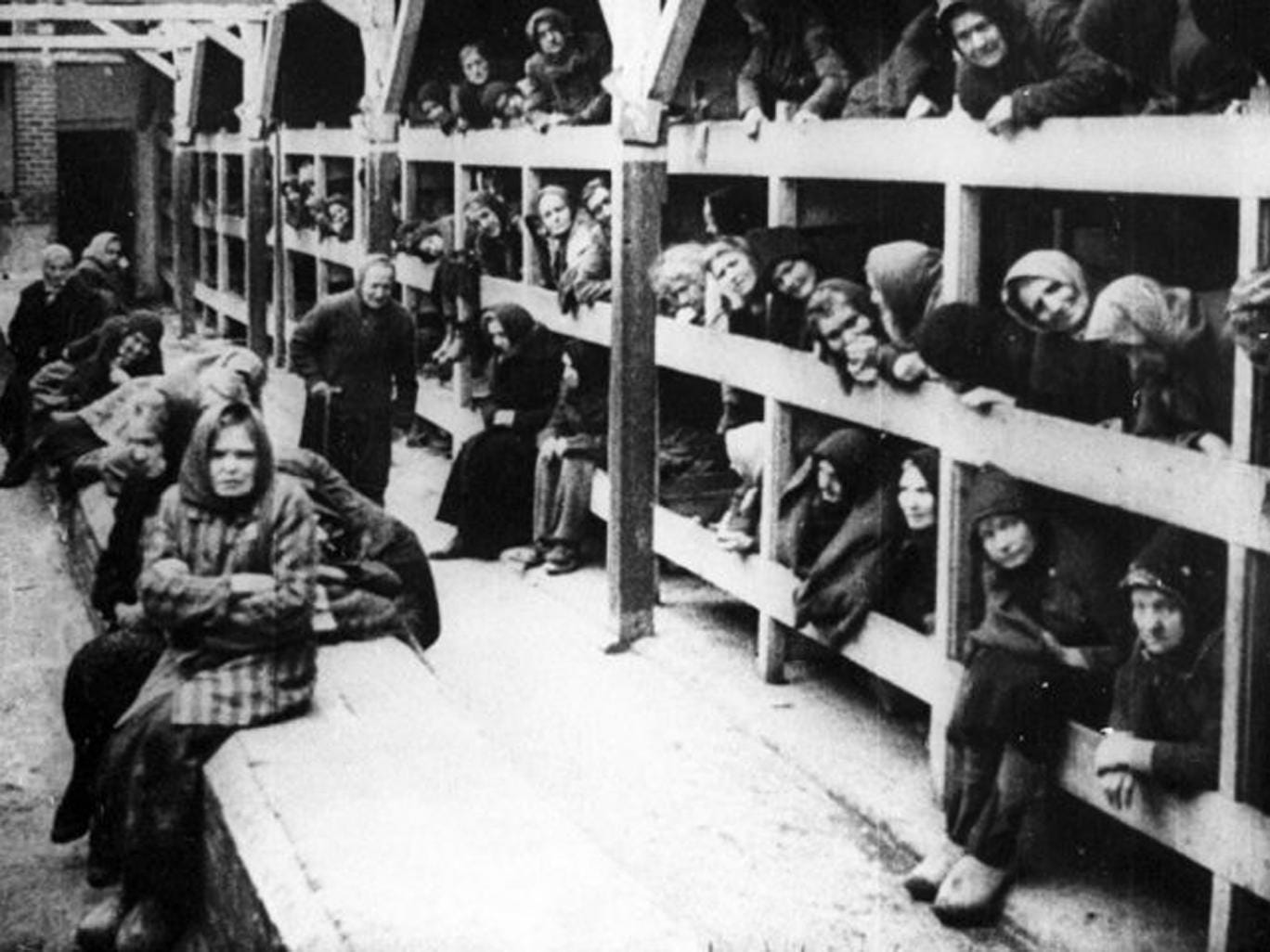
Nazi camp network was 'twice as big as previously thought'

From the Independent, 3 Mar 2013, by Cahal Milmo:

The network of camps and ghettos set up by the Nazis to conduct the Holocaust and persecute millions of victims across Europe may have been far larger and systematic than previously believed
Researchers have now catalogued more than 42,500 institutions used for persecution and death.

The network of camps and ghettos set up by the Nazis to conduct the Holocaust and persecute millions of victims across Europe was far larger and systematic than previously believed, according to new academic research.

Researchers conducting the bleak work of chronicling all the forced labour sites, ghettos and detention facilities run by Hitler’s regime alongside such centres of industrialised murder as Auschwitz have now catalogued more than 42,500 institutions used for persecution and death.

The figure has shocked academics and more than doubles an earlier finding by the same team that up to 20,000 sites were used. It casts a disturbing new light on the sheer scale of the machinery of imprisonment and oppression put in place by the Nazis throughout Europe, from Italy to Russia.

The team behind the research, based at the United States Holocaust Memorial Museum in Washington DC, told The Independent that they believe the evidence could also be crucial to survivors trying to bring cases for compensation against Germany and other countries for time spent in camps whose existence was hitherto obscure or undocumented.

The editors of the vast project, which is being compiled from hundreds of scholars into seven volumes due to be published by 2025, estimate that between 15 million and 20 million were killed or imprisoned in the facilities set up by the Nazis and puppet regimes in occupied countries from France to Romania.

The work, whose latest findings caused surprise among Holocaust academics when they were presented in Washington in January, draws together previously disparate records from dozens of archives, memorial sites and research bodies to create the first comprehensive catalogue of the facilities.

Geoffrey Megargee, the director of the project, called the Encyclopedia of Camps and Ghettos, said:
“The results of our research are shocking. We are putting together numbers that no one ever compiled before, even for camp systems that have been fairly well researched - and many of them have not been.”


He added: “There is a tendency for people to see the Holocaust as consisting of Auschwitz and perhaps a few other places. It’s important to understand that the system was much larger and more complex than that; that many more people knew about it and took part in it; that it was central to the entire Nazi system; and, moreover, that many other countries had their own camp systems.”

The sites include not only the concentration camps that lent the names of Dachau or Bergen-Belsen to infamy but many thousands of slave labour sites used to manufacture war supplies, prisoner of war camps and military brothels where women were dragooned into having sex with Nazi troops.

The work, compiled from data supplied by 400 academic contributors, further reveals the inter-locking nature of the Nazi system of imprisonment and persecution with victims of the Holocaust often passing through up to half a dozen work sites, factories or prison camps while others were sent straight from ghettos to the horrors of a Treblinka or Sobibor. PoWs found to be Jews were removed from military sites and passed into the extermination camps.

The attempt to build the first comprehensive chronicle of all Nazi-related camps also includes first-hand accounts from victims to help understand how each site worked and what its purpose was. The project has catalogued 30,000 slave labour camps alone.

Organisers hope it will not only prove a valuable resource to survivors and academic researchers but also serve as a tool in combating revisionists and Holocaust deniers.

Karen Pollock, chief executive of the Britain’s Holocaust Educational Trust, said: “This research demonstrates the Nazi’s determination to systematically wipe out the Jews of Europe. Years on, new information continues to come to light - making the enormous scale of the Holocaust even more difficult to comprehend.”

Last chance to set the record straight
Geoffrey Megargee

When the number of camps started to climb toward 10,000, we reviewed the project, to see if we wanted to limit it.

We asked ourselves if we wanted to cover only those camps that held Jews. Three points became apparent, however.

First, such a sorting process would be incredibly complex in itself. The Germans held Jews in many different kinds of camps. Many Soviet POWs, for example, were separated and murdered because they were Jewish.

Second, there was an ideological link that bound all the camps and ghettos together.

Finally, and most importantly, we realised no one is ever going to do this project again.

Geoffrey Megargee is a Senior Applied Research Scholar at the  United States Holocaust Memorial Museum

Thursday, February 11, 2016

Palestinian Arabs: Pioneers of Global Terrorism

From Times of Israel, 10 Feb 2016, by Ely Karmon:


...by attacking Israelis and Jews all over the world and sometimes American and Western interests, the Palestinians, not the jihadists, have been the pioneers of the global terrorism that now threatens the international community and many of the UN members.

The Palestinians succeeded in executing their nefarious plans with the active support of the Syrian, Iraqi and Libyan regimes and the fear of their victims in the West or elsewhere of reacting forcefully.
 
A short non-comprehensive list:
  • The first hijacking of a civilian airplane, El Al in 1968;
  • the hijacking and the bombing of 4 airplanes in 1970 in Jordan and Cairo (Pan Am, TWA, Swissair and BOAC) and the attempts of suicide air attacks by the PFLP, preparing the scenario of 9/11;
  • the first attack on the Munich Olympics in 1972 (think of the billions of dollars invested since that tragic event in the security of the Olympic Games everywhere on the globe!);
  • the first use of anti-aerial missiles against civil aviation (Rome 1971), barometer bombs in airplanes already in 1970 (Swiss Air flight 330 – all 47 passengers killed, and Austrian Airlines, without loss of life) and liquid bombs (Chianti nitroglycerine bombs);
  • the first attacks against synagogues, Jewish schools and Israeli embassies (from Brussels to Bangkok); and
  • attacks against Western and American interests (1977, the PFLP hijacked Lufthansa flight LH181, etc.).
Most of the perpetrators of these attacks, including youngsters 14-15 years old (like the Palestinians of today) sent from Lebanon or Jordan, were quickly released by most of the countries involved, even when their own citizens were the victims. No Arab sponsor that gave refuge to all these terrorists has ever been bothered.
 
The Palestinian organizations have set the example for terrorists from the Lebanese Hezbollah, German radical leftists or and Tamil Tigers. Before al-Qaeda set up its training camps in Afghanistan, Palestinians were training, in Lebanon, a long list of terrorist organizations, including the Japanese Red Army, the Armenian ASALA, the Argentinian Montoneros, and the Basque ETA.
 
Some Palestinian terrorist groups preferred to be mercenaries in the service of Iraqi, Syrian or Libyan intelligence agencies targeting Western interests or other Arab countries. These include Fatah Revolutionary Council/Abu Nidal (ANO), Arab Nationalist Youth for the Liberation of Palestine (ANYLP), The Arab Liberation Front (ALF), Al Saiqa.
 
Imad Mughniyeh, Hezbollah’s international operations head and Chief of Staff of its military forces, was America’s most wanted international terrorist, key planner of the bombing of a US marine barracks and French paratroopers in Beirut in 1983, which killed more than 330 people. Mughniyeh began his career in the Palestinian Fatah movement at an early age, remained its member until 1984 and finished it when his car was bombed in Damascus in 2008.
 
One of the pillars of Al-Qaeda, its ideologue and strategist of jihad was Palestinian Islamic scholar Abdullah Azzam. He created the Mujahideen Services Bureau in Afghanistan, the foundation of international recruits for Al-Qaeda, many of whom held high positions in Al-Qaeda’s command structure. His teachings about jihad had a huge impact on generations of fighters including on Osama bin Laden himself and his ideas inspire foreign fighters to this day.
 
Azzam argued for taking the jihad back to Palestine, and was instrumental in the formation of Hamas by supporting it politically, financially and logistically and providing military training in Pakistan. The first generation of the military wing of Hamas’ Izz al-Din Qassam Brigades was trained by him. Hamas leaders even sent him a draft copy of its charter in 1987 for “review”.
 
Hamas is the Islamist organization which derailed the peace process between Israel and the Palestinians by staging, together with the Palestinian Islamic Jihad (PIJ), the campaigns of suicide terrorism immediately after the signing of the Oslo agreement, all along the 1990s and then during the second bloody intifada, which alienated the Israeli public opinion from the peace process and strengthen those circles in Israeli society who supported the building of settlements.
 
The 2005 Israeli unilateral withdrawal from Gaza, leaving behind a rich educational and agricultural infrastructure, did not bring peace and development for the local population but rather immediate campaigns of rocket attacks against Israeli territory, the militarization of Gaza under the Hamas elected government and finally the military coup against the legitimate Palestinian Authority and its actual split into two enemy entities.
 
Ban Ki-moon ...asks Israeli authorities “to unequivocally support the Palestinian Authority and Palestinian institutions” and make “significant shifts in policies toward the West Bank and Gaza.”
 
True, he also tells the Palestinians that change will require of them “consistently and firmly denouncing terrorism and taking preventive action to end attacks on Israelis, including an immediate stop to Gaza tunnel construction.” But there is no real denunciation by him of the intense incitement by the PA authorities at the highest level and the Hamas government in support of the violence in the West Bank.
 
Interestingly, Hamas — its nefarious terrorism and violence and its dedication to Israel’s destruction — is not mentioned by name even once in the Secretary-General’s statements.
 
It is time the UN and the international community recognize the Palestinians’ key role in their present predicament...

Azerbaijan, Israel’s strategic partner in the Muslim world

From EU Reporter, 6 Feb 2016, by Giacomo Fracassi:

israel now

Israeli Prime Minister Benjamin Netanyahu, who attended last month’s annual World Economic Forum in Davos, held there a series of meetings with world leaders. Among them, one is particularly cherished by Israel, it is Azerbaijan’s President Ilham Aliyev, because of the strategic alliance that exists between Jerusalem and Baku.

‘Azerbaijani-Israeli relations develop and nothing can hinder this’, said recently a senior official from Israel’s foreign ministry about the cooperation between the two countries who share many similarities: old nations but young countries, democratic values, hostile and unstable environment, importance of human life and family, many ethnic groups living side by side, need to fight a distorted image and hostile propaganda campaign. Like Israel, Azerbaijan criticizes ‘those who don’t want to see the reality on the ground’.

“The Azerbaijani-Israeli strategic partnership relation encompasses many different areas, like energy, security, defense, agriculture, trade but it is also mostly characterized by the human factor, with a vibrant Jewish community in Azerbaijan,” Hikmat Hajiyev, spokesperson of the Ministry of Foreign Affairs of the Republic of Azerbaijan told EJP in Baku, the country’s capital, located on the western shore of the Caspian Sea, a city which mixes modernity and tradition.

The Jewish community of Azerbaijan, with around 30,000 people, is viewed today as an example in the world how in a secular country with a majority Muslim Shia population, which borders Iran in its southern part, all faith communities, including Judaism, live in perfect harmony and mutual respect.
There are 7 synagogues in the country, including two in Baku and three in Quba, an old city in the north east of the country, also dubbed the ‘Jerusalem of the Caucasus’, where an entire Jewish population, known as Mountains Jews, lives. The sole example in the world of a Jewish city outside Israel.

Moreover, a new Jewish Museum is being build with government financial support in Quba.
70,000 Azerbaijani Jews made aliyah – the Hebrew word for immigration- to Israel in the years just after the country gained independence in 1991 from the former Soviet Union when economic hardship preceded the oil booming.

Israel, which opened an embassy in Baku as early as in 1992, buys oil from Azerbaijan, through the Baku-Tbilisi-Cyehan pipeline, while Azerbaijan is interested in Israel’s technologies, science, medical know how and is importing defense-related equipment. Annual trade between the two countries amounts $5 billion and there is a twice weekly flight between Baku and Tel Aviv.
There is an Azerbaijani-Israeli parliamentary friendship group and the ADA University in Baku, which hosted former President Shimon Peres, is partnering with the University of Haifa for an exchange of students every semester.

On the political side, it is worthy to mention that both countries face the same kind of ‘double standard’ attitude from the international community, and particularly from the European Union.
Israel, the sole democracy in the Middle East, is targeted by the Western media and also the EU political echelon for its ‘settlement policy’.EU-Israel political relations are showing strains since the EU decided last November to label Israeli settlement products entering the European market. A measure denounced as ‘discriminatory’ by Jerusalem.

“With our friends in Israel we had a very open discussion. This is not an issue for us. Our view is not different from the mainstream view of Israel’s society and Israel’s government. We have no problem with importing such products in Azerbaijan,” replies Hikmat Hajyev, when asked about his country’s position on the labelling question, as he argues that people in the settlements are working to get salaries. “If you stop importing their products, they will lose their jobs” he says.

According to him, the two-state solution “is the only guarantee for sustainable peace in this part of the world and for the security and safety of the Israeli people.”

Azerbaijan, too, is regularly denouncing ‘double standards’ by the European Union and the media, when it comes to the image of the country and also regarding the conflict in Nagorno-Karabakh, an Azerbaijani territory occupied by Armenia since 1992 along with 7 other adjacent regions, taking up 20% of the Azerbaijani territory. Since then one million of refugees have been forced to flee their homes in the disputed areas.

The two countries signed a ceasefire agreement in 1994 and since the co-chairs of the OSCE Minsk Group – Russia, France and the US- are holding peace negotiations.

“We are witnessing regular unfair criticism and attacks in the European Parliament against Azerbaijan,” deplores Bahar Muradova, Vice President of the Milli Mejlis, the country’s 125-member parliament, and chairperson of the Human Rights committee.

Herself a refugee from one of the 7 occupied districts, she deplores the difference of attitude of the EU when it comes to this conflict and the one adopted by Brussels towards Russia following the annexation of Crimea.

“This is very disappointing because we attach a lot of importance to our relationship with the EU,” she said.

As a result of an ‘offensive’ resolution of the EU parliament last September on the so-called ‘violation of human rights’ in Azerbaijan, Baku suspended its participation in the Euronest parliamentary assembly, a forum in the framework of EU’s Eastern Partnership grouping members of national parliaments from Ukraine, Moldova, Belarus, Armenia, Azerbaijan and Georgia.
In her conversation with EJP, Muradova was proud to say that “Azerbaijan is the only country where there is no anti-Semitism”, contrary to what is happening in several countries of Europe.

Moreover, despite the conflict in Nagorno Karabakh, there are 30,000 Armenians living peacefully in Azerbaijan, she explained. “Isn’t this tolerance and respect of human rights ?,” the MP asked.
Turning to the succesful integration of one million refugees from Nagorno Karabakh region, she believes the EU, which is increasingly coping with the migrant crisis, has to learn from Azerbaijan’s experience.

Despite the ‘cooling’ in its relation with the EU, Azerbaijan attaches great importance and hope in the upcoming visit to Baku of EU foreign policy chief Federica Mogherini.
“We expect this visit will lift all misunderstandings and revitalize our relations,” says Dr Azay Guliev, a member of the Azerbaijani parliament who also chairs the Council of State Support to NGOs, as he explained that his country has proposed and initiated a strategic partnership with the EU based on close cooperation.
“We are not asking for money, we are not troublemakers, we are not sendig migrants to Europe. We only want equal partnership,” notes the foreign ministry’s spokesperson ahead of Mogherini’s visit in March.

But both him and Guliyev are stressing that the EU leadership must recognize the inviolability of Azerbaijan’s international borders and territorial integrity in conformity with international law when it comes to the Nagorno Karabakh conflict.

“If you support Ukraine or Georgia’s integrity, why not supporting Azerbaijan’s integrity ?”, Guliyev asks. “We hope that this conflict will end peacefully and that the occupied territory will be returned to Azerbaijan”, he says.

Mogherini will also be hearing from her Azerbaijani hosts how much the country cherishes its multiculturalism and tolerance – two notions regularly praised by the EU leaders in their speeches.
Soon after her visit, the country will host the Global Forum of United Nations Alliance of Civilizations, which was established to eliminate the tension between the West and the Islamic world. Holding this forum in Azerbaijan in 2016- which has been named Year of Multiculturalism in the country- is not only symbolic.

“Our multiculturalism should be developed as an example for the rest of the world at a time when anti-Semitism and Islamophobia are the main threats to our common home”, says Azay Guliyev.
“Wasn’t Azerbaijan the first country to give voting rights to women in 1918, even before the US did so ?” he asks to counter his country’s critics