Saturday, June 06, 2015

New Israel Fund continues its global vilification of Israel via "Breaking the Silence"

From NGO Monitor, June 04, 2015:
Members of the Israeli NGO Breaking the Silence (BtS) are in the midst of another international tour of Europe and the United States, this time promoting allegations of Israeli war crimes during the summer 2014 Gaza conflict.
In the United States, the BtS tour is being touted by one of its major donors, the New Israel Fund (NIF), which is also hosting a number of programs. From 2008 to 2013, NIF authorized grants worth $560,428 to BtS (2008, 2009,2010, 2011, 2012, 2013).
In an attempt to defend this fringe controversial and discredited group, NIF has been circulating a 2-page FAQ about BtS, which largely consists of apologetics and justifications.
However, the NIF is not providing a full picture. 
Here is what NIF is not telling you about Breaking the Silence. (Questions taken from NIF’s FAQs.)
About Our Speaker
Avner Gvaryahu was the Director of Public Outreach for Breaking the Silence (he is no longer listed as a staff member on the NGO’s website).  Last week (May 28), at a speech in New York, he called on the U.S. and Europe to “oppose” peace negotiations between Israel and the Palestinians.
About Breaking the Silence
What is Breaking the Silence?
Breaking the Silence (BtS) is a tiny Israeli non-governmental organization (NGO) claiming to collect testimonies of Israeli veterans who have served in the West Bank and Gaza, in order to “make heard the voices of these soldiers, pushing Israeli society to face the reality whose creation it has enabled.” In reality, however, the NGO’s lobbying and media advocacy focus on international audiences, including translations of its materials into English and other languages and extensive presentationsthroughout Europe and the United States.
Prominent Israeli journalist Amos Harel stated in Ha’aretzthat, “Breaking the Silence...has a clear political agenda, and can no longer be classed as a ‘human rights organization.’ Any organization whose website includes the claim by members to expose the ‘corruption which permeates the military system’ is not a neutral observer.”
Are they credible?
The testimonies provided in BtS publications are anonymous and therefore cannot be verified. They possibly reflect the personal experience of a small group of mostly low-level soldiers, whose ability to see the wider battlefield context in Gaza is very limited and who have minimal or no knowledge of the intentions or strategy of decision makers. Moreover, the former CEO has acknowledged that she edits all the testimonies, raising questions as to what extent information has been removed or shaped.
Despite this, and guided by BtS’ political agenda, BtS makes sweeping accusations and conclusions based entirely on these anecdotal and unverifiable stories. These “testimonies” lack context, ignoring the fact that during the 2014 Gaza War heavy fighting took place between Israel and terror groups in Gaza, and that soldiers faced grave danger throughout the conflict from rockets, mortar shells, booby traps, and terrorists emerging from tunnels dug beneath private homes. The extremely narrow and distorted picture is also manifest in the fact that there is no mention of the widespread use of human shields by Hamas and other terrorist groups, as well as the use of UN facilities, hospitals, etc. as military installations. These basic facts are essential to understanding the nature of the combat and the complexity of battlefield operations.
More seriously, having promised to reveal the secret of the civilian death toll in Gaza in the form of systematic Israeli misdeeds, and having selected, with that purpose in mind, the most incriminating segments from much longer interviews, the report fails to deliver. Perhaps that is why, instead of letting readers examine the interviews and decide for themselves, the activist-editors of Breaking the Silence felt compelled to add a heated introduction announcing that their report “exposes” the true face of the Gaza operation—namely, its “disturbing” and “unprecedented” violence directed at civilians by the Israeli military.
Contrary to NIF’s spin, the IDF does not forgo interviews with soldiers providing incriminating testimonies. Rather, the IDF cannot interview individuals who remain anonymous and who hide other essential details of the incidents, as is the practice with BtS. If BtS does have such details, they have yet to send these up the chain of command to allow for a proper response. The claim that the IDF has never attempted to investigate these events is also baseless.
Furthermore, the IDF Chief of Staff is not the correct person for a meeting with a marginal NGO. If BtS has evidence of wrongdoing by Israeli soldiers, the proper address is the Military Advocate General’s office, which is responsible for investigating and prosecuting these matters. BtS has not approached this office, reflecting its international political agenda and belying claims of wanting to improve Israel’s conduct.
Finally, claims by BtS and the NIF that approval by the Israeli censor supports their testimonies as “reliable” are laughable. Approval by the censor does not confirm the veracity of the testimonies, but simply that they do not disclose any matters that are classified.
The IDF is committed to properly investigating all credible claims raised via media, NGOs, and official complaints concerning IDF conduct during operation Protective Edge, in as serious a manner as possible.
Today, as in the past, the organization Breaking the Silence has been asked to provide any evidence or testimony related to IDF activities prior to publication, in order for genuine investigations to be carried out. Unfortunately, as in the past, Breaking the Silence has refused to provide the IDF with any proof of their claims.
For obvious reasons such conduct makes any investigation by the relevant IDF bodies impossible, and does not allow for the claims and incidents brought up to be dealt with in an immediate and appropriate manner.
This pattern of collecting evidence over an extended period of time and refusing to share it with the IDF in a manner that would allow a proper response and, if required, an investigation indicates that contrary to its claims, this organization does not act with the intention of correcting any wrongdoings it allegedly uncovered, therefore we are unable to respond to the allegations raised.
As in the past, the IDF calls on Breaking the Silence to turn to the relevant parties in the IDF immediately upon receiving complaints and evidence that raise suspicion of improper conduct or offenses, to allow investigation of events in due process.
It should be noted that following Operation Protective Edge, thorough investigations were carried out, and soldiers and commanders were given the opportunity to present any complaint. Exceptional incidents were then transferred to the Military Advocate General for further inquiry.
Why are they speaking outside of Israel?
Despite claiming to speak to Israeli society, between the years 2012 to 2015, BtS has been part of at least 50 events in Europe, the U.S., Canada, Australia, and South Africa.  It appears that the NGO’s main motivation for speaking to foreign audiences is to bring international pressure to bear against Israel, and to circumvent the Israeli democratic process. Yehuda Shaul, BtS co-founder,defended this practice, stating that, “Sometimes, when you want to deliver messages to the inside, you must go outside.”
Another, related factor is the desire to propagate BtS’ political agenda. As stated by Executive Director Yuli Novak, “the debate is already happening outside Israel, but the only Israeli position that is presented there is the position of people who want to guarantee the continuation of the occupation, that want to guarantee the expansion of settlements...” (This characterization is a disingenuous portrayal of the international discourse regarding Israel.)
As opposed to Breaking the Silence, other Israeli soldiers with stories to tell do not have opportunities and massive resources provided by foreign governments to present their narratives in Europe and the United States.
What are the issues they will raise?
Despite claims that the NGO “aims to warn about the unsustainability of current policies towards the occupied territories,” in reality, BtS publicizes its own baseless and predetermined analysis of Israeli policy in the West Bank and Gaza, falsely claiming that it is “an offensive policy that includes annexation of territory, terrorizing and tightening the control over the civilian population.” Any discussion about rules of engagement and incidents in the 2014 Gaza war is a pretext to express BtS’ opposition to the occupation.
Moreover, the incidents BtS describes in both Gaza and the West Bank do not relate to decision-making in the army’s higher echelons, but rather refer entirely to allegations of low-level infractions. Hence, any claims that these reflect are a systemic policy are groundless.
Why are they controversial?
BtS uses unverifiable, anonymous soldier testimonies in order to promote political objectives. The NGO removes the context of these testimonies, portraying IDF actions as immoral and evil, while discounting the actions of Hamas and other terrorist organizations.
Furthermore, BtS is almost entirely funded by European governments (either directly or indirectly via third parties, including many European churches).  NGO Monitor research has recently revealed that a number of funders made their grants conditional on the NGO obtaining a minimum number of negative “testimonies.” A British journalist notedthat, “It appeared …that these former soldiers, some of whom draw salaries from Breaking the Silence, were motivated by financial and political concerns to further a pro-Palestinian agenda. They weren’t merely telling the truth about their experiences. They were under pressure to perform.” This contradicts BtS’ declarations and thus turns it into an organization that represents its foreign donors’ interests, severely damaging the NGO’s credibility, reliability, and ability to analyze complicated combat situations.
Who is the intended audience?
Contrary to NIF’s claim that BtS “aim[s] to speak to American Jews” or to BtS’ claim to address “Israeli society,” the events they participate in are mainly organized and used by anti-Israeli activists on U.S. campuses, European churches, and other venues as ammunition for BDS (boycott, divestment and sanction) campaigns, lawfare, and other activity aimed at delegitimizing and isolating Israel.
In recent years BtS published a book titled “Our Harsh Logic” in English, German, and Swedish. Book launch events in the various languages have served as a platform for further demonization and delegitmization of Israel, including accusations of “racism” and alleged “political assassinations” of Palestinians, claims that Gaza is still “occupied,” and implying that Israel is ethnically cleansing “area C.”
Why do some soldiers give testimony anonymously?
The use of anonymous testimonies by the organization supports their modus operandi of removing the context of terrorism and portraying Israeli policy as one aimed at “terrorizing” the Palestinians, rather than one of self-defense. By removing the ability to verify the testimonies, BtS denies independent observers the ability to confirm the NGO’s analysis of events.
Additionally, contrary to BtS’ claim that accusations of abuse are not discussed in Israeli society or that soldiers reporting this abuse face backlash, alleged instances of Israeli army misconduct are widely reported in the Israeli media and are debated in government and army frameworks, and also by the public.
Do they advocate war crimes prosecution of Israelis?
Contrary to the BtS claim that “they ask Israeli society to conduct a fair and independent investigation,” the organization implies that Israeli investigations into the events of the Gaza war are uniquely flawed, despite theindependent IDF fact-finding mechanism and criminalinvestigations conducted by the IDF Military Advocate General Corps. This allegation, echoed by Israeli, Palestinian, and international NGOs and in the media, is the basis for lawfare campaigns, falsely asserting that Israel is “unwilling and unable” to investigate its own wrongdoing and, therefore, external investigations and international prosecutions are needed.
Do they support boycott of Israel?
While BtS claims that they do not work with or support BDS groups, Yehuda Shaul, BtS’ foreign relations director and one of its founders, told South African parliamentarians that “he agreed with the intention of the BDS movement but he felt that its approach could compromise the goal.” (p.34)
Furthermore, many of the NGO’s funders, such as ICCO(Netherlands) and Broederlijk Delen (Belgium), support BDS directly and/or through the funding of BDS groups.
Why does NIF support Israeli human rights NGOs?
Contrary to claims of upholding human rights and demanding accountability, many NIF grantees exploit these essential values in order to achieve political gains and generate PR. The real question is why the NIF continues to fund NGOs whose activities and rhetoric explicitly violate NIF’s funding guidelines and contribute to the delegitimization of Israel.
By bringing groups such as BtS across the United States, NIF is not adding to the debate or making any difference in Israel. Rather, much like its grantees, it is contributing to a destructive atmosphere of anti-Israel sentiments. As a result of such funding and events, the NIF is thus becoming more toxic and irrelevant within Israel.
For Further Reading:
Breaking the Silence Funding Chart, NGO Monitor Resource, May 21, 2015
Publication of Israeli Soldiers´ Accounts Clouded by Political Agenda, Gerald Steinberg, Brisbane Times, May 9, 2015
´Breaking the Silence´ and Gaza, Gerald Steinberg, The Jewish Journal, September 11, 2014
Why are European powers (and Oxfam) funding a radical Israeli group?, Jake Wallis Simons, The Telegraph, December 17, 2013

Friday, June 05, 2015

Pentagon: Iran Continuing Work on Nuclear Systems; Covert support for terrorism ‘unabated’


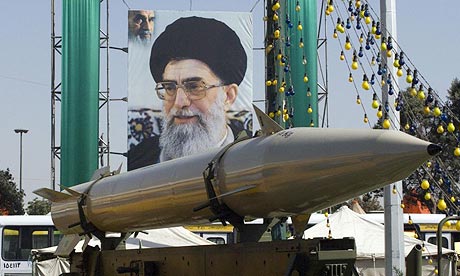
Iran is continuing to develop missiles capable of delivering nuclear weapons despite an interim agreement on its nuclear programs, according to a Pentagon report.
“Although Iran has paused progress in some areas of its nuclear program and fulfilled its obligations under the Joint Plan of Action (JPOA), it continues to develop technological capabilities that also could be applicable to nuclear weapons, including ballistic missile development...”...
...Iran’s military also continues to threaten the strategic Strait of Hormuz, the Pentagon report said.
“Iran continues to develop its capabilities to control the Strait of Hormuz and avenues of approach in the event of a military conflict...” ..Tehran is “quietly fielding increasingly lethal weapon systems, including more advanced naval mines, small but capable submarines, armed unmanned aerial vehicles, coastal defense cruise missile batteries, attack craft, and ant ship-capable missiles.”
U.S. officials said Iranian backing for Houthi rebels in Yemen is also aimed at gaining access to the strategic Red Sea strait called the Bab-el-Mandeb, which, like the Strait of Hormuz, could be used by Iran to disrupt oil and other shipping.

Tehran’s support for terrorism also has not stopped, according to the Pentagon.
“Iran’s covert activities appear to be continuing unabated...The Islamic Revolutionary Guard Corps-Qods Force (IRGC-QF) remains a key tool of lran’s foreign policy and power projection, particularly in Iraq, Syria, Lebanon, Bahrain, and Yemen.”...
U.S. officials disclosed to the Free Beacon last week that Iran is increasing the number of Quds Force fighters and Lebanese Hezbollah militants it is sending to Yemen, to support pro-Iran Houthi rebels there.

...Iranian forces have been working with Iraq’s government to battle Islamic State forces that have taken over large portions of that Middle East state. They have included IRGC fighters.

...Iran is seeking to become the dominant regional power and in pursuit of that aim has “unwaveringly sought to improve its deterrent capabilities and increase its regional influence.”...

...Ilan Berman, an Iran specialist with the American Foreign Policy Council, said...
“The study is long overdue, and its delay suggests that the administration has been leery of injecting inconvenient facts into the Iran debate as it closes in on a nuclear deal with the regime in Tehran...
“The findings of the report confirm that Iran’s destructive regional activities have not abated over the past year....
“If anything, they have increased despite Iran’s dialogue with the West...
“The product can be seen in the battlefield victories of Yemen’s Iran-supported Houthi rebels, of the persistence of the Assad regime in Syria, and of the growing profile and capabilities of Iraq’s Shi’a militias. Iran’s activities represent a significant challenge to peace and security in the Middle East...
“The real question is what, if anything, the White House is prepared to do about it?”...

Mark Dubowitz [executive director of the Foundation for Defense of Democracies], another Iran expert, said Tehran is continuing to develop long-range ballistic missiles capable of carrying nuclear warheads, in violation of U.N. Security Council limits.
“The Obama administration ceded to Iranian demands that their missile program was non-negotiable and, instead, has tried to reassure Congress that this missile threat can be mitigated by constraining Iran’s ability to develop a nuclear warhead...
“This major administration concession to Iran will greatly complicate the U.S. intelligence community’s ability to detect whether Iran has develop a nuclear warhead-carrying ICBM capable of reaching the continental United States ...By its very nature, it is much more difficult to detect and prevent warhead development, which can take place in small, covert facilities, than it is to determine the nature and extent of a hostile missile program. In yet another example of how deeply flawed the emerging Iran deal will be, Tehran will have a much easier pathway to develop systems.”

Israelis and Saudis Reveal Secret Talks to Thwart Iran

From Bloomberg 4 June 2015, by Eli Lake:

<p>Old enemies find a common foe.</p>
 Photographer: Kaveh Sardari/Council on Foreign Relations

OLD ENEMIES FIND A COMMON FOE. 
PHOTOGRAPHER: KAVEH SARDARI/COUNCIL ON FOREIGN RELATIONS

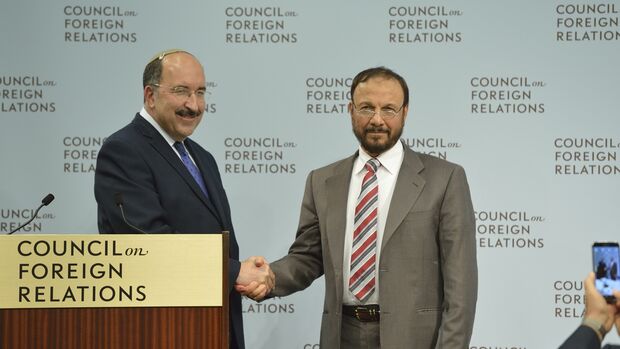
Since the beginning of 2014, representatives from Israel and Saudi Arabia have had five secret meetings to discuss a common foe, Iran. On Thursday, the two countries came out of the closet by revealing this covert diplomacy at the Council on Foreign Relations in Washington.

Among those who follow the Middle East closely, it's been an open secret that Israel and Saudi Arabia have a common interest in thwarting Iran. But until Thursday, actual diplomacy between the two was never officially acknowledged. Saudi Arabia still doesn't recognize Israel's right to exist. Israel has yet to accept a Saudi-initiated peace offer to create a Palestinian state.

... After an introduction, there was a speech in Arabic from Anwar Majed Eshki, a retired Saudi general and ex-adviser to Prince Bandar bin Sultan, the former Saudi ambassador to the U.S.

Then Dore Gold, a former Israeli ambassador to the United Nations who is slotted to be the next director general of Israel's foreign ministry, gave a speech in English.

While these men represent countries that have been historic enemies, their message was identical: 
Iran is trying to take over the Middle East and it must be stopped.
Eshki was particularly alarming. He laid out a brief history of Iran since the 1979 revolution, highlighting the regime's acts of terrorism, hostage-taking and aggression. He ended his remarks with a seven-point plan for the Middle East.

  • Atop the list was achieving peace between Israel and the Arabs. 
  • Second came regime-change in Iran. 

Also on the list were

  • greater Arab unity, the establishment of an Arab regional military force, and 
  • a call for an independent Kurdistan to be made up of territory now belonging to Iraq, Turkey and Iran.

Gold's speech was slightly less grandiose. He, too, warned of Iran's regional ambitions. But he didn't call for toppling the Tehran government.
"Our standing today on this stage does not mean we have resolved all the differences that our countries have shared over the years...But our hope is we will be able to address them fully in the years ahead."
It's no coincidence that the meetings between Gold, Eshki and a few other former officials from both sides took place in the shadow of the nuclear talks among Iran, the U.S. and other major powers. Saudi Arabia and Israel are arguably the two countries most threatened by Iran's nuclear program, but neither has a seat at the negotiations scheduled to wrap up at the end of the month.

The five bilateral meetings over the last 17 months occurred in India, Italy and the Czech Republic. One participant, Shimon Shapira, a retired Israeli general and an expert on the Lebanese militant group Hezbollah, told me: "We discovered we have the same problems and same challenges and some of the same answers." Shapira described the problem as Iran's activities in the region, and said both sides had discussed political and economic ways to blunt them, but wouldn't get into any further specifics.

Eshki told me that no real cooperation would be possible until Israel's prime minister, Benjamin Netanyahu, accepted what's known as the Arab Peace Initiative to end the Israeli-Palestinian conflict. The plan was first shared with New York Times columnist Tom Friedman in 2002 by Saudi Arabia's late King Abdullah, then the kingdom's crown prince.

Israel's quiet relationships with Gulf Arab states goes back to the 1990s and the Oslo Peace Process. Back then, some Arab countries such as Qatar allowed Israel to open trade missions. Others allowed an Israeli intelligence presence, including Abu Dhabi, the capital of the United Arab Emirates.

These ties became more focused on Iran over the last decade, as shown by documents released by WikiLeaks in 2010. A March 19, 2009, cable quoted Israel's then-deputy director general of the foreign minister, Yacov Hadas, saying one reason for the warming of relations was that the Arabs felt Israel could advance their interests vis-a-vis Iran in Washington. "Gulf Arabs believe in Israel's role because of their perception of Israel's close relationship with the U.S. but also due to their sense that they can count on Israel against Iran," the cable said.

But only now has open cooperation between Saudi Arabia and Israel become a possibility. For Gold, it represents something of a sea change. In 2003, he published a book, "Hatred's Kingdom," about Saudi Arabia's role in financing terrorism and Islamic extremism. He explained Thursday that he wrote that book "at the height of the second intifada when Saudi Arabia was financing and fundraising for the murder of Israelis." Today, Gold said, it is Iran that is primarily working with those Palestinian groups that continue to embrace terrorism.

Gold went on to say that Iran is now outfitting groups such as Hezbollah in Lebanon with precision-guided missiles, as opposed to the unguided rockets Iran has traditionally provided its allies in Lebanon. He also said Iranian Revolutionary Guard Corps forces propping up the Bashar al-Assad regime are now close to the Israeli-Syrian border.

A few years ago, it was mainly Israel that rang the alarm about Iranian expansionism in the Middle East. It is significant that now Israel is joined in this campaign by Saudi Arabia, a country that has wished for its destruction since 1948.

The two nations worry today that President Barack Obama's efforts to make peace with Iran will embolden that regime's aggression against them. It's unclear whether Obama will get his nuclear deal. But either way, it may end up that his greatest diplomatic accomplishment will be that his outreach to Iran helped create the conditions for a Saudi-Israeli alliance against it.

Thursday, June 04, 2015

It's the Palestinians who don't want any peaceful solution

From the Commentator, 3 June 2015:

Bibi_and_obama_latest

Obama's latest reckless and ignorant intervention against Israel shows how mindful we should be of the damage he could yet cause before we see the back of him in January 2017

Whether it's from ignorance or from ideology or from both is now beside the point. Barack Obama is fundamentally hostile to Israel. He doesn't understand the conflict between Israel and the Palestinians. And he plainly doesn't want to.

That's the only conclusion that can be drawn from his ludicrous and provocative intervention on Israel's Channel 2 on Tuesday.

The Guardian quoted him as saying the following in the context of remarks by Israeli Prime Minister Netanyahu before the Israeli elections that he did not envisage a Palestinian state during his next term, and then after the elections saying that he welcomed peace negotiations.
"... The danger here is that Israel as a whole loses credibility," President Obama said. "...Already, the international community does not believe that Israel is serious about a two-state solution.”
"And I think that it is difficult to simply accept at face value the statement made after an election that would appear to look as if this is simply an effort to return to the previous status quo in which we talk about peace in the abstract, but it’s always tomorrow, it’s always later.”
Obama also issued a thinly veiled threat to stop vetoing anti-Israeli resolutions at the United Nations if, "there's no prospect of an actual peace process."

...The fact is that Netanyahu's comments before the election were merely a statement of the obvious. There isn't going to be a Palestinian state in the near future. And there isn't going to be a Palestinian state in the near future because the Palestinians don't want a two-state solution, and never have.

If the two sides can talk about keeping the situation under a degree of control, and avoiding bloodshed, then all well and good. But until there is a fundamental shift in popular and elite attitudes among the Palestinians this will not result in the much vaunted two-state solution.

We've known this at least since 1947, when the Jewish/Israeli side accepted the two-state partition plan agreed upon by the United Nations, while the Arab/Palestinian side rejected it.

We've known this since the infamous "Three Nos", issued in the Khartoum Resolution of September 1, 1967: "no peace with Israel; no recognition of Israel; no negotiations with [Israel]".

The Oslo Accords of the 1990s held out the prospect of possible Palestinian compliance, but were then fatally undermined by the words and actions of Yasser Arafat.

Under Bill Clinton's auspices in 2000 and 2001, the Israeli side again offered a two-state solution only for it to be flatly rejected. In 2007, Ehud Olmert offered Palestinian leader Mahmoud Abbas more or less the same deal, only for it to be turned down.

The Palestinian side makes rejection of the very existence of Israel a fact of daily life in its (Arab-language) pronouncements, its glorification of terrorism, and its media and education policies.

Opinion polls, such as those conducted by the Israel Project, consistently show that the Palestinian people would only accept a two-state solution as a stepping stone towards a one-state solution involving the destruction of the State of Israel.

The fact that these realities are never reported in the mainstream Western media does not, of course, mean that they aren't available to anyone who wants to know about them, especially if your job title says you are president of the United States.

Obama is nothing more than a default Israel-hater, a characteristic he shares with most in the international community. He has been one all along, but he has so far been held in check by the wider American political establishment.

But if his reckless and ignorant intervention yesterday is anything to go by, we should all be mindful of the damage he could yet do until the world finally sees the back of him in January, 2017.

Wednesday, June 03, 2015

Family Reunion - after 2700 years

From Arutz Sheva, 2 June 2015, by Ari Soffer:


Pilgrims to Joseph's Tomb in the Biblical city of Shechem on Monday night were treated to moving scenes, as members of a lost Tribe of Israel reunited with their ancient forefather for the first time in well over two millennia.

The Bnei Menashe (literally “Children of Manasseh”), claim descent from the Israelite tribe of Menashe, one of the 10 Lost Tribes of Israel exiled by the Assyrian Empire some 2,700 years ago.

Today, some 3,000 Bnei Menashe live in Israel, mainly in Judea, Samaria and the Galilee. The remaining 7,000 Bnei Menashe reside in India – primarily in the northeastern states of Mizoram and Manipur, which border Burma.

The group which is aiding the aliyah of the Bnei Menashe - Shavei Israel, founded and headed by Rabbi Michael Freund - arranged for Monday's unique visit as both a part of the tribe's homecoming, as well as to pray for the remaining Bnei Menashe who are still awaiting permission to move to Israel.

Rabbi Freund described the experience as a "family reunion of sorts."
"For the first time in 2,700 years, a group of 100 recent Bnei Menashe immigrants from India visited Joseph's Tomb in Shechem (Nablus)..."...
What makes this so unique is that the Bnei Menashe are descendants of the Tribe of Manasseh, who was the Biblical Joseph's eldest son. Hence it was akin to a family reunion of sorts.
In addition, according to tradition, Joseph's sons Manasseh and Ephraim are buried alongside him, adding to the sense that it was the closing of an historical circle."
"For me, it was a very moving sight to see the Bnei Menashe, descendants of Manasseh and Joseph, standing at the tomb of their ancestors after being cut off from our people for so many centuries. If that’s not a miracle, what is?"
While at the Tomb, ecstatic pilgrims sang their community's de-facto anthem: a song in their native Kuki language describing their yearning to return to Zion.

According to the Bnei Menashe’s oral tradition, their ancestors arrived in northeastern India after centuries of wandering from slavery in Assyria, through Persia, Afghanistan, Hindu-Kush, Tibet and as far as the Chinese city of Kaifeng, where they were once again forced to escape slavery.

Finally, after a near-eternity of slavery, persecution and forced assimilation, at least some of them traveled on to Burma (Myanmar) and India, where they finally settled, cut off from their fellow Israelites and just barely clinging to their ancestor’s heritage  via a number of ancient traditions, including the legend of their ancestor “Manmaseh” and a number of recognizable Jewish practices and songs.

250 more Bnei Menashe are slated to arrive in Israel later this month, as part of Israel's commitment to bring the entire community home to Israel.

Shavei Israel hopes to complete the aliyah of the Bnei Menashe by 2020.

Abbas admits that Arabs from Palestine already have a state

From Arutz Sheva, 2 June 2015, by Ari Soffer:

Mahmoud Abbas
Mahmoud Abbas
Reuters

Palestinian Authority Chairman Mahmoud Abbas has described Jordanian and Palestinian Arabs as "one people living in two states," during a meeting with the head of the Jordan Football Association on Tuesday.

...The Jordanians are reportedly angry that the PA did not vote for their preferred candidate for FIFA President, and there are calls in Jordan to strip PFA head and senior PA leader Jibril Rajoub of his Jordanian citizenship. 

Bethlehem-based Maan News cited the Jordanian al-Ghad newspaper as saying that Abbas arrived in Jordan from Doha along with several other senior PA officials, including its intelligence chief Majid Faraj.

The Arabic-language Al-Quds news outlet directly quoted Abbas, who it said
"stressed that the relationship between Jordan and Palestine is the relationship of 'one people living in two states,' adding that this relationship will not be affected by anything."
...The Hashemite royal family of King Abdullah II is a tiny minority in the country - whereas the majority of residents in fact identify as Palestinian (various studies put the number as anything from 60% to 80%).

The Kingdom of Jordan (originally known as "Transjordan") was established in 1946 - two years before the establishment of the State of Israel - on three quarters of the territory previously allocated for a Jewish state.

It was the result of a partition of the British Mandate of Palestine as a compromise between Jews and Arabs - a compromise which began at the 1922 San Remo Conference, when the Arab population received the lion's share (77%) of the country, to the east of the River Jordan, and the Jews received the remaining portion to its west.

That partition was made legally binding by the UN's predecessor - the League of Nations - which in its Mandate for Palestine granted the Jews a state from the Mediterranean to the Jordan River, and reserved the eastern side of the River for one of 22 independent Arab states.

Under Article 80 of the UN Charter that treaty is still binding.

But instead of handing over control to the local Arab population, the British government - which previously occupied both sides of the Jordan River - installed the Hashemite tribe of Jordan's King Abdullah I (grandfather of King Abdullah II), which was sympathetic to British imperial interests. That ushered in an era of autocratic, minority rule which lasted until today, and left the local Jews and Arabs to continue to fight over the remaining 23%.

Despite being the majority, Palestinians in Jordan are subject to widespread discrimination and repression by the government. Recently, sensing the growing threat from disgruntled Palestinians, the Jordanian government began stripping large numbers of their Jordanian citizenship, dealing another blow to their collective civil rights, and illustrating how it relies on their disenfranchisement to survive.

While that history has been largely forgotten or ignored by advocates of a "two state solution," Israeli nationalists have long pointed to it as proof of the illegitimacy of establishing a 23rd "Palestinian" Arab state in Judea and Samaria.

Many Palestinians - including not just Rajoub but Abbas himself and Hamas leader Khaled Meshaal - have Jordanian citizenship.

Tuesday, June 02, 2015

Egyptian Historian: Drop the Palestinians, Normalize With Israel

From Arutz Sheva, 1 June 2015, by Ari Soffer:

A prominent Egyptian historian took to national television last week to make an unusually open and robust case for Egypt to "drop the Palestinian cause and normalize relations with Israel."

In a lengthy interview with Egypt's Mehwar TV on May 28 - segments of which were translated by MEMRI [see below for a link to the video] - historian Maged Farag insisted it was time for Egyptians to leave "the old ideology and cultural heritage on which we were raised" - namely, rabid anti-Zionism and anti-Semitism - in favor of a more rational focus on Egypt's own national interests.

"What I'm saying is that we should pay attention to the interests of our country," he told his interviewer.

"There are no such things as eternal enmity or eternal love.There are only eternal interests. We should identify our country's interest. Churchill once said that he was ready to cooperate with the Devil in the interest of his country. As a man who knows a little bit about history and about international relations, I believe that it is in our interest to maintain normal relations with Israel."

Noting that in practice there already is close cooperation on security, political and other issues between the two countries' respective governments, Farag asserted:
"The state is not the problem. The problem lies with the people, who still live the old ideology and the cultural heritage on which we were raised. Our generation was raised upon hatred and upon these people being barbaric..."
Indeed, despite Israel and Egypt successfully maintaining an official peace treaty since 1979, popular sentiment inside Egypt is still largely - though not exclusively - anti-Israel.

Anti-Semitism is also rife in the country, which is the most populous Arab state in the world.

Egypt was home to around 80,000 Jews in 1948, but expelled most of them and seized their property as part of a wider campaign of ethnic-cleansing carried out by Arab states in "revenge" for the defeat of Arab armies by the nascent State of Israel in 1948.

Key to that outdated mentality was Egypt's continued support for the "Palestinian cause," Farag posited. Since Egypt had achieved a just peace with the State of Israel, there was no rational or logical reason for it to maintain any hostility towards the Jewish state, he said - particularly when the Palestinians themselves "have no interest" in actually ending the conflict, short of annihilating Israel altogether.

"For over 70 years, the Palestinian cause has brought upon Egypt and the Egyptians nothing but harm, destruction, and expense. We have been preoccupied all our lives with the Palestinian cause.
"The Palestinian cause is Palestinian... Egypt's problem has been resolved."

Referring to the Sinai Peninsula - which Israel captured during the 1967 Six Day War, and handed over to Egypt as part of their 1979 peace treaty - he added: "The occupied land has been liberated. End of story, as far as I'm concerned. Let us now live and care about the interests of my country."
"Am I supposed to shackle myself to the Palestinian cause? Let the (Palestinians) resolve it... We have tried to help them many times."
"They don't think it is in their interest," he said of the Palestinians themselves. "They don't want to resolve their own problem."
Farag also brushed off criticism of a recent visit he paid to Israel, during which he posted pictures of himself at famous Muslim, Christian and Jewish sites, as well as other Israeli attractions. He retorted that he was "not afraid" of openly visiting a neighboring country, and noted that many other Egyptians work and have relations with Israel and Israelis, but simply don't admit to it.

"I still don't understand what the big deal is. I met many Egyptians there, and many Egyptians have visited Israel. I don't understand why my visit there made people so angry," he said.

Farag also busted a common Egyptian myth that a large sign exists outside of Israel's Knesset declaring the country's attempt to expand "from the Nile to the Euphrates."

"This is not true. There is no such thing," he informed viewers. "We all know that this is not true, but people keep saying this to heat up the hostility."

His vision for Israeli-Egyptian relations is one of total cooperation - citing by way of example the relationship between Germany and France, who until the latter half of the twentieth century had been at war on and off for hundreds of years.

"Normal relations require, first of all, cultural exchange," he explained. "I must not fear the other. So long as I fear the other, nothing good can develop. We should not fear (Israel). We should visit there."

"There should be tourist exchange, and economic exchange.

"There are Israeli companies that specialize in modern drip irrigation. They have very advanced irrigation technology. We have a water problem. We have a shortage of water. Why can't we take advantage of their technology, of their thought, and of the results of their research?

"They used this technology to cultivate the desert, so why can't we use it here? Why can't I benefit from someone who used to be my enemy? I'm not looking to force him to become my friend. I want him as a partner in developing agriculture and industry in Egypt."

Challenged by his interviewer as to how Egyptian schools should teach about the numerous wars between Israel and Egypt, he stated simply: "We should teach that there were wars in '48, '56, '67, and '73, and that these wars came to an end, that we signed a peace treaty, and we should set our eyes on the future. That's it.
"Israel exists, whether we like it or not, and it will continue to exist, whether we like it or not. So let's just accept this."
View the video interview:
MEMRI: Egyptian Historian Maged Farag in Support of Normalized Relations with Israel: We Must Focus on Our Own Interests, Not on the Palestinian Cause

Saturday, May 30, 2015

The Demons of the Farhud Pogrom are With Us Still Today


Salim Fattal was just eleven when the two-day Baghdad pogrom known as the Farhud erupted on Shavuot (Pentecost) 74 years ago, yet its memory is engraved deep in his soul. Despite the passage of time, the shrieks and wails of the pogrom's 179 Jewish victims still echo in his ears.

On 1 June, the first day of Shavuot in 1941, Fattal, his widowed mother and four siblings witnessed unimaginable terror, as he describes in his vivid memoir In the Alleys of Baghdad:
Helpless Jews had been cornered in their homes and fallen easy prey to robbers, murderers and rapists, who abused their victims to their heart's content, with no let or hindrance. They slit throats, slashed off limbs, smashed skulls. They made no distinction between women, children and old people. In that gory scene, blind hatred of Jews and the joy of murder for its own sake reinforced each other.
Salim's uncle Meir was pulled off a bus by a raging mob baying for Jewish blood, and never seen again.

Salim and his family managed to get through the night unscathed by bribing a local policeman to stand guard over their house. Haggling over how much he would be paid for each bullet he fired at the rioters, the policeman finally settled with the family at a quarter of a dinar for each shot.

The Farhud (meaning "violent dispossession") marked an irrevocable break between Jews and Arabs in Iraq and paved the way for the dissolution of the 2,600-year-old Jewish community barely 10 years later. Loyal and productive citizens comprising a fifth of Baghdad, the Jews had not known anything like the Farhud in living memory. Before the victims' blood was dry, army and police warned the Jews not to testify against the murderers and looters. Even the official report on the massacre was not published until 1958.

Despite their deep roots, the Jews understood that they would never, along with other minorities, be an integral part of an independent Iraq. Fear of a second Farhud was a major reason why 90 per cent of Iraq's Jewish community fled to Israel after 1948.
But the Farhud was not just another anti-Jewish pogrom.The Nazi supporters who planned it had a more sinister objective: the round-up, deportation and extermination in desert camps of the Baghdadi Jews.

The inspiration behind the short-lived pro-Nazi government led by Rashid Ali al-Gaylani in May 1941, and the Farhud itself, came not from Baghdad, but Jerusalem. The Grand Mufti, Haj Amin al-Husseini, sought refuge in Iraq in 1939 with 400 Palestinian émigrés. Together, they whipped up local anti-Jewish feeling. An illiterate populace imbibed bigotry through Nazi radio propaganda. 

Days before the Farhud broke out, the proto-Nazi youth movement, the Futuwwa, went around daubing Jewish homes with a red palm print. Yunis al-Sabawi, who, together with the Mufti and Rashid Ali, spent the rest of the war in Berlin broadcasting propaganda, instructed the Jews to stay in their homes so that they could more easily be rounded up.

The Farhud and the coup which preceded it, a failed attempt to spark a pro-Nazi insurgency, cemented a wartime Arab-Nazi alliance designed to rid Palestine, and the world, of the Jews. The Mufti had secret plans to build crematoria near Nablus.

The Mufti's postwar legacy endured. Six months after the end of WWll, and before Israel was established, vicious riots broke out in Egypt and Libya - the latter, incited by anti-Jewish hatred, claimed more than 130 lives.

Barely three years after the full horror of the Holocaust had come to light, Arab League member states embarked on a programme of ethnic cleansing Hitler would have been proud of. The uprooting of the 140,000 Jews of Iraq followed a Nazi pattern of victimisation - dismantlement, dispossession and expulsio.n Nuremberg-style laws criminalised Zionism, freezing Jewish bank accounts, instituting quotas and restrictions on jobs and movement. Every Arab state adopted all, or some, of these anti-Jewish measures. The result was the exodus of nearly a million Jews from the Arab world.

While the world has devoted all its attention to the Palestinian "Nakba," until recently, Israel has said and done little to publicise the monumental injustice done to the 870,000 Jews driven from Arab countries.

More Jews died than on Kristallnacht, yet the Farhud has not become part of Holocaust memory. Indeed, the Washington Holocaust Museum had to be vigorously lobbied to include the Farhud as a Holocaust event.

Since that fateful event, so effectively has history been distorted that even Jews believe that Arabs had no part to play in Nazism. A body of opinion mainly on the Left has turned the facts on their head and is convinced that the Palestinians paid the price of the Holocaust, and that Israelis are the new Nazis.

Yet Nazism was popular in the Arab world - and not just because the Germans were fighting the British and French colonial powers. Nazism gave ideological inspiration both to Arab secular nationalist parties and the Muslim Brotherhood (Gaza branch: Hamas). Antisemitism - a synthesis of Nazi tropes and traditional Koranic prejudice - is at the core of Islamist beliefs. Abu Bakr al-Baghdadi, the head of Islamic State (ISIL), was a member of the Muslim Brotherhood.

The Arab world's most famous pro-Nazi, the Mufti of Jerusalem, should have been tried as a war criminal at Nuremberg. The unremitting campaign to destroy Israel through war, terror or political delegitimisation, is a manifestation of the unfulfilled genocidal intentions of Arab nationalism and Islamism.

The demons awakened by the Farhud are still with us today.

Beware: My Liberal Jewish Friends

From Mosaic Magazine, 28 May 2015, by Michael Moran, senior fellow at the Hudson Institute, former deputy assistant secretary of defense and former senior director of the National Security Council: 

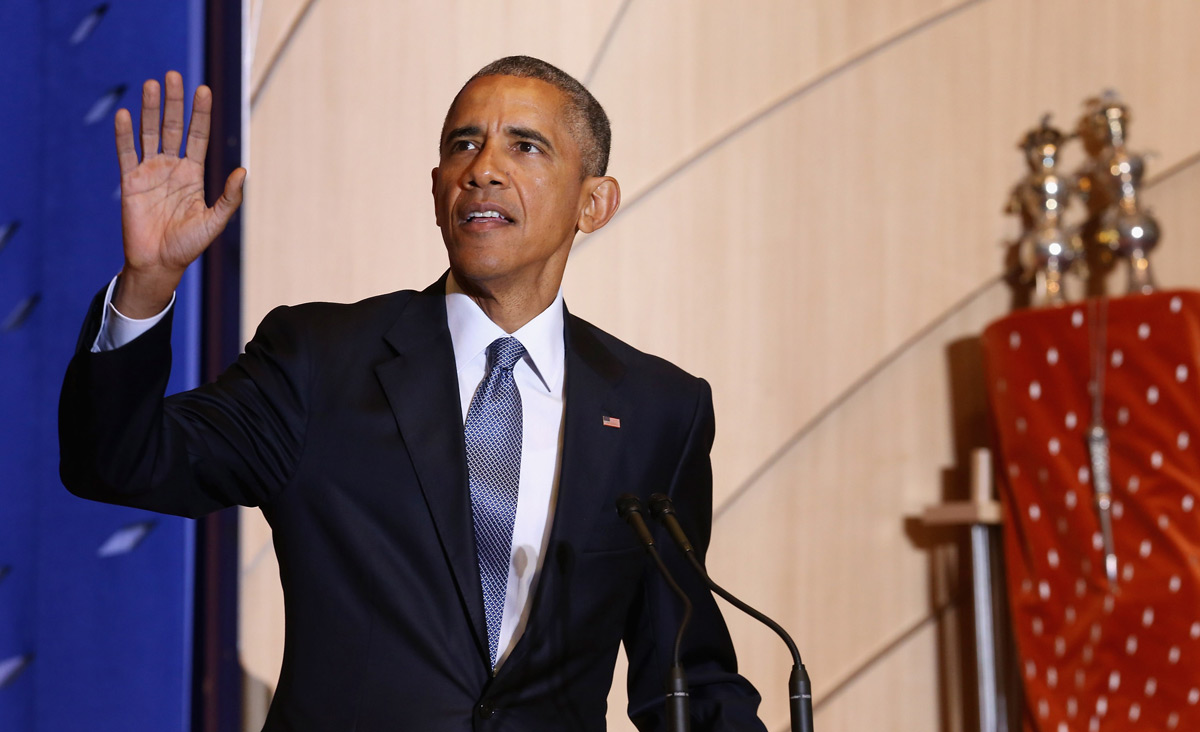
The president’s address last week to Congregation Adas Israel as “an honorary member of the tribe” was something other than it seemed.

A Letter to My Liberal Jewish Friends
President Obama speaks at Congregation Adas Israel in Washington, DC on May 22. Photo by Chip Somodevilla/Getty Images.

Dear Congregants of Adas Israel:
On Friday, May 22, President Obama, calling himself “an honorary member of the tribe,” addressed you not just as the president of the United States but also as an explicit adherent of the “tikkun olam” tradition: a Jewish viewpoint for “repairing the world” that, in his reading, promotes universal progressive ideals like fighting bigotry and working for social justice everywhere. Thus, for him, the same “shared values” that underlay the civil-rights movement in the United States were what led him to identify himself with the cause of Israel—and also with the cause of Palestinian nationalism.

Although, as you may have noticed, the president never mentioned Israeli Prime Minister Benjamin Netanyahu by name, the heart of his speech was devoted to justifying his own role in their by now famous conflict. At the heart of that conflict, he suggested, was Netanyahu’s presumed hostility to recognizing the rights of the Palestinians. Making references to Ramallah in one breath and Selma in the next, and sketching an ethical map that made the civil-rights movement and Palestinian nationalism interchangeable, the president implied that support for Netanyahu’s policies was tantamount to rejecting the legacy of Martin Luther King, Jr.

It was Chemi Shalev, the U.S. editor of Haaretz, who best captured the essence of Obama’s May 22 message to you: 
“I represent your core values far better than the elected leader of Israel.”
To judge by the enthusiastic applause, many of you accepted the president’s sincerity and strongly agreed with his message. May I ask you, however, to pause and consider an alternative view? I cannot claim, as Obama did, membership in the tribe, but I can say that I am well informed both about the Middle East and about United States policy toward that region. In addition, I am deeply concerned about the deterioration in Israeli-American relations.

Here’s my question. As Obama donned his yarmulke and embraced your community, did you also catch the hint of a warning? If you did, it was because the president was raising, very subtly, the specter of dual loyalty: the hoary allegation that Jews pursue their tribal interests to the detriment of the wider community or nation. Obama was certainly not engaging in anything so crude as that; nor is he an enemy of the Jewish people.

But he did imply that many Jews—that is, Jews who support Benjamin Netanyahu—have indeed placed their narrow, ethnic interests above their commitment to universal humanistic values. In his view, they have betrayed those values. And so the warning was faint, but unmistakable: if Jews wish to avoid being branded as bigots, then they—you—must line up with him against Netanyahu.

“But the president is right,” many of you would no doubt reply. “Netanyahu’s values are not my values.” That may well be the case. Yet this is also why it is a trap for you to accept Obama’s claim that his fight with Netanyahu is a struggle over “values.”

The struggle is not over values. Rather, at the core of the Netanyahu-Obama grudge match is one issue and one issue only: the president’s long-sought détente with the Islamic Republic of Iran.

To be sure, there are other sources of tension between the two men, both personal and political. Among them is the Israel-Palestinian issue, which the president dwelt upon at length in his remarks to you—but in the service of a goal that has nothing whatsoever to do with Israeli-Palestinian relations. If this sounds too calculating by half, consider three key points.

First, every informed observer knows there is no chance of moving Israel-Palestinian relations forward in the next two years—and also that, what with the Arab and Muslim Middle East exploding in violence, Benjamin Netanyahu is hardly the only skeptic in Israel when it comes to advancing a two-state solution any time soon. Had Isaac Herzog, the leader of Israel’s main opposition party, won the election in March, the prospects of reaching such a compromise solution would have remained the same as under Netanyahu: that is, next to nil.

Let’s not forget that, back in April 2014, it wasn’t the Israeli government that put the final nail in the coffin of the American initiative to solve the Israel-Palestinian conflict. Netanyahu, for his part, grudgingly accepted the Americans’ draft framework agreement; Mahmoud Abbas refused. I have yet to hear the president excoriate Abbas for his betrayal of the values of progressive humanism.

Next, Obama has fallen out with or pulled away from almost every traditional American ally in the Middle East—a development that, even if it did not create the chaos now engulfing the region, has certainly played a major role in abetting it. The president’s relations with the leaders of Saudi Arabia, Egypt, and Turkey are nearly as strained as his relations with Netanyahu. 

While these leaders may shrink from disagreeing with him in public, they have unmistakably signaled their conviction that the president’s deal with Tehran will not achieve its stated goal of stopping Iran’s progress toward a nuclear weapon and that, in his obsessive pursuit of this deal, American policy is actively helping to turn the aggressively hostile regime of the mullahs into the dominant power in the Middle East.

Which brings me to the third point. In the course of extolling the virtues of his emerging nuclear deal, the president paused to express his unyielding commitment to shielding Israel from the threat of Iranian expansionism. Or did he? Take a look at his exact words:
[E]ven if we do get a good deal, there remains the broader issue of Iran’s support for terrorism and regional destabilization, and [its] ugly threats against Israel. And that’s why our strategic partnership with Israel will remain, no matter what happens in the days and years ahead. And that’s why the people of Israel must always know America has its back, and America will always have its back.
This gauzy rhetoric may sound reassuring but it is deliberately devoid of content—for good reason. The plain fact is that the United States is doing nothing to arrest the projection and expansion of Iranian power in the region; quite the contrary. 

In Lebanon, for example, Washington has cut funding for Shiite figures who remain independent of Iran’s proxy Hizballah. In Iraq, the United States, through the Iraqi armed forces, is actually coordinating with Iranian-backed militias and serving as their air force. Indeed, wherever one looks in the Middle East, one can observe an American bias in favor of, to say the least, non-confrontation with Iran and its allies.

The pattern is most glaring in Syria, where the president has repeatedly avoided conflict with Bashar al-Assad, Iran’s closest ally. The tendency surfaced again a few weeks ago in connection with mounting evidence that Assad has routinely attacked his own people with gas. If true, this fact should trigger a sharp American response in keeping with the president’s famous “red line” on the use of chemical weapons. But when questioned on this matter at a press conference, he contrived to find a loophole. Assad’s forces, he said, have been deploying chlorine gas, which “historically” has not been considered a chemical weapon.

The president’s sophistry demonstrates a simple but profound truth: his commitment to the progressive values of tikkun olam is governed by its own “red lines,” and is entirely utilitarian. Which again raises the question: what was his purpose in stressing this shared progressive commitment in his address to you, and what was his purpose in subtly reminding you of the costs of failing to abide by its terms?

The answer, I hope, is obvious. On June 30, Obama will likely conclude a nuclear deal with Iran. This will spark a faceoff with Congress, which has already declared its opposition to the deal. Congress will inevitably pass a vote of disapproval, which Obama will inevitably veto. In order to defend that veto from a congressional override, however, he must line up 34 Senators—all Democrats. This calls in turn for a preemptive ideological campaign to foster liberal solidarity—for which your support is key. If the president can convince the liberal Jewish community, on the basis of “shared values,” to shun any suspicion of alignment with congressional Republicans or Benjamin Netanyahu, he will have an easier time batting down Congress’s opposition to the deal with Iran.

Progressive values have nothing to do with what is truly at stake in this moment of decision. Only one final question really matters: in your considered view, should the Islamic Republic of Iran be the dominant power in the Middle East, and should we be helping it to become that power? If your answer is yes, then, by all means, continue to applaud the president—loudly and enthusiastically—as he purports to repair the world.

Your friend,
Michael Doran

Friday, May 29, 2015

The Myth of Expulsion - part 2

From the Appendix to “BIG LIES: Demolishing The Myths of the Propaganda War Against Israel” (2005) by DAVID MEIR-LEVI

“The first group of our fifth column consist of those who abandon their homes…At the first sign of trouble they take to their heels to escape sharing the burden of struggle”
-- Ash-Sha’ab, Jaffa, January 30, 1948

“(The fleeing villagers)…are bringing down disgrace on us all… by abandoning their villages”
 -- As-Sarih, Jaffa, March 30, 1948

“Every effort is being made by the Jews to persuade the Arab populace to stay and carry on with their normal lives, to get their shops and businesses open and to be assured that their lives and interests will be safe.”
 -- Haifa District HQ of the British Police, April 26, 1948, (quoted in Battleground by Samuel Katz).

“The mass evacuation, prompted partly by fear, partly by order of Arab leaders, left the Arab quarter of Haifa a ghost city.... By withdrawing Arab workers their leaders hoped to paralyze Haifa.”
 -- Time Magazine, May 3, 1948, page 25

“The Arab streets (of Palestine) are curiously deserted (because)…following the poor example of the moneyed class, there has been an exodus from Jerusalem, but not to the same extent as from Jaffa and Haifa”.
-- London Times, May 5, 1948

“The Arab civilians panicked and fled ignominiously. Villages were frequently abandoned before they were threatened by the progress of war.”
 -- General John Glubb “Pasha,” The London Daily Mail, August 12, 1948

“The fact that there are these refugees is the direct consequence of the act of the Arab states in opposing partition and the Jewish state. The Arab states agreed upon this policy unanimously and they must share in the solution of the problem.”
-- Emile Ghoury, secretary of the Palestinian Arab Higher Committee, in an interview with the Beirut Telegraph September 6, 1948. (same appeared in The London Telegraph, August 1948)

“The most potent factor [in the flight of Palestinians] was the announcements made over the air by the Arab-Palestinian Higher Executive, urging all Haifa Arabs to quit... It was clearly intimated that Arabs who remained in Haifa and accepted Jewish protection would be regarded as renegades.”
 -- London Economist October 2, 1948

“It must not be forgotten that the Arab Higher Committee encouraged the refugees’ flight from their homes in Jaffa, Haifa, and Jerusalem”.
 -- Near East Arabic Broadcasting Station, Cyprus, April 3, 1949.

“The Arabs of Haifa fled in spite of the fact that the Jewish authorities guaranteed their safety and rights as citizens of Israel.”
-- Monsignor George Hakim, Greek Catholic Bishop of Galilee, New York Herald Tribune, June 30, 1949

“The military and civil (Israeli) authorities expressed their profound regret at this grave decision (taken by the Arab military delegates of Haifa and the Acting Chair of the Palestine Arab Higher Committee to evacuate Haifa despite the Israeli offer of a truce). The Jewish mayor of Haifa made a passionate appeal to the delegation (of Arab military leaders) to reconsider its decision.”
 -- Memorandum of the Arab National Committee of Haifa, 1950, to the governments of the Arab League, quoted in J. B. Schechtman, The Refugees in the World, NY 1963, pp. 192f.

Sir John Troutbeck, British Middle East Office in Cairo, noted in cables to superiors (1948-49) that the refugees (in Gaza) have no bitterness against Jews, but harbor intense hatred toward Egyptians: “They say ‘we know who our enemies are (referring to the Egyptians)’, declaring that their Arab brethren persuaded them unnecessarily to leave their homes…I even heard it said that many of the refugees would give a welcome to the Israelis if they were to come in and take the district over.”

“The Arab states which had encouraged the Palestine Arabs to leave their homes temporarily in order to be out of the way of the Arab invasion armies, have failed to keep their promise to help these refugees.”
– The Jordanian daily newspaper Falastin, February 19, 1949.

“The Secretary General of the Arab League, Azzam Pasha, assured the Arab peoples that the occupation of Palestine and of Tel Aviv would be as simple as a military promenade...Brotherly advice was given to the Arabs of Palestine to leave their land, homes, and property to stay temporarily In neighboring fraternal states, lest the guns of invading Arab armies mow them down.”
 --Al Hoda, a NewYork-based Lebanese daily, June 8, 1951.

“Who brought the Palestinians to Lebanon as refugees, suffering now from the malign attitude of newspapers and communal leaders, who have neither honor nor conscience? Who brought them over in dire straits and penniless, after they lost their honor? TheArab states, and Lebanon amongst them, did it.” -- The Beirut Muslim weekly Kul-Shay, August 19, 1951.

16. “We will smash the country with our guns and obliterate everyplace the Jews seek shelter in. The Arabs should conduct their wives and children to safe areas until the fighting has died down.”
 -- Iraqi Prime Minister Nuri Said, quoted in Sir An-Nakbah (“The Secret Behind the Disaster”) by Nimr el-Hawari, Nazareth, 1952

“The Arab Exodus …was not caused by the actual battle, but by the exaggerated description spread by the Arab leaders to incite them to fight the Jews. …For the flight and fall of the other villages it is our leaders who are responsible because of their dissemination of rumors exaggerating Jewish crimes and describing them as atrocities in order to inflame the Arabs ... By spreading rumors of Jewish atrocities, killings of women and children etc., they instilled fear and terror in the hearts of the Arabs in Palestine, until they fled leaving their homes and properties to the enemy.”
-- The Jordanian daily newspaper Al Urdun, April 9, 1953.


“The Arab governments told us: Get out so that we can get in. So we got out, but they did not get in.” --A refugee quoted in Al Difaa (Jordan) September 6, 1954.

“The wholesale exodus was due partly to the belief of the Arabs, encouraged by the boasting of an unrealistic press and the irresponsible utterances of some of the Arab leaders that it could be only a matter of some weeks before the Jews were defeated by the armies of the Arab states, and the Palestinian Arabs enabled to re-enter and re-take possession of their country”.
 -- Edward Atiyah (Secretary of the Arab League, London, The Arabs, 1955, p. 183)

“As early as the first months of 1948, the Arab League issued orders exhorting the people to seek a temporary refuge in neighboring countries, later to return to their abodes ... and obtain their share of abandoned Jewish property.”
 -- Bulletin of The Research Group for European Migration Problems, 1957.

“Israelis argue that the Arab states encouraged the Palestinians to flee. And, in fact, Arabs still living in Israel recall being urged to evacuate Haifa by Arab military commanders who wanted to bomb the city.”
 -- Newsweek, January 20, 1963.

“The 15th May, 1948, arrived ... On that day the mufti of Jerusalem appealed to the Arabs of Palestine to leave the country, because the Arab armies were about to enter and fight in their stead.”
 -- The Cairo daily Akhbar el Yom, October 12, 1963.

In listing the reasons for the Arab failure in 1948, Khaled al- Azm (Syrian Prime Minister) notes that “…the fifth factor was the call by the Arab governments to the inhabitants of Palestine to evacuate it (Palestine) and leave for the bordering Arab countries. Since 1948, it is we who have demanded the return of the refugees, while it is we who made them leave. We brought disaster upon a million Arab refugees by inviting them and bringing pressure on them to leave. We have accustomed them to begging...we have participated in lowering their morale and social level...Then we exploited them in executing crimes of murder, arson and throwing stones upon men, women and children...all this in the service of political purposes...”
 -- Khaled el- Azm, Syrian prime minister after the 1948 War, in his 1972 memoirs, published in 1973.

“The Arab states succeeded in scattering the Palestinian people and in destroying their unity. They did not recognize them as a unified people until the states of the world did so, and this is regrettable.”
 -- Abu Mazen (Mahmoud Abbas), from the official journal of the PLO, Falastin el-Thawra (“What We Have Learned and What We Should Do”), Beirut, March 1976.

“Since 1948, the Arab leaders have approached the Palestinian problem in an irresponsible manner. They have used to Palestinian people for political purposes; this is ridiculous, I might even say criminal...”
 -- King Hussein, Hashemite kingdom of Jordan, 1996.


“Abu Mazen Charges that the Arab States Are the Cause of the Palestinian Refugee Problem” (Wall Street Journal; June 5, 2003): Falastin al-Thawra, the official journal of the PLO in Beirut: “The Arab armies entered Palestine to protect the Palestinians from the Zionist tyranny, but instead they abandoned them, forced them to emigrate and to leave their homeland, imposed upon them a political and ideological blockade and threw them into prisons similar to the ghettos in which the Jews used to live in Eastern Europe.” As Abu Mazen alluded, it was in large part due to threats and fearmongering from Arab leaders that some 700,000 Arabs fled Israel in 1948 when the new state was invaded by Arab armies. Ever since, the growing refugee population, now around 4 million by UN estimates, has been corralled into squalid camps scattered across the Middle East - in Lebanon, Jordan, Syria, Gaza, and the West Bank. In 1950, the UN set up the United Nations Relief and Works Agency as a temporary relief effort for Palestinian refugees. Former UNRWA director Ralph Galloway stated eight years later that, “the Arab states do not want to solve the refugee problem. They want to keep it as an open sore, as a weapon against Israel. Arab leaders do not give a damn whether Arab refugees live or die. The only thing that has changed since [1949] is the number of Palestinians cooped up in these prison camps.”

Hamas quashes reasons for hope


Hamas regularly inflicts war on Israel, suffering on Gazans

Dennis Ross may know more about the challenges posed by conflicts in the Middle East than anyone in America. A top foreign policy adviser to four U.S. presidents, Ross was President Clinton’s Middle East envoy and President Obama’s special adviser on Iran.

In Cambridge last week to speak to a conference of corporate executives hosted by MIT, the veteran diplomat was asked to estimate the chance that Hamas would not launch another war against Israel in the near future of the sort it initiated in 2008, in 2012 and then again last summer. “Virtually no chance,” Ross replied flatly.

This week’s flurry of rockets fired from Gaza at Israeli civilians, the closing of schools in one Israeli community and the Israeli air strikes in response punctuated Ross’s assessment. And two reports issued on Tuesday illuminated Ross’ larger point: that those who claim to care most about the suffering of Gazans have effectively abandoned them, consigning them to a miserable fate and guaranteeing that a region already boiling over with armed conflict will likely soon have another reprise of the conflict on the Gazan border.

The nub of Gaza’s problem is that it is ruled by Hamas, whose iron-fisted enforcement of Islamic extremism at its most backward, and its commitment to violence, have repelled even those most inclined to indulge it. 

The human rights group Amnesty International, whose predilection for glossing over Palestinian human rights abuses is near-legendary, has released a report finding that during its war against Israel last summer Hamas engaged in a “brutal campaign of abductions, torture and unlawful killings” against Palestinians. The report detailed the “extrajudicial execution of at least 23 Palestinians and the arrest and torture of dozens of others.” This, of course, is Hamas’ way of terrorizing its own citizens, thereby ensuring that its economic and social death grip over Gaza will remain unchallenged.

Also on Tuesday, the World Bank issued a report showing that despite their fanfare-filled promises to help rebuild Gaza after Hamas’ attacks on Israel last summer boomeranged yet again, Gaza’s best friends have stiffed it — yet again. 
  • Qatar, which after helping Hamas launch the ill-advised attacks in the first place promised $1 billion toward Gaza’s reconstruction, has paid only 10 percent of its pledge. 
  • Saudi Arabia pledged $500 million; it too has paid only 10 percent. 
  • Kuwait promised $200 million, and has paid not a dime. 
  • As for Turkey, whose president, Recep Erdogan, promotes himself as Gaza’s staunchest ally, it promised $200 million — but has actually delivered all of $520,000. 
By contrast, American taxpayers have largely fulfilled our government’s $200 million pledge.

What donor aid actually does arrive in Gaza is frequently diverted by a regime far more interested in replenishing its arsenals and rebuilding tunnels from which to stage raids on Israelis than to relieve a badly-suffering population. With 68 percent of young Gazans unemployed and a poverty rate over 40 percent, the World Bank warns that Gaza is “on the verge of collapse.”

Gaza’s problem is not that Israel, tired of seeing its communities attacked, imposed a blockade to try to keep the rockets out of Gaza. Its problem is Hamas, which insists on a strain of extremism unpalatable even to the Arab states, and on keeping a destitute populace destitute so that it can maintain its campaign to eliminate Israel.


When, as seems inevitable, Hamas once again decides to resume major attacks on Israel and Israel in turn is obliged to try to stop them, the usual parties will assume their equally inevitable positions. 

Those who have indulged Hamas and the suffering it causes will find a way to avoid confronting Gaza’s fundamental fact of life: As long as Hamas runs their lives, the people of Gaza have precious little reason for hope.

New Israel Fund Is No Friend of Israel

From FrontPage, 17 March 2015, by Ronn Torossian, Hank Sheinkopf and George Birnbaum:
...Recently, many have stood up and told the truth about New Israel Fund’s support for the anti-Semitic Boycott, Divestment and Sanctions (BDS) movement, their actions to harm Israel Defense Forces personnel, and cooperation with the United Nation’s Anti-Israel activities.  
....We applaud Birthright Israel who has banned The New Israel Fund from partnering with them, and urge others to follow suit.
While we welcome political debate, there are limits.  ...boycotts of Israel be deemed unacceptable for any friends of Israel.The masses of Jews – on the left and right – shun those extremist Jews who sympathize with Israel’s enemies, who represent a tiny portion of world Jewry – but are given an oversized prominence in the media – and unfortunately amongst Jewish leadership. We are outraged about the cancer called the New Israel Fund, as they must be rooted out of the realm of acceptability.
Kenneth Levin, a Harvard psychiatrist, has noted that Jewish self-hatred is in part a result of Stockholm Syndrome, where “population segments under chronic siege commonly embrace the indictments of their besiegers however bigoted and outrageous.” 
The Deputy Speaker of the Knesset Yoni Chetboun said,
“The main goal of the NIF is to undermine the Israeli Army, by knowingly financing left-wing Israeli groups that try to get young Israeli soldiers prosecuted for war crimes.”
...As Naftali Bennett said,
Yes, New Israel Fund, I will boycott whoever persecutes Israeli soldiers. I will not apologize for it. Members of the New Israel Fund, listen carefully: Whoever harms, slanders and persecutes Israeli soldiers are not my brothers. The NIF works methodically and consistently to attack our Israeli soldiers, accuse them of war crimes of torturing Palestinians and intentionally attacking women and children. They turn to the UN and to the committees that are most hostile to Israel and try their best to convince them that Israel is a war criminal. I repeat: They say that our soldiers- you, I, your friends and your families, your children and their friends – that we are all war criminals. The New Israel Fund invests large amounts of money through its organizations with one purpose - to harm IDF soldiers who are physically protecting us with their bodies.
....we welcome debate and discussion – but we do not welcome hatred of the Jewish State.  No matter how difficult it is, all self-respecting Jews must renounce the New Israel Fund.
Harvard Professor Ruth Wisse has said, 
“The rapid demoralization of Jews in the face of anti-Zionism… shows the depth of the influence of the past, for many have yet to achieve the simple self-respect that has been eluding the Jews collectively since the dawn of modernity.”
They may be nice people, they may do good things on other fronts – but those who support the New Israel Fund stand against the Jewish people.
Hank Sheinkopf is CEO of Sheinkopf Communications and a leading Democratic strategist. His clients have included former President Bill Clinton, and others.
Ronn Torossian is CEO of 5WPR, one of the 20 largest independent American PR firms.
George Birnbaum is an international political consultant, who is partners with Arthur Finkelstein. Birnbaum formerly served as chief of staff for Israeli Prime Minister Benjamin Netanyahu.

New Israel Fund: moral hypocrisy

From Tuvia Brodie, Friday, February 6, 2015:

The New Israel Fund (NIF) is a Non-Government Organization (NGO) that focuses its attention on Israel. Its Homepage announces its mission: “Advancing democracy and equality for all Israelis”.

The NIF, for all its nice words, doesn’t support the Jewish Cause (building, growing and protecting the Jewish state). It seems to support the ‘Palestinian Cause’ over the Jewish Cause.

...NIF is in the news right now for denouncing Jewish Home Party leader Naftali Bennet (Gil Ronen, “New Israel Fund: Bennett Abuses Arabs”, Arutz Sheva, February 5, 2015). Naftali Bennet may be many things, but to most Israelis he doesn’t have a reputation for incitement, abuse or prejudice. Nevertheless, in its effort to promote its ‘peace and equality’, the NIF has attacked Bennet for, among other things, abusing Arabs.

NIF wrote about Bennet on its Facebook, "An Israeli in our eyes is one who does not incite, who does not stifle speech, who does not act patronizingly toward Mizrahi Jews and other sectors, who does not rule out the homosexuals and lesbians as a public with equal rights, who does not abuse Arabs” (ibid).

The NIF accused Bennet of “incitement and lies” (ibid)--but offered no details to buttress its accusation. It gave no evidence that such accusations were legitimate.

You’d think that if the NIF were truly interested in ‘equality’, it would treat both parties –Arab and Jew--equally. That is, if NIF was legitimately focussed on ‘equality in Israel’, it would practice what it preached. 

It would denounce every incitement, lie or abuse it found from both Arab and Jew alike. It would document its accusations. It would make clear to all that they were being monitored equally. 

But the NIF doesn’t do that. It doesn’t pursue incitement, lies and abuse by ‘Palestinians’ with as much vigour as it pursues Jews. It focuses its attacks on Jews alone.

If the NIF will denounce the Israeli Bennet because of some unnamed ' Arab abuse', what should it do with someone who openly and explicitly abuses Jews by dehumanizing them in TV? Shouldn’t NIF publish a tirade against those individuals, too?

Surely, NIF recognizes that the dehumanization of another group is not a hallmark of one who seeks peace with that group. Try calling your future mother-in-law a pig. How much peace-in-the-family is that going to bring?

If the NIF truly wished to promote 'equality', why does it limit itself to denouncing only one side--Naftali Bennet--for “anonymous quotes”? It can denounce real quotes.

It can denounce Palestinian Authority (PA) TV for broadcasting real quotes that say Jews are ‘apes and pigs’. For example, during a recent sermon (January 30, 2015), PA TV broadcast a cleric doing exactly that (Itamar Marcus, “PA TV sermon: Jews are ‘apes and pigs’”, Palestinian Media Watch, February 5, 2015).

Surely, the NIF knows that when you refer to another group as ‘apes and pigs’ you dehumanize them. Surely, the NIF realizes that one does not customarily treat apes and pigs as equals. Just as surely, NIF realizes that the purpose of dehumanization is to make it easier for the TV viewer to kill the one being dehumanized (it’s psychologically easier to kill a pig than it is to kill a human being).

The NIF could demonstrate how it seeks ‘equality’ by denouncing ‘apes and pigs’ with as much spirit as it denounces ‘anonymous quotes’. But it doesn’t.

It could have denounced other PA TV broadcasts in September 2014 and March 2014 in which Jews were, yet again, called, ‘apes and pigs’ (ibid). It could have could denounced the TV-broadcast poem:
“You have been condemned to humiliation and hardship
O Sons of Zion [Jews], O most evil among creations
O barbaric apes, O wretched pigs" (ibid).

  • What did NIF say about a PA TV broadcast that showed a child speak of shooting “all the Jews’ (May 2, 2014)? Nothing.
  • What did NIF say when PA TV broadcast a song that declared that Tiberias, Acre, Haifa, and Jaffa are in "my country Palestine" (January 15, 2015)? Nothing.
  • What did NIF say when a Hamas student bloc at Al-Quds University re-enacted the murder of Jews at prayer as a celebratory video (January 12, 2015)? Nothing.
  • What did NIF say when PA TV broadcast a Fatah event that honoured a terrorist killer--and called Israel "the poison in the snake's fangs" (January 9, 2015)? Nothing (see PMW.org for sources).

The NIF does not promote ‘equality’. It has nothing to say about Arab demonization and dehumanization of Israel and Jews. Instead, it hounds and harasses Jews who defend what is Jewish. 

The NIF’s professed dedication to peace and equality link it to the Humanitarian ethos. 

But when it denounces Bennett for immoral ‘anonymous suggestion’ while it ignores outrageously immoral Jew-hate, it doesn’t reveal moral probity. It reveals moral hypocrisy....