From The Jerusalem Post, 18 Nov 2013, by Anne Bayefsky:
Today, UN Secretary-General Ban Ki-moon will pay a
visit to Auschwitz where he will make a show of concern for the demonization of
Jews in the past century. However, at the very same time his UN staff is
actively discriminating against Jews at UN Headquarters in the here and now.
On Friday, November 15, 2013, an official UN-accredited Jewish non-governmental
organization had its security clearance to attend an open UN meeting in New
York revoked at the behest of the UN Division for Palestinian Rights.
The group of 18 Birthright Israel alumni had been invited to witness the annual
offensive “UN Day of Solidarity with the Palestinian People” by the
UN-accredited Touro Institute on Human Rights and the Holocaust.
The annual event marks the anniversary of November 29, 1947, the day that the
UN General Assembly adopted a resolution which partitioned Palestine into a
Jewish and an Arab state. It was a resolution accepted by Jews and rejected
across the Arab world.
It was also a day celebrated by the victims of the Nazis and the Jewish people
in their ancient homeland and around the world.
But not by the modern United Nations. Former secretary-general Kofi Annan
characterized it as “a day of mourning and a day of grief,” and every year
under UN auspices, member states and NGOs gather to mourn the creation of the
Jewish state.
This year, the admission passes of the Jewish group had been officially
approved, security clearance had been granted, and the passes were scheduled to
be picked up.
That is, until UN security official Lt. Paul Jankowsky reversed course and
unilaterally decided that the chief of the UN Palestinian Rights Division,
Wolfgang Grieger, had a veto over who could attend.
The November 15 message sent to the Touro Institute from Jankowsky reads: “The
Division for Palestinian Rights... are the meeting organizers.... The
organizers instruct me not to issue additional passes that they did not
request.”
Jankowsky and Grieger’s interference occurred despite the fact that the meeting
was clearly advertised on the UN’s own website with the simple statement: “NGOs
are invited to attend.” Furthermore, an open invitation announcing the date,
time and place had been advertised with no restrictions of any kind in the UN’s
Daily Journal of the very same day, November 15.
The campaign to exclude Jewish groups which support Israel from attending UN
meetings is only the latest affront to the UN Charter’s promise of “the equal
rights of men and women and of nations large and small.”
In 2005, the UN marked Palestinian Solidarity Day by displaying a map of the
region which was missing the UN member state of Israel. After the embarrassing
map was photographed, and a letter of objection sent from American UN
ambassador John Bolton to then secretary-general Annan, the map was not shown
again.
But instead, every year the UN meeting room holding the event is decorated with
only two flags – the flag of the United Nations and the flag of “Palestine.”
The flag of Israel is never flown, notwithstanding that the 1947 resolution
commits the UN to a two-state solution.
Palestinian Solidarity Day is a major event in the UN calendar. Speeches in New
York are given by each of the president of the general assembly, the president
of the Security Council and the secretary-general.
Also in attendance, and welcomed with open arms, are selected NGO extremists
and representatives of so-called “civil society” who are prepared to contribute
to the ritual demonization of Israel.
An example of the kind of person who makes the cut of the UN Division for
Palestinian Rights is Roger Waters, who represented civil society at last
year’s event.
He accused Israel of “ethnic cleansing,” voiced his support for boycott,
divestment and sanctions (BDS) campaigns, claimed “Hamas is open to permanent
peace with Israel,” and even demanded the General Assembly terminate the
membership of Israel in the UN until its “illegal apartheid regime” ends.
Undoubtedly, the Division for Palestinian Rights will have hand-picked another
such “civil society” representative to grace this year’s event, which will take
place on November 25 because of Thanksgiving in the US.
Today in Poland the secretary-general will pose for the cameras at Auschwitz
and the UN media machine will move into high gear. One week today in New York,
the secretary-general will bar selected Jews from attending a public UN meeting
and deliver a statement marking the partition vote absent the flag of the
Jewish state. The duplicity could not be clearer.

Tuesday, November 19, 2013


Saturday, November 16, 2013
Obama and Kerry Shatter US Credibility
US President Barack Obama.
Photo: REUTERS/Kevin Lamarque
What happened in Geneva last week was the most significant international event since the collapse of the Soviet Union in 1991. The collapse of the Soviet Union signaled the rise of the United States as the sole global superpower. The developments in the six-party nuclear talks with Iran in Geneva last week signaled the end of American world leadership.
Global leadership is based on two things – power and credibility. The United States remains the most powerful actor in the world. But last week, American credibility was shattered.
Secretary of State John Kerry spent the first part of last week lying to Israeli and Gulf Arab leaders and threatening the Israeli people. He lied to Prime Minister Binyamin Netanyahu and the Saudis about the content of the deal US and European negotiators had achieved with the Iranians.
Kerry told them that in exchange for Iran temporarily freezing its nuclear weapons development program, the US and its allies would free up no more than $5 billion in Iranian funds seized and frozen in foreign banks.
Kerry threatened the Israeli people with terrorism and murder – and so invited both – if Israel fails to accept his demands for territorial surrender to PLO terrorists that reject Israel’s right to exist.
Kerry’s threats were laced with bigoted innuendo.
He claimed that Israelis are too wealthy to understand their own interests. If you don’t wise up and do what I say, he intoned, the Europeans will take away your money while the Palestinians kill you. Oh, and aside from that, your presence in the historic heartland of Jewish civilization from Jerusalem to Alon Moreh is illegitimate.
It is hard to separate the rise in terrorist activity since Kerry’s remarks last week from his remarks.
What greater carte blanche for murder could the Palestinians have received than the legitimization of their crimes by the chief diplomat of Israel’s closest ally? Certainly, Kerry’s negotiating partner Catherine Ashton couldn’t have received a clearer signal to ratchet up her economic boycott of Jewish Israeli businesses than Kerry’s blackmail message, given just two days before the 75th anniversary of Kristallnacht.
Kerry’s threats were so obscene and unprecedented that Israeli officials broke with tradition and disagreed with him openly and directly, while he was still in the country. Normally supportive leftist commentators have begun reporting Kerry’s history of anti-Israel advocacy, including his 2009 letter of support for pro-Hamas activists organizing flotillas to Gaza in breach of international and American law.
As for Kerry’s lies to the US’s chief Middle Eastern allies, it was the British and the French who informed the Israelis and the Saudis that far from limiting sanctions relief to a few billion dollars in frozen funds, the draft agreement involved ending sanctions on Iran’s oil and gas sector, and on other industries.
In other words, the draft agreement exposed Washington’s willingness to effectively end economic sanctions against Iran in exchange for Iran’s agreement to cosmetic concessions that will not slow down its nuclear weapons program.
Both the US’s position, and the fact that Kerry lied about that position to the US’s chief allies, ended what was left of American credibility in the Middle East. That credibility was already tattered by US fecklessness in Syria and support for the Muslim Brotherhood in Egypt.
True, in the end, Kerry was unable to close the deal he rushed off to Geneva to sign last Friday.
Of course, it wasn’t Iran that rejected the American surrender. And it wasn’t America that scuttled the proposal. It was France. Unable to hide behind American power and recognizing its national interest in preventing Iran from emerging as a nuclear armed power in the Middle East, France vetoed a deal that paved the way a nuclear Iran.
Kerry’s failure to reach the hoped-for deal represented a huge blow to America, and a double victory for Iran. The simple fact that Washington was willing to sign the deal – and lie about it to its closest allies – caused the US to lose its credibility in the Middle East. Even without the deal, the US paid the price of appeasing Iran and surrendering leadership of the free world to France and Israel.
Just by getting the Americans to commit themselves to reducing sanctions while Iran continues its march to a nuclear weapon, Iran destroyed any remaining possibility of doing any serious non-military damage to Iran’s plans for nuclear weaponry. At the same time, the Americans boosted Iranian credibility, endorsed Iranian power, and belittled Israel and Saudi Arabia – Iran’s chief challengers in the Middle East. Thus, Iran ended Pax Americana in the Middle East, removing the greatest obstacle in its path to regional hegemony. And it did so without having to make the slightest concession to the Great Satan.
Global leadership is based on two things – power and credibility. The United States remains the most powerful actor in the world. But last week, American credibility was shattered.
Secretary of State John Kerry spent the first part of last week lying to Israeli and Gulf Arab leaders and threatening the Israeli people. He lied to Prime Minister Binyamin Netanyahu and the Saudis about the content of the deal US and European negotiators had achieved with the Iranians.
Kerry told them that in exchange for Iran temporarily freezing its nuclear weapons development program, the US and its allies would free up no more than $5 billion in Iranian funds seized and frozen in foreign banks.
Kerry threatened the Israeli people with terrorism and murder – and so invited both – if Israel fails to accept his demands for territorial surrender to PLO terrorists that reject Israel’s right to exist.
Kerry’s threats were laced with bigoted innuendo.
He claimed that Israelis are too wealthy to understand their own interests. If you don’t wise up and do what I say, he intoned, the Europeans will take away your money while the Palestinians kill you. Oh, and aside from that, your presence in the historic heartland of Jewish civilization from Jerusalem to Alon Moreh is illegitimate.
It is hard to separate the rise in terrorist activity since Kerry’s remarks last week from his remarks.
What greater carte blanche for murder could the Palestinians have received than the legitimization of their crimes by the chief diplomat of Israel’s closest ally? Certainly, Kerry’s negotiating partner Catherine Ashton couldn’t have received a clearer signal to ratchet up her economic boycott of Jewish Israeli businesses than Kerry’s blackmail message, given just two days before the 75th anniversary of Kristallnacht.
Kerry’s threats were so obscene and unprecedented that Israeli officials broke with tradition and disagreed with him openly and directly, while he was still in the country. Normally supportive leftist commentators have begun reporting Kerry’s history of anti-Israel advocacy, including his 2009 letter of support for pro-Hamas activists organizing flotillas to Gaza in breach of international and American law.
As for Kerry’s lies to the US’s chief Middle Eastern allies, it was the British and the French who informed the Israelis and the Saudis that far from limiting sanctions relief to a few billion dollars in frozen funds, the draft agreement involved ending sanctions on Iran’s oil and gas sector, and on other industries.
In other words, the draft agreement exposed Washington’s willingness to effectively end economic sanctions against Iran in exchange for Iran’s agreement to cosmetic concessions that will not slow down its nuclear weapons program.
Both the US’s position, and the fact that Kerry lied about that position to the US’s chief allies, ended what was left of American credibility in the Middle East. That credibility was already tattered by US fecklessness in Syria and support for the Muslim Brotherhood in Egypt.
True, in the end, Kerry was unable to close the deal he rushed off to Geneva to sign last Friday.
Of course, it wasn’t Iran that rejected the American surrender. And it wasn’t America that scuttled the proposal. It was France. Unable to hide behind American power and recognizing its national interest in preventing Iran from emerging as a nuclear armed power in the Middle East, France vetoed a deal that paved the way a nuclear Iran.
Kerry’s failure to reach the hoped-for deal represented a huge blow to America, and a double victory for Iran. The simple fact that Washington was willing to sign the deal – and lie about it to its closest allies – caused the US to lose its credibility in the Middle East. Even without the deal, the US paid the price of appeasing Iran and surrendering leadership of the free world to France and Israel.
Just by getting the Americans to commit themselves to reducing sanctions while Iran continues its march to a nuclear weapon, Iran destroyed any remaining possibility of doing any serious non-military damage to Iran’s plans for nuclear weaponry. At the same time, the Americans boosted Iranian credibility, endorsed Iranian power, and belittled Israel and Saudi Arabia – Iran’s chief challengers in the Middle East. Thus, Iran ended Pax Americana in the Middle East, removing the greatest obstacle in its path to regional hegemony. And it did so without having to make the slightest concession to the Great Satan.
As Walter Russell Mead wrote last week, it was fear of losing Pax Americana that made all previous US administrations balk at reaching an accord with Iran. As he put it, “Past administrations have generally concluded that the price Iran wants for a different relationship with the United States is unsustainably high. Essentially, to get a deal with Iran we would have to sell out all of our other allies. That’s not only a moral problem. Throwing over old allies like that would reduce the confidence that America’s allies all over the world have in our support.”
The Obama administration just paid that unsustainably high price, and didn’t even get a different relationship with Iran.
Most analyses of what happened in Geneva last week have centered on what the failure of the talks means for the future of Obama’s foreign policy.
Certainly Obama, now universally reviled by America’s allies in the Middle East, will be diplomatically weakened. This diplomatic weakness may not make much difference to Obama’s foreign policy, because appeasement and retreat do not require diplomatic strength.
But the real story of what happened last week is far more significant than the future of Obama’s foreign policy. Last week it was America that lost credibility, not Obama. It was America that squandered the essential component of global leadership. And that is the watershed event of this young century.
States act in concert because of perceived shared interests. If Israel and Saudi Arabia combine to attack Iran’s nuclear installations it will be due to their shared interest in preventing Iran from acquiring a nuclear arsenal. But that concerted action will not make them allies.
Alliances are based on the perceived longevity of the shared interests, and that perception is based on the credibility of international actors.
Until Obama became president, the consensus view of the US foreign policy establishment and of both major parties was that the US had a permanent interest in being the hegemonic power in the Middle East. US hegemony ensured three permanent US national security interests: preventing enemy regimes and terror groups from acquiring the means to cause catastrophic harm; ensuring the smooth flow of petroleum products through the Persian Gulf and the Suez Canal; and demonstrating the credibility of American power by ensuring the security of US allies like Israel and Saudi Arabia. The third interest was an essential foundation of US deterrence of the Soviets during the Cold War, and of the Chinese over the past decade.
Regardless of who was in the White House, for the better part of 70 years, every US government has upheld these interests. This consistency built US credibility, which in turn enabled the US to throw its weight around.
Obama departed from this foreign policy consensus in an irrevocable manner last week. In so doing, he destroyed US credibility.
It doesn’t matter who succeeds Obama. If a conservative internationalist in the mold of Harry Truman, John F. Kennedy or Ronald Reagan is elected in 2016, Obama’s legacy will make it impossible for him to rebuild the US alliance structure. US allies will be willing to buy US military platforms – although not exclusively.
They will be willing to act in a concerted manner with the US on a temporary basis to advance specific goals.
But they will not be willing to make any longterm commitments based on US security guarantees.
They will not be willing to place their strategic eggs in the US basket.
Obama has taught the world that the same US that elected Truman and formed NATO, and elected George H.W. Bush and threw Saddam Hussein out of Kuwait, can elect a man who betrays US allies and US interests to advance a radical ideology predicated on a rejection of the morality of American power. Any US ally is now on notice that US promises – even if based on US interests – are not reliable. American commitments can expire the next time America elects a radical to the White House....
The Obama administration just paid that unsustainably high price, and didn’t even get a different relationship with Iran.
Most analyses of what happened in Geneva last week have centered on what the failure of the talks means for the future of Obama’s foreign policy.
Certainly Obama, now universally reviled by America’s allies in the Middle East, will be diplomatically weakened. This diplomatic weakness may not make much difference to Obama’s foreign policy, because appeasement and retreat do not require diplomatic strength.
But the real story of what happened last week is far more significant than the future of Obama’s foreign policy. Last week it was America that lost credibility, not Obama. It was America that squandered the essential component of global leadership. And that is the watershed event of this young century.
States act in concert because of perceived shared interests. If Israel and Saudi Arabia combine to attack Iran’s nuclear installations it will be due to their shared interest in preventing Iran from acquiring a nuclear arsenal. But that concerted action will not make them allies.
Alliances are based on the perceived longevity of the shared interests, and that perception is based on the credibility of international actors.
Until Obama became president, the consensus view of the US foreign policy establishment and of both major parties was that the US had a permanent interest in being the hegemonic power in the Middle East. US hegemony ensured three permanent US national security interests: preventing enemy regimes and terror groups from acquiring the means to cause catastrophic harm; ensuring the smooth flow of petroleum products through the Persian Gulf and the Suez Canal; and demonstrating the credibility of American power by ensuring the security of US allies like Israel and Saudi Arabia. The third interest was an essential foundation of US deterrence of the Soviets during the Cold War, and of the Chinese over the past decade.
Regardless of who was in the White House, for the better part of 70 years, every US government has upheld these interests. This consistency built US credibility, which in turn enabled the US to throw its weight around.
Obama departed from this foreign policy consensus in an irrevocable manner last week. In so doing, he destroyed US credibility.
It doesn’t matter who succeeds Obama. If a conservative internationalist in the mold of Harry Truman, John F. Kennedy or Ronald Reagan is elected in 2016, Obama’s legacy will make it impossible for him to rebuild the US alliance structure. US allies will be willing to buy US military platforms – although not exclusively.
They will be willing to act in a concerted manner with the US on a temporary basis to advance specific goals.
But they will not be willing to make any longterm commitments based on US security guarantees.
They will not be willing to place their strategic eggs in the US basket.
Obama has taught the world that the same US that elected Truman and formed NATO, and elected George H.W. Bush and threw Saddam Hussein out of Kuwait, can elect a man who betrays US allies and US interests to advance a radical ideology predicated on a rejection of the morality of American power. Any US ally is now on notice that US promises – even if based on US interests – are not reliable. American commitments can expire the next time America elects a radical to the White House....
Thursday, November 14, 2013
Managing a Superpower Outage: What's Plan B?
From Commentary, 13 Nov 2013, by Martin Kramer:
...Even at times of great tension with Washington, Israelis must never forget that it is not just that they have no viable alternatives to the U.S. but that American power remains the best hope of freedom for all nations.”
This “linkage” is problematic, and its acceptance could blind Israelis to what they need to do to survive through the next half-century.
The problem with American power, like all power, is that it waxes and wanes. We have become used to the notion that U.S. pre-eminence in the world and the Middle East is a constant. But it isn’t so. Geography has rendered the United States the most self-contained superpower in history. As a result, it goes through manic bouts of interventionism and isolationism, and sometimes awakens to the responsibilities of its power too late. It did so during the Holocaust, and it did so during the first years of Israeli independence, when the fledgling Jewish state had to look to the Soviet Union and France for the arms essential to its defense.
The simple truth is that Israel cannot rely on the United States to do just the right thing at just the right time. That’s at the heart of the crisis of confidence between the United States and Israel over Iran...
... one doesn’t have to be a “declinist” to realize that the United States can lead the free world and still write off the Middle East, which isn’t part of it. That’s precisely the mood in America today.
Hedging has been a fundamental principle of Zionism from its inception. That’s how it managed to outlast the fall of two empires that dominated the Middle East in the pre-state decades. When political Zionism emerged, the Ottoman Empire still held sway over the land, and Theodor Herzl went as a supplicant to the sultan’s palace in Istanbul. As late as 1912, the future first prime minister of Israel, David Ben-Gurion, and the future second president of Israel, Yitzhak Ben-Zvi, went to Istanbul to study Ottoman law, on the assumption that they would have to build the Yishuv under the same Ottoman power that had ruled the country for four centuries. (Here they are, looking like the deputies to the Ottoman parliament they planned to become.) A few years later, Ottoman power collapsed. Fortunately, Chaim Weizmann had laid the foundations for the support of the Allied victors, above all the British, whose empire now expanded to encompass the core of the Middle East.
British dominance in Palestine lasted for thirty years, during which London became the center of Zionist political activity. Britain was the mother of democracy, bastion of freedom, and home to a strong tradition of philo-Judaism and Christian Zionism. Much was made of “shared values.” But Britain, after facilitating the remarkable growth of the Yishuv, backtracked on its commitment to Zionism at the very moment of paramount Jewish need.
It was Ben-Gurion who understood that the world war would bring down the British empire across Asia and Africa, Palestine included, and who sought an alliance with the ascendant United States. Still, years would pass before the United States would admit Israel to a “special relationship,” leaving Israel to fend for itself in the world’s arms market. That insecurity drove Israel to ally with Britain and France against Nasser’s Egypt—to Washington’s chagrin—and to build a nuclear capability with French assistance—in defiance of Washington.
Those days may seem distant, and Israel and the United States have had an extraordinary run. But history stands still for no people....
However enamored we are of the status quo, Israel needs a Plan B, and it has to consist of more than editorially flogging America for failing to maintain its forward positions in the Middle East.
The State of Israel, like Zionism before it, must be agile enough to survive a power outage of any ally, and to plug in elsewhere.
If Israel’s long-term safety really did depend on America’s will to govern the world, then it would be a poor substitute for Judaism’s own survival mechanism, by which the Jewish people outlasted the fall of countless host empires. But Israel’s future depends upon something within its own grasp: its ability to read the changing map of the world, to register the ebb and flow of global power, and to adapt as necessary.
Let us pray for the perpetuation of America’s power to do good in the world. Let us prepare for something less.
Thursday, November 07, 2013
Israel-Palestinian Talks: Why Fate of Jordan Valley Is Key
From BBC News, 6 Nov 2013, by Yolande Knell
The fertile, largely undeveloped Jordan Valley makes up a quarter of the West Bank. It was captured by Israel during the 1967 Six-Day War, and most of it is still under Israel's military and administrative control. Israel says it cannot give up the valley for reasons of security. The fate of the valley is said to be one of the points on which Israeli and Palestinian negotiators are struggling to find a compromise.
In October, Israeli Prime Minister Benjamin Netanyahu told a Knesset meeting, "Our strength is the guarantee for our existence and peace....This requires a security border in the Jordan Valley, as Rabin said in his last speech." Israeli media report that Netanyahu plans to build a new security barrier in the Jordan Valley and rejects the introduction of international forces to guard the border.
"Our experience has been that international forces just don't do the job," says Dore Gold, president of the Jerusalem Center for Public Affairs. He points to the limitations of UNIFIL, which was given responsibility for the southern Lebanon border after the 2006 war. "Giving up the security of the Jordan Valley in a Middle East that's full of chaos? Who knows what's going to happen to Syria - maybe we'll have a new jihad stand to our east - that's a major worry for the Israeli army today."
The fertile, largely undeveloped Jordan Valley makes up a quarter of the West Bank. It was captured by Israel during the 1967 Six-Day War, and most of it is still under Israel's military and administrative control. Israel says it cannot give up the valley for reasons of security. The fate of the valley is said to be one of the points on which Israeli and Palestinian negotiators are struggling to find a compromise.
In October, Israeli Prime Minister Benjamin Netanyahu told a Knesset meeting, "Our strength is the guarantee for our existence and peace....This requires a security border in the Jordan Valley, as Rabin said in his last speech." Israeli media report that Netanyahu plans to build a new security barrier in the Jordan Valley and rejects the introduction of international forces to guard the border.
"Our experience has been that international forces just don't do the job," says Dore Gold, president of the Jerusalem Center for Public Affairs. He points to the limitations of UNIFIL, which was given responsibility for the southern Lebanon border after the 2006 war. "Giving up the security of the Jordan Valley in a Middle East that's full of chaos? Who knows what's going to happen to Syria - maybe we'll have a new jihad stand to our east - that's a major worry for the Israeli army today."
Compromise Will Likely Lead to a Nuclear Iran
From Jerusalem Post, 6 Nov 2013, by Yaakov Lappin:
The international community and Iran are on a path to reaching a "middle ground" deal on Tehran's nuclear program that will allow each side to claim victory, but which will allow Iran to eventually become a nuclear state, Prof. Uzi Rabi, director of the Moshe Dayan Center for Middle Eastern and African Studies at Tel Aviv University, told the Jerusalem Post on Tuesday.
An agreement will likely involve Iran decreasing its uranium enrichment activities and a timetable for inspection of nuclear facilities, though it will not include complete Iranian transparency, Rabi said. But a partial nuclear deal is a "certified recipe for creating a nuclear Iran in the intermediate future," he warned....
“Some of the sites will be open for inspection. Everything will be partial. This is convenient for the Iranian and the American presidents,” Rabi stated.
Such an agreement will likely be supported by Russia – and Europe, despite some reservations, will give its blessing as well....
A deal on Iran’s nuclear program might also expand to an international arrangement for the attempted resolution of the Syrian conflict, Rabi said.
“The Iranians can say: ‘If we’re accepted as a partner in future talks on Syria, we can carry out steps that will push towards an end to the conflict in Syria,’” he added.
The US will seek to calm its Middle East allies, Israel, the Gulf states and Egypt, all of whom are threatened by a nuclear Iran, and convince them that it did not abandon them.
...Any lifting of sanctions will likely be gradual and could involve a slow easing of restrictions on the Iranian oil or banking industries.
But a partial nuclear deal is a “certified recipe for creating a nuclear Iran in the intermediate future...”
...Inside Iran, President Hassan Rouhani has managed to convince the Supreme Leader, Ayatollah Khamenei, that a change in tactics is in order to prevent a collapse of the economy and a new revolution.
Rouhani is a product of the Iranian regime, and his call for a change of course is merely tactical, not ideological, according to Rabi’s assessment.
“He belongs to the elite of the Islamic revolution... what he’s trying to do is prove that through his way, Iran can purchase estates of support abroad and ease the sanctions, without significantly harming Iranian interests.”
“The Iranian charm offensive is working on the Europeans and Americans, who do not want to get involved in another Middle Eastern saga, and want to look at the half-full glass,” Rabi added.
The international community and Iran are on a path to reaching a "middle ground" deal on Tehran's nuclear program that will allow each side to claim victory, but which will allow Iran to eventually become a nuclear state, Prof. Uzi Rabi, director of the Moshe Dayan Center for Middle Eastern and African Studies at Tel Aviv University, told the Jerusalem Post on Tuesday.
An agreement will likely involve Iran decreasing its uranium enrichment activities and a timetable for inspection of nuclear facilities, though it will not include complete Iranian transparency, Rabi said. But a partial nuclear deal is a "certified recipe for creating a nuclear Iran in the intermediate future," he warned....
“Some of the sites will be open for inspection. Everything will be partial. This is convenient for the Iranian and the American presidents,” Rabi stated.
Such an agreement will likely be supported by Russia – and Europe, despite some reservations, will give its blessing as well....
A deal on Iran’s nuclear program might also expand to an international arrangement for the attempted resolution of the Syrian conflict, Rabi said.
“The Iranians can say: ‘If we’re accepted as a partner in future talks on Syria, we can carry out steps that will push towards an end to the conflict in Syria,’” he added.
The US will seek to calm its Middle East allies, Israel, the Gulf states and Egypt, all of whom are threatened by a nuclear Iran, and convince them that it did not abandon them.
...Any lifting of sanctions will likely be gradual and could involve a slow easing of restrictions on the Iranian oil or banking industries.
But a partial nuclear deal is a “certified recipe for creating a nuclear Iran in the intermediate future...”
...Inside Iran, President Hassan Rouhani has managed to convince the Supreme Leader, Ayatollah Khamenei, that a change in tactics is in order to prevent a collapse of the economy and a new revolution.
Rouhani is a product of the Iranian regime, and his call for a change of course is merely tactical, not ideological, according to Rabi’s assessment.
“He belongs to the elite of the Islamic revolution... what he’s trying to do is prove that through his way, Iran can purchase estates of support abroad and ease the sanctions, without significantly harming Iranian interests.”
“The Iranian charm offensive is working on the Europeans and Americans, who do not want to get involved in another Middle Eastern saga, and want to look at the half-full glass,” Rabi added.
Pallywood Poster Girls Financing the flames from Florida
October 30, 2013:
A shadowy volunteer organization of non-Israelis ["Pallywood Poster Girls"] working ‘against the brutal occupation of Palestine’ is tracked from the West Bank to the woods near Tampa, Florida

Illustrative photo of Palestinian and foreign activists during a 2010 protest against the security barrier at the West Bank village of Bil'in, near Ramallah (photo credit: Issam Rimawi / Flash90)

Illustrative photo of Palestinian and foreign activists during a 2010 protest against the security barrier at the West Bank village of Bil'in, near Ramallah (photo credit: Issam Rimawi / Flash90)
A regular feature of West Bank confrontation between Israeli soldiers and Palestinians seems to be a corps of intrepid young women that villagers call “internationals.” They specialize in upfront and personal, in-your-face, and often nose-to-nose verbal taunting hoping to provoke a reaction that video cameras can record. If and when soldiers finally do react, these incidents are then uploaded to the Internet to prove “the brutality of the IDF.” These [Pallywood Poster Girls] often seem to appear out of nowhere at a village flashpoint. Just as suddenly, they melt into the background.
Using false names and seemingly untrackable movements, the skilled and stealthy internationals have managed to inspire and encourage videographed confrontation far beyond their numbers. Who are they? What is the font of their financial wherewithal? Who is financing these flames?
Searching for answers, one night in early May 2013, I traveled to the tiny West Bank town of Deir Itsiya where the [Pallywood Poster Girls] quietly maintain a base of operations. The women are known to many in that local Arab community, where they are provided logistical assistance and deferential hospitality. They receive many European guests. When I asked my taxi driver, “Do you know where the house is?” he answered, “Yes, Sheik Haider (neighborhood).” He took me there.
At an elbow in a dusty road, I found their compound behind long, ornate iron fencing. I knocked on all the doors, the ones with knockers and the ones without. No answer. I called out for anyone who was home. A neighbor strolled by to remark. The driver translated: “He said the European girls are not sleeping in town tonight. But he knows how to reach them. I will take you where he said.”
Moments later, as I walked down a back alley, a man appeared at the top of the lane. After brief introductions, he dialed one of the international women on his cellphone. “Hello, dear,” he said to them in English, exercising almost affectionate appreciation. “There is someone here who wishes to talk to you, dear.” After listening for a few moments, he answered, “So, dear, what you wish us to do?” A few moments elapsed. “Yes, dear, I will do just as you say,” he replied, with unexpected docility. In four consecutive sentences, he addressed the woman as “dear.”
With a nod, the man handled me his cell. The woman on the other end of the phone spoke to me with an American accent but would not identify whether she was an American or give her real name.
“We don’t reveal our identities. We use false names,” she explained. “Our group is the International Women’s Peace Service...Our group is completely independent. We are here for protective presence.[shorthand for obstructive confrontation with security forces during high-profile actions] She added, “We resist the Israeli occupation... We go to the Friday demonstrations at Nabi Saleh...”
“We don’t reveal our identities. We use false names,” she explained. “Our group is the International Women’s Peace Service...Our group is completely independent. We are here for protective presence.[shorthand for obstructive confrontation with security forces during high-profile actions] She added, “We resist the Israeli occupation... We go to the Friday demonstrations at Nabi Saleh...”
The International Women’s Peace Service bills itself as a volunteer confrontation and intervention organization. ...The IWPS keeps member names and locations a secret to evade the Israeli police and security forces.
But who finances and organizes the operation?
Tracking the organization’s international banking information revealed their European banking and donations are channeled through BAWAG PSK bank in Vienna, Austria. Internet-based donations to the IWPS are accepted via WePay, a recently developed alternative to PayPal. WePay has become popular with alternative and protest groups seeking opacity. It was reportedly the money channel of choice during the Occupy Movement.
In the United States, checks for the IWPS are mailed to the titular American nerve center of the international movement. That location is not ensconced in the avant-garde, liberal Mission District of San Francisco, or the constricted hustle-bustle avenues of New York’s socially-conscious West Village, or even the fractious, academic neighborhoods of Chicago’s Hyde Park. That location is secluded in a heavily wooded area of Spring Hill, Florida, a small community in sparsely populated Hernando County about an hour north of Tampa.
A check of Internet traffic reaching the IWPS IP address daily for the past year, including the two dozen-odd websites that currently link back to the IWPS, led to the same residence in Spring Hill that receives checks.
To reach that dwelling, one must first drive from the nearest state highway, skirting the nearby sandhill preserves and state parks, and then turn down a small paved road, which after 970 feet stops abruptly but then continues for 1,700 feet as a primitive lane that was upgraded earlier this year by the county roads department from compacted limerock to reclaimed asphalt, and from that last maintained lip down along a personal dirt driveway that must first cross an adjacent private five-acre wooded lot. There, at the end of the end of the end of the road is a small mobile home on a five-acre, tree-filled parcel. County real estate records indicate that of the property’s approximate $95,000 value, about $83,000 is in the five-acre land itself, with only $10,000 allotted for the actual dwelling. The trailer enjoys a street-specific numbered postal address only as a theoretical extension of the nearest paved road that is used to access the asphalt extension leading to the dirt driveway that extends to the front step of the front door.
In other words, the IWPS [Pallywood Poster Girls] American location is a little trailer in the woods.
Frank and Marie Indelicato live at that address. Their phone number is unlisted. I got it.
Marie picked up the phone and confirmed that she is one of just eleven people worldwide that run [Pallywood Poster Girls]. The others are located in Europe, Japan, Australia, and Latin America. There is no president or director..
[Pallywood Poster Girls] know they are operating stealthily, often in the shadows and at the edge of confrontation. “Four of our people have been caught and been banned by the Israelis from entering the country for ten years,” she said. Even a reduction of four diminished the thin but effective disruption operation. [There are only 150 Pallywood Poster Girls.] Marie states, “Most are paying their own way and getting assistance from the villages and others.” The 150 participants are divided up between “long-term volunteers” and “short-term volunteers,” with twenty-two being the minimum age for involvement. A three-year commitment is required of long-term volunteers, which includes at least an annual three-month stint secreted in the West Bank. Short-term volunteers can work on the West Bank for just four months.
A rigorous screening process awaits any applicant. That screening includes a warning: “Are you aware that our work of nonviolent resistance runs the risk of possible injury, arrest, and deportation? Our Volunteer Agreement draws your attention in addition to the possibility of death, though this has never happened to [a Pallywood Poster Girls]. Please note that we take every precaution against all these possibilities.”
The volunteer agreement specifies: “Any medical insurance you take out may not cover you for injuries sustained through participation in any conflict, riot or war (e.g. your human-rights monitoring, nonviolent intervention, and civil resistance work).” That said, Marie explained that most [Pallywood Poster Girls] resort to ordinary travelers insurance for such coverage. “If we are injured protesting at an Israeli action,” Marie added, “under our agreements with the Palestinians, we are provided treatment by the hospitals in Nablus or Ramallah free of charge.”
Training is undertaken in conjunction with the International Solidarity Movement, which on occasion takes their calls and answers emails for them from the ISM email account. ISM functions as a partner to [Pallywood Poster Girls].
But participation in IWPS is dwindling, and recently the group’s presence has been reduced. Under IWPS rules, “at least two seasoned volunteers must be in the house at all times,” Marie explained. But with a lack of participants, the house in Deir Istiya is, at press time in mid-2013, unoccupied and may not be restaffed in time for the fall 2013 harvest, when the town is traditionally more active and populated. “We may not be able to reopen it until the spring of 2014,” Marie said.
The house in Deir Istiya incurs a monthly rent of 580 Israeli shekel— about $162. Deir Istiya mayor Abu Hejleh confirmed that the village council signed a contract with the local owner in 2009 to enable the international rental. “The house is owned by a Palestinian,” explained Abu Hejleh. “He did not know about these women. He was afraid to rent to them. So we signed the contract with him to show it was fine.” When asked about the utilities, Abu Hejleh confirmed that those costs are defrayed by the council. “We also help with the issues of electricity and water, and they pay nothing,” he stated.
One prior [Pallywood Poster Girls] was a Jewish woman called Kate Raphael. She is publicly identified as a founder of a San Francisco Bay-area anti-Israeli group called “Queers Undermining Israeli Terrorism.” Raphael is known as a frequent anti-Israeli protester who has repeatedly clashed with the IDF, been jailed, and also been deported from Israel, according to reportage over recent years as well as her various taped radio interviews.
Raphael has written about her involvement with the International Women’s Peace Service [Pallywood Poster Girls] for Reclaiming Quarterly, a magazine for a segment of the witchcraft and magic activism community, according to that publication’s website. In that publication, Raphael is quoted as writing that the entire IWPS project “was initiated by members of the Hares Villager Council.” In a second Reclaiming Quarterly article, an interview with Raphael explores the anti-Israeli obstructive protest and confrontation skills — direct action — that she deployed for the International Solidarity Movement.
She is quoted as stating, “When I heard about the March 2002 direct-action campaign, I didn’t hesitate. I thought, ‘Breaking the law, that’s something I’m good at.’ You didn’t have to be a nurse or a doctor or a lawyer. You just had to be willing to put your body in the way.” Despite efforts, Raphael could not be contacted for comment.
She is quoted as stating, “When I heard about the March 2002 direct-action campaign, I didn’t hesitate. I thought, ‘Breaking the law, that’s something I’m good at.’ You didn’t have to be a nurse or a doctor or a lawyer. You just had to be willing to put your body in the way.” Despite efforts, Raphael could not be contacted for comment.
Those who wonder whether Palestinians and Israeli can reconcile and co-exist in peace must also confront the fact that foreign influences are working to make that more difficult. In the case of the [Pallywood Poster Girls] at Deir Istiya, the foreign intervention reaches all the way into the United States, and to a humble trailer located off the road, deep in the woods of Florida.
The UN’s hypocritical Human Rights Council
From The Star, Mon Nov 04 2013 by Vivian Bercovici:
On Oct. 29, in a United Nations chamber in Geneva, a well-orchestrated
farce played out. Unsurprisingly, the western media gave it scant attention.
As is customary for the UN, Israel was the focus. This time, the 47
member nations of the UN Human Rights Council gathered to express brazen
hypocrisy masquerading as earnest politics.
Established in 2006, the UNHRC is intended to monitor human rights
issues and follows a protocol of conducting country-specific reviews every five
years to assess compliance with global standards. The only country in the world
to be singled out by this august body for special scrutiny, set out as a
standing agenda item for every single meeting, is Israel.
Since its inception, of the 19 “special sessions” convened by the UNHRC,
six have focused on Israel. Only when Israel is the subject of such an inquiry
is the phrase “grave situation” used. Fratricide in Syria, apparently, is less
urgent. Not a single special session has been convened regarding North Korea.
Never mind Russia, Saudi Arabia, China.
In the UN, no country on the planet can be a more heinous violator of
human rights than Israel.
Leading the charge against Israel in Geneva were the beacons of
international human rights.
Waffa Bassem, Egypt’s UN Ambassador, condemned Israel’s treatment of
Palestinians, demanded the release of all political prisoners and free movement
for Palestinian refugees.
Wow. This, from a country that condones detention without charges; which
just replaced an elected Islamist government by military putsch; that flooded
Gaza smuggling tunnels and has choked off the passage of goods or people to and
from the territory, with impunity and without exception.
Israel allows building, medical, food and other supplies to pass into
Gaza. Construction materials allowed into Gaza have been diverted to the
building of tunnels burrowing from the Strip into Israel. Hamas makes no effort
to conceal their purpose: to facilitate the kidnap of Israeli soldiers and
execute terrorist raids against civilians. Ho hum.
Iran’s representative refused, in the chamber of a United Nations
conference, to utter the name “Israel,” instead calling it “the regime.” This,
from a country that tortures and murders, en masse, peaceful protesters
demanding basic civil rights.
Qatar. A filthy rich emirate that has been criticized, gently, for using
foreign workers as slaves. In the last few years, according to the Guardian
newspaper, hundreds of migrant labourers went home in coffins, worked to death
in broiling heat, for paltry wages, in deplorable conditions. They die
servicing a $100-billion building spree so that Qatar can put on a big show for
the 2022 World Cup it will host.
Joining in the pile-on were Turkey. Venezuela. Cuba. Is it really
necessary to elaborate?
Why have all the activists — women’s, LGBT, NGOs — gone silent?
The UN is supposed to mean something; it is supposed to set the bar for
decency and integrity.
But, UN operations are predicated on a regional group system, where each
member state belongs to a group intended to ensure equitable geographical
representation. Only through group participation can a state engage, fully, in
the UN’s major juridical institutions, tribunals and inter-state consultations.
Israel’s group — Asia — is dominated by Arab and Muslim members which
block its inclusion.
“This hobbled and undignified position in which … Israel uniquely finds
itself is without doubt morally shocking; but it is also manifestly unlawful
and constitutes a breach of both the letter and the spirit of the Charter of
the United Nations … Israel’s continuing exclusion from the regional group
system is both unlawful and strikes at the roots of the principles on which the
United Nations exists.”
So declared Sir Robert Jennings, eminent Cambridge law professor and
judge of the International Court of Justice, in a legal opinion in 1999.
Not only do his recommendations, reflecting outrage, remain unrectified,
but the UNCHR report on Israel was reviewed and finalized last Friday by the
Maldives, where a 15-year-old rape victim was sentenced to 100 lashes by a
court for “fornication;” and Sierra Leone and Venezuela, hardly renowned for
their human rights record.
Talk about a world gone topsy-turvy.
*Vivian Bercovici is a Toronto lawyer and adjunct professor at the
University of Toronto’s Faculty of Law. Her column appears monthly.
Sunday, November 03, 2013
China's Growing Role in the Middle East
From MEF, 28 Oct 2013, by David P. Goldman*:
English-language media completely ignored a noteworthy statement that led Der Spiegel's German-language website October 12, a call for China to "take on responsibility as a world power" in the Middle East. Penned by Bernhard Zand, the German news organization's Beijing correspondent, it is terse and to the point: now that China imports more oil from the Middle East than any other country in the world, it must answer for the region's security. "America's interest in the Middle East diminishes day by day" as it heads towards energy self-sufficiency, wrote Zand, adding:
American commentators have regarded China as a spoiler, the source of Pakistan's nuclear weapons technology, Iran's ballistic missiles, and other alarming instances of proliferation. It is worth considering a radically different view of China's interests in the lands between the Himalayas and the Mediterranean: no world power has more to lose from instability than does China.
Iran's nuclear weapons program poses the greatest risk to the region, and China has been viewed as uncooperative in the extreme by Western diplomats trying to tighten the economic screws on Tehran. Chinese companies, moreover, have helped Iran bypass trade sanctions, but at great cost, and with a complex result. The New York Times on September 30 profiled the problems of Iran's economy under the sanctions, and took note of the country's dependence on China:
"With a population of 170 million, Pakistan has 20 million men of military age, as many as Iran and Turkey combined; by 2035 it will have half again as many," I observed in 2009 (see Hedgehogs and flamingos in Tehran, Asia Times Online, June 16, 2009). It also has nuclear weapons.
Iran sits between two Sunni powers -Turkey and Pakistan - that depend to a great extent on Saudi financing, and that also have excellent relations with China.
Turkey's still-disputed agreement to buy a Chinese air defense system represented a revolution in Chinese-Turkish relations, motivated by a Chinese promise to transfer the whole package of relevant technology to Turkey and to help the Turks to manufacture the systems, a more generous offer than ever Ankara got from the West. Turkey is the logical terminus for the "New Silk Road" of road, rail, pipelines and broadband that China has proposed to build in Central Asia.
China, it might be added, also has excellent relations with Israel, whose premier technical university just was offered a US$130 million grant from Hong Kong magnate Li Ka-shing to fund part of the costs of building a branch in China. Chinese provincial and local governments will contribute another $147 million. The seamless interchange of ideas and personnel between Israel's military, universities and tech entrepreneurs is a success story in miniature that China hopes to reproduce in scale.
As Singapore-based political scientist Michael Raska reports, China's military modernization envisions the spread of dual-use technologies to private industry.
Without attributing any geopolitical intention to Beijing, the visible facts make clear that China has the capacity to exercise strategic influence in the Middle East, and it has an unambiguous interest in maintaining stability. What China might choose to do, Washington will learn after the fact, if ever. If China wished to influence Iran, for example, it has considerable means to do so, and a great deal else besides.
1. Iran Staggers as Sanctions Hit Economy, New York Times, September 30, 2013.
2. China and Iran: Destined to Clash?, The Diplomat, October 17, 2013.
English-language media completely ignored a noteworthy statement that led Der Spiegel's German-language website October 12, a call for China to "take on responsibility as a world power" in the Middle East. Penned by Bernhard Zand, the German news organization's Beijing correspondent, it is terse and to the point: now that China imports more oil from the Middle East than any other country in the world, it must answer for the region's security. "America's interest in the Middle East diminishes day by day" as it heads towards energy self-sufficiency, wrote Zand, adding:
China's interest in a peaceful Middle East is enormous, by contrast. Beijing is not only the biggest customer of precisely those oil powers who presently are fanning the flames of conflict in Syria; as a VIP customer, Beijing has growing political influence, which it should use openly. The word of the Chinese foreign minister has just as much weight in Tehran and Riyadh as that of his American counterpart.China's situation, Zand continues, is rather like Germany's after reunification: a state whose economic power is growing will eventually be asked what it puts on the table politically. He concludes:
The time when American could be counted on to secure Beijing's supply lines soon will come to an end - America's budget deficit will take care of that by itself. Whoever wants to be a world power must take on responsibilities.I have no idea how China envisions its future role in the Middle East. Americans will learn the intentions of the powers who gradually fill the vacuum left by Washington's withdrawal from the world "well after the fact, if ever", as I wrote on September 16 (See US plays Monopoly, Russia plays chess, Asia Times Online). .... It is helpful, though, to take note of what the rest of the world is saying, particularly when not a single English-language source made reference to it. Der Spiegel's public call for China to assume a leading geopolitical role in the Middle East, though, did not appear out of context.
American commentators have regarded China as a spoiler, the source of Pakistan's nuclear weapons technology, Iran's ballistic missiles, and other alarming instances of proliferation. It is worth considering a radically different view of China's interests in the lands between the Himalayas and the Mediterranean: no world power has more to lose from instability than does China.
Iran's nuclear weapons program poses the greatest risk to the region, and China has been viewed as uncooperative in the extreme by Western diplomats trying to tighten the economic screws on Tehran. Chinese companies, moreover, have helped Iran bypass trade sanctions, but at great cost, and with a complex result. The New York Times on September 30 profiled the problems of Iran's economy under the sanctions, and took note of the country's dependence on China:
One economist, Mohammad Sadegh Jahansefat, said the government had been taken hostage by countries benefiting from the sanctions - particularly China, which he called the worst business partner Iran had ever had."China has monopolized our trade - we are subsidizing their goods, which we are forced to import," he said, adding of its work in the energy industry, "They destroy local production and leave oil and gas projects unfinished so that no one can work with them." [1]China's capacity to exert pressure on the Iranian regime is considerable. Apart from its interest in avoiding nuclear proliferation in the Persian Gulf, China has a number of points of conflict with Iran, well summarized in an October 17 survey by Zachary Keck in The Diplomat. [2] The one that should keep Tehran on its toes is the Islamic Republic's border with Pakistan. Iran announced October 26 that it had hanged 16 alleged Sunni rebels in Baluchistan province on the Pakistani border, the latest in a long series of violent incidents.
"With a population of 170 million, Pakistan has 20 million men of military age, as many as Iran and Turkey combined; by 2035 it will have half again as many," I observed in 2009 (see Hedgehogs and flamingos in Tehran, Asia Times Online, June 16, 2009). It also has nuclear weapons.
Iran sits between two Sunni powers -Turkey and Pakistan - that depend to a great extent on Saudi financing, and that also have excellent relations with China.
Turkey's still-disputed agreement to buy a Chinese air defense system represented a revolution in Chinese-Turkish relations, motivated by a Chinese promise to transfer the whole package of relevant technology to Turkey and to help the Turks to manufacture the systems, a more generous offer than ever Ankara got from the West. Turkey is the logical terminus for the "New Silk Road" of road, rail, pipelines and broadband that China has proposed to build in Central Asia.
China, it might be added, also has excellent relations with Israel, whose premier technical university just was offered a US$130 million grant from Hong Kong magnate Li Ka-shing to fund part of the costs of building a branch in China. Chinese provincial and local governments will contribute another $147 million. The seamless interchange of ideas and personnel between Israel's military, universities and tech entrepreneurs is a success story in miniature that China hopes to reproduce in scale.
As Singapore-based political scientist Michael Raska reports, China's military modernization envisions the spread of dual-use technologies to private industry.
Without attributing any geopolitical intention to Beijing, the visible facts make clear that China has the capacity to exercise strategic influence in the Middle East, and it has an unambiguous interest in maintaining stability. What China might choose to do, Washington will learn after the fact, if ever. If China wished to influence Iran, for example, it has considerable means to do so, and a great deal else besides.
*David P. Goldman is Senior Fellow at the London Center for Policy Research and Associate Fellow at the Middle East Forum.Notes:
1. Iran Staggers as Sanctions Hit Economy, New York Times, September 30, 2013.
2. China and Iran: Destined to Clash?, The Diplomat, October 17, 2013.
Saturday, November 02, 2013
IDF soldiers injured in Gaza operation
An IDF drill that was digging into a Hamas attack tunnel to destroy it on Thursday night triggered a bomb planted inside, leading to the injury of five soldiers, a senior IDF source said Friday.
Hamas planted the bomb - made up of explosives and diesel fuel - on the Gazan side of the tunnel in early October, a few days after the IDF exposed the 1.7 kilometer-long structure, according to the IDF's assessment.
The explosive was intended to kill, maim, or facilitate the kidnapping of soldiers that Hamas expected the IDF to send into the Gazan side of the tunnel to destroy it, the IDF believes.
Instead, the army chose to destroy the tunnel from overground, sending a task force composed of the Yahalom elite Combat Engineering Corps unit, Golani infantry brigade soldiers, and units from the 401st Armored Brigade over the security fence, a hundred meters into Gaza, to carry out the job.
"The drill set off the bomb, creating shock waves, which injured the soldiers. We would never send our soldiers into the tunnel before mapping it out with dogs and robots first. We didn't reach that stage in the operation," the senior army source said.
"The blast injured six soldiers and commanders; one seriously and the remainder lightly. No one is in a life-threatening condition," he added. One of the wounded was a team commander overseeing demolition work. Five of the soldiers were air lifted to the Soroka Medical Center in Beersheba.
"Despite the injuries, we continued the mission until its completion," the source said. The IDF inserted new commanders to replace the wounded, and oversaw the completion of the drilling operation.
Just after the drill set off Hamas's bomb, the IDF identified a terrorist cell spying on the army's activities from a distance of just over a kilometer away, in Gaza's Khan Younis district.
The cell included one man armed with an anti-tank missile launcher and a second who acted as a lookout. An Israeli tank fired a shell in their direction, killing one terrorist and seriously injuring a second.
The IDF then lowered an enormous 2,800 kilogram bomb into the drilling site, 90 meters inside Gaza, and detonated it, leading to the tunnel's collapse. shortly before 11 p.m. on Thursday night.
Hours later, at approximately 5 a.m. on Friday, an Israel Air Force jet struck the tunnel's shaft in Gaza, which was located 1700 meters from the border, hidden under a Palestinian hothouse.
The missile strike also killed three senior Hamas commanders who were in the vicinity. The commanders were situated underground in a parallel tunnel that was linked to the tunnel hit by the IAF.
The men were high-ranking experts in tunnel warfare from Hamas's Khan Younis Division. One was also a rockets expert.
"Last night, we acted offensively in regards to the terror tunnel we exposed," the source said. "We believe that as soon as Hamas saw that we uncovered its tunnel, it planted the explosive. We prepared for this possibility. We will investigate this incident - I'm sure we will learn from it," he added.
The IDF's aim, he continued, is to turn Hamas's advantage in tunnel warfare into a disadvantage.
"Hamas thought its tunnel was a secret. We showed it we have the ability to expose it... and we helped Hamas understand that their tunnels can go from hideouts to graves."
"We're investing a lot into combating tunnels and exposing them, including the introduction of new technologies for this," he added.
The IDF believes that Hamas will not respond to the recent incidents, due to Israeli deterrence, and its growing economic troubles and regional isolation. "I don't see any preparations by Hamas to act," the source said.
He described the successful demolition of the tunnel as an impressive achievement that was completed despite "disruptions to the chain of command."
"Last night, we found that despite the shortage of diesel fuel for Gaza's power plant, Hamas is diverting the fuel to create bombs, just as it used Israeli concrete sent into Gaza for the civilian construction sector to build the terror tunnel," the source said.
The IDF has placed Iron Dome air defense batteries around southern communities in preparations for the possibility of an escalation. But following an evaluation held on Friday morning, it decided to instruct civilians in the south to proceed as normal.
Thursday, October 31, 2013
Book Review: "Financing the Flames...of Confrontation and Terrorism in Israel."
From a Speros News Book Review, 30 October 2013, by Martin Barillas:
"Financing the Flames: How Tax-Exempt and Public Money Fuel a Culture of Confrontation and Terrorism in Israel." by Edwin Black.
Dialog Press, 2013. 262 pp.
Buy the book at Amazon here.
...Edwin Black, a New York Times bestselling international investigative author, has spent a good part of his life’s work explaining human rights abuses ...
... there can be no understanding of the current Middle East madness, spilling out over the entire world, without appreciating ...a cabal of parties who fancy themselves doing “good.”
This ...is the subject of Black’s most recent work, Financing the Flames: How Tax-Exempt and Public Money Fuel a Culture of Confrontation and Terrorism in Israel.
"The unhappy intersection of big inhumanity and big money finds its most ironic dynamic in philanthropic abuse" Black writes in the introduction.
"The unhappy intersection of big inhumanity and big money finds its most ironic dynamic in philanthropic abuse" Black writes in the introduction.
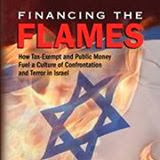
The book reads like a novel, beginning with the wedding of a 15th-generation sabra – a Jew who is native to his ancestral lands rather than transplanted from elsewhere. Through the dramatic events of this particular young man, the reader is introduced to the Goldstone Mission report, a document based on “information provided by Israeli nongovernmental organizations (NGOs) avowedly devoted to human rights…” that “was later recanted as being based on false and incomplete information.” (p 10)
However, the report had accused Israeli soldiers of widespread war crimes, so before its recantation, it caused enormous damage to both the military and to the individual soldiers involved.
The NGO most significantly behind the Goldstone Mission report is the New Israel Fund (NIF).
The NGO most significantly behind the Goldstone Mission report is the New Israel Fund (NIF).
NIF describes itself as an “agent of change” in Israel, promulgating the distinctly American vision of equality amid religious and ethnic plurality. Its money comes from donors around the world, as much as $37 million annually, much of that from the United States, and provides “seed” funding to thousands of Israeli social-action organizations and creating a progressive network across Israel.
It is not a “direct action” charity but a vehicle of “empowerment” to help, it says, “marginalized Israelis to organize and speak for themselves and achieve recognition and results in the corridors of power…We are a funder with a point of view…We are an advocacy organization that takes on the toughest issues; builds coalitions; incubates new approaches, programs, and projects for social change; and serves as the acknowledged leader of progressive civil society in Israel.” (p 25-6)
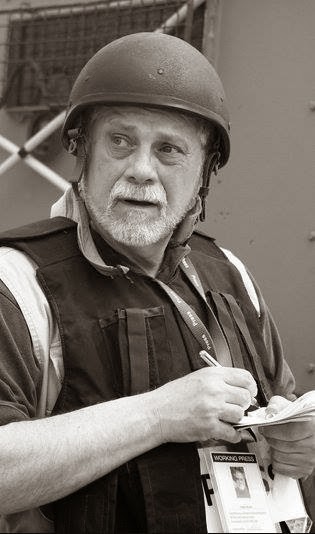
(Edwin Black taking notes in Israel)
Black praises some of NIF’s efforts but is quick to add that it has a political agenda funded by foreigners.
In recent years the New Israel Fund (NIF) has been “funding groups that directly or indirectly advocate for boycott, divestment, and sanctions, known as the BDS movement, which seeks to delegitimize Israel’s right to exist in every forum worldwide.” (p 27)
The Goldstone Mission report, with its unmerited attack against the Israel Defense Forces – using American tax-enabled money – appears to have been an example. An orchestrated campaign of provoking Israeli soldiers coupled with selectively edited propaganda materials is another (chapters 5-7). Deliberate efforts are made by a small but highly effective American group, not to resolve conflict, but to exacerbate it (chapter 8). Black looks closely at these foreign groups funding the NIF and at least one is quite familiar: the Ford Foundation, that in just one year, 2000 -2001, gave more than $35 million to some 272 Arab and Palestinian organizations and whose network of activities is ridiculously complicated (ch 4)
In recent years the New Israel Fund (NIF) has been “funding groups that directly or indirectly advocate for boycott, divestment, and sanctions, known as the BDS movement, which seeks to delegitimize Israel’s right to exist in every forum worldwide.” (p 27)
The Goldstone Mission report, with its unmerited attack against the Israel Defense Forces – using American tax-enabled money – appears to have been an example. An orchestrated campaign of provoking Israeli soldiers coupled with selectively edited propaganda materials is another (chapters 5-7). Deliberate efforts are made by a small but highly effective American group, not to resolve conflict, but to exacerbate it (chapter 8). Black looks closely at these foreign groups funding the NIF and at least one is quite familiar: the Ford Foundation, that in just one year, 2000 -2001, gave more than $35 million to some 272 Arab and Palestinian organizations and whose network of activities is ridiculously complicated (ch 4)
NIF is, above all, a lobbyist – or, where that is too sensitive a term, an “advocate for policy change” – that, in the words of one Israeli legislator, is “using American money to affect our internal political affairs.” The fuller record of NIF lobbying braggadocio runs off the edge of the legal pad,” Black writes. “The topics cover a range of issues from military benefits for veterans to involvement in the method of terrorist interrogations by security agencies…. the NIF has recently told its supporters that it was responsible for influencing some five hundred different laws and legal initiatives.” (p 169) Nor is this work confined to Israel: “And we do advocate outside Israel for changes in Israeli society that may impact Jewish communities elsewhere. (p 172)
- Is the military being hamstrung by impossible humanitarian considerations that are in no matched by the rabidly zealous suicide bombers or enemy tacticians who use innocent citizenry to shield their movements?
- Are Jewish groups from outside Israel “funding anti-Israeli agitation and fueling war crime tribunals,” while “terrorists [are] waging war on Israeli children with impunity, and the soldiers who save the day [are] threatened with trial and discouraged from shooting, themselves being shot to death?”
Black believes the answer to both questions is, “yes.”
A particularly egregious situation is the payment of “salaries” to convicted Arab Palestinian prisoners of Israel who have committed acts of “resistance.” The “salary” increases according to the seriousness of the act, measured by the length of the prison sentence. The beneficiary of this “salary – in later usage termed “social welfare” – is determined by the prisoner.
From where does the money to pay these “salaries” come? Not from the Palestinian national economy “but from donor countries paying billions in financial aid to the Palestinian Authority.” (p 192) After 9-11, the United States, no longer sent direct financial aid but ways were still found, as late as 2006, to get hundreds of millions of U.S. taxpayer dollars into their hands via various UN agencies.
And then, there’s the banking system.
“A superhighway of money goes directly from Israel’s greatest adversaries into a vast interchange where it comingles with dollars, shekels, Euros, and yen from the finest financial nameplates and charitable funds in the world.” (p 198)
Millions are poured into the support of the families of jihadist “martyrs,” filtered through special funds administered by the Islamic Development Bank.
“A superhighway of money goes directly from Israel’s greatest adversaries into a vast interchange where it comingles with dollars, shekels, Euros, and yen from the finest financial nameplates and charitable funds in the world.” (p 198)
Millions are poured into the support of the families of jihadist “martyrs,” filtered through special funds administered by the Islamic Development Bank.
It doesn’t end there, though:
“Ironically, some of the same Israel-based recipients who receive American tax-subsidized grants from the New Israel Fund have been selected for support by the most influential sovereign Arab and Islamic charitable organizations representing national treasuries committed to erasing the existence of Israel.” (p 200)
Any demand by a nation that its financial aid be used for peaceful projects and not terrorist salaries has been dismissed as “donor filth.”
“Ironically, some of the same Israel-based recipients who receive American tax-subsidized grants from the New Israel Fund have been selected for support by the most influential sovereign Arab and Islamic charitable organizations representing national treasuries committed to erasing the existence of Israel.” (p 200)
Any demand by a nation that its financial aid be used for peaceful projects and not terrorist salaries has been dismissed as “donor filth.”
Black ends his Introduction to the book by saying, “Many people know how this saga [of conflict in the Middle East] began, but no one knows how this saga will end. For the Israelis, the resilient ethos embedded in their existence is encapsulated in their national anthem. That song is called Hatikva. In Hebrew, it means ‘the hope’.”...
Buy the book at Amazon here.
Buy the book at Amazon here.
Anti-Semitism in Australia?
From JPost, 29 Oct 2013, b* :

Brawl in Sydney, Australia. Photo: Screenshot Sky News
Last Friday, a Jewish family of five was walking home after Shabbat services and dinner in Bondi, in the heart of the famous beachside suburb in Sydney, Australia, when they were viciously assaulted by a gang of youths in one of the most horrific anti-Semitic attacks in Australia in memory.
Although police investigations are ongoing, three of the attackers have already been arrested, with police confirming they were part of a group of eight mainly Pacific Islander youths, who had no connection to Islam. The victims, which included a couple in their 60s, have now all been released from hospital, although each sustained serious injuries, including bleeding of the brain and a fractured skull.
News of the incident has now reverberated around the world, with many commentators quick to say it is no longer safe to be a Jew in Australia or that Down Under is quickly turning into the next Europe.
So, allow me please to dispel some of these theories.
As horrific and unquestionably anti-Semitic as this was, it was an isolated and spontaneous act committed by a group of thugs with criminal histories.
The attack in Bondi was not the beginning of a pogrom and Australia is not in danger of turning into Europe, where a recent survey showed that a quarter of European Jews are afraid to openly identify as Jewish for fear of anti-Semitism.
Australia always has been ...an incredibly open, diverse, peaceful and tolerant society, and importantly, one of the safest places in the world to be Jewish.
....What is perhaps most important to note is the reaction following the incident, which has received immediate and unequivocal wall-to-wall political condemnation, including from the highest echelons of federal and state government, social and community leaders, the media and from different faith groups, including from the Muslim community.
The police have already caught three of the attackers and expect to apprehend the remaining few shortly.
It is also important acknowledge the brave individuals, including the security guards from a nearby bar, who ran to help the victims, and a taxi driver who stopped to apprehend one of the attackers. As Peter Wertheim, president of the Executive Council of Australian Jewry, the umbrella organization for the Australian Jewish community, noted, “the brave and selfless actions of these bystanders is a much more accurate reflection of the attitude of Australians to their Jewish fellow citizens, than the hate-filled violence of the group who allegedly attacked the family.”
...Though famous for its open, laid back and tolerant lifestyle, Australia is not perfect and a degree of racism, and anti-Semitism, does exist.
The Boycott, Divestment & Sanctions (BDS) Movement continues to demonize Israel and Jews, students on some campuses will incur verbal anti-Semitic attacks (most frequently from the far Left) and sporadic graffiti and vandalism attacks still occur...
The rise in social media is also offering a new large-scale platform for today’s bigots.
...One of the reasons there has been such a spike in anti-Semitism across Europe is because the political and social leadership failed to act when the warning signs first appeared.
Today, they are playing catch up, and some may say, are even too late.
While anti-Semitism will always exist no matter where, the Australian response of zero tolerance, education and unequivocal political and social condemnation ought to be an example to all those fighting this oldest and most enduring forms of hatred.
*The author is director of research at The Israeli-Jewish Congress. Originally from Australia, he was also active in the Sydney Jewish community, including serving as a policy analyst at the Australia/Israel & Jewish Affairs Council.
Although police investigations are ongoing, three of the attackers have already been arrested, with police confirming they were part of a group of eight mainly Pacific Islander youths, who had no connection to Islam. The victims, which included a couple in their 60s, have now all been released from hospital, although each sustained serious injuries, including bleeding of the brain and a fractured skull.
News of the incident has now reverberated around the world, with many commentators quick to say it is no longer safe to be a Jew in Australia or that Down Under is quickly turning into the next Europe.
So, allow me please to dispel some of these theories.
As horrific and unquestionably anti-Semitic as this was, it was an isolated and spontaneous act committed by a group of thugs with criminal histories.
The attack in Bondi was not the beginning of a pogrom and Australia is not in danger of turning into Europe, where a recent survey showed that a quarter of European Jews are afraid to openly identify as Jewish for fear of anti-Semitism.
Australia always has been ...an incredibly open, diverse, peaceful and tolerant society, and importantly, one of the safest places in the world to be Jewish.
....What is perhaps most important to note is the reaction following the incident, which has received immediate and unequivocal wall-to-wall political condemnation, including from the highest echelons of federal and state government, social and community leaders, the media and from different faith groups, including from the Muslim community.
The police have already caught three of the attackers and expect to apprehend the remaining few shortly.
It is also important acknowledge the brave individuals, including the security guards from a nearby bar, who ran to help the victims, and a taxi driver who stopped to apprehend one of the attackers. As Peter Wertheim, president of the Executive Council of Australian Jewry, the umbrella organization for the Australian Jewish community, noted, “the brave and selfless actions of these bystanders is a much more accurate reflection of the attitude of Australians to their Jewish fellow citizens, than the hate-filled violence of the group who allegedly attacked the family.”
...Though famous for its open, laid back and tolerant lifestyle, Australia is not perfect and a degree of racism, and anti-Semitism, does exist.
The Boycott, Divestment & Sanctions (BDS) Movement continues to demonize Israel and Jews, students on some campuses will incur verbal anti-Semitic attacks (most frequently from the far Left) and sporadic graffiti and vandalism attacks still occur...
The rise in social media is also offering a new large-scale platform for today’s bigots.
...One of the reasons there has been such a spike in anti-Semitism across Europe is because the political and social leadership failed to act when the warning signs first appeared.
Today, they are playing catch up, and some may say, are even too late.
While anti-Semitism will always exist no matter where, the Australian response of zero tolerance, education and unequivocal political and social condemnation ought to be an example to all those fighting this oldest and most enduring forms of hatred.
*The author is director of research at The Israeli-Jewish Congress. Originally from Australia, he was also active in the Sydney Jewish community, including serving as a policy analyst at the Australia/Israel & Jewish Affairs Council.
Wednesday, October 30, 2013
Iran will continue uranium enrichment and chanting "death to America"
From Times of Israel, 28 Oct, 3013, by Elhannan Miller:

Iran will not suspend its uranium enrichment nor will it stop the custom of chanting “death to America” in public gatherings, a senior Iranian politician said.

President of the Iranian Parliament's Foreign Policy and National Security Committee Alaeddin Boroujerdi waits for the start of a press conference in Madrid, Thursday, Feb. 22, 2007 (photo credit: AP/Sergio Barrenechea)
Iran will not suspend its uranium enrichment nor will it stop the custom of chanting “death to America” in public gatherings, a senior Iranian politician said.
Alaeddin Boroujerdi, chairman of the foreign policy and national security committee in the Iranian parliament, told members of the engineers’ association that uranium enrichment is a “red line” in nuclear negotiations, adding that the suspension of enrichment in the past by Iran’s reformist government will never repeat itself.
“The gloom that surrounded the nuclear facilities at the time is over,” Boroujerdi was quoted by Iran’s Arabic-language news channel Al-Alam as saying Saturday. “Today Iran can take new decisions.”
Earlier this month, Iranian Foreign Minister Mohammed Javad Zarif denied reports that Iran had agreed to stop enriching uranium to 20 percent and allow full monitoring of the underground enrichment facility at Fordo, which is to become a research facility.
Boroujerdi adamantly denied reports on the closure of Fordo.
“Fordo is one of Iran’s red lines and will certainly not be closed. It has been designed constructed to withstand the most severe threats,” he said. “If the Israeli entity wishes to act foolishly [by attacking it] it will certainly fail, because the Fordo installation is heavily fortified and cannot be struck.”
Israel is insisting that Iran completely suspend the enrichment of uranium, garnering a demand last week by US Secretary of State John Kerry that Iran prove “undeniably” that it is pursuing a peaceful nuclear program.
In his speech, the Iranian official also referred to reports that the traditional chant “death to America” will no longer be used, saying the opposite was true; and the slogan will be used even more than before...
Iran is propping ip Assad
Report: Over 60,000 Iranians Fighting Alongside Assad Forces (AKI-Italy)
There are more than 60,000 Iranians fighting alongside forces loyal to Syrian President Assad, opposition leader Ahmad Jarba claimed on Oct. 22.
For this reason Iran should not attend Syrian peace talks dubbed Geneva II scheduled to take place next month, Jarba told Arab and Western foreign ministers in London.
"Assad's regime would already have fallen were it not for the Iranian presence in Syria," Jarba claimed.
Iran's Secret Night Flights to Arm Syria's Assad Revealed - Phil Sands (The National-Abu Dhabi)
Iran provides military support to Syrian President Assad by way of regular clandestine flights between Tehran and Damascus.
"There are private flights every week, sometimes three a week, and they are controlled by an Iranian officer in Damascus," a Syrian official said.
"Everyone must follow this [Iranian] man's orders. We have been told he is the second most important man in Syria and that we are to do as he says without question," said the official.
"We know the flights are being organized by the [Iranian] Revolutionary Guard."
Another Syrian said at least some of the Iranian aircraft had been seen transporting fighters to help regime forces battle rebels.
There are more than 60,000 Iranians fighting alongside forces loyal to Syrian President Assad, opposition leader Ahmad Jarba claimed on Oct. 22.
For this reason Iran should not attend Syrian peace talks dubbed Geneva II scheduled to take place next month, Jarba told Arab and Western foreign ministers in London.
"Assad's regime would already have fallen were it not for the Iranian presence in Syria," Jarba claimed.
Iran's Secret Night Flights to Arm Syria's Assad Revealed - Phil Sands (The National-Abu Dhabi)
Iran provides military support to Syrian President Assad by way of regular clandestine flights between Tehran and Damascus.
"There are private flights every week, sometimes three a week, and they are controlled by an Iranian officer in Damascus," a Syrian official said.
"Everyone must follow this [Iranian] man's orders. We have been told he is the second most important man in Syria and that we are to do as he says without question," said the official.
"We know the flights are being organized by the [Iranian] Revolutionary Guard."
Another Syrian said at least some of the Iranian aircraft had been seen transporting fighters to help regime forces battle rebels.
Israel Air Force Plans for 10-Fold Increase in Rate of Bombs-on-Target
From Defence News, 27 Oct 2013, by BARBARA OPALL-ROME:

RAMAT DAVID AIR BASE, ISRAEL — The Israel Air Force (IAF) is revamping headquarters staff, planning procedures and air operations to support a 10-fold increase in the number of targets it can detect and destroy, the Air Force’s chief of air operations said.
... Brig. Gen. Amikam Norkin said the institutional revamp — the service’s first since the 1973 Yom Kippur War — aims to shorten the duration of future wars while reducing demand for manoeuvring
ground forces through massive, persistent and punishing use of precision air power.
More than a year in the making and slated for phased implementation in the coming months, the changes are driven by IAF Commander Maj. Gen. Amir Eshel and his Expanding Attack Capacity (EAC) program.
Officers here say the program affects all aspects of air operations, from the orders received from the Israel Defense Forces (IDF) General Staff to the pilot in the cockpit and maintenance crews tasked with turnaround time.
It also involves wholesale changes in mission planning, resource management, bomb damage assessment and the way the IAF coordinates movements with western coalition forces that may be operating in the region.
But perhaps the biggest driver of EAC, experts here say, is significant improvements in so-called sensor-to-shooter capabilities. By mating persistent intelligence collection with precision weapons, the IAF expects to generate an exponential number of new, time-sensitive targets during each day of future fights.
Once implemented, traditional waves of air attack should give way to an express train of precision strikes, allowing “first circle” enemies such as Lebanon-based Hezbollah and Gaza-based Hamas little time to recover from the initial shock and awe of previous campaigns.
“We’re focusing on the entire system across the full distance,” Norkin said. “The RPMs [rotations per minute] of this engine must be much higher to support a huge surge in the quantity of targets we detect and destroy each and every day of a future campaign.”
In an Oct. 21 interview at this IAF hub in northern Israel, Norkin noted that the 1,500 targets attacked in Israel’s November 2012, eight-day Pillar of Defense operation in Gaza doubled the number of targets attacked in the 34-day 2006 Lebanon War.
“In Pillar of Defense, our daily attack capacity was twice that of Lebanon, despite the fact that [Gaza] was a much smaller area and more densely populated,” Norkin said. “Now, when we talk about the northern area of operations, we’re aspiring for an order of magnitude expansion — maybe more — in the number of targets to be destroyed every day.”
Despite IAF sensor-to-shooter capabilities demonstrated by its destruction of 120-some rocket launchers in the last Lebanon war, Norkin said the IDF realizes it can no longer waste time and assets going after individual launchers. “We all understand that rockets will continue to fall here until the last day of war. A residual capacity to launch will remain with the enemy,” he said.
Under the new concept, Israel will focus on “hurting the enemy where it hurts the most,” Norkin said, referring to leadership, commanders and significant war-fighting assets.
“We won’t be able to push the enemy to the point where he can no longer shoot rockets and missiles. Therefore we need to push him to the point where he doesn’t want to shoot his rockets and missiles,” the IAF officer said...
“As soon as war breaks out, the hourglass is overturned,” Lt. Gen. Benjamin Gantz, IDF chief of staff, said of Israel’s race to achieve optimum operational gain while preserving domestic and international support prior to a brokered cease-fire.
With Hezbollah and Hamas vowed to Israel’s destruction and unwilling to entertain any type of negotiated peace, officers here insist their only option is to prolong periods of relative quiet between the inevitable outbreak of future wars.
As such, IDF strategy demands inflicting as much pain as possible through high-intensity combat and rapid battlefield gains to deter the next round of fighting once a cease-fire takes effect.
In an address this month at Bar Ilan University’s Begin-Sadat Center for Strategic Studies, Gantz cited the “blurring of definitions between terrorist and civilian,” particularly in the context of Lebanon-based Hezbollah, “where the living room and the missile room is in the same house.”
Future wars, Gantz said, will be “transparent” and subject to round-the-clock media coverage and international scrutiny. “Every irregularity of the IDF will be accompanied by attempts to delegitimize Israel.”
While commanders across all sectors and services must be ready “to activate maximum assets with ultimate force,” Gantz flagged a preference, when possible, for precision, standoff operations.
As the officer in charge of last November’s standoff campaign against Gaza-launched rockets, Gantz delivered significant results through standoff strikes without having to embark on broad-based incursion.
More than 20,000 active-duty and reserve forces were poised at the border for the real prospect of a manoeuvring ground war. But after eight days of punishing precision strikes, Israeli political leaders were convinced Hamas had been sufficiently deterred and accepted the Egyptian-brokered cease-fire that ended the fight.
Assaf Agmon, a brigadier general in the IAF reserve and director of Israel’s Fisher Institute for Strategic Air and Space Studies, warned against mistaking Pillar of Defense as a template for future wars that may require ground manoeuvring to support initial gains from standoff attack.
Nevertheless, he said operational efficiencies expected from the EAC effort should, in many scenarios, “lessen the likelihood, or at least diminish the duration,” of a costly and diplomatically damaging ground war.
“Air power assumes enormous added value in our defensive concept and in all Western cultures that are less tolerant of the heavy casualties that come from big manoeuvring ground wars,” Norkin said. “It’s hard to stop the lethality of tanks once they start to move. In contrast, air power can be controlled in a very calibrated, surgical manner. It’s like a thermostat that you can direct as hard or as soft as needed or turned off entirely when it’s time to stop.”...
Israeli F-15 fighter jets are refueled by a Boeing 707 during an air show over the Negev desert, near the southern Israeli city of Beersheva, on June 28, 2012. Israel Air Force leaders plan a major revamp in how the service operates. (Agence France-Presse)
RAMAT DAVID AIR BASE, ISRAEL — The Israel Air Force (IAF) is revamping headquarters staff, planning procedures and air operations to support a 10-fold increase in the number of targets it can detect and destroy, the Air Force’s chief of air operations said.
... Brig. Gen. Amikam Norkin said the institutional revamp — the service’s first since the 1973 Yom Kippur War — aims to shorten the duration of future wars while reducing demand for manoeuvring
ground forces through massive, persistent and punishing use of precision air power.
More than a year in the making and slated for phased implementation in the coming months, the changes are driven by IAF Commander Maj. Gen. Amir Eshel and his Expanding Attack Capacity (EAC) program.
Officers here say the program affects all aspects of air operations, from the orders received from the Israel Defense Forces (IDF) General Staff to the pilot in the cockpit and maintenance crews tasked with turnaround time.
It also involves wholesale changes in mission planning, resource management, bomb damage assessment and the way the IAF coordinates movements with western coalition forces that may be operating in the region.
But perhaps the biggest driver of EAC, experts here say, is significant improvements in so-called sensor-to-shooter capabilities. By mating persistent intelligence collection with precision weapons, the IAF expects to generate an exponential number of new, time-sensitive targets during each day of future fights.
Once implemented, traditional waves of air attack should give way to an express train of precision strikes, allowing “first circle” enemies such as Lebanon-based Hezbollah and Gaza-based Hamas little time to recover from the initial shock and awe of previous campaigns.
“We’re focusing on the entire system across the full distance,” Norkin said. “The RPMs [rotations per minute] of this engine must be much higher to support a huge surge in the quantity of targets we detect and destroy each and every day of a future campaign.”
In an Oct. 21 interview at this IAF hub in northern Israel, Norkin noted that the 1,500 targets attacked in Israel’s November 2012, eight-day Pillar of Defense operation in Gaza doubled the number of targets attacked in the 34-day 2006 Lebanon War.
“In Pillar of Defense, our daily attack capacity was twice that of Lebanon, despite the fact that [Gaza] was a much smaller area and more densely populated,” Norkin said. “Now, when we talk about the northern area of operations, we’re aspiring for an order of magnitude expansion — maybe more — in the number of targets to be destroyed every day.”
Despite IAF sensor-to-shooter capabilities demonstrated by its destruction of 120-some rocket launchers in the last Lebanon war, Norkin said the IDF realizes it can no longer waste time and assets going after individual launchers. “We all understand that rockets will continue to fall here until the last day of war. A residual capacity to launch will remain with the enemy,” he said.
Under the new concept, Israel will focus on “hurting the enemy where it hurts the most,” Norkin said, referring to leadership, commanders and significant war-fighting assets.
“We won’t be able to push the enemy to the point where he can no longer shoot rockets and missiles. Therefore we need to push him to the point where he doesn’t want to shoot his rockets and missiles,” the IAF officer said...
Expediting the Endgame
Israeli officers and defense experts said the IAF revamp is an essential element in IDF strategy for expediting the diplomatic endgame through maximum destruction of enemy assets and minimal harm to uninvolved civilians.“As soon as war breaks out, the hourglass is overturned,” Lt. Gen. Benjamin Gantz, IDF chief of staff, said of Israel’s race to achieve optimum operational gain while preserving domestic and international support prior to a brokered cease-fire.
With Hezbollah and Hamas vowed to Israel’s destruction and unwilling to entertain any type of negotiated peace, officers here insist their only option is to prolong periods of relative quiet between the inevitable outbreak of future wars.
As such, IDF strategy demands inflicting as much pain as possible through high-intensity combat and rapid battlefield gains to deter the next round of fighting once a cease-fire takes effect.
In an address this month at Bar Ilan University’s Begin-Sadat Center for Strategic Studies, Gantz cited the “blurring of definitions between terrorist and civilian,” particularly in the context of Lebanon-based Hezbollah, “where the living room and the missile room is in the same house.”
Future wars, Gantz said, will be “transparent” and subject to round-the-clock media coverage and international scrutiny. “Every irregularity of the IDF will be accompanied by attempts to delegitimize Israel.”
While commanders across all sectors and services must be ready “to activate maximum assets with ultimate force,” Gantz flagged a preference, when possible, for precision, standoff operations.
As the officer in charge of last November’s standoff campaign against Gaza-launched rockets, Gantz delivered significant results through standoff strikes without having to embark on broad-based incursion.
More than 20,000 active-duty and reserve forces were poised at the border for the real prospect of a manoeuvring ground war. But after eight days of punishing precision strikes, Israeli political leaders were convinced Hamas had been sufficiently deterred and accepted the Egyptian-brokered cease-fire that ended the fight.
Assaf Agmon, a brigadier general in the IAF reserve and director of Israel’s Fisher Institute for Strategic Air and Space Studies, warned against mistaking Pillar of Defense as a template for future wars that may require ground manoeuvring to support initial gains from standoff attack.
Nevertheless, he said operational efficiencies expected from the EAC effort should, in many scenarios, “lessen the likelihood, or at least diminish the duration,” of a costly and diplomatically damaging ground war.
“Air power assumes enormous added value in our defensive concept and in all Western cultures that are less tolerant of the heavy casualties that come from big manoeuvring ground wars,” Norkin said. “It’s hard to stop the lethality of tanks once they start to move. In contrast, air power can be controlled in a very calibrated, surgical manner. It’s like a thermostat that you can direct as hard or as soft as needed or turned off entirely when it’s time to stop.”...
Monday, October 28, 2013
Iran may be month from a bomb
Iran could produce enough weapons-grade uranium to build a nuclear bomb in as little as a month, according to a new estimate by one of the USA's top nuclear experts.
David Albright, president of the institute and a former inspector for the U.N. International Atomic Energy Agency, said the estimate means that Iran would have to eliminate more than half of its 19,000 centrifuges to extend the time it would take to build a bomb to six months.
The Obama administration has said Iran is probably a year away from having enough enriched uranium to make a bomb.
Bernadette Meehan, an NSC spokeswoman for President Obama's National Security Council, said the intelligence community maintains "a number of assessments" regarding potential time frames for Iran to produce enough weapons-grade uranium for one weapon or a testable nuclear device.hi
"We continue to closely monitor the Iranian nuclear program and its stockpile of enriched uranium," Meehan said.
World powers are seeking an agreement "that ultimately resolves all of the international community's concerns about Iran's nuclear program," she said. "The ultimate goal is a comprehensive agreement that is credible, transparent, and verifiable."
In the report, Albright said negotiations with Iran should focus on so-called "breakout" times, or the time required to convert low-enriched uranium to weapons-grade.
Albright, who has testified before Congress, said the negotiators should try to find ways to lengthen the breakout times and shorten the time that inspectors could detect breakout. ISIS' analysis is based on the latest Iranian and United Nations reports on Iran's centrifuge equipment for producing nuclear fuel and its nuclear fuel stockpiles.
Iran's stockpile of medium-enriched uranium has nearly doubled in a year's time and its number of centrifuges has expanded from 12,000 in 2012 to 19,000 today.
Sen. Mark Kirk, an Illinois Republican whose Senate Banking Committee is considering legislation to tighten Iran sanctions, said the report shows that Iran is expanding its nuclear capabilities under the cover of negotiations.
"The Senate should move forward immediately with a new round of sanctions to prevent Iran from acquiring an undetectable breakout capability," he said.
The White House has said new sanctions legislation should wait while current negotiations — scheduled to resume officially in Geneva next month — are moving forward.
The White House said Thursday it will continue consulting with Congress "so that any congressional action is aligned with our negotiating strategy as we move forward," said Caitlin Hayden, a spokeswoman for President Obama's National Security Council.
Iranian President Hassan Rouhani has said his country has no interest in nuclear weapons but that producing nuclear fuel is Iran's right. His foreign minister, Javad Zarif, has said Iran will not ship its nuclear stockpile to a third country.
However, Iran has blocked international inspectors from some suspected nuclear facilities to verify they are being used for peaceful purposes, access required under international agreements it has signed.
United Nations inspectors have found evidence of a weapons program in violation of Iran's commitment under the Nuclear Non-Proliferation Treaty. The USA and the U.N. Security Council have implemented crippling economic sanctions on Iran to sway it to take steps to assure the world it is not developing a bomb.
Israel, which sees an Iranian nuclear bomb as a threat to its very existence, has said it will take military action to prevent Iran from getting a bomb.
ISIS estimated in October 2012 that Iran could produce enough highly-enriched uranium for a bomb within two to four months. The new estimate is based on an analysis of the latest reports by Iran and the the IAEA.
ISIS considered various scenarios, including if Iran decided to build a covert enrichment plant like it has under a mountain in Fordow, near the city of Qom, that was designed for optimal efficiency and minimal time to enrich enough uranium for bomb making. Such a facility built with current Iranian technology could produce enough material for a bomb in a week, according to the ISIS report.
"If they did that and they were caught it would be a smoking gun of a nuclear weapons program," Albright said.
If Iran moves ahead with installation of its more efficient, second generation centrifuges, it would be able to produce enough nuclear fuel for a bomb with so few of them, between 2,000 and 3,300 centrifuges, that they could fit in a small warehouse, Albright said.
Subscribe to:
Posts (Atom)