From PJ Media, 31 Aug 2013, by Bryan Preston:
President Obama delivered an astonishing speech on Syria in the Rose Garden this afternoon. The Syrian government apparently crossed the “red line,” using chemical weapons against civilians on August 21. Ten days later, Obama stepped forward to articulate his plan…to delay any American response until at least September 9. That’s when Congress returns to Washington, at which time, the president said today, in his hectoring tone, he will take military strikes on Syria up for debate and a vote.
... the groundwork for congressional approval should have begun August 22nd, not August 31st. Actually, it should have begun in 2012.
Now we’re left with a strange timetable. Secretary of State John Kerry made a strong case Friday that Syria’s actions represent a significant enough threat to America’s national security that we must act. ... Kerry was delivering the Obama administration’s urgent position on Syria. But later Friday and especially today, President Obama poured cold water on the idea that there could be very much urgency to the threat...
Obama has just given Assad another fortnight to move his SCUDs and other potential targets, and line up his responses should the U.S. attack.
Additionally, Kerry’s statements this week did not appear to move the needle with Congress or the public. Odds are that another week plus of no action will not raise the appetite for military action.
President Obama has handled Syria with an utter lack of seriousness throughout. He labeled the use of chemical weapons a “red line” a year ago in an offhand comment, then spent the following year doing nothing to prepare the Congress or the public or the United Nations for the possibility that that red line would be crossed and then America would have to act.
Now the red line has been crossed, but probably by both sides in the Syrian civil war at different times. Only Assad’s crossing it merits Obama’s attention, for some reason.
...There may be Jeffersonian federalists extant somewhere in Damascus or the rebel-held territories, but they do not hold sway. One side is a brutal Baathist dictatorship aligned with Iran that supports Shiite terrorists; the other side is dominated by al Qaeda’s predominantly Sunni terrorists. Syria is a sectarian and tribal civil war.
Obama appears weak, indecisive and unable to back up his own words. Assad is not the only enemy who is watching.

Sunday, September 01, 2013


Obama intends to get Congressional approval for (possible) Syria action in a couple of weeks
From PJ Media, 1/9/13, by Bridget Johnson:
With Vice President Joe Biden at his side, President Obama promised in a Rose Garden address that he would seek authorization from Congress to strike at Syria.
Obama said inaction against the regime of Bashar al-Assad “risks making a mockery of the global prohibition on the use of chemical weapons.”
“It endangers our friends and our partners along Syria’s borders, including Israel, Jordan, Turkey, Lebanon and Iraq. It could lead to escalating use of chemical weapons, or their proliferation to terrorist groups who would do our people harm. In a world with many dangers, this menace must be confronted.”
“After careful deliberation, I have decided that the United States should take military action against Syrian regime targets,” said Obama...
“… I will seek authorization for the use of force from the American people’s representatives in Congress.” There’s no indication that Congress will return earlier than Sept. 9, though, to begin considering such an authorization...
After the address, Obama went golfing with Biden at Fort Belvoir.
Obama’s remarks...were carried live on Syrian state television..
With Vice President Joe Biden at his side, President Obama promised in a Rose Garden address that he would seek authorization from Congress to strike at Syria.
Obama said inaction against the regime of Bashar al-Assad “risks making a mockery of the global prohibition on the use of chemical weapons.”
“It endangers our friends and our partners along Syria’s borders, including Israel, Jordan, Turkey, Lebanon and Iraq. It could lead to escalating use of chemical weapons, or their proliferation to terrorist groups who would do our people harm. In a world with many dangers, this menace must be confronted.”
“After careful deliberation, I have decided that the United States should take military action against Syrian regime targets,” said Obama...
“… I will seek authorization for the use of force from the American people’s representatives in Congress.” There’s no indication that Congress will return earlier than Sept. 9, though, to begin considering such an authorization...
After the address, Obama went golfing with Biden at Fort Belvoir.
Obama’s remarks...were carried live on Syrian state television..
“Under the Constitution, the responsibility to declare war lies with Congress,” House GOP leaders Boehner, Majority Leader Eric Cantor (R-Va.), Majority Whip Kevin McCarthy (R-Calif.) and Conference Chair Cathy McMorris Rodgers (R-Wash.) said in a joint statement. “We are glad the president is seeking authorization for any military action in Syria in response to serious, substantive questions being raised. In consultation with the president, we expect the House to consider a measure the week of September 9th. This provides the president time to make his case to Congress and the American people.”
“I appreciate the president’s decision to seek congressional authorization for military action,” said House Armed Services Committee Chairman Buck McKeon (R-Calif.).
“I agree those who use chemical weapons against their own people should be held accountable. Authorization for the use of force in this case should be contingent on the president setting clear military objectives that can meet articulated policy goals, including degrading any party’s ability to use these weapons again. The coming days will determine if such a military operation can be identified. I look forward to the debate.”...
“I appreciate the president’s decision to seek congressional authorization for military action,” said House Armed Services Committee Chairman Buck McKeon (R-Calif.).
“I agree those who use chemical weapons against their own people should be held accountable. Authorization for the use of force in this case should be contingent on the president setting clear military objectives that can meet articulated policy goals, including degrading any party’s ability to use these weapons again. The coming days will determine if such a military operation can be identified. I look forward to the debate.”...
Israel cannot afford half measures by the Obama administration.
From PJ Media, 30 Aug 2013, by Joseph Puder, founder and executive director of the Interfaith Taskforce for America and Israel (ITAI):
Soon after the UN inspectors leave Syria and are able to present their report to the UN Security Council, it appears that President Obama’s national security team will recommend an immediate but limited strike against the Assad war machine but will not seek to affect a regime change.
Obama has already provided the U.S. Congress with evidence of Assad’s use of chemical weapons against his civilian population. A U.S. attack would be, by all accounts, an effort to deter and degrade Assad’s air force, strike the missile stockpile capable of launching chemical weapons, and eliminate communications and control centers.
The question at this point is not if the Obama administration will launch an attack, but rather when, and to what extent the Obama administration is willing to go in order to defeat Bashar Assad.
The Obama administration has announced that it will not abide by a UN timetable. It has already consulted with NATO allies, Arab League member states, and other Middle Eastern countries. Similar to George Bush Sr., Obama has been trying to assemble a coalition of states willing to engage in the attack on the Assad regime, including some NATO countries, as well as Saudi Arabia and Jordan. Friends of the Assad regime, including Russia, China, and Iran, have protested against the planned attack. And the Tehran regime already warned that if Assad’s Syria is attacked, Israel will suffer the consequences.
Obama, having committed himself to a red line, must act if he and the U.S. are to maintain any credibility. There is ample evidence already about the Assad regime’s complicity and engagement in the use of chemical weapons against civilians.
The question is what effect a U.S. attack on the Assad regime would have on Israel.
An attack on Syria would be different from the U.S. attack on Iraq in 1991 to dislodge Saddam Hussein’s Iraqi forces from Kuwait. For one thing, the geography is different. Syria borders Israel in the northeast. Iraq has no border with Israel and is over 1,000 miles away. In 1991, the Bush administration ordered the Israeli government of Yitzhak Shamir not to retaliate against Saddam Hussein’s Scud missile attacks on Israeli cities in order to preserve the wide coalition, which included Arab and Islamic states. In today’s scenario, an Israeli retaliatory attack on Assad would be acceptable if not welcomed by most Sunni-Muslim Arab states.
Despite the Netanyahu government’s pronouncements that chances of a chemical attack on Israel by the Assad regime are slim at best, Israelis are not taking chances and are preparing for the worst possible outcome. Thousands of Israelis have crowded the gas-mask distribution centers. Israeli Defense Minister Moshe Ya’alon, in a press conference, assured Israelis that the Israel Defense Forces (IDF) is ready and capable of dealing with all eventualities. The IDF has moved additional batteries of the Iron Dome anti-missile defense system and Patriot missiles to the Golan and Galilee. The long-range Arrow missiles have also been moved to the north.
An American attack on Assad’s military infrastructure that degrades his capabilities would certainly be welcomed in Jerusalem. In spite of viewing the civil war from the sidelines, Israel has obvious strategic interests. While the Sunni and Islamist rebels in Syria are not a welcome sight for Israelis, they do not, however, pose a strategic threat to Israel. The Assad arsenal does. And should Assad be defeated, the “evil axis” of Iran, Syria, and Hezbollah would be broken smack in the middle. The Islamic Republic of Iran knows it, and it has invested much of its capital in maintaining Assad in power.
But even if the Assad regime would refrain from attacking Israel, there is still a chance that Hezbollah from Lebanon and Hamas from Gaza would attack the Jewish state. The chance of this happening is also rather slim. Hezbollah is heavily involved in Syria and, as a result, has lost much of its legitimacy in Lebanon. Attacking Israel would mean further eroding its standing in Lebanon, and a devastating retaliation on Lebanon by Israel would be blamed on Hezbollah.
Hamas has lost its Egyptian backer, deposed President Mohammad Morsi. It is now faced with a hostile Egyptian government, largely controlled by an unsympathetic Egyptian military. The need for a new patron, however, may lead Hamas into Tehran’s arms. Still, it is unlikely that Hamas would provoke a fight with Israel. It is more likely that the Islamic Jihad terrorist groups would attack Israel from Gaza. Such an attack would result in painful retaliation that would garner little support for Hamas or Islamic Jihad in the Arab world.
Should Assad’s Syria, against all logic, attack Israel (and one has to assume that his logic is not the same as that of the Israelis and Americans) it would provide Jerusalem with a legitimate excuse to bring down the Assad regime. It is reasonable to presume that if Bashar Assad interprets the American attack as one that is meant to topple him, he might attack Israel savagely. After killing more than 100,000 of his own people, killing thousands of Israelis would bring him pleasure.
The demise of the Assad regime would be a major disaster for Assad’s Iranian patrons.
Russia and China are unlikely to intervene. China does not have the global capabilities that the U.S. has, and Russia, while defending its Mediterranean port in Tartus, Syria, is committed to combating the dissemination of weapons of mass destruction along with the U.S. It will not risk a confrontation with the U.S. or send ground forces to Syria to defend Assad from Israel.
The reasonable assumption is that, at least officially, Damascus would not directly attack Israel, and neither would Hezbollah. The Iranian paymasters, nevertheless, might push Syria or Hezbollah to engage Israel. Hezbollah’s leader, Hassan Nasrallah, knows that he may lose a great deal by attacking Israel, so he might sub-contract an attack on Israel to smaller, lesser-known groups. Additionally, Hezbollah might transfer weapons from Syria into Lebanon. In both cases, the IDF is committed to acting decisively. The transfer of lethal weapons to Lebanon is a red line for Israel.
Attacking Assad’s Syria is not a passionate humanitarian or principled move by President Obama. He would rather stay away from another Middle Eastern involvement. But, in this case, his credibility is on the line. The attack, if it comes, would be weak and limited in scope, and it would not seek to topple Assad. A U.S. attack on Syria would serve as a symbolic gesture towards Iran by demonstrating the reach of our military. Iran’s commander of the Revolutionary Guards, Gen. Mohammad Ali Jafari, is concerned about it. He stated on August 29 that a U.S. attack on Syria would mean the “imminent destruction” of Israel. He warned that “Syria will turn into a more dangerous and deadly battlefield than the Vietnam War.”
Israel has to face an implacable enemy, not only in Syria’s Assad, but in Iran’s nuclear and conventional power. Israel cannot, therefore, afford half measures by the Obama administration or Washington’s miscalculations in Syria.
Soon after the UN inspectors leave Syria and are able to present their report to the UN Security Council, it appears that President Obama’s national security team will recommend an immediate but limited strike against the Assad war machine but will not seek to affect a regime change.
Obama has already provided the U.S. Congress with evidence of Assad’s use of chemical weapons against his civilian population. A U.S. attack would be, by all accounts, an effort to deter and degrade Assad’s air force, strike the missile stockpile capable of launching chemical weapons, and eliminate communications and control centers.
The question at this point is not if the Obama administration will launch an attack, but rather when, and to what extent the Obama administration is willing to go in order to defeat Bashar Assad.
The Obama administration has announced that it will not abide by a UN timetable. It has already consulted with NATO allies, Arab League member states, and other Middle Eastern countries. Similar to George Bush Sr., Obama has been trying to assemble a coalition of states willing to engage in the attack on the Assad regime, including some NATO countries, as well as Saudi Arabia and Jordan. Friends of the Assad regime, including Russia, China, and Iran, have protested against the planned attack. And the Tehran regime already warned that if Assad’s Syria is attacked, Israel will suffer the consequences.
Obama, having committed himself to a red line, must act if he and the U.S. are to maintain any credibility. There is ample evidence already about the Assad regime’s complicity and engagement in the use of chemical weapons against civilians.
The question is what effect a U.S. attack on the Assad regime would have on Israel.
An attack on Syria would be different from the U.S. attack on Iraq in 1991 to dislodge Saddam Hussein’s Iraqi forces from Kuwait. For one thing, the geography is different. Syria borders Israel in the northeast. Iraq has no border with Israel and is over 1,000 miles away. In 1991, the Bush administration ordered the Israeli government of Yitzhak Shamir not to retaliate against Saddam Hussein’s Scud missile attacks on Israeli cities in order to preserve the wide coalition, which included Arab and Islamic states. In today’s scenario, an Israeli retaliatory attack on Assad would be acceptable if not welcomed by most Sunni-Muslim Arab states.
Despite the Netanyahu government’s pronouncements that chances of a chemical attack on Israel by the Assad regime are slim at best, Israelis are not taking chances and are preparing for the worst possible outcome. Thousands of Israelis have crowded the gas-mask distribution centers. Israeli Defense Minister Moshe Ya’alon, in a press conference, assured Israelis that the Israel Defense Forces (IDF) is ready and capable of dealing with all eventualities. The IDF has moved additional batteries of the Iron Dome anti-missile defense system and Patriot missiles to the Golan and Galilee. The long-range Arrow missiles have also been moved to the north.
An American attack on Assad’s military infrastructure that degrades his capabilities would certainly be welcomed in Jerusalem. In spite of viewing the civil war from the sidelines, Israel has obvious strategic interests. While the Sunni and Islamist rebels in Syria are not a welcome sight for Israelis, they do not, however, pose a strategic threat to Israel. The Assad arsenal does. And should Assad be defeated, the “evil axis” of Iran, Syria, and Hezbollah would be broken smack in the middle. The Islamic Republic of Iran knows it, and it has invested much of its capital in maintaining Assad in power.
But even if the Assad regime would refrain from attacking Israel, there is still a chance that Hezbollah from Lebanon and Hamas from Gaza would attack the Jewish state. The chance of this happening is also rather slim. Hezbollah is heavily involved in Syria and, as a result, has lost much of its legitimacy in Lebanon. Attacking Israel would mean further eroding its standing in Lebanon, and a devastating retaliation on Lebanon by Israel would be blamed on Hezbollah.
Hamas has lost its Egyptian backer, deposed President Mohammad Morsi. It is now faced with a hostile Egyptian government, largely controlled by an unsympathetic Egyptian military. The need for a new patron, however, may lead Hamas into Tehran’s arms. Still, it is unlikely that Hamas would provoke a fight with Israel. It is more likely that the Islamic Jihad terrorist groups would attack Israel from Gaza. Such an attack would result in painful retaliation that would garner little support for Hamas or Islamic Jihad in the Arab world.
Should Assad’s Syria, against all logic, attack Israel (and one has to assume that his logic is not the same as that of the Israelis and Americans) it would provide Jerusalem with a legitimate excuse to bring down the Assad regime. It is reasonable to presume that if Bashar Assad interprets the American attack as one that is meant to topple him, he might attack Israel savagely. After killing more than 100,000 of his own people, killing thousands of Israelis would bring him pleasure.
The demise of the Assad regime would be a major disaster for Assad’s Iranian patrons.
Russia and China are unlikely to intervene. China does not have the global capabilities that the U.S. has, and Russia, while defending its Mediterranean port in Tartus, Syria, is committed to combating the dissemination of weapons of mass destruction along with the U.S. It will not risk a confrontation with the U.S. or send ground forces to Syria to defend Assad from Israel.
The reasonable assumption is that, at least officially, Damascus would not directly attack Israel, and neither would Hezbollah. The Iranian paymasters, nevertheless, might push Syria or Hezbollah to engage Israel. Hezbollah’s leader, Hassan Nasrallah, knows that he may lose a great deal by attacking Israel, so he might sub-contract an attack on Israel to smaller, lesser-known groups. Additionally, Hezbollah might transfer weapons from Syria into Lebanon. In both cases, the IDF is committed to acting decisively. The transfer of lethal weapons to Lebanon is a red line for Israel.
Attacking Assad’s Syria is not a passionate humanitarian or principled move by President Obama. He would rather stay away from another Middle Eastern involvement. But, in this case, his credibility is on the line. The attack, if it comes, would be weak and limited in scope, and it would not seek to topple Assad. A U.S. attack on Syria would serve as a symbolic gesture towards Iran by demonstrating the reach of our military. Iran’s commander of the Revolutionary Guards, Gen. Mohammad Ali Jafari, is concerned about it. He stated on August 29 that a U.S. attack on Syria would mean the “imminent destruction” of Israel. He warned that “Syria will turn into a more dangerous and deadly battlefield than the Vietnam War.”
Israel has to face an implacable enemy, not only in Syria’s Assad, but in Iran’s nuclear and conventional power. Israel cannot, therefore, afford half measures by the Obama administration or Washington’s miscalculations in Syria.
Saturday, August 31, 2013
"The idea of a two-state solution should be dead"
From JPost, 29 August, by Martin Sherman:
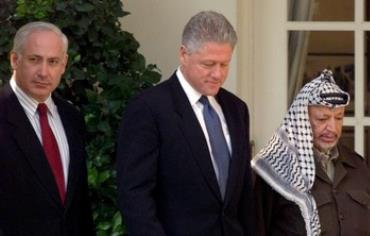
Binyamin Netanyahu, Bill Clinton and Yasser Arafat Photo: REUTERS
...Since we cannot defeat Israel in war, we do this in stages. We take any and every territory that we can of Palestine, and establish a sovereignty there, and we use it as a springboard to take more. When the time comes, we can get the Arab nations to join us for the final blow against Israel
– Yasser Arafat, Jordanian TV, September 13, 1993 (the day he signed the Oslo Accords on the White House Lawn)
The idea of a two-state solution should be dead, today, because unfortunately a Palestinian state in Judea and Samaria would bring about Israel’s demise – Yuval Steinitz, The Jerusalem Post, September 14, 2008
...Belief in the inevitable implementation of the [two-state solution -"TSS"] as the format for resolution of the Israel-Palestinian conflict has acquired the status of a quasi-religious article of faith, whose validity is self-evident, requiring no proof.
...Of course, quite the opposite is true. For over the past two post-Oslo decades, ever since Israel has accepted the notion of two states for two peoples, the conflict with the Palestinians has escalated and Israel’s isolation has increased ...
...With regard to the level of conflict, based on data from the Foreign Ministry, during the 12 years following the Oslo Agreement (1994-2005) the number of terror-related fatalities was almost six(!) times those incurred in the 12 years prior to it (1981-1992); and significantly higher than ALL terror-related fatalities in the 44 years following the War of Independence until the dawn of the Oslo-era (1949- 1992).
With regard to international isolation, contrary to prevailing urban legend, one would be hard pressed to find any state of substantial international standing that set up diplomatic relations with Israel after the conclusion of the Oslo Accords in September 1993.
For example, China, India and Russia, which together comprise almost 40 percent of humanity, and had long avoided diplomatic ties with Israel, opened embassies in the country almost two years previously – under the recalcitrant, rejectionist government of Yitzhak Shamir.
By contrast, a glance at the Foreign Ministry website will reveal that the vast majority of nations that established official contacts with Israel in the wake of the Oslo initiative were hardly of crucial importance to its international stature – with all due respect to exotic locations such as Andorra, Burkina Faso, Botswana, Bosnia/Herzegovina, Burundi, Cape Verde, Croatia, East Timor, Equatorial Guinea, Macedonia, Madagascar, Mauritania, Montenegro, Namibia, Nauru, Rwanda, San Marino, Sao Tome & Principe, Vanuatu and Zimbabwe – which make up the overwhelming bulk of the post- Oslo additions to countries maintaining diplomatic relations with Israel.
Conversely – and perversely? – delegitimization of Israel appears to have intensified in the post-Oslo period.
For example, the infamous “Durban” series of conferences took place after Israel had adopted a TSS-compliant policy.
The 2001-Durban conference (Durban I) was held only a few months after Ehud Barak’s far-reaching peace offer to Arafat, and provided a high-profile platform for a myriad of anti-Israel NGOs to peddle their noxious wares.
The subsequent “Durban II” (Geneva, 2009) and “Durban III” (New York, 2011) conferences comprised the “Durban process” which one prominent authority characterized as follows: “The objective of the Durban process is to use human rights and international law terminology to isolate, demonize and delegitimize Israel... this process manifests itself in various ways: the academic boycott campaigns in the UK; a variety of boycotts in Scandinavian countries; divestment in churches and in Norway; ‘lawfare’ cases brought against Israelis in various European countries. All these take their mandate from the 2001 NGO Forum at the Durban Conference and... work toward reinforcing its resolutions.”
The egregious Boycott, Divestment and Sanctions movement, which is acquiring disturbing momentum of late, is a post-Oslo initiative, launched in mid-2005, just weeks prior to the unilateral withdrawal from Gaza, and over a year after the hyperhawk Ariel Sharon declared that “we are willing to proceed toward its implementation: two states – Israel and a Palestinian state living side by side in tranquility, security and peace.”
...According to [American Jewish Committee director, David] Harris, “Israel owe[s] itself the obligation to leave no stone unturned in seeing if a partner, absent yesterday, might somehow show up today. And if, miracle of miracles, the Palestinian leadership actually turns out to be a credible partner this time, then, of course, all the more reason to try.”
Wrong...! The supposed sincerity of the Palestine negotiating partner’s peaceable intentions is...at least, largely-irrelevant to whether or not negotiations should be undertaken. What is far more pertinent is his ability – and that of any prospective successor – to honor them. Or does Harris feel comfortable with Israel making perilous concessions, if, as in Gaza, they could fall to radical extremists? Has he any way to ensure they will not? And if he can’t, isn’t he being wildly shortsighted in urging taking such risks?
And should the talks fail, Harris would have us believe that “if the Palestinians once again prove they are unwilling partners, as they did in 2000-1 and again in 2008, let the world see who torpedoed a potential deal.”
...Has Harris forgotten the wrenching concessions Israel has made over the past decades – the unrequited unilateral 10-month freeze on construction in the “settlements”; withdrawal from major populations centers in Judea-Samaria; unilateral evacuation of Gaza, and erasure of every vestige of Jewish presence there; the unearthing of its dead from their graves; the demolition of settlements in northern Samaria; permitting armed militias to deploy adjacent to its capital, within mortar range of its parliament?
To all these the Palestinians responded with Judeocidal terror and Judeophobic incitement.
Surely, if after all this, the penny still hasn’t dropped, what possible reason is there for any farsighted person to believe the offer of further concessions will do the trick? Or is Harris suggesting forlorn hope as a national strategy?
According to Harris, “Israel must never hesitate to show up at any serious negotiating table.”
It is of course questionable whether the current coerced talks, with an unrepresentative and aging PA president, in office now for almost nine years of his elected four-year term and whose continued incumbency is far from certain, comprises a “serious negotiating table.”
However, putting that thorny issue aside, it is difficult to imagine any worse a negotiating strategy than declaring almost unconditional willingness to negotiate – especially in the Middle East.
...: Given the infinitesimal geographical distances from major Israeli population centers and the topographical dominance over vital Israeli infrastructure any Palestinian state [west of the Jordan river] would have, Harris’s prescription for “the need for extraordinarily careful attention to security arrangements in any two-state deal” is little more than lip service, designed to fob off profound concerns which in reality can never be satisfied...
In the final analysis, between the River and the Sea there will exist either exclusive Jewish sovereignty or exclusive Arab sovereignty. The side that will prevail is the side whose national will is the stronger and whose political vision is the sharper....
Binyamin Netanyahu, Bill Clinton and Yasser Arafat Photo: REUTERS
...Since we cannot defeat Israel in war, we do this in stages. We take any and every territory that we can of Palestine, and establish a sovereignty there, and we use it as a springboard to take more. When the time comes, we can get the Arab nations to join us for the final blow against Israel
– Yasser Arafat, Jordanian TV, September 13, 1993 (the day he signed the Oslo Accords on the White House Lawn)
The idea of a two-state solution should be dead, today, because unfortunately a Palestinian state in Judea and Samaria would bring about Israel’s demise – Yuval Steinitz, The Jerusalem Post, September 14, 2008
...Belief in the inevitable implementation of the [two-state solution -"TSS"] as the format for resolution of the Israel-Palestinian conflict has acquired the status of a quasi-religious article of faith, whose validity is self-evident, requiring no proof.
...Of course, quite the opposite is true. For over the past two post-Oslo decades, ever since Israel has accepted the notion of two states for two peoples, the conflict with the Palestinians has escalated and Israel’s isolation has increased ...
...With regard to the level of conflict, based on data from the Foreign Ministry, during the 12 years following the Oslo Agreement (1994-2005) the number of terror-related fatalities was almost six(!) times those incurred in the 12 years prior to it (1981-1992); and significantly higher than ALL terror-related fatalities in the 44 years following the War of Independence until the dawn of the Oslo-era (1949- 1992).
With regard to international isolation, contrary to prevailing urban legend, one would be hard pressed to find any state of substantial international standing that set up diplomatic relations with Israel after the conclusion of the Oslo Accords in September 1993.
For example, China, India and Russia, which together comprise almost 40 percent of humanity, and had long avoided diplomatic ties with Israel, opened embassies in the country almost two years previously – under the recalcitrant, rejectionist government of Yitzhak Shamir.
By contrast, a glance at the Foreign Ministry website will reveal that the vast majority of nations that established official contacts with Israel in the wake of the Oslo initiative were hardly of crucial importance to its international stature – with all due respect to exotic locations such as Andorra, Burkina Faso, Botswana, Bosnia/Herzegovina, Burundi, Cape Verde, Croatia, East Timor, Equatorial Guinea, Macedonia, Madagascar, Mauritania, Montenegro, Namibia, Nauru, Rwanda, San Marino, Sao Tome & Principe, Vanuatu and Zimbabwe – which make up the overwhelming bulk of the post- Oslo additions to countries maintaining diplomatic relations with Israel.
Conversely – and perversely? – delegitimization of Israel appears to have intensified in the post-Oslo period.
For example, the infamous “Durban” series of conferences took place after Israel had adopted a TSS-compliant policy.
The 2001-Durban conference (Durban I) was held only a few months after Ehud Barak’s far-reaching peace offer to Arafat, and provided a high-profile platform for a myriad of anti-Israel NGOs to peddle their noxious wares.
The subsequent “Durban II” (Geneva, 2009) and “Durban III” (New York, 2011) conferences comprised the “Durban process” which one prominent authority characterized as follows: “The objective of the Durban process is to use human rights and international law terminology to isolate, demonize and delegitimize Israel... this process manifests itself in various ways: the academic boycott campaigns in the UK; a variety of boycotts in Scandinavian countries; divestment in churches and in Norway; ‘lawfare’ cases brought against Israelis in various European countries. All these take their mandate from the 2001 NGO Forum at the Durban Conference and... work toward reinforcing its resolutions.”
The egregious Boycott, Divestment and Sanctions movement, which is acquiring disturbing momentum of late, is a post-Oslo initiative, launched in mid-2005, just weeks prior to the unilateral withdrawal from Gaza, and over a year after the hyperhawk Ariel Sharon declared that “we are willing to proceed toward its implementation: two states – Israel and a Palestinian state living side by side in tranquility, security and peace.”
...According to [American Jewish Committee director, David] Harris, “Israel owe[s] itself the obligation to leave no stone unturned in seeing if a partner, absent yesterday, might somehow show up today. And if, miracle of miracles, the Palestinian leadership actually turns out to be a credible partner this time, then, of course, all the more reason to try.”
Wrong...! The supposed sincerity of the Palestine negotiating partner’s peaceable intentions is...at least, largely-irrelevant to whether or not negotiations should be undertaken. What is far more pertinent is his ability – and that of any prospective successor – to honor them. Or does Harris feel comfortable with Israel making perilous concessions, if, as in Gaza, they could fall to radical extremists? Has he any way to ensure they will not? And if he can’t, isn’t he being wildly shortsighted in urging taking such risks?
And should the talks fail, Harris would have us believe that “if the Palestinians once again prove they are unwilling partners, as they did in 2000-1 and again in 2008, let the world see who torpedoed a potential deal.”
...Has Harris forgotten the wrenching concessions Israel has made over the past decades – the unrequited unilateral 10-month freeze on construction in the “settlements”; withdrawal from major populations centers in Judea-Samaria; unilateral evacuation of Gaza, and erasure of every vestige of Jewish presence there; the unearthing of its dead from their graves; the demolition of settlements in northern Samaria; permitting armed militias to deploy adjacent to its capital, within mortar range of its parliament?
To all these the Palestinians responded with Judeocidal terror and Judeophobic incitement.
Surely, if after all this, the penny still hasn’t dropped, what possible reason is there for any farsighted person to believe the offer of further concessions will do the trick? Or is Harris suggesting forlorn hope as a national strategy?
According to Harris, “Israel must never hesitate to show up at any serious negotiating table.”
It is of course questionable whether the current coerced talks, with an unrepresentative and aging PA president, in office now for almost nine years of his elected four-year term and whose continued incumbency is far from certain, comprises a “serious negotiating table.”
However, putting that thorny issue aside, it is difficult to imagine any worse a negotiating strategy than declaring almost unconditional willingness to negotiate – especially in the Middle East.
...: Given the infinitesimal geographical distances from major Israeli population centers and the topographical dominance over vital Israeli infrastructure any Palestinian state [west of the Jordan river] would have, Harris’s prescription for “the need for extraordinarily careful attention to security arrangements in any two-state deal” is little more than lip service, designed to fob off profound concerns which in reality can never be satisfied...
In the final analysis, between the River and the Sea there will exist either exclusive Jewish sovereignty or exclusive Arab sovereignty. The side that will prevail is the side whose national will is the stronger and whose political vision is the sharper....
U.S. ‘black budget’ summary admits spying on Israel
From The Washington Post, 30 August 2013 , by Barton Gellman and Greg Miller:
U.S. spy agencies have built an intelligence-gathering colossus since the attacks of Sept. 11, 2001..according to the government’s top-secret budget.
The $52.6 billion “black budget” for fiscal 2013, obtained by The Washington Post from former intelligence contractor Edward Snowden, maps a bureaucratic and operational landscape that has never been subject to public scrutiny. ...
The 178-page budget summary for the National Intelligence Program details the successes, failures and objectives of the 16 spy agencies that make up the U.S. intelligence community, which has 107,035 employees...
Among the notable revelations in the budget summary:
●Spending by the CIA has surged past that of every other spy agency, with $14.7 billion in requested funding for 2013. The figure vastly exceeds outside estimates and is nearly 50 percent above that of the National Security Agency, which conducts eavesdropping operations and has long been considered the behemoth of the community.
●The CIA and the NSA have begun aggressive new efforts to hack into foreign computer networks to steal information or sabotage enemy systems, embracing what the budget refers to as “offensive cyber operations.”
●Long before Snowden’s leaks, the U.S. intelligence community worried about “anomalous behavior” by employees and contractors with access to classified material. The NSA planned to ward off a “potential insider compromise of sensitive information” by re-investigating at least 4,000 people this year who hold high-level security clearances.
●U.S. intelligence officials take an active interest in friends as well as foes. ...counterintelligence operations “are strategically focused against [the] priority targets of China, Russia, Iran, Cuba and Israel.” ...
...The summary provides a detailed look at how the U.S. intelligence community has been reconfigured by the massive infusion of resources that followed the 2001 attacks. The United States has spent more than $500 billion on intelligence during that period...
The result is an espionage empire with resources and a reach...sustained even now by spending that rivals or exceeds the levels at the height of the Cold War.
The current total budget request was 2.4 percent below that of fiscal 2012. In constant dollars, it was about twice the estimated size of the 2001 budget and 25 percent above that of 2006, five years into what was then known as the “global war on terror.”
Historical data on U.S. intelligence spending is largely nonexistent. Through extrapolation, experts have estimated that Cold War spending probably peaked in the late 1980s at an amount that would be the equivalent of $71 billion today.
Spending in the most recent cycle surpassed that amount, based on the $52.6 billion detailed in documents obtained by The Post plus a separate $23 billion devoted to intelligence programs that more directly support the U.S. military...
Follow the link to read this lengthy article in full.
U.S. spy agencies have built an intelligence-gathering colossus since the attacks of Sept. 11, 2001..according to the government’s top-secret budget.
The $52.6 billion “black budget” for fiscal 2013, obtained by The Washington Post from former intelligence contractor Edward Snowden, maps a bureaucratic and operational landscape that has never been subject to public scrutiny. ...
The 178-page budget summary for the National Intelligence Program details the successes, failures and objectives of the 16 spy agencies that make up the U.S. intelligence community, which has 107,035 employees...
Among the notable revelations in the budget summary:
●Spending by the CIA has surged past that of every other spy agency, with $14.7 billion in requested funding for 2013. The figure vastly exceeds outside estimates and is nearly 50 percent above that of the National Security Agency, which conducts eavesdropping operations and has long been considered the behemoth of the community.
●The CIA and the NSA have begun aggressive new efforts to hack into foreign computer networks to steal information or sabotage enemy systems, embracing what the budget refers to as “offensive cyber operations.”
●Long before Snowden’s leaks, the U.S. intelligence community worried about “anomalous behavior” by employees and contractors with access to classified material. The NSA planned to ward off a “potential insider compromise of sensitive information” by re-investigating at least 4,000 people this year who hold high-level security clearances.
●U.S. intelligence officials take an active interest in friends as well as foes. ...counterintelligence operations “are strategically focused against [the] priority targets of China, Russia, Iran, Cuba and Israel.” ...
...The summary provides a detailed look at how the U.S. intelligence community has been reconfigured by the massive infusion of resources that followed the 2001 attacks. The United States has spent more than $500 billion on intelligence during that period...
The result is an espionage empire with resources and a reach...sustained even now by spending that rivals or exceeds the levels at the height of the Cold War.
The current total budget request was 2.4 percent below that of fiscal 2012. In constant dollars, it was about twice the estimated size of the 2001 budget and 25 percent above that of 2006, five years into what was then known as the “global war on terror.”
Historical data on U.S. intelligence spending is largely nonexistent. Through extrapolation, experts have estimated that Cold War spending probably peaked in the late 1980s at an amount that would be the equivalent of $71 billion today.
Spending in the most recent cycle surpassed that amount, based on the $52.6 billion detailed in documents obtained by The Post plus a separate $23 billion devoted to intelligence programs that more directly support the U.S. military...
Follow the link to read this lengthy article in full.
Friday, August 30, 2013
US Military Intervention in Syria: The Broad Strategic Purpose, Beyond Punitive Action
From INSS Insight No. 459, August 29, 2013, by Amos Yadlin and Avner Golov:
.... In light of the conclusion by
Western intelligence agencies – reflected in the statement by US Secretary of
State John Kerry – that the Assad regime is responsible for using chemical weapons,
the US government is considering a military response...
5. A prolonged aerial attack against critical regime assets that allow Assad to conduct the fighting against the rebels, such as headquarters and weapons bases. In this type of large scale attack, it would be possible to attack ground, air, and naval forces as well as advanced weaponry. This is an option that would impact on the balance of power between Assad and the rebels and convey a message of American resolve that could undermine the regime's sense of security. This option, which involves direct American involvement in the Syrian civil war and places Assad in a new and difficult position, involves a relatively high risk of sucking the United States into the civil war.
6. Gaining control and destroying chemical weapons in Syria. This is the most direct option against the threat that Assad will use chemical weapons again or that the rebels will resort to this tactic. However, seizing and destroying the stores of chemical weapons in Syria’s possession is an operation requiring the use of special forces in Syria for a prolonged period until all of the chemical material has been destroyed. In this scenario, there is a risk that a small quantity of chemical weapons would reach hostile elements. Therefore, before this option is used, there should be an examination of how possible it is to reduce the use of chemical weapons by strengthening US deterrent power through one of the other options, and it should be made clear that the United States is determined to act in the event of further use of chemical weapons.
The declared US
objective is to punish Assad for the use of chemical weapons and to deter him
from further use of these weapons. Undeclared but no less important American
goals would be to
- damage the Syrian president’s sense of security;
- bring about an end to the slaughter, including the “conventional” slaughter; and
- bring about an end to the civil war.
In order to promote
these goals, President Obama should restore the deterrent power of the United
States. The President, who announced a red line that if crossed would generate
a response, has avoided acting until now. American restraint has strengthened
Assad’s sense of security and encouraged him to expand the scope of his
operations against the rebels and his attacks against innocent civilians. This
restraint has also strengthened the assessment in Moscow that supporting Assad
demonstrates to the world Russia's loyalty to its allies and its principles, in
contrast to the United States, which allegedly abandons its allies and
hesitates to stand up for its principles.
A very important
American interest is to weaken the radical axis – Iran, Syria, and Hizbollah –
which negates American values and interests. The American aversion to an
operation encouraged Hizbollah to intervene in Syria, and this intervention
succeeded in changing the momentum in the Syrian civil war in Assad’s favor.
Western vacillation has strengthened both Russia, which continues to support
the Assad regime, and the jihadi organizations, which have grown stronger while
the United States has failed to act. The organizations that have remained the
weakest are actually the pro-Western secular organizations, which are vital to
Syria's ability to establish a liberal, democratic regime the day after Assad
falls. It is an American interest to attempt to change the momentum in favor of
these organizations.
Weakening the
Tehran-Damascus-Beirut axis and the jihadi organizations would also reduce the
fear of undermining stability along Syria’s borders with Turkey, Jordan, and
Israel, all US allies in the region. Indeed, the continued current trend toward
instability could lead to an expansion of the cycle of violence in other states
in the region.
Tension sometimes
exists between a state's moral obligation and its interests, but for the United
States there is no such tension regarding Syria. From a moral perspective, the
fact that Assad’s army’s carried out a large scale attack with chemical weapons
clearly cannot be ignored. This is not an isolated case, but merely
continuation of a policy that does not shy away from slaughtering civilians
through the massive use of inaccurate and destructive weapons, including
chemical weapons. This policy has cost the lives of over 100,000 people thus
far and has turned millions of Syrian citizens into refugees. American
vacillation in response to the massacres has only increased Assad's brazenness.
Rebel organizations have also become more daring as Assad has expanded his acts
of slaughter.
At this time, there
is no military option that could immediately stop the slaughter in Syria, force
Assad to leave, and ensure a moderate, democratic regime. Therefore, all the
existing options, including continuation of American restraint, are less than
optimal, if not poor. Yet given the understanding that a lack of action is a
very bad strategy – it is not moral and it harms American interests – what
constitutes the best of the bad strategies?
...there
are six strategies other than an all-out attack a la Iraq in 2003. General
Martin Dempsey, Chairman of the Joint Chiefs of Staff, discussed these options
in a letter to Congressman Eliot Engel on August 19, 2013, two days before
the chemical attack in Damascus...
... What follows is a brief analysis of each of the options.
... What follows is a brief analysis of each of the options.
1. “What was, is what
will be,”
i.e.., increased training and armaments for the rebels. This involves training
for rebel forces outside of Syria, aid in establishing an effective chain of
command, and transferring a significant amount of weaponry while incurring the
risk that the advanced weaponry reaches terrorist organizations in Syria.
President Obama has already declared that the United States will arm the
rebels. While the United States has not yet fully implemented this policy, even
full implementation will not at this stage be a convincing sign of change in
American policy and the determination of the United States to change the
balance of power in Syria. Although this strategy could have been appropriate
until several weeks ago, it does not provide an appropriate response at this
point, specifically, after the latest chemical attack.
2. A pinpoint “punitive”
attack.
The attack would be limited in scope, localized, and of short duration,
targeting the units that took part in the recent chemical attack, military
targets, or regime assets. This option would constitute a change in US policy
and strengthen American credibility, but its chances of restoring US deterrent
power are slim. This localized retribution would not change the reality in
Syria in a significant way. It has the ability to prevent large scale use of
chemical weapons, such as what took place on August 21, 2013, but it is
doubtful that if would have an impact on Assad’s considerations regarding the
continued massacre of his people.
4. Demilitarized zones near the border with
Turkey and Jordan and humanitarian corridors. The goal here is to create a
haven for the civilian population and reduce the scope of the slaughter in
Syria, with the possibility of creating humanitarian aid corridors for people
already wounded. Like the previous alternative, this requires ongoing
maintenance and requires the entry of ground forces. If this option is chosen,
the forces maintaining the demilitarized zones and humanitarian corridors would
not be American. Turkish soldiers would maintain the corridors near the border
with Turkey and Jordanian soldiers would maintain the areas near the border
with Jordan. Cooperation with moderate organizations associated with the rebels
can also help maintain the areas within Syria.
5. A prolonged aerial attack against critical regime assets that allow Assad to conduct the fighting against the rebels, such as headquarters and weapons bases. In this type of large scale attack, it would be possible to attack ground, air, and naval forces as well as advanced weaponry. This is an option that would impact on the balance of power between Assad and the rebels and convey a message of American resolve that could undermine the regime's sense of security. This option, which involves direct American involvement in the Syrian civil war and places Assad in a new and difficult position, involves a relatively high risk of sucking the United States into the civil war.
6. Gaining control and destroying chemical weapons in Syria. This is the most direct option against the threat that Assad will use chemical weapons again or that the rebels will resort to this tactic. However, seizing and destroying the stores of chemical weapons in Syria’s possession is an operation requiring the use of special forces in Syria for a prolonged period until all of the chemical material has been destroyed. In this scenario, there is a risk that a small quantity of chemical weapons would reach hostile elements. Therefore, before this option is used, there should be an examination of how possible it is to reduce the use of chemical weapons by strengthening US deterrent power through one of the other options, and it should be made clear that the United States is determined to act in the event of further use of chemical weapons.
Policy
Recommendations
An analysis of the
relevant options available to President Obama indicates the need for a strategy
combining the third, fourth, and fifth alternatives toward direct, gradual US
intervention. This strategy, beyond punishing Assad, would change the rules of the
game in Syria and deter the regime from further use of chemical
weapons.
A strategy of combined, gradual intervention would include an attack on selected strategic targets as punishment for the chemical attack in the Damascus suburbs and declaration of a no-fly zone. In a second step, the United States could also declare demilitarized zones and humanitarian corridors and attack a number of regime assets if Assad escalates his response.
A strategy of combined, gradual intervention would include an attack on selected strategic targets as punishment for the chemical attack in the Damascus suburbs and declaration of a no-fly zone. In a second step, the United States could also declare demilitarized zones and humanitarian corridors and attack a number of regime assets if Assad escalates his response.
The
Obama administration has designed a national security policy that initiates
intervention only when the supreme national interest is at risk and there is as
broad legitimacy as possible. It appears that Washington's assessment is that
Assad’s recent actions threaten the supreme American interest. The
administration should promote a joint military action in the broadest possible
framework in the Security Council. If vetoed by Russia, the United States
should involve its own allies in the region – Turkey, which has already
announced its support for a US action, Saudi Arabia, Qatar, Jordan, and Israel,
with the possibility of also involving Egypt in order to improve relations
between the states.
American planning should also include a diplomatic response to Russian opposition and readiness to deter Iran and Hizbollah from expanding the battlefield.
Such a US military action would not resolve the Syrian conflict, but it is the least problematic of the bad options.
Together with an initiative for a political settlement, it could very likely promote the strategic goals of replacing the Assad regime, inflicting defeat on the radical camp, restoring American deterrence and credibility toward Iran, and strengthening US alliances in the Middle East.
American planning should also include a diplomatic response to Russian opposition and readiness to deter Iran and Hizbollah from expanding the battlefield.
Such a US military action would not resolve the Syrian conflict, but it is the least problematic of the bad options.
Together with an initiative for a political settlement, it could very likely promote the strategic goals of replacing the Assad regime, inflicting defeat on the radical camp, restoring American deterrence and credibility toward Iran, and strengthening US alliances in the Middle East.
Tuesday, August 27, 2013
Syria strike coming in days
From JPost, 27 August 2013, b
![US destroyer fires Tomahawk cruise missile in Mediterranean [file]](http://www.jpost.com/HttpHandlers/ShowImage.ashx?id=225499&h=236&w=370 "US destroyer fires Tomahawk cruise missile in Mediterranean [file]")
US destroyer fires Tomahawk cruise missile in Mediterranean [file] Photo: REUTERS
AMMAN/BEIRUT/BANDAR SERI BEGAWAN
Western powers told the Syrian opposition to expect a strike against President Bashar Assad's forces within days, according to sources who attended a meeting between envoys and the Syrian National Coalition in Istanbul.
...According to the sources, opposition members provided western military authorities with a list of Assad regime targets to hit.
The meeting at a hotel in downtown Istanbul was between senior figures of the Syrian National Coalition, including its president Ahmad Jarba, and envoys from 11 core "Friends of Syria" alliance members, that included US envoy Robert Ford, the top US official handling the Syria file, the sources said.
US Defense Secretary Chuck Hagel said in a television interview with the BBC on Tuesday that the US military is ready to act immediately should President Barack Obama order action against Syria over a chemical weapons attack.
"We have moved assets in place to be able to fulfill and comply with whatever option the president wishes to take," Hagel said during a trip to Brunei, according to a partial transcript provided by the BBC.
Asked if the US military was ready to respond just "like that," Hagel said: "We are ready to go, like that."
US allies were drafting plans for air strikes and other military action against Syria on Tuesday, as Assad's enemies vowed to punish a poison gas attack that Washington called a "moral obscenity".
Facing Russian and Chinese disapproval that will complicate hopes for a united front backed by international law, and keen to win over wary voters at home, Western leaders seem in no rush to pull the trigger. British Prime Minister David Cameron called parliament back from recess for a session on Syria on Thursday.
UN experts trying to establish what killed hundreds of civilians in rebel-held suburbs of Damascus last Wednesday were finally able to cross the frontline on Monday to see survivors - despite being shot at in government-held territory. But they put off a second visit until Wednesday.
However, US officials said Obama already had little doubt Assad's forces were to blame. Turkey, Syria's neighbor and part of the US-led NATO military pact, called it a "crime against humanity" that demanded international reaction.
The Syrian government, which denies using gas, said it would press on with its offensive against rebels around the capital. Foreign Minister Walid Moualem said US strikes would help al-Qaida allies but called Western leaders "delusional" if they hoped to aid the rebels to create a balance of power in Syria.
In Britain, whose forces have supported the US military in a succession of wars, Cameron called for an appropriate level of retribution for using chemical weapons.
"Our forces are making contingency plans," a spokesman for Cameron told reporters. London and its allies would make a "proportionate response" to the "utterly abhorrent" attack.
Top generals from the United States and European and Middle Eastern allies met in Jordan for what could be a council of war.
As strike on Syria looms, Israelis scramble for gas masks
From Times of Israel, August 26, 2013, by Adiv Sterman:
Citizens fear chemical retaliation in light of assessments US preparing to attack the Assad regime

Cause for concern? The recent tension along the northern border has caused a spike in demand for gas masks. (photo credit: Yonatan Sindel/Flash90)
Requests for gas masks among Israelis saw a major increase on Sunday and Monday, reflecting growing concern among the country’s citizens of a possible Syrian chemical attack following assessments that the US will soon launch a military assault on the war-torn country.
Israeli post offices, which serve as distribution points for gas masks, reported receiving 300 percent more phone calls on Sunday and Monday than on an average day from people who wished to acquire protection kits. More than twice as many people than average approached the distribution points themselves.
...According to numbers released by the government, only 60% of Israelis currently possess gas masks.
Britain on Monday reportedly pushed for US action on Syria in the wake of a horrific alleged chemical weapons attack on civilians outside Damascus. According to a report from the Times of London, British Prime Minister David Cameron wants a strike in the coming days, while outrage over the alleged attack is still fresh. Foreign Secretary William Hague said in an interview with the BBC on Monday that action could be taken even without the full support of the UN Security Council.
US Secretary of State John Kerry on Monday stated unequivocally that Washington believes Syrian President Bashar Assad was behind the attack and attempted to cover up evidence to that effect in its aftermath.
Israeli military officials have indicated they believe it’s unlikely that Syria would target Israel if the US or others intervened, but Israel has reportedly been taking security precautions.
Syrian and Iranian officials delivered an explicit warning to Israel Monday, saying in no uncertain terms that the Jewish state would be attacked in the event of a Western-led strike on Syria.
The Totalitarian Muslim Brotherhood
From Middle East Forum, July 4, 2013, by Raymond Ibrahim, World Watch Monitor:
The Muslim Brotherhood is the most important Islamic organization in the world, with ...influence everywhere, both in the Islamic world but also in the West, wherever its purpose—the establishment of a Sharia-enforcing caliphate—can be achieved. ...
A school teacher and imam, Banna was reportedly very charismatic and pivotal to the subsequent growth of the movement, which, when he started it in 1922, consisted of only a handful of members but had burgeoned to half a million in as little as little as ten years. Banna did one thing that not only gave rise and prominence to the Muslim Brotherhood, but all Islamist organizations as well, including al-Qaeda, which is currently headed by Ayman Zawahiri, a onetime Muslim Brotherhood member: he helped politicize Islam [again]...
.... A few centuries after the chaotic times of the Islamic conquests, Islamic law, or Sharia (etymologically related to the words meaning "way" and "road") was developed and held sway over Islamic lands, in this case Egypt for centuries. ... For example, courts were all ruled according to Sharia dictates; the caliph, again, according to Sharia, was obligated to wage war, or jihad, on his non-Muslim neighbors; and so forth.
However, a new thing happened in 1798: a Frenchman—an infidel, Napoleon—invaded and conquered Egypt. This heralded a new paradigm—that the infidel West (then and often now seen as Christendom) was stronger, and thus better, than the Islamic world. To appreciate this idea fully, one must first understand that,
...since the time of the Muslim prophet Muhammad, the veracity of Islam and its Sharia have been tied to its temporal success, its ability to aggrandize and enrich its followers with land and warbooty, including slaves.When Muhammad was just a "prophet" preaching to the Arabs, he spent a decade with nothing but a handful of followers. But when he styled himself as a warlord, attacking and plundering those who did not accept him as prophet, and thereby acquiring many victories and even more war booty for his growing number of followers, Arabians acquiesced to him and his message. Thus, from the start, the veracity of the prophet was tied to his military and temporal successes.
The Islamic conquests, whereby Islam's invading armies conquered much of the Old World—from India in the east to Spain in the west—were especial proof that the Islamic way, the Sharia, was the right way.
The West's conquest and subsequent colonization shook this paradigm to its core [in 1798...Napoleon—invaded and conquered Egypt. This heralded a new paradigm—that the infidel West (then and often now seen as Christendom) was stronger, and thus better, than the Islamic world]... causing the majority of nominal Muslims to turn to the West and essentially westernize.
...Such was the Egypt that Banna and others inherited. To overcome nearly two centuries of westernization, whereby most Egyptians knew little more about Islam than the five pillars, if that, Banna politicized Islam, making it as it once was. However, he and his followers eventually realized that their message would only resonate if:
1) they took a grass-roots approach to mobilizing Muslims—an approach which inevitably took longer, in this case decades, almost a century, but which as we are seeing has yielded great fruit, and 2) they instituted activism and propaganda, which eventually led to a complex, multi-layered organization, with members from all walks of life, from peasants to professionals .
The Muslim Brotherhood took advantage of pre-existing Islamic organizations—politicizing them, Islamizing them, and mobilizing them.
Accordingly, many businesses, schools, and other organizations became attached to the Brotherhood, either formally or informally, as they continue to do to this day. Decades of this further fueled by the group's humanitarian work with laypeople, led to an immense sense of loyalty to the group and always attracted new recruits.
No matter how humanitarian or social, Banna's message, and the Brotherhood's, was/is always couched in Islamic terms. Whether talking about colonialism, health-related issues, education, or nationalism, everything was articulated through an Islamic framework, subtly re-Islamizing the average Egyptian's worldview.
Major themes always hammered out included the loss of the caliphate, the weakness of the fragmented Islamic world, and the need to revive the caliphate and enforce Sharia law—the Islamic "way," which was and is always portrayed as the supreme guide to justice and fair dealing.
It is significant to note that, though several General Guides of the Muslim Brotherhood have come and gone since Banna, the latter's overall strategy and tactics have generally remained fixed, depending on the vicissitudes of the times, and the MB's capacities and position vis-à-vis its opponents. To be sure, and perhaps inevitably, the MB, once it became relatively powerful, did engage in terror attacks, especially against the Nasser government, and ended up being outlawed. Banna himself was killed by government forces in 1949.
Due to its popularity, the MB was briefly legalized again, but only as a religious organization, and then banned again in 1954 due to its non-stop insistence that Egypt be governed under Sharia. Egyptian officials were assassinated, with attempts on Nasser's life as well. The government retaliated swiftly, outlawing the group, imprisoning and torturing thousands of members, while others fled to sympathetic nations, especially Wahhabi Saudi Arabia.
A few of the greatest MB leaders and agitators were also executed at this time. One member who was executed under Gamal in 1966 is of special note: Sayyid Qutb—today known as the "godfather" of modern Islamism. Perhaps no figure has impacted the modern Islamist movement as this man, who wrote prolifically and voluminously especially during his incarceration, producing two "classics" that are today still staples of any serious Islamist or jihadi: (in translation) In the Shade of the Quran (a multi-volume exegesis) and Sign Posts, a short primer that very well captures the phase-by-phase approach of the Muslim Brotherhood, the need to use both prudence and act only according to the reality on the ground, the chances of success. While Qutb stressed the need for stages, he also popularized the jihadi movement by arguing that the Islamic world was not sufficiently Islamic and thus needed a jihadi vanguard to overthrow jahiliyya, or the pre-Islamic state of ignorance the Muslim world was currently in.
According to the 9/11 Commission Report, "Three basic themes emerge from Qutb's writings. First, he claimed that the world was beset with barbarism, licentiousness, and unbelief (a condition he called jahiliyya, the religious term for the period of ignorance prior to the revelations given to the prophet Mohammed). Qutb argued that humans can choose only between Islam and jahiliyya. Second, he warned that more people, including Muslims, were attracted to jahiliyya and its material comforts than to his view of Islam; jahiliyya could therefore triumph over Islam. Third, no middle ground exists in what Qutb conceived as a struggle between God and Satan. All Muslims—as he defined them—therefore must take up arms in this fight. Any Muslim who rejects his ideas is just one more nonbeliever worthy of destruction."
The influence of the Muslim Brotherhood's Qutb's writings cannot be underestimated, as they are quoted regularly by modern-day Islamists. Even al-Qaeda leader Zawahiri regularly quotes Qutb in his writings. Due to Qutb's popularity with terrorists, the Brotherhood's leadership eventually distanced itself from him, openly advocating instead a nonviolent "reformist" strategy from within, which it has followed ever since. [Until the popular June 30, 2013 revolution that overthrew President Morsi, which prompted the Brotherhood to openly engage in violence and terror, seeing they had been exposed and have nothing to lose.]
Due to the popularity of the MB—those many decades of cultivating Egyptian society were not for nothing—Nasser's successor, Anwar al-Sadat, released a great many of their number from the prisons and promised to institute Sharia in Egypt, leading to the introduction of the Second Article of the Egyptian Constitution, which made Islamic law (Sharia) the principal source of jurisprudence. (Ironically it is this matter concerning the Constitution and how Islamic it will be that has created a major rift in Egyptian society today, with Muslim Brotherhood President Muhammad Morsi—and all Islamist factions—pushing for an even greater role for Islam, and portraying as "infidels" and "apostates" all who would resist.)
Even so, Sadat's gesture to Sharia was not enough: after he signed a peace treaty with Israel, the Brotherhood and other Islamic groups constantly agitated against him and he was shortly thereafter assassinated in 1981. In the Mubarak era the group was once again formally outlawed even as independent members were allowed in parliament. But both containment and appeasement were too late: the revivalist spirit of Islam was in the air; banning or arresting individuals was not enough.
Accordingly, after nearly a century of Islamic activism and propaganda by the Muslim Brotherhood, the Egyptian worldview that for some generations had been emulating the West as the path to success has diminished by degrees, decade after decade, slowly becoming more Islamic in orientation. With the 2011 revolt in Egypt, which started with moderates and secularists seeking true democracy, all Islamists were released from the prisons—including Egypt's current [now deposed] president—and they now dominate the life of the nation. For the first time, then, not only is the Brotherhood fueling society from a grass-roots level, but from a top-down approach.
Although many Islamic groups have developed since the inception of the MB, many of them born of it. Equally significant, by and large, all Sunni Islamic organizations—including al-Qaeda and the Taliban—want the same thing the Brotherhood does: a Sharia-enforcing caliphate. They differ primarily on how this goal is to be achieved.
Consider the MB's slogan:
"Allah is our objective; the Quran is our law; the Prophet is our leader; Jihad is our way; and death for the sake of Allah is the highest of our aspirations."
This credo represents a statement that even the most radical, jihadi Muslim would embrace, for it captures all the essentials of radical and jihadi Islam, the sort of Islam practiced by terrorist organizations.
Similarly, the Brotherhood's English language website describes the "principles of the Muslim Brotherhood" as including firstly the introduction of the Islamic Sharia as "the basis for controlling the affairs of state and society"; and secondly working to unify "Islamic countries and states, mainly among the Arab states, and liberating them from foreign imperialism." In other words, working to unite the Muslim world under a caliphate which it still openly insists is its ultimate goal. Indeed, not too long ago, Muhammad Badie, the current General Guide of the Brotherhood [arrested August 19, 2013], openly declared that "The Imam [Bana] delineated transitional goals and detailed methods to achieve this greatest objective, starting by reforming the individual, followed by building the family, the society, the government, and then a rightly guided caliphate and finally mastership of the world."
This idea of "transitional goals" and objectives for every stage is captured very well by the Brotherhood's vision and is very easily captured by the one word that appears under the Muslim Brotherhood banner of two swords crossed over the Koran, "prepare"—a word taken from Koran 8:60:
"And prepare against them whatever you are able of power and of steeds of war by which you may terrorize the enemy of Allah and your enemy and others besides them whom you do not know [but] whom Allah knows. And whatever you spend in the cause of Allah will be fully repaid to you, and you will not be wronged."
In short, the Muslim Brotherhood is dedicated to preparing the way for the coming of the caliphate—which, if history is any indicator, is much more problematic than any one, single Islamic state or terrorist organization: all Islamic conquests of non-Muslim, mostly Christian lands occurred under caliphates, including the Umayyad, Abbasid, and of course, the Turkish Ottoman State.
Having explored some of the history and doctrines of the Muslim Brotherhood, some relevant questions are in order. First, comprehending the motives of the Muslim Brotherhood continues to be difficult for people in the West, whose epistemology for centuries has always separated the realm of religion from the realm of politics. Is the Muslim Brotherhood a political group, or is it a religious group? Such questions plague the West. The fact is, it is both—for in Islam, historically and doctrinally, Islam is politics. The word "sharia" simply means "way", that is, the Islamic way of conducting affairs. It governs every aspect of the believer's life (in Islam, all possible acts are classified according to five categories: obligatory, recommended, permissible, not recommended, and forbidden). Muslim authorities are deemed legitimate or illegitimate based primarily on whether they enforce Sharia on society or not. In fact, this has historically been the grievance that the various Islamist and jihadi groups—beginning with the Brotherhood—have had against the ruling governments and regimes of their respective nations—that they have not been enforcing Sharia law in society.
It bears repeating: the overarching goal of all Islamist and jihadi groups the world over is the establishment of "Allah's rule" on earth. From its inception, this has also been the Muslim Brotherhood's goal—hence the reason it is heavily involved in politics.
The primary disagreement more violent Islamists and jihadis have with the Brotherhood has to do with tactics—not the overall vision which they all share: establishment, enforcement, and then spread of Sharia law. Jihadis have long argued that, by (at least formally) disavowing violence—that is, jihad—and instead participating in politics in order to achieve power and implement Sharia, the Muslim Brotherhood has betrayed the call to jihad. For instance, Ayman al-Zawahiri, the current leader of al-Qaeda, was also a former Muslim Brotherhood member when he was fifteenyears old. However, he was soon lured by the call to jihad, abandoned the group, and joined more radical groups in Egypt, including Al-Gam'a Al-Islamiyya (the "Islamic Group") and Islamic Jihad.
Ayman al-Zawahiri is an interesting case in point concerning the tactics of the Brotherhood and its detractors. Many years after he quit the Brotherhood in the late 1960s when he was a teenager, Zawahiri wrote an entire book criticizing the Muslim Brotherhood. Titled Al Hissad Al Murr, or "The Bitter Harvest", Zawahiri argued that the Brotherhood "takes advantage of the Muslim youths' fervor by bringing them into the fold only to store them in a refrigerator. Then, they steer their one-time passionate, Islamic zeal for jihad to conferences and elections…. And not only have the Brothers been idle from fulfilling their duty of fighting to the death, but they have gone as far as to describe the infidel governments as legitimate, and have joined ranks with them in the ignorant style of governing, that is, democracies, elections, and parliaments."
Ironically, however, for all his scathing remarks against them, time has revealed that the Muslim Brotherhood's strategy of slowly infiltrating society by a grass-roots approach has been much more effective than Zawahiri's and al-Qaeda's jihadi terror [until, that is, fellow Egyptians and Muslims saw them for what they were and overthrew them; in the West, however, subtle infiltration still works better than terrorism and is still the preferred strategy].
The Brotherhood's patience and perseverance, by playing the political game, co-opting Western language and paradigms, formally disavowing violence and jihad, have turned it into a legitimate player in the eyes of many, to the point that the U.S. government has become supportive of it, even though it was once banned.
Yet this does not make the Brotherhood's goals any less troubling. For instance, in July 2012, Safwat Hegazy, a popular preacher and Brotherhood member [since arrested for incitement to terrorism], boasted that the Brotherhood will be "masters of the world, one of these days." Likewise, according to Kamil al-Najjar, who left the Muslim Brotherhood and is currently living under threat of death, "They are trying to deceive the people and they have managed to deceive a lot of Western politicians into believing in them. Their only aim is to control the world with Islam. They know they cannot use force to convert the West, so they use deceit." Even Gamal al-Banna, the brother of the founder of the Muslim Brotherhood, had harsh words for the movement his brother founded, saying it totally rejects freedom.
Egypt's Salafis—who are identical to al-Qaeda and other radical Muslims in that they seek literally to emulate the 7th century Muslim prophet Muhammed and the earliest Muslims, who were quite violent and intolerant—are another case in point. Released from the jails and now in parliaments around the Arab world, following the "Arab Spring", Salafis represent the al-Qaeda-type Muslims who, while initially contemptuous of the Brotherhood's political game of patience, have seen the rewards the Brotherhood has nonetheless earned, and thus are also trying to "moderate" their approach, leading to some incongruous moments. Thus, while the Salafi Nour ("Light") Party ran in Egypt's elections, engaged in democracy, and otherwise played the political game, they rarely hid the fact that they saw democracy and elections as a contemptible means to one end—Sharia law. Thus, one Salafi cleric appears on video telling Muslims to commit voter fraud if they can to see that an Islamist candidate wins; another portrayed elections as a jihad, saying that whoever dies during voting becomes a martyr. Unlike the Brotherhood, whose members have learned to master the art of taqiyya over the course of decades(dissembling has become almost second nature to them), the Salafis—who share the same ideology as al-Qaeda (that is, that open Islam must be practiced now, with force if necessary) have still not fully learned to play the game, and are simply too honest concerning their designs.
It is perhaps ironic that the Brotherhood's greatest opponents at the current time are not Western governments or human rights groups but Egyptians themselves, including a great many Muslims. Western analysts — here I speak of those who understand the threat of the Muslim Brotherhood — sometimes forget that, whatever the Brotherhood's goals are, to a great many of those Egyptians supportive of the group, they see something entirely different. To them, Islam is goodness, and Sharia is justice—so what is so bad about wanting to implement Sharia, as the Brotherhood has long maintained? This is why Muhammad Morsi received slightly more than 50% of Egypt's vote (and that is with widespread allegations of voter fraud). Many Egyptians, used to the humanitarian side of the Brotherhood—as mentioned, like its Hamas offshoot, the Brotherhood won many people over by its social programs—did not think of an overtly Islamist agenda; or, if they did, to their minds an Islamist agenda meant goodness and justice not wholly unlike in the Western sense (which of course many Muslims are still influenced by).
However, mere months after Morsi became president, he began replacing many key governmental and media positions with Brotherhood members. Worse, he introduced a new Constitution that had a strong Islamist element. Many critics pointed out that the wording was always ambiguous, but in all cases, Sharia was portrayed as the ultimate arbitrator in several aspects. Accordingly, Egyptians rose up against Morsi, in protest after protest—arguing that Egypt is not a "Brotherhood organization" to be run like one. At one point, the forcefulness of the attacks drove him from the presidential palace under the cover of dark. ...The main reason such Egyptians are disgusted with Morsi has less to do with Islamism and more to do with the fact that Egyptians are still suffering economically and socially, in fact even worse than under Mubarak. Accordingly, Morsi is increasingly seen as more interested in empowering his group and the Islamist agenda than he is in the betterment of Egypt...
Brotherhood had very little to do with the beginnings of the January 25 2011 revolution of Egypt, which saw the ousting of 30-years-long ruler Hosni Mubarak. Indeed, in the early stages, the Muslim Brotherhood leadership forbade young members from participating in the revolt—although many did so anyway. There is even a video of President Muhammad Morsi, in the early stages of the revolution, mocking it, saying "What do you think you'll achieve?"
The reason for this reticence was, of course, not because of any great love for Mubarak, but rather because the Brotherhood likely thought that Mubarak would ultimately prevail, quash the revolution, and then quietly target all those leaders who participated. The Obama administration seems also to have shared this view, for it originally expressed support for Mubarak during the early days of the protest, though it later abandoned him.
The Egyptian Revolution, which followed the Tunisian revolution, was fundamentally a product of the huge frustration of the average Egyptian, especially regarding the immensely poor economic conditions, where many college graduates could not and cannot get a simple job—certainly not one to enable settling down and starting a family, which, in Egyptian society, is the norm. However, the only group outside the government that was so well organized and prepared to exploit the situation was the Muslim Brotherhood—the primary oppositional group to the government for decades. Many relatively new Egyptian secular parties, for example, complained that presidential and parliamentary elections were conducted too soon after the fall of Mubarak for them to properly mobilize and campaign. But the Brotherhood was ready. Moreover, as mentioned earlier, the idea of Islam as the immediate solution for all of Egypt's woes had become very popular among especially the less educated Egyptians—who make up the majority of the nation.
Nor did the U.S. State Department's meddling help. As Andrew McCarthy put it, Hillary Clinton did "her part to help the Muslim Brotherhood," by pressuring the military to surrender power and portraying its delay to proclaim a winner as "clearly troubling"— words better reserved for the Muslim Brotherhood's anti-democratic tactics.
1) as the oldest and best organized Muslim organization, it has had ample time and experience to expand, network, and propagate its message around the world and
2) the message it is propagating is usually not seen by Muslims as a "Brotherhood" message but rather an Islamic message, hence its popularity and appeal.
This is an important point that needs to be kept in mind as we explore some of the regions where the Brotherhood is present and influencing society. Because its goals are one and the same with all other Islamists—resurrection of a caliphate and enforcement of Islamic law—it often works in unison with other Islamic organizations, making it especially difficult to determine when an organization is a Brotherhood outfit and when it is simply a likeminded ally. This phenomenon occurs also with jihadi organizations: all too often individual jihadis are in the West conflated with al-Qaeda, under the assumption that all who engage in jihadi activities are al-Qaeda members. Yet often the reality is that there is no affiliation—except, of course, in ideology and tactics. Likewise, although many Islamic organizations maintain close symbolic and ideological ties with the Muslim Brotherhood, they remain largely autonomous.
The heart of the Muslim Brotherhood is also the region it was born: Egypt, which represents the core of the movement. The second layer of presence and influence is the region nearest to Egypt, the Middle East, especially Lebanon, Syria, Sudan, Jordan, Iraq, the PA territories, and even throughout the Arabian Peninsula. The third and most recent—and perhaps the most important—region is the West, Europe and North America.
Altogether, it is believed that the Brotherhood is present in some 70 countries around the world.
We have already examined the Muslim Brotherhood in Egypt. As for its next layer of presence and influence, the Middle East, especially those countries closest to Egypt, the following are some of the more important areas where the Brotherhood is known to exist and operate. It is important to note that, as in Egypt, many of these Brotherhood affiliates were founded in direct opposition to the ruling regimes of their respective countries, portrayed as the "moral", "Islamic" substitute for the "secular", "westernized", and, in short, corrupt ruling regimes:
Arabian Peninsula: many Brotherhood members, after being driven out of Egypt in the 1950s and afterwards, found sympathizers and asylum in the Gulf nations. Many of them settled there, influencing those societies, especially by agitating against the authorities. For example, in Saudi Arabia, Brotherhood members formed the Awakening (Sahwa) group, which challenged the legitimacy of the Saudi crown. In nations such as the United Arab Emirates and Qatar, Brotherhood members exploited the media presence there, most notably Al Jazeera, to influence Muslims both in and beyond the region with the Brotherhood narrative and propaganda. [This has proven especially true after the June 30, 2013 revolution, as Al Jazeera has unabashedly proven that it is the Brotherhood's mouthpiece, distorting and manipulating news for the group's benefit.] Brotherhood members have also, as in Egypt, gained many seats in parliaments throughout the Gulf. For example, in Kuwait, through the Hadas movement; in Yemen through the Islah movement; and in Bahrain through the Minbar party, which, since 2002, has been the largest elected party. Saudi Interior Minister Prince Nayef denounced the Brotherhood, saying it was guilty of "betrayal of pledges and ingratitude" and was "the source of all problems in the Islamic world". On the other hand, many Brotherhood members and their descendants who settled in the Peninsula were themselves further radicalized by Saudi Arabia's ultra-Islamic, Wahhabi worldview, bringing it back with them to Egypt and their other countries of origin. The Salafis seem to be the hybrid result of Egyptian Brotherhood mentality mixed with Saudi Wahhabism. Again, this points to the symbiotic relationship that exists between all Islamic groups, for they are all ultimately rooted in the same immutable sources: the Koran and the teachings of Muhammad, as captured in the Hadith, and relayed in the Sunna.
Iraq: under Saddam Hussein, the Iraqi Islamic Party—the largest Sunni Islamic political party and a branch of the Muslim Brotherhood—was banned in the 1960s and forced underground for its religious agitations. It reemerged soon after the U.S. toppled Hussein, and has since been a harsh critic of the U.S. while simultaneously taking part in government and in the transitional process.
Iran: although a predominately Shia Muslim country, and the Muslim Brotherhood is Sunni in doctrine, it is clear that the Muslim Brotherhood, the modern-day pioneers of political Islam, have influenced the Shia of Iran. For example, Nava Safari, who founded Fada'iyan-e Islam, an Iranian Islamic organization active in Iran in the 1940s and 50s, was highly impressed by the Muslim Brotherhood. From 1945 to 1951 the Fadain assassinated several high level Iranian personalities and officials who they believed to be un-Islamic, including anti-clerical writer Ahmad Kasravi, Premier Haj Ali Razmara, former Premier Abdolhossein Hazhir and Education and Culture Minister Ahmad Zangeneh. Again, it must be stressed that, even within the Sunni-Shia divide, which is very real, much cooperation exists, specifically in the context of resurrecting a caliphate and enforcing Sharia. The prevailing logic is that the greater enemy is the infidel (U.S., Israel, etc.), and that it is beneficial for all Muslims to work together for their subjugation. Then they may resume their internal struggle for overall mastery.
Jordan: the Brotherhood is represented by the Islamic Action Front, which was founded in the 1940s and has deeply influenced segments of society through charity, propaganda, and indoctrination. At various times, and under various leaders, it has vacillated between militancy—often influenced by Palestinian elements—and the Brotherhood's hallmark approach of patience and perseverance, working with the Hashemite rulers. To be sure, during the 2011 uprisings, the group became much more assertive. Having failed, it has now slipped back into the diplomatic course, calling for internal, peaceful reforms.
In North Africa, west of Egypt, the Brotherhood's existence has again been positioned in the context of resisting secular/corrupt rulers, this time, the colonial powers themselves. For example, in Algeria, Brotherhood members took part in the nation's war of independence from France. Due to their calls for Sharia, they were eventually marginalized by the secular FLN
party. In Tunisia, the Brotherhood has had a strong impact on that nation's Islamists, particularly al-Nahda, which was formed in 1989 and was largely inspired by the Brotherhood. Since the Tunisian revolution, al-Nahda has received widespread support, and is the new government's most influential voice. In Libya, Brotherhood members have been present since at least the 1940s, when King Idris offered them refuge from Egypt. After Colonel Gaddafi seized power, he, like all other Arab leaders, seeing the threat of the Brotherhood, worked hard to eliminate them. However, they maintained a presence there, and most notably were involved in the
opposition that overthrew Gaddafi.
PA Territories: Hamas, which maintains a militant, jihadi wing, is a Brotherhood offshoot, founded during the First Intifada in 1987. Like its parent organization, it quickly became popular with the Palestinian people in large part because of its charitable services. And like its parent organization, over the years it has managed to indoctrinate the average Palestinian Muslim through its propaganda. While Hamas is dedicated to the elimination of the state of Israel, in fact this objective ties in very well with the overall objective of the Muslim Brotherhood: the global resurrection of a caliphate. After all, any number of Muslims—including many influential Egyptian Brotherhood members—maintain that the seat of the caliphate must be Jerusalem. Thus, even though an organization like Hamas seems to be engaged in a "different" endeavor—the elimination of Israel—in fact, this objective corresponds very well to Brotherhood objectives, and is seen as just one more necessary phase.
Syria: the Brotherhood has been present there for decades and, after the Ba'th party took over in 1963, it became the main Sunni opposition force against the Alawite Assad clan. Resonating with the Sunni majority of Syria, the Brotherhood in many ways spearheaded a violent revolt against the then President Hafiz Assad. However, it was crushed in the 1982 Hama uprising. Afterwards, the group was largely politically inactive in the country, although it maintained a strong support network there—a perfect example of the difficulties involved in determining who a formal Brotherhood affiliate is, and who simply shares their exact worldview, and thus is a natural ally and affiliate. The ongoing uprisings against Assad have a strong Brotherhood element, especially among the Islamist/Salafi factions. A recent Washington Post article describes the Brotherhood as playing a "dominant" role.
Sudan: the Brotherhood maintains a significant, though informal, presence, and has played an important role in the mass Islamization campaigns the Khartoum regime has carried out, often in the context of genocide. Brotherhood members make up a large part of the current Khartoum regime, following the 1989 coup d'état by General Omar Hassan al-Bashir. The National Islamic Front (originally the Islamic Chart Front) which grew during the 1960s, with Islamic scholar Hasan al-Turabi becoming its Secretary General in 1964, is a Brotherhood offshoot.
As for the third layer of the Muslim Brotherhood—its newest and perhaps most important layer of presence—the West, in Europe, formerly Christendom, and home of the original infidel par excellence, the Brotherhood has made great strides in recent years, growing as it has with the large influx of Muslim immigrants and their offspring in Europe.
It operates often under the umbrella of other Muslim organizations, which appear innocuous, such as the Federation of Islamic Organizations in Europe, the Forum of European Muslim Youth and Student Organizations, and the European Council for Fatwa and Research. The group is also involved in setting up a vast and sophisticated network of mosques, schools, and Islamic charities.
Russia: the Muslim Brotherhood is banned there.
United States: the Brotherhood is also in America, where, according to one captured document, the Brotherhood "understand their work in America is a grand jihad in eliminating and destroying Western civilization from within and sabotaging its miserable house by their hands so that Allah's religion [Islam] is victorious over all religions." Accordingly, the Brotherhood has founded and/or works under the cover of several prominent Muslim organizations in America, including the Council on American-Islam Relations ("CAIR"), the Muslim Students' Association (MSA), the Islamic Society of North America (ISNA), the Islamic Circle of North America (ICNA), and the Muslim American Society (MAS).
With lots of funding and organization, and a Western willingness to dialogue with Muslims, the Brotherhood has naturally taken over, and received much legitimacy from European governments, convinced as they are that, by giving the most prominent Muslim organizations much representation, Westerners are demonstrating their "tolerance".
The Muslim Brotherhood is the most important Islamic organization in the world, with ...influence everywhere, both in the Islamic world but also in the West, wherever its purpose—the establishment of a Sharia-enforcing caliphate—can be achieved. ...
History and Approach
... Hassan al-Banna (1906-1949), the son of a mosque imam and Sheikh of the Hanbali school of law, founded the Muslim Brotherhood. Hassan incorporated Sufi views, which tend to be more moderate and which teach, among other things, pragmatism and patience. Of course, in an Islamic context pragmatism and patience can easily take on the form of taqiyya and tawriya—Islamic doctrines that instruct Muslims to deceive when it is perceived to be in Islam's interest—and may well explain how Banna came to develop the Muslim Brotherhood's way of operating, to be discussed further below.A school teacher and imam, Banna was reportedly very charismatic and pivotal to the subsequent growth of the movement, which, when he started it in 1922, consisted of only a handful of members but had burgeoned to half a million in as little as little as ten years. Banna did one thing that not only gave rise and prominence to the Muslim Brotherhood, but all Islamist organizations as well, including al-Qaeda, which is currently headed by Ayman Zawahiri, a onetime Muslim Brotherhood member: he helped politicize Islam [again]...
.... A few centuries after the chaotic times of the Islamic conquests, Islamic law, or Sharia (etymologically related to the words meaning "way" and "road") was developed and held sway over Islamic lands, in this case Egypt for centuries. ... For example, courts were all ruled according to Sharia dictates; the caliph, again, according to Sharia, was obligated to wage war, or jihad, on his non-Muslim neighbors; and so forth.
However, a new thing happened in 1798: a Frenchman—an infidel, Napoleon—invaded and conquered Egypt. This heralded a new paradigm—that the infidel West (then and often now seen as Christendom) was stronger, and thus better, than the Islamic world. To appreciate this idea fully, one must first understand that,
...since the time of the Muslim prophet Muhammad, the veracity of Islam and its Sharia have been tied to its temporal success, its ability to aggrandize and enrich its followers with land and warbooty, including slaves.When Muhammad was just a "prophet" preaching to the Arabs, he spent a decade with nothing but a handful of followers. But when he styled himself as a warlord, attacking and plundering those who did not accept him as prophet, and thereby acquiring many victories and even more war booty for his growing number of followers, Arabians acquiesced to him and his message. Thus, from the start, the veracity of the prophet was tied to his military and temporal successes.
The Islamic conquests, whereby Islam's invading armies conquered much of the Old World—from India in the east to Spain in the west—were especial proof that the Islamic way, the Sharia, was the right way.
The West's conquest and subsequent colonization shook this paradigm to its core [in 1798...Napoleon—invaded and conquered Egypt. This heralded a new paradigm—that the infidel West (then and often now seen as Christendom) was stronger, and thus better, than the Islamic world]... causing the majority of nominal Muslims to turn to the West and essentially westernize.
...Such was the Egypt that Banna and others inherited. To overcome nearly two centuries of westernization, whereby most Egyptians knew little more about Islam than the five pillars, if that, Banna politicized Islam, making it as it once was. However, he and his followers eventually realized that their message would only resonate if:
1) they took a grass-roots approach to mobilizing Muslims—an approach which inevitably took longer, in this case decades, almost a century, but which as we are seeing has yielded great fruit, and 2) they instituted activism and propaganda, which eventually led to a complex, multi-layered organization, with members from all walks of life, from peasants to professionals .
The Muslim Brotherhood took advantage of pre-existing Islamic organizations—politicizing them, Islamizing them, and mobilizing them.
Accordingly, many businesses, schools, and other organizations became attached to the Brotherhood, either formally or informally, as they continue to do to this day. Decades of this further fueled by the group's humanitarian work with laypeople, led to an immense sense of loyalty to the group and always attracted new recruits.
No matter how humanitarian or social, Banna's message, and the Brotherhood's, was/is always couched in Islamic terms. Whether talking about colonialism, health-related issues, education, or nationalism, everything was articulated through an Islamic framework, subtly re-Islamizing the average Egyptian's worldview.
Major themes always hammered out included the loss of the caliphate, the weakness of the fragmented Islamic world, and the need to revive the caliphate and enforce Sharia law—the Islamic "way," which was and is always portrayed as the supreme guide to justice and fair dealing.
It is significant to note that, though several General Guides of the Muslim Brotherhood have come and gone since Banna, the latter's overall strategy and tactics have generally remained fixed, depending on the vicissitudes of the times, and the MB's capacities and position vis-à-vis its opponents. To be sure, and perhaps inevitably, the MB, once it became relatively powerful, did engage in terror attacks, especially against the Nasser government, and ended up being outlawed. Banna himself was killed by government forces in 1949.
Due to its popularity, the MB was briefly legalized again, but only as a religious organization, and then banned again in 1954 due to its non-stop insistence that Egypt be governed under Sharia. Egyptian officials were assassinated, with attempts on Nasser's life as well. The government retaliated swiftly, outlawing the group, imprisoning and torturing thousands of members, while others fled to sympathetic nations, especially Wahhabi Saudi Arabia.
A few of the greatest MB leaders and agitators were also executed at this time. One member who was executed under Gamal in 1966 is of special note: Sayyid Qutb—today known as the "godfather" of modern Islamism. Perhaps no figure has impacted the modern Islamist movement as this man, who wrote prolifically and voluminously especially during his incarceration, producing two "classics" that are today still staples of any serious Islamist or jihadi: (in translation) In the Shade of the Quran (a multi-volume exegesis) and Sign Posts, a short primer that very well captures the phase-by-phase approach of the Muslim Brotherhood, the need to use both prudence and act only according to the reality on the ground, the chances of success. While Qutb stressed the need for stages, he also popularized the jihadi movement by arguing that the Islamic world was not sufficiently Islamic and thus needed a jihadi vanguard to overthrow jahiliyya, or the pre-Islamic state of ignorance the Muslim world was currently in.
According to the 9/11 Commission Report, "Three basic themes emerge from Qutb's writings. First, he claimed that the world was beset with barbarism, licentiousness, and unbelief (a condition he called jahiliyya, the religious term for the period of ignorance prior to the revelations given to the prophet Mohammed). Qutb argued that humans can choose only between Islam and jahiliyya. Second, he warned that more people, including Muslims, were attracted to jahiliyya and its material comforts than to his view of Islam; jahiliyya could therefore triumph over Islam. Third, no middle ground exists in what Qutb conceived as a struggle between God and Satan. All Muslims—as he defined them—therefore must take up arms in this fight. Any Muslim who rejects his ideas is just one more nonbeliever worthy of destruction."
The influence of the Muslim Brotherhood's Qutb's writings cannot be underestimated, as they are quoted regularly by modern-day Islamists. Even al-Qaeda leader Zawahiri regularly quotes Qutb in his writings. Due to Qutb's popularity with terrorists, the Brotherhood's leadership eventually distanced itself from him, openly advocating instead a nonviolent "reformist" strategy from within, which it has followed ever since. [Until the popular June 30, 2013 revolution that overthrew President Morsi, which prompted the Brotherhood to openly engage in violence and terror, seeing they had been exposed and have nothing to lose.]
Due to the popularity of the MB—those many decades of cultivating Egyptian society were not for nothing—Nasser's successor, Anwar al-Sadat, released a great many of their number from the prisons and promised to institute Sharia in Egypt, leading to the introduction of the Second Article of the Egyptian Constitution, which made Islamic law (Sharia) the principal source of jurisprudence. (Ironically it is this matter concerning the Constitution and how Islamic it will be that has created a major rift in Egyptian society today, with Muslim Brotherhood President Muhammad Morsi—and all Islamist factions—pushing for an even greater role for Islam, and portraying as "infidels" and "apostates" all who would resist.)
Even so, Sadat's gesture to Sharia was not enough: after he signed a peace treaty with Israel, the Brotherhood and other Islamic groups constantly agitated against him and he was shortly thereafter assassinated in 1981. In the Mubarak era the group was once again formally outlawed even as independent members were allowed in parliament. But both containment and appeasement were too late: the revivalist spirit of Islam was in the air; banning or arresting individuals was not enough.
Accordingly, after nearly a century of Islamic activism and propaganda by the Muslim Brotherhood, the Egyptian worldview that for some generations had been emulating the West as the path to success has diminished by degrees, decade after decade, slowly becoming more Islamic in orientation. With the 2011 revolt in Egypt, which started with moderates and secularists seeking true democracy, all Islamists were released from the prisons—including Egypt's current [now deposed] president—and they now dominate the life of the nation. For the first time, then, not only is the Brotherhood fueling society from a grass-roots level, but from a top-down approach.
Goals, Objectives, and Other Islamists
What is the ultimate goal of the Muslim Brotherhood?Although many Islamic groups have developed since the inception of the MB, many of them born of it. Equally significant, by and large, all Sunni Islamic organizations—including al-Qaeda and the Taliban—want the same thing the Brotherhood does: a Sharia-enforcing caliphate. They differ primarily on how this goal is to be achieved.
Consider the MB's slogan:
"Allah is our objective; the Quran is our law; the Prophet is our leader; Jihad is our way; and death for the sake of Allah is the highest of our aspirations."
This credo represents a statement that even the most radical, jihadi Muslim would embrace, for it captures all the essentials of radical and jihadi Islam, the sort of Islam practiced by terrorist organizations.
Similarly, the Brotherhood's English language website describes the "principles of the Muslim Brotherhood" as including firstly the introduction of the Islamic Sharia as "the basis for controlling the affairs of state and society"; and secondly working to unify "Islamic countries and states, mainly among the Arab states, and liberating them from foreign imperialism." In other words, working to unite the Muslim world under a caliphate which it still openly insists is its ultimate goal. Indeed, not too long ago, Muhammad Badie, the current General Guide of the Brotherhood [arrested August 19, 2013], openly declared that "The Imam [Bana] delineated transitional goals and detailed methods to achieve this greatest objective, starting by reforming the individual, followed by building the family, the society, the government, and then a rightly guided caliphate and finally mastership of the world."
This idea of "transitional goals" and objectives for every stage is captured very well by the Brotherhood's vision and is very easily captured by the one word that appears under the Muslim Brotherhood banner of two swords crossed over the Koran, "prepare"—a word taken from Koran 8:60:
"And prepare against them whatever you are able of power and of steeds of war by which you may terrorize the enemy of Allah and your enemy and others besides them whom you do not know [but] whom Allah knows. And whatever you spend in the cause of Allah will be fully repaid to you, and you will not be wronged."
In short, the Muslim Brotherhood is dedicated to preparing the way for the coming of the caliphate—which, if history is any indicator, is much more problematic than any one, single Islamic state or terrorist organization: all Islamic conquests of non-Muslim, mostly Christian lands occurred under caliphates, including the Umayyad, Abbasid, and of course, the Turkish Ottoman State.
Having explored some of the history and doctrines of the Muslim Brotherhood, some relevant questions are in order. First, comprehending the motives of the Muslim Brotherhood continues to be difficult for people in the West, whose epistemology for centuries has always separated the realm of religion from the realm of politics. Is the Muslim Brotherhood a political group, or is it a religious group? Such questions plague the West. The fact is, it is both—for in Islam, historically and doctrinally, Islam is politics. The word "sharia" simply means "way", that is, the Islamic way of conducting affairs. It governs every aspect of the believer's life (in Islam, all possible acts are classified according to five categories: obligatory, recommended, permissible, not recommended, and forbidden). Muslim authorities are deemed legitimate or illegitimate based primarily on whether they enforce Sharia on society or not. In fact, this has historically been the grievance that the various Islamist and jihadi groups—beginning with the Brotherhood—have had against the ruling governments and regimes of their respective nations—that they have not been enforcing Sharia law in society.
It bears repeating: the overarching goal of all Islamist and jihadi groups the world over is the establishment of "Allah's rule" on earth. From its inception, this has also been the Muslim Brotherhood's goal—hence the reason it is heavily involved in politics.
The primary disagreement more violent Islamists and jihadis have with the Brotherhood has to do with tactics—not the overall vision which they all share: establishment, enforcement, and then spread of Sharia law. Jihadis have long argued that, by (at least formally) disavowing violence—that is, jihad—and instead participating in politics in order to achieve power and implement Sharia, the Muslim Brotherhood has betrayed the call to jihad. For instance, Ayman al-Zawahiri, the current leader of al-Qaeda, was also a former Muslim Brotherhood member when he was fifteenyears old. However, he was soon lured by the call to jihad, abandoned the group, and joined more radical groups in Egypt, including Al-Gam'a Al-Islamiyya (the "Islamic Group") and Islamic Jihad.
Ayman al-Zawahiri is an interesting case in point concerning the tactics of the Brotherhood and its detractors. Many years after he quit the Brotherhood in the late 1960s when he was a teenager, Zawahiri wrote an entire book criticizing the Muslim Brotherhood. Titled Al Hissad Al Murr, or "The Bitter Harvest", Zawahiri argued that the Brotherhood "takes advantage of the Muslim youths' fervor by bringing them into the fold only to store them in a refrigerator. Then, they steer their one-time passionate, Islamic zeal for jihad to conferences and elections…. And not only have the Brothers been idle from fulfilling their duty of fighting to the death, but they have gone as far as to describe the infidel governments as legitimate, and have joined ranks with them in the ignorant style of governing, that is, democracies, elections, and parliaments."
Ironically, however, for all his scathing remarks against them, time has revealed that the Muslim Brotherhood's strategy of slowly infiltrating society by a grass-roots approach has been much more effective than Zawahiri's and al-Qaeda's jihadi terror [until, that is, fellow Egyptians and Muslims saw them for what they were and overthrew them; in the West, however, subtle infiltration still works better than terrorism and is still the preferred strategy].
The Brotherhood's patience and perseverance, by playing the political game, co-opting Western language and paradigms, formally disavowing violence and jihad, have turned it into a legitimate player in the eyes of many, to the point that the U.S. government has become supportive of it, even though it was once banned.
Yet this does not make the Brotherhood's goals any less troubling. For instance, in July 2012, Safwat Hegazy, a popular preacher and Brotherhood member [since arrested for incitement to terrorism], boasted that the Brotherhood will be "masters of the world, one of these days." Likewise, according to Kamil al-Najjar, who left the Muslim Brotherhood and is currently living under threat of death, "They are trying to deceive the people and they have managed to deceive a lot of Western politicians into believing in them. Their only aim is to control the world with Islam. They know they cannot use force to convert the West, so they use deceit." Even Gamal al-Banna, the brother of the founder of the Muslim Brotherhood, had harsh words for the movement his brother founded, saying it totally rejects freedom.
Egypt's Salafis—who are identical to al-Qaeda and other radical Muslims in that they seek literally to emulate the 7th century Muslim prophet Muhammed and the earliest Muslims, who were quite violent and intolerant—are another case in point. Released from the jails and now in parliaments around the Arab world, following the "Arab Spring", Salafis represent the al-Qaeda-type Muslims who, while initially contemptuous of the Brotherhood's political game of patience, have seen the rewards the Brotherhood has nonetheless earned, and thus are also trying to "moderate" their approach, leading to some incongruous moments. Thus, while the Salafi Nour ("Light") Party ran in Egypt's elections, engaged in democracy, and otherwise played the political game, they rarely hid the fact that they saw democracy and elections as a contemptible means to one end—Sharia law. Thus, one Salafi cleric appears on video telling Muslims to commit voter fraud if they can to see that an Islamist candidate wins; another portrayed elections as a jihad, saying that whoever dies during voting becomes a martyr. Unlike the Brotherhood, whose members have learned to master the art of taqiyya over the course of decades(dissembling has become almost second nature to them), the Salafis—who share the same ideology as al-Qaeda (that is, that open Islam must be practiced now, with force if necessary) have still not fully learned to play the game, and are simply too honest concerning their designs.
It is perhaps ironic that the Brotherhood's greatest opponents at the current time are not Western governments or human rights groups but Egyptians themselves, including a great many Muslims. Western analysts — here I speak of those who understand the threat of the Muslim Brotherhood — sometimes forget that, whatever the Brotherhood's goals are, to a great many of those Egyptians supportive of the group, they see something entirely different. To them, Islam is goodness, and Sharia is justice—so what is so bad about wanting to implement Sharia, as the Brotherhood has long maintained? This is why Muhammad Morsi received slightly more than 50% of Egypt's vote (and that is with widespread allegations of voter fraud). Many Egyptians, used to the humanitarian side of the Brotherhood—as mentioned, like its Hamas offshoot, the Brotherhood won many people over by its social programs—did not think of an overtly Islamist agenda; or, if they did, to their minds an Islamist agenda meant goodness and justice not wholly unlike in the Western sense (which of course many Muslims are still influenced by).
However, mere months after Morsi became president, he began replacing many key governmental and media positions with Brotherhood members. Worse, he introduced a new Constitution that had a strong Islamist element. Many critics pointed out that the wording was always ambiguous, but in all cases, Sharia was portrayed as the ultimate arbitrator in several aspects. Accordingly, Egyptians rose up against Morsi, in protest after protest—arguing that Egypt is not a "Brotherhood organization" to be run like one. At one point, the forcefulness of the attacks drove him from the presidential palace under the cover of dark. ...The main reason such Egyptians are disgusted with Morsi has less to do with Islamism and more to do with the fact that Egyptians are still suffering economically and socially, in fact even worse than under Mubarak. Accordingly, Morsi is increasingly seen as more interested in empowering his group and the Islamist agenda than he is in the betterment of Egypt...
The Arab Spring
This leads to the questions of the Arab Spring—which was pivotally important for the empowerment of the Muslim Brotherhood: What was it? Who was behind it? How and why did the Muslim Brotherhood most benefit from it? All evidence indicates that the MuslimBrotherhood had very little to do with the beginnings of the January 25 2011 revolution of Egypt, which saw the ousting of 30-years-long ruler Hosni Mubarak. Indeed, in the early stages, the Muslim Brotherhood leadership forbade young members from participating in the revolt—although many did so anyway. There is even a video of President Muhammad Morsi, in the early stages of the revolution, mocking it, saying "What do you think you'll achieve?"
The reason for this reticence was, of course, not because of any great love for Mubarak, but rather because the Brotherhood likely thought that Mubarak would ultimately prevail, quash the revolution, and then quietly target all those leaders who participated. The Obama administration seems also to have shared this view, for it originally expressed support for Mubarak during the early days of the protest, though it later abandoned him.
The Egyptian Revolution, which followed the Tunisian revolution, was fundamentally a product of the huge frustration of the average Egyptian, especially regarding the immensely poor economic conditions, where many college graduates could not and cannot get a simple job—certainly not one to enable settling down and starting a family, which, in Egyptian society, is the norm. However, the only group outside the government that was so well organized and prepared to exploit the situation was the Muslim Brotherhood—the primary oppositional group to the government for decades. Many relatively new Egyptian secular parties, for example, complained that presidential and parliamentary elections were conducted too soon after the fall of Mubarak for them to properly mobilize and campaign. But the Brotherhood was ready. Moreover, as mentioned earlier, the idea of Islam as the immediate solution for all of Egypt's woes had become very popular among especially the less educated Egyptians—who make up the majority of the nation.
Nor did the U.S. State Department's meddling help. As Andrew McCarthy put it, Hillary Clinton did "her part to help the Muslim Brotherhood," by pressuring the military to surrender power and portraying its delay to proclaim a winner as "clearly troubling"— words better reserved for the Muslim Brotherhood's anti-democratic tactics.
The Muslim Brotherhood's Reach and Presence
Both formally but especially informally, the Brotherhood's reach is immense. Two reasons account for this:1) as the oldest and best organized Muslim organization, it has had ample time and experience to expand, network, and propagate its message around the world and
2) the message it is propagating is usually not seen by Muslims as a "Brotherhood" message but rather an Islamic message, hence its popularity and appeal.
This is an important point that needs to be kept in mind as we explore some of the regions where the Brotherhood is present and influencing society. Because its goals are one and the same with all other Islamists—resurrection of a caliphate and enforcement of Islamic law—it often works in unison with other Islamic organizations, making it especially difficult to determine when an organization is a Brotherhood outfit and when it is simply a likeminded ally. This phenomenon occurs also with jihadi organizations: all too often individual jihadis are in the West conflated with al-Qaeda, under the assumption that all who engage in jihadi activities are al-Qaeda members. Yet often the reality is that there is no affiliation—except, of course, in ideology and tactics. Likewise, although many Islamic organizations maintain close symbolic and ideological ties with the Muslim Brotherhood, they remain largely autonomous.
The heart of the Muslim Brotherhood is also the region it was born: Egypt, which represents the core of the movement. The second layer of presence and influence is the region nearest to Egypt, the Middle East, especially Lebanon, Syria, Sudan, Jordan, Iraq, the PA territories, and even throughout the Arabian Peninsula. The third and most recent—and perhaps the most important—region is the West, Europe and North America.
Altogether, it is believed that the Brotherhood is present in some 70 countries around the world.
We have already examined the Muslim Brotherhood in Egypt. As for its next layer of presence and influence, the Middle East, especially those countries closest to Egypt, the following are some of the more important areas where the Brotherhood is known to exist and operate. It is important to note that, as in Egypt, many of these Brotherhood affiliates were founded in direct opposition to the ruling regimes of their respective countries, portrayed as the "moral", "Islamic" substitute for the "secular", "westernized", and, in short, corrupt ruling regimes:
Arabian Peninsula: many Brotherhood members, after being driven out of Egypt in the 1950s and afterwards, found sympathizers and asylum in the Gulf nations. Many of them settled there, influencing those societies, especially by agitating against the authorities. For example, in Saudi Arabia, Brotherhood members formed the Awakening (Sahwa) group, which challenged the legitimacy of the Saudi crown. In nations such as the United Arab Emirates and Qatar, Brotherhood members exploited the media presence there, most notably Al Jazeera, to influence Muslims both in and beyond the region with the Brotherhood narrative and propaganda. [This has proven especially true after the June 30, 2013 revolution, as Al Jazeera has unabashedly proven that it is the Brotherhood's mouthpiece, distorting and manipulating news for the group's benefit.] Brotherhood members have also, as in Egypt, gained many seats in parliaments throughout the Gulf. For example, in Kuwait, through the Hadas movement; in Yemen through the Islah movement; and in Bahrain through the Minbar party, which, since 2002, has been the largest elected party. Saudi Interior Minister Prince Nayef denounced the Brotherhood, saying it was guilty of "betrayal of pledges and ingratitude" and was "the source of all problems in the Islamic world". On the other hand, many Brotherhood members and their descendants who settled in the Peninsula were themselves further radicalized by Saudi Arabia's ultra-Islamic, Wahhabi worldview, bringing it back with them to Egypt and their other countries of origin. The Salafis seem to be the hybrid result of Egyptian Brotherhood mentality mixed with Saudi Wahhabism. Again, this points to the symbiotic relationship that exists between all Islamic groups, for they are all ultimately rooted in the same immutable sources: the Koran and the teachings of Muhammad, as captured in the Hadith, and relayed in the Sunna.
Iraq: under Saddam Hussein, the Iraqi Islamic Party—the largest Sunni Islamic political party and a branch of the Muslim Brotherhood—was banned in the 1960s and forced underground for its religious agitations. It reemerged soon after the U.S. toppled Hussein, and has since been a harsh critic of the U.S. while simultaneously taking part in government and in the transitional process.
Iran: although a predominately Shia Muslim country, and the Muslim Brotherhood is Sunni in doctrine, it is clear that the Muslim Brotherhood, the modern-day pioneers of political Islam, have influenced the Shia of Iran. For example, Nava Safari, who founded Fada'iyan-e Islam, an Iranian Islamic organization active in Iran in the 1940s and 50s, was highly impressed by the Muslim Brotherhood. From 1945 to 1951 the Fadain assassinated several high level Iranian personalities and officials who they believed to be un-Islamic, including anti-clerical writer Ahmad Kasravi, Premier Haj Ali Razmara, former Premier Abdolhossein Hazhir and Education and Culture Minister Ahmad Zangeneh. Again, it must be stressed that, even within the Sunni-Shia divide, which is very real, much cooperation exists, specifically in the context of resurrecting a caliphate and enforcing Sharia. The prevailing logic is that the greater enemy is the infidel (U.S., Israel, etc.), and that it is beneficial for all Muslims to work together for their subjugation. Then they may resume their internal struggle for overall mastery.
Jordan: the Brotherhood is represented by the Islamic Action Front, which was founded in the 1940s and has deeply influenced segments of society through charity, propaganda, and indoctrination. At various times, and under various leaders, it has vacillated between militancy—often influenced by Palestinian elements—and the Brotherhood's hallmark approach of patience and perseverance, working with the Hashemite rulers. To be sure, during the 2011 uprisings, the group became much more assertive. Having failed, it has now slipped back into the diplomatic course, calling for internal, peaceful reforms.
In North Africa, west of Egypt, the Brotherhood's existence has again been positioned in the context of resisting secular/corrupt rulers, this time, the colonial powers themselves. For example, in Algeria, Brotherhood members took part in the nation's war of independence from France. Due to their calls for Sharia, they were eventually marginalized by the secular FLN
party. In Tunisia, the Brotherhood has had a strong impact on that nation's Islamists, particularly al-Nahda, which was formed in 1989 and was largely inspired by the Brotherhood. Since the Tunisian revolution, al-Nahda has received widespread support, and is the new government's most influential voice. In Libya, Brotherhood members have been present since at least the 1940s, when King Idris offered them refuge from Egypt. After Colonel Gaddafi seized power, he, like all other Arab leaders, seeing the threat of the Brotherhood, worked hard to eliminate them. However, they maintained a presence there, and most notably were involved in the
opposition that overthrew Gaddafi.
PA Territories: Hamas, which maintains a militant, jihadi wing, is a Brotherhood offshoot, founded during the First Intifada in 1987. Like its parent organization, it quickly became popular with the Palestinian people in large part because of its charitable services. And like its parent organization, over the years it has managed to indoctrinate the average Palestinian Muslim through its propaganda. While Hamas is dedicated to the elimination of the state of Israel, in fact this objective ties in very well with the overall objective of the Muslim Brotherhood: the global resurrection of a caliphate. After all, any number of Muslims—including many influential Egyptian Brotherhood members—maintain that the seat of the caliphate must be Jerusalem. Thus, even though an organization like Hamas seems to be engaged in a "different" endeavor—the elimination of Israel—in fact, this objective corresponds very well to Brotherhood objectives, and is seen as just one more necessary phase.
Syria: the Brotherhood has been present there for decades and, after the Ba'th party took over in 1963, it became the main Sunni opposition force against the Alawite Assad clan. Resonating with the Sunni majority of Syria, the Brotherhood in many ways spearheaded a violent revolt against the then President Hafiz Assad. However, it was crushed in the 1982 Hama uprising. Afterwards, the group was largely politically inactive in the country, although it maintained a strong support network there—a perfect example of the difficulties involved in determining who a formal Brotherhood affiliate is, and who simply shares their exact worldview, and thus is a natural ally and affiliate. The ongoing uprisings against Assad have a strong Brotherhood element, especially among the Islamist/Salafi factions. A recent Washington Post article describes the Brotherhood as playing a "dominant" role.
Sudan: the Brotherhood maintains a significant, though informal, presence, and has played an important role in the mass Islamization campaigns the Khartoum regime has carried out, often in the context of genocide. Brotherhood members make up a large part of the current Khartoum regime, following the 1989 coup d'état by General Omar Hassan al-Bashir. The National Islamic Front (originally the Islamic Chart Front) which grew during the 1960s, with Islamic scholar Hasan al-Turabi becoming its Secretary General in 1964, is a Brotherhood offshoot.
As for the third layer of the Muslim Brotherhood—its newest and perhaps most important layer of presence—the West, in Europe, formerly Christendom, and home of the original infidel par excellence, the Brotherhood has made great strides in recent years, growing as it has with the large influx of Muslim immigrants and their offspring in Europe.
It operates often under the umbrella of other Muslim organizations, which appear innocuous, such as the Federation of Islamic Organizations in Europe, the Forum of European Muslim Youth and Student Organizations, and the European Council for Fatwa and Research. The group is also involved in setting up a vast and sophisticated network of mosques, schools, and Islamic charities.
Russia: the Muslim Brotherhood is banned there.
United States: the Brotherhood is also in America, where, according to one captured document, the Brotherhood "understand their work in America is a grand jihad in eliminating and destroying Western civilization from within and sabotaging its miserable house by their hands so that Allah's religion [Islam] is victorious over all religions." Accordingly, the Brotherhood has founded and/or works under the cover of several prominent Muslim organizations in America, including the Council on American-Islam Relations ("CAIR"), the Muslim Students' Association (MSA), the Islamic Society of North America (ISNA), the Islamic Circle of North America (ICNA), and the Muslim American Society (MAS).
With lots of funding and organization, and a Western willingness to dialogue with Muslims, the Brotherhood has naturally taken over, and received much legitimacy from European governments, convinced as they are that, by giving the most prominent Muslim organizations much representation, Westerners are demonstrating their "tolerance".
The Muslim Brotherhood is the most organized of Muslim organizations; its ultimate goals—establishment of caliphate and enforcement of Sharia—are shared with all Islamists; its tactics of patience and perseverance—and of course dissembling—have proven themselves more effective than violent jihadi tactics; and it is now widely described as a "moderate" organization (indeed, one U.S. official absurdly referred to it as a "largely secular" organization) and it is thus seen as a legitimate player by many Western governments. There is no doubt that the Brotherhood will continue spearheading the Islamist movement around the world, gaining more and more recruits, both formal and informal, as it edges closer to realizing its ultimate goals.
Sunday, August 25, 2013
Islamists attempt to destroy world cuture
From Arutz 7, 24 August 2013, by Giulio Meotti:
Back to the days of the Mongols. Burn, pillage, destroy.
Dozens of churches were burned and destroyed in the largest attack on Coptic houses of worship since 1321", reports the Wall Street Journal about the latest persecution of Christians in Egypt.
A symbol of Egypt's national culture, the ancient churches of Minya, did not hold religious services for the first time in 1,600 years. The churches had been destroyed by supporters of ousted President Mohammed Morsi.
The Coptic Pope Tawadros II, who appeared at the side of General Al Sisi during the announcement of Morsi's dismissal, is now hiding in a secret location for fear of terrorist attacks.
Christian shops and homes have been marked by a black "X", while the Muslim buildings are marked with a red "X". At the end of the clashes, the black painted buildings were destroyed, while the red ones were left unharmed. It was an operation of religious cleansing.
Last July, a Christian was beheaded by Islamists and there have been least seven deaths among Christians in the last few days.
The guru of the Muslim Brotherhood, Sheikh Yusuf al-Qaradawi, gave formal approval for the attacks against Christians. In a video, Qaradawi says that "Christians" have been "recruited (by the military junta) to kill innocent Muslims."
Videos from Egypt show burned churches and Islamists who embrace and kiss each other, congratulating one another for the destruction of the buildings of "infidels." In the city of Sohag, Islamists raised the black flag of al Qaeda on a church and executed a Christian couple after asking for their identity cards.
The Franciscan School of Beni Suef has been destroyed by Islamists and nuns have been forced to march in the streets as if they were "prisoners of war", while the cross in front of the building was torn down and replaced by the terrorists' flag.
Meanwhile, in the church of Mallawi, the statue of the mother of Jesus was literally decapitated.
Islamists are obliterating non-Muslim heritage in the Middle East. Their targets are Jewish shrines, Christian churches, monuments and cultural masterpieces.
In Timbuktu, Mali, Islamists destroyed the tomb of a Sufi saint, Sidi Mahmoud Ben Amar. Timbuktu is known as “the city of the 333 saints”, classified among the UNESCO World Heritage Sites. The UN cultural body didn’t raise its voice against this Islamic cataclysm.
An Islamic mob destroyed the Institute of Egypt in Cairo, founded by Napoleon and containing 192,000 books and documents from as far back as the XIX century. It’s simply gone.
Napoleon’s legendary “Description de l’Egypte” is lost (in 1822 Jean-François Champollion used this document to unveil the mistery of the hierogliphycs). UNESCO, again, stood silent.
As it stood silent when Egypt’s former cultural minister, Farouk Hosni, said he “would burn Israeli books in Egyptian libraries”.
The dream of Napoleon was to conquer the land of the pharaohs and the "wise general" surrounded himself with men of science. He wanted Egypt and its civilization to be recorded for posterity. There were well-known scientist friends of Napoleon, the physicist Gaspard Monge and the chemist Claude Berthollet (the inventor of bleach) whom he enlisted for the project.
The Institute of Egypt became the headquarters of the scientific expedition. The building was "the favorite mistress of the general," according to the mocking comments of the French military. The "Description", in twenty volumes, now burned forever, was their historical testament. It was burned just the way the Mongols burned the library of Baghdad in 1258.
Egypt's history came under attack this week when pro-Morsi terrorists looted more than 1,000 artifacts, burning mummies, breaking statues and hauling off ancient beaded jewelry from Malawi Museum.
Islamic salafists are trying to ban the ancient statues that dot Egypt and suggested that the pagan treasures “could be covered with wax”.
The sirens that embellish the fountain of Zeus in Alexandria have been deemed “inappropriate” by the Salafist party, which decided to “veil” them completely with a sheet.
In Israel, Palestinian Muslims torched the synagogues in Gaza’s Katif Bloc. It was an orgy of hate.
Twelve years ago, Arabs destroyed Joseph’s tomb, Judaism’s fourth holy site, smashing the stone structure and ripping it apart, brick by brick.
The arson attack on the Shalom al Yisrael synagogue in Jericho and the continuing gunfire at Rachel’s Tomb in Bethlehem are two other examples.
The Islamic Waqf is attempting to destroy all evidence of Jewish claims to the The Temple Mount in Jerusalem, while using terror and intimidation to impose its exclusive claim to the sacred site. The Waqf has proceeded on two fronts: de-Judaize the Mount by archeological destruction and Islamize it by preventing the Jews from praying there.
In 2000 the Taliban destroyed two wonderful Buddhas in Bamyan, Afghanistan. It was a turning point for a proto-Nazi ideology bent on the physical eradication of its enemies and their religious symbols. Like when a Greek garrison had to defend Athens' Acropolis against a Turkish siege in 1826.
Between 1999 and 2004 approximately 150 churches, monasteries and seminaries were attacked by Albanian and Bosnian Muslims. Many of the churches contained Byzantine frescoes dating as far back as the 13th century. These sites were reduced to rubble, in full view of the U.N. and the world's media.
We also witnessed the looting of the Baghdad museum during the US invasion in 2003. And in Nigeria dozens of churches have been destroyed by Boko Haram.
French philosopher Christian Godin wrote that
Back to the days of the Mongols. Burn, pillage, destroy.
Dozens of churches were burned and destroyed in the largest attack on Coptic houses of worship since 1321", reports the Wall Street Journal about the latest persecution of Christians in Egypt.
A symbol of Egypt's national culture, the ancient churches of Minya, did not hold religious services for the first time in 1,600 years. The churches had been destroyed by supporters of ousted President Mohammed Morsi.
The Coptic Pope Tawadros II, who appeared at the side of General Al Sisi during the announcement of Morsi's dismissal, is now hiding in a secret location for fear of terrorist attacks.
Christian shops and homes have been marked by a black "X", while the Muslim buildings are marked with a red "X". At the end of the clashes, the black painted buildings were destroyed, while the red ones were left unharmed. It was an operation of religious cleansing.
Last July, a Christian was beheaded by Islamists and there have been least seven deaths among Christians in the last few days.
The guru of the Muslim Brotherhood, Sheikh Yusuf al-Qaradawi, gave formal approval for the attacks against Christians. In a video, Qaradawi says that "Christians" have been "recruited (by the military junta) to kill innocent Muslims."
Videos from Egypt show burned churches and Islamists who embrace and kiss each other, congratulating one another for the destruction of the buildings of "infidels." In the city of Sohag, Islamists raised the black flag of al Qaeda on a church and executed a Christian couple after asking for their identity cards.
The Franciscan School of Beni Suef has been destroyed by Islamists and nuns have been forced to march in the streets as if they were "prisoners of war", while the cross in front of the building was torn down and replaced by the terrorists' flag.
Meanwhile, in the church of Mallawi, the statue of the mother of Jesus was literally decapitated.
Islamists are obliterating non-Muslim heritage in the Middle East. Their targets are Jewish shrines, Christian churches, monuments and cultural masterpieces.
In Timbuktu, Mali, Islamists destroyed the tomb of a Sufi saint, Sidi Mahmoud Ben Amar. Timbuktu is known as “the city of the 333 saints”, classified among the UNESCO World Heritage Sites. The UN cultural body didn’t raise its voice against this Islamic cataclysm.
An Islamic mob destroyed the Institute of Egypt in Cairo, founded by Napoleon and containing 192,000 books and documents from as far back as the XIX century. It’s simply gone.
Napoleon’s legendary “Description de l’Egypte” is lost (in 1822 Jean-François Champollion used this document to unveil the mistery of the hierogliphycs). UNESCO, again, stood silent.
As it stood silent when Egypt’s former cultural minister, Farouk Hosni, said he “would burn Israeli books in Egyptian libraries”.
The dream of Napoleon was to conquer the land of the pharaohs and the "wise general" surrounded himself with men of science. He wanted Egypt and its civilization to be recorded for posterity. There were well-known scientist friends of Napoleon, the physicist Gaspard Monge and the chemist Claude Berthollet (the inventor of bleach) whom he enlisted for the project.
The Institute of Egypt became the headquarters of the scientific expedition. The building was "the favorite mistress of the general," according to the mocking comments of the French military. The "Description", in twenty volumes, now burned forever, was their historical testament. It was burned just the way the Mongols burned the library of Baghdad in 1258.
Egypt's history came under attack this week when pro-Morsi terrorists looted more than 1,000 artifacts, burning mummies, breaking statues and hauling off ancient beaded jewelry from Malawi Museum.
Islamic salafists are trying to ban the ancient statues that dot Egypt and suggested that the pagan treasures “could be covered with wax”.
The sirens that embellish the fountain of Zeus in Alexandria have been deemed “inappropriate” by the Salafist party, which decided to “veil” them completely with a sheet.
In Israel, Palestinian Muslims torched the synagogues in Gaza’s Katif Bloc. It was an orgy of hate.
Twelve years ago, Arabs destroyed Joseph’s tomb, Judaism’s fourth holy site, smashing the stone structure and ripping it apart, brick by brick.
The arson attack on the Shalom al Yisrael synagogue in Jericho and the continuing gunfire at Rachel’s Tomb in Bethlehem are two other examples.
The Islamic Waqf is attempting to destroy all evidence of Jewish claims to the The Temple Mount in Jerusalem, while using terror and intimidation to impose its exclusive claim to the sacred site. The Waqf has proceeded on two fronts: de-Judaize the Mount by archeological destruction and Islamize it by preventing the Jews from praying there.
In 2000 the Taliban destroyed two wonderful Buddhas in Bamyan, Afghanistan. It was a turning point for a proto-Nazi ideology bent on the physical eradication of its enemies and their religious symbols. Like when a Greek garrison had to defend Athens' Acropolis against a Turkish siege in 1826.
Between 1999 and 2004 approximately 150 churches, monasteries and seminaries were attacked by Albanian and Bosnian Muslims. Many of the churches contained Byzantine frescoes dating as far back as the 13th century. These sites were reduced to rubble, in full view of the U.N. and the world's media.
We also witnessed the looting of the Baghdad museum during the US invasion in 2003. And in Nigeria dozens of churches have been destroyed by Boko Haram.
French philosopher Christian Godin wrote that
Islamism is far more dangerous than either Nazism or Communism with regard to world culture
since the latter, despite their genocidal aberrations, presupposed their own preservation (Hitler's cultural chief, Alfred Rosenberg, travelled through the whole of Europe to collect books and masterpieces).For the Islamists, it is the world itself that does not deserve to exist. These troglodytes would, if they had their way, take our civilization back to the 7th century.
Subscribe to:
Posts (Atom)