Monday, November 14, 2011

The Arab Spring leads to a long hot Summer

From The Weizmann Institute International Policy Forum, November 01, 2011, by Prof. Haim Harari:

The phrase “Arab Spring” is a surprisingly appropriate description of current events in the Arab world. It relates not only to the awakening of anger and to the desire for change by the Arab masses, but also to the lack of understanding of the circumstances, by most European and American observers.

Winter in New York, London or Berlin is ... a period when nothing blooms, very little remains green, sunshine is rare and most birds are gone. And then comes the spring, when everything begins to blossom, warmth returns, birds are chirping and life restarts.

...in most of the Arab world, ... “The Arab Spring” inevitably leads to a difficult and unpleasant summer. The metaphor reflects not only what it purports to describe, but also the mentality gap between its Western authors and the real situation.

Many of the demonstrators in the streets of Tunis, Cairo and Damascus were truly fed up with the corrupt dictators, lack of democracy and absence of freedom. Indeed, democracy is long overdue in the Arab world. But democracy and freedom are not trivial concepts.

  • Democracy is not removing the Shah of Iran and replacing him by a cruel Ayatollah regime.
  • Democracy is not removing the Russian Tsar and replacing him by Stalin and 
  • democracy is not electing Hitler. 
  • Democracy is not even just an honest election, once every four years.

None of the above guarantee the rule of law, freedom of speech, free press, proper judicial system, equality for women, fair treatment of minorities, freedom of religion, equal opportunity and social mobility, to quote just a few basic ingredients of a real democracy.

Achieving any of the above in a society in which all significant organized forces are hostile to each of these concepts, and in which the majority of women are illiterate, cannot happen through street demonstrations. Successful protests in such countries are as good as pressing a “restart” button on a machine which can be controlled, at present, only by one of three previously existing forces. And, if all of these forces are hostile to every single element of democracy, the Arab Spring will indeed lead to a long and harsh summer.

There are 22 Arab states ...all or most Arab states have many things in common. Not last among these features is the total absence of democracy, by any definition that is even remotely acceptable by Western standards. At the risk of oversimplification, we might observe that, in every Arab country, in different forms and at various levels, there are at most three major organized types of political forces:
  • First, “Royalty” of one sort or another, supported by the military-police-intelligence complex; 
  • Second, fanatic political Islam, Sunni or Shiite; and 
  • third, tribal forces and rivalries or organized ethnic minorities. 
In some Arab countries, one of these three types of forces is partly missing. In others, one of the forces appears in more than one flavor (for instance, the extremist Sunni and Shiite Islamic groups in Iraq or in Lebanon).
The first and, until the current “Spring”, the dominant organized force is the military, coupled with the police, intelligence services and related bodies, supporting a ruler, who is either a King (Saudi Arabia, Morocco, Jordan), a Sultan (Oman), an Emir (Kuwait, Qatar, UAE), or a “non-royal quasi-monarch” who is, in some sense, royalty without a crown (Assad, Ghaddafi, Mubarak). In several cases, the ruling military-backed regime is also tribalor sectarian, controlled by a well defined minority of the population (the Allawites in Syria, the Bedouins in Jordan and the Sunnis in Bahrain).

The second force is the extreme political Islam, Sunni or Shiite. The Sunni version is usually the Muslim Brothers or variations on its themes, and the Shiite version is largely inspired, if not directly guided, by Iran’s Ayatollahs, who have an active hand in much of the tumult in the Arab world. Iran and Turkey are, of course, Muslim but not Arab. However, both interfere in a variety of ways in the upheaval of the “Arab Spring”. In a full analogy to a kingdom, which has a king, a prime minister and an army, political Islam is often organized in three layers: The “military wing”, which might be a strong organized force like the revolutionary guard in Iran, or the Hizbullah in Lebanon; the “political wing”, which pretends to be the real leadership but has only limited influence; and the “spiritual leader”who is the actual dictatorial ruler, approximately equivalent to an absolute King, although he is always pretending to play the role of a religious scholar and he never stands for election.

The third force is the old tribal structure, based on family or clan loyalty and surviving in the 21st century in a way of life not unlike that of several centuries ago. Somali, Yemen and, to a large extent Libya, are countries in which such allegiances are extremely strong and tribal forces must be reckoned with. In other countries various private armies may belong to specific religious or ethnic groups, rather than to tribes. This is the case with the Druz in Lebanon and the Kurds in Iraq.

... almost nowhere in the Arab world we can find any significant organized force, other than the above three dominant flavors: 
  • The military based Monarchy (or quasi-monarchy), 
  • the Islamic extremists and 
  • the tribal forces.  

In particular, there is nowhere in sight a substantial organized force pushing for real democracy. 

There are individuals, active in weak political parties or in street demonstrations, cheering for democracy. But, whenever one of the three major traditional forces is toppled, its place is taken by another element of this unholy trinity, or by a different version of the same type of force. No street demonstration, facebook driven enterprise or democracy seeking educated youngsters, can change this fact.

A formal election day, in any such country, even if no irregularities are taking place, must inevitably lead to a victory of one of the above, usually the Islamic option. The uneducated rural masses, numerous illiterate voters and even educated, frustrated and hateful young adults are easily incited and influenced by the preachers, and the mosques are the focal points of “guided enlightenment”. Since the Islamic extremists are often the only counterforce to the cruel dictator, they will usually be the winners, if one of the three dominant forces is to be replaced by another.

...Most European and American observers, those who think that spring is the beginning of a good period, observe the Islamists through the distorted lenses of Western culture....The Western TV viewer sees secular youth roaming the streets in demonstrations in Cairo or Tunis, with no major visible Islamic influence, and suddenly the first post-revolution election leads to an Islamic government.
...once in power, the private armies of the extreme Islam are not conventional at all. They are not interested in planes or tanks. Their primary weapon is ruthless terror against civilian populations, and the leading tools are car bombs, explosive devices, suicide murders, rockets and, eventually, even hoping to acquire weapons of mass destruction. We see it in Iraq, in Somali, in the Palestinian areas, and in the Muslim, non-Arab, Afghanistan and Pakistan. The division of labor between the Iranian army and the revolutionary guard, or between the Lebanese army and the Hizbullah, serve as models for Hamas and future Muslim Brotherhood regimes.

...an election of an extremist Islamic regime is not a victory for democracy, even if a real majority voted for it. It is usually the first and last free election in such a country, just as in the Fascist or Communist regimes, which are sometimes elected democratically, for the first time, and perpetuate their totalitarian regime thereafter without regard to any democratic principles or human rights.

Western observers view much of the above with the naïve eyes of those who believe that removing a dictator is a guarantee for freedom, that religious leaders cannot be murderous and that a winning candidate in an election is indeed the real ruler. They also have the illusion that public declarations bear a close relationship to true plans and views. None of these are common practices in the struggle between the two leading undemocratic forces of the Arab world: The ruthless kings and dictators and the even more ruthless extreme political Islam.

The relation of Israel to the events in the Arab world is entirely asymmetric. Israel, its conflict with the Palestinians and any actions it takes, are either totally irrelevant or have a very minor impact on the events in the Arab world.

But the scorching “Arab Summer” that will probably follow the “Arab Spring” may create serious problems for Israel. It is entirely clear that the protesters in Bahrain, Tunis and Yemen, and even those in Cairo and Damascus, could not care less about the Palestinians and are not spending a minute thinking about Israel. Only after the fall of Mubarak, the Egyptian Muslim Brothers tried to mobilize the masses for “a march of a million” against Israel. The attendance was meager and the great march fizzled. This was followed by a fierce attack on the Israeli Embassy, by a relatively small group, with no great visible interest of the demonstrating masses.

The protests are entirely an internal affair of each Arab State, with no relation to the Israeli-Palestinian dispute, and nothing that Israel might do, or avoid doing, would have the slightest effect on them. On the other hand, any power grab by the Muslim Brothers, an organization historically created with the active help of the Nazis, and committed to the annihilation not only of Israel but of the entire Jewish people, will not be good news for Israel. This topic requires a separate analysis, and we will not dwell on it here...

Friday, November 11, 2011

Searching (in vain) for one Palestinian Moderate


From the Jerusalem Post, November 10, 2011, (and Word from Jerusalem) by Isi Leibler


The Bible tells us that God destroyed Sodom and Gomorrah despite Abraham’s intercession, after he was unable to identify even ten righteous people in these cities.

Alas, I believe that if one were to review the entire spectrum of Palestinian political, religious and intellectual leadership, one would be unable to identify even a single righteous or moderate Palestinian leader, committed towards achieving a genuine peace.

We are repeatedly being told that President Mahmoud Abbas and the Palestinian Authority are our genuine peace partners and that we are unlikely to find more moderate Palestinians with whom to negotiate.
Yet Abbas, who obtained his “PhD” justifying holocaust denial:
  • refuses to recognize Israel as a Jewish state, insists that the “occupation” dates back to 1948 and even denies any Jewish link with the Holy Land.
  • sanctifies mass murderers of Israeli women and children by bestowing honor on the killers and granting state pensions to their families.
  • rules over an authority in which the controlled media, mosques and state educational system incite hatred against Jews and deny Israel’s right to exist.
  • endorses the execution of any Palestinian who sold land to a Jew.
  • assures his people that any future Palestinian state will be entirely cleansed of Jews.
  • is committed to reuniting with the genocidal Islamic Hamas whose charter calls for the murder of all Jews and the elimination of Israel.
Besides refusing to negotiate with Israel, Abbas effectively rejected offers made by former Israeli Prime Minister Ehud Olmert to cede 95% of the territories conquered in response to Jordan’s offensive against Israel.

Indeed, the more Israelis concede, the more Abbas demands. Today he has escalated the issue of so-called Arab right of return of refugees to Palestine as a non-negotiable demand, despite realizing that this would bring an end to Jewish sovereignty which no Israeli government could contemplate.

On the surface, the PA appears moderate compared to Hamas. But their objectives are identical. Abbas speaks with a forked tongue and is vague about his long-term goals when he addresses non-Arab audiences, whereas Hamas is completely honest and boasts that it will never negotiate and will continue to fight until the Jewish state is destroyed.

Some PA leaders are now becoming less inhibited. Only a few weeks ago, a prominent Fatah leader explicitly proclaimed that a Palestinian State would merely represent the first stepping stone towards the ultimate objective of eliminating the Jewish state. Unfortunately, all opinion polls demonstrate that the Palestinian masses have been brainwashed and endorse these views.

Professor Sari Nusseibeh, the president of Bir Zeit University, was hailed by many naive Israelis as a Palestinian model of moderation. Dr. Yossi Beilin referred to him as a living testimony to the fact that Oslo was not a failure.

Nearly 10 years ago I challenged the bona fides of Nusseibeh, pointing out that he was appointed by, reported to, and accepted instructions from Arafat. I observed that political dissidents under Arafat’s authority had extraordinarily limited lifespans and suggested that Nusseibeh’s role was to provide the PA with a moderate face to the Western world. His amiable and soothing approach was obviously designed to revive Israel's fond memories of the "irreversible peace process" and Arafat’s cynical "peace of the brave".

Whereas Nusseibeh did in fact call for an end to violence and condemned boycotts, he was also recorded in a Palestinian television program expressing sympathy and praising a militant mother of a suicide bomber whom he referred to as "a soldier dying in battle". He always took care not to pass judgment on suicide bombers, merely questioning the benefits of the strategy rather than its morality.

He was often bracketed with Arafat’s Jerusalem representative, the late Faisal Husseini, who was also considered a “moderate" throughout most of his life. Yet following his death, Husseini was quoted in an Egyptian newspaper interview, stating 
"we must distinguish our strategies and long-term goals from the political phased goals which we are compelled to accept due to international pressures". The "ultimate goal is the liberation of all historic Palestine… Oslo has to be viewed as a Trojan horse".

In a lengthy article recently published on the Al Jazeera website, Nusseibeh set aside his cloak of moderation and, like Faisal Hussein, demonstrated that despite the sophisticated chatter, he was no more moderate than any of his Palestinian counterparts.

His article is a passionate opposition towards recognizing Israel as a Jewish state. The arguments he employs, arguing that Jews should be the only people denied the right to statehood, testify to the fact that his moderation is a sham.

He warns that were Israel to be recognized as a Jewish state, it would become an “apartheid” entity. Not only would Israel's Arabs be stripped of their citizenship and other rights, but they would also be killed like the ancient Canaanites and Jebusites were by the Israelites according to the Bible.

He conveniently ignores that Israel as a Jewish state was the rationale for its creation by the United Nations in 1947. He also overlooks the inconsistency that the new Palestinian entity would be governed by sharia law and cleansed of any Jews and that there is no Arab country which remotely extends similar rights to minorities comparable to Israel.

Furthermore he has the gall to condemn Jewish intolerance towards other faiths in Jerusalem, disregarding the fact that it was only when Jerusalem came under Jewish sovereignty in 1967, that freedom of religious association and worship were extended for the first time to all religions – in dramatic contrast to the manner in which the Jordanians ruled the city.

Adopting the Abbas UN approach, Nusseibeh also reneged on his previous call to Palestinians to cease promoting the right of return for Palestinian refugees to Israel. He actually insisted – hold your breath – that 7 million diaspora Palestinians are entitled to repatriation or compensation.

Nusseibeh’s turnaround reaffirms that there is not a single Palestinian leader of political, religious, or intellectual distinction who could be described as a moderate and would be willing to support a negotiated settlement to achieve genuine peace deal with the Jewish state.

And in this insane Alice in Wonderland global environment, we are being told to deal with these bigots as though they were genuine peace partners.

The reality is that appeasing these hypocrites, far from bringing us closer to peace, merely embolden the radicals who confront us with ever escalating demands which few of the original architects of Oslo – certainly not Yitzhak Rabin – would ever have conceded.

To the world and those calling on us to continue providing unilateral concessions - which without exception weakened our position and encouraged our adversaries - I make one challenge: Please identify one single Palestinian leader or intellectual who genuinely advocated moderation and was not assassinated.

It's Time to Hit Iran

From BESA Center Perspectives Paper No. 154, November 10, 2011, by Prof. Efraim Inbar*:

EXECUTIVE SUMMARY: The recent IAEA report reaffirms suspicions that Iran is pursuing nuclear weapons. While this might generate an additional round of sanctions on Iran, these are unlikely to bring about change in Iran's nuclear policy. 

Israel will soon face a difficult decision on whether to deal a military blow to Iran's nuclear installations – unless the US lives up to its superpower responsibilities. 

A US strike on Iranian nuclear infrastructure is not only necessary, it is also the only course of action that can prevent the impending American retreat from Iraq and Afghanistan from signaling the denouement of US clout in the Middle East.

The International Atomic Energy Agency (IAEA) this week finally submitted a report expressing “serious concerns” about activities within Iran’s nuclear program that indicate a clear military dimension, though this continues to be denied by Tehran. The report confirms what Israel has claimed for years – that Iran is in pursuit of a nuclear bomb. There is nothing in this report that has not been known to Western intelligence agencies for some time.

The report reveals the Iranian strategy of creating an impenetrable fog around its nuclear program and procrastinating in its negotiations with the West in order to buy time while building a nuclear weapon. Yet, the radical Islamist regime in Tehran has continued to deny the truth, contending that the IAEA allegations are based on fake documents. Moreover, the Russians and the Chinese also doubt the report's validity, questioning whether there could be a different, more benign interpretation to the facts gathered therein.

Will the report make any difference? Probably not.

The IAEA under the leadership of Yukiya Amano deserves credit for calling a spade a spade and not giving in to Russian, Chinese and Iranian pressures. Amano has restored some credibility to the IAEA, which under former Director General Mohamed Baradei had largely become an accomplice of Iran. But following the report's publication, the access of the IAEA to sensitive installations in Iran will probably be greatly curtailed.

Nevertheless, the IAEA report puts the Iranian nuclear issue back onto the international agenda, at least for a while, after a period when the so-called “Arab Spring” deflected much attention away from it. The recent publication of leaked information about a possible and/or impending Israeli military action against Iranian nuclear installations also serves to focus international attentions in an effective manner.

The West, particularly the US, may now find it more difficult to ignore Iran's progress on the nuclear path or to dismiss the additional evidence disclosed about duplicitous Iranian behavior. Indeed, senior officials in Western capitals have indicated the need to consider more stringent sanctions on Iran in order to convince Iranian decision-makers to stop uranium enrichment and weaponization. Yet, truly “crippling” sanctions against Iran may never be implemented since Russia and China are unlikely to support such steps. Actually, there is no certainty that most of Europe will agree to this move since, despite the lip service to anti-Iran policies, German firms, among others, continue to trade freely with the Mullahs. This is reminiscent of the days when Iraq’s Saddam Hussein, who was developing long-range missiles and chemical weapons, was courted by European merchants.

Israel may find satisfaction in being proven right – again. But the bitter truth is that most of the world does not want to hear the troubling news about Iran, particularly if military action might be needed to correct the situation. That is why much of the world has done very little so far to avert the emergence of a nuclear Iran. It prefers to assume an ostrich posture, ignoring the dangers to the Middle East and beyond that are likely to result from Iranian nuclear proliferation.

Moreover, Western elites have fooled themselves into thinking that the Iranians can be dissuaded from building an atomic weapon by economic sanctions. These Westerners have difficulty comprehending that the rulers in Tehran are ready to allow their people to suffer in order to attain a nuclear weapon, which is a political objective of great importance. The bomb is needed to gain influence in the Middle East and in the world. But above all, it is critical for the survival of the Iranian regime because it is useful in deterring foreign intervention.

Unfortunately, US President Obama and various European leaders recently reinforced a lesson that the Iranians have likely already internalized: that giving up weapons of mass destruction and cooperating with the West does not guarantee regime survival; rather, it makes you vulnerable to Western military attacks. This of course was the moral of the Western military intervention in Libya to topple Qadaffi.

No matter what diplomatic activity emanates from the IAEA report, the Iranians will be rewarded with more time. Thus far, their strategy of gaining time has worked remarkably well. As the clock keeps ticking, Iran is moving closer to obtaining nuclear weapons.

Not surprisingly, this means that Israel may be left alone to deal with a problem that threatens more than just the Jewish state. Israel has done the world's "dirty work" in the past by attacking the Iraqi nuclear reactor in 1981 and the Syrian nuclear reactor in 2007. It may soon face another difficult decision.

The big question now is whether the US will live up to its superpower responsibilities. Obama does not seem fit for this type of job. Yet, a recent visit of mine to Washington gave me a glimmer of hope. The “arms control crusaders” in America understand that if Iran goes nuclear the whole international arms control architecture would collapse. Their pressure, together with the presidential promise not to allow Iran to become a nuclear power, in addition to electoral difficulties, might yet bring about a muscular American response.

A strong American action would be highly favorable since America is currently in retreat from Iraq and Afghanistan. The only way to withdraw respectably from the Middle East is with a big bang in Iran. In fact, this is what most of America’s friends in the region, who fear a nuclear Iran and a declining US, desperately pray for.

*Efraim Inbar is Professor of Political Studies and Director of the Begin-Sadat (BESA) Center for Strategic Studies at Bar-Ilan University.

Much good news and some worrying results in new study of Muslim public opinion in Canada

November 1, 2011, Ottawa, ON – At a time when Muslims constitute one of Canada’s fastest growing immigrant communities and Islam the fastest-growing religion, Canadians will find much to reassure them, but also much to ponder, in a new study of Muslim public opinion in Canada published today by the Macdonald-Laurier Institute (MLI). Entitled What Do Muslim Canadians Want?, the study examines the values and opinions of a sample of Canadian Muslims in order to understand their varied and extremely diverse attitudes on Canada and its institutions, terrorism, foreign policy, and Sharia law.

According to the authors, Christian Leuprecht (Associate Professor, Royal Military College of Canada) and Conrad Winn (President of COMPAS Research and Professor of Political Science, Carleton University), the most encouraging finding is the general tendency to see Canada as welcoming and pluralistic, not racist. The Canadian Muslims surveyed admire immensely Canada’s freedoms and lawfulness despite belief that social acceptance, the media’s treatment of Muslims, and hiring practices are not always everything that they could be.

The positive views of Canadian society and political system among Canadian Muslims surveyed are good news. So too is the large majority opposition to Al Qaeda among respondents. Almost two-thirds (65%)  “repudiate absolutely” this Islamist terrorist organisation.

On the other hand, a significant minority of respondents do not. As Winn and Leuprecht note

“From a security perspective, it is difficult to know if a 65% rate of repudiation [of Al Qaeda] is re-assuring or a 35% failure to repudiate troubling.”

Also troubling is the news that only a small minority of Muslim newcomers surveyed unequivocally reject Hamas, Hezbollah, or the Iranian regime. Support for the Muslim Brotherhood was stronger than expected, and not limited to Muslims who emigrated from the Middle East.

Support for extremism was found to be just as high among Muslims born in Canada or other industrialized countries as among those coming from oppressive dictatorships, and
“the most radical political views tended to be expressed by relatively secular people, often equipped with higher education in the social sciences, while devout Muslims were sometimes the most articulate advocates for Canada and democracy.”

Among other conclusions in the study one finds:
  • On the introduction of Sharia law, responses were varied. The Canadian Muslims surveyed were not strongly opposed to a Caliphate or even moderately opposed to at least some role for Sharia law.
  • Canadian Muslim respondents had differing opinions about Israel and the United States. They reject the foreign policies of both countries while strongly embracing the United States as a relatively non-racist society.
  • Opposition to all forms of extremism seems to be highest among immigrants from Iran, a leader among extremist regimes, while lower among those arriving from the Middle East.
  • Support for extremism seems stronger than average among those who participate in meetings of small religious study groups. The apparent socialization effect of study groups and the effects of national origin warrant further research because the patterns are not entirely clear-cut.
Leuprecht and Winn conclude,
“The sheer complexity of Muslim opinion, including its apparent variation by national origin, cries out for more and better research on its character, causes and extent. That a thoughtful minority of Muslim newcomers come to Canada to escape extremism and embrace pluralism is a cause for much celebration. So too is the fact that many Muslim newcomers to Ottawa and Canada are so admiring of Canada’s freedoms and lawfulness. That only a small minority of Muslim newcomers unequivocally reject terrorist organizations such as Hamas and Hezbollah or the Iranian regime gives pause for thought.”

In an effort to shed further light on these complex and diverse findings, MLI commissioned commentaries on the study’s results by three well-known analysts with recognized expertise in the field of Muslim public opinion, integration with Western society, terrorism and other themes raised in the main study: 
  • Salim Mansur, Professor of Political Science at the University of Western Ontario and author of Delectable Lie: A liberal repudiation of multiculturalism; 
  • Alex Wilner, Senior Fellow in Terrorism and Security at MLI and Senior Fellow at the Center for Security Studies at the Swiss Federal Institute of Technology; a
  • Daniel Pipes, President of the Middle East Forum in Washington, DC and Taube Distinguished Visiting Fellow at the Hoover Institution of Stanford University.
These commentaries are included with the main paper.

In his piece, Alex Wilner focuses chiefly on the issues of terrorism and counter-terrorism: “In the coming years Canada will have to decide how best to tackle homegrown Islamist radicalization. Empirical studies, like this MLI report, will have to lead the way in both identifying patterns of radicalization more broadly while simultaneously distinguishing the markers and characteristics of violent radicalization in particular. Canadians are also going to have to openly debate the goals and priorities of their counter-radicalization strategy.”

Salim Mansur underlines what Leuprecht and Winn have to tell us, but also the work that remains to be done: “If the purpose of such surveys is to assess the opinion of Canada’s Muslim population, then the findings are mostly reassuring and confirm…that ‘Canadian Muslims appear to be the most contented, moderate and, well, Canadian in the developed world.’ But in the post-9/11 world and in the context of the “war on terror”…we need studies whose purpose is to identify that segment of the Canadian Muslim population where the most likely source of Islamist threat to security is embedded.”

In what might be a fitting conclusion to the entire publication, in his commentary Daniel Pipes cautiously strikes a positive note about how Canada and its Muslim minority’s moderate mainstream can offer a model to the world:
“The Leuprecht-Winn study reveals a number of problematic attitudes, from desire for Sharia to support for Al-Qaeda, but it also establishes that Canada has the most moderate, diverse, and open Muslim population in the West. Not only is this an advantage to build on but it suggests a potential role for moderate Canadian Muslims to take their message and perhaps their institutions to other Western countries.”

*The paper, What Do Muslim Canadians Want?, is MLI’s latest True North publication.

What took them so long?

National Post · Nov. 10, 2011, by *:

IAEA director-general Mohamed ElBaradei speaks during a media conference in Tehran in 2009.
Caren Firouz, Reuters
IAEA director-general Mohamed ElBaradei speaks during a media conference in Tehran in 2009.

 
A new report from the International Atomic Energy Agency (IAEA) offers a detailed list of evidence in regard to Iran's clandestine efforts to build a nuclear device and fit it onto longrange missiles.

This is a remarkable turnaround for a UN body that, for years, couched its conclusions in vague technical language. For example, on June 3, 2008, then-IAEA director-general Mohamed ElBaradei told his board of governors that 
"It should be noted that the agency currently has no information - apart from the uranium metal document - on the actual design or manufacture by Iran of nuclear material components, of a nuclear weapon or of certain other key components, such as initiators, or on related nuclear physics studies."
In light of the latest report, the sentence above seems to be an astonishingly misleading remark. 

For years, IAEA had access to information about Iran's pursuit of nuclear weapons. But under the leadership of ElBaradei - a career diplomat now running for president in his native Egypt - the agency fudged its language, perhaps out of fear that offering all available data would provide the United States or Israel a pretext for a military strike against Iran. As a result, the IAEA ended up providing Iran, and its Russian and Chinese enablers, plausible deniability.

The IAEA's new director general, Yukiya Amano, seems to be cut from different cloth. Since he took office, the agency's pronouncements have been more clear, and less politically motivated. Had ElBaradei taken the same approach, the truth about Iran's programs would have been known sooner. So much for his 2005 Nobel Peace Prize.

U.S. intelligence agencies also have some reckoning to do. When, in December 2007, they jointly released key findings on Iran's nuclear program - the National Intelligence Estimate (NIE) - their unclassified language appeared to suggest that Iran had stopped pursuing nuclear weapons. The document undermined not only those calling for military action, but also those calling for tougher international sanctions. Even Iranian officials took to quoting the NIE as evidence of their innocence.

The IAEA has now confirmed that some of the weaponization work for Iran's nuclear programme was indeed halted in 2003, as U.S. intelligence reported. But it also makes clear that various other nuclear weapons-related activities continued - in particular, Iran's continuing quest for fissile material. Technically speaking, U.S. intelligence was correct in reporting that weaponization had been suspended. Practically speaking, though, bomb-making continued.

The IAEA report also discredits the European Union's dual-track approach to Iran. European leaders assumed that dialogue and sanctions could persuade the country's leaders to change course. Sanctions might have slowed Iran down, but failed to change its leaders' minds. By all evidence, Iran is still building a nuclear weapon and trying to fit it on a long-range missile.

The IAEA report comes late. But better late than not at all. This truthtelling exercise might finally motivate the international community to emerge from its slumber and act before it is too late.

*Emanuele Ottolenghi is a Senior Fellow at the Foundation for Defense of Democracies and the author of Pasdaran: Inside Iran's Islamic Revolutionary Guards' Corps (FDD Press, September 2011).

The Enemy of America Is a "Muslims' Friend", No Matter What

From Huffington Post, 9 Nov 2011, by Tarek Fatah:


It seems we Muslims have developed an entirely new doctrine that determines who is friend or foe and have added it as a new tenet of our faith.

A country could ride roughshod over its Muslim population, jail us, ban our language and religious practices, send tanks to crush our fight for fundamental human rights. Yet, such a nation could escape any criticism from the world's one billion Muslims if it met one condition: It should be seen as anti-American. All sins seem to be forgiven and forgotten if our oppressor hates the USA.

On the other hand, no matter how Muslim-friendly a power, no matter how much it tries to accomodate its Muslim population, if it happens to be a U.S. ally, e.g., Canada, it'll be seen as an adversary, if not an enemy.

China
Take for instance China. It has a history of crushing the rights of its Muslim Uighur population. Hundreds have died over decades. Their country, Kashgaria, remains occupied by the Chinese with impunity, but there is nary a word of protest anywhere in the Muslim majority countries.

As long as China postures as a nation standing up to the USA, my Muslim co-religionists, especially the Islamist variety thriving in the West, couldn't care less what China does to its Muslim citizens.
In May 2010, 140 Chinese Muslims died in clashes with the Chinese security forces.

However, next door in Pakistan, Islamists as well as the government didn't utter a word of protest. Imagine if 140 Gazans or even 14 had died in an Israeli incursion. Just imagine the reaction. However, in the Arab World, Iran, Pakistan or Turkey, the hundred dead Chinese Muslims didn't create as much as a ripple. After all, China was an ally against the Great Satan, America.

It is not just Muslim Kashgaria. China has occupied Tibet for the last over 50 years, but this occupation does not bother the conscience of any American Islamic organisation when they obsessively talk about other occupations.

This year, as millions of Muslims worldwide went to Saudi Arabia for the annual pilgrimage of Hajj, guess which country placed hurdles in the way of its Muslim citizens. The hated USA? Not. It was China. Beijing barred its Uighur Muslims from Hajj by denying them passports to travel.

"We cannot get a passport," the father of Mehmet Ali, not his real name, told the Indian newspaper, The Hindu. "If we want to go on a government trip, we will have to pay 70,000 Yuan. Even we can afford it, it's difficult to get the approval."

Russia
Then there is Russia, where Russian nationalists have often marched in Nazi uniforms demanding an end to Muslim presence in Moscow. It is not uncommon for Russian Muslims to be beaten or harassed in Russia's major metropolitan areas.

On the eve of the anniversary of the Bolsehvik Revolution this year, 5,000 young men chanting "Russia for Russians" and "Migrants today, occupiers tomorrow," marched through a working-class neighbourhoods on the outskirts of the capital where Russian Muslims from the Caucasus live.

The Associated Press reports that violently xenophobic groups kill and beat non-Slavs and crudely denounce the influx of Muslims from the Caucasus and from Central Asian Muslim countries that were once part of the Soviet Union. Among the banners carried during one demonstration was, "Stop feeding the Caucasus."
None of this blatant anti-Muslim hysteria is ever condemned at the UN or by the OIC, the Organization of Islamic Countries. If governments of Muslim majority countries were silent, so are the ordinary Muslims living in the West.

So brainwashed are we Muslims about our supposed victimhood and the rise of "Islamophobia" in the USA that we overlook what is happening to our co-religionists in Russia or China. The lingering hatred of the West and its values that seek to end gender apartheid among Muslims, is so ubiquitous that both Russia and China's crimes against Muslims are set aside as long as both countries undermine American policies.

America
Are Muslims who live in the West blind to the democratic rights and equal citizenship we enjoy? Sure, we Muslims have faced obstacles, but they are dwarfed when when compared to the struggles of Christian African-American or the Japanese-Americans during the Second World War. Today we Muslims are part of the fabric of Western civilization, even if many of us come to these shores as tired masses from the East--Pakistan, Egypt, Iran or Indonesia. In fact, one son of a Muslim immigrant from Kenya rose to become the president of the USA.

Can we ever imagine a Fareed Zakaria or an Ali Velshi on Moscow or Beijing Television network? Could Khaled Hosseini ever be a best-selling author in Russia? Where else but in the West could a Muslim woman become a baroness and head the ruling Conservative Party in the UK. Could my friend the Danish parliamentarian Naser Khadr ever get elected in China, or French feminist Rachida Dati become an MP in Moscow? Impossible.

But it is Russia and China that are eulogized in the Muslim media while America, France, Canada and the UK are derided as the evil empire out to destroy Islam.

It used to be said that to become a Muslim one had to make a single declaration affirming the oneness of God. Today, however, it seems Islam has been reduced to a single declaration: Death to America.

Tuesday, November 08, 2011

Finnish delusions

From The Jerusalem Post, November 7, 2011, by Efraim Karsh*:


 Finnish Foreign Minister Erkki Tuomioja has done it again. No sooner did this 1960s radical ease himself back into the foreign minister's seat after four years in the opposition than he unveiled again his anti- Israel prejudice.
"No apartheid state is justified or sustainable," he told a panel discussion in Helsinki last week. "If you are occupying areas inhabited by... Palestinians who do not have the same rights as the Israelis in Israel, that is apartheid.... I think that the majority in Israel has also realized this, but they have been unable to provide a leadership that [can] move forward on the two-state solution, on the Palestinian problem."
As the longest-serving foreign minister in Finland's history (2000-2007, 2011-present) one would have expected Tuomioja to show greater familiarity with the facts. For one thing, all Israeli prime ministers over the past two decades – from Yitzhak Rabin and Shimon Peres to Ariel Sharon and Binyamin Netanyahu – have unequivocally endorsed the two-state solution, whereas all Palestinian leaders have rejected this solution, refusing to allow a single Jew to live in a prospective Palestinian state. For another, Israel's "occupation" of the populated areas in the West Bank and the Gaza Strip ended in the mid-1990s.
The declaration of principles signed on the White House lawn in 1993 by the PLO and the Israeli government provided for Palestinian self-rule in the West Bank and the Gaza Strip for a transitional period, during which Israel and the Palestinians would negotiate a permanent peace settlement. By May 1994, Israel had completed its withdrawal from Gaza (apart from a small stretch of territory containing settlements in the south of the Strip, which was vacated in 2005) and the Jericho area of the West Bank. On July 1, PLO chairman Yasser Arafat made his triumphant entry into Gaza.
On September 28, 1995, despite Arafat's abysmal failure to clamp down on terrorist activities in the territories now under his control, the two parties signed an interim agreement, and by the end of the year Israeli forces had been withdrawn from the West Bank's populated areas, with the exception of Hebron (where redeployment was completed in early 1997). On January 20, 1996, elections to the Palestinian Legislative Council were held, and shortly afterward, both the Israeli civil administration and the military government were dissolved.
The geographical scope of these withdrawals was relatively limited; the surrendered land amounted to some 30 percent of the West Bank's overall territory. But its impact on the Palestinian population was nothing short of revolutionary. In one fell swoop, Israel relinquished control over virtually all of the West Bank's 1.4 million residents. Since that time, nearly 60% of them – in the Jericho area and in the seven main cities of Jenin, Nablus, Tulkarm, Kalkilya, Ramallah, Bethlehem and Hebron – have lived entirely under Palestinian jurisdiction. Another 40% live in towns, villages, refugee camps and hamlets where the Palestinian Authority exercises civil authority but where, in line with the Oslo accords, Israel has maintained "overriding responsibility for security."
In short, since the beginning of 1996, and certainly following the completion of the Hebron redeployment in January 1997, 99% of the Palestinian residents of the West Bank and the Gaza Strip have not lived under Israeli occupation; rather, they have been under the jurisdiction of the Arafat-led PA.
But a person like Tuomioja wouldn't be bothered with such facts as far as the Jewish state is concerned. Time and again, he has allowed his anti-Israel animosity to get the better of him. In an infamous 2001 interview, he compared Israel's attempts to protect its citizens from the savage terror war launched by Arafat's PA in September 2000 to the Nazi persecution of European Jewry: "It is quite shocking that some implement the same kind of policy toward the Palestinians which they themselves were victims of in the 1930s."
Ignoring criticism of this comparison, which subsequently became an integral component of the EU's working definition of anti-Semitism, he told the same Finnish magazine four years later that he "could have avoided many unnecessary reactions with a different wording, but the matter itself has not changed in any way."
Nor, for that matter, does Tuomioja seem to believe that the Jewish state has any right to self-defense. In 2003, he used the apartheid metaphor to denounce the erection of the security fence, which has done more than any other single factor to slash the tidal wave of Palestinian terrorism, though Finland has long had a similar fence along its border with the Soviet Union/Russia. When Israel responded to years of Gaza rocket attacks on its towns and villages by unleashing Operation Cast Lead in December 2008, Tuomioja, now chairman of the Parliament Grand Committee, condemned this supposed disproportionate use of force. When IDF commandos killed eight Islamist militants in violent clashes on board a Turkish ship trying to break the naval blockade of Hamas-controlled Gaza in June 2009, he demanded that "trade and other ties with Israel should be linked to Israel's regard for international law and commitment to the peace process."
One could have dismissed Tuomioja's musings as a desperate ploy by an aging politician to regain his luster after the highly successful term of his predecessor – the charismatic Alexander Stubb, 22 years his junior – had Finland not been aggressively campaigning for the rotating Security Council seat for the 2013-2014 term. Next time Abbas touts his Jew-free revanchist state to the council, he is likely to find an eager collaborator.
*The writer is research professor of Middle East and Mediterranean studies at King's College London, director of the Middle East Forum (Philadelphia) and author, most recently, of Palestine Betrayed.

Monday, November 07, 2011

Palestinians' U.N. bid moves closer to rejection

From the NEW YORK TIMES, Thursday, November 3, 2011, by NEIL MacFARQUHAR:


The Palestinian bid for membership at the United Nations, which was doomed from the start by the threat of a U.S. veto, moved another notch closer to rejection Thursday at the Security Council, diplomats said.

The council's membership committee met in private, with member states laying out their individual positions on the Palestinians' request, said the diplomats, who spoke on the condition of anonymity. The membership committee is trying to produce a report by Tuesday, and indications are that the group will be unable to reach a consensus.
The report is likely to be a dry document that says some committee members support the Palestinians' bid and others oppose it. A vote to forward the report to the General Assembly will probably take place Nov. 11, diplomats said.
But a vote on the membership request itself — which was intended by the Palestinians to represent international recognition of statehood — might even be skipped if none of the 15 Security Council members demands one.
It seems unlikely that the Palestinians will be able to muster the nine votes needed to approve the membership resolution, which would allow the U.S. to avoid a veto.
Admission to the U.N. as a full member state requires a recommendation from the 15-member Security Council, with a majority of nine votes and no veto from the five permanent members, including the U.S. A submission then would go to the General Assembly, where approval would require a two-thirds vote of the 193 members.
Some European nations that might have been expected to support the Palestinian bid since have said they would abstain, including France and Bosnia, diplomats said.

Friday, November 04, 2011

The stronger Israel is, the closer peace will be: strength, responsibility and unity

Excerpts from PM Netanyahu's Speech at Opening of the Knesset's Winter Session, 31 Oct 2011 (follow the link to the full translation text):


The Knesset is returning to its winter session at a time when the most dramatic events of our time are taking place in our region. ...old regimes have toppled, others are swaying and new ones are rising.

No-one can guarantee how good or how stable these new regimes will be, nor their attitude towards Israel. 

...These new regimes depend on the masses, the raging masses, of which many of the people have been systematically poisoned with anti-Semitic and anti-Zionist propaganda. This incitement began even before the State of Israel was established, and continues at full steam today.

...To cope with the instability and the uncertainty we are faced with, we need two things: strength and responsibility. 

...We operate and will continue to operate intensely and determinately against those who threaten the security of the State of Israel and its citizens.

Our policy is guided by two main principles: the first is "if someone comes to kill you, rise up and kill him first," and the second is "if anyone harms us, his blood is on his own hands."

For two thousand years our people could not realize these two basic principles of self defense.  The Jewish people paid the ultimate price in the history of the world due to this inability.

This changed when the State of Israel was established, and the Israel Defense Forces was founded.  The governments of Israel acted on these principles: they fought those who threatened us and attacked those who harmed us.


...Fostering the strength and responsibility required to fortify Israel's security is also paramount in our quest for peace. 

In the Middle East, peace is made with the strong, not with the weak.  The stronger Israel is, the closer peace will be.

The people in Israel are united in their desire for peace.  Yet we seek real peace; peace that is anchored in the right of the Jewish people to a nation-state in its homeland; peace that is based on security.

We are willing to compromise, but not to discard our security.  Even before the earthquake shook our region, I stood firm on Israel's security interests, and today more than ever.

I assure you that in the negotiations for peace, we will continue to insist on our national interests, first and foremost, security. Last weekend it was said that I am a tough bargainer.  I know that was said as criticism, but I take it as a compliment.

...I am willing to make real peace with our neighbors, but I am not willing to risk our security and future. Any peace deal must be accompanied by firm security agreements on the ground; otherwise it just will not last.

For the negotiations to end, they first need to be started.  I have called upon the Palestinian leadership time and time again to enter direct negotiations without delay.    ...Instead of sitting at the negotiation table, they decided to join the Hamas and take unilateral steps at the United Nations.

...while we support the foundation of a Palestinian state as part of a peace agreement, the Palestinians are trying to reach a Palestinian state without a peace agreement.  That is the essence of our reality and anyone with eyes to see and a sense of decency knows it.
...Members of Knesset, I have spoken, and I must admit not always successfully, about strength and responsibility.

I also want to talk about something that links the two: unity. 

...The unity that brings us to work together for one soldier is a testament to the ability of our people to come together in times of trouble.  It is an expression of our strength, our responsibility, our mutual accountability.  I believe in the power of this unity in times of trouble in the Knesset too.  I believe that in spite of all the disagreements, at the moment of truth we will rise above them and work together for the important and common goals.  These are the things that guide us: strength, responsibility and unity.  We have one country, together we can protect it.

Thank you.

PA doesn’t meet UNESCO statehood guidelines


...The Palestinian Authority does not meet the UNESCO recommendations for becoming a full member in the international organization, according to a study published on Monday by IMPACT-SE – the Institute for Monitoring Peace and Cultural Tolerance in School Education.

IMPACT-SE is a research organization that monitors and analyzes schoolbooks and curricula across the Middle East with an eye toward determining their compliance with international standards on peace and tolerance, a goal derived directly from UNESCO declarations and resolutions.

...Israel, for example, is not mentioned [
Palestinian schoolbooks in use for the school year 2011] among the states of the Levant (which presently consists of the states of Israel, Jordan, Lebanon and Syria as well as the Palestinian territories) and Jewish holy places are never mentioned as such. For instance, Rachel’s Tomb in Bethlehem is presented as the Bilal bin Rabah Mosque.

...The study also found that there was continued demonization of both Israel and the Jews in the books. Jews are described, among others, as violating treaties, getting rich unduly, deceitful, murdering children, disemboweling women and invading snakes. They are never presented in neutral or positive terms.

The study quotes the following examples from the Palestinian schoolbooks: 

  • “The Messenger of God [Muhammad] ordered Zayd Ibn Thabit to learn the language of the Jews in order to be safe from their cheating,” History of the Arabs and Muslims, Grade 6, (2009), page 133;
  • “Your enemies killed your children, split open your women’s bellies, held your revered elderly men by the beard, and led them to the death pits,” Reading and Texts, Grade 8, Part 2, [2003] (reprinted 2007), page 16; and 
  • “By your life! How come snakes invade us and we [still] observe a protection covenant [dhimma] which respects commitments?” Arabic Language– Linguistic Sciences, Grade 12, (2010), page 61.
“The Oslo accords and the Declaration of Principles are mentioned and even quoted, but they are not praised and a peacefully negotiated settlement is not advocated or supported,” said the authors of the study.

“In contrast, there is a lot of praise for jihad and martyrdom to free Palestine without defining clearly the territory to be liberated, hence implying that Israel’s territory is also to be liberated.”

The study quotes the following paragraph from a Grade 8 book: 

“Today the Muslim countries need urgently jihad and jihad fighters in order to liberate the robbed lands and to get rid of the robbing Jews from the robbed lands in Palestine and in the Levant.”

The Shoah is not mentioned at all, though one ambiguous passage reads as follows: “The Jewish question is first and foremost a European problem.”

Tuesday, November 01, 2011

Rocket terrorism in the south

From Israel Daily Alert, Monday,October 31, 2011:

Gaza Rocket Fire Kills Israeli Man in Ashkelon on Saturday
On Saturday, Palestinians in Gaza fired at least 27 rockets at Israel. Moshe Ami, 56, a father of four, was killed in Ashkelon. Two rockets landed outside Beersheba. Nine Islamic Jihad terrorists have been killed in airstrikes since Saturday. Schools were closed in towns within 40 km of Gaza, including Beersheba, Ashkelon and Kiryat Malachi. (Ynet News)

Israeli Towns Hit By Palestinian Rocket Attacks - Shmulik Hadad
In Ashdod, cars were destroyed, apartment windows were shattered and holes in an apartment building's exterior bore testimony to the Grad rocket that hit on Saturday. One rocket landed directly between two apartment buildings. Haim Elimelech, 50, said he was in his car when a rocket hit mere meters from him. "The neighbor's car, which was located between me and the explosion, got the worst of the damage," he said from his hospital bed. "Maybe if it wasn't there, we wouldn't be sitting here talking right now."  (Ynet News)

Israel Attacks Gaza Rocket Squad on Monday - Elior Levy
The IDF announced Monday that the Air Force attacked a rocket squad in Gaza after at least six rockets were fired at Israel. Two members of the Al-Ahrar movement's military wing were killed in the strike. Al-Ahrar consists of ex-Fatah men and is partly sponsored by Hamas. (Ynet News)

The Islamic Jihad Threat - Ron Ben-Yishai
The current round of escalation from Gaza was initiated by Palestinian Islamic Jihad. Islamic Jihad has more long-range rockets than Hamas, thousands of activists, and some 10,000 supporters and collaborators. The group intends to utilize this power in order to challenge Hamas and force it to continue the armed struggle against Israel. (Ynet News)

Israel Kills Palestinian Rocket Commander in Gaza - Nidal al-Mughrabi
Israel's air force on Saturday killed Islamic Jihad commander Ahmed al-Sheikh Khalil and four of the group's munitions experts in Gaza following an earlier Palestinian cross-border rocket launch at Israel. The Israel Defense Forces said in a statement that its aircraft had "targeted a terrorist squad...that was preparing to launch long-range rockets."  (Reuters)

Islamic Jihad Becoming a Threat to Hamas - Khaled Abu Toameh
With the help of Iran and Syria, Islamic Jihad has become the second-largest armed group in Gaza after Hamas. Today, it poses a serious challenge to the Hamas government. In the past two days Hamas chose to sit on the fence while Islamic Jihad militiamen fired rockets at Israel, acting on instructions from Tehran and Damascus.
 
Hamas can't afford to be seen as playing the role of "border guard" for Israel. Dozens of disgruntled Hamas members are reported to have defected to Islamic Jihad, as have former Fatah security officers, some of whom were trained by the U.S. and EU. (Jerusalem Post)


Schools closed in Ashdod, Beersheba, Gan Yavne for third straight day; 4 projectiles fired in latest attack; Iron Dome intercepts Grad over Beersheba; none hurt, no damage reported; US ambassador condemns barrage.

Palestinian terrorists in Gaza fired at least seven volleys of rocket fire into southern Israel on Monday afternoon and evening, undermining reports of a cease-fire.

No injuries were reported from the rockets, but they prompted local officials to shut schools on Tuesday for the third day in a row.

Classes have been cancelled in Ashdod, Beersheba and Gan Yavne by municipalities and regional councils.

The school closures were accompanied by reminders sent by authorities to residents on the need to remain in designated safe zones for a period of 10 minutes following the sounding of air-raid sirens.

...Meanwhile, Military Intelligence concluded that the video released by Islamic Jihad of a truck-mounted rocket launcher firing several projectiles successively was a forgery. The video had been released as part of a boast by the terror organization of improved rocket-firing capabilities.

On Monday night, a Grad-type rocket fired at Beersheba was successfully intercepted by the Iron Dome anti-rocket shield, minutes after air-raid sirens rang out across the Negev city.

Another rocket fell near Ashkelon, and three additional rockets landed in open territory around Sderot and the Sha’ar Hanegev Regional Council. Earlier, a rocket exploded south of Ashkelon, shattering a period of calm that had been in place since early Monday morning.

No injuries or damages were reported in any of the attacks.

Shortly after midnight on Monday, the Air Force struck a rocket-launching crew after it fired three rockets at the Eshkol Regional Council.

“We identified an accurate strike,” an IDF spokesman told The Jerusalem Post.

Defense Minister Ehud Barak said Monday the IDF does not pay attention to empty calls for cease-fires from various terrorist groups.

In an interview on Monday with Army Radio, Barak said if they want a cease-fire, Islamic Jihad and Hamas will need to actually stop their attacks, he explained. He said Israel holds Hamas accountable for all rocket fire from Gaza.

The defense minister said the IDF is not interested in returning to Gaza. It will, however, respond accordingly to attacks against Israel’s citizens.

... US Ambassador to Israel Dan Shapiro strongly condemned the continued rocket barrage.

“There is no excuse for attacking innocent civilians,” Shapiro said. “The US and Israel stand together in their fight against terror.”

Sunday, October 30, 2011

The real racism: Expecting Jews to die meekly

From JPost, 28 Oct 2011, by

...Israel needs to once again convey, un-apologetically, to the world the rationale for its founding.

The most accurate way to describe Israel today is as an apartheid state... 3.5 million Palestinians and almost half a million Jews live in the areas Israel occupied in 1967, and yet while these two groups live in the same area, they are subjected to totally different legal systems. The Palestinians are stateless and lack many of the most basic human rights. – Neve Gordon, “Boycott Israel,” Los Angeles Times, August 20, 2009.

... this excerpt typifies the racist Judeophobic rhetoric ...

Expecting Jews to die meekly
This mode of rhetoric is no less than inciteful, Judeophobic racism, because in effect, it embodies the implicit delegitmization of the right of Jews to defend themselves.

It embodies the implicit expectation that Jews should consent to die meekly. And how can an expectation that Jews die meekly be characterized other than as “inciteful, Judeophobic racism?” For no matter what the measures Israel adopts to protect its citizens from those undisguisedly trying to murder and maim them — because they are Jews — they are widely condemned as “racist,” “disproportionate violence” or even “war crimes/crimes against humanity.”

It matters not whether these measures are administrative decisions or security operations, defensive responses or anticipatory initiatives, punitive retaliations or preemptive strikes. It matters not whether they entail the emplacement of physical barriers to block the infiltration of indiscriminate murderers; the imposition of restrictions to impede their lethal movements; the execution of preventive arrests to foil their deadly intentions; the conduct of targeted killings (with unprecedentedly low levels of collateral damage) to preempt their brutal plans; the launch of military campaigns to prevent the incessant shelling of civilians...

Lip service to Israel’s right to self-defense
The depiction of these measures as arbitrary acts of wrongdoing, whose only motivation is racially driven territorial avarice and discriminatory embitterment of the lives of the Palestinians, distorts reality and disregards context. But far more perturbing, is the moral implication of this condemnation.

For if all endeavors to prevent, protect or preempt are denounced as morally reprehensible, the inevitable conclusion is that they should not be employed. This implies a no less inevitable conclusion: To avoid the morally reprehensible, the Jewish state should — in effect — allow those who would attack its citizens, to do so with total impunity, and with total immunity from retribution.

True, many of Israel’s detractors protest with righteous indignation that they acknowledge that it “has a right to defend itself.” But this is quickly exposed as meaningless lip service, for whenever Israel exercises that allegedly acknowledged right, it is condemned for being excessively heavy-handed.

It makes little difference if Israel imposes a legal maritime blockade to prevent the supply of lethal armaments to Islamist extremists; or if Israeli commandos are forced to use deadly force to prevent themselves from being disemboweled by a frenzied lynch mob; or if, in response to the savage slaughter wrought by Palestinian suicide bombers — which relative to its population, dwarfed the losses on 9/11 — Israel clears the terror-infested and boobytrapped Jenin, using ground troops rather than its air force to minimize Palestinian collateral damage, thus incurring needless casualties of its own.

No matter how murderous the onslaughts initiated by the Palestinians, no matter how blatant the Palestinian brutality, no matter how outrageous the Palestinian provocation, the Israeli response is deemed inappropriate.

Despite the declaration of recognition of some generic abstract right to defend itself and its citizens, it seems that in practice the only “appropriate” response is for Israel to refrain from defending itself.


Exigencies of security
Then there is the reverse racism emblazoned in the subtext of the discourse of Israeli policy towards the Palestinians: The victims of racist hatred are condemned as racist for fending off their racist attackers.

Security barriers are not erected, roadblocks are not put in place, travel restrictions are not enforced as a racist response to Palestinian ethnicity but as a rationale response to Palestinian enmity. To believe otherwise is to fall prey to what Binyamin Netanyahu once called the “reversal of causality.” The blockade of Gaza is a consequence, not a cause, of Hamas’s violence; the West Bank security barrier is the result of, not the reason for, Palestinian terrorism.

If not for the massive carnage at Sbarro pizzeria, at Dizengoff Center, at the Passover Seder in the Park Hotel, there would have been no IDF operation in Jenin in 2002. Without the indiscriminate bombardment of Israeli civilians, there would have been no Cast Lead operation in Gaza in 2009. If pregnant women and ambulances were not used to smuggle explosives into Israeli cities, there would be no need for checkpoints and roadblocks. If Palestinian gunmen would not open fire from vehicles on Israeli families passing by, there would be no need to restrict the movement of Palestinians on certain roads. If Palestinians did not ambush Israeli cars traveling though Palestinian towns, there would be no need to construct special roads for Israelis to bypass those towns.

The outcome of Judeophobic enmity
Of course, the standard Judeophobic response to this will be... “occupation,” that all-purpose, all-weather, one-size-fits-all excuse for every racist Palestinian atrocity perpetrated against the Jews.

According to this morally base and factually baseless contention, all Palestinian violence is an expression of understandable rage and frustration due to years of repressive “occupation” of Palestinian lands.

This claim is as egregious as it is asinine. It must be rejected with the moral opprobrium and the intellectual disdain it so richly deserves.

... the call for the destruction of the Jewish state was made long before Israel held a square inch of what is now designated as “occupied Palestinian land.”


 (In fact, the original 1964 Palestinian National Covenant explicitly disavows any sovereign claim to the “West Bank” and Gaza as the Palestinian homeland.) The founding documents of the PLO, Fatah and Hamas are all committed to the destruction of the Jewish state, irrespective of time and regardless of frontiers. This too was the sentiment reiterated by Mahmoud Abbas in his recent UN appearance.

So clearly “Occupation” is not the origin of Palestinian ill-will towards Israel. Quite the reverse. The Israeli presence in Judea, Samaria and Gaza is a direct outcome of Arab ill-will towards Israel, when in 1967 their massive military offensive to destroy Israel failed catastrophically.

It was not Jewish territorial avarice that brought Israel to “the territories” but Arab Judeocidal aggression.

What if there had been no ‘Occupation’?
Even if it can be irrefutably shown that “occupation” is not the origin of Palestinian hostility, might it is not be possible that elimination of “occupation” would induce, if not Palestinian amitié, then at least Palestinian acceptance of Israel? Sadly, all evidence seems to point the other way. Every time Israel has made tangible efforts to remove “occupation,” the frenzy of Palestinian terrorism has soared to a higher crescendo, and forced abandonment or even reversal of these efforts:

• This was the case from 1993 to ’96, when the implementation of the Oslo agreements brought forth a huge wave of suicide bombings.

• This was the case in 2000, when Ehud Barak offered sweeping concessions to the Palestinians, who responded with a wave of unprecedented terrorism which continued under Ariel Sharon’s “restraint-is-strength-policy” until the carnage made military response unavoidable. The result was Operation Defensive Shield in 2002 that brought the IDF back in force to the “West Bank,” where calm has been largely maintained ever since.

This was the case in 2005, when Israel withdrew from Gaza and erased every vestige of “occupation,” and in return received continuing and escalating violence that culminated in Operation Cast Lead.

Clearly, not only can “occupation” not be attributed as the cause of Palestinian enmity, but attempts to remove — or at least attenuate — it seem only to exacerbate this enmity....
The real racism
...While the Jewish state faces unparalleled threats, and unconditional enmity, it is continually condemned for acting to meet those threats and to contend with that enmity — no matter what measures it adopts, no matter how grave the peril, no matter how severe the provocation.

This then is the real racism that permeates the discourse on the Israel-Palestinian conflict: 

  • The expectation that the Jews jeopardize their security in order to maintain the viability of manifest falsehoods. 
  • The perverse portrayal of every coercive measure undertaken by the IDF to protect the lives of Jews against those striving to kill them, merely because they are Jews, as racially motivated, disproportionate violence.
  • The disingenuous depiction of the inconvenience caused to Palestinians by these measures as a more heinous evil than the Jewish deaths they are designed to prevent.
  • The attitude that shedding Jewish blood is more acceptable than the measures required to prevent it, an element that appears to be becoming increasingly internalized into the discourse on the Israel-Palestinian conflict.
Israel needs to once again convey, unapologetically, to the world the rationale for its founding: Jews will no longer die meekly.

Over 20 rockets were fired at Israel today from Gaza


From the IDF Website, 29 Oct 2011:

Over 20 rockets were fired at Israel today, Chief of Staff holds situation assessment and IAF targets responsible terrorists in response...
 
Over 20 mortars and rockets were fired today from the Gaza Strip at Israeli communities including Ashdod (population of over 200,000), Ashkelon (population of 113,000), Gan Yavne (population of 19,000) and the Eshkol Regional Council, causing light to moderate injuries to at least three people and damaging several buildings, including a school.

10:50pm - IAF aircraft targeted a terrorist squad in the northern Gaza strip that was preparing to launch rockets at Israeli communities. Additionally IAF aircraft targeted two armed rocket launchers in the southern Gaza Strip. Hits were confirmed.
10:15pm - IAF aircraft target a terrorist preparing to launch rockets at Israel in the southern Gaza Strip. Hits were confirmed.
10:10pm - IAF aircraft target terrorist squad responsible for firing rockets at communities in southern Israel. Hits were confirmed.
8:40pm - The Chief of the General Staff, Lt. Gen. Benny Gantz held a situation assessment in response to the renewed rocket fire from Gaza. The assessment was held with the operational general staff including representatives from the Intelligence Corps, the Southern Command, the Home Front Command, the IAF and the Operations Directorate.
2:15pm - In a joint IDF and the Israel Security Agency, IAF aircraft attacked a cell of terrorists preparing to fire long-range rockets from the southern Gaza Strip. This same terrorist cell was responsible for the rockets fired at the Be'er Tuvia Regional Council last Wednesday. Hits were confirmed and the launching attempt was thwarted.
The Home Front Command instructed the civilians to enter safe rooms for at least ten minutes when an alarm sounds. Additionally, any gathering of over 500 in southern Israel is to be cancelled. Further instructions including school system operation are forthcoming.

The IDF will not tolerate any attempt to harm Israeli civilians and IDF soldiers, and will continue to operate with strength and determination against anyone who uses terror against the State of Israel. The Hamas terror organization is solely responsible for any terrorist activity emanating from the Gaza Strip.

Remarkable Revelations from Mahmoud Abbas (in the "departure lounge"...?)

From Huffington Post, 28 Oct 2011, by AMY TEIBEL:
 
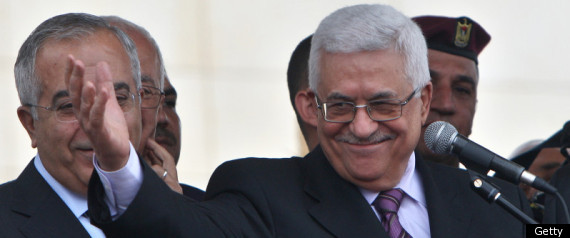
Mahmoud Abbas

JERUSALEM — The Palestinian president, in a remarkable assessment delivered on Israeli TV, said Friday the Arab world erred in rejecting the United Nations' 1947 plan to partition Palestine into a Palestinian and a Jewish state.

The Palestinian and Arab refusal to accept a U.N. plan to partition the then-British-controlled mandate of Palestine sparked widespread fighting, then Arab military intervention after Israel declared independence the following year. The Arabs lost the war.

"It was our mistake. It was an Arab mistake as a whole..."

Abbas also addressed his negotiations with former Israeli leader Ehud Olmert, now in the spotlight because of the publication of the memoirs of former U.S. Secretary of State, Condoleezza Rice.

Rice backs Israel's account that Olmert made a peace offer that was rejected...

Abbas claimed that he and Olmert were "very close" to reaching a peace agreement in 2008, before the Israeli leader left office under the cloud of corruption allegations. ....He confirmed Olmert's account that the Israeli leader was prepared to withdraw from 93.5 percent of the West Bank. ...In her forthcoming book, "No Higher Honor," excerpted in Newsweek this week, Rice claims that the Palestinians rejected Olmert's proposal.

Rice said Olmert proposed in a May 2008 conversation with her to cede about 94 percent of the West Bank, and to share sovereignty over the disputed holy city of Jerusalem and put an international body in charge of its religious shrines.

In its waning days, Rice wrote, the administration of President George W. Bush tried one last time to wrest a peace deal: "To have an Israeli prime minister on record offering those remarkable elements and a Palestinian president accepting them would have pushed the peace process to a new level. Abbas refused."

In their last meeting before Bush left office in December 2008, "The President took Abbas into the Oval Office alone and appealed to him to reconsider. The Palestinian stood firm, and the idea died," Rice wrote.
On Friday, the chief Palestinian negotiator told The Associated Press that the Palestinians had never rejected the Israeli offer.

...In his interview with Channel 2, Abbas acknowledged the Palestinians might not be able to muster the necessary nine votes in the 15-member Security Council to approve the statehood bid...

Monday, October 24, 2011

Gilad Shalit release: freed Palestinian terrorist vows to continue terror

From The Telegraph, 19 Oct 2011, by Adrian Blomfield, Gaza City and Richard Spencer in Mitzpe Hila:

An unsuccessful suicide bomber released from prison as part of the deal to free Gilad Shalit, the Israeli conscript, on Wednesday vowed to fulfil a childhood ambition by "sacrificing" her life for the Palestinian cause.

Gilad Shalit release: freed Palestinian prisoner vows to 'sacrifice' her life
As she returned to her family home in northern Gaza, Wafa al-Bis insisted she would seize any opportunity to mount another suicide mission and encouraged dozens of cheering schoolchildren to follow her example.
 
Bis was one of hundreds of Palestinian militants freed by Israel on Tuesday in the first phase of a prisoner swap agreed with Hamas, Gaza’s Islamist overlords, to win the freedom of Sgt Maj Shalit after five years in solitary confinement. 
 
... Bis was just 21 when, in 2005, she volunteered to undertake a suicide mission in Israel.

Her target, Israel says, was a hospital where she had been given permission to seek treatment for burns she sustained in a gas tank explosion. She never got there. Stopped by suspicious Israeli soldiers at a checkpoint on Gaza’s border, she was discovered with 22lb of explosives sewn into a belt inside her underwear. Bis tried to blow herself up but the detonator malfunctioned.

... Bis yesterday maintained that the six years she spent in an Israeli prison cell had left her with no regrets other than her failure to kill herself and her captors...

“... I wanted to kill as many as I could,” she said. “I had wanted to be a martyr since I was a kid. I regard what I did as an honourable thing. It was my dream to be a martyr but God didn’t let me.” 

... “This is an honourable thing and I would be a suicide bomber three times over if I could.” 

...“This is Jihad, it is an honourable thing and I am proud of her,” [Bis’s mother Salma] said.