Economic News from Israel
Recently the State of Israel celebrated its 67th Independence Day.
Amongst the media coverage by the Israel Hayom newspaper was economic commentary sourced from Dr Adam Reuter and his company Financial Immunities Ltd tracking economic growth in Israel over the past three decades. In the article was the following information:
In 1984, the population of Israel was 4.1 million. Thirty years later, the population doubled to stand at 8.2 million.
Today, the gross national product of Israel is $US307 billion, but 30 years ago it was a mere $US30 billion. That is an increase of more than 900%.
In 1984, the GNP per capita of Israel was $US7,000, and in 2014 it climbed to $US36,000 - an increase of more than 400%.
In 1984, Israel's foreign currency reserves amounted to $US3 billion. Thirty years later, Israel’s reserves have skyrocketed to $US90 billion - an indication of financial stability.
The national deficit made up 17% of the GNP in 1984 and today only 3% - an 82% decrease.
In 1984 Israel's exports were valued at $US10 billion, and 30 years later they are valued at $US96 billion - that's an 860% increase.
In 1984 high-tech exports were valued at $US1 billion, and at $US37 billion in 2014 - a 3,600% increase.
In 1984, the public sector employed 75% of the working public, while today that figure is only 43%. Employment of women was 34% and by 2014 it had risen to 54%.
Israel’s national expenditure on research and development has risen by more than 220% over the last 30 years.
In 1984 Israel had no independent sources of energy, but today, 38% of Israel’s energy comes from domestic sources, and the country is well on its way to complete energy independence.
Israel did not have any desalinated water in 1984 and water was a scarce commodity. Today more than 40% of Israel’s water consumption comes from the desalination plants that it built.
Over the last five years, the cumulative economic growth of Israel was 21% - the second highest rate among the 34 member nations of the OECD.
According to the Wall Street Journal, Israel is the second most educated country in the world, placing behind Canada and ahead of Japan. While there were 64,000 Israelis enrolled in higher education institutions in 1984, there are currently 306,000 enrolled in colleges and universities across the country.
Over the last twenty years, the Israeli economy grew by 180%, while the number of residents increased by only 45%.
Itamar Marcus, director of Palestinian Media
Watch, appeared before Dutch, British and German parliamentarians last week to
present PMW's new report entitled: "Is the PA lying to Western donors? The PA claims to have
stopped paying salaries to prisoners; PMW's evidence shows otherwise."
The
MPs of three parliaments expressed condemnation of PA practices, from rewarding
terrorism to promoting violence and glorifying murder of Jews.
3 members of British Parliament Guto Bebb, James Morris and Andrew
Percy:
"British
taxpayers will be appalled to discover that the Palestinian Authority is
handing their hard-earned money to convicted Palestinian terrorists. The PA
should be strongly condemned for deceiving well-intentioned donor countries
into thinking that it had ended this shocking practice. The British Government
must seriously reconsider its provision of aid to the PA's general budget until
it ceases this abhorrent practice of financially rewarding and incentivising
terrorism."
Member of Dutch Parliament, C.G. van der Staaij:
"It
is important that the sowing of hatred is stopped... We still find in the
official Palestinian media numerous Anti-Semitic statements, the glorification
of violence and hatred, and honoring terrorists. I have read the reports from
Palestinian Media Watch carefully."
Member of German Parliament, Albert Weiler:
"It
should not be possible for anti-democratic terror organizations to murder Jews
or Christians in the name of their religion. We must fight this strongly. And
the whole world should be doing it together."
For years, Western donor countries have been demanding that the PA
stop paying salaries to convicted Palestinian terrorist prisoners. The PA
finally claimed to have stopped paying the salaries last August 2014, when the
PA Ministry of Prisoners' Affairs, the body responsible for paying the
salaries, was changed into a PLO Commission of Prisoners' Affairs. The PA
stated repeatedly to their own people that the change was only a change in name,
but that none of the salaries or other benefits to prisoners would be changed.
They stressed that by transferring the responsibility for paying the prisoners'
salaries to the PLO, the Europeans and the US would not stop funding the PA.
However, PMW's new report presents significant documentation that challenges
the PA claim that the PA is no longer paying salaries. One of the key
indicators exposed in the new PMW report:
In March of this year, when the PA was short on money, it cut the salaries of all
civil servants to 60% of their regular salaries. The next day, the PA Ministry
of Finance announced the same reduction in salaries to prisoners. Had the PLO been paying prisoners'
salaries from non-PA money, then salaries to prisoners should not have been
affected by the PA shortage of resources.
Conclusion of the PMW
report:
"This report exposes that the PA's creation of a PLO Commission of
Prisoners' Affairs to fulfill the same services previously supplied by the PA
Ministry of Prisoners' Affairs, was done solely to satisfy Western donors'
demands that the PA cease paying salaries to terrorist prisoners. This report further documents that the
existence of the PLO Commission has not changed the policy of paying salaries
to terrorists. The PLO commission may have been created for the sole purpose of
deceiving the European donors, who don't want their money to the PA to be used
to reward terrorists. The PA continues to pay salaries to
terrorists in prison in spite of European and US demands that donor money to
the PA not be used to reward terrorists."
The following is the introduction and executive summary of the
report:
2011
PMW exposes that the PA pays high salaries to terrorists in
prison
2012 -2014
Western donors threaten to stop funding the PA because of this
policy of rewarding murderers
August 2014
PA issues "presidential decree" that salaries to
terrorist prisoners would no longer be paid by PA but by PLO
2015
Western donors are giving the PA more than a billion dollars,
with the understanding that the PA has stopped paying salaries to terrorists
May 2015
PMW documentation challenges PA claim:
- The PA Ministry of Finance continues to pay salaries to
terrorist prisoners
- PA continues to set conditions for the salaries to terrorist
prisoners
Conclusion
Western donors may have been intentionally misled by the PA,
which continues to pay salaries to imprisoned terrorists
Executive Summary
The Palestinian Authority receives over a
billion dollars in international aid yearly. Several EU countries and the US
have been threatening to stop this funding ever since Palestinian Media Watch
exposed in 2011 that the PA pays high salaries to terrorist prisoners and
released terrorists, amounting to over $150 million dollars in 2015 alone. For
example, in June 2014, Dutch Parliament voted overwhelmingly, 148 - 2, in favor
of demanding the cessation of PA salaries to terrorists.
In order to continue receiving donor funding,
in August 2014, the PA closed the PA Ministry of Prisoners' Affairs and
announced the establishment of a new PLO Commission of Prisoners' Affairs,
which they claimed would pay the salaries.
However, the PLO Commission was new only in
name. The PLO body would have the same responsibilities and pay the exact same
amounts of salaries to prisoners; the former PA Minister of Prisoners' Affairs,
Issa Karake, became the Director of the new PLO Commission and PA Chairman
Mahmoud Abbas retained overall supervision of the PLO Commission. (All sources
in report)
In spite of these mere cosmetic changes, the
international community accepted PA assurances that it was no longer paying the
salaries to terrorist prisoners. For instance, see this statement issued by the
Dutch government:
"The responsibility for payments to
prisoners was transferred to the PLO and will no longer be charged to the
budget of the PA, and these [payments to prisoners] are not funded by PA tax
revenues or donor funds. The PLO pays such costs from their own income,
where the Cabinet has no access."
[Question and
Answer session, Dutch Ministry of Foreign Affairs, April 22, 2015]
Palestinian Media Watch has now uncovered ample
evidence that contradicts the PA assurances to the Dutch and other donors.
PMW's findings are based entirely on information supplied by the PA:
- In October 2014, the PA announced that there
were more than 200,000 recipients of PA salaries. This figure "includes
the families of the Martyrs (Shahids) and wounded, as well as the
prisoners' and released [prisoners]." (All sources below in full
report)
- In January 2015, the PA Ministry of Finance
announced that the PA budget includes transfer of salaries to prisoners in
Israeli jails, who were from Gaza.
- When Israel withheld PA tax income in the
first months of 2015, the PA announced that prisoners receiving more than 2,000
shekels would only receive 60% of their salary -- the same reduction that was
imposed on civil servants. Were the PLO paying salaries from Arab donor money
and not the PA, Israel's holding up PA money would have no impact on terrorist
prisoners' salaries. Clearly, it is still PA money paying terrorist prisoners'
salaries.
Western donors should ask
the following question: Was the new PLO Commission of Prisoners' Affairs
created for the sole purpose of deceiving Western donors regarding the payment
of salaries to terrorists?
From Arutz Sheva, Friday, May 22 2015, by Ronn Torossian: ...Recently, there has been widespread high-profile outcry against the New Israel Fund (NIF), and more specifically, the donors who fund their boycotts of Israel and other harmful work. Among NIF’s high-profile donors are the President of UJA-Federation, Alisa Doctoroff, The Jewish Communal Fund, The Jim Joseph Foundation, and other well-known American Jewish organizations and leaders. Following public criticism, which has included op-eds inThe New York Post, The New York Observer, The Hill,and many Jewish publications, [Eric Goldstein, the CEO and executive vice president of UJA-Federation of New York] has sought to silence me via pressure applied to a number of mutual acquaintances, including activist Rabbi Avi Weiss, with whom he knows I am close.
....The claim made privately is that if the New Israel Fund is shunned by the community the Reform will stop funding the Jewish establishment, and that left-wing extremists will ensure that support is withdrawn from communal concerns.
It is not easy for me to write these words of criticism of people who work so hard for our people. I know each of these [NIF supporters] personally.
...In Israel, the ruling Likud Party calls NIF an “Anti-Zionist organization”, Israel’s Supreme Court notes that their boycotts are “economic terrorism”, and Israel’s incoming education minister (and past economic minister), Naftali Bennett recently said:
“Yes, New Israel Fund, I will boycott whoever persecutes Israeli soldiers. I will not apologize for it. Members of the New Israel Fund, listen carefully: Whoever harms, slanders and persecutes Israeli soldiers are not my brothers. The NIF works methodically and consistently to attack our Israeli soldiers, accuse them of war crimes of torturing Palestinians and intentionally attacking women and children. They turn to the UN and to the committees that are most hostile to Israel and try their best to convince them that Israel is a war criminal. I repeat: They say that our soldiers- you, I, your friends and your families, your children and their friends – that we are all war criminals. The New Israel Fund invests large amounts of money through its organizations with one purpose- to harm IDF soldiers who are physically protecting us with their bodies.”
Across the Israeli political spectrum, NIF is considered unacceptable.
Birthright Israel has stopped any association with the organization, yet they still dominate the halls of power of so many American Jewish organizations. Those who speak out are the ones opposed – yet NIF should be shunned as is Neturei Karta.
All one needs to know about New Israel Fund is that their website now brags about the new report “Breaking the Silence” issued which slanders the Israeli Army with untruths. That report was funded by NIF donors & George Soros’ organization, Open Society Foundations.
Jewish leaders and organizations can choose between standing for Israel – or standing for boycotts and against the Israel Defense Forces.
As of May, 2015, major donors to the New Israel Fund continue to include The Jim Joseph Foundation, Alisa Doctoroff, Karen R. Adler, David Hochberg, Edith Everett, Joel Greenblatt, Max and Andre Leichtag, Geoffrey Biddle, Dr. Gabor T. Herman, The Jacob & Hilda Blaustein Foundation, Joan & Irwin Jacobs, Joan and Robert Arnow, The Jewish Communal Fund, The Leichtag Foundation and others.
There is no nice way to say it. There is no method this can be done privately. This is not a personal attack on donors to NIF – the personal attacks are only against the soldiers of the IDF who suffer because of Breaking the Silence. The personal attacks are against the business owners and employees of businesses boycotted due to the work of NIF.
It is simple – those who fund the New Israel Fund harm the Israel Defense Forces and the State of Israel. The ruling party of Israel, the Supreme Court, leaders of every major political party, the Army and many others say it: Stop!
The international community and the media often ignore the fact that Mahmoud Abbas's Fatah has a number of armed groups. Their fight is to destroy Israel, eliminate the "Zionist entity" and achieve the "right of return" for millions of descendants of refugees. The Palestinian Authority leadership has never distanced itself from the rhetoric and actions of these groups. Fatah's militias will be the first to reject any peace agreement that includes the slightest concession to Israel. Several Fatah leaders, in fact, often speak in English about the need for reviving the peace process, while in Arabic they praise and endorse the Fatah gunmen.
Many in the international community often refer to the Palestinian Fatah faction, which is headed by Palestinian Authority (PA) President Mahmoud Abbas, as a "moderate" group that believes in Israel's right to exist and the two-state solution. What these people do not know is that Fatah, the largest faction of the Palestine Liberation Organization (PLO), consists of several groups that hold different views than those expressed by Abbas and other English-speaking Fatah officials. Some of these Fatah groups do not believe in Israel's right to exist and continue to talk about the "armed struggle" as the only way to "liberate Palestine and restore Palestinian national rights." One of these groups is called The Aqsa Martyrs Brigade - El Amoudi Brigade. The Aqsa Martyrs Brigades is Fatah's armed wing, established shortly after the beginning of the second intifada in September 2000. Although the Palestinian Authority leadership maintains that the group has been dissolved and its members recruited into its security forces, scores of gunmen continue to operate freely in Palestinian villages and refugee camps in the West Bank. Based in the Gaza Strip, the El Amoudi Brigade, which consists of dozens of Fatah gunmen, is named after Nidal El Amoudi, a top Fatah operative killed by the Israel Defense Forces on January 13, 2008, after he carried out a series of armed attacks against Israeli civilians and soldiers during the second intifada.
During the last war in the Gaza Strip between Israel and Hamas ("Operation Protective Edge"), the El Amoudi Brigade claimed responsibility for firing dozens of rockets at Israeli cities and IDF soldiers.
Sources in the Gaza Strip claim that many of the group's members are former security officers, still on the payroll of the PA. Other sources claim that the group is funded by ousted Fatah official Mohamed Dahlan, who is currently based in the United Arab Emirates, and the Lebanese Shiite terror group Hezbollah.
It is worth noting that the Palestinian Authority leadership has never distanced itself from the El Amoudi Brigade's rhetoric and actions.
In addition to an official website, Fatah's El Amoudi Brigade regularly issues threats to pursue the armed struggle against, and destroy, Israel. Last week, the group posted a video with a message to the "Israeli enemy" on the 67th anniversary of the creation of Israel -- which Palestinians refer to as "Nakba Day" (Day of Catastrophe).
Entitled, "A Message to the Israeli People" and accompanied by Hebrew subtitles, the video declares that the "battle for the liberation (of Palestine) was closer than ever," and warns Israelis: "Our Nakba (catastrophe) is unforgettable; soon you will have to leave because you have no other choice."
The Fatah video shows the group's members during military training in the Gaza Strip, in preparation for the next battle against Israel. "We have prepared the best soldiers," says the song in the background.
In a separate statement on the same occasion, the Fatah group emphasizes that the "armed struggle" against Israel "is the only means to liberate Palestine." It also stresses that the "right of return" for Palestinian refugees to their former homes inside Israel cannot be compromised and is non-negotiable. "Our people reject all alternative options to the right of return," the statement read, repeatedly referring to Israel as the "Zionist enemy."
Elsewhere, the Fatah group boasts that its men have been able to manufacture a new 12-kilometer range rocket called 107 that was used against IDF tanks and soldiers during the last war in the Gaza Strip.
The El Amoudi Brigade is not the only armed Fatah militia operating in the West Bank and Gaza Strip. Another significant group in the Gaza Strip, which also participated in the last war against Israel, is called the Martyr Abdel Qader Hossaini Brigade. Like its sister group, El Amoudi Brigade, the Martyr Abdel Qader Hossaini militia also supports the armed struggle against the "Zionist enemy."
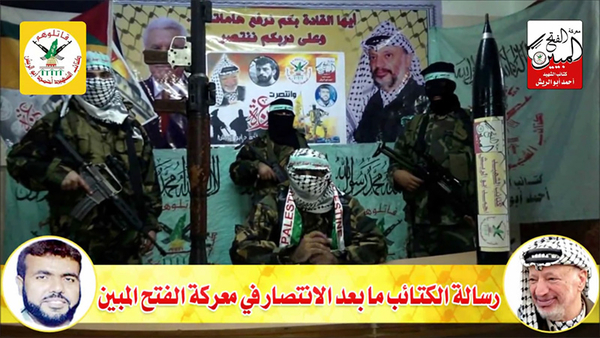
A third major Fatah terror group is called the Abu al-Rish Brigades, which has been responsible for many terrorist attacks against Israel and the kidnapping of foreigners in the Gaza Strip. The gang, which describes itself as the "military wing of Fatah," also refers to Israel as the "Zionist enemy" and claims to have participated alongside Hamas in the last war in the Gaza Strip.
Gunmen from Fatah's Abu al-Rish Brigades, which describes itself as the "military wing of Fatah," appear in a September 2014 propaganda video.
The international community and the media often ignore the fact that Fatah has a number of armed groups that are still openly dedicated to the "armed struggle" and terrorism as a way of "liberating Palestine." They also ignore that "moderate" Fatah leaders who speak in favor of peace and the two-state solution do not distance themselves from these groups. Several Fatah leaders, in fact, often speak in English about the need for reviving the peace process, while in Arabic they praise and endorse the Fatah gunmen.
The presence of armed Fatah gangs in the West Bank and Gaza Strip is a sign of the huge challenges that any Palestinian leader would face if and when the Palestinians and Israel reach a peace agreement. Obviously, these Fatah groups will be the first to reject any peace agreement that includes the slightest concession to Israel. Some of these groups are opposed in principle to peace with Israel because they simply do not recognize Israel's right to exist.
This is something that the international community -- first and foremost the U.S. -- needs to take into consideration when dealing with the Israeli-Palestinian conflict. Decision-makers need to know that opposition to peace with Israel will come not only from Hamas, but also from many groups within Fatah. As the armed groups themselves indicate, their fight is to eliminate "Zionist enemy" and achieve the "right of return" for millions of descendants of refugees to their former homes inside Israel.
Meanwhile, Abbas and other Fatah leaders, who are fully aware of the actions and threats of their loyalists, are doing their utmost to stop the world from hearing what the Fatah gunmen have to say about peace and the two-state solution. The question remains: Until when will the international community continue to bury its head in the sand and pretend that Fatah is a unified, moderate and pragmatic group that seeks peace and coexistence with Israel on behalf of all Palestinians?
As Jonathan Tobin correctly
noted earlier today, the possibility that Pope Francis didn’t really call
Palestinian Authority President Mahmoud Abbas “an angel of peace” doesn’t
change the fact that the Vatican definitely did recognize the “State of
Palestine.” That’s a setback to the cause of peace for many reasons, which
Jonathan detailed in an excellent
post last week.
But I’d like to go into more depth on one point he raised:
the question of which “Palestine” the Church is recognizing.
...“Palestine” isn’t merely split between the Fatah-controlled West Bank and
Hamas-controlled Gaza by a quirk of geography; it’s a civil war waiting to
happen.
Just last week, for instance, Hamas blamed
Fatah for a series of recent bombings in Gaza and arrested 12 Fatah members as
suspects. Last November, Hamas reportedly
bombed the homes and vehicles of several senior Fatah officials in Gaza, as
well as the site of a planned Fatah rally to mark the anniversary of Yasser
Arafat’s death; as a result, Fatah canceled
both the rally and a planned visit to Gaza by PA Prime Minister Rami Hamdallah.
Last month, PA ministers who did visit Gaza left in a huff after Hamas placed
them under house
arrest in their hotel. The previous month, Abbas and one of his senior
advisors separately urged Arab
states to bomb Hamas out of Gaza.
Both sides routinely arrest each other’s
members, and then accuse each other of torturing the detainees (usually
accurately in both cases). Both also routinely accuse each other of collaborating
with Israel – the worst crime in the Palestinian lexicon. Needless to say, none
of this contributes to Hamas-Fatah brotherly love.
Indeed, the parties are so busy feuding with
each other that they can’t provide for their people’s most basic needs, like
reconstructing Gaza after last summer’s war with Israel. The reconstruction has
made almost no progress in the eight months since the war ended, and
astoundingly, everyone except Human Rights Watch director Ken
Roth agrees that this is the fault of the feuding Palestinian governments
rather than Israel. That, for instance, is the stated
view of the Arab League, which is usually quick to blame Israel for
anything. And it’s also the stated
view of the European Union, which is generally equally quick to blame
Israel for everything.
That the violence has remained relatively
low-level despite the intensity of this hatred is due to one thing only:
Israel. Hamas’s main fighting strength is concentrated in Gaza, while Fatah’s
is concentrated in the West Bank, and these territories are currently separated
by an impassible barrier – some 37 kilometers of Israeli territory. Moreover,
Israeli troops in the West Bank have prevented Hamas from building up its
forces there: Last August, for instance, Israel arrested dozens of Hamas
operatives in the West Bank whom both Israel and Abbas said were plotting a
coup against the Fatah-led government.
But both those barriers to war would
disappear if the world had its way: Israeli troops would vacate the West Bank,
and some kind of corridor through Israel would be created to link the West Bank
to Gaza. At that point, there would be nothing to stop Hamas and Fatah from
all-out war. Indeed, that’s precisely what happened after Israel withdrew from
Gaza in 2005: Months of escalating violence ultimately erupted into war.
That war was bloody but swift. One week
later, Hamas-ruled Gaza, 600 Palestinians were dead
and thousands more had fled to the West Bank (Israel allowed the refugees
through its territory). But since then, both sides have built up their forces
considerably, so the next war might well be longer and bloodier.
... I have yet
to hear anyone explain quite how enabling such a war would benefit the
Palestinians.
Thus anyone who really wants to create a
Palestinian state should start by pressuring both Hamas and Fatah to address
basic needs like reconstructing Gaza instead of spending all their time and
energy feuding. That way, if and when such a state does emerge, it might
actually be a good thing for the people who have to live in it rather than a
disaster. And it would surely do far more to help the Palestinians right now
than the empty recognition of a nonexistent state does.
Israel’s critics will celebrate the news today that the Vatican will recognize Palestinian statehood as a rebuke of the Jewish state’s government and policies. ... its impact will be mostly symbolic though it will certainly be considered yet another blow to Israel’s uphill efforts to maintain good relations with European countries that are increasingly hostile to Jerusalem. But the one thing we can be sure it won’t do is to improve the chances for peace. By granting the Palestinians official recognition without first requiring them to make peace with Israel, Pope Francis and the Church have only made it less likely that this will ever happen. ... the pope is mistaken to think that giving the Palestinians such recognition will advance the peace process. To the contrary, by granting them official status in this way only encourages Palestinian Authority leader Mahmoud Abbas to continue to stonewall efforts to make peace.
After all, if Abbas’s real goal been an independent Palestinian state, he could have had one in 2000, 2001 when his former boss Yasir Arafat rejected an Israeli offer of statehood including almost all of the West Bank, Gaza and a share of Jerusalem. Abbas rejected an even better offer in 2008 and then refused to negotiate seriously in 2013 and 2014 even after the Israelis had accepted an American framework whose goal was a two state solution.
The Palestinian campaign to get recognition from the United Nations and other countries is motivated by a desire to avoid peace talks, not to make them more successful. The Palestinians want a state but not one that is prepared to recognize the legitimacy of a Jewish state alongside it, not matter where its borders are drawn.
By telling the Palestinians, the Church recognizes his faux state; it is making it easier for Abbas to refuse to negotiate. To the extent that this recognition grants the Palestinians rights to all of the disputed 1967 territories, the Vatican and other European states that have done the same thing, is prejudging negotiations that should be conducted by the parties, not outsiders.
Just as important, the Church ignores the fact that an independent Palestinian state in all but name already exists in Gaza under the tyrannical rule of Hamas terrorists.
Which “Palestine” is the Church recognizing? Hamasistan or Fatah’s corrupt kleptocracy that Abbas presides over? With Hamas growing more popular, the prospect of it gaining power in an independent West Bank makes an Israeli withdrawal a fantasy rather than a viable policy option.
... the Vatican move will only serve to make peace less likely and do nothing for Middle East Christians who are under unbearable pressure from Islamists, not Israel...
If anyone needs further
evidence of why the news agencies often can’t be trusted to report accurately
on Israel and the Palestinians, and why major news outlets such as the New York Times and the
BBC should stop repeating agency copy without verifying it, here is an
important example from this weekend.
According to Italian and
Spanish news outlets and according to the Vatican’s own website, Pope Francis
told Palestinian President Mahmoud Abbas that he could be an angel
of peace.
“May you be an angel of peace,” he urged Abbas, effectively saying
that if Abbas would take the decision to accept one of the peace offers that
various Israeli prime ministers have made to him, or at least make a serious
counter-offer, he could be an angel of peace. The pope did not say that Abbas –
infamous for ordering the Munich
Olympic massacre, among many other atrocities – was “an angel of
peace.”
And yet the BBC and New York Times were
among dozens of prominent news outlets that claimed he did.
The New
York Times reports today (Page A11 under the headline: “At
Vatican, Abbas Is Praised as ‘Angel of Peace’”):
“Mr. Abbas’s meeting with
the pope ended with an exchange of gifts. Presenting Mr. Abbas with a
medallion, the pope said it depicted an angel of peace ‘destroying the bad
spirit of war.’ It was an appropriate gift, the pope added, since “you are an
angel of peace.”
And here is NBC, Fox,
and, the BBC saying
the same thing.
Contrast the headlines in
the New York Times with
those in the Italian press.
For example, the
headline in the “Vatican Insider” section of Le Stampa is:
Pope embraces Abu Mazen and
bids him to be an angel of peace
“you could be an
angel of peace” – “Lei possa essere un angelo della pace.”
As an astute Italian-speaking
observer of the Middle East points out, all these English-speaking
news media seem to have initially relied on the mistranslations of the world’s
three biggest news agencies.
...Former Middle East reporters
such as myself (“The Case of
Reuters”) and Matti
Friedman (who used to work at AP’s Jerusalem bureau) have long warned
about the impartiality of the major news agencies coverage of the Middle
East.
But then too often do
reporters and editors at the NewYorkTimes, BBC, and elsewhere
seem to be happy reporting on what they want to hear, rather than on what was
actually said or done, when it comes to the Palestinians and Israel.
The events this week in the Mahabad area of Iran’s Western Azerbaijan province cast light on the difficult situation faced by one of the region’s least-noticed minorities – the Kurds of Iran.
The apparent attempt by an intelligence officer in Mahabad to rape an Iranian-Kurdish hotel worker, 25-year-old Farinaz Khosrawani, and the latter’s subsequent suicide by jumping from a fourth-floor window, led to furious protests by Kurds in both Mahabad and beyond.
The hotel was burned by protesters; authorities responded heavy-handedly, using rubber bullets and tear gas.
There is currently a media and social media blackout from the area, but word-of-mouth reports suggest the situation remains tense.
Soran Khedri, a former official of the Iranian-Kurdish Party of Free Life of Kurdistan (PJAK) organization, told The Jerusalem Post that at least one demonstrator has died, and that in the last 48 hours, PJAK guerrillas had attacked an Iranian Revolutionary Guards Corps checkpoint in the area, killing two IRGC personnel.
The Kurds of Iraq and Syria have become highly significant and visible players on the regional stage over the last decade. Turkey’s Kurds, of course, have long been noted internationally – because of the insurgency of the PKK (Kurdistan Workers’ Party) against a succession of governments in Ankara. But the Kurds of Iran have been the most silent of Kurdish populations. Numbering around 8 million in total, they are mainly resident in the Kordestan province of western Iran (adjoining Iraqi Kurdistan), one of the country’s most impoverished regions; Kurdish populations are also to be found in Western Azerbaijan, Ilam and Kermanshah. Unemployment in Kordestan Province stands at 28 percent; there is little local industry. The Iranian Kurds were not always politically silent. Mahabad was the location of the short-lived Mahabad Republic – the only example of full Kurdish sovereignty in the 20th century. The republic was declared in January 1946, and destroyed by the Iranians in December of that year.
But under the Islamic Republic, the Kurds have faced repression of the most severe kind. A large-scale revolt against the new regime, led by the Kurdistan Democratic Party in Iran (PDKI), was crushed with great severity in the period immediately following the Islamic Revolution of 1979. The IRGC killed over 10,000 Kurds as it fought to destroy the nascent Kurdish independence movement; the insurgency was largely defeated by 1983.
The suppression of any hint of Kurdish separatism has remained in place ever since. Education in Kurdish remains forbidden; any sign of attempts at political organization is ruthlessly suppressed by the Revolutionary Guards.
The hostility of the Iranian regime to the slightest hint of separatism derives not solely or mainly from ethnic tensions between Persians and Kurds. Even the most modest Kurdish demands for greater local autonomy raise the specter for the regime of ethnic separatism. Iran is a divided society ethnically, with only 49 percent of the population consisting of ethnic Persians; the rest are a mixture of Azeris, Baluchis, Kurds and Arabs. Thus, the brutal and total repression of Kurdish demands is an indication not of the regime’s strength, but of its potential weakness. Tehran fears that were the demands of one minority ethnicity to be accommodated – even partially – this would risk opening the floodgates for other demands.
In 2004, a new Iranian Kurdish insurgency began. This was led by PJAK, PKK’s franchise among the Iranian Kurds. From the Qandil Mountains in Iraqi Kurdistan, PJAK sought to strike at the Iranian authorities while its cadres worked among the population, seeking to build clandestine support.
A shaky, on/off cease-fire has persisted between PJAK and the Iranian authorities since 2011, after a large-scale incursion by the IRGC into Iraqi Kurdistan led to fierce battles. But PJAK remains armed and deployed along the border, able to exploit any breakdown of regime control in the Kurdish areas.
Alongside PJAK, the PDKI remains active, as do a number of parties claiming the mantle of the Komala Movement, a once-influential leftist force among the Iranian Kurds.
Severe repression, divided politics and a long period of apparent quiescence were followed by sudden, unexpected anger precipitated by an unforeseen event. This is what is currently taking place in Iranian Kurdistan; it sounds, in all particulars, a familiar story in the Middle East of the last half-decade.
So, are the events in Mahabad a prelude to some larger movement or unrest among the Iranian Kurds?
An Iranian-Kurdish lawyer with good connections in the Mahabad area told the Post that the current wave of acrimony looked set to “ebb away.” He noted that the protests “in support of Mahabad spread only to a few other cities, like Sardasht and Mariwan.”
Nevertheless, he also asserted that the protests were an indicator of “vast anti-regime sentiments” among Iran’s Kurdish population.
As of now, the Mahabad situation appears to have been contained by the Iranian authorities, yet the events are an indication of the inner fragility of the Iranian regime. Even as Tehran invests in spreading its influence across the region, Mahabad is a reminder that its position at home is by no means secure, or consolidated.
Rather, it rules over large swathes of the Iranian population by force and coercion alone. It is therefore vulnerable to internal subversion – and the more it spreads its assets thinly, by involvement in ever-more regional arenas, the fewer resources it will have available for dealing with internal unrest.
Rodi Hevian, a Kurdish journalist at the online Kurdish Daily News, likened the Mahabad events to the short-lived uprising by Syrian Kurds in the city of al-Qamishli in 2004. Though quickly (and bloodily) repressed by the Assad regime, the Qamishli events were in retrospect a first tremor for what was to come in Syria.
“It could also be a wake-up call for the Iranian regime interfering in Syria, Iraq and Yemen,” Hevian told the Post, “namely, gaining ground in other countries can lead to losing ground at home.”
Of course, for the Iranians to begin paying a price of this kind, it is necessary that the Iranian Kurds and other minorities begin to receive the attention and support of regional enemies of Iran, and of the West.
For this to happen, in turn, there needs to be a recognition of the urgent necessity of containing and turning back Iranian regional ambitions; no such awareness currently exists in Western capitals.
Following June 30 – should a nuclear agreement between Teheran and the P5+1 world powers be concluded – the pressure on the Iranians may be vastly reduced. Abandonment of sanctions would enable the regime to begin to channel greater resources to areas of instability, and to seek to buy off discontent.
Still, in Middle Eastern capitals, both the Iranian threat and the Iranian vulnerability do not go unnoticed. The mullahs and the IRGC are not all-powerful; the tremor in Mahabad indeed reveals just how notably shallow their rule is.
From Prime Minister Benjamin Netanyahu's address to the5th Global Forum for Combatting Anti-Semitism:
...Seventy years ago, with the end of World War II and the revelation of the horrors of the Holocaust, some believed that humanity would discard one of history's oldest hatreds – anti-Semitism.
And it's true that in the years immediately following World War II, blatant expressions of hatred for the Jews appeared to take a respite, at least in the liberal West. Yet today there is no doubt that we are living in an age of resurgent anti-Semitism. Jews everywhere are once again being slandered and vilified. This is taking place in the intolerant parts of the Middle East but it's also taking place in what otherwise would be expected to be the tolerant parts of the West.
It's taking place in Beirut, in Damascus, in Tehran. But it's also taking place, violently so, in Toulouse, in Paris, in Brussels. Because along with vilification come the inevitable violent attacks.
And Jews are now being targeted for being Jews.
Now, Jews have the right to live freely and safely wherever they choose.
And governments everywhere are responsible for guaranteeing this right.
And I want to take this opportunity to praise all the governments that have been witnessing this resurgent anti-Semitism, their commitment to protect the rights of the Jews, the rights of individuals, the rights of their citizens. Their representatives are here, and I praise you for it.
But Jews also have the right to join us here in Israel, and if they make that choice, we will welcome them with open arms.
Now, contemporary anti-Semitism doesn't just slander, vilify and target the Jewish people. It first and foremost today targets the Jewish state. That's the nexus, that's the core, that's the focus of anti-Semitism.
I want to give you an example of this from today, this morning. I went down to Ben-Gurion airport to welcome home the IDF's humanitarian mission to Nepal.
The UN filed a report. Actually, this is a good UN report about Israel. It said that of all the countries in the world, and Israel is one of the smallest countries in the world, Israel fielded the second largest rescue and relief team in Nepal. Of all the nations in the earth.
Our people did a magnificent job. They saved lives. They took people out of the rubble. They treated 1,600 wounded people and sick people. They delivered life, several births.
Yet yesterday state television in both Iran and Venezuela accused our humanitarian team of trafficking in babies.
Now, did any of you see an Iranian rescue team in Nepal?
This is the quintessential example of the Big Lie technique.
The aggressor accuses his victim.
And this big lie of anti-Semitism is propagated most enthusiastically by those who trample on the human rights of their own people.
Iran will speak of human rights? I don’t want to talk about Venezuela. I'll leave that to you. I'm the Foreign Minister, for God's sake.
They lecture us on human rights, on the rule of law, on safeguarding human decency? They string people in cranes, innocent people in cranes in the squares of Tehran and Iran's other cities. They send their goons to Lebanon, to Syria, to Yemen, slaughtering people by the thousands. They slaughter Muslims, they target Muslims who do not share their violent creed.
Today, a lot of the extreme anti-Semitism that we see today is coming from old quarters, intolerant quarters, xenophobic ones in parts of Europe, in a peculiar marriage with the militants who seek to overtake the world of Islam, and they have integrated the most extreme anti-Semitism into this murderous theology.
I want to give you an example. First, recognize that their first and greatest number of victims are their fellow Muslims. But they also target us, and I give you the Hamas Charter.
It repeats the ancient libels against the Jews. It openly calls for the murder of Jews wherever they are and for the destruction of their state.
And the same can be said of Hezbollah and for the common patron of both Hezbollah and Hamas, which is of course Iran.
And of course they have competition. The militant Shi'ites have competition from the militant Sunnis of al-Qaida, of ISIS and al-Nusra who echo their murderous creed not only about Israel. You've seen the horrors they commit on their fellow Muslims.
Today's anti-Semitism, as I said, is not limited to the various sects of militant Islam, nor is it limited just to the xenophobic elements on the fringes of European society. Because today it often wears the mask of so-called progressive thinking in the West.
Some of those who consider themselves champions of tolerance are remarkably intolerant when it comes to Jews and the Jewish state. The classic anti-Semite portrayed the Jews as the embodiment of all evil in the world. Modern anti-Semites portray the Jewish state as the embodiment of all evil in the world.
When Hamas and Hezbollah rocketed our cities, thousands and thousands and thousands of rockets, fired directly at our cities – that's a war crime, hiding behind their civilians – that's a second war crime – when they committed these dual war crimes, tens of thousands demonstrated on the streets of European capitals, not against Hamas, not against Hezbollah, but against Israel.
Now, thousands are being killed in the brutal conflict in Yemen.
You see any demonstrations in London or Paris?
A quarter of a million people have been savagely butchered in Syria.
You hear any word of academic boycotts on the Assad regime?
And in Iran now under the Rouhani government, executions have gone up, innocent people are taken to death.
You hear any UN resolutions condemning these violations of basic human rights?
And the answer regrettably is no. The demonstrations, the boycotts, the resolutions are all reserved for the Middle East's one true democracy, in fact it's the most beleaguered democracy on earth – Israel.
This is a travesty.
You can try to explain it away in many ways and it's true that the internet has a multiplier effect, but you can have a multiplier effect on many, many lies, on many slanders, and yet this has a global multiplying effect, and there is something fundamentally wrong that this slander is reserved for the one country in the region where the death penalty is not even used against the most gruesome terrorist murderers, the one country that holds human rights sacrosanct, where equality is protected under the law – for women, for Christians, for minorities, for all.
You can ask yourself how is that possible, how could it be that the Jewish state is treated like that. There's got to be fire if there's smoke.
How do think the Jews were treated for generations? The things that peoples said about the Jews for generations were believed across so many lands. They believed that we poisoned the wells, that we drank the blood of Christian children, that we were spreading disease deliberately. By the way, these are all repeated as we speak.
You see, how could it be that they believed it? But they did. Not only did they believe it, you say, well, that's because of ignorance. Yeah, that's true. Except that some of the most educated people in history believed it – Voltaire, Dostoyevsky, and the list is a lot longer, by the way.
So education and knowledge may be a partial protector against this slander, but there's something deeper here because these are such patent falsehoods. It is the willingness to submit to slander, the willingness to believe this. This is what creates the ground, and it starts not from the bottom. It starts with the elites. And that's where it has to be challenged.
And today the treatment of Israel is no different from the treatment of our forbearers. The Jewish state is being treated among the nations the way the Jewish people were treated for generations.
And we're not perfect, by the way. We have a lot of things that we can improve.
We have a very boisterous and robust democracy. You should come to the Knesset. I invite all of you. What fun. But it is. It's alive. It's free. Everything is debated, everything is open, and there is a system of justice, a system of laws and true tolerance. With all the imperfections of any society, we've built here a tremendous society. Beleaguered? Yes, but with great success.
And our best allies actually these days are some of our Arab neighbors because they know we face a common threat.
So we see this country. How can it be that this country is slandered like no other country? Well, probably because old habits die hard.
But the sad truth is that some of them don’t die. The sad truth is that no rational examination can justify the obsession with the Jewish state, and this obsession with the Jewish state and the Jewish people has a name. It's called anti-Semitism.
I know you understand all this.
I know that the people in this room have learned the painful lessons of 70 years ago.
I appreciate your commitment to fighting anti-Semitism because the battle starts from the top. Anti-Semitism, contrary to what people think, does not just bubble up from below. It percolates also from the top. And that's why it's so important that there are leaders here, across lands, across faiths, across professions, from the public and the private domain, who are gearing up to fight this old obsession.
You have learned from history, but regrettably, many around the world have yet to do so.
I want to assure you that we have.
We are no longer a stateless people searching for a safe haven. We are no longer a powerless people begging others to protect us. Today we have an independent and sovereign state. Today we can protect ourselves and defend our freedoms, our lives. What has changed in the history of the world for the Jewish people is not the hatred of the Jews, but with the founding of the Jewish state, the rediscovery by the Jews of the capacity to defend ourselves against slander and against attack.
Today we can speak up against our vilification – as I am doing right now and as you have been doing, and I know you will continue to do.
Because there is a simple fact – a lie that is left unchallenged and endlessly repeated assumes the cachet of self-evident truth.
Our biggest job – our biggest job – is to go and light a candle of truth.
When I came to the United Nations many years ago to serve as Israel's ambassador, I met a famous Jewish religious leader, the Lubavitcher Rebbe, and he said to me: You know, you'll be going into a house where many, many lies will be leveled at Israel and at our people, and he said, 'Remember that in the darkest halls, if you light one candle, then people will see the light of truth for a very long distance. They'll see it from afar, and your job', he said to me, 'is to light a candle of truth in a dark hall.' Well, I'll tell you, we need a lot of candles, a lot of lighters of candles, and that's how I see you.
Because nowhere is this calumny that is leveled against our people more systematically propagated than in Iran.
The ayatollah regime is conducting as we speak a competition. The competition is an international competition. It parallels our conference, except it's the very reverse. It's a competition of Holocaust deniers from around the globe, who can better deny the Holocaust. And while they are denying the Holocaust, they're planning another genocide against our people.
They openly threaten to annihilate the State of Israel. Just a few weeks ago, a few days before the Lausanne agreement was signed, an Iranian general said, "The destruction of Israel is non-negotiable." Openly. And of course they seek to build nuclear weapons to implement this mad design. And I have to tell you honestly that the Lausanne framework won't stop them. Israel wants to see a peaceful solution, a better deal that will actually block Iran's path to the bomb. But I want to be absolutely clear. The Jewish state will defend itself by itself against any threat. That's what we've learned from history. That's what the Jewish state is all about. But we've also learned something else. I don’t know if we'll be able to eradicate the scourge of anti-Semitism. I know we have to fight it. We have learned that if you don’t fight it, if unstopped, these fires of anti-Semitism eventually spread and they consume everyone. That is I think the central lesson of the 20th century, in many ways the central lesson of modern times. So for the sake of decency, for the sake of our common humanity, for the sake of our common future, we must all continue to stand up and fight anti-Semitism...
RAMALLAH, West Bank (AP) — A leading Palestinian advocacy group says
human rights for people living in the Palestinian territories are at their
"worst" in years.
The annual report by the
Palestinian Independent Commission for Human Rights said hundreds of people
were tortured by authorities in Gaza, ruled by the Islamic militant group
Hamas, and in the West Bank, governed by the Western-backed Palestinian
Authority.
It says several people died in
Hamas detention and one died while incarcerated in the West Bank. It also says
Hamas took 16 prisoners from their jail cells and killed them during the war
with Israel last year.
Commission chief Ahmad Harb said
other violations include bans on peaceful gatherings. He said rights violations
"increased in volume" over the past four years.
An Egyptian farmer shows the dryness of the land due to drought in a farm formerly irrigated by the river Nile. Photograph: Mohamed Abd El Ghany
A ranking Iranian political figure, Issa Kalantari, recently warned that past mistakes leave Iran with water supplies so insufficient that up to 70 percent, or 55 million out of 78 million Iranians, would be forced to abandon their native country for parts unknown.
Many facts buttress Kalantari's apocalyptic prediction: Once lauded in poetry, Lake Urmia, the Middle East's largest lake, has lost 95 percent of its water since 1996, going from 31 billion cubic meters to 1.5 billion. What the Seine is to Paris, the Zayanderud was to Isfahan – except the latter went bone-dry in 2010. Over two-thirds of Iran's cities and towns are "on the verge of a water crisis" that could result in drinking water shortages; already, thousands of villages depend on water tankers. Unprecedented dust storms disrupt economic activity and damage health.
Nor are Iranians alone in peril; many others in the arid Middle East may also be forced into unwanted, penurious, desperate exile. With a unique, magnificent exception, much of the Middle East is running out of water due to such maladies as population growth, short-sighted dictators, distorted economic incentives, and infrastructure-destroying warfare.
With one unique, magnificent exception, much of the Middle East is running out of water.
Some specifics:
Egypt: Rising sea levels threaten not only to submerge the country's coastal cities (including Alexandria, population 4 million) but also to contaminate the Nile Delta aquifer, one of the world's largest groundwater reservoirs. The Ethiopian government finally woke to the hydraulic potential of the Blue Nile that originates in its country and is building massive dams that may severely reduce the flow of river water reaching Egypt (and Sudan).
Gaza: In what's called a "hydrological nightmare," seawater intrusion and the leakage of sewage has made 95 percent of the coastal aquifer unfit for human consumption.
Yemen: Oil remittances permit Yemenis to indulge more heavily than ever before in chewing qat, a leaf whose bushes absorb far more water than the food plants they replaced. Drinking water "is down to less than one quart per person per day" in many mountainous areas, reports water specialist Gerhard Lichtenthaeler. Specialist Ilan Wulfsohn writes that Sana'a "may become the first capital city in the world to run out of water."
Syria: The Syrian government wasted $15 billion on failed irrigation projects in 1988-2000. Between 2002 and 2008, nearly all the 420,000 illegal wells went dry, total water resources dropped by half, as did grain output, causing 250,000 farmers to abandon their land. By 2009, water problems had cost more than 800,000 jobs. By 2010, in the hinterland of Raqqa, now the Islamic State's capital, the New York Times reports, "Ancient irrigation systems have collapsed, underground water sources have run dry and hundreds of villages have been abandoned as farmlands turn to cracked desert and grazing animals die off."
Iraq: Experts foresee the Euphrates River's waters soon halved (refer to Revelations 16:22 for those implications). Already in 2011, the Mosul Dam, Iraq's largest, shut down entirely due to insufficient flow. Sea water from the Persian Gulf has pushed up the Shatt al-Arab; the resulting briny water has destroyed fisheries, livestock, and crops. In northern Iraq, water shortages have led to the abandonment of villages, some now buried in sand, and a 95 percent decrease in barley and wheat farming. Date palms have diminished from 33 million to 9 million. Saddam Hussein drained the marshes of southern Iraq, at once destroying a wildlife ecology and depriving the Marsh Arabs of their livelihood.
Persian Gulf: Vast desalination efforts, ironically, have increased the salinity level of gulf sea waterfrom 32,000 to 47,000 parts per million, threatening fauna and marine life.
Nearby Pakistan may be "a water-starved country" by 2022.
Thanks to conservation, innovative agricultural techniques, and high-tech desalination, Israel is awash in H2O.
Israel provides the sole exception to this regional tale of woe. It too, as recently as the 1990s, suffered water shortages; but now, thanks to a combination of conservation, recycling, innovative agricultural techniques, and high-tech desalination, the country is awash in H2O
I find particularly striking that Israel can desalinate about 17 liters of water for one U.S. penny; and that it recycles about five times more water than does second-ranked Spain.
In other words, the looming drought-driven upheaval of populations – probably the very worst of the region's many profound problems – can be solved, with brainpower and political maturity.
Desperate neighbors might think about ending their futile state of war with the world's hydraulic superpower and instead learn from it.