Saturday, February 15, 2014

Abbas Shuts Down the Peace Process

From Commentary Magazine, THURSDAY, FEBRUARY 13, 2014, by Tom Wilson:


Last week, Jonathan Tobin wrote here of how we were on the eve of a fourth Palestinian “no” to a peace agreement. It would appear that has now arrived, albeit slightly sooner than anyone had expected. Many observers assumed that once Secretary of State John Kerry got around to submitting his framework for a negotiated peace, Palestinian Authority head Mahmoud Abbas would then set about finding an excuse for rejecting it. What few could have predicted was that Abbas would find a way to reject the proposal before it was even submitted. Yet, this is precisely the impressive feat that Abbas has now accomplished.

Earlier today, Abbas’s spokespeople in Ramallah announced the PA’s new set of red lines in any negotiated peace settlement. Each and every one of these red lines blows to pieces anything Kerry was about to propose, as it does to the prospects for an agreement between the two sides in general. These red lines which Abbas details in a letter being sent to the U.S. and the Quartet seamlessly preempts whatever Kerry was likely to outline in his own peace parameters. In this way Abbas artfully dodges a scenario in which the Israelis would agree to a peace plan and the Palestinians would come under pressure not to derail yet another effort to resolve the conflict.


Abbas’s new red lines block just about every concession that the Israelis, and even the U.S., have requested.

 Abbas demands: a total Israeli withdrawal from all territories that went to Israel in 1967; that Israel complete that withdrawal within three to four years; that the Palestinians not be required to recognize the Jewish state; that east Jerusalem be specified as the capital of a Palestinian state; the release of all Palestinian prisoners; and resolving the refugee issue along the lines of UN General Assembly resolution 194, which in essence means sending those Palestinians claiming to be refugees, not to a Palestinian state, but to Israel, thus terminating the existence of the Jewish state Abbas refuses to recognize.

“Without these principles there can be no just and comprehensive peace in the region,” stated Abbas’s spokesman Abu Rudeineh. So it seems we can now bid farewell to Kerry’s rather shambolic efforts for reaching a negotiated peace, much of which have been marred by the trading of insults and accusations between the State Department and Israeli politicians, all the while with the EU standing on the sidelines, issuing threats about the repercussions for Israel should talks fail. In fact, earlier today EU parliamentary president Martin Shulz was in Israel’s Knesset lecturing Israelis (in German) on making “painful concessions for peace,” bemoaning the hardships he accused Israel of having inflicted on the Palestinians.  

Israel’s chief negotiator, Tzipi Livni, recently suggested that on the matter of the Palestinians accepting the Jewish state we might be in for a surprise. As it turned out, we weren’t. No one will be surprised by this rejection from the Palestinians, even if its early timing will have caught some a little off-guard. Even President Obama, who had been speaking of Kerry’s framework having a less than 50 percent likelihood of success, won’t be surprised when he receives Abbas’s letter. And Kerry, who was seeing all of this unfold close-up, surely won’t be able to claim to be surprised either.

As it was, the State Department was increasingly looking like it was about to try strong-arming the Israelis into accepting a framework, even on such unacceptable matters as a full Israeli withdrawal from the Jordan valley. Kerry was beginning to issue thinly veiled threats to the Israelis about what might become of Israel should it not find a way to appease Palestinian demands. There were also rumors that the State Department was trying to get the White House to back efforts to pressure the Israelis into accepting a deal even less to Israel’s liking than the one it originally seemed Kerry was about to come up with. Now, presumably, Prime Minister Netanyahu won’t have to worry about being asked to accept parameters that no Israeli leader could be expected to inflict on their people. Instead, Abbas has most likely deflected that whole unpleasant business.

What remains to be seen is how the EU, the State Department, J Street, the boycotters, the writers ofHaaretz and the New York Times, and indeed Abbas himself will manage to pin this whole debacle on Israel and Netanyahu.    


Tom Wilson

Source: http://www.commentarymagazine.com/2014/02/12/abbas-shuts-down-the-peace-process/


Friday, February 14, 2014

Jewish refugees from Arab lands seek compensation

From McClatchy-Tribune News Service, February 12, 2014, by BEN BARBER* (http://www.mcclatchydc.com/2014/02/12/217868/jewish-refugees-from-arab-lands.html):

U.S.-brokered Middle East peace talks have suddenly focused on the long-ignored escape of more than 700,000 Jewish refugees from North Africa and the Middle East to safety in Israel since 1948.

While the 700,000 Palestinian refugees who left Israel since 1948 have been cared for by U.N. programs in camps from Gaza to Damascus, the Jewish refugees from Arab lands have never won U.N. support or obtained restitution of their properties left behind.

A senior U.S. State Department official told Jewish leaders in January that the draft peace "framework" would include compensation for the Jews who fled Arab lands, the New York Times reported.

These Jewish communities had been deeply rooted for centuries: in Morocco, Algeria, Tunisia, Libya, Egypt, Yemen and Iraq; they predated the rise of Islam in the 7th century.

Indeed, in 1965, before the Jewish flight took place, I first visited the Moroccan Jewish neighborhoods known as the "mellahs" in Rabat and in Marrakesh. I met Jews wearing traditional gelaba cloaks and yellow Moroccan slippers. Some spoke little Arabic or French but still spoke the Berber language that predates the Arab conquest.

During my visit back then, I shared the Passover seder meal with Rabat Rabbi David Cohen and learned that many Jews were quietly seeking to leave and head to France or Israel.

At that time, King Hassan II wanted the 300,000 Moroccan Jews to stay put and he sent his son, now King Mohammad Sixth, to a synagogue on the Jewish New Year to convey the royal family regards.

But after Jewish forces routed Arab armies in the 1948 war for independence, and then in 1955 wrested the Sinai Peninsula from Egypt, anti-Jewish sentiment spread. Already in 1965 the Moroccan synagogues no longer had any marker or mezuzah in front. Jews quietly left their homes and businesses and took small boats across the Mediterranean to escape.

After the 1967 victory by Israel over Egypt, Jordan and Syria in the Six-Day War, anti-Jewish riots and pogroms took place across the Arab world. The floodgates of refugee flight had opened and rulers from Cairo to Baghdad arranged for Jews to sign away their land, homes, businesses and other property before leaving.

In Basra, Iraq, in 2003, I noticed some curious adjoined housing along a canal and was told "that's where the Jews lived for 400 years" before they vanished from Iraq, mostly ending up in Israel after 1967. Only one Jew remained in that ancient city. On my flight out of Iraq I sat next to a Christian clergyman who told me he was helping to provide food and medicine for the last Jew in the city - an elderly Jewish woman.

The treatment of the two refugee communities has been markedly different and the suggestion that someone - U.S., UN, EU or perhaps multinational banks - might propose compensation to the Jews is remarkable.

Jewish refugees from Arab lands had a tough time at first in Israel. They faced discrimination by the Jews from Europe who founded the state and considered European culture and intellect superior to the "Oriental" Jews.

Many of the Jews from Arab lands were sent to live in barracks in the desert and build new towns far from the comforts and educational advantages of Tel Aviv and Haifa.

The bleak settlements they lived in were a far cry from the ancient stone pathways and palm trees of their North African cities and towns. But they were free to educate their children, find work where they wanted and become full members of Israel's society and economy.

On the other hand, the 700,000 Palestinian refugees who fled Israel were kept in camps. Arab leaders decided to maintain them as refugees to pressure Israel. Fedayeen killers were recruited and trained in the camps for attacks inside Israel. Life was bleak in Palestinian refugee camps and hatred of Jews was the unifying truth. Instead of letting the Palestinian refugees settle in Lebanon, Syria, Iraq, Jordan and Egypt - where local people spoke the same language and shared the Muslim faith - the Palestinians were barred from adopting local citizenship and escaping their refugee status.

The United States has been the largest donor to the enormous expense - nearly $1 billion in 2013 - of caring for 4.8 million Palestinian refugees and their descendants. After the U.S. came nine European countries. The Islamic Development Bank was 10th largest donor and Saudi Arabia 15th.

I asked a prominent Lebanese leader a few years ago, "Why not let the 300,000 Palestinian refugees in Lebanon out of the camps and let them become citizens?"

"Never," he said. "They must not be part of our balance of communities. They must go back to Israel."

However Israelis of all political persuasion agree on one thing: not to accept millions of refugees bred to hate Israel and Jews.

So the new plan being crafted by Secretary of State John Kerry and his team calls for:

-Arab refugees would "return" but not to Israel. They could resettle in the new Palestinian state on the West Bank and would receive compensation.

-Jewish refugees from Arab lands would get some compensation for their lost property.

The very fact that the peace framework mentions that Jewish refugees from Arab lands are entitled to some form of compensation may do a lot to get support for a two-state solution - Palestine and Israel living side by side in peace - from hawkish Sephardic Jews and their descendants who left behind billions in property.

But it remained unclear who would provide the compensation and how much it would amount to.

*ABOUT THE WRITER

Ben Barber has covered the Middle East for 30 years for the Baltimore Sun, London Observer, Toronto Globe and Mail and other publications.


Myths and Facts in Israeli-Palestinian Water Conflict

From BESA, 14 Feb 2013:


New BESA Center Study: Myths and Facts in Israeli-Palestinian Water Conflict


A study by Prof. Haim Gvirtzman, based on newly-released statistical information, has just been published (18.1.2012) by the Begin-Sadat Center for Strategic Studies. The study refutes once and for all Palestinian claims that Israel is denying West Bank Palestinians water rights negotiated under the Oslo Accords or preventing Palestinian growth by restricting water supply. The study also proposes a practical plan for Israeli-Palestinian water sharing into the future.


In the first-of-its-kind study published by the Begin-Sadat Center for Strategic Studies, hydrologist Prof. Haim Gvirtzman of the Institute of Earth Sciences at the Hebrew University examines Palestinian arguments against Israel by presenting detailed information about water supply systems presently serving Israelis and Palestinians and discussing international law. Gvirtzman shows that the Palestinians have little basis for their water demands. In fact, the data brought to light by Gvirtzman for the first time shows that currently there is almost no difference in per-capita consumption of natural water between Israelis and Palestinians.


Gvirtzman relies on previously classified data, recently released for publication by the Israeli Water Authority – 15 years after the signing of the Israeli-Palestinian interim agreement in this regard.


The Palestinian Authority claims that it suffers from water shortages in its towns and villages due to the Israeli occupation and it cites international law in support of its claims. PA claims amount to more than 700 million cubic meters (MCM) of water per year, including rights over the groundwater reservoir of the Mountain Aquifer, water rights in the Gaza Strip Coastal Aquifer and the Jordan River. These demands amount to more than 50 percent of the total natural water available between the Mediterranean Sea and the Jordan River.


But contrary to Palestinian claims, Israel has fulfilled all of its obligations according to the agreements it signed in 1995 with the Palestinian Authority, and in fact has exceeded them. The PA currently consumes 200 MCM of water every year (with Israel providing about 50 MCM of this) – which, under the accords, is more than Israel it supposed to provide a full-fledged Palestinian state under a final settlement arrangement!


Gvirtzman shows that large difference in water usage that existed in 1967, when the administration of Judea and Samaria was handed over from Jordan to Israel, has been reduced over the last 40 years and is now negligible. As well, the per capita domestic water consumption of the Palestinians is significantly higher than the minimum human needs defined by the World Health Organization.


In contrast, the Palestinians have violated their part of the agreement drilling over 250 unauthorized wells, which draw about 15 MCM a year of water, and connecting these pirate wells to its electricity grid. Moreover, the PA has illegally and surreptitiously connected itself in many places to the water lines of Israel's Mekorot National Water Company – stealing Israel's water.


Palestinian famers also wildly overwater their crops through old-fashioned, wasteful flooding methods. Gvirtzman says that at least a third of the water being pumped out the ground by the Palestinians (again, in violation of their accords with Israel) is wasted through leakage and mismanagement. No recycling of water takes place and no treated water is used for agriculture.


In fact, 95 percent of the 56 million cubic meters of sewage produced by the Palestinians each year is not treated at all. Only one sewage plant has been built in the West Bank in the last 15 years, despite there being a $500 international donor fund available for this purpose. “The Palestinians refuse to build sewage treatment plants,” Gvirtzman says. “The PA is neither judicious nor neighborly in its water usage and sewage management.”


Gvirtzman further shows that the Palestinians have little basis for their water demands according to international legal norms. First, the signed water agreement overrules all other parameters. Second, Israel's historical possession of the Mountain Aquifer was established in the 1940s. Third, the Palestinians should not exploit groundwater from the Western Aquifer, which is fully utilized by Israel, before first exploiting groundwater from the non-utilized Eastern Aquifer.


Finally, the Palestinians should be preventing leaks in domestic pipelines, implementing conservative irrigation techniques, and reusing sewage water as irrigation. The fact that they have taken none of these steps and have not adopted any sustainable development practices precludes their demands for additional water from Israel.


Israel believes that the water issue could be transformed from a source of controversy and tension to a source of understanding and cooperation. Gvirtzman’s study puts forth a plan that can efficiently and quickly solve the current and future water shortages on both sides. The proposed plan, based on sustainable development and advanced technologies, would supply the sufficient quantity of water needed at least until 2030 and still leave some reserves.


Prof. Gvirztman’s study on water issues was first presented as part of a fall 2011 conference at the Begin-Sadat Center for Strategic Studies at Bar-Ilan University on the “Threat of Agro-Terrorism,” held in cooperation with the Counter Agro-Terrorism Research Center (CATRC) of Israel.


Link to the Full Study:

http://besacenter.org/mideast-security-and-policy-studies/the-israeli-palestinian-water-conflict-an-israeli-perspective-3-2/


Monday, February 10, 2014

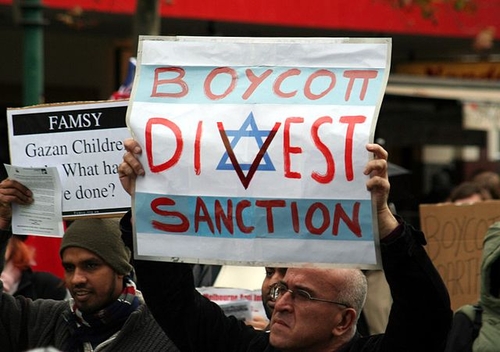
The Boycott Mirage


US Secretary of State John Kerry is warning that Israel faces economic embargoes if a US-drafted framework agreement with the Palestinians fails to go forward. 

While the merits of the current American diplomatic initiative are debatable, Kerry's warnings clearly have a deleterious effect: 

  • they feed the Boycott, Divestment and Sanctions (BDS) campaign being waged by Israel's enemies, and 
  • create the false impression that this campaign is a significant threat to Israel.


Sunday, February 09, 2014

The fabricated Palestinian history

From Israel Hayom, 7 Feb 2014, by Nadav Shragai:

Chief Palestinian negotiator Saeb Erekat, who this past week claimed Palestinian lineage to the Canaanites, is not the first Palestinian to reinvent history • A study of history shows that the roots of present-day Palestinians lie far from here.
Chief Palestinian negotiator Saeb Erekat
|
Photo credit: AP
Palestinians in today's Ramallah
|
Photo credit: Ziv Koren
Chief Palestinian negotiator Saeb Erekat
|
Photo credit: AP

Wednesday, February 05, 2014

Kerry’s deceptive Israeli supporters

From Caroline Glick*, Tuesday, February 4th, 2014 (Originally published in The Jerusalem Post. ):

Kerry boycott
Once again, on Saturday, US Secretary of State John Kerry tried to extort Israeli concessions to the PLO by threatening us with a Western economic boycott.
Kerry is obsessed with Israel’s economic success. Last May he told us that we’re too rich to surrender our land. Now he’s saying we’ll be poor if we don’t do so.
The anti-Semitic undertones of Kerry’s constant chatter about Jews having too much money are obvious. But beyond their inherent bigotry, Kerry’s statements serve to legitimize the radical Left’s economic war against the Jewish state. Administration supporters and fundraisers from Code Pink and other pressure groups, as well as the EU understand that if they escalate their economic and political persecution of the Jewish state, their actions will be met with quiet understanding, and even support from the Obama administration.
This is so even if the State Department issues indignant press releases expressing fury that Israeli elected officials have the chutzpah to object to Kerry’s behavior.
Israel has been subjected to plenty of abuse from American secretaries of state. But Kerry’s incessant talk of “illusory” Jewish money is unprecedented.
Why does Kerry believe he can get away with this? The overwhelming majority of US lawmakers oppose economic warfare against Israel.
The vast majority of Americans support Israel and believe that a Palestinian state will support terrorism and be hostile to Israel.
So if the American public opposes Kerry’s obsessive aggressiveness toward Israel, who is supporting him? Who is giving him cover for his anti-Jewish smears and his irrational focus on Jewish communities beyond the 1949 armistice lines?
The answer is as infuriating as it is apparent. It is the Israeli Left and through it, much of the American Jewish community that enables Kerry’s diplomatic aggression against the Jewish state.
Operating under their cover, Kerry feels free to engage in anti-Jewish bigotry directed against Israeli society. He believes he is immune from allegations of ill-will toward Israel even as he places the full weight of the US government behind a plan that will endanger Israel, bring no peace, destabilize the Middle East and fail to win the US any friends or allies in the Islamic world.
On the face of it, it is hard to understand why leftist Israeli Jews cheer Kerry’s aggressive attacks and threats. After all, they live here.
They know as well as the rest of the country that if Israel bows to his will and surrenders Jerusalem, Judea and Samaria to the PLO the move will bring no peace.
Rather it will unleash a Palestinian terrorist assault the likes of which we haven’t seen before.
They know that the international delegitimization of Israel only expands with every Israeli concession to the PLO, and that giving up the store will bring us no respite from the Western world’s assault on our right to exist.
So what do they gain by giving cover to Kerry? Why do people like Labor MK Shelly Yacimovich applaud Kerry for placing unrelenting pressure on the government to take steps that the majority of Israelis oppose and urge him to keep it up? Ron Pundak, one of the original architects of Israel’s embrace of the PLO and the so-called two-state solution at Oslo in 1993 supplied the answer in a recently published paper.
Last November the George Soros-supported International Crisis Group published a paper by Pundak entitled “Leap of Faith: Israel’s National Religious and the Israeli-Palestinian Conflict.”
The purpose of his paper was to provide strategies for contending with the religious Zionist opposition to the two-state model. According to Pundak, non-secular Israelis oppose the two-state policy because it “is seen as… aimed at de-Zionizing the state.”
Rather than develop talking points to convince Israeli Zionists that they are wrong to view the two-state model as an anti-Zionist project, Pundak admitted they are right. Indeed, destroying the Zionist underpinning of the Jewish state is not a byproduct of the two-state model. It is the purpose of the two-state model.
In Pundak’s words, “Peace is not an objective by itself. It is a way to transition Israel from one era to another: to an era of what I consider is a normal state. Israelisation of society rather than its judaisation…”
Pundak’s explanation is not new. Before the Sharon government surrendered Gaza to Palestinian terrorists and forcibly expelled its 8,000 Jewish residents from their homes, Haaretz published an unsigned editorial along the same lines.
“The disengagement of Israeli policy from its religious fuel is the real disengagement currently on the agenda. On the day after the disengagement, religious Zionism’s status will be different.”
The editorial concluded that all the talk about enhanced security or peace was pure nonsense. The purpose of destroying the communities in Gaza was to destroy the political and social power of religious Zionism in Israel.
Other leftist commentators and policy makers including Doron Rosenblum, Avirama Golan, Avrum Burg, Efraim Sneh, Dan Margalit and Ami Ayalon made similar arguments.
For Pundak and his colleagues in the post-Zionist camp, Kerry is a key ally. And to the extent Kerry weakens the government and its supporters, he is a strategic asset.
True, Kerry’s “framework” will bring no peace. But if what Pundak and his camp were after was peace, they wouldn’t have embraced the PLO to begin with. They would have cultivated pro-Israel Arabs who would lead their people into Israeli society.
That is, they would have done precisely what center- right governing coalitions – that included religious Zionists – sought to achieve, with significant success, in the decade and a half that preceded the phony peace-process.
Israel is a democracy. And it is perfectly legitimate for Pundak and his colleagues to try to advance their policy goal of replacing Zionism with a de-Judaized state or anything else they wish.
What is illegitimate is the means they have employed to advance their goal.
In a democracy, the strategic goals and policies of the government are supposed to be based on the will of the public as expressed at the ballot box. In Israel, there is a political party that shares the goals of the post-Zionist camp. It is called Meretz and it receives between two and five seats in the Knesset every election.
Pundak and his colleagues know that they cannot convince the majority of Israelis to abandon Zionism in favor of their anti-Jewish vision of the future. So rather than tell us the truth about what they are doing, they engage in subversion and subterfuge. They call themselves “the peace camp,” and use outside pressure and coercion to bend an unwilling public to their will.
For them, Kerry is best when he’s worst for their country.
And Kerry knows this. And so he piles on the threats, and the anti-Semitism, and with their support, he knows he can get away with it.

*Caroline Glick’s new book, The Israeli Solution: A One- State Plan for Peace in the Middle East, is due out on March 4.


Oxfam and extremists flock together

This report from Stand for Peace, 15 Jan 2013, is freshly relevant in the light of Oxfam's recent attack on Scarlett Johansson and Sodastream:

Oxfam ...a leading charity in the UK.. sponsors and runs events with a number of extremist groups.

Download the full Report Here

Summary
This report reveals that Oxfam has partnered with groups that support terrorism, religious extremism, anti-Semitism and advocate violence against Jews, women and homosexuals.

But what exactly defines a partnership? Oxfam has sponsored events, issued joint press releases, and run campaigns with all these groups...

Most importantly, Oxfam itself describes many of these relations as “partnerships”. It partnered with Islamic Relief and Human Appeal and Muslim Brotherhood-linked group MADE to produce a ‘campaigns toolkit’.  Both Islamic Relief and Human Appeal have been accused by a number of Governments of being “terrorist fronts”. Further, Islamic Relief’s President, Essam al-Haddad, was the campaign manager for Egyptian President Morsi, who recently described Jews as the “descendents of apes and pigs”.

In fact, on Oxfam’s website, the blog post acknowledging the ‘campaigns toolkit’ project was written by an Oxfam staff member called Nina Gora, who was a leading anti-Israel activist while at University. Working with the Palestine Solidarity Campaign, she invited Aharon Cohen, the extremist leader of Neturei Karta, to address students. A few years before, Cohen had said that Holocaust victims “deserved it”. Gora also wrote this piece, titled ‘Horror of Occuption’.

Oxfam’s relationship with the London Muslim Centre, considered by many to be one of the most extreme anti-Semitic institutions in Europe, has also been described as a “partnership”.

Oxfam proudly labels itself as the leading supporter of Zaytoun, an organisation run by the pro-Hamas International Solidarity Movement. Again, Oxfam calls the relationship a “partnership”. And yet Zaytoun is one of the leading actors in the movement to boycott Israeli goods.

Oxfam’s relations with these groups goes beyond sharing the occasional platform; it includes running joint events and affirming support for each other.

Oxfam partners have included:
  1. East London Mosque - an extremist institution whose speakers have included Saad Al Beraik, a hate preacher who calls for the enslavement of Jewish women.
  2. Islamic Relief - a charity which the Israeli government has designated a “terrorist front”. Ayaz Ali, the head of the charity’s Gaza operations, was deported after being accused of funnelling money to Hamas. Neo-Nazi images were found stored on his computer.
  3. MADE in Europe - a charity whose staff are linked to the Muslim Brotherhood and other radical Islamist groups, and whose offices are based at the extremist London Muslim Centre.
  4. Human Appeal International - a charity identified by the US Government as one of a number of groups used as conduits for funds to terrorist organisations, including Hamas.
  5. Zaytoun - a trade collective run by members of the anti-Israel, pro-terror International Solidarity Movement. Zaytoun works to promote the boycott of Israeli goods.
  6. Palestine Solidarity Campaign - an anti-Israel lobbying group which the BBC has described as a ‘radical’ organisation that supports Hamas. The Board of Deputies of British Jews has stated the PSC’s views include “racist conspiracy theories, the propagation of antisemitic stereotypes and Holocaust denial”.
  7. Muslim Aid - According to its own accounts, Muslim Aid paid £325,000 to the Islamic University of Gaza, where leading Hamas figures teach; and £13,998 to the al-Ihsan Charitable Society, designated by the US government as a “sponsor of terrorism” and a front for the Palestinian Islamic Jihad terrorist group.
  8. Federation of Student Islamic Societies – a radical student movement which has, in the past, promoted Al Qaeda recruiter Anwar Awlawki and has provided a platform to hate preachers such as Haitham Al-Haddad, who has said that Jews are “apes and pigs” and that the Gaza war made him happy because “it clearly encouraged Muslims to prepare themselves for jihad, all over the world”.
Download the full Report Here

Tuesday, February 04, 2014

Israel will manage, even without an agreement with the Palestinians

From JPost, 2/2/2014, by Herb Keinon:

Defense Minister Moshe Ya'alon speaks at Munich Security Conference
Defense Minister Moshe Ya'alon speaks at Munich Security Conference 
Photo: COURTESY MUNICH SECURITY CONFERENCE

Israel will manage, even without an agreement with the Palestinians, Defense Minister Moshe Ya’alon said Sunday, in contradiction to US Secretary of State John Kerry’s assessment that the status quo is unsustainable.
Speaking of a possible agreement with the Palestinians, Ya’alon – at the Munich Security Conference – said he was not willing to talk about giving up “one inch” unless the Palestinians agree that
 “at the end of the process, the framework of the negotiations will include 
  • the recognition of our right to exist as a nation-state of the Jewish people, 
  • a finality of claims, giving up the right of return, and 
  • addressing our security needs. That is what is [being] discussed now. 
Hopefully we’ll get it. If not, we will manage.”

The day before, Kerry’s message to the conference was that if the Israeli-Palestinian talks failed, matters would get significantly more problematic for Israel.
“Today’s status quo absolutely, to a certainty, I promise you 100 percent, cannot be maintained,” he said. “It’s not sustainable. It’s illusionary.
There’s a momentary prosperity, there’s a momentary peace. Last year, not one Israeli was killed by a Palestinian from the West Bank. This year, unfortunately, there’s been an uptick in some violence.
But the fact is the status quo will change if there is failure.”...
Ya’alon reiterated his position that the Israeli- Palestinian conflict was not a dispute over territory but over the Palestinian refusal to accept Israel as a Jewish state and to declare an end to the conflict, if and when there is an agreed-upon withdrawal from the West Bank.
“The core of the conflict is not territory which was liberated or occupied or taken in ’67,” said Ya’alon, who added that he supported the Oslo process because he believes that human life is more important than land. “The conflict started early on since the dawn of Zionism, and unfortunately I don’t see a leadership on the Palestinian side that is ready to say that if we reach a compromise on territory, it would be the end of claims.”
“I support the negotiations, I support any political engagement, but we should tell the truth to ourselves and not delude ourselves and to deceive ourselves regarding Abu Mazen’s intentions,” ...
“Will Abu Mazen be ready to recognize our right to exist as nation state of the Jewish people?...We got a clear answer. Never.”
The defense minister also rejected suggestions that Israel’s settlement activity was a sign that the government was not sincere about negotiating an agreement with the Palestinians.
“Settlements are not the obstacle to peace...The settlements include today less than five percent of the territory in the Palestinian arena. If we are going for peace – we have Arabs living side by side with us in Galilee and Jaffa and Acre; we don’t deny this right. Why does the Palestinian leadership insist on getting the territory without Jews? If we have to live together, we can benefit from each other.”...

Saturday, February 01, 2014

Nothing good comes from surrendering our rights and our land

From JPost,

As we learned from Oslo and Gaza, nothing good comes from surrendering our rights and our land.

Lapid
Finance Minister Yair Lapid tries to frighten Israelis at the INSS conference in Tel Aviv, January 29, 2014. 
Photo: CHEN GALILI

Finance Minister Yair Lapid delivered a scary speech on Wednesday. At the Institute of National Security Studies conference, Lapid warned that if we don’t accept US Secretary of State John Kerry’s framework for negotiations, ... the EU will abrogate its economic association agreement with us. And such a move on Europe’s part will cause serious harm to our economy.

...On the other hand, if we give up Jerusalem, Judea and Samaria, Lapid promises that we will all get rich.

It took less than 10 minutes for Lapid’s remarks to be exposed as utter nonsense.

The EU delegation to Israel flatly denied that the EU is considering abrogating the association agreement.
“There has been absolutely no consideration in the EU of the abrogation of the association agreement. It is not in the cards,” a statement by the delegation said.

As for the economic benefits Lapid promised Israel would reap from giving in to the PLO, here too, his claims do not withstand scrutiny.

First of all, Israel’s economy will be dramatically weakened, not strengthened, by a deal with the PLO.

As Economy Minister Naftali Bennett explained last week, the establishment of a Palestinian state in Judea, Samaria and Jerusalem would cause unprecedented damage to the economy. Like the de facto Palestinian state in Gaza, such a state would serve as a launching ground for missile attacks against Israel. And from Judea and Samaria, the Palestinians would have the capacity to destroy Israel’s economy with just a few, relatively primitive projectiles.
As Bennett out it, “Imagine if just one missile per day fell on [Israel’s technology hub in] Herzliya Pituah, what that would do to Israel’s economy.
If even one plane which was supposed to land at Ben-Gurion Airport crashes [due to terrorism] per year, it would crush the Israeli economy.”
Beyond what the Palestinians would do, there is no reason to believe – and every reason to doubt – that Europe would reward Israel in any way for giving its capital and heartland to the PLO.

In remarks last week meant to counter Bennett’s statement, Justice Minister Tzipi Livni inadvertently explained the true situation Israel faces from Europe.
In Livni’s words, “Europe is boycotting [Israeli] products. And, true, it is starting with the settlements, but their problem is with Israel, which is perceived as a colonialist state, so it won’t only stop with the settlements but will [reach] Israel as a whole.”
As we learned from our experience with the 2005 withdrawal from Gaza, Israel’s actions play no role in Europe’s perception of the Jewish state.

Europe will not cease to perceive Israel as “a colonialist state” even if we remove ourselves, lock, stock and barrel to the 1949 armistice lines.
In the lead-up to the Gaza withdrawal, Livni promised that once Israel quit Gaza, its diplomatic position would improve dramatically. By ending the so-called occupation of Gaza, she argued, Israel would prove its good will, and the Europeans would stop attacking us and take our side against the Palestinians at the UN and other arenas.

In the event, not only did this not occur, but the EU refused to acknowledge that the so-called occupation of Gaza even ended. To this day, Europe castigates Israel for its mythical “occupation” of Gaza.

As Livni accidentally explained, as far as Europe is concerned, Israel’s size is not the issue. Israel is the issue. True, Israel surrendered Gaza to Palestinian terrorists and removed every Israeli civilian and soldier from the territory. But since Israel is still stronger than the terror state in Gaza, Israel is still the “occupier.”

By the same token, even if Israel were to quit Judea, Samaria and Jerusalem completely, as long as Israel remains more powerful than the Palestinians in the areas, Europe will castigate Israel as the “occupier.”


And since the Palestinians and their allies will destroy Israel if it is ever less powerful than they are, Europe will stop condemning Israel as “a colonialist state” only if Israel ceases to exist.
At any rate, since the EU is not considering abrogating the economic association agreement, and since Israel will be economically worse off if it quits Judea, Samaria and Jerusalem, why is the finance minister trying to scare us? First, he’s doing it because everyone else is doing it.

Peace Now has joined the boycott, sanctions and divestment campaign.

Livni threatens Israelis so often with economic ruin that Foreign Ministry officials are complaining that she’s giving foreigners ideas.

In Washington, the Obama administration has added the threat of Israeli economic devastation to its list of plagues that will befall the Jewish state if we don’t give up our national heartland to the PLO.

In his remarks at the World Economic Forum in Davos last week, US Secretary of State John Kerry said, “Israel’s economic juggernaut is a wonder to behold…. But a deteriorating security environment and the growing isolation that could come with it could put that prosperity at risk.”

In other words, “Nice economy you got there Israel. It’d be a real shame if anything happened to it.”

The second reason that Lapid is threatening us – along with Livni, Kerry and so many others – is that he has nothing else to say in support of the fake peace process.

Kerry’s framework for Middle East peace offers neither anything new nor anything positive for the Israeli public to support. Were Israel to follow him down his garden path, we would receive neither peace, nor demographic security, nor national security nor national prosperity.

We will not receive peace because there is no Palestinian leadership interested in making peace, and there is no significant Palestinian constituency that supports peace. As Strategic Affairs Minister Yuval Steinitz said at the INSS Wednesday, PLO chief Mahmoud Abbas is “the world’s number one anti-Semitic leader.”

Steinitz elaborated, “There is an anti-Semitic subtext prevalent throughout the Palestinian Authority’s curriculum and the children programs.

The subtext is very clear – the State of Israel and the Jews should be destroyed.
“Abbas does not actively finance terror, but he who denied the Holocaust now denies the existence of a Jewish nation and its right to a state.”
In this context, no negotiations will lead to peace. In Steinitz’s words, “There is no peace process.

If an agreement is signed with the Palestinian Authority, it will be a diplomatic agreement, not a peace agreement.”

And the vast majority of Israelis know this. And Livni, Lapid, Kerry and their ilk know we know this. So all they can do is threaten us.

The first place they went, after the promise of peace was blown up at cafes and bus stops countrywide, was demographics.

For 17 years, the Left has been relying on a falsified 1997 Palestinian census that exaggerated the Palestinian population by 50 percent, as a means of scaring Israelis into going along with its phony peace process.

Still today, Kerry, Livni, Lapid and their fellow travelers seek to intimidate us by constantly telling us that continued Israeli control over Judea, Samaria and Jerusalem will bring about Israel’s demographic demise.

But the lie at the heart of their argument is no longer possible to ignore.

As demographic expert Yoram Ettinger wrote last week in Yisrael Hayom, Jewish Israeli fertility rates are higher than Palestinian fertility rates in Judea and Samaria. In 2013, the Palestinian fertility rate was 2.91 children per woman and the Israeli Jewish fertility rate was 3.04 children per woman.

Today Jews make up 62-66 percent of the population in Judea, Samaria and sovereign Israel.

With a two to one majority, a higher birthrate, and positive immigration rates, far from being a strategic threat to Israel’s national viability, demographics are one of Israel’s strategic assets.

The only threat to Israel’s demographic stability is the two-state formula. A Palestinian state in Judea, Samaria and Jerusalem would permit the unlimited immigration of millions of foreign Arabs into its territory. Rather than securing Israel’s Jewish majority, a Palestinian state would place millions of hostile Arabs on the outskirts of a rump Israel’s major cities.

With their threat of demographic ruin losing its traction with the public, purveyors of the twostate plan now raise the threat of economic strangulation and ruin at every opportunity.

They understand that given the public’s refusal to be drawn into their fantasies about “peace dividends,” the only path before them is a mix of intimidation and political subversion. They hope that together these two tactics can force Prime Minister Binyamin Netanyahu to submit to Kerry’s dictates for Israeli territorial surrenders.

Regarding political subversion, last week Eli Lake at the Daily Beast reported that the Obama administration is appealing to retired Israeli security brass to lobby the public against the government, in support of Kerry’s plan for Israel to surrender the Jordan Valley to the PLO.

According to senior defense sources, administration lobbying is not limited to retired generals.

The US is also recruiting currently serving IDF commanders to work on behalf of Kerry’s plan.

The idea is to rally a large enough cadre of security brass in favor of surrendering the Jordan Valley to undermine the authority of Netanyahu and Defense Minister Moshe Ya’alon, who has rejected Kerry’s plan.

Beyond frightening the general public, the economic threats are geared toward subverting the economic leadership of the country. Until now, Israel’s business leaders have been supporting Netanyahu’s economic leadership.

The campaign’s largest success to date came last week when a large delegation of Israeli business leaders joined the Kerry bandwagon and called for the partition of Jerusalem and surrender of Judea and Samaria in order to avoid economic penalties.

Clearly we are getting to crunch time.

Kerry is waiting for Netanyahu to agree to his framework. Until he does, Kerry, his allies and agents will escalate their threats and subversion.

So far, Netanyahu, Bennett and Ya’alon have competently exposed the lies behind the threats.

And they must continue on this course.

As we learned from Oslo and Gaza, nothing good comes from surrendering our rights and our land. And with Judea, Samaria and Jerusalem hanging in the balance, the stakes have never been higher.

Say No to The Kerry Plan

“Israel Hayom”, January 31, 2014:

The assumption that Israel must accept the Kerry Plan as a basis for negotiations with the Palestinian Authority – lest it risk a rift with the US – should be assessed in light of the full context of US-Israel strategic cooperation, the imploding Arab Street, the unique foundations and nature of US-Israel ties, the US political system, the ineffectiveness of prior US plans and Israel’s own security requirements.
US-Israel strategic cooperation transcends the Palestinian issue.  Thus, despite the 66-year-old disagreement, between the two Administrations, about the ways and means to resolve the Palestinian issue, strategic cooperation has catapulted to unprecedented heights.
Notwithstanding Arab talk – but based on the Arab walk - the Palestinian issue does not preoccupy the attention of Arab policy-makers, does not significantly impact vital US interests, and does not play a key role in destabilizing the Middle East, as reaffirmed by the tectonic Arab Tsunami, which is unrelated to Israel or the Palestinian issue. 
Therefore, the Palestinian issue has been superseded by regional and global mutual threats, interests and benefits, shaping the increasingly two-way-street mutually-beneficial US-Israel agenda: the US supply of critical military systems to Israel; the Israeli battle-tested laboratory, which enhances the performance of US military systems and the US defense industries; the joint development of ballistic, space, UAV, cyber and other critical technologies; Israeli innovations upgrade the competitive edge of US high tech industries; Israel provides intelligence of Iran’s nuclear threat and Islamic terrorism on the US mainland and beyond; Israel trains US elite units in countering-terrorism and urban warfare, and shares battle lessons, shaping US battle tactics; Israel’s power-projection deters rogue regimes, which threaten pro-US Arab regimes such as Jordan and Saudi Arabia; etc..
Israel’s role as the most consistent, capable and willing ally of the US gains in importance, as the Arab Street becomes increasingly anti-US, Islamist, unstable and unpredictably violent.  While the US cuts its defense budget and withdraws its military from the Middle East, Russia and China deepen their presence in the region and West Europe is preoccupied with domestic challenges.
The disagreement over the Palestinian issue is, also, superseded by shared US-Israel Judeo-Christian values, which have strongly influenced US morality, legal and political systems.  This dates back to the early Pilgrims in the 17th century, the Liberty Bell’s inscription from Leviticus, the Founding Fathers, the Biblically-driven Anti-Slavery Movement and the current statues of Moses in the US House of Representatives and the US Supreme Court.  
American constituents – which are the axis of the Federal system – through most of the Congress – a co-equal, co-determining branch of government on external and domestic matters – have established a unique bottom-up, systematic, positive attitude towards the Jewish state. They disassociate themselves from the Executive’s moral equivalence towards Israel – the role model of counter terrorism and unconditional alliance with the US – as opposed to the Palestinian leadership – a role model of international terrorism and an ally of Nazi Germany, the Communist Bloc, Khomeini, Saddam Hussein and Bin Laden.
In 1948, the charismatic US Secretary of State, George Marshall pressured Israel to accept his plan of a UN Mandate for Palestine as a substitute for independence.  Marshall considered the Jewish state a liability and the Arabs an asset.  He assumed that Israel would join the Communist Bloc and would be unable to defend itself against the invading Arabs, thus triggering a second Jewish Holocaust in less than ten years. Prime Minister Ben Gurion refused to negotiate Marshall’s proposal.
When threatened by UN Security Council sanctions, which dictated a withdrawal from the “occupied Negev,” Ben Gurion stated: “What Israel has won on the battlefield, it is determined not to yield at the [UN Security] Council table.” Ben Gurion’s principle-driven defiance and steadfastness produced short-term pressure, but long-term strategic respect, transforming Israel into the most reliable, stable, capable, democratic and unconditional ally of the US in the Middle East and beyond.
In 1957, President Eisenhower pressured Israel to evacuate the Sinai Peninsula.  Senate and House leaders, both Democrats and Republicans, threatened Eisenhower with legislative paralysis, and convinced Eisenhower to reduce his pressure.  However, Israel pulled the rug from under their feet by accepting the Eisenhower plan.
In December, 1969 and June, 1970, Secretary of State, William Rogers, introduced the Rogers Plan, calling for Israeli withdrawal to the 1967 lines, providing for a return of Arab refugees to Israel and shared Israel-Jordan rule in Jerusalem. Prime Minister Golda Meir rejected the plan, initializing the construction of three large new neighborhoods in eastern Jerusalem, home of over 100,00 persons. Rogers tolerated Egypt’s advancing surface-to-air missiles in violation of commitments, which facilitated the deterioration to the 1973 Yom Kippur War.
In 1977, President Carter pressured Israel to participate in an international conference, highlighting the Palestinian issue and a full Israeli withdrawal.  Prime Minister Begin dismissed the idea and initiated the dialogue with Egyptian President Sadat, which led to a peace accord.
In September, 1982, President Reagan announced his plan, calling for full Israeli withdrawal and an immediate settlement freeze. Prime Minister Begin rejected the plan, expanded settlements, and laid the foundation for the November, 1983 upgrade of US-Israel strategic cooperation.

Accepting the Kerry Plan would revert Israel to the pre-1967 9-15 mile sliver along the Mediterranean, dominated by the mountain ridges of Judea and Samaria, which would be controlled by the Palestinian Authority, a systematic violator of agreements, perpetuator of hate education and generator of terror.  The irreplaceability of Judea and Samaria mountain ridges for Israel’s national security has been reinforced by the Arab Tsunami.  It has made the Middle East – the most conflict-ridden region in the world - more violently intolerant, unpredictable, unreliable, unstable and treacherous.

Accepting the Kerry Plan requires the subordination of long-term vision and security to short-term convenience, and the subjugation of realism to wishful-thinking, thus jeopardizing the very survival of the Jewish State, transforming Israel from a unique asset to a burden. Rejecting the Kerry Plan, might create short-term tension, but no long-term rift. 
On a rainy day, the US prefers a defiant, rather than a submissive, ally.