Saturday, May 05, 2012

Beinart Book a Colossal Flop

From Commentary Magazine, 3 May 2012, by Jonatan S. Tobin:

Both conservative and liberal Jewish critics have panned Peter Beinart’s book about the so-called Crisis of Zionism, giving the onetime neo-liberal scribbler a series of spankings that would daunt a less conceited author. But because the disillusioned lover of Zion didn’t let his own abysmal ignorance about both Israel and the Palestinians stop him from writing a book about the topic, there’s no reason to assume he won’t go on annoying audiences with his agonized but all too predictable misgivings about the real life state of Israel ... the book-buying public, like the critics, aren’t buying it.

According to BookScan, the respected service that tabulates point-of-sales purchases of books at stores around the nation, Beinart’s much-hyped effort is a flop. Reliable sources tell us that BookScan, which is believed to capture the figures that represent about 60 percent of the book buying in the nation, has tabulated that as of this week Beinart had only sold 2,845 copies of The Crisis of Zionism. Because books that sell thousands more than that number are considered by publishers to be busts, Beinart’s ballyhooed cri-de-coeur must be considered a colossal flop. And considering that Beinart is believed to have received an advance of several hundred thousand dollars for it, one imagines that the brass at Times Books — the partnership between Henry Holt and the New York Times that published Crisis — are kicking themselves for being duped into believing the market for post-Zionist carping extended beyond the tiny group of people who will buy anything that takes a dim view of Israel.


Crisis’s current Amazon rating is 2,530. That might not be considered embarrassing for a run-of-the-mill non-fiction book. But it’s a terrible ranking for a book whose author has been feted on broadcast and cable networks in the kind of public relations blitz orchestrated by his publisher normally reserved for a blockbuster.

In making this observation, we’re not looking to rain on Beinart’s parade. He’s already got his money for the book and can, as they say, cry all the way to the bank while continuing to portray himself as a courageous and embattled dissident no matter what anyone says. The point is that the failure of this book undercuts the claim that Beinart represents mainstream American Jewish views. He doesn’t. The apathetic response of a book-buying community like the Jewish one illustrates that the public has as little interest in his misguided views as the critics.

Though Beinart’s attack on Israel may conform to the views of the editors and publishers of the Times, perhaps the next time an ambitious scribbler and his book agent tries to sell a publisher on a project with a similar theme, they will remember Beinart and take a pass.

Thursday, May 03, 2012

United Church report shows how Israel-haters have lost the argument

From the National Post, May 1, 2012 by Jonathan Kay, Managing Editor for Comment at the National Post, and a Fellow at the Foundation for Defense of Democracies in Washington, D.C.:
According to a new report from the United Church of Canada, “the deepest meaning of the Holocaust was the denial of human dignity to Jews.”
Oh, really? Actually, I’d say that the “deepest meaning of the Holocaust” was the slaughter of six-million human beings. Being strip-searched by police for no good reason is an infringement of one’s “dignity.” Getting thrown into a gas chamber is a little bit more serious. I’m guessing the last thoughts of the victims at Auschwitz, as their silent shrieks left their throats, wasn’t “Oh my, but this is undignified.”
So why that choice of phrase — “human dignity” — on the first page of the United Church’s Report of the Working Group On Israel/Palestine Policy? The answer becomes obvious in the very next paragraph: “The working group is also aware that the Occupation has meant a loss of dignity for Palestinian people” — including “the denial of the legitimacy of the Palestinian experience.”
See how they did that? See how that magically expansive, all-encompassing word “dignity” works? The Holocaust damaged “human dignity.” So does the uprooting of Palestinian olive trees. So does a pundit who fails to ponder the “Palestinian experience.” Why, it’s all part of the same struggle. (Incidentally, the same trick works with “social justice” — which is why you see that one thrown around a lot by Middle East peace-studies types, too.)
The pity of it is that the substance of the United Church’s report, which was released on Tuesday, isn’t particularly radical. Yes, it repeats the slander that Christians “are leaving Palestine because of the Israeli occupation, not because of conflict with Muslim Palestinians” (one wonders if the dreaded Israeli Occupation is equally to blame for the even greater mass exodus of Christians from Lebanon, Egypt and Iraq). But it also clearly states that questioning Israel’s “legitimacy” and its “right to exist” is unacceptable. That’s a proposition that most of us find obvious, but which is a live controversy in the left-wing NGO circles where United Church types travel.
The report also sensibly states that “It is impossible to overstate the threats to the existence of Israel,” including Iranian threats. The authors discourage use of the term “apartheid” — since it “shuts down conversation,” and oppose radical BDS (boycott, divestment and sanctions) initiatives that target the entire Israeli economy. Instead, they call for “focused economic action directed at products produced in the settlements.” (This won’t please supporters of Israel, of course. But keep in mind that activists have been calling for this sort of boycott for years, and such efforts have never caused so much as a blip on Israel’s economic radar.)
Perhaps the most notable aspect of the United Church report is its extraordinarily defensive tone. Like the aforementioned sophistry involving the term “human dignity,” much of the report seems aimed at justifying the author’s own continuing obsession with Israel, and at fending off the many critics who accuse the Church of anti-Zionist monomania.
One section of the report, for instance, addresses “questions about why Israel is currently the only country in the world being challenged by a global boycott.” The answers supplied are wholly inadequate: One is left wondering, for instance, why United Church functionaries seem to care more about Israel than Sudan and Nigeria, where real, murderous anti-Christian pogroms are a regular occurrence. Yet the mere fact that the Church feels compelled to address these obvious questions is good news, as it goes against the prevailing wisdom (in conservative circles) that elites are becoming more and more blindly hostile to the Jewish state.
In fact, the opposite phenomenon has been obvious for years in Canada. Like the United Church, Canadian public-service unions and academic groups that target Israel have been harshly criticized — often by their own members. Queers Against Israeli Apartheid, a small but noisy group that once insisted on marching in Toronto’s annual Gay Pride parade, was forced to bow out. On campuses, Israeli Apartheid Week recently has proved something of a dud — as left-wing student activists move on to other causes, such as the Arab Spring and, closer to home, the fight against Stephen Harper.
Yes, the Globe & Mail and Toronto Star still feature occasional anti-Israel pieces from former UN ambassadors and the like. But their heart isn’t really in it any more. Even the CBC, once the bugbear of Canadian Israel-defenders, now features (largely) balanced coverage on the subject. The scathing criticism of Israel that once was featured regularly in these outlets is now relegated to niche web sites such as rabble.ca, and tiny fringe groups such as Independent Jewish Voices. As the United Church report shows, mainstream critics of Israel no longer are willing to make common cause with such radicals — which is why the movement now has descended into schism.
The battle for balance on the Israeli question was won at the Parliamentary level, thanks to Stephen Harper’s government — but also through the grass roots: by countless bloggers, journalists, activists and rabbis putting hard questions to Israel’s critics. (For a sample, see this great 2011 National Post interview with a vocal United Church pastor, in which reporter Charles Lewis simply would not let the pastor get away with evasive answers on the question of singling Israel out for boycott.) This week’s United Church report, no matter the objectionable nature of some of its recommendations, provides a good opportunity for defenders of Israel to take stock of how profoundly they have changed the terms of debate.

Wednesday, May 02, 2012

PA celebrates Abu Jihad's terror

Six sporting events named after the arch-terrorist
PA TV and PA official news agency WAFA venerate Abu Jihad's 125 killings

PA TV broadcast of Abu Jihad speaking in the 1960s and 1970s:

"On one street, for example, we will hold 500 people [hostage]... at any moment, he can blow up everyone; blow up their building, or the whole thing, no matter how many people are there... We want to turn the Tel Aviv day black. We want to turn the Tel Aviv day into destruction, Allah willing. We will turn the Tel Aviv day so it will be remembered in the history of Tel Aviv as black Saturday, black Sunday. Tel Aviv will be closed that whole day with blood and destruction."
[PA TV (Fatah), April 16, 2012]

During the week of the anniversary of the death of PLO arch-terrorist Abu Jihad, the Palestinian Authority held events and broadcast TV programs celebrating him and his terror attacks.
One of the striking components of the Abu Jihad festivities was the presentation of the 125 Israeli civilians and soldiers killed in terror attacks he planned and directed, as a positive achievement.
...[See full listing of his terrorist "successes" below ]
...Sporting events portraying him as a hero and role model for youth were held throughout the anniversary period, as reported in the official PA daily:
"The anniversary of the Martyrdom-death of our people's legendary leader, Khalil Al-Wazir, Abu Jihad, is approaching, and in its honor the sports organizations in Palestine are organizing many tournaments in diverse branches of sports... the knights of the Ansar Al-Quds club have commemorated this anniversary every year, and continue to do so. This year they will be holding their 18th tournament."
[Al-Hayat Al-Jadida, April 12, 2012]

Other sporting events in his name, included:
"Abu Jihad table-tennis championship reaches the quarter-finals."
[Al-Hayat Al-Jadida, April 16, 2012]

"Veterans of Tulkarem prepare for the 'Abu Jihad' Tournament."  
[Al-Hayat Al-Jadida, April 21, 2012]

"The Palestinian Judo Association held the Martyr Abu Jihad judo tournament on the anniversary of the death of commander Khalil Al-Wazir - 'Abu Jihad'... Ziyad Abu Sbih delivered a moving address in which he reviewed the life of Martyr Abu Jihad and his national achievements. He told the children and youth about the Martyr's biography."
[Al-Hayat Al-Jadida, April 24, 2012]

"Sponsored by the Palestinian Investment Fund - 'The Prince of Martyrs Abu Jihad' Tournament draw will take place today at the 'Al-Ansar club ."
[Al-Hayat Al-Jadida, April 22, 2012]

 "The Boxing Association has announced the launch of the Third Palestine Tournament for Men and Boys. The association has named [the tournament] 'the Martyr (Shahid) Khalil Al-Wazir, Abu Jihad, Tournament.'"
[Al-Hayat Al-Jadida, March 27, 2012]

The period was marked with events. For example:

"Marking the anniversary of the Martyrdom-death of Abu Jihad at the Open University in Bethlehem..."
[Al-Hayat Al-Jadida, April 22, 2012]


"Martyr (Shahid) Abu Jihad School names the winner of the Ya'bad marathon..."
[Al-Hayat Al-Jadida, April 7, 2012]

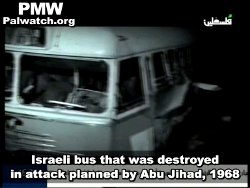
The PA TV documentary on Abu Jihad included
this image of a bus that was destroyed 
in one of Abu Jihad's attacks
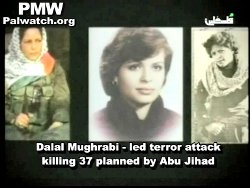
The second PA TV film on Abu Jihad glorified terrorist Dalal Mughrabi, who participated in the bus hijacking and killing of 37 civilians,
that was planned by Abu Jihad

Parts of a long documentary program, including old films showing Abu Jihad planning large scale terror attacks against Israel was broadcast on PA TV. The film, entitled Abu Jihad: Revolution of a man; a man in the Revolution, shows Abu Jihad telling PLO terrorists about to embark on their terror attack that his goal is "to turn the Tel Aviv day black... Tel Aviv will be closed that whole day with blood and destruction."


The following are texts from the documentary broadcast on PA TV. The film was produced in 2010 under the auspices and supervision of Fatah MP Ashraf Jum'a. It opens with a note that the film contains footage of Abu Jihad making "final arrangements for self-sacrificing operations in occupied Palestine." The PA term "operations in occupied Palestine" refers to terror attacks in Israel. Parts of the documentary film were broadcast on April 16 , the day of the celebrations of his "Martyrdom" death and other parts were broadcast earlier on PA TV in January 2012. Another film honoring him was broadcast on the same day - April 16, 2012.


The following is the video and transcript of the first Abu Jihad film:

Abu Jihad: "After we strike the [Israeli] headquarters, Allah willing, we will close off the streets [of Tel Aviv]. On one street, for example, we will hold 500 people [hostage]. 500 people at once. Can anyone bargain over them? No one, without exception, is allowed to go there unless he sets up the fuse and the explosives. At any moment, he can blow up everyone. Blow up their building, or the whole thing, no matter how many people are there. Our dagger will be a poisoned dagger in our enemy's heart, and we will take down as many as possible. We want to land on enemy territory (Israel) and to be like a single fortress. When we get there, Allah willing, we will begin to fire, to fire on our enemy. We will dig in his throat and heart with the massacres that we spoke about. We want to turn the Tel Aviv day black. We want to turn the Tel Aviv day into destruction, Allah willing. We will turn the Tel Aviv day so it will be remembered in the history of Tel Aviv as black Saturday, black Sunday. Tel Aviv will be closed that whole day with blood and destruction."

Narrator:
"It occurred to Abu Jihad to publish a Fatah journal named The Call of Life - Palestine. The first issue, published in October 1959, called for an armed revolution to uproot the Zionist entity. [Abu Jihad] was the mastermind of the armed struggle against Israel. He is a symbol of Palestinian armed struggle. Abu Jihad fell as a Martyr, and symbolized the generation of the fighting commanders who adopted the path of resistance as the first and last solution for the nation's cause. He was known as a tough fighter and an extraordinary commander who was always in a state of war and never lost his way."
[PA TV (Fatah), April 16, 2012]

Click to view


The following is the video and transcript of the second Abu Jihad film also broadcast on April 16:
Narrator: "The Palestinian revolution was at its peak, and many times Fatah carried out 60 special operations a day. Among the leading operations of the Prince of Martyrs (Abu Jihad): the explosion of the Zohar reservoir in 1955, the explosion of the Israeli National Water Carrier in 1965, the 1975 Savoy Hotel operation in Tel Aviv, in which 10 Israelis were killed, the Dalal Mughrabi operation in 1978, in which more than 37 Israelis were killed, the shelling of the Eilat Port in 1979, and the Dimona Reactor operation in 1988 (bus hijacking and killing of 3 civilians), which was the principle reason for his assassination on April 16, 1988."
[PA TV (Fatah), April 16, 2012]


Click to view

During the anniversary week, the Secretary General of the Mahmoud Abbas's office praised Abu Jihad:

"Secretary General of the Presidential Office and member of the Fatah Central Committee, Al-Tayeb Abd Al-Rahim, emphasized that the Martyr Abu Jihad left behind him a clear stamp and heritage in the journey of the Palestinian struggle... Abd Al-Rahim said: 'On days like these we recall one of the founding members and leaders who risked their lives and fought quietly, without making a show and without the media, but they created men who brought about victories, who brought about acts of heroism... Abu Jihad will remain in our hearts and in the pulse in our veins. He will never die among us; rather, he will be renewed with every young boy, with every young girl... When Abu Jihad died as a Martyr, we felt - I personally and all who knew him - that we had lost not only a symbol, but a father, a brother, a teacher and ideal; a model in every way."
[Al-Hayat Al-Jadida, April 17, 2012]

The following is the full text of the article by WAFA, the official PA news agency, glorifying Abu Jihad for killing Israeli civilians, that was also published in the official PA daily:

"Abu Jihad was killed by the Israeli Mossad in Tunisia on April 16, 1988... and was crowned the Prince of the Martyrs of Palestine... Among the military operations planned by Abu Jihad: the explosion at the Zohar reservoir in 1955; the operation to blow up the Israeli National Water Carrier in 1965; the operation at the Savoy Hotel in Tel Aviv, which killed 10 Israelis, in 1975; the blowing up of a truck bomb in Jerusalem in 1975; the killing of Albert Levi, the senior sapper, and his assistant, in Nablus in 1976; the Dalal Mughrabi operation, in which more than 37 Israelis were killed, in 1978; the shelling of the Eilat Port in 1979; the Katyusha fire on the northern settlements [in Israel] in 1981 and the capture of 8 Israeli soldiers in Lebanon, and their exchange for 5,000 Lebanese and Palestinian prisoners and 100 of the detainees from occupied territory in 1982. He planned the infiltration and bombing of the headquarters of the Israeli military governor in Tyre, leading to the deaths of 76 officers and soldiers, including 12 senior officers, in 1982; he led the war of attrition during the years 1982-1984 in southern Lebanon, and planned the Dimona Reactor operation in 1988, which was the principle reason for his assassination."
[Al-Hayat Al-Jadida, April 16, 2012]

1-4 May, 1948: Arab Legion massacres Jewish residents of East Jerusalem

From Aish.com: This time, in 1948: 1 May, 1948: an Arab force ambushed a Jewish convoy on the way to Hadassah Hospital (in "East Jerusalem"), killing 77 Jews, including doctors, nurses, patients, and the director of the hospital. Another 23 people were injured. This massacre attracted little attention and is never mentioned by those who are quick to bring up Deir Yassin. Moreover, despite attacks such as this against the Jewish community in Palestine, in which more than 500 Jews were killed in the first four months after the partition decision alone, Jews did not flee. On May 4, 1948: the Arab Legion attacked Kfar Etzion. The defenders drove them back, but the Legion returned a week later. After two days, the ill-equipped and outnumbered Jewish settlers were overwhelmed. Many defenders were massacred after they surrendered. In all, 148 people were killed, including the settlement's Palmach defenders. Only four people survived.

Egypt on the Brink of Starvation

From The Asia Times, 1 May 2012, by Spengler:
Egypt's national tragedy took a turn towards farce April 27, when Saudi Arabia closed its embassy and several consulates after demonstrations that "threaten the security and safety of Saudi and Egyptian employees, raising hostile slogans and violating the inviolability and sovereignty", according to a Saudi statement. Saudi Arabia and other Gulf States were supposed to anchor an international aid package that will forestall a disorderly financial crisis.
With a critical fuel shortage cutting into food supplies and essential services, Egyptians already have a foretaste of chaos. The two-for-a-penny pita, the subsidized flat bread that provides much of the caloric intake for the half of Egypt's population living on less than $2 a day, is at risk.
A battle over the Muslim Brotherhood's international ambitions
may push Egypt over the edge into a Somali level of horror.... the Brotherhood prefers an early economic crisis to a later one, so that it can blame the disaster on the present military government.

The Muslim Brotherhood's then presidential candidate Khairat al-Shater"said he realized the country's finances were precarious and a severe crunch could come by early to mid-May as the end of the fiscal year approached, but that this was the government's problem to resolve." Since then, the military-controlled elections commission has excluded al-Shater as a candidate, and the Brotherhood replaced him with Mohammed Morsi.
Meanwhile, Egypt's Salafist party, the extreme Islamists, withdrew support from Mohammed Morsi and backed instead the more liberal Islamist candidate, Abdel Moneim Aboul Fotouh, often described as a "defector" from the Brotherhood.
Although the Salafists propose an even more extreme version of the Muslim Brotherhood's program, oil is thicker than blood in the region; the Salafists get a reported $50 million annual subsidy from the Saudis, and presumably are acting under Saudi orders.
As the situation on the ground deteriorates, Egypt's military government is becoming a bystander to events. Egypt is in a classic pre-revolutionary situation, like Russia in October 1917 or German in March 1933, with a vanguard party ready to dislodge a disintegrating civil society, and replace it with totalitarian party rule at street level. The Muslim Brotherhood, Egypt's largest political party, is poised to ride to power on the back of this crisis.
The International Monetary Fund (IMF) is negotiating a US$3 billion loan with the Egyptian government, with the understanding that all the major parties will support severe belt-tightening, and that the Saudis and other Gulf states will fund the loan as well as additional aid. Saudi Arabia had promised to lend Egypt $3.75 billion, but paid in only $500 million of its pledge. Last week the Saudis said that they would pay in another $1 billion. But that was before the demonstrations against their embassy.
As the main opposition body to military misrule during the past six decades, the Brotherhood harbors parliamentarians as well as firebrands. But the revolutionary dynamic in Egypt favors the firebrands. As critical shortages spread through Egypt's fragile economy, Islamist street justice already is replacing the corrupt and crumbling institutions of the military regime. There is a second analogy to revolutionary Leninism, in the form of the Brotherhood's international ambitions.
In effect, the Muslim Brotherhood has chosen to push the country towards chaos. "North Africa's biggest economy has imploded since a democratic uprising last year and the country will run out of money to meet basic subsidies including wheat and oil by the summer," the Daily Telegraph reported April 16.

 ...Fuel shortages have become critical in many parts of Egypt. UN observers report that the supply of diesel is down by 35%, and is so scarce that food supplies are threatened.
...More than a hundred Egyptian bakeries shut down in mid-April to protest the fuel shortage, the Egyptian news site Youm7.com reported April 12. In Beni Suef, dozens of bakery owners gathered in front of a government flour warehouse to complain that they could obtain fuel only at black market prices, which required them to sell bread at black market prices.
... Egypt is running out of cash - its liquid foreign exchange reserves have fallen from $25 billion when Mubarak fell to only US$9 billion in March - and a devaluation of the Egyptian pound is widely expected, followed by a sharp rise in the price of imported commodities.
...The Arab monarchies fear that the ascent of the Muslim Brotherhood to power in Egypt by revolutionary means portends a further revolutionary assault on their own regimes. And the result of American failure to take decisive action to interdict the Brotherhood's march to power is likely to be greater instability and a decline of American influence in the region.
Interdicting the Brotherhood, in turn, requires an uncharacteristic harshness on the part of American policy. War correspondent Peter Arnett might have concocted the notorious statement, "It became necessary to destroy the town to save it," supposedly said by an American officer of the Vietnamese provincial capital Ben Tre in 1968. Something like that might be the outcome for Egypt.

Kadima would Give the Palestinians 100%

From INN, 7 April 2012:Kadima head Shaul Mofaz says he will give the PA 100% of its territorial demands if he is elected Prime Minister.


Shaul Mofaz
Shaul Mofaz

Opposition leader Shaul Mofaz (Kadima) told the The New York Times that he would "respond to 100% of the territorial demands of the Palestinians" if elected Prime Minister.
“I intend to replace Netanyahu,” Mr. Mofaz, 63, said. “I will not join his government.”
Mofaz said that he believed Israel should keep the main settlement blocs, but that he would give the Palestinian Authority as much land from sovereign Israeli ground as he kept from Judea and Samaria.
He added that he believes it is possible to reach an agreement on the borders and security within one year.
When asked about Israeli residents of Judea and Samaria living in communities he would cede to the Palestinian Authority, Mofaz said,
"If they're given the right incentives they will leave their homes. Those who do not, we would have to evacuate [them]."
MK Uri Ariel (National Union) responded by saying
"He proposes Palestinians be given 100% of the land with a swap, and those Jews who do not leave voluntarily evacuated by force."
"This is a wildly radical program that undermines our security and will lead the State of Israel into one hundred years of conflict rather than one hundred years of peace," Ariel countered. "Mofaz should find another way of trying to achieve popularity for his [declining] party without undermining Israel's security."
Yesha Council Chairman Danny Dayan said,
"A man who will give the Palestinians 100% of what they demand in a territorial power play and evict tens of thousands of Israelis is unfit to be prime minister of Israel." "But do not worry," Dayan said. "Kadima will not be chosen to lead the nation again."
Kadima is currently Israel's largest party with 28 Knesset mandates. However, recent polls indicate Kadima would only win 12-15 seats if elections were held today. It may be an effort to gain Kadima voters from other left of center parties that is causing Mofaz to voice extremist views, sources have said. He has also made anti hareidi remarks.,
Even with 28 mandates, Mofaz's predecessor Tzipi Livni was unable to call upon sufficient coalition partners to form a government - a task that was given to Prime Minister Binyamin Netanyahu's Likud party.
Likud, which has 27 Knesset mandates at present, is currently polling at 32 seats. Other rightist parties are also polling beyond their present numbers.

Monday, April 30, 2012

Middle East Myths and Facts

From Israel Ministry of Foreign Affairs, 23 Apr 2012 (Ambassador Ron Prosor addresses the Security Council):
"The Situation in the Middle East" - I would like to use today's debate as an opportunity to address just a few of the myths that have become a permanent hindrance to our discussion of the Middle East here at the United Nations. ...In the barren deserts of the Middle East, myths find fertile ground to grow wild. ...I would like to use today's debate as an opportunity to address just a few of the myths that have become a permanent hindrance to our discussion of the Middle East here at the United Nations.
Myth number one: The Israeli-Palestinian conflict is the central conflict in the Middle East. If you solve that conflict, you solve all the other conflicts in the region.

Make no mistake: it is important for Israel and the Palestinians to resolve our longstanding conflict for its own merits. Yet, the truth is that conflicts in Syria, Yemen, Egypt, Bahrain, and many other parts of the Middle East have nothing to do with Israel.

It is obvious that resolving the Israeli-Palestinian conflict won't stop the persecution of minorities across the region, end the subjugation of women, or heal sectarian divides. Obsessing over Israel has not stopped Assad's tanks from flattening entire communities. On the contrary, it has only distracted attention from his crimes. And dedicating the majority of this debate to the Israeli-Palestinian conflict, month after month, has not stopped the Iranian regime's centrifuges from spinning. Iran's ambitions for nuclear weapons are the single greatest threat to the Middle East, and the entire world.

The Iranian nuclear program continues to advance at the speed of an express train. The international community's efforts to stop them are moving at the pace of the local train, pausing at every stop for some nations to get on and off. The danger of inaction is clear. We cannot allow the diplomatic channel to provide another avenue for the Iranian regime to stall for more time, as they inch closer and closer to a nuclear weapon.

Myth number two: There is a humanitarian crisis in the Gaza Strip.

In fact, numerous international organizations have said clearly that there is no humanitarian crisis in Gaza, including the Deputy Head of the Red Cross Office in the area. Gaza's real GDP grew by more than 25 percent during the first three quarters of 2011.  Exports are expanding. International humanitarian projects are moving forward at a rapid pace. There is not a single civilian good that cannot enter Gaza today.

Yet, as aid flows into the area, missiles fly out. That is the crisis in Gaza. And that is what keeps Gaza from realizing its potential.

It is a simple equation. If it is calm in Israel, it will be calm in Gaza. But the people of Gaza will face hardship as long as terrorists use them as human shields to rain rockets down on Israeli cities. Each rocket in Gaza is armed with a warhead capable of causing a political earthquake that would extend well beyond Israel's borders. It will only take one rocket that lands in the wrong place at the wrong time to change the equation on the ground. If that happens, Israel's leaders would be forced to respond in a completely different manner.

It is time for all in this Chamber to finally wake up to that dangerous reality. The Security Council has not condemned a single rocket attack from Gaza. History's lessons are clear. Today's silence is tomorrow's tragedy.

Myth number three: Settlements are the primary obstacle to peace.
How many times have we heard that argument in this chamber? Just this month, the Human Rights Council proposed yet another "fact-finding" mission to Israel. It will explore…surprise, surprise…Israeli settlements.

Today, I'd like to save the Human Rights Council and the international community some time and energy. The facts have already been found. They are plain for all to see.

The fact is that from 1948 until 1967, the West Bank was part of Jordan, and Gaza was part of Egypt. The Arab World did not lift a finger to create a Palestinian state. And it sought Israel's annihilation when not a single settlement stood anywhere in the West Bank or Gaza.

The fact is that in 2005 we took every settlement out of Gaza and only got rockets on our cities in return. The fact is that this Israeli Government put in place an unprecedented ten-month moratorium on settlements. The Palestinian leadership used the gesture as an opportunity to take Israel and the international community on another ride to nowhere. For nine of those months, they rejected the moratorium as insufficient - and then demanded that we extend it. As former U.S. Special Envoy George Mitchell said "what had been less than worthless a few months earlier became indispensable to continue negotiations…[for the Palestinians]."

The primary obstacle to peace is not settlements. The primary obstacle to peace is the so-called "claim of return" - and the Palestinian's refusal to recognize Israel's right to exist as the nation-state of the Jewish people.

You will never hear Palestinian leaders say "two states for two peoples". You won't hear them say "two states for two peoples" because today the Palestinian leadership is calling for an independent Palestinian state, but insists that its people return to the Jewish state. This would mean the destruction of Israel.

Some of you might say, "Oh Ambassador, but the Palestinians know that they will have to give up this claim, that's what they whisper quietly at the negotiating table."

Ladies and Gentleman - the Palestinian leadership has never said publicly that they will give up the so-called "claim of return" - neither to the Palestinian people, to the Arab world, to the international community, or to anyone else. Since the Palestinian leadership refuses to tell the Palestinian people the truth, the international community has the responsibility to tell them the truth. You have a duty to stand up and say that the so-called "claim of return" is a non-starter.

Instead of telling the Palestinian people the truth, much of the international community stands idle as the Arab world tries to erase the Jewish people's historical connection to the Land of Israel. Across the Arab world - and even at this table - you hear claims that Israel is "Judaizing Jerusalem". These accusations come about 3,000 years too late. It's like accusing the NBA of Americanizing basketball.

Like many nations around this table, the Jewish people have a proud legacy of age-old kings and queens. It's just that our tradition goes back a few years earlier.  Since King David laid the cornerstone for his palace in the 10th Century BC, Jerusalem has served as the heart of our faith.

In debate after debate, speakers sit in the Security Council and say that Israel is committing "ethnic cleansing" in Jerusalem, even though the percentage of Arab residents in the city has grown from 26% to 35% since 1967.

The holiest sites in Jerusalem, the eternal capital of the Jewish people, were closed only to Jews from 1948 until 1967. Everyone could come to these sites except Jews. There was absolutely no freedom of worship. The world did not say a word about the situation in Jerusalem at that time.

Since Israel unified the city, it has thrived under the values of tolerance and freedom. For the first time in centuries, sacred places that were once sealed off along religious lines are now permanently open for worship by all peoples. This is a principle grounded in our values, our actions and our laws.

There is another great truth that this organization has completely overlooked for the past 64 years. In all of the pages that the UN has written about the Israeli-Palestinian Conflict, in all of its reports and fact-finding commissions, and in all of the hours dedicated to debate about the Middle East, there is one great untold story. Or - to be more specific - there are more than 850,000 untold stories.

More than 850,000 Jews have been uprooted from their homes in Arab countries during the past 64 years. These were vibrant communities dating back 2,500 years. On the banks of the Tigris and Euphrates rivers, Babylonian Jewry produced many of Judaism's holiest books - and thrived for two millennia. In the great synagogues and libraries of Cairo, Jews preserved the intellectual and scientific treasures of antiquity into the Renaissance. From Aleppo to Aden to Alexandria, Jews stood out as some of the greatest artists, musicians, businessmen, and writers.

All of these communities were wiped out. Age-old family businesses and properties were confiscated. Jewish quarters were destroyed. Pogroms left synagogues looted, graveyards desecrated and thousands dead. The pages that the UN has written about the Palestinian refugees could fill up soccer stadiums, but not a drop of ink has been spilled about the Jewish refugees.

Out of over 1088 UN resolutions on the Middle East, you will not find a single syllable regarding the displacement of Jewish refugees. There have been more than 172 resolutions exclusively devoted to Palestinian refugees, but not one dedicated to Jewish refugees. The Palestinian refugees have their own UN agency, their own information program, and their own department within the United Nations. None exist for the Jewish refugees. The word "double-standard" does not even begin to describe this gap.

This discrepancy is very convenient for some in this Chamber, but it's not right. The time has come for the UN to end its complicity in trying to erase the stories of 850,000 people from history. The time has also come to speak openly in these halls about the Arab World's role in maintaining the Palestinians as refugees for more than six decades.

Jews from Arab countries came to refugee camps in Israel, which eventually gave birth to thriving towns and cities. Refugee camps in Arab Countries gave birth to more Palestinian refugees. Israel welcomed its Jewish refugees with citizenship and unlocked their vast potential. As they rose to the highest levels of society, our refugees lifted the State of Israel to new heights.

Imagine if Arab countries had done the same with their Palestinian refugees. Instead, they have cynically perpetuated their status as refugees, for generation after generation. Across the Arab world, Palestinians have been denied citizenship, rights and opportunities.

All of these are facts that must be neither forgotten nor overlooked, as we look to move forward on the path to peace.

I've saved the most obvious myth for last: The myth that peace can somehow be achieved between Israelis and Palestinians by bypassing direct negotiations. History has shown that peace and negotiations are inseparable.

Direct negotiations are the only tool, the only way and the only path to create two-states for two peoples. Last January, Israel offered a clear proposal in Amman for restarting direct negotiations. We presented the Palestinian delegation with negotiating positions on every major issue separating the parties.

That proposal - filled with Israel's vision for peace - continues to gather dust, as Palestinian leaders continue to pile up new pre-conditions for sitting with Israel. They are everywhere except the negotiating table. It is time for them to give up unilateral efforts to internationalize the conflict and take up the real path to peace...

...In the dangerous uncertainty of a turbulent Middle East, the Security Council has never had a greater responsibility to separate myth from truth, and fact from fiction. The clarity of candor has never been more valuable. The need for honest discourse has never been clearer. It is time for this Council to sweep out the cobwebs of old illusions - and plant the seeds for a truly "open" debate on the Middle East. The challenges before us demand nothing less.

Saturday, April 28, 2012

Peter Beinart attracts the dersion of almost every senior figure in the American foreign policy world

From AIJAC, 27 April 2012, by Daniel Meyerowitz-Katz:
Peter Beinart...has been a figure of much controversy lately due to his new book The Crisis of Zionism -- an extension of his 2009 essay 'The Failure of the American Jewish Establishment' in the New York Review of Books -- in which he makes the case that the Jewish community in America is taking an incorrect line on Israel and provides his own perspective on how the Israeli/Palestinian conflict ought to be addressed.
The book provoked a litany of responses from across the political spectrum, with almost every senior figure in the American foreign policy world deriding or distancing themselves from his contribution.
As a result, there is a very substantial body of work from which to draw in order to evaluate every point that he makes. In general, most experts agree that Beinart is ...hopelessly naive and heavily encumbered by a lack of serious research on the topic. ...a sheltered American ...who has never had much expertise in foreign policy -- deciding all of a sudden to jump head-first into one of the most controversial debates on the planet and go toe-to-toe with far more credible analysts.
The most salient criticism of Beinart is his entirely Israel-centric view on the conflict. He has taken a stance denying Palestinians of any agency or accountability, relegating them to bit-players in an Israeli production. To him, solving the conflict is entirely Israel's prerogative -- the Palestinians are passive victims with no say in the process. He does acknowledge that Palestinians have walked away from peace in the past and does condemn the continuing attacks on Israeli civilians by Hamas, however he maintains that Israel is accountable for Palestinian decisions and punishing Israel could alter the way that Palestinians act....


From The Daily Beast, 19 March 2012, by David Frum:
...Peter Beinart urges a global economic boycott of Israel.
Peter draws a distinction between a boycott of "Israel" and "the occupied territories," but as his new associates in the anti-Israel boycott movement understand better than he does, such a distinction is unworkable in fact and unsustainable psychologically.
...The solution Peter offers
... punish Israelis in order to change the Palestinians. It's not a very good plan.
If the Israeli-Palestinian dispute were a dispute over borders, it would have been settled long ago. The dispute never has been about borders, and it is not about borders now. The spread of Jewish settlements in the West Bank is not a cause of Palestinian rejectionism. It is a consequence of Palestinian rejectionism.
It's tiresome to repeat the history. Peter knows it as well as I do.
Has there been a moment since 1936 when a majority of Jewish opinion would have rejected a peace based on partition and mutual recognition by a Jewish and Arab state? Has there has been a moment since 1936 when the Palestinian political community would have accepted such a peace?....

From a book review (‘The Crisis of Zionism,’ by Peter Beinart) in the NYT, 13 April 2012, by Jonathan Rosen, editorial director of Nextbook:
...Beinart, a former editor of The New Republic who now runs a blog called Open Zion...has written “The Crisis of Zionism,” in which he sets out to save the country by labeling many of its leaders racist, denouncing many of its American supporters as ­Holocaust-obsessed enablers and advocating a boycott of people and products from beyond Israel’s 1967 eastern border.
While saving Israel, Beinart hopes with evangelical zeal to save America from a handful of Jewish organizations that in his view have not only hijacked American liberalism but also stolen the spine of the president of the United States, who, despite having received 78 percent of the Jewish vote, is powerless to pursue his own agenda.
... because he minimizes the cataclysmic impact of the second Intifada; describes Israel’s unilateral withdrawal from Gaza not as a gut-wrenching act of desperation but as a cynical ploy to continue the occupation by other means; belittles those who harp on a Hamas charter that calls for the destruction of Israel and the murder of Jews the world over; and plays down the magnitude of the Palestinian demand for a right of return — not to a future Palestine but to Israel itself, which would destroy the Jewish state — he liberates his book from the practicalities of politics.
How you condense a thorny complexity into a short book says a great deal about your relationship to history — and to language. Beinart is especially good at invoking facts as a way of dismissing them. Thus Israel’s offer to withdraw from conquered land in 1967, and the Arab States’ declaration — “No peace with Israel, no recognition of Israel, no negotiations with it” — becomes literally a parenthetical aside in which the Arabs’ “apparent refusal” made Israeli settlement “easier.”
Jews, Beinart insists, are failing what he calls “the test of Jewish power.” He does not mean by this that after millenniums of statelessness, Jews are slow to acknowledge the exigencies of force but something quite the opposite, which allows him to employ several formulations favored by anti-Semites, from the notion of a White House-­crushing Israel lobby, and the observation that “privately, American Jews revel in Jewish power,” to the grotesque idea that “in the 1970s, American Jewish organizations began hoarding the Holocaust.” His statement that occupation “requires racism” indicts Israel as racist (even as Beinart notes elsewhere the libelous United Nations resolution in 1975 declaring that “Zionism is a form of racism”).
In Beinart’s world, anti-Semitism seems little more than a form of Jewish self-deception. The Anti-Defamation League fights “alleged” anti-Semitism against Israel, he tells us. To worry about existential threats to a country the size of New Jersey, with fewer than eight million people living in a suicide-bombing nuclear age, is to surrender to “Jewish victimhood.” Surely it is possible for a country to be both powerful and precarious? Surely “vulnerability” would be a better word than “victimhood”? But Beinart’s feints toward nuance repeatedly give way to stark dualisms: “Liberalism was out, tribalism was in.”
Though allowing that “there is some truth” to the argument that Palestinians have turned their back on past offers of a two-state solution, Beinart’s formula — “were Israel to permit the creation of a Palestinian state” — waves that away, establishing, through purely rhetorical means, that peace is Israel’s to bestow, and incidentally robbing Palestinians of any role in their own destiny. But then Beinart has little to say about Palestinians in any case. While there is a chapter called “The Crisis in Israel” and a chapter called “The Crisis in America,” there is no chapter called “The Crisis in Palestinian Society” or “The Crisis in Islam,” though Islam has played an enormous role in Palestinian nationalism. Beinart may of course believe there is no crisis in these quarters, but he is essentially silent on the matter, just as he pays scant attention to the larger Arab world, finding it easier to recast a Mideast struggle as an American-Israeli drama.
...Beinart has a missionary impulse toward Israel. His faith resides in “liberal ­ideals,” which he often makes synonymous with Judaism itself, or what Judaism ought to be. Thus we are told that Benjamin Netanyahu doesn’t trust Barack Obama because “Obama reminds Netanyahu of what Netanyahu doesn’t like about Jews,” by which he means a sense of moral obligation. In a neat trick of replacement theology, Obama, referred to as “the Jewish president,” becomes the real Jew on whom election has fallen figuratively as well as ­literally.
Netanyahu, meanwhile, languishes in an old and brutal dispensation, indulging in “the glorification of the ferocious Jews of antiquity.” This Old Testament fury causes Obama to retreat from mentioning the division of Jerusalem: “The response from Netanyahu, the Republicans and the American Jewish organizations would be too ferocious to bear.” What this unbearable ferocity would consist of Beinart does not say. But it must be awful if it can cow the most powerful man in the free world.
This is of a piece with the sins of American Jews, who “rarely talk about what Joseph did to the Egyptians when Pharaoh put him in charge of the nation’s grain.” Turning away from such ugliness, Beinart declares that we need “a new American Jewish story.”
The wish for a new testament is old in Judaism, though some would say that Beinart’s attempt to separate Judaism’s sinful body from its liberal soul — the better to save it — is an antiquated act. Others might say that Israel is itself a new testament, or to borrow Theodor Herzl’s phrase, an old-new testament. Herzl, a hero of Beinart’s, didn’t think Israel would need an army. In 1902, this fantasy was still possible.
Beinart cites approvingly Israel’s declaration of statehood, read aloud by David Ben-Gurion in 1948. It promised “complete equality of social and political rights to all its inhabitants irrespective of religion, race or sex.” Yet Ben-Gurion also decided to eliminate from that document any reference to Israel’s borders, because the Arabs were preparing to attack and he wasn’t fighting to defend rejected borders but to save his state. The written as well as the unwritten words form a kind of text and commentary that Israel still struggles to balance amid all the brute realities of an unforgiving region. Sometimes it does this well and sometimes badly, but the struggle itself is the hallmark of a civilization far beyond Peter Beinart’s Manichaean ­simplicities.

Record birth rate in Israel over past year

From Israel Hayom Newsletter, April 25, 2012, by Zeev Klein:

As Israel turns 64, it takes the command to "be fruitful and multiply" to heart • Population reaches 7.8 million, an almost tenfold increase since the state's establishment in 1948, when it was home to 806,000 people.

Baby boom: Israel's population is almost 10 times larger than on its first Independence Day in 1948.
|
Photo credit: Yehoshua Yosef

Baby boom: Israel's population is almost 10 times larger than on its first Independence Day in 1948.
|
Photo credit: Yehoshua Yosef

The West must match Russia’s strategic clarity in Syria

From NOWLebanon, April 26, 2012, by Tony Badran, research fellow at the Foundation for Defense of Democracies:
A picture of the Syrian president splattered with fake blood next to a Russian flag ahead of an anti-Assad protest in Beirut. Russia wants Assad’s Alawite-led regime to continue as its only foothold in the region. (AFP photo)
Russian foreign policy scored another victory last week with the passage of UN Security Council Resolution 2043, which established a supervision mission in Syria for an initial 90-day period. In other words, Russia bought three more months for the Assad regime to go on killing with impunity.
...Moscow has been steadily pursuing a clear objective in Syria: preserving the core Alawite rule and its current strategic alignment. The Kremlin’s policy, then, is the reflection of something that’s been sorely lacking in the White House: strategic clarity.
Russia’s foreign minister, Sergei Lavrov, summarized Moscow’s rationale in an interview last month with Kommersant FM:
 “The struggle is going on in the entire region, and if the current regime in Syria were to fall, there will be a strong desire, and massive pressure, on the part of some countries in the region to establish a Sunni regime in Syria. I have no doubt about that.”
...  Russia wants Assad’s Alawite-led regime to continue as its only foothold in the region.
... as far as the Saudis and the Turks were concerned, Russia’s support for Assad meant protecting the pro-Iranian regional axis to which they are opposed.
Naturally, these allies and clients of the US look to Washington to counterbalance the Russian push, especially since the breaking of the Iranian axis is an obvious shared interest. However, to their dismay, what they’ve seen is the opposite of what they expected. The Obama administration’s policy has been to not only widen the Russian margin of maneuver, but also to effectively empower the Kremlin’s position.
...
What should be the US objective in Syria?
In strategic terms, the answer always was obvious – to deal a crippling blow to the Iranian network in the region by hastening a transfer of power away from Assad and his Alawite clique to a government that empowers the Sunni majority. That’s certainly how Washington’s allies view it. It’s certainly what the Russians know, and are actively seeking to thwart.
...The Obama administration has been reassuring its regional allies that it will contain Iranian influence. However, Washington’s credibility has taken a serious blow in Syria. When presented with the opportunity to roll back Iran’s reach in the Levant, the White House is balking. Worse still, by working in concert with Russia and endorsing its preferred initiatives, it is effectively, if unwittingly, shielding Iran’s assets.
...Russia and Iran see in continued Alawite rule a continuity of policy and alignments. The US, therefore, must ensure the end of this rule and the establishment of an order that empowers Syria’s Sunnis. It must pursue this aim as assertively and as explicitly as Russia (and Iran) pursues its diametrically opposed objective.

Iran is only months from becoming a nuclear power.


...Western talks with Iran over its disputed nuclear program... [began] on April 13 ...in Istanbul, Turkey. The Western side [is] represented by the P5+1 - the five permanent members of the UN Security Council (the US, Russia, Britain, China, and France) and Germany.
The previous talks between Iran and the P5+1 that were held in Istanbul in early 2011 ended with no agreement between the parties. Iran had demanded the removal of sanctions against Iran as a precondition for talks, while at the same time it indicated that it would not even discuss the suspension of its uranium enrichment program, as called for in past UN Security Council Resolutions.
...The clock is ticking on the Iranian nuclear program. Last December, US Secretary of Defense Leon Panetta appeared on the CBS news program, "60 Minutes", and declared that Iran could have a bomb within twelve months. He added that the time frame might be shorter if the Iranians have "a hidden facility somewhere in Iran that may be enriching fuel." If Panetta's assessments are correct, then Iran's best diplomatic strategy for 2012 is just to let the clock run out. The West will have to carefully develop a counter-strategy to neutralise Iran's likely course of action...
...The Priority of Halting All Uranium Enrichment and the Removal of All Current Stockpiles
As background to the debate over the Iranian nuclear program, it is important to know some basic essentials. Uranium is normally found in two forms or isotopes: U-238 and the lighter isotope, U-235. It is only the lighter isotope, U-235, that can undergo nuclear fission and release the energy needed for a nuclear reactor or an atomic bomb.
But natural uranium is only 0.7% U-235 and 99.3% U-238. Iran has converted its uranium ore into a gas, at a facility in Isfahan, and then injected the uranium gas into centrifuges that spin at high speeds to increase the amount of U-235, at its Natanz enrichment plant. A civilian reactor needs only 3.5% U-235, which is called low-enriched uranium (LEU), while for nuclear weapons, high-enriched uranium (HEU), which is based on at least 90% U-235, is necessary. Iran has been enriching its uranium up to 5% U-235 since 2007.
While the 1968 Nuclear Non-Proliferation Treaty guarantees the right of signatories, like Iran, to use nuclear energy for "peaceful purposes", that did not include a right to enrich uranium in order to produce indigenous nuclear fuels that could also be employed for nuclear weapons....
...Iran chose to establish its own uranium enrichment infrastructure at Natanz and suspiciously kept it totally secret from the world until 2002, when it was revealed by the Iranian opposition. A second secret enrichment facility, known as the Fordow Fuel Enrichment Plant which was located near Qom, was disclosed in 2009.
It must be stressed that uranium enrichment facilities are extremely expensive. Given the fact that Iran has only one nuclear-power plant at Bushehr, the fuel for which is supplied by Russia, it is reasonable for the West to ask whether the purpose of Iran's vast enrichment infrastructure is for civilian energy purposes as Teheran declares, or is for hidden military purposes.
Iran's suspicious behavior with its enrichment facilities led the UN Security Council to adopt six resolutions to halt all enrichment activity - UN Security Council Resolutions 1696 (2006), 1737 (2006), 1747 (2007), 1803 (2008), 1929 (2010).
Nonetheless, according to the last IAEA report issued on February 24, 2012, Iran has managed to produce a total of 5,451 kilograms of 5% enriched uranium ...[which] could be used for the eventual manufacture of four to five atomic bombs.
The Special Problem of 20% Enriched Uranium
The problem with Iran's enrichment facilities has become more acute in recent years. When the West refused to supply 20%-enriched uranium for the small Teheran Research Reactor, where the Iranians produce medical isotopes, Iranian nuclear experts went ahead in June 2010 and fed their 5% enriched uranium into the centrifuges to produce 20% enriched uranium, by themselves. With a stockpile of 20% enriched uranium, the Iranians would cut by more than half the time they needed to take the next enrichment step to weapons-grade uranium.
The total production of 20% enriched uranium according to the IAEA was about 95 kilograms this past February. It is projected by the Wisconsin Project that 120 kilograms of 20% enriched uranium is necessary in order to manufacture enough weapons grade uranium for one atomic bomb. Fereydoun Abbassi-Divani, the head of Iran's atomic energy organisation, announced in June 2011 that Teheran was planning to triple its capacity to produce 20% enriched uranium. There was no pressing civilian need, since the Iranians had more than their domestic requirements of 20% enriched uranium for their Teheran Research Reactor. The excess quantities that would come from tripled production would likely go to Iran's military program.
Unquestionably, in upcoming negotiations, the West must get Iran to halt enrichment. At this point, it appears that Washington is particularly focused on Iran's production of 20% enriched uranium, which it views as an "urgent priority" for the upcoming talks. It is expected that the administration will seek to obtain a halt in production and to get Iran to give up its current 20% stockpile and perhaps send it out of the country. But it would be a cardinal error for Western diplomacy to focus only on the 20% stockpile while leaving the 5% stockpile intact and permitting this lower level of enrichment.
For Iran could race to weapons-grade uranium with its low enriched uranium as well. There are two factors which would allow Iran to make a break-through to weapons-grade uranium, even if they use only 5% enriched uranium as a feedstock for their centrifuges. First, the critical factor is the number of centrifuges Iran would utilise. By increasing the number of centrifuges, Iran can shorten the time it would take to reach high-enriched uranium.
The second factor is the speed of the centrifuges to be employed. The standard centrifuge that Iran used was known as the IR-1. The new generation of Iranian centrifuges, known by professionals as the IR-2m and IR-4, by some estimates would be able to increase the output of each machine by 600%. A more conservative estimate is that the output of the new centrifuges is 4 to 5 times greater than the older machines. By August 2011, Iran had already installed 136 IR-2m centrifuges and 27 IR-4 centrifuges at the Pilot Fuel Enrichment Plant (PFEP) at Natanz.
Limiting the Time for Negotiations
Clearly, the talks with Iran that began on April 13, 2012 are not the first diplomatic encounter between the West and the Islamic Republic on the nuclear issue. There were negotiations during the previous decade between Iran and the EU-3 and later between Iran and the P5+1. Certain features of Iranian diplomatic strategy can be discerned from these previous encounters which must be taken into account at present as the West develops its diplomatic strategy.
At the end of the Iranian negotiations with the EU-3 in 2005, Iranian negotiators actually disclosed their approach to their talks with the West. For example, the head negotiator, Hassan Rowhani, revealed that Iran had managed to exploit its negotiations with the West to complete its uranium conversion plant at Isfahan, which produced the feedstock for the centrifuges in Natanz:

"The day we started the [negotiating] project there was no such thing as the Isfahan project."


His deputy, Hossein Musavian, was even more blunt on Iranian Channel 2 television:

"Thanks to negotiations with Europe we gained another year, in which we completed [the uranium conversion facility] in Isfahan."


This was a classical case of diplomatic deception - or taqiya - in which the Iranians claimed that they were sincerely interested in reaching an agreement with the West, but in reality, all they were doing is playing for time.

...Today, Iran has a strong interest to utilise the time it will be provided with by the negotiations in order to advance with many aspects of its nuclear program and head for the finishing line by producing a nuclear weapon. It will further enlarge its stockpiles of enriched uranium. Iran may seek to install faster centrifuges in both of its main enrichment facilities. Finally, it has an interest in shifting the most sensitive elements of its uranium enrichment - like its production of 20% uranium to the Fordow plant.
By insisting that Iran freeze all enrichment as a pre-condition for the talks, the P5+1 can counter the Iranian strategy of exploiting the talks of letting the clock run out as it produces enough materials in order to manufacture a nuclear bomb. This is not an outlandish demand. According to six legally binding UN Security Council resolutions, adopted under Chapter VII of the UN Charter, Iran is supposed to suspend all enrichment-related activities. These resolutions were supported by Russia and China, as well. Only by achieving a suspension can the West prevent Iran from moving its nuclear program further along under the cover of negotiations.
Closing the Fordow Fuel Enrichment Plant
The Iranians kept their Fordow Fuel Enrichment Plant, near the holy city of Qom, a secret, in violation of their Nuclear Non-Proliferation Treaty (NPT) obligations, until they informed the IAEA of its existence in September 2009. They explained that they intended to install 3,000 centrifuges in the facility. But what made Fordow a particular concern was the fact that it was built under a mountain and is between 200 and 275 feet underground.
The Iranians wanted to engage in prohibited activities at Fordow and keep that activity hidden away from IAEA inspectors. It could be surmised that it was also built for the completion of military-related activities and for that reason, Iran wanted a facility that was bomb-proof. The Natanz Fuel Enrichment facility is only buried 25 to 30 feet underground.
Moreover, Iran declared that it was its intent to engage in enrichment of 20% uranium at Fordow - its most militarily significant enrichment program. In an article in the Guardian, dated July 11, 2011, British Foreign Secretary William Hague disclosed that Iran intended to transfer the production of 20% enrichment from its above ground facility at Natanz, known as the Pilot Enrichment Plant, to Fordow.
The sensitivity of Fordow in the strategic calculations of the West was attested to by Matthew Kroenig, who was a special adviser in the Office of the US Secretary of Defense, and was responsible for defence strategy and policy on Iran. Kroenig wrote in the January/February 2012 edition of Foreign Affairs the developments that would warrant an immediate American military strike on Iranian nuclear facilities. These included the installation of advanced centrifuges in Fordow and Iran undertaking the final step of enrichment to weapons-grade uranium. Fordow would be the ideal facility for such a final step. Closing the facility down would make it far more difficult for the Iranians to pursue this sort of policy.
Don't Forget Plutonium
When the Iranian opposition disclosed Iran's unreported nuclear facilities in 2002, their report included a Heavy Water nuclear reactor at Arak and a production plant for Heavy Water. According to the Iranians, the Arak heavy water reactor will be complete by the end of 2013. The main disturbing feature of this reactor is that it will be able to produce plutonium, the material which North Korea used to manufacture its atomic bombs. Under UN Security Council resolutions, Iran is supposed to suspend all heavy water related projects.
According to the David Ignatius of the Washington Post, US President Barack Obama is offering Ayatollah Ali Khamenei a basic bargain: the US will accept an Iranian civilian nuclear program if Khamenei can back up his his claim that Iran will never pursue nuclear weapons. What are the elements of this offer? Does Obama intend to accept that Iran has a right to enrich its uranium domestically? The UN Security Council has called on Iran to suspend enrichment. Moreover, the NPT does not recognise such a right. And will Khamenei allow inspections of Iran's most sensitive military sites? This will be a very difficult negotiation.
The main problem with the proposed negotiations is that they are coming too late. If Leon Panetta's assessments about Iran's nuclear weapons capabilities are correct, then these talks are being held when Iran is only months away from becoming a nuclear power. Given the broad gaps between the parties, the prospects of bridging their difference are not very great, at this late date. Moreover, on the basis of past practice, the Iranian leadership will be greatly tempted to engage in its traditional practice of diplomatic deception, by which it will offer new concessions, from which it will withdraw, in order to advance its real goal of completing its nuclear weapons program.