Thursday, May 28, 2015

The Myth of Expulsion


based on extracts from “BIG LIES: Demolishing The Myths of the Propaganda War Against Israel” (2005) by DAVID MEIR-LEVI, with updates by Steve Lieblich:

1. THE REFUGEE QUESTION
The Arab version of the tragic fate of Arab refugees who fled from the Palestine Mandate before and during the 1948 war and from Israel immediately after the war, has so thoroughly dominated the discourse about the Israel-Arab conflict, that for some, it is almost a given that the creation of the State of Israel caused the flight of half a million Arab refugees; and that Israel caused the problem and thus Israel must solve the problem.

This assertion, although canonized by the anti-Israel propaganda which makes it the core of its narratives of the Middle East conflict, is unequivocally and totally false.

Origins of the Problem       
Arab leaders persecuted their Jewish population in Palestine from the 1920s, and launched a relentless campaign, against the interests of their own people, to obliterate the Jewish national revival …before any “occupation” and even before the establishment of the State of Israel. They flatly rejected the restoration of the Jewish homeland as mandated by the League of Nations after World War 1. 

The State of Israel was not created out of Palestinian lands. It was created out of the Ottoman Empire, ruled for four hundred years by the Turks who lost it when they were defeated in World War I.

There were no “Palestinian” lands at the time because there were no people claiming to be Palestinians. There were Arabs who lived in the region of Palestine who considered themselves Syrians. It was only after World War I that the present states of Jordan, Syria, Lebanon and Iraq were also created – and also created artificially out of the Turkish Empire by the British and French victors.


Population of Western Palestine (Gaza, Israel, and the West Bank) – from “The Claim of Dispossession” by Arieh L. Avneri

1550   200k
1915   700k (100k Jews)
1946   1.8 million (600k Jews)
2015   12 million (7 million Jews)


Jordan was created on about 80 percent of the Palestine Mandate, which was originally designated by the League of Nations for the re-establishment of the Jewish homeland. Since then, Jews have been prohibited from owning property there. Two-thirds of its citizens are Palestinian Arabs, but it is ruled by a Hashemite monarchy.

Even after Jordan was created from 80% of the British Mandate of Palestine, the Arabs rejected the 1937 Peel Commission proposal to partition the remaining 20%.  

In 1947, the UN partition plan recommended the creation of two states on the remaining 20 percent of the Palestine Mandate: the State of Israel for the Jews, and another state for the Arabs. The Arabs rejected their state, and launched a war against Israel. This is the primal cause of the Arab refugee problem.

In 1947, the UN partition would have created an even larger Arab state. If not for the Arabs' violent attempt to abort the partition, there would have been no war and there would now be a Palestinian state over 60 years old.

The Arab refugees were about 600,000 people who lost their homes because of the war that the Arab states started. The Arab states - dictatorships all - did not want a non-Arab state in the Middle East. The rulers of eight Arab countries whose populations vastly outnumbered the Jewish settlers in the Turkish Empire, initiated the war with simultaneous invasions of the newly-created state of Israel on three fronts.

Nascent Israel begged for peace and offered friendship and cooperation to its neighbors. The Arab dictators rejected this offer and answered it with a war of annihilation against the Jews. The war failed. But the state of war has continued uninterruptedly because of the failure of the Arab states –Saudi Arabia and Iraq in particular – to sign a peace treaty with Israel. To this day, the Arab states and the Palestinians refer to the failure of their aggression and the survival of Israel as an-Nakba – the catastrophe.

Had there been no Arab aggression, no war, and no invasion by Arab armies whose intent was overtly genocidal, not only would there have been no Arab refugees, but there would have been a state of Palestine in the West Bank and Gaza since 1948.

Israel actually offered to return land it had acquired while defending itself against the Arab aggression in exchange for a formal peace. It made this offer during the Rhodes Armistice talks and Lausanne conference in 1949. The Arab rulers refused the land because they wanted to maintain a state of war in order to destroy the Jewish state.

Had Israel’s offer been accepted, there could have been prompt and just resolution to all the problems that have afflicted the region since. The only problem that wouldn’t have been resolved to the satisfaction of the Arabs was their desire to obliterate the state of Israel.

From 1948 to 1967, Israel did not control the West Bank and Gaza. The Arab nations could have created an independent Palestinian state there, but did not. Instead of peace and reconciliation, they chose rejection and global terrorism. 

The Arabs also rejected the offer of Palestinian autonomy in the 1979 Egypt-Israel peace negotiations. They scuttled the Oslo process that began in 1993 leading toward the creation of a Palestinian state, by violating their commitments. In 2000 and 2008, they also rejected offers to create a Palestinian state.

It was not Israel that caused the Arab refugee problem, nor Israel that obstructed its solution. On the contrary, the Arab refugee problem was the direct result of the aggression by the Arab states, and their refusal after failing to obliterate Israel to sign a formal peace, or to take care of the Arab refugees who remained outside Israel’s borders.

The Jewish Refugees
There were other refugees from the Arab-Israeli conflict that everyone on the Arab side of the argument chooses conveniently to forget. Between 1949 and 1954, about 800,000 Jews were forced to flee from the Arab and Muslim lands where they had lived for hundreds and even thousands of years – from Iraq, Morocco, Tunisia, Jordan and Iran, Syria, Egypt, Lebanon, and other Muslim countries. These Jews were peaceful citizens of their Arab countries and in no way a hostile population. Nonetheless, they were forced at gun-point to flee with nothing but the clothes on their backs. The only reason for their expulsion was revenge against the Jewish citizenry of Arab countries for the shame of the Arab defeat in their war of aggression. Most of these Jewish refugees came to Israel, where they were integrated into normalcy by the tiny fledgling Jewish state. The Arab states (and later the PLO) refused to do this for the Arab refugees because they preferred to keep them an aggrieved constituency for their war against Israel.


Some observers have suggested that the dual refugee situation should be understood as a “population exchange” – Arabs fled to Arab countries as Jews fled to the Jewish country, both as a result of the 1948 war, both under conditions which their side regards as forced evacuations. On the other hand, no one on the Arab side has suggested the obvious: if Jewish refugees were resettled on land vacated by fleeing Arabs, why not resettle Arab refugees on the lands of Jews who were forced to flee the Arab countries. One reason no one has suggested this is that no Arab state will even now allow Arab refugees to become citizens.

Taking into account the Jewish refugees’ assets that were confiscated when they fled from Arab and Muslim lands, one can conclude that the Jews have already paid massive “reparations” to the Arabs whether warranted or not. The property and belongings of the Jewish refugees, confiscated by the Arab governments, has been conservatively estimated at about $2.5 billion in 1948 dollars. Invest that money at a modest 6.5% over 57 years and you have today a sum of $80 billion, which the Arab and Muslim governments of the lands from which the Jews were expelled could apply to the benefit of the Arab refugees. That sum is quite sufficient for reparations to Arab refugees. There is no way of accurately assessing the value of Arab property left in Israel’s control; but there are no estimates as high as a 1948 value of $2,500,000,000. So, hypothetically, the Arab side has already gotten the better end of the deal.

Another irony must be considered in the context of the refugee issue. Israel handled its Jewish refugee problem by devoting massive resources to the education and integration of the Jewish refugee population into its society. These refugees never became a burden on the world, never needed the assistance of the United Nations, and never had their civil and human rights denied by their new host country. Instead, despite great hardship, early discrimination, difficult adjustments and initial privations, they and their offspring have become productive citizens of the Middle East’s only democracy, and substantive contributors to one of the most technologically and socially advanced countries in the world.

During the many wars of the 20th century, tens of millions of refugees were created.

The Office of the United Nations High Commissioner for Refugees (UNHCR) was established on December 14, 1950 to lead and co-ordinate international action to protect refugees and resolve refugee problems worldwide. In more than five decades, the agency has helped an estimated 50 million refugees to restart their lives (25 million refugees of World War 2, and another 25 million since). Today, the UNHCR in more than 110 countries continues to help over 30 million refugees.

The only refugees for whom resettlement is not even attempted, are the Arabs refugees of the 1948 Arab-Israel war, whom the Arab states and the Palestinian Authority have kept in refugee camps.

The fate of the Arab refugees has been the diametric opposite of Israel’s pro-active approach to the problem of Jewish refugees, and the UNHCR’s approach to all other refugees, except the Arabs refugees of Palestine. 

Arab leadership has purposely kept their Palestinian brethren in refugee slums, with their misery perpetuated by Machiavellian rulers to be used as a propaganda weapon against Israel and against the West.

The Palestinian refugees in Gaza were forced there in 1948 not by Israel but by the Egyptians, kept there under guard, shot if they tried to leave, and never given Egyptian citizenship or Egyptian passports. (These facts are recorded by Yasir Arafat himself in his authorized biography by Alan Hart, Arafat: Terrorist or Peace Maker? 1982).

Refugees in Lebanon were kept under similar but less draconian repression. They were barred by law from almost 70 professions, not granted citizenship, and not allowed to travel. Only in Jordan were the refugees granted citizenship.

Senior Fatah Central Committee member Sakher Habash succinctly explained the reason for the calculated refusal of the Arab rulers including the Palestinian rulers to help the Palestinian refugees to return to normal lives. During a 1998 lecture at Shechem’s An-Najah University, Habash said:

“To us, the refugee issue is the winning card which means the end of the Israeli state.”

In other words, war, terrorism, diplomatic isolation of Israel, world-wide PR campaigns to demonize Israel all may fail (and most have, so far); but as long as this last trump card is still alive, hope for the destruction of Israel still pulses in the hearts of Arab revanchists.

Palestinians who fled Israel in 1948 and are still alive have no legal right to return to Israel, because the Arab leadership representing them (Arab nations until 1993, and since then the Palestinian Authority) are still, de jure and de facto, at war with Israel; and these refugees, therefore, are still potential hostiles. International law does not require a country at war to commit suicide by allowing the entry of hundreds of thousands of a potentially hostile population. In the context of a peace treaty, in 1949, the Arab refugees could have taken advantage of Israel’s offer; but their leadership refused.

Of course the present Palestinian claim of a “Right of Return” is accompanied by the claim that there are not the original 600,000 refugees (minus those who have died in the interim) but over 5 million.

As distinct from the UNHCR definition of refugee, under the UN Relief Works Agency (UNRWA)'s operational definition, “Palestine refugees” are persons whose normal place of residence was Palestine between June 1946 and May 1948, who lost both their homes and means of livelihood as a result of the 1948 Arab-Israeli conflict. UNRWA's definition of a refugee also covers the descendants of persons who became refugees in 1948. The number of registered Palestine refugees has subsequently grown from over 500,000 in 1950 to more 5 million in 2007, and continues to rise due to natural population growth.

A Summary of The Salient Facts
The protracted Arab refugee crisis is an artificial crisis maintained for decades by Arab rulers in order to exploit their own people’s suffering -- to create a “poster child” for Palestinian victim-hood; a staging ground for anti-Israel propaganda; a training center for Arab terrorists; and a trump card for the anti-Israel jihad when all else (war, terrorism, international diplomacy) fails.

“Haq el-Auda,” the claimed “right of return,” for Palestinian Arabs to return their homes that have been part of Israel since 1948 is a sham.

Sixty years ago there were nearly a million Jews in the Arab states of the Middle East: honest hard-working citizenry contributing to the culture and economy of their countries of domicile. Today, there are almost no Jews in the Arab countries of the Middle East, and racist apartheid laws prohibit even Jewish tourists from entering some Arab countries.

In Israel, on the other hand, the Arabs who did not flee numbered about 170,000 in 1949; and now number more than 1,400,000. They have representatives in the Israeli Parliament, judges sitting on the Israeli courts and on the Israeli Supreme Court benches, and PhD’s and tenured professors teaching in Israeli colleges and universities. They are a population that enjoys more freedom, education, and economic opportunity than do any comparable Arab populations anywhere in the Arab world.

The Arab rulers caused the Arab refugee problem in 1948 by their war of aggression against the infant state of Israel; the Arab rulers have since maintained the Arab refugee population and denied it any possibility of normal life in Arab countries in order to use the suffering they themselves have caused, as a weapon in their unending war against Israel.

During all these decades the refugee camps and their Arab exploiters have been funded by billions of dollars from the oil-rich Arab nations and the international community.

2. THE EIGHT STAGES OF THE CREATION OF THE PROBLEM
The flight of Arabs from what would soon become Israel took place in eight stages:

One. As early as the Fall of 1947, months before the UN partition plan of November 29, 1947, it was clear that there would be a war no matter how the partition lines were drawn. In anticipation of this war, many of the well-to-do Arabs (the effendi) of Western Galilee, from Haifa to Acco and villages in between, closed down their houses and went to Beirut or Damascus. With their wealth and connections, they could wait out the war in safety. No one imagined the infant state of Israel could win a war with the Arab states. The Arabs who left thought that they would be out of the way of danger, and when the war was over they would come back to their homes. Current estimates by objective observers (Conor Cruise O’Brien, in his book The Siege, being perhaps the most objective) is that about 70,000 fled.

Two. These refugees caused a sudden absence of political and social leadership among the Arabs of Galilee, and thus as the hostilities developed in the winter of 1947, many of the Arab peasantry (Felahin) fled as well, following their leaders’ example. They lacked the money and connections to make a comfortable trip out of the way of danger, as their effendi had done. So many of them simply walked with whatever they could carry to Lebanon or Syria. Their leadership had fled, which led them to assume that things must be pretty bad, so they figured they had better leave too. They too were sure, based upon documentation from Arab press at the time, that when the war was over and the Jews were all dead or driven from Israel, they would come back to their homes.

There are no solid numbers for this exodus, but estimates range around 100,000 people. There were so many exiting that the Arab states had a special conference in Beirut to decide how to handle all the Arabs that were pouring across the borders. They set up special camps, later to be known as refugee camps.These Arabs were fleeing of their own free will. No one, neither Israel nor Arab states, were encouraging, frightening, or ordering them to do so. The war had not yet even begun.

Three. After November 29, 1947, warfare between the Israeli Haganah and para-military Arab volunteers numbering in the tens of thousands began in earnest. The Arab press and public speeches made it clear that this was to be a war of annihilation like those of the great Mongol hordes killing all in their path. The Jews would be either dead or out. Israel was fighting not a war of independence, but a war of survival.

In order to defend some areas where Jews were completely surrounded by Arabs (like the Jews of Jaffa, Jewish villages or kibbutzim in parts of Galilee and the central hill country, and in Jerusalem), the Haganah adopted scare-tactics that were intended to strike terror into the Arab population of those areas, so that they would retreat to safer ground. Then, it would be possible for the Haganah to defend those Jews who would otherwise be inaccessible and thus vulnerable to genocidal Arab intentions.

Many Arabs in parts of western Galilee, Jaffa, and parts of western Jerusalem, fled because of tactics such as rumors that a huge Jewish army from the West was about to land on the coast, hand-grenades thrown on front porches of homes, jeeps driving by and firing machine guns into the walls or fences of houses, rumors circulated by Arabic-speaking Jews that the Haganah was far bigger than it really was and was on the verge of surfacing with a massive Jewish army, etc.

Here it is important to note that Jews were responsible in this part of the Arab flight. But it was not because they wanted to ethnically cleanse the country, or to wipe out the Arabs. It was because they knew that outnumbered Jews, undefended in Arab enclaves would be slaughtered (as in fact was the case of Jews in the Gush Etzion villages and in the Jewish Quarter of the Old City in Jerusalem, and as had happened in Hebron in 1929). It was the exigency of their fighting a war of survival against a bigger and better armed enemy that drove them to the tactics described above.

It is also important not to forget these facts: Had the Arab leadership accepted the UN partition plan, there would have been a state of Palestine since November 29, 1947, for the Arabs, alongside of Israel.

Had the Arab armies not invaded, there would have been no refugee problem. Keeping in mind these two facts, it is clear that the total onus of culpability for the start of the refugee problem rests squarely and solely upon the Arab states that invaded, in clear disregard for the UN resolution 181 and international law.

Four. Arab leadership from among the para-military forces and the forces of Syria were vociferous in their announcements that they wanted Arabs to leave so that the armies would have a clear field in which to perpetrate their genocide of the Jews. When the war was over and the Jews were driven out or killed, the Arab residents could come back and have both their own lands and those of the Jews.

We cannot know how many Arabs fled because of these announcements; but since a number of Arab spokespersons after the war admitted to having done this, and wrung their hands publicly in painful repentance of having created the refugee problem, it is clear that the Arab leadership’s own message to many Arabs in the area was a major
factor in the Arab flight.

It is also important to point out at this time that there were a number of cases where Jewish leaders got out in public and pleaded with Arabs not to leave. The mayor of Haifa is the best example of this. At the risk of his own life, he drove through the Arab section of Haifa with a loudspeaker on his jeep, and in Arabic called out to the residents of his city to disregard the Arab propaganda.

Nonetheless, tens of thousands fled. The incredulous British officers who witnessed this, documented it in a variety of sources. Those Arabs who stayed were unharmed and became citizens of Israel.

The British also documented for the world a similar phenomenon in Tiberius (a town in which the Arab population vastly outnumbered the Jewish). The Arabs quite literally chose to leave even though they were under no direct threat from the Jews and asked the British to assist them. Tens of thousands left under British guard, while the Jews, both civilian and Haganah, looked on. In a slightly different twist, the Arabs of Safed (Tzefat) fled before the Haganah attack, even though the Arab forces in Safed outnumbered the Jews about 10 to one.

Wherever Arabs chose to stay, they were unharmed and later became citizens of Israel.

There have been a number of essays written by later historians contesting the truth of the assertion that Arab leaders told their people to flee. But Conor Cruise O’Brien’s The Siege and Mitchell Bard’s Myths and Facts of the Middle East Conflict offer irrefutable proof of the existence of such pronouncements.

Five. Deir Yassin: The events that took place at Deir Yassin are still hotly disputed. But by their own admission, Arab leadership today acknowledges that the lies created by the Arabs about the fictitious “massacre” were concocted in order to shame the Arab armies into fighting against the Jews, frighten the Arabs, and encourage them to flee.The village sits near Jerusalem, overlooking the road from Tel Aviv. Jewish Jerusalem was under siege, and its only lifeline was this one road to Tel Aviv. A contingent of Iraqi troops had entered Deir Yassin on March 13, 1948. Some sources suggest that they were asked to leave. Apparently they did not, since their armed bodies were numerous among the dead after the battle. It was obvious that they were going to try to cut off that road. Doing so would spell the end of Jewish Jerusalem. So on April 9, 1948, a contingent of the Irgun (a para-military splinter group) entered the village. This operation was completely legitimate in the context of rules of engagement, since the Iraqi presence made the village a legal military objective.

Their intent, to capture the village and drive out the Iraqis, was completely clear from the onset, because they entered with a jeep and loudspeaker telling the civilian population to flee the village.

Unfortunately, this jeep slid into a ditch, so some of the villagers may not have heard the message; however, many did and fled before the Irgun got to the village. Rather than surround the village and prevent their escape, the Irgun left several routes open for the civilians to flee, which hundreds of villagers used. However, the Iraqis had disguised themselves as women -- it is easy to hide weapons beneath the flowing robes of the burqa -- and had hidden themselves among women and children in the village. So, when the Irgun fighters entered, they encountered fire from “women!”

When the Irgun fighters fired back, they killed innocent women because the Iraqis were dressed like women and hiding behind them. After suffering more than 40 percent casualties to their forces, the Irgun succeeded in killing or capturing the Iraqis. Then, while they were in a group, still dressed as women, having surrendered and agreed to be taken prisoner, some of the Iraqis opened fire again with weapons concealed beneath their women’s clothing. Irgun fighters were caught off guard, more were killed, and others opened fire into the group. Iraqis who had indeed surrendered were killed along with those who had only pretended to surrender and had then opened fire.

When the Haganah arrived they found the dead women and other civilians and thus incorrectly accused the Irgun of murder and massacre. But the Red Cross, which was called in to assist the wounded and civilians, found no evidence of a massacre. In fact, even the most recent review of the evidence (July 1999), by Arab scholars at Beir-Zayyit university in Ramallah, indicates that there was no massacre, but rather a military conflict in which civilians were killed in the crossfire. The total Arab dead, including the Iraqi soldiers, according to the Beir Zayyit calculation, was 107.

So where did the idea of a massacre come from? The same Arab sources that confess to having urged the Arabs to flee have also acknowledged that Arab spokespersons at the time cynically exaggerated the casualties of the Deir Yassin battle, making up stories of gang rape, brutalizing of pregnant women, killing unborn children cut from their mothers’ wombs by blood-thirsty Jews, and massive murders with bodies thrown into a nearby quarry. The same Arab sources admit that their purpose in these lies was to shame the Arab nations into entering the conflict with greater alacrity, so that the Jews would be destroyed by the overwhelming numbers of Arab invaders.

The plan backfired. As a result of this propaganda, Arab civilians panicked and fled by the tens of thousands. This was confirmed in the 1993 PBS documentary called The Fifty Years of War in which Deir Yassin survivors were interviewed. They testified that they had begged Dr. Hussein Khalidi, director of Voice of Palestine (the Palestinian radio station in East Jerusalem) to edit out the lies and fabrications of atrocities that never happened. He told them: “We must capitalize on this great opportunity!”

The flight of Arabs had begun many months before Deir Yassin. So Deir Yassin cannot account for those hundreds of thousands of Arabs who sought refuge prior to April 9, 1948. Moreover, while current Arab propaganda asserts that Deir Yassin was one of many examples of Jewish massacre and slaughter, there is not one other documented example of any such behavior by the Jews. By any standard, Deir Yassin was not an example, but an exception.

In sum, it was not what happened at Deir Yassin that caused the flight of tens of thousands of Arabs; it was the lies invented by the Arab High Command and Dr. Hussein Khalidi of the “Voice of Palestine” radio news channel that caused the panic. One can hardly blame Israel for that.

Moreover, we have information from a famous source, Yassir Arafat himself (his authorized biography, by Alan Hart, Arafat: Terrorist or Peace Maker) that the Deir Yassin lies were spread “like a red flag in front of a bull” by the Egyptians. Then, having terrorized them with these stories, the Egyptians proceeded to disarm the Arabs of the area and herd them into detention camps in Gaza (today’s Gaza refugee camps). Why did the Egyptians do this? According to Arafat, it was to get the Arabs out of the area because the Egyptians wanted a free hand to wage their war. Egypt had every intention of conquering the Negev and southern part of the coastal plain. They wanted no interference from the local Arabs.

Deir Yassin was not a massacre; nothing even vaguely akin to what the Jews are accused of ever happened. We don’t know how many Arabs fled as a result of the Arab propaganda over Deir Yassin. Several hundred thousand is a good estimate. Most of them ended up in the Egyptian detention camps in Gaza.

Six. Besides Deir Yassin, there are two other incidents in which Arab refugees are said to have fled because of Israeli army actions: Lydda and Ramle. Both villages sat astride the road from Tel Aviv to Jerusalem. As the siege on Jerusalem tightened, the Israeli forces knew that in order to save the Jews of west Jerusalem from defeat and possible annihilation, they had to keep that road open. So one night they entered both villages and forcibly drove out the Arab residents. They rousted them from bed and sent them walking across the fields to the area that was under Jordanian control some kilometers away. None were killed. There was no massacre, but they were driven out. On the other hand, they were driven out because their villages sat astride the road to Jerusalem, and the only way to guarantee the survival of 150,000 Jews in Jerusalem was to control this one road.

Seven. By May 15, 1948, the British had evacuated their forces from all of British Mandatory Palestine, and the Haganah, which now became the Israeli Defense Force (IDF), had a free hand. The Arab countries also had a free hand in attacking, and attack they did. Armies from eight Arab dictatorships poured into the area from Lebanon, Syria, Jordan, Iraq and Egypt (volunteers and soldiers from Saudi Arabia, Yemen and Morocco came too). They outnumbered the IDF about five to one. For the next month or so the Israelis were fighting a terribly difficult defensive war and were just barely able to keep the invaders out. There were about 63,000 IDF volunteers, but weapons for only 22,000.

In June 1948 the UN imposed a cease-fire. By July when the Arabs re-initiated hostilities, the Israelis had been able to use the cease-fire to import arms and planes from Russia and Germany via Czechoslovakia. Now better armed, the IDF numbered 65,000 and the odds were reduced to about 2 to 1. Those were good odds for the determined Jewish fighters.

When the fighting resumed in July, the IDF went on the offensive and succeeded in driving the Arab armies out of both the Jewish areas and large parts of the areas that the UN had intended to be the Palestinian state (western Galilee, and southern coastal plain north of Gaza). When this offensive began, more Arabs fled. As noted above, the Arabs who stayed were not harmed and became citizens of Israel.

Contrary to revisionist Arab propaganda, there was never any intent to massacre Arabs, although the Arabs clearly intended to massacre the Jews. Many civilians died in the cross fire, and the overwhelming majority of Arabs who fled did so needlessly, at their own initiative, or because of the Arab leadership that lied and intimidated them. In at least two specific cases a few Arabs were driven out by the IDF as a defensive measure. It was not part of any plan to ethnically cleanse the land or massacre the Arabs. These accusations are all part of a new and mendacious revisionism aimed at exonerating the Arabs from their culpability as aggressors and from their role in creating the Arab Refugee problem. Their agenda is to transfer the guilt from themselves – where it belongs -- to Israel.

Proof that Israel never set out to ethnically cleanse the Arabs of Palestine is to be seen in the following facts:

  1. the complete absence of any coverage in any world press, including the Arab press and the openly hostile western press in regard to any such actions by Israel;
  2. the complete absence of these accusations from any Arab spokespersons during that time, even at the very height of the flight (post-Deir Yassin), and for many years thereafter; and 3) The fate of the Arabs who stayed: They became Israeli citizens and enjoy more freedom, democracy, political representation, high standard of living better education, and economic opportunities, than many Arabs anywhere in the Arab world today.

Finally, after the February 1949 cease-fire that signaled the end of the war, there was still a continued flight by tens of thousands of Arabs. The Jews did absolutely nothing to encourage or force this flight.

Eight. During the Rhodes armistice talks in February 1949, Israel offered to return to the Arabs the lands it now occupied as a result of the war and that were originally meant to be part of the Palestinian state if the Arabs would sign a peace treaty. This would have allowed hundreds of thousands of refugees to return to their homes. But the Arabs rejected the offer because, as they themselves admitted, they were about to mount a new offensive. They had lost round one but they were hoping for more and more rounds until the Arabs achieved victory. Their new offensive took the form of 9000 terrorist attacks by the fedayeen mostly from Egypt that were perpetrated against Israel from 1949 to 1956.

At the Lausanne conference which took place from August to September 1949, Israel offered to repatriate 100,000 refugees even without a peace treaty. But the Arab states rejected the offer because to accept it would involve a tacit recognition of the state of Israel.

In other words, despite Israel’s offers of repatriation, the Arabs insisted on keeping the Arab refugees in squalor and suffering. Arab spokespersons in Syria and Egypt were quoted in their newspapers as saying: We will keep the refugees in their camps until the flag of Palestine flies over all of the land. They will go back home only as victors, on the graves and corpses of the Jews.

Moreover, as some Arabs were candid enough to announce in public, the refugee problem would serve as “a festering sore on the backside of Europe,” as moral leverage to be used against Israel in order to win the emotional support of the West against Israel.

Conclusion
The Arab refugee problem was created by the belligerent Arab dictators who defied the UN, invaded Israel, encouraged the Arabs to flee, and then purposely kept the Arab refugees in a state of wretched poverty for propaganda purposes. Israel’s role in creating the refugee problem was a relatively minor one restricted to legitimate military contexts. It tried to reverse these after the war, but was rebuffed by the Arab states.

The refugee problem was then intentionally perpetuated by the Arab states through their refusal to abide by the UN resolutions and the Geneva convention, their refusal to integrate any refugees into under-populated Arab countries, their refusal to enter into peace negotiations with Israel, and their refusal to countenance any steps toward resolution by Israel or others.

By perpetuating the refugee problem, the Arab leaders sought to gain pseudo-moral leverage against Europe and Israel, to keep a “festering human sore” in the forefront of their propaganda war against Israel, and to use the issue as a political weapon against Israel.

As late as 1979, when Egypt signed a peace treaty with Israel, the Egyptians refused to deal with the refugee issue in the Gaza strip and instead ceded all of the Gaza strip to Israel. A similar pattern was established in Jordan’s 1994 peace treaty with Israel. Jordan had integrated thousands of Palestinians into its economy and did not see any need or responsibility to deal with the disposition of those on the
West Bank.

The abuses, exaggerations, lies, and distortions perpetrated by Arab governments, by the UN Refugee Agency, and the refugee spokespersons made it impossible, even back in 1949, to identify a bona fide refugee populace.

In 1967, the Arab states again launched an aggressive war against Israel and as a result Israel became the governing authority in the Gaza Strip, Sinai Peninsula, the Golan Heights, and in the West Bank.

Under Israeli rule from 1967 to 1992, The Palestinian population of the West Bank experienced the highest standard of living of any Arab country with the exception of the oil states. The same is true of Arab Israelis. The Arab population of the West Bank and Gaza has tripled since June 1967!

By contrast, since the transfer of authority in the West Bank to the PLO in 1993, the condition of the Palestinian population under the Palestinian Authority has declined precipitously. The standard of living of the West Bank Palestinians has eroded, and GDP is one-tenth of what it was under Israeli control. This is due to the mis-appropriation of more than $5.2 billion by the rule of the Palestinian Authority into the personal accounts of Arafat and his lieutenants for weapons stock-piling, neglect of the infrastructure, and due to the continuous terror war, against which Israel must exercise defensive controls and deterrents.

Justice for Jewish and Arab refugees could have been part of a peace settlement if the Arab states had been willing. Today, solutions are possible, but only if the Palestinian Authority will stop its new war of terror.

Tuesday, May 26, 2015

Israel: economic growth powerhouse

From the Australia-Israel Chamber of Commerce Newsletter, 26 May 2015:

Economic News from Israel
Recently the State of Israel celebrated its 67th Independence Day.


Amongst the media coverage by the Israel Hayom newspaper was economic commentary sourced from Dr Adam Reuter and his company Financial Immunities Ltd tracking economic growth in Israel over the past three decades.  In the article was the following information:

  • In 1984, the population of Israel was 4.1 million. Thirty years later, the population doubled to stand at 8.2 million.
  • Today, the gross national product of Israel is $US307 billion, but 30 years ago it was a mere $US30 billion. That is an increase of more than 900%.
  • In 1984, the GNP per capita of Israel was $US7,000, and in 2014 it climbed to $US36,000 - an increase of more than 400%.
  • In 1984, Israel's foreign currency reserves amounted to $US3 billion. Thirty years later, Israel’s reserves have skyrocketed to $US90 billion - an indication of financial stability.
  • The national deficit made up 17% of the GNP in 1984 and today only 3% - an 82% decrease.
  • In 1984 Israel's exports were valued at $US10 billion, and 30 years later they are valued at $US96 billion - that's an 860% increase.
  • In 1984 high-tech exports were valued at $US1 billion, and at $US37 billion in 2014 - a 3,600% increase.
  • In 1984, the public sector employed 75% of the working public, while today that figure is only 43%. Employment of women was 34% and by 2014 it had risen to 54%.
  • Israel’s national expenditure on research and development has risen by more than 220% over the last 30 years.
  • In 1984 Israel had no independent sources of energy, but today, 38% of Israel’s energy comes from domestic sources, and the country is well on its way to complete energy independence.
  • Israel did not have any desalinated water in 1984 and water was a scarce commodity.  Today more than 40% of Israel’s water consumption comes from the desalination plants that it built.
  • Over the last five years, the cumulative economic growth of Israel was 21% - the second highest rate among the 34 member nations of the OECD.
  • According to the Wall Street Journal, Israel is the second most educated country in the world, placing behind Canada and ahead of Japan. While there were 64,000 Israelis enrolled in higher education institutions in 1984, there are currently 306,000 enrolled in colleges and universities across the country.
  • Over the last twenty years, the Israeli economy grew by 180%, while the number of residents increased by only 45%.


PA deception, antisemitism, and terrorism


Itamar Marcus, director of Palestinian Media Watch, appeared before Dutch, British and German parliamentarians last week to present PMW's new report entitled: "Is the PA lying to Western donors? The PA claims to have stopped paying salaries to prisoners; PMW's evidence shows otherwise."  
The MPs of three parliaments expressed condemnation of PA practices, from rewarding terrorism to promoting violence and glorifying murder of Jews.
 
3 members of British Parliament Guto Bebb, James Morris and Andrew Percy:
"British taxpayers will be appalled to discover that the Palestinian Authority is handing their hard-earned money to convicted Palestinian terrorists. The PA should be strongly condemned for deceiving well-intentioned donor countries into thinking that it had ended this shocking practice. The British Government must seriously reconsider its provision of aid to the PA's general budget until it ceases this abhorrent practice of financially rewarding and incentivising terrorism."

Member of Dutch Parliament, C.G. van der Staaij:
"It is important that the sowing of hatred is stopped... We still find in the official Palestinian media numerous Anti-Semitic statements, the glorification of violence and hatred, and honoring terrorists. I have read the reports from Palestinian Media Watch carefully."

Member of German Parliament, Albert Weiler:
"It should not be possible for anti-democratic terror organizations to murder Jews or Christians in the name of their religion. We must fight this strongly. And the whole world should be doing it together."

For years, Western donor countries have been demanding that the PA stop paying salaries to convicted Palestinian terrorist prisoners. The PA finally claimed to have stopped paying the salaries last August 2014, when the PA Ministry of Prisoners' Affairs, the body responsible for paying the salaries, was changed into a PLO Commission of Prisoners' Affairs. The PA stated repeatedly to their own people that the change was only a change in name, but that none of the salaries or other benefits to prisoners would be changed. They stressed that by transferring the responsibility for paying the prisoners' salaries to the PLO, the Europeans and the US would not stop funding the PA.

However, PMW's new report presents significant documentation that challenges the PA claim that the PA is no longer paying salaries. One of the key indicators exposed in the new PMW report:
In March of this year, when the PA was short on money, it cut the salaries of all civil servants to 60% of their regular salaries. The next day, the PA Ministry of Finance announced the same reduction in salaries to prisoners. Had the PLO been paying prisoners' salaries from non-PA money, then salaries to prisoners should not have been affected by the PA shortage of resources.

Conclusion of the PMW report:
"This report exposes that the PA's creation of a PLO Commission of Prisoners' Affairs to fulfill the same services previously supplied by the PA Ministry of Prisoners' Affairs, was done solely to satisfy Western donors' demands that the PA cease paying salaries to terrorist prisoners. This report further documents that the existence of the PLO Commission has not changed the policy of paying salaries to terrorists. The PLO commission may have been created for the sole purpose of deceiving the European donors, who don't want their money to the PA to be used to reward terrorists. The PA continues to pay salaries to terrorists in prison in spite of European and US demands that donor money to the PA not be used to reward terrorists."

The following is the introduction and executive summary of the report:  

2011
PMW exposes that the PA pays high salaries to terrorists in prison

2012 -2014
Western donors threaten to stop funding the PA because of this policy of rewarding murderers

August 2014
PA issues "presidential decree" that salaries to terrorist prisoners would no longer be paid by PA but by PLO

2015
Western donors are giving the PA more than a billion dollars, with the understanding that the PA has stopped paying salaries to terrorists

May 2015
PMW documentation challenges PA claim:
- The PA Ministry of Finance continues to pay salaries to terrorist prisoners
- PA continues to set conditions for the salaries to terrorist prisoners

Conclusion
Western donors may have been intentionally misled by the PA, which continues to pay salaries to imprisoned terrorists

Executive Summary
The Palestinian Authority receives over a billion dollars in international aid yearly. Several EU countries and the US have been threatening to stop this funding ever since Palestinian Media Watch exposed in 2011 that the PA pays high salaries to terrorist prisoners and released terrorists, amounting to over $150 million dollars in 2015 alone. For example, in June 2014, Dutch Parliament voted overwhelmingly, 148 - 2, in favor of demanding the cessation of PA salaries to terrorists.  
In order to continue receiving donor funding, in August 2014, the PA closed the PA Ministry of Prisoners' Affairs and announced the establishment of a new PLO Commission of Prisoners' Affairs, which they claimed would pay the salaries.

However, the PLO Commission was new only in name. The PLO body would have the same responsibilities and pay the exact same amounts of salaries to prisoners; the former PA Minister of Prisoners' Affairs, Issa Karake, became the Director of the new PLO Commission and PA Chairman Mahmoud Abbas retained overall supervision of the PLO Commission. (All sources in report) 

In spite of these mere cosmetic changes, the international community accepted PA assurances that it was no longer paying the salaries to terrorist prisoners. For instance, see this statement issued by the Dutch government:
"The responsibility for payments to prisoners was transferred to the PLO and will no longer be charged to the budget of the PA, and these [payments to prisoners] are not funded by PA tax revenues or donor funds. The PLO pays such costs from their own income, where the Cabinet has no access."
[Question and Answer session, Dutch Ministry of Foreign Affairs, April 22, 2015]

Palestinian Media Watch has now uncovered ample evidence that contradicts the PA assurances to the Dutch and other donors. PMW's findings are based entirely on information supplied by the PA:
- In October 2014, the PA announced that there were more than 200,000 recipients of PA salaries. This figure "includes the families of the Martyrs (Shahids) and wounded, as well as the prisoners' and released [prisoners]." (All sources below in full report)
- In January 2015, the PA Ministry of Finance announced that the PA budget includes transfer of salaries to prisoners in Israeli jails, who were from Gaza.
- When Israel withheld PA tax income in the first months of 2015, the PA announced that prisoners receiving more than 2,000 shekels would only receive 60% of their salary -- the same reduction that was imposed on civil servants. Were the PLO paying salaries from Arab donor money and not the PA, Israel's holding up PA money would have no impact on terrorist prisoners' salaries. Clearly, it is still PA money paying terrorist prisoners' salaries.

Western donors should ask the following question: Was the new PLO Commission of Prisoners' Affairs created for the sole purpose of deceiving Western donors regarding the payment of salaries to terrorists?


Monday, May 25, 2015

Jews Who Fund Israel's Enemies

From Arutz Sheva, Friday, May 22 2015, by Ronn Torossian:

...Recently, there has been widespread high-profile outcry against the New Israel Fund (NIF), and more specifically, the donors who fund their boycotts of Israel and other harmful work.  

Among NIF’s high-profile donors are the President of UJA-Federation, Alisa Doctoroff, The Jewish Communal Fund, The Jim Joseph Foundation, and other well-known American Jewish organizations and leaders. 

Following public criticism, which has included op-eds in The New York Post, The New York Observer, The Hill, and many Jewish publications, [Eric Goldstein, the CEO and executive vice president of UJA-Federation of New York] has sought to silence me via pressure applied to a number of mutual acquaintances, including activist Rabbi Avi Weiss, with whom he knows I am close.


....The claim made privately is that if the New Israel Fund is shunned by the community the Reform will stop funding the Jewish establishment, and that left-wing extremists will ensure that support is withdrawn from communal concerns.  

It is not easy for me to write these words of criticism of people who work so hard for our people.  I know each of these [NIF supporters] personally.

...In Israel, the ruling Likud Party calls NIF an “Anti-Zionist organization”, Israel’s Supreme Court notes that their boycotts are “economic terrorism”, and Israel’s incoming education minister (and past economic minister), Naftali Bennett recently said: 
“Yes, New Israel Fund, I will boycott whoever persecutes Israeli soldiers. I will not apologize for it. Members of the New Israel Fund, listen carefully: Whoever harms, slanders and persecutes Israeli soldiers are not my brothers. The NIF works methodically and consistently to attack our Israeli soldiers, accuse them of war crimes of torturing Palestinians and intentionally attacking women and children. They turn to the UN and to the committees that are most hostile to Israel and try their best to convince them that Israel is a war criminal. I repeat: They say that our soldiers- you, I, your friends and your families, your children and their friends – that we are all war criminals. The New Israel Fund invests large amounts of money through its organizations with one purpose- to harm IDF soldiers who are physically protecting us with their bodies.”
Across the Israeli political spectrum, NIF is considered unacceptable.

Birthright Israel has stopped any association with the organization, yet they still dominate the halls of power of so many American Jewish organizations.  Those who speak out are the ones opposed – yet NIF should be shunned as is Neturei Karta.

All one needs to know about New Israel Fund is that their website now brags about the new report “Breaking the Silence” issued which slanders the Israeli Army with untruths.  That report was funded by NIF donors & George Soros’ organization, Open Society Foundations.

Jewish leaders and organizations can choose between standing for Israel – or standing for boycotts and against the Israel Defense Forces. 

As of May, 2015, major donors to the New Israel Fund continue to include The Jim Joseph Foundation, Alisa Doctoroff, Karen R. Adler,  David Hochberg, Edith Everett, Joel Greenblatt, Max and Andre Leichtag, Geoffrey Biddle, Dr. Gabor T. Herman,  The Jacob & Hilda Blaustein Foundation, Joan & Irwin Jacobs, Joan and Robert Arnow, The Jewish Communal Fund, The Leichtag Foundation and others.

There is no nice way to say it.  There is no method this can be done privately.  This is not a personal attack on donors to NIF – the personal attacks are only against the soldiers of the IDF who suffer because of Breaking the Silence.  The personal attacks are against the business owners and employees of businesses boycotted due to the work of NIF.

It is simple – those who fund the New Israel Fund harm the Israel Defense Forces and the State of Israel.  The ruling party of Israel, the Supreme Court, leaders of every major political party, the Army and many others say it: Stop!

Thursday, May 21, 2015

Fatah: "moderate" in English, murderous in Arabic

From Gatestone Institute, May 20, 2015, by Khaled Abu Toameh:

The international community and the media often ignore the fact that Mahmoud Abbas's Fatah has a number of armed groups. Their fight is to destroy Israel, eliminate the "Zionist entity" and achieve the "right of return" for millions of descendants of refugees.

The Palestinian Authority leadership has never distanced itself from the rhetoric and actions of these groups. Fatah's militias will be the first to reject any peace agreement that includes the slightest concession to Israel.

Several Fatah leaders, in fact, often speak in English about the need for reviving the peace process, while in Arabic they praise and endorse the Fatah gunmen.

Many in the international community often refer to the Palestinian Fatah faction, which is headed by Palestinian Authority (PA) President Mahmoud Abbas, as a "moderate" group that believes in Israel's right to exist and the two-state solution.

What these people do not know is that Fatah, the largest faction of the Palestine Liberation Organization (PLO), consists of several groups that hold different views than those expressed by Abbas and other English-speaking Fatah officials.

Some of these Fatah groups do not believe in Israel's right to exist and continue to talk about the "armed struggle" as the only way to "liberate Palestine and restore Palestinian national rights."
One of these groups is called The Aqsa Martyrs Brigade - El Amoudi Brigade.

The Aqsa Martyrs Brigades is Fatah's armed wing, established shortly after the beginning of the second intifada in September 2000. Although the Palestinian Authority leadership maintains that the group has been dissolved and its members recruited into its security forces, scores of gunmen continue to operate freely in Palestinian villages and refugee camps in the West Bank.

Based in the Gaza Strip, the El Amoudi Brigade, which consists of dozens of Fatah gunmen, is named after Nidal El Amoudi, a top Fatah operative killed by the Israel Defense Forces on January 13, 2008, after he carried out a series of armed attacks against Israeli civilians and soldiers during the second intifada.

During the last war in the Gaza Strip between Israel and Hamas ("Operation Protective Edge"), the El Amoudi Brigade claimed responsibility for firing dozens of rockets at Israeli cities and IDF soldiers.
Sources in the Gaza Strip claim that many of the group's members are former security officers, still on the payroll of the PA. Other sources claim that the group is funded by ousted Fatah official Mohamed Dahlan, who is currently based in the United Arab Emirates, and the Lebanese Shiite terror group Hezbollah.

It is worth noting that the Palestinian Authority leadership has never distanced itself from the El Amoudi Brigade's rhetoric and actions.

In addition to an official website, Fatah's El Amoudi Brigade regularly issues threats to pursue the armed struggle against, and destroy, Israel. Last week, the group posted a video with a message to the "Israeli enemy" on the 67th anniversary of the creation of Israel -- which Palestinians refer to as "Nakba Day" (Day of Catastrophe).

Entitled, "A Message to the Israeli People" and accompanied by Hebrew subtitles, the video declares that the "battle for the liberation (of Palestine) was closer than ever," and warns Israelis: "Our Nakba (catastrophe) is unforgettable; soon you will have to leave because you have no other choice."

The Fatah video shows the group's members during military training in the Gaza Strip, in preparation for the next battle against Israel. "We have prepared the best soldiers," says the song in the background.

In a separate statement on the same occasion, the Fatah group emphasizes that the "armed struggle" against Israel "is the only means to liberate Palestine." It also stresses that the "right of return" for Palestinian refugees to their former homes inside Israel cannot be compromised and is non-negotiable. "Our people reject all alternative options to the right of return," the statement read, repeatedly referring to Israel as the "Zionist enemy."

Elsewhere, the Fatah group boasts that its men have been able to manufacture a new 12-kilometer range rocket called 107 that was used against IDF tanks and soldiers during the last war in the Gaza Strip.

The El Amoudi Brigade is not the only armed Fatah militia operating in the West Bank and Gaza Strip. Another significant group in the Gaza Strip, which also participated in the last war against Israel, is called the Martyr Abdel Qader Hossaini Brigade. Like its sister group, El Amoudi Brigade, the Martyr Abdel Qader Hossaini militia also supports the armed struggle against the "Zionist enemy."

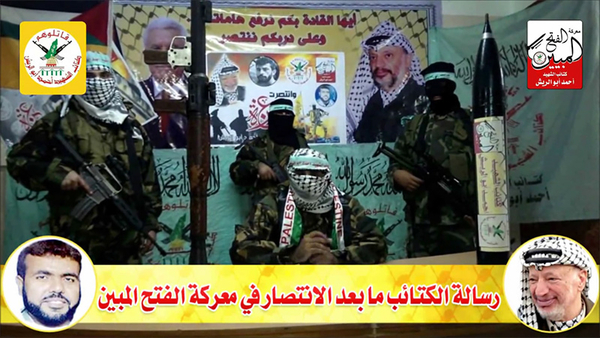
A third major Fatah terror group is called the Abu al-Rish Brigades, which has been responsible for many terrorist attacks against Israel and the kidnapping of foreigners in the Gaza Strip. The gang, which describes itself as the "military wing of Fatah," also refers to Israel as the "Zionist enemy" and claims to have participated alongside Hamas in the last war in the Gaza Strip.


Gunmen from Fatah's Abu al-Rish Brigades, which describes itself as the "military wing of Fatah," appear in a September 2014 propaganda video.

The international community and the media often ignore the fact that Fatah has a number of armed groups that are still openly dedicated to the "armed struggle" and terrorism as a way of "liberating Palestine." They also ignore that "moderate" Fatah leaders who speak in favor of peace and the two-state solution do not distance themselves from these groups. Several Fatah leaders, in fact, often speak in English about the need for reviving the peace process, while in Arabic they praise and endorse the Fatah gunmen.

The presence of armed Fatah gangs in the West Bank and Gaza Strip is a sign of the huge challenges that any Palestinian leader would face if and when the Palestinians and Israel reach a peace agreement. Obviously, these Fatah groups will be the first to reject any peace agreement that includes the slightest concession to Israel. Some of these groups are opposed in principle to peace with Israel because they simply do not recognize Israel's right to exist.

This is something that the international community -- first and foremost the U.S. -- needs to take into consideration when dealing with the Israeli-Palestinian conflict. Decision-makers need to know that opposition to peace with Israel will come not only from Hamas, but also from many groups within Fatah. As the armed groups themselves indicate, their fight is to eliminate "Zionist enemy" and achieve the "right of return" for millions of descendants of refugees to their former homes inside Israel.

Meanwhile, Abbas and other Fatah leaders, who are fully aware of the actions and threats of their loyalists, are doing their utmost to stop the world from hearing what the Fatah gunmen have to say about peace and the two-state solution. 

The question remains: Until when will the international community continue to bury its head in the sand and pretend that Fatah is a unified, moderate and pragmatic group that seeks peace and coexistence with Israel on behalf of all Palestinians?

Tuesday, May 19, 2015

‘Palestine’ is a Civil War Waiting to Happen


As Jonathan Tobin correctly noted earlier today, the possibility that Pope Francis didn’t really call Palestinian Authority President Mahmoud Abbas “an angel of peace” doesn’t change the fact that the Vatican definitely did recognize the “State of Palestine.” That’s a setback to the cause of peace for many reasons, which Jonathan detailed in an excellent post last week. 

But I’d like to go into more depth on one point he raised: the question of which “Palestine” the Church is recognizing. 

...“Palestine” isn’t merely split between the Fatah-controlled West Bank and Hamas-controlled Gaza by a quirk of geography; it’s a civil war waiting to happen.

Just last week, for instance, Hamas blamed Fatah for a series of recent bombings in Gaza and arrested 12 Fatah members as suspects. Last November, Hamas reportedly bombed the homes and vehicles of several senior Fatah officials in Gaza, as well as the site of a planned Fatah rally to mark the anniversary of Yasser Arafat’s death; as a result, Fatah canceled both the rally and a planned visit to Gaza by PA Prime Minister Rami Hamdallah. Last month, PA ministers who did visit Gaza left in a huff after Hamas placed them under house arrest in their hotel. The previous month, Abbas and one of his senior advisors separately urged Arab states to bomb Hamas out of Gaza.

Both sides routinely arrest each other’s members, and then accuse each other of torturing the detainees (usually accurately in both cases). Both also routinely accuse each other of collaborating with Israel – the worst crime in the Palestinian lexicon. Needless to say, none of this contributes to Hamas-Fatah brotherly love.

Indeed, the parties are so busy feuding with each other that they can’t provide for their people’s most basic needs, like reconstructing Gaza after last summer’s war with Israel. The reconstruction has made almost no progress in the eight months since the war ended, and astoundingly, everyone except Human Rights Watch director Ken Roth agrees that this is the fault of the feuding Palestinian governments rather than Israel. That, for instance, is the stated view of the Arab League, which is usually quick to blame Israel for anything. And it’s also the stated view of the European Union, which is generally equally quick to blame Israel for everything.

That the violence has remained relatively low-level despite the intensity of this hatred is due to one thing only: Israel. Hamas’s main fighting strength is concentrated in Gaza, while Fatah’s is concentrated in the West Bank, and these territories are currently separated by an impassible barrier – some 37 kilometers of Israeli territory. Moreover, Israeli troops in the West Bank have prevented Hamas from building up its forces there: Last August, for instance, Israel arrested dozens of Hamas operatives in the West Bank whom both Israel and Abbas said were plotting a coup against the Fatah-led government.

But both those barriers to war would disappear if the world had its way: Israeli troops would vacate the West Bank, and some kind of corridor through Israel would be created to link the West Bank to Gaza. At that point, there would be nothing to stop Hamas and Fatah from all-out war. Indeed, that’s precisely what happened after Israel withdrew from Gaza in 2005: Months of escalating violence ultimately erupted into war.

That war was bloody but swift. One week later, Hamas-ruled Gaza, 600 Palestinians were dead and thousands more had fled to the West Bank (Israel allowed the refugees through its territory). But since then, both sides have built up their forces considerably, so the next war might well be longer and bloodier. 

... I have yet to hear anyone explain quite how enabling such a war would benefit the Palestinians.


Thus anyone who really wants to create a Palestinian state should start by pressuring both Hamas and Fatah to address basic needs like reconstructing Gaza instead of spending all their time and energy feuding. That way, if and when such a state does emerge, it might actually be a good thing for the people who have to live in it rather than a disaster. And it would surely do far more to help the Palestinians right now than the empty recognition of a nonexistent state does.

Recognition of Palestine Won’t Bring Peace Closer

From Commentary, 13 May 2015, by Jonathan S. Tobin:

Israel’s critics will celebrate the news today that the Vatican will recognize Palestinian statehood as a rebuke of the Jewish state’s government and policies. ... its impact will be mostly symbolic though it will certainly be considered yet another blow to Israel’s uphill efforts to maintain good relations with European countries that are increasingly hostile to Jerusalem. But the one thing we can be sure it won’t do is to improve the chances for peace. By granting the Palestinians official recognition without first requiring them to make peace with Israel, Pope Francis and the Church have only made it less likely that this will ever happen.

... the pope is mistaken to think that giving the Palestinians such recognition will advance the peace process. To the contrary, by granting them official status in this way only encourages Palestinian Authority leader Mahmoud Abbas to continue to stonewall efforts to make peace.

After all, if Abbas’s real goal been an independent Palestinian state, he could have had one in 2000, 2001 when his former boss Yasir Arafat rejected an Israeli offer of statehood including almost all of the West Bank, Gaza and a share of Jerusalem. Abbas rejected an even better offer in 2008 and then refused to negotiate seriously in 2013 and 2014 even after the Israelis had accepted an American framework whose goal was a two state solution.

The Palestinian campaign to get recognition from the United Nations and other countries is motivated by a desire to avoid peace talks, not to make them more successful. The Palestinians want a state but not one that is prepared to recognize the legitimacy of a Jewish state alongside it, not matter where its borders are drawn. 

By telling the Palestinians, the Church recognizes his faux state; it is making it easier for Abbas to refuse to negotiate. To the extent that this recognition grants the Palestinians rights to all of the disputed 1967 territories, the Vatican and other European states that have done the same thing, is prejudging negotiations that should be conducted by the parties, not outsiders.

Just as important, the Church ignores the fact that an independent Palestinian state in all but name already exists in Gaza under the tyrannical rule of Hamas terrorists. 

Which “Palestine” is the Church recognizing? Hamasistan or Fatah’s corrupt kleptocracy that Abbas presides over? With Hamas growing more popular, the prospect of it gaining power in an independent West Bank makes an Israeli withdrawal a fantasy rather than a viable policy option.

... the Vatican move will only serve to make peace less likely and do nothing for Middle East Christians who are under unbearable pressure from Islamists, not Israel...

Monday, May 18, 2015

Media Gets Pope’s Abbas Comments Wrong


If anyone needs further evidence of why the news agencies often can’t be trusted to report accurately on Israel and the Palestinians, and why major news outlets such as the New York Times and the BBC should stop repeating agency copy without verifying it, here is an important example from this weekend.

According to Italian and Spanish news outlets and according to the Vatican’s own website, Pope Francis told Palestinian President Mahmoud Abbas that he could be an angel of peace. 

“May you be an angel of peace,” he urged Abbas, effectively saying that if Abbas would take the decision to accept one of the peace offers that various Israeli prime ministers have made to him, or at least make a serious counter-offer, he could be an angel of peace. The pope did not say that Abbas – infamous for ordering the Munich Olympic massacre, among many other atrocities – was “an angel of peace.”

And yet the BBC and New York Times were among dozens of prominent news outlets that claimed he did.

The New York Times reports today (Page A11 under the headline: “At Vatican, Abbas Is Praised as ‘Angel of Peace’”):
“Mr. Abbas’s meeting with the pope ended with an exchange of gifts. Presenting Mr. Abbas with a medallion, the pope said it depicted an angel of peace ‘destroying the bad spirit of war.’ It was an appropriate gift, the pope added, since “you are an angel of peace.” 
And here is NBC, Fox, and, the BBC saying the same thing.

Contrast the headlines in the New York Times with those in the Italian press. 

For example, the headline in the “Vatican Insider” section of Le Stampa is:
Pope embraces Abu Mazen and bids him to be an angel of peace
The original Italian is here. 
Or as Il Giornale reports, the pope met Abbas, “asking him to be ‘an angel of peace.’” 

Read almost any Italian news outlet and they say the same thing: 
“you could be an angel of peace” – “Lei possa essere un angelo della pace.”

As an astute Italian-speaking observer of the Middle East points out, all these English-speaking news media seem to have initially relied on the mistranslations of the world’s three biggest news agencies. 

...Former Middle East reporters such as myself (“The Case of Reuters”) and Matti Friedman (who used to work at AP’s Jerusalem bureau) have long warned about the impartiality of the major news agencies coverage of the Middle East. 


But then too often do reporters and editors at the New York Times, BBC, and elsewhere seem to be happy reporting on what they want to hear, rather than on what was actually said or done, when it comes to the Palestinians and Israel.

Sunday, May 17, 2015

Repressed Iranian Kurds break their silence

From Jonathan Spyer, 15 May 2015:

The events this week in the Mahabad area of Iran’s Western Azerbaijan province cast light on the difficult situation faced by one of the region’s least-noticed minorities – the Kurds of Iran.

The apparent attempt by an intelligence officer in Mahabad to rape an Iranian-Kurdish hotel worker, 25-year-old Farinaz Khosrawani, and the latter’s subsequent suicide by jumping from a fourth-floor window, led to furious protests by Kurds in both Mahabad and beyond.

The hotel was burned by protesters; authorities responded heavy-handedly, using rubber bullets and tear gas.

There is currently a media and social media blackout from the area, but word-of-mouth reports suggest the situation remains tense.

Soran Khedri, a former official of the Iranian-Kurdish Party of Free Life of Kurdistan (PJAK) organization, told The Jerusalem Post that at least one demonstrator has died, and that in the last 48 hours, PJAK guerrillas had attacked an Iranian Revolutionary Guards Corps checkpoint in the area, killing two IRGC personnel.

The Kurds of Iraq and Syria have become highly significant and visible players on the regional stage over the last decade. Turkey’s Kurds, of course, have long been noted internationally – because of the insurgency of the PKK (Kurdistan Workers’ Party) against a succession of governments in Ankara.
But the Kurds of Iran have been the most silent of Kurdish populations.

Numbering around 8 million in total, they are mainly resident in the Kordestan province of western Iran (adjoining Iraqi Kurdistan), one of the country’s most impoverished regions; Kurdish populations are also to be found in Western Azerbaijan, Ilam and Kermanshah. Unemployment in Kordestan Province stands at 28 percent; there is little local industry.

The Iranian Kurds were not always politically silent. Mahabad was the location of the short-lived Mahabad Republic – the only example of full Kurdish sovereignty in the 20th century. The republic was declared in January 1946, and destroyed by the Iranians in December of that year.

But under the Islamic Republic, the Kurds have faced repression of the most severe kind. A large-scale revolt against the new regime, led by the Kurdistan Democratic Party in Iran (PDKI), was crushed with great severity in the period immediately following the Islamic Revolution of 1979. The IRGC killed over 10,000 Kurds as it fought to destroy the nascent Kurdish independence movement; the insurgency was largely defeated by 1983.

The suppression of any hint of Kurdish separatism has remained in place ever since. Education in Kurdish remains forbidden; any sign of attempts at political organization is ruthlessly suppressed by the Revolutionary Guards.

The hostility of the Iranian regime to the slightest hint of separatism derives not solely or mainly from ethnic tensions between Persians and Kurds. Even the most modest Kurdish demands for greater local autonomy raise the specter for the regime of ethnic separatism. Iran is a divided society ethnically, with only 49 percent of the population consisting of ethnic Persians; the rest are a mixture of Azeris, Baluchis, Kurds and Arabs.

Thus, the brutal and total repression of Kurdish demands is an indication not of the regime’s strength, but of its potential weakness. Tehran fears that were the demands of one minority ethnicity to be accommodated – even partially – this would risk opening the floodgates for other demands.

In 2004, a new Iranian Kurdish insurgency began. This was led by PJAK, PKK’s franchise among the Iranian Kurds. From the Qandil Mountains in Iraqi Kurdistan, PJAK sought to strike at the Iranian authorities while its cadres worked among the population, seeking to build clandestine support.

A shaky, on/off cease-fire has persisted between PJAK and the Iranian authorities since 2011, after a large-scale incursion by the IRGC into Iraqi Kurdistan led to fierce battles. But PJAK remains armed and deployed along the border, able to exploit any breakdown of regime control in the Kurdish areas.
Alongside PJAK, the PDKI remains active, as do a number of parties claiming the mantle of the Komala Movement, a once-influential leftist force among the Iranian Kurds.

Severe repression, divided politics and a long period of apparent quiescence were followed by sudden, unexpected anger precipitated by an unforeseen event. This is what is currently taking place in Iranian Kurdistan; it sounds, in all particulars, a familiar story in the Middle East of the last half-decade.

So, are the events in Mahabad a prelude to some larger movement or unrest among the Iranian Kurds?
An Iranian-Kurdish lawyer with good connections in the Mahabad area told the Post that the current wave of acrimony looked set to “ebb away.” He noted that the protests “in support of Mahabad spread only to a few other cities, like Sardasht and Mariwan.”

Nevertheless, he also asserted that the protests were an indicator of “vast anti-regime sentiments” among Iran’s Kurdish population.

As of now, the Mahabad situation appears to have been contained by the Iranian authorities, yet the events are an indication of the inner fragility of the Iranian regime. Even as Tehran invests in spreading its influence across the region, Mahabad is a reminder that its position at home is by no means secure, or consolidated.

Rather, it rules over large swathes of the Iranian population by force and coercion alone. It is therefore vulnerable to internal subversion – and the more it spreads its assets thinly, by involvement in ever-more regional arenas, the fewer resources it will have available for dealing with internal unrest.

Rodi Hevian, a Kurdish journalist at the online Kurdish Daily News, likened the Mahabad events to the short-lived uprising by Syrian Kurds in the city of al-Qamishli in 2004. Though quickly (and bloodily) repressed by the Assad regime, the Qamishli events were in retrospect a first tremor for what was to come in Syria.

“It could also be a wake-up call for the Iranian regime interfering in Syria, Iraq and Yemen,” Hevian told the Post, “namely, gaining ground in other countries can lead to losing ground at home.”
Of course, for the Iranians to begin paying a price of this kind, it is necessary that the Iranian Kurds and other minorities begin to receive the attention and support of regional enemies of Iran, and of the West.

For this to happen, in turn, there needs to be a recognition of the urgent necessity of containing and turning back Iranian regional ambitions; no such awareness currently exists in Western capitals.
Following June 30 – should a nuclear agreement between Teheran and the P5+1 world powers be concluded – the pressure on the Iranians may be vastly reduced. Abandonment of sanctions would enable the regime to begin to channel greater resources to areas of instability, and to seek to buy off discontent.

Still, in Middle Eastern capitals, both the Iranian threat and the Iranian vulnerability do not go unnoticed. The mullahs and the IRGC are not all-powerful; the tremor in Mahabad indeed reveals just how notably shallow their rule is.