Monday, October 07, 2013

Rouhani brags on Iranian TV about how he deceived the West and continued nuclear development

October 2013:


In a video clip now gaining fresh attention as the international community seeks to assess his credibility, Iran’s President Hassan Rouhani bragged on Iranian state television just four months ago that he and the regime utterly flouted a 2003 agreement with the IAEA in which it promised to suspend all uranium enrichment and certain other nuclear activities.
Rouhani, who was being interviewed by Iran’s state IRIB TV (Islamic Republic of Iran Broadcasting) on May 27, less than three weeks before he won the June 14 presidential elections, was provoked by the interviewer’s assertion that, as Iran’s chief nuclear negotiator in 2003-5, “everything was suspended” on the nuclear program under his watch. 
Smiling but evidently highly irritated by the suggestion, Rouhani called it “a lie” that only “the illiterate” would believe, and said that “whoever is talking to you in your earpiece” was feeding false information. He proceeded to detail how Iran, in fact, had flagrantly breached the October 2003 “Tehran Declaration,” which he said “was supposed to outline how everything should be suspended.”
Although Iran issued a joint statement with visiting EU ministers in October 2003 setting out its pledged obligations under the Tehran Declaration, in practice, Rouhani said in the interview, “We did not let that happen!”
The interview, conducted by Hassan Abedini, was one in a series of shows in which the presidential candidates were questioned by the widely watched channel. The TV station is closely controlled by loyalists of Supreme Leader Ayatollah Ali Khamenei, and Rouhani clearly felt the imperative to underline that he was no Western pushover.
Far from honoring the commitment, in which Iran said “it has decided voluntarily to suspend all uranium enrichment and reprocessing activities,” Rouhani told the interviewer that all Iran did was merely suspend “ten centrifuges” in the Natanz enrichment facility. “And not a total suspension. Just reduced the yield.”
Unimpressed, interviewer Abedini asserted that work had been suspended at the UCF — the Uranium Enrichment Facility at Isfahan. Quite the contrary, Rouhani countered, detailing the completion of various phases of work at Isfahan under his watch in 2004 and 2005. He went on to state proudly that the Iranian heavy water reactor at Arak was also developed under his watch, in 2004.
“Do you know when we developed yellowcake? Winter 2004,” Rouhani went on. “Do you know when the number of centrifuges reached 3,000? Winter 2004.”
Incredulous at the notion that Iran had bowed to international pressure and halted nuclear activities in that period, Rouhani asked the interviewer, We halted the nuclear program? We were the ones to complete it! We completed the technology.”
He clarified that this was not his solo success, but was rather thanks to the work of “our valuable nuclear scientists. Our beloved ones. We kiss their hands.” But he stressed, “We were the first to initiate this. By ‘we,’ I mean the whole government, not Hassan Rouhani. By we, I mean the supreme leader. We were all hand in hand. That is why the supreme leader in his speech of November 11, 2003, said that in those negotiations, the conspiracy of Washington and Israel was shattered.”
Iran had taken “the correct stance [in the nuclear talks], without submission and coercion,” he said.
Rouhani then again attacked the interviewer, and “the guy who talks into your earpiece” for allegedly misleading viewers, to which Abedini replied: “I have read your book from cover to cover, twice.”
“Good job,” retorted Rouhani. “Then read it for a third time, Mr. Abedini. This is how we completed the nuclear enrichment program.”
In his speech to the UN General Assembly last week, and in a succession of other statements and inteviews, Israel’s Prime Minister Benjamin Netanyahu has alleged that Rouhani, in his current outreach to the West, is misleading it by professing a willingness to negotiate over the nuclear program. Netanyahu warned the international community not to be “fooled” by Rouhani as it enters new diplomatic negotiations set to start next week.
As Iran’s chief nuclear negotiator between 2003 and 2005, Netanyahu said at the UN, Rouhani “masterminded the strategy which enabled Iran to advance its nuclear weapons program behind a smokescreen of diplomatic engagement and very soothing rhetoric.” 
Netanyahu then quoted from Rouhani’s 2011 book, in which he wrote, “‘While we were talking to the Europeans in Tehran, we were installing equipment in Isfahan.’ Now, for those of you who don’t know,” Netanyahu explained, “the Isfahan facility is an indispensable part of Iran’s nuclear weapons program. That’s where uranium ore called yellowcake is converted into an enrichable form. Rouhani boasted, and I quote, ‘By creating a calm environment — a calm environment — we were able to complete the work in Isfahan.’ He fooled the world once. Now he thinks he can fool it again.”
In Rouhani’s address to the UN, on September 24, the president said “Iran poses absolutely no threat to the world or the region,” and offered “to engage immediately in time-bound and result-oriented talks” over the nuclear program, “to build mutual confidence and removal of mutual uncertainties with full transparency.” At the same time, he warned, “Nuclear knowledge in Iran has been domesticated now and the nuclear technology, inclusive of enrichment, has already reached industrial scale. It is, therefore, an illusion, and extremely unrealistic, to presume that the peaceful nature of the nuclear program of Iran could be ensured through impeding the program via illegitimate pressures.”

Netanyahu blames Mideast conflict on refusal to recognize Jewish state

From the Times if Israel, 6 Oct 2013:

In address at Bar-Ilan University, PM says lasting peace only possible if Palestinian leadership acknowledges Jewish sovereignty


In a marked change in emphasis from a speech at the same podium four years ago, Prime Minister Benjamin Netanyahu on Sunday voiced doubt over the possibility of a two-state solution, citing the Palestinian leadership’s refusal to recognize Israel as a Jewish state.
Speaking at the 20th anniversary ceremony of Bar-Ilan University’s Begin-Sadat Center for Strategic Studies, the prime minister placed blame for the ongoing Israeli-Palestinian conflict on Ramallah’s refusal to come to terms with Israel as a Jewish state.        
“The Palestinians must abandon their refusal to recognize the right of the Jewish people to have their national state,” he said.
Netanyahu dismissed claims that Israel’s presence in the West Bank stood at the heart of the conflict, stating instead that as long as the Palestinians don’t internalize the Jewish state’s right to exist, there will not be peace.
“In order for the process in which we find ourselves to be significant… in order for it to have a real chance of success,” he said, referring to the current rounds of negotiations begun this summer, “it’s necessary to hear the Palestinian leadership finally say that it recognizes the right of the Jewish people to a state of its own, which is the state of Israel.”
“I hope that it shall be so, so that we can advance a real solution to the conflict,” continued Netanyahu.
The prime minister stated that the conflict between the Jews and Arabs began not in 1967, when Israel captured the West Bank, Gaza and East Jerusalem in the Six Day War, but in 1921, when Palestinian Arabs attacked a building in Jaffa that housed Jewish immigrants.
He also called for Palestinians to give up on their demand for Palestinian refugees and their descendants to return to areas now inside Israel. ”The Palestinians must abandon their [demand for a] right of return,” he said.
And he said any agreement would need to address Israel’s security needs.
“After generations of incitement, we have no confidence that recognition [of Israel] will trickle down to the Palestinian people. Therefore, we need very strong security arrangements, and to go forward without blindness.”
In 2009, also speaking at Bar-Ilan University, Netanyahu said that “if we get a guarantee of demilitarization, and if the Palestinians recognize Israel as the Jewish state, we are ready to agree to a real peace agreement, a demilitarized Palestinian state side by side with the Jewish state.”
The speech was seen as a major milestone, marking the first time the prime minister openly endorsed a two-state solution.
Israel and the Palestinians restarted peace talks in July, committing themselves to a US-brokered effort to reach a permanent accord within nine months, though officials said recently negotiations have become stuck over a number of issues, including land swaps and recognizing Israel as a Jewish state.
Earlier Sunday, Palestinians in Ramallah held a rally calling for Palestinian Authority President Mahmoud Abbas to pull out of the talks. In Jerusalem, a number of Israeli politicians also called for Netanyahu to rethink negotiations after a suspected terror attack in the settlement of Psagot in which a 9-year-old girl was shot and slightly injured.
 
Netanyahu also addressed the Iranian nuclear issue, reiterating his distrust of Iranian President Hassan Rouhani’s peace overtures to the West at the United Nations and saying Iran aspires “to rule the entire Middle East” and destroy the state of Israel.
He repeated his insistence that Iran abandon its uranium enrichment capacity and dismantle its plutonium core, saying those apparatuses are “not necessary at all for [civilian] nuclear energy,” and that only a state seeking a bomb would refuse to give them up.
 

Sunday, October 06, 2013

Rouhani, in his flimsy disguise, brings a smile and experienced embezzlers to the job

From The Times of Israel, 5 Oct 2013, by Emanuele Ottolenghi and Saeed Ghasseminejad,:

In his address to the United Nations, Benjamin Netanyahu described Hassan Rouhani as a wolf in sheep’s clothing, but you’d have to be very gullible or very nearsighted to be fooled by the Iranian president’s flimsy disguise.
After all, Rouhani has not conceded one iota of Iran’s nuclear program on substance. He has stood defiantly at the United Nations and challenged the international community over Iran’s continuing refusal to comply with UN Security Council resolutions and its solemn obligations under the Nuclear Non Proliferation Treaty. His speeches offered convoluted verbiage that, while not as esoteric as his predecessor’s, were in line with his regime’s third world-ist grievance-filled rhetoric. He rejected a request for a meeting with the U.S. president – though he found time to sit with many other world leaders – and settled only for a phone call on his way to the airport that the White House initiated. Finally, while he did not deny the Holocaust in as crass and insulting a fashion as Mahmoud Ahmadinejad, he engaged in the kind of belittling typical of more sophisticated Holocaust denier.       
And yet, Rouhani’s charm offensive seems to be working – witness the enthusiasm triggered by his New York visit as evidence that many wish to turn a new page on the strength of charm alone. In fact, Rouhani is a more polished version of Ahmadinejad – more sophisticated and worldly, but not substantively better.
Many words have been used to describe Iran’s former president – vile, radical, authentic, messianic, confrontational. But behind the rhetoric, there stood a leader who attempted to leverage his presidency as a challenge to the entrenched power structure of the Mullahs and wealthy revolutionary aristocracy that had power over the country’s purse strings. While it is doubtful that a more moderate Iran would have emerged had he been successful, it’s almost certain that Rouhani, with the installation of an old guard of insiders and trusted loyalists of former Iranian president Akbar Hashemi Rafsanjani, has plans to continue in a familiar and corrupt oligarchical vein, a troubling development as current events unfold in the Eastern Mediterranean.
Most Western observers welcomed the end of Ahmadinejad’s term with a sigh of relief, interpreting Rouhani’s election as a sign of moderation and, perhaps, even a return of something like a reformist agenda. Western chanceries were adamant that anything was better than Ahmadinejad.
This was a mistake, if an understandable one.
Rouhani presented himself as a moderate. But he has begun meticulously replacing Ahmadinejad’s friends with familiar faces who spent previous decades plundering the country’s resources for their own personal profit, or in pursuit of proliferation activities that allowed them to make money on the side. Rather than reforming the system, there’s every reason to believe Rouhani and his clique will be busy milking it.
Take for example Mr. Bijan Namdar Zanganeh, Rouhani’s minister of oil. As the holder of a key position that controls billions of dollars’ worth of contracts and revenues, Zanganeh knows his way around. He served as oil minister under reformist president Mohammad Khatami. Reuters described him as a ‘non-partisan technocrat.’ In truth, Zanganeh’s time at the oil ministry is associated with many high level corruption cases – most notably with handing contracts to Petropars under the buy-back scheme he invented to lure foreign oil companies back into the Iranian energy market during the reformist era.
Petropars is a subsidiary company of the U.S. and EU sanctioned Naftiran Intertrade Company (NICO), which Zanganeh helped establish. During Zanganeh’s tenure at the oil ministry, Petropars was chaired by Akbar Torkan, who previously served as Iran’s minister of defense under Rafsanjani. Zanganeh rewarded Torkan’s company with contracts worth billions – including several development phases of the lucrative South Pars natural gas field. Now the two occupy key posts in government once again – and the contracts are predictably flowing.
Zanganeh and Torkan are but two in a long list of recent returnees to the corridors of Iranian power. Mehdi Karbasian, the newly appointed chairman of the Iranian Mines & Mining Industries Development & Renovation Organization (IMIDRO), is a board member of the U.S. sanctioned Parsian Bank and of Sepehr Energy Corporation, which has been winning oil contracts at an astonishing rate, despite its short existence and lack of proven record.
Like Zanganeh and others, Karbasian never really left the control room – his resume reads like a U.S. Department of Treasury sanctioned entities’ list, with past and present executive roles with companies in the shipping, heavy industry, food, transport, banking, and oil sectors. A veteran of the Islamic Republic’s early glories and, like Zanganeh, a past holder of ministerial positions beginning in the early 1980’s, Karbasian’s business interests flourished during his time in the private sector thanks to government contracts. He is now back at the helm of a key government holding company, whose portfolio he needs to privatize – presumably to friendly investors like himself. Above him sits Minister of Industries and Trade, Mohammad Reza Nematzadeh, another veteran of the Islamic Republic’s cabinet, who, in between government assignments, ran overseas companies for Iran’s energy industry.
Then there’s Rouhani’s Minister of Justice, Mostafa Pour Mohammadi, known for his blood-soaked past. In 1988, at the behest of the late Ayatollah Ruollah Khomeini and with the full knowledge and backing of former president Rafsanjani, Pour Mohammadi was responsible for the death of thousands of political prisoners, who were ultimately executed after infamous one-minute trials. For his solicitude in efficiently ridding Iran of so many political undesirables, Pour Mohammadi earned the post of deputy Minister of Intelligence once Rafsanjani became president in 1989. And his corruption extends beyond his reputation as a ruthless murderer.
Ahmadinejad appointed Pour Mohammadi Interior Minister because of his bloody record, but eventually tried to fire him because of his graft. The trigger was the allegation that he had stolen millions from the ministry’s account for his own personal use. There was only one problem: Pour Mohammadi headed the institution in charge of prosecuting him. With Ahmadinejad now gone, Pour Mohammadi is back in a position that allows him to return to his old habits of theft and graft.
Another example is Valiollah Seif, the new head of Iran’s Central Bank, who was the CEO of Bank Saderat from 1992 to 1995, and presided over one of the most notorious corruption cases in Iran involving the embezzlement of millions of dollars from Saderat Bank. The main culprits in the scheme were Fazel Khodadad and Morteza Rafiqdoust, the latter the brother of the president of the Mostazafan Foundation, Mohsen Rafiqdoust, whose vice president for international and economic affairs at one point was Seif himself. Khodadad was executed, but not Rafiqdoust.
Moshsen Rafiqdoust stayed at the Foundation. His brother Morteza stayed alive. Seif quit Saderat Bank, but his banking career never suffered – he was quickly appointed CEO of the Bank Sepah. He later became the CEO of Karafarin Bank, a U.S. and EU sanctioned bank controlled by Iran’s Supreme Leader, its main shareholder. In short, Mr. Seif has a record of corruption and of loyalty to the Islamic Republic’s financial interests, which appears to have been the reason Rouhani appointed him.
It is increasingly clear that Rouhani’s skilled and moderate technocrats are in fact the old elite of regime stalwarts, whose main claim to fame is making themselves rich in pursuit of public office. Competent though they may be at maximizing business profits for government companies, these new appointees are faithful servants of the Islamic Republic and loyal associates of those who, like Rafsanjani, helped make them rich. Rouhani has provided them with renewed access to power so they are free to plunder again.
Ahmadinejad’s rhetoric will not be missed. But given that his successor brings only a smile and experienced embezzlers to the job, it’s a pity his assault on the entrenched elites of the Islamic Republic was not more successful.
*This post was co-authored by Emanuele Ottolenghi, a Senior Fellow at the Foundation for Defense of Democracies in Washington DC; Mr Saeed Ghasseminejad, a Ph.D. Candidate in Finance at City University of New York.

Saturday, October 05, 2013

Weimar Greece ?

From The Australian, 5 Oct 2013, by Ben McIntyre (The Times):              
...Antonis Samaras, the beleaguered conservative Prime Minister of Greece, has [compared Greece to Germany in the chaotic period that led to the rise of Hitler:]
"Greek democracy stands before what is perhaps its greatest challenge...[with social cohesion] endangered by rising unemployment, just as it was towards the end of the Weimar Republic in Germany."
A year after Samaris drew this dramatic analogy, the Greek state has moved to combat the most obvious manifestation of that challenge, by arresting the head of the neo-fascist Golden Dawn party and several of his followers, and charging them with criminal conspiracy after the murder of a young anti-racist hip-hop star.
Modern comparisons with Nazi Germany are tempting, familiar and frequently simplistic. When Syria used chemical weapons on its own people, John Kerry lost no time in comparing Bashar Assad to Adolf Hitler, insisting "this is our Munich moment". Saddam Hussein, Mahmoud Ahmadinejad, Slobodan Milosevic: all have been awarded the Hitler label, convenient shorthand for "nasty".
Greece is not in the grip of hyper-inflation, moderate politics has not been abandoned, Golden Dawn has not achieved the meteoric rise of the National Socialists in 1932, and Nikos Michaloliakos is not Hitler (although he keeps a portrait of the Fuhrer in his home). A pudgy, grey-haired, 56-year-old mathematician, he is a boilerplate bigot with zero charisma.
Yet the echoes of Weimar grow louder: this week Michaloliakos was charged in court, while his followers chanted: "Blood, honour, Golden Dawn", an adapted Nazi slogan, and vowed, in traditional fascist style: "You will only stop us with bullets."
Many of the factors that pulled apart the Weimar Republic are present in Greece: mass unemployment, political paralysis, spreading poverty, social unrest, rising crime and rampant corruption, suffused with an acute sense of national humiliation.
Austerity measures imposed to pay off Greece's crushing debts are seen by many Greeks in the same way that Germans viewed reparations imposed by the Treaty of Versailles, a brutal degradation enforced by international bankers, a disgrace, a stab in the back.
No one is yet wheeling around barrow-loads of worthless currency to buy bread, but with middle-class Athenians reduced to rooting through dustbins, living standards plummeting and political violence growing, radicalism is on the rise. As in Weimar Germany, the racist anti-immigrant Right in Greece has seized on the chaos with extraordinary effectiveness.
In 1928 the Nazis were a splinter group with only 2.7 per cent of the vote. In 2009 Golden Dawn seemed even more irrelevant, with support hovering around 0.2 per cent. In last year's elections, campaigning on the slogan "We can rid this land of filth", it garnered nearly half a million votes, in a population of 11 million, winning 18 seats in the Hellenic parliament. That may be fraction of the 37 per cent won by Hitler in 1932, but is still a grim reflection of the speed at which economic dislocation can poison politics. Unemployment was 30 per cent when Hitler took power; in Greece it is near that, with more than 50 per cent youth unemployment.
Golden Dawn rejects the neo-Nazi label, while revelling in Nazi imagery, including a black, white and red flag and an emblem unmistakably close to a swastika. Its methods mimic those of the Brownshirts, attacking immigrants, parading in paramilitary dress and shutting down theatrical productions it considers immoral.
As in Weimar Germany, Greek right-wing extremists have found support in the police and military. According to some surveys nearly half the Greek police support Golden Dawn. Last month a message posted on the Special Forces Reserve Union website called for an interim government "under military guarantee" - in other words, a coup.
But if Greece offers disturbing parallels with Weimar Germany, the analogy might also offer a way to combat the rise of fascism. In his biography of Hitler, Ian Kershaw writes that the Nazi rise to power came about, in large part, because of the "blatant disregard by Germany's power elites for safeguarding democracy". Centrist parties believed they could control and co-opt the extremists, and were destroyed by them.
As Golden Dawn has grown in power, there have been signs that some on the moderate right might be willing to make a deal with them. At the same time, the State appeared to turn a blind eye to the rising tide of violence by Golden Dawn supporters against immigrants, ethnic minorities and political opponents.
Finally, the Government has acted, investigating infiltration of the police and arresting Golden Dawn MPs and other supporters. Rather than trying to ban the party, the Government is charging extremists with membership of a violent criminal group.
Michaloliakos is the first elected party chief to be held in jail since the end of military rule in Greece, and his arrest has substantially raised the political stakes. If the prosecution can demonstrate a direct connection between Golden Dawn and the murder of the rapper Pavlos Fyssas, that might destroy the party by exposing it as a genuinely subversive and criminal organisation. Proving criminal conspiracy would enable party funding to be cut off and the ejection of convicted MPs.
But if Michaloliakos wriggles free, or escapes with only minor punishment, then there is another deeply disturbing historical precedent.
The trial of Hitler in 1924, after the failed Beer Hall putsch, was intended to destroy Nazism and had precisely the opposite effect, providing the party with national publicity and an ideal propaganda platform. Hitler emerged from prison after nine months, having written Mein Kampf, a martyr in many eyes.
A successful prosecution of Golden Dawn would safeguard Greek democracy; a failed one would imperil it still more gravely. Michaloliakos will not be sitting idle in prison: if history is any guide, he will be writing an account of His Struggle.

Israel Negotiating Historic Alliance with Saudi Arabia over Iran’s Nuclear Weapons

From International Business Times, 3 Oct 2013, By :

Israel’s Channel 2 reports meetings between Tel Aviv, Gulf and Arab states diplomats...
ternational Business Times UK

Netanyahu Saudi Arabia Iran
Prime Minister Benjamin Netanyahu said Israel welcomes engagement with the wider Arab world (Reuters)
Israel is negotiating an unlikely diplomatic alliance with several Gulf and Arab states, including Saudi Arabia, to tackle Iran's nuclear programme...

High-profile Israeli and Gulf diplomats held a series of meetings overseen by Benjamin Netanyahu in the weeks leading to his speech to the UN General Assembly, Israel's Channel 2 reported.
Channel 2 said a "high ranking official" even came secretly to Israel to address growing concerns on Tehran's nuclear program, following US President Barack Obama's decision to open a dialogue with his Iranian counterpart Hassan Rohani.
Israel officially has no diplomatic relations with Saudi Arabia and any of the Arab states in the Gulf.
"The dangers of a nuclear-armed Iran and the emergence of other threats in our region have led many of our Arab neighbours to recognize, finally recognize, that Israel is not their enemy," Netanyahu told the UN this week.
"And this affords us the opportunity to overcome the historic animosities and build new relationships, new friendships, new hopes.
"Israel welcomes engagement with the wider Arab world. We hope that our common interests and common challenges will help us forge a more peaceful future," Netanyahu added.
The rise of sectarian tensions between Sunni and Shiite Muslims across the Middle East has worsened diplomatic relations between Iran and Saudi Arabia.
The two countries sits on the opposite sides of the Syrian civil war, Saudia Arabia backing Sunni rebel groups and Tehran supporting the regime of Bashar al-Assad.
Saudi Arabia and other Sunni countries, such as Kuwait and the United Arab Emirates have also been vocal opponents of Iran's nuclear program.
..."I wish I could believe Rouhani, but I don't because facts are stubborn things, and the facts are that Iran's savage record flatly contradicts Rouhani's soothing rhetoric," Netanyahu told the UN.
"Israel will never acquiesce to nuclear arms in the hands of a rogue regime that repeatedly promises to wipe us off the map. Against such a threat, Israel will have no choice but to defend itself," he said. "I want there to be no confusion on this point. Israel will not allow Iran to get nuclear weapons. If Israel is forced to stand alone, Israel will stand alone."

US, Israel discussing 'verifiable' Iranian steps on nuclear program

From JPost, 5 Oct 2013, by Herb Keinon:

The US and Israel are discussing what steps Iran could take that would be “verifiable and meaningful” and indicate that it is indeed stopping its nuclear program...


Netanyahu in a 45-minute interview with PBS/CBS interviewer Charlie Rose (one of 8 he's given since his UN speech)

The prime minister praised Obama for saying publicly and privately that steps and transparent actions, not just words, were needed from Iran.
“What we’re talking about right now,” he said, was “what are the meaningful actions that will do the job.”
... Netanyahu ...slammed Iranian President Hassan Rouhani and vowed that Israel would take action alone, if necessary, to stop Iran from getting nuclear weapons.
... Netanyahu said that what he was saying to the world was to “keep up the pressure and for God’s sake don’t let them have nuclear weapons.”
He said this was “not only for us, but also for the Americans, Europeans, Arabs and – you know what I am adding here – you the people of Iran, you the Persians. You don’t want them to have nuclear weapons, because you will never get rid of this tyranny if it is armed with nuclear weapons.”
...he believed the US and Israel, working together, could get to a common policy and that the American position was not yet “crystallized.”
The prime minister said there had been no confrontation with Obama and that Israel did not object to testing the diplomatic route.
“The question is, what is a deal that does it?” he said.
Netanyahu made clear that at this point his biggest concern was that the talks could lead to a partial deal providing Iran with sanctions relief in return for minor concessions that would not materially hurt its nuclear infrastructure.The prime minister quoted US Secretary of State John Kerry as saying that a bad deal on Iran would be worse than no deal. “And I guess my point is that a partial deal is a bad deal. Because when you lift the sanctions for some minor stuff that they do, or partial thing that they do, it takes years to put the sanctions in place.”
According to Netanyahu, there are “a lot of countries who are just waiting to lift the sanctions,” something that could make the whole sanctions regime collapse.
He said the last thing Israel, the US or some “significant European countries” were interested in was to “let Iran wiggle away with a smile campaign.”
The prime minister, obviously intent on framing the Iranian issue as an American problem as much as an Israeli one, stressed on two occasions that Tehran was developing intercontinental ballistic missiles to hit the US, since it already had the missile capacity to strike Israel.
Regarding where Iran stands in the development of its nuclear program, Netanyahu explained that the Iranians were close to a point where they would have enough enriched uranium at lower levels “to be able to punch through and enrich it very rapidly within a matter of weeks to get high enriched uranium that could be used for a bomb.”
He took issue with the oftheard argument that Iran had a “natural right to enrich uranium,” by saying that countries do not need to enrich uranium – something needed for a military program – to harness nuclear power for civilian needs. Seventeen countries, including Canada and Mexico, had civilian nuclear energy without enriching uranium, he said.
Netanyahu likened Iran, which he said was controlled by a “cult,” to a suicide bomber. “We’ve had a lot of them,” he explained. “The suicide bomber, as he’s driving on the way to board the bus, he obeys the traffic laws, he says the right things. Once he gets on the bus, bam.”Regarding peace negotiations with the Palestinians, Netanyahu said that while it was true that Jews had preceded them in the area by “thousands of years,” it was “true also that they’re here.”
The crux of the negotiations from Israel’s point of view, he explained, was to create a situation where Israel did not get the worst of all worlds: to leave land that is both strategically important and the Jewish people’s historical cradle, and also to “get Iran.”
Effectively, he said, when Israel left Lebanon and Gaza it received Iranian proxies in return.
“We cannot have it happen a third time,” he said. “So we have to have a different arrangement. And that arrangement will mean that Israel will have to have a long-term military presence along the Jordan River to prevent this area, this Palestinian state, from being perforated by Iranian agents from Jordan.”

Thursday, October 03, 2013

Lessons from the 1973 Yom Kippur War

From BESA Center Perspectives Paper No. 215, 2 October 2013, by Efraim Inbar*:

EXECUTIVE SUMMARY:
The Israeli military victory in 1973 was marred by pain over the nation’s casualties and disappointment with the country’s leadership.

Jerusalem learned that it needs close strategic coordination with Washington, while Israel’s Arab enemies learned that they cannot destroy it by force.

Forty years after the 1973 war, Israel prospers, and the power differential between Israel and its neighbors has greatly widened. Moreover, Israeli society possesses the social resilience necessary to meet the challenges of continuous conflict.

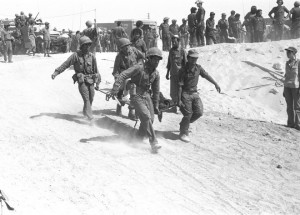
The 1973 war was an Israeli military victory: the IDF demonstrated a rare ability to overcome a surprise attack on two fronts and ended up 100 kilometers from Cairo, deep into Egypt, and within artillery range of Damascus. Yet, the remarkable military victory was marred by the acute pain over the many casualties and the disappointment with the political and military leadership.
As the war ended, Israeli society lost its naiveté and began a process of political maturation. Greater healthy skepticism toward state institutions and the IDF developed within the media and public opinion. The war’s misfortunes also created a political atmosphere that led to greater political pluralism, propelling the Likud into a ruling position. Over time, the conservative instincts of a changing electorate left the Likud as the main political force in the arena...
In terms of international politics, the war left Israel vulnerable to attempts to isolate it in the international arena, particularly since the Arabs effectively used the oil weapon. Many states severed relations with Israel, and the UN General Assembly adopted the infamous resolution that equated Zionism to racism. This resolution has since been rescinded and Israel is hardly isolated in the international arena; it is viewed as a successful state with which many countries seek to establish bilateral ties.
The 1973 war also underscored the dependency of a small state such as Israel on its superpower patron. Whatever dreams of self-sufficiency in weapon development and production were entertained in Israel before the war were soon abandoned. Jerusalem learned that it needs close strategic coordination with Washington to secure the capability to act forcefully, as well as freedom of action. This was a crucial corrective to the pre-war hubris that introduced much caution to Israel’s foreign policy.
One important factor that led to the IDF recuperation after the initial surprise of the war was the fact that the fighting started at defensible borders and not in proximity to Israel’s heartland. The “1967 borders” could have hardly allowed the IDF to regroup and go for a counter-attack. This is an important lesson for the future that seems to have been internalized by a significant part of Israel’s decision-makers.
The deliberations about the reasons for the initial 1973 surprise and the resulting military debacle indicated a clear need for expanding the circles that engage in the study of national security issues. This has led to a more pluralist intelligence establishment, although the IDF still plays a major role in supplying national estimates. Moreover, the IDF and other government agencies have gradually opened up, though not enough, to inputs from outsiders. Think tanks, such as the Institute for National Security Studies at Tel Aviv University and the Begin-Sadat Center (BESA) for Strategic Studies at Bar-Ilan University, have become participants in the national security debates and have offered alternatives to governmental policies. Nevertheless, strategic surprises may happen, which means that Israel still has to prepare itself for worst-case scenarios and should not succumb to rosy wishful thinking.
In historical terms, the 1973 victory taught the Arab leaders that even under most auspicious conditions they cannot eradicate the Jewish State by force. While Israel failed to hold on to the position that changes in the territorial status quo require peace agreements, and instead accepted interim agreements, the military outcome of this war brought about the change in Egypt, the largest and most important Arab state that eventually decided to make peace with Israel. The war was the last attempt by Arab armies to invade Israel. Gradually, for a variety of reasons, the likelihood of a large-scale war was drastically reduced. Today, the Arab world is in disarray as result of a colossal socio-economic and political crisis. The Arab predicament makes the possibility of a large-scale war even more distant.
Though terrorism against Israel has the potential to be on the rise, in the near future it carries lower risks than large-scale conventional encounters. Israel was successful in containing terrorist organizations. State-supported terrorist groups could be much more dangerous, but such a problem is with the states rather than the terrorists.
Forty years after the 1973 Yom Kippur War, when the fear of losing the “Third Temple” was voiced, Israel prospers and the power differential with its neighbors has greatly widened. Its society displays significant social resilience and readiness to meet the challenges of continuous conflict. This is critically important, since the old calls to destroy the Jewish state continue unabated, and one fanatic foe, Iran, is assiduously working to acquire WMD capabilities.
                                                            
Prof. Efraim Inbar
*Prof. Efraim Inbar, director of the Begin-Sadat Center for Strategic Studies, is a professor of political studies at Bar-Ilan University and a fellow at the Middle East Forum. He will visit Australia in October.
 

The people of Israel have come home, never to be uprooted again.

You MUST view this 33 minute speech in its entirety


"...And I will bring back the captivity of My people Israel, and they will build the waste cities, and inhabit them; and they will plant vineyards and drink their wine; they will also make gardens, and eat the fruit of them. And I will plant them upon their land, and they will never be uprooted ..."

Israel-Arab alliance to stop Iran

...Intensive talks with leading figures taking place over recent weeks, amid concern that Tehran will dupe Washington

: 
Israel has held a series of meetings with prominent figures from a number of Gulf and other Arab states in recent weeks in an attempt to muster a new alliance capable of blocking Iran’s drive toward nuclear weapons, Israel’s Channel 2 reported Wednesday. 
Israel has held a series of meetings with prominent figures from a number of Gulf and other Arab states in recent weeks in an attempt to muster a new alliance capable of blocking Iran’s drive toward nuclear weapons, Israel’s Channel 2 reported Wednesday.
According to the report, Prime Minister Benjamin Netanyahu has been supervising a series of “intensive meetings” with representatives of these other countries. One “high ranking official” even came on a secret visit to Israel, the report said.        
The report came a day after Netanyahu, in an overlooked passage of his UN speech, noted that shared concerns over Iran’s nuclear program “have led many of our Arab neighbors to recognize… that Israel is not their enemy” and created an opportunity to “build new relationships.”
The Arab and Gulf states involved in the new talks have no diplomatic ties with Jerusalem, the report noted. What they share with Israel, it said, is the concern that President Hasan Rouhani’s new diplomatic outreach will fool the US and lead to a US-Iran diplomatic agreement which provides for “less than the dismantling of the Iranian nuclear program.”
“There is a deep sense of anxiety concerning what’s happening in Iran,” Israeli Ambassador to the UN Ron Prosor told Channel 2 Wednesday. While he avoided comment on any direct contact between Israel and the Gulf states, he said there were messages “from all over the region” being transmitted to the highest ranks of the US government.
Likud MK Tzachi Hanegbi, who is close to Netanyahu, indicated to the Times of Israel after the prime minister’s speech to the General Assembly on Tuesday that Israel was no longer certain that the Obama administration would use force against Iran even in a last resort to stop[ it attaining nuclear weapons.
...On Tuesday Netanyahu made it clear that “Israel will not allow Iran to get nuclear weapons” and could take military action to stop it from doing so. ”If Israel is forced to stand alone, Israel will stand alone. Yet, in standing alone, Israel will know that we will be defending many, many others,” he stated.
He immediately added:
“The dangers of a nuclear-armed Iran and the emergence of other threats in our region have led many of our Arab neighbors to recognize, finally recognize, that Israel is not their enemy. And this affords us the opportunity to overcome the historic animosities and build new relationships, new friendships, new hopes.”
He went on: “Israel welcomes engagement with the wider Arab world. We hope that our common interests and common challenges will help us forge a more peaceful future.”
A number of Sunni countries, such as Saudi Arabia, Kuwait and the United Arab Emirates, have been vocally opposed to Iran’s nuclear program, placing them and Israel on the same side of the debate....     ,

Monday, September 30, 2013

Deaths in conflict since 1950

From FrontPageMagazine.com,  October 8, 2007, by Gunnar Heinsohn and Daniel Pipes:

...the total number of deaths in conflicts since 1950 ...about 85,000,000.

...the deaths in the Arab-Israeli conflict since 1950 include 32,000 deaths due to Arab state attacks and 19,000 due to Palestinian attacks, or 51,000 in all. Arabs make up roughly 35,000 of these dead and Jewish Israelis make up 16,000.

... deaths in Arab-Israeli fighting since 1950 amount to just 0.06 percent of the total number of deaths in all conflicts in that period...1 out of about 1,700 persons killed in conflicts since 1950 has died due to Arab-Israeli fighting.

...11,000,000 Muslims have been violently killed since 1948, of which 35,000, or 0.3 percent, died during the sixty years of fighting Israel, or just 1 out of every 315 Muslim fatalities. In contrast, over 90 percent of the 11 million who perished were killed by fellow Muslims.

The Arab-Israeli conflict is often said, not just by extremists, to be the world's most dangerous conflict – and, accordingly, Israel is judged the world's most belligerent country.
For example, British prime minister Tony Blair told the U.S. Congress in July 2003 that "Terrorism will not be defeated without peace in the Middle East between Israel and Palestine. Here it is that the poison is incubated. Here it is that the extremist is able to confuse in the mind of a frighteningly large number of people the case for a Palestinian state and the destruction of Israel." This viewpoint leads many Europeans, among others, to see Israel as the most menacing country on earth.
But is this true? It flies in the face of the well-known pattern that liberal democracies do not aggress; plus, it assumes, wrongly, that the Arab-Israeli conflict is among the most costly in terms of lives lost.
To place the Arab-Israeli fatalities in their proper context, one of the two co-authors, Gunnar Heinsohn, has compiled statistics to rank conflicts since 1950 by the number of human deaths incurred. Note how far down the list is the entry in bold type.

Conflicts since 1950 with over 10,000 Fatalities (all figures rounded)*
140,000,000Red China, 1949-76 (outright killing, manmade famine, Gulag)

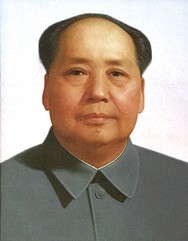
Mao Tse-Tung, by far the greatest post-1950 murderer.
 
210,000,000Soviet Bloc: late Stalinism, 1950-53; post-Stalinism, to 1987 (mostly Gulag)
34,000,000Ethiopia, 1962-92: Communists, artificial hunger, genocides
43,800,000Zaire (Congo-Kinshasa): 1967-68; 1977-78; 1992-95; 1998-present
52,800,000Korean war, 1950-53
61,900,000Sudan, 1955-72; 1983-2006 (civil wars, genocides)
71,870,000Cambodia: Khmer Rouge 1975-79; civil war 1978-91
81,800,000Vietnam War, 1954-75
91,800,000Afghanistan: Soviet and internecine killings, Taliban 1980-2001
101,250,000West Pakistan massacres in East Pakistan (Bangladesh 1971)
111,100,000Nigeria, 1966-79 (Biafra); 1993-present
121,100,000Mozambique, 1964-70 (30,000) + after retreat of Portugal 1976-92
131,000,000Iran-Iraq-War, 1980-88
14900,000Rwanda genocide, 1994
15875,000Algeria: against France 1954-62 (675,000); between Islamists and the government 1991-2006 (200,000)
16850,000Uganda, 1971-79; 1981-85; 1994-present
17650,000Indonesia: Marxists 1965-66 (450,000); East Timor, Papua, Aceh etc, 1969-present (200,000)
18580,000Angola: war against Portugal 1961-72 (80,000); after Portugal's retreat (1972-2002)
19500,000Brazil against its Indians, up to 1999
20430,000Vietnam, after the war ended in 1975 (own people; boat refugees)
21400,000Indochina: against France, 1945-54
22400,000Burundi, 1959-present (Tutsi/Hutu)
23400,000Somalia, 1991-present
24400,000North Korea up to 2006 (own people)
25300,000Kurds in Iraq, Iran, Turkey, 1980s-1990s
26300,000Iraq, 1970-2003 (Saddam against minorities)
27240,000Colombia, 1946-58; 1964-present
28200,000Yugoslavia, Tito regime, 1944-80
29200,000Guatemala, 1960-96
30190,000Laos, 1975-90
31175,000Serbia against Croatia, Bosnia-Herzegovina, Kosovo, 1991-1999
32150,000Romania, 1949-99 (own people)
33150,000Liberia, 1989-97
34140,000Russia against Chechnya, 1994-present
35150,000Lebanon civil war, 1975-90
36140,000Kuwait War, 1990-91
37130,000Philippines: 1946-54 (10,000); 1972-present (120,000)
38130,000Burma/Myanmar, 1948-present
39100,000North Yemen, 1962-70
40100,000Sierra Leone, 1991-present
41100,000Albania, 1945-91 (own people)
4280,000Iran, 1978-79 (revolution)
4375,000Iraq, 2003-present (domestic)
4475,000El Salvador, 1975-92
4570,000Eritrea against Ethiopia, 1998-2000
4668,000Sri Lanka, 1997-present
4760,000Zimbabwe, 1966-79; 1980-present
4860,000Nicaragua, 1972-91 (Marxists/natives etc,)
4951,000Arab-Israeli conflict 1950-present
5050,000North Vietnam, 1954-75 (own people)
5150,000Tajikistan, 1992-96 (secularists against Islamists)
5250,000Equatorial Guinea, 1969-79
5350,000Peru, 1980-2000
5450,000Guinea, 1958-84
5540,000Chad, 1982-90
5630,000Bulgaria, 1948-89 (own people)
5730,000Rhodesia, 1972-79
5830,000Argentina, 1976-83 (own people)
5927,000Hungary, 1948-89 (own people)
6026,000Kashmir independence, 1989-present
6125,000Jordan government vs. Palestinians, 1970-71 (Black September)
6222,000Poland, 1948-89 (own people)
6320,000Syria, 1982 (against Islamists in Hama)
6420,000Chinese-Vietnamese war, 1979
6519,000Morocco: war against France, 1953-56 (3,000) and in Western Sahara, 1975-present (16,000)
6618,000Congo Republic, 1997-99
6710,000South Yemen, 1986 (civil war)
*Sources: Z. Brzezinski, Out of Control: Global Turmoil on the Eve of the Twenty-first Century, 1993; S. Courtois, Le Livre Noir du Communism, 1997; G. Heinsohn, Lexikon der Völkermorde, 1999, 2nd ed.; G. Heinsohn, Söhne und Weltmacht, 2006, 8th ed.; R. Rummel, Death by Government, 1994; M. Small and J.D. Singer, Resort to Arms: International and Civil Wars 1816-1980, 1982; M. White, "Death Tolls for the Major Wars and Atrocities of the Twentieth Century," 2003.

This grisly inventory finds the total number of deaths in conflicts since 1950 numbering about 85,000,000. Of that sum, the deaths in the Arab-Israeli conflict since 1950 include 32,000 deaths due to Arab state attacks and 19,000 due to Palestinian attacks, or 51,000 in all. Arabs make up roughly 35,000 of these dead and Jewish Israelis make up 16,000.

These figures mean that deaths in Arab-Israeli fighting since 1950 amount to just 0.06 percent of the total number of deaths in all conflicts in that period. More graphically, only 1 out of about 1,700 persons killed in conflicts since 1950 has died due to Arab-Israeli fighting.
(Adding the 11,000 killed in the Israeli war of independence, 1947-49, made up of 5,000 Arabs and 6,000 Israeli Jews, does not significantly alter these figures.)
In a different perspective, some 11,000,000 Muslims have been violently killed since 1948, of which 35,000, or 0.3 percent, died during the sixty years of fighting Israel, or just 1 out of every 315 Muslim fatalities. In contrast, over 90 percent of the 11 million who perished were killed by fellow Muslims.
Comments:
(1) Despite the relative non-lethality of the Arab-Israeli conflict, its renown, notoriety, complexity, and diplomatic centrality will probably give it continued out-sized importance in the global imagination. And Israel's reputation will continue to pay the price.
(2) Still, it helps to point out the 1-in-1,700 statistic as a corrective, in the hope that one day, this reality will register, permitting the Arab-Israeli conflict to subside to its rightful, lesser place in world politics.
Professor Heinsohn is director of the Raphael-Lemkin-Institut für Xenophobie- und Genozidforschung at the University of Bremen. Mr. Pipes is director of the Middle East Forum.

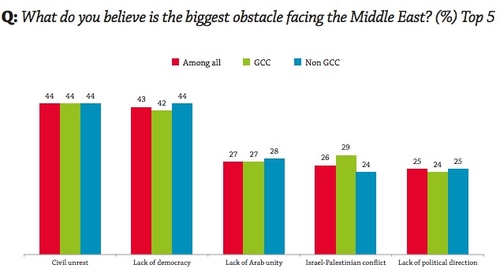
Apr. 9, 2013 update: Congruent with these numbers, the ASDA'A Burson-Marsteller Arab Youth Survey 2013, titled Our Best Days Are Ahead of Us, finds that the Arab-Israeli conflict rates as concern #4 in the minds of young Arabic-speakers.

The poll was conducted by Penn Schoen Berland with 3,000 face-to-face interviews between December 2012 and January 2013 with Arab men and women aged 18 to 24 in the six Gulf Cooperation Council states (Bahrain, Kuwait, Oman, Qatar, Saudi Arabia and the UAE), Egypt, Jordan, Lebanon, Libya, Iraq and Tunisia, Algeria, Morocco, and Yemen. The gender split of the survey is 60:40 male to female. The margin of error is +/-2.19%.

Iranian and Syrian Despots offer "peace in our time..."

From Daniel Pipes, September 28, 2013:
Has anyone else noted the similarity in today's top two Middle East news headlines – the telephone call between the Iranian and American presidents and the passage of U.N. Security Council Resoluton 2118 that calls for the "expeditious destruction" of Syrian chemical weapons? In both cases:
  • A long-ruling tyrant (Ali Khamene'i, Bashar al-Assad,) is reaching out to the West.
  • Those tyrants are furiously signaling an apparent reform (a smiling Hassan Rouhani, Assad acknowledging his chemical weapons and agreeing to turn them over).
  • "Who us, WMD?" they ask. "No interest at all in them."

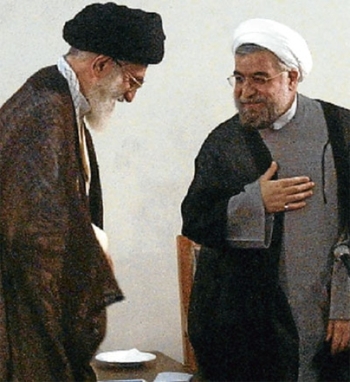
Supreme Leader Ali Khamene'i (left) with President Hassan Rouhani.
Let's not forget who's in charge in Tehran.
Count me skeptical.

In part, I've learned over the decades that pessimism is good for one's career as a Middle East analyst. In part, both the Iranian and Syrian governments have shown such dedication to their WMD buildups that it's nearly inconceivable either will voluntarily undo them.

I just hope that the U.S. and other governments don't fall prey to manipulations and delays.

Given the occupant in the White House, however, that seems like a very probable outcome, especially in the Iranian case.

"Charming" Iranian Despots...

From JCPA, Vol. 13, No. 26,  24 September 2013:
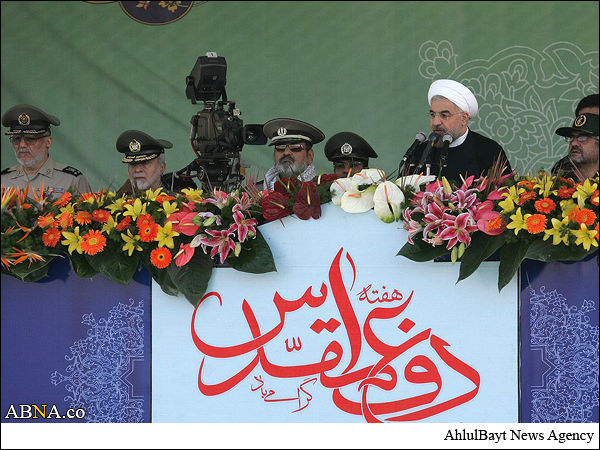
With Iranian President Rouhani speaking at the UN in New York, it is useful to see the messages coming out of Tehran from an annual military parade held on Sept. 22, 2013. Significantly, Rouhani attended the parade, reviewed the forces and spoke as well. He was accompanied by the heads of the Iranian armed forces. Seated to his right was Iranian Chief of Staff, Major General Hassan Firouzabadi, and to his left was the Commander of the Revolutionary Guards, General Mohammad-Ali Jafari (see photo).
iran-24sep13a-600w

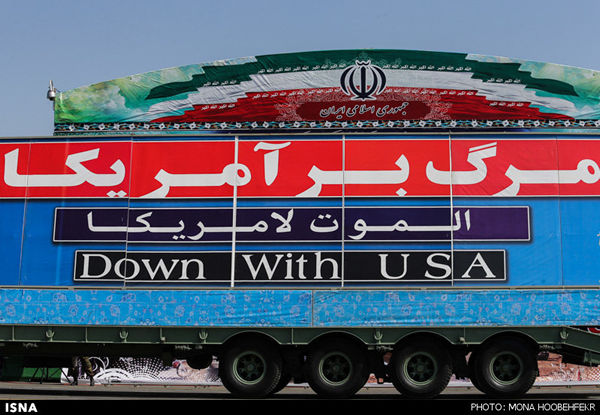
Here is a display of Iranian messages that were featured during the Tehran military parade. While in English the Iranians wrote “Down with America,” in Persian and Arabic, the Iranians wrote, “Death to America.”
iran-24sep13b-600w

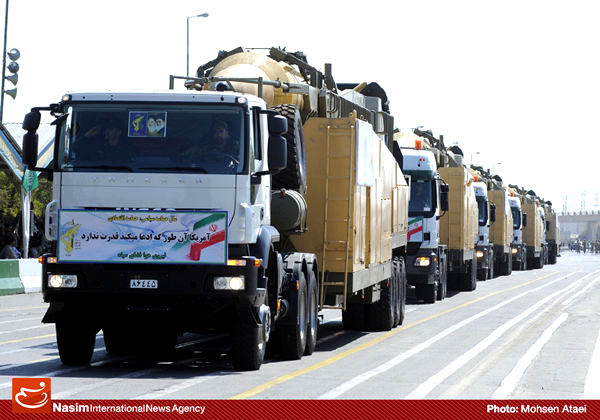
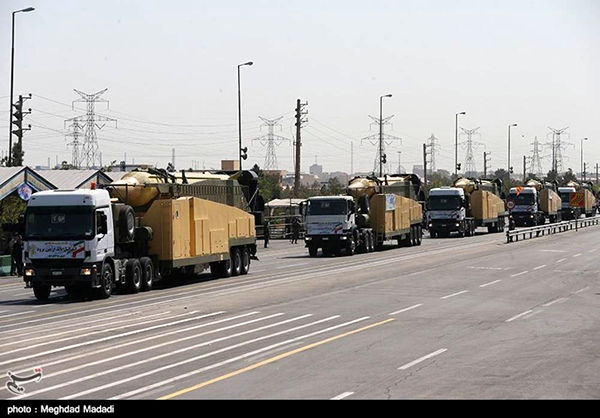
The parade included a line of missile transports carrying Shahab-3 missiles, which have a 1,300-kilometer range that can reach both Israel and American bases in the Persian Gulf. The lead vehicle has a poster in the front which says: “America Is Not as Powerful as It Claims to Be.” Thus, on the eve of his visit to the UN, Rouhani took part in a major national event which contradicted the themes he has been stressing during his charm offensive in New York.
iran-24sep13c-600w

Finally, under Rouhani’s presidency, Iran’s military parade contained a blatant statement calling for Israel’s destruction. On the lead vehicle of a line of trucks transporting Shahab-3 missiles, there appears a banner that reads: “Esraail baayad az beyn beravad” – “Israel Should Cease to Exist.” Iran’s apologists will no doubt say that the sentence is in the passive voice, so it is not clear how it ceases to exist. But the very fact that the Iranians attach a sign of this sort to a vehicle carrying Shahab-3 missiles means that Tehran itself is juxtaposing its intention to destroy Israel with the military means to carry it out.
Reports by the International Atomic Energy Agency last year, especially in May 2012, contained information that Iran was seeking to remove the conventional warhead from a Shahab-3 missile and replace it with a spherical nuclear device.
 iran-24sep13d-600w

Wednesday, September 25, 2013

Syrian Chemical Weapons: Is a Disarmament Possible?

From BESA Center Perspectives Paper* No. 214, 24 Sept 2013, by Lt. Col. (res.) Dr. Dany Shoham:

EXECUTIVE SUMMARY: Implementing chemical disarmament in Syria will be an enormous challenge, and the prospects for accomplishing it are doubtful. Appreciable portions of the chemical weapons arsenal have been trans-located, in part untraceably. Moreover, the timetable for Syrian disarmament announced by the US and Russia seems too condensed, even if “good will” and “fair play” are (mistakenly) assumed. Syria possesses a huge chemical warfare alignment, with dozens of multiform facilities and installations. Just an up-to-date mapping of this alignment is a very complex mission. The plausible possibility that various Iraqi chemical and biological weapons were added to the Syrian CBW inventory significantly complicates the situation. Moreover, Syria is likely to methodically further develop biological weapons as a powerful alternative to chemical weapons; and the US-Russia accord does not deal with this. 

This special edition Perspectives Paper can be viewed in its entirety in this PDF link.

Introduction

While various events and assessments related to the Syrian chemical weapons (CW) capabilities and conducts have been largely covered in the media since the civil war began, the picture concerning the program’s evolution – both conceptual and technological, which led to Syria’s vast CW arsenal – have remained nearly unnoticed. Comprehending the evolution of the chemical program is a prime tool for coping with the current complex situation, particularly since Syria is about to join the international CW convention. Above all, hovers the question of whether President Bashar al-Assad is indeed ready to give up Syria’s non-conventional arms. This essay addresses these issues and provides a detailed picture about the Syrian CW program, from its inception to the present.
Syria today is a prominent member of the chemical and biological weapons (CBW) club. As early as 1992, the US Defense Department ranked Syria as the sole Muslim state possessing a “chemical systems capability in all critical elements” for chemical weapons. And in recent years, Syria has added biological weapons to its arsenal. Money is also there, and in plenty; the picture of poverty that is drawn for the Syrian army’s conventional ordnance is misleading. Syria spends between $1 billion and $2 billion annually on its ballistic and CBW capabilities, an enormous share of its military budget.
Syria’s successful development of its CBW capabilities is a textbook case of how a small but determined state can operate beneath the radar of international scrutiny, building a formidable array of non-conventional capabilities under an ostensibly scientific cover. Yet media reports and most discussions of Syrian CBW programs have been far from adequate. What strategic concepts inform Syria’s programs? And what is the nature and composition of the Syrian CBW alignment? A thorough analysis of those questions would clarify some aspects of Syria’s chemical arsenal.
Click here to read more.
*BESA Center Perspectives Papers are published through the generosity of the Greg Rosshandler Family
Click here for a PDF version of this article

Tuesday, September 24, 2013

Fighting terrorism with settlement

From Daniel Pipes, September 23, 2013:

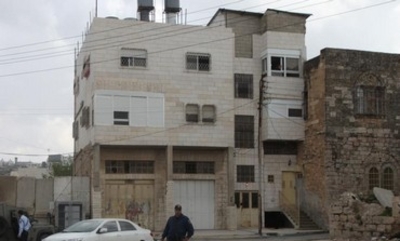
In retaliation for the shooting on Sep. 22 of an Israeli soldier, Sgt. Gabriel Koby, 20, while patrolling in Hebron, killed by a sniper with a shot to the neck, the Government of Israel has allowed the immediate resettlement of Beit Hamachpela ("House of the Patriarchs") a three-story apartment building in that city near the Cave of the Patriarchs and close to where Koby was shot.

(Hebron's Jewish community had purchased most of the building in March 2012 but its members were expelled from it by the Israeli government a few days later on the grounds that they lacked a residential permit. They subsequently won a lawsuit permitting them to return but did not have authorization to do so.)
Beit Hamachpela in Hebron.

Prime Minister Benjamin Netanyahu commented that
"Whoever tries to uproot us from the city of our forefathers will achieve the opposite. We will continue to fight terrorism and hit the terrorists with one hand, and we will continue to strengthen the settlement enterprise with the other hand."
Economy Minister Naftali Bennett noted that "We know how to build and settle. Not to kill. This would be the appropriate Zionist answer [to the violence]."
Comments:
(1) As someone who has long argued for a more robust Israeli response to unprovoked violence, this decision strikes me as very appropriate. It signals the Palestinians that killing Israelis marches them exactly backwards. Next time, the Israeli response should be even more robust; as Aaron Lerner suggests, that could mean the settlement of a new neighborhood. This message would quickly get through and violence would abate.
(2) The Palestinian Authority did not condemn this attack, nor another one a day earlier, when an Israeli soldier, Tomer Hazan, also 20, was lured to his death in the West Bank, pointing again to the PA's completely unsuitability as a "peace partner" for Israel. The farcical negotiations sponsored by John Kerry and overseen by Martin Indyk should be suspended until Mahmoud Abbas makes a convincing apology and takes steps to insure that such misbehavior is never repeated. (September 23, 2013)

Rouhani will smile all the way to the bomb

From Washington Post, 23 Sept 2013:

[As] President Barack Obama tentatively engage[s] the new Iranian president, Hasan Rouhani[,]
Yuval Steinitz, Israel’s minister for intelligence and strategic affairs, confirmed that Israel is alarmed by what he derided as Rouhani’s “smiley campaign.” He said that despite some friendly gestures, Iran has shown no signs of slowing its efforts to enrich uranium, a key step in the production of nuclear weapons.
“On the one hand, Iran is trying to appease the world with Rouhani’s moderate rhetoric. And on the other hand, Iran continues its approach toward nuclear weapons, and if nothing serious will be done, Rouhani will continue to smile, will continue to appease, and he will smile all the way to the bomb,” Steinitz told the Associated Press.
Iran claims its nuclear program is for peaceful purposes. But critics in Israel and the West dismiss such explanations. They point to Iran’s refusals to cooperate with U.N. nuclear inspectors, its covert enrichment activities and lack of progress in years of Western on-and-off negotiations with the Iranians.
Israel has long claimed a nuclear-armed Iran would pose a grave threat to world peace and security. For Israel, the stakes are especially high. Israel views a nuclear-armed Iran a threat to its very existence, noting calls by Iranian leaders for destruction of the Jewish state and Tehran’s support of Israel’s bitterest enemies such as Hezbollah in Lebanon and Palestinian groups Hamas and Islamic Jihad.
Israeli leaders have repeatedly expressed frustration with the West’s inability to halt Iran’s nuclear program. While welcoming several rounds of economic sanctions against Iran, it says diplomatic pressure has not been enough and must be coupled with a credible threat of military action. Israel has repeatedly hinted that if needed, it is prepared to take unilateral military action against Iran’s nuclear program if it believes diplomacy has failed.
Speaking to his Cabinet last week, Netanyahu said he would make Iran the focus of his upcoming trip to the White House and the United Nations. He said he would make four key demands: that Iran stop enriching uranium, remove its existing stockpile of enriched uranium, close an underground enrichment facility in the central city of Qom and halt production of plutonium, another pathway to nuclear weapons.
“Until all four of these measures are achieved, the pressure on Iran must be increased and not relaxed, and certainly not eased,” he said.
That does not seem likely as Obama, who has always seemed reluctant to use force against Iran, appears set to give diplomacy another shot.
Since taking office last month, Rouhani has said he would like to peacefully resolve the nuclear standoff by finding a formula that would ease international sanctions in return for more nuclear transparency. Meanwhile, he has made a series of gestures toward the U.S., such as exchanging letters with Obama and telling the U.S. network NBC his country does not want nuclear weapons.
These gestures mark a dramatic departure from the policies of his predecessor, Mahmoud Ahmadinejad, who seemed to thrive on confrontation with Israel and the West. In another key shift, Rouhani appears to have the backing of the country’s supreme leader, Ayatollah Ali Khamenei, a sign his gestures are genuine.
The White House has cautiously welcomed Rouhani’s outreach, raising speculation of a meeting with Obama on the sidelines of the U.N. gathering.
“We have a preference for resolving this issue diplomatically and that we’re open to engagement with the Iranian government,” Ben Rhodes, Obama’s deputy national security adviser, said last week. While calling for a “sense of urgency,” Rhodes also said the White House believes there is still time for diplomacy. Rhodes added: “We certainly recognize and appreciate Israel’s significant concerns about Iran.”
But Israeli officials are jittery. “Rouhani will cheat and lie at the U.N. Assembly,” Defense Minister Moshe Yaalon told a group of visiting Christian parliamentarians from around the world on Sunday. “And therefore we say: One way or another the Iranian nuclear threat needs to be stopped,” he said.
For many in Israel, Obama’s handling of the Syrian crisis is a cautionary tale. After earlier declaring that the use of chemical weapons constituted a “red line”, Obama recently put off a strike in Syria in response to a chemical attack as part of a diplomatic agreement with Russia that calls for Syria to dismantle its chemical weapons by mid-2014. At the U.N., Obama will be trying to build support for a Security Council resolution making this agreement legally binding.
The U.S.-Russia agreement received only lukewarm support from Israel, which had felt it was important for Obama to uphold his red lines more firmly. Netanyahu has called the deal a “test case” for Iran, saying a failure by the international community to disarm Syria, Iran’s close ally, will bode poorly for global efforts to curb Iran’s nuclear program.
Netanyahu may also face questions about Israel’s changing assessments of Iranian capabilities. In his address to the U.N. last year, Netanyahu said Iran would reach the final phase of weapons production “at most” by mid-2013. In a published interview last week, Steinitz said Iran was “six months” away from weapons capability.
Israeli officials say the Syrian diplomatic compromise and the changing intelligence assessment on Iran are the result of successful international pressure, specifically the threat of military action.
“It was not Israel that changed its assessment. It was the Iranians that changed their behavior following the depiction, the presentation of the red line by Benjamin Netanyahu,” said Steinitz.
Pushing Iran too hard also risks drawing scrutiny toward Israel’s own nuclear activities. Israel is widely believed to possess nuclear weapons, though it neither confirms nor denies having them. Last week, Israel fended off an Arab-led attempt at the annual conference of the U.N.’s nuclear agency to censure Israel’s refusal to acknowledge having nuclear arms and put them under international oversight. Israel says an Israeli-Palestinian peace must be reached before creation of a Middle East zone free of weapons of mass destruction.
Eytan Gilboa, an expert on U.S.-Israel relations at Israel’s Bar-Ilan University, predicted disagreements between Netanyahu and Obama in their meeting.
“Netanyahu will ask Obama how he will make sure that Syria would not hide chemical weapons and that Iran would not develop nuclear weapons in disguise,” he said. “I see some disagreements because Obama is likely to accept many deficient agreements that could prevent use of force.”