Thursday, May 09, 2013

United Jerusalem, for all ...under Jewish Sovereignty

From  The Times of Israel , May 8, 2013, b

Prime Minister Benjamin Netanyahu, Jerusalem Mayor Nir Barkat (left) and Cabinet Secretary Zvi Hauser at a cabinet meeting on May 5, held at the Herzl Museum, in honor of the upcoming Jerusalem Day. (Photo credit: Kobi Gideon/GPO/FLASH90)

Mayor Nir Barkat says he’s repositioning the city to retake the role it fulfilled ‘amazingly well’ for a thousand years — where all peoples were equally accepted, but Jewish sovereignty was unquestioned 

 ...In this interview, conducted to coincide with Wednesday’s Jerusalem Day, Barkat sets out his vision for Jerusalem both ideologically and at street level. ...much of it revolves around the mayor’s overall philosophy, which stands starkly at odds with the international community’s default attitude to Jerusalem and its future. As earnest as ever, and unusually candid, Barkat states flatly that he’s right and the world is foolish, hypocritical and plain wrong....
 
...What’s the latest demographic breakdown of the city?
Well, about 35% of the population is Arab — about 33% Muslim and 2% Christian. And then from the remaining 65%, you have about 22% ultra-Orthodox and 43% Zionist.
...In which areas is there space to build?
We’re talking about expansion of current neighborhoods. In Gilo, Givat Mesua… We can hit the target of creating 50,000 more apartments over the next 10-20 years.
To raise the city’s population from today’s 800,000 to one million?
Yes. It has to be done while developing areas for business and industry. This is another thing I’m very proud of. We’ve outlined a new business district at the entrance to the city which will enable us to build 13 towers of 35 stories. And with the expansion of the (nearby) government (office) areas, that’s 1.1 million square meters of office space, culture, hotels, that can employ about 40,000 people.
What’s the time scale?
We will see the first towers in the next five years, and it will complete itself in the next seven to eight.
...It seems to me that your philosophy is to try to unify the city as much as possible, bring harmony to the city, give East Jerusalem Arabs a stake in the city… But that’s not realistic. Israel is never going to be able to make peace with the Palestinians while maintaining sovereignty throughout Jerusalem, and therefore your vision, if there is to be a political accommodation, is destined to fail.
I disagree with you. I keep on saying to people, to better understand the future of the city, you have to understand what happened here when Jerusalem was functional for a thousand years. When Jews came to the Land of Israel, each tribe had a piece of the territory, except Jerusalem. It was not divided among the tribes. For a thousand years, it was managed as a city that all people came to, and they felt, ‘Wow, the city belongs to me as much as it belongs to the other tribes.’ And Jews and non-Jews alike that used to come to Jerusalem felt respect… for people different from them.
It’s sort of the foundation of modern democracy – where different people were equally accepted into the gates of Jerusalem. It doesn’t necessarily mean that it’s a great idea for all tribes or all peoples around the world. But when something was successful in Jerusalem, by definition it’s accepted by all tribes, Jews and non-Jews alike.
Jerusalem had a role as a united city, whole, not divided into tribes. That is the DNA we have to develop because nothing else will ever work. The city has to work for all sectors. By definition, that DNA cannot be divided.
I’ll give you another perspective. Not one city in the world that was ever divided stayed functional. Now, the fact that there’s lots of pressure, that people think that, as you said…
That as long as Israel insists on sovereignty throughout the city, there’s no chance for a peace…
I totally disagree. That kind of thinking will get us nowhere. It will get us to a dead end, to a bad deal that will fall apart. And I prefer not to do a deal, if it’s a bad deal.
The Arab residents (of Jerusalem) are looking around. They’re looking at countries around us in the Middle East. Nothing to write home about. Egypt is not a role model for them, neither is Syria, nor Iraq, nor Iran, nor Lebanon, nor Gaza. They look at the Arab Israelis and in spite of all the challenges we have in Israel, by far they prefer to be part of Jerusalem than not. The vast majority of the Arab residents in Jerusalem do not want the city divided. The vast majority of them, if God forbid anybody imposes a division on the city, they will move to the west side. The quality of life in Jerusalem is increasing at a dramatic pace. Jobs, the quality of medicine, the school system — we have huge improvements in the school system. I’ll just give you an example: The bagrut (Israeli matriculation). We are introducing the bagrut into the schooling system in the Arab areas. They’re opting in to the Israeli way of learning.
I don’t doubt anything that you’re saying about what ordinary people want in their hearts, but the historical precedent you cited — of all the tribes – it was nonetheless an Israeli-controlled city. Now you have 250,000 Arabs.
An Israeli-controlled city.
Their leadership – never mind what they may say privately – their leadership is not going to agree…
That’s not true. They are living as residents of Jerusalem and there is lots of local leadership that works directly with us in a huge capacity of joint work. They’re working with the municipality of Jerusalem like many of the other residents of the city.
But their ‘national leadership’ has a stated ambition, endorsed by almost all of the international community, that they would have some kind of sovereign share of Jerusalem.
Well, when you poll the residents of Jerusalem you will find that you’re wrong. You’ll find that yes, some of them see themselves as Palestinians, but they see themselves as Jerusalemites first and I don’t think there’s a contradiction between the two.
Do you think the Israeli-Palestinian conflict can be solved with Jerusalem in its current municipal size, under Israeli sovereignty?
I’ll state the question differently. The challenge is what can we do with our neighbors when they realize that Jerusalem has to stay united.
Do you think of a model in which you would have a Palestinian mayor-partner or deputy mayor?
The answer is no separation of the city. One city, period.
Under sole Israeli sovereignty?
Yes.
And you think that this is not a recipe for endless conflict with the Palestinians?
Any other idea is a theoretical, bad deal. It is a theoretical concept that I hear. In the practical world, I know, God forbid, if the world pushes us there, it’s just a matter of time before things will fall apart. It will not bring closer a resolution or a better relationship with our neighbors. There is no doubt in my mind. It will get much, much worse.
And the Olmert idea of non-sovereign control of the Old City and dividing the city into Israeli- and Palestinian-controlled neighborhoods is a terrible mistake?
Terrible mistake.
Thank goodness Abbas turned it down?
Thank God he’s not there.
Who’s the “he”?
Olmert.
That he’s not where? In the prime minister’s office?
Yeah. I think it would have been a bad deal. And I was deeply disappointed to hear him even think this way, because I did not hear this from him in the past, when he was here (as Jerusalem mayor).
Maybe he was like others. He may have given up on the city. It was in a negative spiral. But today, thank God, the city is in a positive spiral.
And yet, for example, I remember I was sitting in here with you a couple of years ago and you had the whole development scheme for Silwan (an Arab neighborhood just outside the Old City walls), a very ambitious project which would have made real change on the ground…
It’s still there and it will happen.
But it didn’t happen. You were ready to go with this and people told you privately at an individual level that this (development) is fantastic for Arab residents of the city. Yet when push came to shove, even your ally at the national level, Netanyahu, had to tell you that this is not workable.
Well, there are many, many elements to the whole Silwan side. The bigger part of (developing) Silwan, I was able to move it through the municipal system with zero objection. I’m talking about the larger part of Silwan. The Gan Hamelech area, which is the smaller part of Silwan, there’s a bit of controversy. There’s no doubt in my mind, it’s the best thing for the residents. And, by the way, the controversy is from both sides. From the extreme left and the extreme right… I’m still waiting for the national government to approve the new plan because once everyone understands that it’s the right thing to do, one must go ahead and do it.
By the way, at the time, when I proposed the plans for Silwan, it was the beginning of the term. There’s no doubt in my mind there’s no better solution because the current solution is worse. The current quality of life of the residents, who are all breaking the law (because their homes are built illegally) is much worse. And we cannot help them until we introduce the new plan. Now the new plan doesn’t call for any eviction, everyone improves their quality of life, you bring dramatic investments into the place, you enable commerce, and all the residents stay.
That was the goal when we planned this. There’s no doubt in my mind that it’s defendable, it’s right, it’s honest, it’s fair. It’s much, much better than the current situation. That’s why eventually it will happen. It is indeed for the benefit of the residents. At the beginning of the term, the trust element was missing. Now I’m telling you that even the people who objected to it in the past are now considering supporting it. They’ve been here (and said) to me, ‘Oh, we didn’t know, we thought that the intention was whatever it is.’ Now they understand that the intention is: what you see is what you get.
They thought the intention was to ‘Judaize’ the area?
Yeah. Which was not the intention. So now, when people really understand that it’s for the benefit of the residents, and that it’s a much better solution than the current situation, there is a much, much wider acceptance of the plan.
I would not be surprised if in the term of this (national) government, my next term, we will be able to bring such new innovation to some of the parts of East Jerusalem, some of the Arab neighborhoods of Jerusalem. They deserve it. It’s just a matter of making sure they understand that it’s an honest and fair plan. We’re very close to being there.
On housing, on the land, as you say, you are dependent on the national government. And the national government is operating in a global arena where any building for Jews over the ’67 line is controversial, headline-making and potentially problematic — as when a vice-president comes to visit. Have there been major projects that have actually gone all the way through, where there is now building going on? Ramat Shlomo, for example (where the announcement of building plans during Vice President Joe Biden’s 2010 visit caused a crisis in ties with the US), has anything happened there?
First, let me challenge the fundamental statement you just said. There was a period of a few years when there was a lot of pressure from the different governments of the world to freeze building in Jerusalem. I had a few questions (for those who made that demand). I said, ‘Here are the facts: We’re building 500 classrooms (in East Jerusalem) that were below standard; those are now 500 classrooms that are the best in the city. We’re building lots of infrastructure, investing in lots of roads. And we’re starting to resolve some of the legal challenges because there’s no proof of ownership on 90% of the land in East Jerusalem. So if somebody wants to build a building, we don’t know if he owns it or not because there’s no credentials. Which is absurd, but that’s life. We resolved some of those legal issues, to enable people to get a license or at least a temporary license until we know that nobody challenges their ownership claims.
We (now) have 50,000 registered apartments in East Jerusalem (up from 39,000). We’re still in a process of registering.
And how many are there?
We guesstimate that it’s between 55-65,000. We made a big, big change on that, and there was very little negative resistance – on the contrary. We’ve given names to practically all the streets.
So, I’d ask: ‘Should we stop all that? Or God forbid, are you saying that I as mayor, when somebody comes to build, that I have to ask him if he’s a Jew or not Jew? Not to give a license to the Jews and to give a license to the Muslims or the Christians? Under which law? American law? English law?’
As mayor, I can only check if the building is legal. I’m going out of my way to enable building even in places where the registry of land is not clear. I will go out of my way to enable people to build, to enable people to register their homes. Once their home is registered with the municipality, it’s worth much more for the resident.
Now, some of the government-owned land they had to dish out only by bid – to the highest bidder. They are not allowed to ask if the people who won the bid are black or white, or Jewish or Muslim or Christian. Anybody can use a lawyer and a proxy and win a bid. Government-owned land all over the country is sold to the highest bidder.
So, I totally reject this international pressure because it’s illegal, it’s unethical. We will continue working by Israeli law, which is similar to any other law, and we will not discriminate Jews from non-Jews, for good and for bad.
...Of course, you don’t need me to tell you that when you say, ‘We operate according to Israeli law,’ they will tell you that any building over the ’67 line is illegal under international law.
Which building – (for) the Jews or the Arabs?
Anything which Israel does which changes the status quo on the ground. You’re a big believer in the status quo. All the expansion of neighborhoods beyond the ’67 line, they will say, is a case of you changing the status quo.
But here’s the absurdity of this, okay? If you look back on the last 20 years, the Arab population is growing, in market share, faster than the Jewish population. So, if anything, they’re wrong. If anything, the status quo is the other way around. Natural growth of a city has to be planned. The master plan that we proposed, of scaling from 800,000 people to a million people, is an honest and fair plan. It enables natural growth, for the Jews and non-Jews alike. And the reality is that we’re investing and catching up with the challenges that we had in an honest and fair way. And to come and to make such statements is totally political…
When the International Criminal Court rules one day that it is illegal for Israel to be building in, choose whichever neighborhood you like, Ramat Shlomo, Gilo, Armon Hanatziv – your response to that is, ‘If that’s international law then international law is an ass, and what we’re doing is for the best interests of the residents of the city.’ Am I right?
I work under Israeli law. I work for Israel, as an Israeli, and I have 100 percent confidence as mayor of the city of Jerusalem that we’re doing the right thing for all residents. It’s not against anyone. The fact is that all residents are happier today than they were in the past. The fact is that the model we’re proposing for Jerusalem, I did not invent. It worked amazingly well for a thousand years. We’re repositioning Jerusalem to its role in the world.
Sometimes I feel people have triple standards. Here’s where the world stands: They expect from us in Israel more than they expect from themselves. Which is fine. I accept that. They try to hold us accountable to higher ethics and standards. And I can live with that. On the other hand, they have no expectations from our Arab neighbors.
When one criminal dies from cancer in an Israeli prison, the whole world goes crazy. When you have 50,000, 70,000 people murdered and killed in Syria, the outcry is less. That’s absurd.
There’s no accountability. I didn’t hear the international world come to the Arab residents of Jerusalem and demand of them to build legally, to do what they are obliged to do. I don’t hear that. So building illegally is totally okay. But for Jews to build legally, anywhere in the Holy Land, is not okay? So there’s very, very clear triple standards.
What are your thoughts on the dispute surrounding Jewish rights to pray on the Temple Mount? One might be forgiven for assuming that you would say, ‘This was recaptured, liberated by Israel in ’67. How ridiculous that this is the one place in the world where Jews are not allowed to pray?’ Is that what you think?
It is ridiculous. The status quo is ridiculous. But it’s the status quo.
And therefore, you’re fine with that.
(Sighs) No, I don’t feel comfortable with it.
You think Jews should be allowed to pray on the Temple Mount.
Well, theoretically, yeah. Why not? I mean, I don’t think the Muslims should feel that enabling Jews to pray in their holiest site should be a problem. But, again, it’s the status quo and changing the status quo is a huge challenge, especially in things like this. And I wouldn’t rush to make a change without working it out with the different players.
Do you have relations with the different players? I mean, are there such consultations taking place? The (relevant Muslim authorities) would be utterly resistant to the idea (of Jews praying on the Temple Mount).
I’m not involved in any of this at this point. I don’t think it’s prudent to deal with this at this point. That doesn’t mean I’m happy with it.
 
...President Obama was recently here. What you’ve said to me today about how you see the future of Jerusalem, in terms of who controls it, is anathema to the worldview that even our closest ally stands for. You’re running against the current of international thinking, even from our closest friend.
Unfortunately, they’re wrong. You want to hear the truth. You want to understand what will work, not what our allies are telling you. And if anything, I would recommend to our allies to ask us and to better understand the big writing on the wall. For every complex problem, there is one simple, wrong answer. What they’re seeking is the simple, wrong answer for this region, for Jerusalem, for the Middle East and for the relationship between us and our neighbors.
I propose a different solution, which is derived from our past. And I believe that we’re showing and demonstrating that it works – much better than any other solution they could propose. The fact that they’re saying what they’re saying doesn’t mean they’re right. And I will do everything I can, the best I can, not only to fulfill the vision I have for Jerusalem, but through doing and developing the city, to convince the rest of the world, or whoever doesn’t understand what’s going on here, that while they are thinking right and left, we’re thinking up and down. While they’re thinking in a certain format throughout these years, that format will never work.
This vision of yours does not sentence Israel to endless friction with the Arab world? Your vision of a pastoral, harmonious city doesn’t mean that we are going to be in a forever antagonistic relationship with the Arab world?
I will answer it differently. I think we should stick to our strategy and manage the conflict until there’s a window of opportunity to create peace – where our neighbors understand our strategy. You see, doing a bad deal? Better not do it.
So what would be your vision of an accommodation with the Palestinians?
Well, it would probably be in line with Prime Minister Netanyahu’s understanding of the two-state solution. But not dividing Jerusalem.
And not giving the Palestinians any share of sovereignty.
No, no, there’s no such thing. No such thing in the world.
Is there room in that vision for something next to Jerusalem, the Abu Dis kind of idea although [the Arab neighborhood of] Abu Dis is partially in Jerusalem — some kind of Palestinian sovereignty that could be considered…?
Call Ramallah “Jerusalem.” ...Change its name to Jerusalem, to northern Jerusalem, ok? Give it another name. But it’s not Jerusalem.

How the Palestinians Have Trapped Themselves and Dragged the West Along

From Middle East and terrorism Blog, Wednesday, May 8, 2013, by Barry Rubin:
...Today, as in 1948, the Zionist side is more eager for the existences of an independent Palestinian state living in peace inside permanent borders than is the Palestinian Arab leadership.
That statement might strike misinformed people as ludicrous, but it is nonetheless true, as they should have known since Yasir Arafat’s destruction of the Camp David summit meeting and rejection of the Clinton peace initiative of 2000. And that only followed on the earlier Palestinian rejectionism of the original Camp David summit in 1977, which offered a pathway to statehood, or various other initiatives.
And this pattern of behavior is being reinforced daily.
Consider a recent incident. On April 30, an Israeli civilian father of five was stabbed to death by a Palestinian at the Tapuach Junction on the West Bank. The killer was a prisoner who had just completed his sentence and been released by Israel, as Secretary of State John Kerry wants Israel to release hundreds of other prisoners before their sentences are done.
The killer is a member of the Al-Aqsa Martyrs Brigade. Note the following details:
–For many years Fatah, the ruling party in the Palestinian Authority (PA), denied the link with the brigade. Legal cases were held in the United States over the murder of Americans by the al-Aqsa Brigade in which PA lawyers strenuously denied any connection. But in 2009, the Fatah Congress, that organization’s highest authority, admitted that the al-Aqsa Brigades were part of Fatah, a fact one might have known earlier since that’s what it said on the Brigades’ web-site.
Fatah proudly took responsibility for earlier terrorist attacks by the group.
In the case of the April 30 murder, the official Al-Aqsa Brigades statement was very interesting, saying it had “received a green light to carry out military actions against Israeli targets in response to the deaths of prisoners Arafat Jaradat and Maysara Abu Hamdia in an Israeli prison.”
A green light from whom?
Since the Brigades did not receive a green light from itself, this is an open admission that they were ordered to murder ...civilians by the Fatah leadership, in other words by those ruling the PA, a Western-financed and supported entity.
–The two prisoners had been examined at autopsies conducted in the presence of PA officials. Thus, the PA knew that these two men died of natural causes. It was thus lying to its own people to incite them into supporting murders of Israeli civilians that the PA was ordering.
–In this case, however, a junior member of the Fatah Central Committee named Jamal Muheisen, while defending the attack, tried to distance his organization from responsibility:
“The Za’atra action was a natural response to attacks by the occupation and settlers [on Palestinians], but it does not express the general policy of the Palestinian Authority and of Fatah, who have espoused [the option of] popular resistance to the occupation.”
But it was Muheisen and not the killer or the al-Aqsa Brigades that was criticized universally by Fatah. Nobody came to Muheisen’s defense. On the contrary, the killer was praised as a hero who restored Fatah’s pride. No doubt, a street, a square, or something else will be named in his honor in future.
One Fatah member put it this way:
“[The killer] is a hero of the Fatah movement, a revolutionary and a fighter who restores Fatah’s pride and former glory; he exposes the dark [face of] interested parties and unmasks the mercenaries.”
–But why use the phrase about restoring Fatah’s pride?
Because the organization’s pride is counted by the number of Israelis it kills. 
That’s how score is kept in Palestinian politics, even in 2013. When Fatah isn’t killing Israelis it is ashamed (restores…former glory), while any Palestinian—like Muheisen—who doesn’t support it is one of the “mercenaries,” presumably of the Zionists and Americans. If Fatah doesn’t keep up the killings, it believes that means it loses ground to Hamas.
...the PA is ... in a box of its own making.
It cannot win militarily against Israel, nor will it engage in serious diplomacy with Israel. During a recent meeting in Washington, supposedly to show Arab state support for a two-state solution, the PA’s representatives glowered in making clear they weren’t interested in serious negotiations with Israel.
Meanwhile, on the domestic front, the Fatah chiefs finally rid themselves of relatively moderate Prime Minister Salam Fayyad who was too honest for their purposes. Fayyad blasted the PA’s corruption and incompetence in a New York Times interview and then denied he had said these things, hoping for political survival.  It isn’t clear whether he might return but clearly the credibility of the PA regime’s front-man, who was effective at collecting international donation, should be undermined.
So what can the PA do? Collect billions of dollars in Western aid, stage occasional terrorist attacks, try to use the UN General Assembly’s designation of Palestine as a “non-member state” to try to get into international groups and someday sue Israel in the World Court.
It is precisely because it lacks any active alternative that the PA and its allies are engaged in an unprecedented public relations’ campaign complete with strenuous attempts to subvert support for Israel in Jewish communities, boycotts, and disinvestment drives. This echoes the old PLO strategy although in this case it is not Arab state armies but armies of activists that will weaken Israel to the point that it must make huge concessions and subsequently collapse. Of course, this strategy won’t work as it did not work in the 1960s and 1970s.
Meanwhile, the PA leadership benefits from the status quo, they live well, pocket the aid money, posture as revolutionaries, and avoid being “traitors” by refusing to make peace.
...we all know the broad outlines of a potential comprehensive agreement and we can play at drawing borders and have fun imagining the status of Jerusalem.
Yet the deadlock nonetheless prevails and it will prevail.
...Why...is there such a growing gap between the lynch mobs hating Israel being trained on many college campuses and other public or media institutions, and the far different Western policies toward Israel on the government level?
...the policymakers know the truth but conceal it from their publics sometimes because it benefits their perceived state interests (make Arabs and Muslims generally happy) and political interests (plays up to the left-wing activists). That’s too bad but reality remains unchanged.

Tuesday, May 07, 2013

Is a bombed out and burning Damascus a dress rehearsal for Iran?

From Al-Monitor, 5 May 2013, by Ben Caspit:
... Israel’s highest ranking defense officials have made it clear that Israel would ...stop “game-changing” weapons from making their way to Hezbollah. And not only chemical weapons.
The Israeli airstrikes, according to Western Intelligence sources, around Damascus over the weekend were proof that Israel means business.
As far as Israel is concerned, three types of Syrian weapons constitute casus belli, game changers, the types Israel will never allow to flow to Hezbollah. And that's without addressing the issue of chemical weapons. According to experienced military sources, these are
  • high precision, lethal Yakhont missiles that are able to strike ships or marine platforms from a distance of 300 km or farther. Missiles such as these would put the gas excavations in Israel's economic waters within strike range.
  • ...  SA17 anti-aircraft missiles, which are considered game changers in terms of the Israeli air force's freedom of operation.
  • ... the weapons hit in Damascus in recent days.
 ... the targets that were bombed twice (during the night between last Thursday and Friday, May 2, and the night between Saturday and Sunday this week, May 4) were Fateh-110 missiles depots and their solid fuel depots. Why are they considered “game changers”? Because they are far more precise than the old Scuds and Nasrallah’s rockets, and because they are propelled by solid fuel and launched from mobile launchers. In other words: precision is the critical element here. If Nasrallah gets missiles with a dispersion range of only a few dozen meters, like the Fateh missiles, it means that he would be able to threaten the Israeli air forces’ airports and other strategic facilities. Israel cannot allow itself to be in that position. Another, even more serious matter for the Israelis: the fact that launching Fateh missiles does not require a lengthy and complex launch process that can be seen by Israeli Unmanned Aerial Vehicles [UAVs]. Because it is equipped with solid fuel, the Fateh can be launched quickly, within a matter of minutes, from a relatively small vehicle, and strike its target with lethal precision, with a war head weighing half a ton. You can’t make predictions, you can’t shoot them down from the air. If there is such a thing as “game-changing” weapons in the match between Israel and Hezbollah, this is it.
It is believed that the operation was coordinated with the United States through a very long series of discussions between the parties, at all levels. The issue was also raised during US President Barack Obama’s visit to Jerusalem at the end of March this year.
 
...What does Israel get out of all of this?
First of all, it has reduced the risk of transfer of missiles or “game-changing” technologies into what it believes are dangerous hands. It is not a far stretch to believe that there will be other strikes, if and when. It is not unimaginable that Israel will take advantage of the chaos to drastically reduce the potential of such technology and equipment falling into the wrong hands.
Second of all, Israel has once again put on a show of military, and especially intelligence, strength. The consignments that exploded with a thundering boom in Damascus in recent days are underground, protected by thick layers of concrete. While it’s true that this is still not the Fordow site, there are very few air forces in the world that know how to crack such caches, and with such ease.
And we still haven’t mentioned the excellent and precise intelligence.
I believe that in Jerusalem they assume that Tehran is looking at bombed out and burning Damascus and understanding several things. The United States is supportive, the world is silent and the sides are ready in a face-off, closer than ever to conflict. If we think about it, we are actually right in the middle of the dress rehearsal.
*Ben Caspit is a contributing writer for Al-Monitor's Israel Pulse. He is also a senior columnist and political analyst for Israeli newspapers, and has a daily radio show and regular TV shows on politics and Israel.

Israel Targeted Iranian Missiles in Syria Attack

From New York Times, 5 May 2013, by , and *:

Atta Kenare/Agence France-Presse — Getty Images
The missile shipment struck by Israel was reported to include Iranian-made Fateh-110’s, a type of mobile, accurate, solid-fueled missile, like this one in a military parade in Tehran in 2010.

 
BEIRUT, Lebanon — A series of powerful explosions rocked the outskirts of Damascus early Sunday morning, which Syrian state television said was the result of Israeli missile attacks on a Syrian military installation.
See video here
 
    
Twice in four months Israel has sought to disrupt the pipeline of weapons to Hezbollah.                           
If true, it would be the second Israeli airstrike in Syria in two days and the third this year.
The airstrike that Israeli warplanes carried out in Syria overnight on Thursday was directed at a shipment of advanced surface-to-surface missiles from Iran that Israel believed was intended for Hezbollah, American officials said Saturday. That strike was aimed at disrupting the arms pipeline that runs from Syria to Hezbollah, the militant Lebanese organization, and it highlighted the mounting stakes for Hezbollah and Israel as Syria becomes more chaotic.
Iran and Hezbollah have both backed President Bashar al-Assad in the Syrian civil war, now in its third year. But as fighting in Syria escalates, they also have a powerful interest in expediting the delivery of advanced weapons to Hezbollah in case Mr. Assad loses his grip on power and Syria ceases to be an effective channel for funneling weapons from Iran.
The missiles that were the target of the Israeli raid had been shipped from Iran and were being stored in a warehouse at Damascus International Airport when they were struck, according to an American official.
Iran has sought to use the threat of a Hezbollah missile attack against Israeli territory as a means of building up its ally and deterring Israel from conducting airstrikes on Iranian nuclear installations that Israeli and American officials believe are part of an Iranian nuclear weapons program.
In Lebanon, some analysts said they believed that a strong Hezbollah could also emerge as a powerful ally for Mr. Assad if he is forced to abandon Damascus, the Syrian capital, and take refuge in a rump Iranian-backed state on the Syrian coast, a region that abuts the Hezbollah-controlled northern Bekaa Valley.
“The relationship between Hezbollah and the Assad regime is stronger now,” said Talal Atrissi, a professor at Lebanese University in Beirut who has good relations with Hezbollah. If Mr. Assad falls, Hezbollah knows the axis of Syria, Hezbollah and Iran will be greatly weakened, he said.
Israel, for its part, has repeatedly cautioned that it will not allow Hezbollah to receive “game changing” weapons that could threaten the Israeli heartland even if a new Syrian government takes power.
As the Obama administration considers how to dissuade Mr. Assad from ordering a chemical weapons attack — the use of such weapons, the White House has said, would cross a “red line” — Israel, by striking the warehouse, is clearly showing that it is prepared to stand behind the red lines it has set.
“The Israelis are saying, ‘O.K., whichever way the civil war is going, we are going to keep our red lines, which are different from Obama’s,’ ” said Ehud Yaari, an Israel-based fellow of the Washington Institute for Near East Policy.
On Friday, SANA, the official Syrian news agency, reported an attack on the Damascus airport by Syrian rebels firing rockets at an aircraft and fuel dump — an account that American officials say may have been intended to obscure the fact that the target was a warehouse full of missiles.
An American official, who asked not to be identified because he was discussing intelligence reports, said the targeted shipment consisted of Iranian-made Fateh-110s — a mobile, accurate, solid-fueled missile that has the range to strike Tel Aviv and much of Israel from southern Lebanon, and that represents a considerable improvement over the liquid-fueled Scud missile. Two prominent Israeli defense analysts said the shipment included Scud Ds, a missile that Syrians have developed from Russian weapons with a range of up to 422 miles — long enough to reach Eilat, in southernmost Israel, from Lebanon.
Syrian forces loyal to Mr. Assad have used Fateh-110 missiles against the Syrian opposition. Some American officials are unsure whether the new shipment was intended for use by Hezbollah or by the Assad government, which is believed to be running low on missiles in its bloody civil war. But one American official said the warehouse that was struck in the Israeli attack overnight Thursday was believed to be under the control of operatives from Hezbollah and Iran’s paramilitary Quds Force.
Hezbollah is now believed to have more missiles and fighters than it had before its 2006 battle with Israel, when Hezbollah missiles forced a third of Israel’s population into shelters and hit as far south as Haifa. A Pentagon official said in 2010 that Hezbollah’s arsenal was believed to include a small number of Fateh-110s, and additional shipments would add to Hezbollah’s striking power.
In carrying out the raid overnight Thursday, Israeli warplanes fired air-to-ground weapons, apparently staying clear of Syrian airspace and operating in the skies over neighboring Lebanon.
A spokesman for the Israeli Embassy in Washington declined to acknowledge the attack, saying only in a statement, “Israel is determined to prevent the transfer of chemical weapons or other game-changing weaponry by the Syrian regime to terrorists, especially to Hezbollah in Lebanon.”
In late January, Israel carried out a similar airstrike in Syria, which it also refused to publicly confirm, that used similar tactics, including a route over Lebanon, according to a former senior American official. The January attack was against a convoy carrying SA-17 antiaircraft weapons, which were supplied by Russia. The transfer of those weapons to Hezbollah would jeopardize the Israeli Air Force’s ability to operate over Lebanon.
On Sunday, the Syrian government said that the Israelis had launched a missile attack against the military complex at Jamraya just outside Damascus overnight.
Large blasts sent towering plumes of flame and smoke into the night sky above Qasioun Mountain, which towers over downtown Damascus, according to residents and videos posted by opposition activists. The videos showed multiple explosions over a period of several minutes, suggesting that more than one target may have been hit.
The mountain is home to an array of Syrian military facilities, including military research centers, and is the source of much of the government shelling of rebel positions in the suburbs. Residents and activists said the explosions struck the mountain headquarters of the army’s Fourth Division, the elite and feared unit run by the president’s brother Maher, as well as al-Hamah, where the command of the Republican Guard, one of the government’s elite forces, is located.
...Israeli officials had no comment on the explosions. Nor did American officials, who signaled that the United States did not carry out the attack.       
“They are definitely going after military facilities on or around Qasioun,” said Andrew J. Tabler, an expert on Syria as the Washington Institute for Near East Policy. “There are a lot of research and military facilities there that are tied into the command and control structure of the regime.”
“It is unprecedented and something all of Damascus can see,” he added, stressing that it would likely have an important political impact in Syria.
The Jamraya complex, the Syrian Scientific Studies and Research Center, is Syria’s main research center for work on biological and chemical weapons, American officials have said, raising questions about whether the motivation for the attack went beyond stopping the flow of arms to Hezbollah. The Israeli raid in January was in the same area and the complex suffered moderate damage in that attack.
Israel’s official silence reveals the broader dilemma it faces in how to handle Syria’s upheaval. After 40 years of quiet on its northeastern border, Israel is now deeply worried about violence spilling over into its territory and about a post-Assad Syria being a vast, ungoverned area controlled by Islamist or jihadist groups, with no central authority to control militant activity.
But leaders in Jerusalem believe that they have few options beyond the targeted airstrikes, seeing greater military intervention as likely to backfire by uniting anti-Israel forces.
President Obama, who is traveling in Central America, said  Israel was entitled to defend itself from its enemies.
“The Israelis, justifiably, have to guard against the transfer of advanced weaponry to terrorist organizations like Hezbollah,” he told the Spanish-language TV station Telemundo.
Few experts expect the Israeli airstrike to put an end to Iran’s attempts to ship arms to Syria and its Hezbollah ally. Jonathan Spyer, an expert on Syria and Hezbollah at the Interdisciplinary Center in Herzliya, Israel, predicted more attempts to transfer weapons — and Israeli efforts to stop them.
“Clearly Hezbollah is hoping to benefit from its engagement in Syria, and clearly Israel is committed to preventing that,” said Mr. Spyer, who noted that Israel was taking a “calculated risk” that its limited intervention would provoke only a limited response, if any.
Certainly, nothing in recent comments by Hezbollah’s leader, Hassan Nasrallah, suggested that his organization would pull back from its support of Mr. Assad or its alliance with Iran.
Days before the Israeli strike, Mr. Nasrallah issued some of his strongest statements yet of support for Mr. Assad, edging closer to confirming what the Obama administration has already reported: that Hezbollah is backing him militarily, not merely tolerating border crossings by some of its members to defend Lebanese citizens in Syria, as Hezbollah has officially maintained.
Mr. Nasrallah said Hezbollah — using the word “we” — would not allow Syria to fall to an armed assault that he said was backed by the United States and Israel, and added that the party was defending civilians of all sects in Qusayr, a city in Homs Province near the Lebanese border, where rebels say Hezbollah has led recent battles against them.

*Anne Barnard reported from Beirut, Lebanon; Michael R. Gordon reported from Washington; and Jodi Rudoren from Jerusalem. Reporting was contributed by Eric Schmitt and David E. Sanger from Washington, and an employee of The New York Times from Damascus, Syria.

Monday, May 06, 2013

Iran’s Plans to Take Over Syria

From JCPA Vol. 13, No. 10, 5 May 2013, by :
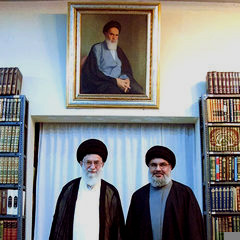
khamenei-nasrallah
  • In mid-April, Hizbullah leader Hassan Nasrallah paid a secret visit to Tehran where he met with the top Iranian officials headed by Supreme Leader Ali Khamenei and Gen. Qasem Suleimani, the commander of the Quds Force of the Revolutionary Guard Corps. Suleimani prepared an operational plan named after him based upon the establishment of a 150,000-man force for Syria, the majority of whom will come from Iran, Iraq, and a smaller number from Hizbullah and the Gulf states.
  • Suleimani’s involvement was significant. He has been the spearhead of Iranian military activism in the Middle East. In January 2012, he declared that the Islamic Republic controlled “one way or another” Iraq and South Lebanon. Even before recent events in Syria, observers in the Arab world have been warning for years about growing evidence of “Iranian expansionism.”
  • An important expression of Syria’s centrality in Iranian strategy was voiced by Mehdi Taaib, who heads Khamenei’s think tank. He recently stated that “Syria is the 35th district of Iran and it has greater strategic importance for Iran than Khuzestan [an Arab-populated district inside Iran].” Significantly, Taaib was drawing a comparison between Syria and a district that is under full Iranian sovereignty.
  • Tehran has had political ambitions with respect to Syria for years and has indeed invested huge resources in making Syria a Shiite state. The Syrian regime let Iranian missionaries work freely to strengthen the Shiite faith in Damascus and the cities of the Alawite coast, as well as the smaller towns and villages. In both urban and rural parts of Syria, Sunnis and others who adopted the Shiite faith received privileges and preferential treatment in the disbursement of Iranian aid money.
  • Iran is also recruiting Shiite forces in Iraq for the warfare in Syria. These are organized in a sister framework of Lebanese Hizbullah. Known as the League of the Righteous People and Kateeb Hizbullah, its mission is to defend the Shiite centers in Damascus. It is likely that Tehran will make every effort to recruit additional Shiite elements from Iraq, the Persian Gulf, and even from Pakistan.

Holocaust Survivors Say 'Never Again' at Mauthausen

From Arutz Sheva, 6 May 2013, by Elad Benari:
Leaders and camp survivors commemorate the liberation of the Mauthausen concentration camp in Austria.
 
Holocaust memorial
Holocaust memorial - Flash 90

Leaders and Nazi camp survivors made a stirring appeal to combat racism as they commemorated the liberation of the Mauthausen concentration camp in Austria on Sunday, urging "never again."
...The 68th anniversary of the camp's liberation by the U.S. army coincided with the inauguration of a new visitor center at Mauthausen, and was marked by a large ceremony attended by the presidents of Poland and Hungary, Bronislaw Komorowski and Janos Ader, Serbian Prime Minister Ivica Dacic and Russian State Duma speaker Sergei Naryshkin.
Some 30 survivors of Mauthausen, some wearing the striped caps that were part of the uniform given to inmates of the Nazi concentration camps, also took part in the ceremony, AFP reported.
In a moving moment, they deposited pictures and testimonies in a time capsule that will become part of the new exhibit, as their harrowing stories were read out to the public.
"This is the right moment and the right place to make an urgent appeal to all who are in a position of authority in Europe to learn from our tragic past and confront each and every form of racism or anti-Semitism: decidedly, consistently and clearly," Austrian President Heinz Fischer urged.
"That's the minimum that should come out of this day,” he said, according to AFP.
David Harris, head of the American Jewish Committee, also sounded words of warning, pointing to rising anti-Semitism in Europe and the presence in a few parliaments of xenophobic or anti-Semitic parties.
"We must wake up. The words 'never again' must apply not just on commemorative events but must apply 24 hours a day, seven days a week," he urged.
"We each have a responsibility to ensure the words 'never again' truly mean 'never again'. Not for the targets of Mauthausen, not for the Jewish people, not for any people.
"Then we can hand off to the next generation a more perfect and just world," said Harris.
Some 200,000 people from 40 nations -- around a quarter of them Jewish [including my father Israel Lieblich - SL], but also Soviet civilians and 7,000 Republican Spaniards -- were incarcerated between 1938 and 1945 at Mauthausen.
Around 90,000 didn't make it, perishing in back-breaking labor in granite quarries from malnourishment, disease -- or shot by the guards, hanged, throttled, beaten to a pulp or gassed.

Delegitimisation is war by other means

From Prof. Ofira Seliktar's Lecture for the IAM Round table, May 3, 2013:


... Unlike ordinary criticism of Israel, the delegitimization campaign is part of Soft Asymmetrical Conflict (SAC). The Pentagon defines SAC as a campaign to delegitimize the target country and to improve the image of the challenge group and the causes it represents. 

The anti -Israel SAC involved an extensive, complex, multilayered, interlocking and well-financed network. Its components include NGOs, UN-based forums, EU-sponsored entities, sovereign governments, religious organizations, academic associations, scholars, committees, conferences, symposia, journals and presses.

Michel Foucault developed the idea of soft asymmetrical conflict by inverting the idea of famous dictum of Clausewitz that “war is a continuation of politics by other means” to read "politics is war by other means."  Foucault and his disciplines considered  the “discursive  arena”  as a battlefield; using critical approaches, intellectuals and scholars can delegitimize “hegemonic” narrative and substitute it with the narrative of the of the powerless and suppressed strata in the society.

The core of the delegimitzation is in the academy, since it is the academic paradigms that structure our view of social reality.   There are two paradigms that are currently used in liberal arts (humanities and social sciences)

Positivist: “Truth” is arrived at through a discursive-pedagogical process with fixed rules, including objectivity and neutrality.  The liberal arts classroom becomes the “marketplace of ideas.” 

Neo-Marxist, Critical:  There is no social “truth,” there are “narratives,” critical scholars need to expose the “hegemonic” narrative” of the dominant classes.  The scholar is urged to use teaching and research to advance social justice and other progressive issues.   
...Predictably, Israel looks very different in the two paradigms.


Israel in the positivist paradigm: 

Membership/territory: Jews are an authentic ethno-religious community rooted in its ancestral Biblical home;  Authority system: western-style liberal democracy (as ranked by Freedom House); Distributive justice system: Market economy. 

Israel in the neo-Marxist, Critical Paradigm:

Membership/territory: Jews are an “invented people” with no legitimate right to an ancestral (Biblical) home; Authority system: Israel is a “Herrenvolk” democracy limited to Jews, an apartheid state modeled on South Africa; Distributive justice system: a capitalist system that exploits workers, the Mizrahim, women and Palestinians.   

There are a number of reasons why the neo-Marxist, critical paradigm and its depiction of Israel has become so successful in Israel. One of them is that Israeli scholars who operate within this paradigm have been part of the anti-Israel SAC and have benefited from its vast resources.   For instance, the probability of publishing a book or an article reflecting the neo-Marxist, critical paradigm is probably six to seven times higher than a comparable work in the positivist paradigm.     Critical scholars have a much better chance to spend sabbatical leave in Ivy League universities than positivist scholars. 

Another and arguably the most important reason is the expansive academic freedom that Israeli faculty enjoys as opposed to their peers in other countries.   This relation makes sense since today "Israel in the Middle East" has become the litmus test of freedom of faculty, replacing such older test cases as IQ of African-American etc. 

To test this proposition the study compared Israel to three countries – Germany, Great Britain and the United States (public universities).    All three of them have influenced the educational system of Israel and all three are academic leaders.

There are three factors that shape the amount of academic freedom of a given country: 1) cultural-academic history; 2) case law and the amount of government intervention; 3) transition to management (corporate) university. 

Academic freedom in Germany has been rather restricted because of #1- the democratic reeducation campaign has restricted certain topics such as denial of the Holocaust or denying the guilt of Hitler and the Nazi Party in starting the war, the Constitutional Court is in charge of overseeing academic expression, German professors are considered government employees and thus not allowed to stray too far from their field of expertise.  The transition to Management University also meant that economic and business considerations have to be taken into consideration, business people have been appointed to the boards of governors of universities.

Academic Freedom in Great Britain has been greatly constrained by the Education Reform Act instituted by the Thatcher Government.   Traditional tenure was abolished, making faculty less likely to speak out on controversial issues; stringent quality control of faculty and department makes is harder for faculty to engage in politics.

In response to the growing anti-Semitism in Europe, the European Union Monitoring Center has proposed a “Working Definition of anti-Semitism:” which states that anti-Zionism is a form of anti-Semitism.  The definition was adopted by the European Union Agency for Fundamental Rights.  As a result, certain expressions such as comparing Israel to Nazi Germany, known as “nazification of Israel” are considered new anti-Semitism. 

In the United States public universities (known as state universities) have enjoyed more limited freedom than private universities.  The governor appoints the board of directors and the board of directors appoints the president of the state university.  State legislatures demand accountability for the budgetary allocation to the universities.  Case law plays a large role in dictating the limits of freedoms; for instance, a district court ruling decreed that a faculty member cannot call for sanctions that would undermine his/her institution and have an adverse impact on the higher education system.  Even at the height of the Vietnam War, there was no faculty call to boycott the United States.   Balanced view on the Middle East is required of all public and private universities that receive Title IV federal grants.

In Israel, academic freedom is very broad because of the unique historical circumstances surrounding the founding of the Hebrew University.  Judah Magnes, the founder and president of HUJ and most of the influential professors, including Martin Buber were anti-Zionists.  The HUJ was financially supported by a group of wealthy donors from the anti-Zionist Council for American Judaism.   Magnes and his professors did not consider themselves to be accountable to the Jewish community in Palestine, but to a greater universal ideal of pursuit of academic excellence. As a result, they refused the request of Ben Gurion to add applied science and technology departments.  Even after the independent state was created that supported the higher education budget, the attitude that the academy is not accountable to the state persisted.  The Maltz Report that suggested a transition to a Thatcher style management university was only partially implemented due to fierce resistance of faculty.

As a result, there is a very broad scope of academic freedom in Israel in both the intramural (within the classroom) dimension and the extramural (outside the campus dimension)

For instance: Israeli scholars can compare Israel to Nazi Germany with impunity, something that they cannot do in EU or the United States (public universities) without taking a serious professional risk.  

Before the Knesset law, Israeli scholars could call (and some still do) for boycott of Israel, an action that would not be tolerated in other countries. As a matter of fact, radical Israeli scholars were among the architects of the boycott, divestment and sanction movement (BDS) against Israel.  Other faculty were involved in demanding that IDF commanders be tried for war crimes.

Israeli scholars switch from research in the field for which they were hired in order to “research” the Israeli-Palestinian conflict, something that would not be tolerated in other countries.

Liberal arts in Israel have paid a heavy price for this state of affair.

v  The frequently heard assertions that restriction on academic freedom will lead to a lower quality of education is not born out empirically:  Israeli liberal arts, especially social sciences, are trending well below average.

v  Students are not well served by faculty using their classroom as a platform for political indoctrination rather than a “marketplace of ideas.”

v  Taxpayers and society are not well served by faculty who abandon their field of research to engage in writings which support their political agenda.   It should be emphasized that this would not be tolerated in the comparative cases.

The Case of the Department of Politics and Government at BGU

The case of the Department of Politics and Government at BGU has introduced a unique complication to the system of higher education in Israel. 

BGU appealed to the international community of scholars to prevent the closing of the department.

The strategy was allegedly conceived by the Dean David Newman (as revealed in a leaked e-mail published by Israel Hayom.

The response of the international community was swift and overwhelming;  some 40 professional associations and hundreds of individual scholars, including at least one Nobel laureate , sent  letters and petitions to the Minister of Education and the Council of Higher Education (CHE, or Malag) to protest the proposed closure.  The fact that academic associations which normally act at a glacial pace have responded so fast has been most interesting.  

 Of course, it is difficult to speculate on the final decision of the Malag- but there is a possibility that it was influenced by this massive protest; if this is indeed the case, the BGU affair created a unique precedent in annals of higher education in the sense that Israel lost some sovereignty over its higher education system.  There is no comparable case of such massive intervention in the educational system of another country.

Such massive intervention did not happen in a vacuum; it is part and parcel of the campaign to delegitimize Israel which as I noted, has originated on the campuses... 


Muslim Brotherhood worked hand-in-hand with Hamas in Egypt's "revolution"

From JPost, 2 May 2013, by Zvi Mazel*:
New revelations throw a startling light on how the Muslim Brotherhood worked hand-in-hand with Hamas during the mass demonstrations that brought about the fall of Hosni Mubarak’s regime.
According to the Al-Masry Al-Youm daily, quoting a high-ranking security source, Egyptian homeland security head Khaled Tharwet gave Khairat el- Shater – No. 2 in the Brotherhood’s supreme guidance office – transcripts of five phone calls that were allegedly intercepted between Brotherhood members and Hamas leaders during the crucial January 2011 period.
The Brotherhood, it seems, wanted Hamas to put added pressure on security forces by contributing to the general turmoil. Another, no less important goal was to secure the release of extremists imprisoned in Wadi Natrun prison – most notably Mohamed Morsi, who was to become Egyptian president a year later.
From the transcripts, it appears that the Brotherhood knew in advance about the protests which erupted on January 25 – and that they participated in the planning. The first two calls took place between senior Brotherhood members before the mass demonstrations of January 25 and 27. On the 21st, one of them mentions preparations for the demonstrations and adds, “Don’t worry, we shall be helped by our neighbors.” The following day, he says, “Things are okay, the neighbors are ready.” In both cases, “Hamas” may be substituted in place of “neighbors.”
On the 24th, one day before the demonstration, a high-ranking Brotherhood member asks a Hamas official if they know exactly what they are supposed to do; “absolutely,” answers his correspondent.
There is another call on February 2, when the mass protests are reaching a paroxysm. An agitated Brotherhood member asks, “Where are you, I don’t see any of your people,” and the Hamas official replies, “Don’t worry, we are behind the museum [the Egyptian Museum on Tahrir Square] with our slingshots at the ready.”
The last conversation took place on February 11, after the resignation of Mubarak. The Hamas official congratulates the senior Brotherhood member, saying that “this is our victory also.” The Brotherhood members replies: “You have helped us and we owe you. We shall meet soon.”
That there are links between Hamas, an offshoot of the Muslim Brotherhood – which was set up in Gaza in 1987 – and the movement is nothing new; indeed, for many years they were both a favorite target of Mubarak’s repressive apparatus. However, these conversations put a whole new slant on the revolution narrative. Far from having waited a number of days before joining the protests as was previously believed, the Brotherhood was in the know and participated from the very beginning. Hamas terrorists, too, were right there in Tahrir Square, agitating and taking part in attacks on public institutions – though from the phone calls their precise role is not clear.
Interestingly, Gen. Mansour el-Essawy, who was interior minister during the rule of the Supreme Council of the Armed Forces, confirmed last week that there had been Hamas members in Tahrir Square and that some of them had been killed. He added that Hamas and Hezbollah terror agents had taken part in attacks on a number of jails to free political prisoners. It is worth noting that Habib el-Adly – who was interior minister from 1997 to 2011 and is now on trial for his role in the repression – had been accused in the past of having ordered that the prisoners be allowed to escape, in order to frighten the people.
Apparently, this was not true. Adly stated in court last week that it was indeed Hamas and Hezbollah fighters who broke into the jails, and he appears to have some evidence to back his claim. A journalist from Al- Masry Al-Youm said that he himself had witnessed the arrest of members of both organizations near Tahrir Square on February 4.
Two years ago, the paper published the results of an investigation carried out over a period of six weeks – in March-April 2011 – at great personal risk by two courageous journalists. Among the many eyewitnesses interviewed in the piece were a number of prisoners who had been freed, as well as some Sinai Beduin. The tale of the storming of the al-Marg prison north of Cairo is a case in point. Ayman Nofel, a senior member of Hamas, was imprisoned there; so was Muhammad Yusuf Mansour, codenamed “Sami Shehab,” the head of the Hezbollah terror cell in Egypt.
On January 30, 2011, the prison was surrounded by dozens of heavily armed gunmen, who arrived on brand-new cars and motorcycles and opened fire on the guards, who were primarily new recruits with little or no experience; they then broke in and freed all prisoners. Eyewitnesses said the attackers were Sinai Beduin fighters who spoke with the same type of accent – that is, people from the Gaza Strip. Former prisoners said that Nofel and Mansour had been in touch by phone with the attack organizers and that they had told their comrades to be ready to flee.
The two men disappeared immediately after the break-in. Nofel surfaced in Gaza a few hours later, while Sami Shehab appeared on Lebanese television from Beirut after four days; Egypt has yet to ask for their extradition.
Al-Masry Al-Youm argues that Tharwet should not have been given secret transcripts to Shater, who has no official standing and is merely the No. 2 in the guidance office of the Brotherhood – a movement that was not even legal. For the paper, this is the proof of collusion between the Brotherhood and the top levels of national security, and it demands that an investigation be launched by the prosecutor-general on the links between the security apparatus and the Brotherhood.
According to a spokesman for the paper, the transcripts as well as details of the way they were handed over to Shater were given to Al-Masry Al-Youm by a highly reliable national security source. In the request sent to the prosecutor-general, the daily states that the names of the Brotherhood and Hamas members who were recorded in the five phone calls are known to it, though it only published their initials.
Some commentators are already calling for the Brotherhood to be indicted for treason, since it called on foreign elements – i.e. Hamas – to operate in a seditious manner on Egyptian soil. Others are outraged by what they see as the infiltration of the national security apparatus by the Brotherhood, and claim that this is yet another attempt at taking over the country while endangering the security of Egypt. There are reports that Shater and Essam el-Erian, a prominent member of the Brotherhood, pay frequent visits to the offices of the state security, and that they use a passage reserved for the interior minister.
Shater’s bodyguard was arrested while “loitering” by the voting stations during the parliamentary elections more than a year ago; he was carrying a weapon without a permit. It transpired during his trial that he had traveled several times to Gaza through the tunnels and had contact with Hamas leaders. He was sentenced to one year in prison, but nothing filtered out about the content of these contacts. A few days ago it was announced that he had been transferred to what was described as an “easier prison.”
Predictably, Hamas leader Musa Abu Marzouk denied there had been conversations between his organization and the Brotherhood at the time. A number of spokesmen for the Brotherhood also denied that transcripts of any kind had been handed over to Shater, and said it was just a ploy to discredit their movement. Meanwhile, the Interior Ministry published a communiqué that did not address the issue, but threatened to prosecute those who try to harm its activities.
There has been no comment from the president, and it is easy to understand why. The commander of the Wadi Natrun prison, who testified last week about the break-in, stated that all political prisoners from the Brotherhood and jihadi movements had been sent to his jail. From January 25 onward, he said, there was a great deal of agitation among them; they threatened him and said they would soon be freed. Indeed, on January 30, some 80 heavily armed men attacked the prison with automatic fire, broke down the doors and freed all inmates, including Morsi; some of the recaptured prisoners, now standing trial, want the president to testify together with the actual and previous heads of the intelligence services.
So far there is no sign that this will occur.
Interestingly, why was Morsi in jail? According to the Brotherhood, he was considered “dangerous” by the government, but it is well known that he was a secondrate politician, not a fighter. According to one source, he was arrested and accused of spying following a lengthy phone call with a Hamas leader – recorded by national security – discussing what Hamas would do in Egypt during the revolution.
However, if Hamas expected the new regime to open the borders between the Gaza Strip and Egypt, and to allow people and goods – let alone arms – to flow freely on both sides, they were bitterly disappointed.
The border is still closed and Egypt carefully monitors those who are allowed in and out. Worse, more and more tunnels are being destroyed by the Egyptian army.
In actuality, despite their common ideological ground, Egypt is acutely aware of the security threats posed by its small neighbor. Over the past months, the role of Hamas in Egypt has becomes a hot topic.
Hamas is accused of having had a hand in the attack that caused the death of 16 Egyptian soldiers last August, and some say Nofel himself was involved. Hamas is also accused of letting jihadi terrorists cross into Sinai, and of being behind the kidnapping of three police officers who disappeared in Sinai last year and were allegedly taken to Gaza through the tunnels. Some also say Hamas wants to set up an outpost in Sinai and settle Palestinians in the peninsula with the help of Qatar.
The Muslim Brotherhood has nothing to say on these subjects, although short denials are regularly issued.
Egyptians are increasingly uneasy about the links between the Brotherhood and Hamas. The latest revelations add fuel to the fire, and deepen the crisis of confidence between the people and the movement now ruling the country.

*The writer, a fellow of The Jerusalem Center for Public Affairs, is a former ambassador to Romania, Egypt and Sweden.