Thursday, July 12, 2012

Is Assad's regime unravelling?

From Fox News, 11 July 2012, by Associated Press writers*:
The Syrian ambassador to Iraq has defected, denouncing President Bashar Assad in a TV statement Wednesday, becoming the most senior diplomat to abandon the regime during a bloody 16-month uprising.
Nawaf Fares, a former provincial governor, is the second prominent Syrian to break with the regime in less than a week. Brig. Gen. Manaf Tlass, an Assad confidant and son of a former defense minister, fled Syria last week, buoying Western powers and anti-regime activists, who expressed hope that other high-ranking defections would follow.
The high-level defections could be a sign that Assad's tightly wrapped regime is unraveling, but it was too early to be certain. There have been thousands of defections in the past, mostly low-level army conscripts, but until now no one as senior as the general and the ambassador had fled.
In a statement broadcast on the Arabic satellite channel Al-Jazeera, Fares said he was resigning and joining the opposition. Wearing a dark suit and reading from a prepared text in what appeared to be a large office, Fares harshly criticized Assad.
"I'm announcing from this moment on that I'm siding with the revolution in Syria," he said... He called on all Syrians to abandon Assad."Where is the honor in killing your countrymen? Where is the national allegiance? The nation is all the people, not one person in particular," he said. "The allegiance is to the people, not to a dictator who kills his people."
It was not known where or when Fares recorded the statement.
Appointed to the Baghdad post four years ago, Fares was the first Syrian ambassador to Iraq in 26 years. Like Tlass, he is a member of the privileged Sunni elite in a regime dominated by Assad's minority Alawite sect.
Khaled Khoja, a member of the opposition Syrian National Council who is based in Istanbul, said Fares was "moving toward Turkey." Asked for details, Khoja said the information came from his own sources on the ground in Iraq.
There was no immediate comment from either Iraq or Syria. An operator who answered the phone at the Syrian Embassy in Baghdad said there was nobody at the embassy. When asked if the ambassador is currently in Iraq, the operator said he did not know.
White House spokesman Jay Carney said the U.S. had no confirmation of the defection as of Wednesday afternoon. But he said recent high-level defections from the Assad regime were "a welcome development."
"That is an indication of the fact that support for Assad is crumbling," Carney said. State Department spokesman Patrick Ventrell said that if true, Fares would be the first senior diplomat from the regime to defect.
The conflict in Syria has defied every international attempt to bring peace. Although the Assad government's crackdown has turned the Syrian president into an international pariah, he still has the support of strong allies such as Russia, Iran and China.
A prominent Syrian opposition leader said Wednesday during a visit to Moscow that Russia's resistance to international intervention in the conflict was bringing misery and "suffering" to the violence-torn country.
Two Syrian opposition delegations visited Moscow this week, raising hopes that Russia could be pushed to accept the ouster of Assad. But Syrian National Council head Abdelbaset Sieda said he saw "no change" in Moscow's stance after meeting with officials including Foreign Minister Sergey Lavrov.
"The Syrian people are suffering because of Russia, because of the position it has taken, because of its veto in the U.N. Security Council," Sieda said at a news conference. "The current regime uses Russian weapons against its own people."
Activists estimate 17,000 people have been killed since the uprising began, and as the conflict continues, the rebellion appears to be getting more and more radicalized and violent, making any peaceful resolution or transfer of power a long-shot.
International envoy Kofi Annan urged the U.N. Security Council on Wednesday to send a message to the Syrian government and the opposition that there will be "consequences" if they don't comply with demands for an immediate cease-fire, a U.N. diplomat said.
Russia and China, veto-wielding council members, have blocked repeated attempts by the United States and its European allies to even threaten "consequences" — a diplomatic code word for sanctions.
The diplomat, speaking on condition of anonymity because Annan's videoconference briefing from Geneva was at a closed session, said the council should insist on implementation of its resolutions, which included a strong endorsement of his six-point peace plan.
That plan calls for an immediate cease-fire and withdrawal of heavy weapons from populated areas by the Syrian government, to be followed by an opposition cessation of hostilities.
The U.N. sent a 300-strong unarmed observer mission for 90 days to oversee the cease-fire and monitor implementation of the Annan plan. But it was forced to withdraw from key conflict areas because of escalating fighting and the council must decide what to do about extending its mandate, which expires on July 20.
Another U.N. diplomat said U.N. peacekeeping chief Herve Ladsous told the council the observers should remain and the U.N. should decide on their deployment. A third diplomat said the peacekeeping department plans to temporarily withdraw half of the 300-member mission, on 48-hour standby to return if conditions change.
They spoke on condition of anonymity because Annan spoke behind closed doors.
Annan also said Wednesday that Assad has discussed the possibility of forming a transitional Syrian government. An international conference in Geneva last month proposed having a transitional framework.
Annan said the Syrian leader during recent talks in Damascus "did offer a name" of someone who could serve as an interlocutor for the regime as it explores ways of forming a transitional government with the opposition. Annan, the U.N.-Arab League envoy to Syria, told reporters in Geneva that he was now considering the person whom Assad proposed, but he did not identify who it is.
He spoke Wednesday after a videoconference session with the U.N. Security Council in New York.
Also Wednesday, a Greek Orthodox priest said a group of Christians trapped in the besieged, bombed-out Syrian city of Homs has been evacuated after a deal between the army and rebels. The priest, Maximos al-Jamal, said 63 people were taken out to safety over the past 24 hours.
Christians, who make up about 10 percent of Syria's population, say they are particularly vulnerable to the violence sweeping the country of 22 million people. They are fearful that Syria will become another Iraq, with Christians caught in the crossfire between rival Muslim groups.
Homs, Syria's third-largest city, has a substantial Christian population and has been one of the hardest-hit regions during the uprising. Rebels control several neighborhoods, which has sparked several rounds of intense attacks by government troops over the past months.
Syrian Christians have largely stuck by Assad, fearing the strength of Islamist hard-liners in the uprising against his rule.
"I stayed inside Hamidiyeh to protect the churches from looting. I saved 14 icons from the St. George church which has been destroyed," said Jihad Akhras, who was among those who were evacuated Wednesday.
He said the situation inside Hamidiyeh and Bistan al-Diwan was "tragic" with barely enough food for those who remain trapped there.
___
*Associated Press writers Edith M. Lederer at the United Nations, Mark Lavie in Cairo and Sameer N. Yacoub in Baghdad contributed to this report.

Western rabble-rousers promote extremism

From JPost, 11 July 2012, by KHALED ABU TOAMEH:

Anti-Israel foreign nationals living in the West Bank...participated in ...protests in Ramallah....

The first protest, which was organized by a group called "Palestinians for Dignity", was held to demand the cancellation of a planned visit to Ramallah by Vice Premier Shaul Mofaz.

PA policemen and intelligence officers used force to prevent the protesters from marching on PA President Mahmoud Abbas’s presidential compound. At least seven protesters and five journalists were wounded in the confrontation.

The second demonstration was held a few days later to protest against police brutality.

A third demonstration was held last week in Ramallah, where protesters called for the abrogation of the Oslo Accords and demanded the return of all Palestinian refugees to their original villages and homes inside Israel.

A PA security source in Ramallah said that a number of Western nationals took part in all three protests...

Hundreds of Western activists live in Ramallah and surrounding villages and take part in weekly protests against settlements and the West Bank security barrier.

Don't whitewash the role of collaborators in the Holocaust

From the Times of Israel, June 22, 2012, by Dr Robert Rozett, Director of the Yad Vashem Libraries:
...On [June 22] in summer 1941 Nazi Germany attacked its ally, the Soviet Union. It was the start of a new and extraordinarily bloody and destructive phase of the Second World War. It was the move that ultimately contributed more than anything else to Hitler’s downfall. Like Napoleon before him, Hitler and his armies could not bring “Russia,” to her knees, and in this “Russia” was helped by her ally “General Winter,” the savage cold – for which Hitler’s troops were woefully unprepared – that began earlier than normal that year and that would ultimately face for three lethal winters on Soviet soil.
But as important as June 22 is for the military aspects of the Second World War, it is no less important a date to remember because it was the start of the systematic mass murder of Jews. Following close on the heels of the blitzkrieg attack on the Soviets, special units of the SS Einsatzgruppen, along with a variety of other formations, and many local collaborators, began shooting Jews in their newly acquired territories. At first only men were shot, but by mid-August, Jewish women and children were also being brutally murdered in these areas. Soon the Nazis would extend the murder to other areas, and as far as researchers can tell, by autumn, there was an overall policy of murder for all areas under Nazi domination: the so-called Final Solution.
One of the hallmarks of the murder of Jews, from the very beginning, was the role that local collaborators played. Some of the earliest atrocities were deadly pogroms carried out against the Jews by their neighbors.
Among the more infamous are the pogroms in Kaunus (Kovno) and in Lviv (Lwow). On the night of June 25, 1941, Lithuanian ultra-nationalists murdered some 800 Jewish men, women and children in the Slobodka (Villijampole) suburb of Kaunus, and murdered dozens more in a garage in the city proper. Just a few days later in Lviv, rumors that Jews had collaborated with the Soviets in murdering political prisoners spread throughout the city. Between June 29 and July 3, local Ukrainians in “revenge” for this supposed crime murdered some 4,000 Jews. Murder of Jews in Lviv continued unabated, reaching an apogee on what came to be known as the Petliura Days (named for the Ukrainian nationalist leader Symon Petliura) between July 25 and July 27, when an additional 2,000 were killed.
Undoubtedly the primary responsibility for the Holocaust rests on the shoulders of the leadership of Nazi Germany, and the myriad of Germans on various levels of society who took part in it, especially the diehard Nazis among them. Yet the trend to minimize, marginalize and obscure the role of diverse groups of local collaborators in the murder of their fellow countrymen is ongoing and not new. In the emerging states of Communist Eastern Europe soon after the war, great numbers of people accused of being war criminals were tried and punished, frequently with death. Yet, despite these trials, these societies refrained from truly confronting their responsibility as societies for their part in the Holocaust. In the Communist states, by and large, the history of the Holocaust was neither researched nor taught in a meaningful way. In their jargon, the war criminals were “fascists,” the casualties “victims of fascism,” and the heroes “anti-fascists.”
It was almost never mentioned that the victims were overwhelmingly Jewish, or that the Nazis (not the fascists) and their partners targeted Jews, first and foremost because of a racial anti-Semitic ideology that frequently existed in harmony with the various agendas of the local collaborators. In the post-communist era in which we now live, the search for a useable past and for national heroes has continued the trend of whitewashing and minimizing the role of local people in the murder of their neighbors and compatriots.
Recently, two events in Hungary underscore this trend. The speaker of the Hungarian parliament, Laszlo Kover, participated in a ceremony honoring Jozsef Nyiro, an anti-Semitic politician and ideologue from the Holocaust era. This was followed by the recent erection of a statue of the Hungarian wartime leader Admiral Miklos Horthy in the village of Csokako.


Jozsef Nyiro: Hungarian anti-Semitic politician and ideologue from the Holocaust era

From a narrow perspective, Horthy could be deemed a Hungarian patriot. He rose to the rank of admiral in the Austro-Hungarian navy and then, after the truncation of Hungary at the Trianon Palace conference following their defeat in the First World War, emerged as the acknowledged leader of a still-smarting Hungary. But from another perspective it becomes clear that his behavior regarding his Jewish countrymen was less than heroic. In spring 1944, now with German troops on Hungarian soil to ensure that Horthy did not break his alliance with Hitler, Horthy’s regime cooperated closely with the Germans to deport some 437,000 Jews. Almost all were sent to Auschwitz-Birkenau.
Horthy did not initiate this chapter of the Holocaust, but he still bears a significant degree of responsibility for it, as well as for earlier phases in the persecution of Hungarian Jewry, some of which involved murder on a smaller scale. It takes a view of history with a solid set of blinders to countenance the erection of a statue in his honor.
It is in part because of incidents like these that Yad Vashem this year has decided that the goal of its international educators’ conference is to “get back to the basics,” and discuss the core events of the Holocaust and its main issues. The German invasion of the Soviet Union and the murder that followed in its wake is one such core event, as is the issue of local cooperation in the murder. It seems that returning to such subjects is necessary to keep the details of the Holocaust in focus. When they become blurred, it makes it much easier to disregard and instrumentalize events beyond recognition, especially for ideological and political purposes. Perhaps the best safeguard we have for preventing and combating this distortion is to ensure that the primary facts of the Holocaust are indelibly imprinted in our collective consciousness.

Wednesday, July 11, 2012

Egypt's Real Ruler: Mohamed Tantawi

From Daniel Pipes.org, July 11, 2012, by Daniel Pipes and Cynthia Farahat:
What does it mean that Mohamed Morsi is president of Egypt? ...Morsi is not the most powerful politician in Egypt or the commander in chief. Arguably, he does not even run the Muslim Brotherhood. His job is undefined. The military could brush him aside. For the first time since 1954, Egypt's president is a secondary figure, assigned the functionary role long associated with its prime ministers.


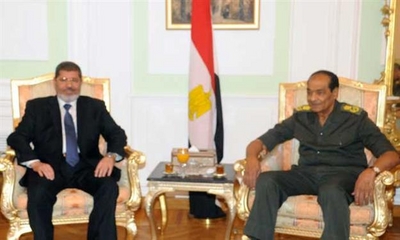
A picture of Morsi and Tantawi reveals the terms of their relationship: Not only is Tantawi sitting on the right side, where prior Egyptian presidents (Nasser, Sadat, Mubarak) ritualistically sat when hosting a visitor, but their meeting took place in the Ministry of Defense, not in the presidential palace, which protocol would normally require.

Mohamed Tantawi is the real ruler of Egypt. Chairman of the Supreme Council of the Armed Forces (SCAF), Field Marshall, and Minister of Defense, he serves not only as the commander in chief but also as effective head of all three Egypt's governmental branches. Tantawi is an autocrat with near-absolute powers. As chief representative of the military junta that has been ruling Egypt since February 2011, his mission is to extend the junta's rule indefinitely into the future, thereby assuring officers their perquisites and privileges.
SCAF exploits the Muslim Brotherhood and other proxies as its civilian fronts, a role they are happy to play, by permitting Islamists to garner an outsized percentage of the parliamentary vote, then to win the presidency. During the suspicious week-long delay before the presidential votes were announced, SCAF met with the Muslim Brotherhood's real leader, Khairat El-Shater, and reached a deal whereby Morsi became president but SCAF still governs.
To understand SCAF's power, note three actions it took in conjunction with the presidential elections:
Imposition of martial law: On June 13, the Justice Minister authorized the General Intelligence Services and military police to arrest civilians at will and incarcerate them for six months if they express any form of written or artist opposition against SCAF, the police, or their Islamist proxies, while protesting these same institutions on the streets can lead to life in prison.
Dissolution of parliament: On the grounds that the parliamentary elections of Nov. 2011-Jan. 2012, breached the constitution (which prohibits party candidates to run for "individual" seats), the Supreme Administrative Court ruled them invalid in February 2012. On June 14, the SCAF-controlled Supreme Constitutional Court confirmed this decision and dissolved parliament. In retrospect, it appears that SCAF, which oversaw those elections, intentionally allowed Islamists to break the law so as to have an excuse at will to dissolve Egypt's fraudulent parliament.
Establish the premise for martial law: SCAF issued a constitutional declaration on June 17 that formalized its intention to prolong the military's 60-year-old rule. Article 53/2 states that, in the face of internal unrest, "the president can issue a decision to direct the armed forces – with the approval of SCAF - to maintain security and defend public properties." The basis for a complete military takeover could hardly be more baldly asserted; Morsi's plan to reconvene the dissolved parliament could justify such an action.


Morsi took the oath of office before the Supreme Constitutional Court and not before the parliament. Score another symbolic victory for SCAF.

If foreigners are largely blind to SCAF's power play, Egyptians widely recognize this reality. The liberal April 6 Youth Movement called its recent actions "a soft coup d'état." Journalist Zainab Abu El-Magd bitterly noted that "political coups these days are done through 'fair elections'." Ziad Abdel Tawab of the Cairo Institute for Human Rights Studies calls the dissolution of parliament a "blatant military coup." One Egyptian newspaper called Morsi "president without powers," while an Islamist compared him to Queen Elizabeth II of Britain.
SCAF is struggling to perpetuate the status quo, whereby the officer corps enjoys the good life and the rest of the country serves its needs.
Making Morsi the apparent president of Egypt cleverly saddles him with responsibility as the country's economic problems worsen. But SCAF's tricks run great dangers and could backfire, for a population fed up with tyranny and backwardness finds itself with more of the same.
The next explosion could make the uprising of early 2011 look tame.
To help avoid that next explosion, Western governments should adopt a policy of pressuring SCAF gradually to permit increasing genuine political participation.

Interview With the Chief Pilot of the Entebbe Rescue

From IDF Blog, 
Brig. Gen. (res.) Joshua Shani was the lead pilot in Operation Entebbe, flying the first C-130 Hercules cargo plane with the entire rescue force on board. This week, for the 36th anniversary of the rescue operation on July 4th, he agreed to answer a few questions.
Joshua Shani
Joshua Shani was a Lieutenant Colonel in the Israel Air Force during the Entebbe rescue operation.
Tell us a bit about your family background.
My parents lived in what is now Ukraine. Their small town was part of Poland at the time. They escaped the Nazis and ended up in Siberia, where I was born in 1945. We were refugees, wherever we were....
You were on active duty during some of Israel’s major wars. Where were you then?
In 1967, during the Six-Day War, I supplied fuel and ammunition to IDF soldiers fighting in the Sinai Peninsula.
In 1973, during the Yom Kippur War, I was a squadron commander. I was involved in fueling and reconnaissance missions with the C-97 Stratofreighter. I also flew the C-130 Hercules across the Suez Canal, deep into Egyptian territory, in order to supply fuel and ammunition to the ground forces that were holding territory west of the canal. Those forces, by the way, were led by Ariel Sharon.
Joshua Shani
Joshua Shani accumulated 13,000 flight hours during his career in the Israel Air Force.

How did the crisis at Entebbe begin?
On June 27, 1976, a Paris-bound Air France flight from Tel Aviv, via Athens, was hijacked and diverted to Entebbe, Uganda. Two of the hijackers were members of the German Baader-Meinhof Gang, and two were from the Popular Front for the Liberation of Palestine. They demanded the release of 53 jailed terrorists in Israel.
On the third day of the crisis, the terrorists separated Israeli and Jewish passengers from the others. The captors freed the non-Jews and sent them to France the next day. Quietly, while the rest of the world talked but did nothing, the Israel Defense Forces planned a rescue mission....
How did the operation begin?
We began our journey from Sharm el-Sheikh, Egypt, which at the time was under Israeli control. The takeoff from Sharm was one of the heaviest ever in the history of this airplane. I didn’t have a clue what would happen. The aircraft was crowded. I was carrying the Sayeret Matkal assault team, led by Yonatan Netanyahu. I was also carrying a Mercedes, which was supposed to confuse Ugandan soldiers at the airport, because Idi Amin, the country’s dictator, had the same car. And I also found room to pack Land Rovers and a paratrooper force.
I gave the plane maximum power, and it was just taxiing, not accelerating. At the very end of the runway, I was probably two knots over the stall speed, and I had to lift off. I took off to the north, but had to turn south where our destination was. I couldn’t make the turn until I gained more speed. Just making that turn, I was struggling to keep control, but you know, airplanes have feelings, and all turned out well.
The flight to Entebbe is about 2,500 miles (4,000 km). How’d you do it?
We had to fly very close to Saudi Arabia and Egypt, over the Gulf of Suez. We weren’t afraid of violating anyone’s air space — it’s an international air route. The problem was that they might pick us up on radar. We flew really low — 100 feet above the water, a formation of four planes. The main element was surprise. All it takes is one truck to block a runway, and that’s all. The operation would be over. Therefore, secrecy was critical.
At some places that were particularly dangerous, we flew at an altitude of 35 feet. I recall the altimeter reading. Trust me, this is scary! In this situation, you cannot fly close formation. As flight leader, I didn’t know if I still had planes 2, 3 and 4 behind me because there was total radio silence. You can’t see behind you in a C-130. Luckily, they were smart, so from time to time they would show themselves to me and then go back to their place in the formation, so I still knew I had my formation with me.
Joshua Shani and Crew
The crew of the C-130 that landed at Entebbe poses with their plane after the mission. Joshua Shani is in the center of the front row.

What was going through your head as you approached the runway in Uganda?
My biggest fear was not being shot at from the ground, but making a mistake as a pilot. All I could think the entire time was “Don’t screw this up!” True, the risks to my life were real, but I was more worried about botching the landing and endangering the success of the entire operation. Think about it — how many people would have died at Entebbe if I had made a mistake?
In case something did go wrong, though, I was prepared for the worst. I was wearing a helmet, a bullet-proof vest, and I had an Uzi. I was also given a thick wad of cash in case I needed to use it to escape Uganda. Luckily, I never had to use it. I returned the cash after returning to Israel.
What happened after you landed?
I stopped in the middle of the runway, and a group of paratroopers jumped out from the side doors and marked the runway with electric lights, so that the other planes behind me could have an easier time landing. The paratroopers went on to take the control tower. The Mercedes and Land Rovers drove out from the back cargo door of my airplane, and the commandos stormed the old terminal building where the hostages were. While coordinating the assault, Yonatan Netanyahu, Sayeret Matkal’s commander, was fatally shot by a Ugandan soldier.
When the hostages were freed, what was your next move?
We had a little problem: We needed fuel to fly back home. We came on a one-way ticket! We had planned for a number of options for refueling, and I learned from the command-and-control aircraft flying above us that the option to refuel in Nairobi, Kenya, was open. After about 50 minutes on the ground in Entebbe, I gave the order: “Whoever is ready, take off.” I remember the satisfaction of seeing plane number 4, with the hostages on board, taking off from Entebbe — the sight of its silhouette in the night. It was then that I knew. That’s it. We did it. The mission succeeded....
Rabin After Entebbe
Israeli Prime Minister Yitzhak Rabin greets the rescued passengers after their arrival in Israel.
What was it like returning to Israel as a hero?
After my father’s death, I found his letters from Bergen-Belsen that he sent to Kibbutz Mishmar Haemek. The letters describe his experiences during the Holocaust, what happened to his family, etc. I won’t discuss it here. One of his letters said, “My only comfort is Joshua. He gives me reason to continue.”
The reason I mention this letter is because, 30 years later, when I returned from Entebbe, my father hosted a party for me. Family and friends were all there to celebrate the success of my mission. My father was in a great mood. I know what he was thinking, a Holocaust survivor. His son at the time was a lieutenant colonel in the Israel Air Force and had just flown thousands of miles in order to save Jews. It probably added ten years to his life.

...Today, I am the vice president of Israel operations for Lockheed Martin. And to think, as a new recruit in the IDF, I wasn’t interested in being in the Air Force...

Tuesday, July 10, 2012

Jurists back legalizing West Bank outposts

From CBNews.com, July 09, 2012:

http://m.cbsnews.com/fullstory.rbml?catid=57468386&feed_id=999&videofeed=999

JERUSALEM: A [panel of jurists] has recommended that Israel legalize dozens of unsanctioned West Bank settlement outposts....
The panel of jurists, headed by former Supreme Court Justice Edmond Levy, also concluded that the West Bank is not occupied territory and therefore Israel has the legal right to settle it...
...Dozens of outposts dot the West Bank, in addition to more than 120 full-fledged settlements.
Baker, [one of the committee members and] a former legal adviser to the Foreign Ministry who is now a fellow at a conservative think-tank, said the outposts were not authorized because of international pressure and urged their approval.
"Nothing here was inherently illegal," he said, adding that any Palestinian claims to owning lands where outposts stand should be referred to a court.
...The committee also concluded Israel can settle the West Bank, which it never officially annexed. Baker said the area is not sovereign territory and therefore, "the actual act of settling the West Bank is not illegal."
Israel captured the West Bank, now home to some 2.5 million Palestinians, from Jordan. Jordan had annexed the West Bank in 1948 in a move not recognized by most of the international community, but renounced all claims to the territory in 1988.

Monday, July 09, 2012

The Zentai Case: silencing the ‘memory of offence’

From “Genocide Perspectives IV: Essays on Holocaust and Genocide” edited by  Colin Tatz, The Australian Institute for Holocaust & Genocide Studies, 2012 (pp372-311): “...Zentai and the Quest for Historical Justice” by Ruth Balint:
...The Holocaust in Hungary and the case of Peter Balàzs
...In 1944, the Jews of Hungary, numbering some 700,000, remained the most physically intact Jewish community in Europe. Close to 64,000 Hungarian Jews had already lost their lives; 20,000 ‘alien’ Jews had been sent across the border into Poland and shot at Kamenets-Poldolsk, and a majority of the rest were Jewish men killed when serving in labour battalions on the Ukrainian front. A series of severe anti-Jewish laws had also been implemented, restricting basic civil and socio-economic rights. But the conservative government of Miklos Kallay (9 March 1942 to 22 March 1944) had stopped short of complying with Germany’s demands for the deportation of Hungarian Jewry. The occupation of Hungary by Germany in March 1944 led to the implementation of the 'Final Solution' with a speed and efficiency unrivalled in other Nazi-occupied countries. Within a few short months, at a time when it was clear that the war was already lost, and when the realities of Auschwitz were public knowledge among the world’s leaders, more than 437,000 Hungarian Jews were deported from the provinces to the death camps. This was only made possible with the wholehearted support of the Hungarian constitutionally appointed government of Döme Sztójay, the endorsement of the Regent of Hungary, Miklos Horthy, and with the assistance of local authorities. As Braham writes: ‘With Horthy still at the helm, providing the symbol of national sovereignty, the Hungarian police, gendarmerie, and civil service collaborated with the SS in the anti-Jewish drive with a routine and efficiency that impressed even the Germans.’ By 1 June, the average daily number of Hungarian Jews being deported to Auschwitz was 20,000.
By the end of July, virtually the only remaining Jews surviving in Hungary were in Budapest. In the month of July, 25,000 were deported to Auschwitz, at which point the government temporarily suspended deportations. In October, the fascist Arrow Cross party, under the leadership of Ferenc Szàlasi, was installed in government in a Nazi-orchestrated coup. The Arrow Cross embarked on a reign of terror, enacting frenetic killing sprees of the remaining Jews seeking refuge in the city. Thousands were arrested and shot and dumped into the Danube, and thousands more were shot or perished during a death march of 70,000 to Austria. The Arrow Cross reign lasted until Soviet forces liberated the city on 13 February 1945; during this time, those Jews who managed to stay outside of the ghetto, using false papers and not wearing a yellow star, had a slim chance of survival. Péter Balázs, an 18-year-old boy, was among those who chose the Jewish underground.
It was during this time that Zentai, a conscripted Hungarian Royal Army officer, was stationed at the Aréna Road military barracks in Budapest in 1944. Zentai’s commanding officer was Bela Máder, and his fellow officer Lajos Nagy. After the war, they were tried for the murder of Péter Balázs and found guilty, Máder in 1946, Nagy in 1947. Máder was sentenced to forced labour for life; Nagy was given the death sentence, later commuted to life imprisonment. Evidence given at these trials prompted the Hungarian authorities to charge Zentai with the same crime; by that time, he was already in Germany living as a DP. These trials were part of the wave of war crimes trials held in Hungary in the immediate postwar period; approximately 27,000 people were sentenced by the Hungarian 'people's courts' for war crimes, crimes against the state or crimes against humanity, among them a number of senior government ministers. These also included local and county government officials, gendarmerie and military officers responsible for the expropriation, ghettoisation and deportation of the Jews of Hungary.
At his trial, Nagy told of how, under the orders of their commanding officer Bela Máder, Zentai went out on patrols regularly to perform identity checks and round up Jews for interrogation. According to Nagy, Zentai already knew Péter Balázs: in his statement after his arrest he told the police, ‘Zentai told me that the boy and his family were old acquaintances of his’. The Zentai and Balázs families were both from Budafok, a small town on the outskirts of Budapest. The Balázs family were well known in their region as Jews and for their leftist sympathies; Dezsö Balázs, Péter’s father, had his legal practice there until 1942 when the family moved into Budapest. Zentai, only a few years older than Péter Balázs, was apparently his ‘Levente’ instructor for a time in Budafok. Balázs was surviving on false identity papers, and defied a call-up order for a Jewish forced labour unit in April 1944. On 8 November, Zentai recognised the boy on a Buda-pest tram and arrested him for not wearing the yellow star.
What happened afterwards, according to the evidence presented at Nagy's trial, is that between the hours of 3 pm and 8 pm, Zentai and Nagy beat Balázs so badly that by 8 pm he was dying. According to Nagy's evidence, they (Zentai, Máder and himself) saw that the boy was dying, and then went to an adjoining room and began drinking. In a macabre twist, Captain Máder decided to show off their handiwork to a number of other prisoners detained that night at Aréna Road. As a number of them testified at Nagy's trial, eight of them (some say six) were taken to Captain Máder's rooms, where one by one, they were shown a man lying on the floor covered by his own overcoat. His breath rattled, and it was clear that he was dying. ‘Can you hear that music?’ Sándor Révner stated that Máder asked him, when it came his turn to view the dying man. ‘That's the way you will go too.’ Each of the witnesses said they were told the same thing. The prisoners were then brought back into the room and forced to say the Hebrew prayer for the dead, ‘and we said that prayer according to his instructions’. The next day, all but one of them escaped. Each confirmed, as did other officers present that day, that the man lying on the floor, according to his photograph, was Péter Balázs.
I have before me the original court transcripts in which witnesses describe the brutalities they endured while they were detained at the barracks. There are various references to Zentai’s regular participation in these beatings. Imre Zoltan testified that in 1944, while in Budapest as a forced labourer, he was arrested and taken to the barracks ‘where at Béla Máder's orders, Cadet Károly Zentai and Cadet Ferenc Érsek beat me up for hours with boxing gloves until I lost consciousness’. Ervin Barinkai, another soldier at the barracks, remembered seeing Zoltan ‘gravely assaulted several times, especially by Cadet Sergeant Károly Zentai’. Another cadet, György Varsányi, stated that ‘it was Cadet Sergeant Zentai who did the beatings, I saw that myself several times’.
On the night in question, József Monori, another officer assigned to the barracks under Máder’s command, reported that he heard, but did not see, the beating going on behind closed doors. He ‘definitely’ remembered Zentai, Nagy and Máder present. He went to bed, but was woken up at around 11 pm and told to harness a horse and carriage: ‘Nagy and Zentai brought down a corpse from the office, put it on the cart, and covered it with straw…Nagy sat on the driver’s seat, Zentai beside him, and I sat on the side of the cart. Nagy was driving the cart. We drove along Aréna Road…down to the Danube…There Nagy and Zentai took the corpse and dumped it in the Danube. They waited a while to see if the corpse would come up but it sank.’ Monori also stated that during the journey ‘Nagy and Zentai were talking about how they should not have beaten the boy so hard’.

These testimonies were taken before the warrant for Zentai’s arrest, which was issued on 29 April 1948. After the warrant was issued, Máder, already a condemned man, stated that Zentai ‘took part in patrols as well as in beating and maltreating Jews…He and 1st Lieutenant (Nagy) were always ready to volunteer to do the atrocities.’ Imre Parázsló, another cadet, stated that the identity checks on Jews were ‘mostly carried out by 1st Lieutenant Lajos Nagy and Ensign Károly Zentai accompanied by the worst imaginable beatings…Zentai hit hardest but Nagy was not far behind. They hit the Jews with fists, boxing gloves or sticks, kicked them, and I often saw these Jews beaten to a bloody pulp coming out of the office moaning and crying. Bela Máder knew about these tortures, indeed, he gave orders to them.’
Hungarian journalist György Vámos, referring to the ‘unusual circumstances’ of judicial practices in postwar Hungary, recently cautioned that witness testimonies relating to this case should be treated with care. He offers no detail beyond remarking that social justice, as opposed to merely criminal justice, was an important objective of the government at the time. This is largely true. The people’s courts were driven less by legal concerns than by the desire for retribution and, in many cases, revenge. Confusion, insufficient preparation and political bias were rife during the major political trials, of which there were 14 between 1945 and 1946. ‘The historical responsibility of the Hungarian principal war criminals is beyond question’, wrote historian Laszlo Karsai. ‘What is questionable, however, is whether the people's courts were sufficiently equipped to establish their criminal responsibility.’...
...Istvan Hargittai is a professor of chemistry at Budapest Technical University and one of a few to have published in Hungarian his Holocaust experiences and the wall of silence that surrounds this history. He recalls that he and his generation grew up thinking ‘it was the Germans’ who were responsible for the Hungarian Holocaust. Members of the Arrow Cross were outsiders, so the theory went, unrepresentative of the Hungarian people. This myth prevails. Most Hungarians, he says, have lived since World War II as if Auschwitz never happened. The crimes of the Communist regime command the sphere of public debate over retribution and justice. The question of Hungarian complicity in the crimes against a significant number of its own people in World War II has yet to be asked....

Károly Zentai and the route to Australia
...The story of how Zentai came to be in Australia is part of the history of Australia’s first immigration program, in which tens of thousands of DPs were brought out on ships from the DP camps in Germany and Italy to Australia on its mass resettlement scheme. For many genuine refugees, Australia was ‘the farthest place’, far removed from the Europe of old race hatreds that had led to the concentration camps of World War II; for others, Australia was a country of last resort. Zentai’s own application for refugee status, for example, lists Canada and Argentina as countries of preference for immigration. There is no mention of Australia. Contemporary observers were often struck by how comparatively easy it could be, if you were non-Jewish and ‘fit’, to get in to Australia when applications elsewhere had failed. Ron Maslyn Williams—on location in Germany in 1949 to make Mike and Stefani (1952)—wrote to his boss at the Commonwealth Film Unit, Stanley Hawes: ‘As one intelligent DP put it to me “It is Australia or Siberia or starvation…Australia is the gambler’s shot”. Moreover, “quite literally, very many IRO officials regard Australia as a kind of modern Van Dieman’s (sic) land where they can dump the people who constitute IRO’s problem”.’
The Australian authorities, for their part, counted physical attributes above all else as criteria for migration: one needed to be fit, preferably young and, more preferably still, fair-skinned. Until 1960, humanitarian principles did not inform motives for assisted refugee migration—pragmatism did. Australia needed to expand its labour force and its population, and the only way that the government could sell its scheme of mass migration was by assuring its public that it remained committed to the principles of a ‘White Australia’ on which the Commonwealth was founded. Jews were especially unwelcome. Immediately after the war the government announced a humanitarian scheme to permit the arrival of concentration camp victims with Australian relatives; the scheme was met by antisemitic protest, and in response, the immigration minister Arthur Calwell introduced a quota system, in which only 25 percent of each ship carrying migrants could comprise Jews. These would be admitted only on the grounds of their potential contribution to Australia's economy, not on humanitarian grounds.
As Klaus Neumann has written: ‘Suitable non-British settlers were young, educated and healthy and, ideally, possessed certain racial features. Australian selection teams preferred vigorous, flaxen-haired, fair-skinned and blue-eyed young men and women from the Baltic countries who did not or could not return to the Soviet Union.’ These were to resemble Australia's ‘own kind’ as closely as possible. Beyond this, a philosophy of assimilation governed immigration policy and popular attitudes towards new arrivals. Immigrants, labelled ‘New Australians’, were expected to merge, quickly and quietly, into the Australian cultural and social landscape. This kind of thinking also implied, of course, that people's political pasts were as irrelevant as their cultural pasts—a slate wiped clean by the promise of Australian acculturation.
The Zentais ticked the right boxes: ‘fit worker’ is handwritten across both Károly and Rozsa’s migration selection forms. In March 1949, Zentai, his wife Rozsa, their two sons born after the war, and Zentai’s older sister, Julia, were at Tuttlingen in southern Germany’s French zone, where they were interviewed and accepted by the Australian Migration Team for resettlement in Australia. Zentai’s screening card twice states that he arrived in Germany on 9 March 1949, and that he had ‘fled from the Communist Party’. His wife’s card indicates the same information. The accompanying resettlement card from the IRO, which establishes their status as DPs, also states that Zentai and his wife were in Budafok between 1945 and 1949, and that their son Gabor was born in Budafok, Hungary, in 1946.
Except that he wasn’t, and they weren’t. Documents held by the International Tracing Service (ITS) tell a different story. The ITS, located in Bad Arolsen in Germany, is a massive storage house of SS records of the death camps, yet it also holds the records created by the Allies in the DP camps. Zentai’s file includes his application for refugee assistance to the IRO, and lists his places of residence from 1938 onwards: in March 1945 he was already on his way to Dietersburg, Bavaria, where he arrived, according to the information he provided, on 19 April 1945 and remained until March 1948. A document dated 14 August 1946 confirms that he, his wife, his sister and his son, Gabor, born 26 February of that year, were in Dietersburg. His son Gabor is twice recorded as having been born in Arnstorf, Bavaria. Another, dated 15 July 1947, indicates that Zentai was temporarily in Kösslarn, in the district of Griesbach, also in Bavaria.
In his application for IRO assistance, a routine statutory declaration states that Karl Zentai was ‘never a member of the Arrow Cross or any political party and never committed any atrocities’. It is signed by Zentai and three witnesses, dated 12 March 1948 at the Hungarian office (Ungarisches Büro) in Pfarrkirchen. A handwritten statement by an IRO officer concludes: ‘On account of credibility of the statement of the Hungarian office and the witnesses he should be found eligible for refugee status with IRO assistance. Refuses to return home for the present regime there—no political freedoms.’
None of these official records hint at the warrant for his arrest issued by the Budapest People’s Court in April 1948, despite the fact that his whereabouts were well known to the Hungarian authorities. The warrant even lists an address, ‘the American occupation zone in Germany, where his address at present is…Furth in Pfarrkirchen district with farmer Jakob Schneiderbauer’. It appears that Zentai was able to make his way safely to Tuttlingen almost one year after the warrant was issued. Was the warrant ever communicated to the Allied Occupation Forces in Germany, and if so, why was it ignored? Did Zentai know about his warrant? The answers to these questions, of course, can only be speculative. Yet the inconsistencies in the records as to his whereabouts for the four years between 1945 and 1949 seem to indicate some kind of attempt to cover his tracks. In his recent interviews with the media, Zentai has never tried to deny that he was already living under the protection of the Allied Occupation Forces in Germany from 1945. Why then did he lie about his whereabouts in 1949? I contend that his decision was strategic: rewriting those four years in this way so as to convey that he was coming from Hungary in 1949 rather than 1945 distanced his decision to leave Hungary from the imme-diate aftermath of World War II, thus making it simpler to argue that he was ‘fleeing the Communists’, as so many other East Europeans were doing in the years of 1948 and 1949.
Moreover, as Zentai’s case makes clear, the DP camps, and their route to Australia, could provide avenues of escape for those wishing to avoid retribution or exposure. It was well known to contemporaries that a number of collaborators and war criminals were hiding in the DP camps. G Daniel Cohen has examined the extensive technologies of screening and identification developed by the IRO, which took over from the United Nations Relief and Rehabilitation Administration (UNRRA) in 1947, to determine the authenticity of refugees and displaced persons. It was a daunting task, but according to IRO officials, ‘of first importance in its work’.70 Refugees were now required to fill in numerous forms and questionnaires, yet as Cohen explains, if there was no apparent reason for exclusion, that is, if they seemed to fit the story they presented, they were not required to prove their right to be included as eligible. IRO officers received manuals that included sample cases and historical information to guide their decisions, and were taught how to detect untrue statements, yet in practice their mission to cleanse the system of ineligibles was often frustrated. Visitors reported that the ‘right answers’ to IRO questionnaires were circulating in the camps; further, it was clear to IRO officials that many simply destroyed their identity papers and made up new ones. Dates of displacement were frequently altered during interrogations to make their applications more plausible. Within the IRO, Cohen quotes, it was commonly believed that ‘after many months of observation and listening, the DPs are told what to say and know how to craft an acceptable story leading to eligibility’.
Over one million people arrived in Australia under various immigration schemes by the end of the 1950s, and there are estimates that even in its earliest years, 4,000 to 5,000 Nazis may have found sanctuary there, most of them from East-Central Europe. As Konrad Kwiet notes, during the screening process they lied about their wartime activities, usually claiming to have been subjected to ‘forced labour’ or ‘deportation to Germany’. ‘In reality’, he writes, ‘many of them had actively enthusiastically assisted the Nazis. Their claims concealed “police work”, military and Waffen SS service and participation in killing operations’.
This should also be viewed in the context of a broader Allied retreat from the issue of denazification and punishment of wartime activities. Zentai was in Germany at the very moment that Europe’s postwar memory was being moulded, by all sides, around the notion of German guilt, in which all responsibility for the war was made to lie squarely at the feet of the Germans. This focus on Germany meant the postwar status of other countries could be resolved. Thus Austria was retrospectively declared the ‘first victim’ of Nazi aggression and with Austria’s innocence assured, the responsibilities of other non-German nationals in Europe were similarly eradicated. As the Cold War deepened, the Allies were determined to avoid alienating Austria and Germany, and this meant removing attention from the past. ‘In a process that would have been unthinkable in 1945’, Judt wrote, ‘the identification and punishment of active Nazis in German-speaking Europe had effectively ended by 1948 and was a forgotten issue by the early fifties’.
IRO policy also reflected a softening towards those who previously may have been denied eligibility as collaborators. Ideological motives for assisting enemy forces, for example, became as important as their actions during the war; in other words, if someone had voluntarily enlisted in the German army because they wanted to oppose the Soviet regime, this was reason enough for inclusion. DP claims of anti-Communist sympathies and fear of Communist persecution began to carry as much, if not more, weight than claims of Nazi persecution. ‘By 1950, refugees deemed "imposters" or "security threats" in the days of UNRRA were now offered the chance to emigrate to Australia or the North American continent.’
This strategic refocusing of attention away from the crimes of the past identified by Judt was enormously significant for the thousands, if not millions, whose wartime pasts were being reframed by a deliberate process of forgetting and denial, and whose identities were recast as refugees of an oppressive Communist regime. Australia’s own role in this history was one of passivity and equally, one of denial. In the 1950s, protests by the Australian Jewish community over the migration of Nazis and their collaborators were even-tually silenced by the continuing apathy and even hostility to their campaign. The politics and ideology of anti-Communism coloured government rhetoric and attitudes to the evidence of Nazi war criminals and collaborators living in Australia, and governed the state’s failure to act. This was made explicit in the official response in 1961 to a request by the USSR for the extradition of an Estonian immigrant Ervin Viks, who was accused of murdering 12,000 Jews and Roma in the Tartu concentration camp. The Liberal government of Robert Menzies refused. In a speech defending the decision, Australian Attorney General Sir Garfield Barwick declared that against the ‘utter abhorrence’ felt by Australians against war crimes, ‘there is the right of this nation, by receiving people into this country to enable men to turn their backs on past bitternesses and to make a new life for themselves in a happier community’. He concluded, in what has become an infamous phrase: ‘the time has come to close the chapter’.
This directive to forget in order to create ‘new lives’ and a ‘happier community’ became a prevailing ethos in the next few decades, assisted by the fact that there was no legal framework established for extradition or prosecution of suspected war criminals. This changed briefly in the late 1980s when, under the Hawke Labor government, a special inquiry was set up to investigate allegations of Nazi war criminals living here, inspired largely by the forensic investigations of journalist Mark Aarons in a series of reports for ABC radio and television, which resulted in the Menzies Report. Controversial legislation was passed in parliament enabling Australian courts to prosecute suspects for war crimes (War Crimes Amendment Act, 1988). Most importantly, a Special Investigation Unit (SIU) was created within the federal Attorney General’s department to investigate suspected war criminals. In its five short years of operation, there were 843 investigations, three individuals charged and tried in Adelaide, with no successful conviction.82 In 1992, the SIU was closed down, and responsibility for following up war crimes’ accusations delegated to the federal police, who were either unwilling or unable to investigate them. It was, in Kwiet’s words, ‘a clear signal that the second chapter of the war crimes debate in Australia was closed’. During his brief tenure as chief historian for the SIU, Kwiet observed both the negative, ‘even damning’ attitude that prevailed within the legal fraternity towards war crimes’ legislation and the proceedings themselves; and the frequent indifference of the Australian public. He recalls:
In the public domain the war crimes debate had, in my view, little, if any impact on public awareness and memory… The public proceedings in Adelaide took place in front of empty galleries. Quite popular in the scant media coverage were references to the accused as ‘nice neighbours’ or ‘old’ and ‘sick’ pensioners. For the overwhelming majority of Australians, the news of the closure of the SIU went almost unnoticed.
David Fraser has also noted that the presence of unpunished perpetrators never became part of the cultural or political dynamic of Australian national identity or Australian values. Yet others have recognised that in spite of a lethargic community response to war crimes trials, these are important forums for producing cosmopolitan ideals of justice and human rights. They also affirm the role of history, in the form of evidence that 'things happened', in justice work and in the work of remembrance.
Although the legal framework was successfully developed by the SIU in the late 1980s, the resources for the investigation of people who have committed war crimes overseas have not been forthcoming and there have been no charges laid since.
The Wiesenthal Centre recently listed Australia as the ‘only major country of refuge’ and former diplomat Fergus Hansen, in a recent report compiled for the Lowy Institute, writes that Australia ‘has inadvertently become a safe haven for war criminals’. This is certainly the impression Australia has been giving the world, and presumably its war criminals, for some time. Hansen notes that there are indications war criminals have come here from Afghanistan, Palestine, Sri Lanka, Nepal, Sierra Leone, India, Cambodia, Iran, Iraq, Chile, Lebanon, Nigeria, Bangladesh, the former Yugoslavia, possibly Rwanda and East Timor as well, among other countries.

The twilight of memory and the struggle for historical justice
Zentai’s appeal against his extradition to Australia’s Federal Court in April 2008 failed, with Federal Court judge John Gilmour finding that there was no reason why Zentai should not be extradited to face trial. The court agreed to bail for Zentai on the grounds of ill health, and his lawyers took the case to the Minister for Home Affairs, O’Connor. This appeal failed, and Zentai was ruled fit to travel. This time Zentai’s lawyers based the justification for their appeal on the argument that the offence for which Zentai is convicted did not constitute a war crime at the time it was committed. The implications of an argument such as this, although not new, are momentous, legitimising what was, in effect, a fascist regime at the time and putting forward the quite extraordinary idea that for Jews like Balázs, being beaten to death was somehow lawful. A similar argument was made during the Nuremberg Trials, in which the question of whether the 24 German leaders should have to answer for actions rendered illegal after the fact—ex-post-facto—was put forward by the defence. The prosecuting lawyers never conceded this point, arguing that the charges were grounded in international law and what they called a common law of nations. Such an argument suggested that the accused had no idea they were acting illegally, an argument without merit in the minds of contemporary observers: murder is murder. The legality of the charge of war crimes was upheld at Nuremberg, and it is commendable that Federal Court judge John Gilmour resisted such logic today.
His lawyers successfully appealed the decision, taking it back to the Federal Court. In July 2010, Justice Neil McKerracher ruled that the Government had made an ‘error of law’ in agreeing to extradite him, and that the crime for which Zentai was charged was not an extraditable offence under the Extradition Act. Zentai returned home, but in 2011 the Federal Government returned to the High Court for another appeal, seeking a ruling on what constitutes a war crime. It is thought that such a ruling will have a significant impact on Australia’s extradition regime.
Zentai has clearly led an exemplary life in Australia. He is the embodiment of the multicultural ideal, a man who worked, brought up a family here and settled quietly into the suburban landscape. It is not easy to watch a frail elderly man being hauled in front of the courts to face trial. He might, despite all the evidence, be innocent. There are powerful incentives to simply turn our collective back on this story and let the old man be. But are we also prepared to accept a statute of limitations on war crimes or crimes against humanity? Is there a time when it is too late for justice? ‘That the past slips into the oblivion of forgetting does not change its moral nature’, writes Booth. ‘The passage of time may dull our recollection of events, but it does not erase the (morally weighty) fact of their having happened nor the wrong involved in them.’
...Andreas Huyssen has described our time as the twilight of memory. ‘Twilight’, he writes, ‘is that moment of the day that foreshadows the night of forgetting, but that seems to slow time itself, an in-between state in which the last light of the day may still play out its ultimate marvels. It is memory’s privileged time.’ As did Levi, Huyssen believes the struggle for memory is also a struggle for history. When we think of the Holocaust today, we often imagine our present time in terms of it being ‘too late’ for justice.
... in this brief twilight of Holocaust time when victims and perpetrators are gradually leaving our world behind, we should be ensuring that these cases are told and not forgotten. Justice, not memory, is the antonym of forgetting, writes Booth. ‘In other words, the imperative to remember is not the leaden voice of what has gone before, but rather it is the call of justice insisting on the irreversibility and persistence of what has been done, its claims on us which are neither diminished nor augmented by the extra-moral passing of time, and which call on us to bear these injustices in mind.’ History’s purpose is to give meaning to the present even as it seeks knowledge of the past; justice, or the attempt at it, however flawed and incomplete, belongs squarely within the historical project of understanding. A 1987 cartoon by Ben Sargent about the Klaus Barbie trial in France remains pertinent: ‘It's been more than forty years’, a younger man remarks. ‘Why are we hunting down a bunch of pathetic old men just to prosecute them for…er…uh…well, you know…uh…whatever that stuff was they did…?’ The older man replies: ‘That's precisely why.’
As Huyssen writes, ‘the inner temporality and the politics of Holocaust memory, however, even where it speaks of the past, must be directed towards the future. The future will not judge us for forgetting but for remembering all too well and still not acting in accordance with those memories’.

Zentai’s case is not just about Zentai. The important question of a regime and a country that enabled, indeed encouraged, the murder of thousands of Jews like Péter Balázs, and a country that then gave murderers refuge and even prosperity is still to be addressed. It is about the legacy of both countries in the denial and silencing of a ‘memory of offence’, and a responsibility towards our present and their future.

Palestine in 1695

From Think Israel, by Avi Goldreich (Translated from the Hebrew by Nurit Greenger):


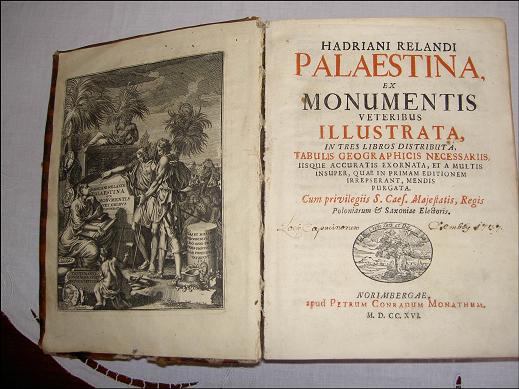
...The author [of Palaestina ex monumentis veteribus illustrata, Hadriani] Relandi, a real scholar, geographer, cartographer and well known philologist, spoke perfect Hebrew, Arabic and ancient Greek, as well as the European languages. The book was written in Latin. In 1695 he was sent on a sightseeing tour to Israel, at that time known as Palestina. In his travels he surveyed approximately 2500 places where people lived that were mentioned in the bible or Mishnah. His research method was interesting... 

His most prominent conclusions
1. Not one settlement in the Land of Israel has a name that is of Arabic origin. Most of the settlement names originate in the Hebrew, Greek, Latin or Roman languages. In fact, till today, except to Ramlah, not one Arabic settlement has an original Arabic name. Till today, most of the settlements names are of Hebrew or Greek origin, the names distorted to senseless Arabic names. There is no meaning in Arabic to names such as Acco (Acre), Haifa, Jaffa, Nablus, Gaza, or Jenin and towns named Ramallah, El Halil and El-Kuds (Jerusalem) lack historical roots or Arabic philology. In 1696, the year Relandi toured the land, Ramallah, for instance, was called Bet'allah (From the Hebrew name Beit El) and Hebron was called Hebron (Hevron) and the Arabs called Mearat HaMachpelah El Chalil, their name for the Forefather Abraham.

2. Most of the land was empty, desolate, and the inhabitants few in number and mostly concentrate in the towns Jerusalem, Acco, Tzfat, Jaffa, Tiberius and Gaza. Most of the inhabitants were Jews and the rest Christians. There were few Muslims, mostly nomad Bedouins. Nablus, known as Shchem, was exceptional, where approximately 120 people, members of the Muslim Natsha family and approximately 70 Shomronites, lived.
In the Galilee capital, Nazareth, lived approximately 700 Christians and in Jerusalem approximately 5000 people, mostly Jews and some Christians.
The interesting part was that Relandi mentioned the Muslims as nomad Bedouins who arrived in the area as construction and agriculture labor reinforcement, seasonal workers.
In Gaza for example, lived approximately 550 people, fifty percent Jews and the rest mostly Christians. The Jews grew and worked in their flourishing vineyards, olive tree orchards and wheat fields (remember Gush Katif?) and the Christians worked in commerce and transportation of produce and goods. Tiberius and Tzfat were mostly Jewish and except of mentioning fishermen fishing in Lake Kinneret -- the Lake of Galilee -- a traditional Tiberius occupation, there is no mention of their occupations. A town like Um el-Phahem was a village where ten families, approximately fifty people in total, all Christian, lived and there was also a small Maronite church in the village (The Shehadah family).

3. The book totally contradicts any post-modern theory claiming a "Palestinian heritage," or Palestinian nation. The book strengthens the connection, relevance, pertinence, kinship of the Land of Israel to the Jews and the absolute lack of belonging to the Arabs, who robbed the Latin name Palestina and took it as their own.

In Granada, Spain, for example, one can see Arabic heritage and architecture. In large cities such as Granada and the land of Andalucía, mountains and rivers like Guadalajara, one can see genuine Arabic cultural heritage: literature, monumental creations, engineering, medicine, etc. Seven hundred years of Arabic reign left in Spain an Arabic heritage that one cannot ignore, hide or camouflage.

But here, in Israel there is nothing like that! Nada, as the Spanish say! No names of towns, no culture, no art, no history, and no evidence of Arabic rule; only huge robbery, pillaging and looting; stealing the Jews' holiest place, robbing the Jews of their Promised Land. Lately, under the auspices of all kind of post modern Israelis -- also hijacking and robbing us of our Jewish history.

Farewell Yaakov Meidad: Nazi-hunter

From JPost, 7 July 2012. by EFRAIM ZUROFF*:

It is a shame that [Latvian Nazi war criminal Herberts] Cukurs’ many heinous crimes were never presented to a court of law, but at least he was not able to escape punishment [at the hands of  Yaakov Meidad posing as “Anton Kuenzle”].

Neo-Nazi man giving Hitler salute
Neo-Nazis today: photo: REUTERS/Tim Shaffer
               
Late last week, “Anton Kuenzle” died in Tel Aviv and momentarily emerged from the shadows of anonymity enforced on Mossad operatives. Ironically, the media reports of his demise focused primarily on his participation in the abduction of Adolf Eichmann from Argentina, but it was his role in another operation against an escaped Nazi war criminal living in South America which was probably his most outstanding individual achievement.

Whereas “Kuenzle” was one of a relatively large team of at least a dozen Mossad agents who participated in the Eichmann kidnapping in Buenos Aires, it was Yaakov Meidad posing as “Anton Kuenzle” who virtually single-handedly organized the assassination of notorious Latvian Nazi war criminal Herberts Cukurs in Uruguay in 1964.

That operation was exceptional in the annals of the Mossad, which to the best of our public knowledge devoted relatively little attention to the issue of escaped Nazi war criminals, except for the cases of Eichmann, Auschwitz doctor Josef Mengele (the infamous “Angel of Death”) and Gestapo chief Heinrich Mueller, and was not involved in the assassination of former Nazis.

The background to the action was also a product of special historical circumstances.

At that time, there was talk in West Germany of applying the statute of limitations to murder, which would have prohibited the prosecution of killers, including Nazi war criminals, if 20 years had passed since the crime had been committed. That discussion lit a red light in Jerusalem, where the fear was that such a step would end the efforts to bring Holocaust perpetrators to justice, even though many of the worst murderers were still at large.

According to a memoir Meidad published in Hebrew 15 years ago under the pseudonym he used in the operation, this was the background for the unusual decision made by Israel, which wanted to signal West Germany that if they stopped bringing Nazi war criminals to trial, the Jewish state would have no choice but to track them down and execute them.

The reason the first target of the operation was Cukurs, who was notorious for his brutality as the deputy commander of the infamous Latvian Arajs Kommando murder squad which killed at least 30,000 Latvian Jews and actively participated in the mass murder of many additional thousands of Jews in Belarus, had to do with the legal status of his case.

Toward the end of the war, Arajs and Cukurs, along with many of the Latvians who served under them, retreated with the German forces and posed as innocent refugees fleeing Communism, a ruse which enabled many of these killers to emigrate overseas, primarily to Anglo-Saxon democracies. Cukurs escaped to Brazil and was living in Sao Paulo, where he was eventually discovered living under his own name.

The Soviet Union, which had occupied Latvia, asked for his extradition but the Brazilians refused, claiming that they could only extradite Cukurs to the country in which he had committed his crimes – which no longer existed (due to its occupation by the Soviets).

Under these circumstances, it appeared there was no hope the “Butcher of Riga” would ever be held accountable for his heinous crimes.

The plan formulated by the Mossad was complicated because it called for the assassination to take place outside Brazil, where there was still a death penalty for murder. Meidad, who posed as an Austrian business man interested in investing in a tourism company, had to earn Cukurs’ trust, so that he could be lured to Uruguay, where the operation could be carried out with less risk for the Mossad agents.

Meidad did so successfully, despite the emotional difficulty of posing as a Wehrmacht officer and spending lots of time with a brutal mass murderer with so much Jewish blood on his hands.

Meidad’s parents were killed in Nazi concentration camps.

Eventually, after weeks of courting Cukurs with the hope of considerably expanding his aviation tourism business (Cukurs was a famous pilot), Meidad convinced the Latvian to meet him in Montevideo, where a Mossad team was waiting for him.

The original plan was to hold a trial and then execute Cukurs, but the minute he walked into the safe house, the Latvian realized what was about to happen and he fought against his captors, who executed him on February 23, 1965. The operation was portrayed as the work of “those who can never forget” in a message sent to local media outlets.

The State of Israel never officially admitted its role in the execution of Cukurs, but 15 years ago, Meidad wrote a memoir with journalist Gad Shimron under the pseudonym “Anton Kuenzle,” entitled The Execution of the Hangman of Riga, which was published first in Hebrew and then eight years ago in English, and fully clarified the circumstances of the operation.

Ironically, the fact that Cukurs was never convicted in a court of law in recent years inspired Latvian right-wing extremists to try to portray him as a blameless national hero, an effort which reflects the current attempts in the Baltics to distort the history of the Holocaust by minimizing the highly-significant role of Latvian, Lithuanian and Estonian Nazi collaborators in the mass murder of Jews.

In that respect, it is a shame that Cukurs’ many heinous crimes were never presented to a court of law, but at least he was not able to escape punishment, thanks in large measure to the daring exploits of Yaakov Meidad, to whom we all owe a debt of deep gratitude.

*The writer is the chief Nazi-hunter of the Simon Wiesenthal Center and director of its Israel Office. His most recent book, Operation Last Chance; One Man’s Quest to Bring Nazi Criminals to Justice, has a chapter on the failure of independent Latvia to honestly face its Holocaust past and the efforts to rehabilitate Cukurs as a national hero.