Monday, June 11, 2012

UN-supported puppet show:"don't smoke - carry a machine gun"

From PMW, 4 June 2012:

Puppet 1: "I wanted to stand before the audience and sing to Jerusalem, which is being kept from us. Jerusalem, whose youth are being killed by the Jews. To sing and to say: Jerusalem, we are coming, Jerusalem, the time of death has arrived. Jerusalem, we will not surrender to the enemies or be humiliated."

Puppet 2: "What am I doing to myself [by smoking]? I, and many other youth like me, think that through cigarettes we will be adults and men. Jerusalem doesn't need youth who hold cigarettes. It needs men who hold machine guns, not cigarettes."

Note: According to the Burj Luq Luq Center's website where the puppet show was held, they are funded and have ties to
  • the French Consulate,
  • the Swiss Development Agency,
  • the Italian Institutions' Union,
  • the UNFPA,
  • the [PA] Ministry of Youth and Sports,
  • UNICEF and
  • UNESCO.

Sunday, June 10, 2012

North Korea still poses a threat to Israel

From the North Korea Herald, 3 June 2012, by John Power:
North Korea still poses “a constant threat to Israel,” 40 years after a Pyongyang-sponsored terrorist attack in Tel Aviv, the Israeli ambassador has said.
...The roots of the Lod Airport massacre, which took the lives of 26 people and injured 72 others in Tel Aviv on May 30, 1972, trace back to the North Korean regime.
“This attack was the first of its kind, but unfortunately the fight against terrorism has become a daily routine in many parts of the world,” Ambassador Tuvia Israeli said Wednesday, the 40th anniversary of the attack.
“Israel has no diplomatic ties with North Korea and in many ways it is a constant threat to Israel,” he added. “Beyond support for terrorist organizations, North Korea violates the internationally accepted rules of proliferation. North Korea is an active partner in the establishment of nuclear capability for military purposes in Iran and Syria.”

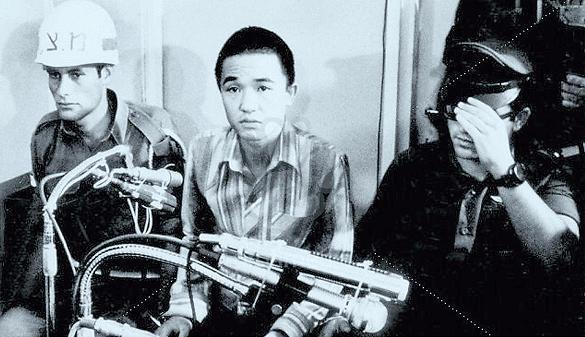
Terrorist Kozo Okamoto is pictured during his 1972 trial for the Lod Airport attack.
(Shurat HaDin-Israel Law Center)

Many of the victims of the three Japanese Red Army members who carried out the attack on Lod Airport, now called Ben Gurion Airport, were Puerto Rican pilgrims. Using machine guns and grenades they’d stowed in their hold luggage, the three terrorists carried out the attack on behalf of the Popular Front for the Liberation of Palestine.
North Korea’s backing of the attack was substantiated in a legal judgment against Pyongyang in 2010. A U.S. federal court in Puerto Rico found that the North Korean regime had trained, funded and armed the terrorists, and ordered Pyongyang to pay $378 million in damages to two of the victims’ families.
North Korea does not recognize the state of Israel, regarding it an “imperialist satellite,” and has previously funded various Palestinian paramilitary groups. North Korea did so to get at the U.S., Israel’s principal ally, according to Nitsana Darshan-Leitner who represented the families in the 2010 case.

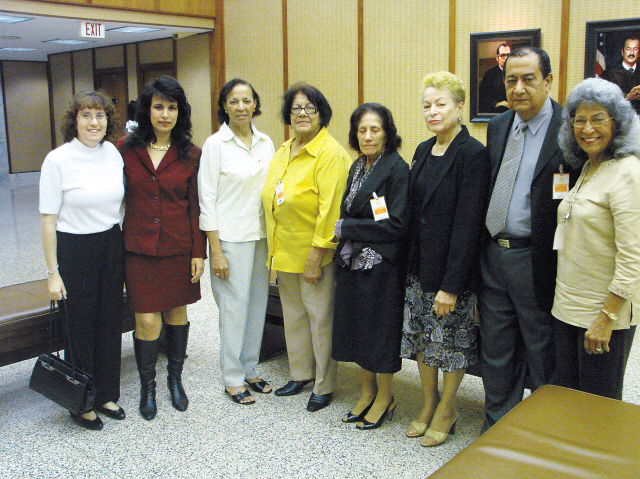
Attorneys Naomi Weinberg and Nitsana Darshan-Leitner (second left) with family members of terror victim Carmelo Calderon-Molina in the United States District Court in San Juan, Puerto Rico, during the 2010 trial to prove North Korea’s involvement in the 1972 Lod Airport attack.
(Shurat HaDin-Israel Law Center)

She is the director of Shurat HaDin-Israel Law Center, an NGO which sues terrorist groups and their sponsors in a bid to strip them of their assets and end their activities. The organization has won judgments totaling $1 billion, frozen assets worth $600 million and collected about $120 million in damages.
“What happens usually in these cases is that we go after assets that belong to the other country,” Darshan-Leitner said. “We collect by enforcing the judgment against bank accounts that belong to the country, in this case North Korea.”
The NGO is also currently suing Pyongyang on behalf of the family of Kim Dong-shik, a pastor kidnapped by the regime in 2000 who is believed to have starved to death in a North Korean prison camp.
Although no money has yet been collected from the 2010 judgment, Darshan-Leitner is confident that her organization will ultimately be able to locate and seize North Korean assets in other countries.
“This was how we were able to collect money against Iran,” she said. Iran never came and paid their judgment but we were able to find houses that belonged to Iran, back accounts that belonged Iran, bank accounts that belonged to their national companies, and this is how we were able to retrieve.”
She said that U.S. law, unlike that in most other countries, allows for cases against third countries involved in criminality. U.S. Congress legislated in 1996 for an exception to the sovereign immunity law on the grounds that countries that sponsor terrorism are not acting like sovereign states, and therefore should not enjoy sovereign immunity.
Zeev Sarig was deputy director of Lod Airport at the time of the attack. He remembers the destruction of what he calls Israeli airport security’s “September 11.”
Blood, chaos and broken glass
“It was complete chaos of course,” he said. “Bodies all over, blood, broken glass, open suitcases, chaos like an utter massacre.”
For Sarig, Shurat HaDin’s work is an important part of the fight for justice for survivors and victims’ families.
“For me, it was really a mission that those who murdered, or sent murderers who killed innocent people, should pay for the rest of their lives. That should be a sign to all of those who send criminals, murderers, terrorists, whatever you call them, to kill innocent people, at the end of the day they will pay.”
Israeli composer Shimrit Or, whose father died in the attack, also witnessed the scene firsthand with her brother.
“There was a huge roar, a sound that I had never heard before and in my mind I tired to realize what this sound could be and I thought maybe a ceiling was falling in, something very enormous. Then there was a minute of silence and they started shooting.
“My brother me pulled me and dropped me on the floor and covered me with himself. And the shooting and the shouting were endless. In real time it was almost five minutes, but it was unbelievable how long it seemed at the moment.”
While she thought that justice should be sought for the crime, Or said she has never been contacted by Shurat HaDin, and only heard of the 2010 judgment through the media. She feels more needs to be done to locate and connect the many survivors of the attack.
The Israeli ambassador said that Seoul and Tel Aviv should connect on security to defend against such threats.
“Despite the great distance between Israel and the Republic of Korea, a strategic security dimension has many interests in common, and all focused on bringing change in North Korea, first of all for the sake of citizens there, but also to increase the stability and security on the Korean Peninsula and in fact throughout the world,” Israeli said.

Recipe for War: Unilateral Withdrawal from West Bank

From Gatestone Institute, 08 June '12, by Khaled Abu Toameh:
.


Israel's Defense Minister Ehud Barak believes that Israel should consider a unilateral withdrawal from the West Bank if negotiations with the Palestinian Authority fail to bear fruit.

Under the current circumstances, such a move would lead to the creation of another radical Palestinian Islamic entity, this time in those parts of the West Bank that would be handed over to Mahmoud Abbas and Salam Fayyad. Any land that is handed over to the Palestinian Authority would end up in the hands of Hamas.
In the summer of 2005, Israel pulled out of the Gaza Strip, passing it to Abbas and his 40,000-strong Fatah-dominated security forces. A few months later, thanks to a free and fair parliamentary election that was held at the request of the US and some EU countries, Hamas came to power.
One of the main reasons Hamas scored a victory in that election was because it took credit for driving Israel out of the Gaza Strip through rockets and suicide bombings.
A year later, in the summer of 2007, it took fewer than 10,000 Hamas militiamen to defeat Abbas's security forces and bring down the entire Palestinian Authority regime in the Gaza Strip. Hamas's rule over the Gaza Strip has since brought more suffering and bloodshed for both Israelis and Palestinians.
Once Israel carries out a unilateral withdrawal, the same scenario is likely to be repeated in the West Bank.

Even though Hamas does not have a strong military presence in the West Bank, the movement seems to enjoy much popularity among Palestinians. The so-called Arab Spring, which has seen the rise of Islamists to power in a number of Arab countries, has emboldened Hamas and other radical Palestinian groups, such as Islamic Jihad.
These groups have managed to attract many followers by offering themselves as the best alternative to Western-backed corrupt secular dictatorships in the Arab world. As before, Hamas's chances of taking over the West Bank are high after the failure of Abbas's ruling Fatah faction to implement significant reforms or combat rampant corruption.
Fatah lost the 2006 parliamentary election mainly because of its leaders' involvement in the embezzlement of public funds. Since then, Fatah has failed to draw the conclusions from its defeat and has not even been able to come up with a new list of capable candidates that could attract Palestinian voters. The same Fatah men who lost the vote are, in fact, continuing to run the show in Ramallah -- as if they had never lost.
Even if the Islamists do not take over the West Bank in the aftermath of a unilateral Israeli pullout, it is almost certain that the Palestinian Authority would not be able to prevent local gangs and clans from seizing power.
The case of Jenin, a city in the West Bank, is a good example of the weakness of the Palestinian Authority security forces, especially with regard to imposing law and order: Palestinian Authority officials have admitted that Jenin has been controlled over the past two years by Fatah militiamen and thugs who worked closely with many top Palestinian security officers, imposing a reign of terror and intimidation on the city's residents.
A unilateral withdrawal from the West Bank could mean that Palestinian cities like Ramallah, Nablus, Jenin, Bethlehem and Hebron would fall either into the hands of Hamas or armed Fatah gangs.
Abbas and Fayyad would not be able to do much to prevent a return to scenes of anarchy and lawlessness that were once prevalent on the Palestinian street. The chaos and violence inside the Palestinian cities would also spill over into Israel, forcing it to launch another "Defensive Shield" type of operation, like the one in 2002, to clear the area of armed gangs.
Before withdrawing from any area, Israel needs to make sure that those who would be in charge would not run away, handing the territories to Hamas or any other local gangs. Under the current circumstances, a unilateral and unconditional withdrawal would only be a recipe for more violence and bloodshed and repression.

Comparative Demographics 101

From Israel Hayom, 1 June 2012, by Yoram Ettinger:
(Also see this recent JIW posting on the subject)

...the fertility rate among young Arabs in Judea and Samaria — at an average of three births per woman — has converged with the respective fertility rates of young Israeli Arabs and Jews, while (mostly secular) Jewish fertility rates are currently trending upwards and Arab fertility rates are trending downwards.
The Arab fertility rate in Judea and Samaria is declining at an accelerated pace as a result of modernity: urbanization (70 percent rural in 1967 vs. 75% urban in 2012), increased education, especially among women (most of whom complete high school and increasingly attend community colleges), enhanced career mentality and growing integration into the workforce among women (reproduction starts later and ends earlier), all-time high median wedding age and divorce rate, minimal teen pregnancy (common in 1967 but rare in 2012), family planning and secularization.
David Goldman (“Spengler”) writes in his book "How Civilizations Die" that “as Muslim fertility shrinks at a rate demographers have never seen before, it is converging on Europe’s low fertility. … Iranian women in their 20s, who grew up with five or six siblings, will bear only one or two children during their lifetimes. ... By the middle of this century, the belt of Muslim countries from Morocco to Iran will become as gray as depopulating Europe."
“Demographers have identified several different factors associated with population decline: urbanization, education and literacy. ... Children in traditional societies had an economic value, as agricultural labor and as providers for elderly parents; urbanization and pension systems turned children into a cost rather than a source of income…. Dozens of new studies document the link between religious belief and fertility. ... [An] Iranian 25-year-old’s mother married in her teens and had several children by her mid-twenties. Her daughter has postponed family formation, or foregone it altogether, and spent her most fertile years on education and work. ... World fertility has fallen by about two children per woman in the past half century — from about 4.5 children per woman to about 2.5. Fertility in the Muslim world has fallen two or three times faster than the world average... Across the entire Muslim world, university-educated Muslim women bear children at the same rate as their infecund European counterparts. ... The only Muslim countries where women still give birth to seven or eight children are the poorest and least literate: Mali, Niger, Somalia and Afghanistan. ... Iran’s secular government under the late Shah put enormous efforts into education during the 1970s and 1980s. ... Ayatollah Khomeini’s Islamic Revolution slowed but could not stop the literacy movement.”
Director of the UN Population Division Hania Zlotnik argued that “In most of the Islamic world it’s amazing, the decline in fertility that has happened.” Eight of the 15 countries that experienced the biggest drop in population growth since 1980 are in the Middle East.
David Goldman (“Spengler”) states that “the only advanced country [other than the U.S.] to sustain high fertility rates is Israel...”
He criticizes Israeli leaders who based their policy on erroneous demographic assumptions: “Israeli concessions in the first decade of the 21st century [Rabin’s Oslo, Sharon’s uprooting of Jewish communities in Gaza and Olmert’s unprecedented proposed concessions] were motivated by fear that Arab fecundity would swamp Israel’s Jewish population. In actuality, quite the opposite was occurring..."
In fact, the Jewish fertility rate in Israel in 2012 — three births per woman — is higher than all Arab countries, other than Sudan, Yemen, Iraq and Jordan, which are trending downward.
The average Israeli-born Jewish mother exceeds three births. Moreover, Israel’s robust demography yields uniquely promising economic, social, technological and national security ramifications.
According to Goldman, “Israel will have more young people than Italy or Spain, and as many as Germany, by the end of the century, if fertility remains unchanged. A century and a half after the Holocaust, the Jewish State will have more military-age men, and will be able to field a larger land army, than Germany.”
Israel’s rising (especially secular) Jewish fertility rate is in direct correlation to its relatively high-level optimism, collective responsibility, generational continuity (roots and future), patriotism, tradition, faith and value-driven education. Israel’s demographic tailwind is even more powerful, when considering the potential of 500,000 Olim during the next ten years.
The demographic, economic, military and diplomatic resources at the disposal of Israel in 2012 are dramatically superior to those available to Herzl in 1900, Ben-Gurion in 1948 and Shamir in 1992.
Anyone suggesting that Jews are doomed to become a minority west of the Jordan River, that there is a demographic machete at the throat of the Jewish state and that the Jewish state must concede Jewish geography in order to secure Jewish demography, is either grossly mistaken or outrageously misleading!

"RE-EMERGING: The Jews of Nigeria"

From YouTube, Apr 18, 2012:


"RE-EMERGING: The Jews of Nigeria"
A Documentary Film by Jeff L. Lieberman

Several years ago, the Internet was introduced into the more rural parts of southeast Nigeria. As it has done for so many people around the world, it opened the eyes of a few young Igbo people and began answering some difficult questions of identity. For Shmuel (who was then called Sam), the nagging question he wanted answered was whether there was any truth to the long-told lore that the Igbo people were once Jews. He began by comparing Hebrew traditions to Igbo traditions, and what he found astounded him. The similarities were so convincing that it sent him off on a journey in the quest to find other Igbo who might be practicing Judaism.

"RE-EMERGING: The Jews of Nigeria" is a journey into the heart of Igboland and into the lives and culture of the Igbo people. The film introduces the world to the many synagogues that dot the land, and a handful of passionate, committed, and diverse characters -- each striving to fulfill their historical legacy with few resources and unbeknownst to most of the world. Individual stories are woven together with key facets of history, tracing the Igbo from Biblical times up to the brutal 1960s Biafran War, which killed over 1 million Igbo. A wide range of American academics help detail this history, including shedding new light on the Igbo origins of thousands of slaves captured during the Atlantic Slave Trade and brought to American shores. The film delves into this history and travels to the southeast coast of Georgia, where locals still speak of the Igbo spirit alive and well at a riverbed called Ibo Landing.

The individuals featured in the film also demonstrate that incredible Igbo spirit. Shmuel is a young man whose story exemplifies the journey toward finding Judaism. Today, he is a leader in his community who teaches and chants Torah, and has big dreams of one day becoming a rabbi. But like almost every Igbo, he grew up surrounded by Christian colonialism, and the road to discovery has been fraught with misunderstanding, wrong turns into Messianic worship, family exile, violent prejudice from both Muslim and Christian neighbors, scorn from Jews he has contacted in the Western world, and frustration of a lack of funds to further educate himself through Internet access. Yet, it's also been an amazing discovery of community, and furthered with the love of an American rabbi who has been working with both him and the larger community to see their dreams become a reality.

To find out more, visit www.re-emergingfilm.com

Saturday, June 09, 2012

"How are such people supposed to govern?"

From Raymond Ibrahim, 4 June 2012:

http://www.raymondibrahim.com/11798/graphic-video-tunisian-muslims-slaughter-convert

Liberal talk show host Tawfiq Okasha recently appeared on "Egypt Today" airing a video of Muslims in Tunisia slicing a young man's head off for the crime of apostasy, in this case, the crime of converting to Christianity and refusing to renounce it. The video—be warned, it is immensely graphic—[can be seen in the posting on Raymond Ibrahim's blog] ....(the actual execution appears from minute 1:13-4:00). For those who prefer not to view it, a summary follows:

A young man appears held down by masked men. His head is pulled back, with a knife to his throat. He does not struggle and appears resigned to his fate. Speaking in Arabic, the background speaker, or "narrator," chants a number of Muslim prayers and supplications, mostly condemning Christianity, which, because of the Trinity, is referred to as a polytheistic faith: "Let Allah be avenged on the polytheist apostate"; "Allah empower your religion, make it victorious against the polytheists"; "Allah, defeat the infidels at the hands of the Muslims"; "There is no god but Allah and Muhammad is his messenger."

Then, to cries of "Allahu Akbar!"—or, "God is great!"—the man holding the knife to the apostate's throat begins to slice away, even as the victim appears calmly mouthing a prayer. It takes nearly two minutes of graphic knife-carving to sever the Christian's head, which is then held aloft to more Islamic cries and slogans of victory.

Visibly distraught, Tawfiq Okasha, the host, asked: "Is this Islam? Does Islam call for this? How is Islam related to this matter?...These are the images that are disseminated throughout the electronic media in Europe and America…. Can you imagine?" Then, in reference to Egypt's Muslim Brotherhood and Salafis, whose political influence has grown tremendously, he asked, "How are such people supposed to govern?"

In fact, only the other day a top Egyptian Salafi leader openly stated that no Muslim has the right to apostatize (http://www.raymondibrahim.com/2012/05/salafi-leader-no-freedom-in-islam-apostates-must), or leave Islam, based on the canonical hadiths, including Muhammad's command, "Whoever leaves his religion, kill him." Islam's most authoritative legal manuals make crystal clear that apostasy is a capital crime, punishable by death.

The first "righteous caliph," a paragon of Muslim piety and virtue, had tens of thousands of people slaughtered—including by burning, beheading, and crucifixion—simply because they tried to break away from Islam. According to the Encyclopaedia of Islam, the most authoritative reference work on Islam in the English language, "there is unanimity that the male apostate must be put to death."

Finally, a word on the "prayers" or supplications to Allah made by the Muslim executioners in the video: these are standard and formulaic. It is not just masked, anonymous butchers who supplicate Allah as they engage in acts of evil; rather, top-ranking Muslim leaders openly invoke such hate-filled prayers.
See here (http://www.raymondibrahim.com/10669/muslim-prayers-of-hate) for examples of prominent Muslims supplicating Allah to strike infidels with cancer and disease "till they pray for death and do not receive it," and even formalized prayers in Mecca, blasted on megaphones as Muslims pilgrimage and circumambulate the Ka'ba, supplicating Allah to make the lives of Christians and Jews "hostage to misery; drape them with endless despair, unrelenting pain and unremitting ailment; fill their lives with sorrow and pain and end their lives in humiliation and oppression."

Friday, June 08, 2012

Touring Muslim lecturer has two messages


     ...Tareq Al Suwaidan, is about to start another tour of Australia ...with two very different messages, however.
...Dr Suwaidan - his doctorate is in petroleum engineering, from Tulsa University in the US, where he lived for many years - is now based in his home country, Kuwait, with his wife and six children.
...His Australian tour is organised by Human Appeal International, which describes itself as "a non-governmental humanitarian organisation seeking funds from supporters to assist in providing services to thousands of poor and needy people".
Dr Suwaidan - who lectures in English in Australia - is a leader of the Muslim Brotherhood in Kuwait, and general manager of Al-Resalah (The Message), an Arabic language satellite TV station funded by Prince al-Waleed bin Talal of Saudi Arabia.
He presents himself to English-speaking audiences as moderate, a supporter of free speech and freedom of religion.
But what he has said elsewhere points to a darker program.
He asked rhetorically on an Arabic TV station a year ago:

"Is what I am doing any less important than jihad?"

In an interview for Al-Quds, a TV station affiliated with Hamas, he said 10 weeks ago:

"I can change the positions of some Westerners, but at the end of the day, power lies with the politicians, who are influenced by two things only: money and the media, both of which are controlled by the Jews.
"So we must not rely on Western aid or on Western popular sympathy. These are minor things. We rely upon Allah and then upon our armed resistance in obtaining our rights."

He said his foremost cause is that of Palestine and Jerusalem.

"The most dangerous thing facing the Muslims is not the (Arab) dictatorships. The absolutely most dangerous thing is the Jews. They are the greatest enemy."

At a conference of the Islamic Circle of North America in 2000 he said: "We must tell the West that we are extending a hand of peace now, but it will not be so for long.

"Even if a civilisation is ready to crumble - like the West, with all the characteristics of deterioration of past fallen empires - it will not fall until we, the Muslims, strive to give it that last push, the last straw that will break the camel's back."

Ali Kazak, the then representative of the Palestinian Authority in Australia, told ABC TV's Lateline in 2003: "I have stopped giving (Human Appeal International) any donations. People should not give a contribution until it makes it public and clear as to how much it collects and where the money is going."

Five years after this, Israel's Defence Minister Ehud Barak banned 36 funds around the world, including HAI Australia, that were deemed "part of Hamas's fund-raising network".
...A spokeswoman for Monash University said: "Monash is not hosting this conference nor does it have any affiliation with this organisation. The booking was made and charged as per any booking for the Robert Blackwood Hall by community groups etc. We do not endorse the topics or presenters, and have simply provided a venue space."
Hamas's Izz al-Din al-Qassam Brigades have been proscribed as a terrorist organisation by Australia, but not the Hamas organisation itself.

OECD: Israeli technology can alleviate global water crisis

From Ynet News, 7 June 2012, by Billie Frenkel:


Angel Gurría says OECD will use Israeli technology, knowhow in third world countries in efforts to halt global water crisis

Secretary General of the OECD Angel Gurría announced Wednesday that the organization intends to distribute Israeli technology and know how to third world countries as part of the efforts to deal with the global water crisis.
Gurria made his announcement at a meeting held at the Mekorot National Water Company in Tel Aviv in the presence of Water and Energy Minister Uzi Landau and senior Mekorot officials.
"The global water crisis is gaining momentum and the demand for water is increasing at a much higher rate than the increase in population, " Gurria said, adding: "The OECD is seeking knowledge, experience and professionalism to solve the global water crisis.
During the meeting Mekorot presented calculations according to which the global economic damage expected in 2050 as a result of the water crisis may reach $800 billion.
The national water company explained that their calculations are based on OECD data that states that 40% of the world's population will suffer from the water shortage in 2050, mainly in Africa, South America and west Asia.
Mekorot presented technologies it had developed to deal with water crises, technologies it promotes throughout the world. Among the innovations presented was the ability to produce water in arid areas like the Arava in the south – which is disconnected from the national water system – through drilling to depths of over 1.5 kilometers.
Moreover, the company presented developments meant to ease the water crisis in third world countries. Thus, a planned project to develop water infrastructure in one of the most arid regions in the world in Uganda, will be carried out based on the Arava model. Some two million people live in the most arid region in Uganda.
The OECD chief was also presented with information about the desalination facilities in Cyprus which are set to provide 40% of the island's water, and an installation established to filter river water in Buenos Aires.
The company further noted: "Proper preparation, assimilation of water solutions and water technologies at this stage could decrease the scope of the (water) crisis."

Thursday, June 07, 2012

End the Fake Palestinian Refugee Farce!

From:The Australian, June 04, 2012, by Daniel Pipes*:
THE fetid, dark heart of the Arab war on Israel, I have long argued, lies not in disputes over Jerusalem, checkpoints, or "settlements". Rather, it concerns the so-called Palestine refugees.
So-called, because of the nearly five million official refugees served by the UN's Palestinian refugee relief agency UNRWA, only about 1 per cent are real refugees who fit the agency's definition of "people whose normal place of residence was Palestine between June 1946 and May 1948, who lost both their homes and means of livelihood as a result of the 1948 Arab-Israeli conflict".
The other 99 per cent are descendants of those refugees, or what I call fake refugees.
Worse: those alive in 1948 are dying off and in about 50 years not a single real refugee will remain alive, whereas their fake refugee descendants will number about 20 million.
In this context, the Australian government's recent decision to allocate an additional $90 million over five years perpetuates and exacerbates this problem.
This matters because the refugee status has harmful effects. It blights the lives of these millions of non-refugees by disenfranchising them while imposing an ugly, unrealistic, irredentist dream on them.
Even worse, the refugee status preserves them as a permanent dagger aimed at Israel's heart, threatening the Jewish state and disrupting the Middle East.
Solving the Arab-Israeli conflict, in short, requires ending the absurd and damaging farce of proliferating fake Palestine refugees and permanently settling them. 1948 happened: it's time to get real.
In part based on the work carried out by the Middle East Forum's Steven Rosen and myself over the past year, the US Senate appropriations committee unanimously passed a limited but potentially momentous amendment on May 24 to the US$52.1 billion fiscal 2013 State Department and foreign operations appropriations bill.
The amendment, proposed by Republican Mark Kirk, requires the State Department to inform congress about the use of the annual US$240m of direct American taxpayer funds donated to Palestine refugees via UNRWA.
How many recipients, Kirk asks, meet the UNRWA definition cited above, making them real refugees? And how many do not, but are descendants of those refugees?
Were the State Department compelled to differentiate real Palestine refugees from fake ones, the US and other Western governments (who, together, cover more than 80 per cent of UNRWA's budget) could decide to cut out the fakes and thereby undermine their claim to a "right of return" to Israel.
Sadly, the Obama administration has badly botched this issue.
A letter from Deputy Secretary of State Thomas Nides opposing an earlier version of the Kirk amendment demonstrates complete incoherence.
On the one hand, Nides states that Kirk would, by forcing the US government "to make a public judgment on the number and status of Palestinian refugees, prejudge and determine the outcome of this sensitive issue".
On the other, Nides refers to "approximately five million refugees", thereby lumping together real and fake refugees -- and prejudging exactly the issue he insists on leaving open. That five million refugee statement was no fluke. When asked about it, State Department spokesman Patrick Ventrell confirmed that "the US government supports" the guiding principle to "recognise descendants of refugees as refugees".
Through all of Israel's 64-year existence, one American president after another has resolved to resolve the Arab-Israeli conflict, yet every one of them ignored the ugliest aspect of this confrontation -- the purposeful exploitation of a refugee issue to challenge the very existence of the Jewish state.
Bravo to Kirk and his staff for the wisdom and courage to begin the effort to address unpleasant realities, initiating a change that finally goes to the heart of the conflict.
If Bob Carr really wants to contribute to Middle East peace, the Foreign Minister should follow Kirk's example and compel UNRWA to distinguish real refugees from the fakes.

*Daniel Pipes is president of the Middle East Forum and the Taube distinguished visiting fellow at the Hoover Institution of Stanford University

Fertility Decline in the Muslim World

From Stanford University Policy Review #173, June 01, 2012, by Dr. Nicholas Eberstadt and Apoorva Shah (Nicholas Eberstadt holds the Henry Wendt chair in political economy at the American Enterprise Institute, where Apoorva Shah served as research fellow):
... the United Nations Population Division (UNPD) and the United States Census Bureau (USCB) — regularly estimate and project population trends for all the countries in the world....
...The unpd provides estimates and projections for period “total fertility rates” (births per woman per lifetime) for over 190 countries and territories across the planet for both the late 1970s and the 2005 to 2010 period. Using these data, we can appraise the magnitude of fertility declines in 48 of the world’s 49 identified Muslim-majority countries and territories.
...according to unpd estimates and projections, all 48 Muslim-majority countries and territories witnessed fertility decline over the three decades under consideration. To be sure: For some high-fertility or extremely-high-fertility venues in sub-Saharan Africa, where tfrs (total fertility rates) in the six to eight range prevailed in the late 1970s, declines are believed to have been marginal (think of Sierra Leone, Mali, Somalia, and Niger). In other places where a fertility transition had already brought tfrs down around three by the late 1970s, subsequent absolute declines also appear to have been somewhat limited (think of Kazakhstan). In most of the rest of the Muslim-majority countries and territories, however, significant or dramatic reductions in fertility have been registered — and in many of these places, the drops in question have been truly extraordinary.
With respect to absolute changes in tfrs, the population-weighted average for the grouping as a whole amounted to a drop of an estimated 2.6 births per woman between 1975 and 1980 and 2005 and 2010 — a markedly larger absolute decline than estimated for either the world as a whole (-1.3) or the less developed regions as a whole (-2.2) during those same years. Fully eighteen of these Muslim-majority places saw tfrs fall by three or more over those 30 years — with nine of them by four births per woman or more! In Oman, tfrs plummeted by an astonishing 5.6 births per woman during those 30 years: an average estimated pace of nearly 1.9 births per woman every decade.
As for relative or proportional fertility declines, here again the record is striking. The estimated population-weighted average for the Muslim-majority areas as a whole was -41 percent over these three decades: by any historical benchmark, an exceptionally rapid tempo of sustained fertility decline. In aggregate, the proportional decline in fertility for Muslim-majority areas wasareas as a whole was -41 percent over these three decades: by any historical benchmark, an exceptionally rapid tempo of sustained fertility decline. In aggregate, the proportional decline in fertility for Muslim-majority areas was again greater than for the world as a whole over that same period (-33 percent) or for the less-developed regions as whole (-34 percent). Fully 22 Muslim-majority countries and territories were estimated to have undergone fertility declines of 50 percent or more during those three decades — ten of them by 60 percent or more. For both Iran and the Maldives, the declines in total fertility rates over those 30 years were estimated to exceed 70 percent....
...six of the ten largest absolute declines in fertility for a two-decade period yet recorded in the postwar era (and by extension, we may suppose, ever to take place under orderly conditions in human history) have occurred in Muslim-majority countries. The four very largest of these absolute declines, furthermore, all happened in Muslim-majority countries — each of these entailing a decline of over 4.5 births per woman in just 20 years. (The world record-breaker here, Oman, is estimated to have seen its tfr fall by over 5.3 births per woman over just the last two decades: a drop of over 2.6 births per woman per decade.) Notably, four of the ten greatest fertility declines ever recorded in a 20-year period took place in the Arab world (Algeria, Libya, Kuwait, and Oman); adding in Iran, we see that five of these “top ten” unfolded in the greater Middle East. No other region of the world — not highly dynamic Southeast Asia, or even rapidly modernizing East Asia — comes close to this showing....
... Iran has registered one of the most rapid and pronounced fertility declines ever recorded. By 2000... tfr for the country as a whole had dropped to 2.0, below the notional replacement level of 2.1. But there were also great regional variations within Iran, with some areas (such as the largely Baluchi provinces of Sistan and Baluchistan in the east and the largely Kurdish West Azerbaijan province in the west) well above replacement, and much of the rest of the country far below replacement. Note in particular that Tehran and Isfahan reported fertility levels lower than any state in the U.S. With a tfr of 1.4, indeed, Tehran’s fertility level in 2000 would have been below the average for the eu-27 for 2002 (tfr 1.45), well below 2000 fertility in such places as Portugal (1.54) and Sweden (1.54), and only slightly higher than such famously low-fertility European countries as Italy (1.26) and Germany (1.38)....
... Typically, demographers and other social scientists in our era attempt to explain fertility changes in terms of the socioeconomic trends that drive (or at least accompany) them....
.... “Developmentalist” perspectives cannot explain the great changes underway in many of these countries and territories — in fact, various metrics of socioeconomic modernization serve as much poorer predictors of fertility change for Muslim-majority populations than for non-Muslim populations. Not to put too fine a point on it: Proponents of “developmentalism” are confronted by the awkward fact that fertility decline over the past generation has been more rapid in the Arab states than virtually anywhere else on earth — while well-informed observers lament the exceptionally poor development record of the Arab countries over that very period.
By the same token, contraceptive prevalence has only limited statistical power in explaining fertility differentials for Muslim-majority populations — and can do nothing to explain the highly inconvenient fact that use of modern contraceptives remains much lower among Muslim-majority populations than among non-Muslim societies of similar income level, despite the tremendous fertility declines recorded in the former over the past generation.
Put another way: Materialist theories would appear to come up short when pressed to account for the dimensions of fertility change registered in large parts of the Ummah over the past generation. An approach that focuses on parental attitudes and desires, their role in affecting behavior that results in achieved family size, and the manner in which attitudes about desired family size can change with or without marked socioeconomic change may prove more fruitful here....
...The remarkable fertility declines now unfolding throughout the Muslim world is one of the most important demographic developments in our era. Yet it has been “hiding in plain sight” — that is to say, it has somehow gone unrecognized and overlooked by all but a handful of observers*, even by specialists in the realm of population studies. Needless to say, such an oversight is more than passing strange, and we do not propose to account for it here. Preconceptions about the nature of “Muslim society” and “Muslim family values” may or may not help explain why these dramatic developments have come as such a surprise to so many otherwise well-informed students of the international scene. By the same token, the essentially “frozen” nature of politics in so many Muslim-majority countries over the past generation (at least until the Arab Spring) may or may not have encouraged in many quarters the unwarranted presumption that rhythms of life beneath these seemingly unchanging Muslim-world autocracies were unchanging as well. Whatever the case may be, the great and still ongoing declines in fertility that are sweeping through the Muslim world most assuredly qualify as a “revolution” — a quiet revolution, to be sure — but a revolution in which hundreds of millions of adults are already participating: and one which stands to transform the future.

*Two works in particular may be saluted in this regard:
  • Youssef Courbage and Emmanuel Todd’s A Convergence of Civilizations: The Transformation of Muslim Societies Around The World (Columbia University Press, 2011), and
  • David P. Goldman’s How Civilizations Die (And Why Islam Is Dying Too) (Regnery, 2011).
The former is a translation of a 2007 study by two noted French demographers; the latter, a wide-ranging and provocative exposition by an American public intellectual. Neither work has to date received the readership it deserves.

UN appoints Murderous Mugabe as "Leader for Tourism"

From AIJAC's Australia Israel Review, 1 June 2012 by Sharyn Mittelman:
The UN has often suffered from a ‘credibility' issue because of its choice of appointments (see previous AIJAC blog post), and the latest appointment of Zimbabwean President Robert Mugabe by the UN World Tourism Organisation (UNWTO) as "Leader for Tourism" illustrates once again why.

UN 'Leader for Tourism' Robert Mugabe (also known for ethnic cleansing, rigging elections, terrorising opposition, suppressing media freedom and presiding over a collapsed economy)

That's right, UNWTO has selected Mugabe despite the fact that he is widely accused of ethnic cleansing, rigging elections, terrorising opposition, suppressing media freedom and presiding over a collapsed economy (including destroying Zimbabwe's once vibrant tourism sector). The appointment as a 'Leader for Tourism' becomes even more bizarre when it is recalled that Mugabe is under a travel ban! EU and US sanctions prevent Mugabe and his allies from travelling to EU countries.

Then again Mugabe's appointment is not that surprising when you consider that
Iran currently sits on the United Nations Commission on the Status of Women, and Libya was on the UN's Human Rights Council in the midst of the Gaddafi regime's attack on civilians.

However, the UNWTO's move has shocked human rights campaigners, as the Guardian
reported:
"Kumbi Muchemwa, a spokesman for the Movement for Democratic Change (MDC), said: ‘I can't see any justification for the man being an 'ambassador'. An ambassador for what? The man has blood on his hands. Do they want tourists to see those bloody hands?'

Meanwhile, British MP Kate Hoey, chair of the all-party parliamentary group on Zimbabwe, said: ‘It is an absolute scandal - and an affront to the people of Zimbabwe, who didn't vote for Mugabe as their president but had him imposed because he used violence and the armed forces to hang onto power in defiance of the democratic will of the people of Zimbabwe...

‘The UN is losing credibility in this process. Does it think people should go to a country where the law is not obeyed? An MDC activist was murdered last Saturday. Zimbabwe is doing things which don't encourage the arrival of tourists.'...

‘It sends the wrong message to Mugabe that he is now acceptable to the international community. This is the same guy who last week was bashing gays and lesbians, who he says are worse than dogs.'"
Mugabe's appointment is strange not only because he is accused of human rights abuses but also given that Mugabe is considered to have ruined the Zimbabwe tourism industry. John Makumbe, a politics professor at the University of Zimbabwe, told the Guardian of Mugabe's appointment:
"I think it's ridiculous because Zimbabwe is one of the countries least used by tourists...Tourism is at its lowest level because of the political and economic crises it's gone through. Tourists really wish Victoria Falls was in another country, like South Africa... Robert Mugabe will do more damage to international tourism than good. His image is in tatters, his country is an international pariah."
UNWTO later claimed that it has not awarded Mugabe and Zambian President Michael Sata an official title, but rather "an open letter which calls for them to support tourism as a means to foster sustainable development in their countries to the benefit of their people and consequently ask them to support the sector in this respect."

Nevertheless, the move by UNWTO appears to undermine the UN's commitment to human rights, as Mugabe can now claim that his UN honour is evidence that opponents and media have exaggerated the country's problems.

Meanwhile, Zimbabwe has
announced that it is training troops in advance of a Syrian peace keeping mission - presumably under UN auspices. That's right, the UN apparently believes that the solution to the Assad regime using its armed forces to oppress and murder its own people is to send "peacekeepers" from the armed forces of another regime infamous for doing the same thing.

On this issue, noted Middle East commentator Michael Rubin
writes in Commentary Magazine:
"I'm sure the Syrian people, in desperate need of protection from a regime gone wild whose forces rape and pillage, will be grateful the United Nations is sending a force best known for its rape and pillage."

Wednesday, June 06, 2012

Is Syria Immune from the Arab Upheavals?

Jonathan Spyer is in Australia. The following is from my notes of his various speaking engagements in Perth:

On Middle-East geopolitics in general:
  • the expulsion of Saddam Hussein from Kuwait in the early 1990s heralded a period of undisputed US dominance of the region (the Oslo "peace process" with Israel was a consequence)
  • within the Iranian regime, "radical conservatives" rose to the fore. Their "ticket": to act as a counterforce to US hegemony AND to destroy Israel.
  • the antisemitism of the Iranian radical conservatives is a banner. With it they hope to "trump" a key impediment to being respected in the Arab world: being both non-Arab and Shia
  • however the primary objective is control of the Gulf, with its global energy supplies
  • thus since the 1990s there has been a regional "cold war" between the Iranian bloc (Iran, Syria, Hizbollah, Hamas) and the US bloc (Israel, Egypt, Saudi Arabia, Jordan etc etc etc)
  • the Arab Upheavals commencing 2011 has damaged BOTH blocs
  • in fact the Arab Upheavals has been a regional "referendum" expressing final exasperation with the failed military dictatorships that have held the nations and the peoples in the region in the grip of brutal repression and economic and civil disfunction for decades
  • Syria is virtually the last such dictatorship left standing - the US-allied dictaorships have been allowed to fall, but the the Iranian-allied dictator (backed by Russia and China) has received iron-clad support from its patron
  • the USA could be seen to be an unreliable patron (by aspiring dictators)
  • thus, for example, Saudi Arabia and the Gulf monarchies had to mobilise to protect the regime in Bahrain from instability.
  • USA didn't criticise this regime-led repression of street revolt. in Bahrain...the "democratic Arab spring" is for dictators that don't have oil....
  • the ONLY winner in the recent Arab Upheavals is Sunni Islamism (referring to the political ideology, not the religion)
  • Spyer suggests that the region will see sectarian conflict for many years
  • Spyer suggests that a Sunni-Islamist bloc, analogous to the Iranian Shi'ite-Islamist bloc is NOT likely to arise. Egypt is impoverished and reliant on the West and the IMF to feed its population; the Saudi and Gulf kingdoms are too fragile and incompetent to lead such a geopolitical movement; and Turkey is also non-Arab and unlikely to be acceptable as a leading nation of Arab states.
On Syria:
  • Assad had declared himself "immune" from the so-called "Arab Spring", but in March 2011 there was an uprising in the south and despite some cosmetic reforms, outright confrontation continues and intensifies.
  • About 14,000 Syrians have been killed in the regime's attempts to quell the uprisings, including 2,400 since the commencement of the ceasefire declared by the UN-brokered and Arab-League-brokered "peace plan" was introduced by Kofi Annan.
  • the regime's modus operandi is to seal off areas in uprisings occur - rebel armed forces withdraw - the regime brutally massacres the civilians in the area, then withdraws to attend to other uprisings - the rebel forces return to the destroyed area, and the cycle repeats itself
  • Syria is in a state of civil war, with neither side able to muster sufficiant force to deal a fatal blow to the other
  • Syrian Arab Army (SAA): 220,000 regulars and 280,000 reserves
  • Syria has a Sunni Arab majority, from which regime opposition is drawn, and 12% Alawis (ruling Assad family and their elites)
  • opposition is splintered and disorganised along provincial/tribal lines: the Syrian National Council (SNC), led from Turkey is the Muslim Brotherhood leadership; the Free Syrian Army (FSA) was formed in August 2011, and uses guerilla tactics of independent small bands of fighters, usually directed by a local sheik or Imam
  • Syria also has  ~10% Christian, ~10% Druze, ~10% Kurds - all spectators in the civil war - apprehensive that the stability of the status quo is disturbed and unsure what the "winner" will do with them... those who figure it out are emigrating or fortifying into sectarian enclaves
  • external support for the Alawi regime comes from Iran and Russia
  • the so-called "peace plan" jointly brokered by the UN and the Arab League, with joint envoy Kofi Annan, is a complete failure. 2,400 people have been killed since its "ceasefire" was declared, including the recent massacre of mainly civilians in Houla
  • there has been some suggestions that the rebel forces are now also receiving external military support, possibly from Saudi Arabia, Qatar, the Muslim Brotherhood or Western forces
  • however Syria's alliance with Iran is its trump card, as long as Western allies stand  idly by
  • a failure to depose the Assad regime would be a major strategic blow to the US-led West, having proven it to be an unreliable ally compared to Iran.

Jewish voters sour on Obama

From the Washington Free Beacon, June 5, 2012:

Typically liberal Jewish voters appear to be souring on President Obama, according to a recent poll conducted by a left-leaning Jewish social values organization.

Obama was selected by 59 percent of those Jewish voters polled—down significantly from the 78 percent of the Jewish electorate Obama garnered in 2008, according to a Workman’s Circle Poll.

Twenty-seven percent of those polled selected a general Republican candidate over Obama. Replacing the generic Republican with an actual candidate may shift that number further toward Republicans, however; surveys of Jewish voting behavior suggest a growing number of Jewish voters consider themselves Independents instead of Democrats and could be breaking toward Republicans in greater numbers.

Fourteen percent of those polled remain undecided, a significant amount in an American Jewish community that reflexively tends to vote Democratic and that wholeheartedly embraced Barack Obama in 2008.

Update on the Kofi Annan "peace plan" in Syria

From The Australian, 6 June 2012, by by AFP & AP:
...According to the UN monitors, 108 people -- 59 of them children and 34 women -- were slaughtered in rebel-controlled villages near the town of Houla in central Syria.
The UN says pro-government Shabiha militiamen were responsible for up to 80 per cent of the killings in Houla on May 25 -- cutting throats and shooting their victims at point-blank range after tanks bombarded the villages.
...[Syrian] troops and pro-government militia backed by tanks went on the offensive against rebels, seizing the central town of Kfar Zita after three days of bombardment, the British-based Syrian Observatory for Human Rights said, adding that rebel fighters had withdrawn.
Militiamen looted homes and shops after town residents fled, the observatory said.
On Sunday, it said, 19 Syrian soldiers, eight rebels and 19 civilians had been killed, and 57 soldiers had been killed by the rebels the previous day -- the biggest single day of losses for the military during the uprising.
China was last night hosting summit talks with Russia, which like Beijing has blocked UN Security Council condemnation of the Syrian government for its crackdown, which has cost thousands of lives.
Russian President Vladimir Putin began talks with Chinese President Hu Jintao yesterday ahead of a meeting today with Mr Hu's likely successor Vice-President Xi Jinping.
...In talks in St Petersburg on Monday with Mr Putin, European Union President Herman Van Rompuy said the EU and Russia "might have some divergent assessments" of the situation in Syria.
But he said they agreed that implementing the troubled peace plan brokered by UN-Arab League envoy Kofi Annan was the only way forward.
China's ambassador, Li Baodong, said the Houla massacre had dealt a huge blow to Mr Annan's mediation mission, as Beijing took over the UN Security Council for this month.
Mr Annan is to discuss the Syria crisis at the Security Council tomorrow and in talks with US Secretary of State Hillary Clinton in Washington on Friday.
As international co-ordination picks up pace, a US State Department official was to visit Moscow this week to discuss the Syrian crisis, Russia's Deputy Foreign Minister Mikhail Bogdanov said.
As many as 2400 of the more than 13,500 people killed since the uprising began have died since the UN-backed ceasefire was supposed to come into force last month, according to the human rights observatory.

Tuesday, June 05, 2012

More trouble looms for Iran

From Commentry Magazine, 4June 2012, by Emanuele Ottolenghi:

When OPEC meets later this month for its ministers’ summit, price-hawk Iran will confront a new reality – for the first time since the beginning of international sanctions against the regime in Tehran, oil prices are in free fall.

In the last few days, Brent Crude is finally trading below $100, a barrel benchmark. Crude traded at the New York Mercantile Exchange was trading today around $83 a barrel.

For Iran, this is bad news.

For years, the regime was able to somewhat cushion the combined impact of externally imposed sanctions and self-inflicted economic mismanagement thanks to high oil prices. No more.

There are several reasons why prices are falling ...

...Global economic slowdown influenced prices downward significantly. The steady expansion of Iraqi output is another game changer. The nearly completed recovery of Libyan oil is a significant psychological barrier that is now coming down to ease the pressure on markets. And last, but not least, a new pipeline designed to bypass the Strait of Hormuz is about to come online in the United Arab Emirates. The pipeline will reduce export costs for oil produced by Abu Dhabi and avoid exposing it to the hazards of an Iranian attempt to seal the Strait in the event of a conflict.

Another element is that sustained price hikes, over time, encourage further exploration because, at such prices, extraction of crude in remote locations becomes lucrative. Eventually, more oil comes into the market, affecting supply upward and contributing to price reduction. Finally, markets have discounted risk by moving away from Iran’s oil, even before the EU-imposed oil embargo sets in on July 1. Proof that Iran’s oil is less relevant to global markets is the fact that Iran’s oil production is actually declining, with no significant impact on pricing.

All this means that oil prices are likely to remain low and likely to leave Iran in a pickle.

After all, Tehran is already finding it difficult to export – it is selling at a discount to a number of customers who have difficulty paying or fear political repercussions of doing business with Iran. It is accepting yuan and rupees payments from China and India – an element likely to limit Iran’s ability to use the revenue for anything other than purchasing products on the Indian market. Looming sanctions on oil exports and on insurance and reinsurance of crude carriers will corner Iran more and more – probably forcing Tehran to offer further discounts to prevent further flight among its customers.

And here’s the rub. Iran’s budget is pegged to an $85 a barrel oil price.

With prices below that benchmark and Iran having to offer further discounts or being dragged into barter agreements to avoid dollar payments that could trigger U.S. sanctions, it is very likely the regime will have less and less funds available to keep its power base happy.

Trouble is brewing then, and offering a facile compromise on nuclear matters to this regime at this juncture would be a terrible mistake. Sanctions are slowly working – but we should keep using them less to extract an impossible deal and more to undermine the regime in Tehran.